EP0128323A2 - Pompe cryostatique avec degré d'adsorption perfectionné - Google Patents
Pompe cryostatique avec degré d'adsorption perfectionné Download PDFInfo
- Publication number
- EP0128323A2 EP0128323A2 EP84104896A EP84104896A EP0128323A2 EP 0128323 A2 EP0128323 A2 EP 0128323A2 EP 84104896 A EP84104896 A EP 84104896A EP 84104896 A EP84104896 A EP 84104896A EP 0128323 A2 EP0128323 A2 EP 0128323A2
- Authority
- EP
- European Patent Office
- Prior art keywords
- stage
- cryopump
- honeycomb structure
- refrigerator
- cryopanel
- Prior art date
- Legal status (The legal status is an assumption and is not a legal conclusion. Google has not performed a legal analysis and makes no representation as to the accuracy of the status listed.)
- Granted
Links
- 238000001179 sorption measurement Methods 0.000 title abstract description 3
- 239000003463 adsorbent Substances 0.000 claims abstract description 39
- 239000000463 material Substances 0.000 claims description 14
- 238000005192 partition Methods 0.000 claims description 14
- 238000004891 communication Methods 0.000 claims description 13
- 230000005855 radiation Effects 0.000 claims description 10
- 239000011159 matrix material Substances 0.000 claims description 9
- 239000012530 fluid Substances 0.000 claims description 6
- RYGMFSIKBFXOCR-UHFFFAOYSA-N Copper Chemical compound [Cu] RYGMFSIKBFXOCR-UHFFFAOYSA-N 0.000 claims description 2
- QVGXLLKOCUKJST-UHFFFAOYSA-N atomic oxygen Chemical compound [O] QVGXLLKOCUKJST-UHFFFAOYSA-N 0.000 claims description 2
- 229910052802 copper Inorganic materials 0.000 claims description 2
- 239000010949 copper Substances 0.000 claims description 2
- 239000001301 oxygen Substances 0.000 claims description 2
- 229910052760 oxygen Inorganic materials 0.000 claims description 2
- 239000003610 charcoal Substances 0.000 abstract description 8
- 230000000274 adsorptive effect Effects 0.000 abstract 1
- 239000007789 gas Substances 0.000 description 43
- 239000001257 hydrogen Substances 0.000 description 11
- 229910052739 hydrogen Inorganic materials 0.000 description 11
- 238000000034 method Methods 0.000 description 9
- UFHFLCQGNIYNRP-UHFFFAOYSA-N Hydrogen Chemical compound [H][H] UFHFLCQGNIYNRP-UHFFFAOYSA-N 0.000 description 7
- 239000001307 helium Substances 0.000 description 7
- 229910052734 helium Inorganic materials 0.000 description 7
- SWQJXJOGLNCZEY-UHFFFAOYSA-N helium atom Chemical compound [He] SWQJXJOGLNCZEY-UHFFFAOYSA-N 0.000 description 7
- 238000005086 pumping Methods 0.000 description 7
- 150000002431 hydrogen Chemical class 0.000 description 6
- 229910052754 neon Inorganic materials 0.000 description 5
- GKAOGPIIYCISHV-UHFFFAOYSA-N neon atom Chemical compound [Ne] GKAOGPIIYCISHV-UHFFFAOYSA-N 0.000 description 5
- 238000009833 condensation Methods 0.000 description 4
- 230000005494 condensation Effects 0.000 description 4
- 230000008929 regeneration Effects 0.000 description 3
- 238000011069 regeneration method Methods 0.000 description 3
- XKRFYHLGVUSROY-UHFFFAOYSA-N Argon Chemical compound [Ar] XKRFYHLGVUSROY-UHFFFAOYSA-N 0.000 description 2
- IJGRMHOSHXDMSA-UHFFFAOYSA-N Atomic nitrogen Chemical compound N#N IJGRMHOSHXDMSA-UHFFFAOYSA-N 0.000 description 2
- 239000002250 absorbent Substances 0.000 description 2
- 230000002745 absorbent Effects 0.000 description 2
- 239000006227 byproduct Substances 0.000 description 2
- 238000010276 construction Methods 0.000 description 2
- 239000000356 contaminant Substances 0.000 description 2
- 238000004519 manufacturing process Methods 0.000 description 2
- 238000004544 sputter deposition Methods 0.000 description 2
- 229910021536 Zeolite Inorganic materials 0.000 description 1
- 229910052786 argon Inorganic materials 0.000 description 1
- 238000003491 array Methods 0.000 description 1
- HNPSIPDUKPIQMN-UHFFFAOYSA-N dioxosilane;oxo(oxoalumanyloxy)alumane Chemical compound O=[Si]=O.O=[Al]O[Al]=O HNPSIPDUKPIQMN-UHFFFAOYSA-N 0.000 description 1
- 229920006334 epoxy coating Polymers 0.000 description 1
- 238000010438 heat treatment Methods 0.000 description 1
- 230000002452 interceptive effect Effects 0.000 description 1
- 229910052757 nitrogen Inorganic materials 0.000 description 1
- 239000012255 powdered metal Substances 0.000 description 1
- XLYOFNOQVPJJNP-UHFFFAOYSA-N water Chemical compound O XLYOFNOQVPJJNP-UHFFFAOYSA-N 0.000 description 1
- 239000010457 zeolite Substances 0.000 description 1
Images


Classifications
-
- F—MECHANICAL ENGINEERING; LIGHTING; HEATING; WEAPONS; BLASTING
- F04—POSITIVE - DISPLACEMENT MACHINES FOR LIQUIDS; PUMPS FOR LIQUIDS OR ELASTIC FLUIDS
- F04B—POSITIVE-DISPLACEMENT MACHINES FOR LIQUIDS; PUMPS
- F04B37/00—Pumps having pertinent characteristics not provided for in, or of interest apart from, groups F04B25/00 - F04B35/00
- F04B37/06—Pumps having pertinent characteristics not provided for in, or of interest apart from, groups F04B25/00 - F04B35/00 for evacuating by thermal means
- F04B37/08—Pumps having pertinent characteristics not provided for in, or of interest apart from, groups F04B25/00 - F04B35/00 for evacuating by thermal means by condensing or freezing, e.g. cryogenic pumps
-
- Y—GENERAL TAGGING OF NEW TECHNOLOGICAL DEVELOPMENTS; GENERAL TAGGING OF CROSS-SECTIONAL TECHNOLOGIES SPANNING OVER SEVERAL SECTIONS OF THE IPC; TECHNICAL SUBJECTS COVERED BY FORMER USPC CROSS-REFERENCE ART COLLECTIONS [XRACs] AND DIGESTS
- Y10—TECHNICAL SUBJECTS COVERED BY FORMER USPC
- Y10S—TECHNICAL SUBJECTS COVERED BY FORMER USPC CROSS-REFERENCE ART COLLECTIONS [XRACs] AND DIGESTS
- Y10S417/00—Pumps
- Y10S417/901—Cryogenic pumps
-
- Y—GENERAL TAGGING OF NEW TECHNOLOGICAL DEVELOPMENTS; GENERAL TAGGING OF CROSS-SECTIONAL TECHNOLOGIES SPANNING OVER SEVERAL SECTIONS OF THE IPC; TECHNICAL SUBJECTS COVERED BY FORMER USPC CROSS-REFERENCE ART COLLECTIONS [XRACs] AND DIGESTS
- Y10—TECHNICAL SUBJECTS COVERED BY FORMER USPC
- Y10T—TECHNICAL SUBJECTS COVERED BY FORMER US CLASSIFICATION
- Y10T428/00—Stock material or miscellaneous articles
- Y10T428/24—Structurally defined web or sheet [e.g., overall dimension, etc.]
- Y10T428/24149—Honeycomb-like
Definitions
- This invention relates to cryopumps, specifically to cryopumps used in applications where large amounts of hydrogen, helium, or neon must be removed from a work environment.
- Cryopumps are frequently used to remove gases from a work environment and to hold that environment at high vacuum. Many processes require near perfect vacuum environments to obtain good results. In some processes, large amounts of hydrogen, helium or neon, gases which do not condense well at easily attainable cryogenic temperatures, are present in the work environment. These gases must be adsorbed by an adsorbent placed within the coldest area of the cryopump. Adsorption is a process whereby gases are physically captured by a material held at cryogenic temperatures and thereby removed from an environment.
- Cryopumps need to be regenerated from time to time after large amounts of gas have been collected; otherwise they become inefficient.
- Regeneration is a process wherein the cryopump is allowed to return to ambient temperatures. Gases previously captured by the cryopump are released into the environment during regeneration and removed by a secondary pumping means. Following this release of gas, the cryopump is turned back on and is again capable of removing large amounts of gas from a work chamber.
- cryopump capacity is limited to the amount of non-condensing gas the cryopump is capable of adsorbing.
- cryopump surfaces in the interior of the pump which operate at temperatures below 20°K, are coated with a charcoal, zeolite, or powdered metal material. At very low temperatures these adsorbent materials physically capture gas molecules. Molecular motion of the gas serves to bring them into contact with these surfaces.
- a first stage array of baffles or chevrons blocks gases from direct access to a second stage, or coldest temperature arrays.
- the second stages of many cryopumps comprise vanes or chevrons, some of which are coated with adsorbent material.
- Another example of a second stage array is where the interior of an inverted cup is coated with an adsorbent material. Cryopumps made in this fashion are subject to frequent regeneration.
- a cryopump incorporating the principles of this invention comprises a cryopump housing having a port for fluid communication with a work chamber, a multistage refrigerator and cryopanels mounted to low temperature heat sinks on the refrigerator. Enclosed within the lowest temperature cryopanel is a honeycomb structure comprising multiple chambers coated with an adsorbent material. The honeycomb adsorbent structure is maintained in thermal communication with the lowest temperature heat sink.
- the cryopump refrigerator has two stages.
- the second stage is the lower temperature refrigerator on which is mounted a low temperature heat sink.
- a second stage cryopanel is mounted to the low temperature heat sink and encloses the honeycomb structure.
- the honeycomb structure has several different embodiments.
- the honeycomb structure comprises a frustoconical array of adsorbent chambers substantially enclosed within the second stage cryopanel. Interlocking vertical and horizontal partitions are brazed together to produce five-side chambers coated with adsorbent material.
- the frustoconical array of adsorbent chambers is open to indirect fluid communication with the interior environment of the cryopump by means of passages between the chevrons of the second stage cryopanel.
- honeycomb structure is a cylindrical matrix of similar construction to the frustoconical matrix. These chambers are also only open to the interior environment of the cryopump by means of indirect fluid communication past the chevrons of the second stage cryopanel.
- the second stage cryopanel is shaped as an inverted cup.
- a cylindrical matrix of chambers is positioned adjacent to the inner wall of the cup. These chambers are open to fluid communication with an open annulus formed between the cylindrical matrix and the second stage refrigerator. The annulus is open to the interior environment of the cryopump through an annular port at the base of the inverted cup.
- Figure 1 is a cross sectional view of a cryopump incorporating principles of this invention which enable it to adsorb large quantities of gas.
- a cryopump 20 in Figure 1 comprises a main cryopump housing 22 which may be mounted directly to a work chamber on flange 26 or to an intermediate gate valve between it and the work chamber.
- a two-stage cold finger 45 of a cryogenic refrigerator protrudes into the housing through opening 66.
- the refrigerator is a Gifford-MacMahon cycle refrigerator but others may be used.
- the refrigerator includes a displacer in the cold finger 45 which is driven by a motor 48.
- Helium gas is introduced to and removed from the cold finger 45 by lines 38 and 36.
- Helium gas entering the cold finger is expanded by the displacer and thus cooled in a manner which produces very cold temperatures.
- Such a refrigerator is disclosed in U. S. Patent No. 3,218,815 to Chellis et al.
- a first stage pumping surface 34 is mounted to a cold end heat sink 44 of a first stage 62 of the refrigerator 45 through a radiation shield 32.
- a second stage pumping array 40 is mounted to a cold end heat sink 42 of a second stage 52 of the refrigerator.
- the second stage refrigerator 52 of the cold finger extends through an opening 60 at the base of the radiation shield 32.
- the cup-shaped radiation shield 32 mounted to the first stage heat sink 44 operates at about 77°Kelvin.
- the radiation shield surrounds the second stage cryopumping area and minimizes the heating of that area by direct radiation and higher condensing temperature vapors.
- the first stage pumping surface comprises a front chevron and/or array 34 which serves as both a radiation shield for the second stage pumping area and a cryopumping surface for higher condensation temperature gases such as water vapor.
- the frontal chevron array 34 shown here is a typical configuration but the frontal array may be constructed in several different ways and still be effective in the collection of higher condensation temperature gases. This chevron array allows the passage of lower condensation temperature gases through to the second stage pumping area.
- the second stage pumping surface comprises a set of chevrons 40 arranged in a frustoconical, array.
- the chevron array is mounted to the heat sink 42 and operates at a temperature of about 15°Kelvin.
- the surfaces of the chevrons making up the array form a cryopumping surface whereby low condensing temperature gases cryocondense and are removed from the environment. There are, however, some gases which will not condense even at the extremely low temperatures found on the second stage cryopumping array. These gases, such as hydrogen, helium and neon, are the so-called Type III gases.
- An adsorbent is used to remove Type III gases from the cryopump and work chamber.
- a frustoconical adsorbent honeycomb 46 Enclosed within the chevron array 40 of the second stage is a frustoconical adsorbent honeycomb 46.
- the honeycomb is mounted to the second stage heat sink 42 and is thus held at about the second stage operating temperature of 15° Kelvin. This honeycomb is better understood with reference to the perspective view of Figure 2.
- the frustoconical honeycomb is made up of vertical partitions 54 and horizontal disks 56. As shown in the broken-away portion of Figure 2, both the partitions 54 and the disks 56 have slots 55., 57 which allow for easy interlocking assembly.
- the partitions 54 and the disks 56 are brazed together at their intersections to form a unified construct.
- Central core 70 is positioned within the central holes in the disks and is also brazed into position.
- the honeycomb is constructed of an oxygen-free high conductivity copper (OFHC) which assures operation at temperatures approaching that of the second stage heat sink 42 (i.e. 15° Kelvin).
- OFHC oxygen-free high conductivity copper
- the partitions 54 and disks 56 form a series of enclosed areas 58 in which all the exposed surfaces are covered with adsorbent material such as the charcoal 68.
- the unified construct is assembled to the refrigerator 45 prior to the assembly of the first and second stage chevrons.
- the honeycomb 46 maximizes the charcoal mass and surface area by utilizing both the vertical surfaces 54 and horizontal surfaces 56 interlaced about the central core 70 to form five sided boxes 58. Charcoal of an intermediate size range is securely attached to the walls of the boxes. In this embodiment charcoal is coated on all five surfaces made up of the disks, vertical partitions and core. The charcoal is pressed onto an epoxy coating previously applied to the honeycomb.
- the vertical array of chevrons 40 shown in Figure 1 surrounding the honeycomb plays an important part in allowing the adsorbent array to operate at maximum efficiency. Gas access to the adsorbent array is limited since the chevrons remove condensable gas prior to residual gas entry into the adsorbent array, thus only non-condensing gases are allowed to reach the adsorbent. Low condensing temperature gases such as argon, nitrogen and oxygen cryocondense on the chevron array 40. The adsorbent array 46 is thereby protected from an overload of condensable gases. The remaining Type III gases such as hydrogen, neon and helium are adsorbed by the charcoal.
- FIG 3 discloses an alternate embodiment of an adsorbent array embodying principles of the invention.
- This honeycomb array 72 forms an annulus interspaced between a vertical second stage condensing array similar to the condensing array 40 of Figure 1 and the second stage refrigerator 52. It is very similar in construction to the adsorbent array of Figures 1 and 2.
- Discs 74 form horizontal surfaces and partitions 75 form vertical surfaces. Both are slotted as shown in the prior embodiment of Figure 2 so that vertical partitions 75 interlock with disks 74. The disks and partitions are brazed together to form a unified construct.
- An inner core 78 completes five (5) sided boxes 79. All the surfaces are coated with an adsorbent 68 which traps non-condensing gases.
- honeycomb designs as shown in Figures 1, 2 and 3 have been found capable of absorbing up to five times as much gas such as hydrogen as those in conventional pumps.
- the frustoconical design maximizes adsorbent area in a current type of cryopump housing without interfering with gas flow to the second stage element.
- the cylindrical design as shown in Figure 3 also greatly increases the available adsorbent.
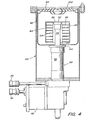
- Figure 4 is a cross section of another embodiment of the invention.
- the honeycomb of Figure 3 has been rearranged for gas entry at its base.
- Cryopump 30 contains a two stage refrigerator , 85.
- Chevrons and baffles 90 are attached through radiation shield 82 to a first stage heat sink 94 which is mounted upon the first stage 96 of the refrigerator 85.
- the chevrons 90 are positioned at inlet port 100 to form a condensation surface for higher condensing temperature gases.
- a second stage condensing panel 84 is positioned upon a second stage heat sink 92.
- the heat sink 92 is mounted upon the second stage refrigerator 98.
- Lower condensing temperature gases condense upon the outer surfaces of the second stage condensing panel 84 which is shaped like an inverted cup.
- An adsorbent array 88 is positioned within the inverted cup of the second stage cryopanel 84. Both the second stage condensing surface and the adsorbent honeycomb are maintained at a very low temperature approaching the 15° Kelvin temperature of the second stage refrigerator 98.
- Gas entering the second stage area from the inlet chevrons 90 must travel past the length of the second stage cryopanel 84 before it may enter the adsorbent array 88. In this way low condensing temperature gases are removed by the panel 84 before residual gas reaches the adsorbent array. Those gases not condensed upon the second stage, flow from below the cup 84 through annular space 102 into the interior of the second stage. Gases entering the interior of the second stage are adsorbed by the circular honeycomb surrounding the annulus 104.
- the second stage refrigerator is surrounded vertical and horizontal partitions 89, 86. These partitions 89, 86 make up the radial honeycomb 88 which is similar to those shown in Figure 1 and 3.
- the inner surface of the cup 84 forms a back wall on each of the individual honeycomb chambers.
- the inside of the cup 84 and the surfaces formed by the partitions 89 and 86 are covered with adsorbent material.
- the five-sided chambers so formed are open ended facing inward towards the annulus 104 and adsorb the gases found there.
- cup-like second stages have adsorbent material solely on the inner walls of the cub.
- the honeycomb configuration has increased the absorbent capacity of the cup-like second stages approximately three fold.
- Increased absorbent capacity is particularly useful for manufacturing processes where hydrogen is one of the byproducts.
- processes such as sputtering, a material deposit is bonded to a workpiece. Hydrogen is released by the process and becomes a serious contaminant which can prevent proper bonding of subsequent workpieces.
- the cryopump must quickly remove hydrogen from the environment to allow for continued manufacturing.
- hydrogen gas which has the lightest molecular weight of any element, is very quickly drawn through the first stage chevrons past the second stage cryopanel, and into the second stage adsorbing areas.
Landscapes
- Engineering & Computer Science (AREA)
- Mechanical Engineering (AREA)
- General Engineering & Computer Science (AREA)
- Compressors, Vaccum Pumps And Other Relevant Systems (AREA)
Applications Claiming Priority (2)
| Application Number | Priority Date | Filing Date | Title |
|---|---|---|---|
| US494758 | 1983-05-13 | ||
| US06/494,758 US4494381A (en) | 1983-05-13 | 1983-05-13 | Cryopump with improved adsorption capacity |
Publications (3)
| Publication Number | Publication Date |
|---|---|
| EP0128323A2 true EP0128323A2 (fr) | 1984-12-19 |
| EP0128323A3 EP0128323A3 (en) | 1985-01-23 |
| EP0128323B1 EP0128323B1 (fr) | 1988-01-13 |
Family
ID=23965851
Family Applications (1)
| Application Number | Title | Priority Date | Filing Date |
|---|---|---|---|
| EP84104896A Expired EP0128323B1 (fr) | 1983-05-13 | 1984-05-02 | Pompe cryostatique avec degré d'adsorption perfectionné |
Country Status (6)
| Country | Link |
|---|---|
| US (1) | US4494381A (fr) |
| EP (1) | EP0128323B1 (fr) |
| JP (1) | JPS6035190A (fr) |
| CA (1) | CA1221553A (fr) |
| DE (1) | DE3468726D1 (fr) |
| IL (1) | IL71730A (fr) |
Families Citing this family (21)
| Publication number | Priority date | Publication date | Assignee | Title |
|---|---|---|---|---|
| IT1201263B (it) * | 1985-03-26 | 1989-01-27 | Galileo Spa Off | Pompa criogenica a refrigeratore con geometria degli scherma atta a raggiungere elevata efficienza e durata prolungata |
| US4718241A (en) * | 1985-10-31 | 1988-01-12 | Helix Technology Corporation | Cryopump with quicker adsorption |
| JPS63501585A (ja) * | 1985-10-31 | 1988-06-16 | ヘリツクス テクノロジ− コ−ポレ−シヨン | 迅速吸着クライオポンプ |
| SU1682628A1 (ru) * | 1988-03-10 | 1991-10-07 | Институт Аналитического Приборостроения Научно-Технического Объединения Ан Ссср | Криоадсорбционный насос |
| JP2551204B2 (ja) * | 1990-06-14 | 1996-11-06 | ダイキン工業株式会社 | クライオポンプ |
| US5932119A (en) | 1996-01-05 | 1999-08-03 | Lazare Kaplan International, Inc. | Laser marking system |
| US6154478A (en) * | 1998-06-30 | 2000-11-28 | The Boeing Company | Chemical oxygen-iodine laser (coil)/cryosorption vacuum pump system |
| US6650681B1 (en) | 2000-04-25 | 2003-11-18 | The Boeing Company | Sealed exhaust chemical oxygen-iodine laser system |
| US6621848B1 (en) | 2000-04-25 | 2003-09-16 | The Boeing Company | SECOIL reprocessing system |
| JP4356250B2 (ja) * | 2001-02-13 | 2009-11-04 | 日本電気株式会社 | 無線受信機 |
| US7313922B2 (en) | 2004-09-24 | 2008-01-01 | Brooks Automation, Inc. | High conductance cryopump for type III gas pumping |
| JP4430042B2 (ja) * | 2006-06-07 | 2010-03-10 | 住友重機械工業株式会社 | クライオポンプおよび半導体製造装置 |
| US20090038319A1 (en) * | 2007-08-08 | 2009-02-12 | Sumitomo Heavy Industries, Ltd. | Cryopanel and Cryopump Using the Cryopanel |
| CN103348137B (zh) * | 2010-11-24 | 2016-01-20 | 布鲁克机械公司 | 具备控制氢气释出的低温泵 |
| WO2012109304A2 (fr) | 2011-02-09 | 2012-08-16 | Brooks Automation, Inc. | Cryopompe |
| JP6053588B2 (ja) | 2013-03-19 | 2016-12-27 | 住友重機械工業株式会社 | クライオポンプ、及び非凝縮性気体の真空排気方法 |
| KR102579506B1 (ko) | 2017-11-17 | 2023-09-19 | 에드워즈 배큠 엘엘시 | 주변 제 1 및 2 스테이지 어레이를 갖는 크라이오펌프 |
| EP3710699B1 (fr) | 2017-11-17 | 2022-06-22 | Edwards Vacuum LLC | Cryopompe à réseau frontal amélioré |
| US11694899B2 (en) | 2020-01-10 | 2023-07-04 | Taiwan Semiconductor Manufacturing Co., Ltd. | Interconnect structures and methods and apparatuses for forming the same |
| US20240337265A1 (en) * | 2023-04-06 | 2024-10-10 | Taiwan Semiconductor Manufacturing Company, Ltd. | Cryogenic pump for semiconductor processing |
| CN120845302B (zh) * | 2025-09-08 | 2026-06-23 | 浙江博开机电科技有限公司 | 一种高密封大口径低温真空泵 |
Family Cites Families (12)
| Publication number | Priority date | Publication date | Assignee | Title |
|---|---|---|---|---|
| US2831549A (en) * | 1954-08-31 | 1958-04-22 | Westinghouse Electric Corp | Isolation trap |
| US3130563A (en) * | 1961-08-07 | 1964-04-28 | Gen Electric | Cryogenic apparatus |
| US3309844A (en) * | 1963-11-29 | 1967-03-21 | Union Carbide Corp | Process for adsorbing gases |
| US3335550A (en) * | 1964-04-24 | 1967-08-15 | Union Carbide Corp | Cryosorption apparatus |
| US3256706A (en) * | 1965-02-23 | 1966-06-21 | Hughes Aircraft Co | Cryopump with regenerative shield |
| US3502596A (en) * | 1965-11-16 | 1970-03-24 | Du Pont | Ceramic structures |
| US3416326A (en) * | 1967-06-02 | 1968-12-17 | Stuffer Rowen | Efficient nitrogen trap |
| US3490247A (en) * | 1968-01-24 | 1970-01-20 | Perkin Elmer Corp | Sorption pump roughing system |
| FR2396879A1 (fr) * | 1977-07-05 | 1979-02-02 | Air Liquide | Cryopompe |
| DE3034934A1 (de) * | 1979-09-28 | 1982-04-22 | Varian Associates, Inc., 94303 Palo Alto, Calif. | Kryogenpumpe mit strahlungsschutzschild |
| US4295338A (en) * | 1979-10-18 | 1981-10-20 | Varian Associates, Inc. | Cryogenic pumping apparatus with replaceable pumping surface elements |
| US4356701A (en) * | 1981-05-22 | 1982-11-02 | Helix Technology Corporation | Cryopump |
-
1983
- 1983-05-13 US US06/494,758 patent/US4494381A/en not_active Expired - Fee Related
-
1984
- 1984-05-02 IL IL71730A patent/IL71730A/xx not_active IP Right Cessation
- 1984-05-02 DE DE8484104896T patent/DE3468726D1/de not_active Expired
- 1984-05-02 EP EP84104896A patent/EP0128323B1/fr not_active Expired
- 1984-05-11 CA CA000454185A patent/CA1221553A/fr not_active Expired
- 1984-05-11 JP JP59093129A patent/JPS6035190A/ja active Pending
Also Published As
| Publication number | Publication date |
|---|---|
| US4494381A (en) | 1985-01-22 |
| CA1221553A (fr) | 1987-05-12 |
| EP0128323A3 (en) | 1985-01-23 |
| IL71730A0 (en) | 1984-09-30 |
| EP0128323B1 (fr) | 1988-01-13 |
| JPS6035190A (ja) | 1985-02-22 |
| IL71730A (en) | 1988-08-31 |
| DE3468726D1 (en) | 1988-02-18 |
Similar Documents
| Publication | Publication Date | Title |
|---|---|---|
| US4494381A (en) | Cryopump with improved adsorption capacity | |
| US4555907A (en) | Cryopump with improved second stage array | |
| US9926919B2 (en) | Cryopump | |
| US4763483A (en) | Cryopump and method of starting the cryopump | |
| KR100302178B1 (ko) | 게터펌프및반도체공정장치 | |
| KR101047398B1 (ko) | 크라이오펌프 및 진공배기방법 | |
| US4356701A (en) | Cryopump | |
| US4966016A (en) | Cryopump with multiple refrigerators | |
| US4718241A (en) | Cryopump with quicker adsorption | |
| EP3710699B1 (fr) | Cryopompe à réseau frontal amélioré | |
| US6122920A (en) | High specific surface area aerogel cryoadsorber for vacuum pumping applications | |
| US5000007A (en) | Cryogenic pump operated with a two-stage refrigerator | |
| EP3710763B1 (fr) | Cryopompe dotée de réseaux périphériques de premier et second étages | |
| US5211022A (en) | Cryopump with differential pumping capability | |
| US5001903A (en) | Optimally staged cryopump | |
| US4479360A (en) | Cryopump | |
| CN111788389A (zh) | 低温泵 | |
| JPH0214554B2 (fr) | ||
| US4454722A (en) | Cryopump | |
| US4896511A (en) | Optimally staged cryopump | |
| EP0506133B1 (fr) | Cryopompe | |
| CN110291291B (zh) | 低温泵 | |
| WO1987002743A1 (fr) | Pompe cryogenique avec adsorption plus rapide | |
| JPH0658257A (ja) | 真空クライオポンプ | |
| RU2094656C1 (ru) | Адсорбционный высоковакуумный насос |
Legal Events
| Date | Code | Title | Description |
|---|---|---|---|
| PUAI | Public reference made under article 153(3) epc to a published international application that has entered the european phase |
Free format text: ORIGINAL CODE: 0009012 |
|
| PUAL | Search report despatched |
Free format text: ORIGINAL CODE: 0009013 |
|
| AK | Designated contracting states |
Designated state(s): CH DE FR GB IT LI NL |
|
| AK | Designated contracting states |
Designated state(s): CH DE FR GB IT LI NL |
|
| 17P | Request for examination filed |
Effective date: 19850523 |
|
| GRAA | (expected) grant |
Free format text: ORIGINAL CODE: 0009210 |
|
| AK | Designated contracting states |
Kind code of ref document: B1 Designated state(s): CH DE FR GB IT LI NL |
|
| ITF | It: translation for a ep patent filed | ||
| REF | Corresponds to: |
Ref document number: 3468726 Country of ref document: DE Date of ref document: 19880218 |
|
| ET | Fr: translation filed | ||
| PLBI | Opposition filed |
Free format text: ORIGINAL CODE: 0009260 |
|
| 26 | Opposition filed |
Opponent name: BALZERS AKTIENGESELLSCHAFT Effective date: 19881011 |
|
| NLR1 | Nl: opposition has been filed with the epo |
Opponent name: BALZERS AG |
|
| PLBN | Opposition rejected |
Free format text: ORIGINAL CODE: 0009273 |
|
| STAA | Information on the status of an ep patent application or granted ep patent |
Free format text: STATUS: OPPOSITION REJECTED |
|
| 27O | Opposition rejected |
Effective date: 19900316 |
|
| NLR2 | Nl: decision of opposition | ||
| ITTA | It: last paid annual fee | ||
| PGFP | Annual fee paid to national office [announced via postgrant information from national office to epo] |
Ref country code: NL Payment date: 19910531 Year of fee payment: 8 |
|
| PGFP | Annual fee paid to national office [announced via postgrant information from national office to epo] |
Ref country code: FR Payment date: 19910823 Year of fee payment: 8 |
|
| PGFP | Annual fee paid to national office [announced via postgrant information from national office to epo] |
Ref country code: DE Payment date: 19910829 Year of fee payment: 8 |
|
| PGFP | Annual fee paid to national office [announced via postgrant information from national office to epo] |
Ref country code: GB Payment date: 19910830 Year of fee payment: 8 |
|
| PGFP | Annual fee paid to national office [announced via postgrant information from national office to epo] |
Ref country code: CH Payment date: 19911107 Year of fee payment: 8 |
|
| PG25 | Lapsed in a contracting state [announced via postgrant information from national office to epo] |
Ref country code: GB Effective date: 19920502 |
|
| PG25 | Lapsed in a contracting state [announced via postgrant information from national office to epo] |
Ref country code: LI Effective date: 19920531 Ref country code: CH Effective date: 19920531 |
|
| PG25 | Lapsed in a contracting state [announced via postgrant information from national office to epo] |
Ref country code: NL Effective date: 19921201 |
|
| GBPC | Gb: european patent ceased through non-payment of renewal fee |
Effective date: 19920502 |
|
| NLV4 | Nl: lapsed or anulled due to non-payment of the annual fee | ||
| PG25 | Lapsed in a contracting state [announced via postgrant information from national office to epo] |
Ref country code: FR Effective date: 19930129 |
|
| REG | Reference to a national code |
Ref country code: CH Ref legal event code: PL |
|
| PG25 | Lapsed in a contracting state [announced via postgrant information from national office to epo] |
Ref country code: DE Effective date: 19930202 |
|
| REG | Reference to a national code |
Ref country code: FR Ref legal event code: ST |