EP0128409A1 - Procédé de fabrication d'une structure composite renforcée en matière céramique - Google Patents
Procédé de fabrication d'une structure composite renforcée en matière céramique Download PDFInfo
- Publication number
- EP0128409A1 EP0128409A1 EP84105803A EP84105803A EP0128409A1 EP 0128409 A1 EP0128409 A1 EP 0128409A1 EP 84105803 A EP84105803 A EP 84105803A EP 84105803 A EP84105803 A EP 84105803A EP 0128409 A1 EP0128409 A1 EP 0128409A1
- Authority
- EP
- European Patent Office
- Prior art keywords
- slip
- fibers
- ceramic material
- drying
- synthetic resin
- Prior art date
- Legal status (The legal status is an assumption and is not a legal conclusion. Google has not performed a legal analysis and makes no representation as to the accuracy of the status listed.)
- Granted
Links
- 238000000034 method Methods 0.000 title claims abstract description 23
- 239000002131 composite material Substances 0.000 title claims abstract description 20
- 229910010293 ceramic material Inorganic materials 0.000 title claims abstract description 16
- 238000004519 manufacturing process Methods 0.000 title claims abstract description 14
- 239000000835 fiber Substances 0.000 claims abstract description 39
- 238000001035 drying Methods 0.000 claims abstract description 19
- 238000005245 sintering Methods 0.000 claims abstract description 17
- 229920003002 synthetic resin Polymers 0.000 claims abstract description 14
- 239000000057 synthetic resin Substances 0.000 claims abstract description 14
- 239000002904 solvent Substances 0.000 claims abstract description 5
- 238000009736 wetting Methods 0.000 claims abstract description 4
- 238000010304 firing Methods 0.000 claims abstract description 3
- 239000007791 liquid phase Substances 0.000 claims abstract description 3
- 238000010438 heat treatment Methods 0.000 claims description 19
- 239000004014 plasticizer Substances 0.000 claims description 5
- 238000002360 preparation method Methods 0.000 claims description 4
- 230000008030 elimination Effects 0.000 claims description 3
- 238000003379 elimination reaction Methods 0.000 claims description 3
- 239000004744 fabric Substances 0.000 claims description 3
- 239000011230 binding agent Substances 0.000 claims description 2
- 150000001875 compounds Chemical class 0.000 claims description 2
- 238000010411 cooking Methods 0.000 claims description 2
- 239000007788 liquid Substances 0.000 claims description 2
- 238000007789 sealing Methods 0.000 claims 1
- 229920005989 resin Polymers 0.000 abstract description 2
- 239000011347 resin Substances 0.000 abstract description 2
- PNEYBMLMFCGWSK-UHFFFAOYSA-N aluminium oxide Inorganic materials [O-2].[O-2].[O-2].[Al+3].[Al+3] PNEYBMLMFCGWSK-UHFFFAOYSA-N 0.000 description 10
- XUIMIQQOPSSXEZ-UHFFFAOYSA-N Silicon Chemical compound [Si] XUIMIQQOPSSXEZ-UHFFFAOYSA-N 0.000 description 9
- HBMJWWWQQXIZIP-UHFFFAOYSA-N silicon carbide Chemical compound [Si+]#[C-] HBMJWWWQQXIZIP-UHFFFAOYSA-N 0.000 description 7
- 229910052581 Si3N4 Inorganic materials 0.000 description 6
- 229910010271 silicon carbide Inorganic materials 0.000 description 5
- HQVNEWCFYHHQES-UHFFFAOYSA-N silicon nitride Chemical compound N12[Si]34N5[Si]62N3[Si]51N64 HQVNEWCFYHHQES-UHFFFAOYSA-N 0.000 description 5
- 238000005121 nitriding Methods 0.000 description 4
- 238000000227 grinding Methods 0.000 description 3
- CPLXHLVBOLITMK-UHFFFAOYSA-N Magnesium oxide Chemical compound [Mg]=O CPLXHLVBOLITMK-UHFFFAOYSA-N 0.000 description 2
- 239000002202 Polyethylene glycol Substances 0.000 description 2
- MCMNRKCIXSYSNV-UHFFFAOYSA-N Zirconium dioxide Chemical compound O=[Zr]=O MCMNRKCIXSYSNV-UHFFFAOYSA-N 0.000 description 2
- 239000011324 bead Substances 0.000 description 2
- 239000011159 matrix material Substances 0.000 description 2
- 229910052863 mullite Inorganic materials 0.000 description 2
- 229920001223 polyethylene glycol Polymers 0.000 description 2
- 229910052573 porcelain Inorganic materials 0.000 description 2
- 239000000843 powder Substances 0.000 description 2
- 229910052710 silicon Inorganic materials 0.000 description 2
- 239000010703 silicon Substances 0.000 description 2
- 150000003377 silicon compounds Chemical class 0.000 description 2
- KKEYFWRCBNTPAC-UHFFFAOYSA-L terephthalate(2-) Chemical compound [O-]C(=O)C1=CC=C(C([O-])=O)C=C1 KKEYFWRCBNTPAC-UHFFFAOYSA-L 0.000 description 2
- 241000287107 Passer Species 0.000 description 1
- NIXOWILDQLNWCW-UHFFFAOYSA-N acrylic acid group Chemical group C(C=C)(=O)O NIXOWILDQLNWCW-UHFFFAOYSA-N 0.000 description 1
- 238000004026 adhesive bonding Methods 0.000 description 1
- HIGRAKVNKLCVCA-UHFFFAOYSA-N alumine Chemical compound C1=CC=[Al]C=C1 HIGRAKVNKLCVCA-UHFFFAOYSA-N 0.000 description 1
- 229910000323 aluminium silicate Inorganic materials 0.000 description 1
- 239000000919 ceramic Substances 0.000 description 1
- 238000007596 consolidation process Methods 0.000 description 1
- 238000005520 cutting process Methods 0.000 description 1
- 230000002950 deficient Effects 0.000 description 1
- HNPSIPDUKPIQMN-UHFFFAOYSA-N dioxosilane;oxo(oxoalumanyloxy)alumane Chemical compound O=[Si]=O.O=[Al]O[Al]=O HNPSIPDUKPIQMN-UHFFFAOYSA-N 0.000 description 1
- KZHJGOXRZJKJNY-UHFFFAOYSA-N dioxosilane;oxo(oxoalumanyloxy)alumane Chemical compound O=[Si]=O.O=[Si]=O.O=[Al]O[Al]=O.O=[Al]O[Al]=O.O=[Al]O[Al]=O KZHJGOXRZJKJNY-UHFFFAOYSA-N 0.000 description 1
- 239000006185 dispersion Substances 0.000 description 1
- 238000001704 evaporation Methods 0.000 description 1
- 230000008020 evaporation Effects 0.000 description 1
- 230000001747 exhibiting effect Effects 0.000 description 1
- 238000001093 holography Methods 0.000 description 1
- 238000005470 impregnation Methods 0.000 description 1
- 239000004816 latex Substances 0.000 description 1
- 229920000126 latex Polymers 0.000 description 1
- 239000000395 magnesium oxide Substances 0.000 description 1
- 239000000463 material Substances 0.000 description 1
- 238000002156 mixing Methods 0.000 description 1
- 238000012986 modification Methods 0.000 description 1
- 230000004048 modification Effects 0.000 description 1
- 239000012299 nitrogen atmosphere Substances 0.000 description 1
- 230000005855 radiation Effects 0.000 description 1
- 239000011226 reinforced ceramic Substances 0.000 description 1
- 239000011863 silicon-based powder Substances 0.000 description 1
- 229910052596 spinel Inorganic materials 0.000 description 1
- 239000011029 spinel Substances 0.000 description 1
- 238000005507 spraying Methods 0.000 description 1
- 210000001519 tissue Anatomy 0.000 description 1
- 238000002604 ultrasonography Methods 0.000 description 1
- XLYOFNOQVPJJNP-UHFFFAOYSA-N water Substances O XLYOFNOQVPJJNP-UHFFFAOYSA-N 0.000 description 1
- 230000004584 weight gain Effects 0.000 description 1
- 235000019786 weight gain Nutrition 0.000 description 1
Images

Classifications
-
- C—CHEMISTRY; METALLURGY
- C04—CEMENTS; CONCRETE; ARTIFICIAL STONE; CERAMICS; REFRACTORIES
- C04B—LIME, MAGNESIA; SLAG; CEMENTS; COMPOSITIONS THEREOF, e.g. MORTARS, CONCRETE OR LIKE BUILDING MATERIALS; ARTIFICIAL STONE; CERAMICS; REFRACTORIES; TREATMENT OF NATURAL STONE
- C04B35/00—Shaped ceramic products characterised by their composition; Ceramics compositions; Processing powders of inorganic compounds preparatory to the manufacturing of ceramic products
- C04B35/71—Ceramic products containing macroscopic reinforcing agents
- C04B35/78—Ceramic products containing macroscopic reinforcing agents containing non-metallic materials
- C04B35/80—Fibres, filaments, whiskers, platelets, or the like
-
- C—CHEMISTRY; METALLURGY
- C04—CEMENTS; CONCRETE; ARTIFICIAL STONE; CERAMICS; REFRACTORIES
- C04B—LIME, MAGNESIA; SLAG; CEMENTS; COMPOSITIONS THEREOF, e.g. MORTARS, CONCRETE OR LIKE BUILDING MATERIALS; ARTIFICIAL STONE; CERAMICS; REFRACTORIES; TREATMENT OF NATURAL STONE
- C04B35/00—Shaped ceramic products characterised by their composition; Ceramics compositions; Processing powders of inorganic compounds preparatory to the manufacturing of ceramic products
- C04B35/515—Shaped ceramic products characterised by their composition; Ceramics compositions; Processing powders of inorganic compounds preparatory to the manufacturing of ceramic products based on non-oxide ceramics
- C04B35/58—Shaped ceramic products characterised by their composition; Ceramics compositions; Processing powders of inorganic compounds preparatory to the manufacturing of ceramic products based on non-oxide ceramics based on borides, nitrides, i.e. nitrides, oxynitrides, carbonitrides or oxycarbonitrides or silicides
- C04B35/581—Shaped ceramic products characterised by their composition; Ceramics compositions; Processing powders of inorganic compounds preparatory to the manufacturing of ceramic products based on non-oxide ceramics based on borides, nitrides, i.e. nitrides, oxynitrides, carbonitrides or oxycarbonitrides or silicides based on aluminium nitride
Definitions
- the present invention relates to a method of manufacturing a composite structure of ceramic material reinforced with refractory fibers, in which a slip is prepared comprising a synthetic resin having good wetting properties of the ceramic material and the fibers, the fibers are made to penetrate.
- a slip is prepared comprising a synthetic resin having good wetting properties of the ceramic material and the fibers, the fibers are made to penetrate.
- the liquid phase is removed from the slip by drying, the synthetic resin is removed from the structure formed by firing, and the ceramic material loaded with the fibers is subjected to sintering.
- the patent FR-A-2 084 703 or the patent GB-A-1 335 842 corresponding to the manufacture of fiber-reinforced silicon nitride sheets has already been proposed by mixing silicon powder in a dispersion of acrylic latex. , adding fibers of silicon nitride or an aluminosilicate, drying and forming a powder which is compressed into a strip, then cooking and nitriding sintering of the latter.
- the object of the present invention is to provide a method of manufacturing a composite structure made of fiber-reinforced ceramic material, having high cohesion, a method which is simple, rapid and inexpensive in energy, and which makes it possible to obtain parts. composites of form which can be complex, without subjecting the fibers to significant mechanical stresses during the manufacture of the initial structure.
- the process of the invention is characterized in that a solvent for the synthetic resin is incorporated into the slip, and that the fibers assembled in a sheet or wick are introduced into the slip before carrying out drying.
- the structural changes of the matrix during the heat treatment (s) should not do not cause significant shrinkage, which could damage the fibers and lower the mechanical properties of the composite structure. It is also advisable that the heat treatment or treatments for forming the composite structure are carried out at a temperature lower than that where the fiber would begin to degrade.
- the slip is introduced into a 50 liter rotary mill 1 with 55 kg of alumina balls, rotating around the horizontal axis 2. After crushing for 24 hours, the crushed slip is poured through the door 3 into the container 4, d '' where a pump 5 discharges it through line 6 to the reservoir 7 for supplying a conveyor belt 8 with terephthalate polyethylene glycol, driven by rollers 9 and 10.
- the slip 11 pours out at the entrance to the conveyor belt.
- a doctor blade 12 adjusts the thickness of the slip layer 13 on the carpet.
- the slip loaded with the wires is then driven by the belt 8 in the dryer 16.
- the latter comprises a fan 17 driven by a motor 18, which expels dry air in contact with the heating resistor 19.
- the dry air and hot at 200 ° C. for example, reaches the mouths 20 in contact with the slip and ensures the evaporation of the trichloethylene.
- the sheet 21 formed is peeled off from the surface of the plate, by means of a knife 22, and is wound on the drum 23.
- the sheets obtained are cut into strips of the desired length, stacked and heated to 135 ° to 150 ° C.
- the different sheets are bonded together to form a monolithic stack.
- the mechanical properties of the parts obtained are improved by crossing the directions of the fibers of the superimposed sheets.
- the sintering of the alumina can then be carried out, for example by heating between 1200 ° and 1800 ° C. for 15 min to 1 hour.
- the nitriding of the silicon is carried out, under a nitrogen atmosphere, at 1150 ° to 1250 ° C.
- sintering takes place without withdrawal of the silicon nitride formed, the weight gain due to nitriding compensating for the sintering withdrawal.
- the procedure is as above, by immersing in the slip spread on a conveyor belt alumina fibers of FP quality sold by Dupont de Nemours, which are aligned in the direction of unwinding of the carpet. After drying, cutting the strips, stacking and gluing them, the parts obtained are subjected to sintering of alumina between 1200 ° and 1800 ° C for 15 min to 1 hour.
- the above-defined process makes it possible to control the quality of the bonding of the different bands together before the ceramic consolidation heat treatment (examination by ultrasound or by holography). It even makes it possible to repair the areas which prove to be defective, thanks to a new impregnation with the plasticizer of the resin followed by a new heat treatment at low temperature.
- the grinding of the slip can be carried out dry, and not wet. It is possible to immerse in the slip, instead of the son of refractory fibers, a fabric formed from such son, or else short elementary fibers of random direction.
- the drying of the slip layer can be carried out by other means, in particular by infrared radiation.
Landscapes
- Chemical & Material Sciences (AREA)
- Engineering & Computer Science (AREA)
- Ceramic Engineering (AREA)
- Manufacturing & Machinery (AREA)
- Materials Engineering (AREA)
- Structural Engineering (AREA)
- Organic Chemistry (AREA)
- Chemical Kinetics & Catalysis (AREA)
- Reinforced Plastic Materials (AREA)
- Laminated Bodies (AREA)
- Compositions Of Oxide Ceramics (AREA)
- Chemical Or Physical Treatment Of Fibers (AREA)
Abstract
Description
- La présente invention concerne un procédé de fabrication d'une structure composite de matière céramique renforcée de fibres réfractaires, dans lequel on prépare une barbotine comprenant une résine synthétique possédant de bonnes propriétés de mouillage de la matière céramique et des fibres, on fait pénétrer les fibres dans la barbotine, on élimine la phase liquide de la barbotine par séchage, on élimine la résine synthétique de la structure formée par une cuisson, et soumet la matière céramique chargée des fibres à un frittage.
- On a déjà proposé dans le brevet FR-A-2 084 703 ou le brevet GB-A-1 335 842 correspondant la fabrication de feuilles de nitrure de silicium renforcées par des fibres, par mélange de poudre de silicium dans une dispersion de latex acrylique, addition de fibres de nitrure de silicium ou d'un aluminosilicate, séchage et formation d'une poudre que l'on comprime en une bande, puis cuisson et frittage nitrurant de cette dernière.
- Un tel procédé ne permet pas un bon mouillage des fibres, ce qui réduit la cohésion de la structure finale. Il procure des structure difficilement collables sur elles-mêmes et nécessite la vaporisation de quantités importantes d'eau. Il est relativement long et coûteux en énergie.
- La présente invention a pour but de procurer un procédé de fabrication d'une structure composite en matière céramique renforcée par des fibres, présentant une grande cohésion, procédé qui soit simple, rapide et peu coûteux en énergie, et qui permette d'obtenir des pièces composites de forme pouvant être complexe, sans soumettre les fibres à des sollicitations mécaniques importantes lors de la fabrication de la structure initiale.
- Le procédé de l'invention est caractérisé en ce que l'on incorpore dans la barbotine un solvant de la résine synthétique, et en ce que l'on introduit dans la barbotine les fibres assemblées en une nappe ou une mèche, avant d'effectuer le séchage.
- Il répond en outre de préférence à au moins l'une des caractéristiques suivantes :
- - On incorpore également dans la barbotine un plastifiant de la résine synthétique.
- - En vue de la fabrication d'une feuille composite, on étale la barbotine sur un tapis roulant, et on introduit les fibres dans la barbotine étalée sur celui-ci, avant d'effectuer le séchage.
- - On projette des fibres relativement courtes dans la barbotine à son arrivée sur le tapis roulant.
- - On dévide et immerge dans la barbotine des fibres longues côte à côte à l'arrivée de celle-ci sur le tapis roulant.
- - On dévide et immerge dans la barbotine un tissu ou une feuille de fibres non tissées agglomérées formés avec les fibres réfractaires.
- - Après séchage on empile la feuille formée avec d'autres feuilles identiques et les solidarise par chauffage moderé, de préférence à une température inférieure à 200°C, avant d'effectuer le frittage.
- - Après séchage on soumet la feuille formée à une élimination partielle de la résine synthétique par traitement thermique, on l'imprègne d'un solvant ou d'un plastifiant, puis l'empile avec d'autres feuilles identiques identiquement traitées et les solidarise par chauffage modéré (au-dessous de 200°C), avant d'effectuer le frittage.
- - Après séchage on soumet la feuille formée à une élimination partielle ou complète de la résine synthétique par traitement thermique, on l'imprègne d'un composé liquide de la matière céramique, puis l'empile avec d'autres feuilles analogues identiquement traitées et les solidarise par chauffage, avant d'effectuer le frittage.
- - En vue de la préparation d'un câble composite, on trempe dans une barbotine de la matière céramique une mèche de fibres réfractaires, et on fait passer la mèche imprégnée de barbotine dans un ajutage de calibrage, avant d'effectuer le séchage.
- - En vue de la fabrication d'une pièce en forme à partir du câble composite, on bobine le câble séché en une pièce de forme déterminée, on solidarise les spires de la pièce par thermocollage, avant d'en éliminer le liant par cuisson, puis de la fritter.
- Pour que le procédé ci-dessus défini procure des pièces présentant de bonnes propriétés mécaniques, il convient que les transformations de structure de la matrice au cours du ou des traitements thermiques ne provoquent pas de retrait notable au frittage, qui risquerait d'endommager les fibres et d'abaisser les propriétés mécaniques de la structure composite. Il convient aussi que le ou les traitements thermiques de formation de la structure composite s'effectuent à une température inférieure à celle où la fibre commencerait à se dégrader.
- Compte tenu de ces conditions, le procédé de l'invention s'applique à de nombreux matériaux de matrice, notamment
- - au nitrure de silicium obtenu par nitruration de pièces façonnées à partir de silicium
- - au nitrure de silicium obtenu à partir d'une poudre de ce matériau, consolidée et densifiée à l'aide de composés organiques de silicium
- - au carbure de silicium densifié à l'aide de composés organiques du silicium
- - à l'alumine
- - au spinelle alumine-magnésie
- - à la zircone
- - à la magnésie
- - à la mullite.
- Il est décrit ci-après, à titre d'exemple et en référence à la figure unique du dessin annexé, des procédés de fabrication de feuilles composites selon l'invention.
-

- On introduit la barbotine dans un broyeur rotatif 1 de 50 litres avec 55 Kg de billes d'alumine, tournant autour de l'axe horizontal 2. Après broyage pendant 24h, on déverse la barbotine broyée par la porte 3 dans le récipient 4, d'où une pompe 5 la refoule par le conduit 6 vers le réservoir 7 d'alimentation d'un tapis roulant 8 en téréphtalate de polyéthylène-glycol, entraîné par les rouleaux 9 et 10.
- La barbotine 11 se déverse à l'entrée du tapis roulant. Une racle 12 règle l'épaisseur de la couche de barbotine 13 sur le tapis.
- En même temps, plusieurs bobines 14 de fil 15 de fibres de carbure de silicium de la qualité Nicalon, vendue par la société Mitsui, sont déroulées au-dessus de la barbotine. Les fils 15 s'immergent dans celle-ci.
- La barbotine chargée des fils est alors entraînée par le tapis 8 dans le séchoir 16. Celui-ci comprend un ventilateur 17 entraîné par un moteur 18, qui refoule de l'air sec au contact de la résistance de chauffage 19. L'air sec et chaud, à 200°C par exemple, parvient par les embouchures 20 au contact de la barbotine et assure l'évaporation du trichloéthylène. A la sortie du séchoir, la feuille 21 formée se décolle de la surface du plateau, grâce à un couteau 22, et vient s'enrouler sur le tambour 23.
- Les feuilles obtenues sont découpées en bandes de la longueur désirée, empilées et chauffées à 135° à 150°C. Il s'effectue un collage des différentes feuilles qui forment un empilage monolithique. On améliore les propriétés mécaniques des pièces obtenues en croisant les directions des fibres des feuilles superposées. On peut alors effectuer le frittage de l'alumine, par exemple par chauffage entre 1200° et 18000C pendant 15 mn à 1 heure.
-
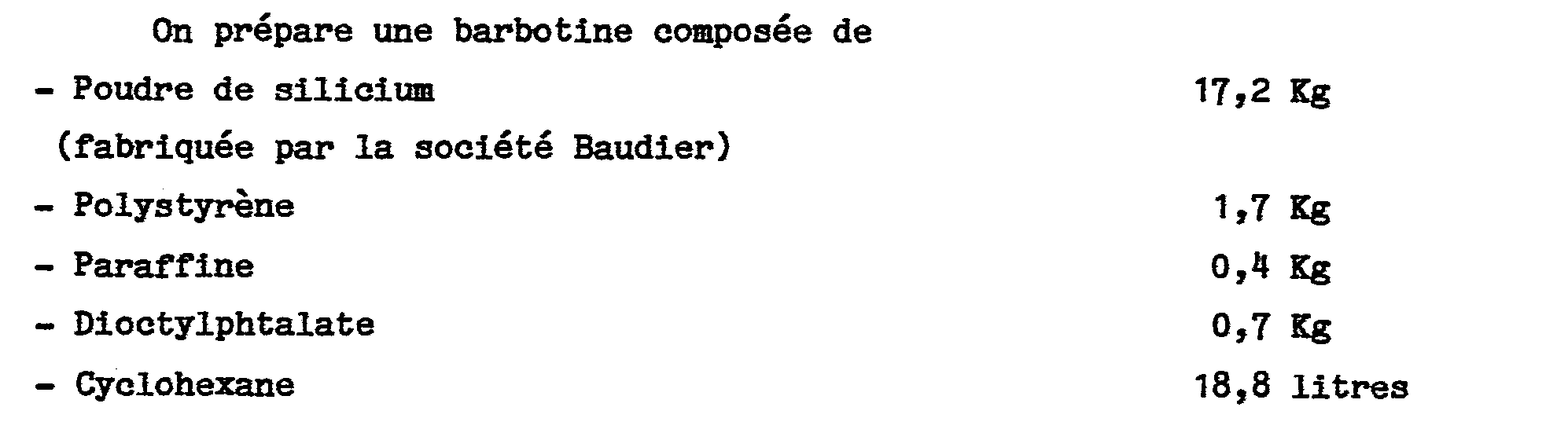
- On l'introduit dans un broyeur rotatif en porcelaine de 50 litres avec 40 Kg de billes de porcelaine. Après broyage pendant 24 heures, on fait arriver la barbotine, comme dans l'exemple précédent, sur un tapis roulant en téréphtalate de polyéthylène-glycol. On immerge dans la barbotine étendue sur le tapis des fils de carbure de silicium Nicalon.
- Après séchage de la barbotine et formage d'une pièce à partir de bandes découpées sur la feuille formée à la sortie du tapis roulant, par empilage et collage, on procédé à la nitruration du silicium, sous atmosphère d'azote, à 1150° à 1250°C. Il se produit en même temps un frittage sans retrait du nitrure de silicium formé, la prise de poids due à la nitruration compensant le retrait de frittage.
-

- On l'introduit dans un broyeur en alumine de 50 litres avec 55 Kg de billes d'alumine, et effectue son broyage pendant 24 heures.
- On opère comme précédemment, en immergeant dans la barbotine étendue sur un tapis roulant des fibres d'alumine de la qualité FP commercialisées par Dupont de Nemours, qu'on aligne dans le sens de déroulement du tapis. Après séchage, découpage de bandes, _empilage et collage de celles-ci, on soumet les pièces obtenues au frittage de l'alumine entre 1200° et 1800°C pendant 15 mn à 1 heure.
- Le procédé ci-dessus défini permet de contrôler la qualité des collages des différentes bandes entre elles avant le traitement thermique de consolidation céramique (examen par ultra-sons ou par holographie). Il permet même de réparer les zones qui se révèleraient défectueuses, grâce à une nouvelle imprégnation par le plastifiant de la résine suivie d'un nouveau traitement thermique à basse température.
- Bien que le procédé qui vient d'être décrit en référence aux exemples paraisse la forme de mise en oeuvre préférable de l'invention, on comprendra que diverses modifications peuvent lui être apportées sans sortir de son cadre général, certaines opérations pouvant être remplacées par d'autres qui joueraient le même rôle technique. En particulier, le broyage de la barbotine peut être effectué à sec, et non par voie humide. On peut immerger dans la barbotine, à la place des fils de fibres réfractaires, un tissu formé à partir de tels fils, ou bien des fibres élémentaires courtes de direction aléatoire. Le séchage de la couche de barbotine peut être effectué par d'autres moyens, notamment par rayonnement infra-rouge.
- La préparation de câbles composites, et la fabrication de pièces en forme à partir de ces câbles, s'effectuent de manière analogue. On peut aussi utiliser les câbles composites formés comme éléments constitutifs d'une structure tridimensionnelle, en perçant en cru des feuilles composites telles que précédemment décrites, en les empilant, puis en mettant en place les câbles dans les canaux constitués par la superposition des trous. On peut alors solidariser l'ensemble des feuilles et des câbles par chauffage à 135° à 150°C, puis effectuer le frittage de la pièce définitive.
Claims (12)
Applications Claiming Priority (2)
| Application Number | Priority Date | Filing Date | Title |
|---|---|---|---|
| FR8308573A FR2546441B1 (fr) | 1983-05-25 | 1983-05-25 | Procede de fabrication d'une structure composite renforcee en matiere ceramique |
| FR8308573 | 1983-05-25 |
Publications (2)
| Publication Number | Publication Date |
|---|---|
| EP0128409A1 true EP0128409A1 (fr) | 1984-12-19 |
| EP0128409B1 EP0128409B1 (fr) | 1987-01-28 |
Family
ID=9289140
Family Applications (1)
| Application Number | Title | Priority Date | Filing Date |
|---|---|---|---|
| EP84105803A Expired EP0128409B1 (fr) | 1983-05-25 | 1984-05-22 | Procédé de fabrication d'une structure composite renforcée en matière céramique |
Country Status (5)
| Country | Link |
|---|---|
| US (1) | US4696710A (fr) |
| EP (1) | EP0128409B1 (fr) |
| JP (1) | JPS6046065B2 (fr) |
| DE (1) | DE3462245D1 (fr) |
| FR (1) | FR2546441B1 (fr) |
Cited By (7)
| Publication number | Priority date | Publication date | Assignee | Title |
|---|---|---|---|---|
| US4585500A (en) * | 1983-12-01 | 1986-04-29 | Ceraver | Method of manufacturing a reinforced composite structure of ceramic material |
| GB2176469A (en) * | 1985-06-17 | 1986-12-31 | Mitsubishi Chem Ind | Alumina fiber structure and process for its production |
| EP0188270A3 (en) * | 1985-01-17 | 1987-02-04 | Norton Company | Fibre-reinforced ceramic and process therefor |
| EP0240177A3 (en) * | 1986-03-17 | 1988-06-08 | Sumitomo Electric Industries Limited | Ceramic compact, in particular based on silicon nitride and ceramic fibres and process for its production |
| EP0331460A1 (fr) * | 1988-03-02 | 1989-09-06 | Honda Giken Kogyo Kabushiki Kaisha | Corps céramique non fritté renforçé par des fibres |
| EP0404631A1 (fr) * | 1989-06-21 | 1990-12-27 | AEROSPATIALE Société Nationale Industrielle | Matériaux composites à matrice vitreuse renforcée et leur procédé de préparation |
| FR2700765A1 (fr) * | 1993-01-28 | 1994-07-29 | Aerospatiale | Semi-produit en bande pour la fabrication de matériaux composites à matrice céramique renforcée par des fibres, procédé et dispositif pour sa fabrication, et ses applications. |
Families Citing this family (8)
| Publication number | Priority date | Publication date | Assignee | Title |
|---|---|---|---|---|
| JPS62187179A (ja) * | 1986-02-10 | 1987-08-15 | 株式会社新潟鐵工所 | セラミツク成形品の製造方法 |
| JP2563392B2 (ja) * | 1986-11-21 | 1996-12-11 | 株式会社東芝 | 窒化ケイ素系セラミックスおよびその製造方法 |
| US4828774A (en) * | 1987-02-05 | 1989-05-09 | The United States Of America As Represented By The Secretary Of The Air Force | Porous ceramic bodies |
| US5024978A (en) * | 1989-05-30 | 1991-06-18 | Corning Incorporated | Compositions and methods for making ceramic matrix composites |
| US5078818A (en) * | 1990-04-18 | 1992-01-07 | Hexcel Corporation | Method for producing a fiber-reinforced ceramic honeycomb panel |
| US5217533A (en) * | 1991-07-08 | 1993-06-08 | The United States Of America As Represented By The Secretary Of The Air Force | Coating apparatus for continuous fibers |
| US5164229A (en) * | 1991-07-08 | 1992-11-17 | The United States Of America As Represented By The Secretary Of The Air Force | Method for coating continuous tow |
| US5851326A (en) * | 1995-10-25 | 1998-12-22 | Hexcel Corpation | Method for making ceramic honeycomb |
Citations (8)
| Publication number | Priority date | Publication date | Assignee | Title |
|---|---|---|---|---|
| FR1184641A (fr) * | 1956-07-31 | 1959-07-23 | Rex Asbestwerke | Procédé pour la transformation de fibres séparées, notamment de fibres d'amiante, en produits cohérents |
| FR2084703A5 (en) * | 1970-03-17 | 1971-12-17 | Lucas Industries Ltd | Silicon nitride articles |
| US3819439A (en) * | 1971-05-17 | 1974-06-25 | Hexcel Corp | Method of making honeycomb of sinterable material employing stepwise coating of a resin-containing composition |
| FR2299951A1 (fr) * | 1975-02-03 | 1976-09-03 | Gail Tonwerke Wilhelm | Procede et dispositif pour fabriquer des placages ceramiques |
| US4017347A (en) * | 1974-03-27 | 1977-04-12 | Gte Sylvania Incorporated | Method for producing ceramic cellular structure having high cell density |
| EP0032097A1 (fr) * | 1980-01-02 | 1981-07-15 | SOCIETE EUROPEENNE DE PROPULSION (S.E.P.) Société Anonyme dite: | Procédé de fabrication d'une structure en carbure de silicium |
| FR2488880A1 (fr) * | 1979-02-28 | 1982-02-26 | Asahi Glass Co Ltd | Procede pour preparer une ceramique ou un metal moule |
| US4366202A (en) * | 1981-06-19 | 1982-12-28 | Kimberly-Clark Corporation | Ceramic/organic web |
Family Cites Families (3)
| Publication number | Priority date | Publication date | Assignee | Title |
|---|---|---|---|---|
| SU559636A3 (ru) * | 1970-03-17 | 1977-05-25 | Джозеф Лукас /Индастриз/ Лимитед (Фирма) | Способ получени изделий из нитрида кремни |
| US3899554A (en) * | 1973-12-14 | 1975-08-12 | Ibm | Process for forming a ceramic substrate |
| US4207371A (en) * | 1976-09-02 | 1980-06-10 | Wilhelm Gail'sche Tonwerke Kgaa | Ceramic veneer |
-
1983
- 1983-05-25 FR FR8308573A patent/FR2546441B1/fr not_active Expired
-
1984
- 1984-05-22 EP EP84105803A patent/EP0128409B1/fr not_active Expired
- 1984-05-22 DE DE8484105803T patent/DE3462245D1/de not_active Expired
- 1984-05-24 JP JP59105641A patent/JPS6046065B2/ja not_active Expired
-
1986
- 1986-11-20 US US06/933,275 patent/US4696710A/en not_active Expired - Lifetime
Patent Citations (8)
| Publication number | Priority date | Publication date | Assignee | Title |
|---|---|---|---|---|
| FR1184641A (fr) * | 1956-07-31 | 1959-07-23 | Rex Asbestwerke | Procédé pour la transformation de fibres séparées, notamment de fibres d'amiante, en produits cohérents |
| FR2084703A5 (en) * | 1970-03-17 | 1971-12-17 | Lucas Industries Ltd | Silicon nitride articles |
| US3819439A (en) * | 1971-05-17 | 1974-06-25 | Hexcel Corp | Method of making honeycomb of sinterable material employing stepwise coating of a resin-containing composition |
| US4017347A (en) * | 1974-03-27 | 1977-04-12 | Gte Sylvania Incorporated | Method for producing ceramic cellular structure having high cell density |
| FR2299951A1 (fr) * | 1975-02-03 | 1976-09-03 | Gail Tonwerke Wilhelm | Procede et dispositif pour fabriquer des placages ceramiques |
| FR2488880A1 (fr) * | 1979-02-28 | 1982-02-26 | Asahi Glass Co Ltd | Procede pour preparer une ceramique ou un metal moule |
| EP0032097A1 (fr) * | 1980-01-02 | 1981-07-15 | SOCIETE EUROPEENNE DE PROPULSION (S.E.P.) Société Anonyme dite: | Procédé de fabrication d'une structure en carbure de silicium |
| US4366202A (en) * | 1981-06-19 | 1982-12-28 | Kimberly-Clark Corporation | Ceramic/organic web |
Cited By (15)
| Publication number | Priority date | Publication date | Assignee | Title |
|---|---|---|---|---|
| US4585500A (en) * | 1983-12-01 | 1986-04-29 | Ceraver | Method of manufacturing a reinforced composite structure of ceramic material |
| EP0188270A3 (en) * | 1985-01-17 | 1987-02-04 | Norton Company | Fibre-reinforced ceramic and process therefor |
| US4931239A (en) * | 1985-06-17 | 1990-06-05 | Mitsubishi Kasei Corporation | Alumina fiber structure and process for its production |
| GB2176469A (en) * | 1985-06-17 | 1986-12-31 | Mitsubishi Chem Ind | Alumina fiber structure and process for its production |
| GB2176469B (en) * | 1985-06-17 | 1989-07-12 | Mitsubishi Chem Ind | Alumina fiber structure and process for its production |
| EP0240177A3 (en) * | 1986-03-17 | 1988-06-08 | Sumitomo Electric Industries Limited | Ceramic compact, in particular based on silicon nitride and ceramic fibres and process for its production |
| US4994418A (en) * | 1986-03-17 | 1991-02-19 | Sumitomo Electric Industries, Ltd. | Ceramic compact and a process for the production of the same |
| EP0494706B1 (fr) * | 1986-03-17 | 1995-06-28 | Sumitomo Electric Industries Limited | Procédé pour la fabrication d'un corps céramique renforcé par des fibres ou par des whiskers |
| EP0331460A1 (fr) * | 1988-03-02 | 1989-09-06 | Honda Giken Kogyo Kabushiki Kaisha | Corps céramique non fritté renforçé par des fibres |
| US5077242A (en) * | 1988-03-02 | 1991-12-31 | Honda Giken Kogyo Kabushiki Kaisha | Fiber-reinforced ceramic green body and method of producing same |
| EP0404631A1 (fr) * | 1989-06-21 | 1990-12-27 | AEROSPATIALE Société Nationale Industrielle | Matériaux composites à matrice vitreuse renforcée et leur procédé de préparation |
| FR2648805A1 (fr) * | 1989-06-21 | 1990-12-28 | Ceramiques Composites | Materiaux composites a matrice vitreuse renforcee et leur procede de preparation |
| US5221645A (en) * | 1989-06-21 | 1993-06-22 | Ceramiques Et Composites | Composite shaped articles comprising reinforced vitreous matrices |
| FR2700765A1 (fr) * | 1993-01-28 | 1994-07-29 | Aerospatiale | Semi-produit en bande pour la fabrication de matériaux composites à matrice céramique renforcée par des fibres, procédé et dispositif pour sa fabrication, et ses applications. |
| EP0612597A1 (fr) * | 1993-01-28 | 1994-08-31 | AEROSPATIALE Société Nationale Industrielle | Procédé et dispositif pour la fabrication d'un semi-produit en bande utilisable dans la fabrication de matériaux ou produits composites à matrice céramique renforcée par des fibres |
Also Published As
| Publication number | Publication date |
|---|---|
| JPS6046065B2 (ja) | 1985-10-14 |
| FR2546441A1 (fr) | 1984-11-30 |
| FR2546441B1 (fr) | 1987-05-15 |
| JPS605082A (ja) | 1985-01-11 |
| DE3462245D1 (en) | 1987-03-05 |
| US4696710A (en) | 1987-09-29 |
| EP0128409B1 (fr) | 1987-01-28 |
Similar Documents
| Publication | Publication Date | Title |
|---|---|---|
| EP0128409B1 (fr) | Procédé de fabrication d'une structure composite renforcée en matière céramique | |
| EP0147651B1 (fr) | Procédé de fabrication d'une structure composite renforcée en matière céramique | |
| FR2527517A1 (fr) | Procede de fabrication d'articles de forme complexe a structure composite de matrice de verre renforcee de fibres | |
| BE1000612A4 (fr) | Procede de fabrication d'un segment de frein pour frein a disque et segment de frein ainsi obtenu. | |
| EP0886627B1 (fr) | Procede de fabrication de pieces, notamment de disques de freins, en materiau composite carbone-carbone | |
| EP0557140B1 (fr) | Procédé de dépose au contact à chaud de matériau composite fibré à matrice vitreuse et dispositif pour la mise en ouevre du procédé | |
| EP0158156B1 (fr) | Matelas fibreux moulable et son procédé de fabrication | |
| US4410635A (en) | Discontinuous silicon carbide fiber reinforced ceramic composites | |
| CA3051884A1 (fr) | Procede de fabrication d'une piece en materiau composite | |
| FR2527594A1 (fr) | Procede de fabrication d'articles a structure composite a matrice de verre renforcee de fibres tissees | |
| US20170328429A1 (en) | Method for making brake discs in material reinforced with fibres and brake disc made with such method | |
| FR2638390A1 (fr) | Structures textiles ayant une aptitude amelioree a la mise en oeuvre comme renforts pour materiaux composites et leur obtention | |
| EP1054091B1 (fr) | Nappe unidirectionnelle de fibres de carbone | |
| KR20010042386A (ko) | 열충격 저항성 세라믹 제품 | |
| BE897526A (fr) | Plaque de construction, dispositif et procèdè pour sa formation. | |
| EP0555134B1 (fr) | Procédé d'élaboration de préformes fibreuses pour la fabrication de pièces en matériau composite et produits obtenus par le procédé | |
| EP0371847B1 (fr) | Matériau composite à base de fibres minérales, dispositif d'obtention et application du matériau composite | |
| FR2531662A1 (fr) | Plaque de construction, dispositif et procede pour sa formation | |
| FR2529918A1 (fr) | Procede pour la fabrication de non-tisses aiguilletes en fibres minerales, en particulier refractaires, et non-tisses realises selon ce procede | |
| KR980700907A (ko) | 복합재 제조용 예비제형 및 이것의 제조방법(Preforms for Composite Material Manufacture and Methods of Making) | |
| EP0047701B1 (fr) | Procédé de fabrication d'un matériau de protection thermique, notamment pour éléments d'engin et matériau ainsi obtenu | |
| EP0424216A1 (fr) | Matériau composite, son procédé de réalisation et utilisation dudit matériau | |
| EP1144745B1 (fr) | Procede de fabrication d'un mat et produits obtenus | |
| FR2819804A1 (fr) | Procede de fabrication d'une piece en carbone/carbone | |
| KR19980025816A (ko) | 콤비네이션매트의 제조방법 |
Legal Events
| Date | Code | Title | Description |
|---|---|---|---|
| PUAI | Public reference made under article 153(3) epc to a published international application that has entered the european phase |
Free format text: ORIGINAL CODE: 0009012 |
|
| AK | Designated contracting states |
Designated state(s): BE CH DE FR GB IT LI NL SE |
|
| 17P | Request for examination filed |
Effective date: 19850611 |
|
| 17Q | First examination report despatched |
Effective date: 19860325 |
|
| ITF | It: translation for a ep patent filed | ||
| GRAA | (expected) grant |
Free format text: ORIGINAL CODE: 0009210 |
|
| RAP1 | Party data changed (applicant data changed or rights of an application transferred) |
Owner name: CERAMIQUES ET COMPOSITES |
|
| AK | Designated contracting states |
Kind code of ref document: B1 Designated state(s): BE CH DE FR GB IT LI NL SE |
|
| REF | Corresponds to: |
Ref document number: 3462245 Country of ref document: DE Date of ref document: 19870305 |
|
| PLBE | No opposition filed within time limit |
Free format text: ORIGINAL CODE: 0009261 |
|
| STAA | Information on the status of an ep patent application or granted ep patent |
Free format text: STATUS: NO OPPOSITION FILED WITHIN TIME LIMIT |
|
| 26N | No opposition filed | ||
| ITTA | It: last paid annual fee | ||
| REG | Reference to a national code |
Ref country code: FR Ref legal event code: TP |
|
| EAL | Se: european patent in force in sweden |
Ref document number: 84105803.5 |
|
| PGFP | Annual fee paid to national office [announced via postgrant information from national office to epo] |
Ref country code: SE Payment date: 19990506 Year of fee payment: 16 |
|
| PGFP | Annual fee paid to national office [announced via postgrant information from national office to epo] |
Ref country code: GB Payment date: 19990519 Year of fee payment: 16 |
|
| PGFP | Annual fee paid to national office [announced via postgrant information from national office to epo] |
Ref country code: CH Payment date: 19990528 Year of fee payment: 16 |
|
| PGFP | Annual fee paid to national office [announced via postgrant information from national office to epo] |
Ref country code: NL Payment date: 19990531 Year of fee payment: 16 Ref country code: FR Payment date: 19990531 Year of fee payment: 16 |
|
| PGFP | Annual fee paid to national office [announced via postgrant information from national office to epo] |
Ref country code: BE Payment date: 19990603 Year of fee payment: 16 |
|
| PGFP | Annual fee paid to national office [announced via postgrant information from national office to epo] |
Ref country code: DE Payment date: 19990616 Year of fee payment: 16 |
|
| PG25 | Lapsed in a contracting state [announced via postgrant information from national office to epo] |
Ref country code: GB Free format text: LAPSE BECAUSE OF NON-PAYMENT OF DUE FEES Effective date: 20000522 |
|
| PG25 | Lapsed in a contracting state [announced via postgrant information from national office to epo] |
Ref country code: SE Free format text: LAPSE BECAUSE OF NON-PAYMENT OF DUE FEES Effective date: 20000523 |
|
| PG25 | Lapsed in a contracting state [announced via postgrant information from national office to epo] |
Ref country code: LI Free format text: LAPSE BECAUSE OF NON-PAYMENT OF DUE FEES Effective date: 20000531 Ref country code: CH Free format text: LAPSE BECAUSE OF NON-PAYMENT OF DUE FEES Effective date: 20000531 Ref country code: BE Free format text: LAPSE BECAUSE OF NON-PAYMENT OF DUE FEES Effective date: 20000531 |
|
| BERE | Be: lapsed |
Owner name: CERAMIQUES ET COMPOSITES Effective date: 20000531 |
|
| PG25 | Lapsed in a contracting state [announced via postgrant information from national office to epo] |
Ref country code: NL Free format text: LAPSE BECAUSE OF NON-PAYMENT OF DUE FEES Effective date: 20001201 |
|
| GBPC | Gb: european patent ceased through non-payment of renewal fee |
Effective date: 20000522 |
|
| REG | Reference to a national code |
Ref country code: CH Ref legal event code: PL |
|
| EUG | Se: european patent has lapsed |
Ref document number: 84105803.5 |
|
| PG25 | Lapsed in a contracting state [announced via postgrant information from national office to epo] |
Ref country code: FR Free format text: LAPSE BECAUSE OF NON-PAYMENT OF DUE FEES Effective date: 20010131 |
|
| NLV4 | Nl: lapsed or anulled due to non-payment of the annual fee |
Effective date: 20001201 |
|
| PG25 | Lapsed in a contracting state [announced via postgrant information from national office to epo] |
Ref country code: DE Free format text: LAPSE BECAUSE OF NON-PAYMENT OF DUE FEES Effective date: 20010301 |
|
| REG | Reference to a national code |
Ref country code: FR Ref legal event code: ST |