EP0128548A2 - Impulsgenerator - Google Patents
Impulsgenerator Download PDFInfo
- Publication number
- EP0128548A2 EP0128548A2 EP84106556A EP84106556A EP0128548A2 EP 0128548 A2 EP0128548 A2 EP 0128548A2 EP 84106556 A EP84106556 A EP 84106556A EP 84106556 A EP84106556 A EP 84106556A EP 0128548 A2 EP0128548 A2 EP 0128548A2
- Authority
- EP
- European Patent Office
- Prior art keywords
- rotor
- teeth
- generator according
- contact
- impulse
- Prior art date
- Legal status (The legal status is an assumption and is not a legal conclusion. Google has not performed a legal analysis and makes no representation as to the accuracy of the status listed.)
- Ceased
Links
Images
Classifications
-
- H—ELECTRICITY
- H01—ELECTRIC ELEMENTS
- H01H—ELECTRIC SWITCHES; RELAYS; SELECTORS; EMERGENCY PROTECTIVE DEVICES
- H01H19/00—Switches operated by an operating part which is rotatable about a longitudinal axis thereof and which is acted upon directly by a solid body external to the switch, e.g. by a hand
- H01H19/02—Details
- H01H19/10—Movable parts; Contacts mounted thereon
- H01H19/11—Movable parts; Contacts mounted thereon with indexing means
-
- H—ELECTRICITY
- H01—ELECTRIC ELEMENTS
- H01H—ELECTRIC SWITCHES; RELAYS; SELECTORS; EMERGENCY PROTECTIVE DEVICES
- H01H19/00—Switches operated by an operating part which is rotatable about a longitudinal axis thereof and which is acted upon directly by a solid body external to the switch, e.g. by a hand
- H01H19/005—Electromechanical pulse generators
-
- H—ELECTRICITY
- H01—ELECTRIC ELEMENTS
- H01H—ELECTRIC SWITCHES; RELAYS; SELECTORS; EMERGENCY PROTECTIVE DEVICES
- H01H3/00—Mechanisms for operating contacts
- H01H3/32—Driving mechanisms, i.e. for transmitting driving force to the contacts
- H01H3/40—Driving mechanisms, i.e. for transmitting driving force to the contacts using friction, toothed, or screw-and-nut gearing
Definitions
- the present invention relates to an impulse generator according to the preamble of claim 1.
- Such a pulse generator designed as a digital angle measuring device is known from DE-GM 80 05 990. There, contact springs are arranged on a concentric circle. No information is given on the configuration of the conductive grid. It is also an inductive angle measuring device.
- An electromechanical pulse generator is known from DE-OS 31 36 598.
- a middle contact spring is deflected by a toothed washer and the contact thereof is pressed against a counter contact of a second contact spring. Due to the relatively low pressing speed, especially when individual impulses are emitted, a one-time contact, i.e. a single impulse, is often difficult to achieve.
- the object of the present invention is to achieve an electromechanical pulse generator in such a way that it is simple to manufacture and suitable for rough operation, and enables flawless contact-free operation.
- a cup-shaped housing part with an integrally formed or attached bearing bush 2.
- a drive axle 3 is rotatable and immovably supported by a locking washer 4.
- the drive axle 3 is provided with a drive pinion 5 and an inwardly projecting bearing pin 6.
- a rotor 7 is mounted on the journal 6 and rotatably mounted.
- the side of the rotor 7 pointing to the drive pinion L 5 is provided with a pinion line 8 or rigidly coupled thereto.
- Drive sprockets L 5 and RitzeL 8 are operatively connected via a rigidly coupled, in particular one-piece gear pair 9, 10 formed from two spur gear wheels.
- the pair of gearwheels 9, 10 is rotatably mounted on a bearing shaft 11 which is integrally formed on or attached to the housing part 1.
- the spur gear 9 is smaller than the drive pinion 5 and the spur gear 10 is larger than the pinion 8.
- the housing part 1 is expediently rectangular or square and the bearing axis 11 is provided in the direction of a corner 12.
- the surface 13 of the rotor 7 is provided with a conductive layer 14, which has a coherent grinding ring running concentrically to the drive axis 3 with rectangular or trapezoidal teeth 16 projecting inwards on a likewise concentric circular path K 1 and projecting laterally outwards on one outer circular path K 2 arranged rectangular or trapezoidal teeth 17 forms.
- the conductive layer 14 can be applied directly to the rotor 7 or, as in the exemplary embodiment, can be provided on a special, thin insulating disk 18, for example in the manner of the printed circuit.
- This insulating disk 18 lies in a flat depression 19 of the surface 13 of the rotor 7.
- the insulating disk 18 is secured against rotation by a recess 20 in the insulating disk 18 and a lug 21 which engages laterally in the recess 19 on the rotor 7.
- the number of inner teeth 16 and their angular pitch ⁇ is equal to that of the outer teeth 17 and that of the locking cams 23 provided on the rotor 7, in particular on its end face 22 and in particular perpendicular to this elastically deflectable locking fingers 24 together.
- the locking fingers 24 are in the diametrically opposite corners 25 and 26 are arranged so that the forces acting on the drive shaft 3 and the rotor 7 cancel each other out.
- Contact springs 28, 29, 30 pressing or pressing on the surface 13 of the rotor 7 are molded or inserted into a lower housing wall 27, the contact spring 28 being assigned to the outer teeth 17, the contact spring 29 to the slip ring 15 and the contact spring 30 to the inner teeth 16 is.
- the contact springs 28, 29, 30 carrying fixed contacts are expediently arranged approximately perpendicular to the diameter of the rotor 7 and their contact points 31, 32, 33 preferably lie at least approximately on a straight line, in particular on or near the diameter D.
- the contact point 32 acts as a grinding Fixed contact and each contact point 31 and 33 as ImpuLs fixed contact.
- the contact points 31 and 33 or the latching cams 23 are arranged such that when the or a latching finger (s) 24 is latched, the contact points 31 and 33 do not contact a tooth 17 or 16 between two latching cams 23.
- the teeth 16 or their tooth flanks on one side are phase-shifted relative to the teeth 17 or their tooth flanks on the same side by an angle between> 0 ° and ⁇ 180 °, so that when rotating from the phase shift in a manner known per se, the direction of rotation of the rotor 7 can be derived.
- Adjustment of the offset of the teeth 16, 17 or their tooth flanks against one another can also the contact springs 28 and 30 are arranged so that the contact points 31 and 33 cause this phase shift, or both the teeth 16, 17 or their tooth flanks and the contact points 31, 33 can be phase-shifted with respect to one another such that the pulses generated by 0 0 and ⁇ 180 0 are offset.
- the offset of the impulse flanks can also be brought about by using a different tooth width of the teeth 16 compared to that of the teeth 17. It is essential that in one direction of rotation of the rotor 7 a tooth 16 or 17 is contacted earlier than the other tooth 17 or 16.
- the cup-shaped housing part 1 can be closed by a further housing part 34, which can also be cup-shaped, and both can e.g. be locked together in the closed state by a locking element 35 on the housing part 1 and / or 34.
- the housing rear part 27 carrying the contact springs 28, 29, 30 can be designed as a strip and can be inserted between the two housing parts 1 and 34. This facilitates the adjustment of the contact springs 28, 29, 30 or the generation of the pretensioning thereof.
Landscapes
- Connection Of Motors, Electrical Generators, Mechanical Devices, And The Like (AREA)
- Transmission And Conversion Of Sensor Element Output (AREA)
- Rotary Switch, Piano Key Switch, And Lever Switch (AREA)
Abstract
Description
- Die vorLiegende-Erfindung bezieht sich auf einen ImpuLsgenerator gemäß dem Oberbegriff des Anspruchs 1.
- Ein derartiger, als digitale Winkelmeßeinrichtung ausgebildeter ImpuLsgenerator ist bekannt aus dem DE-GM 80 05 990. Dort sind Kontaktfedern auf einem konzentrischen Kreis angeordnet. über die Konfiguration der Leitfähigen Raster sind keinerlei Angaben gemacht. Auch handelt es sich dort um eine induktive Winkelmeßeinrichtung.
- Ein elektromechanischer ImpuLsgenerator ist aus der DE-OS 31 36 598 bekannt. Dort wird eine mittlere Kontaktfeder durch eine Zahnscheibe ausgelenkt und der Kontakt derselben gegen einen Gegenkontakt einer zweiten Kontaktfeder gedrückt. InfoLge der relativ geringen Andrückgeschwindigkeit insbesondere bei Abgabe vereinzelter Impulse ist eine einmalige Kontaktgabe, also ein EinzeLimpuls, oft schwer realisierbar.
- Mit der vorliegenden Erfindung soll die Aufgabe gelöst werden, einen elektromechanischen ImpuLsgenerator so auszugestalten, daß er einfach in der HersteLLung und für rauhen Betrieb geeignet ist und eine einwandfreie, preLLfreie Kontaktgabe ermöglicht.
- GeLöst wird diese Aufgabe durch die im Kennzeichen des Anspruchs 1 angegebenen MerkmaLe.
- Weitere vorteilhafte EinzeLheiten der Erfindung sind in den Unteransprüchen angegeben und nachfolgend anhand eines in der Zeichnung veranschaulichten AusführungsbeispieLes beschrieben. Dabei zeigen:
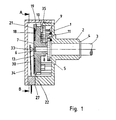
- Fig. 1 einen erfindungsgemäßen ImpuLsgenerator von der Seite im Schnitt und
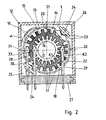
- Fig. 2 eine Ansicht gemäß dem Schnitt A-B der Fig. 1.
- Mit 1 ist ein topfförmiges Gehäuseteil mit einer angeformten oder daran befestigten Lagerbuchse 2 bezeichnet. In Letzterer ist eine Antriebsachse 3 drehbar und durch eine Sicherungsscheibe 4 unverschiebbar gelagert. Im GehäuseteiL 1 ist die Antriebsachse 3 mit einem Antriebsritzel 5 und einem nach innen ragenden Lagerzapfen 6 versehen.
- Auf dem Lagerzapfen 6 ist ein Rotor 7 aufgesteckt und drehbar gelagert. Die zum AntriebsritzeL 5 zeigende Seite des Rotors 7 ist mit einem RitzeL 8 versehen oder mit diesem starr gekuppelt. AntriebsritzeL 5 und RitzeL 8 stehen über ein starr gekoppeltes, insbesondere einstückiges, aus zwei Sfirnzahnrädern gebildetes Zahnradpaar 9, 10 in Wirkverbindung. Das Zahnradpaar 9, 10 ist auf einer am GehäuseteiL 1 angeformten oder an diesem befestigten Lagerachse 11 drehbar gelagert. Das Stirnzahnrad 9 ist kleiner als das Antriebsritzel 5 und das Stirnzahnrad 10 ist größer als das Ritzel 8. Zweckmäßig ist das Gehäuseteil 1 rechteckig oder quadratisch und die Lagerachse 11 ist in Richtung einer Ecke 12 vorgesehen.
- Die Oberfläche 13 des Rotors 7 ist mit einer Leitschicht 14 versehen, die einen zusammenhängenden, konzentrisch zur Antriebsachse 3 verlaufenden SchLeifring mit seitLich nach innen ragenden, auf einer ebenfalls konzentrischen Kreisbahn K1 angeordneten rechteckigen oder trapezförmigen Zähnen 16 und seitlich nach außen ragenden, auf einer äußeren Kreisbahn K2 angeordneten rechteckigen oder trapezförmigen Zähnen 17 bildet.
- Die Leitschicht 14 kann unmittelbar auf dem Rotor 7 aufgebracht oder wie beim Ausführungsbeispiel auf einer besonderen, dünnen IsoLierstoffscheibe 18 beispielsweise nach Art der gedruckten SchaLtung vorgesehen sein. Diese Isolierstoffscheibe 18 Liegt in einer flachen Vertiefung 19 der Oberfläche 13 des Rotors 7. Durch eine Aussparung 20 in der IsoLierstoffscheibe 18 und eine in die Vertiefung 19 seitlich eingreifende Nase 21 am Rotor 7 ist die IsoLierstoffscheibe 18 gegen Verdrehen gesichert.
- Die AnzahL der inneren Zähne 16 und deren Winkelteilung α ist gleich derjenigen der äußeren Zähne 17 und gleich derjenigen von am Rotor 7, insbesondere an dessen Stirnfläche 22, vorgesehenen Rastnocken 23. Letztere wirken mit vorzugsweise am GehäuseteiL 1 angeformten zweckmäßig in Richtung der Antriebsachse 3 verlaufenden und insbesondere senkrecht zu dieser elastisch auslenkbaren Rastfingern 24 zusammen. Die Rastfinger 24 sind in den diametral gegenüberliegenden Ecken 25 und 26 angeordnet, so daß sich die auf die Antriebsachse 3 und den Rotor 7 wirkenden Kräfte aufheben.
- In einem unteren GehäusewandteiC 27 sind unter Vorspannung auf die Oberfläche 13 des Rotors 7 drückende Kontaktfedern 28, 29, 30 eingeformt oder eingesteckt, wobei die Kontaktfeder 28 den äußeren Zähnen 17, die Kontaktfeder 29 dem SchLeifring 15 und die Kontaktfeder 30 den inneren Zähnen 16 zugeordnet ist. Zweckmäßig sind die Festkontakte tragenden Kontaktfedern 28, 29, 30 etwa senkrecht zum Durchmesser des Rotors 7 angeordnet und deren Kontaktpunkte 31, 32, 33 Liegen vorzugsweise wenigstens annähernd auf einer Geraden, insbesondere auf oder nahe dem Durchmesser D. Der Kontaktpunkt 32 wirkt aLs SchLeif-Festkontakt und jeder Kontaktpunkt 31 und 33 aLs ImpuLs-Festkontakt.
- Die Kontaktpunkte 31 und 33 bzw. die Rastnocken 23 sind so angeordnet, daß bei Rastung der bzw. eines Rastfinger(s) 24 zwischen zwei Rastnocken 23 die Kontaktpunkte 31 und 33 keinen Zahn 17 bzw. 16 kontaktieren.
- Die Zähne 16 bzw. deren ZahnfLanken einer Seite sind gegenüber den Zähnen 17 bzw. deren ZahnfLanken der gLeichen Seite um einen WinkeL zwischen > 0° und < 180° phasenverschoben, son daß bei Drehung aus der Phasenverschiebung in an sich bekannter Weise die Drehrichtung des Rotors 7 abgeLeitet werden kann. AnsteLLe des Versatzes der Zähne 16, 17 bzw. deren ZahnfLanken gegeneinander können auch die Kontaktfedern 28 und 30 so angeordnet sein, daß die Kontaktpunkte 31 und 33 diese Phasenverschiebung bewirken, oder es können sowohl die Zähne 16, 17 bzw. deren ZahnfLanken als auch die Kontaktpunkte 31, 33 so gegeneinander phasenverschoben sein, daß die erzeugten Impulse um > 00 und < 1800 versetzt sind. Der Versatz der ImpuLsfLanken kann auch durch Verwendung einer unterschiedlichen Zahnbreite der Zähne 16 gegenüber denen der Zähne 17 herbeigeführt sein. WesentLich ist, daß in einer Drehrichtung des Rotors 7 ein Zahn 16 oder 17 früher kontaktiert wird als der andere Zahn 17 bzw. 16.
- Das topfförmige Gehäuseteil 1 kann durch ein weiteres Gehäuseteil 34, das ebenfalls topfförmig ausgebildet sein kann, geschlossen werden und beide können z.B. durch ein RasteLement 35 am Gehäuseteil 1 und/oder 34 im geschlossenen Zustand miteinander verrastet sein. Das die Kontaktfedern 28, 29, 30 tragende GehäusewandteiL 27 kann als Leiste ausgebildet sein und zwischen die beiden GehäuseteiLe 1 und 34 eingeschoben werden. Dadurch wird die Justierung der Kontaktfedern 28, 29, 30 oder die Erzeugung der Vorspannung derselben erleichtert.
Claims (11)
Applications Claiming Priority (2)
| Application Number | Priority Date | Filing Date | Title |
|---|---|---|---|
| DE3320769A DE3320769C2 (de) | 1983-06-09 | 1983-06-09 | Impulsgenerator |
| DE3320769 | 1983-06-09 |
Publications (2)
| Publication Number | Publication Date |
|---|---|
| EP0128548A2 true EP0128548A2 (de) | 1984-12-19 |
| EP0128548A3 EP0128548A3 (de) | 1985-08-21 |
Family
ID=6200993
Family Applications (1)
| Application Number | Title | Priority Date | Filing Date |
|---|---|---|---|
| EP84106556A Ceased EP0128548A3 (de) | 1983-06-09 | 1984-06-07 | Impulsgenerator |
Country Status (5)
| Country | Link |
|---|---|
| US (1) | US4591674A (de) |
| EP (1) | EP0128548A3 (de) |
| JP (1) | JPS6063833A (de) |
| DE (1) | DE3320769C2 (de) |
| ES (1) | ES8507726A1 (de) |
Families Citing this family (8)
| Publication number | Priority date | Publication date | Assignee | Title |
|---|---|---|---|---|
| US5128661A (en) * | 1982-10-12 | 1992-07-07 | Robertshaw Controls Company | Solid state rotary entry control system |
| JPH02110817U (de) * | 1989-02-21 | 1990-09-05 | ||
| JP2556126Y2 (ja) * | 1991-09-13 | 1997-12-03 | 旭光学工業株式会社 | カメラの操作部材 |
| KR970011265B1 (en) * | 1992-05-25 | 1997-07-08 | Lg Electronics Inc | Television receiver controlling apparatus and method for it |
| JP3044957B2 (ja) * | 1993-01-13 | 2000-05-22 | 松下電器産業株式会社 | インクリメンタルエンコーダ |
| DE19617163A1 (de) * | 1996-04-29 | 1997-11-06 | Siemens Ag | Schalteranordnung mit zumindest zwei Drehschaltern |
| US6288653B1 (en) * | 1998-12-22 | 2001-09-11 | Yun Ning Shih | Curved surface signal pick-up device |
| US6386886B1 (en) * | 1999-09-09 | 2002-05-14 | Raytheon Company | Gimbal system |
Family Cites Families (18)
| Publication number | Priority date | Publication date | Assignee | Title |
|---|---|---|---|---|
| US3514774A (en) * | 1967-03-13 | 1970-05-26 | Litton Systems Inc | Analog-to-digital encoder |
| DE1913370A1 (de) * | 1968-12-09 | 1970-06-18 | Zentronik Veb K | Anordnung zum Erzeugen von elektrischen Impulsen,insbesondere fuer datenverarbeitende Maschinen |
| US3736390A (en) * | 1971-12-10 | 1973-05-29 | Amp Inc | Rotary switch assembly with printed circuit rotor and multilayer housing features |
| US3754106A (en) * | 1972-04-03 | 1973-08-21 | Donald W Mac | Panel display switch |
| DE2217540C3 (de) * | 1972-04-12 | 1975-01-30 | Fritz 8523 Baiersdorf Hartmann | Mehrfachstufenschalter |
| US3975601A (en) * | 1975-06-11 | 1976-08-17 | General Instrument Corporation | Rotary switch actuatable to generate pulses in a selected one of two nodes |
| US4037116A (en) * | 1976-08-16 | 1977-07-19 | Sbe Incorporated | Up/down switch and switching signal generator |
| JPS5325880A (en) * | 1976-08-24 | 1978-03-10 | Alps Electric Co Ltd | Rotary pulse switch |
| US4131771A (en) * | 1977-04-06 | 1978-12-26 | Becton, Dickinson Electronics Company | Rotary switch with spaced circuit boards and discrete contacts on rotor opposite faces electrically insulated from furthermost board |
| US4163879A (en) * | 1977-12-01 | 1979-08-07 | Amerace Corporation | Selector switch |
| DE2853505C2 (de) * | 1978-12-12 | 1983-02-24 | Diehl GmbH & Co, 8500 Nürnberg | Vorrichtung zur manuellen Erzeugung elektrischer Impulse |
| JPS6029147Y2 (ja) * | 1979-05-02 | 1985-09-04 | アルプス電気株式会社 | ロ−タリ−パルススイツチ |
| JPS6034049B2 (ja) * | 1979-09-14 | 1985-08-06 | 松下電器産業株式会社 | 接点基板の製造方法 |
| DE8005990U1 (de) * | 1980-03-05 | 1982-06-24 | Dr. Johannes Heidenhain Gmbh, 8225 Traunreut | Digitale elektrische Winkelmeßeinrichtung |
| JPS5712636U (de) * | 1980-06-18 | 1982-01-22 | ||
| US4392030A (en) * | 1981-08-19 | 1983-07-05 | Cts Corporation | Adjustable rotary switch |
| DE3136598A1 (de) * | 1981-09-15 | 1983-03-31 | Horn Hans Joachim | "impulsgenerator" |
| JPS5957821U (ja) * | 1982-10-08 | 1984-04-16 | アルプス電気株式会社 | ロ−タリ−パルススイツチ |
-
1983
- 1983-06-09 DE DE3320769A patent/DE3320769C2/de not_active Expired
-
1984
- 1984-06-07 EP EP84106556A patent/EP0128548A3/de not_active Ceased
- 1984-06-08 US US06/618,644 patent/US4591674A/en not_active Expired - Fee Related
- 1984-06-08 JP JP59116720A patent/JPS6063833A/ja active Pending
- 1984-06-08 ES ES533233A patent/ES8507726A1/es not_active Expired
Also Published As
| Publication number | Publication date |
|---|---|
| DE3320769C2 (de) | 1987-02-05 |
| ES533233A0 (es) | 1985-07-01 |
| EP0128548A3 (de) | 1985-08-21 |
| US4591674A (en) | 1986-05-27 |
| DE3320769A1 (de) | 1984-12-13 |
| ES8507726A1 (es) | 1985-07-01 |
| JPS6063833A (ja) | 1985-04-12 |
Similar Documents
| Publication | Publication Date | Title |
|---|---|---|
| DE7527947U (de) | Spielfahrzeug-kupplung | |
| DE1615880A1 (de) | Stellwiderstand | |
| DE3937149A1 (de) | Kreuzspulmess- und -anzeigegeraet | |
| DE3320769A1 (de) | Impulsgenerator | |
| DE3445243A1 (de) | Winkelgeber | |
| DE1913468B2 (de) | Drehzahlgebergenerator | |
| EP0725262A2 (de) | Anzeigevorrichtung | |
| DE2826040C2 (de) | ||
| DE2446839C3 (de) | Vorrichtung zum Antrieb einer Wischerwelle von Wischvorrichtungen an Kraftfahrzeugen | |
| DE3740312C2 (de) | Antriebsvorrichtung, insbesondere für eine Scheibenwischeranlage an einem Kraftfahrzeug | |
| DE1450768B1 (de) | Getriebe für geringe Leistungen | |
| DE2919240A1 (de) | Antriebsvorrichtung, insbesondere zum antrieb von scheibenwischern an kraftfahrzeugen | |
| DE4335733C2 (de) | Potentiometer | |
| DE7733242U1 (de) | Stufendrehschalter | |
| DE4041314A1 (de) | Spielfreier zahnradantrieb | |
| DE4428910B4 (de) | Dreh-Potentiometer | |
| DE3407103A1 (de) | Positionsgeber | |
| DE3339992C2 (de) | Schieblehre mit Meßuhr | |
| DE2504408C3 (de) | Weckerauslösung | |
| DE2740578C2 (de) | Einstellbarer Widerstand | |
| DE2841493A1 (de) | Stelleinrichtung fuer ein in mehrere ruhelagen einstellbares mechanisches system | |
| DE3417905A1 (de) | Impulsgeber mit einer elektromechanischen kontaktvorrichtung | |
| DE1450768C (de) | Getriebe fur geringe Leistungen | |
| EP0043515A2 (de) | Schaltuhr | |
| DE3027313B2 (de) | Ins Langsame übersetzendes Zahnradgetriebe für ein elektronisches Uhrwerk |
Legal Events
| Date | Code | Title | Description |
|---|---|---|---|
| PUAI | Public reference made under article 153(3) epc to a published international application that has entered the european phase |
Free format text: ORIGINAL CODE: 0009012 |
|
| AK | Designated contracting states |
Designated state(s): AT DE FR GB IT |
|
| PUAL | Search report despatched |
Free format text: ORIGINAL CODE: 0009013 |
|
| AK | Designated contracting states |
Designated state(s): AT DE FR GB IT |
|
| RHK1 | Main classification (correction) |
Ipc: H01H 19/00 |
|
| 17P | Request for examination filed |
Effective date: 19860124 |
|
| 17Q | First examination report despatched |
Effective date: 19861222 |
|
| RAP1 | Party data changed (applicant data changed or rights of an application transferred) |
Owner name: STANDARD ELEKTRIK LORENZ AKTIENGESELLSCHAFT Owner name: ALCATEL N.V. |
|
| RAP3 | Party data changed (applicant data changed or rights of an application transferred) |
Owner name: STANDARD ELEKTRIK LORENZ AKTIENGESELLSCHAFT Owner name: ALCATEL N.V. |
|
| STAA | Information on the status of an ep patent application or granted ep patent |
Free format text: STATUS: THE APPLICATION HAS BEEN REFUSED |
|
| 18R | Application refused |
Effective date: 19880507 |
|
| PGFP | Annual fee paid to national office [announced via postgrant information from national office to epo] |
Ref country code: LU Payment date: 19900904 Year of fee payment: 7 |
|
| RIN1 | Information on inventor provided before grant (corrected) |
Inventor name: ZEBISCH, MANFRED WENZEL Inventor name: ROSE, JOCHEN |