EP0128555A2 - Verfahren und Vorrichtung zum Münzfernsehen gegen Vorauszahlung - Google Patents
Verfahren und Vorrichtung zum Münzfernsehen gegen Vorauszahlung Download PDFInfo
- Publication number
- EP0128555A2 EP0128555A2 EP84106573A EP84106573A EP0128555A2 EP 0128555 A2 EP0128555 A2 EP 0128555A2 EP 84106573 A EP84106573 A EP 84106573A EP 84106573 A EP84106573 A EP 84106573A EP 0128555 A2 EP0128555 A2 EP 0128555A2
- Authority
- EP
- European Patent Office
- Prior art keywords
- unit amount
- credit unit
- data storage
- credit
- pay
- Prior art date
- Legal status (The legal status is an assumption and is not a legal conclusion. Google has not performed a legal analysis and makes no representation as to the accuracy of the status listed.)
- Withdrawn
Links
- 238000000034 method Methods 0.000 title claims abstract description 39
- 238000013500 data storage Methods 0.000 claims abstract description 31
- 230000008569 process Effects 0.000 claims description 30
- 230000000007 visual effect Effects 0.000 claims description 22
- 230000004044 response Effects 0.000 claims description 14
- 230000008878 coupling Effects 0.000 claims 3
- 238000010168 coupling process Methods 0.000 claims 3
- 238000005859 coupling reaction Methods 0.000 claims 3
- 238000012795 verification Methods 0.000 abstract description 2
- 238000010586 diagram Methods 0.000 description 8
- 230000003287 optical effect Effects 0.000 description 3
- 230000005540 biological transmission Effects 0.000 description 2
- 230000000994 depressogenic effect Effects 0.000 description 2
- 230000006870 function Effects 0.000 description 2
- 238000012986 modification Methods 0.000 description 2
- 230000004048 modification Effects 0.000 description 2
- 230000000737 periodic effect Effects 0.000 description 2
- 238000011144 upstream manufacturing Methods 0.000 description 2
- 230000009471 action Effects 0.000 description 1
- 238000013459 approach Methods 0.000 description 1
- 230000001934 delay Effects 0.000 description 1
- 230000002452 interceptive effect Effects 0.000 description 1
- 230000009467 reduction Effects 0.000 description 1
- 230000000717 retained effect Effects 0.000 description 1
- 230000005236 sound signal Effects 0.000 description 1
- 238000012546 transfer Methods 0.000 description 1
Images

Classifications
-
- H—ELECTRICITY
- H04—ELECTRIC COMMUNICATION TECHNIQUE
- H04N—PICTORIAL COMMUNICATION, e.g. TELEVISION
- H04N7/00—Television systems
- H04N7/16—Analogue secrecy systems; Analogue subscription systems
- H04N7/173—Analogue secrecy systems; Analogue subscription systems with two-way working, e.g. subscriber sending a programme selection signal
- H04N7/17345—Control of the passage of the selected programme
- H04N7/17363—Control of the passage of the selected programme at or near the user terminal
-
- H—ELECTRICITY
- H04—ELECTRIC COMMUNICATION TECHNIQUE
- H04N—PICTORIAL COMMUNICATION, e.g. TELEVISION
- H04N7/00—Television systems
- H04N7/16—Analogue secrecy systems; Analogue subscription systems
- H04N7/162—Authorising the user terminal, e.g. by paying; Registering the use of a subscription channel, e.g. billing
- H04N7/163—Authorising the user terminal, e.g. by paying; Registering the use of a subscription channel, e.g. billing by receiver means only
Definitions
- This invention relates to cable or subscription television systems in general and in particular to such systems which broadcast pay-per-view programming.
- one-way cable television systems all information flows downstream and the only response possible by the user is over a telephone line, by mail, separate transmitter or other means.
- the conventional manner in which pay-per-view television has been made available is through advanced ordering and payment.
- a subscriber must notify the operating company several days in advance that he wants to watch a particular program which requires payment.
- This approach has the disadvantage of lack of flexibility is that the order cannot be changed once it has been placed. Additionally, a last minute order cannot be made because of the delay time involved in carrying out the order.
- the present invention is preferably utilized in a one-way closed circuit system in which the user is periodically given the opportunity to order in advance a certain number of credit units for storage in his user control box, called a "converter". Once ordered, the credits are downloaded into the converter and can be drawn upon at will.
- the converter maintains a current total of the user's credits and displays that information to the user.
- the converter communicates with the central computer by a low priority method such as telephone dialer on a periodic basis to update the computer on the credits used and the programs watched by the user.
- the user provides the operator with a periodic report, which indicates the pay programs watched during that time period and orders a new amount of credits to be downloaded into the converter.
- the converter can transmit the account information upstream at low priority times when the system is not in heavy use.
- a data storage device is provided at the remote subscriber's location for storage of credit unit information transmitted to the subscriber's location from a central station.
- a comparison circuit is utilized to compare the credit cost of a particular program selected by the subscriber with the total amount of credits stored in the data storage device. If a sufficient number of credits is present the cost of viewing the selected program is subtracted from the total credits stored and the program is coupled to the subscriber's television receiver.
- the foregoing system enables the user to order credits ahead of time and download the credit information into the converter.
- the user's converter stores the credit information in a nonvolatile memory.
- the user is thereby enabled to "impulse purchase" a pay program at the last possible moment and be instantly debited from his established credit amount.
- the user's converter carries out all the work and does not need to have an immediate upstream channel to the computer for any verification or other reason. Reporting is carried out by the user himself or by the converter through low priority, low speed channels.
- This system thereby provides a high degree of flexibility which allows the user to impulse purchase a program at the last moment. In this manner, one-way closed circuit television systems may be utilized for impulse pay-per-view program purchasing.
- credit information and pay-per-view program viewing history is stored in nonvolatile memory which cannot be lost in the event of power disruption.
- the concept of the present invention is not necessarily limited to cable television but includes subscription television or any other closed circuit television system.
- the process may be enabled by a converter as discussed in the preferred embodiment, by a decoder in a subscription television system or by any other home user box which has sufficient control capability to download and store credits ahead of time and store data relating to credits use and programs viewed.
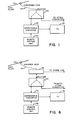
- an addressable converter 40 is connected in a stand alone, one-way configuration between a conventional RF splitter unit 150 and the subscriber's television receiver 46.
- RF signals from cable TV plant 152 are transmitted by way of a subscriber drop 154 to a conventional RF splitter 150 where they are separated and sent to a plurality of addressable converters such as converter 40.
- a remote control unit 140 for remote usage by a subscriber in controlling addressable converter 40 is an optional feature of this system.
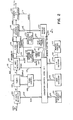
- addressable converter 40 may be implemented utilizing an addressable converter unit such as the model 5504B manufactured by Tocom, Incorporated of Dallas, Texas.
- Converter 40 under direction of converter control logic unit 104, processes the data and pay television programs received from cable TV plant 152 at RF/data separator 100 and provides video and audio output for a standard television receiver, preferably on VHF channels 3 or 4.
- the RF video information representative of a plurality of pay television programs received by RF/data separator 100 is coupled to tuner 106, which is preferably a conventional tuning unit utilizing a shding band pass filter and a band switch front end that is tuned with a phase lock loop control.
- tuner 106 which is preferably a conventional tuning unit utilizing a shding band pass filter and a band switch front end that is tuned with a phase lock loop control.
- the RF output signals are detected by IF amplifier and detector 112 to provide a scrambled base-band video signal and a separate audio signal.
- Two-stage automatic gain control on feedback line 110 is provided to optimize noise reduction.
- a data extractor 114 is connected to the scrambled video output of IF amplifier and detector 112. Data extractor 114 provides a serial data stream extracted from the vertical interval of the scrambled video signal to converter control logic unit 104. This serial data stream can include credit and debit information, as will be explained herein, or other control information for operating the present system.
- a logic command signal for timing control is transmitted to data extractor 114 by converter control logic unit 104 on line 117.
- IF amplifier and detector unit 112 also generates a synchronizing signal from the video signal which is transmitted to converter control logic unit 104 on line 113.
- a conventional video descrambler unit 116 processes the scrambled base-band video signal from tuner 106 and provides a descrambled base-band video signal which is directed to a text/graphics generator 118.
- a scramble/descramble timing signal is generated at cable TV plant 152 and transmitted to addressable converter 40 to control this operation.
- the channel sound information is amplitude adjusted or muted by an audio level/mute control unit 120 which is controlled by a signal on data line 122 from converter control logic unit 104.
- Text/graphics generator 118 is provided to display characters and graphic signals that have been transmitted on the vertical interval or generated by converter control logic unit 104.
- Converter control logic unit 104 also directs screen control data on data link 124 to a display memory 130 which in turn sends the formatted display characters along data link 132 to text/graphics generator 118 for display.
- Text/graphics generator 118 preferably includes a plurality of video switches which may be utilized to bypass text/graphics generator 118 with the channel video.
- the video switches also permit the channel number display and various credit unit displays to be superimposed on the video signal of the channel which is being presented.
- the output of text/graphics generator 118 is connected to a modulator 134 which in turn is connected to a subscriber's television receiver.
- the subscriber's television receiver is coupled to a power outlet on addressable converter 40 which is enabled on command from a user keyboard 146 connected to converter control logic unit 104. All manual user inputs required by the system are preferably keyed in on user keyboard 146. Alternately, the subscriber may provide inputs from a remote control unit 140 having a keyboard similar to user keyboard 146. Data is preferably sent from remote control unit 140 via an infrared wireless link 142 to a conventional infrared receiver 144 which is connected to converter control logic unit 104. Hence, converter control logic unit 104 receives input data from the vertical interval data extractor 114 and from the subscriber via keyboard 146 or remote control unit 140.
- nonvolatile memory unit 20 which is coupled to converter control logic unit 104 by means of memory bus 24.
- a serial data stream encoded into the vertical interval is extracted by data extractor 114 and may include a predetermined credit unit amount transmitted from cable television plant 152 to be stored in nonvolatile memory unit 20.
- This credit information is coupled from data extractor 114 to converter control logic unit 104 by data path 115.
- memory device 20 must be implemented utilizing a nonvolatile memory unit to prevent the loss of credit unit data in the event of a power loss at the subscriber's location. Therefore, memory unit 20 may be implemented utilizing an electrically erasable read only memory (EEPROM) or a low power, CMOS random access memory with a capacitive or battery alternate power source.
- EEPROM electrically erasable read only memory
- the credit unit amounts stored in nonvolatile memory unit 20 are utilized by the subscriber in a manner which will be described herein, to purchase certain pay-per-view pay television programs.
- nonvolatile memory unit 20 can be utilized to store certain other system parameters as will be explained herein.
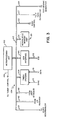
- converter control logic unit 104 is shown in greater detail.
- the central function of converter control logic unit 104 is preferably carried out by a microprocessor unit 410.
- Microprocessor 410 is preferably a single microprocessor chip containing a random access memory, a read only memory and a timer.
- Microprocessor unit 410 interfaces between tuner control unit 108 of addressable converter 40 and a two way data link 412 which connects it to the remainder of converter control logic unit 104.
- Timer decoder unit 414 is preferably connected to bus 412 and receives data from data extractor 114 on line 115. The data is then buffered and decoded by timer/decoder unit 414 preparatory to being transmitted to microprocessor unit 410. In addition. timer decoder unit 414 receives sync pulses from IF amplifier detector 112 on line 113. Unit 414 includes line counting logic for determining when data is to be received on the vertical interval.
- a subscriber control bus (SCB) interface unit 416 receives incoming data from subscriber control bus 102 relating to the control functions of addressable converter 40.
- the subscriber control bus data is processed by interface unit 416 and transmitted to microprocessor 410 in a manner well known in the art.
- Nonvolatile memory unit 20 is connected by way of memory bus 24 to microprocessor 410.
- nonvolatile memory unit 20 preferably contains a number of data codes which do not require changing in the normal operation of the system and which uniquely identify addressable converter 40. These data codes include the identification number of addressable converter 40, the frequency configuration acceptable for addressable converter 40, and the "home channel" number, that is the channel number to which addressable converter 40 will be tuned in the event of an emergency alert signal.
- units 410, 414, 416 and 420 are all conventional integrated circuits readily available in the marketplace.
- Suitable integrated circuits for microprocessor 410 and timer decoder unit 414 are circuit numbers 8048 and 8041 respectively, both manufactured by Intel Corporation.
- a suitable integrated circuit for subscriber control bus interface unit 416 is a universal asynchronous receiver transmitter (UART) circuit Model 6402 manufactured by Intersil Corporation.
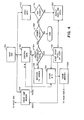
- FIG. 4 a logic flow diagram is depicted describing the operation of addressable converter 40 as modified by the inclusion of nonvolatile memory unit 20 and operated utilizing the novel pay-per-view television method of the present invention.
- the process begins at step 310 in which selected data and video information is transmitted from the cable TV plant central station to addressable converter 40.
- the video data is coupled to video data receiver 312, control data including identification numbers for various pay-per-view television programs and the cost associated with each selected pay-per-view program are coupled to control data register 314 and a predetermined amount of credit units may be periodically transmitted from the central station of the cable television plant to credit unit memory 316.
- the predetermined amount of credit units to be transmitted from the central station is ordered and paid for by the subscriber with a monthly invoice and the transmission of credit units to credit memory 316 occurs subsequent to such payment.
- a monthly invoice the transmission of credit units to credit memory 316 occurs subsequent to such payment.
- the video information received by addressable converter 40 is examined in decision step 318 and a determination is made whether or not the video data pertains to a pay-per-view event. In the event that the video data does not pertain to a pay-per-view event the video descrambler 116 is activated by block 320 and the video signal is enabled to the subscriber's television receiver.
- decision block 322 is utilized to determine whether or not the viewer has selected the pay-per-view event for viewing.
- the selection of a particular pay-per-view event by the subscriber may be accomplished by entering a preselected code sequence utilizing user keyboard 146 or remote control unit 140 and the keyboards associated therein as will be described with respect to Figure 5. In the event that the viewer does not select the pay-per-view event no further action will take place.
- decision step 324 is utilized to compare the cost of the selected pay-per-view event with the credit unit total currently stored in credit unit memory 316.
- step 326 may be utilized in conjunction with converter control logic unit 104, display memory 130 and text/graphics generator 118 to provide a visual message to the subscriber that insufficient credit units exist in credit unit memory 316 to purchase the desired pay-per-view program.
- an enable signal is generated by decision step 324 and the enable video step is utilized to permit video descrambler 116 to couple the selected pay-per-view television program to the television receiver. Additionally, the output of decision step 324 is also utilized to transfer the identification number associated with the selected pay-per-view television program from buffer storage 328 to usage memory 330.
- usage memory 330 and credit unit memory 316 are implemented utilizing a single nonvolatile memory unit.
- the enable signal is also utilized to alter the credit unit amount stored in credit unit memory 316 by debiting that amount in an amount equal to the cost of viewing the selected pay-per-view television program.
- the total amount of credit units remaining in credit unit memory 316, the number of credit units utilized during a specified reporting period and the usage data stored in usage memory 330 may simply be transmitted to the central station of the cable television plant in a two-way cable television system, or by utilizing a low priority communications link such as a telephone dialer or mail invoice in one-way cable television systems.
- the credit unit data and usage data i.e.
- remote control unit 140 includes a keyboard 168 which is identical to the keyboard associated with user keyboard 146. The input from keyboard 168 determines the television and text outputs to be viewed by the subscriber on his television receiver.
- addressable converter 40 provides for the tuning of up to fifty-five television program channels on a broad band cable system. Converter 40 selectively processes each of these channels and outputs them individually to a standard television set on channel 3 or 4 for viewing in the home. Converter 40 and its attendant remote control unit 140 can be used as a stand alone conventional cable TV converter and in certain alternate embodiments is also compatible as an expansion module for a two-way interactive system.
- Keyboard 168 includes a plurality of keys operable to vary the operation of addressable converter 40.
- Numeral keys 172 may be utilized to directly enter a particular channel or channel select keys 170 and 171 may be utilized to cycle through the selected channels in an upward or downward direction.
- cable A or cable B may be selected by pressing the A/B key 174.
- the channel number which is selected is displayed on the television receiver screen or an associated optical display each time the channel key is depressed by utilizing text/graphics generator 118 in the manner described herein.
- a subset of preferred channels may be stored for quick access on addressable converter 40. These channels are stored by pressing the ENTER/CLEAR key 176 first and then the PREF key 178 while the unit is in the channel select mode. Remote control unit 140 will then generate the necessary signals to display the ten preferred channel assignments, if any, on the television receiver screen. The subscriber can then enter or modify the preferred channels utilizing the number keys and exit pressing the channel keys 170 or 171. Preferred channels are accessed after programming by pressing the PREF key 178 each time the key is pressed, addressable converter 40 steps through the preferred channel and displays the next selected channel in sequence.
- Remote control unit 140 also provides for a complete volume control and sound muting by pressing the "sound up" key 180, the "sound down" key 182 or the mute key 184.
- sound is always muted for channels that have not been authorized.
- the sound is also muted for channels providing text and graphic programming.
- One aspect of the pay-per-view system of the present invention is operated utilizing the credit key 186 which may be depressed to display the credit unit amount stored in nonvolatile memory unit 20.
- the credit unit cost of a selected pay-per-view television program is displayed on the television screen or by utilizing an actual display. If the subscriber desires to determine whether or not he has sufficient credit units to purchase a pay-per-view program with a displayed cost, he simply depresses credit key 186 to display his credit total. Display of the appropriate credit unit total may be accomplished utilizing text/graphics generator 118 under the control of converter control logic unit 104 or by a separate optical display unit. If sufficient credits are present the subscriber may purchase the program by entering a selected numerical code utilizing numeral keys 172. This code prevents children and unauthorized individuals from purchasing pay-per-view programming.
- FIG. 6 there is depicted a schematic diagram of an alternate embodiment two-way cable television system which incorporates the novel pay-per-view method and apparatus of the present invention.
- addressable converter 40 is connected in a multiple converter, two-way configuration between a conventional RF splitter 150 and the subscriber's television receiver 46.
- RF signals from cable TV plant 152 are transmitted by way of a subscriber drop 154 through splitter 150 where they are separated and sent to a plurality of addressable converters such as addressable converter 40.
- a remote control unit 140 is depicted as associated with addressable converter 40 in this embodiment.
- the major difference between this system and the system of Figure 1 is the inclusion of communications device 151.
- Communications device 151 is utilized, in this embodiment of the present invention, to send credit unit data and program viewing information (encoded or uncoded format) to the central station.
- Communications device 151 may comprise a simple RF transmitter which utilizes well known FSK transmission techniques to transmit this data via the cable itself or, may be implemented utilizing a telephone dialer which transmits this data to the central station via a telephone line.
Landscapes
- Engineering & Computer Science (AREA)
- Multimedia (AREA)
- Signal Processing (AREA)
- Computer Security & Cryptography (AREA)
- Two-Way Televisions, Distribution Of Moving Picture Or The Like (AREA)
- Control Of Vending Devices And Auxiliary Devices For Vending Devices (AREA)
Applications Claiming Priority (2)
| Application Number | Priority Date | Filing Date | Title |
|---|---|---|---|
| US50339383A | 1983-06-10 | 1983-06-10 | |
| US503393 | 1990-04-02 |
Publications (2)
| Publication Number | Publication Date |
|---|---|
| EP0128555A2 true EP0128555A2 (de) | 1984-12-19 |
| EP0128555A3 EP0128555A3 (de) | 1985-09-11 |
Family
ID=24001903
Family Applications (1)
| Application Number | Title | Priority Date | Filing Date |
|---|---|---|---|
| EP84106573A Withdrawn EP0128555A3 (de) | 1983-06-10 | 1984-06-08 | Verfahren und Vorrichtung zum Münzfernsehen gegen Vorauszahlung |
Country Status (2)
| Country | Link |
|---|---|
| EP (1) | EP0128555A3 (de) |
| JP (1) | JPS6024791A (de) |
Cited By (20)
| Publication number | Priority date | Publication date | Assignee | Title |
|---|---|---|---|---|
| WO1986001962A1 (en) * | 1984-09-21 | 1986-03-27 | Scientific Atlanta, Inc. | Information display scheme for subscribers of a subscription television system |
| GB2173065A (en) * | 1984-10-25 | 1986-10-01 | Thorn Emi Ferguson | Television receiver |
| EP0153837A3 (en) * | 1984-02-15 | 1987-07-15 | Matsushita Electric Industrial Co., Ltd. | Pay television system |
| US4686564A (en) * | 1984-05-30 | 1987-08-11 | Kabushiki Kaisha Toshiba | Communication data processing device of cable television system |
| EP0183626A3 (en) * | 1984-11-29 | 1987-09-02 | Sony Corporation | Receiver for pay television receiver for pay television |
| US4724478A (en) * | 1984-05-30 | 1988-02-02 | Kabushiki Kaisha Toshiba | Cable television communication system with passive sensor signal path and a subscriber power supply source |
| EP0243312A3 (en) * | 1986-04-18 | 1990-01-31 | Kudelski Sa Fabrique D'enregistreurs Nagra | Method for facilitating a dialog between a subscriber to a pay television system and a decoder of the received signals, and a decoder for these signals |
| EP0297988A3 (de) * | 1987-06-30 | 1990-09-26 | Communications Satellite Corporation | Zeitankaufsystem für Bezahltfernsehen |
| US4961109A (en) * | 1986-02-10 | 1990-10-02 | Pioneer Electronic Corporation | Chargeable program receiving limit setting system in two-way cable television system |
| US5070400A (en) * | 1987-06-30 | 1991-12-03 | Comsat | Pay-tv time purchase scheme |
| EP0595354A1 (de) * | 1992-10-30 | 1994-05-04 | Ricos Co., Ltd. | Kostenrechnungssystem für Funkübertragungen |
| WO1995020294A1 (en) * | 1994-01-19 | 1995-07-27 | Nemirofsky Frank R | Television signal activated interactive smart card system |
| WO2000004717A1 (en) * | 1998-07-17 | 2000-01-27 | Thomson Licensing S.A. | A conditional access system for broadcast digital television |
| US6151626A (en) * | 1997-02-07 | 2000-11-21 | Two Way Tv Limited | Interactive television communication system |
| WO2001047265A1 (en) * | 1999-12-22 | 2001-06-28 | Koninklijke Philips Electronics N.V. | Conditional access system for controlling the access to a data content |
| WO2001067762A1 (de) * | 2000-03-10 | 2001-09-13 | Rudolf Ritter | Verfahren, kommunikationssystem und empfangsvorrichtung für die verrechnung von zugriffskontrollierten programmen und/oder daten von broadcastsendern |
| WO2001088801A1 (en) * | 2000-05-19 | 2001-11-22 | Wilson How Kiap Gueh | Method and apparatus for controlling use of or access to electronic content |
| US20070136137A1 (en) * | 1999-05-10 | 2007-06-14 | Xerox Corporation | Remote feature delivery for output devices |
| WO2009009806A3 (en) * | 2007-07-12 | 2009-04-09 | Mosiuoa Sophonia Molakeng | Method of receiving broadcasts |
| US8098820B2 (en) | 2001-03-14 | 2012-01-17 | Thomson Licensing | Conditional access system for broadcast digital television |
Families Citing this family (5)
| Publication number | Priority date | Publication date | Assignee | Title |
|---|---|---|---|---|
| JPS60171880A (ja) * | 1984-02-15 | 1985-09-05 | Matsushita Electric Ind Co Ltd | 有料テレビジヨン端末装置 |
| JPS6197281U (de) * | 1984-11-30 | 1986-06-21 | ||
| JPS61166672U (de) * | 1985-04-03 | 1986-10-16 | ||
| US6704563B1 (en) | 1998-08-11 | 2004-03-09 | Boston Communications Group, Inc. | Systems and methods for prerating costs for a communication event |
| US7187928B1 (en) | 1998-11-24 | 2007-03-06 | Boston Communications Group, Inc. | Call delivery systems for roaming prepaid subscribers |
Family Cites Families (2)
| Publication number | Priority date | Publication date | Assignee | Title |
|---|---|---|---|---|
| GB986019A (en) * | 1962-09-21 | 1965-03-17 | R & R Res Ltd | Subscription entertainment systems |
| GB1090873A (en) * | 1964-04-21 | 1967-11-15 | R & R Res Ltd | Improvements in and relating to broadcast systems |
-
1984
- 1984-06-08 JP JP11804884A patent/JPS6024791A/ja active Pending
- 1984-06-08 EP EP84106573A patent/EP0128555A3/de not_active Withdrawn
Cited By (31)
| Publication number | Priority date | Publication date | Assignee | Title |
|---|---|---|---|---|
| EP0153837A3 (en) * | 1984-02-15 | 1987-07-15 | Matsushita Electric Industrial Co., Ltd. | Pay television system |
| US4833710A (en) * | 1984-02-15 | 1989-05-23 | Matsushita Electric Industrial Co., Ltd. | Pay television system |
| US4686564A (en) * | 1984-05-30 | 1987-08-11 | Kabushiki Kaisha Toshiba | Communication data processing device of cable television system |
| US4724478A (en) * | 1984-05-30 | 1988-02-02 | Kabushiki Kaisha Toshiba | Cable television communication system with passive sensor signal path and a subscriber power supply source |
| WO1986001962A1 (en) * | 1984-09-21 | 1986-03-27 | Scientific Atlanta, Inc. | Information display scheme for subscribers of a subscription television system |
| US4885775A (en) * | 1984-09-21 | 1989-12-05 | Scientific-Atlanta, Inc. | Information display scheme for subscribers of a subscription television system |
| GB2173065A (en) * | 1984-10-25 | 1986-10-01 | Thorn Emi Ferguson | Television receiver |
| EP0183626A3 (en) * | 1984-11-29 | 1987-09-02 | Sony Corporation | Receiver for pay television receiver for pay television |
| US4961109A (en) * | 1986-02-10 | 1990-10-02 | Pioneer Electronic Corporation | Chargeable program receiving limit setting system in two-way cable television system |
| EP0243312A3 (en) * | 1986-04-18 | 1990-01-31 | Kudelski Sa Fabrique D'enregistreurs Nagra | Method for facilitating a dialog between a subscriber to a pay television system and a decoder of the received signals, and a decoder for these signals |
| EP0297988A3 (de) * | 1987-06-30 | 1990-09-26 | Communications Satellite Corporation | Zeitankaufsystem für Bezahltfernsehen |
| US5070400A (en) * | 1987-06-30 | 1991-12-03 | Comsat | Pay-tv time purchase scheme |
| EP0595354A1 (de) * | 1992-10-30 | 1994-05-04 | Ricos Co., Ltd. | Kostenrechnungssystem für Funkübertragungen |
| EP0895419A3 (de) * | 1992-10-30 | 1999-02-24 | Ricos Co., Ltd. | Abrechnungssystem für Funkübertragumgen |
| US5594493A (en) * | 1994-01-19 | 1997-01-14 | Nemirofsky; Frank R. | Television signal activated interactive smart card system |
| WO1995020294A1 (en) * | 1994-01-19 | 1995-07-27 | Nemirofsky Frank R | Television signal activated interactive smart card system |
| US6151626A (en) * | 1997-02-07 | 2000-11-21 | Two Way Tv Limited | Interactive television communication system |
| US7492897B1 (en) | 1998-07-17 | 2009-02-17 | Thomson Licensing | Conditional access system for broadcast digital television |
| WO2000004717A1 (en) * | 1998-07-17 | 2000-01-27 | Thomson Licensing S.A. | A conditional access system for broadcast digital television |
| US8909554B2 (en) | 1999-05-10 | 2014-12-09 | Google Inc. | System for installing programmable features on output devices |
| US8671059B2 (en) * | 1999-05-10 | 2014-03-11 | Google Inc. | Remote feature delivery for output devices |
| US20070136137A1 (en) * | 1999-05-10 | 2007-06-14 | Xerox Corporation | Remote feature delivery for output devices |
| WO2001047265A1 (en) * | 1999-12-22 | 2001-06-28 | Koninklijke Philips Electronics N.V. | Conditional access system for controlling the access to a data content |
| US6964060B2 (en) | 1999-12-22 | 2005-11-08 | Koninklijke Philips Electronics N.V. | Conditional access system for controlling the access to a data content |
| WO2001067762A1 (de) * | 2000-03-10 | 2001-09-13 | Rudolf Ritter | Verfahren, kommunikationssystem und empfangsvorrichtung für die verrechnung von zugriffskontrollierten programmen und/oder daten von broadcastsendern |
| US7478069B1 (en) | 2000-03-10 | 2009-01-13 | Kudelski S.A. | Method, communications system and receiver device for the billing of access-controlled programmes and/or data from broadcast transmitters |
| US7895126B1 (en) | 2000-03-10 | 2011-02-22 | Kudelski S.A. | Method, communications system and receiver device for the billing of access controlled programmes and /or data from broadcast transmitters |
| WO2001067761A1 (de) * | 2000-03-10 | 2001-09-13 | Rudolf Ritter | Verfahren, kommunikationssystem und empfangsvorrichtung fur die verrechnung von zugriffskontrollierten programmen und/oder daten von broadcastsendern |
| WO2001088801A1 (en) * | 2000-05-19 | 2001-11-22 | Wilson How Kiap Gueh | Method and apparatus for controlling use of or access to electronic content |
| US8098820B2 (en) | 2001-03-14 | 2012-01-17 | Thomson Licensing | Conditional access system for broadcast digital television |
| WO2009009806A3 (en) * | 2007-07-12 | 2009-04-09 | Mosiuoa Sophonia Molakeng | Method of receiving broadcasts |
Also Published As
| Publication number | Publication date |
|---|---|
| JPS6024791A (ja) | 1985-02-07 |
| EP0128555A3 (de) | 1985-09-11 |
Similar Documents
| Publication | Publication Date | Title |
|---|---|---|
| US4759060A (en) | Decoder for a pay television system | |
| US4991011A (en) | Interactive television terminal with programmable background audio or video | |
| CA2014794C (en) | Terminal authorization method | |
| JPS6024791A (ja) | 視聴料前払いテレビジヨン方法及び装置 | |
| AU596514B2 (en) | Method and system for remote reporting, particularly for pay television billing | |
| RU2112325C1 (ru) | Аппаратный ведущий терминал для системы доставки телевизионных программ и способа его использования | |
| US5406626A (en) | Radio receiver for information dissemenation using subcarrier | |
| CA1337215C (en) | Set-top interface transactions in an impulse pay per view television system | |
| US5590195A (en) | Information dissemination using various transmission modes | |
| US6195530B1 (en) | Selective messaging via on-screen display | |
| US6330334B1 (en) | Method and system for information dissemination using television signals | |
| US6424947B1 (en) | Distributed IRD system | |
| US5033085A (en) | Method for controlling video and audio of a television set | |
| US6279824B1 (en) | Method and apparatus for performing an electronic money terminal function using a smart card | |
| US4323922A (en) | Television coding system with channel level identification | |
| WO1997019555A1 (en) | Interactive special events video signal navigation system | |
| JP2001517409A (ja) | 放送受信システムおよびそれに使用される受信器/デコーダおよびリモコン | |
| JPH0697787B2 (ja) | 加入者テレビの料金計算方法 | |
| US7149309B1 (en) | Time-dependent authorization | |
| USRE36988E (en) | Terminal authorization method | |
| GB2334361A (en) | A portable subscriber unit for controlling access to television transmissions via wireless communication | |
| KR100229035B1 (ko) | 스마트카드를 이용한 페이퍼뷰 프로그램 시청내역 저장방법 | |
| US20030033213A1 (en) | System for acquiring goods and/or services | |
| KR100497958B1 (ko) | 셀룰러폰을 이용하여 위성신호를 단속하기 위한 결제단말기 및 그를 이용한 결제방법 | |
| KR100240768B1 (ko) | 전자화폐 서비스기능을 갖는 디지틀 위성방송수신기와 그 제어방법 |
Legal Events
| Date | Code | Title | Description |
|---|---|---|---|
| PUAI | Public reference made under article 153(3) epc to a published international application that has entered the european phase |
Free format text: ORIGINAL CODE: 0009012 |
|
| AK | Designated contracting states |
Designated state(s): AT BE CH DE FR GB IT LI LU NL SE |
|
| PUAL | Search report despatched |
Free format text: ORIGINAL CODE: 0009013 |
|
| AK | Designated contracting states |
Designated state(s): AT BE CH DE FR GB IT LI LU NL SE |
|
| 17P | Request for examination filed |
Effective date: 19860307 |
|
| 17Q | First examination report despatched |
Effective date: 19870723 |
|
| STAA | Information on the status of an ep patent application or granted ep patent |
Free format text: STATUS: THE APPLICATION IS DEEMED TO BE WITHDRAWN |
|
| 18D | Application deemed to be withdrawn |
Effective date: 19871203 |
|
| RIN1 | Information on inventor provided before grant (corrected) |
Inventor name: CAMPBELL, JOHN G. Inventor name: CHENOWETH, JOHN STEPHEN Inventor name: MARTIN, THOMAS F. Inventor name: SCHOENEBERGER, CARL F. Inventor name: BUNDENS, ALLAN B., JR. Inventor name: STOREY, ROBERT W. |
|
| P01 | Opt-out of the competence of the unified patent court (upc) registered |
Effective date: 20230522 |