EP0128653A2 - Katalysatorgehäuse - Google Patents
Katalysatorgehäuse Download PDFInfo
- Publication number
- EP0128653A2 EP0128653A2 EP84302931A EP84302931A EP0128653A2 EP 0128653 A2 EP0128653 A2 EP 0128653A2 EP 84302931 A EP84302931 A EP 84302931A EP 84302931 A EP84302931 A EP 84302931A EP 0128653 A2 EP0128653 A2 EP 0128653A2
- Authority
- EP
- European Patent Office
- Prior art keywords
- interior
- manifold
- disposed
- flanges
- halves
- Prior art date
- Legal status (The legal status is an assumption and is not a legal conclusion. Google has not performed a legal analysis and makes no representation as to the accuracy of the status listed.)
- Granted
Links
Images
Classifications
-
- F—MECHANICAL ENGINEERING; LIGHTING; HEATING; WEAPONS; BLASTING
- F01—MACHINES OR ENGINES IN GENERAL; ENGINE PLANTS IN GENERAL; STEAM ENGINES
- F01N—GAS-FLOW SILENCERS OR EXHAUST APPARATUS FOR MACHINES OR ENGINES IN GENERAL; GAS-FLOW SILENCERS OR EXHAUST APPARATUS FOR INTERNAL-COMBUSTION ENGINES
- F01N3/00—Exhaust or silencing apparatus having means for purifying, rendering innocuous, or otherwise treating exhaust
- F01N3/08—Exhaust or silencing apparatus having means for purifying, rendering innocuous, or otherwise treating exhaust for rendering innocuous
- F01N3/10—Exhaust or silencing apparatus having means for purifying, rendering innocuous, or otherwise treating exhaust for rendering innocuous by thermal or catalytic conversion of noxious components of exhaust
- F01N3/24—Exhaust or silencing apparatus having means for purifying, rendering innocuous, or otherwise treating exhaust for rendering innocuous by thermal or catalytic conversion of noxious components of exhaust characterised by constructional aspects of converting apparatus
- F01N3/28—Construction of catalytic reactors
-
- F—MECHANICAL ENGINEERING; LIGHTING; HEATING; WEAPONS; BLASTING
- F01—MACHINES OR ENGINES IN GENERAL; ENGINE PLANTS IN GENERAL; STEAM ENGINES
- F01N—GAS-FLOW SILENCERS OR EXHAUST APPARATUS FOR MACHINES OR ENGINES IN GENERAL; GAS-FLOW SILENCERS OR EXHAUST APPARATUS FOR INTERNAL-COMBUSTION ENGINES
- F01N3/00—Exhaust or silencing apparatus having means for purifying, rendering innocuous, or otherwise treating exhaust
- F01N3/08—Exhaust or silencing apparatus having means for purifying, rendering innocuous, or otherwise treating exhaust for rendering innocuous
- F01N3/10—Exhaust or silencing apparatus having means for purifying, rendering innocuous, or otherwise treating exhaust for rendering innocuous by thermal or catalytic conversion of noxious components of exhaust
- F01N3/24—Exhaust or silencing apparatus having means for purifying, rendering innocuous, or otherwise treating exhaust for rendering innocuous by thermal or catalytic conversion of noxious components of exhaust characterised by constructional aspects of converting apparatus
- F01N3/30—Arrangements for supply of additional air
-
- F—MECHANICAL ENGINEERING; LIGHTING; HEATING; WEAPONS; BLASTING
- F01—MACHINES OR ENGINES IN GENERAL; ENGINE PLANTS IN GENERAL; STEAM ENGINES
- F01N—GAS-FLOW SILENCERS OR EXHAUST APPARATUS FOR MACHINES OR ENGINES IN GENERAL; GAS-FLOW SILENCERS OR EXHAUST APPARATUS FOR INTERNAL-COMBUSTION ENGINES
- F01N13/00—Exhaust or silencing apparatus characterised by constructional features
- F01N13/18—Construction facilitating manufacture, assembly, or disassembly
-
- F—MECHANICAL ENGINEERING; LIGHTING; HEATING; WEAPONS; BLASTING
- F01—MACHINES OR ENGINES IN GENERAL; ENGINE PLANTS IN GENERAL; STEAM ENGINES
- F01N—GAS-FLOW SILENCERS OR EXHAUST APPARATUS FOR MACHINES OR ENGINES IN GENERAL; GAS-FLOW SILENCERS OR EXHAUST APPARATUS FOR INTERNAL-COMBUSTION ENGINES
- F01N2270/00—Mixing air with exhaust gases
- F01N2270/04—Mixing air with exhaust gases for afterburning
-
- F—MECHANICAL ENGINEERING; LIGHTING; HEATING; WEAPONS; BLASTING
- F01—MACHINES OR ENGINES IN GENERAL; ENGINE PLANTS IN GENERAL; STEAM ENGINES
- F01N—GAS-FLOW SILENCERS OR EXHAUST APPARATUS FOR MACHINES OR ENGINES IN GENERAL; GAS-FLOW SILENCERS OR EXHAUST APPARATUS FOR INTERNAL-COMBUSTION ENGINES
- F01N2350/00—Arrangements for fitting catalyst support or particle filter element in the housing
- F01N2350/02—Fitting ceramic monoliths in a metallic housing
-
- Y—GENERAL TAGGING OF NEW TECHNOLOGICAL DEVELOPMENTS; GENERAL TAGGING OF CROSS-SECTIONAL TECHNOLOGIES SPANNING OVER SEVERAL SECTIONS OF THE IPC; TECHNICAL SUBJECTS COVERED BY FORMER USPC CROSS-REFERENCE ART COLLECTIONS [XRACs] AND DIGESTS
- Y02—TECHNOLOGIES OR APPLICATIONS FOR MITIGATION OR ADAPTATION AGAINST CLIMATE CHANGE
- Y02A—TECHNOLOGIES FOR ADAPTATION TO CLIMATE CHANGE
- Y02A50/00—TECHNOLOGIES FOR ADAPTATION TO CLIMATE CHANGE in human health protection, e.g. against extreme weather
- Y02A50/20—Air quality improvement or preservation, e.g. vehicle emission control or emission reduction by using catalytic converters
-
- Y—GENERAL TAGGING OF NEW TECHNOLOGICAL DEVELOPMENTS; GENERAL TAGGING OF CROSS-SECTIONAL TECHNOLOGIES SPANNING OVER SEVERAL SECTIONS OF THE IPC; TECHNICAL SUBJECTS COVERED BY FORMER USPC CROSS-REFERENCE ART COLLECTIONS [XRACs] AND DIGESTS
- Y02—TECHNOLOGIES OR APPLICATIONS FOR MITIGATION OR ADAPTATION AGAINST CLIMATE CHANGE
- Y02T—CLIMATE CHANGE MITIGATION TECHNOLOGIES RELATED TO TRANSPORTATION
- Y02T10/00—Road transport of goods or passengers
- Y02T10/10—Internal combustion engine [ICE] based vehicles
- Y02T10/12—Improving ICE efficiencies
Definitions
- This invention relates to catalytic converters and specifically to converters of the two-stage type.
- the invention particularly relates to catalytic converters having means for the introduction of non-combustion gases to enhance the oxidation of combustion gases.
- the invention is especially useful in exhaust gas treatment systems for vehicles powered by internal combustion engines.
- Two-stage catalytic converters generally include a first, or reducing, catalyst and a second, or oxidizing, catalyst. Air is typically introduced into the combustion product gases passing through the converter after such gases have been treated in the reducing catalyst. An air pump is often provided for pumping air into the converter at an elevated pressure. The air, introduced into such gases before the combustion product is treated in the oxidizing catalyst, aids in oxidation of the combustion product.
- Two-stage catalytic converters of the type with which this invention deals are known in the prior art. See, for example, Scheitlin U.S. Patent 3,771,969; Scheitlin et al U.S. Patent 3,740,197; and Scheitlin et al U.S. Patent No. 3,090,677.
- Such two-stage catalytic converters include shells defining first and second housing portions.
- the second housing portion is downstream from the first in the path of combustion product flow through the shell.
- the first, upstream housing portion houses a substrate which presents, in the stream of combustion product flow past the substrate, a reducing catalyst.
- a reducing catalyst typically, the purpose of such reducing catalyst is to reduce harmful and deleterious oxides, such as oxides of nitrogen, appearing in the combustion product into harmless gases, e.g., nitrogen and oxygen.
- the second, downstream shell portion houses a substrate which contains an oxidizing catalyst.
- the oxidizing catalyst is used to complete the oxidation of harmful and deleterious gases appearing in the combustion product as a result of incomplete combustion, e.g., carbon monoxide and unburned hydrocarbons, into harmless gases, e.g., carbon dioxide and water vapor.
- an accepted practice in such two-stage converters is to introduce additional oxygen from an external source, e.g., atmospheric air outside the shell, into the shell downstream in the combustion product flow from the reducing site and upstream from the oxidizing site.
- the additional oxygen is used to oxidize the carbon monoxide and unburned hydrocarbons.
- the above-mentioned prior art references also disclose that the air is introduced into the catalytic converter through an -air tube" which extends transversely of the longitudinal axis of the converter between two opposed portions of the side wall thereof.
- the air tube which in the prior art patents has an elongated cylindrical shape, is provided with a plurality of apertures located to provide some mixing of oxygen from the external source with the combustion product gases flowing into the oxidizing portion of the shell.
- Scheitlin U.S. Patent No. 4,049,388 relates to an improved means for introducing air into the combustion product flowing through the passageway between the reducing catalyst and the oxidizing catalyst.
- the air introduction means shown in this patent includes a manifold which extends perimetrally about at least a portion of the interior wall of the shell in this passageway.
- the manifold conforms to the interior of the wall of the shell in this passageway, and includes a plurality of apertures which open inwardly to direct a plurality of streams in the manifold into the stream of the combusion product flowing through this passageway.
- the manifold is adapted to a clam shell-type of converter.
- the manifold includes a first and second manifold half, with each of the manifold halves being secured, before assembly of the clam shell, into a respective one of the shell halves.
- Hardin et al U.S. Patent No. 4,322,388 relates to an improved structure for a clam shell-type converter wherein the side of the outer, perimetral flanges are reduced to save space in the converter.
- the instant invention comprises an improved apparatus for introducing oxygen from an external source into the flowing streams of combustion product between the first, upstream reducing shell portion and the second, oxidizing downstream shell portion.
- a catalytic converter in accordance with the instant invention, includes a longitudinally disposed body portion having first and second shell halves and an interior through which the combustion product can flow.
- the body of the converter also includes an inlet through which the combustion product can flow into the interior of the body, and an outlet through which the combustion product can flow out of the interior of the body.
- a reducing catalyst is disposed in the interior of the body proximal to the inlet.
- An oxidizing catalyst is disposed in the interior of the body proximal to the outlet. Means are provided for forming a passageway between the body interior containing reducing catalyst and the body interior containing the oxidizing catalyst.
- the means includes first and second manifold halves, with each manifold half including a pair of flanges which extend perimetrally and substantially completely along the interior wall of one shell half.
- the manifold flanges are disposed substantially parallel to the interior wall and coupled thereto.
- the manifold flanges include a portion which is recessed inwardly from the interior wall and first and second mating sections.
- the recessed portions include means for introducing air into the passageway between the reducing catalyst and the oxidizing catalyst.
- Each shell half also includes a portion of the interior wall for attaching the pair of manifold flanges to the interior wall of the shell. This portion is generally continuous to allow selective placement of the manifold halves.
- the first mating section includes a stud and the second mating section includes an aperture.
- the aperture of the second mating section is sized and positioned to receive the stud of the first mating section.
- the body portion of the converter has no necked-down portion in the area of the body portion where the manifold is placed. It has been found that mechanical and thermal stress on the necked-down portion will often cause the converter to fail. Converter shell deterioration can be accelerated by the heat which builds up in this area. By eliminating the necked-down portion, a significant cause of catalytic converter failure can be reduced. Further, the use of a catalytic converter shell without a necked-down portion enables a single-sized shell to be used in a variety of applications. Converters for different vehicles often require different amounts of oxidizing catalyst and reducing catalyst. Also, the ratio of oxidizing catalysts to reducing catalysts will vary between different vehicles.
- the oxidizing catalyst will comprise between 30-70% of the total amount of catalyst, with the remainder consisting of reducing catalyst.
- the straight-sided converter shell of the instant invention allows the manufacturer to vary the placement of the manifold section in the interior of the shell. This feature enables the manufacturer to vary the relative amounts of reducing and oxidizing catalyst used in the converter, without forcing him to use a different-sized or shaped shell. The use of a single-sized and shaped shell can result in a cost saving to the manufacturer by eliminating the tooling cost which would be necessary to fabricate shells having different sizes.
- a manifold is formed through the use of a pair of inverted manifold halves.
- This use of identical manifold halves placed in a head-to-tail relation has the advantage of reducing tooling and inventory costs to the manufacturer by reducing the number of different parts which the manufacturer needs to fabricate.
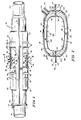
- the catalytic converter 10 shown in Figs. 1-4 includes a longitudinally disposed body portion 12.
- Body portion 12 includes a first, upper shell half 14 and a second, lower shell half 16.
- First, upper shell half 14 includes a generally horizontally disposed upper exterior surface 18 and generally vertically disposed side exterior surfaces 20, 22.
- Second, lower shell half 16 includes a generally horizontally disposed lower exterior surface 24 and generally vertically disposed side exterior surfaces 26, 28.
- a series of exteriorly convex stiffening ridges 30, 32 are stamped on first shell half 14 and second shell half 16, respectively, in a direction generally transverse to the longitudinal extent of body portion 12. Stiffening ridges 30, 32 are stamped into shell halves 14, 16 to add rigidity to the body 12 of converter 10.
- Each shell half 14, 16 includes a pair of outwardly disposed flanges 33, 34, respectively.
- the outwardly disposed flanges 33 of first shell half 14 are welded or otherwise joined to the outwardly disposed flanges 34 of second shell half 16 to form seams 35, 36 which join the first shell half 14 to the second shell half 16.
- the converter When first shell half 14 is joined to second shell half 16, the converter has an interior 38 through which a combustion product can flow.
- An inlet 40 is provided at one end of body 12 through which the combustion product can flow into the interior 38 of body 12.
- An outlet 42 is disposed at the opposite end of body 12 through which the combustion product can flow out of the interior 38 of body 12.
- a mounting bracket 44 having a plurality of mounting holes 46 is provided near the inlet 40 end for mounting the converter 10 to a portion of the vehicle or to another portion of the exhaust system of the vehicle.
- a reducing catalyst 48 is disposed in the interior 38 of the body proximal to inlet 40.
- An oxidizing catalyst 50 is disposed in the interior 38 of the body 12 converter 10 proximal to the outlet 42 end of body 12.
- Manifold 52 provides a passageway 54 between the portion of the body interior 38 containing the reducing catalyst 48 and the portion of the body interior 38 containing the oxidizing catalyst 50.
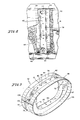
- Manifold 52 includes a first manifold half 60 and a second manifold half 62.
- Manifold halves 60, 62 are preferably identical and inverted to place the halves 60, 62 in a head-to-tail relation.
- First manifold half 60 includes a first 64 and second 65 flange.
- second manifold half 62 includes a first 66 and second 67 flange.
- Flanges 64, 65 of first manifold half 60 extend perimetrally substantially completely along the interior wall 68 of first shell half 14.
- Flanges 66, 67 of second manifold half 62 extend perimetrally substantially completely along the interior wall 68 of second shell half 16.
- Flanges 64, 65 66, 67 are coupled to the interior wall 68 by spot-welding or other conventional means.
- the coupling of the flanges 64, 65, 66, 67 to interior wall 68 should be done so as to provide an airtight seal to prevent combustion product or air from flowing between interior wall 68 and the outwardly disposed surfaces of flanges 64, 65, 66, 67.
- the exteriorly concave ridges 30, 32 are spaced longitudinally on the shell half by a distance sufficient to permit flanges 64, 65, 66, 67 to be placed between adjacent ridges 30, 32.
- the flanges 64, 65, 66, 67 can be placed to overhang one of the ridges 30, 32, such placement of the flanges 64, 65, 66, 67 makes the spot-welding of the flanges 64, 65, 66, 67 more difficult.
- the generally continuous interior wall 68 allows the positioning of the manifold 52 to be varied along a substantial portion of the interior wall 68.
- the longitudinal extent of the interior wall 68 upon which the manifold halves 60, 62 can be attached is greater than the longitudinal extent A of the manifold 52.
- First manifold half 60 includes a first 70 and second 72 inwardly disposed portion.
- second manifold half 62 includes a first 74 and second 76 inwardly disposed portion.
- First and second manifold halves 60, 62 also include recessed portions 78, 80 having a means such as air holes 82, 83 for introducing air into the passageway 54 between the reducing catalyst 48 and the oxidizing catalyst 50.
- Each manifold half 60, 62 also includes first, male mating sections 84, 86, respectively, and second, female mating sections 88, 90, respectively.
- the male mating section 84 of first manifold half 60 is disposed oppositely to the first, male mating section 86 of second manifold half 62.
- Each male mating section 84, 86 includes a male mating flange 94, 96 and a hollow stud 98, 100.
- Each female mating section 88, 90 includes a female mating flange 102, 104 having an aperture 106, 108.
- the hollow stud 98 of the male mating section 84 of first manifold half 60 is sized and positioned to be received by the aperture 108 of the female mating section 90 of second manifold half 62.
- the hollow stud 100 of the male mating section 86 of second manifold half 62 is sized and positioned to be received by the aperture 106 of the female mating section 88 of first manifold half 60.
- a fitting 114 is disposed on first shell half 14 and includes a port 116 through which air is introduced into manifold passageway 118.
- the position of the fitting can be varied longitudinally on the side surface of first 14 or second 16 shell half, depending on the particular converter being produced.
- the fitting 114 is placed into a hole (not shown) which is formed in first shell half 14 during the stamping operation.
- the hole for the fitting 114 can be punched into the shell half 14 after the stamping operation is completed.
- Air introduced through port 116 into manifold passageway 118 flows through air holes 82, 83 into the passageway 54. To reach air hole 83, air can flow through apertures 106, 108 provided in the mating sections 84, 86, 88, 90.
Landscapes
- Chemical & Material Sciences (AREA)
- Engineering & Computer Science (AREA)
- Chemical Kinetics & Catalysis (AREA)
- Health & Medical Sciences (AREA)
- Toxicology (AREA)
- Combustion & Propulsion (AREA)
- Mechanical Engineering (AREA)
- General Engineering & Computer Science (AREA)
- Exhaust Gas After Treatment (AREA)
Applications Claiming Priority (2)
| Application Number | Priority Date | Filing Date | Title |
|---|---|---|---|
| US494611 | 1983-05-16 | ||
| US06/494,611 US4501118A (en) | 1983-05-16 | 1983-05-16 | Catalytic converter housing |
Publications (3)
| Publication Number | Publication Date |
|---|---|
| EP0128653A2 true EP0128653A2 (de) | 1984-12-19 |
| EP0128653A3 EP0128653A3 (en) | 1987-08-26 |
| EP0128653B1 EP0128653B1 (de) | 1989-12-20 |
Family
ID=23965198
Family Applications (1)
| Application Number | Title | Priority Date | Filing Date |
|---|---|---|---|
| EP84302931A Expired EP0128653B1 (de) | 1983-05-16 | 1984-05-01 | Katalysatorgehäuse |
Country Status (4)
| Country | Link |
|---|---|
| US (1) | US4501118A (de) |
| EP (1) | EP0128653B1 (de) |
| CA (1) | CA1220428A (de) |
| DE (1) | DE3480799D1 (de) |
Cited By (2)
| Publication number | Priority date | Publication date | Assignee | Title |
|---|---|---|---|---|
| WO1989003928A1 (fr) * | 1987-10-28 | 1989-05-05 | Kst-Motorenversuch Gmbh & Co. Kg | Catalyseur pour moteurs marins et procede de purification catalytique des gaz d'echappement |
| WO2008098727A1 (de) * | 2007-02-12 | 2008-08-21 | Emcon Technologies Germany (Augsburg) Gmbh | Abgasführende vorrichtung, insbesondere abgasreinigungsvorrichtung, sowie verfahren zur herstellung einer abgasführenden vorrichtung |
Families Citing this family (4)
| Publication number | Priority date | Publication date | Assignee | Title |
|---|---|---|---|---|
| US6685887B1 (en) * | 1992-04-13 | 2004-02-03 | Conrad Oliver Gardner | System for ambient air pollution processing by motor vehicles |
| US6116022A (en) * | 1996-07-03 | 2000-09-12 | Outboard Marine Corporation | Catalytic reactor for marine application |
| US7238327B2 (en) * | 2002-12-10 | 2007-07-03 | Automotive Components Holdings, Llc | Method of attaching internal heat shield in automotive catalytic converters |
| JP2007297985A (ja) * | 2006-05-01 | 2007-11-15 | Yamaha Motor Co Ltd | 排気装置およびその排気装置を備えた車両 |
Family Cites Families (8)
| Publication number | Priority date | Publication date | Assignee | Title |
|---|---|---|---|---|
| US3090677A (en) * | 1961-03-09 | 1963-05-21 | Arvin Ind Inc | Catalytic converter |
| US3771969A (en) * | 1971-05-10 | 1973-11-13 | Arvin Ind Inc | Catalytic converter |
| US3740197A (en) * | 1971-05-10 | 1973-06-19 | Arvin Ind Inc | Catalytic converter |
| DE2319606A1 (de) * | 1973-04-18 | 1974-11-14 | Volkswagenwerk Ag | Katalysator zur katalytischen reinigung von abgasen |
| US4049388A (en) * | 1976-07-12 | 1977-09-20 | Arvin Industries, Inc. | Center air manifold for catalytic converter |
| US4218422A (en) * | 1976-10-15 | 1980-08-19 | Ford Motor Company | Converter structure |
| US4322388A (en) * | 1979-11-26 | 1982-03-30 | Arvin Industries, Inc. | Catalytic converter assembly |
| US4425304A (en) * | 1981-01-20 | 1984-01-10 | Toyo Kogyo Co., Ltd. | Catalytic converter |
-
1983
- 1983-05-16 US US06/494,611 patent/US4501118A/en not_active Expired - Lifetime
-
1984
- 1984-05-01 EP EP84302931A patent/EP0128653B1/de not_active Expired
- 1984-05-01 DE DE8484302931T patent/DE3480799D1/de not_active Expired - Lifetime
- 1984-05-10 CA CA000453994A patent/CA1220428A/en not_active Expired
Cited By (4)
| Publication number | Priority date | Publication date | Assignee | Title |
|---|---|---|---|---|
| WO1989003928A1 (fr) * | 1987-10-28 | 1989-05-05 | Kst-Motorenversuch Gmbh & Co. Kg | Catalyseur pour moteurs marins et procede de purification catalytique des gaz d'echappement |
| EP0314129A3 (en) * | 1987-10-28 | 1989-08-09 | Kst-Motorenversuch Gmbh & Co. Kg | Catalyst installation for boat engines and method for catalytical exhaust gas purification |
| US5167934A (en) * | 1987-10-28 | 1992-12-01 | Kst-Motorenversuch Gmbh & Co., Kg | Catalyzer installation for boat engines and method for catalytic exhaust gas cleaning |
| WO2008098727A1 (de) * | 2007-02-12 | 2008-08-21 | Emcon Technologies Germany (Augsburg) Gmbh | Abgasführende vorrichtung, insbesondere abgasreinigungsvorrichtung, sowie verfahren zur herstellung einer abgasführenden vorrichtung |
Also Published As
| Publication number | Publication date |
|---|---|
| DE3480799D1 (de) | 1990-01-25 |
| EP0128653A3 (en) | 1987-08-26 |
| CA1220428A (en) | 1987-04-14 |
| US4501118A (en) | 1985-02-26 |
| EP0128653B1 (de) | 1989-12-20 |
Similar Documents
| Publication | Publication Date | Title |
|---|---|---|
| US4049388A (en) | Center air manifold for catalytic converter | |
| US4425304A (en) | Catalytic converter | |
| EP1793100B1 (de) | Abgasbehandlungsvorrichtung mit wärmeisolierendem Gehäuse | |
| US5148597A (en) | Method of making a collector device | |
| US5482681A (en) | Catalytic converter for motor vehicles | |
| US4905791A (en) | Light weight hybrid exhaust muffler and method of manufacture | |
| US6415889B1 (en) | Stamped-formed muffler apparatus and assembly process | |
| EP1770253B1 (de) | Abgasreinigungsvorrichtung für motor | |
| EP0217493A1 (de) | Substrat für einen katalytischen Konverter | |
| US4536371A (en) | Catalytic converter divider | |
| JPH02207125A (ja) | 排気マフラ及びその形成方法 | |
| US4501118A (en) | Catalytic converter housing | |
| EP1787017A2 (de) | Kalalytischer wandler und entsprechendes verfahren zu dessen zusammenbau | |
| US4215093A (en) | Catalytic converter | |
| JPH08240117A (ja) | 排気ガスエヤーレールマニフォルド | |
| US5134852A (en) | Clam shell type Y-joint | |
| CN101547731B (zh) | 汽车排放组件和制造方法 | |
| US4206179A (en) | Apparatus for purifying exhaust gases of internal combustion engines | |
| US5314665A (en) | Catalytic converter | |
| US7582267B1 (en) | Space saving serviceable exhaust aftertreatment assembly | |
| US6651425B2 (en) | Stamped exhausts manifold for vehicle engines | |
| US4235843A (en) | Catalytic converter | |
| KR950001064A (ko) | 배기가스 촉매 처리용 촉매식 컨버터 | |
| US6474697B2 (en) | Exhaust elbow | |
| CA2009396C (en) | Catalytic converter with one piece housing |
Legal Events
| Date | Code | Title | Description |
|---|---|---|---|
| PUAI | Public reference made under article 153(3) epc to a published international application that has entered the european phase |
Free format text: ORIGINAL CODE: 0009012 |
|
| AK | Designated contracting states |
Designated state(s): DE FR GB IT |
|
| PUAL | Search report despatched |
Free format text: ORIGINAL CODE: 0009013 |
|
| AK | Designated contracting states |
Kind code of ref document: A3 Designated state(s): DE FR GB IT |
|
| 17P | Request for examination filed |
Effective date: 19880129 |
|
| 17Q | First examination report despatched |
Effective date: 19880506 |
|
| GRAA | (expected) grant |
Free format text: ORIGINAL CODE: 0009210 |
|
| ITF | It: translation for a ep patent filed | ||
| AK | Designated contracting states |
Kind code of ref document: B1 Designated state(s): DE FR GB IT |
|
| REF | Corresponds to: |
Ref document number: 3480799 Country of ref document: DE Date of ref document: 19900125 |
|
| PGFP | Annual fee paid to national office [announced via postgrant information from national office to epo] |
Ref country code: GB Payment date: 19900423 Year of fee payment: 7 |
|
| ET | Fr: translation filed | ||
| PGFP | Annual fee paid to national office [announced via postgrant information from national office to epo] |
Ref country code: FR Payment date: 19900430 Year of fee payment: 7 |
|
| ITTA | It: last paid annual fee | ||
| PGFP | Annual fee paid to national office [announced via postgrant information from national office to epo] |
Ref country code: DE Payment date: 19900620 Year of fee payment: 7 |
|
| PLBE | No opposition filed within time limit |
Free format text: ORIGINAL CODE: 0009261 |
|
| STAA | Information on the status of an ep patent application or granted ep patent |
Free format text: STATUS: NO OPPOSITION FILED WITHIN TIME LIMIT |
|
| 26N | No opposition filed | ||
| PG25 | Lapsed in a contracting state [announced via postgrant information from national office to epo] |
Ref country code: GB Effective date: 19910501 |
|
| GBPC | Gb: european patent ceased through non-payment of renewal fee | ||
| PG25 | Lapsed in a contracting state [announced via postgrant information from national office to epo] |
Ref country code: FR Effective date: 19920131 |
|
| PG25 | Lapsed in a contracting state [announced via postgrant information from national office to epo] |
Ref country code: DE Effective date: 19920303 |
|
| REG | Reference to a national code |
Ref country code: FR Ref legal event code: ST |