EP0129112A2 - Kontinuierliche Produktion von Siliciumtetrafluoridgas in einer vertikalen Säule - Google Patents
Kontinuierliche Produktion von Siliciumtetrafluoridgas in einer vertikalen Säule Download PDFInfo
- Publication number
- EP0129112A2 EP0129112A2 EP84106092A EP84106092A EP0129112A2 EP 0129112 A2 EP0129112 A2 EP 0129112A2 EP 84106092 A EP84106092 A EP 84106092A EP 84106092 A EP84106092 A EP 84106092A EP 0129112 A2 EP0129112 A2 EP 0129112A2
- Authority
- EP
- European Patent Office
- Prior art keywords
- feed
- acid
- column
- sulfuric acid
- stream
- Prior art date
- Legal status (The legal status is an assumption and is not a legal conclusion. Google has not performed a legal analysis and makes no representation as to the accuracy of the status listed.)
- Ceased
Links
Images

Classifications
-
- C—CHEMISTRY; METALLURGY
- C01—INORGANIC CHEMISTRY
- C01B—NON-METALLIC ELEMENTS; COMPOUNDS THEREOF; METALLOIDS OR COMPOUNDS THEREOF NOT COVERED BY SUBCLASS C01C
- C01B33/00—Silicon; Compounds thereof
- C01B33/08—Compounds containing halogen
- C01B33/107—Halogenated silanes
- C01B33/10705—Tetrafluoride
Definitions
- the present invention relates to the production of silicon tetrafluoride gas, and especially to the production of such gas by reaction between concentrated sulfuric acid and aqueous fluosilicic acid.
- Silicon tetrafluoride gas is an article of commerce useful for a variety of purposes, and especially as a chemical intermediate; most notably to make fumed silica (see U.S. Patent 3,969,485 of Flemmert and the references cited therein) and to make silane (see U.S. Patent 4,374,111 of Lefrancois).
- Generation of silicon tetrafluoride by mixing concentrated sulfuric acid with aqueous fluosilicic acid is disclosed in the above- referenced Flemmert patent, as well as in other references including U.S. Patents 3,218,124 to Oakley, Jr et al. (1965) and 4,062,930 to Zawadzki et al. (1977).
- the general scheme used in these references is a stirred tank, into which both liquids are fed, and a column in which the product gas is scrubbed with concentrated sulfuric acid.
- the references differ as to whether the sulfuric acid passing through the column represents a portion or all of the concentrated sulfuric acid stream fed to the reactor.
- Certain of these references provide for silica (sand) feed to the reactor. Without any silica feed, the net reaction is With silica fed in the proper amount, the net reaction is
- the by-product acid should have a concentration of about 72-78%.
- the by-product acid will have various levels of fluoride (as dissolved HF and/or dissolved S i F4 ) and silicon (as S iF 4 ) values.
- Figure 1 is a schematic view of the process bf the present invention.
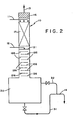
- Figure 2 is a similar view of the system used in the Examples.
- the present invention includes a process for the continuous production of silicon tetrafluoride gas which comprises the steps:
- the present reaction is conducted in a vertical column, as illustrated by the figures and described below in reference thereto.
- the column can be thought of as having three sections, the boundary between the upper and middle sections being defined by the feed point of aqueous fluosilicic acid.
- the product silicon tetrafluoride is scrubbed of impurities such as, especially, hydrogen fluoride and water vapor.
- the middle section including the point of fluosilicic acid introduction and in some cases several effective trays below that point, the present reaction occurs.
- silicon tetrafluoride and, to a lesser extent, hydrogen fluoride disengages from the liquid phase, preferably down to the equilibrium level for such gases in the by-product acid.
- a clear line of demarcation between the middle and lower sections is not required. If silica is fed with fluosilicic acid at the intermediate feed point, then the middle section can be considered those trays to which the silica is confined during operation; and the lower section can then be considered those trays (or effective trays) where only liquid and gas phases are present.
- the number of trays (or their equivalents) in each section, the design of the trays (or their equivalents), the general geometric configuration of the column, and other design features are discussed below in connection with the two forms of the invention: with and without silica feed.
- One feed stream to the present column is aqueous fluosilicic acid, which is fed at an intermediate feed point.
- This stream will always contain water and fluosilicic acid (H 2 SiF 6 ) and, if no other components are present, the fluosilicic acid may be present up to the saturation level, which is about 61 weight percent at 20°C.
- a common additional component in this stream is hydrogen fluoride, either because of recycle from a fumed silica flame reactor (as in the above Flemmert patent), because of evaporative concentration of fluosilicic acid and formation of the ternary azeotrope between water, fluosilicic and hydrogen fluoride (see U.S.
- Patent 4,008,130 to Leather et al. or because HF was initially present in excess in the source of fluosilicic acid (e.g., in the recovery area of a phosphoric acid plant).
- Other materials may also be present in the aqueous stream, such as, for example, iron, phosphorus, sulfur, chlorine or calcium values.
- Such other impurities generally represent less than one weight percent of the aqueous fluosilicic acid stream.
- aqueous fluosilicic acid stream will normally contain 15 - 35%, preferably about 20-30% fluosilic acid, on a weight basis as
- the stoichiometric amount would be one mole Sio 2 for each two moles of H 2 SiF 6 (eq 2) and one mole of Si0 2 for each four moles of excess HF:
- aqueous fluosilicic acid commonly contains dissolved silicon dioxide (as 10 to 30 mole % Si0 2 by moles of H 2 SiF 6 ). Having, for example 23% silica is sometimes called having a "silica number" of 1.23 (1.23 actual moles of silicon value for each mole of silicon based upon H 2 SiF 6 alone).
- the stoichiometric amount of total silicon dioxide (dissolved and suspended on a time average basis, but some variation can occur at any particular time, either because the silica is added intermittently or non- uniformally, because the fluosilicic acid concentration varies over time, or because the HF concentration in the fluosilicic acid varies over time.
- Temperature of the fluosilicic acid feed stream is not critical, and can be room temperature or ambient temperature if the acid feed (and other factors such as insulation on the column) are sufficient to achieve the desired temperature in the reaction zone (at least about 80°C, and preferably between about 90 and about 110°C). Some preheating of the aqueous fluosilicic stream can be performed, if convenient; but feed temperatures causing excessive vapor formation in this feed prior to reaching the column should be avoided.
- Concentrated sulfuric acid feed to the top of the column may be at any concentration between about 80% and about 100% but is preferably between about 90 and about 99%, and is more preferably between about 95 and about 99%, depending upon availability. Temperature of this stream is not critical, with l5°-40°C acid being preferred. There should not, however, be a combination of sulfuric concentration and temperature which causes significant sulfur dioxide or sulfur trioxide vapor pressure at the top of the column, and appropriate temperatures to avoid this for any particular acid feed would be well known or determinable by routine experimentation.
- the feed rate of sulfuric acid should be that producing a weight ratio of in the by-product acid bottoms at least 60%, and preferably between about 70% and about 80%.
- the water used for this calculation will be primarily the water content of the aqueous fluosilicic acid feed stream, and to a lesser extent, the water of the sulfuric acid feed stream, but should also include the by-product water of equation 2 and equation 3 if silica is used.
- the vertical column should be designed and operated in the reaction zone to effect good mixing between the two liquid streams: aqueous fluosilicic acid being fed at the intermediate feed point and concentrated sulfuric acid coming from the upper section of the column.
- Mixing trays having downcomers are used at the point of fluosilicic acid feed.
- modified trays having a hold-up capacity for slurry and small sieve openings for gas to rise should be used below the mixing tray or trays. Examples of such modified trays include seive trays, bubble-cap trays and valve trays.
- indirect heat exchange such as steam jacketing this section of the column
- the upper section of the vertical column should be designed for good gas-liquid contact and, therefore, may be a column filled with trays, packing, or any other equipment used for absorption.
- the temperature in this / upper section is not critical and, in general, will be substantially lower than in the reaction zone and be substantially the same as the temperature of the sulfuric acid feed stream.
- Contact time and especially sulfuric acid flux should be sufficient to lower water vapor and especially hydrogen fluoride concentration in the vapor phase to below 0.1 volume percent, preferably below 0.01 volume percent ( 100 ppm) and more preferably below 0.005 volume percent (50 ppm). Determination of the HF concentration in silica tetrafluoride gas can be made by infrared spectroscopy. It is contemplated to have a demister or similar structure above the sulfuric acid feedpoint, as shown in the Figures.
- the lower section of the column should be designed for sufficient turbulence in downcoming liquid to permit HF and SiF 4 to evaporate to equilibrium levels. Simple cascade trays are preferred in this section, although sieve or bubble trays or packed sections may be used. If no silica is fed into the reaction zone, substantial HF will remain in the by-product acid. If silica is fed into proper amounts, complete reaction will cause substantially only SiF 4 to be present as dissolved gas in the liquid phase in this lower zone (some dissolved or suspended silica may be present). The number of trays (or effective trays if other types of column are used) required for disengagement may be greater in the silica feed case; however, levels of both fluoride and silicon values obtainable are lower in the silica feed case.
- Modification of the above process by feeding some of the sulfuric acid to the mixing tray and/or by feeding silica to the mixing tray separate from the aqueous fluosilicic acid feed (e.g., suspended in sulfuric acid) are contemplated, especially when using coarse sand.
- aqueous fluosilicic acid feed e.g., suspended in sulfuric acid
- FIG. 1 illustrates the operation of preferred embodiments of the present invention.
- a vertical column 10 is shown into which are fed a sulfuric acid stream 11 near the top and an aqueous fluosilicic acid stream near the middle, and from which are withdrawn silicon tetrafluoride vapor 13 at the top and a by-product acid stream 14 from the bottom (through a holding tank 30 as described below).
- the column can be considered as having an upper section 15 above the feedpoint of stream 12, a middle section 20 including and below the feed point of stream 12 and a lower section 25 below middle section 20.
- a demister pad 16 is located above the feedpoint of sulfuric acid stream 11 and below the exit of silicon tetrafluoride stream 13.
- Upper section 15 is designed for scrubbing product vapor with incoming concentrated sulfuric acid and, accordingly, may be any hardware providing for good liquid/gas contacting.
- a section of packing 17 is shown in section 15 which should be of a fluoropolymer material (e.g. polytetrafluorethylene) resistant to both strong sulfuric acid and HF.
- the reaction section 20 should contain trays providing good mixing of two liquids (downcoming sulfuric acid and aqueous fluosilicic acid from feed stream 12).
- a pair of mixing trays 21 are illustrated at and immediately below the feedpoint of stream 12.
- These trays 21 are preferably seive trays, which have weirs forming a liquid (or liquid/solid) hold-up area, small apertures in the vertical portions for up-flowing vapor and downcomers for overflowing liquid (or liquid mixed with silica). Bubble cap trays may also be used in place of the illustrated seive trays 21.
- trays 21, but also in middle section 20 are a series of trays 22 which can be cascade trays with weirs, so as to provide additional hold-up for liquid (or liquid with a decreasing amount of silica on successively lower trays). While heating is normally not required to achieve the desired 90-110°C temperature in middle section 20, effective insulation is normally necessary, at least for columns having an inside diameter less than 15 cm.
- the lower section 25 should be designed for disengagement of dissolved gases (HF and SiF 4 ) in downcoming liquid.
- a series of simple cascade trays 26 are preferred for this purpose, with large passages provided for vapor, once disengaged, to pass up the column into the reaction zone (section 20).
- a clear line of demarcation between section 20 and section 25 is not required, and the lowermost of trays 22 may serve for disengagement under some operating conditions, while the uppermost of trays 26 may serve for reaction under other operating conditions.
- a holding tank 30 is provided below lower section 26 to receive by-product acid. Except under extraordinary operating conditions, neither reaction nor disengagement will occur to a significant extent in holding tank 30 and, accordingly, neither the temperature, the capacity nor the residence time of liquid in holding tank 30 are critical to the operation of the present process. Liquid may be removed from holding tank 30 in a lower outlet 31 (fitted with a valve) or may overflow into an overflow line 32, passing in either event by gravity or pressure within the system out through line 14 to a cooler (not shown). It is preferred not to provide a pump in any of these three lines 31, 32 and 14. When liquid is being removed through line 31, line 32 may (optionally) be left open to permit any entrained gas bubbles to return to holding tank 32.
- Liquid will normally overflow into line 32 only when the valve in line 31 is closed. This latter arrangement may be used if excess silica is being fed through line 12 beyond the stoichiometric amount. In such event, liquid may be removed in line 32 while permitting solids to build up in a modified holding tank 30 designed for liquid/solid separation. Periodically, slurry would be removed through line 31 and filtered to recover solids.
- the size of column 10 and of the elements thereof can be scaled to produce a variety of rates of silicon tetrafluoride gas.
- approximately 5 effective trays in upper section 15, approximately 2 effective trays in middle section 20 and approximately 10 effective trays in lower section 25 should suffice.
- Residence time in holding tank 30 may vary from essentially none to 60 minutes or more.
- at least 10 effective trays in middle section 20 and at least one minute liquid residence time (for fine sand, more may be required for coarser sand) in section 20 are preferably provided to assure both adequate reaction and essentially complete disengagement.
- Example 1 was repeated using 100 pounds per hour (45 kg/h) 98% sulfuric acid in stream 11 at 18-20°C and 50 pounds per hour (23 kg/h) 25% aqueous fluosilicic acid (containing about 23% dissolved Si0 2 by moles H 2 SiF 6 ) in stream 12 at 30 + 6°C.
- the peak operating temperature at steady-state was 93°C.
- the total recovered by-product acid assayed 75% H 2 S0 4 by titration and 0.027% (270 ppm) Si by atomic absorption. This represents a 1.5% yield loss (by moles Si in feed stream 12).
- 98.5% silicon tetrafluoride presumed to be produced 83% was collected during 3 hours, 41 minutes of the 4 hours, 20 minutes run.
- Atomic absorption showed 56 ppm silicon in the waste acid, representing a presumed potential yield of 99.95% SiF 4 , based on moles of both H2S iF 6 and Si0 2 fed.
Landscapes
- Chemical & Material Sciences (AREA)
- Organic Chemistry (AREA)
- Inorganic Chemistry (AREA)
- Silicon Compounds (AREA)
Applications Claiming Priority (2)
| Application Number | Priority Date | Filing Date | Title |
|---|---|---|---|
| US06/505,620 US4470959A (en) | 1983-06-20 | 1983-06-20 | Continuous production of silicon tetrafluoride gas in a vertical column |
| US505620 | 1983-06-20 |
Publications (2)
| Publication Number | Publication Date |
|---|---|
| EP0129112A2 true EP0129112A2 (de) | 1984-12-27 |
| EP0129112A3 EP0129112A3 (de) | 1985-12-04 |
Family
ID=24011107
Family Applications (1)
| Application Number | Title | Priority Date | Filing Date |
|---|---|---|---|
| EP84106092A Ceased EP0129112A3 (de) | 1983-06-20 | 1984-05-29 | Kontinuierliche Produktion von Siliciumtetrafluoridgas in einer vertikalen Säule |
Country Status (4)
| Country | Link |
|---|---|
| US (1) | US4470959A (de) |
| EP (1) | EP0129112A3 (de) |
| JP (1) | JPS6011217A (de) |
| CA (1) | CA1201574A (de) |
Cited By (2)
| Publication number | Priority date | Publication date | Assignee | Title |
|---|---|---|---|---|
| EP0254349A3 (en) * | 1986-07-23 | 1988-08-31 | Enichem Agricoltura S.P.A. | Process for the production of silicon tetrafluoride |
| WO2005030642A1 (en) * | 2003-09-25 | 2005-04-07 | Showa Denko K.K. | Method for producing tetrafluorosilane |
Families Citing this family (16)
| Publication number | Priority date | Publication date | Assignee | Title |
|---|---|---|---|---|
| JPS62133942U (de) * | 1986-02-19 | 1987-08-24 | ||
| US5242670A (en) * | 1992-07-02 | 1993-09-07 | Gehringer Ronald C | Method for hydrofluoric acid digestion of silica/alumina matrix material for the production of silicon tetrafluoride, aluminum fluoride and other residual metal fluorides and oxides |
| US5888468A (en) * | 1998-06-05 | 1999-03-30 | Starmet Corp. | Method for producing silicon tetrafluoride from uranium tetrafluoride |
| US5918106A (en) * | 1998-06-05 | 1999-06-29 | Starmet Corp. | Method for producing uranium oxide and a non-radioactive fluorine compound from uranium tetrafluoride and a solid oxide compound |
| US5901338A (en) * | 1998-06-05 | 1999-05-04 | Starmet Corporation | Method for producing uranium oxide and silicon tetrafluoride from uranium tetrafluoride, silicon, and a gaseous oxide |
| US6033642A (en) * | 1999-03-29 | 2000-03-07 | Starmet Corporation | Method for producing silicon tetrafluoride from uranium oxyfluoride |
| US6096281A (en) * | 1999-03-29 | 2000-08-01 | Starmet Corporation | Method for producing uranium oxide from uranium oxyfluoride |
| US6086836A (en) * | 1999-03-29 | 2000-07-11 | Starmet Corporation | Method for producing uranium oxide from uranium oxyfluoride and silicon |
| JP4576312B2 (ja) * | 2005-10-03 | 2010-11-04 | 東北電力株式会社 | 四フッ化ケイ素の製造方法、及びそれに用いる製造装置 |
| US8528026B2 (en) * | 2008-12-05 | 2013-09-03 | At&T Intellectual Property I, L.P. | System and method for processing audio signals received by a communication device |
| US8124039B2 (en) | 2009-01-26 | 2012-02-28 | Vithal Revankar | Process of silicon tetrafluoride gas synthesis |
| US8529860B2 (en) * | 2009-12-30 | 2013-09-10 | Memc Electronics Materials, Inc. | Methods for producing silicon tetrafluoride |
| US8388925B2 (en) * | 2009-12-30 | 2013-03-05 | Memc Electronic Materials, Inc. | Methods for producing aluminum trifluoride |
| CN101920962B (zh) * | 2010-07-26 | 2012-01-11 | 化学工业第二设计院宁波工程有限公司 | 一种用石英砂法制备四氟化硅的方法 |
| US20120082610A1 (en) * | 2010-10-02 | 2012-04-05 | Channon Matthew J | Fluorspar/Iodide process for reduction,purificatioin, and crystallization of silicon |
| CN101973553B (zh) * | 2010-11-03 | 2015-07-15 | 瓮福(集团)有限责任公司 | 用氟硅酸生产高纯度四氟化硅的方法 |
Family Cites Families (17)
| Publication number | Priority date | Publication date | Assignee | Title |
|---|---|---|---|---|
| CA544842A (en) * | 1957-08-13 | W.R. Grace And Co. | Process for the preparation of silicon tetrafluoride | |
| GB745800A (en) * | 1953-08-06 | 1956-02-29 | Kali Chemie Ag | Process for the production of pure silicon tetrafluoride |
| US2833628A (en) * | 1954-06-09 | 1958-05-06 | Grace W R & Co | Manufacture of silicon tetrafluoride |
| US2813008A (en) * | 1954-06-25 | 1957-11-12 | Du Pont | Method of purifying silicon tetrafluoride |
| US2844441A (en) * | 1954-11-26 | 1958-07-22 | Du Pont | Process of purifying liquid silicon halide |
| GB803756A (en) * | 1955-05-24 | 1958-10-29 | Grace W R & Co | Process for the preparation of silicon tetrafluoride |
| AT215959B (de) * | 1957-08-28 | 1961-07-10 | Paul August Franz Baeumert | Verfahren zur Gewinnung von Siliziumtetrafluorid und/oder Kohlenstofffluoriden sowie gegegenenfalls Fluorwasserstoff oder Aluminium- und Natriumfluorid bzw. Natriumsilikofluorid aus Fluormineralien, insbesondere Flußspat |
| US3218124A (en) * | 1962-09-10 | 1965-11-16 | Tennessee Corp | Process of producing hydrogen fluoride as a dry gas from clear fluosilicic acid-containing solutions |
| US3574542A (en) * | 1969-03-05 | 1971-04-13 | Rufus G Hartig | Process for recovery of hf and h2sif6 from gases containing hf and sif4 |
| US3645678A (en) * | 1970-03-09 | 1972-02-29 | Wellman Lord Inc | Concentrating fluosilicic acid |
| US3645680A (en) * | 1970-03-09 | 1972-02-29 | Wellman Lord Inc | Concentrating fluosilicic acid |
| US3645679A (en) * | 1970-03-09 | 1972-02-29 | Wellman Lord Inc | Concentrating fluosilicic acid |
| US3674431A (en) * | 1970-07-01 | 1972-07-04 | Cities Service Co | Generation of silicon tetrafluoride |
| US3969485A (en) * | 1971-10-28 | 1976-07-13 | Flemmert Goesta Lennart | Process for converting silicon-and-fluorine-containing waste gases into silicon dioxide and hydrogen fluoride |
| US4062930A (en) * | 1973-05-31 | 1977-12-13 | Bohdan Zawadzki | Method of production of anhydrous hydrogen fluoride |
| US4008130A (en) * | 1976-02-23 | 1977-02-15 | The Dow Chemical Company | Method for distilling a ternary azeotrope of fluorosilicic acid, hydrogen fluoride and water |
| US4374111A (en) * | 1980-11-21 | 1983-02-15 | Allied Corporation | Production of silane |
-
1983
- 1983-06-20 US US06/505,620 patent/US4470959A/en not_active Expired - Fee Related
-
1984
- 1984-05-29 EP EP84106092A patent/EP0129112A3/de not_active Ceased
- 1984-05-30 CA CA000455439A patent/CA1201574A/en not_active Expired
- 1984-06-20 JP JP59127232A patent/JPS6011217A/ja active Pending
Cited By (2)
| Publication number | Priority date | Publication date | Assignee | Title |
|---|---|---|---|---|
| EP0254349A3 (en) * | 1986-07-23 | 1988-08-31 | Enichem Agricoltura S.P.A. | Process for the production of silicon tetrafluoride |
| WO2005030642A1 (en) * | 2003-09-25 | 2005-04-07 | Showa Denko K.K. | Method for producing tetrafluorosilane |
Also Published As
| Publication number | Publication date |
|---|---|
| US4470959A (en) | 1984-09-11 |
| JPS6011217A (ja) | 1985-01-21 |
| CA1201574A (en) | 1986-03-11 |
| EP0129112A3 (de) | 1985-12-04 |
Similar Documents
| Publication | Publication Date | Title |
|---|---|---|
| US4470959A (en) | Continuous production of silicon tetrafluoride gas in a vertical column | |
| US5837107A (en) | Process for production of aqueous solutions of free hydroxylamine | |
| US2344346A (en) | Preparation of chlorine dioxide | |
| KR100839274B1 (ko) | 삼불화질소의 제조 방법 및 장치 | |
| US2929852A (en) | Process for the preparation of olefin dichlorides | |
| EP0254349B1 (de) | Verfahren zur Herstellung von Silizium-Tetrafluorid | |
| BG51039A3 (bg) | Метод за пречистване на етиленгликол получен от етиленкарбонат | |
| US4154804A (en) | Novel calcium chloride scrubbing bath | |
| US3386892A (en) | Purification of fluosilicic acid solution by distillation with phosphoric acid solution | |
| IE49567B1 (en) | Continuous process for the removal of sulphur dioxide from waste gases,and hydrogen and sulphuric acid produced thereby | |
| US3687622A (en) | High pressure purification of hydrogen fluoride | |
| CA1146179A (en) | Methylamines manufacture | |
| JPS60145907A (ja) | シラン化合物の連続的製造方法 | |
| US6890508B2 (en) | Preparation of largely HBr-free HCI gas and largely HBr-free aqueous HCI solution | |
| US5789632A (en) | Process of purifying 1,1,1,3,3,-pentafluoro-2,3 dichloropropane | |
| US2777878A (en) | Preparation of tetraethylthiuramdisulfide | |
| RU2399409C2 (ru) | Способ изотопного обогащения | |
| DE10057483B4 (de) | Verfahren zur Entfernung von Aluminiumtrichlorid aus Chlorsilanen | |
| US3454645A (en) | Method of preparing ethylenediamine | |
| US6548669B2 (en) | Method for preparing melamine | |
| JPH06247707A (ja) | 一酸化炭素の製造方法および製造装置 | |
| US7029557B2 (en) | Method for producing an aqueous hydroxylamine solution devoid of salt | |
| US4491572A (en) | Process for preparing sulfur dioxide | |
| US3062616A (en) | Conversion of metal chloride to the corresponding metal nitrate | |
| JPS61151017A (ja) | シラン化合物の連続的製造法 |
Legal Events
| Date | Code | Title | Description |
|---|---|---|---|
| PUAI | Public reference made under article 153(3) epc to a published international application that has entered the european phase |
Free format text: ORIGINAL CODE: 0009012 |
|
| AK | Designated contracting states |
Designated state(s): DE FR GB IT |
|
| PUAL | Search report despatched |
Free format text: ORIGINAL CODE: 0009013 |
|
| AK | Designated contracting states |
Designated state(s): DE FR GB IT |
|
| 17P | Request for examination filed |
Effective date: 19860411 |
|
| 17Q | First examination report despatched |
Effective date: 19870203 |
|
| STAA | Information on the status of an ep patent application or granted ep patent |
Free format text: STATUS: THE APPLICATION HAS BEEN REFUSED |
|
| 18R | Application refused |
Effective date: 19881002 |
|
| RIN1 | Information on inventor provided before grant (corrected) |
Inventor name: HENDRICKSON, JAMES, JR. Inventor name: TALWAR, JAIDEV SINGH |