EP0129347A2 - Methode für eine Stossverbindung von Holzbauteilen in einem Gebäude und Verbindungsplatte zum Ausführen dieser Methode - Google Patents
Methode für eine Stossverbindung von Holzbauteilen in einem Gebäude und Verbindungsplatte zum Ausführen dieser Methode Download PDFInfo
- Publication number
- EP0129347A2 EP0129347A2 EP84303450A EP84303450A EP0129347A2 EP 0129347 A2 EP0129347 A2 EP 0129347A2 EP 84303450 A EP84303450 A EP 84303450A EP 84303450 A EP84303450 A EP 84303450A EP 0129347 A2 EP0129347 A2 EP 0129347A2
- Authority
- EP
- European Patent Office
- Prior art keywords
- timbers
- splice plate
- flanges
- splice
- timber
- Prior art date
- Legal status (The legal status is an assumption and is not a legal conclusion. Google has not performed a legal analysis and makes no representation as to the accuracy of the status listed.)
- Granted
Links
Images



Classifications
-
- E—FIXED CONSTRUCTIONS
- E04—BUILDING
- E04B—GENERAL BUILDING CONSTRUCTIONS; WALLS, e.g. PARTITIONS; ROOFS; FLOORS; CEILINGS; INSULATION OR OTHER PROTECTION OF BUILDINGS
- E04B1/00—Constructions in general; Structures which are not restricted either to walls, e.g. partitions, or floors or ceilings or roofs
- E04B1/18—Structures comprising elongated load-supporting parts, e.g. columns, girders, skeletons
- E04B1/26—Structures comprising elongated load-supporting parts, e.g. columns, girders, skeletons the supporting parts consisting of wood
- E04B1/2604—Connections specially adapted therefor
- E04B1/2612—Joist hangers
Definitions
- This invention relates to a method of butt jointing timbers and to a method of renovating timbers in a building, and to a splice plate for performing the method.
- a method of butt jointing two timbers in a building comprising:-
- step of cutting a slot into one or more surfaces of the timbers to generate internal surfaces of the timbers against which one or more of said flanges may abut.
- the timbers may be slotted on a central longitudinal plane.
- the fasteners preferably comprise nails.
- the invention also provides a splice plate for securing together timbers in performance of the methods according to the invention, the splice plate comprising a single sheet metal member having at least two mutually perpendicular flanges, at least one flange being provided with a plurality of apertures to receive fasteners, and a central portion of the splice plate extending across both or all of the flanges being devoid of apertures.
- the splice plate may be provided with stiffening means, which may comprise ribs or depressions in the metal of the plate. Preferably, these stiffening means are disposed in said central portion devoid of apertures.
- the stiffening means may be localised near the junction between said flanges.
- the apertures may be provided in a pattern such that no three adjacent apertures in any direction are aligned with each other, to reduce the risk of tensile failure of the plate by tearing along a line of apertures and to reduce splitting of the timbers fastened using the plate.
- the splice plate may comprise two flanges, meeting at right angles, one of which is of narrower width than the other.
- the splice plate may comprise three flanges, defining a channel-section, the base of the channel being of the same width as the timbers to be secured together.
- a further alternative form of splice plate is of T-section, the upright of the T being adapted to be inserted into a slot cut in a timber.
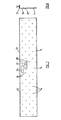
- a splice plate 10 is made of galvanised steel sheet, stainless steel sheet or other strong and corrosion resistant sheet metal. It comprises a first flange 11 and a narrower second flange 12, meeting at right angles at a junction line 13.
- each flange is provided with a plurality of apertures 14, to receive nails, which will be used to secure together timbers for renovation. Careful examination of the pattern of apertures will show that these are arranged so that no three adjacent apertures are aligned. The plate will be subjected to tensile stress in use, and alignment of the apertures could lead to failure by tearing along a line of apertures. The offset pattern of holes helps to prevent such failure. It may also reduce the risk of splitting timbers secured using the splice plate.
- the central portion 15 of the splice plate is devoid of apertures. Building Regulation require that timbers should not be nailed within a certain distance of their ends, to reduce risk of splitting, which could make the nails insecure. The central portion 15 will overlie the ends of two abutting timbers in use.
- stiffening formations in the form of ribs 16 or depressions in the material of the plate, these ribs 16 being made in both first and second flanges 11 and 12.
- the first difference in the embodiment shown in Figures 7 and 8 is that the narrow second flange 12 does not have apertures similar to the apertures 14 shown in Figure 2 and does not have a central stiffening rib 16. It has been found in practice that these can be omitted without detriment to the functioning of the splice plate to be described below and their omission leads to simpler manufacturing.
- a second difference is in the shape of the stiffening formations indicated at 26 and 27 in the drawings.
- a pair of straight stiffening ribs 26, 27 are provided, again lying in the central region of the splice plate which is devoid of apertures.
- the ribs 26, 27 are located adjacent the junction line 13 between the first and second flanges 11 and 12. This provides increased stiffening at the point where it is most needed. This will be referred to again in the description of the use of the splice plate below.
- the ribs 26 and 27 are off-set on opposite sides of the centre line of the splice plate. The reason for this is to avoid the ribs obstructing a hammber which is used to nail fasteners in the group of apertures indicated at 28 which surround the stiffening formation.
- the stiffening formations are intended to stiffen the splice plate, to make it more resistant to the bending moments and shear forces which will be exerted on it in use.
- the method of use of the splice plate needs to be considered, in relation to the chosen example of renovation of rotten timber joists adjacent a wall.
- Figure 9 of the drawings the splice plate of Figures 7 and 8 is shown in use.
- Figure 4 shows a section through the plate of Figures 1 to 3 in use. Where a joist has rotted adjacent a wall, the deteriorated portion is cut out. A substitute timber 29 of the same cross- section as the original joist 30 is cut to the same length as the deteriorated original portion which has been removed. The substitute timber is then placed in the same position as that removed, using the same joist hanger 31 if a suitable one is in use or using a new hanger in the original position. As a further alternative, the joist can be built directly into the masonry (not shown).
- the substitute timber 29 occupies exactly the same position as the deteriorated portion which it replaces and abuts the remaining portion 30 of the original joist, where it is secured by means of the splice plates 10 described.
- Figure 9 these are in the form shown in Figures 7 and 8 but they could be as shown in Figures 1 to 3.
- the substitute timber may be swung laterally or downwardly into a position where it is brought into abutment with one or more splice plates 10 secured to the remaining original timber 30, which serve to support it until the other splice plates 10 are added and the assembly is nailed firmly together.
- the compressive strength of the joint between the joist portions relies mainly on the compressive strength of the joist timbers themselves in their abutting position.
- the tensile strength is derived from that of the metal splice plates 10.
- the stiffening ribs are positioned close to the junction 13 of the flanges 11 and 12 to minimise any tendency for the plate to buckle under this loading.
- Figure 10 illustrates forms of joint which can be secured using the splice plate.
- the timbers are either abutted at upright faces or at mating oblique faces.
- the lowest of the three illustrations showing a pair of timbers which merely make contact at the upper faces is acceptable provided that the gap between the lower faces of the timbers is restricted to a fairly. small size, for example a maximum of 20. mm for a joist of 98 mm nominal depth.
- Joints between joists which make contact only at their lower face are not preferred since the performance of the splice joint is reduced. This is because of the reduction in the compressive strength of the joint, which as previously stated relies mainly on the strength of the joist timbers themselves in their abutting position at the upper face of the joint.
- splice plates shown in Figures 1 to 4 and in Figures 7 and 8 may have particular usefulness in assisting correct positioning of the substitute timber during renovation, other forms of splice plate may be used.
- Figure 5 shows a modified splice plate 17, similar to that of Figures 1 to 4 except that it has a channel-section, effectively combining two of the splice plates 10.
- This form of splice plate 17 is of course limited to use with a particular width of timber, since the base 18 must be of the same width as the timber, so that the side flanges 19, 20 of the channel abut the side faces of the timber 25.
- the extra metal width in the horizontal planes of the top and bottom of the joists gives this version of splice plate some extra strength to resist heavy bending moments.
- the timbers are slotted at 21 on a central upright plane, and a T-shaped splice plate 22 is used, (or two of the angle shaped splice plates 10 are used back- to-back) with the upright web 23 of the T inserted into the slot.
- the web 23 need not be provided with holes, as their positions would not be visible from the face of the timbers. Long nails are driven through the timber, penetrating the web 23 within.
- This version of splice plate provides extra strength on the central longitudinal axis of the timbers at their junction, without obscuring their side faces and without any limitation to the width of timbers which can be secured together.
- splice plate can be devised for use in the method of butt jointing of timbers according to the invention. It will be appreciated that parts of the foregoing description in relation to renovating a rotten joist may not be appropriate to butt jointing of other timbers, such as upright timber studs for example. However, the invention can be applied to such situations with appropriate modifications.
Landscapes
- Engineering & Computer Science (AREA)
- Architecture (AREA)
- Physics & Mathematics (AREA)
- Electromagnetism (AREA)
- Civil Engineering (AREA)
- Structural Engineering (AREA)
- Joining Of Building Structures In Genera (AREA)
Applications Claiming Priority (2)
| Application Number | Priority Date | Filing Date | Title |
|---|---|---|---|
| GB838316644A GB8316644D0 (en) | 1983-06-18 | 1983-06-18 | Butt jointing timbers in building |
| GB8316644 | 1983-06-18 |
Publications (3)
| Publication Number | Publication Date |
|---|---|
| EP0129347A2 true EP0129347A2 (de) | 1984-12-27 |
| EP0129347A3 EP0129347A3 (en) | 1985-05-22 |
| EP0129347B1 EP0129347B1 (de) | 1987-04-08 |
Family
ID=10544456
Family Applications (1)
| Application Number | Title | Priority Date | Filing Date |
|---|---|---|---|
| EP19840303450 Expired EP0129347B1 (de) | 1983-06-18 | 1984-05-22 | Methode für eine Stossverbindung von Holzbauteilen in einem Gebäude und Verbindungsplatte zum Ausführen dieser Methode |
Country Status (4)
| Country | Link |
|---|---|
| EP (1) | EP0129347B1 (de) |
| DE (1) | DE3463068D1 (de) |
| GB (2) | GB8316644D0 (de) |
| IE (1) | IE55178B1 (de) |
Cited By (1)
| Publication number | Priority date | Publication date | Assignee | Title |
|---|---|---|---|---|
| EP1104828A3 (de) * | 1999-12-02 | 2001-08-16 | E.L. HIRZ GmbH & Co. KG | Dachlattenverlängerung |
Families Citing this family (8)
| Publication number | Priority date | Publication date | Assignee | Title |
|---|---|---|---|---|
| GB8332533D0 (en) * | 1983-12-06 | 1984-01-11 | Dinardo & Partners | Restoration and strengthening of timber components |
| GB2233382A (en) * | 1989-06-16 | 1991-01-09 | Donald Alexander Payne | Repairing or supporting a structural member |
| GB2369852A (en) * | 2000-11-18 | 2002-06-12 | Thomas Kelly | Loft joist |
| GB0624066D0 (en) * | 2006-12-01 | 2007-01-10 | Reardon Micheal P | I beam or timber joist, end support or collar or sleeve or shoe or clip or bracket |
| ES2505248B1 (es) * | 2013-04-08 | 2015-03-31 | Carlos González Bravo | Pieza para refuerzo de vigas y viguetas de forjados, pares de cubierta, pies derechos y otros elementos estructurales de madera |
| JP6532144B2 (ja) * | 2015-03-24 | 2019-06-19 | 住友林業株式会社 | 柱の接合構造 |
| CN112854644B (zh) * | 2021-02-04 | 2024-08-16 | 梦牌新材料(宁国)有限公司 | 一种引流式石膏板及其施工方法 |
| JP2023152464A (ja) * | 2022-04-04 | 2023-10-17 | 後藤木材株式会社 | 接合金物、長尺梁材、及び長尺大断面構造材 |
Family Cites Families (13)
| Publication number | Priority date | Publication date | Assignee | Title |
|---|---|---|---|---|
| GB107080A (de) * | ||||
| GB185694A (en) * | 1921-12-30 | 1922-09-14 | Baden Robert Rowell | Improved joint for floor joists and like weight supporting members |
| GB1232592A (de) * | 1967-05-15 | 1971-05-19 | ||
| GB1179267A (en) * | 1967-06-14 | 1970-01-28 | Internat Entpr Inc | Roof Framing System with Adjustable Brackets. |
| GB1417190A (en) * | 1971-12-21 | 1975-12-10 | Turner A R | Wall framing |
| GB1414326A (en) * | 1972-12-21 | 1975-11-19 | Wilson J M | Building constructions |
| GB2043758A (en) * | 1979-03-05 | 1980-10-08 | Hydro Betong Ab | Space framework |
| GB2047320B (en) * | 1979-03-22 | 1983-02-02 | Hydro Air International Ltd | Joist hangers |
| IE50239B1 (en) * | 1979-09-28 | 1986-03-05 | Press Bat Holdings Ltd | A joist support for use in building and a building structure including such a support |
| GB2070184B (en) * | 1980-02-23 | 1983-09-07 | Press Bat Holdings Ltd | Cantiliver bracket for joining joists end to end |
| IE811718L (en) * | 1981-07-29 | 1983-01-29 | Vivion James Glynn | Building element for fixing structural member |
| DE3133014C2 (de) * | 1981-08-20 | 1985-03-21 | Lömpel-Bautenschutz GmbH + Co KG, 8725 Arnstein | Verfahren zur Restaurierung von Holzbalken |
| GB2126307A (en) * | 1982-07-16 | 1984-03-21 | Catnic Components Ltd | A purlin or joist connector |
-
1983
- 1983-06-18 GB GB838316644A patent/GB8316644D0/en active Pending
-
1984
- 1984-05-22 GB GB08413077A patent/GB2141460B/en not_active Expired
- 1984-05-22 EP EP19840303450 patent/EP0129347B1/de not_active Expired
- 1984-05-22 DE DE8484303450T patent/DE3463068D1/de not_active Expired
- 1984-05-24 IE IE130084A patent/IE55178B1/en unknown
Cited By (1)
| Publication number | Priority date | Publication date | Assignee | Title |
|---|---|---|---|---|
| EP1104828A3 (de) * | 1999-12-02 | 2001-08-16 | E.L. HIRZ GmbH & Co. KG | Dachlattenverlängerung |
Also Published As
| Publication number | Publication date |
|---|---|
| EP0129347B1 (de) | 1987-04-08 |
| GB2141460A (en) | 1984-12-19 |
| DE3463068D1 (en) | 1987-05-14 |
| IE841300L (en) | 1984-12-18 |
| IE55178B1 (en) | 1990-06-20 |
| GB8413077D0 (en) | 1984-06-27 |
| GB2141460B (en) | 1986-10-08 |
| EP0129347A3 (en) | 1985-05-22 |
| GB8316644D0 (en) | 1983-07-20 |
Similar Documents
| Publication | Publication Date | Title |
|---|---|---|
| FI83129B (fi) | Framstaellning av timmerbalk genom stoetfog. | |
| US8287206B2 (en) | Decking system and anchoring device | |
| US6708460B1 (en) | Stud wall system and method using a combined bridging and spacing device | |
| US6510666B1 (en) | Sheathing tie down | |
| US6640516B1 (en) | Sheathing tie down | |
| US4209265A (en) | Connector system for wood structures | |
| JPH05295799A (ja) | 木造建築用軸組構造及び軸組具 | |
| US4794746A (en) | Joist bridging | |
| US4549381A (en) | Composite joist system | |
| US4795141A (en) | Cam locked stud nailing fixture | |
| US6343453B1 (en) | Composite wooden beam and method for producing said beam | |
| EP0129347B1 (de) | Methode für eine Stossverbindung von Holzbauteilen in einem Gebäude und Verbindungsplatte zum Ausführen dieser Methode | |
| US4442649A (en) | Fabricated beam | |
| AU768502B2 (en) | Stud wall system and method using combined bridging and spacing device | |
| EP0026397A2 (de) | Stütze für Tragbalken zur Verwendung im Bau und Baustruktur mit einer solchen Stütze | |
| US6463712B1 (en) | Floor truss repair bracket and method of fabrication | |
| EP0032417A1 (de) | Bauvorrichtung, insbesondere zur Unterstützung von Schalungen | |
| AU710215B2 (en) | Steel framing system for walls | |
| EP1251213A2 (de) | Zusammengesetzte Holztragstruktur für Böden | |
| JPH06117096A (ja) | 縁用桟木とこの縁用桟木を有する型枠パネルとこの型枠パネルを用いたコンクリート型枠の組立方法 | |
| JPS6023539A (ja) | 屋根パネルの固定構造 | |
| CA1234471A (en) | Manufacture of wooden beams | |
| GB2185275A (en) | Builders straps with fasteners and anchors | |
| CA2298292A1 (en) | Composite wooden beam and method for producing said beam | |
| JP2025162763A (ja) | 鉄骨梁と木質床版との接合部構造 |
Legal Events
| Date | Code | Title | Description |
|---|---|---|---|
| PUAI | Public reference made under article 153(3) epc to a published international application that has entered the european phase |
Free format text: ORIGINAL CODE: 0009012 |
|
| AK | Designated contracting states |
Designated state(s): BE DE FR GB NL |
|
| PUAL | Search report despatched |
Free format text: ORIGINAL CODE: 0009013 |
|
| AK | Designated contracting states |
Designated state(s): BE DE FR GB NL |
|
| 17P | Request for examination filed |
Effective date: 19850504 |
|
| GRAA | (expected) grant |
Free format text: ORIGINAL CODE: 0009210 |
|
| AK | Designated contracting states |
Kind code of ref document: B1 Designated state(s): BE DE FR NL |
|
| PG25 | Lapsed in a contracting state [announced via postgrant information from national office to epo] |
Ref country code: NL Effective date: 19870408 |
|
| REF | Corresponds to: |
Ref document number: 3463068 Country of ref document: DE Date of ref document: 19870514 |
|
| ET | Fr: translation filed | ||
| NLV1 | Nl: lapsed or annulled due to failure to fulfill the requirements of art. 29p and 29m of the patents act | ||
| BERE | Be: lapsed |
Owner name: PRESS-BAT HOLDINGS LTD Effective date: 19870531 |
|
| PG25 | Lapsed in a contracting state [announced via postgrant information from national office to epo] |
Ref country code: DE Effective date: 19880202 |
|
| PLBE | No opposition filed within time limit |
Free format text: ORIGINAL CODE: 0009261 |
|
| STAA | Information on the status of an ep patent application or granted ep patent |
Free format text: STATUS: NO OPPOSITION FILED WITHIN TIME LIMIT |
|
| PG25 | Lapsed in a contracting state [announced via postgrant information from national office to epo] |
Ref country code: FR Free format text: LAPSE BECAUSE OF NON-PAYMENT OF DUE FEES Effective date: 19880226 |
|
| 26N | No opposition filed | ||
| REG | Reference to a national code |
Ref country code: FR Ref legal event code: ST |
|
| PG25 | Lapsed in a contracting state [announced via postgrant information from national office to epo] |
Ref country code: BE Effective date: 19890531 |