EP0129653A2 - Gasbehälter - Google Patents
Gasbehälter Download PDFInfo
- Publication number
- EP0129653A2 EP0129653A2 EP84104020A EP84104020A EP0129653A2 EP 0129653 A2 EP0129653 A2 EP 0129653A2 EP 84104020 A EP84104020 A EP 84104020A EP 84104020 A EP84104020 A EP 84104020A EP 0129653 A2 EP0129653 A2 EP 0129653A2
- Authority
- EP
- European Patent Office
- Prior art keywords
- container
- gas container
- filling insert
- container according
- aluminum alloy
- Prior art date
- Legal status (The legal status is an assumption and is not a legal conclusion. Google has not performed a legal analysis and makes no representation as to the accuracy of the status listed.)
- Granted
Links
Images
Classifications
-
- F—MECHANICAL ENGINEERING; LIGHTING; HEATING; WEAPONS; BLASTING
- F17—STORING OR DISTRIBUTING GASES OR LIQUIDS
- F17C—VESSELS FOR CONTAINING OR STORING COMPRESSED, LIQUEFIED OR SOLIDIFIED GASES; FIXED-CAPACITY GAS-HOLDERS; FILLING VESSELS WITH, OR DISCHARGING FROM VESSELS, COMPRESSED, LIQUEFIED, OR SOLIDIFIED GASES
- F17C1/00—Pressure vessels, e.g. gas cylinder, gas tank, replaceable cartridge
- F17C1/14—Pressure vessels, e.g. gas cylinder, gas tank, replaceable cartridge constructed of aluminium; constructed of non-magnetic steel
-
- F—MECHANICAL ENGINEERING; LIGHTING; HEATING; WEAPONS; BLASTING
- F17—STORING OR DISTRIBUTING GASES OR LIQUIDS
- F17C—VESSELS FOR CONTAINING OR STORING COMPRESSED, LIQUEFIED OR SOLIDIFIED GASES; FIXED-CAPACITY GAS-HOLDERS; FILLING VESSELS WITH, OR DISCHARGING FROM VESSELS, COMPRESSED, LIQUEFIED, OR SOLIDIFIED GASES
- F17C13/00—Details of vessels or of the filling or discharging of vessels
- F17C13/12—Arrangements or mounting of devices for preventing or minimising the effect of explosion ; Other safety measures
- F17C13/123—Arrangements or mounting of devices for preventing or minimising the effect of explosion ; Other safety measures for gas bottles, cylinders or reservoirs for tank vehicles or for railway tank wagons
-
- F—MECHANICAL ENGINEERING; LIGHTING; HEATING; WEAPONS; BLASTING
- F17—STORING OR DISTRIBUTING GASES OR LIQUIDS
- F17C—VESSELS FOR CONTAINING OR STORING COMPRESSED, LIQUEFIED OR SOLIDIFIED GASES; FIXED-CAPACITY GAS-HOLDERS; FILLING VESSELS WITH, OR DISCHARGING FROM VESSELS, COMPRESSED, LIQUEFIED, OR SOLIDIFIED GASES
- F17C2201/00—Vessel construction, in particular geometry, arrangement or size
- F17C2201/01—Shape
- F17C2201/0104—Shape cylindrical
- F17C2201/0109—Shape cylindrical with exteriorly curved end-piece
-
- F—MECHANICAL ENGINEERING; LIGHTING; HEATING; WEAPONS; BLASTING
- F17—STORING OR DISTRIBUTING GASES OR LIQUIDS
- F17C—VESSELS FOR CONTAINING OR STORING COMPRESSED, LIQUEFIED OR SOLIDIFIED GASES; FIXED-CAPACITY GAS-HOLDERS; FILLING VESSELS WITH, OR DISCHARGING FROM VESSELS, COMPRESSED, LIQUEFIED, OR SOLIDIFIED GASES
- F17C2201/00—Vessel construction, in particular geometry, arrangement or size
- F17C2201/03—Orientation
- F17C2201/032—Orientation with substantially vertical main axis
-
- F—MECHANICAL ENGINEERING; LIGHTING; HEATING; WEAPONS; BLASTING
- F17—STORING OR DISTRIBUTING GASES OR LIQUIDS
- F17C—VESSELS FOR CONTAINING OR STORING COMPRESSED, LIQUEFIED OR SOLIDIFIED GASES; FIXED-CAPACITY GAS-HOLDERS; FILLING VESSELS WITH, OR DISCHARGING FROM VESSELS, COMPRESSED, LIQUEFIED, OR SOLIDIFIED GASES
- F17C2201/00—Vessel construction, in particular geometry, arrangement or size
- F17C2201/03—Orientation
- F17C2201/035—Orientation with substantially horizontal main axis
-
- F—MECHANICAL ENGINEERING; LIGHTING; HEATING; WEAPONS; BLASTING
- F17—STORING OR DISTRIBUTING GASES OR LIQUIDS
- F17C—VESSELS FOR CONTAINING OR STORING COMPRESSED, LIQUEFIED OR SOLIDIFIED GASES; FIXED-CAPACITY GAS-HOLDERS; FILLING VESSELS WITH, OR DISCHARGING FROM VESSELS, COMPRESSED, LIQUEFIED, OR SOLIDIFIED GASES
- F17C2201/00—Vessel construction, in particular geometry, arrangement or size
- F17C2201/05—Size
- F17C2201/056—Small (<1 m3)
-
- F—MECHANICAL ENGINEERING; LIGHTING; HEATING; WEAPONS; BLASTING
- F17—STORING OR DISTRIBUTING GASES OR LIQUIDS
- F17C—VESSELS FOR CONTAINING OR STORING COMPRESSED, LIQUEFIED OR SOLIDIFIED GASES; FIXED-CAPACITY GAS-HOLDERS; FILLING VESSELS WITH, OR DISCHARGING FROM VESSELS, COMPRESSED, LIQUEFIED, OR SOLIDIFIED GASES
- F17C2201/00—Vessel construction, in particular geometry, arrangement or size
- F17C2201/05—Size
- F17C2201/058—Size portable (<30 l)
-
- F—MECHANICAL ENGINEERING; LIGHTING; HEATING; WEAPONS; BLASTING
- F17—STORING OR DISTRIBUTING GASES OR LIQUIDS
- F17C—VESSELS FOR CONTAINING OR STORING COMPRESSED, LIQUEFIED OR SOLIDIFIED GASES; FIXED-CAPACITY GAS-HOLDERS; FILLING VESSELS WITH, OR DISCHARGING FROM VESSELS, COMPRESSED, LIQUEFIED, OR SOLIDIFIED GASES
- F17C2203/00—Vessel construction, in particular walls or details thereof
- F17C2203/06—Materials for walls or layers thereof; Properties or structures of walls or their materials
- F17C2203/0602—Wall structures; Special features thereof
- F17C2203/0612—Wall structures
- F17C2203/0614—Single wall
- F17C2203/0617—Single wall with one layer
-
- F—MECHANICAL ENGINEERING; LIGHTING; HEATING; WEAPONS; BLASTING
- F17—STORING OR DISTRIBUTING GASES OR LIQUIDS
- F17C—VESSELS FOR CONTAINING OR STORING COMPRESSED, LIQUEFIED OR SOLIDIFIED GASES; FIXED-CAPACITY GAS-HOLDERS; FILLING VESSELS WITH, OR DISCHARGING FROM VESSELS, COMPRESSED, LIQUEFIED, OR SOLIDIFIED GASES
- F17C2203/00—Vessel construction, in particular walls or details thereof
- F17C2203/06—Materials for walls or layers thereof; Properties or structures of walls or their materials
- F17C2203/0634—Materials for walls or layers thereof
- F17C2203/0636—Metals
- F17C2203/0646—Aluminium
-
- F—MECHANICAL ENGINEERING; LIGHTING; HEATING; WEAPONS; BLASTING
- F17—STORING OR DISTRIBUTING GASES OR LIQUIDS
- F17C—VESSELS FOR CONTAINING OR STORING COMPRESSED, LIQUEFIED OR SOLIDIFIED GASES; FIXED-CAPACITY GAS-HOLDERS; FILLING VESSELS WITH, OR DISCHARGING FROM VESSELS, COMPRESSED, LIQUEFIED, OR SOLIDIFIED GASES
- F17C2203/00—Vessel construction, in particular walls or details thereof
- F17C2203/06—Materials for walls or layers thereof; Properties or structures of walls or their materials
- F17C2203/0634—Materials for walls or layers thereof
- F17C2203/0636—Metals
- F17C2203/0648—Alloys or compositions of metals
-
- F—MECHANICAL ENGINEERING; LIGHTING; HEATING; WEAPONS; BLASTING
- F17—STORING OR DISTRIBUTING GASES OR LIQUIDS
- F17C—VESSELS FOR CONTAINING OR STORING COMPRESSED, LIQUEFIED OR SOLIDIFIED GASES; FIXED-CAPACITY GAS-HOLDERS; FILLING VESSELS WITH, OR DISCHARGING FROM VESSELS, COMPRESSED, LIQUEFIED, OR SOLIDIFIED GASES
- F17C2205/00—Vessel construction, in particular mounting arrangements, attachments or identifications means
- F17C2205/01—Mounting arrangements
- F17C2205/0153—Details of mounting arrangements
- F17C2205/018—Supporting feet
-
- F—MECHANICAL ENGINEERING; LIGHTING; HEATING; WEAPONS; BLASTING
- F17—STORING OR DISTRIBUTING GASES OR LIQUIDS
- F17C—VESSELS FOR CONTAINING OR STORING COMPRESSED, LIQUEFIED OR SOLIDIFIED GASES; FIXED-CAPACITY GAS-HOLDERS; FILLING VESSELS WITH, OR DISCHARGING FROM VESSELS, COMPRESSED, LIQUEFIED, OR SOLIDIFIED GASES
- F17C2205/00—Vessel construction, in particular mounting arrangements, attachments or identifications means
- F17C2205/03—Fluid connections, filters, valves, closure means or other attachments
- F17C2205/0302—Fittings, valves, filters, or components in connection with the gas storage device
- F17C2205/0308—Protective caps
-
- F—MECHANICAL ENGINEERING; LIGHTING; HEATING; WEAPONS; BLASTING
- F17—STORING OR DISTRIBUTING GASES OR LIQUIDS
- F17C—VESSELS FOR CONTAINING OR STORING COMPRESSED, LIQUEFIED OR SOLIDIFIED GASES; FIXED-CAPACITY GAS-HOLDERS; FILLING VESSELS WITH, OR DISCHARGING FROM VESSELS, COMPRESSED, LIQUEFIED, OR SOLIDIFIED GASES
- F17C2205/00—Vessel construction, in particular mounting arrangements, attachments or identifications means
- F17C2205/03—Fluid connections, filters, valves, closure means or other attachments
- F17C2205/0302—Fittings, valves, filters, or components in connection with the gas storage device
- F17C2205/0323—Valves
- F17C2205/0329—Valves manually actuated
-
- F—MECHANICAL ENGINEERING; LIGHTING; HEATING; WEAPONS; BLASTING
- F17—STORING OR DISTRIBUTING GASES OR LIQUIDS
- F17C—VESSELS FOR CONTAINING OR STORING COMPRESSED, LIQUEFIED OR SOLIDIFIED GASES; FIXED-CAPACITY GAS-HOLDERS; FILLING VESSELS WITH, OR DISCHARGING FROM VESSELS, COMPRESSED, LIQUEFIED, OR SOLIDIFIED GASES
- F17C2209/00—Vessel construction, in particular methods of manufacturing
- F17C2209/21—Shaping processes
- F17C2209/2154—Winding
-
- F—MECHANICAL ENGINEERING; LIGHTING; HEATING; WEAPONS; BLASTING
- F17—STORING OR DISTRIBUTING GASES OR LIQUIDS
- F17C—VESSELS FOR CONTAINING OR STORING COMPRESSED, LIQUEFIED OR SOLIDIFIED GASES; FIXED-CAPACITY GAS-HOLDERS; FILLING VESSELS WITH, OR DISCHARGING FROM VESSELS, COMPRESSED, LIQUEFIED, OR SOLIDIFIED GASES
- F17C2209/00—Vessel construction, in particular methods of manufacturing
- F17C2209/22—Assembling processes
- F17C2209/221—Welding
-
- F—MECHANICAL ENGINEERING; LIGHTING; HEATING; WEAPONS; BLASTING
- F17—STORING OR DISTRIBUTING GASES OR LIQUIDS
- F17C—VESSELS FOR CONTAINING OR STORING COMPRESSED, LIQUEFIED OR SOLIDIFIED GASES; FIXED-CAPACITY GAS-HOLDERS; FILLING VESSELS WITH, OR DISCHARGING FROM VESSELS, COMPRESSED, LIQUEFIED, OR SOLIDIFIED GASES
- F17C2221/00—Handled fluid, in particular type of fluid
- F17C2221/03—Mixtures
- F17C2221/032—Hydrocarbons
-
- F—MECHANICAL ENGINEERING; LIGHTING; HEATING; WEAPONS; BLASTING
- F17—STORING OR DISTRIBUTING GASES OR LIQUIDS
- F17C—VESSELS FOR CONTAINING OR STORING COMPRESSED, LIQUEFIED OR SOLIDIFIED GASES; FIXED-CAPACITY GAS-HOLDERS; FILLING VESSELS WITH, OR DISCHARGING FROM VESSELS, COMPRESSED, LIQUEFIED, OR SOLIDIFIED GASES
- F17C2221/00—Handled fluid, in particular type of fluid
- F17C2221/03—Mixtures
- F17C2221/032—Hydrocarbons
- F17C2221/035—Propane butane, e.g. LPG, GPL
-
- F—MECHANICAL ENGINEERING; LIGHTING; HEATING; WEAPONS; BLASTING
- F17—STORING OR DISTRIBUTING GASES OR LIQUIDS
- F17C—VESSELS FOR CONTAINING OR STORING COMPRESSED, LIQUEFIED OR SOLIDIFIED GASES; FIXED-CAPACITY GAS-HOLDERS; FILLING VESSELS WITH, OR DISCHARGING FROM VESSELS, COMPRESSED, LIQUEFIED, OR SOLIDIFIED GASES
- F17C2223/00—Handled fluid before transfer, i.e. state of fluid when stored in the vessel or before transfer from the vessel
- F17C2223/01—Handled fluid before transfer, i.e. state of fluid when stored in the vessel or before transfer from the vessel characterised by the phase
- F17C2223/0107—Single phase
- F17C2223/0123—Single phase gaseous, e.g. CNG, GNC
-
- F—MECHANICAL ENGINEERING; LIGHTING; HEATING; WEAPONS; BLASTING
- F17—STORING OR DISTRIBUTING GASES OR LIQUIDS
- F17C—VESSELS FOR CONTAINING OR STORING COMPRESSED, LIQUEFIED OR SOLIDIFIED GASES; FIXED-CAPACITY GAS-HOLDERS; FILLING VESSELS WITH, OR DISCHARGING FROM VESSELS, COMPRESSED, LIQUEFIED, OR SOLIDIFIED GASES
- F17C2223/00—Handled fluid before transfer, i.e. state of fluid when stored in the vessel or before transfer from the vessel
- F17C2223/01—Handled fluid before transfer, i.e. state of fluid when stored in the vessel or before transfer from the vessel characterised by the phase
- F17C2223/0146—Two-phase
- F17C2223/0153—Liquefied gas, e.g. LPG, GPL
-
- F—MECHANICAL ENGINEERING; LIGHTING; HEATING; WEAPONS; BLASTING
- F17—STORING OR DISTRIBUTING GASES OR LIQUIDS
- F17C—VESSELS FOR CONTAINING OR STORING COMPRESSED, LIQUEFIED OR SOLIDIFIED GASES; FIXED-CAPACITY GAS-HOLDERS; FILLING VESSELS WITH, OR DISCHARGING FROM VESSELS, COMPRESSED, LIQUEFIED, OR SOLIDIFIED GASES
- F17C2223/00—Handled fluid before transfer, i.e. state of fluid when stored in the vessel or before transfer from the vessel
- F17C2223/03—Handled fluid before transfer, i.e. state of fluid when stored in the vessel or before transfer from the vessel characterised by the pressure level
- F17C2223/033—Small pressure, e.g. for liquefied gas
-
- F—MECHANICAL ENGINEERING; LIGHTING; HEATING; WEAPONS; BLASTING
- F17—STORING OR DISTRIBUTING GASES OR LIQUIDS
- F17C—VESSELS FOR CONTAINING OR STORING COMPRESSED, LIQUEFIED OR SOLIDIFIED GASES; FIXED-CAPACITY GAS-HOLDERS; FILLING VESSELS WITH, OR DISCHARGING FROM VESSELS, COMPRESSED, LIQUEFIED, OR SOLIDIFIED GASES
- F17C2227/00—Transfer of fluids, i.e. method or means for transferring the fluid; Heat exchange with the fluid
- F17C2227/03—Heat exchange with the fluid
- F17C2227/0367—Localisation of heat exchange
- F17C2227/0369—Localisation of heat exchange in or on a vessel
- F17C2227/0376—Localisation of heat exchange in or on a vessel in wall contact
- F17C2227/0379—Localisation of heat exchange in or on a vessel in wall contact inside the vessel
-
- F—MECHANICAL ENGINEERING; LIGHTING; HEATING; WEAPONS; BLASTING
- F17—STORING OR DISTRIBUTING GASES OR LIQUIDS
- F17C—VESSELS FOR CONTAINING OR STORING COMPRESSED, LIQUEFIED OR SOLIDIFIED GASES; FIXED-CAPACITY GAS-HOLDERS; FILLING VESSELS WITH, OR DISCHARGING FROM VESSELS, COMPRESSED, LIQUEFIED, OR SOLIDIFIED GASES
- F17C2227/00—Transfer of fluids, i.e. method or means for transferring the fluid; Heat exchange with the fluid
- F17C2227/03—Heat exchange with the fluid
- F17C2227/0367—Localisation of heat exchange
- F17C2227/0369—Localisation of heat exchange in or on a vessel
- F17C2227/0376—Localisation of heat exchange in or on a vessel in wall contact
- F17C2227/0381—Localisation of heat exchange in or on a vessel in wall contact integrated in the wall
-
- F—MECHANICAL ENGINEERING; LIGHTING; HEATING; WEAPONS; BLASTING
- F17—STORING OR DISTRIBUTING GASES OR LIQUIDS
- F17C—VESSELS FOR CONTAINING OR STORING COMPRESSED, LIQUEFIED OR SOLIDIFIED GASES; FIXED-CAPACITY GAS-HOLDERS; FILLING VESSELS WITH, OR DISCHARGING FROM VESSELS, COMPRESSED, LIQUEFIED, OR SOLIDIFIED GASES
- F17C2260/00—Purposes of gas storage and gas handling
- F17C2260/01—Improving mechanical properties or manufacturing
- F17C2260/011—Improving strength
-
- F—MECHANICAL ENGINEERING; LIGHTING; HEATING; WEAPONS; BLASTING
- F17—STORING OR DISTRIBUTING GASES OR LIQUIDS
- F17C—VESSELS FOR CONTAINING OR STORING COMPRESSED, LIQUEFIED OR SOLIDIFIED GASES; FIXED-CAPACITY GAS-HOLDERS; FILLING VESSELS WITH, OR DISCHARGING FROM VESSELS, COMPRESSED, LIQUEFIED, OR SOLIDIFIED GASES
- F17C2260/00—Purposes of gas storage and gas handling
- F17C2260/01—Improving mechanical properties or manufacturing
- F17C2260/012—Reducing weight
-
- F—MECHANICAL ENGINEERING; LIGHTING; HEATING; WEAPONS; BLASTING
- F17—STORING OR DISTRIBUTING GASES OR LIQUIDS
- F17C—VESSELS FOR CONTAINING OR STORING COMPRESSED, LIQUEFIED OR SOLIDIFIED GASES; FIXED-CAPACITY GAS-HOLDERS; FILLING VESSELS WITH, OR DISCHARGING FROM VESSELS, COMPRESSED, LIQUEFIED, OR SOLIDIFIED GASES
- F17C2260/00—Purposes of gas storage and gas handling
- F17C2260/04—Reducing risks and environmental impact
- F17C2260/042—Reducing risk of explosion
-
- F—MECHANICAL ENGINEERING; LIGHTING; HEATING; WEAPONS; BLASTING
- F17—STORING OR DISTRIBUTING GASES OR LIQUIDS
- F17C—VESSELS FOR CONTAINING OR STORING COMPRESSED, LIQUEFIED OR SOLIDIFIED GASES; FIXED-CAPACITY GAS-HOLDERS; FILLING VESSELS WITH, OR DISCHARGING FROM VESSELS, COMPRESSED, LIQUEFIED, OR SOLIDIFIED GASES
- F17C2260/00—Purposes of gas storage and gas handling
- F17C2260/05—Improving chemical properties
- F17C2260/053—Reducing corrosion
-
- F—MECHANICAL ENGINEERING; LIGHTING; HEATING; WEAPONS; BLASTING
- F17—STORING OR DISTRIBUTING GASES OR LIQUIDS
- F17C—VESSELS FOR CONTAINING OR STORING COMPRESSED, LIQUEFIED OR SOLIDIFIED GASES; FIXED-CAPACITY GAS-HOLDERS; FILLING VESSELS WITH, OR DISCHARGING FROM VESSELS, COMPRESSED, LIQUEFIED, OR SOLIDIFIED GASES
- F17C2270/00—Applications
- F17C2270/01—Applications for fluid transport or storage
- F17C2270/0165—Applications for fluid transport or storage on the road
- F17C2270/0168—Applications for fluid transport or storage on the road by vehicles
-
- F—MECHANICAL ENGINEERING; LIGHTING; HEATING; WEAPONS; BLASTING
- F17—STORING OR DISTRIBUTING GASES OR LIQUIDS
- F17C—VESSELS FOR CONTAINING OR STORING COMPRESSED, LIQUEFIED OR SOLIDIFIED GASES; FIXED-CAPACITY GAS-HOLDERS; FILLING VESSELS WITH, OR DISCHARGING FROM VESSELS, COMPRESSED, LIQUEFIED, OR SOLIDIFIED GASES
- F17C2270/00—Applications
- F17C2270/05—Applications for industrial use
-
- F—MECHANICAL ENGINEERING; LIGHTING; HEATING; WEAPONS; BLASTING
- F17—STORING OR DISTRIBUTING GASES OR LIQUIDS
- F17C—VESSELS FOR CONTAINING OR STORING COMPRESSED, LIQUEFIED OR SOLIDIFIED GASES; FIXED-CAPACITY GAS-HOLDERS; FILLING VESSELS WITH, OR DISCHARGING FROM VESSELS, COMPRESSED, LIQUEFIED, OR SOLIDIFIED GASES
- F17C2270/00—Applications
- F17C2270/07—Applications for household use
- F17C2270/0709—Camping gas
Definitions
- the invention relates to a gas container, and in particular to a liquid gas container, such as a propane gas container, for use in the home and industry.
- Liquid gas containers in particular propane gas bottles, are used in many areas of household, trade and industry, for example as fuel gas storage containers. Such gas containers pose a risk of explosion, especially if a gas-air mixture has formed in the area of the bottle and sudden overheating occurs.
- the invention has for its object to provide a gas container of the type mentioned, which is reliably protected against the formation and spread of flames. And explosions with a simple structure and economical manufacture.
- This object is inventively achieved in that the walls of the container made of aluminum or an aluminum consisting alloy, and that is arranged in the interior of the container a heat-conducting filling insert made of a metallic spatial lattice that is made of aluminum or an aluminum alloy .
- the gas container according to the invention consists of aluminum or an aluminum alloy. This eliminates the risk of corrosion potential between the container walls and the thermally conductive filler insert, which according to the invention is arranged in the container and also consists of aluminum or an aluminum alloy, and also largely eliminates the possibility of friction and heat-generating points in the interior of the container.
- the gas container according to the invention can be used, for example, as a camping gas bottle or fuel gas bottle for burning points in the house stop or used as a liquid gas container for the automotive sector. Due to the filling insert arranged in the interior of the gas container, the heat is dissipated and distributed very quickly over the entire filling insert in the event of heat, thus preventing local overheating and the formation and spread of flames and explosions.
- the container according to the invention can be produced in a simple and economical manner, for example from sheets, tubes or round blanks. Elaborate and expensive anti-corrosion or anti-friction coatings of the container wall material before the container is assembled, in particular on the inner wall sides, are not required in the container according to the invention.
- the container according to the invention has a very low weight and is therefore convenient and practical to handle.
- the gas container according to the invention is advantageously designed such that the filling insert is made of expanded metal.
- Expanded metal which can be produced in a manner known per se from a metal sheet strip or a metal foil by cutting or punching a plurality of slots of limited length and then pulling the sheet or foil apart in a direction transverse to the direction of the slots lattice-like structure, which has honeycomb-like openings with oblique or vertical to the main plane of the lattice opening walls.
- Such an expanded metal can, for example, be rolled into a coil or folded into a folding mechanism, individual layers of the expanded metal coming into contact with one another without penetrating into one another. In this way, a spatial network can be formed which has a relatively high inherent stability and shape retention of the individual lattice components, and in which the lattice material itself takes up only a very small proportion of the volume covered by the lattice work.
- a favorable design of the gas container according to the invention is also given in that the filling insert is made from a mesh.
- a mesh can be made of wire and can also be combined in a number of layers to form packages and larger spatial structures, even if the individual layers come into contact with each other, they do not penetrate into each other, but form a spatial network that is used for most of its volume is an receptive cavity.
- a favorable embodiment of the gas container according to the invention is achieved in that the filling insert is designed as a winding.
- a winding can be made both from an expanded metal and from a mesh.
- a wrap is particularly suitable as a filling insert for gas containers with a cylindrical interior, for example for propane gas bottles of the commercially available shape. After the roll-up, such a roll has a certain radial compressibility, both when it is wound from expanded metal and when it is wound from mesh.
- the wrap can be made in such a size that it must be slightly compressed when it is placed in a container in order to fit into the interior of the container.
- such a wrap After insertion, such a wrap tries to expand a little and then comes to rest against the inner wall of the container and is thus positioned in the container.
- a wrap can be introduced into an initially open cup-shaped lower part of the container during the production of a gas container, a container cap then being subsequently welded onto the cup-shaped lower part.
- the filling insert covers practically the entire interior of a container produced in this way and is secured therein against slipping.
- the gas container according to the invention is advantageously designed in such a way that the filling insert is made of at least two interlocking coils, of which the outer one essentially has the shape of a hollow cylinder, the outside diameter of which is adapted to the inside diameter of the container interior to be filled, and of which the inside diameter are in each case matched to the outer diameter of the respective inner winding which immediately adjoins the inside.
- the outer wrap is inserted through the top opening of the bottle into the interior of the container.
- the outer roll which is designed as a hollow cylinder, can be temporarily provided with indentations or gusset folds in order to reduce its outer diameter to such an extent that it fits through the narrow bottle opening.
- the outer winding automatically returns to its original shape and fills the radially outer regions of the interior of the container.
- the inner roll the outer diameter of which may, for example, substantially correspond to the diameter of the opening of the bottle-shaped container, is then pushed into the interior of the bottle and there into the cavity of the outer roll.
- the inner winding can be compressed slightly elastically so that it can be easily introduced into the space in the outer winding.
- the inner wrap After insertion, the inner wrap then expands again elastically and then comes into contact with the inner area of the outer wrap. If necessary, one or more further inner windings can then be introduced into the first inner wind. Overall, there is a unit forming after the introduction of the winding Filling insert in the container. In this configuration, it is possible to introduce the filling insert even at bottle-shaped containers until the bottle-shaped loading - is already completed container itself. It is not necessary to first insert the filling insert into a pot-shaped lower part of the bottle and then to weld a bottle cap, in which the opening is made, onto the lower part.
- the filling insert is designed as a folding mechanism.
- the production of a filler insert by folding a strip-shaped expanded metal or a strip-shaped mesh grid onto one another leads to an essentially rectangular spatial network.
- Such a structure is particularly suitable as a filling insert for containers with an essentially cuboid interior.
- a gas container according to the invention is advantageously designed in such a way that the filling insert is arranged in the container and is secured against relative movement.
- Such an arrangement is given in the configuration of the filling insert as a winding and corresponding dimensioning of the same in relation to the inside diameter of the container interior.
- a particularly favorable embodiment of the gas container according to the invention is provided in that the expanded metal is produced from a foil made of aluminum or an aluminum alloy with a thickness in the range from 0.02 mm to 0.1 mm, in particular 0.085 mm, by punching and stretching .
- An expanded metal made of an aluminum or an aluminum alloy in the specified thickness range not only has a particularly low weight, but it also ensures an advantageous honeycomb structure of the individual openings of the expanded metal and sufficient inherent rigidity as well as a certain inherent elasticity of a roll or multilayer structure made therefrom.
- a spatial network made from such an expanded metal only occupies between 2 and 4% of the volume covered by the network. Such a filling insert thus only insignificantly reduces the usable volume of the gas container.
- a favorable design of the gas container is also achieved by using AlMgSi1 as the aluminum alloy for the filling insert.
- This aluminum alloy has proven to be particularly suitable as a material for a heat-dissipating and thus explosion-preventing network in the gas container according to the invention.
- the gas container according to the invention can also advantageously be designed such that AlMgSi1 itself is used as the aluminum alloy for the container.
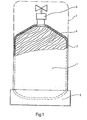
- FIG. 1 shows an exemplary embodiment of a gas container according to the invention designed as a propane gas bottle.
- the actual container 1 is produced by welding a circular cylindrical pot-shaped lower part to a circular cover part.
- the walls 2 of the container 1 consist of the aluminum alloy AlMgSi1.
- At the lower end of the container an annular foot 3 is attached, which is made of the same material.
- a thermally conductive filler insert 4 made of a metallic spatial lattice, which in the present example also consists of the aluminum alloy AlMgSi1.
- the spatial lattice work is shown schematically in FIG. 1 by a bevy of oblique lines and essentially fills the interior of the container 1.
- the lattice work is fixed relative to the container both in the axial and in the radial direction. A relative movement between the container and the filling insert which generates friction cannot therefore take place.
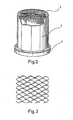
- the filling insert is designed as an expanded metal coil in the illustrated embodiment.
- Fig. 3 shows a section of an expanded metal made of AlMgSil, which was produced from a film of 0.085 mm thickness by punching and stretching. The individual honeycomb openings of the expanded metal are visible in FIG. 3.
- an expanded metal is rolled into a winding 6, the outer diameter of which is dimensioned such that the winding 6 only compresses gently into the initially open pot-shaped lower part the insulating gas bottle can be inserted. After insertion, the wrap 6 elastically expands again in the container and comes into contact with the Inner wall of the container.
- the height of the winding 6 can be such that it also largely fills the interior of the container in the axial direction.
- the winding 6 is thus fixed in its position relative to the container and cannot execute any relative movements.
- the roll 6 of expanded metal forms a spatial lattice work that only occupies between 2 and 4% of the volume over which it extends.
- the lid can be placed on the lower part and connected to it in a gastight manner by a weld seam running all around.
- the tightness of the weld seam can be checked in a known manner, for example by means of X-rays or also by means of an endoscope.
- An endoscope also enables a check of the lattice work installed inside the container.
- a connection and opening valve 5 is arranged on the top of the container.
- both the filling insert made of expanded metal and the container itself are made of the aluminum alloy AlMgSil, no corrosion potential can arise between these parts and there is no abrasion. Local warming caused by such phenomena is therefore avoided from the outset. Furthermore, damage to the propane gas bottle by corrosion is prevented.
- the filling insert acts as a heat-conducting and distributing spatial network, which immediately dissipates any local heat development by dissipating the heat over the entire filling insert area. This makes the filling insert a safety network that prevents and prevents the development of flames and explosions.
- the propane gas bottle according to FIGS. 1 to 3 has a very low weight and is simple and economical to manufacture and easy to handle. Because of their good Flame retardancy and good explosion protection do not require the installation of pressure relief devices and additional valves next to the connection valve.
- a removable cover 7 is provided on the upper part of the propane gas bottle, which is indicated in broken lines in FIG. 1.
- the filling insert is made up of two coils of expanded metal arranged one inside the other.
- the material of each of these coils corresponds to the material of the material specified in the exemplary embodiment according to FIGS. 2 and 3.
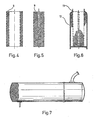
- the outer winding 8 (FIG. 4) and the inner winding 9 (FIG. 5) are each manufactured individually.
- the outer diameter of the outer coil is adapted to the inner diameter of the container to be filled by the filling insert so that the outer coil, after being introduced into the container, lies against the inner wall of the container with a certain intrinsic elasticity.
- the hollow cylindrical outer wrap Because of the relatively small “wall thickness" of the hollow cylindrical outer wrap, it can also be introduced through relatively narrow openings, such as the opening 11 of the bottle 12 (FIG. 6), the cylindrical wrap being temporarily deformed by bending or folding using its own elasticity and is reduced in its outer diameter so that it can be inserted through the opening 11 into the interior of the bottle 12. As soon as the outer roll 8 is in the interior of the bottle 12, it assumes its cylindrical shape again under its own elasticity and expands again so far that it comes to rest on the inner wall of the bottle 12. The inner wrap 9 (FIG. 5) can subsequently be introduced into the bottle 12 through the opening 11. The outside diameter of the inner winding 9 is adapted to the inner diameter of the outer winding 8.
- the inner diameter of the inner wrap can be reduced to such an extent that it can be inserted through the opening 11 of the bottle 12 into the interior of the outer wrap 8.
- a hollow tube 13 of small diameter can be provided in the center of the inner winding 9.
- a test tube or a dip tube can be inserted into such a cavity.
- both coils are hergestllt from the managerial g chen aluminum alloy AlMgSi1 8 and 9, showing also the walls of the bottle 12 are formed do not generate between the two winding of the filling insert or between the filling insert and the container corrosion potentials.
- Both coils 8 and 9 consist of expanded metal made of an AlMgSi foil of 0.085 mm thickness.
- FIG. 7 shows a container according to the invention designed as a fuel gas tank for motor vehicles.
- 7 has a substantially cylindrical shape.
- the filler insert of this container can consist of a wrap made of expanded metal.
- the container itself can be formed from two pot-shaped parts welded together.
- the expanded metal coil which is designed in its diameter, that it can be introduced into the interior of the container with slight deformation, first inserted into a pot-like part of the container.
- the other pot-like part of the container is then pushed over the free-standing end of the coil until it comes into contact with the other pot-like part, after which the two pot-like parts are welded around the circumference at their abutting edges.
- the cylindrical container is then completely filled by the filling insert designed as a winding.
- the aluminum alloy AlMgSil is an advantageous material for both the winding and the walls of the container.
- the coil can be made of expanded metal from a foil of 0.085 mm thickness.
- the length and diameter of the cylindrical LPG tank depend on the required tank capacity. For example, the length can be approximately 1200 mm and the outer diameter can be, for example, 200 to 300 mm.
- Gas containers according to the invention can be produced in different shapes and for a large range of capacities and can be used to store a large number of gases or liquid gases or flammable liquids. In addition to the storage of propane, storage of butane or methane can also be considered.
Landscapes
- Engineering & Computer Science (AREA)
- Mechanical Engineering (AREA)
- General Engineering & Computer Science (AREA)
- Filling Or Discharging Of Gas Storage Vessels (AREA)
- Glass Compositions (AREA)
- Crystals, And After-Treatments Of Crystals (AREA)
Abstract
Description
- Die Erfindung betrifft einen Gasbehälter, und insbesondere einen Flüssiggasbehälter, wie beispielsweise einen Propangasbehälter, zur Verwendung in Haushalt und Industrie.
- Flüssiggasbehälter, insbesondere Propangasflaschen, werden in vielen Bereichen von Haushalt, Gewerbe und Industrie, beispielsweise als Brenngasvorratsbehälter eingesetzt. Bei derartigen Gasbehältern ist Explosionsgefahr gegeben, insbesondere dann, wenn im Bereich der Flasche ein Gas-LuftGemisch entstanden ist und plötzliche überhitzungen auftreten.
- Der Erfindung liegt die Aufgabe zugrunde, einen Gasbehälter der eingangs erläuterten Art zu schaffen, welcher bei einfachem Aufbau und wirtschaftlicher Herstellung zuverlässig gegen Entstehung und Ausbreitung von Flammen.und Explosionen geschützt ist.
- Diese Aufgabe wird erfindungsgemäß dadurch gelöst, daß die Wände des Behälters aus Aluminium oder einer Aluminium- Legierung bestehen, und daß im Inneren des Behälters eine wärmeleitende Fülleinlage aus einem metallischen räumlichen Gitterwerk, das aus Aluminium oder einer Aluminium-Legie- rung besteht, angeordnet ist.
- Der erfindungsgemäße Gasbehälter besteht aus Aluminium oder einer Aluminium-Legierung. Damit ist die Gefahr der Entstehen von Korrosionspotentialen zwischen den Behälterwänden und der erfindungsgemäß in dem Behälter angeordneten wärmeleitenden Fülleinlage, die ebenfalls aus Aluminium oder einer Aluminium-Legierung besteht, und weiterhin weitgehend die Möglichkeit des Entstehens von Reibung und hitzeerzeugenden Stellen im Behälterinneren ausgeschaltet. Der erfindungsgemäße Gasbehälter kann beispielsweise als Camping-Gasflasche oder Brenngasflasche für Brennstellen im Haushalt oder auch als Flüssig-Gasbehälter für den Kraftfahrzeugsektor verwendet werden. Durch die im Inneren des Gasbehälters angeordnete Fülleinlage wird bei punktuell entstehender Hitze die Wärme sehr rasch über die gesamte Fülleinlage abgeleitet und verteilt und damit eine lokale überhitzung und die Entstehung und Ausbreitung von Flammen und Explosionen verhindert. Der erfindungsgemäße Behälter ist beispielsweise aus Blechen, Rohren oder Ronden auf einfache und wirtschaftliche Weise herstellbar. Aufwendige und teuere Korrosionsschutz- oder Reibschutz-Beschichtungen des Behälterwandmaterials vor dem Zusammenbau des Behälters, insbesondere an den Innenwandseiten, sind bei dem erfindungsgemäßen Behälter nicht erforderlich. Der erfindungsgemäße Behälter hat ein sehr geringes Gewicht und ist daher bequem und praktisch handhabbar.
- Mit Vorteil ist der Gasbehälter gemäß der Erfindung so ausgestaltet, daß die Fülleinlage aus Streckmetall gebildet ist. Ein Streckmetall, das in an sich bekannter Weise aus einem Metallblechstreifen oder einer Metallfolie durch Einschneiden oder Einstanzen von einer Vielzahl von Schlitzen begrenzter Länge und nachfolgendes Auseinanderziehen des Bleches oder der Folie in einer quer zu der Richtung der Schlitze verlaufenden Richtung hergestellt werden kann, stellt ein gitterartiges Gebilde dar, das wabenartige Öffnungen mit schräg oder vertikal zur Hauptebene des Gitters verlaufenden Öffnungswänden aufweist. Ein solches Streckmetall kann beispielsweise zu einem Wickel gerollt oder zu einem Faltwerk gefaltet werden, wobei einzelne Lagen des Streckmetalls in Berührung miteinander kommen, ohne ineinander einzudringen. Auf diese Weise kann ein räumliches Netzwerk gebildet werden, das eine relativ große Eigenstabilität und Formhaltigkeit der einzelnen Gitterbestandteile aufweist, und bei dem das Gittermaterial selbst nur einen sehr geringen Anteil des von dem Gitterwerk erfaßten Volumens einnimmt.
- Eine günstige Ausbildung des erfindungsgemäßen Gasbehälters ist auch dadurch gegeben, daß die Fülleinlage aus einem Maschengitter hergestellt ist. Ein solches Maschengitter kann aus Draht gefertigt sein und kann ebenfalls in einer Anzahl von Lagen zu Paketen und größeren räumlichen Gebilden zusammengelegt werden, wobei selbst dann, wenn die einzelnen Lagen in Berührung miteinander kommen, diese nicht ineinander eindringen, sondern ein Raumnetzwerk bilden, das zum größten Teil seines Volumens ein aufnahmefähiger Hohlraum ist.
- Eine günstige Ausgestaltung des erfindungsgemäßen Gasbehälters wird dadurch erreicht, daß die Fülleinlage als Wickel ausgebildet ist. Ein solcher Wickel kann sowohl aus einem Streckmetall, als auch aus einem Maschengitter hergestellt werden. Wegen der zylindrischen Form ist ein Wickel besonders als Fülleinlage für Gasbehälter mit zylindrischem Innenraum, beispielsweise für Propangasflaschen der handelsüblichen Form, geeignet. Nach dem Zusammenrollen weist ein solcher Wickel, sowohl wenn er aus Streckmetall gewickelt ist, als auch wenn er aus Maschengitter gewickelt ist, eine gewisse radiale Kompressibilität auf. Der Wickel kann in einer solchen Größe gefertigt werden, daß er beim Einbringen in einen Behälter leicht zusammengedrückt werden muß, um in den Behälterinnenraum zu passen. Nach dem Einbringen versucht ein solcher Wickel, sich etwas auszudehnen und kommt dann zur Anlage an der Innenwand des Behälters und wird dadurch in seiner Lage im Behälter positioniert. Beispielsweise kann ein solcher Wickel bei der Herstellung eines Gasbehälters in einen zunächst offenen topfförmigen Unterteil des Behälters eingebracht werden, wobei dann nachträglich eine Behälterkappe auf den topfförmigen Unterteil aufgeschweißt wird. Die Fülleinlage erfaßt praktisch den gesamten Innenraum eines so hergestellten Behälters und ist darin gegen Verrutschen gesichert festgelegt.
- Mit Vorteil ist der Gasbehälter gemäß der Erfindung so ausgebildet, daß die Fülleinlage aus mindestens zwei ineinandersteckbaren Wickeln hergestellt ist, von denen der äußere im wesentlichen die Form eines Hohlzylinders aufweist, dessen Außendurchmesser an den Innendurchmesser des zu füllenden Behälterinnenraumes angepaßt ist und von denen die Innendurchmesser jeweils auf den Außendurchmesser des jeweiligen sich unmittelbar nach innen anschließenden inneren Wickels abgestimmt sind. Bei dieser Ausgestaltung ist es möglich, flaschenförmige Behälter mit relativ enger Öffnung rasch, einfach und zuverlässig mit einer den ganzen Innenraum ausfüllenden Fülleinlage zu versehen. Dabei wird zunächst der äußere Wickel durch die obere Öffnung der Flasche hindurch ins Behälterinnere eingebracht. Zu diesem Zweck kann der als Hohlzylinder ausgebildete äußere Wickel vorübergehend mit Einbuchtungen oder ginfaltungen versehen werden, um seinen Außendurchmesser so weit zu verringern, daß er durch die enge Flaschenöffnung hindurchpaßt. Der äußere Wickel stellt sich, sobald er in den Behälterinnenrand gelangt ist, selbsttätig wieder in die ursprüngliche Form zurück und füllt dabei die radial äußeren Bereiche des Innenraumes des Behälters aus. Nachfolgend wird dann der innere Wickel, dessen Außendurchmesser beispielsweise im wesentlichen dem Durchmesser der Öffnung des flaschenförmigen Behälters entsprechen kann, in den Innenraum der Flasche und dort in den Hohlraum des äußeren Wickels eingeschoben. Zu diesem Zweck kann der innere Wickel elastisch geringfügig zusammengedrückt werden, so daß er sich leicht in den Raum im äußeren Wickel einbringen läßt. Nach dem Einfügen weitet sich der innere Wickel dann elastisch wieder etwas aus und kommt dann zur Anlage am Innenbereich des äußeren Wickels. Gegebenenfalls können dann noch ein oder mehrere weitere innere Wickel in den ersten inneren Wickel eingebracht werden. Insgesamt ergibt sich eine nach der Einbringung der Wickel eine Einheit bildende Fülleinlage im Behälter. Bei dieser Ausgestaltung ist es möglich, auch bei flaschenförmigen Behältern die Fülleinlage erst einzubringen, wenn der flaschenförmige Be- hälter an sich bereits fertiggestellt ist. Es ist nicht notwendig, zunächst die Fülleinlage in einen topfförmigen Unterteil der Flasche einzubringen und dann eine Flaschenkappe, in der die öffnung angebracht ist, auf den Unterteil aufzuschweißen.
- Eine andere günstige Ausgestaltung eines erfindungsgemäßen Gasbehälters ist dadurch gegeben, daß die Fülleinlage als Faltwerk ausgebildet ist. Die Herstellung einer Fülleinlage durch mehrlagiges Aufeinanderfalten eines streifenförmigen Streckmetalls oder eines streifenförmigen Maschengitters führt zu einem im wesentlichen rechteckigen Raumnetz. Ein solches Gebilde ist insbesondere als Fülleinlage für Behälter mit im wesentlichen quaderförmigem Innenraum geeignet.
- Mit Vorteil ist ein erfindungsgemäßer Gasbehälter so ausgestaltet, daß die Fülleinlage gegen Relativbewegung gesichert in dem Behälter angeordnet ist. Eine solche Anordnung ist bei Ausgestaltung der Fülleinlage als Wickel und entsprechende Dimensionierung desselben im Verhältnis zum Innendurchmesser des Behälterinnenraums gegeben. Es ist aber beispielsweise auch möglich, eine Fülleinlage in einen zunächst offenen Teil eines Behälters einzubringen und dort punktuell mit der Behälterinnenwand, beispielsweise durch Schweißen, zu verbinden, oder durch eine formschlüssige Verbindung, beispielsweise durch Festhaken an an der Innenwand des Behälters vorgesehenen Vorsprüngen, gegen Relativbewegung zu sichern. Auf diese Weise wird die Gefahr, daß die Fülleinlage an den Innenwänden des Behälters bei starker Bewegung desselben scheuert und dabei Abrieb und Wärme erzeugt, von vornherein unterbunden.
- Eine besonders günstige Ausgestaltung des erfindungsgemäßen Gasbehälters ist dadurch gegeben, daß das Streckmetall aus einer Folie aus Aluminium oder einer Aluminium- Legierung von einer Dicke im Bereich von 0,02 mm bis 0,1 mm, insbesondere 0,085 mm, durch Stanzen und Strecken hergestellt ist. Ein Streckmetall aus einem Aluminium oder einer Aluminium-Legierung in dem angegebenen Dickenbereich hat nicht nur ein besonders geringes Gewicht, sondern es gewährleistet auch eine vorteilhafte Wabenstruktur der einzelnen Öffnungen des Streckmetalls und eine ausreichende Eigensteifigkeit sowie eine gewisse Eigenelastizität eines daraus hergestellten Wickels oder mehrlagigen Gebildes. Ein aus einem solchen Streckmetall hergestelltes Raumnetzwerk nimmt nur zwischen 2 und 4 % des von dem Netzwerk erfaßten Volumens ein. Eine derartige Fülleinlage verringert somit den nutzbaren Rauminhalt des Gasbehälters nur unwesentlich.
- Eine günstige Ausgestaltung des Gasbehälters wird auch dadurch erreicht, daß als Aluminium-Legierung für die Fülleinlage AlMgSi1 verwendet wird. Diese Aluminium- Legierung hat sich als Werkstoff für ein wärmeableitendes und damit explosionsverhinderndes Netzwerk in dem erfindungsgemäßen Gasbehälter als besonders geeignet erwiesen.
- Mit Vorteil kann der Gasbehälter gemäß der Erfindung auch so ausgebildet sein, daß als Aluminium-Legierung für den Behälter selbst AlMgSi1 verwendet ist.
- Im folgenden werden Ausführungsbeispiele des erfindungsgemäßen Gasbehälters, und zwar von Propangasflaschen und eines Treibgastanks für Fahrzeuge, in Verbindung mit der Zeichnung beschrieben. Es zeigen:
- Fig. 1 eine Seitenansicht einer erfindungsgemäßen Propangasflasche, teilweise im Schnitt und teilweise schematisch,
- Fig. 2 eine perspektivische Ansicht einer teilweise aufgeschnittenen Propangasflasche gemäß Fig. 1,
- Fig. 3 einen Teilausschnitt aus einem Streckmetall zur Bildung einer Fülleinlage für die Propangasflasche gemäß Fig. 1 und 2,
- Fig. 4 eine schematische Längsschnittansicht durch einen äußeren hohlzylindrischen Wickel einer aus zwei ineinandergesteckten Wickeln gebildeten Fülleinlage für eine Propangasflasche gemäß Fig. 1,
- Fig. 5 eine schematische Längsschnittansicht durch einen inneren Wickel der Fülleinlage für eine Propangasflasche gemäß Fig. 4,
- Fig. 6 eine schematische Längsschnittansicht durch eine Propangasflasche mit einer aus zwei ineinandergesteckten Wickeln gemäß Fig. 4 und 5 bestehenden Fülleinlage, und
- Fig. 7 eine schematische Seitenansicht eines erfindungsgemäßen Treibgastanks für Fahrzeuge.
- In Fig. 1 ist ein Ausführungsbeispiel eines als Propangasflasche ausgebildeten erfindungsgemäßen Gasbehälters dargestellt. Der eigentliche Behälter 1 ist durch Verschweißen eines kreiszylindrischen topfförmigen Unterteils mit einem kreisrunden Deckelteil hergestellt. Die Wände 2 des Behälters 1 bestehen aus der Aluminium-Legierung AlMgSi1. Am unteren Ende des Behälters ist ein ringförmiger Fuß,3 befestigt, der aus dem gleichen Material gefertigt ist. Im Inneren des Behälters 1 ist eine wärmeleitende Fülleinlage 4 aus einem metallischen räumlichen Gitterwerk, das im vorliegenden Beispiel ebenfalls aus der Aluminium-Legierung AlMgSi1 besteht, angeordnet. Das räumliche Gitterwerk ist in Fig. 1 schematisch durch eine Schar schrägverlaufender Linien dargestellt und füllt das Innere des Behälters 1 im wesentlichen aus. Dadurch ist das Gitterwerk relativ zum Behälter sowohl in axialer als auch in radialer Richtung festgelegt. Eine Reibung erzeugende Relativbewegung zwischen Behälter und Fülleinlage kann somit nicht erfolgen.
- Aus Fig. 2 ist erkennbar, daß die Fülleinlage bei dem dargestellten Ausführungsbeispiel als Streckmetall-Wickel ausgebildet ist. Fig. 3 zeigt einen Ausschnitt aus einem Streckmetall aus AlMgSil, das aus einer Folie von 0,085 mm Stärke durch Stanzen und Recken hergestellt wurde. In Fig. 3 sind die einzelnen wabenförmigen öffnungen des Streckmetalls sichtbar. Zur Erzielung einer zylindrischen Fülleinlage zum Ausfüllen des zylindrischen Innenraums der Propangasflasche gemäß Fig. 1 und 2 wird ein derartiges Streckmetall zu einem Wickel 6 gerollt, dessen Außendurchmesser so bemessen wird, daß sich der Wickel 6 nur unter leichtem Zusammendrücken in den zunächst noch offenen topfförmigen Unterteil der Isoliergasflasche einbringbar ist. Nach dem Einbringen dehnt sich der Wickel 6 in dem Behälter wieder elastisch aus und kommt zur Anlage an der Innenwand des Behälters. Drr Wickel 6 kann in seiner Höhe so bemessen sein, daß er den Innenraum des'Behälters in axialer Richtung ebenfalls weitgehend ausfüllt. Der Wickel 6ist damit relativ zum Behälter in seiner Lage festgelegt und kann keine Relativbewegungen ausführen. Der Wickel 6aus Streckmetall bildet ein räumliches Gitterwerk, das nur zwischen 2 und 4 % des Volumens, über das es sich erstreckt, einnimmt. Nach dem Einbringen des Wickels 6 in den Unterteil der Propanflasche kann der Deckel auf den Unterteil aufgesetzt und durch eine ringsum verlaufende Schweißnaht mit diesem gasdicht verbunden werden. Die Prüfung der Dichtigkeit der Schweißnaht kann in bekannter Weise, beispielsweise mittels Röntgenstrahlen oder auch mittels eines Endoskops erfolgen. Ein Endoskop ermöglicht zusätzlich auch eine Kontrolle des im Inneren des Behälters angebrachten Gitterwerks. An der Oberseite des Behälters ist ein Anschluß- und öffnungsventil 5 angeordnet.
- Durch den Umstand, daß bei der Propangasflasche sowohl die aus Streckmetall bestehende Fülleinlage als auch der Behälter selbst aus der Aluminium-Legierung AlMgSil gebildet sind, können zwischen diesen Teilen keine Korrosionspotentiale entstehen und es entsteht auch kein Abrieb. Durch solche Erscheinungen bedingte lokale Erwärmungen sind daher von vornherein vermieden. Weiterhin ist ein Schadhaftwerden der Propangasflasche durch Korrosion verhindert. Die Fülleinlage wirkt als wärmeleitendes und verteilendes Raumnetz, das etwaige lokale Wärmeentwicklung sofort durch Ableitung der Wärme über den gesamten Fülleinlagebereich abbaut. Damit wird die Fülleinlage als die Entwicklung von Flammen und Explosionen hemmendes und verhinderndes Sicherheitsnetzwerk.
- Die Propangasflasche gemäß Fig. 1 bis 3 hat ein sehr geringes Gewicht und sie ist einfach und wirtschaftlich herstellbar und einfach handhabbar. Wegen ihrer guten Flammhemmung und des guten Explosionsschutzes ist die Anordnung von Überdrucksicherungen und zusätzlichen Ventilen neben dem Anschlußventil nicht erforderlich.
- Am Oberteil der Propangasflasche ist ein abnehmbarer Deckel 7 vorgesehen, der in Fig. 1 in strichpunktierten Linien angedeutet ist.
- In den Fig. 4 bis 6 ist ein Ausführungsbeispiel eines als Propangasflasche ausgebildeten erfindungsgemäßen Gasbehälters dargestellt. Bei diesem Behälter ist die Füll--einlage aus zwei ineinander angeordnete Wickeln aus Streckmetall gebildet. Das Material jedes dieser Wickel stimmt mit dem Material des in dem Ausführungsbeispiel gemäß Fig. 2 und Fig. 3 im einzelnen angegebenen Material überein. Der äußere Wickel 8 (Fig. 4) und der innere Wickel 9 (Fig. 5) werden jeweils für sich hergestellt. Der Außendurchmesser des äußeren Wickels ist an den Innendurchmesser des von der Fülleinlage auszufüllenden Behälters so angepaßt, daß der äußere Wickel nach Einbringung in den Behälter sich unter einer gewissen Eigenelastizität an die Innenwand des Behälters anlegt. Wegen der relativ geringen "Wandstärke" des hohlzylindrischen äußeren Wickels läßt sich dieser auch durch relativ enge Öffnungen, wie die Öffnung 11 der Flasche 12 (Fig. 6) einbringen, wobei der zylindrische Wickel durch Einbiegungen bzw. Einfaltungen vorübergehend unter Ausnutzung seiner Eigenelastizität verformt und in seinem Außendurchmesser so reduziert wird, daß er sich durch die Öffnung 11 in den Innenraum der Flasche 12 einschieben läßt. Sobald der äußere Wickel 8 sich im Innenraum der Flasche 12 befindet, nimmt er unter seiner Eigenelastizität seine zylindrische Form wieder an und weitet sich dabei wieder so weit aus, daß er an der Innenwand der Flasche 12 zur Anlage kommt. Der innere Wickel 9 (Fig. 5) kann nachfolgend durch die Öffnung 11 in die Flasche 12 eingebracht werden. Der Außendurchmesser des inneren Wickels 9 ist an den Innendurchmesser des äußeren Wickels 8 angepaßt. Durch geringfügiges vorübergehendes Zusammendrücken läßt sich der innere Wickel in seinem Außendurchmesser so weit reduzieren, daß er durch die Öffnung 11 der Flasche 12 hindurch in den Innenraum des äußeren Wickels 8 eingeschoben werden kann. Sobald der innere Wickel sich im Innenraum der Flasche 12 befindet, weitet er sich unter seiner Eigenelastizität so weit aus, daß er zur Anlage am Innenumfang des äußeren Wickels 8 kommt und mit diesem Zusammen eine Fülleinlage, die sich wie eine Einheit verhält, bildet. Im Zentrum des Innenwickels 9 kann ein Hohlrohr 13 geringen Durchmessers vorgesehen sein. In einen solchen Hohlraum kann ein Prüfrohr oder ein Tauchrohr eingeführt werden. Bei dieser Ausgestaltung läßt sich der Innenraum flaschenartig geformter Behälter optimal ausfüllen. Die Fülleinlage kann nach Herstellung der Flasche auf einfache Weise in die Flasche eingebracht werden. Es ist somit nicht nötig, die Fülleinlage zunächst in einen topfartigen Unterteil der Flasche einzubringen und erst danach die Flasche durch Aufsetzen und Anschweißen eines Deckels fertigzustellen. Dadurch, daß beide Wickel 8 bzw. 9 aus der glei- chen Aluminiumlegierung AlMgSi1 hergestllt sind, aus der auch die Wände der Flasche 12 gebildet sind, entstehen weder zwischen den beiden Wickeln der Fülleinlage noch zwischen der Fülleinlage und dem Behälter Korrosionspotentiale. Beide Wickel 8 und 9 bestehen aus Streckmetall aus einer AlMgSi-Folie von 0,085 mm Stärke.
- In Fig. 7 ist ein als Treibgastank für Kraftfahrzeuge ausgebildeter erfindungsgemäßer Behälter dargestellt. Der Behälter gemäß Fig. 7 hat im wesentlichen zylindrische Gestalt. Die Fülleinlage dieses Behälters kann aus einem Wickel aus Streckmetall bestehen. Der Behälter selbst kann aus zwei miteinander verschweißten topfförmigen Teilen gebildet sein. In diesem Falle wird der Streckmetallwickel, der in seinem Durchmesser so gestaltet ist, daß er sich unter geringfügiger Deformation in den Innenraum des Behälters einbringen läßt, zunächst in den einen topfartigen Teil des Behälters eingeschoben. Der andere topfartige Teil des Behälters wird dann über das freistehende Ende des Wickels geschoben, bis es zur Anlage an dem anderen topfartigen Teil kommt.Danach werden die beiden topfartigen Teile an ihren aneinanderstoßenden Rändern rings um den Umfang herum verschweißt. Der zylindrische Behälter ist dann durch die als Wickel ausgebildete Fülleinlage vollständig ausgefüllt. Als Material sowohl für den Wickel als auch für die Wände des Behälters kommt die Aluminiumlegierung AlMgSil mit Vorteil in Betracht. Der Wickel kann aus Streckmetall aus einer Folie von 0,085 mm Stärke hergestellt sein. Die Länge und der Durchmesser des zylindrischen Treibgastanks hängen von der erforderlichen Tankkapazität ab. Beispielsweise kann die Länge ca. 1200 mm betragen und der Außendurchmesser kann beispielsweise 200 bis 300 mm betragen.
- Die Erfindung ist nicht auf das dargestellte Ausführungsbeispiel beschränkt. Erfindungsgemäße Gasbehälter können in unterschiedlicher Gestalt und für einen großen Bereich von Fassungsvermögen hergestellt werden und zur Aufbewahrung einer Vielzahl von Gasen bzw. Flüssiggasen bzw. brennbaren Flüssigkeiten eingesetzt werden. Neben der Aufbewahrung von Propan kommt beispielsweise auch die Aufbewahrung von Butan oder Methan in Betracht.
Claims (11)
Priority Applications (1)
| Application Number | Priority Date | Filing Date | Title |
|---|---|---|---|
| AT84104020T ATE39560T1 (de) | 1983-06-22 | 1984-04-10 | Gasbehaelter. |
Applications Claiming Priority (2)
| Application Number | Priority Date | Filing Date | Title |
|---|---|---|---|
| DE3322328 | 1983-06-22 | ||
| DE3322328A DE3322328A1 (de) | 1983-03-04 | 1983-06-22 | Gasbehaelter |
Publications (3)
| Publication Number | Publication Date |
|---|---|
| EP0129653A2 true EP0129653A2 (de) | 1985-01-02 |
| EP0129653A3 EP0129653A3 (en) | 1985-12-04 |
| EP0129653B1 EP0129653B1 (de) | 1988-12-28 |
Family
ID=6201995
Family Applications (1)
| Application Number | Title | Priority Date | Filing Date |
|---|---|---|---|
| EP84104020A Expired EP0129653B1 (de) | 1983-06-22 | 1984-04-10 | Gasbehälter |
Country Status (2)
| Country | Link |
|---|---|
| EP (1) | EP0129653B1 (de) |
| AT (1) | ATE39560T1 (de) |
Cited By (3)
| Publication number | Priority date | Publication date | Assignee | Title |
|---|---|---|---|---|
| EP0256239A1 (de) * | 1986-08-07 | 1988-02-24 | EKSPLO KONTROL Patlamayi Önleyici Maddeler Sanayi ve Ticaret A.S. | Behälterfüllmasse zum Verhindern von Explosionen |
| FR2654694A1 (fr) * | 1989-11-17 | 1991-05-24 | Wabco Westinghouse Equip Ferro | Dispositif de reservoir de pression et systeme de commande de freinage utilisant un tel dispositif. |
| EP0569047A3 (de) * | 1985-09-27 | 1993-12-08 | The Schawbel Corporation | Tragbare Heizvorrichtung |
Family Cites Families (4)
| Publication number | Priority date | Publication date | Assignee | Title |
|---|---|---|---|---|
| DE2306682C3 (de) * | 1972-03-24 | 1975-05-15 | Aluminiumarugyar, Budapest | Aluminiumflasche zur Aufnahme von verflüssigtem Gas unter Druck |
| AU4373279A (en) * | 1978-02-07 | 1979-08-16 | Expanded Metal Co. Ltd., The | Containers |
| CA1150682A (en) * | 1978-03-30 | 1983-07-26 | Andrew Szego | Interior safety device for liquid-containing storage vessels |
| GB2028129B (en) * | 1978-08-17 | 1983-02-02 | Explosafe Sa | Containers and packings therefor |
-
1984
- 1984-04-10 EP EP84104020A patent/EP0129653B1/de not_active Expired
- 1984-04-10 AT AT84104020T patent/ATE39560T1/de not_active IP Right Cessation
Cited By (3)
| Publication number | Priority date | Publication date | Assignee | Title |
|---|---|---|---|---|
| EP0569047A3 (de) * | 1985-09-27 | 1993-12-08 | The Schawbel Corporation | Tragbare Heizvorrichtung |
| EP0256239A1 (de) * | 1986-08-07 | 1988-02-24 | EKSPLO KONTROL Patlamayi Önleyici Maddeler Sanayi ve Ticaret A.S. | Behälterfüllmasse zum Verhindern von Explosionen |
| FR2654694A1 (fr) * | 1989-11-17 | 1991-05-24 | Wabco Westinghouse Equip Ferro | Dispositif de reservoir de pression et systeme de commande de freinage utilisant un tel dispositif. |
Also Published As
| Publication number | Publication date |
|---|---|
| ATE39560T1 (de) | 1989-01-15 |
| EP0129653A3 (en) | 1985-12-04 |
| EP0129653B1 (de) | 1988-12-28 |
Similar Documents
| Publication | Publication Date | Title |
|---|---|---|
| DE3322328A1 (de) | Gasbehaelter | |
| EP0151132B1 (de) | Explosionsunterdrückendes tanksicherheits-elemente-system | |
| DE2652259C2 (de) | Rohrförmiger Behälter zum Aufnehmen und Lagern verbrauchter Kernbrennstoffelemente in einem Abklingbecken und Verfahren zum Herstellen des Behälters | |
| DE9116330U1 (de) | Quetschkupplung für flexible Schläuche | |
| DE2020062A1 (de) | Explosions-Entlastungsventil | |
| DE1486285A1 (de) | Behaelter | |
| DE3435457A1 (de) | Fluessigkeits- und/oder gasbehaelter mit explosionshemmender und verbrennungseinschraenkender waermeleitender einlage | |
| EP1048881A2 (de) | Kältemittelleitung für Klimaanlagen | |
| CH681616A5 (de) | ||
| EP0129653B1 (de) | Gasbehälter | |
| DE3533406C2 (de) | ||
| DE102017114810A1 (de) | Umhüllungseinheit, insbesondere für thermisch zu dämmende Körper | |
| DE102004060591B4 (de) | Tank für kryogene Medien sowie Verfahren und Vorrichtung zu dessen Zusammenbau | |
| DE3307797A1 (de) | Gasbehaelter | |
| AT391301B (de) | Brauchwasserspeicher | |
| DE2834403C2 (de) | Druckspeicher | |
| DE4244315C2 (de) | Katalytische Abgasreinigungsvorrichtung | |
| DE1104607B (de) | Elektrische Spule mit isolierenden Zwischenschichten | |
| DE2843591C2 (de) | Ein strömbares Medium führendes Rohr mit thermischer Isolation, z.B. Innenrohr eines Sackrohres z.B. für Wärmetauscher | |
| EP3167454A1 (de) | Abschirmbehälter für den transport und/oder die lagerung von radioaktiven stoffen | |
| DE2449920C2 (de) | Vorrichtung zur Abgabe von Flüssigkeit | |
| DE10255034A1 (de) | Transportverpackung | |
| DE4339830C2 (de) | Wärmedämmung eines Kugeltanks zur Aufnahme tiefkalter Flüssigkeiten | |
| EP1076780A1 (de) | Tragstruktur mit einem deformationselement mit verkürzter restblocklänge | |
| DE2347288C3 (de) | Membrantank für Flüssiggas |
Legal Events
| Date | Code | Title | Description |
|---|---|---|---|
| PUAI | Public reference made under article 153(3) epc to a published international application that has entered the european phase |
Free format text: ORIGINAL CODE: 0009012 |
|
| AK | Designated contracting states |
Designated state(s): AT BE CH FR IT LI LU NL |
|
| PUAL | Search report despatched |
Free format text: ORIGINAL CODE: 0009013 |
|
| AK | Designated contracting states |
Designated state(s): AT BE CH FR IT LI LU NL |
|
| 17P | Request for examination filed |
Effective date: 19860530 |
|
| 17Q | First examination report despatched |
Effective date: 19870820 |
|
| GRAA | (expected) grant |
Free format text: ORIGINAL CODE: 0009210 |
|
| ITF | It: translation for a ep patent filed | ||
| AK | Designated contracting states |
Kind code of ref document: B1 Designated state(s): AT BE CH FR IT LI LU NL |
|
| PG25 | Lapsed in a contracting state [announced via postgrant information from national office to epo] |
Ref country code: NL Effective date: 19881228 |
|
| REF | Corresponds to: |
Ref document number: 39560 Country of ref document: AT Date of ref document: 19890115 Kind code of ref document: T |
|
| ET | Fr: translation filed | ||
| ITTA | It: last paid annual fee | ||
| PG25 | Lapsed in a contracting state [announced via postgrant information from national office to epo] |
Ref country code: LU Free format text: LAPSE BECAUSE OF NON-PAYMENT OF DUE FEES Effective date: 19890430 Ref country code: LI Effective date: 19890430 Ref country code: CH Effective date: 19890430 Ref country code: BE Effective date: 19890430 |
|
| PGFP | Annual fee paid to national office [announced via postgrant information from national office to epo] |
Ref country code: FR Payment date: 19890614 Year of fee payment: 6 |
|
| NLV1 | Nl: lapsed or annulled due to failure to fulfill the requirements of art. 29p and 29m of the patents act | ||
| PGFP | Annual fee paid to national office [announced via postgrant information from national office to epo] |
Ref country code: AT Payment date: 19890627 Year of fee payment: 6 |
|
| BERE | Be: lapsed |
Owner name: POSCHINGER UDO Effective date: 19890430 |
|
| PLBE | No opposition filed within time limit |
Free format text: ORIGINAL CODE: 0009261 |
|
| STAA | Information on the status of an ep patent application or granted ep patent |
Free format text: STATUS: NO OPPOSITION FILED WITHIN TIME LIMIT |
|
| REG | Reference to a national code |
Ref country code: CH Ref legal event code: PL |
|
| 26N | No opposition filed | ||
| PG25 | Lapsed in a contracting state [announced via postgrant information from national office to epo] |
Ref country code: AT Effective date: 19900410 |
|
| PG25 | Lapsed in a contracting state [announced via postgrant information from national office to epo] |
Ref country code: FR Effective date: 19901228 |
|
| REG | Reference to a national code |
Ref country code: FR Ref legal event code: ST |