EP0129984B1 - 2'-Desoxy-5-substituierte Uridin-Derivate, Verfahren zu ihrer Herstellung und diese enthaltende Antitumor- Zusammensetzungen - Google Patents
2'-Desoxy-5-substituierte Uridin-Derivate, Verfahren zu ihrer Herstellung und diese enthaltende Antitumor- Zusammensetzungen Download PDFInfo
- Publication number
- EP0129984B1 EP0129984B1 EP84303476A EP84303476A EP0129984B1 EP 0129984 B1 EP0129984 B1 EP 0129984B1 EP 84303476 A EP84303476 A EP 84303476A EP 84303476 A EP84303476 A EP 84303476A EP 0129984 B1 EP0129984 B1 EP 0129984B1
- Authority
- EP
- European Patent Office
- Prior art keywords
- compound
- deoxy
- group
- carbon atoms
- trifluoromethyluridine
- Prior art date
- Legal status (The legal status is an assumption and is not a legal conclusion. Google has not performed a legal analysis and makes no representation as to the accuracy of the status listed.)
- Expired
Links
- 0 CC(*)(*)c1ccccc1 Chemical compound CC(*)(*)c1ccccc1 0.000 description 1
- IRVSVKDHRRNHDC-UHFFFAOYSA-N CC(CO)(C(CCC1)O)OC1N(C=C(C)C(N1C)=O)C1=C Chemical compound CC(CO)(C(CCC1)O)OC1N(C=C(C)C(N1C)=O)C1=C IRVSVKDHRRNHDC-UHFFFAOYSA-N 0.000 description 1
Classifications
-
- C—CHEMISTRY; METALLURGY
- C07—ORGANIC CHEMISTRY
- C07H—SUGARS; DERIVATIVES THEREOF; NUCLEOSIDES; NUCLEOTIDES; NUCLEIC ACIDS
- C07H19/00—Compounds containing a hetero ring sharing one ring hetero atom with a saccharide radical; Nucleosides; Mononucleotides; Anhydro-derivatives thereof
- C07H19/02—Compounds containing a hetero ring sharing one ring hetero atom with a saccharide radical; Nucleosides; Mononucleotides; Anhydro-derivatives thereof sharing nitrogen
- C07H19/04—Heterocyclic radicals containing only nitrogen atoms as ring hetero atom
- C07H19/06—Pyrimidine radicals
-
- C—CHEMISTRY; METALLURGY
- C07—ORGANIC CHEMISTRY
- C07D—HETEROCYCLIC COMPOUNDS
- C07D405/00—Heterocyclic compounds containing both one or more hetero rings having oxygen atoms as the only ring hetero atoms, and one or more rings having nitrogen as the only ring hetero atom
- C07D405/02—Heterocyclic compounds containing both one or more hetero rings having oxygen atoms as the only ring hetero atoms, and one or more rings having nitrogen as the only ring hetero atom containing two hetero rings
- C07D405/04—Heterocyclic compounds containing both one or more hetero rings having oxygen atoms as the only ring hetero atoms, and one or more rings having nitrogen as the only ring hetero atom containing two hetero rings directly linked by a ring-member-to-ring-member bond
Definitions
- the present invention relates to novel 2'-deoxy-5-substituted uridine derivatives, processes for preparing the derivatives and antitumor agents containing the same as the active ingredient.
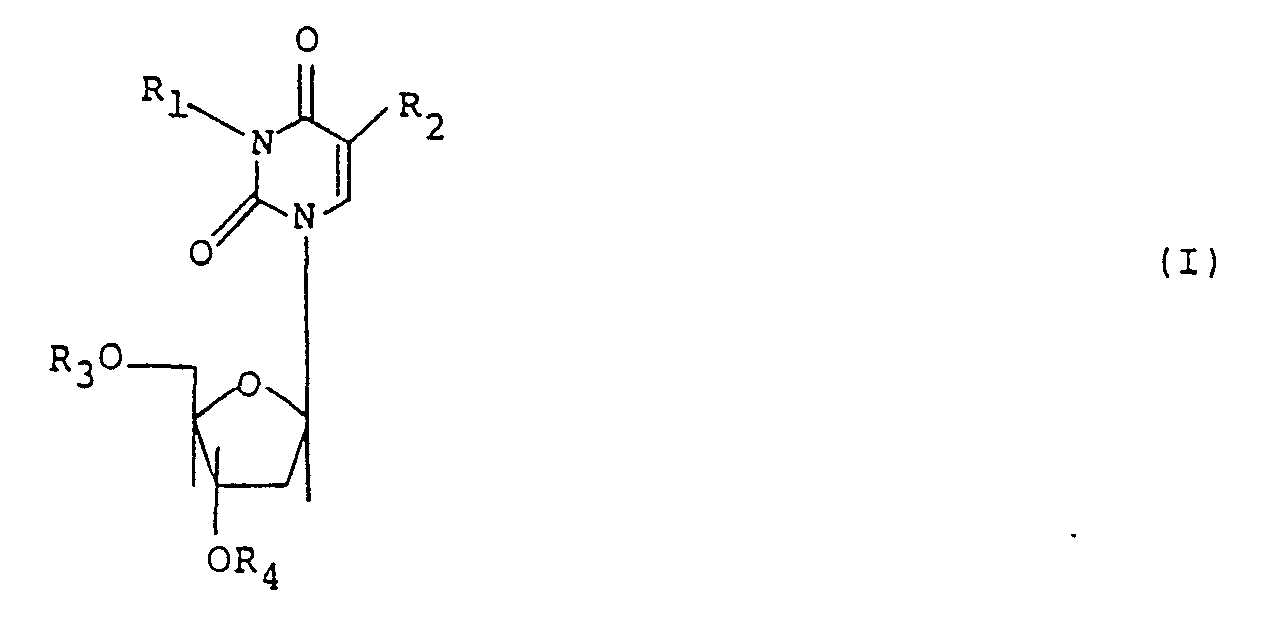
- compounds for use as antitumour agents are represented by the general formula (I), wherein R, is a hydrogen atom, a benzoyl group or a tetrahydrofuranyl group; R 2 is a fluorine atom or a trifluoromethyl group; and one of R 3 and R 4 is a hydrogen atom and the other is an alkyl group having 1 to 10 carbon atoms, an alkenyl group having 2 to 6 carbon atoms, a benzyl group optionally having one or more substituents selected from halogen atoms, alkyl groups having 1 to 4 carbon atoms, alkoxy groups having 1 to 4 carbon atoms and nitro groups, or an alkyl group having 1 to 3 carbon atoms and having one or two phenyl groups as substituent(s).
- R is a hydrogen atom, a benzoyl group or a tetrahydrofuranyl group
- R 2 is a fluorine atom or a trifluoromethyl group
- F 3 TdR 2'-Deoxy-5-trifluoromethyl uridine
- F 3 TdR has an antitumor activity and that its therapeutic index for Andenocarcinoma 755 is superior to that of 2'-deoxy-5-fluorourdine (hereinafter referred to as FudR) [Cancer Research, Vol. 24, pp. 1979 (1964)]. Also it is known that F 3 TdR has a high antiviral activity [Cancer Research, Vol. 30, pp. 1549 (1970)].
- F 3 TdR has not yet shown any clinical effects, and accordingly is not utilized as an antitumour agent.
- FudR has a very high carcinostatic activity in vitro, namely, a carcinostatic activity is as high as about 100 times that of 5-fluorouracil (hereinafter referred to as 5-FU) [C. Heiderberger: Proceedings of the Society for Experimental Biology & Medicine, Vol. 97, pp. 470 (1958)]. Further, FudR was expected to be a carcinostatic agent having higher effect, because FudR is converted, in vivo, into the active form of 5-fluoro-2'-deox Y -I3-uridine-5'-monophosphate more easily than 5-FU.
- 5-FU 5-fluorouracil
- FudR when FudR is administred in vivo, it is easily decomposed into 5-FU by nucleosidephosphorylase [G.D. Birnie, et al.: Biochimica et Biophysica Acta, Vol. 76, pp. 315 (1963)] and that FudR has a poor prolonged action in blood and is excreted very quickly and hence is inferior to 5-FU in carcinostatic effect [F. Kanzawa, et al., European Journal of Cancer, Vol. 16, pp. 1087 (1980)].
- FudR as a medicine is very toxic and has a small safety margin and that its administration is limited only to intra-arterial injection and no oral administration is possible which is a big handicap in actual care [PHYSICIAN'S DESK REFERENCE, 32 edition, p. 1387, (1978)].
- DE-A-2658672 discloses a number of 5-substituted uridine and dithioxouridine derivatives for use as antiviral agents.
- the present invention makes it possible to provide 2'-deoxy-5-substituted uridine derivatives represented by the general formula (I), having antitumor activity.
- the invention also makes it possible to provide processes for preparing said 2'-deoxy-5-substituted uridine derivatives represented by the general formula (I).
- the invention further makes is possible to provide antitumour agents containing a 2'-deoxy-5- substituted uridine derivative represented by the general formula (I) as the active ingredient.
- the present invention provides compounds of the general formula (I)
- R is a hydrogen atom, a benzoyl group or a tetrahydrofuranyl group
- R 2 is a fluorine atom or a trifluoromethyl group
- one of R 3 and R 4 is a hydrogen atom and the other is an alkyl group having 1 to 10 carbon atoms, an alkenyl group having 2 to 6 carbon atoms, a benzyl group optionally having one or more substituents selected from halogen atoms, alkyl groups having 1 to 4 carbon atoms, alkoxy groups having 1 to 4 carbon atoms and nitro groups, or an alkyl group having 1 to 3 carbon atoms and having one or two phenyl groups as substituent(s), with the proviso that the compound is not 2'-deoxy-3'-O-methyl-5-fluorourdine or 2'-deoxy-5'-O-methyl-5-fluorouridine.
- the present invention further provides the use of compounds of the invention in the manufacture of an antitumor agent, and a process for producing the compounds.
- the alkyl group having 1 to 10 carbon atoms as defined in R 3 or R 4 may be a straight-chain or a branched-chain alkyl group, for example, a methyl, ethyl, propyl, isopropyl, butyl, sec-butyl, tert-butyl, pentyl, hexyl, heptyl, octyl, or decyl group preferably an alkyl group having 1 to 6 carbon atoms;
- the alkenyl group having 2 to 6 carbon qtoms may be a straight-chain or a branched-chain alkenyl group, for exaple, a vinyl, allyl, 2-butenyl, 3-butenyl, 2-methyl-2-propenyl, 2-pentenyl, or 5-hexenyl group
- the alkyl group having 1 to 4 carbon atoms as a possible substitutent of the benzyl group may be a straight-chain or
- Derivatives of the present invention represented by the general formula (I) can be prepared by various processes which differ according to the kind of R, group of the general formula (I). That is, those derivatives of the present invention wherein R, of the general formula (I) is a benzoyl group or a tetrahydrofuranyl group can be obtained by reacting, for example, F 3 TdR or FudR asa starting material with a benzoic acid halide or 2-chlorotetrahydrofuran, respectively, to form a 3-substituted-2'-deoxy-5-substituted uridine derivative represented by the general formula (II), wherein R 2 is the same as defined above; and R,' is same as defined for provided that a hydrogen atom is excluded, and reacting the resulting uridine derivative of the general formula (II) with a halogen compound represented by the general formula (III), wherein R is an alkyl group having 1 to 10 carbon atoms, an alkenyl group having 2 to
- the reaction of a compound of the general formula (II) with a halogen compound of the general formula (III) is conducted ordinarily in a suitable solvent in the presence of a catalyst.
- the solvent used in this reaction is not particularly restricted, unless it has any adverse effects on the reaction; specific examples include ketones such as acetone, methyr ethyl ketone, 3-pentanone and the like; polar solvents such as acetonitrile, dimethylformamide, dimethyl sulfoxide and the like; etc.
- the catalyst used in this reaction there can be used any of those catalysts which are ordinarily employed in this kind of reaction. Particularly, for example, metal oxides such as silver oxide, barium oxide, mercury oxide and the like are preferably used.
- the halogen compound of the general formula (III) be used ordinarily in an amount of 1 to 10 moles, preferably 2 to 5 moles relative to 1 mole of the 3-substituted-2'-deoxy-5- substituted uridine derivative of the general formula (II).
- the reaction temperature is not particularly restricted, and ordinarily is from room temperature to about 100°C, preferably abot 50° to 80°C.
- R is the general formula (I) is a benzoyl group or a tetrahydrofuranyl group.
- Those derivatives of the present invention wherein R, in the general formula (I) is a hydrogen atom can be prepared by reacting, for example, a compound of the general formula (I) wherein R, is a benzoyl group, which can be obtained by the above described reaction, with an acid or alkali to remove the benzoyl group.
- an acid or alkali used in this benzoyl group removing reaction, any acid or alkali compound usually used in an ordinary benzoyl group removing reaction can be used.
- Preferred acids include, for example, mineral acids such as hydrochloric acid and the like as well as sulfonic acids such as p-toluenesulfonic acid and the like.
- Preferred alkalis include, for example, inorganic bases such as sodium hydroxide, ammonia and the like; organic bases such as alkyl amines such as n-butylamine and the like; metal alcoholates such as sodium alcoholate, potassium alcoholate and the like; and metal amides such as sodium amide, potassium amide and the like.
- the above-mentioned benzoyl group removing reaction is conducted ordinarily in a suitable solvent such as water or an alcohol.
- the reaction temperature is about 0° to 60°C, and preferably is room temperature or thereabouts.
- Derivatives of the present invention, wherein R, in the general formula (I) is a tetrahydrofuranyl group can also be prepared by reacting, for example, a derivative of the present invention wherein R 1 in the general formula (I) is a hydrogen atom, which is obtained by the above described process, with 2-chlorotetrahydrofuran in the presence of a basic compound.
- the base include inorganic bases such as sodium hydroxide, or ammonia as well as organic bases such as pyridine or an alkylamine.
- the above reaction is conducted ordinarily in a suitable solvent such as dimethylformamide or dimethylacetamide.
- the reaction temperature usually is about -50° to 100°C, preferably is 0° to 50°C.
- each of R 8 and Rg is a hydrogen atom or a methyl group, provided that R 8 and Rg are not a hydrogen atom at the same time, can be prepared by reacting F 3 TdR or FudR with a compound represented by the general formula (V), wherein R 8 and Rg each are the same as defined above.
- This reaction may be conducted in the absence or presence of a solvent; preferably the reaction is conducted in the presence of a solvent.
- the solvent used this reaction is not particularly restricted unless it is any adverse effect on the reaction. Examples of the solvents include ethers such as ethyl ether, or dioxane as well as polar solvents such as chloroform, pyridine, acetonitrile, or dimethylformamide.
- a compound of the general formula (V) is used ordinarily in an amount of 1 to 10 moles, preferably 1 to 4 moles relative to 1 mole of FudR or F 3 TdR.
- the above reaction proceeds even in the absence of a catalyst, but preferably is conducted in the presence of a catalyst.
- the catalysts which may be used in this reaction include acid catalysts such as hydrochloric acid, p-toluenesulfonic acid, aluminum chloride and the like.
- the reaction temperature ordinarily is a room temperature to about 100°C, preferably 60° to 80°C.
- Derivatives of the present invention prepared according to each of the above-mentioned processes can be isolated and purified by any one of known methods for separation and purification, for example, recrystallization or column chromatography.
- 2'-Deoxy-5-substituted uridine derivatives of the present invention represented by the general formula (I) are useful as antitumor agents.
- a suitable, pharmaceutically acceptable carrier as a pharmaceutical preparation having a form suitable for the desired administration purposes.
- the carrier may be, for example, a diluent, a binder, a lubricant, a coloring agent or a disintegrator, which is conventionally used and pharmaceutically acceptable.
- the pharmaceutical preparation may take the form of tablets, capsules, granules, powder, liquid for oral administration, or may be in injectable form for non-oral administration methods such as intravenous injection.
- the pharmaceutical preparation may also take the form of suppositories for intra-rectal administration.
- the contents of the active ingredient (compound of the present invention) per unit form of each pharmaceutical preparation can be chosen so as to be appropriate for that particular form and is not substantially different from those in other pharmaceutical preparations.
- a preferred content of the active ingredient is about 25 to 500 mg per 1 unit.
- Pharmaceutical preparation of the above forms can be carried out according to the respective usual methods.
- each pharmaceutical preparation naturally differs according to the condition, the weight, the age of a patient to whom the pharmaceutical preparation is to be administered and accordingly cannot be restricted; in general, administration to adults may be made so that the adult receives about 100 to 2000 mg of the active ingredient daily. This amount of the active ingredient can be administered as one to six doses a day.
- toxicity values of anti-malignant tumor agents have been calculated on the bases of LD 50 of test animals, in most cases.
- LD 50 is measured under serious conditions of the test animals very different from the conditions of a patient where drugs are actually used and accordingly LD 50 does not represent a practical indication of the toxicity of a drug. Therefore, in the present test, accumulated toxicity, which gives a good indication of the toxicity of anti-malignant tumor agents, was focused on and, as an indication for sensitive detection of the accumulated toxicity, inhibition of weight increase of the test animals was measured. That is, when antitumor activity value was determined in the above item (a), the weight of each mouse of each test group for each test compound was measured daily from the day of tumor transplanting, immediately before administration.
- the therapeutic index (hereinafter referred to as C) was calculated in accordance with the following equation.
- a larger therapeutic index of a compound means that the compound is better balanced in effect and toxicity and more useful.
- Tables 1-a, 1-b and 1-c are shown the results of the above tests, on compounds of the present invention obtained in each of the Examples which follow (the same numeral was used both in the Tables and the Examples for the same compound) as well as on comparative compounds, namely, F 3 TdR and FudR.
- Compound 15 lactose, crystalline cellulose and corn starch are mixed in the following proportions. Further, magnesium stearate is mixed with them in the following proportion. This mixture is filled in capsules by the use of a suitable capsule-filling machine so that one capsule contains about 293 mg of the mixture, whereby an intended capsule product is obtained.
- Compound 40 lactose, crystalline cellulose and corn starch are mixed in the following proportions. Thereto is added a 10%-ethanol solution containing hydroxypropyl cellulose and they are kneaded. Then, by the use of an appropriate granulator, the kneaded mixture is made into granules. After drying, the granules are made uniform so as to have granular size of 12 to 42 mesh. Subsequently, the granules are coated with hydroxypropyl methyl cellulose in the following proportion by the use of a suitable coating machine. The coated granules are again made uniform so as to have granular size of 12 to 42 mesh, whereby a granular produce is obtained.
- Compound 33 corn starch and calcium cellulose glycolate are mixed in the following proportions. Thereto is added a 10%-ethanol solution containing hydroxypropyl cellulose, and they are kneaded. The kneaded mixture is made into granules by the use of an appropriate granulator. After drying, the granules are mixed with magnesium stearate and silicic acid anhydride in the following proportion and then the mixture is made into tablets by the use of a suitable tablet machine. The tablets are coated with hydroxypropyl methyl cellulose, whereby an intended tablet product is obtained.
- Witepzol W-35 (trademark, for a suppository base material manufactured by Dynamite Nobel Co.) is melted at about 60°C and then kept at about 45°C. This is mixed with compound 12 in the following proportion. The mixture is molded into suppositories each of 1 g by the use of a suitable suppository- manufacturing machine.
- Reference Examples are for preparation of raw materials of the present invention compounds, namely, 3-benzoyl-2'-deoxy-5-trifluoromethyluridine, 3-(2-tetrahydrofuranyl)-2'-deoxy-5-trifluoromethyluridine and 3-benzoyl-2'-deoxy-5-flourouridine. Examples are for preparation of compounds of the present invention.
- the eluate was subjected to recrystallization from benzene to obtain 2.07 g (yield: 39.8%) of 3-benzoyl-2'-deoxy-3'-O-(4-methoxybenzyl)-5-trifluoromethyluridine (compound 8) having a melting point of 142° to 143°C.
- the eluate was further subjected to recrystallization from acetone-benzene to obtain 0.64 g (yield: 12.4%) of 3-benzoyl-2'-deoxy-5'-O-(4-methoxybenzyl)-5-trifluoromethyluridine (compound 7) having a melting point of 152° to 153°C.
Landscapes
- Chemical & Material Sciences (AREA)
- Organic Chemistry (AREA)
- Health & Medical Sciences (AREA)
- Life Sciences & Earth Sciences (AREA)
- Engineering & Computer Science (AREA)
- Biochemistry (AREA)
- Biotechnology (AREA)
- General Health & Medical Sciences (AREA)
- Genetics & Genomics (AREA)
- Molecular Biology (AREA)
- Pharmaceuticals Containing Other Organic And Inorganic Compounds (AREA)
- Organic Low-Molecular-Weight Compounds And Preparation Thereof (AREA)
Claims (33)



Applications Claiming Priority (6)
| Application Number | Priority Date | Filing Date | Title |
|---|---|---|---|
| JP91190/83 | 1983-05-23 | ||
| JP58091190A JPS59216899A (ja) | 1983-05-23 | 1983-05-23 | 2′―デオキシ―5―トリフルオロメチルウリジン誘導体及びそれを含む抗腫瘍剤 |
| JP58170147A JPS6061591A (ja) | 1983-09-14 | 1983-09-14 | 2′―デオキシ―5―フルオロウリジン誘導体及びそれを含む抗腫瘍剤 |
| JP170147/83 | 1983-09-14 | ||
| JP170149/83 | 1983-09-14 | ||
| JP58170149A JPS6061593A (ja) | 1983-09-14 | 1983-09-14 | 2’−デオキシ−5−トリフルオロメチルウリジン誘導体及びそれを含む抗腫瘍剤 |
Publications (2)
| Publication Number | Publication Date |
|---|---|
| EP0129984A1 EP0129984A1 (de) | 1985-01-02 |
| EP0129984B1 true EP0129984B1 (de) | 1988-03-02 |
Family
ID=27306680
Family Applications (1)
| Application Number | Title | Priority Date | Filing Date |
|---|---|---|---|
| EP84303476A Expired EP0129984B1 (de) | 1983-05-23 | 1984-05-22 | 2'-Desoxy-5-substituierte Uridin-Derivate, Verfahren zu ihrer Herstellung und diese enthaltende Antitumor- Zusammensetzungen |
Country Status (7)
| Country | Link |
|---|---|
| US (1) | US4886877A (de) |
| EP (1) | EP0129984B1 (de) |
| KR (1) | KR860001865B1 (de) |
| AU (1) | AU548712B2 (de) |
| CA (1) | CA1227794A (de) |
| DE (1) | DE3469533D1 (de) |
| ES (4) | ES8606382A1 (de) |
Families Citing this family (13)
| Publication number | Priority date | Publication date | Assignee | Title |
|---|---|---|---|---|
| US5250673A (en) * | 1983-05-23 | 1993-10-05 | Taiho Pharmaceutical Company, Ltd. | 2'-deoxy-5-substituted uridine derivatives |
| EP0436902B1 (de) * | 1984-10-30 | 1995-06-28 | Otsuka Pharmaceutical Co., Ltd. | 5-Fluoruracilderivate |
| US4864021A (en) * | 1984-10-30 | 1989-09-05 | Otsuka Pharmaceutical Co., Ltd. | 5-fluorouracil derivatives |
| WO1987000435A1 (en) * | 1985-07-22 | 1987-01-29 | Teijin Limited | Antiviral drug |
| DE3786834T2 (de) * | 1986-04-30 | 1994-03-03 | Otsuka Pharma Co Ltd | 5-Fluoro-Uracil-Derivate. |
| DK363987A (da) * | 1986-08-08 | 1988-02-09 | Hoffmann La Roche | Pyrimidinderivater |
| AU610913B2 (en) * | 1987-07-31 | 1991-05-30 | Taiho Pharmaceutical Co., Ltd. | 2'-deoxy-5-fluorouridine derivatives |
| US4992534A (en) * | 1987-08-12 | 1991-02-12 | Otsuka Pharmaceutical Co., Ltd. | 3'-O-,5'-O-derivatives of 2'-deoxy-5-fluorouridine |
| EP0517262A1 (de) * | 1991-06-07 | 1992-12-09 | MITSUI TOATSU CHEMICALS, Inc. | Trifluorothymidinderivate, Verfahren zu ihrer Herstellung und ein Antitumormittel, das sie enthält |
| FI935444A7 (fi) * | 1992-12-07 | 1994-06-08 | Mitsui Toatsu Chemicals Incorporated | 3'-O-propargyyli-trifluoritymidiinin tioesterijohdannaiset, menetelmä niiden valmistamiseksi ja niiden käyttö syövänvastaisena aineena |
| JP4110347B2 (ja) * | 1999-11-05 | 2008-07-02 | 大鵬薬品工業株式会社 | 抗hiv剤 |
| US7160537B2 (en) * | 2003-12-15 | 2007-01-09 | Siemens Medical Solutions Usa, Inc. | Method for preparing radiolabeled thymidine having low chromophoric byproducts |
| US20050131224A1 (en) * | 2003-12-15 | 2005-06-16 | Cti Pet Systems, Inc. | Method for preparing radiolabeled thymidine |
Family Cites Families (6)
| Publication number | Priority date | Publication date | Assignee | Title |
|---|---|---|---|---|
| DE2658672A1 (de) * | 1976-12-23 | 1978-06-29 | Robugen Gmbh | Neue nucleosid-verbindungen und verfahren zu ihrer herstellung |
| US4210638A (en) * | 1978-03-17 | 1980-07-01 | Pcr, Inc. | Antiviral composition and method of treating virus diseases |
| GB2016921B (en) * | 1978-03-27 | 1982-08-18 | Taiho Pharmaceutical Co Ltd | Anti cancer compositions containing uracil derivatives |
| JPS5924999B2 (ja) * | 1978-06-10 | 1984-06-13 | 富山化学工業株式会社 | 新規な5−フルオロ−2′−デオキシ−β−ウリジン誘導体の製造法 |
| GB2072164B (en) * | 1980-02-15 | 1983-12-21 | Funai Pharmaceutical Ind Ltd | 2'-deoxy-3',5'-di-o-alkylcarbonyl-5-fluorouridine derivatives a process for the preparation of the derivatives and antitumor agents containing the derivatives |
| JP3834939B2 (ja) * | 1997-06-12 | 2006-10-18 | 松下電工株式会社 | 照明装置 |
-
1984
- 1984-05-22 DE DE8484303476T patent/DE3469533D1/de not_active Expired
- 1984-05-22 EP EP84303476A patent/EP0129984B1/de not_active Expired
- 1984-05-22 KR KR1019840002789A patent/KR860001865B1/ko not_active Expired
- 1984-05-22 AU AU28467/84A patent/AU548712B2/en not_active Ceased
- 1984-05-22 CA CA000454814A patent/CA1227794A/en not_active Expired
- 1984-05-23 ES ES532716A patent/ES8606382A1/es not_active Expired
-
1985
- 1985-08-09 ES ES546060A patent/ES8706715A1/es not_active Expired
- 1985-08-09 ES ES85546062A patent/ES8606381A1/es not_active Expired
- 1985-08-09 ES ES546061A patent/ES8607982A1/es not_active Expired
-
1988
- 1988-02-26 US US07/163,237 patent/US4886877A/en not_active Expired - Lifetime
Also Published As
| Publication number | Publication date |
|---|---|
| ES546060A0 (es) | 1987-06-16 |
| ES8606381A1 (es) | 1986-04-01 |
| EP0129984A1 (de) | 1985-01-02 |
| ES8706715A1 (es) | 1987-06-16 |
| AU2846784A (en) | 1984-11-29 |
| ES8606382A1 (es) | 1986-04-01 |
| CA1227794A (en) | 1987-10-06 |
| ES8607982A1 (es) | 1986-06-01 |
| KR860001865B1 (ko) | 1986-10-24 |
| ES532716A0 (es) | 1986-04-01 |
| DE3469533D1 (en) | 1988-04-07 |
| ES546062A0 (es) | 1986-04-01 |
| ES546061A0 (es) | 1986-06-01 |
| US4886877A (en) | 1989-12-12 |
| KR840009104A (ko) | 1984-12-24 |
| AU548712B2 (en) | 1986-01-02 |
Similar Documents
| Publication | Publication Date | Title |
|---|---|---|
| US4843066A (en) | Novel adenosine derivatives and pharmaceutical composition containing them as an active ingredient | |
| SK281826B6 (sk) | Deriváty fosfolipidov nukleozidov, ich použitie a farmaceutický prostriedok na ich báze | |
| EP0129984A1 (de) | 2'-Desoxy-5-substituierte Uridin-Derivate, Verfahren zu ihrer Herstellung und diese enthaltende Antitumor- Zusammensetzungen | |
| EP0009882B1 (de) | 2'-Deoxy-5-fluorouridin-Derivate, ein Verfahren zu deren Herstellung und sie enthaltende Antitumor-Zusammensetzungen | |
| GB2025401A (en) | 5-fluoro ( uridine or 2 deoxy uridine derivatives | |
| US4503045A (en) | 2'-Deoxy-3',5'-di-O-alkylcarbonyl-5-fluorouridine derivatives, a process for the preparation of the derivatives and anti-tumor agents containing the derivatives | |
| US4650801A (en) | Anti-cancer compositions for delivering 5-fluorouracil | |
| GB2073752A (en) | 2,6-diaminobularines | |
| EP0626970A1 (de) | Dihydropyrimidin nucleoside mit antivirale aktivität | |
| JPH0340034B2 (de) | ||
| GB1570555A (en) | Anti-cancer composition | |
| US4898936A (en) | 2-deoxyuridines and riboside precursors | |
| CA1070616A (en) | Anti-tumor composition | |
| US5250673A (en) | 2'-deoxy-5-substituted uridine derivatives | |
| US4425335A (en) | Ester derivatives of alkoxybenzoyldeoxyfluorouridine | |
| KR860001867B1 (ko) | 2'-데옥시-5-치환 우리딘 유도체의 제조방법 | |
| GB2072164A (en) | 2%-Deoxy-3%,5%-di-O- alkylcarbonyl-5-fluorouridine derivatives, a process for the preparation of the derivatives and anti-tumor agents containing the derivatives | |
| CA1175815A (en) | Ester derivatives of deoxyfluorouridine | |
| EP0378706B1 (de) | 5-substituierte uridinderivate und zwischenprodukte | |
| EP0308977A2 (de) | Anthracyclin-Derivate mit Inhibitorwirkung gegen die reverse Transkriptase des menschlichen Immundefizienzvirus | |
| JPS6337787B2 (de) | ||
| US4576945A (en) | Hexaalkylmelamine-amino-oxy compounds | |
| JPH0340039B2 (de) | ||
| JPS6312477B2 (de) | ||
| JPH0340038B2 (de) |
Legal Events
| Date | Code | Title | Description |
|---|---|---|---|
| PUAI | Public reference made under article 153(3) epc to a published international application that has entered the european phase |
Free format text: ORIGINAL CODE: 0009012 |
|
| AK | Designated contracting states |
Designated state(s): CH DE FR GB IT LI NL |
|
| 17P | Request for examination filed |
Effective date: 19850207 |
|
| 17Q | First examination report despatched |
Effective date: 19860509 |
|
| GRAA | (expected) grant |
Free format text: ORIGINAL CODE: 0009210 |
|
| AK | Designated contracting states |
Kind code of ref document: B1 Designated state(s): CH DE FR GB IT LI NL |
|
| REF | Corresponds to: |
Ref document number: 3469533 Country of ref document: DE Date of ref document: 19880407 |
|
| ET | Fr: translation filed | ||
| ITF | It: translation for a ep patent filed | ||
| PLBE | No opposition filed within time limit |
Free format text: ORIGINAL CODE: 0009261 |
|
| STAA | Information on the status of an ep patent application or granted ep patent |
Free format text: STATUS: NO OPPOSITION FILED WITHIN TIME LIMIT |
|
| 26N | No opposition filed | ||
| ITTA | It: last paid annual fee | ||
| REG | Reference to a national code |
Ref country code: GB Ref legal event code: IF02 |
|
| PGFP | Annual fee paid to national office [announced via postgrant information from national office to epo] |
Ref country code: FR Payment date: 20030508 Year of fee payment: 20 |
|
| PGFP | Annual fee paid to national office [announced via postgrant information from national office to epo] |
Ref country code: GB Payment date: 20030519 Year of fee payment: 20 |
|
| PGFP | Annual fee paid to national office [announced via postgrant information from national office to epo] |
Ref country code: DE Payment date: 20030529 Year of fee payment: 20 |
|
| PGFP | Annual fee paid to national office [announced via postgrant information from national office to epo] |
Ref country code: NL Payment date: 20030530 Year of fee payment: 20 |
|
| PGFP | Annual fee paid to national office [announced via postgrant information from national office to epo] |
Ref country code: CH Payment date: 20030531 Year of fee payment: 20 |
|
| PG25 | Lapsed in a contracting state [announced via postgrant information from national office to epo] |
Ref country code: LI Free format text: LAPSE BECAUSE OF EXPIRATION OF PROTECTION Effective date: 20040521 Ref country code: GB Free format text: LAPSE BECAUSE OF EXPIRATION OF PROTECTION Effective date: 20040521 Ref country code: CH Free format text: LAPSE BECAUSE OF EXPIRATION OF PROTECTION Effective date: 20040521 |
|
| PG25 | Lapsed in a contracting state [announced via postgrant information from national office to epo] |
Ref country code: NL Free format text: LAPSE BECAUSE OF EXPIRATION OF PROTECTION Effective date: 20040522 |
|
| REG | Reference to a national code |
Ref country code: CH Ref legal event code: PL |
|
| REG | Reference to a national code |
Ref country code: GB Ref legal event code: PE20 |
|
| NLV7 | Nl: ceased due to reaching the maximum lifetime of a patent |
Effective date: 20040522 |