EP0130281A1 - Verwendung von Salzen des Methionins zur Fütterung von Wiederkäuern - Google Patents
Verwendung von Salzen des Methionins zur Fütterung von Wiederkäuern Download PDFInfo
- Publication number
- EP0130281A1 EP0130281A1 EP84103508A EP84103508A EP0130281A1 EP 0130281 A1 EP0130281 A1 EP 0130281A1 EP 84103508 A EP84103508 A EP 84103508A EP 84103508 A EP84103508 A EP 84103508A EP 0130281 A1 EP0130281 A1 EP 0130281A1
- Authority
- EP
- European Patent Office
- Prior art keywords
- methionine
- feed
- salts
- ruminants
- feeding
- Prior art date
- Legal status (The legal status is an assumption and is not a legal conclusion. Google has not performed a legal analysis and makes no representation as to the accuracy of the status listed.)
- Withdrawn
Links
- 241000282849 Ruminantia Species 0.000 title claims abstract description 15
- 125000001360 methionine group Chemical class N[C@@H](CCSC)C(=O)* 0.000 title 1
- 229930182817 methionine Natural products 0.000 claims abstract description 38
- FFEARJCKVFRZRR-BYPYZUCNSA-N L-methionine Chemical class CSCC[C@H](N)C(O)=O FFEARJCKVFRZRR-BYPYZUCNSA-N 0.000 claims abstract description 33
- 239000007864 aqueous solution Substances 0.000 claims abstract description 7
- 150000003839 salts Chemical class 0.000 claims description 8
- OYPRJOBELJOOCE-UHFFFAOYSA-N Calcium Chemical compound [Ca] OYPRJOBELJOOCE-UHFFFAOYSA-N 0.000 claims description 4
- 239000011575 calcium Substances 0.000 claims description 4
- 229910052791 calcium Inorganic materials 0.000 claims description 4
- QGZKDVFQNNGYKY-UHFFFAOYSA-O Ammonium Chemical compound [NH4+] QGZKDVFQNNGYKY-UHFFFAOYSA-O 0.000 claims description 3
- DGAQECJNVWCQMB-PUAWFVPOSA-M Ilexoside XXIX Chemical compound C[C@@H]1CC[C@@]2(CC[C@@]3(C(=CC[C@H]4[C@]3(CC[C@@H]5[C@@]4(CC[C@@H](C5(C)C)OS(=O)(=O)[O-])C)C)[C@@H]2[C@]1(C)O)C)C(=O)O[C@H]6[C@@H]([C@H]([C@@H]([C@H](O6)CO)O)O)O.[Na+] DGAQECJNVWCQMB-PUAWFVPOSA-M 0.000 claims description 3
- FYYHWMGAXLPEAU-UHFFFAOYSA-N Magnesium Chemical compound [Mg] FYYHWMGAXLPEAU-UHFFFAOYSA-N 0.000 claims description 3
- ZLMJMSJWJFRBEC-UHFFFAOYSA-N Potassium Chemical compound [K] ZLMJMSJWJFRBEC-UHFFFAOYSA-N 0.000 claims description 3
- 239000011777 magnesium Substances 0.000 claims description 3
- 229910052749 magnesium Inorganic materials 0.000 claims description 3
- 239000011591 potassium Substances 0.000 claims description 3
- 229910052700 potassium Inorganic materials 0.000 claims description 3
- 239000011734 sodium Substances 0.000 claims description 3
- 229910052708 sodium Inorganic materials 0.000 claims description 3
- 150000003863 ammonium salts Chemical class 0.000 abstract description 2
- 159000000007 calcium salts Chemical class 0.000 abstract description 2
- 159000000003 magnesium salts Chemical class 0.000 abstract 1
- 159000000001 potassium salts Chemical class 0.000 abstract 1
- 159000000000 sodium salts Chemical class 0.000 abstract 1
- 235000006109 methionine Nutrition 0.000 description 35
- 235000001014 amino acid Nutrition 0.000 description 20
- 229940024606 amino acid Drugs 0.000 description 20
- 150000001413 amino acids Chemical class 0.000 description 20
- 241001465754 Metazoa Species 0.000 description 12
- 235000018102 proteins Nutrition 0.000 description 9
- 108090000623 proteins and genes Proteins 0.000 description 9
- 102000004169 proteins and genes Human genes 0.000 description 9
- 210000004767 rumen Anatomy 0.000 description 9
- 241000283690 Bos taurus Species 0.000 description 4
- 239000004470 DL Methionine Substances 0.000 description 4
- 239000012141 concentrate Substances 0.000 description 4
- FFEARJCKVFRZRR-UHFFFAOYSA-N methionine Chemical compound CSCCC(N)C(O)=O FFEARJCKVFRZRR-UHFFFAOYSA-N 0.000 description 4
- 235000013336 milk Nutrition 0.000 description 4
- 239000008267 milk Substances 0.000 description 4
- 210000004080 milk Anatomy 0.000 description 4
- 239000000203 mixture Substances 0.000 description 4
- IREPZTZSVPKCAR-UHFFFAOYSA-M sodium;2-amino-4-methylsulfanylbutanoate Chemical compound [Na+].CSCCC(N)C([O-])=O IREPZTZSVPKCAR-UHFFFAOYSA-M 0.000 description 4
- 241000894006 Bacteria Species 0.000 description 3
- 244000309466 calf Species 0.000 description 3
- 230000015556 catabolic process Effects 0.000 description 3
- 230000000813 microbial effect Effects 0.000 description 3
- 239000013589 supplement Substances 0.000 description 3
- QGZKDVFQNNGYKY-UHFFFAOYSA-N Ammonia Chemical compound N QGZKDVFQNNGYKY-UHFFFAOYSA-N 0.000 description 2
- XSQUKJJJFZCRTK-UHFFFAOYSA-N Urea Chemical compound NC(N)=O XSQUKJJJFZCRTK-UHFFFAOYSA-N 0.000 description 2
- 239000000654 additive Substances 0.000 description 2
- 239000003513 alkali Substances 0.000 description 2
- 235000019728 animal nutrition Nutrition 0.000 description 2
- 230000037037 animal physiology Effects 0.000 description 2
- 238000006243 chemical reaction Methods 0.000 description 2
- 150000001875 compounds Chemical class 0.000 description 2
- 230000002596 correlated effect Effects 0.000 description 2
- 230000000875 corresponding effect Effects 0.000 description 2
- 235000013365 dairy product Nutrition 0.000 description 2
- 238000002474 experimental method Methods 0.000 description 2
- 210000001035 gastrointestinal tract Anatomy 0.000 description 2
- 238000004519 manufacturing process Methods 0.000 description 2
- FFEARJCKVFRZRR-UHFFFAOYSA-M methioninate Chemical compound CSCCC(N)C([O-])=O FFEARJCKVFRZRR-UHFFFAOYSA-M 0.000 description 2
- 210000002784 stomach Anatomy 0.000 description 2
- XLYOFNOQVPJJNP-UHFFFAOYSA-N water Substances O XLYOFNOQVPJJNP-UHFFFAOYSA-N 0.000 description 2
- 239000004475 Arginine Substances 0.000 description 1
- AGPKZVBTJJNPAG-WHFBIAKZSA-N L-isoleucine Chemical compound CC[C@H](C)[C@H](N)C(O)=O AGPKZVBTJJNPAG-WHFBIAKZSA-N 0.000 description 1
- 102000014171 Milk Proteins Human genes 0.000 description 1
- 108010011756 Milk Proteins Proteins 0.000 description 1
- NINIDFKCEFEMDL-UHFFFAOYSA-N Sulfur Chemical compound [S] NINIDFKCEFEMDL-UHFFFAOYSA-N 0.000 description 1
- AYFVYJQAPQTCCC-UHFFFAOYSA-N Threonine Natural products CC(O)C(N)C(O)=O AYFVYJQAPQTCCC-UHFFFAOYSA-N 0.000 description 1
- 239000004473 Threonine Substances 0.000 description 1
- 240000008042 Zea mays Species 0.000 description 1
- 235000005824 Zea mays ssp. parviglumis Nutrition 0.000 description 1
- 235000002017 Zea mays subsp mays Nutrition 0.000 description 1
- 230000006978 adaptation Effects 0.000 description 1
- 230000000996 additive effect Effects 0.000 description 1
- 229910001854 alkali hydroxide Inorganic materials 0.000 description 1
- 229910001860 alkaline earth metal hydroxide Inorganic materials 0.000 description 1
- 229910021529 ammonia Inorganic materials 0.000 description 1
- ODKSFYDXXFIFQN-UHFFFAOYSA-N arginine Natural products OC(=O)C(N)CCCNC(N)=N ODKSFYDXXFIFQN-UHFFFAOYSA-N 0.000 description 1
- 230000015572 biosynthetic process Effects 0.000 description 1
- 239000008280 blood Substances 0.000 description 1
- 210000004369 blood Anatomy 0.000 description 1
- CJQLHSKZXXYABG-SCGRZTRASA-L calcium;(2s)-2-amino-4-methylsulfanylbutanoate Chemical compound [Ca+2].CSCC[C@H](N)C([O-])=O.CSCC[C@H](N)C([O-])=O CJQLHSKZXXYABG-SCGRZTRASA-L 0.000 description 1
- 239000004202 carbamide Substances 0.000 description 1
- 235000005822 corn Nutrition 0.000 description 1
- 235000012888 dietary physiology Nutrition 0.000 description 1
- 230000000694 effects Effects 0.000 description 1
- 235000021050 feed intake Nutrition 0.000 description 1
- 239000004461 grass silage Substances 0.000 description 1
- 239000004463 hay Substances 0.000 description 1
- 229940091173 hydantoin Drugs 0.000 description 1
- 230000007062 hydrolysis Effects 0.000 description 1
- 238000006460 hydrolysis reaction Methods 0.000 description 1
- 150000004679 hydroxides Chemical class 0.000 description 1
- 229910052500 inorganic mineral Inorganic materials 0.000 description 1
- AGPKZVBTJJNPAG-UHFFFAOYSA-N isoleucine Natural products CCC(C)C(N)C(O)=O AGPKZVBTJJNPAG-UHFFFAOYSA-N 0.000 description 1
- 229960000310 isoleucine Drugs 0.000 description 1
- 210000004731 jugular vein Anatomy 0.000 description 1
- 230000006651 lactation Effects 0.000 description 1
- 230000004060 metabolic process Effects 0.000 description 1
- 150000004706 metal oxides Chemical class 0.000 description 1
- -1 methionine compound Chemical class 0.000 description 1
- 150000002741 methionine derivatives Chemical class 0.000 description 1
- 238000000034 method Methods 0.000 description 1
- 244000005706 microflora Species 0.000 description 1
- 235000021243 milk fat Nutrition 0.000 description 1
- 235000021239 milk protein Nutrition 0.000 description 1
- 239000011707 mineral Substances 0.000 description 1
- 235000015097 nutrients Nutrition 0.000 description 1
- CDWZRHFHYAOGGK-WCCKRBBISA-M potassium;(2s)-2-amino-4-methylsulfanylbutanoate Chemical compound [K+].CSCC[C@H](N)C([O-])=O CDWZRHFHYAOGGK-WCCKRBBISA-M 0.000 description 1
- CDWZRHFHYAOGGK-UHFFFAOYSA-M potassium;2-amino-4-methylsulfanylbutanoate Chemical compound [K+].CSCCC(N)C([O-])=O CDWZRHFHYAOGGK-UHFFFAOYSA-M 0.000 description 1
- 239000000843 powder Substances 0.000 description 1
- 238000002360 preparation method Methods 0.000 description 1
- 108090000765 processed proteins & peptides Proteins 0.000 description 1
- 239000000047 product Substances 0.000 description 1
- 150000004666 short chain fatty acids Chemical class 0.000 description 1
- 235000021391 short chain fatty acids Nutrition 0.000 description 1
- 239000004460 silage Substances 0.000 description 1
- 239000007787 solid Substances 0.000 description 1
- 239000000243 solution Substances 0.000 description 1
- 239000000126 substance Substances 0.000 description 1
- 239000011593 sulfur Substances 0.000 description 1
- 229910052717 sulfur Inorganic materials 0.000 description 1
- 238000003786 synthesis reaction Methods 0.000 description 1
- 239000011782 vitamin Substances 0.000 description 1
- 235000013343 vitamin Nutrition 0.000 description 1
- 229940088594 vitamin Drugs 0.000 description 1
- 229930003231 vitamin Natural products 0.000 description 1
- 238000005303 weighing Methods 0.000 description 1
- 235000019786 weight gain Nutrition 0.000 description 1
- 230000004584 weight gain Effects 0.000 description 1
- 210000002268 wool Anatomy 0.000 description 1
Classifications
-
- A—HUMAN NECESSITIES
- A23—FOODS OR FOODSTUFFS; TREATMENT THEREOF, NOT COVERED BY OTHER CLASSES
- A23K—FODDER
- A23K50/00—Feeding-stuffs specially adapted for particular animals
- A23K50/10—Feeding-stuffs specially adapted for particular animals for ruminants
-
- A—HUMAN NECESSITIES
- A23—FOODS OR FOODSTUFFS; TREATMENT THEREOF, NOT COVERED BY OTHER CLASSES
- A23K—FODDER
- A23K20/00—Accessory food factors for animal feeding-stuffs
- A23K20/10—Organic substances
- A23K20/142—Amino acids; Derivatives thereof
-
- A—HUMAN NECESSITIES
- A61—MEDICAL OR VETERINARY SCIENCE; HYGIENE
- A61P—SPECIFIC THERAPEUTIC ACTIVITY OF CHEMICAL COMPOUNDS OR MEDICINAL PREPARATIONS
- A61P3/00—Drugs for disorders of the metabolism
Definitions
- the invention relates to the use of salts of methionine with the general formula in which X is an equivalent of sodium, potassium, ammonium, magnesium or calcium, in an amount between 0.01 and 5 percent by weight, calculated as methionine and based on the dry matter of the total amount of feed, for feeding ruminants.
- amino acids as nutritionally effective additives for feed and compound feed.
- methionine to rations in which this amino acid is not present in an amount sufficient for the animal improves the supply of methionine and protein utilization.
- this measure the growth rate and feed conversion of the animal are increased. So far, however, this success has only been achieved with free amino acids on monogastric animals.
- ruminants have several stomachs.
- less than 30% of the protein substances ingested pass through the rumen unchanged. More than 70% are degraded microbially.
- the breakdown rate of the feed proteins is highly correlated with their solubility in the rumen medium. Poorly soluble, denatured proteins are attacked by the microbes relatively slowly.
- the amino acid methionine which is the most limiting factor for ruminants, can be protected to a considerable extent from microbial breakdown in the rumen by the completely opposite measure, namely by "making the methionine readily soluble".
- the sodium, potassium, ammonium, magnesium and calcium salts of the amino acid are preferred as methionine compounds, which can be mixed into the feed in the form of aqueous solutions or used in powder form - with the exception of the ammonium salt of methionine, which only exists in aqueous solution.
- the salts of methionine to be used according to the invention are characterized in that they have a solubility which is in part substantially higher than that of the free amino acid methionine in its DL, L or D form.
- a solubility which is in part substantially higher than that of the free amino acid methionine in its DL, L or D form.
- the solubility of DL-methionine in water at 20 ° C is comparatively less than 3 percent by weight.
- the salts of methionine mentioned can advantageously be obtained by reacting methionine with the corresponding alkali and alkaline earth metal hydroxides or oxides in aqueous solution be put.
- the direct hydrolysis of 5 [( ⁇ -methyl-mercapto) -ethyl] -hydantoin by means of appropriate alkali and / or alkaline earth hydroxides is also suitable for the preparation. It is particularly advantageous when the aim of obtaining the methionine compound is an aqueous solution of the product.
- the use of the salts of methionine in the feed according to the invention is generally carried out by adding to conventional feed and compound feed for ruminants. However, special premixes with vitamins and minerals, feed urea or energy sources can also be used.
- the amount of the salts of methionine to be administered should preferably be such that the amount of methionine added, based on the dry matter, is 0.05 to 1 percent by weight within the total amount of feed.
- methionine is the first limiting amino acid.
- the specific reason for the ruminants' lack of methionine is that their feed rations are largely microbially broken down or converted, regardless of the original composition in the rumen.
- the amino acid supply of the gastrointestinal tract and thus that of the whole organism is essentially linked to the genetically determined amino acid composition of the microbial protein, which is known to have a methionine gap.
- the performance of ruminants can be determined by loading Increase the provision of additional quantities of the first-limiting amino acid methionine at the site of synthesis of the body's own proteins (cf. e.g. Fed. Proc. Am. Soc. Exp. Biol. 29, 1970, 44 to 50; Z. Animal Physiology, Animal Nutrition and Animal Science 41 (4) , 1979, 202 to 217; Austr. J. Biol. Sci. 16, 1, 1963, 218 to 230).
- the effectiveness of sodium DL-methioninate in increasing the amount of methionine available in the metabolism was tested in feeding experiments on 4 dairy cows.
- the animals were given a 1 kg premix with 57 g of sodium DL-methioninate daily for a ration of basic and concentrated feed that was appropriate for the need.
- the premix had the following composition (percentages by weight): After an adaptation period of 3 days, blood samples were taken from the jugular vein on 4 consecutive days at the time of feeding and 1, 2 and 3 hours afterwards. These samples were examined for free methionine in plasma. For comparison, a control period with DL-methionine as an allowance and a control period without additional methionine allowance were used.
- Table 2 Plasma methionine content (mg / 100 ml) of cows after administration of methionine supplements (in the form of sodium DL-methioninate or DL-methionine
- the test group received 34.5 g of methionine daily in the form of calcium DL methioninate, corresponding to 40 g of calcium methioninate with 98% purity, which was mixed in 960 g of concentrate.
- the basic feed ration for the cows consisted of corn silage, grass silage and hay. Concentrated feed was dosed according to performance.
- control group was fed in the same manner, except that concentrate feed was given instead of the methionine supplement. After a test period of 4 weeks, the control group and test group were exchanged and the same parameters milk quantity, milk fat and milk protein content were determined. The results are shown in table (4):
Landscapes
- Life Sciences & Earth Sciences (AREA)
- Chemical & Material Sciences (AREA)
- Polymers & Plastics (AREA)
- Health & Medical Sciences (AREA)
- Engineering & Computer Science (AREA)
- Animal Husbandry (AREA)
- Zoology (AREA)
- Food Science & Technology (AREA)
- Obesity (AREA)
- Organic Chemistry (AREA)
- Diabetes (AREA)
- Hematology (AREA)
- Birds (AREA)
- Chemical Kinetics & Catalysis (AREA)
- General Chemical & Material Sciences (AREA)
- Medicinal Chemistry (AREA)
- Nuclear Medicine, Radiotherapy & Molecular Imaging (AREA)
- Bioinformatics & Cheminformatics (AREA)
- Pharmacology & Pharmacy (AREA)
- Animal Behavior & Ethology (AREA)
- General Health & Medical Sciences (AREA)
- Public Health (AREA)
- Veterinary Medicine (AREA)
- Proteomics, Peptides & Aminoacids (AREA)
- Fodder In General (AREA)
- Feed For Specific Animals (AREA)
- Acyclic And Carbocyclic Compounds In Medicinal Compositions (AREA)
Abstract
Natrium-, Kalium-, Ammonium-, Magnesium- oder Calcium-Salze des Methionins, gegebenenfalls in Form von wäßrigen Lösungen, werden in einer Menge von 0,01 bis 5 Gew.%, bezogen auf die Trockensubstanz der Gesamtfuttermenge, zur Fütterung von Wiederkäuern verwendet.
Description
- Gegenstand der Erfindung ist die Verwendung von Salzen des Methionins mit der allgemeinen Formel

- Es ist bekannt, Aminosäuren als ernährungsphysiologisch wirksame Zusatzstoffe für Futtermittel und Mischfutter zu verwenden. So bewirkt beispielsweise die Zulage von Methionin zu Rationen, in denen diese Aminosäure in einer für das Tier nicht ausreichenden Menge vorhanden ist, eine Verbesserung der Methioninversorgung und der Eiweißausnutzung. Als Folge dieser Maßnahme werden Zuwachsrate und Futterverwertung des Tieres gesteigert. Diese Erfolge lassen sich jedoch bisher mit freien Aminosäuren nur an monogastrischen Tieren erzielen.
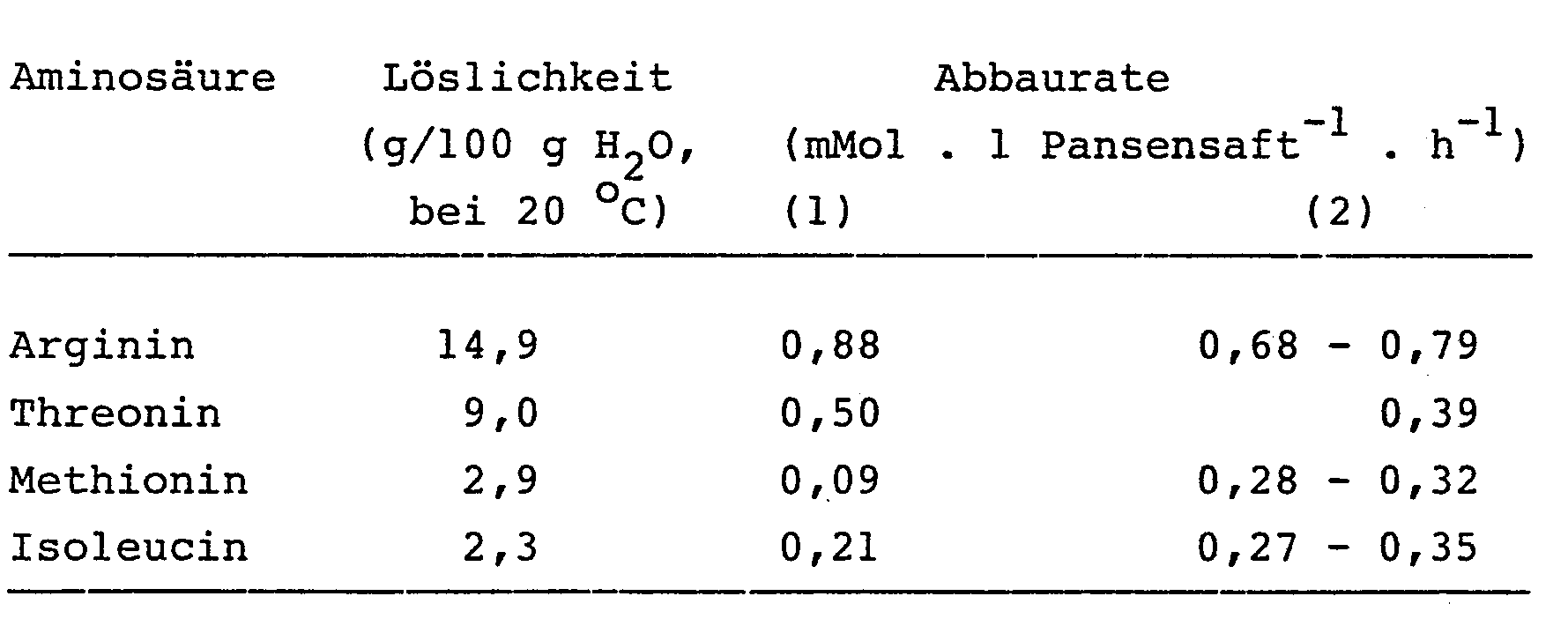
- Der Grund dafür ist, daß sich die Ernährungsphysiologie der Wiederkäuer grundsätzlich von der der monogastrischen Tiere unterscheidet. Wiederkäuer besitzen bekanntlich mehrere Mägen. Der erste und weitaus größte Magen, der Pansen, enthält eine eigene Mikroflora aus Bakterien und Protozoen, die alle Nährstoffe des Futters mikrobiell abbaut. Von den Futterproteinen passieren so trotz ihres hochmolekularen und schwerlöslichen Charakters weniger als 30 % der aufgenommenen Eiweißstoffe den Pansen unverändert. Mehr als 70 % werden mikrobiell abgebaut. Die Abbaurate der Futterproteine ist hoch korreliert mit ihrer Löslichkeit im Pansenmedium. Schwerlösliche, denaturierte Proteine werden von den Mikroben relativ langsam angegriffen. Leichtlösliches Eiweiß hingegen wird vollständig abgebaut, wobei über die Stufe der Peptide die freien Aminosäuren entstehen, die sofort weiter mikrobiell zu Ammoniak und kurzkettigen Fettsäuren umgesetzt werden. Freie Aminosäuren, die dem Futter zugesetzt werden, erleiden das gleiche Schicksal. Wegen ihres niedermolekularen Charakters und ihrer vergleichsweise guten Löslichkeit sind sie dem Angriff der Bakterien und Protozoen des Pansens besonders ausgesetzt (J. Anim. Sci., 14, (1955), 132 - 136). Die Geschwindigkeit der mikrobiellen Umsetzung von Aminosäuren im Pansenmedium ist ebenfalls hoch korreliert mit ihrer Löslichkeit. So wird z.B. das sehr gut lösliche Arginin rasch abgebaut, das nicht ganz so gut lösliche Threonin und die verhältnismäßig schwer löslichen Aminosäuren Methionin und Isoleucin entsprechend langsamer [J. Anim. Sci. 43, 828 (1976) (in der nachfolgenden Tabelle 1 als (1) identifiziert) und Tierphysiologie, Tierernährung und Futtermittelkunde 42, 333 (1979) (in der nachfolgenden Tabelle 1 als (2) identifizierte.
-
- Als Konsequenz wurde vielfach versucht, Aminosäuren durch geeignete Maßnahmen "schwerlöslich" und damit mikrobiell schwerer angreifbar zu machen (vgl. z.B. DE-PS 2 205 210, DE-PS 2 212 568, DE-PS 3 013 000, DE-PS 1 692 452, US-PS 4 181 709, DE-PS 2 307 836 oder DE-OS 2 536 954). Der Zusatz derartig geschützter Aminosäuren, die von den Bakterien und Protozoen nicht mehr abgebaut, in den an den Pansen anschließenden Abschnitten des Verdauungsapparates aber für das Tier wieder verfügbar werden, zum Futter hat sich als eine wirksame Methode zur Verbesserung der Aminosäuren-und Eiweißversorgung von Wiederkäuern erwiesen.
- Überraschenderweise wurde jetzt gefunden, daß die für Wiederkäuer am häufigsten limitierende Aminosäure Methionin sehr vorteilhaft durch die völlig entgegengesetzte Maßnahme, nämlich durch "Leichtlöslichmachen" des Methionins in erheblichem Maße vor mikrobiellem Abbau im Pansen geschützt werden kann. Vorzugsweise eignen sich hierzu als Methioninverbindungen die Natrium-, Kalium-, Ammonium-, Magnesium-und Calciumsalze der Aminosäure, die sowohl in Form von wässrigen Lösungen in das Futter eingemischt als auch in Pulverform Anwendung finden können - mit Ausnahme des Ammoniumsalzes des Methionins, das nur in wässriger Lösung existiert.
- Die erfindungsgemäß zu verwendenden Salze des Methionins sind dadurch gekennzeichnet, daß sie eine zum Teil wesentlich höhere Löslichkeit besitzen als die freie Aminosäure Methionin in ihrer DL-, L- oder D-Form. So lassen sich beispielsweise bei 20 °C in Wasser ohne Schwierigkeiten 50 gewichtsprozentige wässrige Lösungen von Natrium-DL-methioninat herstellen. Die Löslichkeit von DL-Methionin in Wasser bei 20 °C liegt vergleichsweise unter 3 Gewichtsprozent. Die genannten Salze des Methionins können vorteilhaft durch Umsetzung von Methionin mit den entsprechenden Alkali- und Erdalkalihydroxiden oder -oxiden in wässriger Lösung hergestellt werden. Auch die direkte Hydrolyse von 5 [(β-Methyl- mercapto)-ethyl] -hydantoin durch entsprechende Alkali- und/ oder Erdalkalihydroxide ist zur Herstellung geeignet. Sie ist insbesondere dann von Vorteil, wenn als Ziel der Gewinnung der Methioninverbindung eine wässrige Lösung des Produktes angestrebt wird.
- Die erfindungsgemäße Verwendung der Salze des Methionins im Futter erfolgt im allgemeinen durch Zumischen zu üblichen Futtermitteln und Mischfuttern für Wiederkäuer. Es können aber auch spezielle Vormischungen mit Vitaminen und Mineralstoffen, Futterharnstoff oder Energieträgern verwendet werden. Die Menge der zu verabreichenden Salze des Methionins soll vorzugsweise so bemessen sein, daß innerhalb der Gesamtfuttermenge der zugeführte Methioninanteil, bezogen auf Trockensubstanz, 0,05 bis 1 Gewichtsprozent beträgt.
- Methionin ist für Wiederkäuer ebenso wie für viele monogastrische Tierarten erstlimitierende Aminosäure. Der spezifische Grund für den Methioninmangel der Wiederkäuer ist, daß ihre Futterrationen weitgehend unabhängig von der ursprünglichen Zusammensetzung im Pansen mikrobiell zum größten Teil ab- bzw. umgebaut werden. Auf der Proteinseite der Futter ist die Aminosäurenversorgung des Magen-Darmtraktes und damit die des Gesamtorganismus im wesentlichen gebunden an die genetisch festgelegte Aminosäurenzusammensetzung des Mikrobenproteins, das bekanntlich eine Methioninlücke hat. Da andererseits bekannt ist, daß Wiederkäuer sowohl für Milchleistung als auch für Wachstum und Woll- bzw. Fellproduktion einen hohen Bedarf an schwefelhaltigen Aminosäuren, beispielsweise Methionin, haben, läßt sich die Leistung der Wiederkäuer wie die der monogastrischen Tiere durch Bereitstellung zusätzlicher Mengen der erstlimitierenden Aminosäure Methionin am Ort der Synthese der körpereigenen Proteine erhöhen (vgl. z.B. Fed. Proc. Am. Soc. Exp. Biol. 29, 1970, 44 bis 50; Z. Tierphysiologie, Tierernährung und Futtermittelkunde 41 (4), 1979, 202 bis 217; Austr. J. Biol. Sci. 16, 1, 1963, 218 bis 230).
- Die Erfindung soll durch die nachfolgend beschriebenen Beispiele näher erläutert werden:
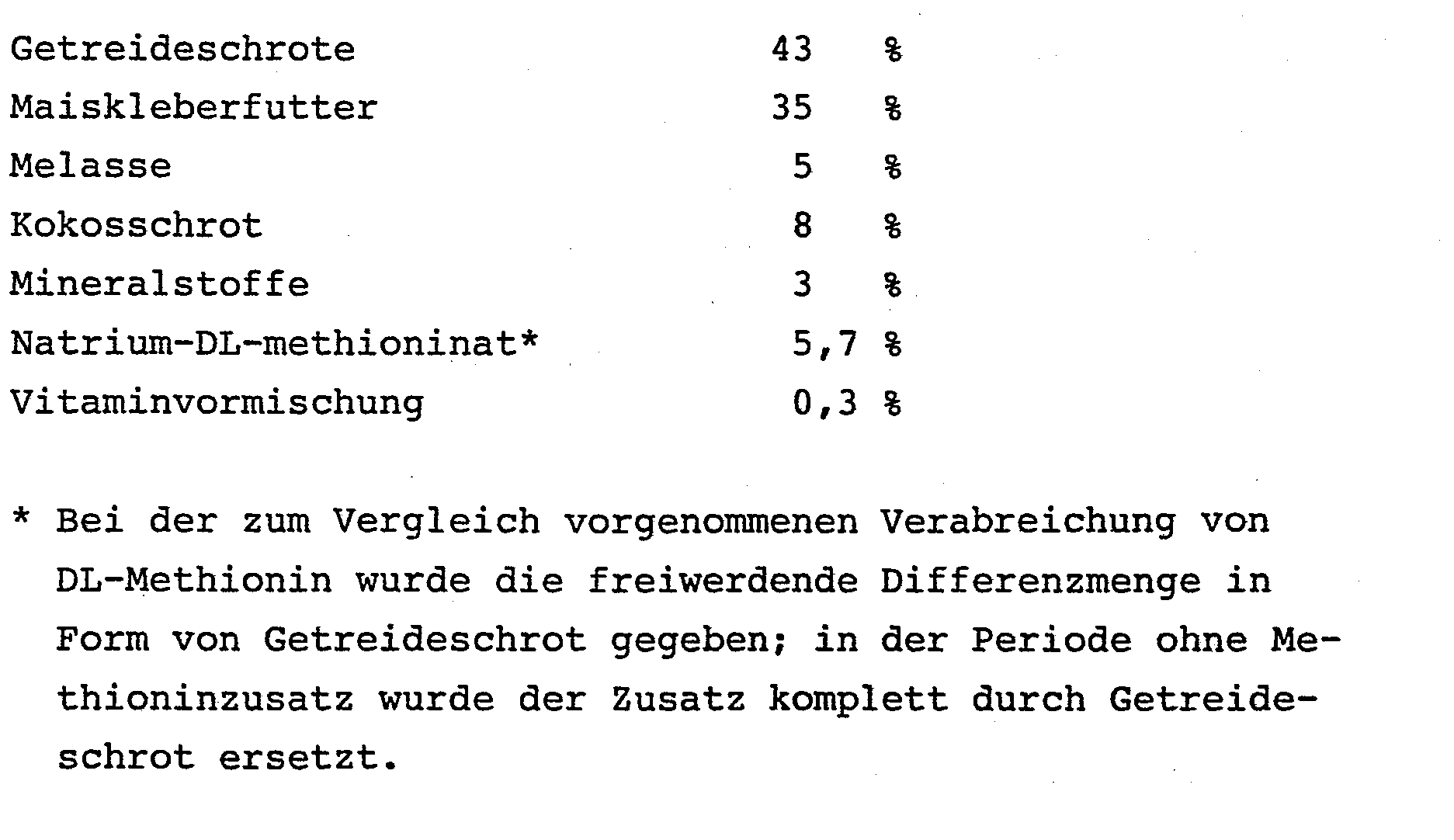
- Die Wirksamkeit von Natrium-DL-methioninat zur Erhöhung der im Stoffwechsel verfügbaren Methioninmenge wurde in Fütterungsversuchen an 4 Milchkühen geprüft. Den Tieren wurde zu einer dem Bedarf entsprechenden Ration aus Grund- und Kraftfutter täglich eine 1 kg-Vormischung mit 57 g Natrium-DL-methioninat verabreicht. Die Vormischung hatte folgende Zusammensetzung (Gewichtsprozente):
- Die Ergebnisse sind in der folgenden Tabelle (2) zusammengefaßt:
-

- In einem Kälbermastversuch mit 12 frühabgesetzten Tieren im Gewichtsabschnitt von 80 bis 120 kg wurde die Wirksamkeit von Kalium-DL-methioninat geprüft. An Gruppen von jeweils 4 Tieren wurden Kraftfuttermischungen gefüttert, die keine Methioninergänzung, 10 g DL-Methionin und 36,1 g einer 35 gewichtsprozentigen wässrigen Kaliunmethioninatlösung enthielten. Den Kälbern wurde zusätzlich zum Kraftfutter eine standardisierte Menge Grundfutter (Heu) verabreicht. Die Kraftfuttermenge wurde limitiert, um in allen Gruppen eine gleiche Futteraufnahme zu erhalten. Die Ergebnisse des Versuches zeigt die folgende Tabelle (3):
-

- 8 Milchkühe in der 3. Laktation wurden in 2 Gruppen a 4 Tiere aufgeteilt. Die Versuchsgruppe erhielt täglich 34,5 g Methionin in Form von Calcium-DL-methioninat, entsprechend 40 g Calciummethioninat mit 98 % Reinheit, das in 960 g Kraftfutter eingemischt war.
- Die Grundfutterration der Kühe bestand aus Maissilage, Grassilage und Heu. Kraftfutter wurde nach Leistung dosiert verabreicht.
- Die Kontrollgruppe wurde in gleicher Weise gefüttert, mit der Ausnahme, daß anstelle des Methioninsupplements Kraftfutter verabreicht wurde. Nach einer Versuchsperiode von 4 Wochen wurden Kontrollgruppe und Versuchsgruppe getauscht und die gleichen Parameter Milchmenge, Milchfett- und Milcheiweißgehalt ermittelt. Die Ergebnisse zeigt Tabelle (4):
-

- Die Ergebnisse der Beispiele 2 und 3 belegen, daß die erfindungsgemäße Verwendung von Salzen des Methionins, sowohl in gelöster als auch in fester Form, geeignet ist, die Methioninversorgung von Wiederkäuern im Hinblick auf_Gewichtszunahme und Milchleistung zu verbessern.
Claims (1)
- Verwendung von Salzen oder wässrigen Lösungen von Salzen des Methionins mit der allgemeinen Formel

Applications Claiming Priority (2)
| Application Number | Priority Date | Filing Date | Title |
|---|---|---|---|
| DE19833323508 DE3323508A1 (de) | 1983-06-30 | 1983-06-30 | Verwendung von salzen des methionins zur fuetterung von wiederkaeuern |
| DE3323508 | 1983-06-30 |
Publications (1)
| Publication Number | Publication Date |
|---|---|
| EP0130281A1 true EP0130281A1 (de) | 1985-01-09 |
Family
ID=6202731
Family Applications (1)
| Application Number | Title | Priority Date | Filing Date |
|---|---|---|---|
| EP84103508A Withdrawn EP0130281A1 (de) | 1983-06-30 | 1984-03-30 | Verwendung von Salzen des Methionins zur Fütterung von Wiederkäuern |
Country Status (5)
| Country | Link |
|---|---|
| EP (1) | EP0130281A1 (de) |
| JP (1) | JPS6019454A (de) |
| DE (1) | DE3323508A1 (de) |
| DK (1) | DK142984A (de) |
| IL (1) | IL71428A0 (de) |
Cited By (2)
| Publication number | Priority date | Publication date | Assignee | Title |
|---|---|---|---|---|
| WO1989005100A1 (en) * | 1987-12-02 | 1989-06-15 | Reanal Finomvegyszergyár | Compositions for use in animal husbandry and method of treatment of animals with vitamin u |
| EP3495346A1 (de) | 2017-12-07 | 2019-06-12 | Evonik Degussa GmbH | Verfahren zur herstellung von calciummethioninat |
Citations (4)
| Publication number | Priority date | Publication date | Assignee | Title |
|---|---|---|---|---|
| GB1166543A (en) * | 1966-08-11 | 1969-10-08 | Sumitomo Chemical Co | Process for the Production of DL-Methionine Composition |
| DE2704746A1 (de) * | 1976-04-08 | 1977-10-27 | Interchemie Ag | Wachstumsfoerderndes zusatzfuttermittel fuer kaelber, rinder und schafe |
| CH603069A5 (de) * | 1974-11-21 | 1978-08-15 | Interchemie Ag | |
| EP0058771A1 (de) * | 1981-02-12 | 1982-09-01 | Degussa Aktiengesellschaft | Verwendung von wässrigen Natrium- oder Kaliummethioninat-Lösungen zur Supplementierung von Mischfuttern mit Methionin |
-
1983
- 1983-06-30 DE DE19833323508 patent/DE3323508A1/de not_active Withdrawn
-
1984
- 1984-02-29 DK DK142984A patent/DK142984A/da not_active IP Right Cessation
- 1984-03-30 EP EP84103508A patent/EP0130281A1/de not_active Withdrawn
- 1984-04-02 IL IL71428A patent/IL71428A0/xx unknown
- 1984-06-25 JP JP59129412A patent/JPS6019454A/ja active Pending
Patent Citations (4)
| Publication number | Priority date | Publication date | Assignee | Title |
|---|---|---|---|---|
| GB1166543A (en) * | 1966-08-11 | 1969-10-08 | Sumitomo Chemical Co | Process for the Production of DL-Methionine Composition |
| CH603069A5 (de) * | 1974-11-21 | 1978-08-15 | Interchemie Ag | |
| DE2704746A1 (de) * | 1976-04-08 | 1977-10-27 | Interchemie Ag | Wachstumsfoerderndes zusatzfuttermittel fuer kaelber, rinder und schafe |
| EP0058771A1 (de) * | 1981-02-12 | 1982-09-01 | Degussa Aktiengesellschaft | Verwendung von wässrigen Natrium- oder Kaliummethioninat-Lösungen zur Supplementierung von Mischfuttern mit Methionin |
Cited By (2)
| Publication number | Priority date | Publication date | Assignee | Title |
|---|---|---|---|---|
| WO1989005100A1 (en) * | 1987-12-02 | 1989-06-15 | Reanal Finomvegyszergyár | Compositions for use in animal husbandry and method of treatment of animals with vitamin u |
| EP3495346A1 (de) | 2017-12-07 | 2019-06-12 | Evonik Degussa GmbH | Verfahren zur herstellung von calciummethioninat |
Also Published As
| Publication number | Publication date |
|---|---|
| JPS6019454A (ja) | 1985-01-31 |
| DE3323508A1 (de) | 1985-01-10 |
| DK142984D0 (da) | 1984-02-29 |
| IL71428A0 (en) | 1984-07-31 |
| DK142984A (da) | 1984-12-31 |
Similar Documents
| Publication | Publication Date | Title |
|---|---|---|
| DE69101595T2 (de) | Verfahren zum aufzüchten von fleisch produzierenden tieren zur erhöhung der entwicklung von magerem fleisch. | |
| DE2953334C1 (de) | 3-(2,2,2-Trimethylhydrazinium)propionat,Verfahren zu dessen Herstellung und Futtermittel,welche dieses enthalten | |
| EP1176875B1 (de) | Verwendung von kreatin als futterzusatz | |
| DE1620114B2 (de) | Schiffsche basen von 2-formylchinoxalin-1,4-dioxiden | |
| DE2413222A1 (de) | Tierfuttermittel | |
| DE2125245C3 (de) | Isoflavone und Verfahren zu deren Herstellung | |
| EP0103830A2 (de) | Wachstumsfördernde Phenylethylamin-Derivate | |
| DE3206911A1 (de) | Biochemischer wirkstoff, dessen herstellung und diesen wirkstoff enthaltendes mittel | |
| DE3618931A1 (de) | Futterzusatz, verfahren zu dessen zubereitung und verfahren zu dessen verwendung | |
| DE3105009C2 (de) | Verwendung von wäßrigen Natrium- oder Kaliummethioninat-Lösungen zur Supplementierung von Mischfuttern mit Methionin und Verfahren zur Supplementierung | |
| EP0316683A2 (de) | Futtermittel für Ferkel, Mastschweine und Geflügel | |
| EP1344767A2 (de) | Cholinsäuren als Futtermittelzusatz in der Tierernährung | |
| EP4277472B1 (de) | Verwendung eines futtermitteladditives in proteinarmem futter für geflügel | |
| DE3234995A1 (de) | Wachstumsfoerdernde phenylethylamin-derivate | |
| SU1748783A1 (ru) | Кормова добавка дл сельскохоз йственных животных и птиц | |
| DE3318129A1 (de) | Futtermittel fuer schweine | |
| DE3721580A1 (de) | Veterinaerzubereitungen | |
| DE2618269C2 (de) | ||
| DE3323508A1 (de) | Verwendung von salzen des methionins zur fuetterung von wiederkaeuern | |
| DE2526750C3 (de) | Calciumsalz von N-Monohydroxymethyl-L-lysin und Na, und Ne -Bishydroxymethyl-L-lysin, Verfahren zu deren Herstellung und deren Verwendung zur Supplementierung von Futter für Wiederkäuer | |
| WO2001089316A1 (de) | Futtermittelzusatz | |
| DE1692405C (de) | Verfahren zur Herstellung wachstumsfördernder Futtermittel und Tränkgemische | |
| DE3705186A1 (de) | Veterinaermedizinische zubereitungen | |
| DE68906595T2 (de) | Futter fuer wiederkaeuer. | |
| AT339130B (de) | Gewichtssteigernder futtermittelzusatz |
Legal Events
| Date | Code | Title | Description |
|---|---|---|---|
| PUAI | Public reference made under article 153(3) epc to a published international application that has entered the european phase |
Free format text: ORIGINAL CODE: 0009012 |
|
| 17P | Request for examination filed |
Effective date: 19840330 |
|
| AK | Designated contracting states |
Designated state(s): AT BE CH DE FR GB IT LI LU NL SE |
|
| STAA | Information on the status of an ep patent application or granted ep patent |
Free format text: STATUS: THE APPLICATION HAS BEEN WITHDRAWN |
|
| 18W | Application withdrawn |
Withdrawal date: 19851207 |
|
| RIN1 | Information on inventor provided before grant (corrected) |
Inventor name: TANNER, HERBERT, DR. DIPL.-CHEM. Inventor name: KOCH, FRIEDHELM, DR. DIPL.-CHEM. Inventor name: SPINDLER, MANFRED, DR. DIPL.-CHEM. |