EP0130367A1 - Thermoplastische Formmassen auf Basis von Bitumen-Ethylenpolymerisat-Mischungen und deren Verwendung zur Herstellung von Formkörpern, insbesondere von Abdichtungsbahnen für den Hoch- und Tiefbau - Google Patents
Thermoplastische Formmassen auf Basis von Bitumen-Ethylenpolymerisat-Mischungen und deren Verwendung zur Herstellung von Formkörpern, insbesondere von Abdichtungsbahnen für den Hoch- und Tiefbau Download PDFInfo
- Publication number
- EP0130367A1 EP0130367A1 EP84106115A EP84106115A EP0130367A1 EP 0130367 A1 EP0130367 A1 EP 0130367A1 EP 84106115 A EP84106115 A EP 84106115A EP 84106115 A EP84106115 A EP 84106115A EP 0130367 A1 EP0130367 A1 EP 0130367A1
- Authority
- EP
- European Patent Office
- Prior art keywords
- weight
- parts
- bitumen
- ethylene
- ethylene polymer
- Prior art date
- Legal status (The legal status is an assumption and is not a legal conclusion. Google has not performed a legal analysis and makes no representation as to the accuracy of the status listed.)
- Granted
Links
Classifications
-
- C—CHEMISTRY; METALLURGY
- C08—ORGANIC MACROMOLECULAR COMPOUNDS; THEIR PREPARATION OR CHEMICAL WORKING-UP; COMPOSITIONS BASED THEREON
- C08L—COMPOSITIONS OF MACROMOLECULAR COMPOUNDS
- C08L23/00—Compositions of homopolymers or copolymers of unsaturated aliphatic hydrocarbons having only one carbon-to-carbon double bond; Compositions of derivatives of such polymers
- C08L23/02—Compositions of homopolymers or copolymers of unsaturated aliphatic hydrocarbons having only one carbon-to-carbon double bond; Compositions of derivatives of such polymers not modified by chemical after-treatment
- C08L23/04—Homopolymers or copolymers of ethene
- C08L23/08—Copolymers of ethene
- C08L23/0846—Copolymers of ethene with unsaturated hydrocarbons containing atoms other than carbon or hydrogen
- C08L23/0869—Copolymers of ethene with unsaturated hydrocarbons containing atoms other than carbon or hydrogen with unsaturated acids, e.g. [meth]acrylic acid; with unsaturated esters, e.g. [meth]acrylic acid esters
-
- C—CHEMISTRY; METALLURGY
- C08—ORGANIC MACROMOLECULAR COMPOUNDS; THEIR PREPARATION OR CHEMICAL WORKING-UP; COMPOSITIONS BASED THEREON
- C08K—Use of inorganic or non-macromolecular organic substances as compounding ingredients
- C08K3/00—Use of inorganic substances as compounding ingredients
- C08K3/02—Elements
- C08K3/04—Carbon
-
- C—CHEMISTRY; METALLURGY
- C08—ORGANIC MACROMOLECULAR COMPOUNDS; THEIR PREPARATION OR CHEMICAL WORKING-UP; COMPOSITIONS BASED THEREON
- C08K—Use of inorganic or non-macromolecular organic substances as compounding ingredients
- C08K5/00—Use of organic ingredients
- C08K5/04—Oxygen-containing compounds
- C08K5/10—Esters; Ether-esters
-
- C—CHEMISTRY; METALLURGY
- C08—ORGANIC MACROMOLECULAR COMPOUNDS; THEIR PREPARATION OR CHEMICAL WORKING-UP; COMPOSITIONS BASED THEREON
- C08L—COMPOSITIONS OF MACROMOLECULAR COMPOUNDS
- C08L23/00—Compositions of homopolymers or copolymers of unsaturated aliphatic hydrocarbons having only one carbon-to-carbon double bond; Compositions of derivatives of such polymers
- C08L23/02—Compositions of homopolymers or copolymers of unsaturated aliphatic hydrocarbons having only one carbon-to-carbon double bond; Compositions of derivatives of such polymers not modified by chemical after-treatment
- C08L23/04—Homopolymers or copolymers of ethene
- C08L23/06—Polyethylene
-
- C—CHEMISTRY; METALLURGY
- C08—ORGANIC MACROMOLECULAR COMPOUNDS; THEIR PREPARATION OR CHEMICAL WORKING-UP; COMPOSITIONS BASED THEREON
- C08L—COMPOSITIONS OF MACROMOLECULAR COMPOUNDS
- C08L23/00—Compositions of homopolymers or copolymers of unsaturated aliphatic hydrocarbons having only one carbon-to-carbon double bond; Compositions of derivatives of such polymers
- C08L23/02—Compositions of homopolymers or copolymers of unsaturated aliphatic hydrocarbons having only one carbon-to-carbon double bond; Compositions of derivatives of such polymers not modified by chemical after-treatment
- C08L23/04—Homopolymers or copolymers of ethene
- C08L23/08—Copolymers of ethene
-
- C—CHEMISTRY; METALLURGY
- C08—ORGANIC MACROMOLECULAR COMPOUNDS; THEIR PREPARATION OR CHEMICAL WORKING-UP; COMPOSITIONS BASED THEREON
- C08L—COMPOSITIONS OF MACROMOLECULAR COMPOUNDS
- C08L95/00—Compositions of bituminous materials, e.g. asphalt, tar, pitch
-
- C—CHEMISTRY; METALLURGY
- C08—ORGANIC MACROMOLECULAR COMPOUNDS; THEIR PREPARATION OR CHEMICAL WORKING-UP; COMPOSITIONS BASED THEREON
- C08L—COMPOSITIONS OF MACROMOLECULAR COMPOUNDS
- C08L2205/00—Polymer mixtures characterised by other features
- C08L2205/03—Polymer mixtures characterised by other features containing three or more polymers in a blend
-
- C—CHEMISTRY; METALLURGY
- C08—ORGANIC MACROMOLECULAR COMPOUNDS; THEIR PREPARATION OR CHEMICAL WORKING-UP; COMPOSITIONS BASED THEREON
- C08L—COMPOSITIONS OF MACROMOLECULAR COMPOUNDS
- C08L2314/00—Polymer mixtures characterised by way of preparation
- C08L2314/02—Ziegler natta catalyst
Definitions
- the invention relates to thermoplastic molding compositions based on mixtures of (A) 20 to 50 parts by weight of an ethylene copolymer which contains 7 to 25% by weight of a vinyl ester of a C 2 - to C3-alkane carboxylic acid and / or a C 1 - to C 4 - Alkyl ester of a C 3 - to C 4 -alkenecarboxylic acid copolymerized, (B) 20 to 50 parts by weight of bitumen, which according to DIN 1995 has a penetration at 25 ° C. of 3 to 100, (C) 20 to 50 parts by weight of an ethylene polymer, (D. ) 0 to 5 parts by weight of carbon black, (E) 0 to 5 parts by weight of glycerol monostearate and (F) 0 to 30 parts by weight of conventional fillers.
- A 20 to 50 parts by weight of an ethylene copolymer which contains 7 to 25% by weight of a vinyl ester of a C 2 - to C3-al
- Molding compositions of this type are suitable for the production of moldings, in particular sealing sheets for building construction and civil engineering.
- compositions based on ethylene copolymers, the Vinylester a C 2 - to C 3 alkanecarboxylic acid and / or C 1 - to C 4- alkyl ester of a C 3 - to C 4 alkene carboxylic acid in copolymerized form, and bitumen are well known from the literature (cf. DE-PS 1 298 282 or DE-PS 1 807 071).
- the invention was based on the object of developing a thermoplastic molding composition based on bitumen and ethylene polymers which has high strength at room temperature and high heat resistance.
- the stiffness of the material should be kept low at room temperature and its temperature profile should be as flat as possible, ie in the area of high temperatures the torsion modulus should be as high as possible or the temperature at which the torsion modulus should be G - 1 N / mm 2 scored, should be as high as possible.
- this object is achieved by using a copolymer of 97 to 85% by weight of ethylene and 3 to 15% by weight of a C 4 -C 10 - ⁇ -olefin in the mixtures described at the outset as the ethylene polymer (C) .
- Thermoplastic molding composition is understood to mean unshaped or preformed substances which can be processed into shaped bodies or semifinished products by means of non-cutting shaping within certain temperature ranges. Their typical characteristic is that they soften when the temperature rises after their softening point is exceeded and harden again when they cool down.
- These ethylene copolymers preferably contain 10 to 20% by weight, based on the copolymer, of comonomers, vinyl acetate, n-, iso- or tert-acrylic acid butyl ester being particularly suitable comonomers.
- the copolymers (A) have a melt index between 0.2 and 25, preferably 1.0 to 10 g / 10 min, measured according to ASTM D 138-65 T at a temperature of 190 ° C. and a coating weight of 2.16 kg .
- the density of the ethylene copolymers (A) is between 0.918 and 0.965 g / cm 3 , measured in accordance with DIN 53 479.
- Bitumen is the dark-colored, semi-solid to hard, meltable, high-molecular-weight hydrocarbon mixture defined in DIN 55 946, which is obtained when mineral oils are carefully processed.
- the bitumen used in the mixture as component (B) have a penetration at 25 ° C of 3 to 100 and a softening point (ring and ball) of 40 to 140 ° C according to DIN 1995. All commercially available natural and synthetic types of bitumen can be used.
- Particularly suitable as bitumen component (B) is an extraction and / or precipitation bitumen which, according to DIN 1955, has a penetration at 25 ° C of 3 to 10 and a softening point according to DIN 1995 (ring and ball) between 40 and 110 ° C.
- Extraction and / or precipitation bitumen are understood to mean low-oil types of bitumen which are correspondingly strongly brittle and hard and have only a low penetration.
- a more precise definition of the above types of bitumen is contained in DE-PS 2 441 203 or US-PS 3 980 598.
- Precipitation bitumen with a penetration of 8 at 25 ° C and a softening point of 64 ° C is particularly suitable.
- the mixtures optionally also contain the mixture components carbon black, glycerol monostearate and / or conventional fillers. These components are so well known that there is no need for further explanations.
- the glycerol monostearate serves to improve the processing properties, in particular aluminum oxide hydrate, slate flour, chalk, glass fibers, kieselguhr ect are used as fillers. suitable.
- the molding compositions can be produced in a customary manner, e.g. by homogenizing the components using kneaders, agitators, rolling mills or extruders at working temperatures of 140 to 250 ° C. It does not matter at which point in the mixing process the ethylene copolymer (A) or the other components are added.
- a second ethylene copolymer (C) is added to the mixture described above, which consists of 97 to 85% by weight of ethylene and 3 to 15% by weight of a C 4 to C 10 ⁇ -olefin, the sum of the percentages is always 100.
- the ethylene copolymers (C) to be used according to the invention preferably contain butene-1, hexene-1 or octene-1 as comonomer, they have a melt index of 0.1 to 10 g / 10 min, measured according to ASTM D 138-65 T at 190 ° C and 2.16 kg coating weight and a density according to DIN 53 479 of 0.913 to 0.935 g / cm 3 .
- the copolymers (C) are obtained by low-pressure copolymerization in the presence of a Ziegler-Natta catalyst.
- the molding compounds obtained are used in particular for the production of waterproofing membranes for civil engineering.
- the webs can absorb high shear and tensile forces as well as strong deformations in a wider temperature range.
- the strength is tested at room temperature in a tensile test according to DIN 53 455.
- the torsional modulus (G) which is measured in the torsional vibration test according to DIN 53 445, serves as a measure of the rigidity.
- the heat resistance is tested a) as a tensile test according to DIN 53 455 and b) as a shear modulus according to DIN 53 445 at high temperatures, whereby high temperatures are understood to mean the range above 70 ° C.
- the melt index the polymers used were measured according to ASTM D 138-65 T at a temperature of 190 ° C. and a coating weight of 2.16 kg, the density according to DIN 53 479.
Landscapes
- Chemical & Material Sciences (AREA)
- Health & Medical Sciences (AREA)
- Chemical Kinetics & Catalysis (AREA)
- Medicinal Chemistry (AREA)
- Polymers & Plastics (AREA)
- Organic Chemistry (AREA)
- Engineering & Computer Science (AREA)
- Civil Engineering (AREA)
- Materials Engineering (AREA)
- Structural Engineering (AREA)
- Compositions Of Macromolecular Compounds (AREA)
- Manufacture Of Macromolecular Shaped Articles (AREA)
Abstract
Description
- Die Erfindung betrifft thermoplastische Formmassen auf der Basis von Mischungen aus (A) 20 bis 50 Gewichtsteilen eines Ethylencopolymerisats, das 7 bis 25 Gew.-% eines Vinylesters einer C2- bis C3-Alkancarbonsäure und/oder eines C1- bis C4-Alkylesters einer C3- bis C4-Alkencarbonsäure einpolymerisiert enthält, (B) 20 bis 50 Gewichtsteilen Bitumen, das entsprechend DIN 1995 eine Penetration bei 250C von 3 bis 100 aufweist, (C) 20 bis 50 Gewichtsteilen eines Ethylenpolymerisats, (D) 0 bis 5 Gewichtsteilen Ruß, (E) 0 bis 5 Gewichtsteilen Glycerinmonostearat und (F) 0 bis 30 Gewichtsteilen üblicher Füllstoffe.
- Derartige Formmassen sind zur Herstellung von Formkörpern, insbesondere von Abdichtungsbahnen für den Hoch- und Tiefbau geeignet.
- Stoffmischungen auf Basis von Ethylencopolymerisaten, die Vinylester einer C2- bis C3-Alkancarbonsäure und/oder C1- bis C4-Alkylester einer C3- bis C4-Alkencarbonsäure einpolymerisiert enthalten, und Bitumen sind aus der Literatur wohl bekannt (vgl. DE-PS 1 298 282 oder DE-PS 1 807 071).
- Es ist weiterhin bekannt, obige Formmassen mit Ruß, üblichen mineralischen Füllstoffen und/oder Glycerinmonostearat auszurüsten (vgl. DE-PS 1 807 071, DE-OS 19 10 178, DE-OS 19 62 640, DE-OS 23 53 439 oder DE-OS 31 17 672). Bekannt ist weiterhin, die mechanische Festigkeit der Bitumenmischung durch Zusätze von Polyethylen der Dichte 0,918 bis 0,935 g/cm in einem gewissen Ausmaß zu erhöhen (vgl. DE-OS 19 48 526, DE-OS 31 17 672, DE-OS 23 04 004 oder DE-OS 21 12 355). Durch Zusätze von Polyethylen der Dichte 0,935 bis 0,960 g/cm kann die Festigkeit und Wärmeformbeständigkeit erhöht werden, gleichzeitig werden die Formkörper aber im unerwünschten Ausmaß steifer. Insbesondere bei Abdichtungsbahnen ist eine hohe Steifigkeit aber unerwünscht, da die Handhabung steifer Bahnen bei der Verlegung erschwert ist.
- Der Erfindung lag die Aufgabe zugrunde, eine thermoplastische Formmasse auf Basis von Bitumen und Ethylenpolymerisaten zu entwickeln, die eine hohe Festigkeit bei Raumtemperatur und eine hohe Wärmeformbeständigkeit aufweist. Die Steifigkeit des Materials soll bei Raumtemperatur niedrig gehalten werden und ihr Temperaturverlauf sollte möglichst flach sein, d.h. im Bereich hoher Temperaturen sollte noch ein möglichst hoher Torsionsmodul vorhanden sein bzw. die Temperatur, bei welcher der Torsionsmodul auf den Wert G - 1 N/mm2 abgesunkten ist, sollte möglichst hoch liegen. Fre/P
- Diese Aufgabe wird erfindungsgemäß dadurch gelöst, daß man in den eingangs beschriebenen Mischungen als Ethylenpolymerisat (C) ein Copolymerisat aus 97 bis 85 Gew.-% Ethylen und 3 bis 15 Gew.-X eines C4- bis C10-α-Olefins verwendet.
- Unter thermoplastischer Formmasse werden ungeformte oder vorgeformte Stoffe verstanden, die durch spanloses Formen innerhalb bestimmter Temperaturbereiche zu Formkörpern oder Halbzeug verarbeitet werden können. Ihr typisches Kennzeichen besteht darin, daß sie bei Erhöhung der Temperatur nach Überschreitung ihres Erweichungspunktes weich werden und bei Abkühlung wieder erhärten.
- Die als Mischungskomponente (A) verwendeten Ethylencopolymerisate, die 7 bis 25 Gew.-X eines Vinylesters einer C2- bis C3-Alkancarbonsäure und/oder eines C1- bis C4-Alkylesters einer C3- bis C4-Alkencarbonsäure und 93 bis 75 Gew.-% Ethylen einpolymerisiert enthalten, wobei die Summe der Prozentzahlen 100 beträgt, sind an sich wohl bekannt. Bevorzugt enthalten diese Ethylencopolymerisate 10 bis 20 Gew.-%, bezogen auf das Copolymerisat, an Comonomeren, wobei Vinylacetat, n-, iso- oder tert.-Acrylsäurebutylester besonders geeignete Comonomere sind. Die Copolymerisate (A) weisen einen Schmelzindex zwischen 0,2 und 25, bevorzugt 1,0 bis 10 g/10 min auf, gemessen nach ASTM D 138-65 T bei einer Temperatur von 190°C und einem Auflagegewicht von 2,16 kg. Die Dichte der Ethylencopolymerisate (A) liegt zwischen 0,918 und 0,965 g/cm3, gemessen nach DIN 53 479.
- Bitumen sind die in der DIN 55 946 definierten, bei schonender Aufarbeitung von Erdölen gewonnenen dunkelfarbigen, halbfesten bis springharten, schmelzbaren hochmolekularen Kohlenwasserstoffgemische. Die in der Mischung als Komponente (B) verwendeten Bitumen haben nach DIN 1995 eine Penetration bei 25°C von 3 bis 100 und einen Erweichungspunkt (Ring und Kugel) von 40 bis 140°C. Es können alle handelsüblichen natürlichen und synthetischen Bitumensorten verwendet werden. Besonders geeignet ist als Bitumenkomponente (B) ein Extraktions- und/oder Fällungsbitumen, das entsprechend DIN 1955 eine Penetration bei 25°C von 3 bis 10 und einen Erweichungspunkt nach DIN 1995 (Ring und Kugel) zwischen 40 und 110°C aufweist. Unter Extraktions- und/ oder Fällungsbitumen werden ölarme Bitumensorten verstanden, die entsprechend stark spröde und hart sind und nur eine geringe Penetration aufweisen. Eine genauere Definition obiger Bitumensorten ist in der DE-PS 2 441 203 oder der US-PS 3 980 598 enthalten. Besonders geeignet ist ein Fällungsbitumen mit einer Penetration von 8 bei 25°C und einem Erweichungspunkt von 64°C.
- Die Mischungen enthalten gegebenenfalls noch die Mischungskomponenten Ruß, Glycerinmonostearat und/oder übliche Füllstoffe. Diese Komponenten sind so bekannt, daß sich nähere Erläuterungen erübrigen. Das Glycerinmonostearat dient zur Verbesserung der Verarbeitungseigenschaften, als Füllstoffe sind insbesondere Aluminiumoxidhydrat, Schiefermehl, Kreide, Glasfasern, Kieselgur ect. geeignet.
- Die Herstellung der Formmassen kann auf übliche Weise erfolgen, z.B. durch Homogenisierung der Bestandteile mittels Kneter, Rührwerken, Walzwerken oder Extrudern bei Arbeitstemperaturen von 140 bis 250°C. Es spielt keine Rolle, an welcher Stelle des Mischungsvorgangs die Zugabe des Ethylencopolymerisats (A) oder der anderen Komponenten erfolgt.
- Erfindungsgemäß wird der oben beschriebenen Mischung ein zweites Ethylencopolymerisat (C) zugesetzt, das aus 97 bis 85 Gew.-X Ethylen und 3 bis 15 Gew.-% eines C4- bis C10-α-Olefins besteht, wobei die Summe der Prozentzahlen stets 100 ist. Die Ethylencopolymerisate (C) sind wohlbekannt und unter der Bezeichnung LLD-PE (= linear low density polyethylene) im Handel erhältlich (vgl. "Plastics Technology" 24, (1978), Seiten 25, 27, 34, 36 und 43). Die erfindungsgemäß zu verwendenden Ethylencopolymerisate (C) enthalten als Comonomer bevorzugt Buten-1, Hexen-1 oder Octen-1, sie weisen einen Schmelzindex von 0,1 bis 10 g/10 min, gemessen nach ASTM D 138-65 T bei 190°C und 2,16 kg Auflagegewicht und eine Dichte nach DIN 53 479 von 0,913 bis 0,935 g/cm3 auf. Die Copolymerisate (C) werden durch Niederdruckcopolymerisation in Gegenwart eines Ziegler-Natta-Katalysators erhalten.
- Die mit der Erfindung erzielten Vorteile sind insbesondere darin zu sehen, daß durch die Kombination zweier Ethylencopolymerisate als Mischungskomponenten mit Bitumen eine bituminöse Formmasse erhalten wird, die zu Formkörpern mit verbesserten mechanischen Eigenschaften in bezug auf Festigkeit bei Raumtemperatur, Wärmeformbeständigkeit und Steifigkeit verarbeitbar ist.
- Die erhaltenen Formmassen dienen insbesondere zur Herstellung von Abdichtungsbahnen für den Hoch- und Tiefbau. Die Bahnen können in einem weiteren Temperaturbereich hohe Schub- und Zugkräfte sowie starke Deformationen aufnehmen.
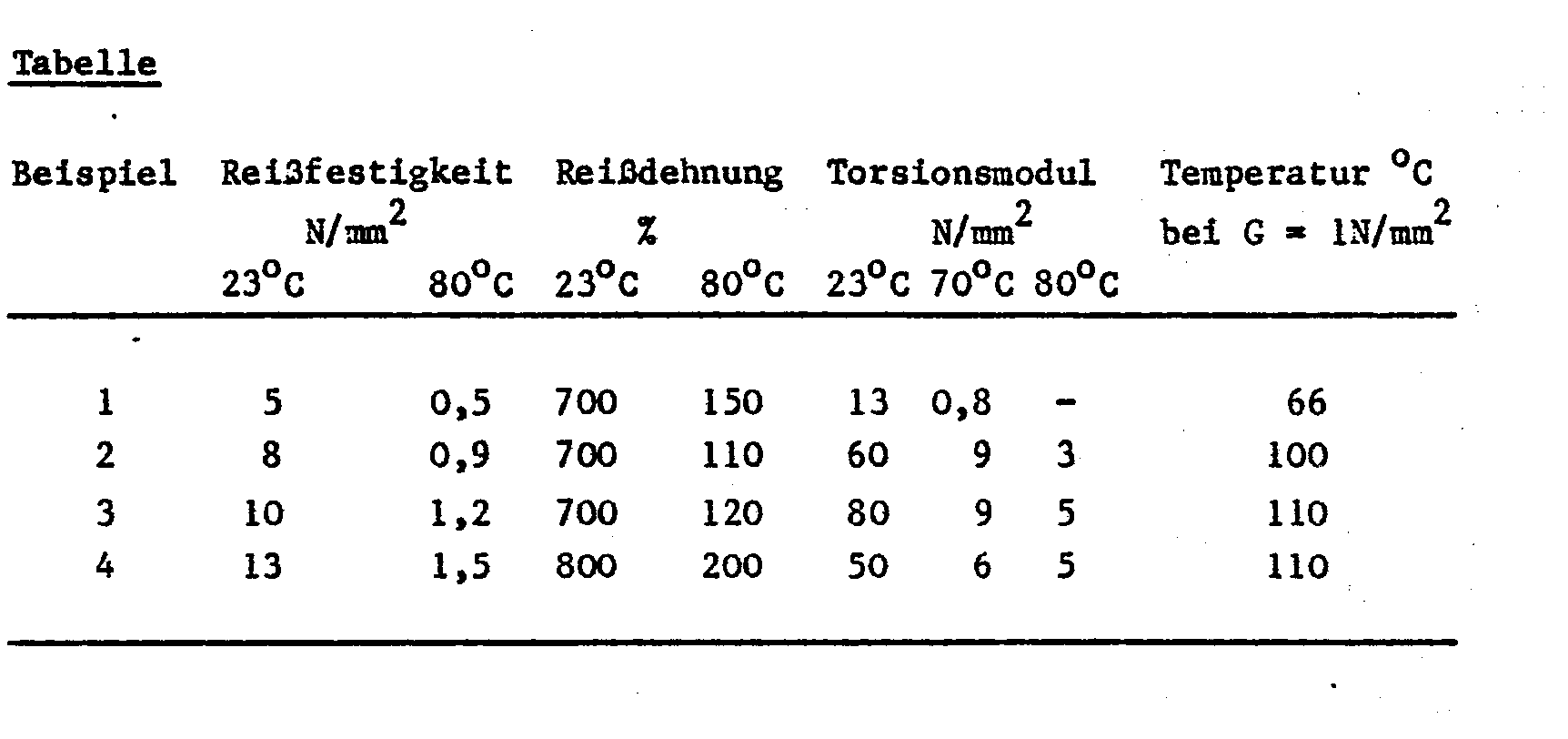
- In den Beispielen wird die Festigkeit bei Raumtemperatur im Zugversuch nach DIN 53 455 geprüft. Als Maß für die Steifigkeit dient der Torsionsmodul (G), der im Torsionsschwingungsversuch nach DIN 53 445 gemessen wird. Die Wärmeformbeständigkeit wird a) als Zugversuch nach DIN 53 455 und b) als Schubmodul nach DIN 53 445 bei hohen Temperaturen geprüft, wobei unter hohen Temperaturen der Bereich oberhalb 70°C verstanden wird. Der Schmelzindex der verwendeten Polymerisate wurde nach ASTM D 138-65 T bei einer Temperatur von 190°C und einem Auflagegewicht von 2,16 kg, die Dichte nach DIN 53 479 gemessen.
-
- 1. Ethylen-n-Butylacrylat-Copolymerisat mit 18 Gew.-X n-Butylacrylat und einem Schmelzindex von 1,5 g/10 min wird mit Fällungsbitumen, das einen Erweichungspunkt (Ring und Kugel) von 64°C und eine Penetration nach DIN 1995 von 8 hat in gleichen Teilen im Kneter gemischt. Aus der Mischung werden 2 mm dicke Platten gepreßt, daraus werden Probestreifen ausgestanzt und im Zugversuch gemessen. Außerdem wird der Torsionsmodul in Abhängigkeit von der Temperatur gemessen (vgl. Tab.).
- 2. Zu gleichen Teilen wurden gemischt
- a) Ethylen-n-Butylacrylat-Copolymerisat wie Beispiel 1
- b) Polyethylen der Dichte 0,918 g/cm3 und des Schmelzindex von 1,5 g/10 min, hergestellt im Hochdruckpolymerisationsverfahren.
- c) Fällungsbitumen wie in Beispiel 1.
Die Mischung wird wie in Beispiel 1 geprüft. - 3. Es wird verfahren wie in Beispiel 2, aber anstelle der Komponente (b) wird ein Polyethylen der Dichte 0,926 g/cm3 und des Schmelzindex 0,2 g/10 min, hergestellt im Hockdruckverfahren, eingesetzt.
- 4. Es wird verfahren wie in Beispiel 2 aber anstelle der Komponente (b) ein Ethylen-Buten-1-Copolymerisat mit 10 Gew.-X Buten-1, einer Dichte von 0,920 g/cm3 und einem Schmelzindex von 1 g/10 min, hergestellt im Niederdruckverfahren mit einem Ziegler-Natta-Katalysator, eingesetzt. Es zeigt sich (vgl. Tab.), daß nach Versuch 4 eine Folie mit der höchsten Festigkeit und größter Dehnung bei Raumtemperatur (23°C) und bei 80°C und geringster Steifigkeit bei Raumtemperatur und eine hohe Temperatur, bei der die Torsionsnadel auf den Wert G - 1 N/mm2 abgesunkten ist, erhalten wird.
Claims (3)
Priority Applications (1)
| Application Number | Priority Date | Filing Date | Title |
|---|---|---|---|
| AT84106115T ATE21259T1 (de) | 1983-06-01 | 1984-05-29 | Thermoplastische formmassen auf basis von bitumen-ethylenpolymerisat-mischungen und deren verwendung zur herstellung von formkoerpern, insbesondere von abdichtungsbahnen fuer den hoch- und tiefbau. |
Applications Claiming Priority (2)
| Application Number | Priority Date | Filing Date | Title |
|---|---|---|---|
| DE19833319844 DE3319844A1 (de) | 1983-06-01 | 1983-06-01 | Thermoplastische formmassen auf basis von bitumen-ethylenpolymerisat-mischungen und deren verwendung zur herstellung von formkoerpern, insbesondere von abdichtungsbahnen fuer den hoch- und tiefbau |
| DE3319844 | 1983-06-01 |
Publications (2)
| Publication Number | Publication Date |
|---|---|
| EP0130367A1 true EP0130367A1 (de) | 1985-01-09 |
| EP0130367B1 EP0130367B1 (de) | 1986-08-06 |
Family
ID=6200403
Family Applications (1)
| Application Number | Title | Priority Date | Filing Date |
|---|---|---|---|
| EP84106115A Expired EP0130367B1 (de) | 1983-06-01 | 1984-05-29 | Thermoplastische Formmassen auf Basis von Bitumen-Ethylenpolymerisat-Mischungen und deren Verwendung zur Herstellung von Formkörpern, insbesondere von Abdichtungsbahnen für den Hoch- und Tiefbau |
Country Status (3)
| Country | Link |
|---|---|
| EP (1) | EP0130367B1 (de) |
| AT (1) | ATE21259T1 (de) |
| DE (2) | DE3319844A1 (de) |
Cited By (4)
| Publication number | Priority date | Publication date | Assignee | Title |
|---|---|---|---|---|
| EP0223019A1 (de) * | 1985-10-04 | 1987-05-27 | BASF Aktiengesellschaft | Thermoplastische Formmassen auf Basis von Bitumen-Ethylenpolymerisat-Mischungen und deren Verwendung zur Herstellung von Formkörpern, insbesondere von Abdichtungsbahnen für den Hoch- und Tiefbau |
| US4868233A (en) * | 1987-07-15 | 1989-09-19 | Exxon Research And Engineering Company | Polyethylene modified asphalts |
| WO2003011975A1 (de) * | 2001-07-26 | 2003-02-13 | Lucobit Ag | Thermoplastische formmassen mit verminderter klebrigkeit |
| EP4434741A1 (de) | 2023-03-21 | 2024-09-25 | JUAL Group A/S | Dichtungsvorrichtung zum einbau in eine dachstruktur, verfahren zur herstellung der dichtungsvorrichtung und verwendung einer folie aus ethylencopolymerbitumen (ecb) |
Families Citing this family (2)
| Publication number | Priority date | Publication date | Assignee | Title |
|---|---|---|---|---|
| DE4409462C1 (de) * | 1994-03-20 | 1995-08-10 | Techno Polymer Hans Joachim Ku | Thermoplastische Formmasse, Verfahren zu ihrer Herstellung und ihre Verwendung |
| DE19701259A1 (de) * | 1997-01-17 | 1998-07-23 | Basf Ag | Thermoplastische Formmassen |
Citations (3)
| Publication number | Priority date | Publication date | Assignee | Title |
|---|---|---|---|---|
| FR1512974A (fr) * | 1966-03-08 | 1968-02-09 | Basf Ag | Masses de moulage à base de bitume, de copolymères de l'éthylène et de polyisobutylène |
| DE1298282B (de) * | 1963-01-04 | 1969-06-26 | Basf Ag | Mischungen auf der Basis von Bitumen zur Herstellung von Formkoerpern |
| EP0064630A1 (de) * | 1981-05-05 | 1982-11-17 | BASF Aktiengesellschaft | Flammhemmende thermoplastische Formmassen auf Basis von Polyolefin-Bitumen-Mischungen und deren Verwendung zur Herstellung von Formkörpern, insbesondere von Abdichtungsbahnen für den Hoch- und Tiefbau |
-
1983
- 1983-06-01 DE DE19833319844 patent/DE3319844A1/de not_active Withdrawn
-
1984
- 1984-05-29 EP EP84106115A patent/EP0130367B1/de not_active Expired
- 1984-05-29 DE DE8484106115T patent/DE3460431D1/de not_active Expired
- 1984-05-29 AT AT84106115T patent/ATE21259T1/de not_active IP Right Cessation
Patent Citations (3)
| Publication number | Priority date | Publication date | Assignee | Title |
|---|---|---|---|---|
| DE1298282B (de) * | 1963-01-04 | 1969-06-26 | Basf Ag | Mischungen auf der Basis von Bitumen zur Herstellung von Formkoerpern |
| FR1512974A (fr) * | 1966-03-08 | 1968-02-09 | Basf Ag | Masses de moulage à base de bitume, de copolymères de l'éthylène et de polyisobutylène |
| EP0064630A1 (de) * | 1981-05-05 | 1982-11-17 | BASF Aktiengesellschaft | Flammhemmende thermoplastische Formmassen auf Basis von Polyolefin-Bitumen-Mischungen und deren Verwendung zur Herstellung von Formkörpern, insbesondere von Abdichtungsbahnen für den Hoch- und Tiefbau |
Cited By (4)
| Publication number | Priority date | Publication date | Assignee | Title |
|---|---|---|---|---|
| EP0223019A1 (de) * | 1985-10-04 | 1987-05-27 | BASF Aktiengesellschaft | Thermoplastische Formmassen auf Basis von Bitumen-Ethylenpolymerisat-Mischungen und deren Verwendung zur Herstellung von Formkörpern, insbesondere von Abdichtungsbahnen für den Hoch- und Tiefbau |
| US4868233A (en) * | 1987-07-15 | 1989-09-19 | Exxon Research And Engineering Company | Polyethylene modified asphalts |
| WO2003011975A1 (de) * | 2001-07-26 | 2003-02-13 | Lucobit Ag | Thermoplastische formmassen mit verminderter klebrigkeit |
| EP4434741A1 (de) | 2023-03-21 | 2024-09-25 | JUAL Group A/S | Dichtungsvorrichtung zum einbau in eine dachstruktur, verfahren zur herstellung der dichtungsvorrichtung und verwendung einer folie aus ethylencopolymerbitumen (ecb) |
Also Published As
| Publication number | Publication date |
|---|---|
| DE3319844A1 (de) | 1984-12-06 |
| ATE21259T1 (de) | 1986-08-15 |
| EP0130367B1 (de) | 1986-08-06 |
| DE3460431D1 (en) | 1986-09-11 |
Similar Documents
| Publication | Publication Date | Title |
|---|---|---|
| DE3781025T2 (de) | Thermoplastische zusammensetzung von kristallinem polyolefin und aethylen-copolymer. | |
| DE68909303T2 (de) | Thermoplastische elastomere Zusammensetzungen. | |
| DE3750992T2 (de) | Elastomermischungen. | |
| DE3887399T2 (de) | Mit Polyäthylen modifizierter Asphalt. | |
| DE2340202B2 (de) | Thermoplastische, elastomere mischungen aus einem monoolefin-mischpolymerisatkautschuk und einem polyolefinkunststoff | |
| DE69705122T2 (de) | Elastomere, verfahren zur herstellung davon, und aus diesen elastomeren hergestellten gegenständen | |
| DE2656927C2 (de) | Gleitmittel aus Polyalkylenoxiden für die formgebende Verarbeitung von Kunststoffen | |
| DE1945417A1 (de) | Polyaethylenmischungen | |
| DE2632654C2 (de) | Thermoplastische elastomere Formmasse und Verfahren zu ihrer Herstellung | |
| EP0429504B1 (de) | Formmasse aus elastomeren polyolefinkautschuken, polyethylen und/oder ethylencopolymeren und zusatzstoffen sowie deren verwendung für elastische dichtungsbahnen | |
| DE69201008T2 (de) | Thermoplastische Elastomerzusammensetzung. | |
| DE69314300T2 (de) | Mit polyolefinischen Materialien modifizierte Bitumenzusammensetzungen | |
| EP0130367B1 (de) | Thermoplastische Formmassen auf Basis von Bitumen-Ethylenpolymerisat-Mischungen und deren Verwendung zur Herstellung von Formkörpern, insbesondere von Abdichtungsbahnen für den Hoch- und Tiefbau | |
| EP0223019B1 (de) | Thermoplastische Formmassen auf Basis von Bitumen-Ethylenpolymerisat-Mischungen und deren Verwendung zur Herstellung von Formkörpern, insbesondere von Abdichtungsbahnen für den Hoch- und Tiefbau | |
| DE2713644C2 (de) | Chlorsulfoniertes Polyäthylen enthaltende Mischungen | |
| DE2757743C3 (de) | Härtbare Vinylchloridpolymerisatmasse | |
| DE69432067T2 (de) | Bituminöse Zusammensetzungen für schalldämpfende Materialien | |
| DE69032273T2 (de) | Heiss-siegelbare Harzzusammensetzungen aus stereoregulärem Polypropylen und Propylen-1-Buten-Copolymeren | |
| CH641482A5 (en) | Thermoplastic elastomeric polymer mixture, and process for the preparation thereof | |
| DE2725709A1 (de) | Thermoplastische blockmischpolymere und deren herstellung | |
| EP0027857B1 (de) | Verfahren zur Herstellung eines ionisch vernetzten Acrylkunststoffes | |
| DE69520014T2 (de) | Fussbodenbeläge auf Basis von Äthylen-copolymeren | |
| DE2934931A1 (de) | Haertbares gemisch aus butadien/acrylnitril-polymer und aethylencopolymer | |
| DE68913267T2 (de) | Wetterbeständige thermoplastische Harzzusammensetzung. | |
| DE2804725C2 (de) | Verbesserte elastomere Präparate und ihre Verwendung zur Folienherstellung |
Legal Events
| Date | Code | Title | Description |
|---|---|---|---|
| PUAI | Public reference made under article 153(3) epc to a published international application that has entered the european phase |
Free format text: ORIGINAL CODE: 0009012 |
|
| AK | Designated contracting states |
Designated state(s): AT BE CH DE FR IT LI NL |
|
| 17P | Request for examination filed |
Effective date: 19841110 |
|
| GRAA | (expected) grant |
Free format text: ORIGINAL CODE: 0009210 |
|
| AK | Designated contracting states |
Kind code of ref document: B1 Designated state(s): AT BE CH DE FR IT LI NL |
|
| REF | Corresponds to: |
Ref document number: 21259 Country of ref document: AT Date of ref document: 19860815 Kind code of ref document: T |
|
| ITF | It: translation for a ep patent filed | ||
| REF | Corresponds to: |
Ref document number: 3460431 Country of ref document: DE Date of ref document: 19860911 |
|
| ET | Fr: translation filed | ||
| PLBE | No opposition filed within time limit |
Free format text: ORIGINAL CODE: 0009261 |
|
| STAA | Information on the status of an ep patent application or granted ep patent |
Free format text: STATUS: NO OPPOSITION FILED WITHIN TIME LIMIT |
|
| 26N | No opposition filed | ||
| ITTA | It: last paid annual fee | ||
| PGFP | Annual fee paid to national office [announced via postgrant information from national office to epo] |
Ref country code: AT Payment date: 20030502 Year of fee payment: 20 |
|
| PGFP | Annual fee paid to national office [announced via postgrant information from national office to epo] |
Ref country code: NL Payment date: 20030513 Year of fee payment: 20 |
|
| PGFP | Annual fee paid to national office [announced via postgrant information from national office to epo] |
Ref country code: FR Payment date: 20030520 Year of fee payment: 20 |
|
| PGFP | Annual fee paid to national office [announced via postgrant information from national office to epo] |
Ref country code: CH Payment date: 20030522 Year of fee payment: 20 |
|
| PGFP | Annual fee paid to national office [announced via postgrant information from national office to epo] |
Ref country code: DE Payment date: 20030526 Year of fee payment: 20 |
|
| PGFP | Annual fee paid to national office [announced via postgrant information from national office to epo] |
Ref country code: BE Payment date: 20030613 Year of fee payment: 20 |
|
| PG25 | Lapsed in a contracting state [announced via postgrant information from national office to epo] |
Ref country code: LI Free format text: LAPSE BECAUSE OF EXPIRATION OF PROTECTION Effective date: 20040528 Ref country code: CH Free format text: LAPSE BECAUSE OF EXPIRATION OF PROTECTION Effective date: 20040528 |
|
| PG25 | Lapsed in a contracting state [announced via postgrant information from national office to epo] |
Ref country code: NL Free format text: LAPSE BECAUSE OF EXPIRATION OF PROTECTION Effective date: 20040529 Ref country code: AT Free format text: LAPSE BECAUSE OF EXPIRATION OF PROTECTION Effective date: 20040529 |
|
| BE20 | Be: patent expired |
Owner name: *BASF A.G. Effective date: 20040529 |
|
| REG | Reference to a national code |
Ref country code: CH Ref legal event code: PL |
|
| NLV7 | Nl: ceased due to reaching the maximum lifetime of a patent |
Effective date: 20040529 |