EP0130886A1 - Vitrage de sécurité, en particulier vitrage anti-balles - Google Patents
Vitrage de sécurité, en particulier vitrage anti-balles Download PDFInfo
- Publication number
- EP0130886A1 EP0130886A1 EP84401290A EP84401290A EP0130886A1 EP 0130886 A1 EP0130886 A1 EP 0130886A1 EP 84401290 A EP84401290 A EP 84401290A EP 84401290 A EP84401290 A EP 84401290A EP 0130886 A1 EP0130886 A1 EP 0130886A1
- Authority
- EP
- European Patent Office
- Prior art keywords
- sheet
- glass
- impact
- resistant
- glass sheet
- Prior art date
- Legal status (The legal status is an assumption and is not a legal conclusion. Google has not performed a legal analysis and makes no representation as to the accuracy of the status listed.)
- Granted
Links
- 239000005336 safety glass Substances 0.000 title abstract 3
- 239000011521 glass Substances 0.000 claims abstract description 66
- 239000010410 layer Substances 0.000 claims abstract description 32
- 239000012790 adhesive layer Substances 0.000 claims abstract description 24
- 239000000463 material Substances 0.000 claims abstract description 14
- 239000011229 interlayer Substances 0.000 claims abstract description 11
- 229920003023 plastic Polymers 0.000 claims abstract description 10
- 239000004033 plastic Substances 0.000 claims abstract description 9
- 239000000203 mixture Substances 0.000 claims abstract description 7
- 239000011241 protective layer Substances 0.000 claims abstract description 5
- 230000008602 contraction Effects 0.000 claims abstract description 3
- 229920000515 polycarbonate Polymers 0.000 claims description 32
- 239000004417 polycarbonate Substances 0.000 claims description 31
- 239000004433 Thermoplastic polyurethane Substances 0.000 claims description 16
- 229920002803 thermoplastic polyurethane Polymers 0.000 claims description 15
- 229920002037 poly(vinyl butyral) polymer Polymers 0.000 claims description 11
- 229920002635 polyurethane Polymers 0.000 claims description 6
- 239000004814 polyurethane Substances 0.000 claims description 6
- 230000001965 increasing effect Effects 0.000 claims description 5
- 239000002985 plastic film Substances 0.000 claims description 5
- 239000005368 silicate glass Substances 0.000 claims description 4
- 229920006352 transparent thermoplastic Polymers 0.000 claims 1
- 230000001070 adhesive effect Effects 0.000 abstract description 5
- 230000035939 shock Effects 0.000 abstract description 4
- 150000001875 compounds Chemical class 0.000 abstract 1
- 239000000853 adhesive Substances 0.000 description 4
- 238000001816 cooling Methods 0.000 description 4
- 230000006399 behavior Effects 0.000 description 2
- 238000005452 bending Methods 0.000 description 2
- 230000000694 effects Effects 0.000 description 2
- 230000003678 scratch resistant effect Effects 0.000 description 2
- 238000010792 warming Methods 0.000 description 2
- 239000004425 Makrolon Substances 0.000 description 1
- 239000003795 chemical substances by application Substances 0.000 description 1
- 230000001939 inductive effect Effects 0.000 description 1
- 238000000034 method Methods 0.000 description 1
- 238000005057 refrigeration Methods 0.000 description 1
- 239000002356 single layer Substances 0.000 description 1
- 210000003462 vein Anatomy 0.000 description 1
Images
Classifications
-
- B—PERFORMING OPERATIONS; TRANSPORTING
- B32—LAYERED PRODUCTS
- B32B—LAYERED PRODUCTS, i.e. PRODUCTS BUILT-UP OF STRATA OF FLAT OR NON-FLAT, e.g. CELLULAR OR HONEYCOMB, FORM
- B32B17/00—Layered products essentially comprising sheet glass, or glass, slag, or like fibres
- B32B17/06—Layered products essentially comprising sheet glass, or glass, slag, or like fibres comprising glass as the main or only constituent of a layer, next to another layer of a specific material
- B32B17/10—Layered products essentially comprising sheet glass, or glass, slag, or like fibres comprising glass as the main or only constituent of a layer, next to another layer of a specific material of synthetic resin
- B32B17/10005—Layered products essentially comprising sheet glass, or glass, slag, or like fibres comprising glass as the main or only constituent of a layer, next to another layer of a specific material of synthetic resin laminated safety glass or glazing
- B32B17/1055—Layered products essentially comprising sheet glass, or glass, slag, or like fibres comprising glass as the main or only constituent of a layer, next to another layer of a specific material of synthetic resin laminated safety glass or glazing characterized by the resin layer, i.e. interlayer
- B32B17/10761—Layered products essentially comprising sheet glass, or glass, slag, or like fibres comprising glass as the main or only constituent of a layer, next to another layer of a specific material of synthetic resin laminated safety glass or glazing characterized by the resin layer, i.e. interlayer containing vinyl acetal
-
- B—PERFORMING OPERATIONS; TRANSPORTING
- B32—LAYERED PRODUCTS
- B32B—LAYERED PRODUCTS, i.e. PRODUCTS BUILT-UP OF STRATA OF FLAT OR NON-FLAT, e.g. CELLULAR OR HONEYCOMB, FORM
- B32B17/00—Layered products essentially comprising sheet glass, or glass, slag, or like fibres
- B32B17/06—Layered products essentially comprising sheet glass, or glass, slag, or like fibres comprising glass as the main or only constituent of a layer, next to another layer of a specific material
- B32B17/10—Layered products essentially comprising sheet glass, or glass, slag, or like fibres comprising glass as the main or only constituent of a layer, next to another layer of a specific material of synthetic resin
- B32B17/10005—Layered products essentially comprising sheet glass, or glass, slag, or like fibres comprising glass as the main or only constituent of a layer, next to another layer of a specific material of synthetic resin laminated safety glass or glazing
- B32B17/10009—Layered products essentially comprising sheet glass, or glass, slag, or like fibres comprising glass as the main or only constituent of a layer, next to another layer of a specific material of synthetic resin laminated safety glass or glazing characterized by the number, the constitution or treatment of glass sheets
- B32B17/10036—Layered products essentially comprising sheet glass, or glass, slag, or like fibres comprising glass as the main or only constituent of a layer, next to another layer of a specific material of synthetic resin laminated safety glass or glazing characterized by the number, the constitution or treatment of glass sheets comprising two outer glass sheets
-
- B—PERFORMING OPERATIONS; TRANSPORTING
- B32—LAYERED PRODUCTS
- B32B—LAYERED PRODUCTS, i.e. PRODUCTS BUILT-UP OF STRATA OF FLAT OR NON-FLAT, e.g. CELLULAR OR HONEYCOMB, FORM
- B32B17/00—Layered products essentially comprising sheet glass, or glass, slag, or like fibres
- B32B17/06—Layered products essentially comprising sheet glass, or glass, slag, or like fibres comprising glass as the main or only constituent of a layer, next to another layer of a specific material
- B32B17/10—Layered products essentially comprising sheet glass, or glass, slag, or like fibres comprising glass as the main or only constituent of a layer, next to another layer of a specific material of synthetic resin
- B32B17/10005—Layered products essentially comprising sheet glass, or glass, slag, or like fibres comprising glass as the main or only constituent of a layer, next to another layer of a specific material of synthetic resin laminated safety glass or glazing
- B32B17/10009—Layered products essentially comprising sheet glass, or glass, slag, or like fibres comprising glass as the main or only constituent of a layer, next to another layer of a specific material of synthetic resin laminated safety glass or glazing characterized by the number, the constitution or treatment of glass sheets
- B32B17/10064—Layered products essentially comprising sheet glass, or glass, slag, or like fibres comprising glass as the main or only constituent of a layer, next to another layer of a specific material of synthetic resin laminated safety glass or glazing characterized by the number, the constitution or treatment of glass sheets comprising at least two glass sheets, only one of which being an outer layer
-
- B—PERFORMING OPERATIONS; TRANSPORTING
- B32—LAYERED PRODUCTS
- B32B—LAYERED PRODUCTS, i.e. PRODUCTS BUILT-UP OF STRATA OF FLAT OR NON-FLAT, e.g. CELLULAR OR HONEYCOMB, FORM
- B32B17/00—Layered products essentially comprising sheet glass, or glass, slag, or like fibres
- B32B17/06—Layered products essentially comprising sheet glass, or glass, slag, or like fibres comprising glass as the main or only constituent of a layer, next to another layer of a specific material
- B32B17/10—Layered products essentially comprising sheet glass, or glass, slag, or like fibres comprising glass as the main or only constituent of a layer, next to another layer of a specific material of synthetic resin
- B32B17/10005—Layered products essentially comprising sheet glass, or glass, slag, or like fibres comprising glass as the main or only constituent of a layer, next to another layer of a specific material of synthetic resin laminated safety glass or glazing
- B32B17/10165—Functional features of the laminated safety glass or glazing
- B32B17/1033—Laminated safety glass or glazing containing temporary protective coatings or layers
-
- B—PERFORMING OPERATIONS; TRANSPORTING
- B32—LAYERED PRODUCTS
- B32B—LAYERED PRODUCTS, i.e. PRODUCTS BUILT-UP OF STRATA OF FLAT OR NON-FLAT, e.g. CELLULAR OR HONEYCOMB, FORM
- B32B17/00—Layered products essentially comprising sheet glass, or glass, slag, or like fibres
- B32B17/06—Layered products essentially comprising sheet glass, or glass, slag, or like fibres comprising glass as the main or only constituent of a layer, next to another layer of a specific material
- B32B17/10—Layered products essentially comprising sheet glass, or glass, slag, or like fibres comprising glass as the main or only constituent of a layer, next to another layer of a specific material of synthetic resin
- B32B17/10005—Layered products essentially comprising sheet glass, or glass, slag, or like fibres comprising glass as the main or only constituent of a layer, next to another layer of a specific material of synthetic resin laminated safety glass or glazing
- B32B17/1055—Layered products essentially comprising sheet glass, or glass, slag, or like fibres comprising glass as the main or only constituent of a layer, next to another layer of a specific material of synthetic resin laminated safety glass or glazing characterized by the resin layer, i.e. interlayer
- B32B17/1077—Layered products essentially comprising sheet glass, or glass, slag, or like fibres comprising glass as the main or only constituent of a layer, next to another layer of a specific material of synthetic resin laminated safety glass or glazing characterized by the resin layer, i.e. interlayer containing polyurethane
-
- F—MECHANICAL ENGINEERING; LIGHTING; HEATING; WEAPONS; BLASTING
- F41—WEAPONS
- F41H—ARMOUR; ARMOURED TURRETS; ARMOURED OR ARMED VEHICLES; MEANS OF ATTACK OR DEFENCE, e.g. CAMOUFLAGE, IN GENERAL
- F41H5/00—Armour; Armour plates
- F41H5/02—Plate construction
- F41H5/04—Plate construction composed of more than one layer
- F41H5/0407—Transparent bullet-proof laminatesinformative reference: layered products essentially comprising glass in general B32B17/06, e.g. B32B17/10009; manufacture or composition of glass, e.g. joining glass to glass C03; permanent multiple-glazing windows, e.g. with spacing therebetween, E06B3/66
-
- B—PERFORMING OPERATIONS; TRANSPORTING
- B32—LAYERED PRODUCTS
- B32B—LAYERED PRODUCTS, i.e. PRODUCTS BUILT-UP OF STRATA OF FLAT OR NON-FLAT, e.g. CELLULAR OR HONEYCOMB, FORM
- B32B2369/00—Polycarbonates
Definitions
- the present invention relates to safety glazing, and in particular, bullet-resistant glazing for motor vehicles, which comprises at least two sheets of silicate glass bonded by one or more interlayer plastic layers, and, on the face back of the glass sheet facing inwards, an additional sheet of plastic material, which, in particular, may be a material having good impact resistance, such as polycarbonate.
- the inner sheet will denote a sheet intended, in a motor vehicle, to be oriented towards the interior of the passenger compartment.
- safety glazing comprising at least one sheet of glass to which a polycarbonate plate is stuck. Thanks to the very good mechanical qualities of polycarbonate, structures, even relatively thin, of this type, have already shown good properties of resistance to mechanical stresses.
- US Pat. No. 3,624,238 describes a laminated structure comprising glass sheets and polycarbonate plates in which a polycarbonate plate is placed between two glass sheets, so that the glass sheets constitute the sheets of the structure.
- a polycarbonate plate is placed between two glass sheets, so that the glass sheets constitute the sheets of the structure.
- more or less large amounts of shards of glass can be projected at the rear of the glazing in the event of an impact, generating significant risks.
- a glazing of the type mentioned above can be used, but in which the polycarbonate plate is oriented towards the interior of the passenger compartment.
- Such a structure is described for example in the German patent publication DE OS 20 39 452.
- the face of the polycarbonate plate which remains free is not in itself sufficiently resistant to scratches, it is possibly lined with an additional sheet much more resistant.
- German patent DE OS 28 51 394 a structure where the polycarbonate plate is coated with a layer of flexible and elastic polyurethane which has self-healing properties.
- the bond between the glass sheet and the polycarbonate plate is ensured by means of an appropriate adhesive layer.
- a layer of transparent and thermoplastic polyurethane is particularly suitable, but reference will be made to German patent publications DE AS 15 94 164 and DE AS 26 60 346, for example, to choose other types of adhesive suitable for this purpose. application.
- the adhesive layer is no longer deformable at these temperatures. It then acts in the same direction as the polycarbonate plate and contributes for its part to the increase in the shear stresses which act on the glass sheet. The resulting deformation of the glass sheet is so considerable that, depending on the structure chosen, it causes it to rupture at a more or less low temperature below 0 ° C.
- the present invention therefore proposes to provide a bulletproof laminated glazing which is particularly suitable for motor vehicles, and which effectively withstands fairly low temperature conditions.
- An object of the invention is to provide glazing which, despite a relatively thin structure, retains, even at low temperature, its resistance to bending, that is to say has in all circumstances a minimum deflection which preserves it from risk of rupture under the effect of cold.
- the invention provides a laminated structure comprising at least two sheets of silicate glass bonded by one or more interlayer plastic sheets and on the inner glass sheet, an additional sheet of at least 1 mm d approximately thickness, in a plastic material which more particularly, can be a material having a good impact resistance like polycarbonate and glued by the intermediary of an adhesive layer in which an interlayer sheet disposed on the side opposite to the face of the inner glass sheet, covered with the impact-resistant sheet has a composition and / or thickness chosen as follows: it must introduce, due to its contraction at low temperature, shear stresses on said inner glass sheet, said stresses having to compensate for those transmitted to the glass sheet by said plastic sheet resistant to shocks through the adhesive layer. In this way, the shear stresses which act on each side of said inner glass sheet are substantially balanced and a deformation of the glass is avoided.
- the dimensions or the composition of the layers which constitute the laminated glazing are chosen so that, as regards the inner glass sheet to which a polycarbonate plate adheres, for example, a certain symmetry of the mechanical behaviors, on the one hand of the polycarbonate plate, and on the other hand, of the plastic sheet located on the other side of the glass sheet.
- this permanent bending is absorbed by deliberately introducing, thanks to the presence of a determined sheet, on the other side of the inner glass sheet, shear stresses which compensate for those due to the presence, on the other side, of the polycarbonate plate.
- the sheet which is generally a monolayer sheet, inducing stresses is placed directly on the face of the inner glass sheet opposite the face covered by the polycarbonate plate.
- said sheet is the sheet which sticks the inner glass sheet to another glass sheet of the laminated structure.
- d 2 has a value of at least 1.5 mm and preferably about 2 mm, the modulus of elasticity of the adhesive material having at 20 ° C, a maximum value of 20 N / mm 2 , the thickness d l of the polycarbonate plate is preferably between 2 mm and 5 mm.
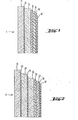
- the laminated structure 1 shown in FIG. 1 is made up, in a known manner, of a glass sheet 11 6 mm thick, of an intermediate layer 12 of polyvinyl butyral 0.76 mm thick, of a second glass sheet 13, of an adhesive layer 14 of a thermoplastic polyurethane, which allows the assembly of the glass sheet 13 and of a polycarbonate plate 15 of the plate 15 of polycarbonate 3 mm thick, d 'a thin adhesive layer 16, and a self-healing layer 17 of flexible polyurethane serving as a scratch-resistant layer for the polycarbonate plate 15.
- each sheet of laminated glazing 1 can also be used for the embodiments subsequently described.
- the polyvinyl butyral used for sheet 12 is the product SAFLEX SR 41 from the company Monsanto.
- the thermoplastic polyurethane described in German patent DE PS 26 60 346 by the company Bayer AG is used for the adhesive layer 14.
- the Makrolon product of the German company Rôhm GmbH was used to constitute the polycarbonate plate.
- the detailed description of the composition of the flexible sheet, of self-healing polyurethane 17, is found in the German patent publication DE AS 26 29 779. All the types of composition mentioned in this document also form part of the present description.
- the structure shown in Figure 2 is also part of the state of the art.
- the bulletproof laminated glazings thus illustrated consist of 3 sheets of glass 6 mm thick 21, 23, 25 glued to each other by adhesive sheets 22, 24, of polyvinyl butyral, 0.76 mm thick.
- a self-healing polyurethane protective layer 17, provided with an adhesive layer 16, is located at the rear of the polycarbonate plate 27.
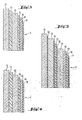
- a laminated glazing unit 3 is made having the structure shown in FIG. 3. It consists of a glass sheet 31 6 mm thick, a sheet 32 of polyvinyl butyral 3.8 mm thick, a glass sheet 33 6 mm thick, a layer 34 of thermoplastic polyurethane 2 mm thick, a plate 35 of polycarbonate 3 mm thick, an adhesive layer 16 and d '' a self-healing protective layer 17. It is the sheet 32 of polyvinyl butyral which, by its thickness, its composition and its position relative to the plate 35 of polycarbonate provides the desired effect according to the invention.
- a laminated glazing unit is made having the structure illustrated in FIG. 4. It successively comprises a glass sheet 41 6 mm thick, a sheet 42 of thermoplastic polyurethane 4 mm thick, a glass sheet 43 6 mm thick, a layer 44 of 2 mm thick thermoplastic polyurethane, a plate 45 of 3 mm thick polycarbonate, an adhesive layer 16 and a self-healing protective layer 17. It is, in this embodiment, the sheet 42 which fulfills the desired function in the structure described.
- a laminated glazing structure is produced as illustrated in FIG. 5, that is to say comprising successively: a sheet of glass 51 6 mm thick, a sheet 52 of polyvinyl butyral of 0.76 mm thick, a glass sheet 53 6 mm thick, a layer 54 of thermoplastic polyurethane 1.2 mm thick, a plate 55 of polycarbonate 2 mm thick, a layer 56 of thermoplastic polyurethane 1.2 mm thick, a sheet of glass 57 6 mm thick, a layer 58 of thermoplastic polyurethane 3.3 mm thick, a plate 59 of polycarbonate 2 mm thick, an adhesive layer 16 and a flexible layer 17 anti-scratch and having self-healing properties.
- the layer assembly 54, 55, 56 fulfills the desired function according to the invention.
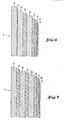
- a laminated glazing structure is produced as illustrated in FIG. 6, that is to say comprising successively: a glass sheet 61 of 6 mm thick, a layer 62 of polyvinyl butyral 0.76 mm thick. thickness, a glass sheet 63 of 6 mm thickness, a layer 64 of thermoplastic polyurethane of 4.2 mm thickness, a glass sheet 65 of 6 mm thickness, a layer 66 of thermoplastic polyurethane of 2 mm thick, a polycarbonate sheet 67 2 mm thick, an adhesive layer 16 and a scratch-resistant layer 17 having self-healing properties and a thickness of 0.5 mm.
- the glazing illustrated in FIG. 7 is produced, successively comprising: a sheet of glass 71 6 mm thick, a sheet 72 of polyvinyl butyral 3.8 mm thick, a sheet of glass 73 6 mm thick , a sheet 74 of polyvinyl butyral 3.8 mm thick, a glass sheet 75 of 6 mm thick, a layer 76 of 2 mm thick thermoplastic polyurethane, a plate 77 of 2 mm polycarbonate thickness, an adhesive layer 16 and an anti-scratch layer 17 having self-healing properties and a thickness of 0.5 mm.
Landscapes
- Engineering & Computer Science (AREA)
- General Engineering & Computer Science (AREA)
- Joining Of Glass To Other Materials (AREA)
- Laminated Bodies (AREA)
Abstract
Description
- La présente invention est relative à un vitrage de sécurité, et en particulier, un vitrage anti-balles pour véhicules automobiles, qui comprend au moins deux feuilles de verre de silicate collées par une ou plusieurs couches intercalaires en matière plastique, et, sur la face arrière de la feuille de verre orientée vers l'intérieur, une feuille supplémentaire en une matière plastique, qui, en particulier, peut être une matière possédant une bonne résistance aux chocs, comme le polycarbonate.
- Dans la suite de la description, on désignera par feuille intérieure, une feuille destinée, dans un véhicule automobile, à être orientée vers l'intérieur de l'habitacle.
- On connait différentes formes de réalisation de vitrages de sécurité, comprenant au moins une feuille de verre à laquelle est collée une plaque de polycarbonate. Grâce aux très bonnes qualités mécaniques du polycarbonate, des structures, même relativement minces, de ce type, ont déjà fait preuve de bonnes propriétés de résistance aux sollicitations mécaniques.
- Ainsi, par exemple, le brevet américain US 3 624 238 décrit une structure feuilletée comprenant des feuilles de verre et des plaques de polycarbonate dans laquelle une plaque de polycarbonate est placée entre deux feuilles de verre, de sorte que les feuilles de verre constituent les feuilles externes de la structure. Dans une telle structure, toutefois, des quantités plus ou moins importantes d'éclats de verre peuvent être projetées à l'arrière du vitrage en cas de choc, engendrant des risques non négligeables.
- Lorsqu'on souhaite toutefois éviter à tout coup d'éventuelles projections d'éclats de verre vers l'intérieur, on peut utiliser un vitrage du type mentionné ci-dessus, mais dans lequel la plaque de pqly- carbonate est orientée vers l'intérieur de l'habitacle. Une telle structure est décrite par exemple dans la publication de brevet allemand DE OS 20 39 452. La face de la plaque de polycarbonate qui reste libre n'étant pas à elle seule suffisamment résistante aux rayures, elle est éventuellement garnie d'une feuille supplémentaire beaucoup plus résistante. Ainsi on connaît déjà, par exemple par la publication de brevet allemand DE OS 28 51 394, une structure où la plaque de polycarbonate est revêtue d'une couche en polyuréthane souple et élastique qui présente des propriétés d'autocicatrisation.
- La liaison entre la feuille de verre et la plaque de polycarbonate est assurée au moyen d'une couche adhésive appropriée. Une couche en polyuréthane thermoplastique et transparent convient particulièrement bien, mais on se reportera avec profit aux publications de brevet allemand DE AS 15 94 164 et DE AS 26 60 346, par exemple, pour choisir d'autres types d'adhésif se prêtant à cette application.
- Lorsque des vitrages anti-balles présentent une telle structure assymétrique, des problèmes surgissent en raison des différences de dilatation thermique entre la feuille en matière plastique orientée vers l'intérieur d'une part et la feuille de verre d'autre part. Dans le cas présent, le coefficient de dilatation thermique de la matière plastique a une valeur multiple de celle du verre, et il en résulte à la jonction des contraintes de cisaillement considérables. A température ambiante ou à haute température, on peut éviter des déformations des vitrages feuilletés en augmentant la quantité ou l'épaisseur des feuilles de verre. On diminue ainsi les contraintes internes qui se produisent à l'intérieur de la couche adhésive déformable à cette température.
- A basse température toutefois, on ne parvient plus à diminuer les contraintes internes pour deux raisons : d'une part, elles varient en sens inverse de la température et d'autre part, la couche adhésive n'est plus déformable à ces températures. Elle agit alors dans le même sens que la plaque de polycarbonate et contribue pour sa part à l'augmentation des contraintes de cisaillement qui agissent sur la feuille de verre. La déformation résultante de la feuille de verre est si considérable que, suivant la structure choisie, elle provoque sa rupture à une température plus ou moins basse en-dessous de 0°C.
- Plus particulièrement en ce qui concerne les vitrages anti-balles pour véhicules automobiles, il est impératif d'obtenir une structure la plus mince possible, mais qui présente cependant une résistance au froid élevée. Les structures décrites jusqu'à présent ne satisfont pas cette exigence.
- La présente invention se propose donc de fournir un vitrage feuilleté anti-balles convenant particulièrement bien pour les véhicules automobiles, et qui résiste efficacement à des conditions de température assez basses. Un objet de l'invention est de proposer des vitrages qui, malgré une structure relativement mince, conservent, même à basse température, leur résistance à la flexion, c'est-à-dire présentent en toutes circonstances une flèche minimale qui les préserve des risques de rupture sous l'effet du froid.
- Pour répondre à ces objectifs, l'invention propose une structure feuilletée comprenant au moins deux feuilles de verre de silicate collées par une ou plusieurs feuilles intercalaires en matière plastique et sur la feuille de verre intérieure, une feuille supplémentaire d'au moins 1 mm d'épaisseur environ, en une matière plastique qui plus particulièrement, peut être une matière possédant une bonne résistance aux chocs comme le polycarbonate et collée par l'intermédiaire d'une couche adhésive dans laquelle une feuille intercalaire disposée du côté opposé à la face de la feuille de verre intérieure, recouverte de la feuille résistant aux chocs présente une composition et/ou une épaisseur choisies de la façon suivante : elle doit introduire, du fait de sa contraction à basse température, des contraintes de cisaillement sur ladite feuille de verre intérieure, lesdites contraintes devant compenser celles transmises à la feuille de verre par ladite feuille en matière plastique résistant aux chocs par l'intermédiaire de la couche adhésive. De cette façon, les contraintes de cisaillement qui agissent de chaque côté de ladite feuille de verre intérieure s'équilibrent sensiblement et on évite une déformation du verre.
- Selon l'invention, on choisit les dimensions ou la composition des couches qui constituent le vitrage feuilleté de façon à ce que, en ce qui concerne la feuille de verre intérieure à laquelle adhère par exemple une plaque de polycarbonate, on soit en présence d'une certaine symétrie des comportements mécaniques, d'une part de la plaque de polycarbonate, et d'autre part, de la feuille en matière plastique située de l'autre côté de la feuille de verre. Alors que antérieurement, on a tenté de renforcer la résistance à la flexion des structures à base de verre de silicate, ou, dans le même ordre d'idée, d'utiliser une couche adhésive molle de façon à maîtriser les contraintes dans la couche adhésive, selon l'invention, on absorbe cette flexion permanente en introduisant volontairement, grâce à la présence d'une feuille dé- terminée, de l'autre côté de la feuille de verre intérieure, des contraintes de cisaillement qui compensent celles dues à la présence, sur l'autre face, de la plaque de polycarbonate.
- Dans une réalisation de l'invention, la feuille, qui est généralement une feuille monocouche, induisant des contraintes est placée directement sur la face de la feuille de verre intérieure opposée à la face recouverte par la plaque de polycarbonate.
- Plus précisément ladite feuille est la feuille qui colle la feuille de verre intérieure à une autre feuille de verre de la structure feuilletée.
- Il n'est pas nécessaire, dans la pratique, de parvenir à une compensation totale des contraintes de cisaillement puisqu'il est évident que la raideur propre du verre absorbe une partie de la déformation. Dans la plupart des cas, il suffit de prévoir une couche dont l'épaisseur est plus faible que celle de la couche résistant aux chocs augmentée de celle de la couche adhésive qui la lie à la feuille de verre. En désignant par dl l'épaisseur de la couche résistant aux chocs, par d2 celle de la couche adhésive, on peut considérer en pratique qu'on atteint une résistance au froid suffisante lorsque l'épaisseur D de la couche déposée de l'autre côté de la feuille de verre est au moins égale, et de préférence supérieure, à
-

- Selon une caractéristique avantageuse de l'invention, d2 a une valeur d'au moins 1,5 mm et de préférence environ 2 mm, le module d'élasticité de la matière adhésive ayant à 20°C, une valeur maximale de 20 N/mm2, l'épaisseur dl de la plaque de polycarbonate est de préférence comprise entre 2 mm et 5 mm.
- Si on utilise pour les différentes couches adhésives intercalaires des matières ayant des modules d'élasticité différents, il est avantageux, selon une caractéristique supplémentaire de l'invention, de former les couches permettant l'adhérence entre deux feuilles de verre avec la matière possédant le module plus élevé.
- D'autres formes avantageuses de réalisation de l'invention apparaîtront au cours de la description suivante, en relation avec les figures 1 à 7 parmi lesquelles :
- Les figures 1 et 2 montrent des vitrages feuilletés anti-balles tels qu'ils existent dans l'état de la technique.
- Les figures 3 à 7 illustrent différentes formes de réalisation de structures de vitrages feuilletés anti-balles selon l'invention.
- La structure feuilletée 1 représentée à la figure 1 se compose, de façon connue, d'une feuille de verre 11 de 6 mm d'épaisseur, d'une couche intercalaire 12 en polyvinylbutyral de 0,76 mm d'épaisseur, d'une deuxième feuille de verre 13, d'une couche adhésive 14 en un polyuréthane thermoplastique, qui permet l'assemblage de la feuille de verre 13 et d'une plaque 15 en polycarbonate de la plaque 15 en polycarbonate de 3 mm d'épaisseur, d'une mince couche adhésive 16, et d'une couche 17 autocicatrisable en polyuréthane souple servant de couche anti-rayure pour la plaque 15 de polycarbonate.
- Les matières employées citées ci-après pour constituer chaque feuille du vitrage feuilleté 1 peuvent également être utilisées pour les exemples de réalisation ultérieurement décrits.
- Le polyvinylbutyral employé pour la feuille 12 est le produit SAFLEX SR 41 de la Société Monsanto. On utilise pour la couche adhésive 14 le polyuréthane thermoplastique décrit dans le brevet allemand DE PS 26 60 346 par la Société Bayer AG. Le produit Makrolon de la Société allemande Rôhm GmbH a été utilisé pour constituer la plaque de polycarbonate. On trouve dans la publication de brevet allemand DE AS 26 29 779 la description détaillée de la composition de la feuille souple, de polyuréthane autocicatrisable 17. Tous les types de composition cités dans ce document font également partie de la présente description.
- On place trois échantillons d'un vitrage feuilleté présentant la structure illustrée à la figure 1, de 50 cm de long et 5 cm de large, dans une armoire frigorifique à 20°C et on abaisse la température. Dès que la température atteint 0°C, tous les échantillons sont rompus.
- La structure représenté à la figure 2 fait également partie de l'état de la technique. Les vitrages feuilletés anti-balles ainsi illustrés se composent de 3 feuilles de verre de 6 mm d'épaisseur 21, 23, 25 collées l'une à l'autre par des feuilles adhésives 22, 24, en polyvinylbutyral, de 0,76 mm d'épaisseur. Une feuille de polyuréthane thermoplastique 26 de 2 mm d'épaisseur, située à l'arrière de la feuille de verre 25, la fait adhérer à une plaque 27 de polycarbonate de 3 mm d'épaisseur. Une couche de protection 17 autocicatrisable en polyuréthane, garnie d'une couche adhésive 16, se trouve à l'arrière de la plaque 27 en polycarbonate.
- Comme précédemment, on place trois échantillons d'un tel vitrage de 50 cm de long sur 3 cm de large, dans une armoire frigorifique à température ambiante et on abaisse lentement la température. A - 30°C, on ouvre l'armoire et on s'aperçoit que les trois échantillons sont détruits.
- Les exemples suivants permettront une meilleure compréhension de l'invention, en relation avec le même type de tests de comportement à basse température.
- On fabrique un vitrage feuilleté 3 ayant la structure représentée à la figure 3. Il se compose d'une feuille de verre 31 de 6 mm d'épaisseur, d'une feuille 32 de polyvinylbutyral de 3,8 mm d'épaisseur, d'une feuille de verre de 33 de 6 mm d'épaisseur, d'une couche 34 de polyuréthane thermoplastique de 2 mm d'épaisseur, d'une plaque 35 de polycarbonate de 3 mm d'épaisseur, d'une couche adhésive 16 et d'une couche de protection 17 autocicatrisable. C'est la feuille 32 de polyvinylbutyral qui, par son épaisseur, sa composition et sa position par rapport à la plaque 35 de polycarbonate procure l'effet désiré selon l'invention.
- On place dans une armoire frigorifique à température ambiante trois échantillons de 50 cm de long pour 5 cm de large d'un tel vitrage ayant une épaisseur d'environ 21,5 mm, et on abaisse lentement la température jusqu'à environ - 40°C. Alors que les feuilles de verre de l'un des échantillons sont déjà rompues à 0°C, les autres sont encore intactes à - 40°C. Les échantillons non endommagés se sont légèrement bombés au cours du refroidissement et la flèche entre les extrémités et le milieu des échantillons a dans un cas augmenté de 0,63 mm et dans l'autre de 0,66 mm.
- On fabrique un vitrage feuilleté ayant la structure illustrée à la figure 4. Il comprend successivement une feuille de verre 41 de 6 mm d'épaisseur, une feuille 42 de polyuréthane thermoplastique de 4 mm d'épaisseur, une feuille de verre 43 de 6 mm d'épaisseur, une couche 44 de polyuréthane thermoplastique de 2 mm d'épaisseur, une plaque 45 de polycarbonate de 3 mm d'épaisseur, une couche adhésive 16 et une couche de protection 17 autocicatrisable. C'est, dans ce mode de réalisation, la feuille 42 qui remplit dans la structure décrite la fonction souhaitée.
- On prépare de nouveau trois échantillons, d'une épaisseur totale de 21,7 mm, et on les soumet à l'épreuve du froid à - 40°C. Tous passent l'épreuve sans endommagement notable. A - 30°C, ils sont légèrement courbés par rapport à leur état à température ambiante, et la flèche a pour deux d'entre eux augmenté de 0,59 mm, et de 0,56 mm pour le troisième. En poursuivant le refroidissment au-delà de - 30°C, on ne note pas d'augmentation de la flèche. On peut donc en déduire que ces structures supportent sans dommage des températures encore inférieures à - 40°C.
- On fabrique une structure de vitrage feuilleté telle qu'illustrée à la figure 5, c'est-à-dire comprenant successivement : une feuille de verre 51 de 6 mm d'épaisseur, une feuille 52 de polyvinybu- tyral de 0,76 mm d'épaisseur, une feuille de verre 53 de 6 mm d'épaisseur, une couche 54 de polyuréthane thermoplastique de 1,2 mm d'épaisseur, une plaque 55 de polycarbonate de 2 mm d'épaisseur, une couche 56 de polyuréthane thermoplastique de 1,2 mm d'épaisseur, une feuille de verre 57 de 6 mm d'épaisseur, une couche 58 de polyuréthane thermoplastique de 3,3 mm d'épaisseur, une plaque 59 de polycarbonate de 2 mm d'épaisseur, une couche adhésive 16 et une couche souple 17 anti-rayures et ayant des propriétés d'autocicatrisation.
- Dans cette structure plus complexe, l'ensemble de couche 54, 55, 56, remplit la fonction souhaitée selon l'invention.
- On soumet trois échantillons de ce type, ayant une épaisseur totale de 29 mm, à l'épreuve du froid jusqu'à - 40°C. Tous supportent l'épreuve sans endommagement. Dans les trois cas, le refroidissement depuis la température ambiante jusqu'à - 30°C a provoqué une augmentation de la flèche de 0,1 mm. Après réchauffement à température ambiante, les échantillons retrouvent au bout de trois jours leur état d'origine.
- On fabrique une structure de vitrage feuilleté telle qu'illustrée à la figure 6, c'est-à-dire comprenant successivement : une feuille de verre 61 de 6 mm d'épaisseur, une couche 62 de polyvinylbutyral de 0,76 mm d'épaisseur, une feuille de verre 63 de 6 mm d'épaisseur, une couche 64 de polyuréthane thermoplastique de 4,2 mm d'épaisseur, une feuille de verre 65 de 6 mm d'épaisseur, une couche 66 de polyuréthane thermoplastique de 2 mm d'épaisseur, une plaque de polycarbonate 67 de 2 mm d'épaisseur, une couche adhésive 16 et une couche 17 anti-rayures ayant des propriétés d'autocicatrisation et une épaisseur de 0,5 mm.
- On soumet trois échantillons de ce type, ayant une épaisseur totale de 28,5.mm à l'épreuve du froid jusqu'à - 40°C. Tous supportent l'épreuve sans dommage. Dans les trois cas, le refroidissement depuis la température ambiante jusqu'à - 30°C a provoqué une augmentation de la flèche de 0,2 mm. Après réchauffement à température ambiante, les échantillons retrouvent au bout de trois jours leur état d'origine.
- On fabrique le vitrage illustré à la figure 7, comprenant successivement : une feuille de verre 71 de 6 mm d'épaisseur, une feuille 72 de polyvinylbutyral de 3,8 mm d'épaisseur, une feuille de verre 73 de 6 mm d'épaisseur, une feuille 74 de polyvinylbutyral de 3,8 mm d'épaisseur, une feuille de verre 75 de 6 mm d'épaisseur, une couche 76 de polyuréthane thermoplastique de 2 mm d'épaisseur, une plaque 77 de polycarbonate de 2 mm d'épaisseur, une couche adhésive 16 et une couche anti-rayures 17 ayant des propriétés d'autocicatrisation et une épaisseur de 0,5 mm.
- Après avoir soumis trois échantillons d'un tel vitrage à l'épreuve du froid, on obtient les mêmes résultats que ceux obtenus à l'exemple 4.
Claims (10)
Priority Applications (2)
| Application Number | Priority Date | Filing Date | Title |
|---|---|---|---|
| DE8484401290T DE3480278D1 (en) | 1984-06-21 | 1984-06-21 | Safety glass, in particular bullet-proof safety glass |
| AT84401290T ATE47562T1 (de) | 1984-06-21 | 1984-06-21 | Sicherheitsglasscheibe, insbesondere eine kugelsichere scheibe. |
Applications Claiming Priority (1)
| Application Number | Priority Date | Filing Date | Title |
|---|---|---|---|
| FR8310295A FR2547809B1 (fr) | 1983-06-22 | 1983-06-22 | Vitrage de securite, en particulier vitrage anti-balles |
Publications (2)
| Publication Number | Publication Date |
|---|---|
| EP0130886A1 true EP0130886A1 (fr) | 1985-01-09 |
| EP0130886B1 EP0130886B1 (fr) | 1989-10-25 |
Family
ID=9290041
Family Applications (1)
| Application Number | Title | Priority Date | Filing Date |
|---|---|---|---|
| EP19840401290 Expired EP0130886B1 (fr) | 1983-06-22 | 1984-06-21 | Vitrage de sécurité, en particulier vitrage anti-balles |
Country Status (3)
| Country | Link |
|---|---|
| EP (1) | EP0130886B1 (fr) |
| DE (1) | DE3421571A1 (fr) |
| FR (1) | FR2547809B1 (fr) |
Cited By (9)
| Publication number | Priority date | Publication date | Assignee | Title |
|---|---|---|---|---|
| EP0236045A3 (en) * | 1986-02-27 | 1988-09-14 | Pilkington Brothers P.L.C. | A window panel |
| US4812359A (en) * | 1984-04-04 | 1989-03-14 | Pilkington Brothers P.L.C. | Impact-resistant laminate |
| WO1993022136A1 (fr) * | 1992-05-04 | 1993-11-11 | John Cross | Panneau transparent resistant aux impacts |
| EP0618178A1 (fr) * | 1993-03-27 | 1994-10-05 | Pilkington Aerospace Limited | Procédé pour le renforcement d'une plaque de verre |
| WO2002068188A1 (fr) * | 2001-02-27 | 2002-09-06 | Armand Zurhaar | Panneau de verre pare-balles |
| WO2009149951A3 (fr) * | 2008-06-13 | 2010-04-08 | Esw Gmbh | Composite stratifié transparent résistant aux balles et dispositif de protection comprenant un composite stratifié transparent résistant aux balles |
| CN111433018A (zh) * | 2017-12-13 | 2020-07-17 | 法国圣戈班玻璃厂 | 具有高耐鸟撞击性的航空层压窗玻璃 |
| CN111465498A (zh) * | 2017-10-20 | 2020-07-28 | 康宁股份有限公司 | 具有改进的波度的层压玻璃结构 |
| CN113845313A (zh) * | 2021-09-17 | 2021-12-28 | 成都拓米双都光电有限公司 | 复合涂层及制备方法、超薄玻璃及制备方法、终端设备 |
Families Citing this family (7)
| Publication number | Priority date | Publication date | Assignee | Title |
|---|---|---|---|---|
| GB8619464D0 (en) * | 1986-08-09 | 1986-09-17 | Glaverbel | Bending thermoplastics sheets |
| DE9111130U1 (de) * | 1991-09-07 | 1992-01-16 | Trasco Export GmbH, 2820 Bremen | Kraftfahrzeug mit gepanzerter Scheibe |
| DE9310957U1 (de) * | 1993-07-22 | 1993-09-23 | Vegla Vereinigte Glaswerke Gmbh, 52066 Aachen | Panzerglasscheibe fuer kraftfahrzeuge |
| RU95104372A (ru) * | 1995-04-03 | 1996-12-20 | Товарищество с ограниченной ответственностью "АНТЕР Лтд." | Слоистое бронестекло и способ его изготовления |
| DE10055830A1 (de) * | 2000-11-11 | 2002-05-29 | Volker Bastian | Temperaturunabhängige Verbundsicherheitsplatte |
| RU2193151C2 (ru) * | 2000-12-04 | 2002-11-20 | Ольховский Эдуард Васильевич | Противопульная защита |
| DE202008014264U1 (de) | 2008-10-27 | 2009-02-05 | GuS Präzision in Kunststoff, Glas und Optik GmbH & Co. KG | Panzerglasverbundscheibe |
Citations (3)
| Publication number | Priority date | Publication date | Assignee | Title |
|---|---|---|---|---|
| FR2181635A1 (en) * | 1972-04-24 | 1973-12-07 | Ppg Industries Inc | Laminated glass - protected from abrasion and bursting |
| EP0003432A1 (fr) * | 1978-01-30 | 1979-08-08 | CIN Industrial Investments Limited | Laminés de verre/résine synthétique et procédé pour la fabrication de ces laminés |
| FR2501580A1 (en) * | 1981-03-16 | 1982-09-17 | Macocco Sa | Laminate screens of glass and polycarbonate sheets - involving polyvinyl butyral film and chemical surface treatment to enhance compatibility |
Family Cites Families (7)
| Publication number | Priority date | Publication date | Assignee | Title |
|---|---|---|---|---|
| US3388032A (en) * | 1965-01-13 | 1968-06-11 | Mobay Chemical Corp | Laminated safety glass |
| US3624238A (en) * | 1969-03-24 | 1971-11-30 | Binswanger Glass Co | Laminated transparent bullet resisting structure |
| BE754566A (fr) * | 1969-06-17 | 1971-02-08 | Ppg Industries Inc | Vitres stratifiees |
| US4169181A (en) * | 1977-11-29 | 1979-09-25 | General Electric Company | Impact resistant soft coated laminates and process for making the same |
| DE2629779C3 (de) * | 1976-07-02 | 1985-04-04 | Saint Gobain | Verfahren zur Herstellung einer zweischichtigen Folie mit Selbstheileigenschaften unter Verwendung von Polyurethanen als Splitterschutzschicht eines Sicherheitsglases |
| US4242403A (en) * | 1976-08-02 | 1980-12-30 | Libbey-Owens-Ford Company | Automotive glazing units and method of producing the same |
| DE2660346C2 (de) * | 1976-10-01 | 1980-09-25 | Bayer Ag, 5090 Leverkusen | Laminierte Schichtstoffe unter Verwendung eines Polyurethan-Polyharnstoffs und Verfahren zu ihrer Herstellung |
-
1983
- 1983-06-22 FR FR8310295A patent/FR2547809B1/fr not_active Expired
-
1984
- 1984-06-09 DE DE19843421571 patent/DE3421571A1/de active Granted
- 1984-06-21 EP EP19840401290 patent/EP0130886B1/fr not_active Expired
Patent Citations (3)
| Publication number | Priority date | Publication date | Assignee | Title |
|---|---|---|---|---|
| FR2181635A1 (en) * | 1972-04-24 | 1973-12-07 | Ppg Industries Inc | Laminated glass - protected from abrasion and bursting |
| EP0003432A1 (fr) * | 1978-01-30 | 1979-08-08 | CIN Industrial Investments Limited | Laminés de verre/résine synthétique et procédé pour la fabrication de ces laminés |
| FR2501580A1 (en) * | 1981-03-16 | 1982-09-17 | Macocco Sa | Laminate screens of glass and polycarbonate sheets - involving polyvinyl butyral film and chemical surface treatment to enhance compatibility |
Cited By (13)
| Publication number | Priority date | Publication date | Assignee | Title |
|---|---|---|---|---|
| US4812359A (en) * | 1984-04-04 | 1989-03-14 | Pilkington Brothers P.L.C. | Impact-resistant laminate |
| EP0236045A3 (en) * | 1986-02-27 | 1988-09-14 | Pilkington Brothers P.L.C. | A window panel |
| WO1993022136A1 (fr) * | 1992-05-04 | 1993-11-11 | John Cross | Panneau transparent resistant aux impacts |
| EP0618178A1 (fr) * | 1993-03-27 | 1994-10-05 | Pilkington Aerospace Limited | Procédé pour le renforcement d'une plaque de verre |
| WO2002068188A1 (fr) * | 2001-02-27 | 2002-09-06 | Armand Zurhaar | Panneau de verre pare-balles |
| US8833233B2 (en) | 2008-06-13 | 2014-09-16 | Krd Sicherheitstechnik Gmbh | Bullet-resistant transparent laminate composite and protection arrangement having a bullet-resistant transparent laminate composite |
| WO2009149951A3 (fr) * | 2008-06-13 | 2010-04-08 | Esw Gmbh | Composite stratifié transparent résistant aux balles et dispositif de protection comprenant un composite stratifié transparent résistant aux balles |
| CN111465498A (zh) * | 2017-10-20 | 2020-07-28 | 康宁股份有限公司 | 具有改进的波度的层压玻璃结构 |
| CN111465498B (zh) * | 2017-10-20 | 2023-10-10 | 康宁股份有限公司 | 具有改进的波度的层压玻璃结构 |
| CN111433018A (zh) * | 2017-12-13 | 2020-07-17 | 法国圣戈班玻璃厂 | 具有高耐鸟撞击性的航空层压窗玻璃 |
| EP3723979A1 (fr) * | 2017-12-13 | 2020-10-21 | Saint-Gobain Glass France | Vitrage feuillete aeronautique a haute resistance a la rupture au choc a l'oiseau |
| CN113845313A (zh) * | 2021-09-17 | 2021-12-28 | 成都拓米双都光电有限公司 | 复合涂层及制备方法、超薄玻璃及制备方法、终端设备 |
| CN113845313B (zh) * | 2021-09-17 | 2023-11-03 | 成都拓米双都光电有限公司 | 复合涂层及制备方法、超薄玻璃及制备方法、终端设备 |
Also Published As
| Publication number | Publication date |
|---|---|
| DE3421571A1 (de) | 1985-01-10 |
| FR2547809A1 (fr) | 1984-12-28 |
| FR2547809B1 (fr) | 1985-10-18 |
| EP0130886B1 (fr) | 1989-10-25 |
| DE3421571C2 (fr) | 1987-05-21 |
Similar Documents
| Publication | Publication Date | Title |
|---|---|---|
| EP0130886B1 (fr) | Vitrage de sécurité, en particulier vitrage anti-balles | |
| EP0844075B9 (fr) | Utilisation d'un vitrage feuilleté pour l'amortissement des vibrations d'origine solidienne dans un véhicule | |
| CA2142984C (fr) | Vitrage a proprietes ameliorees | |
| EP0014141B1 (fr) | Vitrage composite à haute résistance aux impacts | |
| EP0635359B1 (fr) | Vitre blindée pour véhicules automobiles | |
| EP0707951B1 (fr) | Vitrage de sécurité | |
| CA2065516C (fr) | Vitrage feuillete | |
| FR3046382A1 (fr) | Procede de fabrication d'un vitrage feuillete de vehicule dans lequel est incorpore un ecran oled | |
| FR2795365A1 (fr) | Vitrage feuillete blinde, en particulier pour vehicules automobiles | |
| EP0503998B1 (fr) | Vitrage feuilleté | |
| EP1901917B1 (fr) | Structure feuilletee a resistance balistique | |
| EP1025986B1 (fr) | Vitrage feuillete à tenue elevée aux crash-tests | |
| EP0337041A1 (fr) | Panneau de protection et notamment écran balistique | |
| EP0022727B1 (fr) | Vitrage feuilleté à intercalaire double | |
| CA3027874A1 (fr) | Vitrage aeronautique comprenant une feuille de polymere acrylique a proprietes mecaniques ameliorees | |
| EP1101955B1 (fr) | Vitrage multiple de securite ayant au moins trois feuilles separées | |
| EP4320041A1 (fr) | Vitrage multiple d'enceinte pressurisée ayant un film de matériau polymère adhésif et antisolaire | |
| FR2616426A1 (fr) | Vitrage composite presentant des proprietes de resistance aux chocs | |
| FR2697829A1 (fr) | Vitrage feuilleté anti-éclats. | |
| FR2597857A1 (fr) | Materiau composite transparent de protection aux chocs et panneau de protection realise a l'aide d'un tel materiau | |
| FR2781415A1 (fr) | Vitrage feuillete de securite | |
| FR2570749A1 (fr) | Vitrage de securite a haute resistance aux chocs | |
| FR2574779A1 (fr) | Vitrage de securite comprenant plusieurs feuilles de verre et une ou plusieurs feuilles de matiere plastique | |
| EP0364372A1 (fr) | Vitrage de sécurité stratifié transparent | |
| BE662946A (fr) |
Legal Events
| Date | Code | Title | Description |
|---|---|---|---|
| PUAI | Public reference made under article 153(3) epc to a published international application that has entered the european phase |
Free format text: ORIGINAL CODE: 0009012 |
|
| AK | Designated contracting states |
Designated state(s): AT BE CH DE FR GB IT LI LU NL SE |
|
| 17P | Request for examination filed |
Effective date: 19850620 |
|
| 17Q | First examination report despatched |
Effective date: 19880831 |
|
| GRAA | (expected) grant |
Free format text: ORIGINAL CODE: 0009210 |
|
| AK | Designated contracting states |
Kind code of ref document: B1 Designated state(s): AT BE CH DE FR GB IT LI LU NL SE |
|
| REF | Corresponds to: |
Ref document number: 47562 Country of ref document: AT Date of ref document: 19891115 Kind code of ref document: T |
|
| REF | Corresponds to: |
Ref document number: 3480278 Country of ref document: DE Date of ref document: 19891130 |
|
| ITF | It: translation for a ep patent filed | ||
| GBT | Gb: translation of ep patent filed (gb section 77(6)(a)/1977) | ||
| RAP4 | Party data changed (patent owner data changed or rights of a patent transferred) |
Owner name: VEGLA VEREINIGTE GLASWERKE GMBH Owner name: SAINT GOBAIN VITRAGE INTERNATIONAL |
|
| PLBE | No opposition filed within time limit |
Free format text: ORIGINAL CODE: 0009261 |
|
| STAA | Information on the status of an ep patent application or granted ep patent |
Free format text: STATUS: NO OPPOSITION FILED WITHIN TIME LIMIT |
|
| 26N | No opposition filed | ||
| ITTA | It: last paid annual fee | ||
| EPTA | Lu: last paid annual fee | ||
| PGFP | Annual fee paid to national office [announced via postgrant information from national office to epo] |
Ref country code: DE Payment date: 19940822 Year of fee payment: 11 |
|
| EAL | Se: european patent in force in sweden |
Ref document number: 84401290.6 |
|
| PG25 | Lapsed in a contracting state [announced via postgrant information from national office to epo] |
Ref country code: DE Effective date: 19960301 |
|
| PGFP | Annual fee paid to national office [announced via postgrant information from national office to epo] |
Ref country code: SE Payment date: 20000517 Year of fee payment: 17 |
|
| PGFP | Annual fee paid to national office [announced via postgrant information from national office to epo] |
Ref country code: GB Payment date: 20000531 Year of fee payment: 17 |
|
| PGFP | Annual fee paid to national office [announced via postgrant information from national office to epo] |
Ref country code: AT Payment date: 20000609 Year of fee payment: 17 |
|
| PGFP | Annual fee paid to national office [announced via postgrant information from national office to epo] |
Ref country code: LU Payment date: 20000621 Year of fee payment: 17 Ref country code: FR Payment date: 20000621 Year of fee payment: 17 |
|
| PGFP | Annual fee paid to national office [announced via postgrant information from national office to epo] |
Ref country code: BE Payment date: 20000629 Year of fee payment: 17 |
|
| PGFP | Annual fee paid to national office [announced via postgrant information from national office to epo] |
Ref country code: NL Payment date: 20000630 Year of fee payment: 17 |
|
| PGFP | Annual fee paid to national office [announced via postgrant information from national office to epo] |
Ref country code: CH Payment date: 20000915 Year of fee payment: 17 |
|
| PG25 | Lapsed in a contracting state [announced via postgrant information from national office to epo] |
Ref country code: LU Free format text: LAPSE BECAUSE OF NON-PAYMENT OF DUE FEES Effective date: 20010621 Ref country code: GB Free format text: LAPSE BECAUSE OF NON-PAYMENT OF DUE FEES Effective date: 20010621 Ref country code: AT Free format text: LAPSE BECAUSE OF NON-PAYMENT OF DUE FEES Effective date: 20010621 |
|
| PG25 | Lapsed in a contracting state [announced via postgrant information from national office to epo] |
Ref country code: SE Free format text: LAPSE BECAUSE OF NON-PAYMENT OF DUE FEES Effective date: 20010622 |
|
| PG25 | Lapsed in a contracting state [announced via postgrant information from national office to epo] |
Ref country code: LI Free format text: LAPSE BECAUSE OF NON-PAYMENT OF DUE FEES Effective date: 20010630 Ref country code: CH Free format text: LAPSE BECAUSE OF NON-PAYMENT OF DUE FEES Effective date: 20010630 Ref country code: BE Free format text: LAPSE BECAUSE OF NON-PAYMENT OF DUE FEES Effective date: 20010630 |
|
| BERE | Be: lapsed |
Owner name: SAINT-GOBAIN VITRAGE Effective date: 20010630 |
|
| PG25 | Lapsed in a contracting state [announced via postgrant information from national office to epo] |
Ref country code: NL Free format text: LAPSE BECAUSE OF NON-PAYMENT OF DUE FEES Effective date: 20020101 |
|
| EUG | Se: european patent has lapsed |
Ref document number: 84401290.6 |
|
| GBPC | Gb: european patent ceased through non-payment of renewal fee |
Effective date: 20010621 |
|
| REG | Reference to a national code |
Ref country code: CH Ref legal event code: PL |
|
| PG25 | Lapsed in a contracting state [announced via postgrant information from national office to epo] |
Ref country code: FR Free format text: LAPSE BECAUSE OF NON-PAYMENT OF DUE FEES Effective date: 20020228 |
|
| NLV4 | Nl: lapsed or anulled due to non-payment of the annual fee |
Effective date: 20020101 |