EP0132106A2 - Apparat zur Rückgewinnung - Google Patents
Apparat zur Rückgewinnung Download PDFInfo
- Publication number
- EP0132106A2 EP0132106A2 EP84304708A EP84304708A EP0132106A2 EP 0132106 A2 EP0132106 A2 EP 0132106A2 EP 84304708 A EP84304708 A EP 84304708A EP 84304708 A EP84304708 A EP 84304708A EP 0132106 A2 EP0132106 A2 EP 0132106A2
- Authority
- EP
- European Patent Office
- Prior art keywords
- core
- tool
- cable
- strands
- deformed
- Prior art date
- Legal status (The legal status is an assumption and is not a legal conclusion. Google has not performed a legal analysis and makes no representation as to the accuracy of the status listed.)
- Withdrawn
Links
Images


Classifications
-
- H—ELECTRICITY
- H01—ELECTRIC ELEMENTS
- H01B—CABLES; CONDUCTORS; INSULATORS; SELECTION OF MATERIALS FOR THEIR CONDUCTIVE, INSULATING OR DIELECTRIC PROPERTIES
- H01B15/00—Apparatus or processes for salvaging material from cables
- H01B15/005—Apparatus or processes for salvaging material from cables by cutting
-
- B—PERFORMING OPERATIONS; TRANSPORTING
- B23—MACHINE TOOLS; METAL-WORKING NOT OTHERWISE PROVIDED FOR
- B23D—PLANING; SLOTTING; SHEARING; BROACHING; SAWING; FILING; SCRAPING; LIKE OPERATIONS FOR WORKING METAL BY REMOVING MATERIAL, NOT OTHERWISE PROVIDED FOR
- B23D25/00—Machines or arrangements for shearing stock while the latter is travelling otherwise than in the direction of the cut
- B23D25/14—Machines or arrangements for shearing stock while the latter is travelling otherwise than in the direction of the cut without regard to the exact dimensions of the resulting material, e.g. for cutting-up scrap
-
- Y—GENERAL TAGGING OF NEW TECHNOLOGICAL DEVELOPMENTS; GENERAL TAGGING OF CROSS-SECTIONAL TECHNOLOGIES SPANNING OVER SEVERAL SECTIONS OF THE IPC; TECHNICAL SUBJECTS COVERED BY FORMER USPC CROSS-REFERENCE ART COLLECTIONS [XRACs] AND DIGESTS
- Y02—TECHNOLOGIES OR APPLICATIONS FOR MITIGATION OR ADAPTATION AGAINST CLIMATE CHANGE
- Y02W—CLIMATE CHANGE MITIGATION TECHNOLOGIES RELATED TO WASTEWATER TREATMENT OR WASTE MANAGEMENT
- Y02W30/00—Technologies for solid waste management
- Y02W30/50—Reuse, recycling or recovery technologies
- Y02W30/82—Recycling of waste of electrical or electronic equipment [WEEE]
Definitions
- This invention relates to removal of cores from metal cored cables and in particular to removal of steel cores from aluminium cable.
- the present invention is directed towards providing a machine which extracts and fragments core material and thus alleviates handling difficulties.
- the invention provides an apparatus for fragmenting wire comprising at least one pair of gears the teeth of which are set to loosely engage so that a metal wire fed between the teeth is engaged and pulled along and is so deformed that fracture occurs.
- the wire is engaged by two sets of gears, the first set deforming but not fracturing the wire and the second set causing further deformation and ultimate fracture of the wire.
- the invention also provides a method of removing a metallic core from a cable comprising engaging one end of the core between toothed wheels so that the core is pulled from the cable and deformed, then passing the so deformed core to a second engagement between toothed wheels to increase the deformation to the point of fracture.
- a tool for separating a reinforcing core material from surrounding strands comprising an elongate member with longitudinal walls defining a passage for receiving the core and having a tapered end portion which causes the strands to separate as they are pulled on to the tool.
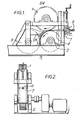
- gear-wheels indicated by numerals 1, 2 and 3. These gears are made of hard material such as hardened steel.
- a steel core 4 from an aluminium stranded cable 5 is passed through an aperture 6 in a plate 7 and is engaqed by the teeth of gear-wheels 1 and 2 which, as they rotate in the directions indicated by the arrows, pull the core from the aluminium cable and also cause the core to be deformed.
- the deformed cable is then carried by gear-wheel 2 to a second engagement between gear-wheels 2 and 3 which are set closer together than the gear-wheels 1 and 2.
- gear-wheels 2 and 3 The closer setting of gear-wheels 2 and 3 causes the core to be pressed deeper into the recesses between the teeth and, as the core is held, relatively, by gear-wheels 1 and 2, it becomes further stretched and eventually fractures, usually at high stress areas at the corners of the teeth.
- a guide 23 is provided to deflect the core 4 towards the second set of gears in the event that it springs away, through premature fracture or for other reasons, from the gear 2.
- the leading edges of the gears 1 and 2 are preferably rounded. It should be noted that if, as shown in Figure 1, the strands of the cable 5 are permitted to build-up against the plate 7 a considerable back pressure resistinq removal of the core occurs and the core must be clamped within the apparatus.
- the first set of gears, 1 and 2 provide this clamping function as well as the first stage of deformation.
- gear-wheels there are four gear-wheels, the second stage of deformation taking place between gear 3 and the fourth gear.
- one gear of each pair must be driven whereas in the first embodiment only gear-wheel 2 (the common gear) was driven.
- the four gear embodiment enables a lesser loading on the shafts as the drive is shared; however the adjustment to the preferred position of the gears for the second stage of deformation in which the teeth register with the deformations imparted by the teeth of the first stage of deformation may be more difficult than in the first embodiment.
- the fragments of the core after the second stage of deformation are of a convenient size (i.e. a few centimeters in length) for collection and placement in a furnace without necessity for binding and other inconveniences associated with the unfragmented lengths of core.
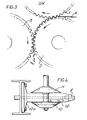
- the apparatus may be fitted with a tool such as that shown in Figure 4.
- the tool shown is generally elongate and has a central bore 8 through which the core material is threaded prior to its engagement between the first pair of gears.
- the tool may be generally conical in shape or as shown in Figure 4 have a conical or tapered nose portion 9, the remaining part of the tool being shaped to co-operate with other parts of the apparatus.
- a cutter 10 and a guide 11 are positioned alongside the tool each at a similar distance from the nose portion 9.
- a flange 12 is provided with which to attach (for example by way of screws) the tool to the cutting apparatus.
- the tool may be attached to the cuttino apparatus either in place of the apertured plate, or it may be positioned (or attached) in front of the plate with the bore aligned with the aperture.
- a length of the core 4 of a cable is bared, threaded through the tool and engaged between the gears of the cutting apparatus. Then, as the core is pulled throuqh the tool by the rotation of the qears, the outer strands of the cable ride up over the nose portion 9, becominq spread as they do so, and are eventually pulled into contact with the cutter 10. As the strands are originally twisted in a helical manner around the core, they impinqe obliquely on the cutter and are cut at each point where the helical path crosses the line of the cutter, thus the strands are cut into lenqths correspondino approximately to the lenqth of one helical path around the core.
- the quide 11 which is shown positioned opposite the cutter in Fiqure 4, is static and causes any severed strands impinqeinq on it to be pushed downwards towards a collecting bin.
- the sides of the tool may be shaped or recessed as shown at 12 to aid separation of the cut strands from the tool and to minimise accumulation of strand fragments in the vicinity of the cutter.
- a wheel may be mounted to rotate so as to push the fragments towards a collecting bin.
- Such an arranqement is shown in Figure 5 where a wheel 13 replaces the static guide 11 and is driven on the same axle as the cutter 10.
- the apparatus as described above has been made using a cutter from a milling machine, such cutters usually having tungsten carbide tips.
- the type of cable which is to be salvaged by this apparatus is usually greased and therefore application of a lubricant is not necessary. In the event that a lubricant or coolant is desired this may be applied in the vicinity of the cutter or directed alone the tool to penetrate beneath the strands of cable as they ride over the nose portion.
- the nose portion of the tool is subject to a substantial amount of friction and becomes hot, eventually deforming especially around the end of the bore.
- the nose piece 8 may be removable, for example by unscrewing, and simply substituted by a new or rebored nose portion.
- a coolant may be directed on to the outside of the cable in the vicinity of the nose piece.
- the tool is hollow rather than solid with a longitudinal bore, however the latter type of tool is generally preferred as it is stronger and facilitates the mounting of the attachments directly on to the tool.
- the cutter may be mounted on the tool or a composite cutter may be used with a fixed blade on the tool and a rotating blade that presses the strands against the fixed blade, the fixed blade taking the pressure of the cut.
- a fixed blade 14 is attached to the tool and a cuttinq wheel 15 is mounted above the tool to cut the strands as they impinge between the fixed blade 14 and cutting wheel 15.
- the fragments of core fall into a collecting bin 16 and the cut strands fall, quided by chute 17, into a collecting bin 18.
- a blade may be incorporated into the apparatus to cut the sheath.
- One particular type of cable for which a further modification of the invention may be employed comprises a reinforcement material that is bound alongside the cable it is to support by a plastics sheath, the sheath may surround the combined periphery or hold the cables apart in a Figure 8 configuration as illustrated in Figure 7.
- the apparatus of the present invention is modified as shown in Figure 8 by the addition of a plate 19 with two apertures 20,21 and a blade 22 mounted on the plate between the apertures.
- the reinforcement material is threaded through one aperture and the strands of cable (which are usually aluminium or copper) are threaded throuqh the other, the cable strands and reinforcement each then pass through a set of deforming gears as previously described for reinforcement cores, only in this instance two sets of gears are mounted side by side, one set for pulling and deforming the cable strands and the other for the cable reinforcement.
- the blade mounted between the apertures cuts the sheath to separate the core and cable as the pulling action of the gears pulls them along causing the plastics sheath to impinge on the cutter.
- the force required to extract the core from the cable depends on many factors such as the qauge of the cable and core, whether or not a cutter is used and also upon how tightly the core is engaged by the strands.
- An experimental prototype of an apparatus according to the invention utilised gears of approximately 35 cm in diameter (such as are used for the large final drive gears of a bulldozer) with the teeth being about 1.5 cm deep and each tooth having a tip width of about 0.5 cms, the base of the recesses between the teeth also having a width of 0.5 cm.
- the thickness of the gears was 7.5 cm.
- This prototype had 7.5 cm bearing shafts and was driven by a 6 cylinder diesel engine of an 8 ton truck coupled through two gear boxes set in their lowest gears. Of course this prototype had an excessive power capability and a smaller, electric motor could be used.
- the prototype was capable of processing cables of the dimensions shown in table 1.
- the above dimensions correspond to BS 125 part 2 1970.
- the 'nominal mm2' refers to the nominal total cross section of the aluminium strands: it is not an accurate figure but rounded to the nearest '5'.
- other cables constructed for special purposes e.q. 6:1 strands of 4.72 mm diameter, and it is envisaged that this may be processed as described herein.
Landscapes
- Engineering & Computer Science (AREA)
- Mechanical Engineering (AREA)
- Electric Cable Installation (AREA)
- Removal Of Insulation Or Armoring From Wires Or Cables (AREA)
- Processing Of Solid Wastes (AREA)
Applications Claiming Priority (4)
| Application Number | Priority Date | Filing Date | Title |
|---|---|---|---|
| GB838318848A GB8318848D0 (en) | 1983-07-12 | 1983-07-12 | Recovery apparatus |
| GB8318848 | 1983-07-12 | ||
| GB838329281A GB8329281D0 (en) | 1983-07-12 | 1983-11-02 | Recovery apparatus |
| GB8329281 | 1983-11-02 |
Publications (2)
| Publication Number | Publication Date |
|---|---|
| EP0132106A2 true EP0132106A2 (de) | 1985-01-23 |
| EP0132106A3 EP0132106A3 (de) | 1985-10-30 |
Family
ID=26286588
Family Applications (1)
| Application Number | Title | Priority Date | Filing Date |
|---|---|---|---|
| EP19840304708 Withdrawn EP0132106A3 (de) | 1983-07-12 | 1984-07-10 | Apparat zur Rückgewinnung |
Country Status (5)
| Country | Link |
|---|---|
| US (1) | US4619411A (de) |
| EP (1) | EP0132106A3 (de) |
| AU (1) | AU572527B2 (de) |
| ES (1) | ES8506176A1 (de) |
| GB (1) | GB2145013B (de) |
Cited By (4)
| Publication number | Priority date | Publication date | Assignee | Title |
|---|---|---|---|---|
| AT505038B1 (de) * | 2007-07-05 | 2008-10-15 | Franz Rieser | Vorrichtung zur zerlegung von drähten |
| CN105788770A (zh) * | 2016-04-28 | 2016-07-20 | 台州金福桂再生资源利用有限公司 | 一种废旧电线自动拆解设备的送线机构 |
| CN111159791A (zh) * | 2019-12-27 | 2020-05-15 | 东华大学 | 一种数据信息防盗电子信息处理器 |
| WO2021056041A1 (de) * | 2019-09-26 | 2021-04-01 | Franz Rieser | Vorrichtung zum zerlegen von drahtseilen |
Families Citing this family (9)
| Publication number | Priority date | Publication date | Assignee | Title |
|---|---|---|---|---|
| AT394502B (de) * | 1988-10-13 | 1992-04-27 | Falkner Raimund | Zerkleinerungsvorrichtung |
| US5163629A (en) * | 1991-05-01 | 1992-11-17 | Cummins-Allison Corp. | Shredder cutting discs |
| US5340034A (en) * | 1993-06-18 | 1994-08-23 | Jang Seong J | Paper grinder |
| RU2149061C1 (ru) * | 1998-05-18 | 2000-05-20 | Сибирская аэрокосмическая академия | Способ переработки кабельной продукции |
| RU2176555C2 (ru) * | 1999-04-12 | 2001-12-10 | Франценюк Людмила Ивановна | Способ утилизации отработанного медь-кремниевого катализатора |
| CN105931762B (zh) * | 2016-04-28 | 2017-05-03 | 台州金福桂再生资源利用有限公司 | 一种废旧电缆拆解装置 |
| CN105702389B (zh) * | 2016-04-28 | 2017-05-17 | 台州金福桂再生资源利用有限公司 | 一种废旧电线拆解设备的钩切装置 |
| CN105826872B (zh) * | 2016-04-28 | 2017-08-25 | 台州金福桂再生资源利用有限公司 | 一种废旧电线自动拆解设备的理线机构 |
| WO2025149282A1 (en) * | 2024-01-08 | 2025-07-17 | British Telecommunications Public Limited Company | Removing a core of an armoured cable |
Family Cites Families (16)
| Publication number | Priority date | Publication date | Assignee | Title |
|---|---|---|---|---|
| GB516101A (en) * | 1938-06-20 | 1939-12-21 | Robert Grechan Carr | Improvements relating to the treatment of grass prior to and during drying |
| US2591943A (en) * | 1948-09-21 | 1952-04-08 | Kitselman Brothers | Helix former |
| US2683500A (en) * | 1951-04-17 | 1954-07-13 | Metal Textile Corp | Filter unit and method of producing same |
| US2851103A (en) * | 1954-12-23 | 1958-09-09 | Ind Rayon Corp | Apparatus for cutting staple |
| US2914643A (en) * | 1957-04-29 | 1959-11-24 | Hy Sil Mfg Company | Wire feeder mechanism |
| US3136045A (en) * | 1962-03-30 | 1964-06-09 | Rieux Wilbert L S De | Method of reclaming and segregating metals from electric cable |
| US3309947A (en) * | 1965-08-16 | 1967-03-21 | Southwire Co | Apparatus for removing a covering from core material |
| US3480189A (en) * | 1966-02-10 | 1969-11-25 | Dow Chemical Co | Fracturing of solid bodies |
| US3577813A (en) * | 1969-04-09 | 1971-05-04 | Evgeny Nikolavevich Vorontsov | Device for stripping out shielding sheath |
| DE1918467C3 (de) * | 1969-04-11 | 1978-10-19 | Jevgenij Nikolaevitsch Leningrad Voroncov (Sowjetunion) | Vorrichtung zum Entfernen der Abschirmung von den Enden von Leitungen oder Kabeln |
| GB1283165A (en) * | 1971-03-15 | 1972-07-26 | Dow Chemical Co | Method and apparatus for pelletizing synthetic resinous material |
| JPS5048289U (de) * | 1973-08-28 | 1975-05-13 | ||
| FR2351475A1 (fr) * | 1976-05-13 | 1977-12-09 | Rascle Francois | Machine pour separer l'ame en acier des cables electriques aeriens desaffectes des brins conducteurs en cuivre ou en aluminium enroules en helice sur cette ame |
| US4020548A (en) * | 1976-08-25 | 1977-05-03 | Western Electric Company, Inc. | Forming and stripping of conductors |
| US4377259A (en) * | 1980-03-21 | 1983-03-22 | Reclamet, Inc. | Chip and turnings separator and crusher |
| EP0237474B1 (de) * | 1986-02-28 | 1991-06-12 | Ameda Ag | Einsatzstück für Brustpumpen |
-
1984
- 1984-07-06 US US06/628,263 patent/US4619411A/en not_active Expired - Fee Related
- 1984-07-10 EP EP19840304708 patent/EP0132106A3/de not_active Withdrawn
- 1984-07-10 GB GB8417537A patent/GB2145013B/en not_active Expired
- 1984-07-10 AU AU30466/84A patent/AU572527B2/en not_active Ceased
- 1984-07-12 ES ES534270A patent/ES8506176A1/es not_active Expired
Cited By (5)
| Publication number | Priority date | Publication date | Assignee | Title |
|---|---|---|---|---|
| AT505038B1 (de) * | 2007-07-05 | 2008-10-15 | Franz Rieser | Vorrichtung zur zerlegung von drähten |
| CN105788770A (zh) * | 2016-04-28 | 2016-07-20 | 台州金福桂再生资源利用有限公司 | 一种废旧电线自动拆解设备的送线机构 |
| WO2021056041A1 (de) * | 2019-09-26 | 2021-04-01 | Franz Rieser | Vorrichtung zum zerlegen von drahtseilen |
| CN111159791A (zh) * | 2019-12-27 | 2020-05-15 | 东华大学 | 一种数据信息防盗电子信息处理器 |
| CN111159791B (zh) * | 2019-12-27 | 2022-04-08 | 东华大学 | 一种数据信息防盗电子信息处理器 |
Also Published As
| Publication number | Publication date |
|---|---|
| ES534270A0 (es) | 1985-06-16 |
| EP0132106A3 (de) | 1985-10-30 |
| ES8506176A1 (es) | 1985-06-16 |
| GB2145013B (en) | 1988-05-25 |
| AU572527B2 (en) | 1988-05-12 |
| US4619411A (en) | 1986-10-28 |
| GB8417537D0 (en) | 1984-08-15 |
| AU3046684A (en) | 1985-01-17 |
| GB2145013A (en) | 1985-03-20 |
Similar Documents
| Publication | Publication Date | Title |
|---|---|---|
| EP0132106A2 (de) | Apparat zur Rückgewinnung | |
| DE69535730T2 (de) | Schmiedeverfahren | |
| US5269206A (en) | Cable stripping apparatus | |
| US5865085A (en) | High volume wire stripper | |
| DE4238774B4 (de) | Verfahren und Vorrichtung zum Durchtrennen einer Kabelummantelung aus Fasern | |
| EP2550123B1 (de) | Bohrwerkzeug | |
| EP2919340A1 (de) | Verfahren zum Bestimmen von Abisolierparametern zum Abisolieren eines Kabels | |
| DE3103311A1 (de) | Verfahren und einrichtung zum losloesen von kunststoff- und/oder gummimaterial von metallischem material oder dgl. | |
| DE60220033T2 (de) | Vorrichtung und verfahren zur auftrennung der gummierung eines förderbands | |
| DE60212399T2 (de) | Verschleissfeste werkzeugeinsätze zum herstellen von nägeln | |
| US2335710A (en) | Bullet core stripper machine | |
| US3885488A (en) | Tapered cast tooth insert for saw | |
| EP1356326B1 (de) | Zangenartiges werkzeug und verfahren zum durchtrennen von lichtwellenleiterkabeln | |
| RU2057388C1 (ru) | Способ разделки электрических кабелей и станок для его осуществления | |
| DE3911490C1 (en) | Apparatus for recovering copper during the scrapping of electric motors | |
| EP2390035A1 (de) | Sägeseil | |
| DE4327356A1 (de) | Vorrichtung zum Abisolieren von Litzenleitern | |
| CN206962364U (zh) | 线缆切割装置 | |
| EP0105668B1 (de) | Verfahren und Apparat zum Entfernen einer oder mehrerer Schichten von Seilen von Vielfachseilkabeln | |
| EP0780943A1 (de) | Kabelentmantelungsmatrizen und Verfahren zu deren Verwendung | |
| EP0860912A3 (de) | Drahtschneide- und -entmantelungsmechanismus | |
| DE9113614U1 (de) | Schneidgerät | |
| SU1265007A1 (ru) | Устройство дл пробивки отверстий | |
| JP7841785B1 (ja) | 金網用鋼線の切断装置 | |
| DE2756987A1 (de) | Ringfoermiges schneideisen und verfahren zum abspanen der umfangsflaeche eines stabes |
Legal Events
| Date | Code | Title | Description |
|---|---|---|---|
| PUAI | Public reference made under article 153(3) epc to a published international application that has entered the european phase |
Free format text: ORIGINAL CODE: 0009012 |
|
| AK | Designated contracting states |
Designated state(s): BE DE FR GB IT NL |
|
| PUAL | Search report despatched |
Free format text: ORIGINAL CODE: 0009013 |
|
| AK | Designated contracting states |
Designated state(s): BE DE FR GB IT NL |
|
| 17P | Request for examination filed |
Effective date: 19860501 |
|
| 17Q | First examination report despatched |
Effective date: 19891123 |
|
| STAA | Information on the status of an ep patent application or granted ep patent |
Free format text: STATUS: THE APPLICATION IS DEEMED TO BE WITHDRAWN |
|
| 18D | Application deemed to be withdrawn |
Effective date: 19900404 |