EP0132109A1 - Elektro-optisches Abbildungssystem - Google Patents
Elektro-optisches Abbildungssystem Download PDFInfo
- Publication number
- EP0132109A1 EP0132109A1 EP84304714A EP84304714A EP0132109A1 EP 0132109 A1 EP0132109 A1 EP 0132109A1 EP 84304714 A EP84304714 A EP 84304714A EP 84304714 A EP84304714 A EP 84304714A EP 0132109 A1 EP0132109 A1 EP 0132109A1
- Authority
- EP
- European Patent Office
- Prior art keywords
- vibration
- mirror
- line
- electro
- video signal
- Prior art date
- Legal status (The legal status is an assumption and is not a legal conclusion. Google has not performed a legal analysis and makes no representation as to the accuracy of the status listed.)
- Withdrawn
Links
- 238000012634 optical imaging Methods 0.000 title claims abstract description 6
- 230000000694 effects Effects 0.000 description 7
- 238000003384 imaging method Methods 0.000 description 6
- 230000003287 optical effect Effects 0.000 description 3
- 238000005286 illumination Methods 0.000 description 2
- 238000000034 method Methods 0.000 description 2
- 210000001747 pupil Anatomy 0.000 description 2
- 230000005855 radiation Effects 0.000 description 2
- 238000012937 correction Methods 0.000 description 1
- 125000004122 cyclic group Chemical group 0.000 description 1
- 230000001419 dependent effect Effects 0.000 description 1
- 238000010586 diagram Methods 0.000 description 1
- 230000002349 favourable effect Effects 0.000 description 1
- 239000003574 free electron Substances 0.000 description 1
- 238000003331 infrared imaging Methods 0.000 description 1
- 230000010354 integration Effects 0.000 description 1
- 230000009897 systematic effect Effects 0.000 description 1
- 230000001960 triggered effect Effects 0.000 description 1
Images


Classifications
-
- H—ELECTRICITY
- H04—ELECTRIC COMMUNICATION TECHNIQUE
- H04N—PICTORIAL COMMUNICATION, e.g. TELEVISION
- H04N3/00—Scanning details of television systems; Combination thereof with generation of supply voltages
- H04N3/02—Scanning details of television systems; Combination thereof with generation of supply voltages by optical-mechanical means only
- H04N3/08—Scanning details of television systems; Combination thereof with generation of supply voltages by optical-mechanical means only having a moving reflector
- H04N3/09—Scanning details of television systems; Combination thereof with generation of supply voltages by optical-mechanical means only having a moving reflector for electromagnetic radiation in the invisible region, e.g. infrared
-
- H—ELECTRICITY
- H04—ELECTRIC COMMUNICATION TECHNIQUE
- H04N—PICTORIAL COMMUNICATION, e.g. TELEVISION
- H04N23/00—Cameras or camera modules comprising electronic image sensors; Control thereof
- H04N23/60—Control of cameras or camera modules
- H04N23/68—Control of cameras or camera modules for stable pick-up of the scene, e.g. compensating for camera body vibrations
-
- H—ELECTRICITY
- H04—ELECTRIC COMMUNICATION TECHNIQUE
- H04N—PICTORIAL COMMUNICATION, e.g. TELEVISION
- H04N23/00—Cameras or camera modules comprising electronic image sensors; Control thereof
- H04N23/60—Control of cameras or camera modules
- H04N23/68—Control of cameras or camera modules for stable pick-up of the scene, e.g. compensating for camera body vibrations
- H04N23/681—Motion detection
- H04N23/6812—Motion detection based on additional sensors, e.g. acceleration sensors
-
- H—ELECTRICITY
- H04—ELECTRIC COMMUNICATION TECHNIQUE
- H04N—PICTORIAL COMMUNICATION, e.g. TELEVISION
- H04N23/00—Cameras or camera modules comprising electronic image sensors; Control thereof
- H04N23/60—Control of cameras or camera modules
- H04N23/68—Control of cameras or camera modules for stable pick-up of the scene, e.g. compensating for camera body vibrations
- H04N23/682—Vibration or motion blur correction
- H04N23/685—Vibration or motion blur correction performed by mechanical compensation
- H04N23/687—Vibration or motion blur correction performed by mechanical compensation by shifting the lens or sensor position
Definitions
- This invention relates to electro-optical imaging systems, and is particularly concerned with the effect of vibration upon such a system, as vibration can result in severe blurring of the image, which can seriously degrade the information content of a viewed scene and the video signals which are derived from it.
- the present invention seeks to provide an improved system which is particularly applicable to photo detectors having a very rapid response, i.e. which do not exhibit an appreciable integration effect.
- an electro-optical imaging system includes an electro-optical sensor arrangement for producing a video signal representative of a series of line scans of a viewed scene; means for detecting vibration of said system in at least the line scan direction; and means for gating out for utilisation a selected portion of the video signal relating to each line scan so as to compensate for said vibration.
- the invention enables a two-dimensional field of view to be scanned point by point to enable a two-dimensional image to be built up.
- the invention is particularly applicable to infra-red imaging systems in which large two-dimensional detectors are not readily available.
- it is customary to scan the field of view across a point detector (or possibly a small number of adjacent point detectors), on a line-by-line basis using a polygon mirror rotating at high speed. Movement of the image in the vertical, or field, direction is obtained by means of a flapping, or oscillating, mirror.
- the rotating polygon generates the horizontal line scans, whereas the action of the flapping mirror is to move the line scan progressively vertically down the field of view in what is normally termed the field direction.
- the imaging system is subject to vibration, the effect on the video signal from which the image is reconstituted can be quite severe, resulting in blurring or distortion of the field of view which greatly degrades the information content.
- the invention enables the effect of vibration occurring in the line direction to be greatly reduced, or even eliminated altogether under favourable circumstances. It also permits vibration occurring in the vertical or field direction to be reduced to a significant extent.
- thermal radiation is received in the direction represented by line 1 and falls upon a facet of a six-sided mirror polygon 2 which is rotated rapidly and continuously in the direction indicated by the arrow 3.
- Each of the six facets has a highly polished mirror surface which reflects the incident illumination on to a pupil transfer optics 4, represented diagramatically in the drawing.
- the mirror 2 is rotated under the action of a small motor 8 and similarly the mirror 5 is oscillated backwards and forwards in the required flapping manner by a torque motor 9.
- the action of the motor 8 is to rotate the polygon 2 continuously at a nominally constant speed in the same sense so as to achieve scanning of the field of view in the horizontal or line direction
- the action of the motor 9 is to move the mirror 5 smoothly and precisely over a predetermined angle which corresponds to the vertical height of field of view, and then to rapidly return it to its initial position to repeat the process.
- FIG 2 shows the imaging device which incorporates the arrangement of Figure 1.
- the input optical aperture is represented at 10, and the remainder of the imaging device is enclosed within the housing 11.
- Azimuth and elevation sensors 12 and 19 are mounted rigidly on top of the housing 11.
- the sensors themselves are conventional devices.
- Information representative of vibration in elevation and azimuth is fed over lines 13 and 14 to a vibration compensation circuit 15.
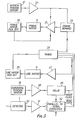
- This circuit which is described in more detail subsequently with reference to Figure 3 provides a feedback signal over lead 16 which permits a considerable degree of compensation to be provided for elevation, i.e. "vertical",vibration.
- the video signal representative of the information generated by the imaging device is output on line 17 and is fed to the vibration compensation circuit 15 where the effect of azimuth, i.e. "horizontal", vibration is largely removed, and a compensated video signal is made available at output terminal 18.
- the pick-off circuit 20 is associated with the mirror 5, and motor 9, and enables precise information about its current position to be made available so that the necessary corrections can be made to compensate for any errors which arise if it departs from a predetermined motion.
- the elevation sensor 12 makes its output available over lead 13 to an amplifier 22, the output of which is fed either directly to the drive circuit 21, which directly drives the motor 9, so as to provide immediate compensation for any vibration which occurs in the elevation of vertical sense, or alternatively, it is fed into a frame demand circuit 24 which is triggered by means of a frame synchronisation pulse obtained from a central timing circuit 23.
- the instant at which the frame synchronisation pulse is applied to restart the cyclic motion of the mirror 5 is modified by the signal applied to the frame demand circuit 24 from the amplifier 22.
- the line motor 8 is subject to a closed feedback control to which compensation for vibration is not directly applied.
- the line motor 8 drives a rotating mirror 2 which is optically coupled to a motor pick-off device 26 so that the mirror's instantaneous position is known.
- An output from the pick-off circuit 26 is fed back to the timing circuit 23 so as to synchronise the overall operation of the optical scanning system.
- Output from the timing circuit 23 is made available via a drive amplifier 27 so as to cause the motor 8 to rotate continuously at precisely the required speed.
- Horizontal position sensor 19 which is mounted on the imaging device 11 generates an output representative of the azimuth vibration and this is fed via an amplifier 28 to a variable delay circuit 29.
- the detector 7 receives the radiation which falls upon it and generates an output video signal on a multiplicity of leads 30.
- the detector 7 would consist of a number of individual detectors mounted closely adjacent to each other connected so as to simultaneously scan a number of adjacent parallel lines, from which a TV compatable picture will subsequently be reconstructed.
- the detector outputs are sampled and stored in parallel in a memory device, which is constituted by the parallel to serial converter 32, under control of a gated clock signal (write clock), produced by the timing circuit 23.
- the stored information for each of the detectors is then read out from the memory device of converter 32 in sequence under control of a second gated clock signal (read clock) to provide a serial TV video signal.
- the time at which the write clock is gated on is varied in accordance with the polygon mirror pick-off signal generated by the pick-off device 26 in order to compensate for variations in polygon rotational speed.
- the time at which the write clock signal is gated on and applied to the converter 32 is varied in accordance with the output signal from the sensor 19, via the delay circuit 29, in order to substantially compensate for the effects of azimuth vibrations without the need to modify the rotational speed of the polygon mirror 2.
- the mirror 5 oscillates in accordance with a saw-tooth waveform, that is to say, it moves steadily and relatively slowly over a particular angle corresponding to the degree of movement required in the field direction, after which it reverts rapidly during its fly-back period to its initial position so as to repeat the sequence.
- the nominal position of the saw-tooth waveform (shown in solid line 40), is shifted in amplitude by an angle E 8 (phown in broken line 41) by means of the control signal generated by the amplifier 22 and applied directly to the amplifier 21.
- the position of the waveform can be shifted in time by applying the control signal to the frame demand circuit 24.
- Figure 5 illustrates the way in which the delay circuit 29 modifies the instant of occurrence of the line period of the video signal.
- the top line of Figure 5 illustrates a video signal having two line sync pulses 50 and 51, between which the video signal is present.
- the actual position of the information varies in time in accordance with the azimuth vibration and by delaying or advancing the write clock signal 52 with respect to a sync pulse, the position of the line of video information can be in effect moved to the left or right in a manner which exactly cancels the super-imposed vibration.
- the initial delay tl is altered to t2 so as to compensate - the value of the delay will, of course, alter rapidly on a line to line basis in accordance with the imposed vibration.
- the provision of the compensation for vibration increases the angular field of view over which the two mirrors are required to scan. This can lead to vignetting of the scan mechanism, and for some purposes this may be quite acceptable.
- the angular scan available to the mirrors can be increased by an amount necessary, as compared with a conventional system in which no vibration compensation is provided within the scanning head itself.
- the same mechanism can be used over a reduced scan angle, and the remaining unvignetted angular range used for vibration compensation.
Landscapes
- Engineering & Computer Science (AREA)
- Multimedia (AREA)
- Signal Processing (AREA)
- Physics & Mathematics (AREA)
- Health & Medical Sciences (AREA)
- Electromagnetism (AREA)
- Toxicology (AREA)
- Transforming Light Signals Into Electric Signals (AREA)
Applications Claiming Priority (2)
| Application Number | Priority Date | Filing Date | Title |
|---|---|---|---|
| GB8319144 | 1983-07-15 | ||
| GB08319144A GB2144291A (en) | 1983-07-15 | 1983-07-15 | Electro-optic imager vibration compensation |
Publications (1)
| Publication Number | Publication Date |
|---|---|
| EP0132109A1 true EP0132109A1 (de) | 1985-01-23 |
Family
ID=10545758
Family Applications (1)
| Application Number | Title | Priority Date | Filing Date |
|---|---|---|---|
| EP84304714A Withdrawn EP0132109A1 (de) | 1983-07-15 | 1984-07-11 | Elektro-optisches Abbildungssystem |
Country Status (2)
| Country | Link |
|---|---|
| EP (1) | EP0132109A1 (de) |
| GB (1) | GB2144291A (de) |
Cited By (2)
| Publication number | Priority date | Publication date | Assignee | Title |
|---|---|---|---|---|
| EP0481230A3 (en) * | 1990-10-18 | 1992-10-21 | Fuji Photo Film Co., Ltd. | Camera shake correction system |
| EP0843183A3 (de) * | 1996-11-19 | 1999-11-17 | Kabushiki Kaisha Toshiba | Abtastbildaufnahmegerät und ein Abtastlaserempfänger |
Families Citing this family (2)
| Publication number | Priority date | Publication date | Assignee | Title |
|---|---|---|---|---|
| GB8418219D0 (en) * | 1984-07-17 | 1984-08-22 | British Aerospace | Image sensing apparatus |
| GB2180714B (en) * | 1985-08-22 | 1989-08-16 | Rank Xerox Ltd | Image apparatus |
Citations (1)
| Publication number | Priority date | Publication date | Assignee | Title |
|---|---|---|---|---|
| EP0083219A2 (de) * | 1981-12-29 | 1983-07-06 | Honeywell Inc. | Anordnung zur Bildstabilisierung in Fernsehsystemen |
Family Cites Families (2)
| Publication number | Priority date | Publication date | Assignee | Title |
|---|---|---|---|---|
| GB1580437A (en) * | 1976-06-10 | 1980-12-03 | Emi Ltd | Arrangement for producing a stabilised picture |
| GB2116397B (en) * | 1982-02-20 | 1985-11-06 | Mervyn Oliver Wilson | Video picture stabilising system |
-
1983
- 1983-07-15 GB GB08319144A patent/GB2144291A/en not_active Withdrawn
-
1984
- 1984-07-11 EP EP84304714A patent/EP0132109A1/de not_active Withdrawn
Patent Citations (1)
| Publication number | Priority date | Publication date | Assignee | Title |
|---|---|---|---|---|
| EP0083219A2 (de) * | 1981-12-29 | 1983-07-06 | Honeywell Inc. | Anordnung zur Bildstabilisierung in Fernsehsystemen |
Cited By (6)
| Publication number | Priority date | Publication date | Assignee | Title |
|---|---|---|---|---|
| EP0481230A3 (en) * | 1990-10-18 | 1992-10-21 | Fuji Photo Film Co., Ltd. | Camera shake correction system |
| US5282044A (en) * | 1990-10-18 | 1994-01-25 | Fuji Photo Film Co., Ltd. | Camera shake correction system |
| EP0843183A3 (de) * | 1996-11-19 | 1999-11-17 | Kabushiki Kaisha Toshiba | Abtastbildaufnahmegerät und ein Abtastlaserempfänger |
| US6449012B1 (en) | 1996-11-19 | 2002-09-10 | Kabushiki Kaisha Toshiba | Scanning type image pick-up apparatus and a scanning type laser beam receive apparatus |
| US7289153B2 (en) | 1996-11-19 | 2007-10-30 | Kabushiki Kaisha Toshiba | Scanning type image pick-up apparatus and a scanning type laser beam receive apparatus |
| US7489330B2 (en) | 1996-11-19 | 2009-02-10 | Kabushiki Kaisha Toshiba | Scanning type image pick-up apparatus and a scanning type laser beam receive apparatus |
Also Published As
| Publication number | Publication date |
|---|---|
| GB2144291A (en) | 1985-02-27 |
Similar Documents
| Publication | Publication Date | Title |
|---|---|---|
| US5663825A (en) | Stabilized step/stare scanning device | |
| US4419692A (en) | High speed infrared imaging system | |
| US3617016A (en) | Image motion and change transducers and systems controlled thereby | |
| CA2221063C (en) | A scanning type image pick-up apparatus and a scanning type laser beam receive apparatus | |
| US5107117A (en) | Optoelectronic viewing system | |
| US5278405A (en) | Method and apparatus for the correction of positioning errors of a deflected light ray | |
| US4992858A (en) | Laser beam scanning apparatus | |
| US4445140A (en) | Electronic image stabilization system | |
| GB2144291A (en) | Electro-optic imager vibration compensation | |
| US4306252A (en) | Optical scanning method and apparatus | |
| US5338933A (en) | Scanning optical sensor | |
| US4439715A (en) | Apparatus for accurately moving a body in accordance with a predetermined motion | |
| US5280363A (en) | Slit camera apparatus | |
| US4164753A (en) | Dual pyroelectric vidicon infrared camera | |
| US4004087A (en) | Panning pyroelectric vidicon system | |
| US3931468A (en) | Method and a device for generating line rasters in an infra-red imaging system | |
| JPS5915376A (ja) | 撮像機構 | |
| JP2571196B2 (ja) | 飛しょう体の誘導装置 | |
| US6025595A (en) | Sprite thermal imaging system with electronic zoom | |
| JPH0552658A (ja) | 赤外線撮像装置 | |
| SU905832A1 (ru) | Устройство дл обработки изображений | |
| GB2165120A (en) | Line scanners | |
| KR920002321B1 (ko) | 전자 스틸 카메라의 촬상방식 | |
| JPS60122918A (ja) | 画像走査記録装置のビ−ム偏向装置及びビ−ム偏向方法 | |
| JPS60261250A (ja) | 画像処理装置 |
Legal Events
| Date | Code | Title | Description |
|---|---|---|---|
| PUAI | Public reference made under article 153(3) epc to a published international application that has entered the european phase |
Free format text: ORIGINAL CODE: 0009012 |
|
| AK | Designated contracting states |
Designated state(s): AT BE CH DE FR IT LI LU NL SE |
|
| 17P | Request for examination filed |
Effective date: 19850305 |
|
| STAA | Information on the status of an ep patent application or granted ep patent |
Free format text: STATUS: THE APPLICATION HAS BEEN WITHDRAWN |
|
| 18W | Application withdrawn |
Withdrawal date: 19860513 |
|
| RIN1 | Information on inventor provided before grant (corrected) |
Inventor name: CUTHBERTSON, GLENN MCPHERSON |