EP0132183A1 - Verfahren zur Herstellung von Speicherkarten - Google Patents
Verfahren zur Herstellung von Speicherkarten Download PDFInfo
- Publication number
- EP0132183A1 EP0132183A1 EP84401370A EP84401370A EP0132183A1 EP 0132183 A1 EP0132183 A1 EP 0132183A1 EP 84401370 A EP84401370 A EP 84401370A EP 84401370 A EP84401370 A EP 84401370A EP 0132183 A1 EP0132183 A1 EP 0132183A1
- Authority
- EP
- European Patent Office
- Prior art keywords
- sheet
- cards
- cavities
- microprocessor
- cavity
- Prior art date
- Legal status (The legal status is an assumption and is not a legal conclusion. Google has not performed a legal analysis and makes no representation as to the accuracy of the status listed.)
- Withdrawn
Links
Images



Classifications
-
- G—PHYSICS
- G06—COMPUTING OR CALCULATING; COUNTING
- G06K—GRAPHICAL DATA READING; PRESENTATION OF DATA; RECORD CARRIERS; HANDLING RECORD CARRIERS
- G06K19/00—Record carriers for use with machines and with at least a part designed to carry digital markings
- G06K19/06—Record carriers for use with machines and with at least a part designed to carry digital markings characterised by the kind of the digital marking, e.g. shape, nature, code
- G06K19/067—Record carriers with conductive marks, printed circuits or semiconductor circuit elements, e.g. credit or identity cards also with resonating or responding marks without active components
- G06K19/07—Record carriers with conductive marks, printed circuits or semiconductor circuit elements, e.g. credit or identity cards also with resonating or responding marks without active components with integrated circuit chips
- G06K19/077—Constructional details, e.g. mounting of circuits in the carrier
- G06K19/07718—Constructional details, e.g. mounting of circuits in the carrier the record carrier being manufactured in a continuous process, e.g. using endless rolls
-
- G—PHYSICS
- G06—COMPUTING OR CALCULATING; COUNTING
- G06K—GRAPHICAL DATA READING; PRESENTATION OF DATA; RECORD CARRIERS; HANDLING RECORD CARRIERS
- G06K19/00—Record carriers for use with machines and with at least a part designed to carry digital markings
- G06K19/06—Record carriers for use with machines and with at least a part designed to carry digital markings characterised by the kind of the digital marking, e.g. shape, nature, code
- G06K19/067—Record carriers with conductive marks, printed circuits or semiconductor circuit elements, e.g. credit or identity cards also with resonating or responding marks without active components
- G06K19/07—Record carriers with conductive marks, printed circuits or semiconductor circuit elements, e.g. credit or identity cards also with resonating or responding marks without active components with integrated circuit chips
- G06K19/077—Constructional details, e.g. mounting of circuits in the carrier
- G06K19/07745—Mounting details of integrated circuit chips
Definitions
- the present invention relates to a method for manufacturing memory cards, in particular intended for recording data for banking or other uses, from a sheet of plastic material, such as polyvinyl chloride.
- the invention also relates to the memory cards thus obtained and an installation for manufacturing them.
- Known memory cards are produced from several superimposed polyvinyl chloride sheets, which are either pre-cut to the dimensions of the punch card, or stamped under pressure using a tool comprising a punch and a matrix.
- the central sheet of this complex assembly has a recess which passes right through it constituting a housing for receiving a pellet-shaped microprocessor. This central sheet is thus sandwiched between two outer sheets fixed to the central sheet by heat sealing or the like.
- One of the outer faces of the card namely the front of the card, receives inscriptions and / or a graphic for personalizing the card and the other, that is to say the back, has a printed magnetic stripe.
- the magnetic strip undergoes deformations due to the fact that it is under pressure from the fact that it is located opposite the recess containing the microprocessor, which can cause disturbances, in particular when reading the data written in this magnetic strip.
- the object of the present invention is to remedy the drawbacks of known embodiments, by proposing a method which considerably simplifies the manufacture of memory cards and significantly increases their reliability, while reducing their manufacturing cost.
- a plastic sheet is used in which a pellet-shaped microprocessor is incorporated, a magnetic strip is applied to one of the faces of the sheet and printing is carried out on the other side a text, numbers and possibly a graphic.
- thermoformed cavities in the sheet are internally covered by a metallic coating, the microprocessors housed inside these cavities are not likely to be degraded by the harmful vapors formed during the plasticization of the plastic material adjacent to these cavities.
- this method avoids the delicate and costly operation of application on the two faces of the sheet provided with a cavity, with an outer sheet of plastic material.
- this operation is replaced by the application on both sides of the sheet of a thin layer of thermoplastic varnish.
- the method according to the invention is thus very simple to implement and it makes it possible to considerably increase the reliability of the memory cards obtained.
- the metallic coating is applied inside the cavities, by mechanical hot pressure of a metallic film carried by a sheet of plastic material.
- This operation is particularly practical to implement and makes it possible to apply a metallic coating whose thickness is perfectly controlled and thus making it possible to obtain excellent reliability.
- a flat support is pressed on the other side of the plastic sheet, comprising pins engaged in the cavities and having a shape complementary to that of these last.
- This operation can be carried out fully automatically, by means of a machine which avoids the use of highly qualified labor.
- the installation for automatically and continuously fixing pellet-shaped microprocessors in the cut cards obtained according to the method according to the invention comprises means for continuously moving along a substantially horizontal path cut cards provided with a cavity to receive a microprocessor, between a card supply input and a finished card collection output, means for depositing an adhesive at the bottom of the card cavity, means for moving a strip carrying microprocessors regularly spaced above the path of the cards and means for pressing this strip against successive cards to introduce the microprocessor into each cavity of the cards.
- the memory card obtained in particular according to the method according to the invention comprising a plastic sheet in which there is incorporated a microprocessor in the form of a pellet, one of the faces of the sheet comprising a magnetic strip and the other face of the inscriptions and optionally a graphic, is characterized in that the sheet comprises a cavity in which the microprocessor is embedded, the bottom and the lateral face of this cavity being coated with a metal layer, that the face of the microprocessor opposite the bottom of the cavity is located substantially in the extension of the outer face of the sheet and in that this face as well as the face of the sheet carrying the magnetic strip are covered. plastic coating.
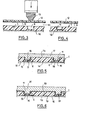
- thermoplastic material 1 such as polyvinyl chloride, which is formed continuously between rollers 2, 3, 4 and 5.
- a series of cavities 6 are regularly spaced in the sheet of thermoplastic material 1, each intended to receive a microprocessor, as will be explained in detail below. .
- This operation is carried out continuously and automatically by scrolling the sheet 1 in the not yet hardened state between two dies 7, 8 of which one 7 has pins 9 intended to form the cavities 6 by thermo-stamping the sheet 1.
- These two dies 7, 8 have channels 8a, 9a to allow the circulation of a cooling fluid.
- the cavities 6 are spaced apart from each other in the length and width direction of the sheet 1, according to distances which correspond to the dimensions of the cards 10 (shown in dotted lines) which will be cut out later in sheet 1.
- a metal coating 11 for example aluminum, silver or a nickel and chromium alloy, is deposited inside each cavity 6.
- the metal coating 11 is applied to the interior of the cavity 6, by mechanical hot pressure of a metal film 11 carried by a sheet of plastic material 12.
- This operation is carried out by pressing the sheet 12 carrying the metal film 11 in the cavity 6, by means of a punch 13 placed opposite the cavity 6 formed in the sheet 1 which rests on a flat surface 14.
- This punch 13 is brought to a sufficient temperature so that when the metallic film 11 and the sheet 12 are pressed in the cavity 6, the portion of metallic film 11 stamped and cut in the cavity 6 is detached from the plastic sheet 12 and remains in place in the cavity 6, as shown in FIG. 4.
- magnetic urepiste printing 15 is applied to the face 1a of the sheet opposite to the cavities 6 and facing each of these.
- the sheet 1 is pressed against the flat printing support 1 6, by means of a flat support 1 7 applied to the other face 1b of the sheet 1 and provided with pins 18 engaged in the cavities 6 and having a shape complementary to them.
- a text, numbers and / or graphics for personalizing the card are printed on the face 1b of the sheet 1.
- a coating 19, 20 or a plasticizable varnish for example of polyurethane resin is applied to the two faces 1b ( Figure 6) and 1a ( Figure 7) a coating 19, 20 or a plasticizable varnish for example of polyurethane resin.
- the plasticization of the coating 19, 20 is carried out by applying a heating press to the coating.
- a heating press 21 is used (see FIG. 6) having pins 22 which can engage in the cavities 6 so as to avoid any deformation of the plastic. During this operation, the cavities 6 are avoided.
- cards 10 are cut from sheet 1 along lines 23 and 24 perpendicular, so that each card 10 has a cavity 6.
- the horizontal surface 25 carrying the cards 10 is moved (see arrow F) parallel to the strip 26 and as soon as a microprocessor 27 is located in line with a cavity 6 of a card 10, the strip 26 is pressed by means of 'a pusher 28 on the card 10 in order to push the microprocessor 27 into the cavity 6.
- the microprocessor 27 is retained at the strip 26 by its face comprising the contact pads 27a, by simple bonding or similar temporary fixing means. Therefore, once the microprocessor is engaged in the cavity 6, after removal of the pusher 28, the strip 26 separates from the microprocessor 27 and the latter remains in place in the cavity 6 of the card 10.
- the fixing of the microprocessor 27 in the cavity 6 is improved by planning to introduce at the bottom of the cavity 6, before the microprocessor 27 is put in place, an appropriate adhesive 29.
- the next microprocessor 27 carried by the strip 26 is then placed in the next card 10, as described above, after displacement of the surface 25 carrying the cards 10 and of the strip 26.
- Figures 12 and 13 show a completed card 10. These figures show that the pellet-shaped microprocessor 27 is embedded in the cavity 6, the bottom and the side face of which are protected by the metallic coating 11.
- the face 1b of the card 10 covered by the coating 19 is located in the extension of the surface of the microprocessor 27 on which its contact pads 27a project.
- These contact pads 27a have a height which is substantially equal to the thickness of the coating 19 which is itself of the order of 40 microns.
- the free end of the contact pads 27a, the lateral surface of which is embedded in the covering 19a is located substantially in the extension of the external surface 10a of the card 10.
- the surface 27b directed towards the outside of the microprocessor 27 can be protected by a layer 19a, for example of polyurethane resin, similar to that of the coating 19 to restore the continuity of the latter above the microprocessor 27.
- the layer 19a can be deposited by means of a serigraphic mask in order to avoid overlapping of the free ends of the contact pads 27a.
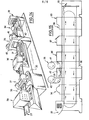
- Figures 14 and 15 show an installation for automatically and continuously executing a number of the operations of the process just described.
- This installation comprises a frame 30 carrying a carpet 31 moving continuously along a horizontal plane.
- This mat 31 is intended to carry the cards 10 precut and provided with cavities 6 and to move them continuously one after the other between a supply inlet 32 and an outlet 33 for collecting the finished cards.
- the device 35 is arranged in FIG. 15 in the direction of movement of the cards 10 while it is transverse to the latter in FIG. 1 4.
- This device 35 comprises two coils 40, 41 on which the strip 26 which carries the microprocessors 27 is unwound and wound respectively.
- This strip 26 is provided along its longitudinal edges with holes 26a (see FIG. 9) which mesh with toothed rollers, not shown, making it easier to guide and move this strip 26.
- the latter has a horizontal portion which extends a short distance above the horizontal path of the cards 10 carried by the belt 31.
- This strip 26 passes inside a housing 42 in which the pusher 28 is located (see FIG. 11) which allows the microprocessors 27 to be successively inserted into the cavities 6 of the cards 10.
- the metal layer 11 which separates the microprocessor 27 from the plastic material constituting the card 10 eliminates any risk of degradation of this microprocessor under the effect of the aggressive vapors formed during subsequent operations, in particular during the deposition of a dried serigraphic varnish UV The reliability of the memory card is thus significantly increased.
- the memory card is real read from a single plastic sheet, its structure is much simpler than that of known memory cards, this simplification of structure also being favorable with regard to reliability.
- the method according to the invention makes it possible to execute the printing of the two faces of the card, without risk of deformation in the region of the magnetic strip, liable to disturb the reading of the latter.
- the shape of the cavities 6 can be different from that described, provided that the latter is adapted to that of the microprocessors 27.
- the application of the metallic coating 11 inside the cavity 6 of the card can be carried out by other methods, such as by chemical or electro-chemical deposition, vacuum spraying and the like, provided that this coating is sufficiently impermeable to the gas formed during the manufacture of the card.
Landscapes
- Engineering & Computer Science (AREA)
- Computer Hardware Design (AREA)
- Microelectronics & Electronic Packaging (AREA)
- Physics & Mathematics (AREA)
- General Physics & Mathematics (AREA)
- Theoretical Computer Science (AREA)
- Credit Cards Or The Like (AREA)
- Manufacturing Of Magnetic Record Carriers (AREA)
Applications Claiming Priority (2)
| Application Number | Priority Date | Filing Date | Title |
|---|---|---|---|
| FR8310737 | 1983-06-29 | ||
| FR8310737A FR2548409B1 (fr) | 1983-06-29 | 1983-06-29 | Procede pour la fabrication de cartes a memoire, installation et cartes a memoire obtenues |
Publications (1)
| Publication Number | Publication Date |
|---|---|
| EP0132183A1 true EP0132183A1 (de) | 1985-01-23 |
Family
ID=9290292
Family Applications (1)
| Application Number | Title | Priority Date | Filing Date |
|---|---|---|---|
| EP84401370A Withdrawn EP0132183A1 (de) | 1983-06-29 | 1984-06-27 | Verfahren zur Herstellung von Speicherkarten |
Country Status (3)
| Country | Link |
|---|---|
| EP (1) | EP0132183A1 (de) |
| DE (1) | DE132183T1 (de) |
| FR (1) | FR2548409B1 (de) |
Cited By (12)
| Publication number | Priority date | Publication date | Assignee | Title |
|---|---|---|---|---|
| WO1988008171A1 (fr) * | 1987-04-14 | 1988-10-20 | Lgz Landis & Gyr Zug Ag | Support pour piece d'identite et procede de fabrication de ce support |
| FR2624999A1 (fr) * | 1987-12-22 | 1989-06-23 | Sgs Thomson Microelectronics | Procede de fabrication de cartes a puce |
| WO1992021105A1 (de) * | 1991-05-14 | 1992-11-26 | Skidata Computer Gesellschaft Mbh | Kartenförmiger datenträger |
| FR2701139A1 (fr) * | 1993-02-01 | 1994-08-05 | Solaic Sa | Procédé pour l'implantation d'un micro-circuit sur un corps de carte intelligente et/ou à mémoire, et carte comportant un micro-circuit ainsi implanté. |
| EP0644507A1 (de) * | 1993-09-22 | 1995-03-22 | ODS, R. OLDENBOURG DATENSYSTEME GmbH | Verfahren und Vorrichtung zum Herstellen eines Chipkarten-Moduls, Chipkarten-Modul und Chipkarte |
| EP0661173A1 (de) * | 1993-08-24 | 1995-07-05 | Giesecke & Devrient GmbH | IC-Karte mit integriertem Baustein |
| EP0615285A3 (de) * | 1993-03-11 | 1996-09-18 | Csir | Montierung einer elektronischen Schaltung auf einem Substrat. |
| FR2736452A1 (fr) * | 1995-07-05 | 1997-01-10 | Solaic Sa | Procede de fabrication d'une carte intelligente comprenant un corps en matiere fibreuse, et carte intelligente ainsi obtenue |
| USRE35578E (en) * | 1988-12-12 | 1997-08-12 | Sgs-Thomson Microelectronics, Inc. | Method to install an electronic component and its electrical connections on a support, and product obtained thereby |
| FR2760209A1 (fr) * | 1997-03-03 | 1998-09-04 | Ier | Procede et systeme d'emission d'etiquettes d'identification |
| FR2791035A1 (fr) * | 1999-03-19 | 2000-09-22 | Allibert Equipement | Procede de conditionnement d'une etiquette electronique, etiquette et piece plastique correspondantes |
| EP1112932A1 (de) * | 1999-12-31 | 2001-07-04 | Allibert Equipement | Verfahren zum herstellen eines elektronischen etiketts sowie die korrespondierende chipkarte |
Citations (6)
| Publication number | Priority date | Publication date | Assignee | Title |
|---|---|---|---|---|
| US3702464A (en) * | 1971-05-04 | 1972-11-07 | Ibm | Information card |
| FR2337381A1 (fr) * | 1975-12-31 | 1977-07-29 | Honeywell Bull Soc Ind | Carte portative pour systeme de traitement de signaux electriques et procede de fabrication de cette carte |
| EP0019280A1 (de) * | 1979-05-17 | 1980-11-26 | GAO Gesellschaft für Automation und Organisation mbH | Ausweiskarte mit IC-Baustein |
| EP0037760A1 (de) * | 1980-04-04 | 1981-10-14 | Societe Flonic | Karte mit Datenspeicher und eine integrierte Schaltung sowie Massnahmen zum Schutz gegen elektrostatische Ladungen |
| GB2100669A (en) * | 1981-06-10 | 1983-01-06 | Gao Ges Automation Org | A method of incorporating ic modules into identification cards |
| DE3151408C1 (de) * | 1981-12-24 | 1983-06-01 | GAO Gesellschaft für Automation und Organisation mbH, 8000 München | Ausweiskarte mit einem IC-Baustein |
-
1983
- 1983-06-29 FR FR8310737A patent/FR2548409B1/fr not_active Expired
-
1984
- 1984-06-27 DE DE198484401370T patent/DE132183T1/de active Pending
- 1984-06-27 EP EP84401370A patent/EP0132183A1/de not_active Withdrawn
Patent Citations (6)
| Publication number | Priority date | Publication date | Assignee | Title |
|---|---|---|---|---|
| US3702464A (en) * | 1971-05-04 | 1972-11-07 | Ibm | Information card |
| FR2337381A1 (fr) * | 1975-12-31 | 1977-07-29 | Honeywell Bull Soc Ind | Carte portative pour systeme de traitement de signaux electriques et procede de fabrication de cette carte |
| EP0019280A1 (de) * | 1979-05-17 | 1980-11-26 | GAO Gesellschaft für Automation und Organisation mbH | Ausweiskarte mit IC-Baustein |
| EP0037760A1 (de) * | 1980-04-04 | 1981-10-14 | Societe Flonic | Karte mit Datenspeicher und eine integrierte Schaltung sowie Massnahmen zum Schutz gegen elektrostatische Ladungen |
| GB2100669A (en) * | 1981-06-10 | 1983-01-06 | Gao Ges Automation Org | A method of incorporating ic modules into identification cards |
| DE3151408C1 (de) * | 1981-12-24 | 1983-06-01 | GAO Gesellschaft für Automation und Organisation mbH, 8000 München | Ausweiskarte mit einem IC-Baustein |
Cited By (15)
| Publication number | Priority date | Publication date | Assignee | Title |
|---|---|---|---|---|
| WO1988008171A1 (fr) * | 1987-04-14 | 1988-10-20 | Lgz Landis & Gyr Zug Ag | Support pour piece d'identite et procede de fabrication de ce support |
| FR2624999A1 (fr) * | 1987-12-22 | 1989-06-23 | Sgs Thomson Microelectronics | Procede de fabrication de cartes a puce |
| USRE35578E (en) * | 1988-12-12 | 1997-08-12 | Sgs-Thomson Microelectronics, Inc. | Method to install an electronic component and its electrical connections on a support, and product obtained thereby |
| WO1992021105A1 (de) * | 1991-05-14 | 1992-11-26 | Skidata Computer Gesellschaft Mbh | Kartenförmiger datenträger |
| FR2701139A1 (fr) * | 1993-02-01 | 1994-08-05 | Solaic Sa | Procédé pour l'implantation d'un micro-circuit sur un corps de carte intelligente et/ou à mémoire, et carte comportant un micro-circuit ainsi implanté. |
| EP0694871A1 (de) * | 1993-02-01 | 1996-01-31 | Solaic | Verfahren zum Implantieren einer Mikroschaltung auf einen Chip- und/oder Speicherkartenkörper, und Karte mit einer auf dieser Weise implantierten Mikroschaltung |
| EP0615285A3 (de) * | 1993-03-11 | 1996-09-18 | Csir | Montierung einer elektronischen Schaltung auf einem Substrat. |
| EP0661173A1 (de) * | 1993-08-24 | 1995-07-05 | Giesecke & Devrient GmbH | IC-Karte mit integriertem Baustein |
| EP0644507A1 (de) * | 1993-09-22 | 1995-03-22 | ODS, R. OLDENBOURG DATENSYSTEME GmbH | Verfahren und Vorrichtung zum Herstellen eines Chipkarten-Moduls, Chipkarten-Modul und Chipkarte |
| FR2736452A1 (fr) * | 1995-07-05 | 1997-01-10 | Solaic Sa | Procede de fabrication d'une carte intelligente comprenant un corps en matiere fibreuse, et carte intelligente ainsi obtenue |
| FR2760209A1 (fr) * | 1997-03-03 | 1998-09-04 | Ier | Procede et systeme d'emission d'etiquettes d'identification |
| WO1998039734A1 (fr) * | 1997-03-03 | 1998-09-11 | Ier | Procede et systeme d'emission d'etiquettes d'identification |
| AU743556B2 (en) * | 1997-03-03 | 2002-01-31 | Ier | Method and system for issuing identification labels |
| FR2791035A1 (fr) * | 1999-03-19 | 2000-09-22 | Allibert Equipement | Procede de conditionnement d'une etiquette electronique, etiquette et piece plastique correspondantes |
| EP1112932A1 (de) * | 1999-12-31 | 2001-07-04 | Allibert Equipement | Verfahren zum herstellen eines elektronischen etiketts sowie die korrespondierende chipkarte |
Also Published As
| Publication number | Publication date |
|---|---|
| DE132183T1 (de) | 1985-08-14 |
| FR2548409B1 (fr) | 1985-11-15 |
| FR2548409A1 (fr) | 1985-01-04 |
Similar Documents
| Publication | Publication Date | Title |
|---|---|---|
| EP0132183A1 (de) | Verfahren zur Herstellung von Speicherkarten | |
| JP5450862B2 (ja) | 少なくとも1つのプリント・パターンを有する電子カードの製造方法 | |
| FR2520541A1 (fr) | Procede d'insertion d'un circuit integre dans une carte a memoire et carte obtenue suivant ce procede | |
| EP2886267A1 (de) | Verfahren und Vorrichtung zum Einbau eines Einsatzes in einen Hohlraum in einem Dünnschichtprodukt | |
| FR2465277A1 (fr) | Barrette magnetique pour documents, procede d'application et documents munis d'une telle barrette | |
| EP1989664B1 (de) | Herstellungsverfahren von chipkarten | |
| EP0011013B1 (de) | Verfahren zur Herstellung von Einrichtungen die kalibrierte metallische Höcker enthalten und so hergestellten elektrokatalyschen Schreibeinrichtungen | |
| EP1192590B1 (de) | Verfahren zur herstellung einer kontaktlosen karte | |
| EP0249526B1 (de) | Maschine zum Überziehen eines flächigen Gegenstandes durch Aufbringen und Schmelzen eines thermoplastischen Films | |
| JP3355537B2 (ja) | フレキシブルフラットケーブルの製造方法及びフレキシブルフラットケーブル用材料の製造方法 | |
| FR2656830A1 (fr) | Procede et dispositif de fabrication d'une feuille continue comprenant des etiquettes. | |
| KR102326885B1 (ko) | 증착 홀로그램 카드의 제조방법 | |
| FR3121310A1 (fr) | Procédé de fabrication d’un circuit imprimé, circuit imprimé et machine de fabrication | |
| EP0195871A1 (de) | Mehrpoliger, elektrischer Steckverbinder und sein Herstellungsverfahren | |
| EP0037304B1 (de) | Perforierlinie oder dergleiche für Druckmaschinen wie Offsetmaschinen und Verfahren zu deren Anwendung in den genannten Maschinen | |
| US5702554A (en) | Process of laminating gold foil and gold foil card | |
| JPH0679812A (ja) | シール及びラベルの連続印刷機 | |
| FR2803412A1 (fr) | Procede de fabrication continue de cartes a circuit integre | |
| JPH09226770A (ja) | ホログラム付き容器およびその製造方法 | |
| WO1995008444A2 (fr) | Dispositif de perforation ou de coupe pour une machine d'impression offset | |
| CH351116A (fr) | Procédé pour la fabrication à grande vitesse de feuilles pour l'enregistrement magnétique sonore | |
| FR2779272A1 (fr) | Procede de fabrication d'un micromodule et d'un support de memorisation comportant un tel micromodule | |
| JPS62160222A (ja) | 磁気記録媒体用収納箱の製造方法 | |
| FR2591055A1 (fr) | Procede pour la fabrication de circuits electriques | |
| JPH09161325A (ja) | 光カード及びその製造方法 |
Legal Events
| Date | Code | Title | Description |
|---|---|---|---|
| PUAI | Public reference made under article 153(3) epc to a published international application that has entered the european phase |
Free format text: ORIGINAL CODE: 0009012 |
|
| 17P | Request for examination filed |
Effective date: 19840630 |
|
| AK | Designated contracting states |
Designated state(s): DE GB IT |
|
| ITCL | It: translation for ep claims filed |
Representative=s name: BARZANO' E ZANARDO ROMA S.P.A. |
|
| DET | De: translation of patent claims | ||
| 17Q | First examination report despatched |
Effective date: 19860128 |
|
| STAA | Information on the status of an ep patent application or granted ep patent |
Free format text: STATUS: THE APPLICATION IS DEEMED TO BE WITHDRAWN |
|
| 18D | Application deemed to be withdrawn |
Effective date: 19870701 |
|
| RIN1 | Information on inventor provided before grant (corrected) |
Inventor name: EYMARD, PIERRE |