EP0132371B1 - Verfahren zur Herstellung von Legierungen mit einem groben ausgezogenen Korngefüge - Google Patents
Verfahren zur Herstellung von Legierungen mit einem groben ausgezogenen Korngefüge Download PDFInfo
- Publication number
- EP0132371B1 EP0132371B1 EP84304872A EP84304872A EP0132371B1 EP 0132371 B1 EP0132371 B1 EP 0132371B1 EP 84304872 A EP84304872 A EP 84304872A EP 84304872 A EP84304872 A EP 84304872A EP 0132371 B1 EP0132371 B1 EP 0132371B1
- Authority
- EP
- European Patent Office
- Prior art keywords
- alloy
- process according
- extrusion
- alloys
- product
- Prior art date
- Legal status (The legal status is an assumption and is not a legal conclusion. Google has not performed a legal analysis and makes no representation as to the accuracy of the status listed.)
- Expired
Links
Images


Classifications
-
- F—MECHANICAL ENGINEERING; LIGHTING; HEATING; WEAPONS; BLASTING
- F28—HEAT EXCHANGE IN GENERAL
- F28F—DETAILS OF HEAT-EXCHANGE AND HEAT-TRANSFER APPARATUS, OF GENERAL APPLICATION
- F28F21/00—Constructions of heat-exchange apparatus characterised by the selection of particular materials
- F28F21/08—Constructions of heat-exchange apparatus characterised by the selection of particular materials of metal
- F28F21/081—Heat exchange elements made from metals or metal alloys
- F28F21/087—Heat exchange elements made from metals or metal alloys from nickel or nickel alloys
-
- B—PERFORMING OPERATIONS; TRANSPORTING
- B22—CASTING; POWDER METALLURGY
- B22F—WORKING METALLIC POWDER; MANUFACTURE OF ARTICLES FROM METALLIC POWDER; MAKING METALLIC POWDER; APPARATUS OR DEVICES SPECIALLY ADAPTED FOR METALLIC POWDER
- B22F3/00—Manufacture of workpieces or articles from metallic powder characterised by the manner of compacting or sintering; Apparatus specially adapted therefor ; Presses and furnaces
- B22F3/12—Both compacting and sintering
- B22F3/16—Both compacting and sintering in successive or repeated steps
-
- C—CHEMISTRY; METALLURGY
- C22—METALLURGY; FERROUS OR NON-FERROUS ALLOYS; TREATMENT OF ALLOYS OR NON-FERROUS METALS
- C22C—ALLOYS
- C22C32/00—Non-ferrous alloys containing at least 5% by weight but less than 50% by weight of oxides, carbides, borides, nitrides, silicides or other metal compounds, e.g. oxynitrides, sulfides, whether added as such or formed in situ
- C22C32/001—Non-ferrous alloys containing at least 5% by weight but less than 50% by weight of oxides, carbides, borides, nitrides, silicides or other metal compounds, e.g. oxynitrides, sulfides, whether added as such or formed in situ with only oxides
- C22C32/0015—Non-ferrous alloys containing at least 5% by weight but less than 50% by weight of oxides, carbides, borides, nitrides, silicides or other metal compounds, e.g. oxynitrides, sulfides, whether added as such or formed in situ with only oxides with only single oxides as main non-metallic constituents
- C22C32/0026—Matrix based on Ni, Co, Cr or alloys thereof
-
- C—CHEMISTRY; METALLURGY
- C22—METALLURGY; FERROUS OR NON-FERROUS ALLOYS; TREATMENT OF ALLOYS OR NON-FERROUS METALS
- C22F—CHANGING THE PHYSICAL STRUCTURE OF NON-FERROUS METALS AND NON-FERROUS ALLOYS
- C22F1/00—Changing the physical structure of non-ferrous metals or alloys by heat treatment or by hot or cold working
- C22F1/10—Changing the physical structure of non-ferrous metals or alloys by heat treatment or by hot or cold working of nickel or cobalt or alloys based thereon
Definitions
- the present invention relates to a process for making alloys, in particular high temperature alloys, having coarse elongated grain structure, and to alloys produced thereby.
- Oxide-dispersion strengthened mechanical alloys exhibit superior high temperature rupture strength because of stable oxide particles in the coarse elongated grain matrix. Such alloys are, however, very expensive to produce and indeed may have properties beyond the requirements of the user.
- the present invention is based on the discovery that the use of water atomisation processes allows the production of low cost powder metallurgy alloys having controlled oxide content which by application of suitable thermomechanical processing steps produce an alloy having coarse elongated grain structure and good high temperature properties, in particular creep strength.
- a heat-resistant article from a heavy metal alloy, for example a chromium-nickel steel or a nickel-cobalt, nickel-chromium or chromium-cobalt alloy, by extrusion of the alloy in the form of powder produced by water atomization under oxidising conditions such that the powder has an oxygen content of between 0.05 and 1.5% and has the oxides homogeneously dispersed therein.
- a heavy metal alloy for example a chromium-nickel steel or a nickel-cobalt, nickel-chromium or chromium-cobalt alloy
- a process for making a heat resistant alloy or superalloy product having a coarse elongated grain structure comprises preparing, by a water atomisation process during which oxygen is introduced into the composition, an alloy powder that contains unstable oxides and has an oxygen content greater than 0.23% by weight but does not contain more than 0.3% aluminium or 0.3% titanium, consolidating the powder by hot extrusion followed by hot rolling of the extruded product in a direction substantially parallel to the extrusion direction to form a fine-grained product in which the oxides are dispersed and strung out in the direction of working, and then annealing the consolidated product to cause recrystallisation to a coarse elongated grain structure.
- the product may be cold rolled after hot rolling.
- the invention may be applied to nickel-, cobalt- and iron-based alloys in order to enhance high temperatures strength and rupture properties.
- the process has been successfully applied to alloys based on the conventional production alloys known as Incoloy alloy 800 and Hastelloy alloy X. (lncoloy is a trade mark of the Inco family of companies and Hastelloy is a trade mark of Cabot Corporation).
- Incoloy alloy 800 is a trade mark of the Inco family of companies
- Hastelloy is a trade mark of Cabot Corporation.
- Application of the process (including the composition limitations set out above) to these alloys gives coarse elongated grain structure in the wrought product and good high temperature strength and creep properties.
- the coarse elongated grain structure arises because the alloy powder becomes oxidised during water atomisation, the oxygen being supplied by the water. This results in the formation of stable oxides such as alumina and titanium oxide and unstable oxides, such as nickel oxide, manganese oxide, silicon oxide and chromium oxide. During the subsequent thermomechanical processing steps, these oxides become fairly evenly distributed throughout the alloy matrix. These oxides may tend to inhibit the dynamic recovery or recrystallisation that would normally be expected to occur during the processing of "cleaner" alloy types such as conventionally cast and wrought alloys or inert gas atomised powder alloys.
- the resulting water atomised, consolidated and worked bars are believed, prior to annealing, to have a fine grain size, and are in an energy state that favours recrystallisation into coarse grains when heated to a high enough temperature. Additionally, the dispersed oxides tend to inhibit recrystallisation during annealing until the grain boundaries attain sufficient thermal energy to bypass them. Also, unidirectional working appears to tend to string out the oxides in the direction of working, preventing grain growth in the direction perpendicular to the working direction, therefore resulting in a coarse, elongated grain structure.
- the levels of oxygen contained in the extruded product are an important factor in processes of the present invention. These in turn are dependent on low levels of deoxidant metals, such as titanium and aluminium being present in the alloy composition. It is believed that oxygen levels of greater than 0.23%, and preferably of at least 0.27% are required. However too great an oxygen content may be disadvantageous and it is preferred that the oxygen content does not significantly exceed 0.38%. Moreover, aluminium and titanium levels are each kept below 0.3%. The titanium level should be as low as possible, and preferably it is absent. It is also preferred that the alloys contain small additions of manganese and silicon, up to 1.5% magnanese and 1.0% silicon, preferably 0.46 to 1.5% manganese and 0.25 to 1% silicon. Preferred alloys also contain a small addition of yttrium, up to .05%.
- an alloy having a coarse elongated grain structure as used herein is meant an alloy having a grain aspect ratio greater than 1:1 and preferably greater than 10:1. The alloy will exhibit between 2 and 6 grains across an 0.64 cm longitudinal section of plate.
- Figure 1 shows a schematic flow chart of a process of the present invention.
- the appropriate constituents of the alloy are water atomised to form a powder, the powder canned and then extruded.
- the extruded product is then hot rolled in the direction parallel to the extrusion direction. After decanning the product is recrystallised by annealing. Alternatively the product may be cold rolled after hot rolling and then annealed.
- This example describes application of the process of the invention to alloys based on the conventionally wrought alloy known as Incoloy alloy 800 (Incoloy is a registered trade mark).
- Incoloy alloy 800 Incoloy is a registered trade mark.
- This alloy which is a high temperature alloy having good strength and carburisation resistance has the nominal composition in weight percent as follows:-
- the powders were screened to remove coarse particles (greater than 841 pm (+40 mesh US standard)), and the atomised powders were packed into mild steel extrusion cans which were evacuated at 816°C for three hours and sealed. Three further cans, designated 2-W, B-W and C-W were sealed in air. Portions of each heat were then extruded under four different extrusion conditions as set out in Table II.
- the cans were heated for 3 hours at extrusion temperature prior to extrusion.
- Lubrication was provided by a glass pad on the die face and oil in the extrusion chamber and a glass wrap on the heated can.
- the throttle setting was 30%. Extrusion ratios were calculated ignoring the can dimensions.
- Heats 1 and 2 which have very similar chemistries except for the presence of 0.036% Y in 2, both had coarse elongated grain structures with occasional stringers and many finely dispersed particles under these thermomechanical processing conditions.
- Heat C had slightly higher AI and Ti levels than heat 1 and developed the coarse elongated grain structure only in the ends of the hot rolled and annealed bars, the centre portion being equiaxed.
- Heat D has comparable chemistry to heat C but without Mn and Si and was equiaxed.
- Heats A and B with high Al and Ti levels and thus low O2 levels had a very fine equiaxed structure. It will be seen that the most desirable properties are given by alloys containing Mn and Si and low levels of AI and Ti and high 0 2 level (preferably 0.32 to 0.38%).
- Transmission electron microscopy foils were prepared from the hot rolled and annealed bars of heats 1 and 2 to determine the dispersoid distribution in the coarse elongated grain structure. Dislocations tangled with inclusions were present in the microstructure. The angular inclusions, which are also seen in Incoloy alloy 800, have been identified as titanium rich, while the small particles observed in heats 1 and 2, which were too small for quantitative analysis, are probably a combination of oxides, including AI 2 0 3 , Ti0 2 and Y 2 0 3 . This trace of fine particles dispersion in the P/M alloy appears to be less uniform than that of the oxide dispersion strengthened alloys produced by mechanical methods.
- Oxidation resistance was measured at 1100°C for 504 hours. The test was cyclic in nature with the specimens being cooled rapidly to room temperature and weighed daily. The environment was low velocity air with 5% H 2 0. After final weight measurements, the samples were descaled by a light AI 2 0 3 grit blast and descaled weight was measured.
- the sulphidation resistance screening test was conducted at 982°C.
- the test was also cyclic in nature with specimens being cooled rapidly to room temperature and weighed daily.
- the environment was H 2 0 with 45% C0 2 and 1.0% H 2 S at gas flow rate of 500 cm 3 /min.
- the first cycle of the test was run with no H 2 S to oxidise the sample surface. The test was stopped when specimens were seriously corroded at the end of a cycle.
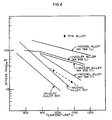
- the slopes of the rupture curves in Figure 4 indicate that the dependence of the P/M alloy rupture life on applied stress, i.e. the stress exponent, is much higher than the corresponding stress exponent for conventionally wrought alloys.
- a plot of 1000-hour stress rupture strength of P/M alloy, along with Incoloy alloy 800, Inconel alloy 617 and mechanically alloyed alloys (Inconel alloy MA 754 and Incoloy alloy MA 956) is shown in Figure 4. It is apparent that the rupture strength of P/M alloy is greater than conventional wrought alloys but less than mechanically alloyed alloys at high temperatures, i.e. above 982°C.
- Hot rolled bar of heat 2 i.e. 2-W
- exhibited coarse elongated structure after final annealing and chemical analysis showed that there was no significant difference in oxygen and nitrogen levels with or without evacuation. It will be seen from Tables IV and V that tensile and rupture strength properties are similar. Results of cyclic oxidation and hot corrosion tests are shown in Tables VI and VII in comparison with those for wrought Incoloy alloy 800. Note: Conditions:
- P/M alloys of the invention had slightly better oxidation resistance than the wrought alloy, and is improved by the small yttrium addition to heat 2. Hot corrosion tests shows the P/M alloys to be comparable with the wrought alloy.
- a portion of heat 2 was processed by extruding the canned product at 1121°C, hot rolling at 954°C, decanning and cold rolling 20% and heat treating at 1316°C for 1 hour under argon.
- This product displayed the desired coarse elongated grain structure.
- the constituents were water atomised, consolidated and extruded at about 1066°C at a ratio of 8:1, the bar size being 5.08x1.9 cm.
- the bar was hot rolled at 1066°C in two passes from 1.3 cm to 1.0 cm. After decanning the bar was annealed at 1260°C for a half hour.
- the product had the desired coarse elongated grain structure.
- the powder surface oxides are less stable and coalesce after controlled thermomechanical processing to give a coarse elongated grain after final annealing at about 1316°C, i.e., about 30 to 40°C below melting temperature.
- the coarsening and elongating action may be explained by a "Critical Dirt Level Theory". Firstly a critical level of oxide or oxygen impurities ("dirt") is contained within the heat. If there is an insufficient quality of oxide, there are not enough barrier sites to impede normal dynamic recrystallisation. There is an insufficient driving force to grow new grains. Conversely, if there is too much oxide, there are too many barriers that will interfere with elongated grain coarsening.
- thermomechanical process operations appears to favour the growth of the fewer grains.
- the resulting grains that do appear are elongated.
- the two mechanisms appear to coalesce in a synergistic manner to give a coarse, elongated grain structure in alloys of the invention.
Landscapes
- Chemical & Material Sciences (AREA)
- Engineering & Computer Science (AREA)
- Mechanical Engineering (AREA)
- Organic Chemistry (AREA)
- Thermal Sciences (AREA)
- Physics & Mathematics (AREA)
- Materials Engineering (AREA)
- Metallurgy (AREA)
- Crystallography & Structural Chemistry (AREA)
- General Engineering & Computer Science (AREA)
- Manufacturing & Machinery (AREA)
- Powder Metallurgy (AREA)
- Manufacture Of Metal Powder And Suspensions Thereof (AREA)
- Pressure Welding/Diffusion-Bonding (AREA)
Claims (13)
Applications Claiming Priority (2)
| Application Number | Priority Date | Filing Date | Title |
|---|---|---|---|
| US06/516,109 US4497669A (en) | 1983-07-22 | 1983-07-22 | Process for making alloys having coarse, elongated grain structure |
| US516109 | 1983-07-22 |
Publications (3)
| Publication Number | Publication Date |
|---|---|
| EP0132371A2 EP0132371A2 (de) | 1985-01-30 |
| EP0132371A3 EP0132371A3 (en) | 1986-06-04 |
| EP0132371B1 true EP0132371B1 (de) | 1989-10-11 |
Family
ID=24054162
Family Applications (1)
| Application Number | Title | Priority Date | Filing Date |
|---|---|---|---|
| EP84304872A Expired EP0132371B1 (de) | 1983-07-22 | 1984-07-17 | Verfahren zur Herstellung von Legierungen mit einem groben ausgezogenen Korngefüge |
Country Status (9)
| Country | Link |
|---|---|
| US (1) | US4497669A (de) |
| EP (1) | EP0132371B1 (de) |
| JP (1) | JPS6046348A (de) |
| AU (1) | AU570059B2 (de) |
| BR (1) | BR8403554A (de) |
| CA (1) | CA1233674A (de) |
| DE (1) | DE3480060D1 (de) |
| NO (1) | NO162728C (de) |
| ZA (1) | ZA845632B (de) |
Families Citing this family (12)
| Publication number | Priority date | Publication date | Assignee | Title |
|---|---|---|---|---|
| US4937042A (en) * | 1986-11-28 | 1990-06-26 | General Electric Company | Method for making an abradable article |
| US4842953A (en) * | 1986-11-28 | 1989-06-27 | General Electric Company | Abradable article, and powder and method for making |
| US5338508A (en) * | 1988-07-13 | 1994-08-16 | Kawasaki Steel Corporation | Alloy steel powders for injection molding use, their compounds and a method for making sintered parts from the same |
| EP0398121B1 (de) * | 1989-05-16 | 1994-11-23 | Asea Brown Boveri Ag | Verfahren zur Erzeugung grober längsgerichteter Stengelkristalle in einer oxyddispersionsgehärteten Nickelbasis-Superlegierung |
| GB2311997A (en) * | 1996-04-10 | 1997-10-15 | Sanyo Special Steel Co Ltd | Oxide-dispersed powder metallurgically produced alloys. |
| US6514307B2 (en) * | 2000-08-31 | 2003-02-04 | Kawasaki Steel Corporation | Iron-based sintered powder metal body, manufacturing method thereof and manufacturing method of iron-based sintered component with high strength and high density |
| EP1734145A1 (de) * | 2005-06-13 | 2006-12-20 | Siemens Aktiengesellschaft | Schichtsystem für ein Bauteil mit Wärmedämmschicht und metallischer Erosionsschutzschicht, Verfahren zur Herstellung und Verfahren zum Betreiben einer Dampfturbine |
| KR100733722B1 (ko) | 2006-06-07 | 2007-06-29 | 고려제강 주식회사 | 연속 주조법을 이용한 니켈-텅스텐 합금 테이프의 제조방법 |
| DE102010029287A1 (de) * | 2009-05-28 | 2011-01-05 | Behr Gmbh & Co. Kg | Schichtwärmeübertrager für hohe Temperaturen |
| EP2737965A1 (de) * | 2012-12-01 | 2014-06-04 | Alstom Technology Ltd | Verfahren zur Herstellung einer metallischen Komponente mittels Zusatzlaserfertigung |
| JP6224378B2 (ja) * | 2013-08-20 | 2017-11-01 | 日本特殊陶業株式会社 | ガスセンサ |
| CN117324625B (zh) * | 2023-11-06 | 2026-03-27 | 中南大学 | 一种低成本异构组织tc4钛合金及其制备方法 |
Family Cites Families (9)
| Publication number | Priority date | Publication date | Assignee | Title |
|---|---|---|---|---|
| GB871065A (en) * | 1956-11-26 | 1961-06-21 | Mannesmann Ag | Improvements in or relating to processes for the manufacture of heat resistant articles |
| US3368883A (en) * | 1965-07-29 | 1968-02-13 | Du Pont | Dispersion-modified cobalt and/or nickel alloy containing anisodiametric grains |
| US3383206A (en) * | 1965-10-11 | 1968-05-14 | Gen Electric | Nickel base alloy and article |
| US3595710A (en) * | 1968-10-25 | 1971-07-27 | Fansteel Inc | Erosion resistant dispersion hardened metals |
| US3696486A (en) * | 1969-08-25 | 1972-10-10 | Int Nickel Co | Stainless steels by powder metallurgy |
| US3639179A (en) * | 1970-02-02 | 1972-02-01 | Federal Mogul Corp | Method of making large grain-sized superalloys |
| US3655458A (en) * | 1970-07-10 | 1972-04-11 | Federal Mogul Corp | Process for making nickel-based superalloys |
| US3909309A (en) * | 1973-09-11 | 1975-09-30 | Int Nickel Co | Post working of mechanically alloyed products |
| US4226644A (en) * | 1978-09-05 | 1980-10-07 | United Technologies Corporation | High gamma prime superalloys by powder metallurgy |
-
1983
- 1983-07-22 US US06/516,109 patent/US4497669A/en not_active Expired - Fee Related
-
1984
- 1984-07-09 CA CA000458417A patent/CA1233674A/en not_active Expired
- 1984-07-17 BR BR8403554A patent/BR8403554A/pt unknown
- 1984-07-17 DE DE8484304872T patent/DE3480060D1/de not_active Expired
- 1984-07-17 EP EP84304872A patent/EP0132371B1/de not_active Expired
- 1984-07-20 ZA ZA845632A patent/ZA845632B/xx unknown
- 1984-07-20 NO NO842985A patent/NO162728C/no unknown
- 1984-07-20 AU AU30904/84A patent/AU570059B2/en not_active Ceased
- 1984-07-21 JP JP59151956A patent/JPS6046348A/ja active Pending
Also Published As
| Publication number | Publication date |
|---|---|
| ZA845632B (en) | 1985-02-27 |
| AU3090484A (en) | 1985-01-24 |
| DE3480060D1 (en) | 1989-11-16 |
| BR8403554A (pt) | 1985-06-25 |
| EP0132371A3 (en) | 1986-06-04 |
| NO162728B (no) | 1989-10-30 |
| US4497669A (en) | 1985-02-05 |
| NO162728C (no) | 1990-02-07 |
| NO842985L (no) | 1985-01-23 |
| CA1233674A (en) | 1988-03-08 |
| JPS6046348A (ja) | 1985-03-13 |
| AU570059B2 (en) | 1988-03-03 |
| EP0132371A2 (de) | 1985-01-30 |
Similar Documents
| Publication | Publication Date | Title |
|---|---|---|
| JP3813311B2 (ja) | 元素状粉末の熱化学処理による鉄アルミナイドの製造方法 | |
| JP4177465B2 (ja) | 電気抵抗加熱素子として有用な鉄アルミナイド | |
| US4419130A (en) | Titanium-diboride dispersion strengthened iron materials | |
| McKamey et al. | A review of recent developments in Fe3Al-based alloys | |
| US3767385A (en) | Cobalt-base alloys | |
| EP0312966B1 (de) | Gamma-Prime-Phase enthaltende Legierungen und Verfahren zu ihrer Formung | |
| US4386976A (en) | Dispersion-strengthened nickel-base alloy | |
| EP0132371A2 (de) | Verfahren zur Herstellung von Legierungen mit einem groben ausgezogenen Korngefüge | |
| JPS61149449A (ja) | 半導体装置用リ−ドフレ−ム複合材料およびその製造方法 | |
| JPH0693363A (ja) | 高力、耐熱アルミニウム基合金 | |
| US3562024A (en) | Cobalt-nickel base alloys containing chromium and molybdenum | |
| EP0569036B1 (de) | Draht für elektrische Bahnstrecke und Verfahren zur Herstellung desselben | |
| US3257178A (en) | Coated metal article | |
| JP2725333B2 (ja) | 粉末高速度工具鋼 | |
| US4440572A (en) | Metal modified dispersion strengthened copper | |
| EP0336612B1 (de) | Oxydationsbeständige Legierung | |
| EP0540055B1 (de) | Hochfeste Legierung auf Aluminiumbasis mit hoher Zähigkeit | |
| EP0374507A1 (de) | Hochtemperaturlegierung auf Niobbasis | |
| EP0964069B1 (de) | Strontium-Vorlegierung mit verminderter Solidustemperatur und ihr Herstellungsverfahren | |
| George et al. | Review of trace element effects on high‐temperature fracture of Fe‐and Ni‐base alloys | |
| CA1073708A (en) | Oxidation resistant iron base alloys | |
| EP1652945A1 (de) | Feinkörniges, rekristallisiertes, Silizium enthaltendes Niob- oder Tantal-Blech, das durch Schmelzen gefolgt von einem thermo-mechanischen Prozess hergestellt wird | |
| US5236661A (en) | Chromium-based weld material | |
| US3494807A (en) | Dispersion hardened cobalt alloy sheet and production thereof | |
| Rizzo et al. | Microstructural characterization of PM 625-type materials |
Legal Events
| Date | Code | Title | Description |
|---|---|---|---|
| PUAI | Public reference made under article 153(3) epc to a published international application that has entered the european phase |
Free format text: ORIGINAL CODE: 0009012 |
|
| AK | Designated contracting states |
Designated state(s): BE CH DE FR GB IT LI SE |
|
| PUAL | Search report despatched |
Free format text: ORIGINAL CODE: 0009013 |
|
| AK | Designated contracting states |
Kind code of ref document: A3 Designated state(s): BE CH DE FR GB IT LI SE |
|
| 17P | Request for examination filed |
Effective date: 19861128 |
|
| 17Q | First examination report despatched |
Effective date: 19880316 |
|
| ITF | It: translation for a ep patent filed | ||
| GRAA | (expected) grant |
Free format text: ORIGINAL CODE: 0009210 |
|
| AK | Designated contracting states |
Kind code of ref document: B1 Designated state(s): BE CH DE FR GB IT LI SE |
|
| REF | Corresponds to: |
Ref document number: 3480060 Country of ref document: DE Date of ref document: 19891116 |
|
| ET | Fr: translation filed | ||
| PLBE | No opposition filed within time limit |
Free format text: ORIGINAL CODE: 0009261 |
|
| STAA | Information on the status of an ep patent application or granted ep patent |
Free format text: STATUS: NO OPPOSITION FILED WITHIN TIME LIMIT |
|
| 26N | No opposition filed | ||
| PGFP | Annual fee paid to national office [announced via postgrant information from national office to epo] |
Ref country code: FR Payment date: 19910610 Year of fee payment: 8 |
|
| PGFP | Annual fee paid to national office [announced via postgrant information from national office to epo] |
Ref country code: GB Payment date: 19910612 Year of fee payment: 8 |
|
| PGFP | Annual fee paid to national office [announced via postgrant information from national office to epo] |
Ref country code: SE Payment date: 19910614 Year of fee payment: 8 |
|
| PGFP | Annual fee paid to national office [announced via postgrant information from national office to epo] |
Ref country code: CH Payment date: 19910619 Year of fee payment: 8 |
|
| PGFP | Annual fee paid to national office [announced via postgrant information from national office to epo] |
Ref country code: BE Payment date: 19910624 Year of fee payment: 8 |
|
| PGFP | Annual fee paid to national office [announced via postgrant information from national office to epo] |
Ref country code: DE Payment date: 19910628 Year of fee payment: 8 |
|
| ITTA | It: last paid annual fee | ||
| PG25 | Lapsed in a contracting state [announced via postgrant information from national office to epo] |
Ref country code: GB Effective date: 19920717 |
|
| PG25 | Lapsed in a contracting state [announced via postgrant information from national office to epo] |
Ref country code: SE Effective date: 19920718 |
|
| PG25 | Lapsed in a contracting state [announced via postgrant information from national office to epo] |
Ref country code: LI Effective date: 19920731 Ref country code: CH Effective date: 19920731 Ref country code: BE Effective date: 19920731 |
|
| BERE | Be: lapsed |
Owner name: INCO ALLOYS INTERNATIONAL INC. Effective date: 19920731 |
|
| GBPC | Gb: european patent ceased through non-payment of renewal fee |
Effective date: 19920717 |
|
| PG25 | Lapsed in a contracting state [announced via postgrant information from national office to epo] |
Ref country code: FR Effective date: 19930331 |
|
| REG | Reference to a national code |
Ref country code: CH Ref legal event code: PL |
|
| PG25 | Lapsed in a contracting state [announced via postgrant information from national office to epo] |
Ref country code: DE Effective date: 19930401 |
|
| REG | Reference to a national code |
Ref country code: FR Ref legal event code: ST |
|
| EUG | Se: european patent has lapsed |
Ref document number: 84304872.9 Effective date: 19930204 |