EP0132521A1 - Bodenerhaltungszwischenfruchtbau - Google Patents
Bodenerhaltungszwischenfruchtbau Download PDFInfo
- Publication number
- EP0132521A1 EP0132521A1 EP84105129A EP84105129A EP0132521A1 EP 0132521 A1 EP0132521 A1 EP 0132521A1 EP 84105129 A EP84105129 A EP 84105129A EP 84105129 A EP84105129 A EP 84105129A EP 0132521 A1 EP0132521 A1 EP 0132521A1
- Authority
- EP
- European Patent Office
- Prior art keywords
- modular
- rows
- cluster
- row
- crop
- Prior art date
- Legal status (The legal status is an assumption and is not a legal conclusion. Google has not performed a legal analysis and makes no representation as to the accuracy of the status listed.)
- Withdrawn
Links
Images







Classifications
-
- A—HUMAN NECESSITIES
- A01—AGRICULTURE; FORESTRY; ANIMAL HUSBANDRY; HUNTING; TRAPPING; FISHING
- A01B—SOIL WORKING IN AGRICULTURE OR FORESTRY; PARTS, DETAILS, OR ACCESSORIES OF AGRICULTURAL MACHINES OR IMPLEMENTS, IN GENERAL
- A01B79/00—Methods for working soil
- A01B79/02—Methods for working soil combined with other agricultural processing, e.g. fertilising, planting
-
- A—HUMAN NECESSITIES
- A01—AGRICULTURE; FORESTRY; ANIMAL HUSBANDRY; HUNTING; TRAPPING; FISHING
- A01C—PLANTING; SOWING; FERTILISING
- A01C7/00—Sowing
Definitions
- Grass-grain crops are oats, wheat, barley, rice, triticale and the like.
- Row-crop crops are corn, soybeans, potatoes, cotton, sunflowers and the like.
- Row-crop crops for the most part, have been a higher income producing crop, therefore farmers have been plowing more of their land each year to grow row-crop crops. With the advent of the use of herbicides they began plowing all theirw tillable land every year. Soil erosion problems have developed because of this. Building terraces, plowing on the contour, and no-till cropping have helped hold some of the soils on, the hillsides, however, the problem of soil erosion persists. Intercropping d grass-grain crop with row-crop crops as taught by the present invention seems to be the best way to solve the problem and without financial sacrifice to the grower. In time, total yields will prove to be greater than sole cropping either'the grass-grain or the row-crop crops.
- the basis of the invention is the concept of planting grass-grain cluster-rows. To explain this concept, one must first understood the term "full stand density”. This term is used throughout this specification and claims and is well known and well understood by those skilled in the art. It is that density of individual plants for the particular crop concerned planted as a single crop in the area concerned to obtain the maximum average yield. Each area will have a particular density for a full stand density dependent on various agricultural parameters and therefore it is not possible to state in this specification details of all densities for all crops for all areas. However, one example is given by University of Minnesota in their publication "Planting Rate and Rate" at page 46 , this example generally applying in that area, but one skilled in the art will be able to modify the example given for specific areas withir that general area.
- this invention provides for the planting of th E grass-grain in cluster-row widths the width of a tractor or harvesting machine tire, and in modular cluster-row widths tractor could either straddle between the tires thereof or coule track within. Then, some time after the grass-grain has emerged planting row-crop crops between the cluster-rows or the modula cluster-rows with either a row-crop or a different grass-grain
- Interrow-cropping is planting two full stands of grai in one field in one season.
- the first planting would be a grass-grain in cluster-rows with spaces between these cluster-rows
- Two of the spaces, symmetrically centered on the swath, would t slightly wider than the other spaces.
- This provides trackir spaces for herbicide spraying and interplanting, and a visue means to guide the operator. This is done by crowding the rows within the cluster-rows closer together adjacent to the track guide spaces.
- This method of intercropping is feasible in areas of heavy rainfall or irrigated fields, i.e., 40 to 80 inches of water per year.
- the cluster-row size would be reduced by widening the spaces between the cluster-rows and/or planting less than a full stand grass-grain in the cluster-row.
- the center of the interplanted swath can now be planted one-half row off the center of the cluster-row planted swath. Both planted swath widths will be the same. I call this method Double-Cover Intercropping. Double-Cover because the two crops will have a canopy over the soil most of the growing season. Planting an extra row or a thickly planted row central in the grass-grain cluster-row swath will guide the operator when interplanting.
- the second planted crop will be a row - crop crop planted full stand, preferably.
- This grass-grain root toxicity also affects the growth of the interplanted row-crop crops, some, mere than others. There is a need for grass-grains with less root toxicity and row-crop crops that are less affected by this toxicity.
- Cluster-row Intercropping is divided into two methods, Interrow-cropping and Double-Cover Intercropping.
- the equipment to plant both methods is a Cluster-row Graindrill with individual Unit Graindrills mounted thereon.
- Each Unit Graindrill plants a cluster-row of grass-grain.
- the No-till Interplanter plants the second crop, a row-crop.
- Each row or Twin-row is planted with a'conventional planter unit.
- the Cluster-row Graindrill is a grass-grain graindrill mounted on a toolbar and attached to a tractor with a three point hitch with support wheels that also drives the Unit Graindrill's seed metering mechanism.
- a plurality of Unit Graindrills and ground opener press wheel assemblies are mounted on a toolbar. At each end of the toolbar are swath markers to enable the operator to accurately plant each swath.
- the Cluster-row Graindrill width can be extended simply by mounting more Unit Graindrills to a longer toolbar.
- the width of the Cluster-row Graindrill is determined by first ascertaining how wide and how many rows will be in the swath of the second planted row-crop. Please note that there is swath overlap. This is to insure that no gap spaces exist between swaths.
- the Unit Graindrill is a very narrow graindrill to be manufactured in widths of about 16 inches, 24 inches, and 30 inches or about the width of a harvesting machine tire.
- Mounted on the Unit Graindrill frame or on a toolbar are ground opener assemblies that plant the seed and firm the soil over the seed with press wheels.
- the ground opener assemblies are laterally adjustable with respect to the Unit Graindrill and the Unit Graindrill is also laterally adjustable on the toolbar.
- the rate at which seed is metered is also adjustable-at each individual seed drop within the cluster-row. This allows the grower to "tailor" his cluster-row growth configuration, more or less umbrella, more planted seed in the outer rows or the inner rows.
- the cluster-row density may be adjusted more for erosion control than crop production.
- the swath-central Unit Graindrill or Graindrills will need the adjustment capabilities to visibly mark, in growing grain, a reference for the interplanter operator to follow.
- 'Swath central' because, for example, the center of a swath could be a cluster-row of grass-grain, or a space between two cluster-rows.
- 'Swath central' might be the two track-guide spaces when Interrow-cropping.
- the guide row marker may be an extra planted row within a cluster-row, or a thick or thinly seeded row within a central-to-the-swath cluster-row.
- No-till tilling ahead of each Unit Graindrill is an excellent way to control soil erosion. It is therefore possible and desirable in severe soil erosion circumstances that an early maturing winter variety of wheat be planted in the fall season in cluster-rows, then in mid or late spring, oats-or barley (another grass-grain) would be planted in the spaces-between the cluster-rows with the Cluster-row Graindrill. Both crops would be harvested separately leaving the stubble- over the dormant season which would be the very best in soil erosion control.
- the No-Till Interplanter is preferably a three point hitch toolbar mounted on a tractor with a plurality of equally spaced Planter Units mounted thereon. Forward of each Planter Unit and mounted on the toolbar are no-till tilling Danish tines. Support wheels could be mounted ahead of the tillage tines.
- the toolbar is positioned high enough to clear first planted crop without damaging the grain.
- the Planter Unit is a conventional row-crop planter and is simply adapted to intercropping with a vertically extended bracket mounted to the toolbar.
- the planter unit is conveniently a conventional plate-type planter.
- the second planted row-crop could use the air, vacuum, electric-type planter unit as well.
- the Planter Unit is a self contained unit with its own seed metering drive and a separate hopper for storing grain.
- the space between cluster-rows allows no-till tillage and Planter Units with press wheels to be used.
- the no-till tines also cultivate weeds from the spaces between the cluster-rows.
- the width of these modular rows and modular spaces being either a 'track-straddle' of the tractor and/or harvesting machine, or a modular width a tractor and/or a harvesting machine can 'track-within' or a combination of both widths.
- the 'track-straddle' width would be narrower than the 'track-within' width.
- These two widths will vary of course with the different sizes of tractor a grower uses. This falls in line with historical farming methods, using a small team of horses and 38-inch planted rows, a large team of horses and 42-inch planted rows or the old Farmall tractor and 40-inch planted rows or modern farm tractors using 30-inch planted rows, etc.
- the configuration of the motive power used on the farm determines the farming methods parameters.
- the grower when farming gentle sloping land the grower would use the 'track-straddle' width Modular Cluster-row first planting and the tracks 'tracking-within' width for his Modular Row-crop Rows.
- the grower For steeper sloping farmland, the grower would use tracks 'tracking-within' width for the Modular Cluster-row first planting and 'track-straddle' width for his Modular Row-crop rows.
- the grower might want to use the tracks 'tracking within' width Modular Row for both his Modular Cluste-rows of grass-grain and the Modular Row-crop rows. This may be a more efficient harvesting method.
- the grass-grain stubble modular row would buffet the surface, wind enough to stop soil erosion.
- the modular grass-grain rows should preferably be planted perpendicular to the direction of the. prevailing winds for flat land farming.
- All Modular Row cropping preferably should be planted on the contour of the slope if at all possible.
- Modular Single-Double Intercropping will have two or more row-crop rows planted in each Modular Space.
- Modular Fallow Farming will alleviate this problem.
- the Modular Rows of grain and fallow are close enough together to stop sheet wash and rill erosion and the standing stubble Modular Rows will effectively buffet the winds to stop blowing soils from the Modular Fallowed Rows.
- the grower would then have the option of planting the Modular Fallowed Space to a short season crop such as peas or lentils as a fallow crop.
- Modular Fallow Farming is different from Single-Double Intercropping in that both grain and fallowed rows are the same width.
- the modular rows are alternately rotated to grain every second year.
- the grower would use 'track-straddling' Modular Row widchs on steep slopes planted on the contour and 'tracking-within' Modular Row widths on the more gentle slopes planted on the contour.
- Modular Fallow Farming is the same acreage planted and harvested as traditional methods. However, Modular Fallow Farming has the potential for increasing yields because the grass-grain terraces hold the runoff and perk this additional moisture into the subsoils, therefore increasing moisture availability to the crop which increases yields.
- Modular Intercropping is divided into two methods, Single-Double Intercropping and Modular Fallow Farming.
- the equipment to plant the grass-grain first crop, both methods, is a Modular Graindrill with individual Modular Unit Graindrills mounted thereon, a Modular Tilling Toolbar would till the Modular Spaces and cultivate the row-crop crop.
- the Modular Interplanter plants the second crop, a row-crop when Single-Double Intercropping.
- Located on the Modular Interplanter are 2 or more Modular Planter Units with a Modular Space or Spaces there between. Each Modular Planter Unit has at least two or more planter units mounted thereon.
- the Modular Graindrill is a three point hitch, tractor mounted toolbar with ground support wheels with two or more Modular Unit Graindrills attached and spaced apart a Modular Space width.
- the ground support wheels drive the Modular Unit Graindrills' seed metering mechanism.
- the Modular Unit Graindrill is very much the same as the Unit G raindrill mechanically, except the unit is wider and has more ground opener assemblies mounted thereon.
- the Modular Unit G raindrill would be manufactured in about three different sizes, 60, 90 and 120 inches wide.
- the 60 unch unit- could lant a 40 inch wide Modular Row of grass-grain, for example.
- the Modular Unit Graindrill is laterally adjustable on the Modular Graindrill, it's ground opener assemblies are laterally adjustable within the units width and the seed metering mechanism is adjustable for each row of seed planted.
- Both the Unit Graindrill and the Modular Unit Graindrill can have no-till tillage mounted forward of each unit and attached to the toolbar.
- the modular unit graindrill is then used as an Interplanter planting modular cluster-rows of crops between the modular crops of grass-grain stubble. They can also have forage grass seed, fertilizer and herbicide attachments mounted on the toolbar.
- the Modular Interplanter comprises in combination a toolbar, hitch means for attaching the toolbar to a tractor, ground wheels for supporting the toolbar for transport across a field, a plurality fo Modular Planter Units mounted along the length of the toolbar, the Modular Planter Units spaced apart approximately the Modular Cluster-row width of the first planted grass-grain.
- the Modular Planter Units are attached to the toolbar, laterally adjustable thereon, with Planter Units mounted thereon. No-till tilling may be attached forward to the Planter Unit on its frame or attached to the toolbar.
- My Application No. filed discloses a high center frame tractor with a three point hitch located under the high center frame (the configuration of which has been standardized), a center mounted toolbar and equipment is mounted thereon.
- the tractor would have all wheel auto-steerable to accurately negotiate intercropped rows planted on steep hillsides having slopes of 5% to 20% grade for example.
- a high-center frame tractor having only a front-wheel drive and front wheel auto steering, the rear wheels and axle trailing, could e used for level land to a 3% slope farming for example.
- another high center frame tractor configuration could have a front wheel drive, and front and rear wheel auto-steering for farming slopes of 2% to 6% grade for example.
- the high-center tractor therefore distributes the dynamic and draft loading equally on each axle. This keeps the tractor, toolbar, and equipment mounted thereon in-line with its direction of travel when intercropping.
- Sole cropping no-till farming is a break-even operation in-so-far as soil erosion is concerned.
- the land loses four tons topsoil from erosion and gains four tons of residue using this method of farming.
- Clustered-row intercropping saves the first four tons per acre from eroding and adds four tons per acre of residue (soil eventually), an 8 ton of soil per acre gain each year.
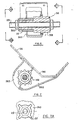
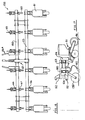
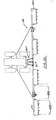
- Figure 1 interrow-cropping is illustrated in Figure 1 and schematically in Figure 12 with a cluster-row graindrill for planting a full stand of grass-grain crop in cluster-rows.
- Figure 1 shows an example with five rows in a cluster and
- Figure 12 shows four rows in a cluster.
- Planted rows 20 are grouped in clusters 21; 22 and 23 and with a predetermined uneven spacing planted full stand density. This grouping and spacing is obtained by the use of the unit graindrill 37 laterally adjusted on the toolbar of the cluster-row graindrill 30.
- the system of the cluster-rows illustrated in Figures 1 and 12 utilizes clusters to provide a full stand density -of the first crop as hereinbefore defined.
- the two planted rows 20 in the cluster-row 21 may be separated by a space for example of 19 inches.
- the clusters may be separated by a space of 8 inches indicated at 24.
- the spaces between the clusters are arranged to be sufficiently narrow that there is considerable shading over the space by the plants and therefore a significant reduction in the productin of weeds. There is however, sufficient space for planting of the second crop in both the 8 inch spaces 24 and the 10 inch spaces 27.
- unit graindrills 37 extend across a plurality of cluster-rows and that the example in Figure 1 has 4 such full cluster-rows each cf 5 rows in a cluster with the outside cluster-rows of the unit graindrill 37 having only 3 such rows.
- the cluster-row graindrill indicated generally at 30 includes wheels 31 and 32, a wheel bracket 48 supporting a toolbar 33 on which are mounted unit graindrills 37.
- These unit graindrills 37 primarily include a series of disc openers 34 provided by a pair of such discs arranged at an angle so as to open the soil for receipt of seed.
- a hopper frame 28 supporting a grain seed hopper 36 is provided for each unit graindrill 37 so that one hopper 36 feeds 5 ground openers 34 for all the cluster-row rows of the implement 30.
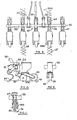
- the hopper 36 includes at a lower position thereof a plurality of seed metering mechanisms 38 shown schematically in Figures 5 and 19A and in more detail in Figures 6 and 7.
- the seed metering mechanism 38 comprises a transverse hopper shaft 29 which is driven by a chain and sprocket system 40 from a shaft 39 with support bearings 61 fixed along toolbar 33 extending to the chain and sprocket arrangement 412 ( Figure 2) from the ground wheels 31 and 32.
- the hopper shaft 29 thus rotates at a desired rate to feed seeds into tubes 41 each of which is associated with a respective pair of ground openers 34.
- a forward frame 26 is fixed to toolbar 33 forward of the hopper frame 28.
- the ground opening means 34 each include a bracket 25 which is laterally adjustable with respect to forward frame 26.
- Trailing arm 17 is pivotally connected to bracket 25 for angular displacement about horizontal pivot 62 on the lower end of each trailing arm 17 is a frame 43 with a pair of disc openers 34 mounted thereon.
- the press wheel 42 is mounted on a frame 43 supported from the toolbar 33 and is biased into contact under predetermined pressure with the ground 46"by a rod 45 and a spring 44 connected to press wheel bracket 47 and hopper frame 28.
- the toolbar 33 is attached to the three point hitch 56A of the tractor 271 by a conventional hitch frame 52 which controls the position of the tractor wheels relative to the spaces 27 so that the same spaced tractor wheels run along the spaces between the cluster-rows of standing grass-grain when interplanting the second crop with the no-till interplanter of Figure 8.
- a conventional disc marker 331 which provides a furrow 332 at a distance from the frame or toolbar 33 of exactly half the width of the frame so that the tractor operator may follow this furrow 332 when planting the succeeding round or swath.
- FIG. 7 the lower portion of the hopper 36 which has an opening 361 through which seeds can fall into a chamber 362 for feeding by the feed mechanism 38.
- the feed mechanism 38 comprises a fluted roller 381 mounted on the shaft 29 extending across the unit graindrill 37.
- the fluted roller 381 is secured to the shaft 29 by a pair of nuts 382 and is axially adjustable in position relative to the shaft 29.
- the fluted roller 381 includes a portion having 12 flutes which co-rotates with the shaft 29 so as to feed seeds from the chamber 362 into the seed drop tube 41 and a non-rotating blanking off fluted roller 35 having 4 flutes.
- the width of the chamber 362 is confined by walls 383 shown in Figure 6 which also confine the axial effect of the fluted roller 381.
- the effective amount of the 12 fluted part can be adjusted to vary seeding rate.
- This adjustment can be carried out individually for each of the ground openers 34 by actuating the nuts 382.
- the outside unit graindrills 37 of the implement 30 of Figure 1 include only 3 rows as opposed to the 5 rows of the intermediate clusters.
- the seeding rate of the furthermost outside row is reduced to an amount of the order of one-half of that of the other graindrills.
- the grower can in the next swath of the implement 30 traverse the furtherest outside unit graindrill 37 along the row previously planted by the last swath of the furthermost outside graindrill whereby two and one half further rows are added to the two and one half previously planted to create a cluster of 5 rows similar to those formed by the intermediate unit graindrills 37.
- This arrangement allows the grower to more accurately control the spacing between the swaths since an inaccuracy obtained by errors in following the centerline formed by the disc 331 are taken up by a variation in seeding rate within a cluster-row rather than in the space between two clusters thus allowing weeds to grow.
- FIG. 12 the position of a row-crop no-till interplanter 50 is shown schematically in the system whereby rows of a row-crop (shown schematically) as defined previously are planted in the spaces 24. and 27 between the cluster-rows of grass-grain.
- outside unit graindrills include three ground openers with the outside two adjusted for reduced seeding rate.
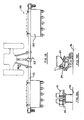
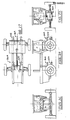
- FIGS 8 through 11 show the no-till interplanter 50 for use in this invention.
- the no-till interplanter 50 may employ conventional planter units 51.
- the no-till interplanter 50 illustrated may comprise a toolbar mounting frame 52 having a tranverse toolbar 53.
- the frame 52 centrally located on toolbar 53 is supported by press wheels 55 (and by the tractor, through its three point hitch 56A).
- the press wheels 55 are used to close the soil over the seed.
- the planter units 51 are mounted on a bracket 56 which lies behind the toolbar 53.
- the main frame 52 is attached to a three point hitch 56A of a tractor, with two points 57 and 58 on the lower level and one point 59 thereabove.
- interplanter toolbar frame 52 is located higher on the three point hitch mounting points 57, 58 and 59 than is usual so that the parts of the machine which cross over the first crop are generally higher than the first crop at this second planting time and bridge over it, with some bending of the grain.
- Planter bracket 56 extends downward from the toolbar for attachment of the planter unit 51 mechanism below the toolbar to elevate the toolbar with respect to the ground.
- the toolbar 53 carries a series of Danish S-tines supported by bracket 64 which are in line with the unit planters 51 so as to provide a certain amount -of tilling in this generally no-till system of interplanting, the tilling being specifically limited to that for the interplanter's second crop and this localized tilling does not interfere with the first crop.
- the gonventional Danish tines 60 may be used or other kinds of tines may be used, including rotating or power-driven tines. Coulters may be used instead of tines if desired.
- the planter units 51 include the press wheels 55 which drive the planting mechanism through a chain drive 55A.
- the wheels 55 are aligned with the Danish tines 60 and they may be evenly spaced apart in the rows at eighteen inch intervals, for example, or at other intervals matching the spaces provided I by cluster-row graindrill 30 for the first crop. There is no difference otherwise so far as the planter units are concerned.
- the no-till interplanter 50 thus tills the ground and plants the seed and firms it in at a good moisture depth, to enhance seed germination and plant emergence.
- the tractor is preferably provided with narrow width tires so that they can more readily be kept within the wheel spaces 27.
- Grain parting wheel guards are preferably provided to deflect gently plant portions from the wheel spaces 27.
- Figure 1 the example of 5 rows in a cluster and the exampled spaces indicated above can of course be altered.
- the use of 3 or more rows in a cluster-row provides the umbrella effect which shades the spaces 24 and 27 and prevents weed growth whereas only 2 rows of grass-grain cannot provide the umbrella effect.
- FIGs 13 and 13A show schematically the system described herein previously as Double-Cover Intercropping.
- the Cluster-row graindrill 133 used for this system is illustrated in Figures 14 and 15 and the interplanter 132 in Figures 16 and 17.
- the spacing of the individual graindrill units 37 on the cluster-row graindrill 133 is such that the planting is less than a full stand density. This provides a wider spacing between the rows within the cluster-row, and wider spaces 138 between the cluster-rows themselves. The spaces 138 therefore can be used to receive a single row 131 or Twin-rows 137 of a row-crop as shown.
- Figure 13 illustrates schematically the chonological operations using the cluster-row graindrill 133 illustrated in more detail in Figures 14 and 15 and the no-till interplanter 132 which is illustrated in more detail in Figures 16 and 17.
- the wheel spacing of the tractor and the support wheels of the implement will be noted in relation to both the cluster-row graindrill 133 and the no-till interplanter 132 whereby the wheels straddle the growing crop and run only between the cluster-rows of grass-grain and the interplanters swath center is one-half row adjacent to the cluster-row graindrill swath center.
- the cluster-row graindrill 133 is very similar to that shown in Figures 1 through 5 but is modified in that an additional toolbar 134 carries for each unit graindrill a coulter 135, a front coulter bracket 66, tine 136 and rear till bracket 65 which, as shown in Figure 13A, acts to till the residue 131 out of the path of the cluster-row graindrill 133 allowing it to operate in the manner described in relation to the embodiment of Figure 1. -
- the no-till interplanter 132 illustrated in Figures 16 and 17 is substantially the same as that disclosed in Figures 8 through 11, except that an additional toolbar 160 is added for supporting the tine 60 and rear tine bracket 67 also a coulter 135 and bracket 66.
- the no-till interplanter 132 operates substantially as described in relation to the earlier figures with the additional tilling prior to the interplanter to cuc through the residue of the last seasonal crop as shown in Figure 13A.
- FIG 18 there is shown schematically the system described hereinbefore known as Modular Single-Double Intercropping.
- the system uses a modular graindrill 181 with modular unit graindrills 180 mounted thereon providing modular cluster-rows of grass-grain. Subsequent to planting of the first grass-grain crop in the modular cluster-rows 334, the modular spaces 336 between the cluster-rows 334 are tilled using a Modular Field Cultivator 182 with modular tillage tools 189 mounted thereon, shown schematically in Figures 18 and 22.
- the modular tillage tools could be a tandem disc, a one way disc; chisel plows, rototillers, cultivators, flex harrow and the like to prepare the spaces 336 for planting a row-crop crop 183 using a modular interplanter ( Figure 20) as indicated at 184.
- the grass-grain crop would be harvested at 186 and the harvesting machine wheel tracks would straddle the planted row-crop crop rows 183 or track on the modular cluster-rows of grass-grain stubble 334.
- modular row-crop rows 183 can be cultivated using a modular cultivator 185 acting only upon the spaces 338 between the row-crop rows 183 and between the modular cluster-rows of grass-grain 334 thus leaving the stubble from the cluster-rows of grass-grain 334 to protect the soil from erosion, as previously explained.
- the modular unit graindrill 180 is shown in more detail in Figures 19, 19A, 19B and has the same seed metering improvements as shown in Figures 6 and 7. i,
- the modular interplanter 184 is shown in more detail in Figure 20.
- the two modular planter units 185 have shown four planter units 51 mounted on a bar 188. Bar 188 therefore is mounted to toolbar 33 with laterally adjustable clamps 187.
- FIG 22 there is shown schematically the system described herein previously as Modular Fallow Farming.
- modular cluster-rows of grass-grain 333 are planted using the modular graindrill 181 such that the density of crops within the modular cluster-row 333 is a full stand density and the spacing 335 between the cluster-rows 333 is equal to width of the modular cluster-row of grass-grain 333.
- the width of the modular cluster-rows 333 and modular spaces 335 is a tractor's 'track-straddle' or a tractor's 'track-within' width.
- Figure 22 illustrates again schematically in chronological order the farming system wherein prior to the first pass of the modular graindrill 181, the land is previously tilled so that the modular graindrill 181 acts merely to plant the grass-grain in modular cluster-rows 333 equally spaced apart a modular space 335.
- the second step is the harvesting of the modular cluster-rows 333, and comes intermediate the second pass illustrated at 222 where the second annual planting takes place in modular spaces 335 intermediate the previous annual modular cluster-rows 333 leaving the stubble from the first annual planting untilled to lie fallow during the second year.
- the no-till modular graindrill 222 therefore includes the no-till tines similar to those previously illustrated in Figures 14 and 15.
- Modular Fallow tilling using sweeps at 223 can take place either prior to harvesting the second annual crop or sebsequent to the harvesting the second annual crop and acts to till the first annual planting of cluster-rows shown leaving the stubble from the second annual planted cluster-rows to protect the land. Subsequently, the third annual planting indicated at 22; takes place upon .the first modular cluster-rows 333 from the first annual planting and this Modular Fallow Farming continues in the same cycle.
- Figures 13, 18 and 22 show a thickly or a thinly planted row within the cluster and modular cluster-row of grass-grain central to the swath at 225. Whether this marker row is standing grain or standing stubble, it acts as a guide for the tractor operator to match up sequential swath integrity. Between swaths of first planted grass-grain there exists a variance space 226 when Double-Cover, Single-Double, and Modular Fallow Farming intercropping. This is the reason for maintaining first and second planting swath integrity.
- Figures 21 and 21A illustrates the ground sheltering effect of the grass-grain cluster-rows 210. Only a small percentage of the rain drops 211 impact the soil during a heavy thunderstorm. Rain drop impact action and accumulated top ground water cascading down a long slope is the problem. Cluster-row intercropping closes the down-the-slope and across-the-field watershed-above distance to a few inches. Modular cluster-row intercropping therefore narrows the down-slope distance to a few feet. Top ground water therefore perks into the subsoils when it reaches the cluster-rows of grass-grain at 210.
- Figure 23 shows a modular graindrill 181 with four modular unit graindrills 180 mounted thereon spaces apart a modular space 335 the same width as the modular unit graindrills 333 to be used for Modular Fallow Farming.
- the tractor shown schematically, is of a conventional type with four wheel drive and four wheel auto-steerable.
- Figures 24 through 27 represent a high-center frame tractor with a three point hitch 56A shown at 220.
- the auto-type steering can be front axle only, for working the gentle sloping farmlands or front and rear axle steering for working the steeper hillside slopes.
- the invention as described above therefore provides a number of major improvements in intercropping techniques which can be used in the four separate farming systems described, one of which is chosen in dependence upon the conditions in the area concerned.
- the whole system described in this patent provides therefore a farming system which if followed will reduce or prevent soil erosion.
Landscapes
- Life Sciences & Earth Sciences (AREA)
- Soil Sciences (AREA)
- Environmental Sciences (AREA)
- Engineering & Computer Science (AREA)
- Mechanical Engineering (AREA)
- Soil Working Implements (AREA)
- Cultivation Of Plants (AREA)
Applications Claiming Priority (2)
| Application Number | Priority Date | Filing Date | Title |
|---|---|---|---|
| US51931483A | 1983-08-01 | 1983-08-01 | |
| US519314 | 1983-08-01 |
Publications (1)
| Publication Number | Publication Date |
|---|---|
| EP0132521A1 true EP0132521A1 (de) | 1985-02-13 |
Family
ID=24067767
Family Applications (1)
| Application Number | Title | Priority Date | Filing Date |
|---|---|---|---|
| EP84105129A Withdrawn EP0132521A1 (de) | 1983-08-01 | 1984-05-07 | Bodenerhaltungszwischenfruchtbau |
Country Status (3)
| Country | Link |
|---|---|
| EP (1) | EP0132521A1 (de) |
| JP (1) | JPS6043317A (de) |
| AU (1) | AU2786184A (de) |
Cited By (28)
| Publication number | Priority date | Publication date | Assignee | Title |
|---|---|---|---|---|
| EP0193804A1 (de) * | 1985-02-22 | 1986-09-10 | Amazonen-Werke H. Dreyer GmbH & Co. KG | Verfahren für die Aussaat von Nutzpflanzensaatgut |
| EP0216003A3 (de) * | 1985-04-06 | 1987-12-23 | S.A. Kuhn | Verfahren und Gerätesystem zur Bodenlockerung, Saatbettherrichtung und Bestellung |
| WO1995031092A1 (en) * | 1994-05-13 | 1995-11-23 | Idaho Research Foundation, Inc. | Cover crop system |
| US5606823A (en) * | 1994-05-16 | 1997-03-04 | Idaho Research Foundation | Cover crop system |
| WO1997036470A1 (fr) * | 1997-04-04 | 1997-10-09 | Nikolai Ivanovich Kuleshov | Techniques de culture de tephrosia orientale destinees a la production de fourrage et de graines |
| NL1004168C2 (nl) * | 1996-10-01 | 1998-04-02 | Hendrik Pol | Werkwijze voor het telen van een gewas en machines voor gebruik daarbij. |
| GB2354419A (en) * | 1999-09-22 | 2001-03-28 | Ingemar Bjurenvall | Method of and apparatus for crop production |
| EP1123646A1 (de) * | 1999-07-06 | 2001-08-16 | Claus Martin Holmen Nygard | Methode zur ökologischen Saataufzucht und dafür geeignete Sämaschine |
| US6631585B1 (en) | 2001-01-02 | 2003-10-14 | Marvin J. Williams, Jr. | Intercropping process |
| FR2891692A1 (fr) * | 2005-10-11 | 2007-04-13 | Andre Beuvin | Procede pour la culture de plantes comportant une etape d'ecimage a au moins deux hauteurs differentes et dispositif d'ecimage graduel specialement adapte pour la mise en oeuvre du procede |
| EA008288B1 (ru) * | 2005-06-07 | 2007-04-27 | Марат Гайфуллович Каримов | Способ выращивания растений кормовых культур |
| CN102870591A (zh) * | 2012-11-02 | 2013-01-16 | 中国科学院新疆生态与地理研究所 | 一种幼龄果树套种作物防风沙方法 |
| CN103155769A (zh) * | 2012-06-13 | 2013-06-19 | 贵州省亚热带作物研究所 | 甘蔗等高带状栽培方法及结构 |
| CN103429071A (zh) * | 2010-12-08 | 2013-12-04 | 韦尔豪泽Nr公司 | 套种能量作物的方法 |
| CN103828570A (zh) * | 2013-11-29 | 2014-06-04 | 中国热带农业科学院热带作物品种资源研究所 | 一种儿菜与多花黑麦草间作方法 |
| US9320192B2 (en) | 2013-11-12 | 2016-04-26 | Dickey-John Corporation | Synchronization of a twin row planting system |
| CN106717242A (zh) * | 2016-11-11 | 2017-05-31 | 会泽县绿创种植有限公司 | 一种滇重楼的生态复合栽培方法 |
| CN107466495A (zh) * | 2017-07-28 | 2017-12-15 | 高峰 | 一种平衡自调节农机 |
| CN108338043A (zh) * | 2018-02-13 | 2018-07-31 | 新疆维吾尔自治区中药民族药研究所 | 一种药用阿魏人工种植栽培的方法 |
| CN110447332A (zh) * | 2019-09-17 | 2019-11-15 | 西南科技大学 | 一种薄层紫色土活土保水耕作方法 |
| US10736264B1 (en) | 2019-02-01 | 2020-08-11 | Cnh Industrial Canada, Ltd. | Modular meter roller shaft system |
| US10750665B1 (en) | 2019-02-01 | 2020-08-25 | Cnh Industrial Canada, Ltd. | Meter roller system |
| US10757857B2 (en) | 2019-02-01 | 2020-09-01 | Cnh Industrial Canada, Ltd. | Meter roller insert system |
| CN113170616A (zh) * | 2021-05-19 | 2021-07-27 | 管其伟 | 一种农药喷洒松土一体设备 |
| US11284552B2 (en) | 2019-06-21 | 2022-03-29 | Cnh Industrial America Llc | Row unit for selectively dispensing a plurality of agricultural products and associated agricultural implements |
| CN114402755A (zh) * | 2022-02-22 | 2022-04-29 | 中国农业科学院农田灌溉研究所 | 一种瓜棉间作播种装置 |
| CN114557162A (zh) * | 2022-02-10 | 2022-05-31 | 中国煤炭地质总局广东煤炭地质局勘查院 | 一种生态环境修复治理方法 |
| IT202200013753A1 (it) * | 2022-06-29 | 2023-12-29 | Visconti Roberto | Metodo di semina di terreno agricolo mediante percorsi di una macchina seminatrice successivi al primo |
Families Citing this family (5)
| Publication number | Priority date | Publication date | Assignee | Title |
|---|---|---|---|---|
| CN104782464A (zh) * | 2015-05-05 | 2015-07-22 | 曾莉 | 无土栽培中降低钙离子浓度的方法以及软化培养液的方法 |
| CN110771297A (zh) * | 2019-11-20 | 2020-02-11 | 灌南县农业技术推广中心 | 一种利用有机质土壤改善农业生态环境的方法 |
| CN111279847B (zh) * | 2020-04-13 | 2021-06-01 | 山东棉花研究中心 | 一种棉花与绿豆的间作播种装置 |
| CN116530267B (zh) * | 2023-05-05 | 2024-01-12 | 永好智能科技(江苏)有限公司 | 一种兼容玉米品字型和大豆双苗带播种的播种机 |
| CN117084025B (zh) * | 2023-10-19 | 2024-01-02 | 安徽农业大学 | 一种小麦倒春寒试验播种装置 |
Citations (3)
| Publication number | Priority date | Publication date | Assignee | Title |
|---|---|---|---|---|
| US4084522A (en) * | 1975-10-03 | 1978-04-18 | Lloyd Younger | Apparatus and method for sowing second crop in standing crop |
| FR2388478A1 (fr) * | 1977-04-25 | 1978-11-24 | Weichel Ernst | Procede et dispositif pour la preparation mecanique de lignes de semis ou de rangees de plantation |
| EP0040385A2 (de) * | 1980-05-20 | 1981-11-25 | Elwyn P. Hilmer | Verfahren und Maschine zum Zwischenreihenanbau |
-
1984
- 1984-04-11 JP JP59072577A patent/JPS6043317A/ja active Pending
- 1984-05-07 EP EP84105129A patent/EP0132521A1/de not_active Withdrawn
- 1984-05-09 AU AU27861/84A patent/AU2786184A/en not_active Abandoned
Patent Citations (3)
| Publication number | Priority date | Publication date | Assignee | Title |
|---|---|---|---|---|
| US4084522A (en) * | 1975-10-03 | 1978-04-18 | Lloyd Younger | Apparatus and method for sowing second crop in standing crop |
| FR2388478A1 (fr) * | 1977-04-25 | 1978-11-24 | Weichel Ernst | Procede et dispositif pour la preparation mecanique de lignes de semis ou de rangees de plantation |
| EP0040385A2 (de) * | 1980-05-20 | 1981-11-25 | Elwyn P. Hilmer | Verfahren und Maschine zum Zwischenreihenanbau |
Non-Patent Citations (3)
| Title |
|---|
| Soviet Inventions Illustrated * |
| Soviet Inventions Illustrated, week B20, 20 June 1979, section P11, & SU-A-614764 * |
| Soviet Inventions Illustrated, week K42, 30 November 1983, section P11, & SU-A-980643 (Cat. A) * |
Cited By (36)
| Publication number | Priority date | Publication date | Assignee | Title |
|---|---|---|---|---|
| EP0193804A1 (de) * | 1985-02-22 | 1986-09-10 | Amazonen-Werke H. Dreyer GmbH & Co. KG | Verfahren für die Aussaat von Nutzpflanzensaatgut |
| EP0216003A3 (de) * | 1985-04-06 | 1987-12-23 | S.A. Kuhn | Verfahren und Gerätesystem zur Bodenlockerung, Saatbettherrichtung und Bestellung |
| WO1995031092A1 (en) * | 1994-05-13 | 1995-11-23 | Idaho Research Foundation, Inc. | Cover crop system |
| AU692165B2 (en) * | 1994-05-13 | 1998-06-04 | Idaho Research Foundation Inc., The | Cover crop system |
| US5606823A (en) * | 1994-05-16 | 1997-03-04 | Idaho Research Foundation | Cover crop system |
| NL1004168C2 (nl) * | 1996-10-01 | 1998-04-02 | Hendrik Pol | Werkwijze voor het telen van een gewas en machines voor gebruik daarbij. |
| WO1997036470A1 (fr) * | 1997-04-04 | 1997-10-09 | Nikolai Ivanovich Kuleshov | Techniques de culture de tephrosia orientale destinees a la production de fourrage et de graines |
| EP1123646A1 (de) * | 1999-07-06 | 2001-08-16 | Claus Martin Holmen Nygard | Methode zur ökologischen Saataufzucht und dafür geeignete Sämaschine |
| GB2354419A (en) * | 1999-09-22 | 2001-03-28 | Ingemar Bjurenvall | Method of and apparatus for crop production |
| WO2001020971A3 (en) * | 1999-09-22 | 2002-01-03 | Ingemar Bjurenvall | Method of and apparatus for crop production |
| US6631585B1 (en) | 2001-01-02 | 2003-10-14 | Marvin J. Williams, Jr. | Intercropping process |
| EA008288B1 (ru) * | 2005-06-07 | 2007-04-27 | Марат Гайфуллович Каримов | Способ выращивания растений кормовых культур |
| FR2891692A1 (fr) * | 2005-10-11 | 2007-04-13 | Andre Beuvin | Procede pour la culture de plantes comportant une etape d'ecimage a au moins deux hauteurs differentes et dispositif d'ecimage graduel specialement adapte pour la mise en oeuvre du procede |
| CN103429071A (zh) * | 2010-12-08 | 2013-12-04 | 韦尔豪泽Nr公司 | 套种能量作物的方法 |
| US9332690B2 (en) | 2010-12-08 | 2016-05-10 | Weyerhaeuser Nr Company | Method for interplanting energy crops |
| CN103429071B (zh) * | 2010-12-08 | 2016-03-02 | 韦尔豪泽Nr公司 | 套种能量作物的方法 |
| CN103155769A (zh) * | 2012-06-13 | 2013-06-19 | 贵州省亚热带作物研究所 | 甘蔗等高带状栽培方法及结构 |
| CN102870591A (zh) * | 2012-11-02 | 2013-01-16 | 中国科学院新疆生态与地理研究所 | 一种幼龄果树套种作物防风沙方法 |
| US9320192B2 (en) | 2013-11-12 | 2016-04-26 | Dickey-John Corporation | Synchronization of a twin row planting system |
| CN103828570A (zh) * | 2013-11-29 | 2014-06-04 | 中国热带农业科学院热带作物品种资源研究所 | 一种儿菜与多花黑麦草间作方法 |
| CN106717242A (zh) * | 2016-11-11 | 2017-05-31 | 会泽县绿创种植有限公司 | 一种滇重楼的生态复合栽培方法 |
| CN107466495A (zh) * | 2017-07-28 | 2017-12-15 | 高峰 | 一种平衡自调节农机 |
| CN108338043A (zh) * | 2018-02-13 | 2018-07-31 | 新疆维吾尔自治区中药民族药研究所 | 一种药用阿魏人工种植栽培的方法 |
| CN108338043B (zh) * | 2018-02-13 | 2020-04-28 | 新疆维吾尔自治区中药民族药研究所 | 一种药用阿魏人工种植栽培的方法 |
| US10736264B1 (en) | 2019-02-01 | 2020-08-11 | Cnh Industrial Canada, Ltd. | Modular meter roller shaft system |
| US10750665B1 (en) | 2019-02-01 | 2020-08-25 | Cnh Industrial Canada, Ltd. | Meter roller system |
| US10757857B2 (en) | 2019-02-01 | 2020-09-01 | Cnh Industrial Canada, Ltd. | Meter roller insert system |
| US11284552B2 (en) | 2019-06-21 | 2022-03-29 | Cnh Industrial America Llc | Row unit for selectively dispensing a plurality of agricultural products and associated agricultural implements |
| CN110447332A (zh) * | 2019-09-17 | 2019-11-15 | 西南科技大学 | 一种薄层紫色土活土保水耕作方法 |
| CN110447332B (zh) * | 2019-09-17 | 2022-06-21 | 西南科技大学 | 一种薄层紫色土活土保水耕作方法 |
| CN113170616A (zh) * | 2021-05-19 | 2021-07-27 | 管其伟 | 一种农药喷洒松土一体设备 |
| CN113170616B (zh) * | 2021-05-19 | 2024-03-08 | 神州农业集团有限公司 | 一种农药喷洒松土一体设备 |
| CN114557162A (zh) * | 2022-02-10 | 2022-05-31 | 中国煤炭地质总局广东煤炭地质局勘查院 | 一种生态环境修复治理方法 |
| CN114557162B (zh) * | 2022-02-10 | 2023-09-12 | 中国煤炭地质总局广东煤炭地质局勘查院 | 一种生态环境修复治理方法 |
| CN114402755A (zh) * | 2022-02-22 | 2022-04-29 | 中国农业科学院农田灌溉研究所 | 一种瓜棉间作播种装置 |
| IT202200013753A1 (it) * | 2022-06-29 | 2023-12-29 | Visconti Roberto | Metodo di semina di terreno agricolo mediante percorsi di una macchina seminatrice successivi al primo |
Also Published As
| Publication number | Publication date |
|---|---|
| AU2786184A (en) | 1985-02-07 |
| JPS6043317A (ja) | 1985-03-07 |
Similar Documents
| Publication | Publication Date | Title |
|---|---|---|
| JPS6043317A (ja) | 土壌保全間作方法および装置 | |
| US4241674A (en) | Sub-soil planter | |
| US9456539B2 (en) | Apparatus and method for no-till inter-row simultaneous application of herbicide and fertilizer, soil preparation, and seeding of a cover crop in a standing crop | |
| US4624197A (en) | Minimum tillage toolbar and method for using same | |
| Evans et al. | Development of strip tillage on sprinkler irrigated sugarbeet | |
| US5303662A (en) | Minimum tillage tool bar and method for using same | |
| Squires et al. | A one-pass seeder for introducing grasses, legumes and fodder crops into swards | |
| Koronka | Machinery development for direct drilling | |
| CA1151954A (en) | Method of and apparatus for interrow cropping | |
| CN210016919U (zh) | 一种宽窄双行起垄式木薯种植机 | |
| Smith et al. | Tillage systems for improved emergence and yield of sugarbeets | |
| EP0343348A2 (de) | Vorrichtung und Verfahren für den Reisbau und andere Nährgewächse | |
| CA1198318A (en) | Soil conservation intercropping | |
| Buehring et al. | Long term wheat and soybean response to an intercropping system | |
| Wendte et al. | Systems for interseeding and double cropping soybeans | |
| Mitchell et al. | Conservation tillage production systems compared in San Joaquin Valley cotton | |
| McPhee et al. | Controlled traffic for irrigated double cropping in a semi-arid tropical environment: Part 1, Machinery requirements and modifications | |
| US20180160614A1 (en) | Strip tillage implement and method | |
| Diekmann et al. | Developing and delivering mechanization for cool season food legumes | |
| Bauder et al. | Tillage practices in South Central Minnesota. | |
| Shedd et al. | Weed control in growing corn | |
| Shedd et al. | Machinery for growing corn | |
| Wesley et al. | Fall deep tillage of tunica and sharkey clay: residual effects on soybean yield and net return | |
| SU1454274A1 (ru) | Способ обработки почвы | |
| Unger | Tillage systems |
Legal Events
| Date | Code | Title | Description |
|---|---|---|---|
| PUAI | Public reference made under article 153(3) epc to a published international application that has entered the european phase |
Free format text: ORIGINAL CODE: 0009012 |
|
| AK | Designated contracting states |
Designated state(s): BE DE FR GB IT |
|
| 17P | Request for examination filed |
Effective date: 19850813 |
|
| 17Q | First examination report despatched |
Effective date: 19860821 |
|
| STAA | Information on the status of an ep patent application or granted ep patent |
Free format text: STATUS: THE APPLICATION IS DEEMED TO BE WITHDRAWN |
|
| 18D | Application deemed to be withdrawn |
Effective date: 19870302 |