EP0133090B1 - Feuille en matière plastique transparente de haute qualité optique - Google Patents
Feuille en matière plastique transparente de haute qualité optique Download PDFInfo
- Publication number
- EP0133090B1 EP0133090B1 EP84401465A EP84401465A EP0133090B1 EP 0133090 B1 EP0133090 B1 EP 0133090B1 EP 84401465 A EP84401465 A EP 84401465A EP 84401465 A EP84401465 A EP 84401465A EP 0133090 B1 EP0133090 B1 EP 0133090B1
- Authority
- EP
- European Patent Office
- Prior art keywords
- layer
- polyol
- isocyanate
- dan
- energy
- Prior art date
- Legal status (The legal status is an assumption and is not a legal conclusion. Google has not performed a legal analysis and makes no representation as to the accuracy of the status listed.)
- Expired
Links
- 229920003023 plastic Polymers 0.000 title claims abstract description 18
- 230000003287 optical effect Effects 0.000 title claims abstract description 14
- 150000003077 polyols Chemical class 0.000 claims abstract description 61
- 229920005862 polyol Polymers 0.000 claims abstract description 56
- 239000012948 isocyanate Substances 0.000 claims abstract description 35
- 150000002513 isocyanates Chemical class 0.000 claims abstract description 31
- 229920002635 polyurethane Polymers 0.000 claims abstract description 25
- 239000004814 polyurethane Substances 0.000 claims abstract description 25
- 238000005266 casting Methods 0.000 claims abstract description 21
- 150000002009 diols Chemical class 0.000 claims abstract description 20
- 125000002887 hydroxy group Chemical group [H]O* 0.000 claims abstract description 19
- XSQUKJJJFZCRTK-UHFFFAOYSA-N urea group Chemical group NC(=O)N XSQUKJJJFZCRTK-UHFFFAOYSA-N 0.000 claims abstract description 16
- 239000000463 material Substances 0.000 claims abstract description 10
- 125000001931 aliphatic group Chemical group 0.000 claims abstract description 8
- 239000003795 chemical substances by application Substances 0.000 claims abstract description 8
- 239000004202 carbamide Substances 0.000 claims abstract description 6
- 239000011541 reaction mixture Substances 0.000 claims abstract description 5
- IQPQWNKOIGAROB-UHFFFAOYSA-N isocyanate group Chemical group [N-]=C=O IQPQWNKOIGAROB-UHFFFAOYSA-N 0.000 claims abstract 3
- 238000005299 abrasion Methods 0.000 claims description 18
- WERYXYBDKMZEQL-UHFFFAOYSA-N butane-1,4-diol Chemical compound OCCCCO WERYXYBDKMZEQL-UHFFFAOYSA-N 0.000 claims description 18
- 239000011521 glass Substances 0.000 claims description 16
- 239000004033 plastic Substances 0.000 claims description 13
- NIMLQBUJDJZYEJ-UHFFFAOYSA-N isophorone diisocyanate Chemical compound CC1(C)CC(N=C=O)CC(C)(CN=C=O)C1 NIMLQBUJDJZYEJ-UHFFFAOYSA-N 0.000 claims description 12
- 229920001187 thermosetting polymer Polymers 0.000 claims description 9
- 239000003054 catalyst Substances 0.000 claims description 7
- 239000003381 stabilizer Substances 0.000 claims description 5
- 238000006748 scratching Methods 0.000 claims description 4
- 230000002393 scratching effect Effects 0.000 claims description 4
- XSTXAVWGXDQKEL-UHFFFAOYSA-N Trichloroethylene Chemical compound ClC=C(Cl)Cl XSTXAVWGXDQKEL-UHFFFAOYSA-N 0.000 claims description 3
- 239000000654 additive Substances 0.000 claims description 2
- 238000010521 absorption reaction Methods 0.000 claims 1
- 230000035876 healing Effects 0.000 claims 1
- 239000010410 layer Substances 0.000 description 116
- LYCAIKOWRPUZTN-UHFFFAOYSA-N Ethylene glycol Chemical compound OCCO LYCAIKOWRPUZTN-UHFFFAOYSA-N 0.000 description 20
- 238000004519 manufacturing process Methods 0.000 description 16
- 239000000203 mixture Substances 0.000 description 13
- 238000000034 method Methods 0.000 description 11
- 238000006116 polymerization reaction Methods 0.000 description 9
- 239000000047 product Substances 0.000 description 9
- PEDCQBHIVMGVHV-UHFFFAOYSA-N Glycerine Chemical compound OCC(O)CO PEDCQBHIVMGVHV-UHFFFAOYSA-N 0.000 description 8
- -1 polytetramethylene Polymers 0.000 description 8
- 239000006096 absorbing agent Substances 0.000 description 7
- WGCNASOHLSPBMP-UHFFFAOYSA-N hydroxyacetaldehyde Natural products OCC=O WGCNASOHLSPBMP-UHFFFAOYSA-N 0.000 description 7
- 239000004721 Polyphenylene oxide Substances 0.000 description 5
- WFAULHLDTDDABL-UHFFFAOYSA-N Proxazole citrate Chemical compound OC(=O)CC(O)(C(O)=O)CC(O)=O.C=1C=CC=CC=1C(CC)C1=NOC(CCN(CC)CC)=N1 WFAULHLDTDDABL-UHFFFAOYSA-N 0.000 description 5
- ZJCCRDAZUWHFQH-UHFFFAOYSA-N Trimethylolpropane Chemical compound CCC(CO)(CO)CO ZJCCRDAZUWHFQH-UHFFFAOYSA-N 0.000 description 5
- 230000015572 biosynthetic process Effects 0.000 description 5
- 239000000178 monomer Substances 0.000 description 5
- 229920000570 polyether Polymers 0.000 description 5
- 239000002904 solvent Substances 0.000 description 5
- WYURNTSHIVDZCO-UHFFFAOYSA-N Tetrahydrofuran Chemical compound C1CCOC1 WYURNTSHIVDZCO-UHFFFAOYSA-N 0.000 description 4
- IISBACLAFKSPIT-UHFFFAOYSA-N bisphenol A Chemical compound C=1C=C(O)C=CC=1C(C)(C)C1=CC=C(O)C=C1 IISBACLAFKSPIT-UHFFFAOYSA-N 0.000 description 4
- OHJMTUPIZMNBFR-UHFFFAOYSA-N biuret Chemical group NC(=O)NC(N)=O OHJMTUPIZMNBFR-UHFFFAOYSA-N 0.000 description 4
- 239000011248 coating agent Substances 0.000 description 4
- 125000005442 diisocyanate group Chemical group 0.000 description 4
- 229920005989 resin Polymers 0.000 description 4
- 239000011347 resin Substances 0.000 description 4
- ZMXDDKWLCZADIW-UHFFFAOYSA-N N,N-Dimethylformamide Chemical compound CN(C)C=O ZMXDDKWLCZADIW-UHFFFAOYSA-N 0.000 description 3
- GOOHAUXETOMSMM-UHFFFAOYSA-N Propylene oxide Chemical compound CC1CO1 GOOHAUXETOMSMM-UHFFFAOYSA-N 0.000 description 3
- UKLDJPRMSDWDSL-UHFFFAOYSA-L [dibutyl(dodecanoyloxy)stannyl] dodecanoate Chemical compound CCCCCCCCCCCC(=O)O[Sn](CCCC)(CCCC)OC(=O)CCCCCCCCCCC UKLDJPRMSDWDSL-UHFFFAOYSA-L 0.000 description 3
- 238000006243 chemical reaction Methods 0.000 description 3
- 239000000470 constituent Substances 0.000 description 3
- MTHSVFCYNBDYFN-UHFFFAOYSA-N diethylene glycol Chemical compound OCCOCCO MTHSVFCYNBDYFN-UHFFFAOYSA-N 0.000 description 3
- 235000011187 glycerol Nutrition 0.000 description 3
- 239000002985 plastic film Substances 0.000 description 3
- 238000003786 synthesis reaction Methods 0.000 description 3
- 150000004072 triols Chemical class 0.000 description 3
- LYDHLGJJJAWBDY-UHFFFAOYSA-N 1-isocyanato-4-[2-(4-isocyanatocyclohexyl)propan-2-yl]cyclohexane Chemical compound C1CC(N=C=O)CCC1C(C)(C)C1CCC(N=C=O)CC1 LYDHLGJJJAWBDY-UHFFFAOYSA-N 0.000 description 2
- SVTBMSDMJJWYQN-UHFFFAOYSA-N 2-methylpentane-2,4-diol Chemical compound CC(O)CC(C)(C)O SVTBMSDMJJWYQN-UHFFFAOYSA-N 0.000 description 2
- 241000209761 Avena Species 0.000 description 2
- 235000007319 Avena orientalis Nutrition 0.000 description 2
- FBPFZTCFMRRESA-JGWLITMVSA-N D-glucitol Chemical compound OC[C@H](O)[C@@H](O)[C@H](O)[C@H](O)CO FBPFZTCFMRRESA-JGWLITMVSA-N 0.000 description 2
- IAYPIBMASNFSPL-UHFFFAOYSA-N Ethylene oxide Chemical compound C1CO1 IAYPIBMASNFSPL-UHFFFAOYSA-N 0.000 description 2
- 239000005057 Hexamethylene diisocyanate Substances 0.000 description 2
- XEEYBQQBJWHFJM-UHFFFAOYSA-N Iron Chemical compound [Fe] XEEYBQQBJWHFJM-UHFFFAOYSA-N 0.000 description 2
- OFOBLEOULBTSOW-UHFFFAOYSA-N Malonic acid Chemical compound OC(=O)CC(O)=O OFOBLEOULBTSOW-UHFFFAOYSA-N 0.000 description 2
- 229920002396 Polyurea Polymers 0.000 description 2
- 229910000831 Steel Inorganic materials 0.000 description 2
- WNLRTRBMVRJNCN-UHFFFAOYSA-N adipic acid Chemical compound OC(=O)CCCCC(O)=O WNLRTRBMVRJNCN-UHFFFAOYSA-N 0.000 description 2
- 150000001412 amines Chemical class 0.000 description 2
- 239000005347 annealed glass Substances 0.000 description 2
- 238000003490 calendering Methods 0.000 description 2
- 238000009833 condensation Methods 0.000 description 2
- 230000005494 condensation Effects 0.000 description 2
- 230000007423 decrease Effects 0.000 description 2
- 239000012975 dibutyltin dilaurate Substances 0.000 description 2
- KORSJDCBLAPZEQ-UHFFFAOYSA-N dicyclohexylmethane-4,4'-diisocyanate Chemical compound C1CC(N=C=O)CCC1CC1CCC(N=C=O)CC1 KORSJDCBLAPZEQ-UHFFFAOYSA-N 0.000 description 2
- 150000002148 esters Chemical class 0.000 description 2
- 238000001704 evaporation Methods 0.000 description 2
- 238000001125 extrusion Methods 0.000 description 2
- RRAMGCGOFNQTLD-UHFFFAOYSA-N hexamethylene diisocyanate Chemical compound O=C=NCCCCCCN=C=O RRAMGCGOFNQTLD-UHFFFAOYSA-N 0.000 description 2
- 230000007062 hydrolysis Effects 0.000 description 2
- 238000006460 hydrolysis reaction Methods 0.000 description 2
- 238000002156 mixing Methods 0.000 description 2
- 229920001610 polycaprolactone Polymers 0.000 description 2
- 239000004632 polycaprolactone Substances 0.000 description 2
- 229920000728 polyester Polymers 0.000 description 2
- 229920005906 polyester polyol Polymers 0.000 description 2
- YPFDHNVEDLHUCE-UHFFFAOYSA-N propane-1,3-diol Chemical compound OCCCO YPFDHNVEDLHUCE-UHFFFAOYSA-N 0.000 description 2
- CXMXRPHRNRROMY-UHFFFAOYSA-N sebacic acid Chemical compound OC(=O)CCCCCCCCC(O)=O CXMXRPHRNRROMY-UHFFFAOYSA-N 0.000 description 2
- 239000002356 single layer Substances 0.000 description 2
- 238000010025 steaming Methods 0.000 description 2
- 239000010959 steel Substances 0.000 description 2
- TYFQFVWCELRYAO-UHFFFAOYSA-N suberic acid Chemical compound OC(=O)CCCCCCC(O)=O TYFQFVWCELRYAO-UHFFFAOYSA-N 0.000 description 2
- YLQBMQCUIZJEEH-UHFFFAOYSA-N tetrahydrofuran Natural products C=1C=COC=1 YLQBMQCUIZJEEH-UHFFFAOYSA-N 0.000 description 2
- 229920001169 thermoplastic Polymers 0.000 description 2
- 239000004416 thermosoftening plastic Substances 0.000 description 2
- QXJQHYBHAIHNGG-UHFFFAOYSA-N trimethylolethane Chemical compound OCC(C)(CO)CO QXJQHYBHAIHNGG-UHFFFAOYSA-N 0.000 description 2
- QVCUKHQDEZNNOC-UHFFFAOYSA-N 1,2-diazabicyclo[2.2.2]octane Chemical compound C1CC2CCN1NC2 QVCUKHQDEZNNOC-UHFFFAOYSA-N 0.000 description 1
- RTTZISZSHSCFRH-UHFFFAOYSA-N 1,3-bis(isocyanatomethyl)benzene Chemical compound O=C=NCC1=CC=CC(CN=C=O)=C1 RTTZISZSHSCFRH-UHFFFAOYSA-N 0.000 description 1
- 239000005059 1,4-Cyclohexyldiisocyanate Substances 0.000 description 1
- CDMDQYCEEKCBGR-UHFFFAOYSA-N 1,4-diisocyanatocyclohexane Chemical compound O=C=NC1CCC(N=C=O)CC1 CDMDQYCEEKCBGR-UHFFFAOYSA-N 0.000 description 1
- QJKFFXLWNODCGA-UHFFFAOYSA-N 1-isocyanato-2,4-dimethylcyclohexane Chemical compound CC1CCC(N=C=O)C(C)C1 QJKFFXLWNODCGA-UHFFFAOYSA-N 0.000 description 1
- VLNDSAWYJSNKOU-UHFFFAOYSA-N 1-isocyanato-4-[(4-isocyanato-3-methylcyclohexyl)methyl]-2-methylcyclohexane Chemical compound C1CC(N=C=O)C(C)CC1CC1CC(C)C(N=C=O)CC1 VLNDSAWYJSNKOU-UHFFFAOYSA-N 0.000 description 1
- SWSXEZOUBBVKCO-UHFFFAOYSA-N 1-isocyanato-4-methylcyclohexane Chemical compound CC1CCC(N=C=O)CC1 SWSXEZOUBBVKCO-UHFFFAOYSA-N 0.000 description 1
- RTBFRGCFXZNCOE-UHFFFAOYSA-N 1-methylsulfonylpiperidin-4-one Chemical compound CS(=O)(=O)N1CCC(=O)CC1 RTBFRGCFXZNCOE-UHFFFAOYSA-N 0.000 description 1
- PTBDIHRZYDMNKB-UHFFFAOYSA-N 2,2-Bis(hydroxymethyl)propionic acid Chemical compound OCC(C)(CO)C(O)=O PTBDIHRZYDMNKB-UHFFFAOYSA-N 0.000 description 1
- GDGUCRQNTDPGSD-UHFFFAOYSA-N 2,2-bis(hydroxymethyl)propane-1,3-diol Chemical compound OCC(CO)(CO)CO.OCC(CO)(CO)CO GDGUCRQNTDPGSD-UHFFFAOYSA-N 0.000 description 1
- CTNICFBTUIFPOE-UHFFFAOYSA-N 2-(4-hydroxyphenoxy)ethane-1,1-diol Chemical compound OC(O)COC1=CC=C(O)C=C1 CTNICFBTUIFPOE-UHFFFAOYSA-N 0.000 description 1
- WJIOHMVWGVGWJW-UHFFFAOYSA-N 3-methyl-n-[4-[(3-methylpyrazole-1-carbonyl)amino]butyl]pyrazole-1-carboxamide Chemical compound N1=C(C)C=CN1C(=O)NCCCCNC(=O)N1N=C(C)C=C1 WJIOHMVWGVGWJW-UHFFFAOYSA-N 0.000 description 1
- RBQLGIKHSXQZTB-UHFFFAOYSA-N 3-methylpentane-2,4-diol Chemical compound CC(O)C(C)C(C)O RBQLGIKHSXQZTB-UHFFFAOYSA-N 0.000 description 1
- JRQLZCFSWYQHPI-UHFFFAOYSA-N 4,5-dichloro-2-cyclohexyl-1,2-thiazol-3-one Chemical compound O=C1C(Cl)=C(Cl)SN1C1CCCCC1 JRQLZCFSWYQHPI-UHFFFAOYSA-N 0.000 description 1
- 239000004925 Acrylic resin Substances 0.000 description 1
- 229920000178 Acrylic resin Polymers 0.000 description 1
- 239000004970 Chain extender Substances 0.000 description 1
- UDHXJZHVNHGCEC-UHFFFAOYSA-N Chlorophacinone Chemical compound C1=CC(Cl)=CC=C1C(C=1C=CC=CC=1)C(=O)C1C(=O)C2=CC=CC=C2C1=O UDHXJZHVNHGCEC-UHFFFAOYSA-N 0.000 description 1
- FBPFZTCFMRRESA-FSIIMWSLSA-N D-Glucitol Natural products OC[C@H](O)[C@H](O)[C@@H](O)[C@H](O)CO FBPFZTCFMRRESA-FSIIMWSLSA-N 0.000 description 1
- UFHFLCQGNIYNRP-UHFFFAOYSA-N Hydrogen Chemical compound [H][H] UFHFLCQGNIYNRP-UHFFFAOYSA-N 0.000 description 1
- 208000034693 Laceration Diseases 0.000 description 1
- KDYFGRWQOYBRFD-UHFFFAOYSA-N Succinic acid Natural products OC(=O)CCC(O)=O KDYFGRWQOYBRFD-UHFFFAOYSA-N 0.000 description 1
- UWHCKJMYHZGTIT-UHFFFAOYSA-N Tetraethylene glycol, Natural products OCCOCCOCCOCCO UWHCKJMYHZGTIT-UHFFFAOYSA-N 0.000 description 1
- 239000004433 Thermoplastic polyurethane Substances 0.000 description 1
- APQHKWPGGHMYKJ-UHFFFAOYSA-N Tributyltin oxide Chemical compound CCCC[Sn](CCCC)(CCCC)O[Sn](CCCC)(CCCC)CCCC APQHKWPGGHMYKJ-UHFFFAOYSA-N 0.000 description 1
- 241001639412 Verres Species 0.000 description 1
- ORLQHILJRHBSAY-UHFFFAOYSA-N [1-(hydroxymethyl)cyclohexyl]methanol Chemical compound OCC1(CO)CCCCC1 ORLQHILJRHBSAY-UHFFFAOYSA-N 0.000 description 1
- 239000002253 acid Substances 0.000 description 1
- 239000002318 adhesion promoter Substances 0.000 description 1
- 239000000853 adhesive Substances 0.000 description 1
- 230000001070 adhesive effect Effects 0.000 description 1
- 239000012790 adhesive layer Substances 0.000 description 1
- 239000001361 adipic acid Substances 0.000 description 1
- 235000011037 adipic acid Nutrition 0.000 description 1
- 150000001298 alcohols Chemical class 0.000 description 1
- JFCQEDHGNNZCLN-UHFFFAOYSA-N anhydrous glutaric acid Natural products OC(=O)CCCC(O)=O JFCQEDHGNNZCLN-UHFFFAOYSA-N 0.000 description 1
- XITRBUPOXXBIJN-UHFFFAOYSA-N bis(2,2,6,6-tetramethylpiperidin-4-yl) decanedioate Chemical compound C1C(C)(C)NC(C)(C)CC1OC(=O)CCCCCCCCC(=O)OC1CC(C)(C)NC(C)(C)C1 XITRBUPOXXBIJN-UHFFFAOYSA-N 0.000 description 1
- CDQSJQSWAWPGKG-UHFFFAOYSA-N butane-1,1-diol Chemical compound CCCC(O)O CDQSJQSWAWPGKG-UHFFFAOYSA-N 0.000 description 1
- KDYFGRWQOYBRFD-NUQCWPJISA-N butanedioic acid Chemical compound O[14C](=O)CC[14C](O)=O KDYFGRWQOYBRFD-NUQCWPJISA-N 0.000 description 1
- 229910052799 carbon Inorganic materials 0.000 description 1
- 239000007795 chemical reaction product Substances 0.000 description 1
- 150000001875 compounds Chemical class 0.000 description 1
- 238000010924 continuous production Methods 0.000 description 1
- 238000004132 cross linking Methods 0.000 description 1
- 150000004292 cyclic ethers Chemical class 0.000 description 1
- 238000007872 degassing Methods 0.000 description 1
- 150000004985 diamines Chemical class 0.000 description 1
- 229910003460 diamond Inorganic materials 0.000 description 1
- 239000010432 diamond Substances 0.000 description 1
- AYOHIQLKSOJJQH-UHFFFAOYSA-N dibutyltin Chemical compound CCCC[Sn]CCCC AYOHIQLKSOJJQH-UHFFFAOYSA-N 0.000 description 1
- 230000000694 effects Effects 0.000 description 1
- 230000005489 elastic deformation Effects 0.000 description 1
- 229940082150 encore Drugs 0.000 description 1
- 230000032050 esterification Effects 0.000 description 1
- 238000005886 esterification reaction Methods 0.000 description 1
- 230000008020 evaporation Effects 0.000 description 1
- 238000009472 formulation Methods 0.000 description 1
- 238000010438 heat treatment Methods 0.000 description 1
- XXMIOPMDWAUFGU-UHFFFAOYSA-N hexane-1,6-diol Chemical compound OCCCCCCO XXMIOPMDWAUFGU-UHFFFAOYSA-N 0.000 description 1
- 239000008240 homogeneous mixture Substances 0.000 description 1
- 239000001257 hydrogen Substances 0.000 description 1
- 229910052739 hydrogen Inorganic materials 0.000 description 1
- 125000004435 hydrogen atom Chemical group [H]* 0.000 description 1
- TUJKJAMUKRIRHC-UHFFFAOYSA-N hydroxyl Chemical compound [OH] TUJKJAMUKRIRHC-UHFFFAOYSA-N 0.000 description 1
- 229910052742 iron Inorganic materials 0.000 description 1
- 238000010409 ironing Methods 0.000 description 1
- 239000007788 liquid Substances 0.000 description 1
- SLCVBVWXLSEKPL-UHFFFAOYSA-N neopentyl glycol Chemical compound OCC(C)(C)CO SLCVBVWXLSEKPL-UHFFFAOYSA-N 0.000 description 1
- 229940117969 neopentyl glycol Drugs 0.000 description 1
- BDJRBEYXGGNYIS-UHFFFAOYSA-N nonanedioic acid Chemical compound OC(=O)CCCCCCCC(O)=O BDJRBEYXGGNYIS-UHFFFAOYSA-N 0.000 description 1
- IPCSVZSSVZVIGE-UHFFFAOYSA-N palmitic acid group Chemical group C(CCCCCCCCCCCCCCC)(=O)O IPCSVZSSVZVIGE-UHFFFAOYSA-N 0.000 description 1
- 230000002085 persistent effect Effects 0.000 description 1
- 239000002530 phenolic antioxidant Substances 0.000 description 1
- 125000001997 phenyl group Chemical group [H]C1=C([H])C([H])=C(*)C([H])=C1[H] 0.000 description 1
- 238000006068 polycondensation reaction Methods 0.000 description 1
- 239000005056 polyisocyanate Substances 0.000 description 1
- 229920001228 polyisocyanate Polymers 0.000 description 1
- 235000020004 porter Nutrition 0.000 description 1
- 238000002360 preparation method Methods 0.000 description 1
- ULWHHBHJGPPBCO-UHFFFAOYSA-N propane-1,1-diol Chemical compound CCC(O)O ULWHHBHJGPPBCO-UHFFFAOYSA-N 0.000 description 1
- 239000011241 protective layer Substances 0.000 description 1
- 230000003678 scratch resistant effect Effects 0.000 description 1
- 238000000926 separation method Methods 0.000 description 1
- 150000004756 silanes Chemical class 0.000 description 1
- 229920002050 silicone resin Polymers 0.000 description 1
- 239000000600 sorbitol Substances 0.000 description 1
- 239000012815 thermoplastic material Substances 0.000 description 1
- 229920002803 thermoplastic polyurethane Polymers 0.000 description 1
- 239000012974 tin catalyst Substances 0.000 description 1
- KSBAEPSJVUENNK-UHFFFAOYSA-L tin(ii) 2-ethylhexanoate Chemical compound [Sn+2].CCCCC(CC)C([O-])=O.CCCCC(CC)C([O-])=O KSBAEPSJVUENNK-UHFFFAOYSA-L 0.000 description 1
- 239000012780 transparent material Substances 0.000 description 1
- ZIBGPFATKBEMQZ-UHFFFAOYSA-N triethylene glycol Chemical compound OCCOCCOCCO ZIBGPFATKBEMQZ-UHFFFAOYSA-N 0.000 description 1
- AVWRKZWQTYIKIY-UHFFFAOYSA-N urea-1-carboxylic acid Chemical compound NC(=O)NC(O)=O AVWRKZWQTYIKIY-UHFFFAOYSA-N 0.000 description 1
- JOYRKODLDBILNP-UHFFFAOYSA-N urethane group Chemical group NC(=O)OCC JOYRKODLDBILNP-UHFFFAOYSA-N 0.000 description 1
- 238000009849 vacuum degassing Methods 0.000 description 1
- 239000002966 varnish Substances 0.000 description 1
- 238000005303 weighing Methods 0.000 description 1
Classifications
-
- B—PERFORMING OPERATIONS; TRANSPORTING
- B29—WORKING OF PLASTICS; WORKING OF SUBSTANCES IN A PLASTIC STATE IN GENERAL
- B29C—SHAPING OR JOINING OF PLASTICS; SHAPING OF MATERIAL IN A PLASTIC STATE, NOT OTHERWISE PROVIDED FOR; AFTER-TREATMENT OF THE SHAPED PRODUCTS, e.g. REPAIRING
- B29C41/00—Shaping by coating a mould, core or other substrate, i.e. by depositing material and stripping-off the shaped article; Apparatus therefor
- B29C41/02—Shaping by coating a mould, core or other substrate, i.e. by depositing material and stripping-off the shaped article; Apparatus therefor for making articles of definite length, i.e. discrete articles
- B29C41/12—Spreading-out the material on a substrate, e.g. on the surface of a liquid
-
- C—CHEMISTRY; METALLURGY
- C08—ORGANIC MACROMOLECULAR COMPOUNDS; THEIR PREPARATION OR CHEMICAL WORKING-UP; COMPOSITIONS BASED THEREON
- C08J—WORKING-UP; GENERAL PROCESSES OF COMPOUNDING; AFTER-TREATMENT NOT COVERED BY SUBCLASSES C08B, C08C, C08F, C08G or C08H
- C08J5/00—Manufacture of articles or shaped materials containing macromolecular substances
- C08J5/18—Manufacture of films or sheets
-
- B—PERFORMING OPERATIONS; TRANSPORTING
- B29—WORKING OF PLASTICS; WORKING OF SUBSTANCES IN A PLASTIC STATE IN GENERAL
- B29C—SHAPING OR JOINING OF PLASTICS; SHAPING OF MATERIAL IN A PLASTIC STATE, NOT OTHERWISE PROVIDED FOR; AFTER-TREATMENT OF THE SHAPED PRODUCTS, e.g. REPAIRING
- B29C41/00—Shaping by coating a mould, core or other substrate, i.e. by depositing material and stripping-off the shaped article; Apparatus therefor
- B29C41/24—Shaping by coating a mould, core or other substrate, i.e. by depositing material and stripping-off the shaped article; Apparatus therefor for making articles of indefinite length
-
- B—PERFORMING OPERATIONS; TRANSPORTING
- B32—LAYERED PRODUCTS
- B32B—LAYERED PRODUCTS, i.e. PRODUCTS BUILT-UP OF STRATA OF FLAT OR NON-FLAT, e.g. CELLULAR OR HONEYCOMB, FORM
- B32B17/00—Layered products essentially comprising sheet glass, or glass, slag, or like fibres
- B32B17/06—Layered products essentially comprising sheet glass, or glass, slag, or like fibres comprising glass as the main or only constituent of a layer, next to another layer of a specific material
- B32B17/10—Layered products essentially comprising sheet glass, or glass, slag, or like fibres comprising glass as the main or only constituent of a layer, next to another layer of a specific material of synthetic resin
- B32B17/10005—Layered products essentially comprising sheet glass, or glass, slag, or like fibres comprising glass as the main or only constituent of a layer, next to another layer of a specific material of synthetic resin laminated safety glass or glazing
- B32B17/1055—Layered products essentially comprising sheet glass, or glass, slag, or like fibres comprising glass as the main or only constituent of a layer, next to another layer of a specific material of synthetic resin laminated safety glass or glazing characterized by the resin layer, i.e. interlayer
- B32B17/1077—Layered products essentially comprising sheet glass, or glass, slag, or like fibres comprising glass as the main or only constituent of a layer, next to another layer of a specific material of synthetic resin laminated safety glass or glazing characterized by the resin layer, i.e. interlayer containing polyurethane
-
- C—CHEMISTRY; METALLURGY
- C08—ORGANIC MACROMOLECULAR COMPOUNDS; THEIR PREPARATION OR CHEMICAL WORKING-UP; COMPOSITIONS BASED THEREON
- C08G—MACROMOLECULAR COMPOUNDS OBTAINED OTHERWISE THAN BY REACTIONS ONLY INVOLVING UNSATURATED CARBON-TO-CARBON BONDS
- C08G18/00—Polymeric products of isocyanates or isothiocyanates
- C08G18/06—Polymeric products of isocyanates or isothiocyanates with compounds having active hydrogen
- C08G18/28—Polymeric products of isocyanates or isothiocyanates with compounds having active hydrogen characterised by the compounds used containing active hydrogen
- C08G18/65—Low-molecular-weight compounds having active hydrogen with high-molecular-weight compounds having active hydrogen
- C08G18/66—Compounds of groups C08G18/42, C08G18/48, or C08G18/52
- C08G18/6603—Compounds of groups C08G18/42, C08G18/48, or C08G18/52 with compounds of group C08G18/32 or polyamines of C08G18/38
- C08G18/6607—Compounds of groups C08G18/42, C08G18/48, or C08G18/52 with compounds of group C08G18/32 or polyamines of C08G18/38 with compounds of group C08G18/3203
-
- C—CHEMISTRY; METALLURGY
- C08—ORGANIC MACROMOLECULAR COMPOUNDS; THEIR PREPARATION OR CHEMICAL WORKING-UP; COMPOSITIONS BASED THEREON
- C08G—MACROMOLECULAR COMPOUNDS OBTAINED OTHERWISE THAN BY REACTIONS ONLY INVOLVING UNSATURATED CARBON-TO-CARBON BONDS
- C08G18/00—Polymeric products of isocyanates or isothiocyanates
- C08G18/06—Polymeric products of isocyanates or isothiocyanates with compounds having active hydrogen
- C08G18/28—Polymeric products of isocyanates or isothiocyanates with compounds having active hydrogen characterised by the compounds used containing active hydrogen
- C08G18/65—Low-molecular-weight compounds having active hydrogen with high-molecular-weight compounds having active hydrogen
- C08G18/66—Compounds of groups C08G18/42, C08G18/48, or C08G18/52
- C08G18/6603—Compounds of groups C08G18/42, C08G18/48, or C08G18/52 with compounds of group C08G18/32 or polyamines of C08G18/38
- C08G18/6607—Compounds of groups C08G18/42, C08G18/48, or C08G18/52 with compounds of group C08G18/32 or polyamines of C08G18/38 with compounds of group C08G18/3203
- C08G18/6611—Compounds of groups C08G18/42, C08G18/48, or C08G18/52 with compounds of group C08G18/32 or polyamines of C08G18/38 with compounds of group C08G18/3203 having at least three hydroxy groups
-
- C—CHEMISTRY; METALLURGY
- C08—ORGANIC MACROMOLECULAR COMPOUNDS; THEIR PREPARATION OR CHEMICAL WORKING-UP; COMPOSITIONS BASED THEREON
- C08G—MACROMOLECULAR COMPOUNDS OBTAINED OTHERWISE THAN BY REACTIONS ONLY INVOLVING UNSATURATED CARBON-TO-CARBON BONDS
- C08G18/00—Polymeric products of isocyanates or isothiocyanates
- C08G18/06—Polymeric products of isocyanates or isothiocyanates with compounds having active hydrogen
- C08G18/70—Polymeric products of isocyanates or isothiocyanates with compounds having active hydrogen characterised by the isocyanates or isothiocyanates used
- C08G18/72—Polyisocyanates or polyisothiocyanates
- C08G18/74—Polyisocyanates or polyisothiocyanates cyclic
- C08G18/75—Polyisocyanates or polyisothiocyanates cyclic cycloaliphatic
- C08G18/751—Polyisocyanates or polyisothiocyanates cyclic cycloaliphatic containing only one cycloaliphatic ring
- C08G18/752—Polyisocyanates or polyisothiocyanates cyclic cycloaliphatic containing only one cycloaliphatic ring containing at least one isocyanate or isothiocyanate group linked to the cycloaliphatic ring by means of an aliphatic group
- C08G18/753—Polyisocyanates or polyisothiocyanates cyclic cycloaliphatic containing only one cycloaliphatic ring containing at least one isocyanate or isothiocyanate group linked to the cycloaliphatic ring by means of an aliphatic group containing one isocyanate or isothiocyanate group linked to the cycloaliphatic ring by means of an aliphatic group having a primary carbon atom next to the isocyanate or isothiocyanate group
- C08G18/755—Polyisocyanates or polyisothiocyanates cyclic cycloaliphatic containing only one cycloaliphatic ring containing at least one isocyanate or isothiocyanate group linked to the cycloaliphatic ring by means of an aliphatic group containing one isocyanate or isothiocyanate group linked to the cycloaliphatic ring by means of an aliphatic group having a primary carbon atom next to the isocyanate or isothiocyanate group and at least one isocyanate or isothiocyanate group linked to a secondary carbon atom of the cycloaliphatic ring, e.g. isophorone diisocyanate
-
- C—CHEMISTRY; METALLURGY
- C08—ORGANIC MACROMOLECULAR COMPOUNDS; THEIR PREPARATION OR CHEMICAL WORKING-UP; COMPOSITIONS BASED THEREON
- C08G—MACROMOLECULAR COMPOUNDS OBTAINED OTHERWISE THAN BY REACTIONS ONLY INVOLVING UNSATURATED CARBON-TO-CARBON BONDS
- C08G18/00—Polymeric products of isocyanates or isothiocyanates
- C08G18/06—Polymeric products of isocyanates or isothiocyanates with compounds having active hydrogen
- C08G18/70—Polymeric products of isocyanates or isothiocyanates with compounds having active hydrogen characterised by the isocyanates or isothiocyanates used
- C08G18/72—Polyisocyanates or polyisothiocyanates
- C08G18/77—Polyisocyanates or polyisothiocyanates having heteroatoms in addition to the isocyanate or isothiocyanate nitrogen and oxygen or sulfur
- C08G18/78—Nitrogen
-
- C—CHEMISTRY; METALLURGY
- C08—ORGANIC MACROMOLECULAR COMPOUNDS; THEIR PREPARATION OR CHEMICAL WORKING-UP; COMPOSITIONS BASED THEREON
- C08G—MACROMOLECULAR COMPOUNDS OBTAINED OTHERWISE THAN BY REACTIONS ONLY INVOLVING UNSATURATED CARBON-TO-CARBON BONDS
- C08G18/00—Polymeric products of isocyanates or isothiocyanates
- C08G18/06—Polymeric products of isocyanates or isothiocyanates with compounds having active hydrogen
- C08G18/70—Polymeric products of isocyanates or isothiocyanates with compounds having active hydrogen characterised by the isocyanates or isothiocyanates used
- C08G18/72—Polyisocyanates or polyisothiocyanates
- C08G18/77—Polyisocyanates or polyisothiocyanates having heteroatoms in addition to the isocyanate or isothiocyanate nitrogen and oxygen or sulfur
- C08G18/78—Nitrogen
- C08G18/7806—Nitrogen containing -N-C=0 groups
- C08G18/7818—Nitrogen containing -N-C=0 groups containing ureum or ureum derivative groups
- C08G18/7825—Nitrogen containing -N-C=0 groups containing ureum or ureum derivative groups containing ureum groups
-
- C—CHEMISTRY; METALLURGY
- C08—ORGANIC MACROMOLECULAR COMPOUNDS; THEIR PREPARATION OR CHEMICAL WORKING-UP; COMPOSITIONS BASED THEREON
- C08J—WORKING-UP; GENERAL PROCESSES OF COMPOUNDING; AFTER-TREATMENT NOT COVERED BY SUBCLASSES C08B, C08C, C08F, C08G or C08H
- C08J2375/00—Characterised by the use of polyureas or polyurethanes; Derivatives of such polymers
- C08J2375/04—Polyurethanes
- C08J2375/08—Polyurethanes from polyethers
Definitions
- the invention relates to a sheet of transparent plastic of high optical quality which can be used alone or in combination with other materials and in particular in the manufacture of laminated glazing comprising a sheet of glass and at least one layer of plastic, for example.
- a sheet of transparent plastic of high optical quality which can be used alone or in combination with other materials and in particular in the manufacture of laminated glazing comprising a sheet of glass and at least one layer of plastic, for example.
- vehicle windshields as claimed in the publications EP-A-131 523 and EP-A 132 198 filed on the same day by the applicant, the plastic sheet having both absorber properties of energy and scratch and abrasion resistance properties.
- the intermediate layer having energy absorbing properties is a thermoplastic polyurethane obtained from at least one aliphatic diisocyanate and at least one polyesterdiol or polyetherdiol, the ratio of the equivalent groups NCO them equivalent groups OH being preferably included between 0.8 and 0.9.
- the glazing using such a two-layer sheet retains its good optical properties and the adhesion remains good between the elements, under very variable temperature and humidity conditions, but the bio-mechanical properties of the glazing and in particular the impact resistance are not entirely satisfactory.
- the invention therefore provides a new transparent sheet of high optical quality suitable for use alone or in combination with other materials and in particular in the manufacture of the laminated glazings described above, this sheet comprising a layer formed in a continuous process by casting.
- a reaction mixture of an isocyanate component and of an active hydrogen component in particular a polyol comosant
- the isocyanate component comprising at least one aliphatic, cycloaliphatic diisocyanate or a prepolymer of diisocyanate, this component having a viscosity of less than approximately 5 Pas at + 40 ° C.
- the polyol component comprising at least one long difunctional polyol of molecular weight between 500 and 4000 and at least one short diol as elongating agent of chain.
- Reactive casting means casting in the form of a layer or a film of a liquid mixture of the components in the state of monomers or prepolymers, followed by polymerization of this mixture by heat. This reactive casting which provides the layer with its good mechanical and optical properties will be described more fully in the following description.
- the proportions of the components of the polyurethane are chosen to obtain a stoichiometrically balanced system, that is to say the ratio of the equivalent NCO groups provided by the diisocyanate component to the equivalent OH groups provided by the polyol component, that is to say saying the long polyol (s) and the short diol (s) is of the order of 1.
- the NCO / OH ratio is less than 1, the more it decreases and the more the mechanical properties sought for the application quickly become unsatisfactory.
- the lower limit of NCO / OH ratio for obtaining satisfactory mechanical properties is around 0.5.
- at least one of the components is trifunctional this lower limit can be lowered to around 0.8.
- the choice of these NCO / OH ratios substantially equal to 1 is a good compromise between the properties obtained and the cost.
- the proportions between the long polyol and the short diol can vary depending on the desired properties and also on the ratio of the equivalent groups, the number of equivalent OH groups due to the short diol representing from 20 to 70% of the total equivalent groups of the mixture forming the component. polyol.
- the proportion of the short diol is increased, the layer hardens and its module is generally increased.
- the suitable diisocyanates used in the context of the invention are chosen in particular from the following aliphatic difunctional isocyanates: hexamethylene diisocyanate (HMDI), 2,2,4-trimethyll, 6-hexanedlisocyanate (TMDI), bis 4-isocyanatocyclohexylmethane (Hylene W), bis 3-methyl-4-isocyanatocyclohexylmethane, 2,2 bis (4-isocyanatocyclohexyl) propane, 3-isocyanatomethyl-3,5,5 trimethylcyclohexylisocyanate (IPDI), m-xylylenedediisocyanate (XDI), m- and p-tetramethylxylylediediocyanate and p-TMXDI), trans-cyclohexane-1,4 diisocyanate (CHDI), 1,3 - (diisocyanatomethyl) cyclohexane (hydrogenated
- IPDI is preferably used in particular for cost reasons.
- an isocyanate component containing urea functions is used. These urea functions improve certain mechanical properties of the layer.
- the level of urea can represent up to approximately 10% of the total weight of the isocyanate component with urea functions.
- the urea content is between 5 and 7% of the total weight of said component.
- 3-isocyanatomethyl-3,5,5 trimethylcyclohexyldiisocyanate preferably comprising urea functions (IPDI and derivatives) is preferably used.
- the suitable long polyols are chosen from polyether diols or polyester diols of molecular weight 500 - 4000; the polyester diols being the esterification products of a diacid such as adipic, succinic, palmitic, azelaic, sebacic, ophthalic acid, and of a diol such as ethylene glycol, propanediol -1.3, butanediol -1.4 , 1,6-hexanediol, polyetherdiols of general formula H (0 (CH 2 ) n] m OH
- n ⁇ 2 to 6; m such that the molecular mass is in the range 500 - 4000 or the polyetherdiols of general formula with m such that the molecular mass is also located in the range 500-4000.
- Polycaprolactone diols can also be used.
- Suitable chain extenders are short diols with a molecular weight of less than about 300 and preferably less than 150, such as: ethylene glycol, propanediol-1,2, propanediol-1,3, butanediol-1,2, -1.3, -1.4, dimethyl-2,2 propanediol-1,3 (neopentylglycol), pentanediol-1.5, hexanediol-1,6, octanediol-1,8, decanediol-1,10, dodecanediol-1, 12, cyclohexanedimethanol, bisphenol A, 2-methyl-2,4-pentanediol, 3-methyl-2,4-pentanediol, 1,3-ethyl-1,3-hexanediol, 1,3-trimethyl-2,2,4-pentanediol-1,3, diethylene glycol, substituted and / or etherified
- 1,4-butanediol is used, which is a good compromise for obtaining a layer which is neither too hard nor too flexible, which is sought for this type of application as an energy absorber. .
- the layer having energy absorbing properties is that it is obtained by reactive casting on a horizontal plane support.
- This reactive casting a form of which has already been described for example in the publication of French patent 2,442,128 for obtaining a layer of thermosetting polyurethane from a mixture of trifunctional components provides surprisingly according to the invention in the case of difunctional starting components a layer which is not entirely thermoplastic when the ratio of the NCO / OH groups is substantially equal to 1.
- Reactive casting involves rapid reaction or polymerization so that the layer is formed in times compatible with industrial manufacture. This requires a high temperature, of the order of about 100 to 140 ° C., a temperature at which secondary branching reactions occur creating, for example, allophanate and / or biuret groups between the urethane chains, such as: or
- the product obtained is not completely thermoplastic; in fact, it is infusible and insoluble in most solvents of polyurethanes such as tetrahydrofuran, dimethylformamide. This does not present any drawback, because the layer is already formed; on the contrary, it takes advantage of it improved mechanical properties with equal formulation compared to an equivalent system polymerized at low temperature where only linear polycondensation occurs.
- the polyol component contains a fabulous proportion of at least one polyol with a functionality greater than two and in particular aliphatic triol monomers such as glycerol, trimethylolpropane, polyether chain triols, polycaprolactone triols, the molecular weight of these triols generally being between 90 and 1000, the mixed polyether / polyester polyols with functionality greater than 2, for example functionality between 2 and 3.
- aliphatic triol monomers such as glycerol, trimethylolpropane, polyether chain triols, polycaprolactone triols, the molecular weight of these triols generally being between 90 and 1000
- the mixed polyether / polyester polyols with functionality greater than 2 for example functionality between 2 and 3.
- the addition of a polyol with a functionality greater than 2 causes additional bridging bonds between the polyurethane chains and can thus further improve the cohesion of the layer.
- the layer can also be produced by replacing part of the polyol component with a product with different active hydrogens such as an amine.
- the isocyanate component may contain in limited proportions, for example less than about 15% in H NCO equivalent, at least one triisocyanate such as an isocyanate biuret or a triisocyanurate .
- the sheet is formed from the single layer described above.
- this layer has, in addition to energy absorber properties, as indicated above, properties of resistance to scratching and abrasion making it suitable for use as an outer layer.
- it has a scratch resistance greater than 20 grams, value measured according to the test described below, an abrasion resistance with a blur difference of less than 4%, value measured according to the test at the abrasion described below.
- the layer according to the invention must have a thickness generally greater than 0.4 mm and preferably greater than 0.5 mm.
- the sheet according to the invention comprises, in addition to the layer described above, a layer of self-healing plastic material, that is to say resistant to scratching and abrasion.
- the scratch-resistant, self-healing plastic cover layer that one can also designate in its application according to the invention an internal protective layer (layer P 1), is for example that described in French patent publications 2187 719 and 2 251 608.
- This self-healing layer has in the normal temperature conditions, a high elastic deformation capacity, a low modulus of elasticity, less than 2000 daN / cm 2 and preferably less than 200 daN / cm 2 , and an elongation at break of more than 60% with less of 2% plastic deformation and preferably an elongation at break of more than 100 with less than 1% of plastic deformation.
- Preferred layers of this type are thermosetting polyurethanes having a modulus of elasticity of about 25 to 200 daN / cm 2 and an elongation of about 100 to 200% with less than 1% plastic deformation.
- thermosetting polyurethanes examples include, on the one hand, the aliphatic difunctional isocyanates such as 1,6-hexanediosocyanate, 2,2,4-trimethyl-1,6-hexanediisocyanate, 2,4, 4-trimethyl-1,6-hexanediisocyanate, 1,3-bis (isocyanatomethyl) benzene, bis (4-isocyanatocyclohexyl) methane, bis (3-methyl-4-isocyanatocyclohexyl) methane, 2,2-bis ( 4-isocyanatocyclohexyl) propane and 3-isocyanato-methyl-3,5,5-trimethylcyclohexylisocyanate, as well as the biurets, isocyanurates and prepolymers of these compounds having a functionality of 3 or more and on the other hand polyfunctional polyols, such as branched polyols such as polyester polyol
- the molecular weight of the branched polyols is advantageously from approximately 250 to 4000 and preferably from approximately 450 to 2000. Mixtures of different polyisocyanates and monomer polyols can be used. A particularly preferred thermosetting polyurethane is that described in French patent publication 2,251,608.
- the total thickness of the two superposed layers is greater than 0.5 mm with a thickness of at least 0.4 mm for the layer having energy absorbing properties.
- the adhesion between this layer and the glass sheet must be greater than approximately 2 daN / 5 cm, value measured in the peeling test as described below.
- This bond strength should not, however, be too high, especially when using a layer A E of relatively small thickness, close to the suitable lower limit of approximately 0.4 mm.
- the layer having energy absorbing properties may contain various additives which generally serve to facilitate its manufacture by reactive casting, or which can further improve these decreases in its properties.
- It can contain a catalyst such as a tin catalyst for example tin dibutyldilaurate, tributyltin oxide, tin octoate, an organomercuric catalyst for example the phenyl mercuric ester, an amine catalyst for example diazabicyclo - (2,2,2) -octane, 1,8diazabicyclo (5,4,0) -1 decene-7.
- a catalyst such as a tin catalyst for example tin dibutyldilaurate, tributyltin oxide, tin octoate, an organomercuric catalyst for example the phenyl mercuric ester, an amine catalyst for example diazabicyclo - (2,2,2) -octane, 1,8diazabicyclo (5,4,0) -1 decene-7.
- the layer may contain a stabilizer such as bis (2,2,6,6-tetramethyl-4 piperidyl) sebaçate, a phenolic antioxidant.
- a stabilizer such as bis (2,2,6,6-tetramethyl-4 piperidyl) sebaçate, a phenolic antioxidant.
- the layer can also contain a coating agent such as a silicone resin, a fluoroalkylated ester, an acrylic resin.
- a coating agent such as a silicone resin, a fluoroalkylated ester, an acrylic resin.
- the elements are assembled by the use of pressure, for example by pinching between the rollers of a calendering machine, and by the action of heat.
- a casting head such as that described in French patent publication 2 347 170 is used.
- a uniform layer is formed which, after polymerization under the effect of heat, for example about 15 minutes at 120 ° C., has a thickness d '' about 0.19 mm and self-healing properties.
- the polyol component is prepared beforehand by mixing a polytetramethylene glycol of molecular mass 1000 (for example the product sold under the name Polymeg 1000 (registered trademark) by the company QUAKER OATS ), with 1,4-butanediol, the proportions of the two constituents being such that polytetramethylene glycol provides 0.37 equivalent in hydroxyl groups while 1,4-butanediol provides 0.63.
- a polytetramethylene glycol of molecular mass 1000 for example the product sold under the name Polymeg 1000 (registered trademark) by the company QUAKER OATS
- 1,4-butanediol 1,4-butanediol
- the polyol component incorporates a stabilizer at a rate of 0.5% by weight of the total mass of the polyol component and the isocyanate component, a coating agent at a rate of 0.05% by weight calculated in the same way and a catalyst namely dibutyltin dilaurate in an amount of 0.02% by weight calculated in the same way as above.
- the isocyanate component used is 3-isocyanatomethyl-3,5,5 trimethylcyclohexylisocyanate (IPDI) having urea functions obtained by partial hydrolysis of IPDI and having a content of NCO groups of approximately 31.5% by weight.
- IPDI 3-isocyanatomethyl-3,5,5 trimethylcyclohexylisocyanate
- the components are taken in quantities such that the NCO / OH ratio is 1.
- the mixture brought to about 40 ° C. is poured using a casting head like that described in French patent publication 2 347 170, onto the layer of self-healing polyurethane previously formed.
- a layer of approximately 0.53 mm thick is thus formed which is subjected to a polymerization cycle consisting of 25 minutes of heating to approximately 120 ° C.
- the two-layer sheet is removed from the glass support and it can be easily handled, stored or used immediately afterwards for the production of the laminated glazings according to the invention.
- the two-layer sheet obtained above is assembled with an annealed glass sheet 2.6 mm thick.
- the glass can optionally be hardened or tempered.
- the assembly as mentioned previously can be carried out in two stages, a first stage consisting of a preliminary assembly obtained by passage of the constituent elements of the glazing between two rollers of a calendering machine; for this purpose, it is possible to use, for example, the device described in the publication of European patent 0 015 209, the AE layer being applied against the internal face of the glass and a second step consisting in placing the laminated product obtained in an autoclave where for about an hour it is subjected to a pressure of approximately 10 bars at a temperature of approximately 135 ° C.
- This autoclave cycle can optionally be replaced by a pressureless steaming cycle.
- the glazing obtained has excellent optical quality and perfect transparency.
- the adhesion obtained between the glass sheet and the layer having energy absorbing properties is measured on the glazing produced by a peeling test described below.
- a 5 cm wide strip is cut from the two-layer cover sheet.
- the end of the strip is taken off on which a traction is carried out perpendicular to the glazing surface, with a traction speed of 5 cm per minute.
- the operation is carried out at 20 ° C.
- the average tensile force required to detach the strip was noted. By operating in this way, a tensile force of 10 daN / 5 cm is obtained.
- the first impact resistance test is carried out with a steel ball weighing 2.260 kg (large ball test) which is dropped on the central part of a laminated glazing sample of 30.5 cm side, held on a rigid frame. The approximate height is determined for which 90% of the samples tested at the chosen temperature resist falling ball without being crossed.
- the value obtained is 8 meters.
- Another impact resistance test is carried out with a steel ball of 0.227 kg and 38 mm of meter. One test is carried out at a temperature of - 20 ° C, another is carried out at a temperature of + 40 ° C. The values obtained are 11 and 13 meters respectively.
- the desired results are at least 4 meters with the big ball, at least 8.5 meters at the small ball at - 20 ° C and at least 9 meters at the small ball at + 40 ° C.
- the glazing according to the example has all the characteristics making it suitable for use as a vehicle windshield.
- Example 2 The procedure is the same as in Example 1 with the same starting components and the same proportions, for the manufacture of the layer AE except that this layer is not obtained by reactive casting but by several successive coliliates of a polyurethane solution prepared by synthesis in solution, in order to obtain a thickness of 0.53 mm.
- the peel test provides a value of 8 daN / 5cm.
- Example 2 The procedure is the same as in Example 1, except that layers with different thicknesses are produced, namely a self-healing layer (P 1) of 0.41 mm thick and an AE layer of 0, 29 mm thick.
- P 1 self-healing layer
- AE layer AE layer
- Example 2 The procedure is the same as in Example 1, except that a layer P 1 of 0.315 mm thick and a layer A E of 0.415 mm thick are produced.
- the peel test provides a value of 10 daN / 5 cm.
- the tests with the big ball and the small ball provide respective values of 4.5, 10 and 13 meters which is quite satisfactory.
- Example 2 The procedure is the same as in Example 1 except that a layer P 1 0.32 mm thick and an AE layer da 0.42 mm thick are produced and subjected to the surface of the glass before assembly, a conventional treatment with adhesion promoters such as silanes to obtain a higher adhesion value.
- the peel test provides a value greater than 20 daN / 5 cm.
- the big ball test provides a value of 3.5 meters.
- Example 4 The procedure is the same as in Example 1, except that a layer P 1 of 0.46 mm thick and an AE layer of 0.56 mm thick are produced and the glass before assembly as in Example 4.
- the peel test provides a valaur of 20 daN / 5 cm while the large and small ball tests provide respective values of 8, 11.5 and 13 meters.
- Example 4 This example is to be compared with Example 4. It shows that despite a strong adhesion, the use of a thick AE layer provides satisfactory mechanical resistance values.
- the starting polyol component for the AE layer is formed from a mixture of polytetramethylene glycol of molecular mass 1000, 1,4-butanediol and polycaprolactonetriol (for example the product sold under the name Niax 301 (registered trademark) by the company UNION CARBIDE), in respective proportions such that for a hydroxyl equivalent, 0.35, 0.55 and 0.10 equivalent of each of the polyols are used.
- the glazing obtained has entirely satisfactory optical and mechanical characteristics.
- the values measured in the various tests are as follows: adhesion of 3 daN / 5 cm, values in the ball tests of 9.13 and 13 meters.
- Layers are made 0.31 mm thick for layer P 1 and 0.48 mm thick for layer A E.
- Example 7 The procedure is the same as in Example 7 except that thicknesses of 0.39 mm are used for layer P 1 and 0.39 mm for layer A E.
- the measured values are as follows: an adhesion of 4, values of 3, 8 and 8 for the balls, which is insufficient.
- Example 7 This example compared with Example 7 shows that for the same thickness for the 2-layer sheet, there is a thickness ratio between the layer A E and the layer P 1 which, depending on the value, provides satisfactory or unsatisfactory glazing.
- the polyol component is prepared beforehand by mixing a polytetramethylene glycol of molecular weight 1000 (for example the product sold under the name Polymeg 1000 ⁇ by the company QUAKER OATS, with 1,4-butanediol , the proportions of the two constituents being such that polytetramethylene glycol provides 0.37 equivalent in hydroxyl groups while 1,4-butanediol provides 0.63.
- a polytetramethylene glycol of molecular weight 1000 for example the product sold under the name Polymeg 1000 ⁇ by the company QUAKER OATS, with 1,4-butanediol , the proportions of the two constituents being such that polytetramethylene glycol provides 0.37 equivalent in hydroxyl groups while 1,4-butanediol provides 0.63.
- the polyol component incorporates a stabilizer at the rate of 0.5% by weight of the total mass of the polyol component and the isocyanate component, a coating agent at the rate of 0.05% by weight calculated in the same way and a dilaurate catalyst. of dibutyltin at 0.02% by weight calculated in the same way as above.
- the isocyanate component used is 3-isocyanatomethyl-3,5,5 trimethylcyclohexyldiisocyanate (IPDI) having urea functions obtained by partial hydrolysis of IPDI and having a content of NCO groups of approximately 31.5% by weight.
- IPDI 3-isocyanatomethyl-3,5,5 trimethylcyclohexyldiisocyanate
- the components are taken in quantities such that the NCO / OH ratio is 1.
- the mixture brought to 40 ° C. is poured using a casting head like that described in the publication of French patent 2,347,170, on a movable glass support covered with a separation agent.
- a layer of homogeneous thickness approximately 0.755 mm thick is thus formed, which is subjected to a polymerization cycle, that is to say at a temperature of 120 ° C for approximately 25 minutes.
- the layer is removed from the glass support and forms a sheet which can be stored or used immediately afterwards for the manufacture of laminated glazing.
- the plastic sheet is assembled with a 2.6 mm thick sheet of annealed glass.
- the glass can optionally be hardened or tempered. This assembly can be carried out in two stages, as described in Example 1.
- the glazing obtained has excellent optical quality and perfect transparency.
- the adhesion obtained between the glass sheet and the polyurethane layer is 10 dN / 5 cm.
- the value obtained in the test of the large ball at + 20 ° C is 12 meters.
- the impact resistance tests carried out with the small ball give - 20 ° C a value of 12 meters and at + 40 ° C a value of 11 meters.
- the scratch resistance for the glazing according to the example is 32 grams.
- the layer according to the example has a haze difference after abrasion of 0.94%.
- polyol component is formed from a mixture of polytetramethylene glycol of molecular weight 1000, 1,4-butanediol, and polycaprolactonetriol (for example the product sold under the name Niax 301 e , by the company UNION CARBIDE) in respective proportions such that for a hydroxyl equivalent in total, 0.35, 0.45 and 0.20 OH equivalent are used.
- the procedure is the same as in Example 10 except that the polyol component consists of 0.35 part equivalent of the long polyol, 0.55 part of the short diol and 0.10 part of the triol per 1 equivalent of polyol component.
- the sheet according to the invention can be used with advantages in other applications, either alone or in combination with other transparent materials or not.
- Example 2 The value obtained with the small ball at -20 ° C is insufficient.
- This example compared to Example 1 highlights the influence of the polymerization temperature used during reactive casting. Here this temperature is too low.
Landscapes
- Chemical & Material Sciences (AREA)
- Health & Medical Sciences (AREA)
- Chemical Kinetics & Catalysis (AREA)
- Medicinal Chemistry (AREA)
- Polymers & Plastics (AREA)
- Organic Chemistry (AREA)
- Engineering & Computer Science (AREA)
- Manufacturing & Machinery (AREA)
- Mechanical Engineering (AREA)
- Materials Engineering (AREA)
- Laminated Bodies (AREA)
- Polyurethanes Or Polyureas (AREA)
- Manufacture Of Macromolecular Shaped Articles (AREA)
- Glass Compositions (AREA)
- Materials For Medical Uses (AREA)
- Organic Insulating Materials (AREA)
- Moulding By Coating Moulds (AREA)
- Surface Treatment Of Glass (AREA)
- Microscoopes, Condenser (AREA)
- Eyeglasses (AREA)
- Joining Of Glass To Other Materials (AREA)
- Liquid Crystal (AREA)
- Polymers With Sulfur, Phosphorus Or Metals In The Main Chain (AREA)
- Dental Preparations (AREA)
- Polysaccharides And Polysaccharide Derivatives (AREA)
Description
- L'invention concerne une feuille en matière plastique transparente de haute qualité optique qui peut être utilisée seule ou en association avec d'autres matériaux et notamment dans la fabrication de vitrages feuilletés comprenant une feuille de verre et au moins une couche de matière plastique, par exemple des pare-brise de véhicule, comme il est revendiqué dans les publications EP-A-131 523 et EP-A 132 198 déposées le même jour la demanderesse, la feuille de matière plastique présentant à la fois des propriétés d'absorbeur d'énergie et des propriétés de résistance à la rayure et à l'abrasion.
- Des feuilles de matière plastique pouvant être utilisées dans des vitrages feuilletés du type décrit précédemment ont déjà été proposées. Ainsi dans la publication de brevet français 2 398 606, on décrit une feuille présentant deux couches, à savoir une couche d'une matière thermoplastique qui dans l'application aux vitrages feuilletés comprenant une seule feuille de verre, est une couche intercalaire présentant des propriétés d'absorbeur d'énergie, et une couche de matière thermodurcissable présentant des propriétés d'antilacération et d'autocicatrisation.
- La couche intercalaire ayant des propriétés d'absorbeur d'énergie est un polyuréthane thermoplastique obtenu à partir d'au moins un diisocyanate aliphatique et d'au moins un polyesterdiol ou polyétherdiol, le rapport des groupements équivalents NCO eux groupements équivalents OH étant de préférence compris entre 0,8 et 0,9. Le vitrage utilisant une telle feuille à deux couches conserve ses bonnes propriétés optiques et l'adhésion reste bonne entre les éléments, dans des conditions de température et d'humidité très variables, mais les propriétés bio-mécaniques du vitrage et notamment la résistance aux chocs ne sont pas entièrement satisfaisantes.
- On connait encore d'après la publication de brevet européen 0 054 491 une feuille à deux couches pouvant être utilisée pour la fabrication d'un vitrage feuilleté ayant la structure décrite précédemment, la couche remplissant la fonction de couche intercalaire ayant des propriétés d'absorbeur d'énergie étant à base d'une polyuréthanepolyurée présentant une structure linéaire et une teneur en groupe urée de l'ordre de 1 à 20 % en poids, ce polyuréthane-polyurée étant le produit réactionnel d'un prépolymère, issu d'un composant polyol et d'un composant isocyanate pris en excès, avec au moins une diamine. Cette couche intercalaire ayant des propriétés d'absorbeur d'énergie est fabriquée par extrusion d'une résine de polyuréthane- polyurée ou par coulée d'une solution de ladite résine et évaporation des solvants, ce qui dans un cas comme dans l'autre nécessite plusieurs opérations successives.
- Dans le cas de l'extrusion, il est nécessaire d'effectuer une synthèse préalable de la résine pour pouvoir l'extruder.
- En outre pour obtenir la qualité optique nécessaire à l'application envisagée, il faut "repasser" la feuille. Cette qualité optique obtenue ne se maintient d'ailleurs généralement pas dans le temps car la matière plastique garde en mémoire son procédé de fabrication et le qualité obtenue par le "repassage" s'amenuise evec le temps.
- De plus, l'extrusion de la couche ayent des propriétés d'absorbeur d'énergie pose un problème d'assemblage avec la couche autocicatrisable.
- Dans le cas de la coulée d'une solution, il est également nécessaire d'effectuer une synthèse préalable de la résine. Il faut ensuite dissoudre celle-ci dans un solvant puis couler la solution et évaporer le solvant de façon répétitive pour l'obtention d'une couche d'épaisseur compatible avec le caractère absorbeur d'énergie recherché. L'évaporation du solvant constitue en outre une source de nuisance.
- L'invention propose donc une nouvelle feuille transparente de haute qualité optique apte à être utilisée seule ou en association avec d'autres matériaux et notamment dans la fabrication des vitrages feuilletés décrits précédemment, cette feuille comprenant une couche formée dans un processus en continu par coulée réactive, sur un support plan horizontal duquel elle est détachable, d'un mélange réactionnel d'un composant isocyanate et d'un composant à hydrogènes actifs notamment un comosant polyol, le composant isocyanate comprenant au moins un diisocyanate aliphatique, cycloaliphatique ou un prépolymère de diisocyanate, ce composant ayant une viscosité inférieure à environ 5 Pas à + 40° C, le composant polyol comprenant au moins un polyol long difonctionnel de masse moléculaire comprise entre 500 et 4000 et au moins un diol court en tant qu'agent d'allongement de chaine. Par coulée réactive on entend la coulée sous forme d'une couche ou d'un film d'un mélange liquide des composants à l'état de monomères ou de prépolymères, suivie d'une polymérisation de ce mélange par la chaleur. Cette coulée réactive qui fournit à la couche ses bonnes propriétés mécaniques et optiques sera décrite plus complètement dans la suite de la description.
- Les proportions des composants du polyuréthane sont choisies pour obtenir un système stoechiométriquement équilibré, c'est-à-dire que le rapport des groupements équivalents NCO apportés par le composant diisocyanate aux groupements équivalents OH apportés par le composant polyol, c'est-à-dire le ou les polyols longs et le ou les diols courts est de l'ordre de 1. Lorsque le rapport NCO/OH est inférieur à 1, plus il décroît et plus les propriétés mécaniques recherchées pour l'application deviennent rapidement peu satisfaisantes. Lorsque tous les composants du polyuréthane sont difonctionnels, la limite inférieure de rapport NCO/OH pour l'obtention de propriétés mécaniques satisfaisante se situe à 0,5 environ. Lorsqu'un des composants au moins est trifonctionnel cette limite inférieure peut être baissée jusqu'à 0,8 environ. Lorsque le rapport NCO/OH est supérieur à 1, plus il croît et plus certaines propriétés mécaniques de la couche obtenue par coulée réactive sont renforcées, par exemple la couche devient plus rigide, mais étant donné le coût plus élevé du composant isocyanate par rapport à celui du composant polyol, le choix de ces rapports NCO/OH sensiblement égal à 1 est un bon compromis entre les propriétés obtenues et le coût.
- Les proportions entre le polyol long et le diol court peuvent varier en fonction des propriétés désirées et aussi du rapport des groupements équivalents, le nombre des groupements équivalents OH dus au diol court représentant de 20 à 70 % des groupements équivalents totaux du mélange formant le composant polyol. Lorsqu'on augmente la proportion du diol court on durcit la couche et on augmente généralement son module.
- Les diisocyanates convenables utilisés dans le cadre de l'invention sont choisis notamment parmi les isocyanates difonctionnels aliphatiques suivants: hexaméthylènediisocyanate (HMDI), 2,2,4-triméthyll,6-hexanedlisocyanate (TMDI), bis 4-isocyanatocyclohexylméthane (Hylène W), bis 3-méthyl-4-isocyanatocyclohexylméthane, 2,2 bis (4-isocyanatocyclohexyl) propane, 3-isocyanatométhyl-3,5,5 triméthylcyclohexylisocyanate (IPDI), m-xylylènediisocyanate (XDI), m-et p-tétraméthylxylylènediisocyanate (m- et p-TMXDI), trans-cyclohexane-1,4 diisocyanate (CHDI), 1,3 -(diisocyanatométhyl) cyclohexane (XDI hydrogéné).
- On utilise de préférence de l'IPDI notamment pour des raisons de prix de revient.
- Selon le premier aspect de l'invention, on utilise un composant isocyanate contenant des fonctions urées. Ces fonctions urées améliorent certaines propriét'es mécaniques de la couche. Le taux d'urée peut représenter jusqu'à environ 10 % du poids total du composant isocyanate à fonctions urées. De préférence le taux d'urée est compris entre 5 et 7 % du poids total dudit composant. Pour la raison invoquée précédemment on utilise de préférence du 3-isocyanatométhyl-3,5,5 triméthylcyclohexyldiisocyanate comportant des fonctions urées (IPDI et dérivés).
- Les polyols longs convenables sont choisis parmi des polyéther diols ou des polyester diols de masse moléculaire 500 - 4000 ; les polyester diols étant les produits d'estérification d'un diacide tel que l'acide adipique, succinique, palmitique, azelaique, sébacique, ophtalique, et d'un diol tel un éthylèneglycol, propanediol -1,3, butanediol -1,4, hexanediol- 1,6, les polyétherdiols de formule générale H (0 (CH2)n] m OH
- avec n―2 à 6; m tel que la masse moléculaire soit située dans l'intervalle 500 - 4000 ou les polyétherdiols de formule générale

- On utilise de préférence un polytétraméthylène glycol (n=4) de masse moléculaire 1000.
- Les agents d'allongement de chaines convenables sont des diols courts de masse moléculaire inférieure à environ 300 et de préférence inférieure à 150, tels que les: éthylèneglycol, propanediol-1,2, propanediol-1,3, butanediol-1,2,-1,3, -1,4, diméthyl-2,2 propanediol-1,3 (néopentylglycol), pentanediol-1.5, hexanediol-1,6, octanediol-1,8, décanediol-1,10, dodécanediol-1,12, cyclohexanediméthanol, bisphénol A, méthyl-2 pentanediol-2,4, méthyl-3 pentanediol- 2,4, éthyl- 2 hexanediol-1,3, triméthyl-2,2,4-pentanediol-1,3, diéthylèneglycol, triéthyléneglycol, tétraéthyléneglycol, butyne-2- diol-1,4,butènediol-1,4 et décynediol substitués et/ou éthérifiés, hydroquinone- bishydroxyéthyléther, bisphénol A éthérifiés par deux ou quatre groupes d'oxyde de propylène, acide diméthylolpropionique. En général plus le diol est court plus la couche est dure.
- On utilise de préférence le butanediol-1,4 qui est un bon compromis pour l'obtention d'une couche ni trop dure, ni trop souple, que l'on recherche pour ce type d'application en tant qu'absorbeur d'énergie.
- Une des caractéristiques de la couche ayant des propriétés d'absorbeur d'énergie est qu'elle est obtenue par coulée réactive sur un support plan horizontal. Cette coulée réactive dont une forme a déjà été décrite par exemple dans la publication de brevet français 2 442128 pour l'obtention d'une couche de polyuréthane thermodurcissable à partir d'un mélange de composants trifonctionnels fournit de façon surprenante selon l'invention dans le cas de composants départ difonctionnels une couche qui n'est pas entièrement thermoplastique lorsque le rapport des groupements NCO/OH est sensiblement égal à 1.
- La coulée réactive implique une réaction ou polymérisation rapide pour que la couche soit formée en des temps compatibles avec une fabrication industrielle. Ceci nécessite une température élevée, de l'ordre de 100 à 140° C environ, température à laquelle des réactions secondaires de ramification se produisent créant par exemple des groupements allophanates et/ou biurets entre les chaines d'uréthane, telles que:


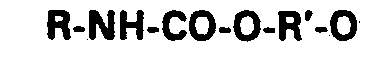


- Dans ces conditions opératoires, mêmes avec des composants difonctionnels, lorsque le rapport NCO/OH est sensiblement égal à 1 comme indiqué précédemment, le produit obtenu n'est pas complètement thermoplastique; en effet, il est infusible et insoluble dans la plupart des solvants des polyuréthanes tel que le tétrahydrofurane, le diméthylformamide. Ceci ne présente pas d'inconvénient, car la couche est déjà formée; au contraire, on en tire comme avantage des propriétés mécaniques améliorées à formulation égale par rapport à un système équivalent polymérisé à basse température où seule une polycondensation linéaire se produit.
- Lorsque le rapport NCO/OH est inférieur à 1 et de l'ordre de 0,8 à 0,9, une réticulation du type décrit ci-dessus ne se produit que de façon insignifiante.
- Selon le deuxième aspect de la réalisation de la couche de polyuréthane ayant des propiétés d'absorbeur d'énergie, le composant polyol contient une fabile proportion d'au moins un polyol de fonctionnalité supérieure à deux et notamment des triols aliphatiques monomères tels le glycérol, le triméthylolpropane, des triols à chaines polyéther, des triols de polycaprolactone, la masse moléculaire de ces triols étant généralement comprise entre 90 et 1000, les polyols mixtes polyéther/polyester de fonctionnalité supérieure à 2, par exemple de fonctionnalité comprise entre 2 et 3. L'ajout d'un polyol de fonctionnalité supérieure à 2 provoque des liaisons de pontage supplémentaires entre les chaines du polyuréthane et peut ainsi encore améliorer la cohésion de la couche.
- Les proportions entre le polyol long, le diol court et éventuellement le polyol de fonctionnalité supérieure à 2 peuvent varier selon les propriétés désirées. On choisit généralement des proportions telles que pour un équivalent hydroxyle le polyol long représente environ de 0,30 à 0,45 équivalent, le diol court d'environ 0,2 à 0,7 équivalent et le polyol de fonctionnalité supérieure à 2 environ 0 à 0,35 équivalent. Dans ces conditions, la couche présente les caractéristiques mécaniques suivantes, mesurées suivant les normes AFNOR/NFT 46 002, 51 034, 54 108.
- - une contrainte au seuil d'écoulement ay à - 20° C inférieure ou égale à 3 daN/mm2,
- - une contrainte à la rupture aR à + 40° C supérieure ou égale à 2 daN/mm2,
- - un allongement à la rupture eR à + 20° C compris entre 250 et 500 %,
- - une résistance à la déchirure amorcée Ra à + 20°C supérieure ou égale à 9 daN/mm d'épaisseur.
- On peut encore réaliser la couche en remplaçant une partie du composant polyol par un produit à hydrogènes actifs différents tel une amine.
- Suivant une réalisation de la couche de matière plastique selon l'invention, le composant isocyanate peut contenir dans des proportions limitées, par exemple inférieures, à environ 15 % en équivalent H NCO, au moins un triisocyanate tels un biuret d'isocyanate ou un triisocyanurate.
- Sur un aspect de l'invention, la feuille est formée de la seule couche décrite précédemment. En effet, cette couche présente outre des propriétés d'absorbeur d'énergie, comme indiqués précédemment, des propriétés de résistance à la rayure et à l'abrasion la rendant apte à être utilisée comme couche externe. Ainsi, elle présente une résistance à la rayure supérieure à 20 grammes, valeur mesurée d'après le test décrit par la suite, une résistance à l'abrasion avec un écart de flou inférieur à 4 %, valeur mesurée d'après le test à l'abrasion décrit par le suite.
- Pour remplir toutes les fonctions qui lui sont demandées, la couche selon l'invention doit présenter une épaisseur généralement supérieure à 0,4 mm et de préférence supérieure à 0,5 mm.
- Dans une variante, la feuille selon l'invention comprend en plus de la couche décrite précédemment, une couche de matière plastique autocicatrisable, c'est-à-dire résistant à la rayure et à l'abrasion.
- La couche de recouvrement autocicatrisable résistante à la rayure en matière plastique, que l'on peut encore désigner dans son l'application selon l'invention par couche de protection interne (couche P 1), est par exemple celle décrite dans les publications de brevets françaises 2187 719 et 2 251 608. Cette couche autocicatrisable a dans les conditions normales de température, une haute capacité de déformation élastique, un faible module d'élasticité, inférieur à 2000 daN/cm2 et de préférence inférieur à 200 daN/cm2, et un allongement à la rupture de plus de 60 % avec moins de 2 % de déformation plastique et de préférence un allongement à la rupture de plus de 100 avec moins de 1 % de déformation plastique. Les couches préférées de ce type sont des polyuréthanes thermodurcissables ayant un module d'élasticité d'environ 25 à 200 daN/cm2 et un allongement d'environ 100 à 200 % avec moins de 1 % de déformation plastique.
- Des exemples de monomères qui conviennent pour la préparation de ces polyuréthanes thermodurcissables sont d'une part les isocyanates difonctionnels aliphatiques comme le 1,6-hexanediosocyanate, le 2,2,4-triméthyl-1,6-hexanediisocyanate, le 2,4,4-triméthyl-1,6-hexanediisocyanate, le 1,3-bis (isocyanatométhyl)benzène, le bis (4-isocyanatocyclohexyl)méthane, le bis (3-méthyl-4-isocyanatocyclohexyl) méthane, le 2,2-bis(4-isocyanatocyclohexyl)propane et le 3-isocyanato- méthyl-3,5,5-triméthylcyclohexylisocyanate, ainsi que les biurets, isocyanurates et prépolymères de ces composés ayant une fonctionnalité de 3 ou davantage et d'autre part les polyols polyfonctionnels, comme les polyols ramifiés tels que les polyesterpolyols et polyétherpolyols obtenus - par réaction d'alcools polyfonctionnels, notamment le 1,2,3-propanetriol (glycérol), le 2,2- bis (hydroxyméthyl)-1-propanol (triméthyloléthane), le 2,2-bis (hydroxyméthyl)-1-butanol (triméthylolpropane), le 1,2,4,-butane- triol, le 1,2,6-hexane-triol, le 2,2-bis (hydroxyméthyl)-1,3-propane-diol (pentaérythritol) et le 1,2,3,4,5,6-hexane-hexol (sorbitol),
avec des diacides aliphatiques comme l'acide malonique, l'acide succinique, l'acide glutarique, l'acide adipique, l'acide subérique et l'acide sébacique ou avec des éthers cycliques, come l'oxyde d'éthylène, l'oxyde de 1,2-propylène et le tétrahydrofurane. - Le poids moléculaire des polyols ramifiés est avantageusement d'environ 250 à 4000 et de préférence d'environ 450 à 2000. Des mélanges de différents polyisocyanates et polyols monomères peuvent être utilisés. Un polyuréthane thermodurcissable particulièrement préféré est celui décrit dans la publication de brevet française 2 251 608.
- Le choix de l'épaisseur de la couche ayant des propriétés d'absorbeur d'énergie (couche A E) et de celle de la couche autocicatrisable (couche P 1) et le rapport entre ces deux épaisseurs sont des facteurs importants. Selon l'invention, l'épaisseur totale des deux couches superposées est supérieure à 0,5 mm avec une épaisseur d'au moins 0,4 mm pour la couche ayant des propriétés d'absorbeur d'énergie.
- En outre, l'adhésion entre cette couche et la feuille de verre doit être supérieure à environ 2 daN/5 cm, valeur mesurée au test de pelage comme décrit par la suite. Catte force d'adhésion ne devant cependant pas être trop élevée surtout lorsqu'on utilise une couche A E d'épaisseur relativement faible, proche de la limite inférieure convenable d'environ 0,4 mm.
- La couche ayant des propriétés d'absorbeur d'énergie peut contenir divers additifs qui servent généralement à faciliter sa fabrication par coulée réactive, ou qui peuvent améliorer encore ces baisses de ses propriétés.
- Elle peut contenir un catalyseur tel un catalyseur d'étain par exemple le dibutyldilaurate d'étain, l'oxyde de tributylétain, l'octoate d'étain, un catalyseur organomercurique par exemple l'ester phenyl mercurique, un catalyseur amine par exemple le diazabicyclo-(2,2,2)-octane, le 1,8diazabicyclo (5,4,0)-1 decene-7.
- La couche peut contenir un stabilisant tel le bis (2,2,6,6-tétraméthyl-4 piperidyl) sebaçate, un antioxydant phénolique.
- La couche peut contenir également un agent nappant tel une résine silicone, un ester fluoroalkylé, une résine acrylique.
- Pour fabriquer la feuille de la variante à deux couches on peut opérer da la façon suivante:
- On fabrique tout d'abord une première couche qui peut être soit le couche adhésive ayant des propriétés d'absorbeur d'énergie (couche A E), soit la couche de matière plastique autocicatrisable de protection interne (couche P 1) formée notamment d'un polyuréthane thermodurcissable. Et sur cette première couche, on forme la deuxième couche.
- On peut ainsi fabriquer tout d'abord une couche de polyuréthane thermodurcissable par coulée du mélange des composants sur un support de coulée. Après polymérisation des monomères et formation d'une couche thermodurcissable d'épaisseur pouvant varier entre 0,1 et 0,8 mm, on coule le mélange réactionnel des composants de la couche ayant des propriétés d'absorbeur d'énergie.
- On peut encore procéder d'une façon inverse, c'est-à-dire en formant d'abord la couche ayant des propriétés d'absorbeur d'énergie (couche A E).
- Pour fabriquer le vitrage feuilleté qui utilise la feuille à une ou deux couches selon l'invention, on en assemble les éléments par utilisation de le pression, par exemple par pinçage entre les rouleaux d'une calandreuse, et par action de la chaleur.
- Il est possible d'améliorer la liaison des éléments ultérieurement en soumettant le vitrage feuilleté à un cycle d'autoclave, par exemple une heure à une température d'environ 100 à 140°C et sous une pression d'environ 3 à 15 bars, ou par un cycle d'étuvage.
- Des exemplas de fabrication de la feuille selon l'invention et des vitrages feuilletés l'utilisant sont décrits par la suite.
- Sur un support en verre mobile défilant de manière continue, revêtu d'un agent de séparation qui peut être par exemple celui décrit dans la publication de brevet français 2 383 000, à savoir un produit d'addition modifié d'éthylène oxyde, on coule un mélange homogène avec les proportions suivantes de:
- -1000 g d'un polyéther d'un poids moléculaire d'environ 450 obtenu par condensation d'oxyde de 1,2-propylène avec du 2,2-bis (hydroxyméthyl)- 1-butanol et ayant une tèneur en radicaux hydroxyles libres d'environ 10,5 à 12 %, contenant 1 % en poids d'un stabilisant, 0,05 % en poids d'un catalyseur à savoir du dilaurate de dibutylétain et 0,1 % en poids d'un agent nappant,
- - 1020 g d'un biuret de 1,6-hexenediisocyanate ayant une teneur en radicaux isocyanates libres d'environ 23,2 %.
- On utilise une tête de coulée telle que celle décrite dans la publication de brevet français 2 347 170. On forme une couche uniforme qui après polymérisation sous l'effet de la chaleur, par exemple environ 15 minutes à 120° C, présente une épaisseur d'environ 0,19 mm et des propriétés d'autocicatrisation.
- Pour fabriquer la couche ayant des propriétés d'absorbeur d'énergie, on prépare au préalable le composant polyol en mélangeant un polytétraméthylèneglycol de masse moléculaire 1000 (par exemple le produit commercialisé sous l'appellation Polymeg 1000 (marque déposée) par la société QUAKER OATS), avec du butanediol-1,4, les proportions des deux constituants étant telles que le polytétraméthylèneglycol apporte 0,37 équivalent en groupes hydroxyles alors que le butanediol-1,4 en apporte 0,63.
- Au composant polyol on incorpore un stabilisant à raison de 0,5 % en poids de la masse totale du composant polyol et du composant isocyanate, un agent nappant à raison de 0,05 % en poids calculé de la même façon et un catalyseur à savoir du dilaurate de dibutylétain à raison de 0,02 % en poids calculé de la même façon que précédemment.
- Le composant isocyanate utilisé est du 3-isocyanatométhyl-3,5,5 triméthylcyclohexylisocyanate (IPDI) présentant des fonctions urées obtenues par hydrolyse partielle de l'IPDI et ayant une teneur en groupements NCO d'environ 31,5 % en poids.
- Les composants sont pris en quantités telles que le rapport NCO/OH est de 1.
- Après dégazage sous vide des composants, le mélange porté à environ 40° C est coulé à l'aide d'une tête de coulée comme celle décrite dans la publication de brevet français 2 347 170, sur la couche de polyuréthane autocicatrisable formée précédemment. On forme ainsi une couche d'environ 0,53 mm d'épaisseur qui est soumis à un cycle de polymérisation consistant en 25 minutes de chauffage à 120° C environ.
- La feuille à deux couches est retirée du support en verre et elle peut être manipulée aisément, stockée ou utilisée juste après pour la fabrication des vitrages feuilletés selon l'invention.
- Pour fabriquer le vitrage on assemble la feuille à deux couches obtenue précédemment avec une feuille en verre recuit de 2,6 mm d'épaisseur. Le verre peut éventuellement être durci ou trempé. L'assemblage comme mentionné auparavant peut s'effectuer en deux étapes, une première étape consistant en un assemblage préliminaire obtenu par passage des éléments constitutifs du vitrage entre deux rouleaux d'une calandreuse; à cette fin, on peut utiliser par exemple, le dispositif décrit dans la publication du brevet européen 0 015 209, la couche AE étant appliquée contre la face interne du verre et une seconde étape consistant en une mise du produit feuilleté obtenu dans un autoclave où pendant une heure environ il subit une pression d'environ 10 bars à une température d'environ 135°C. Ce cycle d'autoclave peut être éventuellement remplacé par un cycle d'étuvage sans pression.
- Le vitrage obtenu présente une excellente qualité optique et une transparence parfaite.
- L'adhérence obtenue entre la feuille de verre et la couche ayant des propriétés d'absorbeur d'énergie est mesurée sur le vitrage fabriqué par un test de pelage décrit ci-dessous.
- On découpe une bande de 5 cm de large de la feuille de recouvrement à deux couches. On décolle l'extrémité de la bande sur laquelle on effectue une traction perpendiculaire à la surface de vitrage, avec une vitesse de traction de 5 cm par minute. L'opération est réalisée à 20°C. On nota la force de traction moyenne nécessaire au décollement de la bande. En opérant ainsi, on obtient une force de traction de 10 daN/5 cm.
- Des essais de résistance au choc à différentes températures sont réalisés sur le vitrage fabriqué selon l'exemple.
- Le premier essai de résistance au choc est effectué avec une bille d'acier d'un poids de 2,260 kg (test de la grosse bille) que l'on fait tomber sur la partie centrale d'un échantillon de vitrage feuilleté de 30,5 cm de côté, maintenu sur un cadre rigide. On détermine la hauteur approximative pour laquelle 90 % des échantillons testés à la température choisie résistent à la chute de bille sans être traversés.
- Pour le vitrage feuilleté selon l'exemple la valeur obtenue est de 8 mètres.
- Un autre essai de résistance au choc est effectué avec une bille d'acier de 0,227 kg et de 38 mm de miamètre. Un essai est réalisé à une température de - 20° C, un autre est réalisé à une tampérature de + 40° C. Les valeurs obtenues sont respectivement de 11 et de 13 mètres.
- Compte-tenu de la norme européenne R 43 en vigueur, les résultats recherchés sont d'au moins 4 mètres à la grosse bille, d'au moins 8,5 métres à la petite bille à - 20°C et d'au moins 9 mètres à la petite bille à + 40°C.
- Par ailleurs, la couche PI montre des propriétés de surface suffisantes pour une utilisation dans un vitrage feuilleté et notamment une résistance à la rayure et à l'abrasion mesurées comme décrit ci-après:
- On mesure la résistance à la rayure par le test à la rayure connu sous l'appellation de "MAR résistant test" et qui est pratiqué avec l'appareil ERICHSEN, type 413. On mesure la charge à porter sur une tête diamantée pour introduire une rayure persistante sur la couche de matière plastique assemblée au support en verre. La charge doit être supérieure ou égale à 20 grammes pour que la couche de matière plastique ait la propriété d'être autocicatrisable.
- On mesure la résistance à l'abrasion selon la norme européenne R43. A cet effet, on fait subir à un échantillon assemblé du vitrage une abrasion à l'aide d'une meule abrasive. Après 100 tours d'abrasion, on mesure avec un spectrophotomètre l'écart de flou entre la partie abrasée et la partie non abrasée. L'écart de flou (Δ flou) doit être inférieur à 4 % pour que la couche ait la qualité anti-abrasive.
- Le vitrage selon l'exemple présente toutes les caractéristiques le rendant apte à l'utilisation en tant que pare-brise de véhicule.
- On opére de la même façon que dans l'example 1 avec les mêmes composants de départ et les mêmes proportions, pour la fabrication de la couche A E sauf que cette couche n'est pas obtenue par coulée réactive mais par plusieurs colilées successives d'une solution de polyuréthane préparée par synthèse an solution, en vue d'obtenir une épaisseur de 0,53 mm.
- Le test de pelage fournit une valeur de 8 daN/5cm.
- Das essais de résistance au choc réalisés dans les mêmes conditions que dans l'exemple 1 fournissent les valeurs suivantes:
- - 3,5 mètres à la grosse bille, 4 mètres et 3 mètres à la petite bille aux températures respectives de - 20°C at + 40° C.
- Ces valeurs sont insuffisantes ce qui montre que la coulée réactive utilisée dans l'exemple 1 donne à la couche, A E les propriétés recherchées.
- On opère de la même façon que dans l'exemple 1, sauf que l'on fabrique des couches avec des épaisseurs différentes, à savoir une couche autocicatrisable (P 1) de 0,41 mm d'épaisseur et une couche A E de 0,29 mm d'épaisseur.
- Le vitrage feuilleté obtenu présente les caractéristiques suivantes:
- Le test de pelage fournit une valeur de 10 daN/5 cm. Le test de la grosse bille et les deux essais à la petite bille donnent des valeurs respectives de 3,5, 9 et 9 mètres ce qui est insuffisant. Ces mauvaises valeurs sont dues à l'épaisseur insuffisante de la couche ayant des propriétés d'absorbeur d'énergie.
- On opère de la même façon que dans l'exemple 1, sauf que l'on fabrique une couche P 1 de 0,315 mm d'épaisseur et une couche A E de 0,415 mm d'épaisseur.
- Le test de pelage fournit une valeur de 10 daN/5 cm. Les tests à la grosse bille at à la petite bille fournissent des valeurs respectivas de 4,5, 10 et 13 mètres ce qui est tout à fait satisfaisant.
- On opère de la même façon que dans l'exemple 1 sauf que l'on fabrique une couche P 1 de 0,32 mm d'épaisseur et une couche A E da 0,42 mm d'épaisseur et que l'on fait subir à la surface du verre avant assemblage, un traitement classique par des promoteurs d'adhésion tels des silanes pour obtenir une valeur d'adhésion plus élevée.
- Le test de pelage fournit une valeur supérieure à 20 daN/5 cm.
- Le test à la grosse bille fournit une valeur de 3,5 mètres.
- Cette valeur insuffisante pour la résistance au choc est due à l'adhésion trop forte de la couche AE avec le varre dans le cas où cette couche présente une épaisseur relativement peu élevée. Cet exemple est à comparer à l'exemple.3 qui, malgré l'utilisation de couches de mêmes épaisseurs, fournit un vitrage satisfaisant grâce à une force d'adhésion plus faible.
- On opère de la même façon que dans l'exemple 1, sauf que l'on fabrique une couche P 1 de 0,46 mm d'épaisseur et une couche A E de 0,56 mm d'épaisseur et que l'on traite le verre avant assemblage comme dans l'exemple 4.
- Le test de pelage fournit une valaur de 20 daN/5 cm alors que les tests à la grosse et petite bille fournissent des valeurs respectives de 8, 11,5 et 13 mètres.
- Cet exemple est à comparer à l'example 4. Il montre que malgré une forte adhésion, l'emploi d'une couche A E de forte épaisseur fournit des valeurs de résistance mécanique satisfaisantes.
- On opère de la même façon que dans l'exemple 1 sauf que le composant polyol de départ pour la couche A E est formé d'un mélange de polytétraméthylèneglycol de masse moléculaire 1000, de butanediol-1,4 et de polycaprolactonetriol (par exemple le produit commercialisé sous l'appellation Niax 301 (marque déposée) par la société UNION CARBIDE), dans des proportions respectives telles que pour un équivalent d'hydroxyle on utilise 0,35, 0,55 et 0,10 équivalent de chacun des polyols.
- On fabrique des couches de 0,160 mm d'épaisseur pour la couche P 1 et de 0,660 mm d'épaisseur pour la couche A E.
- Le vitrage obtenu présente des caractéristiques optiques et mécaniques tout à fait satisfaisantes. Les valeurs mesurées aux différents tests sont les suivantes: une adhésion de 3 daN/5 cm, des valeurs aux tests de billes de 9,13 et 13 mètres.
- On opère de la même façon que dans l'exemple 6 sauf que les proportions des différents polyols sont respectivement de 0,35 équivalent OH pour le polymeg 1000, 0,45 équivalent OH pour le butanediol-1,4, et 0,20 équivalent OH pour le Niax 301.
- On fabrique des couches de 0,31 mm d'épaisseur pour la couche P 1 et de 0,48 mm d'épaisseur pour la couche A E.
- Les valeurs mesurées aux tests sont les suivantes: une adhésion de 3 daN/5 cm, des valeurs de 4.5,10 et 12 mètres aux billes, ce qui est satisfaisant.
- On opère de la même façon que dans l'exemple 7 sauf que l'on utilise des épaisseurs de 0,39 mm pour la couche P 1 et de 0,39 mm pour la couche A E.
- Les valeurs mesurées sont les suivantes: une adhésion de 4, des valeurs de 3, 8 et 8 pour les billes, ce qui est insuffisant.
- Cet exemple comparé à l'exemple 7 montre que pour une même épaisseur pour la feuille à 2 couches, il existe un rapport d'épaisseur entre la couche A E et la couche P 1 qui, selon la valeur, fournit un vitrage satisfaisant ou non.
- Les exemples suivants sont relatifs à la variante de la feuille selon l'invention qui est constituée d'une couche unique et aux vitrages l'utilisant.
- Pour fabriquer la couche de matière plastique, on prépare au préalable le composant polyol en mélangeant un polytétraméthylène glycol de masse moléculaire 1000 (par exemple le produit commercialisé sous l'appellation Polymeg 1000⊕ par la société QUAKER OATS, avec du butanediol-1,4, les proportions des deux constituants étant telles que le polytétraméthylèneglycol apporte 0,37 équivalent en groupes hydroxyles alors que le butanediol-1,4 en apporte 0,63.
- Au composant polyol on incorpore un stabilisant à raison de 0,5 % en poids de la masse totale du composant polyol et du composant isocyanate, un agent nappant à raison de 0,05 % en poids calculé de la même façon et un catalyseur du dilaurate de dibutylétain à raison de 0,02 % en poids calculé de la même façon que précédemment.
- Le composant isocyanate utilisé est du 3-isocyanatométhyl-3,5,5 triméthylcyclohexyldiisocyanate (IPDI) présentant des fonctions urées obtenues par hydrolyse partielle de l'IPDI et ayant une teneur en groupements NCO d'environ 31,5 % en poids.
- Les composants sont pris en quantités telles que le rapport NCO/OH est de 1. Après dégazage sous vide des composants, le mélange porté à 40°C est coulé à l'aide d'une tête de coulée comme celle décrite dans la publication de brevet français 2 347 170, sur un support en verre mobile recouvert d'un agent de séparation. On forme ainsi une couche d'épaisseur homogène d'environ 0,755 mm d'épaisseur, que l'on soumet à un cycle de polymérisation, c'est-à-dire à une température de 120°C durant 25 minutes environ.
- Après polymérisation, la couche est retirée du support en verre et forme une feuille qui peut être stockée ou utilisée juste après pour la fabrication des vitrages feuilletés.
- Pour fabriquer le vitrage on assemble la feuille de matière plastique avec une feuille de 2,6 mm d'épaisseur en verre recuit. Le verre peut éventuellement être durci ou trempé. Cet assemblage peut s'effectuer en deux étape, comme décrit dans l'example 1.
- Le vitrage obtenu présente une excellente qualité optique et une transparence parfaite.
- L'adhérence obtenue entre la feuille de verre et la couche de polyuréthane est de 10 dN/5 cm.
- Des essais de résistance au choc à différentes températures sont réalisés sur le vitrage fabriqué selon l'exemple.
- Pour le vitrage feuilleté selon l'exemple la valeur obtenue au test de la grosse bille à + 20°C est de 12 mètres.
- Les essais de résistance aux chocs effectués avec la petite bille donnent à - 20°C une valeur de 12 mètres et à + 40°C une valeur de 11 mètres.
- La résistance à la rayure pour le vitrage selon l'exemple est de 32 grammes.
- La couche selon l'exemple présente un écart de flou après abrasion de 0,94 %.
- On opère de la même façon que dans l'exemple 9 sauf que le composant polyol est formé d'un mélange de polytétraméthylène glycol de masse moléculaire 1000, de butanediol-1,4, et polycaprolactonetriol (par exemple le produit commercialisé sous l'appellation Niax 301e, par la société UNION CARBIDE) dans des proportions respectives telles que pour un équivalent d'hydroxyle au total, on utilise 0,35, 0,45 et 0,20 équivalent OH.
- On fabrique une couche de 0,70 mm d'épaisseur. Le vitrage obtenu montre des caractéristiques mécaniques et optiques tout à fait satisfaisantes. Les valeurs mesurées aux différents tests sont les suivantes:
- - une adhésion de 11 daN/5cm, des valeurs de 8 mètres à la grosse bille, 11 et 11 mètres respectivement à la petite bille à-20° C et + 40°C.
- - une résistance à la rayure de 35 g et un écart de flou à l'abrasion de 1,2 %.
- On opère da la même façon que dans l'exemple 10 sauf que le composant polyol est constitué de 0,35 partie équivalent du polyol long, 0,55 partie du diol court at 0,10 partie du triol pour 1 équivalent de composant polyol.
- On forme une couche de 0,66 mm d'épaisseur. Les valeurs mesurées aux différents tests sont les suivantes:
- - une adhésion de 11 daN/5 cm, des valeurs de 10 à la grosse bille, 13,5 et 13,5 mètres à la petite bille à - 20°C et + 40°C respectivement, une résistance à la rayure de 25 g, et un écart de flou à l'abrasion de 1,2 %.
- Bien que décrite essentiellement dans l'application à la fabrication des vitrages feuilletés, la feuille, selon l'invention, peut être utiliséé avec avantages dans d'autres applications, soit seule, soit en association avec d'autres matériaux transparents ou non.
- On opère de la même façon que dans l'exemple 1, sauf qu'on effectue la polymérisation de la couche à une température de 60°C seulement, durant 20 heures. Des essais de résistance aux chocs réalisés dans les mêmes conditions que dans l'exemple 1 donnent les valeurs suivantes:
- - 6 mètres à la grosse bille, 6 mètres at 13,5 mètres à la petite bille aux températures respectives de -20°C et +40° C.
- La valeur obtenue à la petite bille à -20°C est insuffisante. Cet exemple comparé à l'exemple 1 met en évidence l'influence de la température de polymérisation utilisée lors de la coulée réactive. Ici cette température est trop basse.
Claims (13)
Priority Applications (1)
| Application Number | Priority Date | Filing Date | Title |
|---|---|---|---|
| AT84401465T ATE31898T1 (de) | 1983-07-11 | 1984-07-10 | Transparente plastikfolie von hoher optischer qualitaet. |
Applications Claiming Priority (2)
| Application Number | Priority Date | Filing Date | Title |
|---|---|---|---|
| FR8311508 | 1983-07-11 | ||
| FR8311508A FR2548956B1 (fr) | 1983-07-11 | 1983-07-11 | Feuille en matiere plastique transparente de haute qualite optique |
Publications (2)
| Publication Number | Publication Date |
|---|---|
| EP0133090A1 EP0133090A1 (fr) | 1985-02-13 |
| EP0133090B1 true EP0133090B1 (fr) | 1988-01-13 |
Family
ID=9290704
Family Applications (1)
| Application Number | Title | Priority Date | Filing Date |
|---|---|---|---|
| EP84401465A Expired EP0133090B1 (fr) | 1983-07-11 | 1984-07-10 | Feuille en matière plastique transparente de haute qualité optique |
Country Status (25)
| Country | Link |
|---|---|
| EP (1) | EP0133090B1 (fr) |
| JP (1) | JPS6071213A (fr) |
| KR (1) | KR920002355B1 (fr) |
| AT (1) | ATE31898T1 (fr) |
| AU (1) | AU575330B2 (fr) |
| BR (1) | BR8403427A (fr) |
| CA (1) | CA1245798A (fr) |
| CS (1) | CS261870B2 (fr) |
| DE (1) | DE3468649D1 (fr) |
| DK (1) | DK337284A (fr) |
| ES (1) | ES8507380A1 (fr) |
| FI (1) | FI77253C (fr) |
| FR (1) | FR2548956B1 (fr) |
| HU (1) | HU212186B (fr) |
| IL (1) | IL72361A (fr) |
| IN (1) | IN160868B (fr) |
| MA (1) | MA20176A1 (fr) |
| MX (1) | MX171709B (fr) |
| NO (1) | NO161966C (fr) |
| NZ (1) | NZ208855A (fr) |
| PH (1) | PH23091A (fr) |
| PT (1) | PT78884B (fr) |
| SU (1) | SU1611212A3 (fr) |
| YU (1) | YU44236B (fr) |
| ZA (1) | ZA845291B (fr) |
Families Citing this family (11)
| Publication number | Priority date | Publication date | Assignee | Title |
|---|---|---|---|---|
| US4592947A (en) * | 1984-06-04 | 1986-06-03 | Sierracin Corporation | Low temperature laminatable polyurethane |
| FR2574396B1 (fr) * | 1984-12-06 | 1987-01-02 | Saint Gobain Vitrages Sa | Couche de revetement ayant des proprietes d'autocicatrisation pour des vitrages notamment ceux exposes aux agents atmospheriques |
| FR2577935B1 (fr) * | 1985-02-26 | 1988-06-17 | Saint Gobain Vitrage | Couche adhesive a base de polyurethane et son utilisation dans les vitrages feuilletes |
| FR2579609B1 (fr) * | 1985-03-28 | 1987-08-21 | Saint Gobain Vitrage | Feuille autocollante de haute qualite optique |
| IT1204812B (it) * | 1986-02-19 | 1989-03-10 | Siv Soc Italiana Vetro | Procedimento per la fabbricazione di una vetrata di sicurezza per autoveicoli ed edifici,e prodotto cosi' ottenuto |
| FR2623120B1 (fr) * | 1987-11-12 | 1990-04-27 | Saint Gobain Vitrage | Procede et dispositif pour la fabrication d'une feuille de matiere plastique de haute qualite optique comprenant une couche de polyurethane obtenue par extrusion et pressage |
| FR2644468B1 (fr) * | 1989-03-20 | 1992-12-31 | Saint Gobain Vitrage | Couche de polyurethane ayant des proprietes d'absorbeur d'energie et utilisation dans les vitrages de securite |
| LU88270A1 (fr) * | 1993-05-17 | 1994-12-01 | Wesley S A | Film de polyuréthane transparent |
| US7072115B2 (en) | 2002-03-26 | 2006-07-04 | Keiwa Inc. | Light diffusion sheet and backlight unit using the same |
| US7294401B2 (en) * | 2003-09-02 | 2007-11-13 | E. I. Du Pont De Nemours And Company | Mar-resistant oligomeric-based coatings for glass-plastic glazing products |
| CN104619738A (zh) | 2012-08-06 | 2015-05-13 | 株式会社可乐丽 | 热塑性聚氨酯及其组合物 |
Family Cites Families (7)
| Publication number | Priority date | Publication date | Assignee | Title |
|---|---|---|---|---|
| US4024113A (en) * | 1976-04-28 | 1977-05-17 | Ppg Industries, Inc. | Polycarbonate polyurethanes based on particular aliphatic/cycloaliphatic polycarbonates |
| DE2629779C3 (de) * | 1976-07-02 | 1985-04-04 | Saint Gobain | Verfahren zur Herstellung einer zweischichtigen Folie mit Selbstheileigenschaften unter Verwendung von Polyurethanen als Splitterschutzschicht eines Sicherheitsglases |
| FR2385751A1 (fr) * | 1977-03-28 | 1978-10-27 | Ppg Industries Inc | Articles en polyurethanne ameliores, durs, optiquement transparents |
| FR2442128A1 (fr) * | 1978-11-23 | 1980-06-20 | Saint Gobain | Procede de fabrication de feuilles de matiere plastique |
| CA1174577A (fr) * | 1980-04-30 | 1984-09-18 | Vernon G. Ammons | Polyurethane intercalaire pour verre de securite |
| FR2496089A1 (fr) * | 1980-12-11 | 1982-06-18 | Saint Gobain Vitrage | Vitrage feuillete de securite |
| DE3135672A1 (de) * | 1981-09-09 | 1983-03-24 | Bayer Ag, 5090 Leverkusen | Verwendung von niederviskosen, selbsthaertenden mischungen fuer polyurethanzwischenschichten bei verbundscheiben |
-
1983
- 1983-07-11 FR FR8311508A patent/FR2548956B1/fr not_active Expired
-
1984
- 1984-07-09 DK DK337284A patent/DK337284A/da not_active Application Discontinuation
- 1984-07-10 AT AT84401465T patent/ATE31898T1/de not_active IP Right Cessation
- 1984-07-10 JP JP59141571A patent/JPS6071213A/ja active Granted
- 1984-07-10 PT PT78884A patent/PT78884B/fr unknown
- 1984-07-10 SU SU843768329A patent/SU1611212A3/ru active
- 1984-07-10 AU AU30455/84A patent/AU575330B2/en not_active Ceased
- 1984-07-10 YU YU1208/84A patent/YU44236B/xx unknown
- 1984-07-10 PH PH30956A patent/PH23091A/en unknown
- 1984-07-10 DE DE8484401465T patent/DE3468649D1/de not_active Expired
- 1984-07-10 HU HU842693A patent/HU212186B/hu not_active IP Right Cessation
- 1984-07-10 EP EP84401465A patent/EP0133090B1/fr not_active Expired
- 1984-07-10 CS CS845349A patent/CS261870B2/cs unknown
- 1984-07-10 NO NO842803A patent/NO161966C/no unknown
- 1984-07-10 ZA ZA845291A patent/ZA845291B/xx unknown
- 1984-07-10 ES ES534173A patent/ES8507380A1/es not_active Expired
- 1984-07-10 BR BR8403427A patent/BR8403427A/pt not_active IP Right Cessation
- 1984-07-10 IN IN495/CAL/84A patent/IN160868B/en unknown
- 1984-07-10 NZ NZ208855A patent/NZ208855A/en unknown
- 1984-07-10 FI FI842767A patent/FI77253C/fi not_active IP Right Cessation
- 1984-07-10 IL IL72361A patent/IL72361A/xx not_active IP Right Cessation
- 1984-07-11 MX MX20197684A patent/MX171709B/es unknown
- 1984-07-11 MA MA20400A patent/MA20176A1/fr unknown
- 1984-07-11 KR KR1019840004058A patent/KR920002355B1/ko not_active Expired
- 1984-07-11 CA CA000458658A patent/CA1245798A/fr not_active Expired
Also Published As
Similar Documents
| Publication | Publication Date | Title |
|---|---|---|
| EP0132198B1 (fr) | Vitrage feuilleté de sécurité | |
| CA1178186A (fr) | Vitrage feuillete de securite | |
| EP0161184B1 (fr) | Procédé et dispositif pour la fabricatiom d'une couche de matière plastique de haute qualité optique | |
| EP0275755B1 (fr) | Feuille en matière plastique transparente de haute qualité optique résistant à la rayure et à la l'abrasion, procédé de fabrication et vitrages qui l'utilisent | |
| EP0344045B1 (fr) | Couche de polyuréthane transparente résistant à la rayure et à l'abrasion et ayant les propriétés d'absorbeur d'énergie et d'anti-buée, procédé de fabrication et vitrages qui l'utilisent | |
| EP0402212B1 (fr) | Procédé pour la fabrication d'une couche de polyuréthane autocicatrisable,et produit obtenu | |
| EP0131523B1 (fr) | Vitrage feuilleté de sécurité | |
| EP0190953B1 (fr) | Procédé et dispositif pour la fabrication d'un vitrage de sécurité | |
| EP0133090A1 (fr) | Feuille en matière plastique transparente de haute qualité optique | |
| EP0191666B1 (fr) | Procédé et dispositif pour la fabrication d'un vitrage de sécurité | |
| EP0389354B1 (fr) | Couche de polyuréthane ayant des propriétés d'absorbeur d'énergie et utilisation dans les vitrages de sécurité | |
| EP0316225B1 (fr) | Procédé pour la fabrication en continu d'une couche de polyuréthane de haute qualité optique | |
| EP0253699B1 (fr) | Procédé pour la fabrication d'une feuille en matière plastique transparente de haute qualité optique |
Legal Events
| Date | Code | Title | Description |
|---|---|---|---|
| PUAI | Public reference made under article 153(3) epc to a published international application that has entered the european phase |
Free format text: ORIGINAL CODE: 0009012 |
|
| AK | Designated contracting states |
Designated state(s): AT BE CH DE FR GB IT LI LU NL SE |
|
| RIN1 | Information on inventor provided before grant (corrected) |
Inventor name: MONCHEAUX, MICHEL-JEAN Inventor name: DAUDE, GERARD Inventor name: COLMON, DANIEL Inventor name: BRAVET, JEAN-LOUIS |
|
| 17P | Request for examination filed |
Effective date: 19850731 |
|
| 17Q | First examination report despatched |
Effective date: 19860414 |
|
| GRAA | (expected) grant |
Free format text: ORIGINAL CODE: 0009210 |
|
| AK | Designated contracting states |
Kind code of ref document: B1 Designated state(s): AT BE CH DE FR GB IT LI LU NL SE |
|
| REF | Corresponds to: |
Ref document number: 31898 Country of ref document: AT Date of ref document: 19880115 Kind code of ref document: T |
|
| REF | Corresponds to: |
Ref document number: 3468649 Country of ref document: DE Date of ref document: 19880218 |
|
| GBT | Gb: translation of ep patent filed (gb section 77(6)(a)/1977) | ||
| ITF | It: translation for a ep patent filed | ||
| PLBE | No opposition filed within time limit |
Free format text: ORIGINAL CODE: 0009261 |
|
| STAA | Information on the status of an ep patent application or granted ep patent |
Free format text: STATUS: NO OPPOSITION FILED WITHIN TIME LIMIT |
|
| 26N | No opposition filed | ||
| ITTA | It: last paid annual fee | ||
| PGFP | Annual fee paid to national office [announced via postgrant information from national office to epo] |
Ref country code: SE Payment date: 19940527 Year of fee payment: 11 |
|
| PGFP | Annual fee paid to national office [announced via postgrant information from national office to epo] |
Ref country code: NL Payment date: 19940731 Year of fee payment: 11 |
|
| EPTA | Lu: last paid annual fee | ||
| EAL | Se: european patent in force in sweden |
Ref document number: 84401465.4 |
|
| PG25 | Lapsed in a contracting state [announced via postgrant information from national office to epo] |
Ref country code: SE Effective date: 19950711 |
|
| PG25 | Lapsed in a contracting state [announced via postgrant information from national office to epo] |
Ref country code: NL Effective date: 19960201 |
|
| NLV4 | Nl: lapsed or anulled due to non-payment of the annual fee |
Effective date: 19960201 |
|
| EUG | Se: european patent has lapsed |
Ref document number: 84401465.4 |
|
| PGFP | Annual fee paid to national office [announced via postgrant information from national office to epo] |
Ref country code: AT Payment date: 19980710 Year of fee payment: 15 |
|
| PGFP | Annual fee paid to national office [announced via postgrant information from national office to epo] |
Ref country code: CH Payment date: 19981021 Year of fee payment: 15 |
|
| PG25 | Lapsed in a contracting state [announced via postgrant information from national office to epo] |
Ref country code: AT Free format text: LAPSE BECAUSE OF NON-PAYMENT OF DUE FEES Effective date: 19990710 |
|
| PGFP | Annual fee paid to national office [announced via postgrant information from national office to epo] |
Ref country code: LU Payment date: 19990728 Year of fee payment: 16 |
|
| PG25 | Lapsed in a contracting state [announced via postgrant information from national office to epo] |
Ref country code: LI Free format text: LAPSE BECAUSE OF NON-PAYMENT OF DUE FEES Effective date: 19990731 Ref country code: CH Free format text: LAPSE BECAUSE OF NON-PAYMENT OF DUE FEES Effective date: 19990731 |
|
| REG | Reference to a national code |
Ref country code: CH Ref legal event code: PL |
|
| PG25 | Lapsed in a contracting state [announced via postgrant information from national office to epo] |
Ref country code: LU Free format text: LAPSE BECAUSE OF NON-PAYMENT OF DUE FEES Effective date: 20000710 |
|
| REG | Reference to a national code |
Ref country code: GB Ref legal event code: IF02 |
|
| PGFP | Annual fee paid to national office [announced via postgrant information from national office to epo] |
Ref country code: FR Payment date: 20030702 Year of fee payment: 20 |
|
| PGFP | Annual fee paid to national office [announced via postgrant information from national office to epo] |
Ref country code: GB Payment date: 20030709 Year of fee payment: 20 |
|
| PGFP | Annual fee paid to national office [announced via postgrant information from national office to epo] |
Ref country code: BE Payment date: 20030723 Year of fee payment: 20 |
|
| PGFP | Annual fee paid to national office [announced via postgrant information from national office to epo] |
Ref country code: DE Payment date: 20030807 Year of fee payment: 20 |
|
| PG25 | Lapsed in a contracting state [announced via postgrant information from national office to epo] |
Ref country code: GB Free format text: LAPSE BECAUSE OF EXPIRATION OF PROTECTION Effective date: 20040709 |
|
| BE20 | Be: patent expired |
Owner name: *SAINT-GOBAIN VITRAGE Effective date: 20040710 |
|
| REG | Reference to a national code |
Ref country code: GB Ref legal event code: PE20 |