EP0133093A1 - Verfahren zur Herstellung eines Reifens für ein Sportfahrrad und so hergestellter Reifen - Google Patents
Verfahren zur Herstellung eines Reifens für ein Sportfahrrad und so hergestellter Reifen Download PDFInfo
- Publication number
- EP0133093A1 EP0133093A1 EP84401472A EP84401472A EP0133093A1 EP 0133093 A1 EP0133093 A1 EP 0133093A1 EP 84401472 A EP84401472 A EP 84401472A EP 84401472 A EP84401472 A EP 84401472A EP 0133093 A1 EP0133093 A1 EP 0133093A1
- Authority
- EP
- European Patent Office
- Prior art keywords
- tire
- tyre
- carcass
- tread
- threads
- Prior art date
- Legal status (The legal status is an assumption and is not a legal conclusion. Google has not performed a legal analysis and makes no representation as to the accuracy of the status listed.)
- Granted
Links
- 238000004519 manufacturing process Methods 0.000 title claims description 7
- 238000000034 method Methods 0.000 claims abstract description 23
- 239000011324 bead Substances 0.000 claims abstract description 19
- 230000003014 reinforcing effect Effects 0.000 claims abstract description 11
- 238000004804 winding Methods 0.000 claims abstract description 6
- 230000002787 reinforcement Effects 0.000 claims description 11
- 229920000271 Kevlar® Polymers 0.000 claims description 10
- 239000004761 kevlar Substances 0.000 claims description 10
- 238000005096 rolling process Methods 0.000 claims description 8
- 230000002093 peripheral effect Effects 0.000 claims description 7
- 229920002994 synthetic fiber Polymers 0.000 claims description 7
- 238000004073 vulcanization Methods 0.000 claims 1
- 206010019909 Hernia Diseases 0.000 description 5
- 229920000742 Cotton Polymers 0.000 description 4
- 229920005549 butyl rubber Polymers 0.000 description 2
- 238000005520 cutting process Methods 0.000 description 2
- 230000000694 effects Effects 0.000 description 2
- 239000004816 latex Substances 0.000 description 2
- 229920000126 latex Polymers 0.000 description 2
- 230000035515 penetration Effects 0.000 description 2
- 230000015572 biosynthetic process Effects 0.000 description 1
- 230000002301 combined effect Effects 0.000 description 1
- 229920001971 elastomer Polymers 0.000 description 1
- 239000004744 fabric Substances 0.000 description 1
- 239000011521 glass Substances 0.000 description 1
- 238000009434 installation Methods 0.000 description 1
- 230000003993 interaction Effects 0.000 description 1
- 230000000750 progressive effect Effects 0.000 description 1
- 239000012209 synthetic fiber Substances 0.000 description 1
- 238000009941 weaving Methods 0.000 description 1
- 239000013585 weight reducing agent Substances 0.000 description 1
Images



Classifications
-
- B—PERFORMING OPERATIONS; TRANSPORTING
- B60—VEHICLES IN GENERAL
- B60C—VEHICLE TYRES; TYRE INFLATION; TYRE CHANGING; CONNECTING VALVES TO INFLATABLE ELASTIC BODIES IN GENERAL; DEVICES OR ARRANGEMENTS RELATED TO TYRES
- B60C3/00—Tyres characterised by the transverse section
- B60C3/02—Closed, e.g. toroidal, tyres
-
- B—PERFORMING OPERATIONS; TRANSPORTING
- B29—WORKING OF PLASTICS; WORKING OF SUBSTANCES IN A PLASTIC STATE IN GENERAL
- B29D—PRODUCING PARTICULAR ARTICLES FROM PLASTICS OR FROM SUBSTANCES IN A PLASTIC STATE
- B29D30/00—Producing pneumatic or solid tyres or parts thereof
- B29D30/06—Pneumatic tyres or parts thereof (e.g. produced by casting, moulding, compression moulding, injection moulding, centrifugal casting)
- B29D30/08—Building tyres
-
- B—PERFORMING OPERATIONS; TRANSPORTING
- B60—VEHICLES IN GENERAL
- B60C—VEHICLE TYRES; TYRE INFLATION; TYRE CHANGING; CONNECTING VALVES TO INFLATABLE ELASTIC BODIES IN GENERAL; DEVICES OR ARRANGEMENTS RELATED TO TYRES
- B60C2200/00—Tyres specially adapted for particular applications
- B60C2200/12—Tyres specially adapted for particular applications for bicycles
Definitions
- the present invention relates to a method of manufacturing a tire for a sports bicycle and the tire thus produced.
- touring bikes are generally equipped with tires surrounding an air chamber that is not permanently trapped in the carcass of the tire. Indeed, as with this type of bicycle, questions of weight and rolling characteristics are not of primary importance, it is preferable to take advantage of the lower cost of this type of tire and the ease of repairing or replacing a air chamber in the event of a puncture.
- This type of tire is in fact a simple reduction of the usual tire: it is made up of a carcass in strips of cloth coated with rubber with a tread, the assembly thus made up being vulcanized.
- This manufacturing technique corresponds to the traditional technique.
- the beads of a tire are reinforced by a wire arch, which is relatively heavy (of the order of 40 g for the two poles), it has been proposed to replace the poles with flexible wires more light and allow to fold the tire to fix it in reserve under the saddle. Despite the flexibility of such hoops, the lifting characteristics have not been improved.
- the object of the present invention is to create a tire which is not integral with the air chamber and which has characteristics of use and of rolling close to those of a hose while retaining the advantages of the air chamber - usual tire system. .
- the invention relates to a process characterized in that a cylinder is produced by winding wires along a sheet of wires juxtaposed and glued to each other, this cylinder is cut into at least one transverse strip in shape of parallelogram, strips the length of which is at least equal to the development of the tire to be produced, and in which the cut wire segments are arranged transversely, parallel to the uncut sides of each transverse strip, the ends of at least two strips are joined together to form a continuous two-ply tape in which the threads of the two plies intersect, a reinforcement wire, inextensible, very resistant to traction, following several turns, as well as a cord, is wound along two lines of drawdown, the side bands are folded along each fold line against the outside of the carcass, and around the reinforcing wires and the cord lette to form the heels of the tire intended to bear on the leg, a tread is fixed on the carcass.
- the invention also relates to a tire produced according to the above method.
- Such a tire has multiple advantages for the user because its characteristics are similar to those of a hose.
- the rolling behavior, the resistance to sudden starts, etc. are identical thanks to the combined effect of the structure in plies of parallel and crossed wires, on the one hand, and of the reinforcing wire and cord and of the heels, on the other hand: there is an almost punctual interaction between the various relatively free wires which constitute the carcass and their attachment on and around the wires and cords of the heels; this allows a great flexibility of rolling to absorb the irregularities of the ground, in spite of the high inflation pressure.
- the tire combines the advantages of traditional tires with the advantageous characteristics of the hoses.
- the tire carcass can be made of any kind of cotton, silk or, if appropriate, synthetic threads, depending on the characteristics sought.
- side strips of sufficient width are produced to cover the sides of the carcass as far as under the tread.
- a wire which is very resistant to traction in the peripheral direction is unwound on the cylinder between the two edges of the lateral bands after the latter have been folded down and the turns of the son are covered by the tread.
- the transverse strips are cut so that the son segments are at 45 °.
- the invention relates to a process described above, characterized in that the lateral bands are folded over a sufficient width so that they overlap at the level of the rolling surface by forming the heels only by drawdown around the reinforcement wires and a tread is put in place.
- the reinforcing threads are threads of synthetic material which is practically non-stretchable under the conditions of their use, such as Kevlar (brand).
- the plies forming the strip constituting the tire are produced using a wire of inextensible synthetic material, in particular Kevlar.
- the invention also relates to a tire obtained according to the above method, this tire being characterized in that it consists of an envelope formed by a ply whose lateral bands are folded down to cover the entire lateral surface and overlap under the running surface.
- a reduction of 60 g therefore represents a reduction of the order of 25% to 35% in weight, which is considerable. If, in addition, the sheets are made of Kevlar yarn, and not of cotton yarn, for the same resistance, the reduction in weight is even greater. Indeed, an unassembled cotton weave represents 80 g and a Kevlar weave 20 g.
- the invention relates to a tire which consists of a carcass formed of at least two transverse bands of threads whose directions intersect symmetrically with respect to the meridian plane of symmetry of the tire, the lateral strips being folded over at least part of the height of the sidewall of the carcass to form the bead by surrounding several turns of a bead reinforcement wire, as well as a tread.
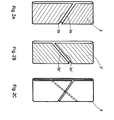
- FIGS. 2A - 2C shows a winding cylinder 1 on which a web of wires is unwound contiguously, the various turns of the wire 2 being glued to each other.
- the sheet of threads thus obtained is cut into so-called "transverse" strips 3, along cutting lines 4, 5. These lines 4, 5 preferably make an angle of 45 ° with the direction of the threads.
- This strip 3 is in the form of an elongated parallelogram and the wire segments are parallel to the edges 3a, 3b of the short sides of the parallelogram.
- a continuous ribbon or a cylindrical sleeve is produced by putting the ends 3a, 3b end to end, 3a ', 3b' of two strips 3, 3 ', as shown in Figures 2A-2C.
- FIG. 3B shows, in a half-section along the line III-III of FIG. 3A, the structure thus obtained, that is to say the arrangement of the two plies 3, 3 ′ forming the continuous tape 6 as well as the reinforcement threads 8 and the cord 9.
- the strip 11, between the fold-down line 7 and the outer edge 10 (left edge in FIG. 3) of the carcass, is intended to be folded along the fold-down line 7 around the cord 9 and wires 8 to form one of the beads of the tire, as shown in FIG. 4.
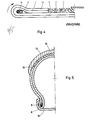
- the last tire manufacturing phase consists of fitting the tread 12 which is glued to the carcass produced according to FIG. 4, so that the two edges of the tread 12 overlap the edge 10 of the tread lateral 11, after folding. A tire is thus produced which is put in place on the rim 16, as shown in FIG. 5.
- outward folding means that the strip 11 is applied externally against the torus 6 obtained from the cylinder on the opposite side from that facing the tire not shown.
- a certain number of turns 15 of a wire may be advantageous to unwind (FIGS. 4 and 5) in the hollow median part 14 delimited by part 6 and the two edges 10 of the folded parts 11, a certain number of turns 15 of a wire. very resistant to traction. These wires 15 are wound in the peripheral direction, that is to say in the rolling direction. These windings of wires 15 are deposited before the tread 12 is put in place.
- the variant of the above method consists in unwinding a sufficient number of turns of reinforcing threads 1, in particular of threads of practically inextensible synthetic fibers, such as Kevlar (brand), so as to allow the drawdown of the lateral strips 22 and 23 on the central strip 21 to form the beads 24, 25 of the tire. These beads serve to fix the tire to the rim 26.
- the folded parts 22, 23 are wide enough to form parts 27, 28 which overlap slightly under the tread 29 of the tire in the median plane of the tire.
- the number of turns of reinforcement threads is chosen as a function of the forces which the bead must resist according to the inflation pressure of the tires.
- the air chamber housed in the tire thus produced is protected at the running surface 30 by a triple layer 21, 22, 29 or 21, 23, 30.
- the thread used for the production of the ply 21, 22, 23 may be thread of practically inextensible synthetic material such as Kevlar, which, in comparison with a cotton weaving, allows a considerable reduction in weight.
- the running surface 30, according to FIG. 6, is particularly advantageous because it has a slight projection giving the section of the tire an oval shape improving its contact with the road. Indeed, this gives a very narrow running surface 30. Such a tire is particularly well suited for the road.
- the overlapping of the flanks is stopped at the limit 32, under the edges of the tread 29.
- the band 29 then comes directly on the middle band 21.
- the air chamber 40 housed in the tire, takes the form indicated in the right half of FIG. 6 (solid line); under the effect of the air pressure, the chamber 40 presses the heel 24 in the peripheral housing 41 of the rim 26.
- This housing 41 is delimited by the curved edge 42 inwards and by a shoulder 43.
- this part of FIG. 6 makes it possible to show the pinching effect exerted by a thick heel 24A, known, (in dotted lines) on the air chamber 40A (in dotted lines) and causing a hernia of the chamber 40, 40A .
- This hernia wears out and pierces the air chamber very quickly.
- the left part of the figure shows two positions of the bead 25 of the tire according to the invention.
- the solid line position 25 is the normal position in support in the housing 41.
- the position in dotted lines 25A is the reassembly position: the bead 25A is located at the bottom of the shoulder 43 at the bottom of the groove 44 of the rim 26.
- part of the periphery of the heel 25A at the bottom of the groove 44 (the chamber 40 being deflated) so that the other part (diametrically opposite) of the same heel 25A can very simply pass over the edge 42 of the rim, as is usually done with small lever-shaped tools. This operation is made possible, thanks to the small thickness of the heel, although the son of the heel are inextensible.
Landscapes
- Engineering & Computer Science (AREA)
- Mechanical Engineering (AREA)
- Tyre Moulding (AREA)
- Tires In General (AREA)
Applications Claiming Priority (4)
| Application Number | Priority Date | Filing Date | Title |
|---|---|---|---|
| FR8312201 | 1983-07-22 | ||
| FR8312201A FR2549416B1 (fr) | 1983-07-22 | 1983-07-22 | Procede de fabrication d'un pneumatique pour bicyclette de sport et pneumatique ainsi realise |
| FR8406241A FR2563151B2 (fr) | 1984-04-19 | 1984-04-19 | Procede de fabrication d'un pneumatique pour bicyclettes de sport et pneumatique ainsi realise |
| FR8406241 | 1984-04-19 |
Publications (2)
| Publication Number | Publication Date |
|---|---|
| EP0133093A1 true EP0133093A1 (de) | 1985-02-13 |
| EP0133093B1 EP0133093B1 (de) | 1987-04-22 |
Family
ID=26223533
Family Applications (1)
| Application Number | Title | Priority Date | Filing Date |
|---|---|---|---|
| EP84401472A Expired EP0133093B1 (de) | 1983-07-22 | 1984-07-11 | Verfahren zur Herstellung eines Reifens für ein Sportfahrrad und so hergestellter Reifen |
Country Status (2)
| Country | Link |
|---|---|
| EP (1) | EP0133093B1 (de) |
| DE (1) | DE3463234D1 (de) |
Cited By (1)
| Publication number | Priority date | Publication date | Assignee | Title |
|---|---|---|---|---|
| AT412256B (de) * | 2003-01-02 | 2004-12-27 | Mario Dr Herzog | Sportgerät |
Citations (4)
| Publication number | Priority date | Publication date | Assignee | Title |
|---|---|---|---|---|
| US1734241A (en) * | 1926-03-22 | 1929-11-05 | Fisk Rubber Co | Pneumatic tire casing |
| US1855560A (en) * | 1928-08-17 | 1932-04-26 | Arthur E Preyer | Cord tire structure |
| US2676637A (en) * | 1950-03-07 | 1954-04-27 | Nat Standard Co | Tire carcass and method of making same |
| FR2421050A1 (fr) * | 1978-03-28 | 1979-10-26 | Wolber | Perfectionnements apportes a la fabrication des pneus sans chambre pour cycles et motocycles |
-
1984
- 1984-07-11 EP EP84401472A patent/EP0133093B1/de not_active Expired
- 1984-07-11 DE DE8484401472T patent/DE3463234D1/de not_active Expired
Patent Citations (4)
| Publication number | Priority date | Publication date | Assignee | Title |
|---|---|---|---|---|
| US1734241A (en) * | 1926-03-22 | 1929-11-05 | Fisk Rubber Co | Pneumatic tire casing |
| US1855560A (en) * | 1928-08-17 | 1932-04-26 | Arthur E Preyer | Cord tire structure |
| US2676637A (en) * | 1950-03-07 | 1954-04-27 | Nat Standard Co | Tire carcass and method of making same |
| FR2421050A1 (fr) * | 1978-03-28 | 1979-10-26 | Wolber | Perfectionnements apportes a la fabrication des pneus sans chambre pour cycles et motocycles |
Cited By (1)
| Publication number | Priority date | Publication date | Assignee | Title |
|---|---|---|---|---|
| AT412256B (de) * | 2003-01-02 | 2004-12-27 | Mario Dr Herzog | Sportgerät |
Also Published As
| Publication number | Publication date |
|---|---|
| EP0133093B1 (de) | 1987-04-22 |
| DE3463234D1 (en) | 1987-05-27 |
Similar Documents
| Publication | Publication Date | Title |
|---|---|---|
| EP0000458B1 (de) | Luft reifen | |
| FR2494639A1 (fr) | Pneumatique de securite | |
| EP1507670B1 (de) | Zweiradreifen | |
| EP2542429B1 (de) | Fahrzeugreifen mit einer lauffläche aus mehreren gummimischungen und radialkarkassenverstärkung aus mindestens zwei lagen | |
| EP1545909B1 (de) | Reifen für zweirädrige fahrzeuge | |
| EP2379343A1 (de) | Fahrzeugreifen mit unterbrochener karkasse und mit einer lage aus umfangsverstärkungselementen | |
| FR2566334A1 (fr) | Pneumatique radial a faible section pour fortes charges et procede pour sa fabrication | |
| EP0133093B1 (de) | Verfahren zur Herstellung eines Reifens für ein Sportfahrrad und so hergestellter Reifen | |
| EP0859702B1 (de) | Radialer reifen mit einer karkasse,deren ende sich schräg überlappen | |
| FR2685255A1 (fr) | Pneumatique a carcasse radiale. | |
| EP0672547B1 (de) | Luftreifen ohne Wulstkern | |
| EP2379342B1 (de) | Fahrzeugreifen mit einer unterbrochenen karkassenverstärkung und aus mehreren verbindungen bestehendes profil | |
| EP0133072A2 (de) | Rad für ein Fahrrad mit einem Schlauchreifen | |
| EP2842768B1 (de) | Reifen für Fahrrad-Rad | |
| FR2493235A1 (fr) | Pneumatique pour bicyclettes, du type couramment appele " boyau " pouvant etre utilise sur des jantes de type different | |
| FR2745754A1 (fr) | Pneu radial comportant une nappe carcasse dont la soudure par recouvrement est pourvue de decoupes | |
| FR2864468A1 (fr) | Pneumatique pour deux roues | |
| FR2549416A1 (fr) | Procede de fabrication d'un pneumatique pour bicyclette de sport et pneumatique ainsi realise | |
| LU81583A1 (fr) | Roue a bandage pneumatique | |
| EP2829418A1 (de) | Felge für Fahrrad-Rad | |
| FR2563151A2 (fr) | Procede de fabrication d'un pneumatique pour bicyclettes de sport et pneumatique ainsi realise | |
| FR2473425A1 (fr) | Pneumatique comportant un element de renforcement en toile pliee et son procede de confection | |
| EP1101633B1 (de) | Lufftreifen mit entkoppelter niedriger Zone | |
| FR2615453A1 (fr) | Pneumatique a carcasse radiale a talons renforces | |
| EP0009067B1 (de) | Isostabiler Schlauchreifen |
Legal Events
| Date | Code | Title | Description |
|---|---|---|---|
| PUAI | Public reference made under article 153(3) epc to a published international application that has entered the european phase |
Free format text: ORIGINAL CODE: 0009012 |
|
| AK | Designated contracting states |
Designated state(s): BE CH DE GB IT LI NL |
|
| 17P | Request for examination filed |
Effective date: 19850720 |
|
| 17Q | First examination report despatched |
Effective date: 19860422 |
|
| GRAA | (expected) grant |
Free format text: ORIGINAL CODE: 0009210 |
|
| AK | Designated contracting states |
Kind code of ref document: B1 Designated state(s): BE CH DE GB IT LI NL |
|
| REF | Corresponds to: |
Ref document number: 3463234 Country of ref document: DE Date of ref document: 19870527 |
|
| ITF | It: translation for a ep patent filed | ||
| PLBE | No opposition filed within time limit |
Free format text: ORIGINAL CODE: 0009261 |
|
| STAA | Information on the status of an ep patent application or granted ep patent |
Free format text: STATUS: NO OPPOSITION FILED WITHIN TIME LIMIT |
|
| 26N | No opposition filed | ||
| PGFP | Annual fee paid to national office [announced via postgrant information from national office to epo] |
Ref country code: GB Payment date: 19900711 Year of fee payment: 7 |
|
| PGFP | Annual fee paid to national office [announced via postgrant information from national office to epo] |
Ref country code: BE Payment date: 19900726 Year of fee payment: 7 |
|
| ITTA | It: last paid annual fee | ||
| PGFP | Annual fee paid to national office [announced via postgrant information from national office to epo] |
Ref country code: NL Payment date: 19900731 Year of fee payment: 7 |
|
| PGFP | Annual fee paid to national office [announced via postgrant information from national office to epo] |
Ref country code: CH Payment date: 19900809 Year of fee payment: 7 |
|
| PGFP | Annual fee paid to national office [announced via postgrant information from national office to epo] |
Ref country code: DE Payment date: 19900824 Year of fee payment: 7 |
|
| PG25 | Lapsed in a contracting state [announced via postgrant information from national office to epo] |
Ref country code: GB Effective date: 19910711 |
|
| PG25 | Lapsed in a contracting state [announced via postgrant information from national office to epo] |
Ref country code: LI Effective date: 19910731 Ref country code: CH Effective date: 19910731 Ref country code: BE Effective date: 19910731 |
|
| BERE | Be: lapsed |
Owner name: MARQUET CHRISTIAN JEAN ROGER Effective date: 19910731 |
|
| PG25 | Lapsed in a contracting state [announced via postgrant information from national office to epo] |
Ref country code: NL Effective date: 19920201 |
|
| GBPC | Gb: european patent ceased through non-payment of renewal fee | ||
| NLV4 | Nl: lapsed or anulled due to non-payment of the annual fee | ||
| REG | Reference to a national code |
Ref country code: CH Ref legal event code: PL |
|
| PG25 | Lapsed in a contracting state [announced via postgrant information from national office to epo] |
Ref country code: DE Effective date: 19920401 |