EP0133378B1 - Méthode et système de radiolocalisation de cas de détresse - Google Patents
Méthode et système de radiolocalisation de cas de détresse Download PDFInfo
- Publication number
- EP0133378B1 EP0133378B1 EP84305334A EP84305334A EP0133378B1 EP 0133378 B1 EP0133378 B1 EP 0133378B1 EP 84305334 A EP84305334 A EP 84305334A EP 84305334 A EP84305334 A EP 84305334A EP 0133378 B1 EP0133378 B1 EP 0133378B1
- Authority
- EP
- European Patent Office
- Prior art keywords
- distress
- central station
- signal
- transmitter
- source
- Prior art date
- Legal status (The legal status is an assumption and is not a legal conclusion. Google has not performed a legal analysis and makes no representation as to the accuracy of the status listed.)
- Expired - Lifetime
Links
- 230000009429 distress Effects 0.000 title claims abstract description 53
- 238000000034 method Methods 0.000 title claims abstract description 9
- 230000005540 biological transmission Effects 0.000 claims abstract description 42
- 238000004891 communication Methods 0.000 claims abstract description 14
- 230000001419 dependent effect Effects 0.000 claims description 2
- 238000001208 nuclear magnetic resonance pulse sequence Methods 0.000 claims 1
- 238000012360 testing method Methods 0.000 description 14
- 238000010586 diagram Methods 0.000 description 9
- 238000005259 measurement Methods 0.000 description 7
- 230000006870 function Effects 0.000 description 5
- 238000012545 processing Methods 0.000 description 4
- 230000004044 response Effects 0.000 description 4
- 230000001413 cellular effect Effects 0.000 description 3
- 238000001514 detection method Methods 0.000 description 3
- 238000012546 transfer Methods 0.000 description 3
- 230000001934 delay Effects 0.000 description 1
- 238000005516 engineering process Methods 0.000 description 1
- 230000007613 environmental effect Effects 0.000 description 1
- 239000000284 extract Substances 0.000 description 1
- 239000012530 fluid Substances 0.000 description 1
- 230000004907 flux Effects 0.000 description 1
- 230000000977 initiatory effect Effects 0.000 description 1
- 229940052961 longrange Drugs 0.000 description 1
- 238000012544 monitoring process Methods 0.000 description 1
- 230000003287 optical effect Effects 0.000 description 1
- 238000004806 packaging method and process Methods 0.000 description 1
- 230000002093 peripheral effect Effects 0.000 description 1
- 230000008569 process Effects 0.000 description 1
- 230000035484 reaction time Effects 0.000 description 1
- 230000035945 sensitivity Effects 0.000 description 1
- 230000011664 signaling Effects 0.000 description 1
Images



Classifications
-
- G—PHYSICS
- G01—MEASURING; TESTING
- G01S—RADIO DIRECTION-FINDING; RADIO NAVIGATION; DETERMINING DISTANCE OR VELOCITY BY USE OF RADIO WAVES; LOCATING OR PRESENCE-DETECTING BY USE OF THE REFLECTION OR RERADIATION OF RADIO WAVES; ANALOGOUS ARRANGEMENTS USING OTHER WAVES
- G01S5/00—Position-fixing by co-ordinating two or more direction or position line determinations; Position-fixing by co-ordinating two or more distance determinations
- G01S5/02—Position-fixing by co-ordinating two or more direction or position line determinations; Position-fixing by co-ordinating two or more distance determinations using radio waves
- G01S5/14—Determining absolute distances from a plurality of spaced points of known location
-
- G—PHYSICS
- G01—MEASURING; TESTING
- G01S—RADIO DIRECTION-FINDING; RADIO NAVIGATION; DETERMINING DISTANCE OR VELOCITY BY USE OF RADIO WAVES; LOCATING OR PRESENCE-DETECTING BY USE OF THE REFLECTION OR RERADIATION OF RADIO WAVES; ANALOGOUS ARRANGEMENTS USING OTHER WAVES
- G01S5/00—Position-fixing by co-ordinating two or more direction or position line determinations; Position-fixing by co-ordinating two or more distance determinations
- G01S5/0009—Transmission of position information to remote stations
Definitions
- This invention relates to a system and a method for locating a signal source, particularly for determining the location of a distress radio transmitter to enable the use of rescue units to respond to its transmissions.
- radio When a vehicle is in distress, radio is often used to communicate that fact to others and to summon assistance. For example, on the high seas when a ship is in grave danger it will broadcast the international distress signal on dedicated distress frequencies upon which all vessels maintain watch. If a vessel receives a distress signal, it is obligated to render such assistance as may be required and to deviate from its planned course if necessary. Of course, there is little to guarantee that a transmitted distress signal will be received or, if it is received, that the recipient will render assistance.
- the distress call is made by any available means, such as shouting. Once again, for a number of reasons, the call may go unanswered.
- Hull describes a personal alarm transmitter to be used by a crime victim to summon police to the scene.
- police both at fixed locations and in automobiles, use direction-finding equipment to locate the source of the signal.
- the transmission may be modulated to indicate the transmitter's approximate location (in the event that it is normally located in a particular area) or its identity.
- DF direction-finding
- the Hull system suffers from other drawbacks: First, it is not a dedicated system. The police, in addition to listening for distress radio transmissions, have other duties which may interfere with locating the distress transmitter (or even take precedence over it). Also, the Hull system is slower and less effective because it relies to a great extent on actions taken by humans rather than actions performed automatically.
- Signal strength is meant the fluid intensity or flux density of the transmitted energy.
- Frenkel U.S. Patent 3,922,678 (November 25, 1975) discloses an arrangement which may be used to locate emergency radio transmissions in an area, such as a city, where numerous receivers have been pre-positioned at intersections of a coordinate grid. The sensitivity and location of the receivers, and the power output of the emergency transmitter, are adjusted so that (a) a transmission at any point in the area of coverage will be received by at least two receiveriers, and (b) each combination of receivers at which a given transmission can be received corresponds to a unique zone within that area.
- the transmitter is activated either by a police officer when in pursuit of a crime suspect or by police intending to track a package in the possession of a suspect.
- Each receiver in the area of coverage is connected to a relay station which relays the fact of receipt or non-receipt of the transmitter's signal to the police station, where the transmitter's path can be followed.
- Frenkel system while providing some degree of automatic radiolocation capacity, is unable to locate a transmitter precisely because it divides the area of coverage into zones and only determines, for each zone, whether a transmitter is present there. For greatly increased accuracy, a much larger number of zones (and rescueing) would be required. Furthermore, Frenkel does not include means for receiving a crime victim who is sending an emergency transmission. The system merely follows, from a central station, the progress of the transmitter throughout the city. Nor would the system disclosed be suitable for personal emergency rescue, for two reasons. First, the transmitter must operate continuously in order to allow the operator at the central station to monitor its location. Second, transmitter power must be precisely controlled because of the accuracy of the system (limited as it is) is strictly dependent upon the size and shape of the receiver fields, which must remain fixed.
- US-A-4 215 345 discloses a locating system which is intended to locate aeroplanes which transmit coded bursts or RF noise.
- the MacDoran system is outlined in the preamble of claim 1.
- Each receiving station acts as a repeater to re-transmit the complete received signal to a central station where the time delay between receipt of corresponding parts of the coded burst at the various receiving stations is measured in order to calculate the location of the aeroplane.
- Vehicle “location” is also a problem which arises in cellular mobile radio systems.
- the purpose of "locating" the cellular telephone is not to determine its precise location geographically but to determine which cell site is best able to process a call from the telephone. This is a function not only of geographical location but also of the distribution of obstructions in the coverage area. It is therefore clear that geographical location is not the object of such systems.
- a solution adopted in this field is described in IEEE Transactions on Vehicular Technology vol VT-26 no. 1 February 1977 pages 43--46. In this reference it is suggested that range can be estimated by measuring the signal strength as received at the various cell sites.
- a cellular radio telephone is capable of making a continuous transmission so that data can be periodically gathered as required to carry out periodical "locates”.
- the present invention is directed to solving the technical problems associated with the location of an emergency transmitter which transmits repeated short duration pulses which may be at varying power levels.
- the system and method of the present invention are defined in the appended claims. Such a system and method are advantageous in that they can automatically operate efficiently without excessive equipment costs or heavy communications channel requirements since each receiving means carries out a signal strength measurement before transmitting this information to the calculating means at the central station.
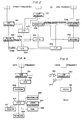
- FIG. 1 is an overall system diagram of a distress radiolocation system constructed in accordance with the present invention.
- Distress transmitter 10 radiates a signal which, in the preferred embodiment, comprises a series of 150 ms pulses recurring at 1.5s intervals. Although a single pulse would be sufficient to locate the transmitter, for increased reliability (and to enable the mobile units to use DF equipment) a steady stream of pulses may be transmitted.
- each repeater 20 recognizes a distress transmission, it automatically measures the signal strength and formats a message for transmission to the central station.
- the message includes the identity of the repeater and the identity (if known) and signal strength of the distress transmission. The message will be repeated until it is acknowledged by the central station, after which the repeater will resume a standby mode, waiting for new distress signals.
- the messages from all repeaters 20 are received and interpreted.
- the central station uses the known locations of the repeaters, the signal strength of the distress transmissions received by them, and the relationship between signal strength and distance established during calibration of each repeater, the central station automatically calculates the location of target transmitter 10. It then transmits the target location, in grid coordinates, to the mobile unit nearest the target, repeating the message until it is acknowledged.
- Mobile unit 40 one of a plurality of such units (the number determined in accordance with service requirements), acknowledges the message from central station 30 and proceeds to the calculated location of target transmitter 10 while monitoring the distress frequency with its DF equipment to provide an exact target location for the intercept.
- VHF transmitter which transmits the distress signal pulses unencoded with any additional information
- UHF transmitter which encodes target identification into each 150 ms distress signal pulse.
- VHF transmitters are used for personal security within a city, while the UHF transmitters are preferred for long- range vehicle security (such as cross-country transportation of valuable cargo).
- the VHF transmitter with a power output of about 1/3 W, is powered solely by an internal battery; while the UHF transmitter, designed to radiate from 2.5 to 4.0 W, uses the vehicle 6atttery for normal power and the internal battery for standby power. Both transmitters have high stability and shock- and weather-resistant packaging.
- the VHF transmitter is activated by a touch- sensitive manual TRANSMIT switch.
- the UHF transmitter may be activated by a signal from a VHF transmitter, by a motion detection switch, by a manual TRANSMIT switch, or by any of a variety of detection devices.
- FIG. 2 is a block diagram of one of the slave repeater units 20.
- VHF receiver 201 which is a conventional receiver such as YAESU FTC 1525, receives distress signals from the VHF target transmitters and demodulates them, sending the demodulated pulses to pulse detector 202. At the same time, the modulated signal is passed to A/D converter 203 which performs the signal strength measurement.
- pulse detector 202 After signal strength is measured, it is sent to CPU 204 where it is stored.
- the function of pulse detector 202 is to enable A/D converter 205 upon, receipt of a series of three pulses matching the characteristics of those emitted by distress transmitters 10. Consequently, it sends out an enable signal on line 202a whenever it detects three 150 ms pulses followed by three 1350 ms spaces.
- the pulses are passed through on line 202b to A/D converter 205.
- Converter 205 is an identification converter, providing an indication that a complete distress transmission has been received and that the resulting signal strength measurement should be transmitted to the central station.
- the identification signal is sent to transmit-receive switch 206, which makes the decision whether to transmit immediately or wait. This decision is based upon whether VHF guard receiver 207, which monitors the communication channel between repeater units 20 and central station 30, indicates that the channel is in use. If the channel is in use, transmit-receive switch 206 does nothing. When the channel is clear, switch 206 signals CPU 204 that a transmission to the central station may be made.
- CPU 204 Upon receipt of the "go" signal from switch 206, CPU 204, which has been storing the measured signal strengths from A/D converter 203, averages the most recent three signal strength measurements and transfers this information to encoder 208.
- the encoder formats a message consisting of the identification of its repeater unit, the target identification, if present, and the signal strength measurement. It then activates transmitter 209 to transmit this information to central station 30. During transmission, transmitter 209 disables guard receiver 207 over line 209a.
- UHF receiver 210 sends the modulated signal to A/D converter 203 for signal strength measurement. However, since receiver 210 includes a digital decoder, it is unnecessary to use pulse detector 202 to detect a series of three distress signal pulses. When three pulses of the proper format are received, the demodulated pulses are sent by receiver 210 directly to AID converter 205, which decodes the target identification information from the distress pulses. (Target identification is only supplied with UHF distress signals).
- the flow chart of Figure 3 illustrates the operation of slave repeater units 20. These units are unattended and require no operator intervention with the exception of being turned on. If the unit is inoperative, this fact will be determined by the central station.
- the program is designed to operate as a loop back system which eventually always comes back to the same starting position.
- the lowest level loop has CPU 204 waiting for a pulse from pulse detector 202. This is the Level One node of the flow chart of Figure 3.
- Detection of a pulse moves the system into a single pass loop in which it validates the pulse. If it is invalid, the system drops down to the pulse detect loop. If the pulse is valid, it checks for encoded identification.
- identification code associated with the target signal
- it is compared with a table of valid identification codes (as well as being compared with previous or subsequent transmissions of the same distress signal). If the identification is invalid, the system returns to level one and waits for more pulses. If it is valid, it is stored along with the associated signal strength measurement.
- a special data package is assembled for transmission to the central station 30.
- the package includes, in addition to the standard data package described below, an indication (such as a flag) that the identification code is special.
- the repeater unit 20 After the repeater unit 20 has received three pulses, it averages the signal strengths and assembles a data package consisting of the identification of the repeater unit, target identification, if any, and the averaged signal strength. It then waits for the VHF guard receiver to indicate that the communication channel is clear, disables the receiver, enables the transmitter, waits for the predetermined delay period, and transmits the data package. The VHF guard receiver is then reenabled, waiting for central station 30 to acknowledge receipt of the message. When acknowledgement is received, the system returns to level one.
- FIG. 4 is a block diagram of the automatic equipment at central station 30.
- the central station's communication link with both repeater units 20 and mobile units 40 is a conventional VHF transceiver 301, which may be a YAESU FTC 2640.
- transceiver 301 Upon receipt of a distress message from a repeater unit 20, transceiver 301 demodulates the message and sends it to decoder 302, which formats in parallel for transfer to CPU 303.
- CPU 303 performs a check for valid data and then stores the information.
- CPU 303 also calculates the distress transmitter's location, using the signal strengths reported by the repeater units, and generates a message to a mobile unit 40.
- the message generated by CPU 303 is sent to voice synthesizer 304, which converts the message to human language for voice transmission to the mobile unit 40. Simultaneously, the message is sent as data to assembler 205, which assembles the voice-and-data message for transmission by transceiver 301.
- A/D converter 306 is an optical piece of equipment which converts a subaudible tone received by transceiver 301 to digital data for processing by CPU 303.
- the subaudible tone may be used to identify the repeater unit 20 whose transmission is being received, to identify families of target transmitters 10, or to identify high priority transmitters.
- All messages sent and received by central station 30 are recorded both on printer 307 and in magnetic storage, such as tape 308.
- Keyboard 309 is provided at the central station for operator input into the CPU.
- UHF transceiver 310 which may be a YAESU FTC 4625, and a telephone patch 311, providing access to local telephone lines for the operators of mobile units 40, through the UHF radio link. (Mobile operators may communicate by telephone directly with the police through their UHF radios and the automatic telephone patch).
- UHF transceiver 310 is equipped with earphones 312 and microphone 313.
- FIG. 6 is a flow chart illustrating the operation of central station 30.
- the first step is initialization.
- the operating system must initialize all the variables it will use in the program-calibration data peculiar to each slave location, etc.-and it must check the current status of the hardware peripherals. These include VHF transceiver 301, voice synthesizer 304, assembler 305, printer 307, and magnetic storage 308.
- Keyboard 309 an integral part of CPU 303, will be checked by the internal diagnostics. If there is a detectible fault with the system, the operator will be notified by a printed message. If the CPU has gone down, it will be evident.
- the operator After a successful initialization, the operator is permitted to choose one of several functions, in default of which (after a short time) the system will automatically enter the normal monitor routine. If the operator suspects that either a repeater unit 20 or a mobile unit 40 is disabled, he may select test routines (described below) which will temporarily bypass the monitor routine, generate a special test message package, transmit the package and then revert to the monitor routine.
- test routines described below
- the monitor routine is built around a series of tests of VHF transceiver 301 and keyboard 309.
- CPU 303 polls these two items alternately.
- the operator may interrupt the monitor routine to select one of the test routines.
- VHF transceiver 301 If a transmission is received by VHF transceiver 301, the clock time will be recorded in a temporary register, while decoder 302 formats the message for the CPU, for use in notifying the operator. Upon receipt of the message, CPU 303 extracts the identification code and checks it for validity.
- Invalid identification may be handled in one of two ways. It may be disregarded until a threshhold is reached, at which time the operator would be alerted, in order to avoid losing any valid data during the operator's reaction time following the receipt of invalid data. (The threshold may be a predetermined period of time following receipt of the invalid data, or it may be a predetermined number of invalid identifications). Alternatively, the operator could be alerted immediately and given the option of transmitting a test message.
- the next test is to determine whether it is that of a repeater unit 20 or a mobile unit 40. Messages from mobile units are decoded and presented directly to the operator. Messages from the repeater units, however, are processed somewhat differently. First, they are decoded to determine the distress transmitter's identification, if any. If identification is present, and if the target transmitter so identified is not one for which data is being stored already is new target transmitter), an area of buffer memory is assigned to the target; and its data, along with the clock time, is stored in this buffer area. For target transmissions which do not satisfy these criteria, time and data are simply stored in the existing buffer.
- the system awaits transmissions from other repeater units 20 relative to this particular target transmitter. Since each repeater unit 20 has a built-in delay, the total time required for all repeater units to respond to a given distress transmission is known. At the end of this time, i.e., at the expiration of target time, the VHF receive channel is closed, and the distress transmitter's location is calculated. This target location is displayed to the operator of central station 30 as well as being transmitted in two formats to the mobile unit 40 nearest the calculated location. Based on the location, CPU 303 will formulate a message for voice synthesizer 304 and transmit the message via VHF transceiver 301. It will also send the target transmitter's location by FSK data to mobile unit 40 for additional assurance that the message will be received.
- transceiver 301 After transmission, transceiver 301 will await acknowledgement from mobile unit 40; and, if the mobile unit does not respond within a predetermined time, central station 30 will transmit the target location again. After a predetermined number of repetitions of the message (expiration of mobile threshhold time), the central station operator will be notified.
- central station 30 During the time when central station 30 is processing and storing target transmitter data, it is advisable that mobile units 40 be data disabled. It is mandatory that repeater units 20 be disabled during the time when central station 30 is awaiting a response from mobile unit 40, otherwise, the central station will begin processing the new transmission without waiting for acknowledgement that the mobile unit received the earlier location.
- FIGS 7 and 8 illustrate the two types of communications equipment carried by each mobile unit 40.
- the units include a conventional VHF transceiver 401.
- Incoming data representing the location of a target transmitter is converted to digital form by A/D converter 402, after which it is both printed by printer 403 and displayed on map display 404.
- Outgoing data representing the status of mobile unit 40 is developed through various pushbuttons and sensors 405.
- the pushbuttons and sensors are capable of developing one of four messages to central station 30.
- an automatic acknowledgement is transmitted.
- the mobile operator may, by pushbutton, transmit a check-in message (including his location) or a mission complete message to central station 30. If, in response to a query from central station 30, no check-in message is sent by the operator, an automatic "vehicle empty" message will be sent.
- Each of these four messages is encoded by encoder 406 before transmission by VHF transceiver 401.
- Mobile unit 40 also has voice capability, through UHF transceiver 407 and its connected speaker 408 and touchtone microphone 409. Microphone 409 enables the mobile unit operator to access the telephone system via central station 30 and phone patch 311, in order to notify the authorities that persons or property are in danger. Mobile unit 40 also carries fixed and portable VHF/UHF DF equipment in order to locate a distress transmission precisely or to intercept one in motion. This is especially important in locating a distress transmitter in a multistorey building or a deliberately concealed vehicle.
- central station 30 is responsible for initiating test routines. These routines perform two functions. First, they confirm that the equipment is operating. Second, they provide the mathematical relationship between signal strength and distance, as a function of azimuth, necessary to calculate distress transmitter location solely on the basis of signal strength.
- test transmission is made by repeater units 20 after receiving a request from central station 30.
- Central station 30 transmits the request on the frequency monitored by VHF guard receiver 207.
- encoder 208 Upon receipt of a request for a test transmission by guard receiver 207, encoder 208 initiates a standard test message and causes it to be transmitted via transmitter 209. This sequence tests the communication between repeater units 20 and central station 30.
- a dedicated mobile unit 40 (after a request by central station 30) and serves both to test the entire system and to provide data from which the relationship between signal strength and distance can be determined.
- a dedicated mobile unit is sent to known locations throughout the area of coverage to make simulated target transmissions. These are identical to ordinary target transmissions except for the identification contained within the pulses. This identification alerts the system to the fact that the data reported to the central station 30 is to be stored and used for future calculations rather than reported to a mobile unit for rescue. From a series of such transmissions from known locations throughout the area, sufficient data regarding the relationship between signal strength and distance for each repeater unit 20 can be accumulated so that an accurate distance determination may be made from a repeater units report of signal strength received. In this way, the accuracy of the system is maintained. Calibration, routines performed by central station 30 allow for the "weighting" of received signal strengths where extraordinary attenuation is evident due to environmental character observed during these mobile unit calibration runs.
Landscapes
- Physics & Mathematics (AREA)
- Engineering & Computer Science (AREA)
- General Physics & Mathematics (AREA)
- Radar, Positioning & Navigation (AREA)
- Remote Sensing (AREA)
- Position Fixing By Use Of Radio Waves (AREA)
- Alarm Systems (AREA)
- Mobile Radio Communication Systems (AREA)
- Telephone Function (AREA)
- Burglar Alarm Systems (AREA)
- Radio Relay Systems (AREA)
- Transmitters (AREA)
Claims (9)
caractérisé en ce que lesdits moyens de mesure comprennent un moyen de mesure (203) respectif à chaque moyen de réception (20) pour mesurer les niveaux de signal d'une impulsion détectée, alors que ledit paramètre dudit signal dont le niveau est mesuré est transmis des moyens de réception (20) à des moyens de calcul (303) situés dans une station centrale (30).
Priority Applications (1)
| Application Number | Priority Date | Filing Date | Title |
|---|---|---|---|
| AT84305334T ATE50422T1 (de) | 1983-08-04 | 1984-08-06 | Verfahren und vorrichtung zur funkortung von notfaellen. |
Applications Claiming Priority (2)
| Application Number | Priority Date | Filing Date | Title |
|---|---|---|---|
| US520327 | 1983-08-04 | ||
| US06/520,327 US4494119A (en) | 1983-08-04 | 1983-08-04 | Distress radiolocation method and system |
Publications (3)
| Publication Number | Publication Date |
|---|---|
| EP0133378A2 EP0133378A2 (fr) | 1985-02-20 |
| EP0133378A3 EP0133378A3 (en) | 1985-10-09 |
| EP0133378B1 true EP0133378B1 (fr) | 1990-02-14 |
Family
ID=24072124
Family Applications (1)
| Application Number | Title | Priority Date | Filing Date |
|---|---|---|---|
| EP84305334A Expired - Lifetime EP0133378B1 (fr) | 1983-08-04 | 1984-08-06 | Méthode et système de radiolocalisation de cas de détresse |
Country Status (5)
| Country | Link |
|---|---|
| US (1) | US4494119A (fr) |
| EP (1) | EP0133378B1 (fr) |
| AT (1) | ATE50422T1 (fr) |
| CA (1) | CA1203607A (fr) |
| DE (1) | DE3481377D1 (fr) |
Families Citing this family (184)
| Publication number | Priority date | Publication date | Assignee | Title |
|---|---|---|---|---|
| US4593273A (en) * | 1984-03-16 | 1986-06-03 | Narcisse Bernadine O | Out-of-range personnel monitor and alarm |
| US5631835A (en) * | 1984-04-27 | 1997-05-20 | Hagenbuch; Leroy G. | Apparatus for identifying containers from which refuse is collected and compiling a historical record of the containers |
| US4908629A (en) * | 1986-03-31 | 1990-03-13 | Lo-Jack Corporation | Apparatus for locating and/or tracking stolen or missing vehicles and the like |
| US4818998A (en) * | 1986-03-31 | 1989-04-04 | Lo-Jack Corporation | Method of and system and apparatus for locating and/or tracking stolen or missing vehicles and the like |
| US4742357A (en) * | 1986-09-17 | 1988-05-03 | Rackley Ernie C | Stolen object location system |
| US4823137A (en) * | 1987-04-13 | 1989-04-18 | Mallick Brian C | Multiple-fixed-frequencies navigation system |
| US4799062A (en) * | 1987-04-27 | 1989-01-17 | Axonn Corporation | Radio position determination method and apparatus |
| US4954836A (en) * | 1987-09-08 | 1990-09-04 | Susumu Sakuma | Follow-up system for moving bodies |
| US5055851A (en) * | 1988-05-16 | 1991-10-08 | Trackmobile, Inc. | Vehicle location system |
| US4891650A (en) * | 1988-05-16 | 1990-01-02 | Trackmobile Inc. | Vehicle location system |
| US4952928A (en) * | 1988-08-29 | 1990-08-28 | B. I. Incorporated | Adaptable electronic monitoring and identification system |
| US5204670A (en) * | 1988-08-29 | 1993-04-20 | B. I. Incorporated | Adaptable electric monitoring and identification system |
| US5369699A (en) * | 1988-08-29 | 1994-11-29 | Bi Incorporated | Adaptable personnel supervisory system with automatic fee collection |
| US4975707A (en) * | 1989-07-13 | 1990-12-04 | Energetics Satellite Corporation | Multiple satellite locating system |
| US5032845A (en) * | 1990-02-08 | 1991-07-16 | D.G.R., Inc. | Vehicle locating system with Loran-C |
| US5406275A (en) * | 1990-05-17 | 1995-04-11 | At/Comm Incorporated | Object location process and apparatus |
| US6653946B1 (en) | 1990-05-17 | 2003-11-25 | Transcore, Inc. | Electronic vehicle toll collection system and method |
| US5045860A (en) * | 1990-06-27 | 1991-09-03 | R & D Associates | Method and arrangement for probabilistic determination of a target location |
| USD337956S (en) | 1991-04-11 | 1993-08-03 | Christian Bohlen | Personnel location monitoring device |
| US5649059A (en) * | 1991-05-22 | 1997-07-15 | Tendler Cellular, Inc. | Alpha-numeric verbal scroll technique for use in an emergency location system |
| US5365516A (en) * | 1991-08-16 | 1994-11-15 | Pinpoint Communications, Inc. | Communication system and method for determining the location of a transponder unit |
| US5280751A (en) * | 1991-11-26 | 1994-01-25 | Hughes Aircraft Company | Radio frequency device for marking munition impact point |
| US6324404B1 (en) * | 1991-12-26 | 2001-11-27 | Sycord Limited Partnership | Cellular telephone system that uses position of a mobile unit to make call management decisions |
| US5423084A (en) * | 1992-05-11 | 1995-06-06 | Motorola, Inc. | Spectrum recovery apparatus and method therefor |
| US5218367A (en) * | 1992-06-01 | 1993-06-08 | Trackmobile | Vehicle tracking system |
| US5592180A (en) * | 1992-08-20 | 1997-01-07 | Nexus1994 Limited | Direction finding and mobile location system for trunked mobile radio systems |
| US5583517A (en) * | 1992-08-20 | 1996-12-10 | Nexus 1994 Limited | Multi-path resistant frequency-hopped spread spectrum mobile location system |
| US5311185A (en) * | 1992-08-31 | 1994-05-10 | Hochstein Peter A | Supervised personnel monitoring system |
| US5596330A (en) * | 1992-10-15 | 1997-01-21 | Nexus Telecommunication Systems Ltd. | Differential ranging for a frequency-hopped remote position determination system |
| US5317323A (en) * | 1993-03-05 | 1994-05-31 | E-Systems, Inc. | Passive high accuracy geolocation system and method |
| WO1994029824A1 (fr) * | 1993-06-10 | 1994-12-22 | Direkt, Inc. | Systeme de surveillance et de localisation sur une distance preselectionnee |
| JP2833967B2 (ja) * | 1993-07-23 | 1998-12-09 | 日本電気株式会社 | 携帯電話機の位置検出方法 |
| US5661492A (en) * | 1994-01-31 | 1997-08-26 | Motorola, Inc. | Personal alarm location system and method |
| US5483244A (en) * | 1994-04-05 | 1996-01-09 | Motorola, Inc. | Method and apparatus of determining location of an unauthorized communication unit |
| US5546072A (en) * | 1994-07-22 | 1996-08-13 | Irw Inc. | Alert locator |
| US6075993A (en) * | 1994-11-16 | 2000-06-13 | Sony Corporation | Personal station and information providing system |
| US5797091A (en) * | 1995-03-07 | 1998-08-18 | Xypoint Corporation | Personal communication system and method of use |
| US5621417A (en) * | 1995-06-07 | 1997-04-15 | General Electric Company | Method and mechanism for reduction of within-train reported data |
| US5732354A (en) * | 1995-06-07 | 1998-03-24 | At&T Wireless Services, Inc. | Method and apparatus for determining the location of a mobile telephone |
| US6034622A (en) | 1995-08-18 | 2000-03-07 | Robert A. Levine | Location monitoring via implanted radio transmitter |
| JP2865043B2 (ja) * | 1996-02-02 | 1999-03-08 | 日本電気株式会社 | 移動体無線電話装置 |
| US5812959A (en) * | 1996-02-27 | 1998-09-22 | Trimble Navigation Limited | Automated vehicle recommendation system |
| US6233517B1 (en) * | 1996-02-27 | 2001-05-15 | Trimble Navigation Limited | Predictive model for automated vehicle recommendation system |
| US7305243B1 (en) | 1996-02-28 | 2007-12-04 | Tendler Cellular, Inc. | Location based information system |
| US6519463B2 (en) | 1996-02-28 | 2003-02-11 | Tendler Cellular, Inc. | Location based service request system |
| US5873040A (en) * | 1996-08-13 | 1999-02-16 | International Business Machines Corporation | Wireless 911 emergency location |
| EP0932840A1 (fr) | 1996-10-17 | 1999-08-04 | Pinpoint Corporation | Systeme de poursuite d'articles |
| US6812824B1 (en) | 1996-10-17 | 2004-11-02 | Rf Technologies, Inc. | Method and apparatus combining a tracking system and a wireless communication system |
| US6438380B1 (en) * | 1997-02-28 | 2002-08-20 | Lucent Technologies Inc. | System for robust location of a mobile-transmitter |
| US6040800A (en) * | 1997-04-22 | 2000-03-21 | Ericsson Inc. | Systems and methods for locating remote terminals in radiocommunication systems |
| US6459704B1 (en) * | 1997-08-12 | 2002-10-01 | Spectrum Tracking Systems, Inc. | Method and system for radio-location determination |
| US6035202A (en) * | 1997-12-19 | 2000-03-07 | Ericsson Inc. | Method and apparatus for locating a mobile unit |
| US6539229B1 (en) * | 1998-08-20 | 2003-03-25 | Sony Corporation | System and method for mobile location detection in synchronous wireless systems |
| US20010056473A1 (en) * | 1999-04-26 | 2001-12-27 | Kenneth Arneson | Information retrieval system and method |
| US7027773B1 (en) | 1999-05-28 | 2006-04-11 | Afx Technology Group International, Inc. | On/off keying node-to-node messaging transceiver network with dynamic routing and configuring |
| HK1051448A1 (zh) * | 1999-05-28 | 2003-08-01 | Afx Technology Group International | 使用节点与节点数据传递的无线接收器网络 |
| ES2154228B1 (es) * | 1999-07-05 | 2001-11-16 | Gomez Gines Sanchez | Sistema de radiolocalizacion de moviles. |
| US8073477B2 (en) | 2000-04-11 | 2011-12-06 | Telecommunication Systems, Inc. | Short message distribution center |
| AU2001239831A1 (en) * | 2000-02-25 | 2001-09-03 | Telecommunication Systems, Inc. | Prepaid short messaging |
| GB0006893D0 (en) | 2000-03-23 | 2000-12-20 | Secr Defence | Localisation of a signal emitting source |
| US7522911B2 (en) | 2000-04-11 | 2009-04-21 | Telecommunication Systems, Inc. | Wireless chat automatic status tracking |
| US6871215B2 (en) * | 2000-04-11 | 2005-03-22 | Telecommunication Systems Inc. | Universal mail wireless e-mail reader |
| AU2001253361A1 (en) | 2000-04-11 | 2001-10-23 | Telecommunication Systems, Inc. | Intelligent delivery agent for short message distribution center |
| US7110773B1 (en) * | 2000-04-11 | 2006-09-19 | Telecommunication Systems, Inc. | Mobile activity status tracker |
| US7949773B2 (en) * | 2000-04-12 | 2011-05-24 | Telecommunication Systems, Inc. | Wireless internet gateway |
| US6891811B1 (en) | 2000-04-18 | 2005-05-10 | Telecommunication Systems Inc. | Short messaging service center mobile-originated to HTTP internet communications |
| ATE402577T1 (de) * | 2000-05-03 | 2008-08-15 | Ericsson Telefon Ab L M | Kalibrierung von positionierungssystemen |
| US20030046091A1 (en) * | 2000-05-12 | 2003-03-06 | Kenneth Arneson | System and method for providing wireless services |
| US20010056508A1 (en) * | 2000-05-12 | 2001-12-27 | Kenneth Arneson | Event notification system and method |
| US6694234B2 (en) | 2000-10-06 | 2004-02-17 | Gmac Insurance Company | Customer service automation systems and methods |
| DE10055289B4 (de) * | 2000-11-08 | 2006-07-27 | Fraunhofer-Gesellschaft zur Förderung der angewandten Forschung e.V. | System zur Bestimmung der Position eines Objekts |
| US7519654B1 (en) * | 2000-11-22 | 2009-04-14 | Telecommunication Systems, Inc. | Web gateway multi-carrier support |
| US7640031B2 (en) * | 2006-06-22 | 2009-12-29 | Telecommunication Systems, Inc. | Mobile originated interactive menus via short messaging services |
| US7127264B2 (en) * | 2001-02-27 | 2006-10-24 | Telecommunication Systems, Inc. | Mobile originated interactive menus via short messaging services |
| US6735477B2 (en) | 2001-07-09 | 2004-05-11 | Robert A. Levine | Internal monitoring system with detection of food intake |
| US6658260B2 (en) * | 2001-09-05 | 2003-12-02 | Telecommunication Systems, Inc. | Inter-carrier short messaging service providing phone number only experience |
| US6826162B2 (en) * | 2001-09-28 | 2004-11-30 | Hewlett-Packard Development Company, L.P. | Locating and mapping wireless network devices via wireless gateways |
| US20030134648A1 (en) * | 2001-10-04 | 2003-07-17 | Reed Mark Jefferson | Machine for providing a dynamic data base of geographic location information for a plurality of wireless devices and process for making same |
| US8977284B2 (en) | 2001-10-04 | 2015-03-10 | Traxcell Technologies, LLC | Machine for providing a dynamic data base of geographic location information for a plurality of wireless devices and process for making same |
| FR2832510B3 (fr) * | 2001-11-21 | 2004-01-23 | Ela Innovation | Dispositif de localisation de l'origine d'une source rayonnante, notamment par mesure de la distance le separant de ladite source rayonnante |
| US7853272B2 (en) * | 2001-12-21 | 2010-12-14 | Telecommunication Systems, Inc. | Wireless network tour guide |
| US7149196B1 (en) * | 2002-01-11 | 2006-12-12 | Broadcom Corporation | Location tracking in a wireless communication system using power levels of packets received by repeaters |
| GB0203621D0 (en) * | 2002-02-15 | 2002-04-03 | Bae Systems Defence Sysytems L | Emitter location system |
| US20040203597A1 (en) * | 2002-03-28 | 2004-10-14 | Pitt Lance Douglas | Mobile subscriber privacy evaluation using solicited vs. unsolicited differentiation |
| US8918073B2 (en) | 2002-03-28 | 2014-12-23 | Telecommunication Systems, Inc. | Wireless telecommunications location based services scheme selection |
| US9154906B2 (en) * | 2002-03-28 | 2015-10-06 | Telecommunication Systems, Inc. | Area watcher for wireless network |
| US7426380B2 (en) | 2002-03-28 | 2008-09-16 | Telecommunication Systems, Inc. | Location derived presence information |
| US8290505B2 (en) | 2006-08-29 | 2012-10-16 | Telecommunications Systems, Inc. | Consequential location derived information |
| US6917290B2 (en) * | 2002-10-11 | 2005-07-12 | Itt Manufacturng Enterprises, Inc. | Zone detection locator |
| US8601606B2 (en) | 2002-11-25 | 2013-12-03 | Carolyn W. Hafeman | Computer recovery or return |
| US20070238455A1 (en) | 2006-04-07 | 2007-10-11 | Yinjun Zhu | Mobile based area event handling when currently visited network doe not cover area |
| US20040253964A1 (en) * | 2003-06-12 | 2004-12-16 | Yinjun Zhu | Mobile based area event handling when currently visited network does not cover area |
| US20060267841A1 (en) * | 2003-01-02 | 2006-11-30 | Lee Chong U | Position determination with peer-to-peer communication |
| US7424293B2 (en) * | 2003-12-02 | 2008-09-09 | Telecommunication Systems, Inc. | User plane location based service using message tunneling to support roaming |
| US7260186B2 (en) | 2004-03-23 | 2007-08-21 | Telecommunication Systems, Inc. | Solutions for voice over internet protocol (VoIP) 911 location services |
| US20080090546A1 (en) | 2006-10-17 | 2008-04-17 | Richard Dickinson | Enhanced E911 network access for a call center using session initiation protocol (SIP) messaging |
| US20080126535A1 (en) | 2006-11-28 | 2008-05-29 | Yinjun Zhu | User plane location services over session initiation protocol (SIP) |
| US20070298765A1 (en) * | 2006-06-27 | 2007-12-27 | Richard Dickinson | Public services access point (PSAP) designation of preferred emergency call routing method via internet or public switched telephone network (PSTN) |
| US7903791B2 (en) * | 2005-06-13 | 2011-03-08 | Telecommunication Systems, Inc. | Enhanced E911 location information using voice over internet protocol (VoIP) |
| US8195205B2 (en) * | 2004-05-06 | 2012-06-05 | Telecommunication Systems, Inc. | Gateway application to support use of a single internet address domain for routing messages to multiple multimedia message service centers |
| GB2415558A (en) * | 2004-06-23 | 2005-12-28 | Philip Williams | Locating a transmitter within a building |
| US7382243B1 (en) * | 2005-01-14 | 2008-06-03 | Isaac Shepher | Personal emergency response system with interconnected slave units |
| US7353034B2 (en) | 2005-04-04 | 2008-04-01 | X One, Inc. | Location sharing and tracking using mobile phones or other wireless devices |
| US7430425B2 (en) * | 2005-05-17 | 2008-09-30 | Telecommunication Systems, Inc. | Inter-carrier digital message with user data payload service providing phone number only experience |
| US8660573B2 (en) | 2005-07-19 | 2014-02-25 | Telecommunications Systems, Inc. | Location service requests throttling |
| US7548158B2 (en) * | 2005-08-08 | 2009-06-16 | Telecommunication Systems, Inc. | First responder wireless emergency alerting with automatic callback and location triggering |
| KR100638248B1 (ko) * | 2005-08-17 | 2006-10-25 | (주)래디안트 | 거리 비율을 이용한 이동 통신 단말기의 위치 결정 방법 및시스템 |
| US20070049288A1 (en) * | 2005-08-24 | 2007-03-01 | Lamprecht Leslie J | Creating optimum temporal location trigger for multiple requests |
| US7933385B2 (en) * | 2005-08-26 | 2011-04-26 | Telecommunication Systems, Inc. | Emergency alert for voice over internet protocol (VoIP) |
| US20070066309A1 (en) * | 2005-09-20 | 2007-03-22 | Elizabeth Countryman | Prepaid call management in intelligent network |
| US9282451B2 (en) * | 2005-09-26 | 2016-03-08 | Telecommunication Systems, Inc. | Automatic location identification (ALI) service requests steering, connection sharing and protocol translation |
| US7626951B2 (en) | 2005-10-06 | 2009-12-01 | Telecommunication Systems, Inc. | Voice Over Internet Protocol (VoIP) location based conferencing |
| US8467320B2 (en) * | 2005-10-06 | 2013-06-18 | Telecommunication Systems, Inc. | Voice over internet protocol (VoIP) multi-user conferencing |
| US7907551B2 (en) * | 2005-10-06 | 2011-03-15 | Telecommunication Systems, Inc. | Voice over internet protocol (VoIP) location based 911 conferencing |
| US20070121798A1 (en) * | 2005-10-20 | 2007-05-31 | Jon Croy | Public service answering point (PSAP) proxy |
| US20070189270A1 (en) * | 2006-02-15 | 2007-08-16 | Borislow Daniel M | Network adapter |
| US20070201450A1 (en) * | 2006-02-15 | 2007-08-30 | Borislow Daniel M | Network adapter |
| US20070189271A1 (en) * | 2006-02-15 | 2007-08-16 | Borislow Daniel M | Computer-related devices and techniques for facilitating an emergency call |
| US8150363B2 (en) * | 2006-02-16 | 2012-04-03 | Telecommunication Systems, Inc. | Enhanced E911 network access for call centers |
| US8059789B2 (en) * | 2006-02-24 | 2011-11-15 | Telecommunication Systems, Inc. | Automatic location identification (ALI) emergency services pseudo key (ESPK) |
| US7420510B2 (en) * | 2006-04-17 | 2008-09-02 | Honeywell International Inc. | Location and tracking of people with combined use of RF infrastructure and dead reckoning modules |
| US8532266B2 (en) * | 2006-05-04 | 2013-09-10 | Telecommunication Systems, Inc. | Efficient usage of emergency services keys |
| US8208605B2 (en) | 2006-05-04 | 2012-06-26 | Telecommunication Systems, Inc. | Extended efficient usage of emergency services keys |
| US9519888B2 (en) * | 2006-05-08 | 2016-12-13 | Telecommunication Systems, Inc. | End use transparent email attachment handling to overcome size and attachment policy barriers |
| WO2007133503A2 (fr) * | 2006-05-08 | 2007-11-22 | Telecommunication Systems, Inc. | Présence automatiquement actualisée d'un utilisateur en itinérance pour messagerie instantanée (im) |
| US8463284B2 (en) * | 2006-07-17 | 2013-06-11 | Telecommunication Systems, Inc. | Short messaging system (SMS) proxy communications to enable location based services in wireless devices |
| US8099105B2 (en) | 2006-09-19 | 2012-01-17 | Telecommunication Systems, Inc. | Device based trigger for location push event |
| US20080259908A1 (en) * | 2006-09-26 | 2008-10-23 | John Gordon Hines | Location object proxy |
| US9408046B2 (en) * | 2006-10-03 | 2016-08-02 | Telecommunication Systems, Inc. | 911 data messaging |
| US9160572B2 (en) * | 2006-10-17 | 2015-10-13 | Telecommunication Systems, Inc. | Automated location determination to support VoIP E911 using self-surveying techniques for ad hoc wireless network |
| US7966013B2 (en) * | 2006-11-03 | 2011-06-21 | Telecommunication Systems, Inc. | Roaming gateway enabling location based services (LBS) roaming for user plane in CDMA networks without requiring use of a mobile positioning center (MPC) |
| US20080249796A1 (en) * | 2007-02-06 | 2008-10-09 | Croy Jonathan A | Voice over internet protocol (VoIP) location based commercial prospect conferencing |
| US8050386B2 (en) | 2007-02-12 | 2011-11-01 | Telecommunication Systems, Inc. | Mobile automatic location identification (ALI) for first responders |
| EP2137951A4 (fr) * | 2007-04-03 | 2010-09-15 | Ymax Comm Corp | Techniques pour remplir une liste de contacts |
| WO2009038726A1 (fr) * | 2007-09-17 | 2009-03-26 | Telecommunication Systems, Inc. | Messagerie de données de service d'urgence 911 |
| US9413889B2 (en) * | 2007-09-18 | 2016-08-09 | Telecommunication Systems, Inc. | House number normalization for master street address guide (MSAG) address matching |
| US7929530B2 (en) * | 2007-11-30 | 2011-04-19 | Telecommunication Systems, Inc. | Ancillary data support in session initiation protocol (SIP) messaging |
| US9130963B2 (en) | 2011-04-06 | 2015-09-08 | Telecommunication Systems, Inc. | Ancillary data support in session initiation protocol (SIP) messaging |
| US9369294B2 (en) * | 2007-12-14 | 2016-06-14 | Telecommunication Systems, Inc. | Reverse 911 using multicast session internet protocol (SIP) conferencing of voice over internet protocol (VoIP) users |
| US20090209224A1 (en) * | 2008-02-20 | 2009-08-20 | Borislow Daniel M | Computer-Related Devices and Techniques for Facilitating an Emergency Call Via a Cellular or Data Network |
| US8576991B2 (en) * | 2008-03-19 | 2013-11-05 | Telecommunication Systems, Inc. | End-to-end logic tracing of complex call flows in a distributed call system |
| US8068587B2 (en) * | 2008-08-22 | 2011-11-29 | Telecommunication Systems, Inc. | Nationwide table routing of voice over internet protocol (VOIP) emergency calls |
| US8954028B2 (en) | 2008-09-25 | 2015-02-10 | Telecommunication Systems, Inc. | Geo-redundant and high reliability commercial mobile alert system (CMAS) |
| US20100080216A1 (en) * | 2008-09-29 | 2010-04-01 | Jonathan Alan Croy | Real-time communication blocking for Dot Not Call" registered information |
| US9035762B2 (en) * | 2008-12-01 | 2015-05-19 | Keysight Technologies, Inc. | Method and system for locating signal emitters using cross-correlation of received signal strengths |
| US8712453B2 (en) * | 2008-12-23 | 2014-04-29 | Telecommunication Systems, Inc. | Login security with short messaging |
| US8433283B2 (en) * | 2009-01-27 | 2013-04-30 | Ymax Communications Corp. | Computer-related devices and techniques for facilitating an emergency call via a cellular or data network using remote communication device identifying information |
| US9301191B2 (en) | 2013-09-20 | 2016-03-29 | Telecommunication Systems, Inc. | Quality of service to over the top applications used with VPN |
| US8867485B2 (en) * | 2009-05-05 | 2014-10-21 | Telecommunication Systems, Inc. | Multiple location retrieval function (LRF) network having location continuity |
| US8315598B2 (en) * | 2009-05-08 | 2012-11-20 | Prima Research Llc | Systems and methods for gathering information about discrete wireless terminals |
| US8825082B2 (en) | 2009-05-08 | 2014-09-02 | Prima Research, Llc. | Systems and methods for gathering information about discrete wireless terminals |
| US9002376B2 (en) | 2009-05-08 | 2015-04-07 | Prima Research, Llc. | Systems and methods for gathering information about discrete wireless terminals |
| US20110064046A1 (en) * | 2009-09-11 | 2011-03-17 | Yinjun Zhu | User plane emergency location continuity for voice over internet protocol (VoIP)/IMS emergency services |
| US20110149953A1 (en) * | 2009-12-23 | 2011-06-23 | William Helgeson | Tracking results of a v2 query in voice over internet (VoIP) emergency call systems |
| US20110175726A1 (en) * | 2010-01-20 | 2011-07-21 | John Baird | Wireless Distress System |
| US8457657B2 (en) * | 2010-01-22 | 2013-06-04 | Qualcomm Incorporated | Method and apparatus for peer-assisted localization |
| US9191520B2 (en) | 2010-12-13 | 2015-11-17 | Telecommunication Systems, Inc. | Location services gateway server |
| US8688087B2 (en) | 2010-12-17 | 2014-04-01 | Telecommunication Systems, Inc. | N-dimensional affinity confluencer |
| US8942743B2 (en) | 2010-12-17 | 2015-01-27 | Telecommunication Systems, Inc. | iALERT enhanced alert manager |
| WO2012087353A1 (fr) | 2010-12-22 | 2012-06-28 | Telecommunication Systems, Inc. | Gestion d'événements de zone quand un réseau actuel ne couvre pas une zone cible |
| EP2469298B1 (fr) * | 2010-12-23 | 2015-02-18 | Televic Healthcare NV | Procédé et dispositif permettant de déterminer l'emplacement d'une cible |
| US8682321B2 (en) | 2011-02-25 | 2014-03-25 | Telecommunication Systems, Inc. | Mobile internet protocol (IP) location |
| US9479344B2 (en) | 2011-09-16 | 2016-10-25 | Telecommunication Systems, Inc. | Anonymous voice conversation |
| US8831556B2 (en) | 2011-09-30 | 2014-09-09 | Telecommunication Systems, Inc. | Unique global identifier header for minimizing prank emergency 911 calls |
| US8929854B2 (en) | 2011-10-27 | 2015-01-06 | Telecommunication Systems, Inc. | Emergency text messaging |
| US9313637B2 (en) | 2011-12-05 | 2016-04-12 | Telecommunication Systems, Inc. | Wireless emergency caller profile data delivery over a legacy interface |
| US8984591B2 (en) | 2011-12-16 | 2015-03-17 | Telecommunications Systems, Inc. | Authentication via motion of wireless device movement |
| US9384339B2 (en) | 2012-01-13 | 2016-07-05 | Telecommunication Systems, Inc. | Authenticating cloud computing enabling secure services |
| US9307372B2 (en) | 2012-03-26 | 2016-04-05 | Telecommunication Systems, Inc. | No responders online |
| US9544260B2 (en) | 2012-03-26 | 2017-01-10 | Telecommunication Systems, Inc. | Rapid assignment dynamic ownership queue |
| US9338153B2 (en) | 2012-04-11 | 2016-05-10 | Telecommunication Systems, Inc. | Secure distribution of non-privileged authentication credentials |
| US9313638B2 (en) | 2012-08-15 | 2016-04-12 | Telecommunication Systems, Inc. | Device independent caller data access for emergency calls |
| US9208346B2 (en) | 2012-09-05 | 2015-12-08 | Telecommunication Systems, Inc. | Persona-notitia intellection codifier |
| US9456301B2 (en) | 2012-12-11 | 2016-09-27 | Telecommunication Systems, Inc. | Efficient prisoner tracking |
| US8983047B2 (en) | 2013-03-20 | 2015-03-17 | Telecommunication Systems, Inc. | Index of suspicion determination for communications request |
| US9408034B2 (en) | 2013-09-09 | 2016-08-02 | Telecommunication Systems, Inc. | Extended area event for network based proximity discovery |
| US9516104B2 (en) | 2013-09-11 | 2016-12-06 | Telecommunication Systems, Inc. | Intelligent load balancer enhanced routing |
| US9479897B2 (en) | 2013-10-03 | 2016-10-25 | Telecommunication Systems, Inc. | SUPL-WiFi access point controller location based services for WiFi enabled mobile devices |
| US9408047B2 (en) | 2013-10-10 | 2016-08-02 | Telecommunication Systems, Inc. | Read acknowledgement interoperability for text messaging and IP messaging |
| JP6366060B2 (ja) * | 2014-08-01 | 2018-08-01 | 哲也 芦塚 | 探索装置および通信システム |
| GB2539208B (en) * | 2015-06-08 | 2019-02-27 | Tunstall Healthcare Uk Ltd | Social alarm system with location detection in a dwelling |
| CN111709308B (zh) * | 2020-05-25 | 2021-12-28 | 未来航空科技(江门)有限公司 | 一种基于无人机的海上遇险人员检测和跟踪方法及其系统 |
| US11915578B2 (en) * | 2021-12-20 | 2024-02-27 | Jvckenwood Corporation | Beacon device, positioning system, beacon signal transmission method |
| SE546305C2 (en) * | 2022-09-06 | 2024-10-01 | Skyresponse Ab | Social alarm system for a person in distress and computer-implemented method therefor |
Family Cites Families (18)
| Publication number | Priority date | Publication date | Assignee | Title |
|---|---|---|---|---|
| US941565A (en) * | 1907-03-18 | 1909-11-30 | Nat Electric Signaling Company | Method for determining positions of vessels. |
| US2204438A (en) * | 1937-06-12 | 1940-06-11 | Neufeld Jacob | Position determining system and method |
| US3137854A (en) * | 1959-05-19 | 1964-06-16 | Thompson Ramo Wooldridge Inc | Locating system for detectable energy |
| US3291987A (en) * | 1963-04-08 | 1966-12-13 | Industrial Nucleonics Corp | All-weather three-dimensional position indicating system |
| US3440635A (en) * | 1965-06-28 | 1969-04-22 | Harris B Hull | Police alarm |
| US3430243A (en) * | 1966-04-04 | 1969-02-25 | Robley D Evans | Method of and apparatus for determining the distance and/or angles between objects with the aid of radiant energy |
| US3419865A (en) * | 1967-05-10 | 1968-12-31 | John P. Chisholm | Mobile emergency unit locating system |
| US3531801A (en) * | 1968-05-29 | 1970-09-29 | Hazeltine Corp | Signal processing apparatus |
| US3518674A (en) * | 1969-02-13 | 1970-06-30 | Urban Scient Corp | Mobile unit locating system |
| US3680121A (en) * | 1970-01-02 | 1972-07-25 | Gen Electric | Mobile locator system for metropolitan areas |
| US3848254A (en) * | 1971-07-28 | 1974-11-12 | Siemens Ag | Method for locating vehicles |
| US3793635A (en) * | 1972-12-08 | 1974-02-19 | Sierra Research Corp | Locating vehicles using their voice transmissions |
| US3997868A (en) * | 1973-02-20 | 1976-12-14 | Ribnick Gerson D | Emergency vehicle warning system |
| US3886553A (en) * | 1973-03-15 | 1975-05-27 | John K Bates | Coordinate locating method and system |
| US3922678A (en) * | 1974-03-25 | 1975-11-25 | Marvin A Frenkel | Police alarm system |
| US4112421A (en) * | 1975-04-16 | 1978-09-05 | Information Identification Company, Inc. | Method and apparatus for automatically monitoring objects |
| US4209787A (en) * | 1975-04-16 | 1980-06-24 | Gould Inc. | Method for monitoring the location of monitored objects |
| US4215345A (en) * | 1978-08-31 | 1980-07-29 | Nasa | Interferometric locating system |
-
1983
- 1983-08-04 US US06/520,327 patent/US4494119A/en not_active Expired - Lifetime
- 1983-08-05 CA CA000433995A patent/CA1203607A/fr not_active Expired
-
1984
- 1984-08-06 DE DE8484305334T patent/DE3481377D1/de not_active Expired - Lifetime
- 1984-08-06 EP EP84305334A patent/EP0133378B1/fr not_active Expired - Lifetime
- 1984-08-06 AT AT84305334T patent/ATE50422T1/de not_active IP Right Cessation
Non-Patent Citations (1)
| Title |
|---|
| IEEE TRANSACTIONS ON VEHICULAR TECHNOLOGY, vol. VT-26,no 1,February 1977 New York, US G.D. OTT:"Vehicle location in cellular mobile radio systems",pages 43-46 * |
Also Published As
| Publication number | Publication date |
|---|---|
| EP0133378A3 (en) | 1985-10-09 |
| CA1203607A (fr) | 1986-04-22 |
| ATE50422T1 (de) | 1990-02-15 |
| US4494119A (en) | 1985-01-15 |
| DE3481377D1 (de) | 1990-03-22 |
| EP0133378A2 (fr) | 1985-02-20 |
Similar Documents
| Publication | Publication Date | Title |
|---|---|---|
| EP0133378B1 (fr) | Méthode et système de radiolocalisation de cas de détresse | |
| US5914675A (en) | Emergency locator device transmitting location data by wireless telephone communications | |
| JP2887815B2 (ja) | 移動局位置モニタリングシステム | |
| US5414432A (en) | Position locating transceiver | |
| US5389935A (en) | Automatic system for locating and identifying vehicles in distress | |
| US7019646B1 (en) | Combination smoke alarm and wireless location device | |
| US4819053A (en) | Single-point locating system | |
| EP0706664B1 (fr) | Systeme de localisation personnel | |
| US5554993A (en) | Global position determining system and method | |
| WO1993024911A1 (fr) | Systeme de surveillance de vehicule | |
| WO1991014242A1 (fr) | Systeme de localisation et de surveillance | |
| AU2009248432A1 (en) | Electronic location monitoring system | |
| GB2325592A (en) | Preventing mobile phone transmissions in prohibited areas | |
| US7437167B2 (en) | Apparatus, system, and method for locating a transceiver using RF communications and radio services | |
| Christ et al. | Radio frequency-based personnel location systems | |
| JP2853670B2 (ja) | 位置検出システム | |
| US11254400B2 (en) | Distress alert systems and processes related thereto | |
| JPH0480353B2 (fr) | ||
| KR20060122626A (ko) | Gps 단말기를 이용한 위급 상황 대처 방법 및 시스템 | |
| JPS63503406A (ja) | 1点位置検出システム | |
| KR102534328B1 (ko) | 통신과 감지 겸용의 현장 단말기 | |
| US11741823B2 (en) | Distress alert systems and processes related thereto | |
| KR100397325B1 (ko) | 지상형 위치추적시스템 | |
| Christ | Application and performance of personnel tracking systems | |
| KR100269368B1 (ko) | 무선신호를이용한긴급신호시스템 |
Legal Events
| Date | Code | Title | Description |
|---|---|---|---|
| PUAI | Public reference made under article 153(3) epc to a published international application that has entered the european phase |
Free format text: ORIGINAL CODE: 0009012 |
|
| AK | Designated contracting states |
Designated state(s): AT BE CH DE FR GB IT LI LU NL SE |
|
| PUAL | Search report despatched |
Free format text: ORIGINAL CODE: 0009013 |
|
| AK | Designated contracting states |
Designated state(s): AT BE CH DE FR GB IT LI LU NL SE |
|
| 17P | Request for examination filed |
Effective date: 19860219 |
|
| 17Q | First examination report despatched |
Effective date: 19871222 |
|
| GRAA | (expected) grant |
Free format text: ORIGINAL CODE: 0009210 |
|
| AK | Designated contracting states |
Kind code of ref document: B1 Designated state(s): AT BE CH DE FR GB IT LI LU NL SE |
|
| PG25 | Lapsed in a contracting state [announced via postgrant information from national office to epo] |
Ref country code: SE Effective date: 19900214 Ref country code: NL Effective date: 19900214 Ref country code: LI Effective date: 19900214 Ref country code: IT Free format text: LAPSE BECAUSE OF FAILURE TO SUBMIT A TRANSLATION OF THE DESCRIPTION OR TO PAY THE FEE WITHIN THE PRESCRIBED TIME-LIMIT;WARNING: LAPSES OF ITALIAN PATENTS WITH EFFECTIVE DATE BEFORE 2007 MAY HAVE OCCURRED AT ANY TIME BEFORE 2007. THE CORRECT EFFECTIVE DATE MAY BE DIFFERENT FROM THE ONE RECORDED. Effective date: 19900214 Ref country code: FR Effective date: 19900214 Ref country code: CH Effective date: 19900214 Ref country code: BE Effective date: 19900214 Ref country code: AT Effective date: 19900214 |
|
| REF | Corresponds to: |
Ref document number: 50422 Country of ref document: AT Date of ref document: 19900215 Kind code of ref document: T |
|
| REF | Corresponds to: |
Ref document number: 3481377 Country of ref document: DE Date of ref document: 19900322 |
|
| REG | Reference to a national code |
Ref country code: CH Ref legal event code: PL |
|
| EN | Fr: translation not filed | ||
| NLV1 | Nl: lapsed or annulled due to failure to fulfill the requirements of art. 29p and 29m of the patents act | ||
| PLBE | No opposition filed within time limit |
Free format text: ORIGINAL CODE: 0009261 |
|
| STAA | Information on the status of an ep patent application or granted ep patent |
Free format text: STATUS: NO OPPOSITION FILED WITHIN TIME LIMIT |
|
| 26N | No opposition filed | ||
| PGFP | Annual fee paid to national office [announced via postgrant information from national office to epo] |
Ref country code: FR Payment date: 19910822 Year of fee payment: 8 |
|
| ITTA | It: last paid annual fee | ||
| EPTA | Lu: last paid annual fee | ||
| PGFP | Annual fee paid to national office [announced via postgrant information from national office to epo] |
Ref country code: LU Payment date: 19940801 Year of fee payment: 11 |
|
| PGFP | Annual fee paid to national office [announced via postgrant information from national office to epo] |
Ref country code: DE Payment date: 19940919 Year of fee payment: 11 |
|
| PGFP | Annual fee paid to national office [announced via postgrant information from national office to epo] |
Ref country code: GB Payment date: 19950801 Year of fee payment: 12 |
|
| PG25 | Lapsed in a contracting state [announced via postgrant information from national office to epo] |
Ref country code: LU Free format text: LAPSE BECAUSE OF NON-PAYMENT OF DUE FEES Effective date: 19950806 |
|
| PG25 | Lapsed in a contracting state [announced via postgrant information from national office to epo] |
Ref country code: DE Effective date: 19960501 |
|
| PG25 | Lapsed in a contracting state [announced via postgrant information from national office to epo] |
Ref country code: GB Effective date: 19960806 |
|
| GBPC | Gb: european patent ceased through non-payment of renewal fee |
Effective date: 19960806 |