EP0134277A1 - Procédé et dispositif de fabrication des tubes frittés polycristallins translucides - Google Patents
Procédé et dispositif de fabrication des tubes frittés polycristallins translucides Download PDFInfo
- Publication number
- EP0134277A1 EP0134277A1 EP83108397A EP83108397A EP0134277A1 EP 0134277 A1 EP0134277 A1 EP 0134277A1 EP 83108397 A EP83108397 A EP 83108397A EP 83108397 A EP83108397 A EP 83108397A EP 0134277 A1 EP0134277 A1 EP 0134277A1
- Authority
- EP
- European Patent Office
- Prior art keywords
- weight
- sintered
- powder
- mixture
- aluminum oxide
- Prior art date
- Legal status (The legal status is an assumption and is not a legal conclusion. Google has not performed a legal analysis and makes no representation as to the accuracy of the status listed.)
- Granted
Links
- 238000000034 method Methods 0.000 title claims abstract description 30
- 230000008569 process Effects 0.000 title claims abstract description 14
- 239000000843 powder Substances 0.000 claims abstract description 38
- TWNQGVIAIRXVLR-UHFFFAOYSA-N oxo(oxoalumanyloxy)alumane Chemical compound O=[Al]O[Al]=O TWNQGVIAIRXVLR-UHFFFAOYSA-N 0.000 claims abstract description 27
- 239000000203 mixture Substances 0.000 claims abstract description 18
- 230000003746 surface roughness Effects 0.000 claims abstract description 16
- 230000005540 biological transmission Effects 0.000 claims abstract description 12
- 238000001125 extrusion Methods 0.000 claims abstract description 12
- 239000000853 adhesive Substances 0.000 claims abstract description 10
- 230000001070 adhesive effect Effects 0.000 claims abstract description 10
- 238000004519 manufacturing process Methods 0.000 claims abstract description 7
- PNEYBMLMFCGWSK-UHFFFAOYSA-N aluminium oxide Inorganic materials [O-2].[O-2].[O-2].[Al+3].[Al+3] PNEYBMLMFCGWSK-UHFFFAOYSA-N 0.000 claims abstract description 6
- 229920000609 methyl cellulose Polymers 0.000 claims abstract description 5
- 239000001923 methylcellulose Substances 0.000 claims abstract description 5
- 235000010981 methylcellulose Nutrition 0.000 claims abstract description 5
- 229910052593 corundum Inorganic materials 0.000 claims abstract description 4
- 229910001845 yogo sapphire Inorganic materials 0.000 claims abstract description 3
- PEDCQBHIVMGVHV-UHFFFAOYSA-N Glycerine Chemical compound OCC(O)CO PEDCQBHIVMGVHV-UHFFFAOYSA-N 0.000 claims description 21
- 238000005245 sintering Methods 0.000 claims description 18
- 239000003921 oil Substances 0.000 claims description 14
- CPLXHLVBOLITMK-UHFFFAOYSA-N magnesium oxide Inorganic materials [Mg]=O CPLXHLVBOLITMK-UHFFFAOYSA-N 0.000 claims description 12
- 239000000654 additive Substances 0.000 claims description 11
- 239000003925 fat Substances 0.000 claims description 10
- 239000011230 binding agent Substances 0.000 claims description 9
- 235000011187 glycerol Nutrition 0.000 claims description 8
- 239000000395 magnesium oxide Substances 0.000 claims description 8
- 238000010304 firing Methods 0.000 claims description 7
- AXZKOIWUVFPNLO-UHFFFAOYSA-N magnesium;oxygen(2-) Chemical compound [O-2].[Mg+2] AXZKOIWUVFPNLO-UHFFFAOYSA-N 0.000 claims description 7
- RVTZCBVAJQQJTK-UHFFFAOYSA-N oxygen(2-);zirconium(4+) Chemical compound [O-2].[O-2].[Zr+4] RVTZCBVAJQQJTK-UHFFFAOYSA-N 0.000 claims description 7
- 229910001928 zirconium oxide Inorganic materials 0.000 claims description 7
- 229910018072 Al 2 O 3 Inorganic materials 0.000 claims description 6
- 239000000080 wetting agent Substances 0.000 claims description 6
- UFHFLCQGNIYNRP-UHFFFAOYSA-N Hydrogen Chemical compound [H][H] UFHFLCQGNIYNRP-UHFFFAOYSA-N 0.000 claims description 5
- 238000010438 heat treatment Methods 0.000 claims description 5
- 239000001257 hydrogen Substances 0.000 claims description 5
- 229910052739 hydrogen Inorganic materials 0.000 claims description 5
- 239000000314 lubricant Substances 0.000 claims description 5
- 238000000227 grinding Methods 0.000 claims description 4
- 230000008961 swelling Effects 0.000 claims description 4
- 235000011837 pasties Nutrition 0.000 claims description 3
- 239000007858 starting material Substances 0.000 claims description 3
- 239000000126 substance Substances 0.000 claims description 3
- 150000001242 acetic acid derivatives Chemical class 0.000 claims description 2
- 150000004945 aromatic hydrocarbons Chemical class 0.000 claims description 2
- 150000004649 carbonic acid derivatives Chemical class 0.000 claims description 2
- 150000001805 chlorine compounds Chemical class 0.000 claims description 2
- 125000002887 hydroxy group Chemical group [H]O* 0.000 claims description 2
- 229910052751 metal Inorganic materials 0.000 claims description 2
- 239000002184 metal Substances 0.000 claims description 2
- 235000021391 short chain fatty acids Nutrition 0.000 claims description 2
- 150000004666 short chain fatty acids Chemical class 0.000 claims description 2
- JZUFKLXOESDKRF-UHFFFAOYSA-N Chlorothiazide Chemical compound C1=C(Cl)C(S(=O)(=O)N)=CC2=C1NCNS2(=O)=O JZUFKLXOESDKRF-UHFFFAOYSA-N 0.000 claims 1
- 239000003795 chemical substances by application Substances 0.000 claims 1
- 229920006395 saturated elastomer Polymers 0.000 claims 1
- 238000002474 experimental method Methods 0.000 description 12
- 238000005187 foaming Methods 0.000 description 7
- 239000004033 plastic Substances 0.000 description 7
- 239000013078 crystal Substances 0.000 description 5
- 238000001035 drying Methods 0.000 description 5
- 230000006872 improvement Effects 0.000 description 5
- 239000000463 material Substances 0.000 description 5
- XLYOFNOQVPJJNP-UHFFFAOYSA-N water Substances O XLYOFNOQVPJJNP-UHFFFAOYSA-N 0.000 description 5
- QGZKDVFQNNGYKY-UHFFFAOYSA-N Ammonia Chemical compound N QGZKDVFQNNGYKY-UHFFFAOYSA-N 0.000 description 4
- 241000519995 Stachys sylvatica Species 0.000 description 4
- 238000005299 abrasion Methods 0.000 description 4
- 238000006243 chemical reaction Methods 0.000 description 4
- 238000010276 construction Methods 0.000 description 4
- UEGPKNKPLBYCNK-UHFFFAOYSA-L magnesium acetate Chemical compound [Mg+2].CC([O-])=O.CC([O-])=O UEGPKNKPLBYCNK-UHFFFAOYSA-L 0.000 description 4
- 235000011285 magnesium acetate Nutrition 0.000 description 4
- 239000011654 magnesium acetate Substances 0.000 description 4
- 229940069446 magnesium acetate Drugs 0.000 description 4
- 239000004014 plasticizer Substances 0.000 description 4
- 239000000047 product Substances 0.000 description 4
- 230000008901 benefit Effects 0.000 description 3
- 230000006835 compression Effects 0.000 description 3
- 238000007906 compression Methods 0.000 description 3
- 238000013461 design Methods 0.000 description 3
- 239000006185 dispersion Substances 0.000 description 3
- 239000012153 distilled water Substances 0.000 description 3
- 238000000462 isostatic pressing Methods 0.000 description 3
- 238000002156 mixing Methods 0.000 description 3
- 230000003287 optical effect Effects 0.000 description 3
- 238000002834 transmittance Methods 0.000 description 3
- DUNKXUFBGCUVQW-UHFFFAOYSA-J zirconium tetrachloride Chemical compound Cl[Zr](Cl)(Cl)Cl DUNKXUFBGCUVQW-UHFFFAOYSA-J 0.000 description 3
- VBICKXHEKHSIBG-UHFFFAOYSA-N 1-monostearoylglycerol Chemical compound CCCCCCCCCCCCCCCCCC(=O)OCC(O)CO VBICKXHEKHSIBG-UHFFFAOYSA-N 0.000 description 2
- DCXXMTOCNZCJGO-UHFFFAOYSA-N Glycerol trioctadecanoate Natural products CCCCCCCCCCCCCCCCCC(=O)OCC(OC(=O)CCCCCCCCCCCCCCCCC)COC(=O)CCCCCCCCCCCCCCCCC DCXXMTOCNZCJGO-UHFFFAOYSA-N 0.000 description 2
- 229910021529 ammonia Inorganic materials 0.000 description 2
- 238000005452 bending Methods 0.000 description 2
- 230000015572 biosynthetic process Effects 0.000 description 2
- 239000007795 chemical reaction product Substances 0.000 description 2
- 238000011109 contamination Methods 0.000 description 2
- 230000006378 damage Effects 0.000 description 2
- 230000007423 decrease Effects 0.000 description 2
- 230000000694 effects Effects 0.000 description 2
- 230000002349 favourable effect Effects 0.000 description 2
- 230000004907 flux Effects 0.000 description 2
- 239000007789 gas Substances 0.000 description 2
- 238000005259 measurement Methods 0.000 description 2
- 230000001590 oxidative effect Effects 0.000 description 2
- 239000012188 paraffin wax Substances 0.000 description 2
- 239000002245 particle Substances 0.000 description 2
- 238000002360 preparation method Methods 0.000 description 2
- 238000012545 processing Methods 0.000 description 2
- 230000009467 reduction Effects 0.000 description 2
- 238000007493 shaping process Methods 0.000 description 2
- 239000000725 suspension Substances 0.000 description 2
- 238000012360 testing method Methods 0.000 description 2
- 238000009736 wetting Methods 0.000 description 2
- 244000025254 Cannabis sativa Species 0.000 description 1
- 235000012766 Cannabis sativa ssp. sativa var. sativa Nutrition 0.000 description 1
- 235000012765 Cannabis sativa ssp. sativa var. spontanea Nutrition 0.000 description 1
- DGAQECJNVWCQMB-PUAWFVPOSA-M Ilexoside XXIX Chemical compound C[C@@H]1CC[C@@]2(CC[C@@]3(C(=CC[C@H]4[C@]3(CC[C@@H]5[C@@]4(CC[C@@H](C5(C)C)OS(=O)(=O)[O-])C)C)[C@@H]2[C@]1(C)O)C)C(=O)O[C@H]6[C@@H]([C@H]([C@@H]([C@H](O6)CO)O)O)O.[Na+] DGAQECJNVWCQMB-PUAWFVPOSA-M 0.000 description 1
- 229910021193 La 2 O 3 Inorganic materials 0.000 description 1
- FYYHWMGAXLPEAU-UHFFFAOYSA-N Magnesium Chemical compound [Mg] FYYHWMGAXLPEAU-UHFFFAOYSA-N 0.000 description 1
- 229910000831 Steel Inorganic materials 0.000 description 1
- 239000002313 adhesive film Substances 0.000 description 1
- 229910052782 aluminium Inorganic materials 0.000 description 1
- XAGFODPZIPBFFR-UHFFFAOYSA-N aluminium Chemical compound [Al] XAGFODPZIPBFFR-UHFFFAOYSA-N 0.000 description 1
- 238000000137 annealing Methods 0.000 description 1
- QVGXLLKOCUKJST-UHFFFAOYSA-N atomic oxygen Chemical compound [O] QVGXLLKOCUKJST-UHFFFAOYSA-N 0.000 description 1
- 235000009120 camo Nutrition 0.000 description 1
- 239000000919 ceramic Substances 0.000 description 1
- 229910000420 cerium oxide Inorganic materials 0.000 description 1
- 235000005607 chanvre indien Nutrition 0.000 description 1
- 238000003486 chemical etching Methods 0.000 description 1
- 238000004939 coking Methods 0.000 description 1
- 238000005056 compaction Methods 0.000 description 1
- 150000001875 compounds Chemical class 0.000 description 1
- 239000000470 constituent Substances 0.000 description 1
- 239000010431 corundum Substances 0.000 description 1
- 238000005520 cutting process Methods 0.000 description 1
- 230000006866 deterioration Effects 0.000 description 1
- 238000011161 development Methods 0.000 description 1
- 238000009826 distribution Methods 0.000 description 1
- 239000000428 dust Substances 0.000 description 1
- 238000010894 electron beam technology Methods 0.000 description 1
- 238000005530 etching Methods 0.000 description 1
- 239000006260 foam Substances 0.000 description 1
- 239000003292 glue Substances 0.000 description 1
- 239000008187 granular material Substances 0.000 description 1
- 238000009499 grossing Methods 0.000 description 1
- 239000011487 hemp Substances 0.000 description 1
- 229910052749 magnesium Inorganic materials 0.000 description 1
- 239000011777 magnesium Substances 0.000 description 1
- 238000000691 measurement method Methods 0.000 description 1
- 238000005457 optimization Methods 0.000 description 1
- 229910052574 oxide ceramic Inorganic materials 0.000 description 1
- 239000011224 oxide ceramic Substances 0.000 description 1
- BMMGVYCKOGBVEV-UHFFFAOYSA-N oxo(oxoceriooxy)cerium Chemical compound [Ce]=O.O=[Ce]=O BMMGVYCKOGBVEV-UHFFFAOYSA-N 0.000 description 1
- 239000001301 oxygen Substances 0.000 description 1
- 229910052760 oxygen Inorganic materials 0.000 description 1
- 238000005498 polishing Methods 0.000 description 1
- 238000003825 pressing Methods 0.000 description 1
- 238000005096 rolling process Methods 0.000 description 1
- 239000000523 sample Substances 0.000 description 1
- 238000007873 sieving Methods 0.000 description 1
- 239000002002 slurry Substances 0.000 description 1
- 229910052708 sodium Inorganic materials 0.000 description 1
- 239000011734 sodium Substances 0.000 description 1
- 229910052596 spinel Inorganic materials 0.000 description 1
- 239000011029 spinel Substances 0.000 description 1
- 239000007921 spray Substances 0.000 description 1
- 239000010959 steel Substances 0.000 description 1
- 238000003860 storage Methods 0.000 description 1
Images
Classifications
-
- C—CHEMISTRY; METALLURGY
- C04—CEMENTS; CONCRETE; ARTIFICIAL STONE; CERAMICS; REFRACTORIES
- C04B—LIME, MAGNESIA; SLAG; CEMENTS; COMPOSITIONS THEREOF, e.g. MORTARS, CONCRETE OR LIKE BUILDING MATERIALS; ARTIFICIAL STONE; CERAMICS; REFRACTORIES; TREATMENT OF NATURAL STONE
- C04B35/00—Shaped ceramic products characterised by their composition; Ceramics compositions; Processing powders of inorganic compounds preparatory to the manufacturing of ceramic products
- C04B35/622—Forming processes; Processing powders of inorganic compounds preparatory to the manufacturing of ceramic products
- C04B35/626—Preparing or treating the powders individually or as batches ; preparing or treating macroscopic reinforcing agents for ceramic products, e.g. fibres; mechanical aspects section B
- C04B35/63—Preparing or treating the powders individually or as batches ; preparing or treating macroscopic reinforcing agents for ceramic products, e.g. fibres; mechanical aspects section B using additives specially adapted for forming the products, e.g.. binder binders
- C04B35/632—Organic additives
- C04B35/634—Polymers
- C04B35/63404—Polymers obtained by reactions only involving carbon-to-carbon unsaturated bonds
- C04B35/63416—Polyvinylalcohols [PVA]; Polyvinylacetates
-
- B—PERFORMING OPERATIONS; TRANSPORTING
- B28—WORKING CEMENT, CLAY, OR STONE
- B28B—SHAPING CLAY OR OTHER CERAMIC COMPOSITIONS; SHAPING SLAG; SHAPING MIXTURES CONTAINING CEMENTITIOUS MATERIAL, e.g. PLASTER
- B28B3/00—Producing shaped articles from the material by using presses; Presses specially adapted therefor
- B28B3/20—Producing shaped articles from the material by using presses; Presses specially adapted therefor wherein the material is extruded
- B28B3/26—Extrusion dies
-
- C—CHEMISTRY; METALLURGY
- C04—CEMENTS; CONCRETE; ARTIFICIAL STONE; CERAMICS; REFRACTORIES
- C04B—LIME, MAGNESIA; SLAG; CEMENTS; COMPOSITIONS THEREOF, e.g. MORTARS, CONCRETE OR LIKE BUILDING MATERIALS; ARTIFICIAL STONE; CERAMICS; REFRACTORIES; TREATMENT OF NATURAL STONE
- C04B35/00—Shaped ceramic products characterised by their composition; Ceramics compositions; Processing powders of inorganic compounds preparatory to the manufacturing of ceramic products
- C04B35/01—Shaped ceramic products characterised by their composition; Ceramics compositions; Processing powders of inorganic compounds preparatory to the manufacturing of ceramic products based on oxide ceramics
- C04B35/10—Shaped ceramic products characterised by their composition; Ceramics compositions; Processing powders of inorganic compounds preparatory to the manufacturing of ceramic products based on oxide ceramics based on aluminium oxide
- C04B35/111—Fine ceramics
- C04B35/115—Translucent or transparent products
-
- C—CHEMISTRY; METALLURGY
- C04—CEMENTS; CONCRETE; ARTIFICIAL STONE; CERAMICS; REFRACTORIES
- C04B—LIME, MAGNESIA; SLAG; CEMENTS; COMPOSITIONS THEREOF, e.g. MORTARS, CONCRETE OR LIKE BUILDING MATERIALS; ARTIFICIAL STONE; CERAMICS; REFRACTORIES; TREATMENT OF NATURAL STONE
- C04B35/00—Shaped ceramic products characterised by their composition; Ceramics compositions; Processing powders of inorganic compounds preparatory to the manufacturing of ceramic products
- C04B35/622—Forming processes; Processing powders of inorganic compounds preparatory to the manufacturing of ceramic products
- C04B35/626—Preparing or treating the powders individually or as batches ; preparing or treating macroscopic reinforcing agents for ceramic products, e.g. fibres; mechanical aspects section B
- C04B35/63—Preparing or treating the powders individually or as batches ; preparing or treating macroscopic reinforcing agents for ceramic products, e.g. fibres; mechanical aspects section B using additives specially adapted for forming the products, e.g.. binder binders
- C04B35/632—Organic additives
- C04B35/634—Polymers
-
- C—CHEMISTRY; METALLURGY
- C04—CEMENTS; CONCRETE; ARTIFICIAL STONE; CERAMICS; REFRACTORIES
- C04B—LIME, MAGNESIA; SLAG; CEMENTS; COMPOSITIONS THEREOF, e.g. MORTARS, CONCRETE OR LIKE BUILDING MATERIALS; ARTIFICIAL STONE; CERAMICS; REFRACTORIES; TREATMENT OF NATURAL STONE
- C04B35/00—Shaped ceramic products characterised by their composition; Ceramics compositions; Processing powders of inorganic compounds preparatory to the manufacturing of ceramic products
- C04B35/622—Forming processes; Processing powders of inorganic compounds preparatory to the manufacturing of ceramic products
- C04B35/626—Preparing or treating the powders individually or as batches ; preparing or treating macroscopic reinforcing agents for ceramic products, e.g. fibres; mechanical aspects section B
- C04B35/63—Preparing or treating the powders individually or as batches ; preparing or treating macroscopic reinforcing agents for ceramic products, e.g. fibres; mechanical aspects section B using additives specially adapted for forming the products, e.g.. binder binders
- C04B35/632—Organic additives
- C04B35/636—Polysaccharides or derivatives thereof
-
- C—CHEMISTRY; METALLURGY
- C04—CEMENTS; CONCRETE; ARTIFICIAL STONE; CERAMICS; REFRACTORIES
- C04B—LIME, MAGNESIA; SLAG; CEMENTS; COMPOSITIONS THEREOF, e.g. MORTARS, CONCRETE OR LIKE BUILDING MATERIALS; ARTIFICIAL STONE; CERAMICS; REFRACTORIES; TREATMENT OF NATURAL STONE
- C04B35/00—Shaped ceramic products characterised by their composition; Ceramics compositions; Processing powders of inorganic compounds preparatory to the manufacturing of ceramic products
- C04B35/622—Forming processes; Processing powders of inorganic compounds preparatory to the manufacturing of ceramic products
- C04B35/626—Preparing or treating the powders individually or as batches ; preparing or treating macroscopic reinforcing agents for ceramic products, e.g. fibres; mechanical aspects section B
- C04B35/63—Preparing or treating the powders individually or as batches ; preparing or treating macroscopic reinforcing agents for ceramic products, e.g. fibres; mechanical aspects section B using additives specially adapted for forming the products, e.g.. binder binders
- C04B35/632—Organic additives
- C04B35/636—Polysaccharides or derivatives thereof
- C04B35/6365—Cellulose or derivatives thereof
-
- Y—GENERAL TAGGING OF NEW TECHNOLOGICAL DEVELOPMENTS; GENERAL TAGGING OF CROSS-SECTIONAL TECHNOLOGIES SPANNING OVER SEVERAL SECTIONS OF THE IPC; TECHNICAL SUBJECTS COVERED BY FORMER USPC CROSS-REFERENCE ART COLLECTIONS [XRACs] AND DIGESTS
- Y10—TECHNICAL SUBJECTS COVERED BY FORMER USPC
- Y10T—TECHNICAL SUBJECTS COVERED BY FORMER US CLASSIFICATION
- Y10T428/00—Stock material or miscellaneous articles
- Y10T428/13—Hollow or container type article [e.g., tube, vase, etc.]
- Y10T428/131—Glass, ceramic, or sintered, fused, fired, or calcined metal oxide or metal carbide containing [e.g., porcelain, brick, cement, etc.]
Definitions
- the invention relates to a process for the production of polycrystalline, translucent sintered tubes from greater than 99.5% by weight aluminum oxide powder with a grain size smaller than 1 ⁇ m, to which small amounts of magnesium oxide and zirconium oxide may be added, mixed with binding agents and lubricants, and the like
- Starting material is drawn into shaped bodies, sintered by firing between 900 ° C and 1200 ° C and firing between 1750 ° C and 1900 ° C in a hydrogen atmosphere or vacuum. Together with a special pulling device and a special procedure for plasticizing, a considerable improvement in the surface properties of the tubes is achieved. This also results in excellent light transmission and very good mechanical strength.
- DE-OS 29 18 729 discloses a process for the production of such a polycrystalline, translucent aluminum oxide for the use of high-pressure gas discharge lamps, the sintered body having an average grain size of not less than 20 pm of the aluminum oxide crystals.
- An aluminum oxide powder with a grain size of less than 1 ⁇ m and a purity is used from more than 99.5% by weight, to which additives MgO, La 2 O 3 and Y 2 O 3 may also be added, the mass then being mixed thoroughly and the starting material being pressed into a shaped body, the burning in Two stages take place, namely once at 1300 ° C to 1500 ° C and sintering between 1650 ° C and 1900 ° C for up to 15 hours in a hydrogen atmosphere or vacuum.
- the heating rate between 1400 ° C and 1700 ° C should be at least 200 ° C / h to achieve an improvement in surface roughness, which is 3 to 7 ⁇ m on the sintered product.
- two fires are very expensive and if you look at the long holding times, the process is also time-consuming.
- crystal growth in the fire is difficult to control, so that reproducibility is difficult.
- Mg0 must be a necessary component in aluminum oxide ceramics if a high degree of translucency is to be achieved in the sintering process.
- Mg0 controls grain growth in the later sintering stages.
- the Zr0 2 - or HfO 2 addition serves to ensure that the magnesium does not evaporate too much in the sintering phase and at the same time prevents spinel formation in the end product.
- DE-OS 28 10 128 also shows that a conventional binder and lubricant is added to the starting mixture in order to enable the extrusion of a pressed, compact body in the form of a sintered tube.
- a pre-sintering step is also required to remove the organic components prior to sintering. Accordingly, an incandescent fire is carried out in an oxygen-containing atmosphere at temperatures of approximately 900 to 1200 ° C.
- the shaping is described in great detail and takes place in two steps, first in the manufacture of the lever by Spritz pour and in the final shape by heat extrusion.
- the individual tubes are then embedded in aluminum oxide powder in order to subsequently remove the organic substances.
- the pre-firing takes place at 1100 ° C for one hour; the subsequent sintering is then carried out in a vacuum oven at 1800 ° C.
- This method has two disadvantages in that additional expensive A1 2 0 3 powder is used for embedding and the powder adhering to it has to be removed in a subsequent operation.
- contact reactions of the tubes during sintering can take place due to the horizontal storage.
- Tubes produced in this way have a light transmittance of 93% and a flexural strength of 600 N / mm 2 , but the measurement method for determining the flexural strength has not been described, so that these values cannot be compared with others.
- the density is 3.98 g / cm 3 and the average crystallite size is approximately 10 ⁇ m, which in itself indicates poor in-line light transmission.
- an optimal sintered tube with regard to light transmission and strength is not obtained; because here are the main problems for later use as high-pressure gas discharge lamps.
- the problem lies in the crystallite size of the sintered Al 2 O 3 body. While the light transmittance increases with increasing crystallite size, the mechanical strength decreases.
- the task of producing a polycrystalline, translucent sintered tube with low surface roughness and thus also higher translucency and with improved mechanical strengths is not only a defined addition of additives and a specific sintering guide, but also a special selection of lubricants and binders for the raw state of the mass in order to achieve the greatest possible homogeneity.
- a further optimization can be found in the preparation method and in the construction and properties of the drawing tool.
- the invention in that the dried A1203 powder mixture with a water-soluble, pasty plasticizing mixture based on PVA or low-viscosity, weakly swelling methyl cellulose adhesives and fats or oils as well as glycerol and wetting agents is turned on, then the plasticized mixture is cold-formed on a piston press using a special extrusion tool, as a result of which the shaped body has a density of 50 to 70% by weight of the theoretical density of aluminum oxide and a glossy surface.
- the improved properties of the polycrystalline, translucent sintered tube depend in particular on the use of the binding agents and lubricants.
- an aluminum oxide powder with a purity greater than 99.5% by weight and an average grain size of no greater than 1 ⁇ m is assumed, the specific surface area being approximately 14 m 2 / g.
- the dispersion in water is carried out with the addition of 0.75 to 2.0 wt .-% liquefier such. B. by sodium-free ammonia, in a disc mill, the grinding discs made of 99.7% alumina ceramic. This gives you no contamination from abrasion, which z. B. is possible during grinding in the usual drum mills.
- the suspension is then sieved to remove agglomerates which later lead to so-called "white spots" in a sintered ceramic. It has proven to be particularly advantageous to mix the dispersed slip after sieving with a mixture of 0.1 to 0.5% by weight glycerol and 0.3 to 2.5% by weight oil in a ratio of 1: 3 to 1: 5 admit, which causes foaming.
- the slurry is then dried at temperatures between 80 and 100 ° C., the residual moisture then being about 3%. After this process there is a very soft and loose, non-sedimented powder, which can be divided very well when mixing later.
- This powder thus already contains constituents of the later water-soluble paste-like plasticizing mixture, which later results in an optimal affinity of the powder for the fat mixture and thus an extremely high homogeneity of the plasticized mass. It is particularly important to ensure that the temperature does not rise above 100 ° C during drying so that coking or hardening of the organic components does not occur.
- the agglomerates may not be broken up in the disk mill if there is a loose aluminum oxide powder with a small agglomerate size.
- plasticizing or possibly doping with additives takes place. Basically, the individual plasticizing components are mixed into a paste before they are added to the powder mixture.
- This paste with 11.2 to 19.5 percent by weight consists of a water-soluble plasticizer based on 3.0 to 4.5% by weight of PVA or low-viscosity, weakly swelling methyl cellulose adhesives, since these are. characterized by good wetting and breaking up of the agglomerates.
- the chemical basis of the PVA adhesive is polymeric hydroxyl compounds, the viscosity of a 5% solution being 100 cp.
- the fats contain short-chain fatty acids with 2.0 to 4.0 percent by weight and the oil is 5.5 to 8.5 percent by weight a mixture of naphenic, paraffinic and aromatic hydrocarbons with natural fat derivatives and polar additives. 0.5 to 1.5% by weight of wetting agent are added as further plasticizing components.
- This paste can then be well distributed in the dry aluminum oxide powder.
- This measure is thus the basis for the later super smooth surface of the sintered tube. If this measure is not taken and the binder is added without prior reaction with the other components, lump formation is almost unavoidable, because even the finely metered addition of glue and an intensive mixture do not allow all aluminum oxide particles to be covered with an adhesive film be surrounded. Rather, whole powder pariahs stick to large lumps. The order in which the individual plasticizers are added must also be observed. If you add oil first, the Al 2 O 3 powder with its high specific surface area absorbs the oil immediately and when the adhesive is added there is no longer sufficient wetting of the powder.
- the additives are then added in the form of magnesium oxide and, if appropriate, zirconium oxide. It has proven particularly expedient that magnesium oxide in an amount in the range from 0.03 to 0.08% by weight, preferably 0.05% by weight and zirconium oxide in the range from 0.002 to 0.05% by weight preferably 0.01% by weight are added, these oxides being present in the preliminary stage as chlorides, carbonates and acetates.
- the plastic mass in the cylinder of the press is evacuated and pre-compressed.
- the shaping is then carried out by means of a piston press with a pressure of 200 to 500 kg / cm 2 and a special mouthpiece.
- the main requirement for the design of a drawing tool is to keep the friction between the mass and the drawing tool as low as possible; the choice of material and the surface quality of the drawing tool is therefore of crucial importance.
- Carbide tools have the advantage that there is no abrasion on contact with the abrasive A1203 powder. If there is abrasion, it is normal Steel tools, different sliding properties occur on the inside of the drawing tool, which results in an uneven compression of the strand.
- the strand has a roughened surface at the abrasion point, so that an optimal surface quality is not achieved on the drawn tube.
- the surface roughness of the polished carbide tool is R a ⁇ 0.15 pm.
- the construction of the drawing tool is of crucial importance. Again, the influence of friction has to be considered.
- the drawing tool should be particularly aerodynamically shaped, ie the resulting pressure should hit as little surface as possible and be distributed over the drawing tool tapering towards the front. That is why the conical surfaces are kept as small as possible, because the friction on cylindrical surfaces is much lower.
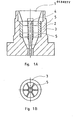
- the construction must be arranged symmetrically so that the drawing compound does not experience an uneven pressure distribution. Therefore, the webs of the three-star to hold the drawing core are arranged so that a six-star is created.
- the positively guided strand is divided again, but then welded again in the last part: the drawing nozzle.
- the mouthpiece also has a long outlet section, which means that any differences in compression when it emerges from the mouthpiece are reduced. Due to the good compression and sliding properties of the plastic mass during extrusion, the flaky structures of the aluminum oxide crystals are evenly aligned. This is particularly supported by the pulling tool made of polished hard metal and the special construction.
- the tubes are placed on perforated aluminum sheets to ensure uniform drying.
- the drying itself is carried out in dust-free chambers with a slight overpressure and ambient temperature.
- Annealing takes place between 900 and 1200 ° C with a holding time of 12 hours in an electric furnace in an oxidizing atmosphere. This measure is useful in order to expel all organic components from the material to be sintered before sintering in a vacuum or in a humid hydrogen atmosphere. Under no circumstances should the temperature exceed 1250 ° C to prevent pre-sintering of the material. From this it can already be seen that the heating rate plays an essential role in the sintering of the shaped bodies, since it can be used to control the grain size again.
- a heating rate of at least 800 ° C / h, preferably between 800 and 1000 ° C / h, in the range from 1200 to 1900 ° C results in an optimal sintered product. Sintering in high vacuum also takes place up to 1900 ° C.
- the properties of the sintered aluminum oxide sintered tube are as follows: the in-line light transmission is greater than 64% and the total light transmission is between 93 and 96%, the crystallite size is between 20 and 40 ⁇ m, the sintered density is 3.98 / cm 3 and the surface roughness is between 0.1 to 1 ⁇ m, preferably 0.2 ⁇ m.
- the strength exceeds at least 320 N / mm 2 .
- a special streamlined design of the extrusion nozzle also ensures that the extremely smooth surface of the mass does not cause any injuries during the extrusion process.
- the risk of the tubes running out of the drawing tool in a crooked manner is extremely low, since the frictional resistance is kept as low as possible. This results in a very high dimensional accuracy of the sintered product.
- FIGS. 1A and B Further details are explained on the basis of the exemplary embodiment, in particular the drawing tool is shown in FIGS. 1A and B.
- the average grain size, the average surface roughness, the in-line light transmission and the bending strength were measured on sintered tubes of the 70-watt type used in the high-pressure sodium vapor discharge lamps.
- the average grain size was determined by examining the sintered surface with the electron beam microscope.
- the measurement of the surface roughness was carried out with a Hommel tester by scanning the pipe in the axial direction over a length of 5 mm.
- the wall thickness of the sintered body was 0.60 mm + 0.3.
- the bending strength measurement was carried out according to the 3-point method.
- the contact distance was 40 mm.
- experiment 1 4000 g of A1203 powder with a purity greater than 99.5%, a particle size smaller than 1 ⁇ m and a specific surface area of approximately 14 m 2 / g are placed in a disk mill in which 10 kg has already distilled Water with 1% condenser, such as B. sodium-free ammonia. The present suspension is then ground for 20 minutes and sieved through a plastic sieve with a mesh size of 10 ⁇ m. Then 0.2% by weight of glycerin and 0.8% by weight of oil are then stirred into the slip with a whisk, a stiff creamy slip being obtained which contains many air bubbles. Drying on sheets takes place at 80 ° C to a residual moisture of 3%.
- condenser such as B. sodium-free ammonia
- the individual plasticizing components are mixed separately to form a paste, the paste itself consisting of 3.75% by weight of water-soluble PVA binder, which is dissolved in water in a ratio of 1: 4, 7% by weight of oil and 3% by weight. Fat as well as 0.3% by weight of wetting agent and 1 wt .-% glycerin consists.
- This paste is then added to the dried Al 2 O 3 foam, 0.265% by weight of magnesium acetate and 0.07 of zirconium chloride being stirred in at the same time.
- the total mixing time is approx. 1.5 hours, with distilled water being added up to a total of 7% by weight in order to obtain a plastic mass of pasty consistencies.
- This mass is then evacuated and pre-compressed in a piston press and extruded into strands of 3 mm diameter by means of a multi-hole disk, these in turn being placed in a press cylinder, evacuated and pre-compressed.
- FIG. 1A and B result in the drawing tool 1 according to the invention.
- This consists of an outer housing 2 in which a double three-star 3 according to FIG. 1B is arranged offset.
- the press tool dimensions for the nominal dimensions are 0 mm 6.1 x 4.35 mm.
- the mandrel 4 is held over the webs 5.
- the pressing pressure is greater than 200 kg / cm 2 , the extruded tubes being cut to a length of 800 mm and placed on perforated press plates. After drying, these strands are cut into individual tubes, at the same time the cutting dust is removed and these raw bodies are then annealed in stacks in an oxidizing atmosphere at 1100 ° C. for two hours. In this fire, the magnesium acetate and zirconium chloride are converted to magnesium oxide and zirconium oxide.
- the other components which can possibly influence the optical properties, are driven out; at sintering temperatures at 1830 ° C with a holding time of 2 hours and a heating rate of 800 ° C / h, the raw bodies achieve their translucent appearance in a sintered firing in a humid hydrogen atmosphere.
- experiment 2 the same batch is used as in experiment 1, except that the aluminum oxide powder is added to the mixer without dispersing and foaming.
- the dispersion and the foaming of the aluminum oxide powder contribute to the improvement of the surface properties.
- the agglomerates are divided into individual crystals without contamination in the disk mill and the foaming prevents the individual crystals from clumping together, so that the mixer contains a powder which is very easily dispersible and accessible to the plasticizing components. If dispersing and foaming are omitted, agglomerates are not broken up and the surface quality deteriorates due to the different grain size.
- there are inhomogeneities in the plastic mass which show up as "white spots" in the sintered tube. "White spots” lead to a reduction in the light transmittance and to a reduction in the mechanical properties.
- Experiment 3 (V3) examines the pre-reaction of the adhesive with the oil in connection with the surface roughness.
- 4000 g of Al 2 O 3 powder with the known properties as in Experiment 1 is also dispersed and dried, and then 0.3% by weight of wetting agent and 3.75% by weight of PVA binder are added to the mixer
- the following components are individually mixed in at 5 minute intervals: 7% by weight of oil, 3% by weight of fat, 1% by weight of glycerol and approx. 7% by weight of distilled water.
- the additives of 0.265% by weight of magnesium acetate and 0.07% by weight of zirconium chloride are also added.
- the further procedure steps are then carried out as in experiment 1.
- experiment 4 the doping is used for the assessment of the surface quality, and indeed the sintered tubes are produced analogously to the method in experiment 1, but with the exception that the doping consists only of 0.265% by weight of magnesium acetate and the sintering done in vacuum.
- test 5 (V5) was included in table 1.
- 4000 g of A1203 powder were also ground as in experiment 1 and the slip was spray-dried.
- the spray dry granules were then pressed isostatically in a tubular shaped body at 1400 bar.
- the pressed on a mandrel tube is then ewalzt on the outermost circumferential surface from g.
Landscapes
- Engineering & Computer Science (AREA)
- Chemical & Material Sciences (AREA)
- Ceramic Engineering (AREA)
- Manufacturing & Machinery (AREA)
- Organic Chemistry (AREA)
- Structural Engineering (AREA)
- Materials Engineering (AREA)
- Inorganic Chemistry (AREA)
- Mechanical Engineering (AREA)
- Chemical Kinetics & Catalysis (AREA)
- Compositions Of Oxide Ceramics (AREA)
- Vessels And Coating Films For Discharge Lamps (AREA)
- Medicinal Preparation (AREA)
Priority Applications (9)
| Application Number | Priority Date | Filing Date | Title |
|---|---|---|---|
| DE8383108397T DE3376001D1 (en) | 1983-08-26 | 1983-08-26 | Process and apparatus for producing sintered polycrystalline translucent tubes |
| EP83108397A EP0134277B2 (fr) | 1983-08-26 | 1983-08-26 | Procédé et dispositif de fabrication des tubes frittés polycristallins translucides |
| US06/643,176 US4629593A (en) | 1983-08-26 | 1984-08-22 | Process for producing polycrystalline, translucent sintered tubes |
| FI843336A FI77640C (fi) | 1983-08-26 | 1984-08-23 | Foerfarande och anordning foer framstaellning av polykristallina genomskinliga sinterroer. |
| HU843165A HUT40785A (en) | 1983-08-26 | 1984-08-23 | Process and apparatus for producing polycristalline light-passing sinter tubes |
| JP59176896A JPS6071572A (ja) | 1983-08-26 | 1984-08-27 | 多結晶透明焼結管を製造する方法および装置 |
| CA000461874A CA1246328A (fr) | 1983-08-26 | 1984-08-27 | Methode et dispositif de production de tubes frittes polycristallins et translucides |
| US06/876,799 US4725467A (en) | 1983-08-26 | 1986-06-20 | Polycrystalline, translucent sintered tubes |
| FI881850A FI79694C (fi) | 1983-08-26 | 1988-04-20 | Polykristallina genomskinliga sinterroer. |
Applications Claiming Priority (1)
| Application Number | Priority Date | Filing Date | Title |
|---|---|---|---|
| EP83108397A EP0134277B2 (fr) | 1983-08-26 | 1983-08-26 | Procédé et dispositif de fabrication des tubes frittés polycristallins translucides |
Publications (3)
| Publication Number | Publication Date |
|---|---|
| EP0134277A1 true EP0134277A1 (fr) | 1985-03-20 |
| EP0134277B1 EP0134277B1 (fr) | 1988-03-16 |
| EP0134277B2 EP0134277B2 (fr) | 1991-11-13 |
Family
ID=8190645
Family Applications (1)
| Application Number | Title | Priority Date | Filing Date |
|---|---|---|---|
| EP83108397A Expired - Lifetime EP0134277B2 (fr) | 1983-08-26 | 1983-08-26 | Procédé et dispositif de fabrication des tubes frittés polycristallins translucides |
Country Status (7)
| Country | Link |
|---|---|
| US (2) | US4629593A (fr) |
| EP (1) | EP0134277B2 (fr) |
| JP (1) | JPS6071572A (fr) |
| CA (1) | CA1246328A (fr) |
| DE (1) | DE3376001D1 (fr) |
| FI (1) | FI77640C (fr) |
| HU (1) | HUT40785A (fr) |
Cited By (5)
| Publication number | Priority date | Publication date | Assignee | Title |
|---|---|---|---|---|
| EP0301748A3 (en) * | 1987-07-27 | 1989-10-25 | Sumitomo Cement Co. Ltd. | Sintered alumina article with high flexural strength and process for producing same |
| EP0384489A3 (en) * | 1989-02-23 | 1990-09-19 | W.R. Grace & Co.-Conn. | High-strength aluminium oxide |
| EP0567095A1 (fr) * | 1992-04-22 | 1993-10-27 | Sumitomo Chemical Company, Limited | Corps d'alumine polycristalline transparente et procédé pour sa préparation |
| EP0652191A1 (fr) * | 1993-11-10 | 1995-05-10 | Ngk Insulators, Ltd. | Fabrication de corps solides en céramique |
| WO1999061373A1 (fr) * | 1998-05-26 | 1999-12-02 | S.A. Lhoist Recherche Et Developpement | Produit d'extrusion a base de chaux hydratee |
Families Citing this family (19)
| Publication number | Priority date | Publication date | Assignee | Title |
|---|---|---|---|---|
| US4841195A (en) * | 1983-04-29 | 1989-06-20 | U.S. Philips Corporation | Discharge lamp having a yttrium aluminum garnet discharge envelope |
| US4968460A (en) * | 1986-03-07 | 1990-11-06 | Basf Aktiengesellschaft | Ceramics |
| GB2211179B (en) * | 1987-10-15 | 1992-08-12 | Hoechst Ceram Tec Ag | Aluminium oxide shaped articles and process for their manufacture |
| FR2639936B1 (fr) * | 1988-12-06 | 1991-01-25 | Thomson Csf | Piece en ceramique a plusieurs proprietes ameliorees et procede de fabrication d'une telle piece |
| DE3842403C1 (fr) * | 1988-12-16 | 1990-01-18 | Radex-Heraklith Industriebeteiligungs Ag, Wien, At | |
| DE3920851A1 (de) * | 1989-06-24 | 1991-01-10 | Asea Brown Boveri | Sintervorrichtung und verfahren zu deren herstellung |
| US5376606A (en) * | 1993-12-30 | 1994-12-27 | Korea Institute Of Science And Technology | Light-transmissive polycrystalline alumina ceramics |
| US5552102A (en) * | 1994-12-16 | 1996-09-03 | Corning Incorporated | Method and apparatus for extruding large honeycombs |
| US5966582A (en) * | 1996-10-28 | 1999-10-12 | Corning Incorporated | Method for rapid stiffening of extrudates |
| KR100414242B1 (ko) * | 1998-11-24 | 2004-01-07 | 니폰 덴키 가라스 가부시키가이샤 | 세라믹 물품 |
| JP4206632B2 (ja) * | 2000-10-31 | 2009-01-14 | 日本碍子株式会社 | 高圧放電灯用発光容器 |
| JP4144176B2 (ja) * | 2000-11-22 | 2008-09-03 | 日本碍子株式会社 | 高圧放電灯用発光容器 |
| WO2002049984A1 (fr) * | 2000-12-20 | 2002-06-27 | Murata Manufacturing Co.,Ltd. | Ceramique transparente, procede de production de celle-ci et element optique |
| CN1853449A (zh) * | 2003-09-18 | 2006-10-25 | 皇家飞利浦电子股份有限公司 | 混合发光灯 |
| US20060202627A1 (en) * | 2005-03-09 | 2006-09-14 | General Electric Company | Ceramic arctubes for discharge lamps |
| US7678725B2 (en) * | 2007-05-14 | 2010-03-16 | General Electric Company | Translucent polycrystalline alumina ceramic |
| US20080283522A1 (en) * | 2007-05-14 | 2008-11-20 | Shuyl Qin | Translucent polycrystalline alumina ceramic |
| US8096799B2 (en) * | 2007-12-21 | 2012-01-17 | American Maplan Corporation | Swept leg spider for an extrusion apparatus |
| CN102537361B (zh) * | 2010-12-07 | 2015-05-27 | 济源市中科新型陶瓷有限公司 | 一种用于汽车水循环密封盒中的密封环及其制备方法 |
Citations (5)
| Publication number | Priority date | Publication date | Assignee | Title |
|---|---|---|---|---|
| DE1696440B1 (de) * | 1962-09-27 | 1970-08-20 | Siemens Ag | Verfahren zum Herstellen von Koerpern aus Oxidwerkstoffen |
| GB2022564A (en) * | 1978-05-12 | 1979-12-19 | Nippon Kaishi Kk | Polycrystalline translucent alumina and method of producing the same |
| GB2071073A (en) * | 1980-03-11 | 1981-09-16 | Gen Electric | Alumina ceramic |
| DE3201750A1 (de) * | 1981-02-18 | 1982-09-16 | Egyesült Izzólámpa és Villamossági Részvénytársaság, 1340 Budapest | Verfahren zur herstellung lichtdurchlaessiger sinterkoerper aus aluminiumoxid |
| US4396595A (en) * | 1982-02-08 | 1983-08-02 | North American Philips Electric Corp. | Method of enhancing the optical transmissivity of polycrystalline alumina bodies, and article produced by such method |
Family Cites Families (7)
| Publication number | Priority date | Publication date | Assignee | Title |
|---|---|---|---|---|
| US3026210A (en) * | 1961-01-03 | 1962-03-20 | Gen Electric | Transparent alumina and method of preparation |
| US3905845A (en) * | 1969-08-27 | 1975-09-16 | Ngk Insulators Ltd | Translucent alumina containing magnesia yttria and lanthium oxide |
| US4020134A (en) * | 1975-01-29 | 1977-04-26 | Ford Motor Company | Method for preparing shaped, green ceramic compacts |
| GB1597162A (en) * | 1977-03-10 | 1981-09-03 | Ngk Insulators Ltd | Transparent polycrystalline alumina and high pressure vapour discharge lamp |
| US4169875A (en) * | 1977-03-11 | 1979-10-02 | General Electric Company | Method of producing a tubular body of polycrystalline alumina |
| JPS5839799B2 (ja) * | 1978-05-02 | 1983-09-01 | 日産自動車株式会社 | 大型ハニカム構造体の製造方法 |
| JPS56144113A (en) * | 1980-04-11 | 1981-11-10 | Ngk Insulators Ltd | Manufacture of high purity alumina porcelain |
-
1983
- 1983-08-26 EP EP83108397A patent/EP0134277B2/fr not_active Expired - Lifetime
- 1983-08-26 DE DE8383108397T patent/DE3376001D1/de not_active Expired
-
1984
- 1984-08-22 US US06/643,176 patent/US4629593A/en not_active Expired - Fee Related
- 1984-08-23 HU HU843165A patent/HUT40785A/hu unknown
- 1984-08-23 FI FI843336A patent/FI77640C/fi not_active IP Right Cessation
- 1984-08-27 CA CA000461874A patent/CA1246328A/fr not_active Expired
- 1984-08-27 JP JP59176896A patent/JPS6071572A/ja active Pending
-
1986
- 1986-06-20 US US06/876,799 patent/US4725467A/en not_active Expired - Fee Related
Patent Citations (5)
| Publication number | Priority date | Publication date | Assignee | Title |
|---|---|---|---|---|
| DE1696440B1 (de) * | 1962-09-27 | 1970-08-20 | Siemens Ag | Verfahren zum Herstellen von Koerpern aus Oxidwerkstoffen |
| GB2022564A (en) * | 1978-05-12 | 1979-12-19 | Nippon Kaishi Kk | Polycrystalline translucent alumina and method of producing the same |
| GB2071073A (en) * | 1980-03-11 | 1981-09-16 | Gen Electric | Alumina ceramic |
| DE3201750A1 (de) * | 1981-02-18 | 1982-09-16 | Egyesült Izzólámpa és Villamossági Részvénytársaság, 1340 Budapest | Verfahren zur herstellung lichtdurchlaessiger sinterkoerper aus aluminiumoxid |
| US4396595A (en) * | 1982-02-08 | 1983-08-02 | North American Philips Electric Corp. | Method of enhancing the optical transmissivity of polycrystalline alumina bodies, and article produced by such method |
Cited By (8)
| Publication number | Priority date | Publication date | Assignee | Title |
|---|---|---|---|---|
| EP0301748A3 (en) * | 1987-07-27 | 1989-10-25 | Sumitomo Cement Co. Ltd. | Sintered alumina article with high flexural strength and process for producing same |
| EP0384489A3 (en) * | 1989-02-23 | 1990-09-19 | W.R. Grace & Co.-Conn. | High-strength aluminium oxide |
| EP0567095A1 (fr) * | 1992-04-22 | 1993-10-27 | Sumitomo Chemical Company, Limited | Corps d'alumine polycristalline transparente et procédé pour sa préparation |
| US5382556A (en) * | 1992-04-22 | 1995-01-17 | Sumitomo Chemical Company, Limited | Translucent polycrystalline alumina and process for producing the same |
| EP0652191A1 (fr) * | 1993-11-10 | 1995-05-10 | Ngk Insulators, Ltd. | Fabrication de corps solides en céramique |
| US5609807A (en) * | 1993-11-10 | 1997-03-11 | Ngk Insulators, Ltd. | Production of ceramic structural bodies |
| WO1999061373A1 (fr) * | 1998-05-26 | 1999-12-02 | S.A. Lhoist Recherche Et Developpement | Produit d'extrusion a base de chaux hydratee |
| BE1011935A3 (fr) * | 1998-05-26 | 2000-03-07 | Lhoist Rech & Dev Sa | Produit d'extrusion a base de chaux hydratee. |
Also Published As
| Publication number | Publication date |
|---|---|
| FI77640B (fi) | 1988-12-30 |
| DE3376001D1 (en) | 1988-04-21 |
| US4629593A (en) | 1986-12-16 |
| CA1246328A (fr) | 1988-12-13 |
| FI77640C (fi) | 1989-04-10 |
| US4725467A (en) | 1988-02-16 |
| HUT40785A (en) | 1987-02-27 |
| JPS6071572A (ja) | 1985-04-23 |
| FI843336L (fi) | 1985-02-27 |
| EP0134277B2 (fr) | 1991-11-13 |
| FI843336A0 (fi) | 1984-08-23 |
| EP0134277B1 (fr) | 1988-03-16 |
Similar Documents
| Publication | Publication Date | Title |
|---|---|---|
| EP0134277A1 (fr) | Procédé et dispositif de fabrication des tubes frittés polycristallins translucides | |
| EP0102590B1 (fr) | Corps moulé en céramique, procédé pour sa fabrication et son utilisation | |
| DE69932634T2 (de) | Verfahren zur herstellung von gesintertem aluminiumoxidkeramik von hoher festigkeit und mit grosser oberfläche | |
| EP0756586A1 (fr) | Produit fritte d'al 2?o 3?, son procede de production et son utilisation | |
| DE69026773T3 (de) | Verschleissbeständiges Bauteil | |
| DE1745207C3 (de) | Verfahren zur Herstellung von chloriertem Polyvinylchlorid | |
| DE10048368B4 (de) | Kohleelektrode zum Schmelzen von Quarzglas und Verfahren zu ihrer Herstellung | |
| DE2752752A1 (de) | Verfahren zur herstellung von koerpern mit bienenwabenstruktur aus keramikstoffen der bariumtitanatgruppe mit positiven temperatur-widerstands-koeffizienten | |
| DE2900440C2 (fr) | ||
| DE102009013567A1 (de) | Verfahren zur Herstellung einer Wabenstruktur | |
| DE69422554T2 (de) | Verfahren und Vorrichtung zur Herstellung eines keramischen Sinterkörpers | |
| DE19529863A1 (de) | Siliciumnitrid-Pulver | |
| DE2123045A1 (de) | Verfahren zur Herstellung von feinteiligen Metalloxiden und deren Verwendung zur Herstellung von gesinterten hitzebeständigen Formteilen | |
| DE10121656A1 (de) | Verbessertes Schleifkorn | |
| CH648009A5 (en) | Preparation of ceramic foams | |
| EP0332984B1 (fr) | Pièces façonnées et procédé pour leur production | |
| DE3854979T2 (de) | Formkörper aus keramischem Werkstoff und seine Herstellung | |
| DE3938890C1 (fr) | ||
| DE2432865A1 (de) | Keramikmaterial und verfahren zu seiner herstellung | |
| DE1571295B1 (de) | Aluminiumosydgemische und geformte keramische gegenstände daraus | |
| DE2838026C2 (fr) | ||
| DE1301752B (de) | Strang zur Beschickung einer Flammspritzpistole mit mineralischem Pulver und Verfahren zu seiner Herstellung | |
| DE2156592B2 (de) | Verfahren zur Herstellung von Erzeugnissen aus Siliziumnitrid durch Heißpressen | |
| FI79694B (fi) | Polykristallina genomskinliga sinterroer. | |
| DE1908475C (de) | Gesintertes Schleifkorn und Verfahren zu seiner Herstellung |
Legal Events
| Date | Code | Title | Description |
|---|---|---|---|
| PUAI | Public reference made under article 153(3) epc to a published international application that has entered the european phase |
Free format text: ORIGINAL CODE: 0009012 |
|
| 17P | Request for examination filed |
Effective date: 19840901 |
|
| AK | Designated contracting states |
Designated state(s): AT BE CH DE FR GB IT LI LU NL SE |
|
| RAP1 | Party data changed (applicant data changed or rights of an application transferred) |
Owner name: HOECHST CERAMTEC AKTIENGESELLSCHAFT |
|
| RBV | Designated contracting states (corrected) |
Designated state(s): DE FR GB IT NL |
|
| 17Q | First examination report despatched |
Effective date: 19860214 |
|
| GRAA | (expected) grant |
Free format text: ORIGINAL CODE: 0009210 |
|
| AK | Designated contracting states |
Kind code of ref document: B1 Designated state(s): DE FR GB IT NL |
|
| ITF | It: translation for a ep patent filed | ||
| REF | Corresponds to: |
Ref document number: 3376001 Country of ref document: DE Date of ref document: 19880421 |
|
| GBT | Gb: translation of ep patent filed (gb section 77(6)(a)/1977) | ||
| ET | Fr: translation filed | ||
| PLBI | Opposition filed |
Free format text: ORIGINAL CODE: 0009260 |
|
| 26 | Opposition filed |
Opponent name: FELDMUEHLE AKTIENGESELLSCHAFT, DUESSELDORF Effective date: 19881207 |
|
| NLR1 | Nl: opposition has been filed with the epo |
Opponent name: FELDMUEHLE AG |
|
| ITTA | It: last paid annual fee | ||
| PUAH | Patent maintained in amended form |
Free format text: ORIGINAL CODE: 0009272 |
|
| STAA | Information on the status of an ep patent application or granted ep patent |
Free format text: STATUS: PATENT MAINTAINED AS AMENDED |
|
| PGFP | Annual fee paid to national office [announced via postgrant information from national office to epo] |
Ref country code: DE Payment date: 19911017 Year of fee payment: 9 |
|
| 27A | Patent maintained in amended form |
Effective date: 19911113 |
|
| AK | Designated contracting states |
Kind code of ref document: B2 Designated state(s): DE FR GB IT NL |
|
| ITF | It: translation for a ep patent filed | ||
| NLR2 | Nl: decision of opposition | ||
| ET3 | Fr: translation filed ** decision concerning opposition | ||
| GBTA | Gb: translation of amended ep patent filed (gb section 77(6)(b)/1977) | ||
| NLR3 | Nl: receipt of modified translations in the netherlands language after an opposition procedure | ||
| PGFP | Annual fee paid to national office [announced via postgrant information from national office to epo] |
Ref country code: FR Payment date: 19920713 Year of fee payment: 10 |
|
| PGFP | Annual fee paid to national office [announced via postgrant information from national office to epo] |
Ref country code: GB Payment date: 19920720 Year of fee payment: 10 |
|
| PGFP | Annual fee paid to national office [announced via postgrant information from national office to epo] |
Ref country code: NL Payment date: 19920831 Year of fee payment: 10 |
|
| PG25 | Lapsed in a contracting state [announced via postgrant information from national office to epo] |
Ref country code: DE Effective date: 19930501 |
|
| PG25 | Lapsed in a contracting state [announced via postgrant information from national office to epo] |
Ref country code: GB Effective date: 19930826 |
|
| PG25 | Lapsed in a contracting state [announced via postgrant information from national office to epo] |
Ref country code: NL Effective date: 19940301 |
|
| NLV4 | Nl: lapsed or anulled due to non-payment of the annual fee | ||
| GBPC | Gb: european patent ceased through non-payment of renewal fee |
Effective date: 19930826 |
|
| PG25 | Lapsed in a contracting state [announced via postgrant information from national office to epo] |
Ref country code: FR Effective date: 19940429 |
|
| REG | Reference to a national code |
Ref country code: FR Ref legal event code: ST |