EP0134287B1 - Système pour le dosage de produits chimiques pour des tanneries - Google Patents
Système pour le dosage de produits chimiques pour des tanneries Download PDFInfo
- Publication number
- EP0134287B1 EP0134287B1 EP83108683A EP83108683A EP0134287B1 EP 0134287 B1 EP0134287 B1 EP 0134287B1 EP 83108683 A EP83108683 A EP 83108683A EP 83108683 A EP83108683 A EP 83108683A EP 0134287 B1 EP0134287 B1 EP 0134287B1
- Authority
- EP
- European Patent Office
- Prior art keywords
- dosing
- control
- weight
- chemicals
- display
- Prior art date
- Legal status (The legal status is an assumption and is not a legal conclusion. Google has not performed a legal analysis and makes no representation as to the accuracy of the status listed.)
- Expired
Links
- 239000000126 substance Substances 0.000 title claims abstract description 41
- 238000005303 weighing Methods 0.000 claims abstract description 30
- 238000002156 mixing Methods 0.000 claims abstract description 19
- XLYOFNOQVPJJNP-UHFFFAOYSA-N water Substances O XLYOFNOQVPJJNP-UHFFFAOYSA-N 0.000 claims abstract description 8
- 238000003860 storage Methods 0.000 claims abstract description 4
- 230000006870 function Effects 0.000 claims description 16
- 238000000034 method Methods 0.000 claims description 13
- 239000000203 mixture Substances 0.000 claims description 3
- 238000011010 flushing procedure Methods 0.000 claims 1
- 239000008186 active pharmaceutical agent Substances 0.000 description 4
- 235000018553 tannin Nutrition 0.000 description 3
- 229920001864 tannin Polymers 0.000 description 3
- 239000001648 tannin Substances 0.000 description 3
- 238000010276 construction Methods 0.000 description 2
- 238000002360 preparation method Methods 0.000 description 2
- 238000010521 absorption reaction Methods 0.000 description 1
- 230000006978 adaptation Effects 0.000 description 1
- 238000009826 distribution Methods 0.000 description 1
- 208000001848 dysentery Diseases 0.000 description 1
- 238000012432 intermediate storage Methods 0.000 description 1
- 239000007788 liquid Substances 0.000 description 1
- 230000003137 locomotive effect Effects 0.000 description 1
- 210000000056 organ Anatomy 0.000 description 1
- 239000000843 powder Substances 0.000 description 1
- 238000003756 stirring Methods 0.000 description 1
Images


Classifications
-
- G—PHYSICS
- G05—CONTROLLING; REGULATING
- G05D—SYSTEMS FOR CONTROLLING OR REGULATING NON-ELECTRIC VARIABLES
- G05D11/00—Control of flow ratio
- G05D11/02—Controlling ratio of two or more flows of fluid or fluent material
- G05D11/13—Controlling ratio of two or more flows of fluid or fluent material characterised by the use of electric means
- G05D11/131—Controlling ratio of two or more flows of fluid or fluent material characterised by the use of electric means by measuring the values related to the quantity of the individual components
- G05D11/133—Controlling ratio of two or more flows of fluid or fluent material characterised by the use of electric means by measuring the values related to the quantity of the individual components with discontinuous action
- G05D11/134—Controlling ratio of two or more flows of fluid or fluent material characterised by the use of electric means by measuring the values related to the quantity of the individual components with discontinuous action by sensing the weight of the individual components
Definitions
- the invention relates to a weight-controlled chemical metering device for tanneries for connection to at least one tanning vessel, with at least one mixing container and a weight measuring cell, metering valves for connecting supply lines from chemical tanks or for water and at least one outlet valve, the functions of which can be actuated by means of a local control assigned to each weighing container .
- a chemical metering device in which the weight measuring cell for measuring the respective total weight is arranged on the mixing container and is connected to a central metering control which is connected via control lines to the local controller assigned to each mixing container, the central metering control being a data processing device with memory, has at least one input connection for receiving external data from a program control, an input unit for manual input of a selectable or storable dosing recipe for a batch and a display unit for displaying the individual components of the batch, the measured value of the weight measuring cell in the data processing device of the central dosing control is comparable to the recipe-based target weights of each added component in order to generate the control signals for local control, so that the K Components from the chemical tanks or from the water pipe can be added by means of the central dosing control and the respective local control in a sequence specified in the dosing recipe up to a settable weight tolerance limit and furthermore a weight display operated by the central dosing control to display the target and actual weight of the respective component
- the arrangement according to the invention can be connected to a tannery control unit via the input connection, but can also be provided manually with a number of dispensing recipes that can be called up or can finally be set for an individually selectable individual dispensing process.
- the display unit on which the components of the dosed batch are displayed, together with the weight display, allows the manual addition of individual components if necessary.
- each weighing container can be assigned a weighing container with local control.
- This variant has the advantage that the chemicals to be added to the tanning vessels can be stored in the associated weighing container so that there are no waiting times in the course of the process.
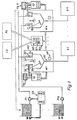
- the first embodiment of the chemical metering device shown in FIG. 1 is designed such that each tanning vessel G1 to G6 is assigned its own weighing container W1 to W6.
- Each weighing container W1 to W6 comes with a locomotive tray tion L1 to L6, through which the functions of the organs arranged on the weighing container are influenced.
- the local controls are equipped with switches for manual triggering of the functions of the weighing container.
- Each weighing container has a dosing valve arrangement DV and at least one outlet valve AV, an agitator R, a rinsing arrangement SP, a weighing cell WZ and a level sensor N.
- the dosing valve arrangement DV has up to 10 chemical tanks C1 to C10, as well as a warm and / and or cold water pipe (not shown) connected. Two valves are provided per supply line, namely a coarse metering valve for filling the weighing container in the vicinity of the respective target weight and a fine metering valve for approaching the exact target weight.
- Each weighing container W1 to W6 is connected to its tanning vessel via its outlet valve AV and an outlet pump AP provided depending on the level conditions.
- the local controls L1 to L6 are connected to a common dosing control DS.
- the dosing control has a computer with input and output circuits, an AD converter for converting the analog signals from the load cells WZ, a display unit AE and an input keyboard ET (cf. FIG. 3).
- the input circuit has, in particular, a serial interface for receiving control commands from a tanner program control PS and input connections for receiving signals from a tanner punch card control LS.
- the individual weighing containers W1 to W6 can be assigned remote displays FA1-FA6, on which at least nominal and actual weights are displayed, as will be explained in more detail below, so that it is possible to dispense into each container by hand on the spot.
- An input keyboard ET is provided for the dosing control DS for manual operation. It can be divided into four function groups: The preselection buttons VT, which can be recognized in FIG. 3 by the fact that they are labeled, are used for entering or correcting special numerical values which are characteristic of the particular dosing recipe.
- the associated display is arranged on the display unit AE above the respective key. When entering, first press a key that defines the corresponding function and then enter or change the desired numerical value so that the control can assign the entered numerical value: First, the tanning vessel number is entered in this way. The batch number can then be entered, and the dosing recipe saved under this number is called up from the memory. The specified values for the individual components can be called up one after the other on the display.
- Batch number 0 allows the individual mixture components of the batch to be freely entered.
- a fixed number from 1 to 999 is assigned to each chemical that can be added as a mixing component, from which up to 5 can be selected per batch.
- Components 1-5 are selected with the MIX COMP. selected and appear one after the other on the display above, the corresponding lamp 1 to 5 lighting up.
- The% WEIGHING QUANTITY key is used to enter or retrieve the percentage of each mixed component of the batch weight (weight of the tannin) or the WEIGHTING QUANTITY key to determine its absolute weight. If the values of these sizes stored for the selected batch are to be changed, this can be done after selection using the corresponding preselection key. Finally, the stirring and rinsing times can be determined using the RUHR and RÜL keys.
- the second function group is formed by the control buttons ST. These are the START and STOP buttons.
- START buttons
- STOP buttons
- a manually entered dosing process is started with the START button. This begins with the automatic taring of the weighing container and the subsequent addition of the individual components of the batch according to the dosing recipe entered.
- the ongoing dosing process can be interrupted with the STOP button, which can be restarted with the START button.
- the third function group are so-called special function keys SF.
- the display of the individual mixing components can be switched on using the «+» key. When you press it, the information about the next component appears.
- the «LT» key the weight can be converted into volume (It) for each component. For this, the specific weights of the components are permanently stored. This is particularly important in the event of a failure of the weighing function, since it is still possible to dose manually using a standpipe provided on the weighing container.
- the «HORN» key is used to turn off an alarm horn. This comes into play if the dosing control registers an error, in particular if the setpoint of an automatically added component is not reached, when the weighing container is overfilled, which is reported by the level sensor N etc.
- the fourth function group is formed by the service switch ST.
- Theirs Function can only take place after a key switch has been operated.
- the MEM button can be used to trigger the storage process for the quantities entered using the preselection buttons. In this way, a number of dosing recipes can be entered and saved under certain batch numbers, as already explained. The saved values are not changed by the deviations of individual sizes selected in individual cases. Using a rotary switch, you can finally choose between the individual operating modes of manual operation, as described, the punch card control LS and the program control AUTO.
- the dosing telegram is transmitted to the dosing control by a central computer each time via a serial interface.
- This essentially contains the dosage information already mentioned.
- the dosing control has connections via which the numbers of the stored batches (see above) are selected. In contrast to program control, this requires manual input of the dosing recipes into the dosing control.
- the dosing is basically the same in all cases by adding the automatically metered components from the chemical tanks C1 to C10 or the water pipes by means of the dosing control DS and the respective local control L1 to L6 within a settable weight tolerance limit, in the order of Components contained in the dosing recipe.
- a chemical tank controller CS which also receives its control signals from the metering controller, controls the function of the pumps P1-P10 that may be required and monitors the level of the chemicals in the tanks with any error messages to the metering controller.
- each of the components has its own remote display FA1 to FA6. Then the total weight, the partial target weight of the respective component and the actual partial weight of the same appear. When the dosing process has been completed, it is dispensed to the appropriate tanning vessel G1 to G6.
- the output can take place using signals from these controls, so that they are coordinated with the tanning process taking place.
- the device described with reference to FIG. 1 has the advantage that the finished dosed batches can be temporarily stored in the weighing container without the dosing device being blocked thereby.
- the metering process can thus largely take place independently of the course of the tanning process in the vessels, which allows optimal use of the metering device. Since the dosing control DS can be arranged in the area of the weighing container W in this system, remote displays are superfluous.
- the chemical metering device described for tanneries has the advantage of being easily adaptable to existing tanneries, in particular the existing chemical store, in that the chemicals available in a suitable form can be metered in automatically and the rest by hand. The greatest possible degree of automation can thus be achieved under the given conditions.
- the possibility of manual operation allows the flexibility and adaptation to the constantly changing properties of the tannin required for tanning processes, either by manually changing individual components in stored dosing recipes or by entering ad hoc dosing recipes.
Landscapes
- Physics & Mathematics (AREA)
- General Physics & Mathematics (AREA)
- Engineering & Computer Science (AREA)
- Automation & Control Theory (AREA)
- Accessories For Mixers (AREA)
- Washing And Drying Of Tableware (AREA)
- Treatment Of Fiber Materials (AREA)
Claims (10)
Priority Applications (3)
| Application Number | Priority Date | Filing Date | Title |
|---|---|---|---|
| DE8383108683T DE3378502D1 (en) | 1983-09-02 | 1983-09-02 | System for dispensing chemicals for tanneries |
| EP83108683A EP0134287B1 (fr) | 1983-09-02 | 1983-09-02 | Système pour le dosage de produits chimiques pour des tanneries |
| AT83108683T ATE38730T1 (de) | 1983-09-02 | 1983-09-02 | Chemikaliendosiereinrichtung fuer gerbereien. |
Applications Claiming Priority (1)
| Application Number | Priority Date | Filing Date | Title |
|---|---|---|---|
| EP83108683A EP0134287B1 (fr) | 1983-09-02 | 1983-09-02 | Système pour le dosage de produits chimiques pour des tanneries |
Publications (2)
| Publication Number | Publication Date |
|---|---|
| EP0134287A1 EP0134287A1 (fr) | 1985-03-20 |
| EP0134287B1 true EP0134287B1 (fr) | 1988-11-17 |
Family
ID=8190658
Family Applications (1)
| Application Number | Title | Priority Date | Filing Date |
|---|---|---|---|
| EP83108683A Expired EP0134287B1 (fr) | 1983-09-02 | 1983-09-02 | Système pour le dosage de produits chimiques pour des tanneries |
Country Status (3)
| Country | Link |
|---|---|
| EP (1) | EP0134287B1 (fr) |
| AT (1) | ATE38730T1 (fr) |
| DE (1) | DE3378502D1 (fr) |
Cited By (1)
| Publication number | Priority date | Publication date | Assignee | Title |
|---|---|---|---|---|
| US7070986B2 (en) | 1997-12-30 | 2006-07-04 | Genencor International, Inc. | Proteases from gram positive organisms |
Families Citing this family (1)
| Publication number | Priority date | Publication date | Assignee | Title |
|---|---|---|---|---|
| GB8326495D0 (en) * | 1983-10-04 | 1983-11-02 | Cherlyn Electronics Ltd | Making formulations for printing inks |
Citations (1)
| Publication number | Priority date | Publication date | Assignee | Title |
|---|---|---|---|---|
| EP0106098A1 (fr) * | 1982-09-09 | 1984-04-25 | Hans Eduard Hüni | Dispositif de commande de processus pour le tannage |
Family Cites Families (3)
| Publication number | Priority date | Publication date | Assignee | Title |
|---|---|---|---|---|
| US3987351A (en) * | 1972-02-22 | 1976-10-19 | Outokumpu Oy | System for arranging the operations and connections between a computer linked to a process and a control station connected to the computer |
| US4353482A (en) * | 1980-01-23 | 1982-10-12 | Halliburton Company | Additive metering control system |
| US4362033A (en) * | 1980-05-08 | 1982-12-07 | Dominion Textile, Inc. | Automatic mixing and cloth bleaching control |
-
1983
- 1983-09-02 EP EP83108683A patent/EP0134287B1/fr not_active Expired
- 1983-09-02 DE DE8383108683T patent/DE3378502D1/de not_active Expired
- 1983-09-02 AT AT83108683T patent/ATE38730T1/de not_active IP Right Cessation
Patent Citations (1)
| Publication number | Priority date | Publication date | Assignee | Title |
|---|---|---|---|---|
| EP0106098A1 (fr) * | 1982-09-09 | 1984-04-25 | Hans Eduard Hüni | Dispositif de commande de processus pour le tannage |
Non-Patent Citations (3)
| Title |
|---|
| Advances in instrumentation, Bd. 32, T.1, 1977, Proceedings of the I.S.A. * |
| Conference Niagara Falls, Oct. 1977, Seiten 131-133 * |
| REGELUNGSTECHNISCHE PRAXIS, Band 25, Nr. 7, Juli 1983, Seiten 290-293, München, DE. K.F. FRÜH: "Automatisierung von Chargenprozessen mit PROVOX" Seite 291, linke Spalte, Absatz 3 * |
Cited By (1)
| Publication number | Priority date | Publication date | Assignee | Title |
|---|---|---|---|---|
| US7070986B2 (en) | 1997-12-30 | 2006-07-04 | Genencor International, Inc. | Proteases from gram positive organisms |
Also Published As
| Publication number | Publication date |
|---|---|
| EP0134287A1 (fr) | 1985-03-20 |
| ATE38730T1 (de) | 1988-12-15 |
| DE3378502D1 (en) | 1988-12-22 |
Similar Documents
| Publication | Publication Date | Title |
|---|---|---|
| DE3146667C2 (de) | Verfahren und Vorrichtung zum Mischen und Dosieren mehrerer Mischgutkomponenten | |
| DE69112667T2 (de) | Verfahren und Vorrichtung zum Mischen und Dosieren von Getränken. | |
| DE2754527A1 (de) | Waege-beschickungsvorrichtung | |
| DE2043372B2 (de) | Dosierverfahren sowie Einrichtung zur Durchführung dieses Verfahrens | |
| EP0163080B1 (fr) | Procédé pour préparer des mélanges pompables d'aliments à bétail et pour les amener à des points de consommation | |
| EP0324937A1 (fr) | Dispositif pour charger un gaz porteur avec une substance fluide et méthode pour l'exploitation du dispositif | |
| EP0548317B1 (fr) | Procede et dispositif pour le melange de composants de boissons | |
| DE3102611C2 (de) | Verfahren zur Steuerung der Mischung und des Austrags einer Mischung in einer Dosier- und Mischanlage | |
| DE3506291C2 (fr) | ||
| EP0491312B1 (fr) | Procédé et installation d'alimentation pour la préparation et la distribution de deux mélanges differents d'affouragement avec susceptibilité d'être pompé à des mangeoires | |
| EP0056033B1 (fr) | Procede pour le dosage de la farine et/ou du (des) liquides dans le petrisseur lors de la fabrication de la pate et installation pour la mise en oeuvre de ce procede | |
| CH689651A5 (de) | Elektronische Waage zum Dosieren. | |
| DE69313228T2 (de) | Flüssigkeitszuführungvorrichtung | |
| EP0163079B1 (fr) | Dispositif d'affouragement pour fourrage avec susceptibilité d'être pompé | |
| DE2432609C3 (de) | Verfahren und Einrichtung zum Zuführen der erforderlichen Zusatzwassermenge bei der Herstellung von Beton | |
| EP0134287A1 (fr) | Système pour le dosage de produits chimiques pour des tanneries | |
| EP0150353A1 (fr) | Dispositif pour l'emmagasinage, le dosage et le malaxage des constituants des matériaux de mortier | |
| EP0106098B1 (fr) | Dispositif de commande de processus pour le tannage | |
| EP0616553B1 (fr) | Procede et dispositif pour la production de rapports exacts de melange notamment lors de la dilution de boue activee avec de l'eau clarifiee | |
| CH605348A5 (en) | Pneumatic mixing and transport of powders | |
| DE3419839A1 (de) | Verfahren und fuetterungseinrichtung zum aufbereiten und zufuehren von pumpfaehigem viehfutter zu verbraucherstellen (fall a) | |
| DE1584298C (de) | Vorrichtung zur Wasserzugabe m ein Kalksandgemisch in Aufbereitungsanlagen fur die Herstellung von Kalksandsteinen | |
| DE1704608C3 (de) | Vorrichtung zur Verarbeitung schäumbarer Kunststoffe | |
| DE1498406A1 (de) | Vorrichtung zur Herstellung von Gemischen,insbesondere Leimgemischen | |
| AT6942U2 (de) | Verfahren zur durchführung eines entleervorgangs eines mischerbehälters |
Legal Events
| Date | Code | Title | Description |
|---|---|---|---|
| PUAI | Public reference made under article 153(3) epc to a published international application that has entered the european phase |
Free format text: ORIGINAL CODE: 0009012 |
|
| AK | Designated contracting states |
Designated state(s): AT BE CH DE FR GB IT LI LU NL SE |
|
| 17P | Request for examination filed |
Effective date: 19850814 |
|
| ITCL | It: translation for ep claims filed |
Representative=s name: BARZANO' E ZANARDO MILANO S.P.A. |
|
| TCNL | Nl: translation of patent claims filed | ||
| 17Q | First examination report despatched |
Effective date: 19861203 |
|
| GRAA | (expected) grant |
Free format text: ORIGINAL CODE: 0009210 |
|
| AK | Designated contracting states |
Kind code of ref document: B1 Designated state(s): AT BE CH DE FR GB IT LI LU NL SE |
|
| PG25 | Lapsed in a contracting state [announced via postgrant information from national office to epo] |
Ref country code: SE Effective date: 19881117 Ref country code: FR Free format text: THE PATENT HAS BEEN ANNULLED BY A DECISION OF A NATIONAL AUTHORITY Effective date: 19881117 Ref country code: BE Effective date: 19881117 |
|
| REF | Corresponds to: |
Ref document number: 38730 Country of ref document: AT Date of ref document: 19881215 Kind code of ref document: T |
|
| ITF | It: translation for a ep patent filed | ||
| GBT | Gb: translation of ep patent filed (gb section 77(6)(a)/1977) | ||
| REF | Corresponds to: |
Ref document number: 3378502 Country of ref document: DE Date of ref document: 19881222 |
|
| EN | Fr: translation not filed | ||
| PLBI | Opposition filed |
Free format text: ORIGINAL CODE: 0009260 |
|
| PG25 | Lapsed in a contracting state [announced via postgrant information from national office to epo] |
Ref country code: AT Effective date: 19890902 |
|
| PG25 | Lapsed in a contracting state [announced via postgrant information from national office to epo] |
Ref country code: LU Free format text: LAPSE BECAUSE OF NON-PAYMENT OF DUE FEES Effective date: 19890930 |
|
| 26 | Opposition filed |
Opponent name: APV ROSISTA B.V. Effective date: 19890817 |
|
| NLR1 | Nl: opposition has been filed with the epo |
Opponent name: APV ROSISTA B.V. |
|
| ITTA | It: last paid annual fee | ||
| PLBN | Opposition rejected |
Free format text: ORIGINAL CODE: 0009273 |
|
| STAA | Information on the status of an ep patent application or granted ep patent |
Free format text: STATUS: OPPOSITION REJECTED |
|
| 27O | Opposition rejected |
Effective date: 19910811 |
|
| NLR2 | Nl: decision of opposition | ||
| PGFP | Annual fee paid to national office [announced via postgrant information from national office to epo] |
Ref country code: CH Payment date: 19920820 Year of fee payment: 10 |
|
| PGFP | Annual fee paid to national office [announced via postgrant information from national office to epo] |
Ref country code: GB Payment date: 19920901 Year of fee payment: 10 |
|
| PGFP | Annual fee paid to national office [announced via postgrant information from national office to epo] |
Ref country code: DE Payment date: 19920914 Year of fee payment: 10 |
|
| PGFP | Annual fee paid to national office [announced via postgrant information from national office to epo] |
Ref country code: NL Payment date: 19920930 Year of fee payment: 10 |
|
| PG25 | Lapsed in a contracting state [announced via postgrant information from national office to epo] |
Ref country code: GB Effective date: 19930902 |
|
| PG25 | Lapsed in a contracting state [announced via postgrant information from national office to epo] |
Ref country code: LI Effective date: 19930930 Ref country code: CH Effective date: 19930930 |
|
| PG25 | Lapsed in a contracting state [announced via postgrant information from national office to epo] |
Ref country code: NL Effective date: 19940401 |
|
| GBPC | Gb: european patent ceased through non-payment of renewal fee |
Effective date: 19930902 |
|
| NLV4 | Nl: lapsed or anulled due to non-payment of the annual fee | ||
| REG | Reference to a national code |
Ref country code: CH Ref legal event code: PL |
|
| PG25 | Lapsed in a contracting state [announced via postgrant information from national office to epo] |
Ref country code: DE Effective date: 19940601 |