EP0134366A1 - Verfahren und Anlage zur Bearbeitung von Rohlingen aus einer Blechwalzstrasse - Google Patents
Verfahren und Anlage zur Bearbeitung von Rohlingen aus einer Blechwalzstrasse Download PDFInfo
- Publication number
- EP0134366A1 EP0134366A1 EP83401623A EP83401623A EP0134366A1 EP 0134366 A1 EP0134366 A1 EP 0134366A1 EP 83401623 A EP83401623 A EP 83401623A EP 83401623 A EP83401623 A EP 83401623A EP 0134366 A1 EP0134366 A1 EP 0134366A1
- Authority
- EP
- European Patent Office
- Prior art keywords
- length
- mother
- sheet
- tracing
- lines
- Prior art date
- Legal status (The legal status is an assumption and is not a legal conclusion. Google has not performed a legal analysis and makes no representation as to the accuracy of the status listed.)
- Granted
Links
Images


Classifications
-
- B—PERFORMING OPERATIONS; TRANSPORTING
- B27—WORKING OR PRESERVING WOOD OR SIMILAR MATERIAL; NAILING OR STAPLING MACHINES IN GENERAL
- B27B—SAWS FOR WOOD OR SIMILAR MATERIAL; COMPONENTS OR ACCESSORIES THEREFOR
- B27B31/00—Arrangements for conveying, loading, turning, adjusting, or discharging the log or timber, specially designed for saw mills or sawing machines
- B27B31/06—Adjusting equipment, e.g. using optical projection
-
- B—PERFORMING OPERATIONS; TRANSPORTING
- B23—MACHINE TOOLS; METAL-WORKING NOT OTHERWISE PROVIDED FOR
- B23D—PLANING; SLOTTING; SHEARING; BROACHING; SAWING; FILING; SCRAPING; LIKE OPERATIONS FOR WORKING METAL BY REMOVING MATERIAL, NOT OTHERWISE PROVIDED FOR
- B23D15/00—Shearing machines or shearing devices cutting by blades which move parallel to themselves
- B23D15/06—Sheet shears
-
- B—PERFORMING OPERATIONS; TRANSPORTING
- B23—MACHINE TOOLS; METAL-WORKING NOT OTHERWISE PROVIDED FOR
- B23D—PLANING; SLOTTING; SHEARING; BROACHING; SAWING; FILING; SCRAPING; LIKE OPERATIONS FOR WORKING METAL BY REMOVING MATERIAL, NOT OTHERWISE PROVIDED FOR
- B23D33/00—Accessories for shearing machines or shearing devices
Definitions
- the present invention relates to the treatment of raw sheets (hereinafter called parent sheets) of great thickness and large dimensions leaving a rolling mill.
- the processing of products from a rolling mill train for flat products firstly involves determining "writability" in the raw sheet, then scaling them down using shears.
- the term "writability" here designates the distribution that can be made in a given parent plate, of sheets to be cut (hereinafter called daughter plates) according to a cutting process involving a minimum loss of metal taking into account the irregularities edges of the parent sheet on the one hand and defects in full sheet on the other.
- the determination of the writability is done mainly manually by chalk tracing and by approximate evaluation.
- the tracer moves on the sheet metal by identifying the usable area or areas, declares by approximate estimates the partial or total writability of the daughter sheets and proceeds to a determination of the remaining recoverable areas, if there is location. Once the tracing plan has been raised, it is transmitted to the shear and cut-to-length conductors.
- the object of the invention is therefore to provide a method and an installation for treating parent plates leaving a rolling mill which are completely free from the drawbacks set out above.
- the invention therefore firstly relates to a process for the treatment of parent plates from a rolling mill in order to cut these plates into daughter plates of pre-etched dimensions, during which the determination of the writability of each parent plate to record a tracing plan allowing optimal use of the latter, then each parent plate is passed through dimensioning means for cutting into daughter plates, characterized in that the 'operation of determining the writability consists in projecting onto the mother plate a network of crossed light lines, selectively moving each of these light lines parallel to itself in order to delimit on the mother sheet a batch of daughter plates to be obtained , note the coordinates of the light lines in relation to a reference system assigned to the parent sheet and cut the parent sheet according to the coordinates obtained.
- the tracing operation can be carried out by an operator located in an observation cabin, by an appropriate control of the light lines, which makes this work convenient and exact, the recorded coordinates being able to be easily transmitted to the shears. of dimensioning.
- the invention also relates to an installation for implementing the method defined above.
- Fig.l schematically shows a plan view of an installation according to the invention. It includes a tracing station 1 provided at its downstream end with a shearing machine 2 for trimming the head of the mother plates TM after which a marking unit 3 is provided. This unit is mounted above a transfer table 4 intended to arrange the sheets to be cut on the path of a double edge shears 5 which is followed by a cutting shears 6. This ensures the cutting into daughter plates of the parent sheet.
- An evacuation table 7 of daughter plates is provided at the end of installation.
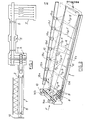
- the plotting station 1 a perspective view of which appears in FIG. 2 comprises a plotting table 8.
- Known per se the top of which is formed by a train of rollers 9 on which the mother plate TM can move from the rolling mill (not shown) from which it is obtained.
- a gantry 10 transversely spanning the path defined for the sheet.
- an edge rule 11 against which the parent plate is applied during tracing is provided.
- a ramp 12 of light sources 13a to 13g (seven in this case), while the gantry 10 supports two of these sources indicated by the references 14a and 14b.
- the light sources are preferably produced using lasers which can be masked using shutters when the beam they produce is not used.
- the light sources 14a and 14b each produce two parallel beams F1 and F2 located in the same plane and oriented downwards at different angles and are thus able to materialize on the mother sheet longitudinal light lines t and t 2 . If lasers are used, the beams F1 and F2 can be obtained from beam lasers with cylindrical or scanning optics so that these beams strike the entire length of the sheet in a predetermined sequence.
- the light sources 13a to 13g each produce a light beam F3 so as to project as many transverse lines t 3 -a to t 3 -g onto the sheet. These beams are preferably produced by lasers scanning in a variable plane.
- the sources 13a to 13g as a whole are mounted oscillating on supports (described below in detail) so that the lines which they produce can be placed at the option of the operator at a predetermined variable location in an area of the mother plate to which the laser in question is assigned.
- the lines t 3 -a to t 3 -g can move in the longitudinal direction at the option of the operator, by an appropriate control of the movements of the light sources 13a to 13g.
- Fig.3 shows a diagram of a mechanism 15 for moving the light sources 14a and 14b.
- This mechanism comprises bearings 16 which are fixed on the gantry 10 and in which is mounted a ball screw 17.
- a support carriage 15 comprising nuts 19 is mounted movable in translation on the screw when the latter is rotated.
- This carriage supports one or the other of the light sources 14a or 14b provided here each with two lasers 20a and 20b respectively projecting the beams F1 and F2.
- the screw 17 can be driven in rotation by a stepping motor 21 via a coupling 22.
- An angular encoder 23 preferably of the absolute multi-turn type is also coupled to the screw 17.
- This core is capable to generate a binary code of type "Gray" are the value is a function of the linear displacement of the carriage 18 along the screw 17.
- This code is converted into a pure binary code in a converter 24 followed by a circuit 25 of correction of measurement tolerances and of a calculation unit 26 and this control which is connected to the stepping motor 21 and also to a computer 27 (FIG. 5) which will be described later.
- the mechanism 15 intended for the light source 14b further comprises an annuiter 28, 29 due to the relatively large length of the worm 17 this mechanism.
- This reducer is also coupled to an encoder 23 and shown in dotted lines in FIG. 3.
- Fig.4 shows a control mechanism 30 of one of the light sources 13a to 13g. It includes a scanning laser 31 mounted on a support 32 oscillating around a horizontal axis, the optical axis of the laser being inclined relative to the horizontal, so that the beam F3 can draw a transverse line on the sheet- mother TM.
- the oscillating support is rotatably mounted in a fixed console 33.
- the mechanism further comprises a ball screw 34 on which is mounted movable in translation a nut 35 through which pass two smooth rods 36 fixed in the oscillating support 32.
- the screw 34 is coupled by a reduction gear 37 to a stepping motor 38 and to an angular encoder 39 by a coupling 40.
- the encoder 39 is connected to a converter 41 of Gray code into binary code followed by a circuit 42 of compensation for tolerances to which is connected a unit 43 of calculation and control which is connected to computer 27.
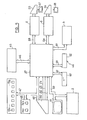
- FIG. 5 represents a general diagram of the information processing and control circuit designated by the reference 44.
- This circuit comprises as central component the microcomputer or computer 27 around which the following peripherals are grouped.
- the generalized management of orders and the manufacture of parent and daughter plates is carried out using a very large central computer 45, which may be the computer for managing the company in which installed the installation according to the invention.
- This computer remembers in particular manages orders of sheets to be delivered to customers and these commands are transferred by a line 46 to the gold-inator to 27 of this facility in the form of a document called "ticket tracing" .
- This document which can be produced on a printer, includes in particular the dimensions and metallurgical characteristics of the sheets to be treated.
- the computer 27 is also connected by lines 47, 48 and 49 respectively to the light sources 13a to 13g and 14a, 14b, to a console 50 for tracing control, and to a monitor 51 or other display device by a line. 52, all these components being arranged in the tracing station 1.
- the information obtained during tracing is transferred to the management computer 45 and also by lines 53 and 54 to the shears 5 and 6 which are provided with control panels 55 and 56 and display screens 57 and 58. They are also sent as regards the abscissas noted during the tracing, to the marking unit 3 by a line 59, this unit being intended to affix on each daughter sheet to be cut, a complete description of identification.
- the trimming shears 2 are connected to the computer 27 by the line 52.
- a device 60 for measuring the temperature is provided to make length corrections and thus compensate for any expansion of the sheets as a function of the temperature.
- This device is connected to the computer 27 by a line 61.
- Another device 62 connected to this computer by a line 63 makes it possible, if necessary, to take account of the changes in thickness from one sheet to another, changes which may influence the measurements taken via the positions of the lasers during tracing.
- the operator console 50 is also connected to the computer 27 by other lines 64, 65 and 66 on which pass orders relating to the defects found on the parent plates during tracing, such as a curved sheet, an undersized sheet, a sheet with non-recoverable defects, etc.
- the installation that has just been described has the primary role of allowing an optimization of the distribution of the daughter plates in the parent plates, an operation which is essentially carried out in the tracing station 1 and which thus makes it possible to determine what specialists call "writability".
- the computer 27 having thus received the data concerning the positioning and the characteristics of the daughter plates to be traced, automatically controls the motor 21 and the light source 14b, which moves the light line t 2 to determine the location of the left bank sheet metal (seen in the direction of travel), this bank being called hereinafter "large bank”.
- the sheet progresses by being applied against the rule 11 by its opposite bank called hereinafter small bank ".
- the line t 2 of large bank is placed at a theoretical dimension l max ae this rule 11.
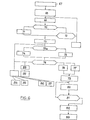
- the sheet being positioned so that its front bora or "head" is under the shears 2, it is trimmed and the operator controls the light source 14a to move the small edge line t 1 , this command being initiated on the console 50 and passing to the corresponding mechanism 15 (FIG. 3) via the calculator 27.
- the lasers 14a and 14b are moved together by the same amplitude and in the same direction so that the lines t l and t 2 maintain the same spacing l max .
- the operator checks whether, in these conditions, the width imperceptibility is correct (no defect to the right of the line t 2 seen in the direction of advancement of the sheet). If it is correct, the width writability is determined and the position of the line t 2 is validated by the operator and stored in the computer 27. Otherwise, the operator makes a correction and then validates the new position (operation 70), which gives a useful width less than the maximum width (case which is not shown in Fig.7).
- the parent sheet Due to the presence of defect D in the opposite bank, the parent sheet has, in the example shown, a useful width l u actually smaller than the width l max , but this defect is eliminated in another way as we will see, the daughter sheets finally cut therefore having the width l max , despite the presence or defect.
- the writable data in useful width and in maximum width appear on the screen 51 to the operator (operations 71 and 72).
- the installation is then ready to receive the data leading to the writability of the TM parent plate in length.
- the cropping cutter 2 provides a reference length of the latter end trimmed after the head of the sheet and / or the engagement of a sample listened pe.
- this length reference can also be obtained optically using one of the transverse lasers (13a to 13g). This laser will then be called "head laser”.
- the operator selects and positions one of the transverse lasers of the ramp 12, as a function of the theoretical length of the sheet (foot laser), so as to eliminate any irregularity at the opposite edge of the head and validates the position thus chosen.
- This operation then provides the computer 27 with a useful length value between the blade of the shears 2 and the validated position of the foot laser, taking into account, where appropriate, the taking of the sample at the head of the sheet. Samples can possibly be delimited in other places where this and the relative length data are extracted from the management computer 45 which via the computer 27 applies them to the concerned lasers of the ramp 12 .
- the position of the foot laser is then validated (operation 73).
- the computer 27 having received temperature data from the member 60 (FIG. 5), an interrogation is made if it is necessary to correct the value of the length recorded to compensate for the expansion. (Operations 73a). The operator can then validate this length (74) or correct it (75).
- the speaker 27 is now able to register in the mother plate TM a certain number of daughter plates (operation 76) taking into account, on the one hand, the tracing ticket which he has received of the computer 45 and on the other hand, of the dimensions noted by the edge lasers and the foot laser.
- the operator can (at 77) delimit the "dead bands" BM to isolate the defect D (or another defect located elsewhere in the sheet) by an appropriate control of the lasers which are here the lasers 13d and 13e.
- the operator can also delimit an additional sample strip (at 78) after which the program passes to an operation at tracing request at 79 which triggers the calculation by the computer of the final tracing of the sheet according to all the previously entered data.
- the computer positions all the lasers from the laser 13a to the foot laser; accordingly, the result is displayed on the screen 51 (operation 80).
- the program loops back to operation 80 so that a corrected tracing can be established.
- the program then proceeds to a marking validation operation 82, which blocks any modification in the tracing station 1, the tracing plane then being kept frozen until the sheet is evacuated.
- the computer 27 stores all the data in its memory (83).
- the parent plate treated in all cases allows a distribution of daughter plates in accordance with the layout ticket and the orders defining the parameters of the daughter plates, taking into account the specific tolerances of the parent sheet, temperature, sheet thickness, etc.
- the accumulation of tolerated rancid does not allow tracing with an optimal distribution and in this case, the installation according to the invention makes it possible to find a distribution compromise leading nevertheless to an optimal use of the material of the parent sheet while respecting the tolerances required for the product leaving the installation.
- the daughter plates are sold with a nominal length c which, barring exceptions, to be described below, must never be lowered.
- the sheets are delivered at this nominal dimension plus a positive tolerance e, the custom being that the length of the product delivered has as much as possible the dimension c + e called maximum length L max .
- this length may be insufficient taking into account the length of the sampling strip so that when cutting the daughter plates required by the tracing ticket all have a c + e dimension.
- the computer 27 performs an averaging calculation affecting during tracing a length at the daughter plates of value c n ⁇ c ⁇ c n + e. (Operation 84; Fig. 6).
- the computer is programmed so as to establish a distribution which eliminates one or more daughter plates, the fall from the parent plate then being recycled (operation 85).
- the daughter plates can be manufactured with a tolerance lying around the nominal value, for example in the case where these plates are used to manufacture tubes.
- the operator after determining the useful length L of the parent plate at 76, the operator enters the limit values L M and L m of the range of tolerances allowed.
- the computer 27 is then configured so as to execute a distribution subroutine (operation 86) based on a calculation aimed at establishing the number x of sheets of length L M and the number y of length L m .
- This algorithm therefore allows the computer 27 to determine the maximum number of daughter plates that can be traced in a parent plate considered.
- the subroutine can include instructions implemented at the option of the operator leading to a tracing of daughter plates whose lengths are intermediate between L M and L m according to the formula: where L is the intermediate length of these daughter-Loles.
- the computer can also implement a distribution subroutine (operation d7) taking into account the faults existing in the parent plate and identified previously.
- the computer 27 considers each section of the mother sheet TM free from defects such as a mother sheet length L 'u which is con- siaticiane as a new parent sheet in which distribution can be established as described above.
- the subroutine includes instructions making it possible to group the bands which cannot be used in these "secondary" parent plates following the distribution calculation, with these bands provided with defects, which leads to optimal use of material.
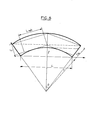
- the sheets are generally, always presented on the plotting table 1 so that their concave edge is turned towards the rule 11.
- the computer 27 can be controlled to transmit the corresponding data to the other members of the cutting installation and in particular to the marking machine 3, to the edge shears 5 and with the lengthening shears 6, the data can also be stored in the central management computer 45.
- the marking unit 3 receives the length data corresponding to the beginnings of the daughter plates. and using these data affixes a mark on the daughter plates thus identified.
- shears 5 and 6 which can be ordered directly by the writability data recorded in the plotting station or else be ordered by an operator receiving this data and entering it on the control console. belonging to the shears.
- a cutting plane for the daughter plates is transmitted to the operator of the shears 6. It comprises the following instructions for positioning the movable stop of the shears necessary for obtaining the daughter plates.
Landscapes
- Engineering & Computer Science (AREA)
- Mechanical Engineering (AREA)
- Life Sciences & Earth Sciences (AREA)
- Wood Science & Technology (AREA)
- Forests & Forestry (AREA)
- Metal Rolling (AREA)
- Laser Beam Processing (AREA)
- Numerical Control (AREA)
- Reduction Rolling/Reduction Stand/Operation Of Reduction Machine (AREA)
Priority Applications (3)
| Application Number | Priority Date | Filing Date | Title |
|---|---|---|---|
| AT83401623T ATE24136T1 (de) | 1983-08-05 | 1983-08-05 | Verfahren und anlage zur bearbeitung von rohlingen aus einer blechwalzstrasse. |
| DE8383401623T DE3368219D1 (en) | 1983-08-05 | 1983-08-05 | Process and installation for machining unfinished sheets issuing from a sheet rolling mill |
| EP83401623A EP0134366B1 (de) | 1983-08-05 | 1983-08-05 | Verfahren und Anlage zur Bearbeitung von Rohlingen aus einer Blechwalzstrasse |
Applications Claiming Priority (1)
| Application Number | Priority Date | Filing Date | Title |
|---|---|---|---|
| EP83401623A EP0134366B1 (de) | 1983-08-05 | 1983-08-05 | Verfahren und Anlage zur Bearbeitung von Rohlingen aus einer Blechwalzstrasse |
Publications (2)
| Publication Number | Publication Date |
|---|---|
| EP0134366A1 true EP0134366A1 (de) | 1985-03-20 |
| EP0134366B1 EP0134366B1 (de) | 1986-12-10 |
Family
ID=8191433
Family Applications (1)
| Application Number | Title | Priority Date | Filing Date |
|---|---|---|---|
| EP83401623A Expired EP0134366B1 (de) | 1983-08-05 | 1983-08-05 | Verfahren und Anlage zur Bearbeitung von Rohlingen aus einer Blechwalzstrasse |
Country Status (3)
| Country | Link |
|---|---|
| EP (1) | EP0134366B1 (de) |
| AT (1) | ATE24136T1 (de) |
| DE (1) | DE3368219D1 (de) |
Cited By (1)
| Publication number | Priority date | Publication date | Assignee | Title |
|---|---|---|---|---|
| CN102294514A (zh) * | 2011-06-22 | 2011-12-28 | 湖北联合天诚防伪技术股份有限公司 | 一种数控裁板机 |
Citations (3)
| Publication number | Priority date | Publication date | Assignee | Title |
|---|---|---|---|---|
| BE676312A (de) * | 1965-02-12 | 1966-06-16 | ||
| FR1580133A (de) * | 1967-11-20 | 1969-09-05 | ||
| FR2384597A1 (fr) * | 1977-03-25 | 1978-10-20 | Saab Scania Ab | Procede et installation de controle de piece de forme allongee telle que des planches |
-
1983
- 1983-08-05 EP EP83401623A patent/EP0134366B1/de not_active Expired
- 1983-08-05 DE DE8383401623T patent/DE3368219D1/de not_active Expired
- 1983-08-05 AT AT83401623T patent/ATE24136T1/de not_active IP Right Cessation
Patent Citations (3)
| Publication number | Priority date | Publication date | Assignee | Title |
|---|---|---|---|---|
| BE676312A (de) * | 1965-02-12 | 1966-06-16 | ||
| FR1580133A (de) * | 1967-11-20 | 1969-09-05 | ||
| FR2384597A1 (fr) * | 1977-03-25 | 1978-10-20 | Saab Scania Ab | Procede et installation de controle de piece de forme allongee telle que des planches |
Cited By (1)
| Publication number | Priority date | Publication date | Assignee | Title |
|---|---|---|---|---|
| CN102294514A (zh) * | 2011-06-22 | 2011-12-28 | 湖北联合天诚防伪技术股份有限公司 | 一种数控裁板机 |
Also Published As
| Publication number | Publication date |
|---|---|
| DE3368219D1 (en) | 1987-01-22 |
| EP0134366B1 (de) | 1986-12-10 |
| ATE24136T1 (de) | 1986-12-15 |
Similar Documents
| Publication | Publication Date | Title |
|---|---|---|
| EP2368105B1 (de) | Verfahren zur nichtdestruktiven inspektion eines mechanischen teils | |
| US7505124B2 (en) | Automated inspection system and method | |
| EP3580156B1 (de) | System und zugehöriges verfahren zur online-messung der optischen eigenschaften einer glasscheibe | |
| EP1158267B1 (de) | Messen der qualität von bandförmigem material mit einem bildaufnahmegerät, verminderung von krümmung und welligkeit, walzen, entgraten | |
| EP0463940B1 (de) | Verfahren und Vorrichtung zur Messung der Qualität einer Glasscheibe | |
| EP0165890A1 (de) | Verfahren und Vorrichtung zur wechselwirkenden Anordnung von Schnittmustern auf einer Unterlage für das Zeichnen und/oder das Zuschneiden | |
| FR2627119A1 (fr) | Procedes de detection d'usinabilite et de coupe | |
| EP0090098A1 (de) | Vorrichtung zum Steuern einer Maschine zum Bau oder zur Instandsetzung eines Eisenbahngleises | |
| EP0511047B1 (de) | Verfahren zum dimensionalen Messen von beweglichen Gegenständen | |
| FR2930032A1 (fr) | Procede et installation de caracterisation d'un defaut de surface sur une piece | |
| EP0574336A1 (de) | Vorrichtung und Verfahren zum Nachweis der Oberflächenfehler von gefährdeten, langgestreckten, metallischen Werkzeugen | |
| FR2529487A1 (fr) | Procede et installation pour le traitement de toles brutes issues d'un laminoir a produits plats | |
| EP0622610B1 (de) | Verfahren und Anordnung zum Eichen der Dickenmessanordnung des Querprofils eines flächigen Gutes | |
| EP0649001B1 (de) | Vorrichtung und Verfahren zum Messen der Form oder/und der Flachheit eines sich bewegenden Materials | |
| FR2571198A1 (fr) | Restituteur d'images haute resolution autorisant le developpement en temps reel des films insoles | |
| JP4426386B2 (ja) | 表面欠陥検査装置、表面欠陥検査方法、その方法をコンピュータに実行させるプログラム | |
| EP0134366B1 (de) | Verfahren und Anlage zur Bearbeitung von Rohlingen aus einer Blechwalzstrasse | |
| US7422042B2 (en) | Method and apparatus for centering a log | |
| US5641971A (en) | Method and device for counting and characterizing defects on a photographic support | |
| WO2004034041B1 (en) | Method and apparatus for the optical evaluation of a paper surface | |
| FR2755240A1 (fr) | Procede pour determiner la qualite d'une feuille de verre plat | |
| FR2595815A1 (fr) | Procede et dispositif de reperage des defauts de planeite d'une tole | |
| WO2001025744A1 (fr) | Procede et appareil de centrage d'une lentille ophtalmique | |
| WO1998000269A1 (fr) | Procede et installation d'obtention de merrains | |
| FR3073806A1 (fr) | Dispositif de mesure des brosses de contact |
Legal Events
| Date | Code | Title | Description |
|---|---|---|---|
| PUAI | Public reference made under article 153(3) epc to a published international application that has entered the european phase |
Free format text: ORIGINAL CODE: 0009012 |
|
| 17P | Request for examination filed |
Effective date: 19840616 |
|
| AK | Designated contracting states |
Designated state(s): AT BE DE GB IT LU NL |
|
| 17Q | First examination report despatched |
Effective date: 19860210 |
|
| ITF | It: translation for a ep patent filed | ||
| GRAA | (expected) grant |
Free format text: ORIGINAL CODE: 0009210 |
|
| AK | Designated contracting states |
Kind code of ref document: B1 Designated state(s): AT BE DE GB IT LU NL |
|
| REF | Corresponds to: |
Ref document number: 24136 Country of ref document: AT Date of ref document: 19861215 Kind code of ref document: T |
|
| REF | Corresponds to: |
Ref document number: 3368219 Country of ref document: DE Date of ref document: 19870122 |
|
| PLBE | No opposition filed within time limit |
Free format text: ORIGINAL CODE: 0009261 |
|
| STAA | Information on the status of an ep patent application or granted ep patent |
Free format text: STATUS: NO OPPOSITION FILED WITHIN TIME LIMIT |
|
| 26N | No opposition filed | ||
| PGFP | Annual fee paid to national office [announced via postgrant information from national office to epo] |
Ref country code: DE Payment date: 19930722 Year of fee payment: 11 |
|
| PGFP | Annual fee paid to national office [announced via postgrant information from national office to epo] |
Ref country code: LU Payment date: 19930723 Year of fee payment: 11 |
|
| PGFP | Annual fee paid to national office [announced via postgrant information from national office to epo] |
Ref country code: AT Payment date: 19930726 Year of fee payment: 11 |
|
| PGFP | Annual fee paid to national office [announced via postgrant information from national office to epo] |
Ref country code: GB Payment date: 19930730 Year of fee payment: 11 |
|
| ITTA | It: last paid annual fee | ||
| PGFP | Annual fee paid to national office [announced via postgrant information from national office to epo] |
Ref country code: NL Payment date: 19930831 Year of fee payment: 11 |
|
| PGFP | Annual fee paid to national office [announced via postgrant information from national office to epo] |
Ref country code: BE Payment date: 19930928 Year of fee payment: 11 |
|
| EPTA | Lu: last paid annual fee | ||
| PG25 | Lapsed in a contracting state [announced via postgrant information from national office to epo] |
Ref country code: LU Free format text: LAPSE BECAUSE OF NON-PAYMENT OF DUE FEES Effective date: 19940805 Ref country code: GB Effective date: 19940805 Ref country code: AT Effective date: 19940805 |
|
| PG25 | Lapsed in a contracting state [announced via postgrant information from national office to epo] |
Ref country code: BE Effective date: 19940831 |
|
| BERE | Be: lapsed |
Owner name: UNION SIDERURGIQUE DU NORD ET DE L'EST DE LA FRANC Effective date: 19940831 |
|
| PG25 | Lapsed in a contracting state [announced via postgrant information from national office to epo] |
Ref country code: NL Effective date: 19950301 |
|
| GBPC | Gb: european patent ceased through non-payment of renewal fee |
Effective date: 19940805 |
|
| NLV4 | Nl: lapsed or anulled due to non-payment of the annual fee | ||
| PG25 | Lapsed in a contracting state [announced via postgrant information from national office to epo] |
Ref country code: DE Effective date: 19950503 |