EP0134941A1 - Verfahren zum Herstellen von Halbzeugen bzw. Formteilen aus Polypropylen - Google Patents
Verfahren zum Herstellen von Halbzeugen bzw. Formteilen aus Polypropylen Download PDFInfo
- Publication number
- EP0134941A1 EP0134941A1 EP84107499A EP84107499A EP0134941A1 EP 0134941 A1 EP0134941 A1 EP 0134941A1 EP 84107499 A EP84107499 A EP 84107499A EP 84107499 A EP84107499 A EP 84107499A EP 0134941 A1 EP0134941 A1 EP 0134941A1
- Authority
- EP
- European Patent Office
- Prior art keywords
- extrudate
- polypropylene
- crosslinking
- weight
- peroxide
- Prior art date
- Legal status (The legal status is an assumption and is not a legal conclusion. Google has not performed a legal analysis and makes no representation as to the accuracy of the status listed.)
- Granted
Links
- -1 polypropylene Polymers 0.000 title claims abstract description 78
- 229920001155 polypropylene Polymers 0.000 title claims abstract description 64
- 239000004743 Polypropylene Substances 0.000 title claims abstract description 62
- 238000000034 method Methods 0.000 title claims abstract description 44
- 230000008569 process Effects 0.000 title claims abstract description 20
- 238000000465 moulding Methods 0.000 title claims description 10
- 239000011265 semifinished product Substances 0.000 claims abstract description 22
- 229910000077 silane Inorganic materials 0.000 claims abstract description 22
- 150000002978 peroxides Chemical class 0.000 claims abstract description 21
- 150000001451 organic peroxides Chemical class 0.000 claims abstract description 11
- 238000004519 manufacturing process Methods 0.000 claims abstract description 10
- QQONPFPTGQHPMA-UHFFFAOYSA-N propylene Natural products CC=C QQONPFPTGQHPMA-UHFFFAOYSA-N 0.000 claims abstract description 10
- 150000001875 compounds Chemical class 0.000 claims abstract description 8
- 125000004805 propylene group Chemical group [H]C([H])([H])C([H])([*:1])C([H])([H])[*:2] 0.000 claims abstract description 8
- 229920001519 homopolymer Polymers 0.000 claims abstract description 6
- 239000000155 melt Substances 0.000 claims abstract description 4
- 238000004132 cross linking Methods 0.000 claims description 54
- SCPYDCQAZCOKTP-UHFFFAOYSA-N silanol Chemical compound [SiH3]O SCPYDCQAZCOKTP-UHFFFAOYSA-N 0.000 claims description 21
- 239000003054 catalyst Substances 0.000 claims description 20
- 238000009833 condensation Methods 0.000 claims description 20
- 230000005494 condensation Effects 0.000 claims description 20
- 239000004744 fabric Substances 0.000 claims description 18
- BLRPTPMANUNPDV-UHFFFAOYSA-N Silane Chemical compound [SiH4] BLRPTPMANUNPDV-UHFFFAOYSA-N 0.000 claims description 17
- 239000003365 glass fiber Substances 0.000 claims description 16
- 239000000203 mixture Substances 0.000 claims description 16
- 239000004753 textile Substances 0.000 claims description 15
- 238000003860 storage Methods 0.000 claims description 12
- 238000009835 boiling Methods 0.000 claims description 8
- 238000001125 extrusion Methods 0.000 claims description 8
- UKLDJPRMSDWDSL-UHFFFAOYSA-L [dibutyl(dodecanoyloxy)stannyl] dodecanoate Chemical compound CCCCCCCCCCCC(=O)O[Sn](CCCC)(CCCC)OC(=O)CCCCCCCCCCC UKLDJPRMSDWDSL-UHFFFAOYSA-L 0.000 claims description 5
- 239000012975 dibutyltin dilaurate Substances 0.000 claims description 5
- XMNIXWIUMCBBBL-UHFFFAOYSA-N 2-(2-phenylpropan-2-ylperoxy)propan-2-ylbenzene Chemical compound C=1C=CC=CC=1C(C)(C)OOC(C)(C)C1=CC=CC=C1 XMNIXWIUMCBBBL-UHFFFAOYSA-N 0.000 claims description 4
- 125000004432 carbon atom Chemical group C* 0.000 claims description 4
- 230000035515 penetration Effects 0.000 claims description 4
- 238000010438 heat treatment Methods 0.000 claims description 3
- 239000004745 nonwoven fabric Substances 0.000 claims description 3
- ISKQADXMHQSTHK-UHFFFAOYSA-N [4-(aminomethyl)phenyl]methanamine Chemical compound NCC1=CC=C(CN)C=C1 ISKQADXMHQSTHK-UHFFFAOYSA-N 0.000 claims description 2
- UFHFLCQGNIYNRP-UHFFFAOYSA-N Hydrogen Chemical compound [H][H] UFHFLCQGNIYNRP-UHFFFAOYSA-N 0.000 claims 1
- 229910052739 hydrogen Inorganic materials 0.000 claims 1
- 239000001257 hydrogen Substances 0.000 claims 1
- 125000004430 oxygen atom Chemical group O* 0.000 claims 1
- YUYCVXFAYWRXLS-UHFFFAOYSA-N trimethoxysilane Chemical compound CO[SiH](OC)OC YUYCVXFAYWRXLS-UHFFFAOYSA-N 0.000 claims 1
- 238000007493 shaping process Methods 0.000 description 14
- 239000000945 filler Substances 0.000 description 8
- 150000004756 silanes Chemical class 0.000 description 7
- 230000015556 catabolic process Effects 0.000 description 6
- 238000006731 degradation reaction Methods 0.000 description 6
- 238000006243 chemical reaction Methods 0.000 description 5
- 238000010276 construction Methods 0.000 description 5
- NKSJNEHGWDZZQF-UHFFFAOYSA-N ethenyl(trimethoxy)silane Chemical compound CO[Si](OC)(OC)C=C NKSJNEHGWDZZQF-UHFFFAOYSA-N 0.000 description 5
- XLYOFNOQVPJJNP-UHFFFAOYSA-N water Substances O XLYOFNOQVPJJNP-UHFFFAOYSA-N 0.000 description 5
- 239000004698 Polyethylene Substances 0.000 description 4
- RTAQQCXQSZGOHL-UHFFFAOYSA-N Titanium Chemical compound [Ti] RTAQQCXQSZGOHL-UHFFFAOYSA-N 0.000 description 4
- 239000003963 antioxidant agent Substances 0.000 description 4
- NNBZCPXTIHJBJL-UHFFFAOYSA-N decalin Chemical compound C1CCCC2CCCCC21 NNBZCPXTIHJBJL-UHFFFAOYSA-N 0.000 description 4
- 239000000835 fiber Substances 0.000 description 4
- 229920000573 polyethylene Polymers 0.000 description 4
- 239000003381 stabilizer Substances 0.000 description 4
- XDLMVUHYZWKMMD-UHFFFAOYSA-N 3-trimethoxysilylpropyl 2-methylprop-2-enoate Chemical compound CO[Si](OC)(OC)CCCOC(=O)C(C)=C XDLMVUHYZWKMMD-UHFFFAOYSA-N 0.000 description 3
- 101100491335 Caenorhabditis elegans mat-2 gene Proteins 0.000 description 3
- 238000005452 bending Methods 0.000 description 3
- 239000004033 plastic Substances 0.000 description 3
- 229920003023 plastic Polymers 0.000 description 3
- 238000003825 pressing Methods 0.000 description 3
- VTYYLEPIZMXCLO-UHFFFAOYSA-L Calcium carbonate Chemical compound [Ca+2].[O-]C([O-])=O VTYYLEPIZMXCLO-UHFFFAOYSA-L 0.000 description 2
- 239000002253 acid Substances 0.000 description 2
- MXTOFRMIIQQSOE-UHFFFAOYSA-N butane;titanium(4+) Chemical compound [Ti+4].CCC[CH2-].CCC[CH2-].CCC[CH2-].CCC[CH2-] MXTOFRMIIQQSOE-UHFFFAOYSA-N 0.000 description 2
- 229920001577 copolymer Polymers 0.000 description 2
- JQVDAXLFBXTEQA-UHFFFAOYSA-N dibutylamine Chemical compound CCCCNCCCC JQVDAXLFBXTEQA-UHFFFAOYSA-N 0.000 description 2
- 238000009472 formulation Methods 0.000 description 2
- 239000011521 glass Substances 0.000 description 2
- 239000008187 granular material Substances 0.000 description 2
- 230000004048 modification Effects 0.000 description 2
- 238000012986 modification Methods 0.000 description 2
- 230000000149 penetrating effect Effects 0.000 description 2
- 229920000642 polymer Polymers 0.000 description 2
- 229920000098 polyolefin Polymers 0.000 description 2
- 229920005606 polypropylene copolymer Polymers 0.000 description 2
- 239000000843 powder Substances 0.000 description 2
- 230000002787 reinforcement Effects 0.000 description 2
- 230000035882 stress Effects 0.000 description 2
- 239000000126 substance Substances 0.000 description 2
- 229920001169 thermoplastic Polymers 0.000 description 2
- 239000004416 thermosoftening plastic Substances 0.000 description 2
- 239000010936 titanium Substances 0.000 description 2
- 229910052719 titanium Inorganic materials 0.000 description 2
- PXXNTAGJWPJAGM-UHFFFAOYSA-N vertaline Natural products C1C2C=3C=C(OC)C(OC)=CC=3OC(C=C3)=CC=C3CCC(=O)OC1CC1N2CCCC1 PXXNTAGJWPJAGM-UHFFFAOYSA-N 0.000 description 2
- BMVXCPBXGZKUPN-UHFFFAOYSA-N 1-hexanamine Chemical compound CCCCCCN BMVXCPBXGZKUPN-UHFFFAOYSA-N 0.000 description 1
- PMAAOHONJPSASX-UHFFFAOYSA-N 2-butylperoxypropan-2-ylbenzene Chemical group CCCCOOC(C)(C)C1=CC=CC=C1 PMAAOHONJPSASX-UHFFFAOYSA-N 0.000 description 1
- RIVJYLGQARVCBI-UHFFFAOYSA-N 2-tert-butylperoxy-2-methylpropane;cumene Chemical group CC(C)C1=CC=CC=C1.CC(C)(C)OOC(C)(C)C RIVJYLGQARVCBI-UHFFFAOYSA-N 0.000 description 1
- 239000004604 Blowing Agent Substances 0.000 description 1
- 229920000089 Cyclic olefin copolymer Polymers 0.000 description 1
- 239000012963 UV stabilizer Substances 0.000 description 1
- HCHKCACWOHOZIP-UHFFFAOYSA-N Zinc Chemical compound [Zn] HCHKCACWOHOZIP-UHFFFAOYSA-N 0.000 description 1
- NBJODVYWAQLZOC-UHFFFAOYSA-L [dibutyl(octanoyloxy)stannyl] octanoate Chemical compound CCCCCCCC(=O)O[Sn](CCCC)(CCCC)OC(=O)CCCCCCC NBJODVYWAQLZOC-UHFFFAOYSA-L 0.000 description 1
- 239000000654 additive Substances 0.000 description 1
- 239000012790 adhesive layer Substances 0.000 description 1
- 230000003078 antioxidant effect Effects 0.000 description 1
- QVGXLLKOCUKJST-UHFFFAOYSA-N atomic oxygen Chemical compound [O] QVGXLLKOCUKJST-UHFFFAOYSA-N 0.000 description 1
- KQNZLOUWXSAZGD-UHFFFAOYSA-N benzylperoxymethylbenzene Chemical compound C=1C=CC=CC=1COOCC1=CC=CC=C1 KQNZLOUWXSAZGD-UHFFFAOYSA-N 0.000 description 1
- 229920001400 block copolymer Polymers 0.000 description 1
- 229910000019 calcium carbonate Inorganic materials 0.000 description 1
- 239000006229 carbon black Substances 0.000 description 1
- 150000001735 carboxylic acids Chemical class 0.000 description 1
- 238000003421 catalytic decomposition reaction Methods 0.000 description 1
- 230000008859 change Effects 0.000 description 1
- 239000013522 chelant Chemical class 0.000 description 1
- 238000003776 cleavage reaction Methods 0.000 description 1
- 239000011248 coating agent Substances 0.000 description 1
- 238000000576 coating method Methods 0.000 description 1
- 239000003086 colorant Substances 0.000 description 1
- 238000006482 condensation reaction Methods 0.000 description 1
- 229920003020 cross-linked polyethylene Polymers 0.000 description 1
- 239000011243 crosslinked material Substances 0.000 description 1
- 238000000354 decomposition reaction Methods 0.000 description 1
- 235000014113 dietary fatty acids Nutrition 0.000 description 1
- 238000001035 drying Methods 0.000 description 1
- 230000000694 effects Effects 0.000 description 1
- 150000002148 esters Chemical class 0.000 description 1
- FWDBOZPQNFPOLF-UHFFFAOYSA-N ethenyl(triethoxy)silane Chemical compound CCO[Si](OCC)(OCC)C=C FWDBOZPQNFPOLF-UHFFFAOYSA-N 0.000 description 1
- TYFZRQLTCYHNAR-UHFFFAOYSA-N ethyl hexanoate iron(2+) Chemical compound C(CCCCC)(=O)OCC.[Fe+2] TYFZRQLTCYHNAR-UHFFFAOYSA-N 0.000 description 1
- 230000007717 exclusion Effects 0.000 description 1
- 239000000194 fatty acid Substances 0.000 description 1
- 229930195729 fatty acid Natural products 0.000 description 1
- 150000004665 fatty acids Chemical class 0.000 description 1
- 239000011152 fibreglass Substances 0.000 description 1
- 239000007789 gas Substances 0.000 description 1
- 230000007062 hydrolysis Effects 0.000 description 1
- 238000006460 hydrolysis reaction Methods 0.000 description 1
- 238000010348 incorporation Methods 0.000 description 1
- 238000002347 injection Methods 0.000 description 1
- 239000007924 injection Substances 0.000 description 1
- GIWKOZXJDKMGQC-UHFFFAOYSA-L lead(2+);naphthalene-2-carboxylate Chemical compound [Pb+2].C1=CC=CC2=CC(C(=O)[O-])=CC=C21.C1=CC=CC2=CC(C(=O)[O-])=CC=C21 GIWKOZXJDKMGQC-UHFFFAOYSA-L 0.000 description 1
- 239000000314 lubricant Substances 0.000 description 1
- 238000011089 mechanical engineering Methods 0.000 description 1
- 238000002844 melting Methods 0.000 description 1
- 230000008018 melting Effects 0.000 description 1
- 150000007522 mineralic acids Chemical class 0.000 description 1
- 238000002156 mixing Methods 0.000 description 1
- 230000006855 networking Effects 0.000 description 1
- 150000007524 organic acids Chemical class 0.000 description 1
- 235000005985 organic acids Nutrition 0.000 description 1
- 150000002902 organometallic compounds Chemical class 0.000 description 1
- 229910052760 oxygen Inorganic materials 0.000 description 1
- 239000001301 oxygen Substances 0.000 description 1
- 238000004806 packaging method and process Methods 0.000 description 1
- 239000002530 phenolic antioxidant Substances 0.000 description 1
- 150000002989 phenols Chemical class 0.000 description 1
- 230000008092 positive effect Effects 0.000 description 1
- 239000000047 product Substances 0.000 description 1
- 229920001384 propylene homopolymer Polymers 0.000 description 1
- 238000004080 punching Methods 0.000 description 1
- 150000003254 radicals Chemical class 0.000 description 1
- 239000002994 raw material Substances 0.000 description 1
- 230000009467 reduction Effects 0.000 description 1
- 238000010992 reflux Methods 0.000 description 1
- 150000003839 salts Chemical class 0.000 description 1
- 229920006395 saturated elastomer Polymers 0.000 description 1
- 230000007017 scission Effects 0.000 description 1
- 239000007858 starting material Substances 0.000 description 1
- 239000000454 talc Substances 0.000 description 1
- 229910052623 talc Inorganic materials 0.000 description 1
- GJBRNHKUVLOCEB-UHFFFAOYSA-N tert-butyl benzenecarboperoxoate Chemical compound CC(C)(C)OOC(=O)C1=CC=CC=C1 GJBRNHKUVLOCEB-UHFFFAOYSA-N 0.000 description 1
- 230000008646 thermal stress Effects 0.000 description 1
- 230000036962 time dependent Effects 0.000 description 1
- YJGJRYWNNHUESM-UHFFFAOYSA-J triacetyloxystannyl acetate Chemical compound [Sn+4].CC([O-])=O.CC([O-])=O.CC([O-])=O.CC([O-])=O YJGJRYWNNHUESM-UHFFFAOYSA-J 0.000 description 1
- 238000007666 vacuum forming Methods 0.000 description 1
- 239000002759 woven fabric Substances 0.000 description 1
- 239000011701 zinc Substances 0.000 description 1
- 229910052725 zinc Inorganic materials 0.000 description 1
Images
Classifications
-
- C—CHEMISTRY; METALLURGY
- C08—ORGANIC MACROMOLECULAR COMPOUNDS; THEIR PREPARATION OR CHEMICAL WORKING-UP; COMPOSITIONS BASED THEREON
- C08F—MACROMOLECULAR COMPOUNDS OBTAINED BY REACTIONS ONLY INVOLVING CARBON-TO-CARBON UNSATURATED BONDS
- C08F255/00—Macromolecular compounds obtained by polymerising monomers on to polymers of hydrocarbons as defined in group C08F10/00
- C08F255/02—Macromolecular compounds obtained by polymerising monomers on to polymers of hydrocarbons as defined in group C08F10/00 on to polymers of olefins having two or three carbon atoms
Definitions
- the invention relates to a process for the production of semi-finished or molded parts made of polypropylene by grafting alkoxysilane compounds in the presence of an organic peroxide by mixing polypropylene, silane compound and peroxide and then plasticizing and extruding them at a temperature of 170 to 240 ° C.
- crosslinking reaction takes place in two stages, so that the polyethylene can, if desired, be stored in a crosslinkable form before the actual crosslinking is subsequently carried out.
- polypropylene since it contains tertiary carbon atoms in the polymer chain, is very sensitive to thermal stress and is therefore easily degraded.
- polypropylene cannot be crosslinked by peroxides, since, in contrast to polyethylene in polypropylene, chain splitting strongly outweighs the chain combination and thus results in degradation, that is to say a reduction in molecular weight.
- the processes for producing silane-modified crosslinked polyethylenes are therefore in no way readily transferable to polypropylene.
- EP-OS 0 004 034 describes a process for producing crosslinked silane-modified polypropylenes and copolymers of propylene, according to which it is necessary to work with the exclusion of oxygen during plasticization and shaping and only use special peroxides which do not promote the degradation of the polypropylene, and the crosslinking reaction of the grafted-on silane compounds is carried out in the presence of a silanol condensation catalyst in water.
- polypropylenes with an MFI greater than 1, ie medium and low molecular weight polypropylenes with a molecular weight up to at most 4 ⁇ 10 5 are used, only di-benzyl peroxide or tert-butyl perbenzoate being considered as peroxides, since they have a relatively low decomposition temperature, while, for example, dicumyl peroxide, which promotes the thermal degradation of polypropylene, is not proven to be suitable for the silane modification of polypropylene.
- DE-OS 24 09 237 discloses a homo- or copolymer of propylene which is silane-modified in the presence of peroxides and which is pressed as an adhesive layer between metallic plates using pressure and heat.
- medium and low molecular weight polymers of propylene with an MFI greater than 0.8 to 9 and more are used, which are obviously easy to graft and can also be extruded into thin coating films.
- the invention has for its object to provide a cross-linked semi-finished or molded part based on polypropylene, as an inexpensive mass plastic with a low specific weight and good chemical and heat resistance.
- the aim of the networking is to specifically change the property profile, in particular to increase the heat resistance and the cold impact strength.
- the task in a first process step is to create a semi-finished product based on polypropylene which has not yet been crosslinked, or only slightly cross-linked so that it can be further processed and possibly deformed before it is fully cross-linked.
- a semi-finished product that has already been fully crosslinked can no longer be deformed, or can only be deformed slightly, and presents considerable difficulties in processing.
- Another object of the invention is to provide a cross-linked molded part based on polypropylene, which is reinforced by means of textile fabrics that are laminated in or laminated on. Such laminates can also no longer be deformed in the fully crosslinked state, since they then tend to delaminate very easily.
- Non-crosslinked polypropylene, reinforced with fillers or glass mats is described, for example, in Plastver kau, 29th year 1978, No. 7, pages 351 to 360 and Zeitschrift Kunststoffe, 66, (1976), No. 12, pages 793 to 797.
- the task according to the invention is achieved in that an essentially isotactic homopolymer of propylene with a density of 0.90 to 0.91 g / cm 3 and a melt index MFI (l90 ° C / 5 kp) less than 0.7 g / 10 min, preferably less than 0.1 g / 10 min and a molecular weight greater than 5 x 10 5 is used.
- the high molecular weight, partially crystalline polypropylenes which contain as little atactic content as possible are relatively stiff.
- Their HFI (230 ° C / 2.16 kp) are also less than 0.7 or less than 0.1 g / 10 min.
- high molecular weight polypropylenes are in the sense of the invention by the use of organic peroxides with a one-minute half-life temperature of about 160 to 240 ° C, such as in particular dicumyl peroxide, tertiary butyl cumyl peroxide, bis-tert-butyl peroxide-isopropyl benzene or 4,4-di-tert .-Butylperoxy-n-butylvalerate, which are added in amounts of 0.1 to 0.8% based on the weight of the amount of polypropylene used, specifically degraded, so that the high molecular weight polypropylene is somewhat softer. According to the invention, a certain degradation of the polypropylene by the peroxide is deliberately brought about. At the same time, however, the polypropylene is rebuilt by grafting on the silane compound.
- organic peroxides with a one-minute half-life temperature of about 160 to 240 ° C
- dicumyl peroxide
- extrudate which is practically still uncrosslinked and which is distinguished by an MFI (230 ° C./2.16 kp) of 25 to 70, preferably 30 to 60 g / 10 min. It has been found that this extrudate is excellently suited to be reinforced with textile fabrics. Since it is not yet cross-linked, its flow behavior means that textile fabrics such as glass fiber mats, nonwovens and woven fabrics can be flawlessly be penetrated without air bubbles. Thereafter, this reinforced and still uncrosslinked half can be processed and shaped into molded parts during or after which it crosslinks.
- MFI 230 ° C./2.16 kp
- propylene copolymers or block copolymers can also be added, up to about 10% based on the weight of the homopropylene, the MFI extrudate according to the invention having to be observed.
- an alkoxysilane compound of the formula according to claim 2 in an amount of 1.0 to 5%, based on the weight of the amount of polypropylene used.
- the silane compounds to be selected from this group should preferably have a boiling point greater than 150 ° C., so that the silane cannot volatilize in appreciable amounts during the plasticization of the polypropylene.
- Particularly suitable silane compounds are methacryloxypropyltrimethoxysilane, boiling point 225 ° C. at 760 torr, vinyltris- ⁇ -methoxyethoxysilane 285 ° C. and vinyltriethoxysilane 161 ° C.
- the vinyltrimethoxysilane 120 ° C. can also be grafted onto the polypropylene, but has a low boiling point, so that there is a risk of volatilization during the incorporation and plasticization process at high temperatures.
- the substances and process conditions selected according to the invention enable the extrudate with an initial degree of crosslinking below 20%, preferably below 5%, to be produced by extrusion and plasticization of the mixture and a degree of crosslinking which is at least 40% higher by crosslinking by storage after 4 to 6 weeks, if appropriate achieved in a humid atmosphere and / or by deformation when using heat and pressure.
- non-cross-linked or slightly cross-linked extrudate can be produced as a semi-finished product as webs or profiles, which can be stored in a normal atmosphere at room temperature for at least several days without being cross-linked. During this state, it can still be subjected to deformation, during or after which the semi-finished product formed into the molded part then crosslinks.
- the mixture can also be admixed with other additives known per se, such as, for example, antioxidants, blowing agents, lubricants, fillers such as talc, calcium carbonate, carbon black, UV stabilizers and stabilizers against the heavy metal-catalytic decomposition, colorants or the like.
- additives known per se such as, for example, antioxidants, blowing agents, lubricants, fillers such as talc, calcium carbonate, carbon black, UV stabilizers and stabilizers against the heavy metal-catalytic decomposition, colorants or the like.
- stabilizers are particularly important because the thermal degradation of the polypropylene is kept within limits and a higher processing temperature is made possible. The higher the processing temperature, the more we are grafted onto the polypropylene, the higher the degree of final crosslinking that can be achieved.
- care must be taken that they are very dry, ie the moisture content is to be reduced as far as possible by drying either the filler or the premixing of polypropylene and filler. Glass fibers can also be incorporated into the mixture in amounts of about 10 to 50%, based on the weight of the amount of polypropylene used.
- the silanol condensation catalyst is incorporated directly in the first process step during the plasticization of the polypropylene. It is important to ensure that all components of the mixture are dry, i.e. are to be used anhydrous. However, it has been found that even without the use of a silanol condensation catalyst, a high degree of crosslinking, i.e. a high degree of crosslinking of the extrudate can be achieved either by storage or by additional treatment with heat, pressure and / or moisture.
- silanol condensation catalysts are salts of carboxylic acids, such as dibutyltin dilaurate, tin acetate, tin-II-octanate, lead naphthenate, zinc caprelate, iron (II) ethylhexanate and organometallic compounds, including titanium acid esters or chelate compounds of titanium acid, such as tetrabutyltitanium titanate, such as tetrabutyltitanium titanate, Hexylamine, dibutylamine and pluredine including inorganic acids and organic acids such as fatty acids.
- carboxylic acids such as dibutyltin dilaurate, tin acetate, tin-II-octanate, lead naphthenate, zinc caprelate, iron (II) ethylhexanate and organometallic compounds, including titanium acid esters or chelate compounds of titanium acid, such as tetrabutyl
- the preferred silanol condensation catalysts are organotin compounds such as dibutyltin dilaurate, dibutyltin diacetate and dibutyltin dioctoate. According to the invention, only very small, if any, amounts of silanol condensation catalyst are added.
- the method according to the invention for producing the crosslinked moldings assumes for the production engineering that the moisture normally present in the atmosphere is sufficient to effect the crosslinking reaction for the silane linkage and crosslinking of the moldings. A final crosslinking time of a few weeks of the molded part can be provided if it is not used immediately after production. In this way, according to the method according to the invention, it is not necessary to provide devices in order to accelerate the crosslinking reaction in hot water or steam atmosphere to which the molded parts are exposed.
- a preferred composition of the mixture for producing crosslinked moldings according to the invention is that according to claim 7. It is characterized by good deformability and machinability of the extrudate before the final crosslinking.
- the required amounts of Peroxide can be reduced, yet sufficient final crosslinking of the molded part is made possible in a practical time and the crosslinking of the extruded semi-finished product, produced in the first process step, is so slight that subsequent shaping, for example vacuum deep-drawing, is not hindered and that improved heat resistance of the cross-linked mold is partially obtained.
- the polypropylene molded part crosslinked by silane linkages which is produced with the aid of the method according to the invention, has excellent properties, such as a reduced percentage of permanent elongation, high stress crack resistance, improved heat resistance and low-temperature impact strength.
- a preferred concern of the invention is the creation of reinforced cross-linked polypropylene molded parts which have high heat resistance, high bending stiffness and good cold impact resistance.
- this involves the extrudate being extruded into a nip fed from one or both sides with a textile fabric and penetrating the textile fabric on one or both sides to form a reinforced web.
- Glass fabric mats, nonwovens, fabrics or the like are preferred as textile fabrics. with a basis weight of about 20 to 1200 g / m 2 used. So that these glass fiber mats or the like. are completely embedded in the thermoplastic wet, a good penetration of the extruded modified polypropylene is required.
- an extrudate with an MFI (230 ° C / 2.16 kp) of 25 to 70, preferably 30 to 60 g / 10 min. Due to the silane modification and the use of the peroxides, it is possible according to the invention to make the high-molecular polypropylene somewhat softer and for the production of the ver to make strong semi-finished products suitable according to the method proposed by the invention.
- the highest bending stiffness of the reinforced extrudates or molded parts is achieved if the textile fabrics, such as glass fiber mats, are embedded on the two outer sides of the extruded sheets or plates. It is also possible to embed a textile fabric only in the middle of the web, this being achieved in that a further extrudate is applied to the outer surface of the textile fabric via a further roller gap.
- the process conditions when penetrating the textile fabrics are to be selected with the extrudate in such a way that the initial degree of crosslinking of the extrudate is not increased.
- the reinforced extrudate or semifinished product produced in this way which is still practically uncrosslinked, can then be subjected to further shaping for molded parts by pressing, deep drawing, vacuum forming, vacuum stretching or the like, or processing such as stamping, bending, punching or the like. be subjected.
- the semi-finished product is then crosslinked either during shaping or by storage. The crosslinking can be accelerated by moisture and temperature increase.
- the crosslinked semi-finished product may be advantageous to moisten the crosslinked semi-finished product in a water bath before shaping it, and then to deform it, so that the crosslinking is initiated and expedited during the shaping process using pressure and heat.
- the achievable degree of crosslinking of the extrudate depends on the degree of silane grafting and this in turn also depends on the residence time during plasticizing and extrusion in the presence of the organic peroxide.
- no silanol condensate is added tional cross-linking degrees of 50% to 80% and with the addition of silanol condensation catalysts from 60 to 90% depending on the composition.
- antioxidants in amounts of 0.1 to 1.0% based on the weight of the amount of polypropylene used, such as sterically hindered phenols, which increase the heat resistance and in this way the production of moldings with renewed heating without to become sticky. It is advantageous to produce the molded parts from the extrudates at as high a temperature as possible by pressing, since this is both good molding and the production of complicated parts, such as those used in automobile construction for body parts or the like. with high degrees of deformation required.
- the degree of final crosslinking of the moldings produced according to the invention also depends on the amount of the grafted silane.
- the degree of crosslinking is determined by the percentage of the insoluble in decalin, i.e. by heating in boiling decalin for 20 hours under reflux, the insoluble gel content of the crosslinked material is determined.
- cross-linked moldings of a deformed Extmdat be of a in the presence of an organic peroxide with a Alkoxisilantress grafted substantially isotactic homopolymer of propylene, a density of 0.90 to 0.91 g / cm 3, and (kp 190 0 C / 5) an MFI less than 0.7, preferably 0.1 g / 10 min and one molecular Weight greater than 5 x 10 5 containing a fabric that is laminated on one and / or both sides and / or completely embedded, in particular based on glass fibers, is proposed.
- cross-linked semifinished product or the cross-linked molded parts according to the invention can advantageously be used as construction parts in apparatus construction, mechanical engineering, motor vehicle construction, aircraft construction, etc., because of their heat resistance, with regard to, for example, engine and exhaust gas heat and lightweight, in particular in the case of glass fiber reinforcement.
- crosslinkable mixtures according to the invention directly into a finished product in the first plasticizing process, for example an injection molded part which is only crosslinked when it is finished and crosslinked after a storage period under normal conditions and reaches the desired degree of final crosslinking after about 6 to 8 weeks .
- the degree of crosslinking of the freshly extruded tape was then determined, as well as after storage in a room atmosphere and, if appropriate, after treatment and storage in hot water.
- the comparison of Examples 1 and 2 shows that the use of a silane compound with a higher boiling point, MEMO has a boiling point of 255 ° C at 760 Torr, has a positive effect on a higher final crosslinking, since obviously with VTMO with a boiling point of 120 ° C at 760 Torr, a larger proportion of VTMO is lost due to volatilization. In this way, the degree of grafting and thus the subsequent degree of crosslinking of the silane compound are not as high according to Example 1.
- Example 5 shows that too small amounts of silane do not lead to a sufficiently high degree of final crosslinking.
- Examples 3 and 4 the influence of the addition of silanol condensation catalyst is shown, which shows that the addition of silanol condensation catalyst crosslinking during storage at room temperature progresses faster with higher proportions of silanol condensation catalyst; this also applies to example 6 with a stabilizer acting as a silanol condensation catalyst and based on a phenolic antioxidant.
- All of the semi-finished products produced according to Examples 1 to 4 can be processed very well within a more or less long time after the production of the semi-finished product, for example by deep drawing or pressing using pressure and heat to give molded parts.
- the further crosslinking up to the final crosslinking is usually initiated and carried out by the temperatures used during the deformation.
- the use of high proportions of silanol condensation catalysts over 0.05% by weight, based on the polypropylene, is only recommended for semi-finished products or extrudates that are not subjected to any further processing or deformation before they are finally used, since they are used in the As a rule, cause an increased initial crosslinking, which hinders processing or deformation that still has to be carried out.
- the extruder had a much higher current consumption, this is due to the peroxides used with a low one-minute half-life temperature, with peroxide B 130 ° C, with peroxide C 110 ° C. These peroxides are not suitable for use in the process according to the invention with high molecular weight propylene homopolymers, since they do not bring about a suitable degradation of the polypropylene in the sense of the invention.
- Examples 12 to 15 and 3 according to Table III, produced analogously to the preceding examples, show the behavior of polypropylene as a function of the melt flow index MFI.
- a very high melt flow index leads neither to an initial crosslinking nor to a sufficient silane grafting, so that even when using a silanol condensation catalyst, a sufficient degree of final crosslinking of over 40 or more% is not achieved.
- Example 13 shows the behavior of a propylene copolymer which exhibits a relatively high initial peroxidic crosslink, but achieves a low degree of final crosslinking with only a low degree of silane grafting.
- the PP-H powder was premixed with the filler and dried, then processed as in the preceding examples. It can be seen that the method according to the invention for producing silane-crosslinked polypropylene moldings can also be used for filled polypropylene.
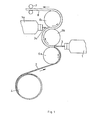
- FIG. 1 An advantageous method for producing an endless extrudate reinforced with fiber mats in the still uncrosslinked state is shown schematically in FIG.
- two extruders 1 and 1a are provided for extruding a web-shaped extrudate 3, 3a, preferably of the same thickness, and a three-roll calender with the rolls 6a, 6b and 6c.
- the endless fiber mat 2 for example a glass fiber mat with a basis weight of 800 g / m 2 , is drawn off from a supply roll 4 and introduced via the roller 6a into the roller gap formed between the roller 6a and the roller 6b, into which the web-shaped extrudate 3 also runs .
- a second web 3a of the extrudate is applied to the outer surface of the glass fiber mat 2 and connected to the web 8a.
- the reinforced web 8 thus produced is then passed over the roller 6c and drawn off by means of the take-off rollers 7.
- rollers can belong to a double belt press, so that the perfect penetration of the extrudate into the glass fiber mats can take place over a longer distance when the double belt press passes between the belts.
- the reinforced semi-finished product in the form of the reinforced web 8, which is illustrated in this way as in FIG. 1, is practically still uncrosslinked and can be deformed very well in this state. If it then crosslinks during or after shaping, high heat resistance is achieved and the good shaping of the molded part achieved in the uncrosslinked state is maintained.
- Such a cross-linked reinforced molded part has an improved heat resistance compared to a non-cross-linked molded part which is produced from a normal polypropylene.
- the polypropylene becomes soft when the temperature is influenced in the vicinity of the crystallite melting point of the polypropylene, as a result of which the internal deformation stresses are released and the reinforcement, for example a glass fiber mat, swells and is pressed out of the softened thermoplastic.
- Reinforced webs 8 are advantageously produced with a glass fiber content of approximately 25 to 45% by weight, based on the extrudate. At higher glass fiber contents, the deformability deteriorates due to the higher rigidity.
Landscapes
- Chemical & Material Sciences (AREA)
- Health & Medical Sciences (AREA)
- Chemical Kinetics & Catalysis (AREA)
- Medicinal Chemistry (AREA)
- Polymers & Plastics (AREA)
- Organic Chemistry (AREA)
- Processes Of Treating Macromolecular Substances (AREA)
- Extrusion Moulding Of Plastics Or The Like (AREA)
- Processing And Handling Of Plastics And Other Materials For Molding In General (AREA)
- Graft Or Block Polymers (AREA)
- Compositions Of Macromolecular Compounds (AREA)
Abstract
Description
- Die Erfindung bezieht sich auf ein Verfahren zum Herstellen von Halbzeugen bzw. Formteilen aus Polypropylen durch Aufpfropfen von Alkoxisilanverbindungen in Gegenwart eines organischen Peroxyds, indem Polypropylen Silanverbindung und Peroxyd gemischt und anschließend bei einer Temperatur von 170 bis 240°C plastifiziert und extrudiert werden.
- Es ist bekannt, Polyolefine unter Verwendung von Silanverbindungen in Gegenwart organischer Peroxyde zu pfropfen, s. US-PS 3 075 948, mit Beispielen für Polyethylen. Das Vernetzen von Polyethylen bzw. Ethylen-Olefin-Copolymeren unter Verwendung von Silanverbindungen in Gegenwart organischer Peroxyde und Silanolkondensations-Katalysatoren wird ausführlich auch beispielsweise in der DE-AS 17 94 028 DE-AS 19 63 571, DE-OS 32 10 192 beschrieben.
- Hierbei wird davon ausgegangen, daß die Vernetzungsreaktion in zwei Stufen abläuft, so daß das Polyethylen gewünschtenfalls in vernetzungsfähiger Form gelagert werden kann, ehe nachträglich die eigentliche Vernetzung durchgeführt wird.
- Es ist bekannt, daß Polypropylen, da es in der Polymerkette tertiäre C-Atome enthält, gegenüber einer thermischen Beanspruchung sehr empfindlich ist und daher leicht abgebaut wird. Insbesondere läßt sich Polypropylen nicht durch Peroxyde vernetzen, da im Gegensatz zu Polyethylen bei Polypropylen die Kettenspaltung die Kettenkombination stark überwiegt und somit ein Abbau, also eine Molekulargewichtsverringerung resultiert. Auch die Verfahren zum Herstellen silanmodifizierter vernetzter Polyethylene sind daher keineswegs ohne weiteres auf Polypropylen übertragbar. In der EP-OS 0 004 034 wird ein Verfahren zum Herstellen vernetzter silanmodifizierte Polypropylene und Copolymere von Propylen beschrieben, demz folge unter Sauerstoffausschluß während der Plastifizierung und Formgebung gearbeitet werden muß und nur spezielle Peroxyde, die den Abbau des Polypropylens nicht fördern, eingesetzt werden und die Vernetzungsreaktion der aufgepfropften Silanverbindungen in Gegenwart eines Silanolkondensationskatalysators in Wasser durchgeführt wird. Nach der EP-OS 0 004 034 werden Polypropylene mit einem MFI größer 1, d.h. Mittel- und Niedermolekulare Polypropylene mit einem Molekulargewicht bis höchstens 4 x 10⁵ eingesetzt, wobei als Peroxyde nur Di-Benzylperoxyd oder Tert.-butylperbenzoat als geeignet angesehen werden, da sie eine relativ niedrige Zerfallstemperatur aufweisen, während z.B. Dicumylperoxyd, als den thermisch n Abbau des Polypropylens fördernd, für die Silanmodifizierung des Polypropylens nicht als geeignet nachgewiesen wird.
- Aus der DE-OS 24 09 237 ist ein in Gegenwart von Peroxyden silanmodifiziertes Homo- oder Copolymer des Propylens bekannt, das als Haftschicht zwischen metallischen Platten unter Anwendung von Druck und Wärme verpreßt wird. Auch hierfür werden mittel- und niedermolekulare Polymere des Propylens mit einem MFI größer 0,8 bis 9 und mehr eingesetzt, die sich offenbar leicht pfropfen lassen und auch zu dünnen Beschichtungsfolien extrudieren lassen.
- Der Erfindung liegt die Aufgabe zugrunde, ein vernetzte Halbzeug bzw. Formteil auf Basis von Polypropylen zu schaffen, als eines preiswerten Massenkunststoffes mit geringem spezifischen Gewicht und guter Chemikalien- und Wärmebeständigkeit. Mit der Vernetzung soll das Eigenschaftsbild gezielt verändert werden, insbesondere die Wärmestandfestigkeit und die Kälteschlagzähigkeit erhöht werden. Ausgehend von der Möglichkeit, Polyolefine mittels Silanverbindungen in Gegenwart von organischen Peroxyden zu pfropfen und mittels Silanolkondensations-Katalysator n in Gegenwart von Wasser zu vernetzen, besteht die Aufgabe, in einem ersten Verfahrensschritt ein Halbzeug auf Basis Polypropylen zu schaffen, das noch nicht vernetzt ist, bzw. nur geringfügig anvernetzt, so daß es noch weiterverarbeitet und ggf. verformt werden kann, ehe es vollständig ausvernetzt. Ein bereits vollständig ausvernetztes Halbzeug kann nicht mehr bzw. nur geringfügig verformt werden und bereitet erhebliche Schwierigkeiten beim Bearbeiten. Eine weitere Aufgabe der Erfindung ist darin zu sehen, ein vernetztes Formteil auf Basis Polypropylen zu schaffen, das mittels textiler Flächengebild die ein- oder aufkaschiert sind, verstärkt ist. Solche Schichtstoffe können ebenfalls im völlig ausvernetzten Zustand nicht mehr verformt werden, da sie dann sehr leicht zur Delaminierung neigen.
- Nicht vernetztes Polypropylen, verstärkt mit Füllstoffen oder Glasmatten ist beispielsweise in Plastverarbeiter, 29. Jahrg. 1978, Nr. 7, Seiten 351 bis 360 und Zeitschrift Kunststoffe, 66, (1976), Nr. 12, Seiten 793 bis 797 beschrieben.
- Die erfindungsgemäße Aufgabenstellung wird ausgehend von dem Verfahren gemäß Gattungsbegriff des Patentanspruchs dadurch gelöst, daß ein im wesentlichen isotaktisches Homopolymer des Propylens mit einer Dichte von 0,90 bis 0,91 g/cm3 und einem Schmelzindex MFI (l90°C/5 kp) kleiner 0,7 g/10 min vorzugsweise kleiner 0,1 g/10 min und einem Molekulargewicht größer 5 x 10⁵ eingesetzt wird. Die erfindungsgemäß eingesetzten hochmolekularen, teilkristallinen, möglichst geringe ataktische Anteile enthaltenden Polypropylene sind relativ steif. Auch ihre HFI (230°C/2,16 kp) sind kleiner 0,7 bzw. kleiner 0,1 g/10 min.
- Diese hochmolekularen Polypropylene werden im Sinn der Erfindung durch den Einsatz von organischen Peroxyden mit einer einminütigen Halbwertszeit-Temperatur von etwa 160 bis 240°C, wie insbesondere Dicumylperoxyd, Tertiärbutylcumylperoxyd, Bis-tert.-bütylperoxyd-IsopropylBenzol oder 4,4-Di-tert.-butylperoxy-n-butylvalerate, die in Mengen von 0,1 bis 0,8 % bezogen auf das Gewicht der eingesetzten Menge Polypropylen zugegeben werden, gezielt abgebaut, so daß das hochmolekulare Polypropylen etwas weicher wird. Erfindungsgemäß wird also ein gewisser Abbau des Polypropylens durch das Peroxyd bewußt herbeigeführt.
Gleichzeitig wird jedoch das Polypropylen durch das Aufpfropfen der Silanverbindung wieder aufgebaut. - Bei der Durchführung des vorliegenden Verfahrens laufen in der ersten Stufe mehrere Reaktionen nebeneinander, da durch die freie radikale erzeugende Peroxidverbindung sowohl die übliche über freie radikale verlaufende Vernetzung des Polypropylens als auch die Kettenspaltung abläuft und die Pfropfung des aktivierten Polypropylens mit der Silankomponente. Die geringe mögliche Anfangsvernetzung des Extrudates ist auf die durch das Peroxid bewirkte Polypropylenvernetzung zurückzuführen, sie ist jedoch erfindungsgemäß durch die vorgesehenen Mengen und Art des Peroxids so gesteuert, daß sie eine spätere formgebende Bearbeitung des extrudierten Halbzeugs nicht beeinträchtigt. Erst in der zweiten Verfahrensstufe wird das so ggf. geringfügig anvernetzte Polypropylen durch Hydrolyse der auf das Polypropylen gepfropften Silanverbindungen, die eine Kondensationsreaktion zur chemischen Vernetzung des Silans bewirkt, fertig anvernetzt. Diese zweite Verfahrensstufe ist zeitabhängig, sie kann einerseits durch Temperatur-und/oder Feuchtigkeitszufuhr beschleunigt werden, zum anderen auch über längere Zeiträume durch Lagerung in normaler Atmosphäre nach der Formgebung erzielt werden.
- Die erfindungsgemäß ausgewählten Komponenten und Bedingung führen zu einem Extrudat, das praktisch noch unvernetzt is sich durch und das einen MFI (230°C/2,16 kp) von 25 bis 70, vorzugsweise 30 bis 60 g/10 min auszeichnet. Es wurde gefunden, daß dieses Extrudat hervorragend geeignet ist mit textilen Flächengebilden verstärkt zu werden. Da es noch nicht vernetzt ist, können aufgrund seines Fließverhaltens textile Flächengebilde wie Glasfasermatten, -vliese, -gewebe einwandfrei d.h. luftblasenfrei penetriert werden. Danach kann dieses verstärkte und noch unvernetzte Halbzeunoch einer Bearbeitung und Verformung zu Formteilen zugeführt werden, während oder nach dem es ausvernetzt.
- Neben den ausgewählten Homopolymeren des Propylens können auch geringe Mengen Propylen-Copolymere oder Block-Copolynere bis etwa 10 % bezogen auf das Gewicht des Homopropylens zugegeben werden, wobei der erfindungsgemäße MFI ies Extrudates eingehalten werden muß.
- Zur Herstellung des zu vernetzenden Propylens gemäß der Erfindung wird eine Alkoxysilanverbindung der Formel

- Die erfindungsgemäß ausgewählten Stoffe und Verfahrensbedingungen ermöglichen, daß das Extrudat mit einem Anfangsvernetzungsgrad unter 20 %, vorzugsweise unter 5 %, durch Extrusion und Plastifizierung der Mischung hergestellt wird und einen um mindestens 40 % höheren Vernetzungsgrad durch Ausvernetzen durch Lagerung nach 4 bis 6 Wochen ggf. in feuchter Atmosphäre und/oder durch Verformen bei Anwendung von Wärme und Druck erreicht.
- Überraschend hat sich herausgestellt, daß mit der erfindurngsgemäß vorgeschlagenen Mischung unvernetztes bzw. nu leicht anvernetztes Extrudat als Halbzeug als Bahnen oder Profil hergestellt werden kann, das in normaler Atmosphär bei Raumtemperatur wenigstens mehrere Tage gelagert werde kann, ohne daß es ausvernetzt. Während dieses Zustandes kann es noch einer Verformung zugeführt werden, während oder nach der das zum Formteil geformte Halbzeug dann aus vernetzt. Dieses bedeutet einen großen technischen Fortschritt, da das in einem ersten Verfahrensschritt hergestellte im wesentlichen nicht vernetzte Halbzeug nicht sofort weiterverarbeitet werden muß, sondern auch nach einer kurzen unproblematischen Zwischenlagerzeit die gute Verformbarkeit und Bearbeitbarkeit behält und einer weite ren Formgebung unter Anwendung von Druck und/oder Wärme zugeführt werden kann, wobei die eigentliche Vernetzung erst während dieser endgültigen Formgebung oder danach stattfindet. Würde das Halbzeug direkt bei oder direkt nach der Extrusion vollständig vernetzt, könnte es einer weiteren Formgebung nicht mehr unterworfen werden. Die erfindungsgemäß hergestellten Formteile hingegen weisen neben einer hohen Wärmeformbeständigkeit auch verbesserte Eigenschaften z.B. hinsichtlich der Kälteschlagfestigkeit auf gegenüber unvernetzten Formteilen und Halbzeugen. Darüber hinaus ist es auch möglich, das erfindungsgemäß hergestellten nahezu unvernetzten Halbzeuges in luft- und feuchtigkeitsdichter Verpackung vor einer weiteren Verarbeitung und der endgültigen Vernetzung zu lagern.
- Bei dem erfindungsgemäßen Verfahren können der Mischung auch andere an sich bekannte Zusätze zugegeben werden, wie beispielsweise Antioxidationsmittel, Treibmittel, Gleitmittel, Füllstoffe wie Talcum, Calciumcarbonat, Ruß, UV-Stabilisatoren und Stabilisatoren gegenüber der schwer metallkatalytischen Zersetzung, Farbmittel o.dgl.
- Der Einsatz von Stabilisatoren ist besonders wichtig, da ier thermische Abbau des Polypropylens in Grenzen gehalten wird und eine höhere Verarbeitungstemperatur ermöglicht wird. Je höher die Verarbeitungstemperatur, desto mehr wir auf das Polypropylen aufgepfropft, umso höher wird der erreichbare Endvernetzungsgrad.
Insbesondere bei der Zugabe von Füllstoffen ist für die Durchführung des erfindungsgemäßen Verfahrens darauf zu achten, daß diese sehr trocken sind, d.h. der Feuchtigkeitsgehalt ist durch Trocknen entweder des Füllstoffes oder de Vormischung von Polypropylen und Füllstoff soweit als möglich zu reduzieren. Auch Glasfasern können in Mengen vo etwa 10 bis 50 %, bezogen auf das Gewicht der eingesetzten Menge Polypropylen in die Mischung eingearbeitet werden. - Nach dem erfindungsgemäßen Verfahren wird, falls überhaupt vorgesehen, der Silanolkondensations-Katalysator direkt im ersten Verfahrensschritt während der Plastifizierung des Polypropylens eingearbeitet. Hierbei ist darauf zu achten, daß alle Komponenten der Mischung in trockenem Zustand, d.h. wasserfrei einzusetzen sind. Es hat sich jedoch herausgestellt, daß nach dem erfindungsgemäßen Verfahren auch ohne Einsatz von Silanolkondensations-Katalysator eine hohe Vernetzung, d.h. ein hoher Vernetzungsgrad des Extrudates entweder durch Lagerung oder durch zusätzliche Behandlung mit Wärme, Druck und/oder Feuchtigkeit erzielt werden kann.
- Als Silanolkondensations-Katalysatoren sind bekannt Salze von Carbonsäuren, wie Dibutylzinndilaurat, Zinnacetat, Zinn-II-Octanat, Bleinaphthenat, Zinkkaprelat, Eisen-(II)-Ethylhexanat und Organometallverbindungen einschließlich Titansäureester oder Chelatverbindungen der Titansäure wie Tetrabutyltitanat, Tetranonyltitanat, organische Basen wie Ethylamin, Hexylamin, Dibutylamin und Pluredin einschließlich anorganische Säuren und organische Säuren wie Fettsäuren. Die bevorzugten Silanolkondensations-Katalysatoren sind jedoch Organozinnverbindungen wie Dibutylzinndilaurat Dibutylzinndiacetat und Dibutylzinndioctoat. Erfindungsgemäß werden nur sehr geringe, wenn überhaupt, Mengen an Silanolkondensations-Katalysator zugegeben. Das erfindungs gemäße Verfahren zum Herstellen der vernetzten Formteile geht für die produktionstechnische Durchführung davon aus, daß die normalerweise in der Atmosphäre enthaltene Feuchtigkeit ausreicht, um die Vernetzungsreaktion zur Silanverknüpfung und Ausvernetzen der Formteile zu bewirken. Hierbei kann durchaus eine Fertigvernetzungsdauer von einigen Wochen des fertig geformten Formteils vorgesehen werden, falls dieses nicht direkt nach der Herstellung unmittelbar in Einsatz kommt. Auf diese Weise ist nach dem erfindungsgemäßen Verfahren nicht notwendig, Vorrichtungen vorzusehen, um die Vernetzungsreaktion in Heißwasser oder Dampfatmosphäre, denen die Formteile ausgesetzt werden, zu beschleunigen.
- Eine bevorzugte Zusammensetzung der Mischung zum Herstellen von vernetzten Formteilen gemäß der Erfindung ist diejenige nach Anspruch 7. Sie zeichnet sich durch eine gute Verformbarkeit und Bearbeitbarkeit des Extrudates vo der endgültigen Vernetzung aus.
- Bei Einsatz relativ geringer Mengen eines Silanolkondensations-Katalysators können die benötigten Mengen an Peroxid reduziert werden, wobei dennoch eine ausreichende Endvernetzung des Formteils ermöglicht wird in einer praktikablen Zeit und die Anvernetzung des extrudierten Halbzeugs, hergestellt im ersten Verfahrensschritt, so geringfügig ist, daß eine nachträgliche Formgebung, beispiel - weise Vakuum-Tiefziehverformung, nicht behindert ist und die verbesserte Wärmeformbeständigkeit des vernetzten Form teils erhalten wird.
- Das durch Silanverknüpfungen vernetzte Polypropylenformteil, das mit Hilfe des erfindungsgemäßen Verfahrens hergestellt wird, hat ausgezeichnete Eigenschaften, wie eine verminderte prozentuale bleibende Dehnung, hohe Spannungsrißbeständigkeit, eine verbesserte Wärmeformbeständigkeit und Kälteschlagzähigkeit.
- Ein bevorzugtes Anliegen der Erfindung ist die Schaffung von verstärkten vernetzten Polypropylenformteilen, die hoh Wärmestandfestigkeiten, hohe Biegesteifigkeit und gute Kälteschlagfestigkeit aufweisen. Erfindungsgemäß wird hierzu vorgehsen, daß das Extrudat in einen von einer oder beiden Seiten mit einem textilen Flächengebilde gespeiste Walzenspalt extrudiert wird und ein- oder beidseitig das textile Flächengebilde zu einer verstärkten Bahn penetriert. Als textile Flächengebilde werden bevorzugt Glasfasermatten, Vliese, Gewebe o.dgl. mit einem Flächengewicht von etwa 20 bis 1200 g/m2 verwendet. Damit diese Glasfasermatten o.dgl. vollständig in die thermoplastische Nasse eingebettet werden, ist ein gutes Penetrationsvermögen des extrudierten modifizierten Polypropylens erforderlich. Dieses wird erreicht durch ein Extrudat mit einem MFI (230°C/2,16 kp) von 25 bis 70, vorzugsweise 30 bis 60 g/ 10 min. Durch die Silanmodifizierung und den Einsatz der Peroxyde gelingt es erfindungsgemäß, das hochmolekulare Polypropylen etwas weicher und für das Herstellen der ver stärkten Halbzeuge nach dem erfindungsgemäß vorgeschlagenen Verfahren geeignet zu machen. Die höchsten Biegesteifigkeiten der verstärkten Extrudate bzw. Formteile werden erreicht, wenn die textilen Flächengebilde, wie Glasfasermatten an den beiden Außenseiten der extrudierten Bahnen oder Platten eingebettet sind. Es ist auch möglich, nur in der Mitte der Bahn ein textiles Flächengebilde einzubetten, wobei dies dadurch erreicht wird, daß ein weitere Extrudat auf die außenliegende Fläche des textilen Flächengebildes über einen weiteren Walzenspalt aufgebracht wird.
- Im Sinne der Erfindung sind die Verfahrensbedingungen beim Penetrieren der textilen Flächengebilde, wie beispielsweise Glasfasermatten,mit dem Extrudat so zu wählen, daß der Anfangsvernetzungsgrad des Extrudates nicht vergrößert wird. Das bedeutet insbesondere, daß die Temperaturen des Extrudates nach Verlassen des Extruders nicht mehr erhöht werden. Das so hergestellte verstärkte Extrudat bzw. Halbzeug, das praktisch noch unvernetzt ist, kann dann einer weiteren Formgebung für Formteile durch Pressen, Tiefziehen Vakuumverformen, Vakuumstreckverfahren oder dgl. oder Bearbeitung wie Stanzen, Biegen, Lochen o.dgl. unterzogen werden. Die Ausvernetzung des Halbzeuges erfolgt dann entweder während der Formgebung, oder aber durch Lagerung. Die Ausvernetzung kann durch Feuchtigkeit und Temperaturerhöhung beschleunigt werden. Es kann beispielsweise vorteilhaft sein, das anvernetzte Halbzeug vor der Formgebung in einem Wasserbad zu befeuchten und dann zu verformen, so daß die Ausvernetzung während des Verformungsvorganges unter Anwendung von Druck und Wärme beschleunigt eingeleitet wird und abläuft. Der erzielbare Vernetzungsgrad des Extrudates ist abhängig vom Silanpfropfungsgrad und dieser wiederum auch abhängig von der Verweilzeit während des Plastifizierens und Extrudierens 5in Gegenwart des organischen Peroxyds. Mit dem erfindungsgemäßen Verfahren werden ohne Zusatz von Silanolkondensationskatalysatoren Endvernetzungsgrade von 50 % bis 80 % und bei Zugabe von Silanolkondensationskatalysatoren von 60 bis 90 % je nach Komposition erreicht.
- Vorteilhaft ist der Zusatz von Antioxidantien in Mengen von 0,1 bis 1,0 % bezogen auf das Gewicht der einge setzten Menge Polypropylen, wie beispielsweise sterisch gehinderter Phenole, die die Wärmebeständigkeit erhöhen und auf diese Weise das Herstellen von Formteilen unter erneu ter Erwärmung ohne klebrig zu werden, erleichtern. Es ist vorteilhaft, die Formteile aus den Extrudaten bei möglichst hohen Temperaturen durch Verpressen herzustellen, da dies sowohl eine gute Ausformung als auch die Herstellung komplizierter Teile, wie sie beispielsweise im Automobilbau für Karosserieteile o.dgl. mit hohen Verformungsgraden benötigt werden, ermöglicht.
- Der Endvernetzungsgrad der erfindungsgemäß hergestellten Formteile ist auch abhängig von der Menge des gepfropften Silans. Je höher die Verarbeitungstemperatur während der Plastifizierung des Polypropylens, desto mehr Silanverbindung pfropft auf das Polypropylen, eine desto höherer Endvernetzungsgrad wird später erreicht. Auch wird ein umso höherer Pfropfungsgrad erreicht, je länger die Verweilzeit beim Plastifizieren, d.h. im Extruder ist.
- Der Vernetzungsgrad wird bestimmt durch die Prozentangabe des Dekalinunlöslichen, d.h. durch 20 Stunden langes Erhitzen in siedendem Dekalin wird unter Rückfluß der Gehalt an unlöslichem Gel des vernetzten Materials bestimmt.
- Erfindungsgemäß werden vernetzte Formteile aus eine verformten Extmdat aus einem in Gegenwart eines organischen Peroxyds mit einer Alkoxisilanverbindung gepfropften im wesentlichen isotaktischen Homopolymer des Propylens eine Dichte von 0,90 bis 0,91 g/cm3 und einem MFI (1900C/5 kp) kleiner 0,7 vorzugsweise 0,1 g/10 min und einem Molekular gewicht größer 5 x 10⁵ enthaltend eine einseitig und/oder beidseitig aufkaschierte und/oder vollständig eingebettete textile Flächengebilde insbesondere auf Glasfaserbasis vorgeschlagen. Das vernetzte Halbzeug bzw. die vernetzten Formteile nach der Erfindung können vorteilhaft als Konstruktionsteile im Apparatebau, Maschinenbau, Kraftfahrzeugbau, Flugzeugbau usw. eingesetzt werden, wegen ihrer Wärmeformbeständigkeit, bezüglich beispielsweise Motor- und Abgaswärme und Leichtgewichtigkeit insbesondere bei Glasfaserverstärkung.
- Es ist auch möglich, die vernetzbaren Mischungen gemäß der Erfindung direkt im ersten Plastifiziervorgang zu einem Fertigprodukt zu formen, beispielsweise einem Spritzgußteil das bei Fertigstellung erst anvernetzt ist und nach einer Lagerzeit unter normalen Bedingungen nachvernetzt und nach ca. 6 bis 8 Wochen den gewünschten Endvernetzunesgrad erreicht.
- Die Erfindung wird nachfolgend an einigen Beispielen erläutert. Dabei wurde in folgender Weise verfahren:
- Als Ausgangsmaterial wird Polypropylen in Pulver- oder Granulatform mit Peroxyd, Silan und ggf. Silanolkondensationskatalysator sowie Stabilisatoren, Antioxidantien und übliche Hilfsmittel kalt gemischt. Für den Fall, daß Füllstoffe vorgesehen sind, werden die Füllstoffe zuerst mit dem Polypropylen zu Granulat verarbeitet und getrockner dann anschließend dieser Vormischung die Peroxyde,Silan und Silanolkondensationskatalysator und ggf. weitere Hilfsstoffe zugegeben. Diese Mischung wird dann in einem Extruder zu einer Bahn extrudiert, wobei die Austrittstemperatur des Extrudates aus dem Extruder etwa bei 220°C liest Es wird der Vernetzungsgrad, d.h. die Anfangsvernetzung des Extrudates direkt nach der Extrusion am ersten Tag festgestellt und dann die erzielbaren Vernetzungsgrade nach mehrtägigen Lagerungen in normaler Atmosphäre oder unter zusätzlicher Feuchtigkeit und Temperatur bzw. nach einer weiteren Formgebung unter Anwendung von Druck und Wärme.
- Aus den in der Tabelle I angegebenen Rezepturen, denen noc Antioxidantien in üblicher Menge zugegeben wurde, wobei VTMO = Vinyltrimethoxysilan, MEMO = γ-Methacryloxipropyl- trimethoxisilan, DCP = Dicumylperoxyd und DBTL = Dibutylzinndilaurat bedeuten, wurde eine Mischung in einem Henschelmischer bei etwa 25°C hergestellt. Anschließend wurde diese Mischung in einem Einspindelschneckenextruder plastifiziert und verließ die Extruderdüse mit einer Temperatur von etwa 220°C in Bandform von 40 mm Breite und 2 mm Dicke. Dann wurde der Vernetzungsgrad des frisch extrudierten Bandes bestimmt, sowie nach Lagerung in Raumatmosphäre und ggf. nach Behandlung und Lagerung in heißem Wasser. Der Vergleich der Beispiele 1 und 2 zeigt, daß der Einsatz einer Silanverbindung mit einem höheren Siedepunkt, MEMO hat einen Siedepunkt von 255°C bei 760 Torr, sich positiv auf eine höhere Endvernetzung auswirkt, da offensichtlich bei VTMO mit einem Siedepunkt von 120°C bei 760 Torr ein größerer Anteil an VTMO durch Verflüchtigung verloren geht. Auf diese Weise ist nach Beispiel 1 der Pfropfungsgrad und damit auch der spätere erzielbare Vernetzungsgrad der Silanverbindung nicht so hoch.
Beispiel 5 zeigt, daß zu geringe Mengen an Silan nicht zu einem ausreichend hohen Endvernetzungsgrad führen. - Bei den Beispielen 3 und 4 ist der Einfluß des Zusatzes von Silanolkondensationskatalysator dargestellt, der aufzeigt, daß durch den Zusatz von Silanolkondensationskatalysator die Vernetzung bei Lagerung bei Raumtemperatur mit höheren Anteilen an Silanolkondensationskatalysator schneller voranschreitet; das gilt auch für Beispiel 6 mit einem als Silanolkondensationskatalysator wirkenden Stabilisator auf Basis eines phenolischen Antioxidants.
- Alle gemäß den Beispielen 1 bis 4 hergestellten Halbzeuge können innerhalb einer mehr oder weniger langen Zeit nach der Herstellung des Halbzeuges noch sehr gut weiterverarbeitet werden, beispielsweise durch Tiefziehen oder Pressen unter Anwendung von Druck und Wärme zu Formteilen verarbeitet werden. Die weitere Ausvernetzung bis zur Endvernetzung wird in der Regel durch die angewendeten Temperaturen bei der Verformung eingeleitet und durchgeführt. Die Anwendung hoher Anteile von Silanolkondensationskatalysatoren über 0,05 Gew.-% bezogen auf das Polypropylen sind nur für solche Halbzeuge bzw. Extrudate zu empfehlen, die keiner weiteren Bearbeitung oder Verformung noch unterworfen werden bevor-sie zum endgültigen Einsatz kommen, da sie in der Regel eine erhöhte Anfangsvernetzung bewirken, die eine noch vorzunehmende Bearbeitung oder Verformung behindert.

- Aus den in Tabelle II angegebenen Rezepturen wurden wie in Beispiel 1 bis 6 beschrieben, Bänder extrudiert und der Vernetzungsgrad nach Extrusion und Lagerung bestimmt. In den Beispielen 7 bis 11 wurden verschiedene Peroxyde eingesetzt. Gutes Extrusionsverhalten, d.h. einwandfreies Plastifizieren und Extrudieren zeigten die Rezepturen mit DCP, s.u.a. Beispiel 1 bis 6 und Beispiele 7, 8, 11. DCP hat eine einminütige Halbwertszeittemperatur von 180°C, Peroxyd Avon 160°C Peroxyd D von 185°C. Die Mischungen nach Beispiel 9 und 10 ließen sich schwer extrudieren, d.h. der Extruder hatte eine wesentlich höhere Stromaufnahme, dies ist auf die eingesetzten Peroxyde mit niedriger einminütiger Halbwert-Zerfallstempe ratur, bei Peroxyd B 130°C, bei Peroxyd C 110°C, zurückzuführen. Diese Peroxyde sind nicht geeignet, bei dem Verfahren nach der Erfindung mit hochmolekularen Propylenhomopolymeren eingesetzt zu werden, da sie keinen geeigneten Abbau des Polypropylens im Sinne der Erfindung bewirken.
-


- Die Beispiele 12 bis 15 und 3 nach Tabelle III, hergestellt analog den vorangehenden Beispielen zeigen das Verhalten von Polypropylen in Abhängigkeit vom Schmelzflußindex MFI. Ein sehr hoher Schmelzflußindex führt weder zu einer Anfangsvernetzung noch zu einer ausreichenden Silanpropfung, so daß auch bei Einsatz von Silanolkondensationskatalysator kein ausreichender Endvernetzungs grad über 40 oder mehr % erreicht wird.
Das Beispiel 13 zeigt das Verhalten eines Propylen-Copolymeren, das eine relativ hohe peroxidische Anfangsvernetzunzeigt, aber bei nur geringen erzielbaren Silanpfropfungsgrad einen niedrigen Endvernetzungsgrad erzielt. -


- Bei den Beispielen 16 bis 18 wurde das PP-H-Pulver mit dem Füllstoff vorgemischt und getrocknet, dann wie in den vorangehenden Beispielen weiterverarbeitet. Es zeigt sich, daß das erfindungsgemäße Verfahren zum Herstellen von silanvernetzten Polypropylen-Formteilen auch auf gefülltes Polypropylen anwendbar ist.
- In der Figur 1 ist schematisch ein vorteilhaftes Verfahren zum Herstellen eines endlosen mit Fasermatten verstärkten Extrudates im noch unvernetzten Zustand dargestellt. Zum Herstellen einer verstärkten Bahn 8 mit vollständig eingebetteter Fasermatte werden zwei Extruder 1 und 1a zum Extrudieren eines bahnförmigen Extrudates 3, 3a, vorzugsweise gleicher Dicke vorgesehen und ein Dreiwalzenkalander mit den Walzen 6a, 6b und 6c. Die endlose Fasermatte 2, beispielsweise eine Glasfasermatte mit einem Flächengewicht von 800 g/m2 wird von einer Vorratsrolle 4 abgezogen und über die Walze 6a in den zwischen der Walze 6a und der Walze 6b gebildeten Walzenspalt eingeführt, in den auch das bahnförmige Extrudat 3 einläuft. Das Extrudat 3 ist noch plastisch und weist eine solche Viskosität ent= sprechend dem eingestellten Schmelzflußindex auf, daß es sehr gut in die Glasfasermatte 2 penetriert und diese voll ständig luftblasenfrei durchtränkt. Dieser Penetrationsvor gang wird durch den relativ großen Umschlingungswinkel mit dem das Extrudat um die Walze 6b geführt wird., noch gefördert. In dem zwischen den Walzen 6b und 6c gebildeten Walzenspalt wird auf die außenliegende Fläche der Glasfasermatte 2 eine zweite Bahn 3a des Extrudates aufgebracht und mit der Bahn 8a verbunden. Die so hergestellte verstärkte Bahn 8 wird dann über die Walze 6c geführt und mittels der Abzugsrollen 7 abgezogen.
- Es ist auch möglich, in einen zwischen zwei Walzen gebildeten Walzenspalt von beiden Seiten eine Fasermatte zuzuführen und mittig in den Walzenspalt das bahnförmige Extrudat im noch plastischen Zustand einzuführen. Zur Erhöhung und Verlängerung des auszuübenden Preßdruckes können die Walzen zu einer Doppelbandpresse gehören, so daß das einwandfreie Penetrieren des Extrudates in die Glasfasermatten beim Durchlaufen der Doppelbandpresse zwischen den Bändern über eine längere Wegstrecke erfolgen kann.
- Das auf diese Weise wie auch in der Figur 1 dargestellte verstärkte Halbzeug in Gestalt der verstärkten Bahn 8 ist praktisch noch unvernetzt und kann in diesem Zustand sehr gut verformt werden. Wenn es dann während oder nach der formung vernetzt, wird eine hohe Wärmeformbeständigkeit er reicht und die im unvernetzten Zustand erreichte gute Ausformung des Formteils beibehalten. Ein solches vernetztes verstärktes Formteil hat gegenüber einem nicht vernetzten Formteil, das aus einem normalen Polypropylen hergestellt wird, eine verbesserte Wärmeformbeständigkeit. Bei einem nicht vernetzten verstärkten Polypropylenformteil wird das Polypropylen bei Temperaturbeeinflussung in der Nähe des Kristallitschmelzpunktes des Polypropylens weich, wodurch sich die inneren Verformungspannungen lösen und die Verstärkung, beispielsweise eine Glasfasermatte aufquillt und aus dem weichgewordenen Thermoplasten herausdrückt. Vorteilhaft werden verstärkte Bahnen 8 hergestellt mit einem Glasfasergehalt von etwa 25 bis 45 Gew.-% bezogen auf das Extrudat. Bei höheren Glasfasergehalten wird die Verformbarkeit infolge der höheren Steifigkeit verschlechtert.
Claims (14)

bei einer Temperatur von 190 bis 220°C zu einem Extrudat mit einem Anfangsvernetzungsgrad unter 2 % extrudiert wird.
Priority Applications (1)
| Application Number | Priority Date | Filing Date | Title |
|---|---|---|---|
| AT84107499T ATE50585T1 (de) | 1983-07-28 | 1984-06-28 | Verfahren zum herstellen von halbzeugen bzw. formteilen aus polypropylen. |
Applications Claiming Priority (2)
| Application Number | Priority Date | Filing Date | Title |
|---|---|---|---|
| DE3327149 | 1983-07-28 | ||
| DE19833327149 DE3327149A1 (de) | 1983-07-28 | 1983-07-28 | Verfahren zum herstellen von halbzeugen bzw. formteilen aus polypropylen |
Publications (2)
| Publication Number | Publication Date |
|---|---|
| EP0134941A1 true EP0134941A1 (de) | 1985-03-27 |
| EP0134941B1 EP0134941B1 (de) | 1990-02-28 |
Family
ID=6205083
Family Applications (1)
| Application Number | Title | Priority Date | Filing Date |
|---|---|---|---|
| EP84107499A Expired - Lifetime EP0134941B1 (de) | 1983-07-28 | 1984-06-28 | Verfahren zum Herstellen von Halbzeugen bzw. Formteilen aus Polypropylen |
Country Status (6)
| Country | Link |
|---|---|
| US (1) | US4652326A (de) |
| EP (1) | EP0134941B1 (de) |
| JP (1) | JPH068354B2 (de) |
| AT (1) | ATE50585T1 (de) |
| DE (2) | DE3327149A1 (de) |
| ES (1) | ES534683A0 (de) |
Cited By (3)
| Publication number | Priority date | Publication date | Assignee | Title |
|---|---|---|---|---|
| GB2199286A (en) * | 1986-12-03 | 1988-07-06 | Dynamit Nobel Ag | Moulded laminate of fibre-reinforced cross-linked polypropylene |
| WO1990013582A1 (en) * | 1989-05-10 | 1990-11-15 | Exxon Chemical Patents Inc. | Polypropylene composition and method for functionalization of polypropylene |
| EP0560131A1 (de) * | 1992-03-07 | 1993-09-15 | BASF Aktiengesellschaft | Teilvernetzte Kunststoffmassen aus Propylencopolymerisaten |
Families Citing this family (15)
| Publication number | Priority date | Publication date | Assignee | Title |
|---|---|---|---|---|
| DE3530364C1 (en) * | 1985-08-24 | 1987-01-02 | Dynamit Nobel Ag | Moulding composition based on polyolefins |
| DE3818478A1 (de) * | 1988-05-31 | 1989-12-07 | Huels Troisdorf | Verbundwerkstoff, enthaltend eine metallschicht und eine faserverstaerkte polypropylenschicht |
| EP0395381A3 (de) * | 1989-04-28 | 1992-04-29 | Tosoh Corporation | Herstellung von porösem Verbundstoff |
| DE4107665A1 (de) * | 1991-03-09 | 1992-09-10 | Basf Ag | Teilvernetzte kunststoffmasse aus polymerisaten des propylens und des ethylens |
| DE4107635A1 (de) * | 1991-03-09 | 1992-09-10 | Basf Ag | Teilvernetzte kunststoffmasse |
| US5565056A (en) * | 1993-04-23 | 1996-10-15 | Aluminum Company Of America | Plural extruder method for making a composite building panel |
| JPH0873546A (ja) | 1994-06-23 | 1996-03-19 | Basf Ag | 不飽和エステルで部分的に架橋された合成樹脂材料 |
| DE19824958B4 (de) * | 1998-06-03 | 2004-02-05 | Werner Kempter | Verfahren zur Herstellung eines vernetzten, extrudierten Polymerproduktes |
| CA2418509A1 (en) | 2000-10-11 | 2002-04-18 | Aristech Chemical Corporation | Polypropylene materials with high melt flow rate and good molding characteristics and methods of making |
| EP1867461A1 (de) * | 2006-06-12 | 2007-12-19 | Tarkett SAS | Mehrschichtige Produkte |
| DE102007011825B3 (de) * | 2007-03-12 | 2008-05-15 | Deutsche Gumtec Ag | Verfahren zur Modifizierung von Gummi- und Thermoplastabfällen mittels Pfropfung während eines Mahlprozesses sowie Verwendung der so modifizierten Gummi-und Thermoplastabfälle |
| US20100038037A1 (en) * | 2008-08-13 | 2010-02-18 | Dana Ray Hanson | Apparatus for applying a film to a bottom side of an extruded sheet |
| US20120027981A1 (en) * | 2010-07-28 | 2012-02-02 | Viking Polymers, Llc | Polyethylene capping material for wood composite |
| JP6110973B1 (ja) | 2015-10-02 | 2017-04-05 | 日新製鋼株式会社 | 金属屋根材及び屋根葺き方法 |
| CN112519287A (zh) * | 2020-10-22 | 2021-03-19 | 广西特斯途汽车科技有限公司 | 一种耐暴晒老化的汽车充电桩壳体 |
Citations (2)
| Publication number | Priority date | Publication date | Assignee | Title |
|---|---|---|---|---|
| BE728012A (de) * | 1966-04-13 | 1969-08-06 | ||
| DE3035709A1 (de) * | 1978-07-21 | 1982-04-29 | Kabel- und Metallwerke Gutehoffnungshütte AG, 3000 Hannover | Verfahren zur herstellung von extrudierbaren und feuchtigkeitsvernetzbaren mischungen |
Family Cites Families (8)
| Publication number | Priority date | Publication date | Assignee | Title |
|---|---|---|---|---|
| GB1234034A (de) * | 1967-08-31 | 1971-06-03 | ||
| US3830872A (en) * | 1971-09-01 | 1974-08-20 | Dart Ind Inc | Use of xylene in controlling melt flow of modified polyolefin compositions |
| JPS5124556B2 (de) * | 1974-03-15 | 1976-07-24 | ||
| GB1526398A (en) * | 1974-12-06 | 1978-09-27 | Maillefer Sa | Manufacture of extruded products |
| JPS5411154A (en) * | 1977-06-28 | 1979-01-27 | Furukawa Electric Co Ltd:The | Production of crosslinked polyolefin molded product |
| GB2002684B (en) * | 1977-08-06 | 1982-02-17 | Showa Electric Wire & Cable Co | Laminated insulating paper and oil-filled cable insulated thereby |
| US4395459A (en) * | 1978-07-11 | 1983-07-26 | Herschdorfer C George | Reinforced laminates produced from crosslinkable thermoplastic olefin polymer material |
| US4407690A (en) * | 1981-03-18 | 1983-10-04 | Du Pont Canada Inc. | Process for coating webs with polyethylene |
-
1983
- 1983-07-28 DE DE19833327149 patent/DE3327149A1/de active Granted
-
1984
- 1984-06-28 DE DE8484107499T patent/DE3481425D1/de not_active Expired - Lifetime
- 1984-06-28 AT AT84107499T patent/ATE50585T1/de active
- 1984-06-28 EP EP84107499A patent/EP0134941B1/de not_active Expired - Lifetime
- 1984-07-27 JP JP59155669A patent/JPH068354B2/ja not_active Expired - Lifetime
- 1984-07-27 ES ES534683A patent/ES534683A0/es active Granted
- 1984-07-30 US US06/635,929 patent/US4652326A/en not_active Expired - Fee Related
Patent Citations (2)
| Publication number | Priority date | Publication date | Assignee | Title |
|---|---|---|---|---|
| BE728012A (de) * | 1966-04-13 | 1969-08-06 | ||
| DE3035709A1 (de) * | 1978-07-21 | 1982-04-29 | Kabel- und Metallwerke Gutehoffnungshütte AG, 3000 Hannover | Verfahren zur herstellung von extrudierbaren und feuchtigkeitsvernetzbaren mischungen |
Non-Patent Citations (1)
| Title |
|---|
| CHEMICAL ABSTRACTS, Band 87, 1977, Seite 37, Nr. 24229d, Columbus, Ohio, USA; & JP - A - 77 40555 (HITACHI CHEMICAL CO., LTD.) 29.03.1977 * |
Cited By (3)
| Publication number | Priority date | Publication date | Assignee | Title |
|---|---|---|---|---|
| GB2199286A (en) * | 1986-12-03 | 1988-07-06 | Dynamit Nobel Ag | Moulded laminate of fibre-reinforced cross-linked polypropylene |
| WO1990013582A1 (en) * | 1989-05-10 | 1990-11-15 | Exxon Chemical Patents Inc. | Polypropylene composition and method for functionalization of polypropylene |
| EP0560131A1 (de) * | 1992-03-07 | 1993-09-15 | BASF Aktiengesellschaft | Teilvernetzte Kunststoffmassen aus Propylencopolymerisaten |
Also Published As
| Publication number | Publication date |
|---|---|
| EP0134941B1 (de) | 1990-02-28 |
| ES8504866A1 (es) | 1985-05-01 |
| ES534683A0 (es) | 1985-05-01 |
| DE3327149A1 (de) | 1985-04-04 |
| US4652326A (en) | 1987-03-24 |
| DE3481425D1 (de) | 1990-04-05 |
| DE3327149C2 (de) | 1987-08-06 |
| JPS6053543A (ja) | 1985-03-27 |
| ATE50585T1 (de) | 1990-03-15 |
| JPH068354B2 (ja) | 1994-02-02 |
Similar Documents
| Publication | Publication Date | Title |
|---|---|---|
| EP0134941B1 (de) | Verfahren zum Herstellen von Halbzeugen bzw. Formteilen aus Polypropylen | |
| EP0203399B1 (de) | Witterungsbeständige weichmacherfreie Folie insbesondere für Kraftfahrzeuge sowie Verfahren zur Herstellung der Folie | |
| DE69116579T2 (de) | Aus Kautschuk hergestellte Formkörper mit einem Finish und Verfahren zu ihrer Herstellung | |
| DE69502573T2 (de) | Geformtes Dachmaterial für KFZ-Anwendungen und Verfahren zu dessen Herstellung | |
| EP1149858B2 (de) | Verfahren zur Herstellung von genarbten Polyolefinfolien und deren Verwendung | |
| DE68915817T2 (de) | Verfahren zunm Herstellen eines geformten laminierten Gegenstandes. | |
| DE3114654A1 (de) | "schmelzformmasse" | |
| DE69129088T2 (de) | Mehrschichtiger geformter Gegenstand und Verfahren zu seiner Herstellung | |
| EP0072444A1 (de) | Formmasse für einen vernetzten Schaumstoff aus Polyolefinen und Äthylen-Propylen-Kautschuk und Verfahren zum Herstellen des Schaumstoffes | |
| CH451501A (de) | Verfahren zur Herstellung von vulkanisierten geformten Artikeln und erhaltene vulkanisierte geformte Artikel | |
| EP0211154B1 (de) | Vernetzte Formkörper mit erhöhter Schlagzähigkeit aus ternären Polyolefin-Formmassen und deren Herstellung | |
| DE3641342A1 (de) | Schichtpressstoff aus faserverstaerktem, vernetztem polypropylen | |
| EP3554809B1 (de) | Verfahren zur herstellung einer lackierten genarbten folie, die lackierte genarbte folie und deren verwendung | |
| EP0904447B1 (de) | Emissionsarmer elastomer-bodenbelag | |
| DE19951776A1 (de) | Hinterspritzung von Leder mit Thermoplasten | |
| DE1704732A1 (de) | Verfahren zur Herstellung von Folien und Baendern | |
| DE2611491C3 (de) | Verschäumbare und vernetzbare Formmasse aus silanmodifiziertem Polyäthylen | |
| EP0186887A2 (de) | Verfahren zum Herstellen eines elektrisch leitfähigen vernetzten Polyolefinschaums und seine Verwendung | |
| EP0643091A1 (de) | Flächiges Halbzeug | |
| EP1688460B1 (de) | Verfahren zur Herstellung einer genarbten Folie und deren Verwendung | |
| DE2736003C2 (de) | Verfahren zur Herstellung extrudierfähiger und feuchtigkeitsvernetzbarer gummiähnlicher Thermoplaste | |
| DE3306909C2 (de) | ||
| DE2617357A1 (de) | Verfahren zur herstellung eines verbundkoerpers und danach hergestellter verbundkoerper | |
| DE3530364C1 (en) | Moulding composition based on polyolefins | |
| EP3904041B1 (de) | Verfahren zur herstellung einer genarbten folie oder eines genarbten, mehrlagigen folienlaminat |
Legal Events
| Date | Code | Title | Description |
|---|---|---|---|
| PUAI | Public reference made under article 153(3) epc to a published international application that has entered the european phase |
Free format text: ORIGINAL CODE: 0009012 |
|
| AK | Designated contracting states |
Designated state(s): AT BE CH DE FR GB IT LI LU NL SE |
|
| 17P | Request for examination filed |
Effective date: 19850816 |
|
| 17Q | First examination report despatched |
Effective date: 19860528 |
|
| RAP1 | Party data changed (applicant data changed or rights of an application transferred) |
Owner name: HUELS TROISDORF AKTIENGESELLSCHAFT |
|
| GRAA | (expected) grant |
Free format text: ORIGINAL CODE: 0009210 |
|
| ITF | It: translation for a ep patent filed | ||
| AK | Designated contracting states |
Kind code of ref document: B1 Designated state(s): AT BE CH DE FR GB IT LI LU NL SE |
|
| REF | Corresponds to: |
Ref document number: 50585 Country of ref document: AT Date of ref document: 19900315 Kind code of ref document: T |
|
| GBT | Gb: translation of ep patent filed (gb section 77(6)(a)/1977) | ||
| REF | Corresponds to: |
Ref document number: 3481425 Country of ref document: DE Date of ref document: 19900405 |
|
| ET | Fr: translation filed | ||
| PLBE | No opposition filed within time limit |
Free format text: ORIGINAL CODE: 0009261 |
|
| STAA | Information on the status of an ep patent application or granted ep patent |
Free format text: STATUS: NO OPPOSITION FILED WITHIN TIME LIMIT |
|
| 26N | No opposition filed | ||
| ITTA | It: last paid annual fee | ||
| EPTA | Lu: last paid annual fee | ||
| EAL | Se: european patent in force in sweden |
Ref document number: 84107499.0 |
|
| PGFP | Annual fee paid to national office [announced via postgrant information from national office to epo] |
Ref country code: FR Payment date: 19970612 Year of fee payment: 14 |
|
| PGFP | Annual fee paid to national office [announced via postgrant information from national office to epo] |
Ref country code: GB Payment date: 19970617 Year of fee payment: 14 |
|
| PGFP | Annual fee paid to national office [announced via postgrant information from national office to epo] |
Ref country code: AT Payment date: 19970624 Year of fee payment: 14 |
|
| PGFP | Annual fee paid to national office [announced via postgrant information from national office to epo] |
Ref country code: BE Payment date: 19970626 Year of fee payment: 14 |
|
| PGFP | Annual fee paid to national office [announced via postgrant information from national office to epo] |
Ref country code: NL Payment date: 19970630 Year of fee payment: 14 |
|
| PGFP | Annual fee paid to national office [announced via postgrant information from national office to epo] |
Ref country code: LU Payment date: 19970717 Year of fee payment: 14 |
|
| PGFP | Annual fee paid to national office [announced via postgrant information from national office to epo] |
Ref country code: DE Payment date: 19970728 Year of fee payment: 14 |
|
| PGFP | Annual fee paid to national office [announced via postgrant information from national office to epo] |
Ref country code: SE Payment date: 19980624 Year of fee payment: 15 |
|
| PG25 | Lapsed in a contracting state [announced via postgrant information from national office to epo] |
Ref country code: LU Free format text: LAPSE BECAUSE OF NON-PAYMENT OF DUE FEES Effective date: 19980628 Ref country code: GB Free format text: LAPSE BECAUSE OF NON-PAYMENT OF DUE FEES Effective date: 19980628 Ref country code: AT Free format text: LAPSE BECAUSE OF NON-PAYMENT OF DUE FEES Effective date: 19980628 |
|
| PGFP | Annual fee paid to national office [announced via postgrant information from national office to epo] |
Ref country code: CH Payment date: 19980629 Year of fee payment: 15 |
|
| PG25 | Lapsed in a contracting state [announced via postgrant information from national office to epo] |
Ref country code: BE Free format text: LAPSE BECAUSE OF NON-PAYMENT OF DUE FEES Effective date: 19980630 |
|
| BERE | Be: lapsed |
Owner name: HULS TROISDORF A.G. Effective date: 19980630 |
|
| PG25 | Lapsed in a contracting state [announced via postgrant information from national office to epo] |
Ref country code: NL Free format text: LAPSE BECAUSE OF NON-PAYMENT OF DUE FEES Effective date: 19990101 |
|
| GBPC | Gb: european patent ceased through non-payment of renewal fee |
Effective date: 19980628 |
|
| PG25 | Lapsed in a contracting state [announced via postgrant information from national office to epo] |
Ref country code: FR Free format text: LAPSE BECAUSE OF NON-PAYMENT OF DUE FEES Effective date: 19990226 |
|
| NLV4 | Nl: lapsed or anulled due to non-payment of the annual fee |
Effective date: 19990101 |
|
| PG25 | Lapsed in a contracting state [announced via postgrant information from national office to epo] |
Ref country code: DE Free format text: LAPSE BECAUSE OF NON-PAYMENT OF DUE FEES Effective date: 19990401 |
|
| REG | Reference to a national code |
Ref country code: FR Ref legal event code: ST |
|
| PG25 | Lapsed in a contracting state [announced via postgrant information from national office to epo] |
Ref country code: SE Free format text: THE PATENT HAS BEEN ANNULLED BY A DECISION OF A NATIONAL AUTHORITY Effective date: 19990629 |
|
| PG25 | Lapsed in a contracting state [announced via postgrant information from national office to epo] |
Ref country code: LI Free format text: LAPSE BECAUSE OF NON-PAYMENT OF DUE FEES Effective date: 19990630 Ref country code: CH Free format text: LAPSE BECAUSE OF NON-PAYMENT OF DUE FEES Effective date: 19990630 |
|
| REG | Reference to a national code |
Ref country code: CH Ref legal event code: PL |
|
| EUG | Se: european patent has lapsed |
Ref document number: 84107499.0 |