EP0134977A2 - Verfahren und Vorrichtung zur Beseitigung von Feuchtigkeit und flüchtigen Bestandteilen aus aus Partikeln bestehendem Plastikformwerkstoff - Google Patents
Verfahren und Vorrichtung zur Beseitigung von Feuchtigkeit und flüchtigen Bestandteilen aus aus Partikeln bestehendem Plastikformwerkstoff Download PDFInfo
- Publication number
- EP0134977A2 EP0134977A2 EP84107883A EP84107883A EP0134977A2 EP 0134977 A2 EP0134977 A2 EP 0134977A2 EP 84107883 A EP84107883 A EP 84107883A EP 84107883 A EP84107883 A EP 84107883A EP 0134977 A2 EP0134977 A2 EP 0134977A2
- Authority
- EP
- European Patent Office
- Prior art keywords
- barrel
- plastic material
- particulate
- opening
- particulate plastic
- Prior art date
- Legal status (The legal status is an assumption and is not a legal conclusion. Google has not performed a legal analysis and makes no representation as to the accuracy of the status listed.)
- Granted
Links
Images

Classifications
-
- B—PERFORMING OPERATIONS; TRANSPORTING
- B29—WORKING OF PLASTICS; WORKING OF SUBSTANCES IN A PLASTIC STATE IN GENERAL
- B29C—SHAPING OR JOINING OF PLASTICS; SHAPING OF MATERIAL IN A PLASTIC STATE, NOT OTHERWISE PROVIDED FOR; AFTER-TREATMENT OF THE SHAPED PRODUCTS, e.g. REPAIRING
- B29C45/00—Injection moulding, i.e. forcing the required volume of moulding material through a nozzle into a closed mould; Apparatus therefor
- B29C45/17—Component parts, details or accessories; Auxiliary operations
- B29C45/46—Means for plasticising or homogenising the moulding material or forcing it into the mould
- B29C45/58—Details
- B29C45/63—Venting or degassing means
-
- B—PERFORMING OPERATIONS; TRANSPORTING
- B29—WORKING OF PLASTICS; WORKING OF SUBSTANCES IN A PLASTIC STATE IN GENERAL
- B29B—PREPARATION OR PRETREATMENT OF THE MATERIAL TO BE SHAPED; MAKING GRANULES OR PREFORMS; RECOVERY OF PLASTICS OR OTHER CONSTITUENTS OF WASTE MATERIAL CONTAINING PLASTICS
- B29B7/00—Mixing; Kneading
- B29B7/30—Mixing; Kneading continuous, with mechanical mixing or kneading devices
- B29B7/34—Mixing; Kneading continuous, with mechanical mixing or kneading devices with movable mixing or kneading devices
- B29B7/38—Mixing; Kneading continuous, with mechanical mixing or kneading devices with movable mixing or kneading devices rotary
- B29B7/40—Mixing; Kneading continuous, with mechanical mixing or kneading devices with movable mixing or kneading devices rotary with single shaft
- B29B7/42—Mixing; Kneading continuous, with mechanical mixing or kneading devices with movable mixing or kneading devices rotary with single shaft with screw or helix
- B29B7/426—Mixing; Kneading continuous, with mechanical mixing or kneading devices with movable mixing or kneading devices rotary with single shaft with screw or helix with consecutive casings or screws, e.g. for charging, discharging, mixing
-
- B—PERFORMING OPERATIONS; TRANSPORTING
- B29—WORKING OF PLASTICS; WORKING OF SUBSTANCES IN A PLASTIC STATE IN GENERAL
- B29B—PREPARATION OR PRETREATMENT OF THE MATERIAL TO BE SHAPED; MAKING GRANULES OR PREFORMS; RECOVERY OF PLASTICS OR OTHER CONSTITUENTS OF WASTE MATERIAL CONTAINING PLASTICS
- B29B7/00—Mixing; Kneading
- B29B7/30—Mixing; Kneading continuous, with mechanical mixing or kneading devices
- B29B7/58—Component parts, details or accessories; Auxiliary operations
- B29B7/60—Component parts, details or accessories; Auxiliary operations for feeding, e.g. end guides for the incoming material
-
- B—PERFORMING OPERATIONS; TRANSPORTING
- B29—WORKING OF PLASTICS; WORKING OF SUBSTANCES IN A PLASTIC STATE IN GENERAL
- B29B—PREPARATION OR PRETREATMENT OF THE MATERIAL TO BE SHAPED; MAKING GRANULES OR PREFORMS; RECOVERY OF PLASTICS OR OTHER CONSTITUENTS OF WASTE MATERIAL CONTAINING PLASTICS
- B29B7/00—Mixing; Kneading
- B29B7/80—Component parts, details or accessories; Auxiliary operations
- B29B7/84—Venting or degassing ; Removing liquids, e.g. by evaporating components
- B29B7/845—Venting, degassing or removing evaporated components in devices with rotary stirrers
-
- B—PERFORMING OPERATIONS; TRANSPORTING
- B29—WORKING OF PLASTICS; WORKING OF SUBSTANCES IN A PLASTIC STATE IN GENERAL
- B29C—SHAPING OR JOINING OF PLASTICS; SHAPING OF MATERIAL IN A PLASTIC STATE, NOT OTHERWISE PROVIDED FOR; AFTER-TREATMENT OF THE SHAPED PRODUCTS, e.g. REPAIRING
- B29C45/00—Injection moulding, i.e. forcing the required volume of moulding material through a nozzle into a closed mould; Apparatus therefor
- B29C45/17—Component parts, details or accessories; Auxiliary operations
- B29C45/18—Feeding the material into the injection moulding apparatus, i.e. feeding the non-plastified material into the injection unit
-
- B—PERFORMING OPERATIONS; TRANSPORTING
- B29—WORKING OF PLASTICS; WORKING OF SUBSTANCES IN A PLASTIC STATE IN GENERAL
- B29C—SHAPING OR JOINING OF PLASTICS; SHAPING OF MATERIAL IN A PLASTIC STATE, NOT OTHERWISE PROVIDED FOR; AFTER-TREATMENT OF THE SHAPED PRODUCTS, e.g. REPAIRING
- B29C48/00—Extrusion moulding, i.e. expressing the moulding material through a die or nozzle which imparts the desired form; Apparatus therefor
- B29C48/25—Component parts, details or accessories; Auxiliary operations
- B29C48/275—Recovery or reuse of energy or materials
- B29C48/276—Recovery or reuse of energy or materials of energy
-
- B—PERFORMING OPERATIONS; TRANSPORTING
- B29—WORKING OF PLASTICS; WORKING OF SUBSTANCES IN A PLASTIC STATE IN GENERAL
- B29C—SHAPING OR JOINING OF PLASTICS; SHAPING OF MATERIAL IN A PLASTIC STATE, NOT OTHERWISE PROVIDED FOR; AFTER-TREATMENT OF THE SHAPED PRODUCTS, e.g. REPAIRING
- B29C48/00—Extrusion moulding, i.e. expressing the moulding material through a die or nozzle which imparts the desired form; Apparatus therefor
- B29C48/25—Component parts, details or accessories; Auxiliary operations
- B29C48/285—Feeding the extrusion material to the extruder
- B29C48/286—Raw material dosing
-
- B—PERFORMING OPERATIONS; TRANSPORTING
- B29—WORKING OF PLASTICS; WORKING OF SUBSTANCES IN A PLASTIC STATE IN GENERAL
- B29C—SHAPING OR JOINING OF PLASTICS; SHAPING OF MATERIAL IN A PLASTIC STATE, NOT OTHERWISE PROVIDED FOR; AFTER-TREATMENT OF THE SHAPED PRODUCTS, e.g. REPAIRING
- B29C48/00—Extrusion moulding, i.e. expressing the moulding material through a die or nozzle which imparts the desired form; Apparatus therefor
- B29C48/25—Component parts, details or accessories; Auxiliary operations
- B29C48/285—Feeding the extrusion material to the extruder
- B29C48/288—Feeding the extrusion material to the extruder in solid form, e.g. powder or granules
-
- B—PERFORMING OPERATIONS; TRANSPORTING
- B29—WORKING OF PLASTICS; WORKING OF SUBSTANCES IN A PLASTIC STATE IN GENERAL
- B29C—SHAPING OR JOINING OF PLASTICS; SHAPING OF MATERIAL IN A PLASTIC STATE, NOT OTHERWISE PROVIDED FOR; AFTER-TREATMENT OF THE SHAPED PRODUCTS, e.g. REPAIRING
- B29C48/00—Extrusion moulding, i.e. expressing the moulding material through a die or nozzle which imparts the desired form; Apparatus therefor
- B29C48/25—Component parts, details or accessories; Auxiliary operations
- B29C48/36—Means for plasticising or homogenising the moulding material or forcing it through the nozzle or die
- B29C48/375—Plasticisers, homogenisers or feeders comprising two or more stages
- B29C48/385—Plasticisers, homogenisers or feeders comprising two or more stages using two or more serially arranged screws in separate barrels
-
- B—PERFORMING OPERATIONS; TRANSPORTING
- B29—WORKING OF PLASTICS; WORKING OF SUBSTANCES IN A PLASTIC STATE IN GENERAL
- B29C—SHAPING OR JOINING OF PLASTICS; SHAPING OF MATERIAL IN A PLASTIC STATE, NOT OTHERWISE PROVIDED FOR; AFTER-TREATMENT OF THE SHAPED PRODUCTS, e.g. REPAIRING
- B29C48/00—Extrusion moulding, i.e. expressing the moulding material through a die or nozzle which imparts the desired form; Apparatus therefor
- B29C48/25—Component parts, details or accessories; Auxiliary operations
- B29C48/36—Means for plasticising or homogenising the moulding material or forcing it through the nozzle or die
- B29C48/375—Plasticisers, homogenisers or feeders comprising two or more stages
- B29C48/39—Plasticisers, homogenisers or feeders comprising two or more stages a first extruder feeding the melt into an intermediate location of a second extruder
-
- B—PERFORMING OPERATIONS; TRANSPORTING
- B29—WORKING OF PLASTICS; WORKING OF SUBSTANCES IN A PLASTIC STATE IN GENERAL
- B29C—SHAPING OR JOINING OF PLASTICS; SHAPING OF MATERIAL IN A PLASTIC STATE, NOT OTHERWISE PROVIDED FOR; AFTER-TREATMENT OF THE SHAPED PRODUCTS, e.g. REPAIRING
- B29C48/00—Extrusion moulding, i.e. expressing the moulding material through a die or nozzle which imparts the desired form; Apparatus therefor
- B29C48/25—Component parts, details or accessories; Auxiliary operations
- B29C48/36—Means for plasticising or homogenising the moulding material or forcing it through the nozzle or die
- B29C48/50—Details of extruders
- B29C48/76—Venting, drying means; Degassing means
-
- B—PERFORMING OPERATIONS; TRANSPORTING
- B29—WORKING OF PLASTICS; WORKING OF SUBSTANCES IN A PLASTIC STATE IN GENERAL
- B29C—SHAPING OR JOINING OF PLASTICS; SHAPING OF MATERIAL IN A PLASTIC STATE, NOT OTHERWISE PROVIDED FOR; AFTER-TREATMENT OF THE SHAPED PRODUCTS, e.g. REPAIRING
- B29C48/00—Extrusion moulding, i.e. expressing the moulding material through a die or nozzle which imparts the desired form; Apparatus therefor
- B29C48/25—Component parts, details or accessories; Auxiliary operations
- B29C48/78—Thermal treatment of the extrusion moulding material or of preformed parts or layers, e.g. by heating or cooling
- B29C48/793—Thermal treatment of the extrusion moulding material or of preformed parts or layers, e.g. by heating or cooling upstream of the plasticising zone, e.g. heating in the hopper
-
- B—PERFORMING OPERATIONS; TRANSPORTING
- B29—WORKING OF PLASTICS; WORKING OF SUBSTANCES IN A PLASTIC STATE IN GENERAL
- B29C—SHAPING OR JOINING OF PLASTICS; SHAPING OF MATERIAL IN A PLASTIC STATE, NOT OTHERWISE PROVIDED FOR; AFTER-TREATMENT OF THE SHAPED PRODUCTS, e.g. REPAIRING
- B29C48/00—Extrusion moulding, i.e. expressing the moulding material through a die or nozzle which imparts the desired form; Apparatus therefor
- B29C48/25—Component parts, details or accessories; Auxiliary operations
- B29C48/78—Thermal treatment of the extrusion moulding material or of preformed parts or layers, e.g. by heating or cooling
- B29C48/80—Thermal treatment of the extrusion moulding material or of preformed parts or layers, e.g. by heating or cooling at the plasticising zone, e.g. by heating cylinders
- B29C48/83—Heating or cooling the cylinders
- B29C48/832—Heating
-
- B—PERFORMING OPERATIONS; TRANSPORTING
- B29—WORKING OF PLASTICS; WORKING OF SUBSTANCES IN A PLASTIC STATE IN GENERAL
- B29C—SHAPING OR JOINING OF PLASTICS; SHAPING OF MATERIAL IN A PLASTIC STATE, NOT OTHERWISE PROVIDED FOR; AFTER-TREATMENT OF THE SHAPED PRODUCTS, e.g. REPAIRING
- B29C45/00—Injection moulding, i.e. forcing the required volume of moulding material through a nozzle into a closed mould; Apparatus therefor
- B29C2045/0096—Injection moulding, i.e. forcing the required volume of moulding material through a nozzle into a closed mould; Apparatus therefor drying the moulding material before injection, e.g. by heating
-
- B—PERFORMING OPERATIONS; TRANSPORTING
- B29—WORKING OF PLASTICS; WORKING OF SUBSTANCES IN A PLASTIC STATE IN GENERAL
- B29C—SHAPING OR JOINING OF PLASTICS; SHAPING OF MATERIAL IN A PLASTIC STATE, NOT OTHERWISE PROVIDED FOR; AFTER-TREATMENT OF THE SHAPED PRODUCTS, e.g. REPAIRING
- B29C45/00—Injection moulding, i.e. forcing the required volume of moulding material through a nozzle into a closed mould; Apparatus therefor
- B29C45/17—Component parts, details or accessories; Auxiliary operations
- B29C45/18—Feeding the material into the injection moulding apparatus, i.e. feeding the non-plastified material into the injection unit
- B29C2045/1875—Hoppers connected to a feed screw
-
- B—PERFORMING OPERATIONS; TRANSPORTING
- B29—WORKING OF PLASTICS; WORKING OF SUBSTANCES IN A PLASTIC STATE IN GENERAL
- B29C—SHAPING OR JOINING OF PLASTICS; SHAPING OF MATERIAL IN A PLASTIC STATE, NOT OTHERWISE PROVIDED FOR; AFTER-TREATMENT OF THE SHAPED PRODUCTS, e.g. REPAIRING
- B29C45/00—Injection moulding, i.e. forcing the required volume of moulding material through a nozzle into a closed mould; Apparatus therefor
- B29C45/17—Component parts, details or accessories; Auxiliary operations
- B29C45/72—Heating or cooling
- B29C2045/7292—Recovering waste heat
-
- B—PERFORMING OPERATIONS; TRANSPORTING
- B29—WORKING OF PLASTICS; WORKING OF SUBSTANCES IN A PLASTIC STATE IN GENERAL
- B29C—SHAPING OR JOINING OF PLASTICS; SHAPING OF MATERIAL IN A PLASTIC STATE, NOT OTHERWISE PROVIDED FOR; AFTER-TREATMENT OF THE SHAPED PRODUCTS, e.g. REPAIRING
- B29C48/00—Extrusion moulding, i.e. expressing the moulding material through a die or nozzle which imparts the desired form; Apparatus therefor
- B29C48/03—Extrusion moulding, i.e. expressing the moulding material through a die or nozzle which imparts the desired form; Apparatus therefor characterised by the shape of the extruded material at extrusion
-
- Y—GENERAL TAGGING OF NEW TECHNOLOGICAL DEVELOPMENTS; GENERAL TAGGING OF CROSS-SECTIONAL TECHNOLOGIES SPANNING OVER SEVERAL SECTIONS OF THE IPC; TECHNICAL SUBJECTS COVERED BY FORMER USPC CROSS-REFERENCE ART COLLECTIONS [XRACs] AND DIGESTS
- Y02—TECHNOLOGIES OR APPLICATIONS FOR MITIGATION OR ADAPTATION AGAINST CLIMATE CHANGE
- Y02P—CLIMATE CHANGE MITIGATION TECHNOLOGIES IN THE PRODUCTION OR PROCESSING OF GOODS
- Y02P70/00—Climate change mitigation technologies in the production process for final industrial or consumer products
- Y02P70/10—Greenhouse gas [GHG] capture, material saving, heat recovery or other energy efficient measures, e.g. motor control, characterised by manufacturing processes, e.g. for rolling metal or metal working
Definitions
- This invention relates to plastic material and more particularly to the removal of moisture and volatiles from the plastic material.
- particulate plastic material is normally fed to an elongated screw which is rotated in a heated barrel to plasticize the material to form melt.
- Well known and difficult problems in these fields are the removal of moisture from the particulate plastic material before entering the barrel and the removal of volatiles which , are produced during plasticizing. While the type and volume of volatiles produced varies with the type of material and the particular application, this term is generally used herein to refer to the vaporized moisture, additives, binders, softeners, lubricants and other materials given off as a gas during plasticizing.
- the volatiles often include monomers or other materials which are toxic or otherwise undesirable in the working environment. If sufficient moisture and volatiles are not removed, then the products molded from the melt frequently contain bubbles or other unacceptable imperfections.
- the particulate plastic material is often hygroscopic and it is normally shipped and stored in sealed containers. Nevertheless, it has remained necessary to dry the material prior to use to produce a satisfactory product. This is often-done by heating the material in dryers for several hours using elaborate equipment. Various apparatus such as drying and vacuum ovens and desiccant filters have been designed for this purpose.
- One early type of continuous dryer for grain is shown in U.S. Patent 759,527 which issued to Irwin May 10, 1904. However, drying has remained a requirement which is both costly and inconvenient due to the amount of electrical power necessary and the additional equipment required.
- a common opening in the barrel may be successfully used to both feed the particulate plastic material and remove hot volatiles by utilizing a combination of controlled feeding and the application of suction to remove the volatiles.
- the invention provides apparatus for removing volatiles from plastic material being fed and plasticized for molding by an elongated plasticizing screw which rotates in a heated barrel, the barrel having a common opening through which the particulate plastic material is I received and the volatiles are removed, comprising controlled supply means for feeding the particulate plastic material through said opening in the barrel, whereby the rate of feed is controlled to only partially fill the barrel with particulate material adjacent said opening, and suction means connected to apply sufficient suction to remove hot volatiles which are released through said opening in the barrel as the particulate plastic material gradually is melted by the heat and shearing forces as it is compressed by the screw.
- the invention further provides a process for feeding particulate plastic material and removing volatiles through a common opening in a heated barrel in which a plasticizing screw rotates to feed plastic material for molding, comprising feeding particulate plastic material to said opening in the barrel at a rate controlled to only partially fill the barrel adjacent the inlet opening, and applying sufficient suction to remove hot volatiles which are released and escape through said opening in the barrel as the particulate plastic material is gradually melted by the heat and shearing forces as it is compressed by the screw as it is carried along the barrel away from said opening.
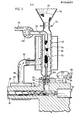
- FIG. 1 shows apparatus which plasticizes particulate plastic material into melt and feeds it for injection or extrusion molding.
- a conventional screw 10 is rotated in a barrel 12 by an electric or hydraulic motor l3 to carry the particulate plastic material received through an opening 14 in the barrel 12 towards a nozzle (not shown).
- the barrel 12 is heated by an electrical heating bands 16 and the screw has a conveying portion 18 adjacent the opening 14 and .a plasticizing portion 20 where the size of the screw shaft gradually increases downstream from the conveying portion.
- the particulate plastic material is carried (to the left in Figure 1) away from the barrel opening it is compressed and the heat and shearing forces cause it to gradually melt layer by layer, releasing entrapped volatiles. This process is amplified and accelerated by the considerable quantities of heat generated by friction in the material as it is "worked" by the screw.
- a supply of particulate plastic material 22 is provided by a hopper 24 which funnels the material through an inlet 26 in the barrel 28 of a separate conveying screw 30.
- the hopper 24 has an electrical heating strip 32 to preheat the particulate plastic material as described below.
- the screw 30 is rotated in the barrel 28 by a motor 34 and the speed of rotation is controlled by a motor speed control 36.
- the conveying screw 30 carries the particulate plastic material at a predetermined rate to a feed passage 38 extending vertically upward from the barrel inlet opening 14. The particulate material is fed into the feed passage 38 through an opening 40 and it falls downward through the opening 14 into the barrel 12 where it is carried away by the rotating screw 10.
- the feed passage 38 also.has a suction opening 42 to which a suction or negative pressure is applied by a nozzle 44 in an exhaust duct 46.
- the nozzle 44 has an annular space 48 to which compressed air is applied through.hose 50 to create a venturi which generates the suction.
- the suction could, of course, be supplied by a fan.
- the exhaust duct 46 extends to atmosphere or to air cleaning equipment to avoid the volatiles which often contain toxic gases contaminating the workplace.
- particulate plastic material 22 from the hopper 24 is carried by the conveying screw 30 to the feed passage 38 where it is dropped into the barrel 12 through the opening 14.
- the suction from the venturi nozzle 44 exhausts the hot volatiles released as the particulate plastic is gradually melted in the barrel l2.
- the speed of the motor 34 is controlled by the motor speed control 36 to restrict or control the rate at which the particulate material is fed into the barrel 12 so that it is only partially filled adjacent the opening 14.
- the molecular structure of the hygroscopic material allows moisture to be absorbed deep inside its particles. As the material moves along the barrel it is heated and "worked” by the action of the screw, particularly when it reaches the plasticizing portion 20.
- the screw l2 will normally gradually withdraw as it rotates and then periodically be actuated longitudinally forward to inject the melt according to a predetermined cycle.
- the feed of particulate material to the barrel 12 will be interrupted during injection by stopping rotation of the motor 34 using motor control circuit 36. This avoids a quantity of unmelted material being suddenly carried deep into the barrel l2 from where withdrawal of the hot volatiles is difficult if not impossible.
- a tubular guide member 52 is mounted between the hopper 24 and the inlet 26 to preheat the particulate plastic material flowing into the barrel 28 of the conveying screw 30.
- the guide member 52 has an upper inlet 54 which is bolted to the hopper 24 at an abutment flange 56 and a lower outlet 58 bolted to the barrel 28 at another abutment flange 60.
- the guide member 52 has a rigid outer body 62 and a meshed inner body 64.
- the outer body 62 is formed of a number of steel rings 66 welded in a vertically spaced configuration to provide generally annular apertures 68 between them.
- the apertures 68 are angled upwardly at about 45° to provide for the passage of air, but not the escape of particulate material from the inside of the guide member 52.
- An electrical annular heating band 70 is secured to the outer surface of each of the rings 66 and they are connected to a temperature controller (not shown) to heat air drawn into the guide member 52 through the apertures 68.
- the hollow inner body 64 of the guide member is centrally located in an4 spaced from the outer body 62 and has a meshed cylindrical wall 72.
- the inner body has an open bottom 74 and an upper end 76 which is connected by a conduit 78 to the exhaust duct 46 containing the suction nozzle 44.
- the outer body 62 of the guide member 52 is enclosed by a cylindrical housing 80 having an outer wall 82 formed of a conductive material such as sheet metal.
- the walls 82 has numerous small fins 84 projecting outward from it to promote heat transfer.
- This inner housing 80 has an inlet 86 which is connected by conduit 88 to a heat gathering manifold 90 mounted over the heated barrel 12 to collect hot air given off by it.
- a conventional damper 92 is pivotally mounted in the inlet conduit 88 and has an external control handle 94 by which it may be rotated to regulate the flow of.heated air to the inner housing 80.
- the inner housing 80 is, in turn, enclosed by a cylindrical outer housing 96 to provide a heat exchanger.
- This outer heat exchanger housing 96 has an inlet 98 and an outlet 100 which is also connected to the exhaust duct 46 containing the suction nozzle 44.
- the inlet 98 is connected to a conduit 102 leading to the suction opening 42 to the feed passage 38.
- a bypass conduit 104 branches from conduit l02 and extends to conduit 78 to carry the hot gases from the feed passage suction opening 42 directly to the exhaust duct 46.
- the bypass conduit 104 also has a damper 106 pivotally mounted in it with an external control handle 108 to regulate the proportion of hot gases which pass through the heat exchanger housing 96.
- the shearing action of the material as it is plasticized in the barrel 12 generates a considerable quantity of heat, most of which is withdrawn with the hot volatiles.
- these gases are drawn through the heat exchanger housing 96 where some of this waste heat is transferred to the incoming air in the inner housing 80.
- the incoming air collected by the manifold 90 is first heated by radiation from the hot barrel 12 and then by the heat transferred from the hot gases passing through the heat exchanger housing 96. Finally, if necessary, additional heat is provided by the heating bands 70 as the air flows through the apertures 68.
- the heating bands 70 need only be used during initial start-up.
- Preheating the particulate plastic material in the guide member 52 warms the particles through to their center and accelerates the process of removing the volatiles in the barrel 12. While the flow of hot air through it in the guide member does remove some surface moisture, the primary purpose is to preheat the material and it has been found that, for most plastics, preheating the material to temperatures in the range of l50-200°F will result in a product without defects due to entrapped gases.
- dampers 92 and l06 in conduits 88 and 104 are adjusted in conjunction with the suction applied by the suction nozzle 44 to regulate the flow through them for each particular application. Sufficient hot air must be drawn through the guide member 52 to preheat the particulate material to the desired temperature, but it is undesirable to heat it too high. Therefore, if a large amount of heat is being generated during plastification, damper 106 may be opened to bypass some of it through conduit 104.
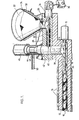
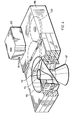
- FIG. 3 and 4 illustrate another embodiment of the invention.
- the incoming particulate plastic material is preheated in a guide member 52 as described above, but the means for controlling or regulating the flow of it is different.
- the conveying screw with the speed controlled motor have been replaced by a rotary valve arrangement 110 mounted in the top of the feed passage 38 leading to the barrel opening 14.
- the rotary valve 110 has three pitched blades 112 which rotate on a hollow central duct 114 in a collar 116 which is in alignment with the feed passage 38.
- the central duct 114 has a funnel-shaped mouth 117 and the blades l12 are mounted in valve block ll8 to be rotated in a counterclockwise direction through gears 120 by an electric motor 122.
- Rotation of the blades 112 is controlled in a manner described below by a motor speed control 124.
- the bottom 74 of the guide member inner body 64 is connected to a pipe 126 which extends downwardly to the central duct 114.
- the nozzle in exhaust duct 46 has been replaced by a centrifugal fan 128 to supply the suction.
- the particulate material from the hopper 24 is preheated as it flows down through the guide member 52.
- the blades 112 of the rotary valve 110 are shaped and pitched to block the downward flow of particulate material when they are not rotating. However, when they are rotated, they bite into the particulate material above them and scatter it at a controlled rate of feed down into the feed passage 38 below.
- the particulate plastic material is "worked" by the screw in the barrel, the heat, pressure and shearing forces gradually release the hot volatiles which are vented upwardly out of the barrel by feed passage 38 through the central duct 114 of the rotary valve 110.
Landscapes
- Engineering & Computer Science (AREA)
- Mechanical Engineering (AREA)
- Manufacturing & Machinery (AREA)
- Physics & Mathematics (AREA)
- Thermal Sciences (AREA)
- Processing And Handling Of Plastics And Other Materials For Molding In General (AREA)
- Injection Moulding Of Plastics Or The Like (AREA)
Priority Applications (1)
| Application Number | Priority Date | Filing Date | Title |
|---|---|---|---|
| AT84107883T ATE68744T1 (de) | 1983-07-22 | 1984-07-05 | Verfahren und vorrichtung zur beseitigung von feuchtigkeit und fluechtigen bestandteilen aus aus partikeln bestehendem plastikformwerkstoff. |
Applications Claiming Priority (4)
| Application Number | Priority Date | Filing Date | Title |
|---|---|---|---|
| CA433017 | 1983-07-22 | ||
| CA433017 | 1983-07-22 | ||
| CA000446499A CA1176017A (en) | 1984-02-01 | 1984-02-01 | Method and apparatus for removing moisture and volatiles from molding particulate plastic material feed |
| CA446499 | 1984-02-01 |
Publications (3)
| Publication Number | Publication Date |
|---|---|
| EP0134977A2 true EP0134977A2 (de) | 1985-03-27 |
| EP0134977A3 EP0134977A3 (en) | 1987-04-15 |
| EP0134977B1 EP0134977B1 (de) | 1991-10-23 |
Family
ID=25670106
Family Applications (1)
| Application Number | Title | Priority Date | Filing Date |
|---|---|---|---|
| EP84107883A Expired - Lifetime EP0134977B1 (de) | 1983-07-22 | 1984-07-05 | Verfahren und Vorrichtung zur Beseitigung von Feuchtigkeit und flüchtigen Bestandteilen aus aus Partikeln bestehendem Plastikformwerkstoff |
Country Status (2)
| Country | Link |
|---|---|
| EP (1) | EP0134977B1 (de) |
| DE (1) | DE3485203D1 (de) |
Cited By (14)
| Publication number | Priority date | Publication date | Assignee | Title |
|---|---|---|---|---|
| EP0336520A1 (de) * | 1988-04-08 | 1989-10-11 | Dsm N.V. | Verfahren zur Verarbeitung von einem durch Polykondensation hergestellten thermoplastischen Polymer |
| EP0357880A3 (en) * | 1988-08-24 | 1990-05-30 | Priesemuth W | Apparatus for producing reclaimed plastics |
| EP0457561A3 (en) * | 1990-05-17 | 1992-04-22 | Impact International Pty. Ltd. | Method and apparatus for making a laminated tubular body |
| US5409559A (en) * | 1992-05-20 | 1995-04-25 | Impact International Pty Ltd. | Making a laminated tubular body |
| EP0806282A1 (de) * | 1996-05-10 | 1997-11-12 | B a r m a g AG | Extruder für Kunststoffgranulat |
| WO2008035185A3 (en) * | 2006-09-21 | 2008-07-17 | Ferioli Filippo S P A | Apparatus and method for extrusion of plastic material |
| AT510263B1 (de) * | 2010-10-18 | 2012-03-15 | Schulz Helmuth Ing | Vorrichtung zum extrudieren von thermoplastischem kunststoffmaterial |
| EP2851175A1 (de) * | 2013-09-20 | 2015-03-25 | Ferromatik Milacron GmbH | Spritzgießmaschine |
| CN115464836A (zh) * | 2022-10-08 | 2022-12-13 | 重庆思普宁塑胶制品有限公司 | 一种智能化汽车配件注塑系统 |
| CN115782054A (zh) * | 2022-12-30 | 2023-03-14 | 丰铁塑机(广州)有限公司 | 一种自动化供料设备的工作方法 |
| CN116901395A (zh) * | 2023-07-17 | 2023-10-20 | 东莞金熙特高分子材料实业有限公司 | 一种可热量回收的pa材料用挤出机 |
| AT526268A1 (de) * | 2022-06-27 | 2024-01-15 | Engel Austria Gmbh | Plastifiziereinheit und/oder Einspritzeinheit für eine Formgebungsmaschine |
| CN118578594A (zh) * | 2024-07-01 | 2024-09-03 | 温州鼎程电子科技有限公司 | 一种空气流量计塑料外壳加工的注塑设备 |
| CN120755326A (zh) * | 2025-07-31 | 2025-10-10 | 广州市型腔模具制造有限公司 | 一种镁合金半固态注射成型装置 |
Family Cites Families (7)
| Publication number | Priority date | Publication date | Assignee | Title |
|---|---|---|---|---|
| CH434719A (de) * | 1963-07-17 | 1967-04-30 | Leybolds Nachfolger E | Vorrichtung zum Kunststoffspritzgiessen |
| US3470584A (en) * | 1965-11-30 | 1969-10-07 | Sekisui Chemical Co Ltd | Extruder for shaping powdery thermoplastic resins |
| CH480165A (de) * | 1967-10-04 | 1969-10-31 | Buehler Ag Geb | Verfahren zur Variation des Plastifiziervermögens einer Schneckenspritzgiessmaschine und Schneckenspritzgiessmaschine zur Durchführung des Verfahrens |
| US3940220A (en) * | 1970-12-29 | 1976-02-24 | Colgate-Palmolive Company | Method and equipment for the manufacture of variegated detergent bars |
| DE2235023C3 (de) * | 1972-07-17 | 1975-05-07 | Nordenia-Kunststoffe Peter Mager Kg, 2841 Steinfeld | Vorrichtung zum Vorwärmen pulverförmiger oder körniger thermoplastischer Kunststoffe |
| JPS4979667U (de) * | 1972-11-06 | 1974-07-10 | ||
| FR2332854A1 (fr) * | 1975-11-27 | 1977-06-24 | Manceau Marcel | Machine a vis de plastification telle que presse a injection, ou extrudeuse et leur procede d'utilisation |
-
1984
- 1984-07-05 DE DE8484107883T patent/DE3485203D1/de not_active Expired - Lifetime
- 1984-07-05 EP EP84107883A patent/EP0134977B1/de not_active Expired - Lifetime
Cited By (19)
| Publication number | Priority date | Publication date | Assignee | Title |
|---|---|---|---|---|
| EP0336520A1 (de) * | 1988-04-08 | 1989-10-11 | Dsm N.V. | Verfahren zur Verarbeitung von einem durch Polykondensation hergestellten thermoplastischen Polymer |
| EP0357880A3 (en) * | 1988-08-24 | 1990-05-30 | Priesemuth W | Apparatus for producing reclaimed plastics |
| EP0457561A3 (en) * | 1990-05-17 | 1992-04-22 | Impact International Pty. Ltd. | Method and apparatus for making a laminated tubular body |
| US5409559A (en) * | 1992-05-20 | 1995-04-25 | Impact International Pty Ltd. | Making a laminated tubular body |
| EP0806282A1 (de) * | 1996-05-10 | 1997-11-12 | B a r m a g AG | Extruder für Kunststoffgranulat |
| US5887972A (en) * | 1996-05-10 | 1999-03-30 | Barmag Ag | Extruder for plastic granules |
| WO2008035185A3 (en) * | 2006-09-21 | 2008-07-17 | Ferioli Filippo S P A | Apparatus and method for extrusion of plastic material |
| AT510263A4 (de) * | 2010-10-18 | 2012-03-15 | Schulz Helmuth Ing | Vorrichtung zum extrudieren von thermoplastischem kunststoffmaterial |
| AT510263B1 (de) * | 2010-10-18 | 2012-03-15 | Schulz Helmuth Ing | Vorrichtung zum extrudieren von thermoplastischem kunststoffmaterial |
| EP2851175A1 (de) * | 2013-09-20 | 2015-03-25 | Ferromatik Milacron GmbH | Spritzgießmaschine |
| AT526268A1 (de) * | 2022-06-27 | 2024-01-15 | Engel Austria Gmbh | Plastifiziereinheit und/oder Einspritzeinheit für eine Formgebungsmaschine |
| AT18384U1 (de) * | 2022-06-27 | 2024-12-15 | Engel Austria Gmbh | Plastifiziereinheit und/oder eine Einspritzeinheit für eine Formgebungsmaschine |
| CN115464836A (zh) * | 2022-10-08 | 2022-12-13 | 重庆思普宁塑胶制品有限公司 | 一种智能化汽车配件注塑系统 |
| CN115464836B (zh) * | 2022-10-08 | 2024-04-02 | 重庆思普宁科技股份有限公司 | 一种智能化汽车配件注塑系统 |
| CN115782054A (zh) * | 2022-12-30 | 2023-03-14 | 丰铁塑机(广州)有限公司 | 一种自动化供料设备的工作方法 |
| CN116901395A (zh) * | 2023-07-17 | 2023-10-20 | 东莞金熙特高分子材料实业有限公司 | 一种可热量回收的pa材料用挤出机 |
| CN116901395B (zh) * | 2023-07-17 | 2024-03-08 | 东莞金熙特高分子材料实业有限公司 | 一种可热量回收的pa材料用挤出机 |
| CN118578594A (zh) * | 2024-07-01 | 2024-09-03 | 温州鼎程电子科技有限公司 | 一种空气流量计塑料外壳加工的注塑设备 |
| CN120755326A (zh) * | 2025-07-31 | 2025-10-10 | 广州市型腔模具制造有限公司 | 一种镁合金半固态注射成型装置 |
Also Published As
| Publication number | Publication date |
|---|---|
| DE3485203D1 (de) | 1991-11-28 |
| EP0134977B1 (de) | 1991-10-23 |
| EP0134977A3 (en) | 1987-04-15 |
Similar Documents
| Publication | Publication Date | Title |
|---|---|---|
| US4632564A (en) | Apparatus for removing moisture and volatiles from molding particulate plastic material feed | |
| EP0134977B1 (de) | Verfahren und Vorrichtung zur Beseitigung von Feuchtigkeit und flüchtigen Bestandteilen aus aus Partikeln bestehendem Plastikformwerkstoff | |
| US8955294B2 (en) | Continuous bagging processes and systems | |
| CN107428421B (zh) | 连续打包工艺和系统 | |
| US9925694B2 (en) | Continuous bagging processes and systems | |
| CN1174000A (zh) | 膨胀烟草的方法和设备 | |
| US4636085A (en) | Apparatus for removing volatiles from plastic materials delivered to an extrusion or injection molding machine | |
| CA1176017A (en) | Method and apparatus for removing moisture and volatiles from molding particulate plastic material feed | |
| CA1036769A (en) | Device for automatically feeding flowable material to a production machine | |
| EP0580571A1 (de) | Verfahren und vorrichtung zum trocknen von abfall. | |
| US4387652A (en) | Furnace | |
| US4238216A (en) | Heating glass batch material | |
| IT201900005192A1 (it) | Impianto di estrusione per la lavorazione di materiale polimerico | |
| CN210336544U (zh) | 一种吹膜机自动上料装置 | |
| CN216977466U (zh) | 一种湿粉闭环输送及干燥系统 | |
| CN214136851U (zh) | 一种高效的塑料熔铸设备 | |
| US3019476A (en) | Cooling method and apparatus | |
| CN116135517A (zh) | 一种用于功能性包装膜的高效吹膜机 | |
| CN210705541U (zh) | 一种吹膜机上料装置 | |
| CA1327687C (en) | Removing volatiles from plastic materials delivered to an extrusion or injection molding machine | |
| CN118775874B (zh) | 一种等离子体弧炬及其使用方法 | |
| CN221969818U (zh) | 一种铝制软管生产用注料装置 | |
| CN217729653U (zh) | 一种塑料包装袋生产用吹膜机下料斗 | |
| CN213537785U (zh) | 一种高水分填料连续表面改性装置 | |
| CN216445426U (zh) | 一种具有自动加料功能的连续式热处理炉 |
Legal Events
| Date | Code | Title | Description |
|---|---|---|---|
| PUAI | Public reference made under article 153(3) epc to a published international application that has entered the european phase |
Free format text: ORIGINAL CODE: 0009012 |
|
| AK | Designated contracting states |
Designated state(s): AT BE CH DE FR GB IT LI LU NL SE |
|
| PUAL | Search report despatched |
Free format text: ORIGINAL CODE: 0009013 |
|
| AK | Designated contracting states |
Kind code of ref document: A3 Designated state(s): AT BE CH DE FR GB IT LI LU NL SE |
|
| 17P | Request for examination filed |
Effective date: 19870623 |
|
| 17Q | First examination report despatched |
Effective date: 19881011 |
|
| ITF | It: translation for a ep patent filed | ||
| GRAA | (expected) grant |
Free format text: ORIGINAL CODE: 0009210 |
|
| AK | Designated contracting states |
Kind code of ref document: B1 Designated state(s): AT BE CH DE FR GB IT LI LU NL SE |
|
| PG25 | Lapsed in a contracting state [announced via postgrant information from national office to epo] |
Ref country code: SE Effective date: 19911023 |
|
| REF | Corresponds to: |
Ref document number: 68744 Country of ref document: AT Date of ref document: 19911115 Kind code of ref document: T |
|
| REF | Corresponds to: |
Ref document number: 3485203 Country of ref document: DE Date of ref document: 19911128 |
|
| ET | Fr: translation filed | ||
| PG25 | Lapsed in a contracting state [announced via postgrant information from national office to epo] |
Ref country code: LU Free format text: LAPSE BECAUSE OF NON-PAYMENT OF DUE FEES Effective date: 19920731 |
|
| PLBE | No opposition filed within time limit |
Free format text: ORIGINAL CODE: 0009261 |
|
| STAA | Information on the status of an ep patent application or granted ep patent |
Free format text: STATUS: NO OPPOSITION FILED WITHIN TIME LIMIT |
|
| 26N | No opposition filed | ||
| PGFP | Annual fee paid to national office [announced via postgrant information from national office to epo] |
Ref country code: BE Payment date: 19930824 Year of fee payment: 10 |
|
| PGFP | Annual fee paid to national office [announced via postgrant information from national office to epo] |
Ref country code: GB Payment date: 19940627 Year of fee payment: 11 |
|
| PGFP | Annual fee paid to national office [announced via postgrant information from national office to epo] |
Ref country code: DE Payment date: 19940708 Year of fee payment: 11 |
|
| PGFP | Annual fee paid to national office [announced via postgrant information from national office to epo] |
Ref country code: FR Payment date: 19940711 Year of fee payment: 11 |
|
| PGFP | Annual fee paid to national office [announced via postgrant information from national office to epo] |
Ref country code: CH Payment date: 19940713 Year of fee payment: 11 |
|
| PGFP | Annual fee paid to national office [announced via postgrant information from national office to epo] |
Ref country code: AT Payment date: 19940714 Year of fee payment: 11 |
|
| PG25 | Lapsed in a contracting state [announced via postgrant information from national office to epo] |
Ref country code: BE Effective date: 19940731 |
|
| PGFP | Annual fee paid to national office [announced via postgrant information from national office to epo] |
Ref country code: NL Payment date: 19940731 Year of fee payment: 11 |
|
| BERE | Be: lapsed |
Owner name: MAPRO INC. Effective date: 19940731 |
|
| PG25 | Lapsed in a contracting state [announced via postgrant information from national office to epo] |
Ref country code: GB Effective date: 19950705 Ref country code: AT Effective date: 19950705 |
|
| PG25 | Lapsed in a contracting state [announced via postgrant information from national office to epo] |
Ref country code: LI Effective date: 19950731 Ref country code: CH Effective date: 19950731 |
|
| PG25 | Lapsed in a contracting state [announced via postgrant information from national office to epo] |
Ref country code: NL Effective date: 19960201 |
|
| GBPC | Gb: european patent ceased through non-payment of renewal fee |
Effective date: 19950705 |
|
| REG | Reference to a national code |
Ref country code: CH Ref legal event code: PL |
|
| NLV4 | Nl: lapsed or anulled due to non-payment of the annual fee |
Effective date: 19960201 |
|
| PG25 | Lapsed in a contracting state [announced via postgrant information from national office to epo] |
Ref country code: DE Effective date: 19960402 |
|
| PG25 | Lapsed in a contracting state [announced via postgrant information from national office to epo] |
Ref country code: FR Effective date: 19960430 |
|
| REG | Reference to a national code |
Ref country code: FR Ref legal event code: ST |
|
| REG | Reference to a national code |
Ref country code: FR Ref legal event code: ST |
|
| REG | Reference to a national code |
Ref country code: FR Ref legal event code: ST |