EP0135076A2 - Pyridazinon-Derivate, Verfahren zu ihrer Herstellung un ihre Verwendung als Fungizide - Google Patents
Pyridazinon-Derivate, Verfahren zu ihrer Herstellung un ihre Verwendung als Fungizide Download PDFInfo
- Publication number
- EP0135076A2 EP0135076A2 EP84108980A EP84108980A EP0135076A2 EP 0135076 A2 EP0135076 A2 EP 0135076A2 EP 84108980 A EP84108980 A EP 84108980A EP 84108980 A EP84108980 A EP 84108980A EP 0135076 A2 EP0135076 A2 EP 0135076A2
- Authority
- EP
- European Patent Office
- Prior art keywords
- formula
- alkyl
- halogen
- mono
- phenyl
- Prior art date
- Legal status (The legal status is an assumption and is not a legal conclusion. Google has not performed a legal analysis and makes no representation as to the accuracy of the status listed.)
- Granted
Links
- 0 CC(C)C1=C(C)C=NN(*)C1=O Chemical compound CC(C)C1=C(C)C=NN(*)C1=O 0.000 description 1
Classifications
-
- C—CHEMISTRY; METALLURGY
- C07—ORGANIC CHEMISTRY
- C07D—HETEROCYCLIC COMPOUNDS
- C07D237/00—Heterocyclic compounds containing 1,2-diazine or hydrogenated 1,2-diazine rings
- C07D237/02—Heterocyclic compounds containing 1,2-diazine or hydrogenated 1,2-diazine rings not condensed with other rings
- C07D237/06—Heterocyclic compounds containing 1,2-diazine or hydrogenated 1,2-diazine rings not condensed with other rings having three double bonds between ring members or between ring members and non-ring members
- C07D237/10—Heterocyclic compounds containing 1,2-diazine or hydrogenated 1,2-diazine rings not condensed with other rings having three double bonds between ring members or between ring members and non-ring members with hetero atoms or with carbon atoms having three bonds to hetero atoms with at the most one bond to halogen, e.g. ester or nitrile radicals, directly attached to ring carbon atoms
- C07D237/18—Sulfur atoms
-
- A—HUMAN NECESSITIES
- A01—AGRICULTURE; FORESTRY; ANIMAL HUSBANDRY; HUNTING; TRAPPING; FISHING
- A01N—PRESERVATION OF BODIES OF HUMANS OR ANIMALS OR PLANTS OR PARTS THEREOF; BIOCIDES, e.g. AS DISINFECTANTS, AS PESTICIDES OR AS HERBICIDES; PEST REPELLANTS OR ATTRACTANTS; PLANT GROWTH REGULATORS
- A01N43/00—Biocides, pest repellants or attractants, or plant growth regulators containing heterocyclic compounds
- A01N43/48—Biocides, pest repellants or attractants, or plant growth regulators containing heterocyclic compounds having rings with two nitrogen atoms as the only ring hetero atoms
- A01N43/58—1,2-Diazines; Hydrogenated 1,2-diazines
Definitions
- the present invention relates to new pyridazinone derivatives, processes for their preparation, fungicides which contain these compounds as active compounds, and processes for combating fungi.
- N-trichloromethylthio-tetrahydrophthalimide As a fungicide in agriculture and in fruit growing and horticulture (see, for example, Wegler, "Chemistry of Plant Protection Products and Pest Control", Vol. 2, p. 109 ff., Springer Verlag Berlin / Heidelberg / New York, 1970).
- the known agent can only be used before infection and its effect does not meet the requirements of practice at low application rates.
- R 1 is preferably a methyl or phenyl radical
- R 2 is a phenyl radical
- X is chlorine or bromine
- m is the number two
- n is the number one or two.
- the new pyridazinone derivatives of the formula I can be prepared by using 4,5-dihalopyridazin-3 (2H) one of the formula II with mercaptans of the formula III where R 1 , R 2 , X and n have the meaning given above, in the presence of a base, for example in an organic solvent, and the thio compounds IV thus obtained if necessary, in an inorganic or organic solvent, oxidized to compounds of the formula I.
- 4,5-dihalosubstituted pyridazinones of type II with mercaptans III in the presence of a base and in a non-nucleophilic solvent at temperatures between -40 ° C and + 100 ° C, but preferably between -20 ° C and + 50 ° C Brought reaction.
- Amines such as trimethylamine, triethylamine, triisobutylamine, dimethylethylamine, ethyldiisopropylamine, N, N-dimethylaniline, N, N-diethylaniline or 2- (diethylamino) ethanol are preferred as bases.
- Alcohols such as isopropanol, sec-butanol, tert-butanol, sec-isoamyl alcohol and tert-amyl alcohol may be mentioned as solvents.
- the oxidation is e.g. at temperatures between -20 and + 120 ° C, preferably between -10 and 80 ° C.
- the 5-benzylthio derivative can be obtained from this by column chromatography.
- the new active ingredients show a strong fungitoxic activity against phytopathogenic fungi. They are used in particular to prevent and cure plant diseases caused by microorganisms, such as Phytophthora infestans, Botrytis cinerea, Plasmopara viticola, Monilia fructigena, Alternaria solani, Sclerotinia sclerotiorum, Pyricularia oryzae, Pellicularia filamentosa, Selerotinia cinerea.
- microorganisms such as Phytophthora infestans, Botrytis cinerea, Plasmopara viticola, Monilia fructigena, Alternaria solani, Sclerotinia sclerotiorum, Pyricularia oryzae, Pellicularia filamentosa, Selerotinia cinerea.
- the active ingredients can simultaneously suppress the growth of two or more of the fungi mentioned and are highly tolerated by plants. Some of the active substances show curative properties, i.e. the agents can still be used after the plants have been infected by the pathogens in order to achieve a safe control success.
- the fungicidal compositions contain 0.1 to 95% (weight percent) of active ingredient, preferably 0.5 to 90%. Depending on the type of effect desired, the application rates are between 0.1 and 5 kg of active ingredient per ha.
- the active ingredients can also be used together with other active ingredients, e.g. Herbicides, insecticides, growth regulators and other fungicides, or mixed with fertilizers. In many cases, mixing with fungicides also results in an increase in the fungicidal spectrum of action; a number of these fungicide mixtures also have synergistic effects, i.e. the fungicidal activity of the combination product is greater than that of the added activity of the individual components.
- active ingredients e.g. Herbicides, insecticides, growth regulators and other fungicides, or mixed with fertilizers.
- mixing with fungicides also results in an increase in the fungicidal spectrum of action; a number of these fungicide mixtures also have synergistic effects, i.e. the fungicidal activity of the combination product is greater than that of the added activity of the individual components.
- the new active ingredients are applied, for example, in the form of directly sprayable solutions, suspensions, emulsions, also in the form of high-strength aqueous, oily or other dispersions, pastes, dusts, sprinkling agents, granules by spraying, dusting, scattering, spreading or pouring.
- the application forms depend entirely on the purposes; as a rule, they should ensure as fine a distribution of the new active substances as possible.
- mineral oil fractions of medium to high boiling point such as kerosene or diesel oil, furthermore coal tar oils etc., as well as oils of vegetable or animal origin, aliphatic, cyclic or aromatic hydrocarbons are used
- mineral oil fractions of medium to high boiling point such as kerosene or diesel oil, furthermore coal tar oils etc., as well as oils of vegetable or animal origin, aliphatic, cyclic or aromatic hydrocarbons
- benzene, toluene, xylene, paraffin, tetrahydronaphthalene, alkylated naphthalenes or their derivatives for example methanol, ethanol, propanol, butanol, chloroform, carbon tetrachloride, cyclohexanol, cyclo hexanone, chlorobenzene, isophorone etc., strongly polar solvents such as dimethylformamide, dimethyl sulfoxide, N-methylpyrrolidone, water etc.
- Aqueous application forms can be prepared from emulsion concentrates, pastes or wettable powders (wettable powders), oil dispersions by adding water.
- emulsions, pastes or oil dispersions the substances as such or dissolved in an oil or solvent can be homogenized in water by means of wetting agents, adhesives, dispersants or emulsifiers.
- concentrates consisting of an active substance, wetting agent, adhesive, dispersant or emulsifier and possibly solvent or oil can also be used, which are suitable for dilution with water.
- Powders, materials for spreading and dusts can be prepared by mixing or grinding the active substances together with a solid carrier.
- Granules e.g. Coating, impregnation and homogeneous granules can be produced by binding the active ingredients to solid carriers.
- Solid carriers are e.g. Mineral soils such as silica gel, silicas, silica gels, silicates, talc, kaolin, Attaclay, limestone, chalk, talc, bolus, loess, clay, dolomite, diatomaceous earth, calcium and magnesium sulfate, magnesium oxide, ground plastics, fertilizers such as e.g. Ammonium sulfate, ammonium phosphate, ammonium nitrate, ureas and vegetable products such as flour, bark, wood and nutshell flour, cellulose powder and other solid carriers.
- Mineral soils such as silica gel, silicas, silica gels, silicates, talc, kaolin, Attaclay, limestone, chalk, talc, bolus, loess, clay, do
- the comparative agent (cf.) is always the known active ingredient N-trichloromethylthio-tetrahydrophthalimide, which is particularly suitable for combating botrytis (Chem. Week, June 21, 1972, page 46).
- Pepper seedlings of the "Neusiedler Ideal Elite" variety after 4 to 5 leaves have developed well, are sprayed to runoff point with aqueous suspensions which contain 80% active ingredient and 20% emulsifier in the dry substance. After the spray coating has dried on, the plants are sprayed with a conidia suspension of the botrytis fungus aea and placed at 22 to 24 ° C. in a chamber with high atmospheric humidity. After 5 days, the disease on the untreated control plants developed so much that the resulting leaf necrosis covered most of the leaves.
- the result of the test shows that, for example, when used as a 0.05% active ingredient broth, the active ingredients 2a, 2b, 3b, 4b, 6b, 9b, 10b, 11b, 16b, 61b, 62b and 63b have a better fungicidal action (for example 97 %) show as the comparative (70 X).
- Leaves of potted plants of the "large meat tomato” variety are sprayed with an aqueous spray liquor which contains 80% active ingredient and 20% emulsifier in the dry matter. After the spray coating has dried on, the leaves are infected with a zoospore suspension of the fungus Phytophthora infestans. The plants are then placed in a steam-saturated chamber at temperatures between 16 and 18 ° C. After 5 days, the disease on the untreated but infected control plants developed so much that the fungicidal activity of the substances can be assessed.
- the result of the test shows that, for example, when used as a 0.025 Zige active ingredient broth, the active ingredients 1b, 2b, 3b, 4b, 6b, 9b, 10b, 11b, 18b, 61b, 62b, 63b, 67b and 72b have a better fungicidal action (for example 97%) show as the comparative (70%).
- Leaves of potted vines of the "Müller-Thurgau" variety are sprayed with an aqueous spray liquor which contains 80% active ingredient and 20% emulsifier in the dry matter.
- the plants are placed in the greenhouse for 10 days after the spray coating has dried on. Only then are the leaves infected with a zoospore suspension of Plasmopara viticola (vine peronospora).
- the vines are then placed for 16 hours in a steam-saturated chamber at 24 ° C and then for 8 days in a greenhouse with temperatures between 20 and 30 ° C. After this time, the plants are again placed in the moist chamber for 16 hours to accelerate the sporangium carrier outbreak.
- the result of the test shows that, for example, the active ingredients Ib, 2b, 3b, 4b, 6a, 6b, 7b, 9b, 10b, 11b, 12b, 13b, 16b, 18b, 23b, 33b, 62b, 64b, 67b, 78b, 89b and 91b have a good fungicidal activity (for example 90%).
Landscapes
- Chemical & Material Sciences (AREA)
- Organic Chemistry (AREA)
- Life Sciences & Earth Sciences (AREA)
- Agronomy & Crop Science (AREA)
- Pest Control & Pesticides (AREA)
- Plant Pathology (AREA)
- Health & Medical Sciences (AREA)
- Engineering & Computer Science (AREA)
- Dentistry (AREA)
- General Health & Medical Sciences (AREA)
- Wood Science & Technology (AREA)
- Zoology (AREA)
- Environmental Sciences (AREA)
- Agricultural Chemicals And Associated Chemicals (AREA)
- Plural Heterocyclic Compounds (AREA)
- Pharmaceuticals Containing Other Organic And Inorganic Compounds (AREA)
- Nitrogen Condensed Heterocyclic Rings (AREA)
Abstract
Description
- Die vorliegende Erfindung betrifft neue Pyridazinon-Derivate, Verfahren zu ihrer Herstellung, Fungizide, die diese Verbindungen als Wirkstoffe enthalten, sowie Verfahren zur Bekämpfung von Pilzen.
- Es ist bekannt, N-Trichlormethylthio-tetrahydrophthalimid als Fungizid in der Landwirtschaft sowie im Obst- und Gartenbau einzusetzen (vgl. z.B. Wegler, "Chemie der Pflanzenschutz- und Schädlingsbekämpfungsmittel", Bd. 2, S. 109 ff, Springer Verlag Berlin/Heidelberg/New York, 1970). Das bekannte Mittel ist jedoch nur vor der Infektion verwendbar und seine Wirkung genügt bei niedrigen Aufwandmengen den Anforderungen der Praxis nicht.
- Es wurde nun gefunden, daß Pyridazinon-Derivate der Formel I

- R1 Wasserstoff; C1-C8-Alkyl, ggf. ein- oder mehrfach durch Halogen sub stituiert; C3-C7-Cycloalkyl; Phenyl, ggf. ein- oder mehrfach, gleich oder verschieden substituiert durch Halogen, Cl-C4-Alkyl, Mono-, Di-oder Trihalogen-C1-C3-Alkyl, Mono-, Di- oder Trihalogen-C1-C3-Alkoxy, C1-C4-Alkoxy, Ci-C4-Alkylthio, C1-C4-Alkylsulfinyl, C1-C4-Alkylsulfonyl, C1-C4-Alkoxycarbonyl, Mono- oder Di-(C1-C4-Alkyl)--carbamoyl, Cyan, Thiocyan oder Nitro; Carboxyl; Hydroxymethyl; -CH2O-COR3, wobei R3 CI-C6-Alkyl bedeutet; -CH2O[CH2CH2O]pR4, wobei R4 Cl-C4-Alkyl oder Phenyl und p 1, 2 oder 3 bedeutet;
- R2 Phenyl, ggf. ein- oder mehrfach, gleich oder verschieden substituiert durch Halogen, C1-C4-Alkyl (ggf. ein- oder mehrfach mit Halogen substituiert), C1-C4-Alkoxy (ggf. ein- oder mehrfach mit Halogen substituiert), CI-C4-Alkylthio, C1-C4-Alkylsulfinyl, C1-C4-Alkylsulfonyl, Mono- oder Di-(C1-C4-Alkyl)-carbamoyl, Cyan, Thiocyan oder Nitro; Vinyl oder 2-Propenyl;
- X Halogen
- m 1 oder 2 und
- n 1, 2, 3 oder 4
- In der Formel I bedeutet R1 vorzugsweise einen Methyl- oder Phenylrest, R 2 einen Phenylrest, X Chlor oder Brom, m die Zahl zwei und n die Zahlen eins oder zwei.
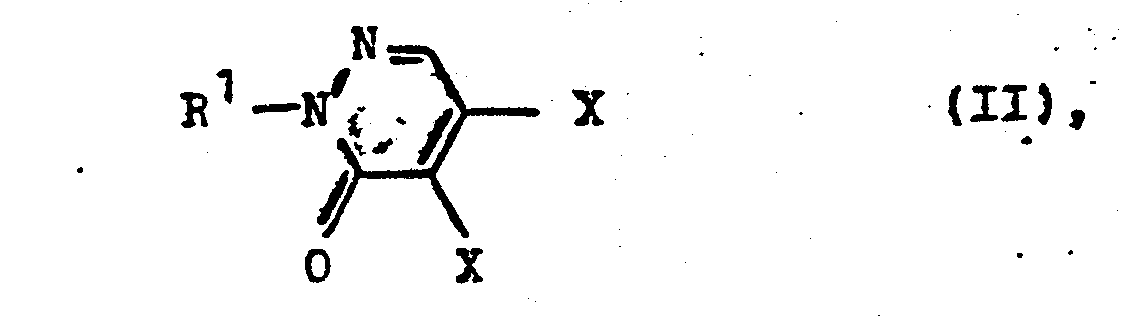
- Die neuen Pyridazinon-Derivate der Formel I lassen sich herstellen, indem man 4,5-Dihalogen-pyridazin-3(2H)one der Formel II


- Verbindungen des Typs IV sind bereits bekannt, jedoch werden bei den bekannten Herstellungsmethoden zwei Stufen benötigt, ausgehend von der Dihalogenverbindung II oder sie liefern unerwünschte Nebenprodukte. In Chem. Abstr. 68, 2906 c (1968) wird die Herstellung von 4-Chlor-5-mer- capto-2-phenyl-pyridazin-3(2H)-on (V), ausgehend von 4,5-Dichlor-2--phenyl-pyridazin-3(2H)-on (II, R1 = C6H5, X » Cl) und Natriumhydrogensulfid, beschrieben, das mit Benzylchlorid und Natrium- sowie Ammoniumhydroxid zum gewünschten 5-Benzylthio-4-chlor-2-phenyl-pyridzain-3(2H)-on umgesetzt wird.
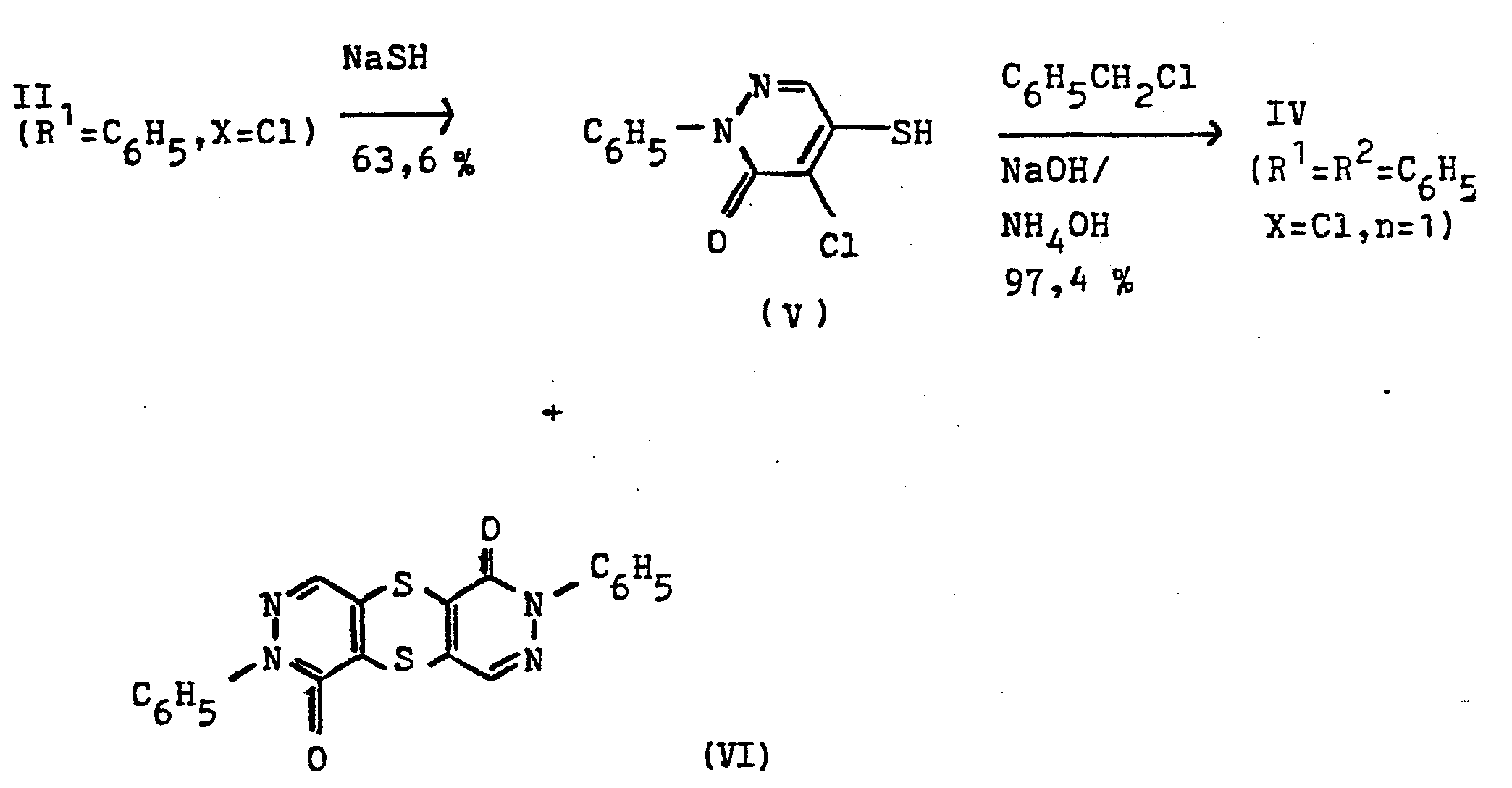
- Eine weitere bekannte Methode (vgl. R.F. Meyer, J. Heterocyclic Chem. 6, 407 bis 408 (1969)) liefert, ausgehend von 4,5-Dichlor-2-methyl-pyridazin-3(2H)-on (II, R1 = CH3, X = Cl), in einer Stufe das gewünschte 5-Benzylthio-4-chlor-2-methyl-pyridazin-3(2H)-on (IV, R1 = CH3, R2 - C6H5, X = C1, n = 1), jedoch nur in 37 % Ausbeute; zudem ist das benötigte S-Benzyl-isothiouronium-chlorid nicht kommerziell erhältlich, sondern muß speziell hergestellt werden.
- Wie eigene Versuche ergaben, besteht zudem die Möglichkeit der Entstehung der unerwünschten Produkte VII und VIII.

- Hierzu werden 4,5-dihalogensubstituierte Pyridazinone des Typs II mit Mercaptanen III in Anwesenheit einer Base und in einem nichtnucleophilen Lösungsmittel bei Temperaturen zwischen -40°C und +100°C, vorzugsweise aber zwischen -20°C und +50°C, zur Reaktion gebracht.
- Als Basen werden Amine bevorzugt wie Trimethylamin, Triethylamin, Triisobutylamin, Dimethylethylamin, Ethyldiisopropylamin, N,N-Dimethylanilin, N,N-Diethylanilin oder 2-(Diethylamino)-ethanol.
- Als Lösungsmittel seien Alkohole wie Isopropanol, sec-Butanol, tert-Butanol, sec-Isoamylalkohol und tert-Amylalkohol genannt.
- Zur Oxidation der 5-thiosubstituierten Pyridazinone IV zu 5-sulfinyl-substituierten (I, m = 1) bzw. 5-sulfonylsubstituierten (I, m = 2) Pyridazinonen können beispielsweise verwendet werden:
- Peroxide, wie Wasserstoffperoxid, tert.-Butylhydroperoxid; Persäuren, wie Perameisensäure, Peressigsäure, Perbenzoesäure oder m-Chlorperbenzoesäure; Peroidate, wie Natrium- oder Kaliumperiodat; Permanganate, wie Natrium- oder Kaliumpermanganat; tert.-Butylhypochlorit oder Jodbenzoldichlorid.
- Als Lösungsmittel können benutzt werden:
- Wasser; Carbonsäuren wie Ameisen-, Essig- oder Propionsäure; halogenierte Kohlenwasserstoffe wie Dichlormethan, Chloroform, 1,2-Dichlorethan, 1,1,1-Trichlorethan oder 1,1,2,2-Tetrachlorethan.
- Die Oxidation wird z.B. bei Temperaturen zwischen -20 und +120°C, vorzugsweise zwischen -10 und 80°C, ausgeführt. Je nach Anzahl der eingesetzten Äquivalente Oxidationsmittel je Äquivalent der Verbindung IV können die entsprechenden Sulfoxide (I, m = 1) oder die Sulfone (I, m - 2) erhalten werden.
- Die Herstellung der erforderlichen 4,5-dihalogensubstituierten Pyridazinone II ist bekannt (vgl. K. Dury, Angew. Chem. 77, 282 bis 290 (1965)), ebenso die der benötigten Mercaptane (vgl. J.L. Wardell in S. Patai, "The Chemistry of the Thiol Group" Bd. 1, S. 179 bis 211, Wiley & Sons New York 1974).
- Die nachfolgenden Beispiele dienen zur Erläuterung der Erfindung, ohne diese einzuschränken.
- Herstellung von 5-Benzylthio-4-chlor-2-phenyl-pyridazin-3(2H)-on mit Natriummethylat als Base.
- Man legt 5,4 g (100 mmol) Natriummethylat in 250 ml trockenem Methanol vor, kühlt auf 0°C ab, tropft langsam 12,4 g (100 mmol) Benzylmercaptan zu und gibt anschließend bei der gleichen Temperatur 24,1 g (100 mmol) 4,5-Dichlor-2-phenyl-pyridazin-3(2H)-on zu. Danach läßt man die Temperatur langsam auf Raumtemperatur (20°C) kommen und rührt 24 h nach, zuletzt 5 h bei 60°C. Die Reaktionslösung wird eingeengt, der Rückstand mit Wasser versetzt, mit Salzsäure auf pH 3 gestellt und mit Dichlormethan extrahiert. Nach Waschen der organ. Phase mit verd. NaHCO3-Lösung wird diese über MgS04 getrocknet und eingeengt. Abziehen des Solvens ergibt 29,1 g Rohmaterial, das man aus Ethanol umkristallisiert. Ein darin unlöslicher Rückstand (5,0 g) wird abfiltriert; er besitzt nach Trocknen einen Schmp. von 158 bis 160°C (Lit. 163 bis 164°C; vgl. R.N. Castle und K.Kaji, J. Heterocyclic Chem. 2, 463 bis 472 (1965)) und ist identisch mit 4,5-Bis(benzylthio)-2-phenyl-pyridazin-3(2H)-on (VIII, R1 = C6H5, R2 = CH2C6H5). Das aus dem Filtrat auskristallisierende Material (21,2 g) besitzt doppelten Schmp. (115 bis 119°C; 135 bis 140°C), weist im Dünnschichtchromatogramm zwei eng benachbarte Flecke auf und besteht aus 5-Benzylthio-4-chlor-pyridazin-3(2H)-on (IV, R1 = R2 = C6H5, X = Cl, n = 1) sowie dem stellungsisomeren 4-Benzylthio-5-chlor-2-phenyl--pyridazin-3(2H)-on (VII, R1 = C6H5, R2 = CH2C6H5, X - Cl) im ungefähren Verhältnis 1:1 (NMR-Analyse). Durch säulenchromatographische Trennung ist hieraus das 5-Benzylthio-Derivat erhältlich.
- 24,1 g (100 mmol) 4,5-Dichlor-2-phenyl-pyridazin-3(2H)-on werden bei -20°C in 150 ml Isopropanol suspendiert und eine gekühlte Mischung aus 12,4 g (100 mmol) Benzylmercaptan, 10,1 g (100 mmol) Triethylamin und 150 ml Isopropanol zugetropft. Anschließend wird 2 h bei -10°C nachgerührt, über Nacht bei Raumtemperatur sowie danach 2,5 h bei 40°C. Nach Abkühlen saugt man den entstandenen Niederschlag ab, wäscht mit Isopropanol und Wasser nach und löst aus Toluol um. Das erhaltene Material (19,5 g, 59 %) ist dünnschichtchromatographisch einheitlich und schmilzt bei 139 bis 140°C.
- Die wie in Vorschrift 2 beschrieben vorgenommene Umsetzung von 15,8 g (100 mmol) 4-Chlor-benzylmercaptan mit 24,1 g (100 mmol) 4,5-Dichlor-2--phenyl-pyridazin-3(2H)-on und 10,1 g (100 mmol) Triethylamin liefert 30,5 g (84 X) dünnschichtchromatographisch einheitliches Material mit Schmp. 154 bis 155°C.
- 35,8 g (200 mmol) 4,5-Dichlor-2-methyl-pyridazin-3(2H)-on werden in 300 ml Isopropanol suspendiert und auf -20°C abgekühlt. Bei dieser Temperatur wird eine Lösung von 24,8 g (200 mmol) Benzylmercaptan und 20,2 g (200 mmol) Triethylamin in 200 ml Isopropanol zugetropft, danach 1 h bei -10°C sowie über Nacht bei Raumtemperatur nachgerührt. Den entstandenen Niederschlag saugt man ab, wäscht mit Isopropanol und Wasser nach und trocknet im Vakuum. Ausb. 31,7 g (60 %), Schmp. 102 bis 104°C.
- Wie in Vorschrift 4 angegeben bringt man 40,2 g (150 mmol) 4,5-Dibrom-2--methyl-pyridazin-3(2H)-on mit 18,6 g (150 mmol) Benzylmercaptan und 15,1 g (150 mmol) Triethylamin in insgesamt 400 ml Isopropanol zur Reaktion. Ausbeute 20,0 g (43 X), Schmp. 118 bis 121°C.
- 9,8 g (30 mmol) 5-Benzylthio-4-chlor-2-phenyl-pyridazin-3(2H)-on aus Vorschrift 2 wurden in 100 ml Eisessig bei 60°C gelöst und 25 ml 30 proz. Wasserstoffperoxid zugetropft. Anschließend hielt man 3 h bei 65°C, ließ abkühlen, saugte den entstandenen Niederschlag ab, wusch ihn mit Wasser peroxidfrei und trocknete im Vakuum. Ausbeute 7,9 g (73 X), Schmp. 154 bis 156°C (Wirkstoff Nr. 61 b)
- 16,0 g (60,0 mmol) 5-Benzylthio-4-chlor-2-methyl-pyridazin-3(2H)-on aus Vorschrift 4 wurden in 200 ml Dichlormethan gelöst, auf -20°C abgekühlt und eine Lösung von 11,4 g (66,1 mmol) m-Chlorperbenzoesäure in Dichlormethan zugetropft. Man ließ 1 h bei -10°C, danach über Nacht bei Raumtemperatur nachrühren. Die Reaktionslösung wurde dreimal mit gesättigter NaBC03-Lösung und einmal mit Wasser gewaschen, getrocknet und eingeengt. Der Rückstand wurde mit Diethylether angerieben und abgesaugt. Ausbeute 13,1 g (77 X), Schmp. 129 bis 131°C (Wirkstoff Nr. 2 a).
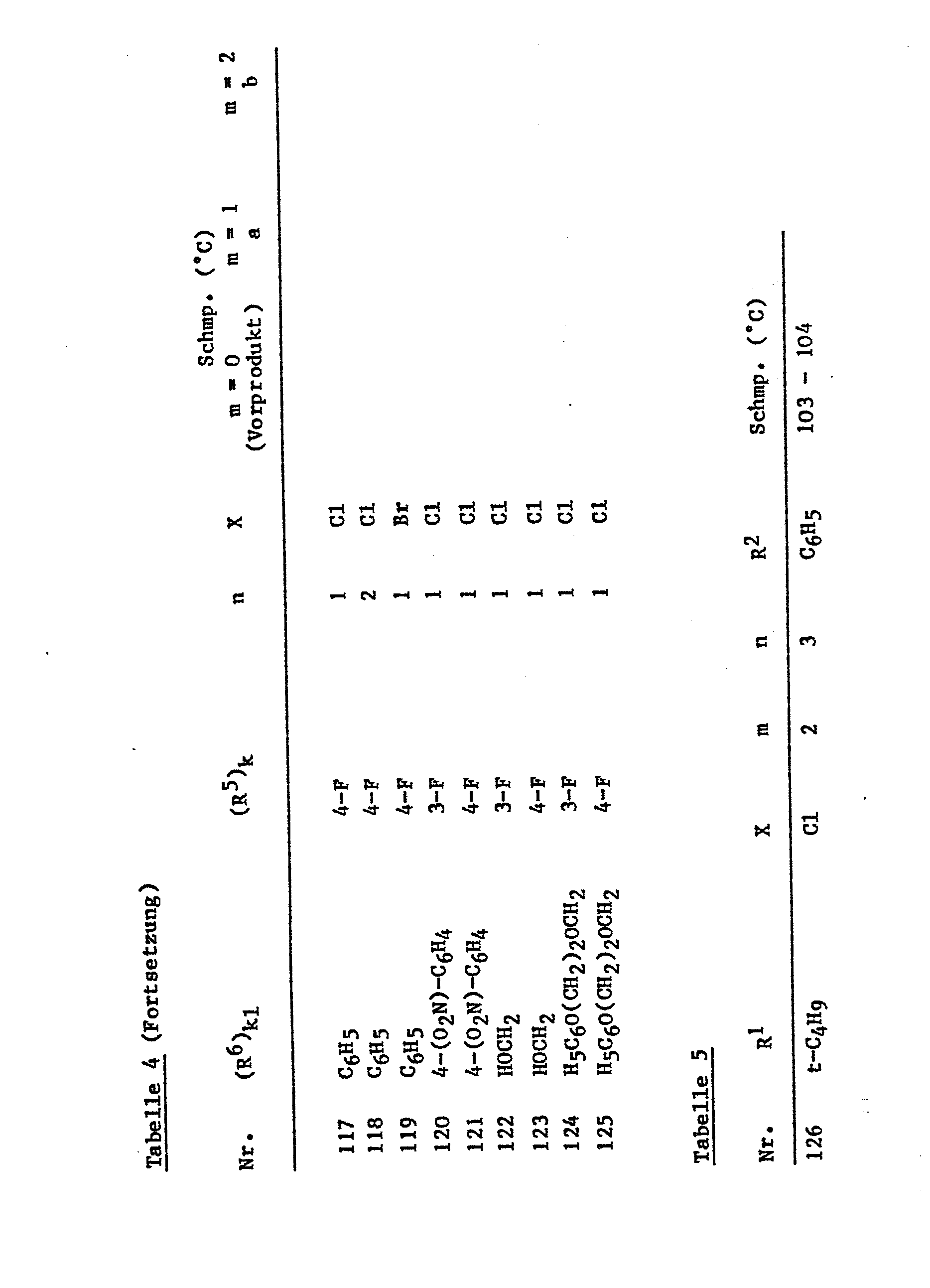
- Nach den genannten Methoden lassen sich folgende Pyridazinon-Derivate herstellen:


- Die neuen Wirkstoffe zeigen eine starke fungitoxische Wirksamkeit gegen phytopathogene Pilze. Sie dienen insbesondere zur Verhütung und Heilung von Pflanzenkrankheiten, die durch Mikroorganismen verursacht werden, wie z.B. Phytophthora infestans, Botrytis cinerea, Plasmopara viticola, Monilia fructigena, Alternaria solani, Sclerotinia sclerotiorum, Pyricularia oryzae, Pellicularia filamentosa, Selerotinia cinerea.
- Die Wirkstoffe können gleichzeitig das Wachstum von zwei oder mehr der genannten Pilze unterdrücken und besitzen eine hohe Pflanzenverträglichkeit. Ein Teil der Wirkstoffe zeigt kurative Eigenschaften, d.h. die Anwendung der Mittel kann noch nach erfolgter Infektion der Pflanzen durch die Krankheitserreger vorgenommen werden, um einen sicheren Bekämpfungserfolg zu erzielen.
- Die fungiziden Mittel enthalten 0,1 bis 95 % (Gewichtsprozent) Wirkstoff, vorzugsweise 0,5 bis 90 %. Die Aufwandmengen liegen je nach Art des gewünschten Effektes zwischen 0,1 bis 5 kg Wirkstoff je ha.
- Die Wirkstoffe können auch zusammen mit anderen Wirkstoffen, z.B. Herbiziden, Insektiziden, Wachstumsregulatoren und anderen Fungiziden, oder auch mit Düngemitteln vermischt ausgebracht werden. In vielen Fällen erhält man bei der Mischung mit Fungiziden auch eine Vergrößerung des fungiziden Wirkungsspektrums; bei einer Anzahl dieser Fungizidmischungen treten auch synergistische Effekte auf, d.h. die fungizide Wirksamkeit des Kombinationsproduktes ist größer als die der addierten Wirksamkeiten der Einzelkomponenten.
- Fungizide, die mit den neuen Verbindungen kombiniert werden können, sind beispielsweise:
- Schwefel,
- Dithiocarbamate und deren Derivate, wie
- Ferridimethyldithiocarbamat
- Zinkdimethyldithiocarbamat
- Zinkethylenbisdithiocarbamat
- Manganethylenbisdithiocarbamat
- Mangan-Zink-ethylendiamin-bis-dithiocarbamat
- Tetramethylthiuramdisulfide
- Ammoniak-Komplex von Zink-(N,N'-ethylen-bis-dithiocarbamat)
- Ammoniak-Komplex von Zink-(N,N'-propylen-bis-dithiocarbamat)
- Zink-(N,N'-propylen-bis-dithiocarbamat)
- N,N'-Polypropylen-bis-(thiocarbamoyl)-disulfid
- Nitroderivate, wie
- Dinitro-(1-methylheptyl)-phenylcrotonat
- 2-sec.-Butyl-4,6-dinitrophenyl-3,3-dimethylacrylat
- 2-sec.-Butyl-4,6-dinitrophenyl-isopropylcarbonat
- 5-Nitro-isophthalsäure-di-isopropylester,
- heterocyclische Strukturen, wie
- 2-Heptadecyl-2-imidazolin-acetat
- 2,4-Dichlor-6-(o-chloranilino)-s-triazin
- 0,0-Diethyl-phthalimidophosphonothioat
- 5-Amino-1-(bis-(dimethylamino)-phosphinyl)-3-phenyl-1,2,4- triazol)
- 2,3-Dicyano-1,4-dithiaanthrachinon
- 2-Thio-1,3-dithio-(4,5,6)-chinoxalin
- 1-(Butylcarbamoyl)-2-benzimidazol-carbaminsäuremethylester
- 2-Methoxycarbonylamino-benzimidazol
- 2-(Furyl-(2)-benzimidazol
- 2-(Thiazolyl-(4)-benzimidazol
- N-(1,1,2,2-Tetrachlorethylthio)-tetrahydrophthalimid
- N-Trichlormethylthio-tetrahydrophthalimid
- N-Trichlormethyl-phthalimid
- N-Dichlorfluormethylthio-N',N'-dimethyl-N-phenyl-schwefelsäurediamid
- 5-Ethoxy-3-trichlormethyl-1,2,3-thiadiazol
- 2-Rhodanmethylthiobenzthiazol
- 1,4-Dichlor-2,5-dimethoxybenzol
- 4-(2-Chlorphenylhydrazono)-3-methyl-5-isoxazolon
- Pyridin-2-thio-1-oxid
- 8-Hydroxychinolin bzw. dessen Kupfersalz
- 2,3-Dihydro-5-carboxanilido-6-methyl-1,4-oxathiin
- 2,3-Dihydro-5-carboxanilido-6-methyl-l,4-oxathiin-4,4-dioxid
- 2-Methyl-5,6-dihydro-4-H-pyran-3-carbonsäure-anilid
- 2-Methyl-furan-3-carbonsäureanilid
- 2,5-Dimethyl-furan-3-earbonsäureanilid
- 2,4,5-Trimethyl-furan-3-carbonsäureanilid
- 2,5-Dimethyl-furan-3-carbonsäurecyclohexylamid
- N-Cyclohexyl-N-methoxy-2,5-dimethyl-furan-3-carbonsäureamid
- 2-Methyl-benzoesäure-anilid
- 2-Jod-benzoesäure-anilid
- N-Formyl-N-morpholin-2,2,2-trichlorethylacetal
- Piperazin-1,4-diylbis-(1-(2,2,2-trichlor-ethyl)-formamid
- 1-(3,4-Dichloranilino)-1-formylamino-2,2,2-trichlorethan
- 2,6-Dimethyl-N-tridecyl-morpholin bzw. dessen Salze
- 2,6-Dimethyl-N-cyclododecyl-morpholin bzw. dessen Salze
- N-[3-(p-tert.-Butylphenyl)-2-methylpropyl]-cis-2,6-dimethylmorpholin
- N-[3-(p-tert.-Butylphenyl)-2-methylpropyl]-piperidin
- 1-[2-(2,4-Dichlorphenyl)-4-ethyl-1,3-dioxolan-2-yl-ethyl]-1H-1,2,4-triazol
- 1[2-(2,4-Dichlorphenyl)-4-n-propyl-1,3-dioxolan-2-yl-ethyll-1-H-1,2,4-triazol
- N-(n-Propyl)-N-(2,4,6-trichlorphenoxyethyl)-N'-imidazol-yl-harnstoff
- 1-(4-Chlorphenoxy)-3,3-dinethyl-1-(1H-1,2,4-triazol-1-yl)-2-butanon
- 1-(4-Chlorphenoxy)-3,3-dimethyl-1-(lE-1,2,4-triazol-1-yl)-2-butanol
- α-(2-Chlorphenyl)-α-(4-chlorphenyl)-5-pyrimidin-methanol
- 5-Butyl-2-dimethylamino-4-hyroxy-6-methyl-pyrimidin
- Bis-(p-chlorphenyl)-3-pyridinmethanol
- 1,2-Bis-(3-ethoxycarbonyl-2-thioureido)-benzol
- 1,2-Bis-(3'-methoxycarbonyl-2-thioureido)-benzol
- Dodecylguanidinacetat
- 3-(3-(3,5-Dimethyl-2-oxycyclohexyl)-2-hydroxyethyl)-glutaramid Hexachlorbenzol
- DL-Methyl-N-(2,6-dimethyl-phenyl)-N-furoyl(2)-alaninat, DL-N-(2,6-Dimethyl-phenyl)-N-(2'-methoxyacetyl)-alaninmethylester N-(2,6-Dimethylphenyl)-N-chloracetyl-D,L-2-aminobutyrolacton DL-N-(2,6-Dimethylphenyl)-N-(phenylacetyl)-alaninmethylester 5-Methyl-5-vinyl-3-(3,5-dichlorphenyl)-2,4-dioxo-1,3-oxazolidin 3-(3,5-Dichlorphenyl(-5-methyl-5-methoxymethyl-1,3-oxazolidin-2,4-dion 3-(3,5-Dichlorphenyl)-1-isopropylcarbamoylhydantoin N-(3,5-Dichlorphenyl)-1,2-dimethylcyclopropan-1,2-dicarbonsäureimid.
- Die neuen Wirkstoffe werden beispielsweise in Form von direkt versprühbaren Lösungen, Suspensionen, Emulsionen, auch in Form von hochprozentigen wäßrigen, öligen oder sonstigen Dispersionen, Pasten, Stäubemitteln, Streumitteln, Granulaten durch Versprühen, Verstäuben, Verstreuen, Verstreichen.oder Gießen ausgebracht. Die Anwendungsformen richten sich ganz nach den Verwendungszwecken; sie sollten in der Regel möglichst eine feine Verteilung der neuen Wirkstoffe gewährleisten.
- Zur Herstellung von direkt oder nach Emulgieren in Wasser verwendbaren Lösungen, Emulsionen, Pasten und öldispersionen kommen Mineralölfraktionen von mittlerem bis hohem Siedepunkt, wie Kerosin oder Dieselöl, ferner Kohlenteeröle usw., sowie öle pflanzlichen oder tierischen Ursprungs, aliphatische, cyclische oder aromatische Kohlenwasserstoffe, zum Beispiel Benzol, Toluol, Xylol, Paraffin, Tetrahydronaphthalin, alkylierte Naphthaline oder deren Derivate z.B. Methanol, Ethanol, Propanol, Butanol, Chloroform, Tetrachlorkohlenstoff, Cyclohexanol, Cyclohexanon, Chlorbenzol, Isophoron usw., stark polare Lösungsmittel, wie z.B. Dimethylformamid, Dimethylsulfoxid, N-Methylpyrrolidon, Wasser usw. in Betracht.
- Wäßrige Anwendungsformen können aus Emulsionskonzentraten, Pasten oder netzbaren Pulvern (Spritzpulvern), öldispersionen durch Zusatz von Wasser bereitet werden. Zur Herstellung von Emulsionen, Pasten oder öldispersionen können die Substanzen als solche oder in einem öl oder Lösungsmittel gelöst, mittels Netz-, Haft-, Dispergier- oder Emulgiermittel in Wasser homogenisiert werden. Es können aber auch aus wirksamer Substanz, Netz-, Haft-, Dispergier- oder Emulgiermittel und eventuell Lösungsmittel oder Öl bestehende Konzentrate hergestellt wenden, die zur Verdünnung mit Wasser geeignet sind.
- Als oberflächenaktive Stoffe kommen Alkali-, Erdalkali-, Ammoniumsalze von Ligninsulfonsäure, Naphthalinsulfonsäuren, Phenolsulfonsäure, Alkylarylsulfonate, Alkylsulfate, Alkylsulfonate, Alkali- und Erdalkalisalze der Dibutylnaphthalinsulfonsäure, Laurylethersulfat, Fettalkoholsulfate, fettsaure Alkali- und Erdalkalisalze, Salze sulfatierter Hexadecanole, Heptadecanole, Octadecanole, Salze von sulfatiertem Fettalkoholglykolether, Kondensationsprodukte von sulfoniertem Naphthalin und Naphthalinderivaten mit Formaldehyd, Kondensationsprodukte des Naphthalins bzw. der Naphthalinsulfonsäuren mit Phenol und Formaldehyd, Polyoxyethylen-octylphenolether, ethoxyliertes Isooctylphenol, Octylphenol, Nonylphenol, Alkylphenolpolyglykolether, Tributylphenylpolyglykolether, Alkylarylpolyetheralkohole, Isotridecylalkohol, Fettalkoholethylenoxid-Kondensate, ethoxyliertes Rizinusöl, Polyoxyethylenalkylether, ethoxyliertes Polyoxypropylen, Laurylalkoholpolyglykoletheracetal, Sorbitester, Lignin, Sulfitablaugen und Methylcellulose in Betracht.
- Pulver, Streu- und Stäubemittel können durch Mischen oder gemeinsames Vermahlen der wirksamen Substanzen mit einem festen Trägerstoff hergestellt werden.
- Granulate, z.B. Umhüllungs-, Imprägnierungs- und Homogengranulate, können durch Bindung der Wirkstoffe-an feste Trägerstoffe hergestellt werden. Feste Trägerstoffe sind z.B. Mineralerden wie Silicagel, Kieselsäuren, Kieselgele, Silikate, Talkum, Kaolin, Attaclay, Kalkstein, Kreide, Talkum, Bolus, Löß, Ton, Dolomit, Diatomeenerde, Calcium- und Magnesiumsulfat, Magnesiumoxid, gemahlene Kunststoffe, Düngemittel, wie z.B. Ammoniumsulfat, Ammoniumphosphat, Ammoniumnitrat, Harnstoffe und pflanzliche Produkte, wie Getreidemehle, Baumrinden-, Holz- und Nußschalenmehl, Cellulosepulver und andere feste Trägerstoffe.
- Beispiele für solche Pflanzenschutzmittel-Zubereitungen sind:
- I. Man vermischt 90 Gewichtsteile der Verbindung des Beispiels 1 mit 100 Gewichtsteilen N-Methylpyrrolidon und erhält eine Lösung, die zur Anwendung in Form kleinster Tropfen geeignet ist.
- II. 20 Gewichtsteile der Verbindung des Beispiels 2 werden in einer Mischung gelöst, die aus 80 Gewichtsteilen Xylol, 10 Gewichtsteilen des Anlagerungsproduktes von 8 bis 10 Mol Ethylenoxid an 1 Mol Ölsäure-N-monoethanolamid, 5 Gewichtsteilen Calciumsalz der Doedecylbenzolsulfonsäure und 5 Gewichtsteilen des Anlagerungsproduktes von 40 Mol Ethylenoxid an 1 Mol Ricinusöl besteht. Durch Ausgießen und feines Verteilen der Lösung in Wasser erhält man eine wäßrige Dispersion.
- III. 20 Gewichtsteile der nach Beispiel 1 erhältlichen Verbindung werden in einer Mischung gelöst, die aus 30 Gewichtsteilen Cyclohexanon, 30 Gewichtsteilen Isobutanol, 20 Gewichtsteilen des Anlagerungsproduktes von 40 Mol Ethylenoxid an 1 Mol Ricinusöl besteht. Durch Eingießen und Verrühren der Lösung in Wasser erhält man eine wäßrige Dispersion.
- IV. 20 Gewichtsteile der nach Beispiel 2 erhältlichen Verbindung werden in einer Mischung gelöst, die aus 25 Gewichtsteilen Cyclohexanol, 65 Gewichtsteilen einer Mineralölfraktion vom Siedepunkt 210 bis 280°C und 10 Gewichtsteilen des Anlagerungsproduktes von 40 Mol Ethylenoxid an 1 Mol Ricinusöl besteht. Durch Eingießen und Verrühren der Lösung in Wasser, erhält man eine wäßrige Dispersion.
- V. 20 Gewichtsteile der nach Beispiel 1 erhältlichen Verbindung werden mit 3 Gewichtsteilen des Natriumsalzes der Diisobutylnaphthalin--alpha-sulfonsäure, 17 Gewichtsteilen des Natriumsalzes einer Ligninsulfonsäure aus einer Sulfitablauge und 60 Gewichtsteilen pulverförmigem Kieselsäuregel gut vermischt und in einer Hammermühle vermahlen. Durch feines Verteilen der Mischung in Wasser erhält man eine Spritzbrühe.
- VI. 5 Gewichtsteile der nach Beispiel 2 erhältlichen Verbindung werden mit 95 Gewichtsteilen feinteiligem Kaolin innig vermischt. Man erhält auf diese Weise ein Stäubemittel, das 5 Gew.-% des Wirkstoffs enthält..
- VII. 30 Gewichtsteile der nach Beispiel 1 erhältlichen Verbindung werden mit einer Mischung aus 92 Gewichtsteilen pulverförmigem Kieselsäuregel und 8 Gewichtsteilen Paraffinöl, das auf die Oberfläche dieses Kieselsäuregels gesprüht wurde, innig vermischt. Man erhält auf diese Weise eine Aufbereitung des Wirkstoffs mit guter Haftfähigkeit.
- VIII. 40 Gewichtsteile der nach Beispiel 2 erhältlichen Verbindung werden mit 30 Teilen Natriumsalz eines Phenolsulfonsäure-Harnstoff-Formaldehyd-Kondensates, 2 Teilen Kieselgel und 48 Teilen Wasser innig vermischt. Man erhält eine stabile wäßrige Dispersion.
- IX. 20 Teile der nach Beispiel 1 erhältlichen Verbindung werden mit 2 Teilen Calciumsalz der Dodecylbenzolsulfonsäure, 8 Teilen Fettalkoholpolyglykolether, 2 Teilen Natriumsalz eines Phenolsulfonsäure-harnstoff-formaldehyd-Kondensates und 68 Teilen eines paraffinischen Mineralöls innig vermischt. Man erhält eine stabile ölige Dispersion.
- Die folgenden Versuche belegen die biologische Wirkung der neuen Verbindungen. Vergleichsmittel (Vglm.) ist stets der bekannte, insbesondere zur Bekämpfung von Botrytis geeignete Wirkstoff N-Trichlormethylthio-tetrahydrophthalimid (Chem. Week, June 21, 1972, Seite 46).
- Paprikasämlinge der Sorte "Neusiedler Ideal Elite" werden, nachdem sich 4 bis 5 Blätter gut entwickelt haben, mit wäßrigen Suspensionen, die 80 X Wirkstoff und 20 X Emulgiermittel in der Trockensubstanz enthalten, tropfnaß gespritzt. Nach dem Antrocknen des Spritzbelages werden die Pflanzen mit einer Konidienaufschwemmung des Pilzes Botrytis einerea besprüht und bei 22 bis 24°C in eine Kammer mit hoher Luftfeuchtigkeit gestellt. Nach 5 Tagen hat sich die Krankheit auf den unbehandelten Kontrollpflanzen so stark entwickelt, daß die entstandenen Blattnekrosen den überwiegenden Teil der Blätter bedecken.
- Das Ergebnis des Versuches zeigt, daß beispielsweise bei der Anwendung als 0,05 %ige Wirkstoffbrühe die Wirkstoffe 2a, 2b, 3b, 4b, 6b, 9b, 10b, llb, 16b, 61b, 62b und 63b eine bessere fungizide Wirkung (beispielsweise 97 %) zeigen als das Vergleichsmittel (70 X).
- Blätter von Topfpflanzen der Sorte "Große Fleischtomate" werden mit wäßriger Spritzbrühe, die 80 % Wirkstoff und 20 % Emulgiermittel in der Trockensubstanz enthält, besprüht. Nach dem Antrocknen des Spritzbelages werden die Blätter mit einer Zoosporenaufschwemmung des Pilzes Phytophthora infestans infiziert. Die Pflanzen werden dann in einer wasserdampfgesättigten Kammer bei Temperaturen zwischen 16 und 18°C aufgestellt. Nach 5 Tagen hat sich die Krankheit auf den unbehandelten, jedoch infizierten Kontrollpflanzen so stark entwickelt, daß die fungizide Wirksamkeit der Substanzen beurteilt werden kann.
- Das Ergebnis des Versuches zeigt, daß beispielsweise bei der Anwendung als 0,025 Zige Wirkstoffbrühe die Wirkstoffe 1b, 2b, 3b, 4b, 6b, 9b, 10b, llb, 18b, 61b, 62b, 63b, 67b und 72b eine bessere fungizide Wirkung (beispielsweise 97 %) zeigen als das Vergleichsmittel (70 %).
- Blätter von Topfreben der Sorte "Müller-Thurgau" werden mit wäßriger Spritzbrühe, die 80 % Wirkstoff und 20 % Emulgiermittel in der Trockensubstanz enthält, besprüht. Um die Wirkungsdauer der Wirkstoffe beurteilen zu können, werden die Pflanzen nach dem Antrocknen des Spritzbelages 10 Tage im Gewächshaus aufgestellt. Erst dann werden die Blätter mit einer Zoosporenaufschwemmung von Plasmopara viticola (Rebenperonospora) infiziert. Danach werden die Reben zunächst für 16 Stunden in einer wasserdampfgesättigten Kammer bei 24°C und anschließend für 8 Tage in einem Gewächshaus mit Temperaturen zwischen 20 und 30°C aufgestellt. Nach dieser Zeit werden die Pflanzen zur Beschleunigung des Sporangienträgerausbruches abermals für 16 Stunden in der feuchten Kammer aufgestellt.
- Dann erfolgt die Beurteilung des Ausmaßes des Pilzausbruches auf den Blattunterseiten.
- Das Ergebnis des Versuches zeigt, daß beispielsweise die Wirkstoffe Ib, 2b, 3b, 4b, 6a, 6b, 7b, 9b, 10b, llb, 12b, 13b, 16b, 18b, 23b, 33b, 62b, 64b, 67b, 78b, 89b und 91b eine gute fungizide Wirkung (beispielsweise 90 %) haben.
bedeuten,
eine gute fungizide Wirksamkeit besitzen und leicht herstellbar sind.
sowie verschiedene Fungizide, wie
Claims (15)

bedeuten.


bedeuten.




Priority Applications (1)
| Application Number | Priority Date | Filing Date | Title |
|---|---|---|---|
| AT84108980T ATE28636T1 (de) | 1983-08-10 | 1984-07-28 | Pyridazinon-derivate, verfahren zu ihrer herstellung un ihre verwendung als fungizide. |
Applications Claiming Priority (2)
| Application Number | Priority Date | Filing Date | Title |
|---|---|---|---|
| DE3328770 | 1983-08-10 | ||
| DE3328770A DE3328770A1 (de) | 1983-08-10 | 1983-08-10 | Pyridazinon-derivate, verfahren zu ihrer herstellung und ihre verwendung als fungizide |
Publications (3)
| Publication Number | Publication Date |
|---|---|
| EP0135076A2 true EP0135076A2 (de) | 1985-03-27 |
| EP0135076A3 EP0135076A3 (en) | 1985-12-27 |
| EP0135076B1 EP0135076B1 (de) | 1987-07-29 |
Family
ID=6206164
Family Applications (1)
| Application Number | Title | Priority Date | Filing Date |
|---|---|---|---|
| EP84108980A Expired EP0135076B1 (de) | 1983-08-10 | 1984-07-28 | Pyridazinon-Derivate, Verfahren zu ihrer Herstellung un ihre Verwendung als Fungizide |
Country Status (4)
| Country | Link |
|---|---|
| US (1) | US4663324A (de) |
| EP (1) | EP0135076B1 (de) |
| AT (1) | ATE28636T1 (de) |
| DE (2) | DE3328770A1 (de) |
Cited By (6)
| Publication number | Priority date | Publication date | Assignee | Title |
|---|---|---|---|---|
| EP0232825A3 (en) * | 1986-02-08 | 1987-10-28 | Nissan Chemical Industries Ltd. | Pyridazinone derivatives, preparation thereof, and insecticidal, acaricidal, nematicidal, fungicidal compositions |
| US4837217A (en) * | 1985-04-19 | 1989-06-06 | Nissan Chemical Industries, Ltd. | Pyridazinone derivatives, preparation thereof, and insecticidal, acaricidal, nematicidal, fungicidal compositions |
| US4874861A (en) * | 1984-11-29 | 1989-10-17 | Nissan Chemical Industries, Ltd. | Pyridazinone derivatives, preparation thereof, and insecticidal, acaricidal, nematicidal, fungicidal compositions |
| US4877787A (en) * | 1983-06-23 | 1989-10-31 | Nissan Chemical Industries | Benzylthio pyridazinone derivatives, preparation thereof, and insecticidal acaricidal, fungicidal compositions |
| EP0302346A3 (en) * | 1987-07-30 | 1990-04-25 | Nissan Chemical Industries Ltd. | Pyridazinone derivatives and compositions for controlling and/or preventing insect pests |
| WO2003057691A1 (en) * | 2002-01-09 | 2003-07-17 | Pfizer Products Inc. | Process and intermediates for pyridazinone antidiabetic agents |
Families Citing this family (3)
| Publication number | Priority date | Publication date | Assignee | Title |
|---|---|---|---|---|
| YU134686A (en) * | 1985-07-30 | 1988-02-29 | Nissan Chemical Ind Ltd | Process for preparing new derivatives 3-(2h)-pyridazinone |
| DE3824211A1 (de) * | 1988-07-16 | 1990-01-18 | Basf Ag | 2-tert.-butyl-4-chlor-5-(4-tert.- butylbenzylthio)-3(2h)-pyridazinon zur bekaempfung von schnecken |
| CN118388414A (zh) * | 2023-01-17 | 2024-07-26 | 中国药科大学 | 哒嗪酮类化合物及其制备方法、药物组合物和应用 |
Family Cites Families (4)
| Publication number | Priority date | Publication date | Assignee | Title |
|---|---|---|---|---|
| US2628181A (en) * | 1949-04-13 | 1953-02-10 | Monsanto Chemicals | Treating plants with 4, 5-dichloro-3-pyridazones |
| BE607934A (de) * | 1960-09-09 | |||
| JPS429344Y1 (de) * | 1965-03-26 | 1967-05-19 | ||
| DE3143303A1 (de) * | 1981-10-31 | 1983-05-11 | Basf Ag, 6700 Ludwigshafen | Pyridazinon-derivate, verfahren zu ihrer herstellung und ihre verwendung als fungizide |
-
1983
- 1983-08-10 DE DE3328770A patent/DE3328770A1/de not_active Withdrawn
-
1984
- 1984-07-28 EP EP84108980A patent/EP0135076B1/de not_active Expired
- 1984-07-28 AT AT84108980T patent/ATE28636T1/de not_active IP Right Cessation
- 1984-07-28 DE DE8484108980T patent/DE3465082D1/de not_active Expired
- 1984-08-10 US US06/639,324 patent/US4663324A/en not_active Expired - Fee Related
Cited By (10)
| Publication number | Priority date | Publication date | Assignee | Title |
|---|---|---|---|---|
| US4877787A (en) * | 1983-06-23 | 1989-10-31 | Nissan Chemical Industries | Benzylthio pyridazinone derivatives, preparation thereof, and insecticidal acaricidal, fungicidal compositions |
| US5026850A (en) * | 1983-06-23 | 1991-06-25 | Nissan Chemical Industries, Ltd. | Pyridazinone derivatives, preparation thereof, and insecticidal, acaricidal, fungicidal compositions |
| US4874861A (en) * | 1984-11-29 | 1989-10-17 | Nissan Chemical Industries, Ltd. | Pyridazinone derivatives, preparation thereof, and insecticidal, acaricidal, nematicidal, fungicidal compositions |
| US4837217A (en) * | 1985-04-19 | 1989-06-06 | Nissan Chemical Industries, Ltd. | Pyridazinone derivatives, preparation thereof, and insecticidal, acaricidal, nematicidal, fungicidal compositions |
| EP0232825A3 (en) * | 1986-02-08 | 1987-10-28 | Nissan Chemical Industries Ltd. | Pyridazinone derivatives, preparation thereof, and insecticidal, acaricidal, nematicidal, fungicidal compositions |
| US4906627A (en) * | 1986-02-08 | 1990-03-06 | Nissan Chemical Industries, Ltd. | Pyridazinone derivatives, and insecticidal, acaricidal and nematicidal compositions |
| EP0302346A3 (en) * | 1987-07-30 | 1990-04-25 | Nissan Chemical Industries Ltd. | Pyridazinone derivatives and compositions for controlling and/or preventing insect pests |
| WO2003057691A1 (en) * | 2002-01-09 | 2003-07-17 | Pfizer Products Inc. | Process and intermediates for pyridazinone antidiabetic agents |
| US6759534B2 (en) * | 2002-01-09 | 2004-07-06 | Pfizer Inc. | Process and intermediates for pyridazinone antidiabetic agents |
| RU2278116C2 (ru) * | 2002-01-09 | 2006-06-20 | Пфайзер Продактс Инк. | Способ и промежуточные продукты для получения пиридазиноновых антидиабетических средств |
Also Published As
| Publication number | Publication date |
|---|---|
| ATE28636T1 (de) | 1987-08-15 |
| EP0135076B1 (de) | 1987-07-29 |
| US4663324A (en) | 1987-05-05 |
| EP0135076A3 (en) | 1985-12-27 |
| DE3328770A1 (de) | 1985-02-28 |
| DE3465082D1 (en) | 1987-09-03 |
Similar Documents
| Publication | Publication Date | Title |
|---|---|---|
| DE3130633A1 (de) | 7-amino-azolo(1,5-a)pyrimidine und diese enthaltende fungizide | |
| DE3338292A1 (de) | 7-amino-azolo(1,5-a)-pyrimidine und diese enthaltende fungizide | |
| DE3620860A1 (de) | Substituierte acrylsaeureester und fungizide, die diese verbindungen enthalten | |
| EP0119539A2 (de) | Fungizide Mittel, substituierte Glucopyranosylamine und Verfahren zur Bekämpfung von Pilzen | |
| EP0078450B1 (de) | Pyridazinon-Derivate, Verfahren zu ihrer Herstellung und ihre Verwendung als Fungizide | |
| EP0135076B1 (de) | Pyridazinon-Derivate, Verfahren zu ihrer Herstellung un ihre Verwendung als Fungizide | |
| EP0159584B1 (de) | N-(Azolylcarbamoyl)-hydroxylamine und diese enthaltende Fungizide | |
| EP0130366A2 (de) | Arylalkylimidazolium- und -triazoliumsalze, Verfahren zu ihrer Herstellung und ihre Verwendung als Mikrozide | |
| EP0379085B1 (de) | Phenylalkylamine und diese enthaltende Fungizide | |
| EP0057362B1 (de) | Dibenzofuranderivate, Verfahren zu ihrer Herstellung und ihre Verwendung zur Bekämpfung von Pilzen | |
| EP0162246B1 (de) | N-(Arylpropyl)-azolylharnstoffe und diese enthaltende Fungizide | |
| EP0374811A1 (de) | Schwefelhaltige Oximether und diese enthaltende Fungizide | |
| EP0191443B1 (de) | 4-Aminopyrimidine und diese enthaltende Fungizide | |
| EP0056860B1 (de) | Substituierte Azolyl-glykolsulfonate, diese enthaltende Fungizide und Verfahren zu ihrer Herstellung | |
| EP0251083B1 (de) | 4-Aminopyrimidinderivate | |
| EP0134499B1 (de) | Biscyclohexylaminalkane und Verfahren zur Bekämpfung von Pilzen | |
| EP0056125B1 (de) | Keten-O,N-acetale, Verfahren zu ihrer Herstellung, diese enthaltende Fungizide und ihre Verwendung zur Bekämpfung von Pilzen | |
| EP0019153A1 (de) | Carbinolether, Verfahren zu ihrer Herstellung und diese enthaltende Fungizide | |
| EP0155574B1 (de) | Pyridiniumsalze und diese enthaltende Fungizide und Bakterizide | |
| EP0071095A1 (de) | Phenylketenacetale und diese enthaltende Fungizide | |
| DE3322010A1 (de) | 2-cyan-2-oxyimino-n-carbamoylacetamide, diese enthaltende fungizide und verfahren zu ihrer herstellung | |
| EP0101974A1 (de) | Thiadiazinone, Verfahren zu ihrer Herstellung und diese enthaltende Fungizide | |
| EP0156255A2 (de) | N-((2,3-Dihydrobenzofuran)-2yl)-azolylharnstoffe und diese enthaltende Fungizide | |
| EP0094566A1 (de) | Dibenzofuranoxyalkyl-imidazoliumsalze, Verfahren zu ihrer Herstellung und ihre Verwendung als Mikrozide | |
| EP0103277A1 (de) | Quartäre Ammoniumsalze von Benzofuranderivaten und diese enthaltende Fungizide |
Legal Events
| Date | Code | Title | Description |
|---|---|---|---|
| PUAI | Public reference made under article 153(3) epc to a published international application that has entered the european phase |
Free format text: ORIGINAL CODE: 0009012 |
|
| AK | Designated contracting states |
Designated state(s): AT BE CH DE FR GB IT LI NL SE |
|
| PUAL | Search report despatched |
Free format text: ORIGINAL CODE: 0009013 |
|
| AK | Designated contracting states |
Designated state(s): AT BE CH DE FR GB IT LI NL SE |
|
| 17P | Request for examination filed |
Effective date: 19851108 |
|
| 17Q | First examination report despatched |
Effective date: 19861218 |
|
| GRAA | (expected) grant |
Free format text: ORIGINAL CODE: 0009210 |
|
| AK | Designated contracting states |
Kind code of ref document: B1 Designated state(s): AT BE CH DE FR GB IT LI NL SE |
|
| REF | Corresponds to: |
Ref document number: 28636 Country of ref document: AT Date of ref document: 19870815 Kind code of ref document: T |
|
| ITF | It: translation for a ep patent filed | ||
| REF | Corresponds to: |
Ref document number: 3465082 Country of ref document: DE Date of ref document: 19870903 |
|
| ET | Fr: translation filed | ||
| PLBE | No opposition filed within time limit |
Free format text: ORIGINAL CODE: 0009261 |
|
| STAA | Information on the status of an ep patent application or granted ep patent |
Free format text: STATUS: NO OPPOSITION FILED WITHIN TIME LIMIT |
|
| 26N | No opposition filed | ||
| PGFP | Annual fee paid to national office [announced via postgrant information from national office to epo] |
Ref country code: FR Payment date: 19890616 Year of fee payment: 6 |
|
| PGFP | Annual fee paid to national office [announced via postgrant information from national office to epo] |
Ref country code: SE Payment date: 19890619 Year of fee payment: 6 Ref country code: AT Payment date: 19890619 Year of fee payment: 6 |
|
| PGFP | Annual fee paid to national office [announced via postgrant information from national office to epo] |
Ref country code: CH Payment date: 19890620 Year of fee payment: 6 |
|
| PGFP | Annual fee paid to national office [announced via postgrant information from national office to epo] |
Ref country code: GB Payment date: 19890630 Year of fee payment: 6 Ref country code: BE Payment date: 19890630 Year of fee payment: 6 |
|
| PGFP | Annual fee paid to national office [announced via postgrant information from national office to epo] |
Ref country code: DE Payment date: 19890718 Year of fee payment: 6 |
|
| ITTA | It: last paid annual fee | ||
| PGFP | Annual fee paid to national office [announced via postgrant information from national office to epo] |
Ref country code: NL Payment date: 19890731 Year of fee payment: 6 |
|
| PG25 | Lapsed in a contracting state [announced via postgrant information from national office to epo] |
Ref country code: DE Effective date: 19900712 |
|
| PG25 | Lapsed in a contracting state [announced via postgrant information from national office to epo] |
Ref country code: GB Effective date: 19900728 Ref country code: AT Effective date: 19900728 |
|
| PG25 | Lapsed in a contracting state [announced via postgrant information from national office to epo] |
Ref country code: SE Effective date: 19900729 |
|
| PG25 | Lapsed in a contracting state [announced via postgrant information from national office to epo] |
Ref country code: LI Effective date: 19900731 Ref country code: CH Effective date: 19900731 Ref country code: BE Effective date: 19900731 |
|
| BERE | Be: lapsed |
Owner name: BASF A.G. Effective date: 19900731 |
|
| PG25 | Lapsed in a contracting state [announced via postgrant information from national office to epo] |
Ref country code: NL Effective date: 19910201 |
|
| NLV4 | Nl: lapsed or anulled due to non-payment of the annual fee | ||
| GBPC | Gb: european patent ceased through non-payment of renewal fee | ||
| REG | Reference to a national code |
Ref country code: CH Ref legal event code: PL |
|
| PG25 | Lapsed in a contracting state [announced via postgrant information from national office to epo] |
Ref country code: FR Effective date: 19910329 |
|
| REG | Reference to a national code |
Ref country code: FR Ref legal event code: ST |
|
| EUG | Se: european patent has lapsed |
Ref document number: 84108980.8 Effective date: 19910402 |