EP0135101A2 - Fluorimeter - Google Patents
Fluorimeter Download PDFInfo
- Publication number
- EP0135101A2 EP0135101A2 EP84109282A EP84109282A EP0135101A2 EP 0135101 A2 EP0135101 A2 EP 0135101A2 EP 84109282 A EP84109282 A EP 84109282A EP 84109282 A EP84109282 A EP 84109282A EP 0135101 A2 EP0135101 A2 EP 0135101A2
- Authority
- EP
- European Patent Office
- Prior art keywords
- arrangement according
- measuring chamber
- receiver
- indicator
- radiator
- Prior art date
- Legal status (The legal status is an assumption and is not a legal conclusion. Google has not performed a legal analysis and makes no representation as to the accuracy of the status listed.)
- Granted
Links
Images

Classifications
-
- G—PHYSICS
- G01—MEASURING; TESTING
- G01N—INVESTIGATING OR ANALYSING MATERIALS BY DETERMINING THEIR CHEMICAL OR PHYSICAL PROPERTIES
- G01N21/00—Investigating or analysing materials by the use of optical means, i.e. using sub-millimetre waves, infrared, visible or ultraviolet light
- G01N21/62—Systems in which the material investigated is excited whereby it emits light or causes a change in wavelength of the incident light
- G01N21/63—Systems in which the material investigated is excited whereby it emits light or causes a change in wavelength of the incident light optically excited
- G01N21/64—Fluorescence; Phosphorescence
- G01N21/645—Specially adapted constructive features of fluorimeters
-
- G—PHYSICS
- G01—MEASURING; TESTING
- G01N—INVESTIGATING OR ANALYSING MATERIALS BY DETERMINING THEIR CHEMICAL OR PHYSICAL PROPERTIES
- G01N21/00—Investigating or analysing materials by the use of optical means, i.e. using sub-millimetre waves, infrared, visible or ultraviolet light
- G01N21/62—Systems in which the material investigated is excited whereby it emits light or causes a change in wavelength of the incident light
- G01N21/63—Systems in which the material investigated is excited whereby it emits light or causes a change in wavelength of the incident light optically excited
- G01N21/64—Fluorescence; Phosphorescence
- G01N21/6428—Measuring fluorescence of fluorescent products of reactions or of fluorochrome labelled reactive substances, e.g. measuring quenching effects, using measuring "optrodes"
- G01N2021/6434—Optrodes
-
- G—PHYSICS
- G01—MEASURING; TESTING
- G01N—INVESTIGATING OR ANALYSING MATERIALS BY DETERMINING THEIR CHEMICAL OR PHYSICAL PROPERTIES
- G01N21/00—Investigating or analysing materials by the use of optical means, i.e. using sub-millimetre waves, infrared, visible or ultraviolet light
- G01N21/75—Systems in which material is subjected to a chemical reaction, the progress or the result of the reaction being investigated
- G01N21/77—Systems in which material is subjected to a chemical reaction, the progress or the result of the reaction being investigated by observing the effect on a chemical indicator
- G01N2021/7769—Measurement method of reaction-produced change in sensor
- G01N2021/7786—Fluorescence
-
- G—PHYSICS
- G01—MEASURING; TESTING
- G01N—INVESTIGATING OR ANALYSING MATERIALS BY DETERMINING THEIR CHEMICAL OR PHYSICAL PROPERTIES
- G01N21/00—Investigating or analysing materials by the use of optical means, i.e. using sub-millimetre waves, infrared, visible or ultraviolet light
- G01N21/75—Systems in which material is subjected to a chemical reaction, the progress or the result of the reaction being investigated
- G01N21/77—Systems in which material is subjected to a chemical reaction, the progress or the result of the reaction being investigated by observing the effect on a chemical indicator
- G01N21/78—Systems in which material is subjected to a chemical reaction, the progress or the result of the reaction being investigated by observing the effect on a chemical indicator producing a change of colour
- G01N21/80—Indicating pH value
Definitions
- the invention relates to a fluorometer, consisting of a monochromator, a radiator, a radiation receiver and a measuring chamber in which the measurement object is operatively connected to an indicator space containing a fluorescent indicator.
- the principle of measurement of such fluorometers is that fluorescence radiation is extinguished when particles, physical or. chemical parameters act on the indicator generating the fluorescent radiation. This allows changes in concentration or changes in parameters to be measured.
- the characteristic constant in such measurements is the quenching constant or "quenching constant" K, which describes the measurement sensitivity of the indicator for changes in concentration or parameters.
- the invention has therefore set itself the task of improving the fluorometer for measurement in transmitted light.
- the advantage of this arrangement is that the receiver can now use the maximum solid angle of the fluorescent radiation, which is only limited by the layer thickness of the measurement object or the measurement chamber.
- the signal-to-noise ratio significantly improved by the arrangement according to the invention now makes it possible to use indicators that previously had to be excluded because of their low sensitivity to measurement. As a result, the number of indicators that can be used is increased, so that indicators for previously unmeasurable particle types or physical parameters can also be used.
- indicators can now be used that have quenching constants ("K-values”) from 10exp-3 / Torr to 10exp-5 / Torr, while the indicators previously used have K-values from 10exp-1 / Torr to 10exp-3 / Torr had to have to generate easily recognizable signals.
- K-values quenching constants
- indicators that are sensitive per se can also be used in the longer-wave range, where they are less sensitive to measurement.
- Such emitters or receivers, such as light-emitting diodes, photodiodes or phototransistors, have so far only been able to be used with great effort in these areas because of their low light intensity or their low sensitivity.
- the monochromatization can easily be done using filters. Filters reduce the signal intensities. However, this is offset by the high increase in sensitivity due to the arrangement of the elements according to the invention. If the wavelength ranges of the receiver and radiator can be matched, the filters can be omitted.
- half-conductor elements also permits the construction of small and robust devices which can then be made transportable without difficulty because of the low energy consumption of the elements.
- Another advantage is the enlargement of the measuring range for pH measurement. So far, only narrow pH ranges around the pK value, approximately 1.5 pH units, have been measurable because the intensity also drops too sharply. With the high radiation intensities now possible, this is no longer significant and measurements can also be taken in areas that are further away from the pK value. Can too compared to the known arrangements, lower layer thicknesses of the measured material can now be used for the measurement, which has an improvement in the response time.
- the measuring distance of the radiator and receiver is variable. This enables adaptation to measuring chambers of different thicknesses, so that the smallest distance between the emitter and the receiver can be set.
- the thickness of the measuring chamber itself can be variable. This embodiment of the invention also allows an optimization of the radiation intensity.
- the indicator room is conveniently located on the side of the radiation receiver.
- the solid angle detected by the photo receiver is at a maximum.
- the reduction in the detected solid angle on the radiator side can be compensated for by increasing the intensity of the radiator.
- measuring space has an indicator space designed as a K-variator, which is displaceable within the measuring space.
- Such a K variator has a locally variable K value and its displacement within the beam path means that the quench constant K can also be set and optimized.
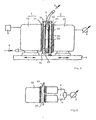
- a monochromated by a filter 11 light-emitting diode 10 is facing as a radiator monochromated by a filter 21 photoreceiver 20th
- the signal of the arrangement is shown on a display A, the arrangement is electrically supplied by a supply B.
- a measuring chamber 3 is arranged between the monochromatized radiator 1 formed from filter and light-emitting diode and the monochromatic receiver 2 formed from fat and photo receiver, which can be designed either as a cuvette or as a flow chamber, as shown.
- the flow chambers can be designed with large cross sections, so that a gas flow G can run unimpeded, with which a breathing gas analysis can be carried out, for example. This is possible due to the small time constants of the compact FLuorometer.
- a flow meter can be provided for monitoring the flow through the measuring chamber and thermostatting for stabilization.
- the monochromatic radiator 1 or the monochromatic receiver 2 can be adjustably attached to a base plate 4, so that both elements can be approached as closely as possible to the measuring chamber 3. Two of these three elements can expediently be set.
- AS monochrome beams and monochrome receivers can preferably use semiconductor elements that are very robust electrically and mechanically. Their disadvantage that, as FIG. 3 shows, they tend to work in the long-wave part of the spectrum, while most indicators work in the short-wave part of the spectrum, is compensated for by the high radiation intensities of the arrangement according to the invention.
- an indicator space 31 in operative connection with the measurement object G.
- the optical properties of the indicator arranged in the indicator space are changed in a known manner by the action of the measurement object G and this change is measured by monochromatic radiation receivers 2.
- the radiation intensity of the fluorescent radiation can be increased in that the side walls 33 of the measuring chamber 3 are elastic, so that the measuring chamber 3 can be adjusted to the maximum signal, that is to say to an optimal thickness, by means of adjusting means 34.
- the windows 35, 36 of the measuring chamber can be designed as optical filters instead of the filters 11, 21, or else the indicator arranged in the indicator space 31 has a concentration such that the excitation radiation is completely absorbed in the indicator space.
- the distances between the emitter 10 and the receiver 20 which then no longer need to be monochromatized — can be further reduced and the intensity of the measurement radiation can thus be further increased.
- the means for holding the measuring chamber which are only shown schematically in the example shown, should be as thin as possible or should be designed such that they do not hinder the setting of the smallest distance.
- optical means 40 for focusing the radiation into the measuring chamber, for example Fresnel plates or lenses, can be used.
- Cold light emitters such as light emitting diodes
- emitters 10 are expediently used as emitters 10. According to FIG. 3, these have only a very slight overlap with the indicators that can be used.
- the excitation radiation of the indicator, curve 1, the fluorescent radiation of the indicator, curve 3 and the emission of the light-emitting diode 2 meet only in the range around 470 nm and with low intensities. However, the low intensity is compensated for by the high signal gain of the arrangement.
- a reference chamber 60 can be arranged parallel to the measuring chamber 30 on the measuring section.
- a measurement signal M that is independent of the absolute fluctuations in the radiation intensity can thereby be generated, for example by forming quotients in a computer C from the reference signal R of the reference chamber 60 and the measurement signal A of the measurement chamber 30.
- the reference chamber 60 can be operated under standard conditions, or the measurement material G also flows through it, as in the example shown. Then the indicator of the reference chamber must be selected so that it is not influenced by the material to be measured.
- the indicator space can be formed with spatially changeable K values according to FIG. 4 a and, according to FIG. 4, be displaceable in the beam path 37.
- the indicator space 33 is shifted in the direction 38 until the respective correct K value of the indicator space in the beam path 37 lies.
- the correct K value is set when the signal noise of the display arrangement A has reached a minimum value.
Landscapes
- Health & Medical Sciences (AREA)
- Nuclear Medicine, Radiotherapy & Molecular Imaging (AREA)
- Physics & Mathematics (AREA)
- Life Sciences & Earth Sciences (AREA)
- Chemical & Material Sciences (AREA)
- Analytical Chemistry (AREA)
- Biochemistry (AREA)
- General Health & Medical Sciences (AREA)
- General Physics & Mathematics (AREA)
- Immunology (AREA)
- Pathology (AREA)
- Investigating, Analyzing Materials By Fluorescence Or Luminescence (AREA)
- Glass Compositions (AREA)
- Organic Low-Molecular-Weight Compounds And Preparation Thereof (AREA)
- Developing Agents For Electrophotography (AREA)
- Addition Polymer Or Copolymer, Post-Treatments, Or Chemical Modifications (AREA)
- Length Measuring Devices By Optical Means (AREA)
- Investigating Or Analysing Materials By Optical Means (AREA)
Abstract
Description
- Die Erfindung betrifft ein FLuorometer, bestehend aus einem Monochromator, einem StrahLer, einem Strahlungsempfänger und einer Messkammer, in der das Messobjekt in Wirkverbindung mit einem, einen FLuoreszenzindikator enthaltenden Indikatorraum steht.
- Das Messprinzip solcher FLuorometer besteht darin, dass eine Löschung von Fluoreszenzstrahlung erfolgt, wenn Teilchen, physikalische oder. chemische Parameter auf den die Fluorszenzstrahlung erzeugenden Indikator einwirken. Dadurch können Konzentrationsänderungen oder Parameteränderungen gemessen werden. Die charakteristische Konstante bei solchen Messungen ist die Löschungskonstante oder auch "Quenchkonstante" K, die die MessempfindLichkeit des Indikators für Konzentrations-oder Parameteränderungen beschreibt.
- FLuorometer mit diesen MerkmaLen sind bisher weitgehend auf solchen Gebieten verwendet worden, bei denen verschiedene Messaufgaben mit der gleichen Vorrichtung gelöst werden sollten. Dabei wurden jeweils die Messkammern oder die Indikatorräume ausgewechselt, die Lichtmesseinrichtung blieb die gleiche.
- Es gibt jedoch Messaufgaben, beispielsweise Serienmessungen im medizinischen und biologischen Bereich, bei denen eine hohe Spezialisierung der Messvorrichtung möglich st odess diese in ihren messtechnischen Eigenschaften besonders auf diese Messaufgabe angepasst werden kann.
- Insbesondere bei transparenten Medien, festen, flüssigen oder gasförmigen, die nur eine geringe FLuorszenzstreuung aufweisen, kann beispielsweise im DurchLicht gemessen werden. DurchLichtmessungen sind aus den US-PSn 3725658 und 3612866 bekannt.
- FLuorometer zur Messung im Durchlicht zu verbessern, hat sich die Erfindung deshalb zur Aufgabe gemacht.
- Sie Löst diese Aufgabe dadurch, dass ein monochromasierter StrahLer höchstens im Messabstand der einen Indikatorraum enthaltenden Messkammer einem monochromasierten Empfänger gegenübersteht.
- Der VorteiL dieser Anordnung besteht darin, dass nunmehr vom Empfänger der maximale Raumwinkel der Fluoreszenzstrahlung ausgenutzt werden kann, der nur noch durch die Schichtdicke des Messobjektes oder der Messkammer begrenzt ist.
- Das durch die erfindungsgemässe Anordnung wesentlich verbesserte Signal-Rauschverhältnis erlaubt es, nunmehr auch solche Indikatoren zu verwenden, die bisher wegen ihrer geringen MessempfindLichkeit ausgeschlossen werden mussten. Dadurch wird die Anzahl der verwendbaren Indikatoren vergrössert, sodass dadurch auch Indikatoren für bislang nicht messbare TeiLchenarten oder physikalische Parameter verwendet werden können.
- BeispieLsweise können jetzt Indikatoren verwendet werden, die Quenchkonstanten ("K-Werte") von 10exp-3/Torr bis 10exp-5/Torr aufweisen, während die bisher angewendeten Indikatoren K-Werte von 10exp-1/Torr bis 10exp-3/Torr haben mussten, um gut erkennbare SignaLe zu erzeugen.
- Es können aber auch an sich empfindliche Indikatoren im Längerwelligen Bereich benutzt werden, wo sie weniger messempfindlich sind. Das eröffnet die Möglichkeit, auch längerwellige StrahLer, beispielsweise Leuchtdioden, und auch Halbleiterempfänger zu verwenden. SoLche StrahLer oder Empfänger, wie beispielsweise Leuchtdioden, Photodioden oder Phototransistoren, waren bislang wegen ihrer geringen Lichtintensität oder ihrer geringen Empfindlichkeit in diesen Bereichen nur mit Aufwand verwendbar.
- Die Monochromasierung kann dabei ohne weiteres durch FiLter erfolgen. FiLter verringern zwar die Signalintensitäten. Dies wird jedoch durch den hohen EmpfindLichkeitszuwachs aufgrund der erfindungsgemässen Anordnung der Elemente ausgeglichen. Sind Abstimmungen der Wellenlängenbereiche von Empfänger und StrahLer möglich, können die FiLter entfaLLen.
- Gerade die Verwendung von HaLbLeitereLementen gestattet aber auch den Aufbau kleiner und robuster Vorrichtungen, die dann wegen des geringen Energieverbrauchs der ELemente ohne Schwierigkeiten transportabel ausgebildet werden können.
- Auch die LangzeitstabiLität der jetzt verwendbaren messunempfindlichen Indikatoren ist wesentlich höher als diejenige von messempfindLichen Indikatoren. Ebenso ist die Linearität messunempfindLicher Indikatoren wesentlich grösser als diejenige von messempfindLichen Indikatoren. Beides sind wesentliche messtechnische VorteiLe.
- ALs weiterer Vorteil ist noch die Vergrösserung des Messbereiches bei der pH-Messung zu nennen. Bisher sind nämlich nur enge pH-Bereiche um den pK-Wert,-etwa 1,5 pH-Einheiten- messbar gewesen, weil die Intensität darüberhinaus zu stark abfäLLt. Bei den jetzt möglichen hohen StrahLungsintensitäten hat dies keine wesentliche Bedeutung mehr und es kann auch in Bereichen gemessen werden, die weiter vom pK-Wert entfernt sind. Auch können jetzt gegenüber den bekannten Anordnungen geringere Schichtdicken des Messgutes zur Messung verwendet werden, was eine Verbesserung der Ansprechzeit zur FoLge hat.
- In Weiterentwickung der Erfindung ist der Messabstand von Strahler und Empfänger variabel. Dadurch ist eine Anpassung an verschieden dicke Messkammern ermöglicht, sodass jeweils der kleinste Abstand zwischen StrahLer und Empfänger einstellbar ist.
- Weiterhin kann die Dicke der Messkammer selbst variabel sein. Auch diese Ausbildung der Erfindung gestattet eine Optimierung der StrahLungsintensität.
- 0 Zweckmässig wird der Indikatorraum an der Seite des StrahLungempfängers angeordnet. Dadurch ist der vom Photoempfänger erfasste Raumwinkel maximal. Die Verringerung des erfassten RaumwinkeLs auf der StrahLerseite Lässt sich durch Intensitätserhöhungen des Strahlers ausgleichen.
- Eine weitere Verbesserung ergibt sich dadurch, dass der Messraum einen als K-Variator ausgebildeten Indikatorraum aufweist, der innerhalb des Messraums verschieblich ist.
- Ein solcher K-Variator weist einen örtlich veränderlichen K-Wert auf und durch seine Verschiebung innerhalb des StrahLenganges ist somit auch die Quenchkonstante K einstellbar und optimierbar.
- In der Zeichnung, anhand derer die Erfindung weiter erläutert wird, zeigen:
- Fig.1 eine Anordnung nach der Erfindung
- Fig.2 eine Anordnung mit Referenzkammer
- Fig.3 die StrahLungscharakterisiken einer Leuchtdiode und eines Fluoreszenzindikators
- Fig.4 einen K-Variator
- In Fig.1 steht eine durch einen Filter 11 monochromatisierte Leuchtdiode 10 als StrahLer einem durch einen FiLter 21 monochromatisierten Photoempfänger 20 gegenüber. Das SignaL der Anordnung wird auf einer Anzeige A angezeigt, die Anordnung wird durch eine Versorgung B elektrisch versorgt.
- Zwischen dem aus FiLter und Leuchtdiode gebiLdeten monochromasierten StrahLer 1 und dem aus Fetter und Photoempfänger gebildeten monochromasierten Empfänger 2 ist eine Messkammer 3 angeordnet, die entweder als Küvette oder als Durchflusskammer, wie gezeichnet, ausgebildet sein kann.
- Die DurchfLusskammern können dabei mit grossen Querschnitten ausgebildet sein, sodass ein Gasstrom G ungehindert verlaufen kann, womit beispielsweise eine Atemgasanalyse durchführbar ist. Das ist aufgrund der kleinen Zeitkonstanten des kompakten FLuorometers messtechnisch gut möglich.
- Bei entsprechender AusbiLdung können aber auch transparente FLüssigkeiten vermessen werden.
- Zur überwachung des Messkammerdurchflusses kann ein Strömungsmesser, zur StabiLisierung eine Thermostatisierung vorgesehen sein.
- Der monochromasierte StrahLer 1 oder der monochromasierte Empfänger 2 können dabei einstellbar auf einer BasispLatte 4 befestigt sein, sodass beide ELemente so dicht wie möglich der Messkammer 3 genähert werden können. Zweckmässig sind jeweils zwei dieser drei ELemente einstellbar.
- ALs monochromasierte StrahLe und monochromasierte Empfänger können vorzugsweise Halbleiterelemente Verwendung finden, die elektrisch und mechanisch sehr robust sind. Ihr Nachteil, dass sie, wie Fig.3 zeigt, eher im langwelligen TeiL des Spektrums arbeiten, während die meisten Indikatoren im kurzwelligen Teil des Spektrums arbeiten, wird durch die hohen StrahLungsintensitäten der erfindungsgemässen Anordnung ausgeglichen.
- In der Messkammer 3 steht ein Indikatorraum 31, meist als OPTODE bezeichnet, mit dem Messobjekt G in Wirkverbindung. Die optischen Eigenschaften des im Indikatorraum angeordneten Indikators werden durch die Einwirkung des Messobjektes G in bekannter Weise verändert und diese Veränderung durch monochromasierte Strahlungsempfänger 2 gemessen.
- Die StrahLungsintensität der Fluoreszenzstrahlung kann dadurch erhöht werden, dass die Seitenwände 33 der Messkammer 3 elastisch sind, sodass dadurch die Messkammer 3 mittels VersteLLmitteLn 34 jeweils auf maximales SignaL, also auf eine optimale Dicke einstellbar ist.
- Weiterhin können die Fenster 35,36 der Messkammer anstelle der Filter 11,21 als optische Filter ausgebildet sein, oder aber der im Indikatorraum 31 angeordnete Indikator weist eine derartige Konzentration auf, dass die AnregungsstrahLung im Indikatorraum vollständig absorbiert wird. In beiden FäLLen können die Abstände zwischen StrahLer 10 und Empfänger 20 -die dann nicht mehr monochromasiert werden müssen- weiter verringert und damit die Intensität der MesstrahLung weiter erhöht werden. Auch sollten die Mittel zur HaLterung der Messkammer, die im gezeichneten Beispiel nur schematisch dargestellt sind, möglichst dünn oder derart ausgebildet sein, dass sie die EinsteLLung des geringsten Abstandes nicht behindern.
- Wenn die Messkammer, beispielsweise bei der Atemgasanalyse, eine bestimmte Dicke nicht unterschreiten darf, können optische Mittel 40 ,Fig.4, zur Fokussierung der StrahLung in die Messkammer, beispielsweise Fresnelplatten oder Linsen, verwendet werden.
- Als StrahLer 10 werden zweckmässig Kaltlichtstcahler, wie beispielsweise Leuchtdioden verwendet. Diese haben zwar nach Fig.3 nur eine sehr geringe Überlappung mit den verwendbaren Indikatoren. Die AnregungungstrahLung des Indikators, Kurve 1, die Fluoreszenzstrahlung der Indikators, Kurve 3 und die Emission der Leuchtdiode 2 treffen nur im Bereich um 470 nm und mit geringen Intensitäten zusammen. Die geringen Intensität werden jedoch durch den hohen SignaLgewinn der Anordnung ausgeglichen.
- Es können jedoch auch andere StrahLungsqueLLen verwendet werden, wenn die entstehende Wärme entsprechend abgeführt wird.
- Zusätzlich kann nach Fig.2 auf der Messtrecke parallel zur Messkammer 30 eine Referenzkammer 60 angeordnet sein. In bekannter Weise kann dadurch ein von den absoluten Schwankungen der StrahLungsintensität unabhängiges Messignal M, beispielsweise durch QuotientenbiLdung in einem Rechner C aus dem Referenzsignal R der Referenzkammer 60 und dem Messignal A der Messkammer 30, erzeugt werden. Die Referenzkammer 60 kann dabei unter Standardbedingungen betrieben werden oder sie wird ebenfalls vom Messgut G durchströmt, wie im gezeichneten Beispiel. Dann muss der Indikator der Referenzkammer jedoch so gewählt werden, dass er vom Messgut nicht beeinfLusst wird.
- Weiterhin kann der Indikatorraum mit räumlich veränderlichen K-Werten gemäss Fig.4a gebildet und gemäss Fig.4 im Strahlengang 37 vterschieblich sein. Hierbei wird der Indikatorraum 33 in Richtung 38 verschoben, bis der jeweils richtige K-Wert des Indikatorraumes im StrahLengang 37 Liegt. Der richtige K-Wert ist dann eingestellt, wenn das Signalrauschen der Anzeigeanordnung A einen Minimalwert erreicht hat.
- Zum Verständnis dieser K-Wertverschiebung sei angefügt, dass die FLuoreszenzLöschung nach STERN-VOLLMER gemäss der Gleichung

- verläuft und damit die MessempfindLichkeit S(P) der Funktion

- Die die Messempfindlichkeit repräsentierenden Funktionen S(P) schneiden sich für verschiedene Werte der "Quenchkonstante" K im Bereich grösserer Messwerte. Dadurch kann durch EinsteLLung des K-Wertes, der beispielsweise durch den stofflichen Aufbau des Indikatorraumes beinflussbar ist, der Rauschanteil des SignaLs beim jeweiligen Messwert minimiert werden.
- Aus der Funktion (1) folgt für gering empfindliche Indikatoren die Lineare Form der MessempfindLichkeit:

Claims (16)
ekennzeichnet,
dass ein monochromasierter StrahLer (1) höchstens im Messabstand der Dicke der einen Indikatorraum (31,33) enthaltenden Messkammer (3) einem monochromasierten Empfänger (2) gegenübersteht.
Priority Applications (1)
| Application Number | Priority Date | Filing Date | Title |
|---|---|---|---|
| AT84109282T ATE54208T1 (de) | 1983-08-12 | 1984-08-04 | Fluorimeter. |
Applications Claiming Priority (2)
| Application Number | Priority Date | Filing Date | Title |
|---|---|---|---|
| DE19833329257 DE3329257A1 (de) | 1983-08-12 | 1983-08-12 | Fluorometer |
| DE3329257 | 1983-08-12 |
Publications (3)
| Publication Number | Publication Date |
|---|---|
| EP0135101A2 true EP0135101A2 (de) | 1985-03-27 |
| EP0135101A3 EP0135101A3 (en) | 1985-11-13 |
| EP0135101B1 EP0135101B1 (de) | 1990-06-27 |
Family
ID=6206462
Family Applications (1)
| Application Number | Title | Priority Date | Filing Date |
|---|---|---|---|
| EP84109282A Expired - Lifetime EP0135101B1 (de) | 1983-08-12 | 1984-08-04 | Fluorimeter |
Country Status (5)
| Country | Link |
|---|---|
| US (1) | US4643877A (de) |
| EP (1) | EP0135101B1 (de) |
| JP (1) | JPS6056242A (de) |
| AT (1) | ATE54208T1 (de) |
| DE (2) | DE3329257A1 (de) |
Cited By (1)
| Publication number | Priority date | Publication date | Assignee | Title |
|---|---|---|---|---|
| EP0198815A3 (en) * | 1985-04-16 | 1989-07-26 | Avl Ag | Probe for determining the concentration of electrolytes |
Families Citing this family (24)
| Publication number | Priority date | Publication date | Assignee | Title |
|---|---|---|---|---|
| US5264368A (en) * | 1990-10-10 | 1993-11-23 | Boston Advanced Technologies, Inc. | Hydrocarbon leak sensor |
| DE4128846C2 (de) * | 1991-08-30 | 1994-07-14 | Rainer Dr Klein | Integriert optischer Stoffsensor |
| US5225679A (en) * | 1992-01-24 | 1993-07-06 | Boston Advanced Technologies, Inc. | Methods and apparatus for determining hydrocarbon fuel properties |
| US5517313A (en) * | 1995-02-21 | 1996-05-14 | Colvin, Jr.; Arthur E. | Fluorescent optical sensor |
| GB9618051D0 (en) * | 1996-08-29 | 1996-10-09 | Sls Wales Ltd | Wrinkle removal |
| WO1998050777A1 (en) | 1997-05-05 | 1998-11-12 | Chemometec A/S | A method and a system for determination of particles in a liquid sample |
| US20030135122A1 (en) * | 1997-12-12 | 2003-07-17 | Spectrx, Inc. | Multi-modal optical tissue diagnostic system |
| US6055451A (en) * | 1997-12-12 | 2000-04-25 | Spectrx, Inc. | Apparatus and method for determining tissue characteristics |
| US6818437B1 (en) * | 1998-05-16 | 2004-11-16 | Applera Corporation | Instrument for monitoring polymerase chain reaction of DNA |
| US7498164B2 (en) | 1998-05-16 | 2009-03-03 | Applied Biosystems, Llc | Instrument for monitoring nucleic acid sequence amplification reaction |
| CA2328609A1 (en) * | 1998-05-16 | 1999-11-25 | Pe Corporation (Ny) | Instrument for monitoring polymerase chain reaction of dna |
| US6290912B1 (en) * | 1998-07-14 | 2001-09-18 | Bayer Corporation | Read head for luminometer |
| AU6139199A (en) * | 1998-09-11 | 2000-04-03 | Spectrx, Inc. | Multi-modal optical tissue diagnostic system |
| US20040147843A1 (en) * | 1999-11-05 | 2004-07-29 | Shabbir Bambot | System and method for determining tissue characteristics |
| US7387891B2 (en) * | 1999-05-17 | 2008-06-17 | Applera Corporation | Optical instrument including excitation source |
| US20050279949A1 (en) | 1999-05-17 | 2005-12-22 | Applera Corporation | Temperature control for light-emitting diode stabilization |
| US7423750B2 (en) * | 2001-11-29 | 2008-09-09 | Applera Corporation | Configurations, systems, and methods for optical scanning with at least one first relative angular motion and at least one second angular motion or at least one linear motion |
| US7410793B2 (en) | 1999-05-17 | 2008-08-12 | Applera Corporation | Optical instrument including excitation source |
| GB2370229A (en) * | 2000-12-22 | 2002-06-26 | Icn Photonics Ltd | Light delivery system for improving the appearance of skin |
| US20030023181A1 (en) * | 2001-07-26 | 2003-01-30 | Mault James R. | Gas analyzer of the fluorescent-film type particularly useful for respiratory analysis |
| US7635588B2 (en) * | 2001-11-29 | 2009-12-22 | Applied Biosystems, Llc | Apparatus and method for differentiating multiple fluorescence signals by excitation wavelength |
| ATE537438T1 (de) * | 2002-05-17 | 2011-12-15 | Life Technologies Corp | Vorrichtung und verfahren zur unterscheidung mehrerer fluoreszenzsignale anhand ihrer anregungswellenlänge |
| US20040175821A1 (en) * | 2003-03-07 | 2004-09-09 | Ehman Michael F. | Integrated photodetector for heavy metals and biological activity analysis |
| US9140648B2 (en) | 2013-03-12 | 2015-09-22 | Ecolab Usa Inc. | Fluorometer with multiple detection channels |
Family Cites Families (23)
| Publication number | Priority date | Publication date | Assignee | Title |
|---|---|---|---|---|
| US2551542A (en) * | 1948-11-10 | 1951-05-01 | Charles R Marsh | Fluorophotometer |
| US2827825A (en) * | 1955-03-22 | 1958-03-25 | White Dev Corp | Raman tube apparatus |
| US3200254A (en) * | 1962-03-19 | 1965-08-10 | Gen Electric | Photosensitive detector for airborne particles |
| GB1190583A (en) * | 1966-10-19 | 1970-05-06 | Mini Of Power | Improvements in or relating to Gas Detectors |
| US4066362A (en) * | 1968-08-16 | 1978-01-03 | E. I. Du Pont De Nemours And Company | Apparatus and method for performing photometric analysis |
| DE1813497C3 (de) * | 1968-11-21 | 1973-09-13 | Jenoptik Jena Gmbh, X 6900 Jena | Differentialkuvette |
| US3612866A (en) * | 1969-07-08 | 1971-10-12 | Brian Stevens | Instrument for determining oxygen quantities by measuring oxygen quenching of fluorescent radiation |
| BE755852A (fr) * | 1969-09-09 | 1971-03-08 | Hoffmann La Roche | Photometre |
| CH531715A (de) * | 1970-04-13 | 1972-12-15 | Trw Inc | Verfahren zum kontinuierlichen Messen des Sauerstoffgehaltes in einem Gasstrom und Einrichtung zur Ausführung dieses Verfahrens |
| US3725658A (en) * | 1971-01-18 | 1973-04-03 | Trw Inc | Apparatus and method for continuously detecting oxygen in a gas stream |
| US3795489A (en) * | 1971-09-15 | 1974-03-05 | Ford Motor Co | Chemiluminescence reaction chamber |
| US3861809A (en) * | 1973-04-06 | 1975-01-21 | Perkin Elmer Corp | Confocal cavity optical gas sensor |
| US3826920A (en) * | 1973-04-12 | 1974-07-30 | Massachusetts Inst Technology | Fluorescent gas analyzer with calibration system |
| DD106086A1 (de) * | 1973-07-16 | 1974-05-20 | ||
| US4193963A (en) * | 1974-09-20 | 1980-03-18 | Petroleo Brasileiro S.A.-Petrobras | Apparatus for the determination of chemical compounds by chemiluminescence with ozone |
| US3970430A (en) * | 1974-10-17 | 1976-07-20 | E. I. Du Pont De Nemours And Company | Method and apparatus for nox analysis |
| DE2508637C3 (de) * | 1975-02-28 | 1979-11-22 | Max-Planck-Gesellschaft Zur Foerderung Der Wissenschaften E.V., 3400 Goettingen | Anordnung zur optischen Messung von Blutgasen |
| JPS5246885A (en) * | 1975-10-13 | 1977-04-14 | Nippon Kogaku Kk <Nikon> | Fluorophotometer |
| DE2749662C2 (de) * | 1977-11-05 | 1986-01-30 | Hartmann & Braun Ag, 6000 Frankfurt | Fotometrisches Analysengerät |
| DE2823138A1 (de) * | 1978-05-26 | 1979-11-29 | Helma Gmbh & Co Kg | Kuevette |
| DE2833356A1 (de) * | 1978-07-29 | 1980-02-14 | Max Planck Gesellschaft | Verfahren zur optischen messung von stoffkonzentrationen |
| DE2948904C2 (de) * | 1979-12-05 | 1986-06-19 | Max-Planck-Gesellschaft zur Förderung der Wissenschaften e.V., 3400 Göttingen | Vorrichtung zur optischen Messung von Konzentrationen von Stoffen |
| AT380572B (de) * | 1982-12-28 | 1986-06-10 | List Hans | Optischer sensor |
-
1983
- 1983-08-12 DE DE19833329257 patent/DE3329257A1/de not_active Ceased
-
1984
- 1984-08-04 AT AT84109282T patent/ATE54208T1/de not_active IP Right Cessation
- 1984-08-04 DE DE8484109282T patent/DE3482604D1/de not_active Expired - Lifetime
- 1984-08-04 EP EP84109282A patent/EP0135101B1/de not_active Expired - Lifetime
- 1984-08-08 US US06/638,883 patent/US4643877A/en not_active Expired - Fee Related
- 1984-08-13 JP JP59167963A patent/JPS6056242A/ja active Pending
Cited By (1)
| Publication number | Priority date | Publication date | Assignee | Title |
|---|---|---|---|---|
| EP0198815A3 (en) * | 1985-04-16 | 1989-07-26 | Avl Ag | Probe for determining the concentration of electrolytes |
Also Published As
| Publication number | Publication date |
|---|---|
| JPS6056242A (ja) | 1985-04-01 |
| EP0135101B1 (de) | 1990-06-27 |
| ATE54208T1 (de) | 1990-07-15 |
| DE3329257A1 (de) | 1985-02-28 |
| EP0135101A3 (en) | 1985-11-13 |
| DE3482604D1 (en) | 1990-08-02 |
| US4643877A (en) | 1987-02-17 |
Similar Documents
| Publication | Publication Date | Title |
|---|---|---|
| EP0135101B1 (de) | Fluorimeter | |
| DE69127670T2 (de) | Optisches Analysegerät | |
| DE2833356C2 (de) | ||
| DE2747698C2 (de) | ||
| DE3103476C2 (de) | ||
| DE2918244C2 (de) | ||
| EP0175352B1 (de) | Verfahren und Anordnung zur schnellen Bestimmung der Parameter eines Probenmediums | |
| DE2543726A1 (de) | Geraet zur feststellung einer gasfoermigen verunreinigung | |
| DE2240523A1 (de) | Infrarotgasanalysator | |
| DE102017128290B4 (de) | Messvorrichtung und Messsystem zur Bestimmung des pH-Wertes und Verfahren zum Bestimmen des pH-Wertes | |
| DE3938142C2 (de) | ||
| DE2355148C3 (de) | Vorrichtung zur Untersuchung der Zusammensetzung einer strömenden FlUs- | |
| DE2927156A1 (de) | Vorrichtung zum messen der sauerstoffkonzentration | |
| DE69728258T2 (de) | Röntgenstrahlspektrometer mit kristallanalysator mit teilweise konstantem und ilweise variablem krümmungsradius | |
| EP0634645B1 (de) | Verfahren und Vorrichtung zum optischen Bestimmen von Feststoff-Konzentrationen in Wasser | |
| DE20280249U1 (de) | Analysegerät zur Bestimmung der chemischen Struktur und/oder Zusammensetzung einer Vielzahl von Proben und Träger zur Aufnahme der Proben | |
| DE1598420B2 (de) | Verfahren und vorrichtung zur bestimmung der menge an freiem ungeloestem wasser in einer fluessigkeit | |
| EP3136083B1 (de) | Verfahren und vorrichtung zur bestimmung einer stoffkonzentration oder eines stoffes in einem flüssigen medium | |
| DE2720300C3 (de) | Verfahren und Gerät zur Untersuchung von Gasen | |
| DE2744168C3 (de) | Magnetooptisches Spektralphotometer | |
| DE69207377T2 (de) | Verfahren zum Nachweis von Polyaminen | |
| DE10118449C1 (de) | Vorrichtung zur Überwachung einer Chemikalienströmung und Verwendung dieser Vorrichtung | |
| EP0135745B1 (de) | Festmembran für einen Indikatorraum | |
| DE1598891A1 (de) | Verfahren und Vorrichtung der Spektralanalyse | |
| CH655183A5 (de) | Verfahren und vorrichtung zur farbauftragsbestimmung einer aufsichtsbildvorlage. |
Legal Events
| Date | Code | Title | Description |
|---|---|---|---|
| PUAI | Public reference made under article 153(3) epc to a published international application that has entered the european phase |
Free format text: ORIGINAL CODE: 0009012 |
|
| AK | Designated contracting states |
Designated state(s): AT CH DE FR GB IT LI LU NL SE |
|
| PUAL | Search report despatched |
Free format text: ORIGINAL CODE: 0009013 |
|
| AK | Designated contracting states |
Designated state(s): AT CH DE FR GB IT LI LU NL SE |
|
| 17P | Request for examination filed |
Effective date: 19860205 |
|
| 17Q | First examination report despatched |
Effective date: 19870514 |
|
| GRAA | (expected) grant |
Free format text: ORIGINAL CODE: 0009210 |
|
| AK | Designated contracting states |
Kind code of ref document: B1 Designated state(s): AT CH DE FR GB IT LI LU NL SE |
|
| PG25 | Lapsed in a contracting state [announced via postgrant information from national office to epo] |
Ref country code: SE Effective date: 19900627 Ref country code: NL Effective date: 19900627 Ref country code: IT Free format text: LAPSE BECAUSE OF FAILURE TO SUBMIT A TRANSLATION OF THE DESCRIPTION OR TO PAY THE FEE WITHIN THE PRESCRIBED TIME-LIMIT;WARNING: LAPSES OF ITALIAN PATENTS WITH EFFECTIVE DATE BEFORE 2007 MAY HAVE OCCURRED AT ANY TIME BEFORE 2007. THE CORRECT EFFECTIVE DATE MAY BE DIFFERENT FROM THE ONE RECORDED. Effective date: 19900627 |
|
| REF | Corresponds to: |
Ref document number: 54208 Country of ref document: AT Date of ref document: 19900715 Kind code of ref document: T |
|
| REF | Corresponds to: |
Ref document number: 3482604 Country of ref document: DE Date of ref document: 19900802 |
|
| ET | Fr: translation filed | ||
| PG25 | Lapsed in a contracting state [announced via postgrant information from national office to epo] |
Ref country code: LU Free format text: LAPSE BECAUSE OF NON-PAYMENT OF DUE FEES Effective date: 19900831 Ref country code: LI Effective date: 19900831 Ref country code: CH Effective date: 19900831 |
|
| GBT | Gb: translation of ep patent filed (gb section 77(6)(a)/1977) | ||
| NLV1 | Nl: lapsed or annulled due to failure to fulfill the requirements of art. 29p and 29m of the patents act | ||
| PLBE | No opposition filed within time limit |
Free format text: ORIGINAL CODE: 0009261 |
|
| STAA | Information on the status of an ep patent application or granted ep patent |
Free format text: STATUS: NO OPPOSITION FILED WITHIN TIME LIMIT |
|
| REG | Reference to a national code |
Ref country code: CH Ref legal event code: PL |
|
| 26N | No opposition filed | ||
| PGFP | Annual fee paid to national office [announced via postgrant information from national office to epo] |
Ref country code: GB Payment date: 19930728 Year of fee payment: 10 |
|
| PGFP | Annual fee paid to national office [announced via postgrant information from national office to epo] |
Ref country code: FR Payment date: 19930729 Year of fee payment: 10 |
|
| PGFP | Annual fee paid to national office [announced via postgrant information from national office to epo] |
Ref country code: DE Payment date: 19930826 Year of fee payment: 10 Ref country code: AT Payment date: 19930826 Year of fee payment: 10 |
|
| PG25 | Lapsed in a contracting state [announced via postgrant information from national office to epo] |
Ref country code: GB Effective date: 19940804 Ref country code: AT Effective date: 19940804 |
|
| GBPC | Gb: european patent ceased through non-payment of renewal fee |
Effective date: 19940804 |
|
| PG25 | Lapsed in a contracting state [announced via postgrant information from national office to epo] |
Ref country code: FR Effective date: 19950428 |
|
| PG25 | Lapsed in a contracting state [announced via postgrant information from national office to epo] |
Ref country code: DE Effective date: 19950503 |
|
| REG | Reference to a national code |
Ref country code: FR Ref legal event code: ST |