EP0135142A2 - Cephalosporinderivate und Verfahren zu ihrer Herstellung - Google Patents
Cephalosporinderivate und Verfahren zu ihrer Herstellung Download PDFInfo
- Publication number
- EP0135142A2 EP0135142A2 EP84109661A EP84109661A EP0135142A2 EP 0135142 A2 EP0135142 A2 EP 0135142A2 EP 84109661 A EP84109661 A EP 84109661A EP 84109661 A EP84109661 A EP 84109661A EP 0135142 A2 EP0135142 A2 EP 0135142A2
- Authority
- EP
- European Patent Office
- Prior art keywords
- substituted
- alkyl
- general formula
- halogen
- optionally
- Prior art date
- Legal status (The legal status is an assumption and is not a legal conclusion. Google has not performed a legal analysis and makes no representation as to the accuracy of the status listed.)
- Granted
Links
Classifications
-
- C—CHEMISTRY; METALLURGY
- C07—ORGANIC CHEMISTRY
- C07D—HETEROCYCLIC COMPOUNDS
- C07D501/00—Heterocyclic compounds containing 5-thia-1-azabicyclo [4.2.0] octane ring systems, i.e. compounds containing a ring system of the formula:, e.g. cephalosporins; Such ring systems being further condensed, e.g. 2,3-condensed with an oxygen-, nitrogen- or sulfur-containing hetero ring
- C07D501/14—Compounds having a nitrogen atom directly attached in position 7
- C07D501/16—Compounds having a nitrogen atom directly attached in position 7 with a double bond between positions 2 and 3
- C07D501/20—7-Acylaminocephalosporanic or substituted 7-acylaminocephalosporanic acids in which the acyl radicals are derived from carboxylic acids
- C07D501/24—7-Acylaminocephalosporanic or substituted 7-acylaminocephalosporanic acids in which the acyl radicals are derived from carboxylic acids with hydrocarbon radicals, substituted by hetero atoms or hetero rings, attached in position 3
- C07D501/36—Methylene radicals, substituted by sulfur atoms
-
- C—CHEMISTRY; METALLURGY
- C07—ORGANIC CHEMISTRY
- C07D—HETEROCYCLIC COMPOUNDS
- C07D417/00—Heterocyclic compounds containing two or more hetero rings, at least one ring having nitrogen and sulfur atoms as the only ring hetero atoms, not provided for by group C07D415/00
- C07D417/02—Heterocyclic compounds containing two or more hetero rings, at least one ring having nitrogen and sulfur atoms as the only ring hetero atoms, not provided for by group C07D415/00 containing two hetero rings
- C07D417/12—Heterocyclic compounds containing two or more hetero rings, at least one ring having nitrogen and sulfur atoms as the only ring hetero atoms, not provided for by group C07D415/00 containing two hetero rings linked by a chain containing hetero atoms as chain links
-
- A—HUMAN NECESSITIES
- A61—MEDICAL OR VETERINARY SCIENCE; HYGIENE
- A61P—SPECIFIC THERAPEUTIC ACTIVITY OF CHEMICAL COMPOUNDS OR MEDICINAL PREPARATIONS
- A61P31/00—Antiinfectives, i.e. antibiotics, antiseptics, chemotherapeutics
- A61P31/04—Antibacterial agents
-
- Y—GENERAL TAGGING OF NEW TECHNOLOGICAL DEVELOPMENTS; GENERAL TAGGING OF CROSS-SECTIONAL TECHNOLOGIES SPANNING OVER SEVERAL SECTIONS OF THE IPC; TECHNICAL SUBJECTS COVERED BY FORMER USPC CROSS-REFERENCE ART COLLECTIONS [XRACs] AND DIGESTS
- Y02—TECHNOLOGIES OR APPLICATIONS FOR MITIGATION OR ADAPTATION AGAINST CLIMATE CHANGE
- Y02P—CLIMATE CHANGE MITIGATION TECHNOLOGIES IN THE PRODUCTION OR PROCESSING OF GOODS
- Y02P20/00—Technologies relating to chemical industry
- Y02P20/50—Improvements relating to the production of bulk chemicals
- Y02P20/55—Design of synthesis routes, e.g. reducing the use of auxiliary or protecting groups
Definitions
- the invention relates to new cephalosporin derivatives and processes for their preparation, in particular polar cephem derivatives which are substituted in the 3-position of the cephem ring by certain pyridinium methyl residues and which have a very good antimicrobial activity against gram-positive and gram-negative bacteria and therefore as a medicament for treatment of microbial infections are suitable.
- A is a pyridinium residue which can be substituted one or more times, identically or differently, by substituted C 1 -C 6 alkyl, where 2 ortho-standing alkyl groups can also be closed to form an optionally substituted di- to decamethylene ring in which a ring carbon atom can be replaced by a heteroatom and can also contain one or two double bonds; by optionally substituted C 2 -C 6 alkenyl, by C 2 -C 6 alkynyl, by C 3 -C 7 cycloalkyl or C 3 -C 7 cycloalkylmethyl, where the ring can also be substituted in both substituents or can be interrupted by a hetero atom, by C4-C7-cycloalkenyl, which can be substituted by methyl, by optionally substituted C 1 -C 6 -alkoxy, by C 2 -C 6 -alkenyloxy or C 2 --C 6 -alkynyloxy, by halogen, trifluoromethyl
- the ring fused onto the pyridinium radical can contain 2 to 10 ring members (di- to decamethylene), but preferably 3 to 5 ring members and thus, for example, a cyclopenteno, cyclohexeno or cyclo represent hepteno ring. If such a fused ring contains a double bond, examples include a cyclopentadieno, cyclohexadieno or cycloheptadieno ring, if such a fused ring contains 2 double bonds, an o-phenylene ring may be mentioned as an example. If a carbon atom in such rings is replaced by a heteroatom, oxygen or sulfur are particularly suitable as heteroatoms.
- Furo, pyrano, dihydrofuro and dihydropyrano may be mentioned, for example, as fused rings containing an oxygen atom and containing two or one double bond, and fused rings with a sulfur atom containing two or one double bond contain thieno, thiopyrano, dihydrothieno and dihydrothiopyrano.
- the radicals R 4 are in particular acyloxy radicals with lower aliphatic carboxylic acids, preferably with 1 to 4 carbon atoms, such as: acetoxy or propionyloxy, especially acetoxy, which can be optionally substituted, such as: chloroacetoxy or acetylacetoxy.
- Other groups are also suitable for R 4 , such as, for example, halogen, in particular chlorine, bromine and iodine, preferably iodine and bram, or carbamoyloxy.
- starting compounds of the general formula II in which R 4 represents acetoxy are used in the nucleophilic exchange reaction, or their salts, such as a sodium or potassium salt.
- the reaction is carried out in a solvent, preferably in water, formamide. or in a mixture of water and an easily miscible organic solvent, such as acetone, dioxane, acetonitrile, dimethylformamide, dimethyl sulfoxide or ethanol.
- the reaction temperature is generally in the range from about 10 to about 100 ° C., preferably between 20 and 80 ° C.
- the pyridine component is added in amounts which are between about equimolar amounts and an up to about 5-fold excess.
- the exchange of the radical R 4 is facilitated by the presence of neutral salt ions, preferably iodide or thiocyanate ions, in the reaction medium.
- neutral salt ions preferably iodide or thiocyanate ions
- about 10 to about 30 equivalents of potassium iodide, sodium iodide, potassium thiocyanate or sodium thiocyanate are added.
- the reaction is advantageously carried out in the vicinity of the neutral point, preferably at a pH in the range from about 5 to about 8.
- suitable amino protecting groups are, for example, optionally substituted alkyl, such as, for example, tert-butyl, tert-amyl; Benzyl, p-methoxybenzyl, trityl, benzhydryl, preferably trityl; Trialkylsilyl such as trimethylsilyl; optionally substituted aliphatic acyl, such as formyl, chloroacetyl, bromoacetyl, trichloroacetyl and trifluoroacetyl, preferably formyl; or optionally substituted alkoxycarbonyl, such as, for example, trichloroethoxycarbonyl, benzyloxycarbonyl or tert-butyloxycarbonyl, preferably tert-butyloxycarbonyl and benzyloxycarbonyl; or dimethylaminomethylene.
- alkyl such as, for example, tert-butyl, tert-amyl;
- the protective group can be split off after the exchange reaction in a manner known per se, e.g. the trityl group by means of a carboxylic acid, e.g. Acetic acid, trifluoroacetic acid, formic acid, or the benzyloxycarbonyl group hydrogenolytically.
- a carboxylic acid e.g. Acetic acid, trifluoroacetic acid, formic acid, or the benzyloxycarbonyl group hydrogenolytically.
- reaction products of formula I can be prepared from the reaction mixture in a conventional manner, e.g. by freeze-drying the water phase, chromatography or also by precipitation as a sparingly soluble salt, for example as a hydroiodide or hydrothiocyanate salt.
- the nucleophilic exchange reaction on compounds of the general formula II can also take place in such a way that the reaction is carried out in the presence of the base component corresponding to the radicals A and of tri-C 1 -C 4 -alkyl iodosilanes, such as trimethyl- or triethyl iodosilane.
- This variant of the exchange reaction is advantageously carried out by adding trimethyliodosilane to a mixture of the compound II and the base in a suitable solvent.
- the procedure can also be such that the compound is first reacted with trinethyliodosilane under the reaction conditions mentioned below and then the base is added.
- trimethyliodosilane it is also possible, for example, to use a reaction mixture of iodine and hexamethyldisilane which has previously been reacted in a manner known from the literature at temperatures between about 60 and 120 ° C., with trimethyliodosilane being formed.
- trimethyliodosilane triethyliodosilane, which is produced in a manner known from the literature, can also be used with the same good result.
- Suitable solvents are chlorinated hydrocarbons, such as methylene chloride, chloroform, dichloroethane, trichloroethane, carbon tetrachloride, or lower alkyl nitriles, such as acetonitrile or propionitrile.
- the base is added in at least a stoichiometric amount up to a twenty-fold excess, preferably a five- to fifteen-fold excess is used.
- Such functional groups can by adding cinesSilyl mecanical forces such as: bistrimethylsilylacetamide, N-methyl-N-trimethylsilyltrifluoroacetamide, bistrimethylsilyltrifluoroacetamide, trimethylchlorosilane, hexamethyldisilazane, Bistrimethylsilylharn - are vorsilyliert material, either without or in the presence of a base, the desired group A preferably underlying base in the amounts described above. Trimethyliodosilane is then added in at least a stoichiometric amount or in excess, preferably in a double to a tenfold excess.
- the reaction is carried out at temperatures between -5 ° C and + 100 ° C, preferably between 10 ° C and 30 ° C.
- reaction products of the formula I can be isolated from the aqueous phase in a customary manner, for example by freeze-drying the water phase, chromatography and the like.
- the polar reaction products are preferably precipitated from the aqueous solution in the form of a sparingly soluble salt, for example after addition of KSCN or KJ, as the hydrothiocyanate or hydroiodide salt.
- R 4 stands for halogen, in particular bromine or iodine
- the exchange can take place in a manner known from the literature.
- silyl derivatives for example, which are involved in the reaction of Ver bonds of the general formula II are formed with a silyl compound, such as trimethylchlorosilane or bis (trimethylsilyl) acetamide.
- a silyl compound such as trimethylchlorosilane or bis (trimethylsilyl) acetamide.
- the reaction is expediently carried out in the presence of a solvent, such as methylene chloride, dimethylformamide or acetonitrile.
- the compounds of general formula I are obtained by acylation of compounds of general formula IV or their addition salts, for example with hydrochloric acid, hydrobromic acid, nitric acid, sulfuric acid, phosphoric acid or an organic acid, such as e.g. Methanesulfonic acid or p-toluenesulfonic acid with carboxylic acids of the general formula V or with a reactive derivative of such an acid.
- reaction can also be carried out by reacting compounds of the general formula III, for example 7-aminocephalosporanic acid or 3-iodomethyl-7-amino-ceph-3-em-4-carboxylic acid or their reactive derivatives in a suitable solvent with the rest A in the base corresponding to general formula IV and the resulting compound of general formula IV acylated in situ to give the compounds of general formula I.
- starting compounds of the general formula III in which R 4 is iodine are preferably used in this reaction.
- Suitable solvents are chlorinated hydrocarbons, such as: methylene chloride and chloroform, ethers, such as: diethyl ether, tetrahydrofuran and dioxane and amides, such as preferably dimethylformamide and dimethylacetamide. It can also prove advantageous to use mixtures of the solvents mentioned.
- silyl derivatives which are formed in the reaction of compounds of the general formula III with silyl compounds, such as, for example: trimethylchlorosilane or bis (trimethylsilyl) acetamide, are particularly suitable.
- the base corresponding to radical A is used in at least a stoichiometric amount, up to a ten-fold excess, preferably 2 to 5 equivalents.
- the reaction is carried out at temperatures between about -5 and + 100 ° C, preferably between + 20 and +50 ° C.
- the compounds of the general formula IV can also be prepared, for example, from compounds of the general formula III, where R 4 is acetoxy, in an analogous manner to that described above for the compounds of the general formula II.
- carboxylic acids of the general formula V and their derivatives protected on the amino group are themselves used as acylating agents, it is advantageous to work in the presence of a condensing agent, for example a carbodiimide such as N, N'-dicyclohexylcarbodiimide.
- a condensing agent for example a carbodiimide such as N, N'-dicyclohexylcarbodiimide.
- carboxylic acids of the general formula V can be carried out in a particularly advantageous manner by treatment with certain carboxamides and, for example, phosgene, phosphorus pentachioride, tosyl chloride, thionyl chloride or oxalychloride, as described e.g. is described in German Patent 28 04 040.
- halides preferably chlorides, which are prepared in a manner known per se by treatment with halogenating agents, such as, for example, phosphorus pentachloride, phosgene or thionyl chloride Cephalosporin chemistry can be obtained from the literature, gentle reaction conditions.
- Anhydrides and mixed anhydrides, azides, activated esters and thioesters are also suitable as activated derivatives of the carboxylic acids of the general formula V.
- Particularly suitable as mixed anhydrides are those with lower alkanoic acids, e.g. Acetic acids and particularly preferably those with substituted acetic acids, e.g. Trichloroacetic acid, pivalic acid or cyanoacetic acid.
- the mixed anhydrides with carbonic acid half-esters which are obtained, for example, by reacting the carboxylic acids of the formula V in which the amino group is protected, with benzyl chloroformate, p-nitrobenzyl ester, isobutyl ester, ethyl ester or allyl ester, are also particularly suitable.
- Suitable activated esters are preferably those with p ⁇ nitrophenol, 2,4-dinitrophenol, methylcyanhydrin, N-hydroxysuccinimide and N-hydroxyphtalimide, especially those with 1-hydroxybenzotriazole and 6-chloro-1-hydroxybenzotriazole.
- Particularly preferred thioesters are, for example, those with 2-mercaptobenzothiazole and 2-mercaptopyridine.
- the activated derivatives can also be reacted in situ as isolated substances.
- the cephem derivatives of the general formula IV are reacted with a carboxylic acid of the general formula V or an activated derivative thereof in the presence of an inert solvent.
- Chlorinated hydrocarbons are particularly suitable, such as preferably methylene chloride and chloroform; Ethers such as diethyl ether, preferably tetrahydrofuran and dioxane; Ketones, such as preferably acetone and butanone; Amides, such as preferably dimethylformind and dimethylacetamide, or pyridine. It can also prove advantageous to use mixtures of the solvents mentioned. This is often the case if the cephem compound of the general formula IV is used in situ generated activated derivative of a carboxylic acid of formula V is implemented.
- cephem compounds of the formula IV with carboxylic acids of the formula V or their activated derivatives can be carried out in a temperature range from about -80 to about + 80 ° C, preferably between about -20 ° C and room temperature.
- the reaction time depends on the reactants, the temperature and the solvent or solvent mixture and is normally between about 1/4 and about 72 hours.
- reaction with acid halides can optionally be carried out in the presence of an acid-binding agent for binding the released hydrogen halide.
- Triethylamine or dimethylaniline such as Triethylamine or dimethylaniline
- inorganic bases such as e.g. Potassium carbonate or sodium carbonate
- acylene oxides such as e.g. Propylene oxide.
- a catalyst e.g. of dimethylaminopyridine, may be of advantage.
- the amino group in the compounds of the general formula IV is in the form of a reactive derivative, it can be one which is known from the literature for amidations.
- silyl derivatives are suitable which are formed in the reaction of compounds of the general formula IV with a silyl compound, e.g. Trimethylchlorosilane or bis (trimethylsilyl) acetamide. If the reaction is carried out with such a compound activated on the amino group, it is expedient to carry out the reaction in an inert solvent, such as e.g. Methylene chloride, tetrahydrofuran or. Perform dimethylformamide.
- Al.'s physiologically compatible acid addition salts of the compound of general formula I may be mentioned, for example, those with hydrochloric acid, hydrogen bromide acid, nitric acid, phosphoric acid, sulfuric acid or organic acids, such as methanesulfonic acid, p-tolosulfonic acid or maleic acid.
- the compounds of general formula I obtained according to the invention and their physiologically tolerated acid addition salts show remarkably good antibacterial activity against both gram-positive and gram-negative bacterial germs.
- the compounds of the formula I are also unexpectedly effective against bacteria which form penicillinase and cephalosporinase. Since they also show favorable toxicological and pharmacological properties, they are valuable chemotherapeutic agents.
- the invention thus also relates to pharmaceutical preparations for the treatment of microbial infections which are characterized by a content of one or more of the compounds according to the invention.
- the products according to the invention can also be used in combinations with other active ingredients, for example from the series of penicillins, cephaloporins or aminoglycosides.
- the compounds of general formula I and their physiologically acceptable acid addition salts can be administered orally, intramuscularly or intravenously.
- Medicinal products which contain one or more compounds of the general formula I as an active ingredient can be prepared by combining the compounds of the formula I with several pharmacologically acceptable carriers or diluents such as, for example, fillers, emulsifiers, lubricants, flavoring agents, colorants or Buffer substances mixed into a suitable pharmaceutical preparation, such as tablets, coated tablets, capsules, or a suspension or solution suitable for parenteral administration.
- a carrier or diluent for example, tragacanth, milk sugar, talc, agar-agar, polyglycols, ethanol and water are mentioned.
- Buffer substances are, for example, organic compounds, such as e.g. N, N'-dibenzylethylenediamine, diethanolamine, ethylenediamine, N-methylglucamine, N-benzylphenethylamine, diethylamine, tris (hydroxymethyl) aminomethane, or inorganic compounds such as e.g. Phosphate buffer, sodium bicarbonate, sodium carbonate.
- suspensions or solutions in water with or without buffer substances are preferred. It is also possible to apply the active substances as such in a suitable form, for example in capsules, without a carrier or diluent.
- Suitable doses of the compounds of general formula I or their physiologically acceptable acid addition salts are about 0.4 to 20 g / day, preferably 0.5 to 4 g / day, for an adult of about 60 kg body weight.
- Single or generally multiple doses can be administered, and the single dose can contain the active ingredient in an amount of about 50 to 1000 mg, preferably about 100 to 500 mg.
Landscapes
- Chemical & Material Sciences (AREA)
- Organic Chemistry (AREA)
- Health & Medical Sciences (AREA)
- Chemical Kinetics & Catalysis (AREA)
- Life Sciences & Earth Sciences (AREA)
- General Chemical & Material Sciences (AREA)
- Medicinal Chemistry (AREA)
- Nuclear Medicine, Radiotherapy & Molecular Imaging (AREA)
- Communicable Diseases (AREA)
- Pharmacology & Pharmacy (AREA)
- Oncology (AREA)
- Animal Behavior & Ethology (AREA)
- General Health & Medical Sciences (AREA)
- Public Health (AREA)
- Veterinary Medicine (AREA)
- Cephalosporin Compounds (AREA)
- Pharmaceuticals Containing Other Organic And Inorganic Compounds (AREA)
Abstract
Description
- Die Erfindung betrifft neue Cephalosporinderivate und Verfahren zu ihrer Herstellung, insbesondere polare Cephemderivate, die in 3-Stellung des Cephemrings durch bestimmte Pyridiniummethyl-Reste substituiert sind und die eine sehr gute antimikrobielle Wirkung gegen grampositive und gram-negative Bakterien besitzen und deshalb als Arzneimittel zur Behandlung von mikrobiellen Infektionen geeignet sind.
- Gegenstand der Erfindung sind daher Cephemderivrate der allgemeinen Formel I .

- R1 Wasserstoff oder Halogen,
- R2 C1-C6-Alkyl, das ein- oder mehrfach, gleich oder verschieden substituiert ist durch Halogen, durch C1-C4-Alkylthio oder C1-C4-Alkyioxy, C2-C6-Alkenyl, das gegebenenfalls ein oder mehrfach, gleich oder verschieden substituiert sein kann durch Halogen, C2-C6-Alkinyl, das gegebenenfalls substituiert sein kann durch Halogen, C3-C7-Cycloalkyl, das gegebenenfalls substituiert sein kann durch Halogen,
- C3-C7-Cycloalkylmethyl, wobei der Cycloalkylrest gegebenenfalls durch Halogen substituiert sein kann.
- A einen Pyridiniumrest

- Die vorliegende Erfindung ist insbesondere auf Verbindungen gerichtet, in denen R1 und R2 die vorstehenden Bedeutungen besitzen und A einen Pyridiniumrest

- durch C2-C6-Alkenyl, das durch Hydroxy substituiert sein kann,
- durch C2-C6-Alkinyl,
- durch C3-C7-Cycloalkyl oder C3-C7-Cycloalkyl-methyl, wobei in beiden Substituenten der Ring auch substituiert sein kann durch Hydroxy, Halogen, Carboxy, C1-C6-Alkyl- oxycarbonyl oder Cyano,
- durch C4-C7-Cycloalvenyl,
- durch C1 -C6-Alkoxy, das durch Hydroxy, Carboxy oder C1-C6-Alkyloxycarbonyl substituiert sein kann,
- durch C2-C6-Alkenyloxy oder C2-C6-Alkinyloxy,
- durch Halogen, Cyano, Hydroxy oder Mercapto,
- durch C1-C6-Alkylthio, C1-C6-Alkylsulfinyl oder C1-C6 Alkylsulfonyl; die im Alkylteil durch Ilydroxy substituiert sein können,
- durch Methylthio, Methylsulfinyl oder Methylsulfonyl, die im Methylteil substituiert sind durch Carboxy oder C1-C6-Alkyloxycarbonyl,
- durch C2-C6-Alkenylthio, C2-C6-Alkenylsulfinyl oder C2-C6-Alkenylsulfonyl,
- durch Phenyl, Benzyl oder Heteroaryl, die auch durch Halogen substituiert sein können,
- durch Formyl oder ketalisiertes Formyl,
- durch C1-C6-Alkylcarbonyl, das auch durch Hydroxy substituiert sein und auch in ketalisierter Form vorliegen kann,
- durch Arylcarbonyl oder C1-C6-Alkylcarbonylamino,
- durch Carboxy oder C1-C6-Alkoxycarbonyl,
- durch Carbamoyl, das am Stickstoff einmal substituiert sein kann durch C1-C6-Alkyl, Hydroxy-C1-C6-Alkyl, C1-C6-Alkyloxycarbonyl, C1-C6-Alkylcarbonyl, Carboxymethyl, C1-C6-Alkyloxycarbonylmethyl, Aminocarbonylmethyl, C1-C6-Alkylaminocarbonyl, Carbamoyl, Hydroxy oder Pyridyl, oder das am Stickstoff zweimal substituiert sein kann durch Cl-C6-Alkyl,
- durch Carbazoyl, das durch C1-C4-Alkyl substituiert sein kann, oder N-Carbamoylcarbamoyl.
- durch Sulfamoyl, das am Stickstoff einmal substituiert sein kann durch C1-C6-Alkylaminocarbonyl,
- durch Pyridyl oder 4-Pyridon-1-yl,
- und wobei auch bei diesen bevorzugten, unter die allgemeine Formel I fallenden Verbindungen die R20-Gruppe in syn-Position steht.
- Als gegebenenfalls mögliche Substituenten des unter A erwähnten Di- bis Decamethylen-Rings, in dem ein C-Atom durch ein Heteroatom ersetzt sein kann und weiterhin auch noch eine oder zwei Doppelbindungen enthalten sein können, kommen insbesondere die folgenden Substituenten in Betracht, die ein- oder mehrfach, vorzugsweise jedoch einfach auftreten können:
- C,-C6-Alkyl, C1-C4-Alkoxy, Hydroxymethyl, Halogen, Hydroxy, Oxo, Hydroximino, Exomethylen, Carboxy, C1-C6-Alkyloxycarbonyl, Cyano oder Carbamoyl.
- Diese Substituenten können an den genannten, an den Pyridiniumrest ankondensierten Ringen auftreten, unabhängig davon, ob der jeweilige Ring gesättigt, ungesättigt oder auch noch durch ein Heteroatom unterbrochen ist. Bevorzugt treten sie jedoch erfindungsgemäß an ankondensierten gesättigten Ringen auf, die kein Hetero- atom enthalten.
- Der an den Pyridiniumrest ankondensierte Ring kann 2 bis 10 Ringglieder (Di- bis Decamethylen), vorzugsweise, jedoch 3 bis 5 Ringglieder enthalten und somit beispielsweise einen Cyclopenteno-, Cyclohexeno- oder Cyclohepteno-Ring darstellen. Enthält ein solcher ankondensierter Ring eine Doppelbindung, so seien als Beispiele ein Cyclopentadieno-, Cyclohexadieno- oder Cycloheptadieno-Ring, enthält ein solcher ankondensierter Ring 2 Doppelbindungen, so sei als Beispiel ein o-Phenylenring genannt. Ist in derartigen Ringen ein C-Atom durch ein Heteroatom ersetzt, so kommen als Heteroatome insbesondere Sauerstoff oder Schwefel in Betracht. Als ein Sauerstoffatom enthaltende, ankondensierte Ringe, die zwei oder eine Doppelbindung enthalten, seien beispielsweise erwähnt Furo, Pyrano, Dihydrofuro und Dihydropyrano, als ankondensierte Ringe mit einem Schwefelatom, die zwei oder eine Doppelbindung enthalten Thieno, Thiopyrano, Dihydrothieno und Dihydrothiopyrano.
- Als besonders bevorzugt kommen beispielsweise die folgenden Substituenten in Betracht:
- R1: Wasserstoff, Fluor, Chlor, Brom, insbesondere Fluor und Chlor,
- R2 C1-C4-Alkyl, wie z.B. Methyl, Äthyl, Propyl, Isopropyl, vorzugsweise Methyl und Äthyl, das ein- oder mehrfach, vorzugsweise 1 bis 6-fach, insbesondere 2- bis 4-fach, substituiert ist, vorzugsweise durch Fluor, wie insbesondere Monofluormethyl, Difluormethyl, Trifluormethyl, 1,1,2,2-Tetrafluoräthyl, 1,1,1-Trifluoräethyl, 1,1,2,2,-Tetrafluorpropyl, durch C1-C4-Alkylthio, vorzugsweise Methyl- und Äthylthio, wie insbesondere Methylthiomethyl, oder durch C1-C4-Alkyloxy, vorzugsweise Methoxy und Äthoxy, wie insbesondere Methyloxymethyl, Äthyloxymethyl, Äthyloxyäthyl, C2-C6-Alkenyl, wie insbesondere 2-Propenyl, 2-Butenyl, das ein- oder mehrfach, vorzugsweise 1- bis 2-fach substituiert sein kann durch Halogen, vorzugsweise Chlor und Brom, wie insbesondere 3-Chlor-2-propenyl, 2-Brom-2-propenyl, C2-C6-Alkinyl, wie insbesondere Propargyl, C3-C7-Cycloalkyl, wie insbesondere Cyclobutyl oder Cyclopentyl, das ein- oder mehrfach, vorzugsweise 1- bis 6-fach, insbesondere 4- bis 6-fach, substituiert sein kann durch Halogen, vorzugsweise Fluor, wie insbesondere 1,2,2,3,3,4-Hexafluorcyclobutyl, oder C3-C7-Cycloalkylmethyl, wie insbesondere Cyclopropyl-und Cyclobutylmethyl, das ein- oder mehrfach, vorzugsweise 1- bis 6-fach, insbesondere 4- bis 6-fach substituiert sein kann durch Halogen, vorzugsweise Fluor, wie insbesondere 1,2,2,3,3,4-Ilexafluorcyclobutylmethyl.
- A :ein Pyridiniumrest, der ein- oder mehrfach, vorzugsweise 1- bis 3- .fach, insbesondere 1- bis 2-fach substituiert sein kam, beispielsweise durch C1-C4-Alkyl, wie insbesondere Methyl, Äthyl, Propyl, Isopropyl, n-Butyl, sec.-Butyl. tert.-Butyl, Dimethyl, Trimethyl, Methyl und Äthyl, Methyl und Propyl, Methyl und Isopropyl, Äthyl und Äthyl;
- Hydroxy-C1-C4-alkyl, wie insbesondere Hydroxymethyl. Hydroxyäthyl, Hydroxypropyl, Hydroxyisopropyl, Hydroxybutyl, Hydroxy-sec.-butyl oder Hydroxy-tert.-butyl, und wobei z.B. auch zwei oder drei Hydroxylgruppen am Alkylrest stehen können;
- Carboxy-C1-C4-alkyl, wie insbesondere Carboxymethyl und Carboxy- äthyl;
- C1-C4-Alkoxycarbonyl-C1-C4-alkyl, wie insbesondere Methyloxycarbonylmethyl, Äthyloxycarbonylmethyl, Methyloxycarbonyläthyl, Formyl-C1-C4-alkyl wie insbesondere Formylmethyl;
- C1-C4-Alkylcarbonyl-C1-C4-alkyl, wie insbesondere Methylcarbonylmethyl, Äthylcarbonylmethyl, Methylcarbonyläthyl und Äthylcarbonyl- äthyl, deren beide Alkylgruppen auch noch durch Hydroxy substituiert deren sein können und deren Carbonylgruppe auch in ketalisierter Form vorliegen kann;
- Carbamoyl-C1-C4-Alkyl,wie insb. Carbamoylmerhyl und -äthyl, die am Stickstoff auch noch durch Ilydroxy substituiert sein können, wie insbesondere N-Hydroxy-Carhamoylmethyl;
- Sulfo-C1-C4-alkyl, wie insbesondere Sulfoäthyl oder 1-Hydroxy-1-sulfomethyl, _
- C1-C4-Alkyloxy-C1-C4-alkyl, wie insbesondere Methyloxymethyl, Äthyloxymethyl, Propyloxymethyl, Isopropyloxymethyl, Methyloxyäthyl, Äthyloxyäthyl, Methyloxypropyl und Methyloxyisopropyl, die auch durch Hydroxy substituiert sein können, wie insbesondere Hydroxyäthyloxymethyl und Hydroxyäthyloxyäthyl,
- C1-C4-Alkylthio-C1-C4-alkyl, wie insbesondere Methylthiomethyl, Äthylthiomethyl, Methylthioäthyl und Äthylthioäthyl,
- C1-C4-Alkylsulfinyl-C1-C4-alkyl, wie insbesondere Methylsulfinylmethyl, Äthylsulfinylmethyl, Methylsulfinyläthyl und Äthylsulfinyläthyl,
- C1-C4-Alkylsulfonyl-C1-C4-alkyl, wie insbesondere Methylsulfonylmethyl, Äthylsulfonylmethyl, Methylsulfonyläthyl und Äthylsulfonyläthyl,
- C3-Alkenyloxy-C1-C4-alkyl, wie insbesondere Allyloxymethyl und Allyloxyäthyl,
- C3-Alkenylthio-C1-C4-alkyl, wie insbesondere Allylthiomethyl,
- C3-Alkenylsulfinyl-C1-C4-alkyl, wie insbesondere Allylsulfinylmethyl,
- C3-Alkenylsulfonyl-C1-C4-alkyl, wie insbesondere Allylsulfonylmethyl,
- Cyano-C1-C3-alkyl, wie insbesondere Cyanomethyl und Cyanoäthyl,
- Trifluormethyl, Hydroximinomethyl und C1-C3-Alkyloximino- methyl, wie insbesondere Methoximinomethyl, C3-C4-Alkenyl, wie insbesondere Allyl, 2-Methylallyl und Buten-3-yl, die auch noch durch Hydroxy substituiert sein können, wie insbesondere Hydroxyallyl und Hydroxybutenyl, C3-Alkinyl, wie insbesondere Propargyl, C3-C6-Cycloalkyl und C3-C6-Cycloalkyl-methyl, wobei sich die Kohlenstoffzahl auf den Cycloalkylteil bezieht, wie insbesondere Cyclopropyl, Cyclobutyl, Cyclopentyl, Cyclohexyl und Cyclopentylmethyl, wobei die Ringe auch substituiert sein können, z.B. durch Hydroxy, wie insbesondere 1-Hydroxy-1-cyclopentyl und 1-Hydroxy-l-cyclohexyl, oder durch Halogen, vorzugsweise Chlor, durch Carboxy, C1-C4-Alkoxycarbonyl oder Cyano, und wobei ein C-Atom durch ein Sauerstoffatom ersetzt sein kann, wie z.B. Tetrahydropyran-4-yl; C5-C6-Cycloalkenyl, wie insbesondere Cyclopenten-l-yl und Cyclohexen-1-yl, C1-C4-Alkoxy, wie insbesondere Methoxy, Äthoxy, Propoxy, Isopropoxy, Butoxy, Isobutoxy und tert.-Butoxy, vorzugsweise Methoxy, wobei diese Alkoxygruppen auch noch substituiert sein können, beispielsweise durch Hydroxy, Carboxy oder C1-C4-Alkyloxycarbonyl, insbesondere Carboxymcthyloxy und Methyloxycarbonylmethyloxy, Epoxy-C2-C3-alkyloxy, wie insbesondere Epoxyäthoxy oder Epoxypropoxy, C3-Alkenyloxy, wie insbesondere Allyloxy, C3-Alkinvloxy wie insbesondere Propargyloxy, Hälogen, wie insbesondere Fluor, Chlor, Brom, Jod, Cyano, Hydroxy, wie insbesondere 3-Hydroxy, C1-C4-Alkylthio, wie insbesondere Methylthio, Äthylthio, Propylthio und Isopropylthio, die auch substituiert sein können durch Hydroxy, insbesondere Hydroxy- äthylthio, C1-C4-Alkylsulfinyl, wie insbesondere Methylsulfinyl, Äthylsulfinyl, Propylsulfinyl und Isopropylsulfinyl, die auch substituiert sein können durch Hydroxy, insbesondere Hydroxyäthylsulfinyl, C1-C4-Alkylsulfonyl, wie Methyl- oder Äthyl- oder Propyl- oder Isopropylsulfonyl, die auch substituiert sein können durch Hydroxy, insbesondere Hydroxyäthylsulfonyl, Carboxymethylthio und C1-C4-Alkyloxycarbonylmethylthio, insbesondere Methyloxycarbonylmethylthio, Carboxymethylsulfinyl und -sulfonyl, sowie C1-C4-Alkyloxycarbonylmethyl-sulfinyl und -sulfonyl, insbesondere Methyloxycarbonylmethyl-sulfinyl und -sulfonyl, C3-Alkenylthio, wie Allylthio und Propen-1-yl-thio, C3-Alkenylsulfinyl, wie Allylsulfinyl und Propen-1-yl- sulfinyl, C3-Alkenylsulfonyl, wie Allylsulfonyl und Propen-1-yl- sulfonyl, Phenyl und Benzyl, die auch substituiert sein können, beispielsweise durch Halogen, insbesondere Chlor, wie z.B. 4-Chlorbenzyl, 2'-Thienyl und 3'-Thienyl, Formyl und ketalisiertes Formyl, wie z.B. 1,3-Dioxolan-2-yl, C1-C4-Alkylcarbonyl, insbesondere Acetyl und Propionyl, vorzugsweise Acetyl, die auch durch Hydroxy substituiert sein und in ketalisierter Form vorliegen können, wie z. B. 2-Methyl-1,3-dioxolan-2-yl, Benzoyl, C1-C4-Alkylcarbonylamino, insbesondere Acetylamino und Propionylamino, Formylamino Carboxy, beispielsweise auch 2,3,4-Carboxy, C1-C4-Alkoxycarbonyl , insbesondere Methoxycarbonyl und Äthoxycarbonyl, wie z.B. auch 2,3,4-Methoxy- oder -Äthoxycarbonyl, Carbamoyl (beispielsweise auch 2,3,4-Carbamoyl), das am Stickstoffatom einmal substituiert seih kann durch C1-C4-Alkyl, wie insbesondere N-Methyl- und N-Äthylcarbamoyl, durch Hydroxy-C1-C4-alkyl, wie insbesondere N-Hydroxymethyl-carbamoyl und N-Hydroxyäthyl-carbamoyl, durch C1-C4-Alkoxy-carbonyl, wie insbesondere N-Methoxycarbonylcarbamoyl und N Äthoxycarbonylcarbaroyl, durch C1-C4-Alkylcarbonyl, wie insbesondere N-Acetylcarbamoyl, durch Carboxymethyl, durch C1-C4-Alkyloxy- carbonylmethyl, wie insbesondere N-Methyl- und N-Äthyloxycarbonylmethylcarbamoyl, durch Aminocarbonylmethyl, durch N-C1-C4-Alkylaminocarbo- nyl, wie insbesondere N-Methyl- und N-Äthylaminocarbonylcarbamoyl, durch Carbamoyl (=Ureidocarbonyl), durch .Hydroxy oder Pyridyl, wie insbesondere N-3'-Pyridylcarba- moyl und N-4'-Pyridylcarbamoyl, N-Cl-C4-Dialkyl-carbamoyl, wie insbesondere N,N-Dimethyl- carbamoyl und N,N-Diäthylcarbamoyl, Carbazoyl, das substituiert sein kann durch C1-C4-Alkyl, insbesondere Methyl oder Äthyl, durch Carbamoyl, wie N-Carbamoyl-carbazoyl, Sulfamoyl, das am Stickstoffatom substituiert sein kann durch C1-C4-Alkylaminocarbonyl, wie insbesondere Äthylaminocarbonylsulfamoyl, Pyridyl, wie insbesondere 2'-, 3'- und 4'-Pyridyl und 4-Pyridon-1-yl.
- Stellt A einen Pyridiniumrest dar, der durch zwei orthoständige, zu einem Di- bis Decamethylen-Ring geschlossene Alkylgruppen substituiert ist, der wiederum ein- oder mehrfach, vorzugsweise einfach substituiert sein und eine oder zwei Doppelbindungen enthalten kann, so kommen hierfür ganz besonders die folgenden ankondensierten Ringsysteme in Betracht:
- o-Phenylen, beispielsweise Chinolinium, Isochinolinium; Cyclopenteno, Hydroxycyclopenteno, Chlorcyclopenteno, Bromcyclopenteno, Oxocyclopenteno, Hydroxymethylcyclopenteno, Exomethylen-cyclopenteno, Carboxycyclopenteno, C1-C4-Alkoxycarbonyl-cyclopenteno, insbesondere Methoxycarbonylcyclopenteno und Carbamoyl-cyclopenteno,
- Cyclohexeno, Hydroxycyclohexeno, Chlor- oder Bromcyclohexeno, Oxocyclchexeno, Hydroxymcthyl-cyclohexeno, Exomethylen-cyclohexeno, Carboxycyclohexeno, C1-C4-Alkoxycarbonyl-cyclohexeno, insbesondere Methoxycarbonylcyclohexeno und Carbamoylcyclohexeno,
- Cyclohepteno, Hydroxy-, Chlor-, Brom-, Oxo-, Hydroxymethyl-, Exomethylen- oder Carboxy-cyclohepteno, C1-C4-Alkoxy-carbonyl-cyclohepteno, insbesondere Methoxycarbonylcyclohepteno und Carbamoyl-cyclohepteno; Cyclopentadieno, Cyclohexadieno und Cycloheptadieno
- Ist in den vorstehend genannten ankondensierten Ringsystemen ein Ring-C-Atom durch ein Heteroatom, insbesondere Sauerstoff ersetzt, so kommen insbesondere die folgenden Ringsysteme in Betracht:
- Furo[2,3-b]pyridin, Furo[3,2-b]pyridin, Furo[2,3-c]pyridin, Furo[3,2-c]pyridin, Thieno[2,3-b]pyridin, Thieno[3,2-b]pyridin, Thieno[2,3-c]pyridin, Thieno[3,2-c] pyridin, Thieno[3,4-b]pyridin, Thieno[3,4-c]pyridin
- Gegenstand der Erfindung ist weiterhin ein Verfahren zur Herstellung von Verbindungen der Formel I und ihrer physiologisch verträglichen Säureadditionssalze, das dadurch gekennzeichnet ist, daß man
- a) eine Verbindung der allgemeinen Form II

- α) eine gegebenenfalls vorhandene Schutzgruppe abspaltet und
- ß) falls erforderlich, das erhaltene Produkt in ein physiologisch verträgliches Säureadditionssalz überführt,
oder - b) eine Verbindung der allgemeinen Formel III


eine gegebenenfalls vorhandene Aminoschutzgruppe abspaltet und
die Verbindung IV worin R eine Aminogruppe bedeutet, entweder als solche oder in Form eines Säureadditionssalzes oder eines reaktionsfähigen Derivates mit einer 2-(2-Aminothiazol-4-yl)-2-syn-oxyiminoessigsäure der allgemeinen Formel V
- α) eine gegebenenfalls vorhandene Schutzgruppe abspaltet und
- ß) falls erforderlich, das erhaltene Produkt in ein physiologisch verträgliches Säureadditionssalz überführt.
- a) eine Verbindung der allgemeinen Form II
- Soll die Herstellung der Verbindungen der allgemeinen Formel I nach dem Verfahren a) durch nucleophilen Austausch von R4 in den Verbindungen der allgemeinen Formel II durch Pyridin oder eines der angegebenen Pyridinderivate erfolgen, so kommen als Reste R4 insbesondere in Betracht Acyloxyrestemit niederen aliphatischen Carbonsäuren, vorzugsweise mit 1 bis 4 C-Atomen, wie z.B.: Acetoxy oder Propionyloxy, insbesondere Acetoxy, die gegebenenfalls substituiert sein können, wie z.B.: Chloracetoxy oder Acetylacetoxy. Für R4 kommen auch andere Gruppen in Betracht, wie beispielsweise Halogen, insbes. Chlor, Brom und Jod, vorzugsweise Jod .und Bram,oder Carbamoyloxy.
- Erfindungsgemäß werden bei der nucleophilen Austauschreaktion Ausgangsverbindungen der allgemeinen Formel II, in denen R4 für Acetoxy steht, eingesetzt, oder deren Salze, wie z.B. ein Natrium- oder Kaliumsalz. Die Reaktion wird in einem Lösungsmittel, vorzugsweise in Wasser, Formamid. oder in einem Gemisch aus Wasser und einem mit Wasser leicht mischbaren organischen Lösungsmittel, wie z.B. Aceton, Dioxan, Acetonitril, Dimethylformamid, Dimethylsulfoxid oder Äthanol durchgeführt. Die Reaktionstemperatur liegt im allgemeinen im Bereich von etwa 10 bis etwa 100 °C, vorzugsweise zwischen 20 und 80 °C. Die Pyridinkomponente wird in Mengen zugegeben, die zwischen etwa äquimolaren Mengen und einem bis zu etwa 5-fachen Überschuß liegt. Der Austausch des Restes R4 wird durch Anwesenheit von Neutralsalzionen, vorzugsweise von Jodid- oder Thiocyanationen, im Reaktionsmedium erleichtert. Insbesondere werden etwa 10 bis etwa 30 Äquivalente Kaliumjodid, Natriumjodid, Kaliumthiocyanat oder Natriumthiocyanat zugegeben. Die Reaktion wird vorteilhaft in der Nähe des Neutralpunktes, vorzugsweise bei einem pH-Wert im Bereich von etwa 5 bis etwa 8 durchgeführt.
- Liegt die Gruppe P3 als geschützte Aminofunktion vor, so eignen sich als Aminoschutzgruppen z.B. gegebenenfalls substituiertes Alkyl, wie beispielsweise tert.-Butyl, tert.-Amyl; Benzyl, p-Methoxybenzyl, Trityl, Benzhydryl, vorzugsweise Trityl; Trialkylsilyl, wie beispielsweise Trimethylsilyl; gegebenenfalls substituihrtes aliphatisches Acyl, wie z.B. Formyl, Chloracetyl, Bromacetyl, Trichloracetyl und Trifluoracetyl, vorzugsweise Formyl; oder gegebenenfalls substituiertes Alkoxycarbonyl, wie beispielsweise Trichloräthoxycarbonyl, Benzyloxycarbonyl oder tert.-Butyloxycarbonyl, vorzugsweise tert.-Butyloxycarbonyl und Benzyloxycarbonyl; oder Dimethylaminomethylen.
- Die Schutzgruppe kann nach der Austauschreaktion in an sich bekannter Weise abgespalten werden, z.B. die Tritylgruppe mittels einer Carbonsäure, wie z.B. Essigsäure, Trifluoressigsäure, Ameisensäure, oder die Benzyloxycarbonylgruppe hydrogenolytisch.
- Die Reaktionsprodukte der Formel I können aus der Reaktionsmischung in üblicher Weise, z.B. durch Gefriertrocknen der Wasserphase, Chromatographie oder auch durch Ausfällen als schwerlösliches Salz, beispielsweise als Hydrojodid- oder Hydrothiocyanatsalz, isoliert werden.
- Die nucleophile Austauschreaktion an Verbindungen der allgemeinen Formel II kann auch so erfolgen, daß die Reaktion in Gegenwart der den Resten A entsprechenden Basenkomponente und von Tri-C1-C4-alkyl- jodsilanen, wie z.B. Trimethyl- oder Triäthyljodsilan vorgenommen wird. Diese Variante der Austauschrcaktion wird vorteilhafterweise so durchgeführt, daß zu einem Gemisch der Verbindung II und der Base in einem geeigneten Lösungsmittel Trimethyljodsilan zugegeben wird. Es kann aber auch so verfahren werden, daß die Verbindung zuerst mit Trinethyljodsilan nach den unten genannten Reaktionsbedingungen zur Reaktion gebracht wird und sodann die Base zugegeben wird.
- Dabei kann beispielsw. so verfahren werden, daß die Verbindung II mit R4 = Acetoxy zuerst mit Trimethyljodsilan nach den im folgenden genannten Reaktionsbedingungen zur Reaktion gebracht wird, die gebildete Verbindung mit R4 = J isoliert und anschließend mit der Base umgesetzt wird, oder die 3-CH2J-Verbindung in situ durch Zugabe der Base zur Reaktion gebracht wird. Eine bevorzugte Ausführungsform ist in den deutschen Patentanmeldungen ? 33 16 796, P 33 16 797 und P 33 16 798 beschrieben Sie besteht darin, daß zu einer Lösung oder Suspension der Verbindung II in einem geeigneten Lösungsmittel die dem Rest A entsprechende Base zugegeben wird, gefolgt von Trimethyljodsilan. Statt Trimethyljodsilan kann beispielsweise auch eine Reaktionsmischung aus Jod und Hexamethyldisilan, die vorher bei Temperaturen zwischen etwa 60 und 120°C in literaturbekannter Weise zur Reaktion gebracht wurde, wobei Trimethyljodsilan entsteht, verwendet werden. Statt Trimethyljodsilan kann mit demselben guten Ergebnis auch Triethyljodsilan, das in literaturbekannter Weise hergestellt wird, verwendet werden.
- Geeignete Lösungsmittel sind chlorierte Kohlenwasserstoffe, wie Methylenchlorid, Chloroform, Dichloräthan, Trichloräthan, Tetrachlorkohlenstoff, oder Niederalkylnitrile, wie Acetonitril oder Propionitril.
- Die Base wird in mindestens stöchiometrischer Menge bis zu einem zwanzigfachen Überschuß zugegeben, vorzugsweise wird mit einem fünf- bis fünfzehnfachen Überschuß gearbeitet.
- Da neben der auszutauschenden Gruppe R4 in der Ausgangsverbindung II auch andere funktionelle Gruppen, wie z.B. die Carboxylgruppe, mit Trimethyljodsilan reagieren, wird letzteres in mindestens doppeltem bis zu etwa fünfzehn-fachem, vorzugsweise in drei- bis zehnfachem Überschuß zugegeben.
- Derartige funktionelle Gruppen können auch durch Zugabe cinesSilylierungsmittel wie z.B.: Bistrimethylsilylacetamid, N-Methyl-N-trimethylsilyltrifluoracetamid, Bistrimethylsilyltrifluoracetamid, Trimethylchlorsilan, Hexamethyldisilazan, Bistrimethylsilylharn- stoff vorsilyliert werden, entweder ohne oder in Gegenwart einer Base, vorzugsweise der gewünschten der Gruppe A zugrunde liegenden Base in den vorstehend beschriebenen Mengen. Anschließend wird Trimethyljodsilan in mindestens stöchiometrischer Menge oder auch im Überschliß, vorzugsweise in einem doppelten bis zu einem zehnfachen Überschuß zugegeben.
- Die Reaktion wird bei Temperaturen zwischen-5 °C und + 100 °C, vorzugsweise zwischen 10 °C und 30 °C ausgeführt.
- Die Reaktionsprodukte der Formel I können nach Hydrolyse der Reaktionsmischung durch Zugabe von Wasser oder wässrigen Mineralsäuren, z.B. HC1 oder H2SO4, aus der wässrigen Phase in üblicher Weise, z.B. durch Gefriertrocknen der Wasserphase, Chromatographie und dergleichen isoliert werden. Vorzugsweise werden die polaren Reaktionsprodukte aus der wässrigen Lösung in Form eines schwerlöslichen Salzes, beispielsweise nach Zugabe von KSCN oder KJ, als Hydrothiocyanat- oder Hydrojodidsalz ausgefällt.
- Für den Fall, das R4 für eine Carbamoyloxygruppe steht, wird die Austauschreaktion analog durchgeführt.
- Steht R4 für Halogen, insbesondere Brom oder Jod, so kann der Austausch in literaturbekannter Weise erfolgen.
- Liegt die Verbindung 11 in Form eines reaktionsfähigen Derivates vor,sokomnen beispielsweise Silylderivate in Betracht, die bei der Umsetzung von Verbindungen der allgemeinen Formel II mit einer Silylverbindung gebildet werden, wie z.B. Trimethylchlorsilan oder Bis-(trimethylsilyl) acetamid. In diesem Fall wird die Umsetzung zweckmäßig in Gegenwart eines Lösungsmittel, wie Methylenchlorid, Dimethylformamid oder Acetonitril, vorgenommen.
- Nach dem Verfahren b) werden die Verbindungen der allgemeinen Formel I durch Acylierung von Verbindungen der allgemeinen Formel IV oder deren Additionssalze, beispielsweise mit Chlorwasserstoffsäure, Bromwasserstoffsäure, Salpetersäure, Schwefelsäure, Phosphorsäure oder einer organischen Säure, wie z.B. Methansulfonsäure oder p-Toluolsulfonsäure mit Carbonsäuren der allgemeinen Formel V oder mit einem reaktionsfähigen Derivat einer solchen Säure durchgeführt.
- Es ist dabei nicht erforderlich, die Verbindungen der allgemeinen Formel IV zu isolieren. Die Reaktion kann auch so durchgeführt werden, daß man Verbindungen der allgemeinen Formel III, beispielsweise 7-Aminocephalosporansäure oder 3-Jodmethyl-7-amino-ceph-3-em-4-carbonsäure oder deren reaktionsfähigen Derivate in einem geeigneten Lösungmittel mit der dem Rest A in der allgemeinen Formel IV entsprechenden Base umsetzt und die entstandene Verbindung der allgemeinen Formel IV in situ zu den Verbindungen der allgemeinen Formel I acyliert. Erfindungsgemäß werden bei dieser Reaktion vorzugsweise Ausgangsverbindungen der allgemeinen Formel III, in denen R4 für Jod steht, eingesetzt. Geeignete Lösungsmittel sind chlorierte Kohlenwasserstoffe, wie z.B.: Methylenchlorid und Chloroform, Ether, wie z.B.: Diethylether, Tetrahydrofuran und Dioxan und Amide, wie vorzugsweise Dimethylformamid und Dimethylacetamid. Es kann sich auch als vorteilhaft erweisen, Gemische der genannten Lösungsmittel zu verwenden.
- Liegt in den Verbindungen der allgemeinen Formel III ein reaktionsfähiges Derivat vor, so kommen insbesondere Silylderivate in Betracht, die bei der Umsetzung von Verbindungen der allgemeinen Formel III mit Silylverbindungen, wie z.B.: Trimethylchlorsilan oder Bis-(trimethylsilyl)-acetamid gebildet werden. Die dem Rest A entsprechende Base wird in mindestens stöchiometrischer Menge, bis zu einem zehnfachen Überschuß, vorzugsweise 2 bis 5 Äquivalente verwendet. Die Reaktion wird bei Temperaturen zwischen etwa -5 und + 100 °C, vorzugsweise zwischen + 20 und +50 °C ausgeführt.
- Die Verbindungen der allgemeinen Formal IV können beispielweise auch aus Verbindungen der allgemeinen Formel III, wobei R4 für Acetoxy steht, in analoger Weise wie vorstehend für die Verbindungen der allgemeinen Formel II beschrieben, dargestellt werden.
- Werden die Carbonsäuren der allgemeinen Formel V sowie ihre an der Aminogruppe geschützten Derivate selbst als Acylierungsmittel eingesetzt, so wird zweckmäßig in Gegenwart eines Kondensationsmittels, beispielsweise eines Carbodiimds, wie beispielsweise N,N'-Dicyclohexylcarbodiimid, gearbeitet.
- Die Aktivierung von Carbonsäuren der allgemeinen Formel V kann in besonders günstiger Weise durch Behandlung mit bestimmten Carbonsäureamiden und beispielsweise Phosgen, Phosphorpentachiorid, Tosylchlorid, Thionylchlorid oder Oxalychlorid erfolgen, wie sie z.B. in der deutschen Patentschrift 28 04 040 beschrieben wird.
- Als aktivierte Derivate der Carbonsäuren der allgemeinen Formel V eignen sich insbesondere auch Halogenide, vorzugsweise Chloride, die in an sich bekannter Weise durch Behandlung mit Halogenierungsmittel, wie z.B. Phosphorpentachlorid, Phosgen oder Thionylchlorid unter für die Cephalosporinchemie literaturbekannten, schonenden Reaktionsbedingungen erhalten werden.
- Als aktivierte Derivate der Carbonsäuren der allgemeinen Formel V eignen sich ferner die Anhydride und gemischten Anhydride, Azide, aktivierten Ester und Thioester. Als gemischte Anhydride sind besonders geeignet solche mit niederen Alkansäuren, wie z.B. Essigsäuren und besonders bevorzugt solche mit substituierten Essigsäuren , wie z.B. Trichloressigsäure, Pivalinsäure oder Cyanessigsäure. Besonders geeignet sind aber auch die gemischten Anhydride mit Kohlensäurehalbestern, die man beispielsweise durch Umsetzung der Carbonsäuren der Formel V, in denen die Aminogruppe geschützt ist, mit Chlorameisensäure-benzylester, -p-nitrobenzylester, -iso-butylester, -ethylester oder allylester gewinnt.
- Als aktivierte Ester eignen sich vorzugsweise diejenigen mit p·Nitrophenol, 2,4-Dinitrophenol, Methylcyanhydrin, N-Hydroxysuccinimid und N-hydroxyphtalimid, insbesondere diejenigen mit 1-Hydroxybenzotriazol und 6-Chlor-1-hydroxybenzotriazol. Besonders bevorzugte Thioester sind bespielsweise diejenigen mit 2-Mercaptobenzothiazol und 2-Mercaptopyridin. Die aktivierten Derivate können als isolierte Substanzen aber auch in situ umgesetzt werden. Im allgemeinen erfolgt die Umsetzung der Cephemderivate der allgemeinen Formel IV mit einer Carbonsäure der allgemeinen Formel V oder einem aktivierten Derivat derselben in Gegenwart eines inerten Lösungsmittels.
- Insbesondere eignen sich chlorierte Kohlenwasserstoffe, wie vorzugsweise Methylenchlorid und Chloroform; Äther, wie z.B. Diäthyläther, vorzugsweise Tetrahydrofuran und Dioxan; Ketone, wie vorzugsweise Aceton und Butanon; Amide, wie vorzugsweise Dimethylformaind und Dimethylacetamid, oder Pyridin. Es kann sich auch als vorteilhaft erweisen, Gemische der genannten Lösungsmittel zu verwenden. Dies ist oftmals dann der Fall, Wrennn die Cephemverbindung der allgemeinen Formel IV mit einm in situ erzeugten aktivierten Derivat einer Carbonsäure der Formel V umgesetzt wird.
- Die Umsetzung von Cephemverbindungcnder Formel IV mit Carbonsäuren der Formel V bzw. deren aktivierten Derivaten kann in einem Temperaturbereich von etwa -80 bis etwa + 80°C, vorzugsweise zwischen etwa -20°C und Raumtemperatur erfolgen.
- Die Reaktionsdauer hängt von den Reaktanden, der Temperatur und dem Lösungsmittel bzw. dem Lösungsmittelgemisch ab und liegt normalerweise zwischen etwa 1/4 und etwa 72 Std..
- Die Reaktion mit Säurehalogeniden kann gegebenenfalls in Gegenwart eines säurebindenden Mittels zur Bindung des freigesetzten Halogenwasserstoffs durchgeführt werden. Als solche eignen sich insbesondere tertiäre Amine,
- wie z.B. Triäthylamin oder Dimethylanilin, anorganische Basen, wie z.B. Kaliumcarbonat oder Natriumcarbonat, Akylenoxide, wie z.B. Propylenoxid. Auch die Anwesenheit eines Katalysators, wie z.B. von Dimethylaminopyridin, kann gegebenenfalls von Vorteil sein.
- Liegt in den Verbindungen der allgemeinen Formel IV die Aminogruppe in Form eines reaktionsfähigen Derivats vor, so kann es sich um ein solches handeln, wie aus der Literatur für Amidierungen bekannt ist. So kommen beispielsweise Silylderivate in Betracht, die bei der Umsetzung von Verbindungen der allgemeinen Formel IV mit einer Silylverbindung gebildet werden, wie z.B. Trimethylchlorsilan oder Bis-(trimethylsilyl)-acetamid. Wird die Umsetzung mit einer solchen, an der Aminogruppe aktivierten Verbingung durchgeführt, so ist es zweckmäßig, die Reaktion in einem inerten Lösungsmittel, wie z.B. Methylenchlorid, Tetrahydrofuran oder. Dimethylformamid durchzuführen.
- Al.s physiologisch verträgliche Säureadditionssalze der Verbindung der allgemeinen Formel I seien beispielsweise erwähnt solche mit Chlorwasserstoffsäurec, Bromwasserstoffsäure, Salpetersäure, Phosphorsäure, Schwefelsäure oder organische Säuren, wie z.B. Methansulfonsäure, p-Toloulsulfonsäure oder Maleinsäure.
- Die Verbindungen der allgemeinen Formal III und V, sowie die den Pyridiniumresten A entsprechenden Verbindungen sind literaturbekannt oder nach literaturbekannten Verfahren herstellbar.
- Die erfindungsgemäß erhaltenen Verbindungender allgemeinen Formel I und ihre physiologisch verträglichen Säureadditionssalze zeigen bemerkenswert gute antibakterielle Wirksamkeit sowohl gegen grampositive als auch gramnegative bakterielle Keime.
- Auch gegen penicillinase- und cephalosporinase-bildende Bakterien sind die Verbindungen der Formel I unerwartet gut wirksam. Da sie zudem günstigte toxikologische und pharmakologische Eigenschaften zeigen, stellen sie wertvolle Chemotherapeutika dar.
- Die Erfindung betrifft somit auch Arzneipräparate zur Behandlung von mikrobiellen Infektionen, die durch einen Gehalt an einer oder mehreren der erfindungsgemäßen Verbindungen charakterisiert sind.
- Die erfindungsgemäßen Produkte können auch in Kombinationen mit anderen Wirkstoffen, beispielsweise aus der Reihe der Penicilline, Cephaloporine oder Aminoglykoside zur Anwendung kommen.
- Die Verbindungen der allgemeinen Formel I und ihre physiologischen verträglichen Säureadditionssalze können oral, intramuskulär oder intravenös verabfolgt werden. Arzneipräparate, die eine oder mehrere Verbindungen der allgemeinen Formel I als Wirkstoff enthalten, können hergestellt werden, indem man die Verbindungen der Formel I mit mehreren pharmakologisch verträglichen Trägerstoffen oder Verdünngunsmittel wie z.B. Füllstoffen, Emulgatoren, Gleitstoffem, Geschmackskorrigentien, Farbstoffen oder Puffersubstanzen vermischt in eine geeignete galenische Zubereitungsform bringt, wie beispielsweise Tabletten, Dragees, Kapseln, oder eine zur parenteralen Applikation geeignete Susupension oder Lösung.
- Als Träger- oder Verdünnungsmittel seinen beispielsweise erwähnt Traganth, Milchzucker, Talkum, Agar-Agar, Polyglykole, Äthanol und Wasser. Puffersubstanzen sind beispielsweise organische Verbindungen, wie z.B. N,N'-Dibenzyläthylendiamin, Diäthanolamin, Äthylendiamin, N-Methylglucamin, N-Benzylphenäthylamin, Diäthylamin, Tris(hydroxymethyl)aminomethan, oder anorganische Verbindungen, wie, z.B. Phosphatpuffer, Natriumbicarbonat, Natriumcarbonat. Für die parenterale Applilation kommen vorzugsweise Suspensionen oder Lösungen in Waser mit oder ohne Puffersubstanzen in Betracht. Es ist auch möglich, die Wirkstoffe als solche ohne Träger- oder Verdünnungsmittel in geeigneter Form, beispielsweise in Kapseln, zu applizieren.
- Geeignete Dosen der Verbindungen der allgemeinen Formel I oder ihrer physiologisch verträglichen Säureadditionssalze liegen bei etwa 0,4 bis 20 g/Tag, vorzugsweise bei 0,5 bis 4 g/Tag, für einen Erwachsenen von etwa 60 kg Körpergewicht.
- Es können Einzel- oder im allgemeinen Mehrfachdosen verabreicht werden, wobei die Einzeldosis den Wirkstoff in einer Menge von etwa 50 bis 1000 mg, vorzugsweise von etwa 100 bis 500 mg, enthalten kann.
- Die folgenden Ausführungsbeispiele für erfindungsgemäß herstellbare syn-Verbindungen dienen zur weiteren Erläuterung der Erfindung, schränken sie jedoch nicht darauf ein.
- Aktivester der 2-(2-Amino-1;3-thiazol-4-yl)-2-syn-(2,2,2-trifluorethyl)-oxyimino-essigsäure mit 1-Hydroxybenztriazol
- 3,4 g 2-(2-Amino-1,3-thiazol-4-yl)-2-syn-(2,2,2-trifluorethyl)-oxyimino-essigsäure werden unter Stickstoff in 100 ml trockenem Tetrahydrofuran suspendiert. Nach Zugabe von 3,7 g Dicyclohexylcarbodiimid (DCCI) und 2,5 g 1-Hydroxyoenztriazol (HOBT) wird 16 Stunden bei Raumtemperatur gerührt. Der ausgefallene Niederschlag wird abgesaugt und das Filtrat i. Vak. eingedampft. Durch Verreiben des öligen Rückstandes mit Diisopropylether erhält man 4,0 g eines farblosen Feststoffes.
- Aktivester der 2-(2-Amino-1,3-thiazol-4-yl)-2-syn-di- fluormethoxyiminoessigsäure mit Hydroxybenztriazol
- 0,90 g 2-(2-Aminö-1,3-thiazol-4-yl)-2-syn-difluor- methoxyimino-essigsäure werden unter Stickstoff in 50 ml trockenem Tetrahydrofuran suspendiert. Nach Zugabe von 1,0 g Dicyclohexylcarbodiimid und 0,675 g 1-Hydroxybenztriazol wird 2 Stunden bei Raumtemperatur gerührt. Der ausgefallene Niederschlag wird ab filtriert und das Filtrat i. Vak. eingedampft. Durch Verreiben mit Diisopropylether erhält man 0,90 (67%) eines farblosen Feststoffes.
- α) 1,50g7-(2-(2-Amino-1,3-thiazol-4-yl)-2-syn-(2,2,2-trifluorethyl)-oxyimino-acetamido)-cephalos- poransäure werden mit 2,5 ml 1n-NaOH in 20 ml Wasser und 5 ml Aceton gelöst. Man gibt 2,90 g Kaliumrhodanid und 0,50 g Pyridin zu und rührt unter Stickstoff 3h bei 60 °C, wobei der pH-Wert der Lösung durch tropfenweise Zugabe von verdünnter Natriumhydrogencarbonatlösung konstant auf 6,6 gehalten wird. Das Reaktionsgemisch wird anschließend mit Essigester extrahiert, i. Vak. auf ca. 5 ml eingedampft und an Kieselgel mit Aceton/Wasser (3/1) chromatographiert. Die Produktfraktionen werden gefriergetrocknet. Man erhält 0,18 g eines farblosen, amorphen Feststoffes.
- IR (KBr): 1770, 1670, 1610 cm-1
- 1H-NMR (CF3COOD): δ = 3,40 und 3,91 (2H, ABq, J=18Hz S-CH2); 4,70 (2H, q, J=9Hz (CH2-CF3); 5,45 und 6,23 (2H, ABq, J = ISHz, CH2 -N+); 5,39 (1H, d, J = 5 Hz, Lactam-H);6,05 (1H, d, J = 5 Hz, Lactam-H); 7,39 (1H, s, Thiazol-H); 8,01 - 9,14 (5H, m, Pyridinium-Il).
- ß) Zu einem Gemisch aus 1,50 g 7-(2-(2-Amino-1,3-thiazol-4-yl)-2-syn-(2,2,2-trifluorethyl)-oxyimino- acetamido)-cephalosporansäure und 3,6 g Pyridin in 40 ml Methylenchlorid werden unter Kühlung 4,4 g Trimethyljodsilan gegeben und die Mischung 2 Std. unter Rückfluß erhitzt. Nach den Erkalten wird durch Zugabe von 10 ml 2N HCl hydrolysiert, das Lösungsmittel in Vakuum entfernt und der Rückstand in 20 ml Aceton/ Wasser (1:1) suspendiert. Von wenig Ungelösten wird filtriert und das Filtrat über Kieselgel mit Aceton/Wasser (3:1) chromatographiert. Die Produktfraktionen werden gefriergetrocknet.Man erhält 0,38 g eines farblosen amorphen Feststoffes. Die Verbindung ist in allen Eigenschaften mit der vorstehend beschriebenen identisch.
- Analog Beispiel 1 werden die nachfolgend aufgeführten Verbindungen, die der allgemeinen Formel I mit R1 = Wasserstoff entsprechen und als Reste R2 und A die in Tabelle 1 angegebenen Substituenten tragen als amorphe Feststoffe erhalten.


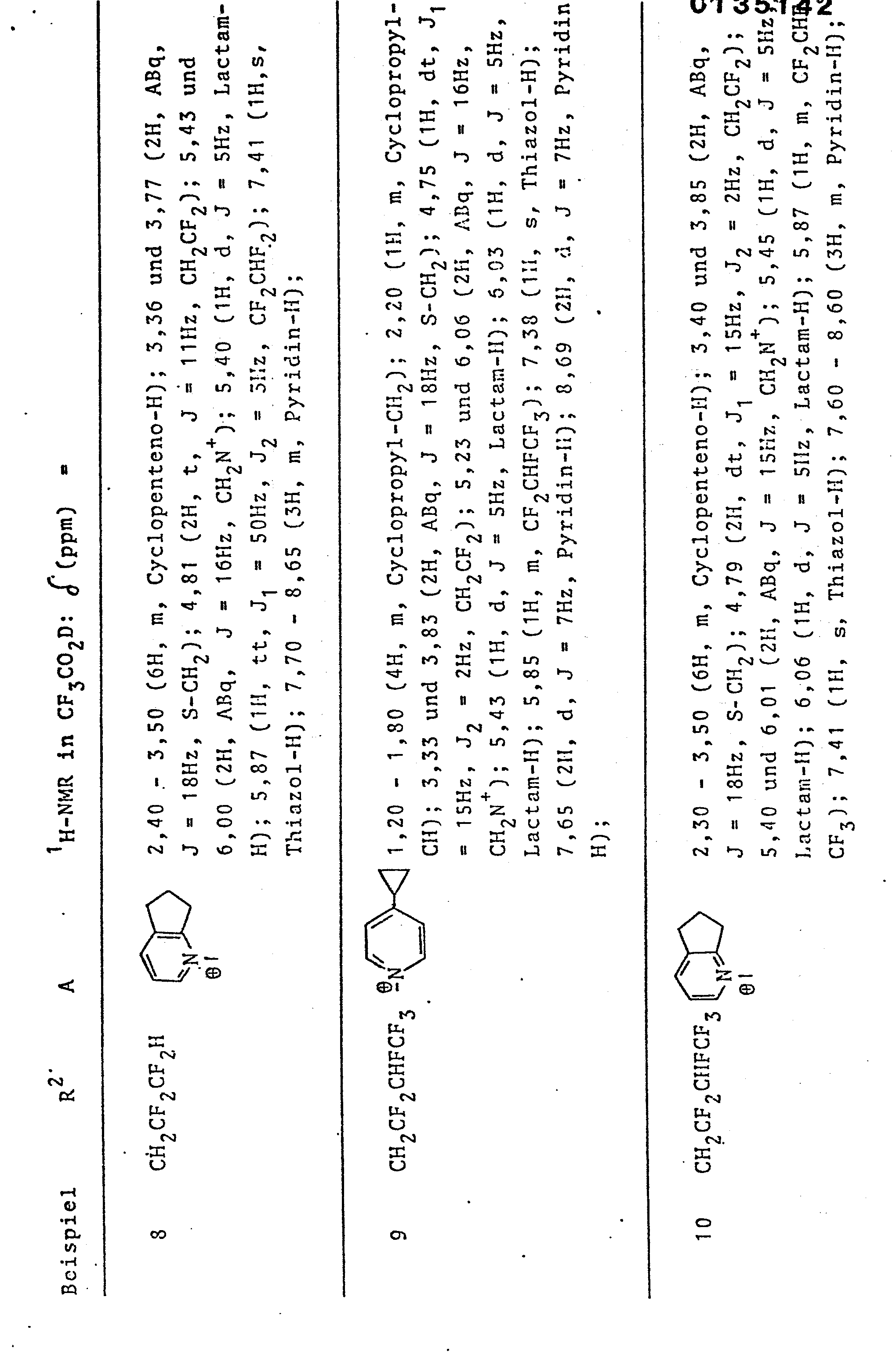


- 0,85 g 7-Amino-3-(1-(2,3-cyclopenteno-pyridinio)-methyl)-ceph-3-em-4-carboxylat werden unter Stickstoff in 35 ml trockenem Methylenchlorid suspebduert. Nach Zugabe von 1,5 ml N, 0- Bis- (trimethylsilyl)-acetamid wird 30 min. bei Raümtemperatur gerührt. Die erhaltene klare Lösung wird im Eisbad gekühlt und 0,78 g des in Herstellungsbeispiel 2 erhaltenen Aktivesters portionsweise zugegeben. Man rührt 12 h bei Raumtemperatur, versetzt mit 100 ml Eiswasser und neutralisiert mit verdünnter Natriumhydrogencarbonatlösung. Die wäßrige Phase wird abgetrennt, zweimal mit Methylenchlorid extrahiert und gefriergetrocknet. Der erhaltene Rückstand wird an Kieselgel mit einem Aceton/Wasser-Gemisch (3/1) chromatographiert. Die Produktfraktionen werden gefriergetrocknet. Man erhält 0,25 g eines farblosen , amorphen Feststoffes, der in allen Eigenschaften mit dem in Beispiel 4 beschriebenen Produkt identisch ist.
- Analog Beispiel 33 werden die Verbindungen der Tabelle 2, die der allgemeinen Formel I mit R1 = Wasserstoff entsprechen als amorphe Feststoffe erhalten.

- 3,38 g (3.3mmol) syn-2-Methylthiomethyloximino-2-(2-tritylaminothiazol-4-yl)-essigsäure werden zusammen mit 0,5 g (3.3 mmol) HOBT und 0,75g(3.6 mmol) DCCI in 25 ml THF oder DMF während ca. 4 h zum Aktivester umgesetzt. Man filtriert (bei 0°C) zu einer Lösung aus 1.21g(3 mmol) 7-Amino -3-(1-(2,3-cyclo- pentenopyridinio)-methyl)-ceph-3-em-4-carbonsäure-Dihydrochlorid in 20 ml THF und 2.2 ml (9 mmol) N,0-Bis-trimethylsilyacetamid (BSA), rührt über Nacht bei 0°C, hydrolysiert mit wenig Wasser und engt ein. Zur Detritylierung wird 1 h bei Raumtemp. mit 20 ml Ameisensäure behandelt, eingeengt, dann wie in Beispiel 1 beschrieben chromatographiert und gefriergetrocknet.
- Ausbeute: 0,1 g
- 1H-NMR: (CF3CO2D) δ = 2,1 - 2,8 (5H, m, 2 Cyclopenten-H und S-CH3); 3.1 - 4,0 (6H, m, Cyclopenten-H und S-CN2); 5.1 - 6.15 (6H, m, 3-CH2, 2 Lactam-H und CH2-S); 7.4 (1H, s, Thiazol-H); 7.6 - 8.6 ppm (3H, m, Pyridin-H);
- In Analogie zu Beispiel 38 aus 7-Amino-3-((4-Cyclo- propylpyridinio)-methyl)- ceph-3-em-4-carbonsäure-Dihydrochlorid und syn-2-Allyloxyimino-2-(2-tritylamino- thiazol-4-yl)-essigäure hergestellt.
- 1H-NMR (DMSO)-d6):δ= 1.0 - 1.6 (4H, m, Cyclopropyl-CH2); 2.0 - 2.5 (1H, m, Cyclopropyl-CH); 3.1 - 4.0 (2H, AB, J = 18Hz, S-CH2); 4.5 - 4.8 (2H, m, Allyl-CH2); 4.95 - 6.1 (7H, m, 2 Lactam-H, 3-CHZ und 3 Allyl-H) 6.66 (1H, s, Thiazol-H) 7.77 und 9.17 (4H, AA'BB', Pyridin-H);
- 1.02 g (4 mmol) syn-2-Cyclopentyloximino-2-(2-aminothiazol-4-yl)-essigsäure werden zusammen mit 0,62 g (4 mmol) 1-Hydroxybenzotriazol und 0,9 g (4.4 mmol) N,N'- Dicyclohexylcarbodiimid in 20 ml N,N-Dimethylformamid gelöst, nach 3 Stunden vom ausgefallenen Harnstoff abfiltriert, und das Filtrat bei 0°C zu einer Suspension von 1.62 g (4 mmol) 7-Amino-3-(4-cyclo- propylpyridinio)-methyl)-ceph-3-em-4-carbonsäure-Dihydrochlorid in 20 ml DMF, 2 ml Wasser und 0,32 ml (4 mmol) Pyridin getropft, über Nacht bei 0°C gerührt und die Vollständigkeit der Reaktion durch DC-Kontrolle überprüft. Man gießt in ca. 500 ml Ether, dekantiert, und rührt noch 1-2 mal mit Ether aus, nimmt mit Aceton/Wasser 3:1 auf, neutralisiert mit NaHCO3 und chromatografiert wie in Beispiel 1 beschrieben.
- Ausbaute: 0,35 g
- 1H-NMR (CF3CO2D):δ= 1,05 - 2,55 (13H, m, Cyclopentyl- und Cyclopropyl-H); 3,16 - 4,05 (2H, AB, J=19HZ, S-CH2); 4,9 - 6,33 (5H, m, 3-CH2, Lactam-H und Cyclopontyl-CH); 7,4 (1H, s, Thiazol-H); 7,63 - 8,66 (4H, AA'BB', Pyridin-H):
- In Analogie zu Beispiel 40 werden die nachfolgend in Tabelle 3 aufgeführten Verbindungen die der allgemeinen Formel I mit R1 = Wasserstoff entsprechen als amorphe Feststoffe erhalten...


- 0,68 g 7-Amino-3-jodmethyl-ceph-3-em-4-carbonsäure werden in 40 ml Methylenchlorid suspendiert. Nach Zugabe von 1,5 ml N,0-Bistrimethylsilylacetamid wird 30 min unter Stickstoff, gerührt. Die erhaltene klare Lösung versetzt man mit 0,8 ml 2,3 Cyclohexenopyridin und rührt 3 Stunden. Nach Zugabe von 0,85 g des im Herstellungsbeispieltbeschriebenen Aktivesters wird 16 Stunden bei Raumtemperatur gerührt. Man versetzt mit 1 ml Methanol und dampft i. Vak. ein. Der Rückstand wird dreimal mit Diäthyläther verrührt und der Äther abdekantiert. Der erhaltene feste Rückstand wird in 10 ml Aceton/Wasser (3/1) gelöst, mit gesättigter Natriumhydrogencarbonatlösung auf pH = 6 eingestellt und an Kieselgel mit Aceton/Wasser (3/1) chromatografiert. Die Produktfraktionen werden gefriergetrocknet. Man erhält 0,33 g eines farblosen, amorphen Feststoffes.
- IR (KBr): 1770, 1670, 1620 cm-1
- 1H-KMR (CF3CODD): δ = 1,8 - 2,3 (4H, m, Cyclohexeno-H); 2,7 - 3,7 (6H, m, Cyclohexeno-H und S-CH2); 4,73 (2H, q, J = 9Hz, CH2CF3); 5,65 - 6,2 (4H, m, 2 Lactam-H und CH2-N+); 7,4 (1H, s , Thiazol-H); 7,6 - 8,8 (3H, m, Pyridin-H);
- Analog Beispiel 50 werden die nachfolgend aufgeführten Verbindungen der Tabelle 4, die der allgemeinen Formel I mit R1 = Wasserstoff entsprechen und als Reste Rund A die in der Tabelle angegebenen Substituenten tragen als amorphe Feststoffe erhalten.


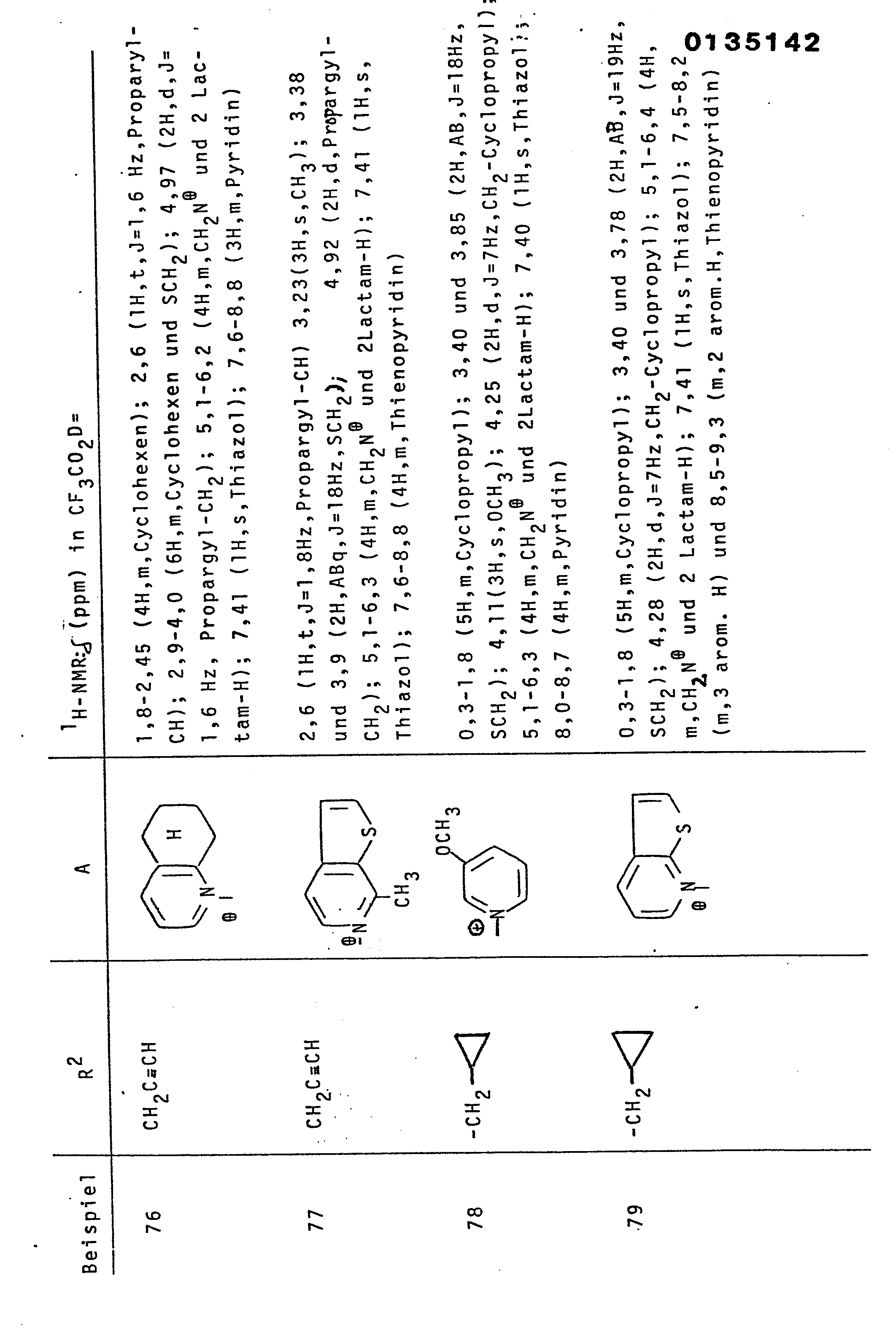


Claims (8)


Herstellung von Verbindungen der Formel I und ihrer physiologisch verträglichen Säureadditionssalze, dadurch gekennzeichnet , daß man

oder


eine gegebenenfalls vorhandene Aminoschutzgruppe abspaltet und
die Verbindung IV worin R5 eine Aminogruppe bedeutet entweder als solche oder in Form eines Säureadditionssalzes oder eines reaktionsfähigen Derivates mit einer 2-(2-Aminothiazol-4-yl)-2-syh-oxyiminoessigsäure der allgemeinen Formel V

Priority Applications (1)
| Application Number | Priority Date | Filing Date | Title |
|---|---|---|---|
| AT84109661T ATE37374T1 (de) | 1983-08-25 | 1984-08-14 | Cephalosporinderivate und verfahren zu ihrer herstellung. |
Applications Claiming Priority (2)
| Application Number | Priority Date | Filing Date | Title |
|---|---|---|---|
| DE3330605 | 1983-08-25 | ||
| DE19833330605 DE3330605A1 (de) | 1983-08-25 | 1983-08-25 | Cephalosporinderivate und verfahren zu ihrer herstellung |
Publications (3)
| Publication Number | Publication Date |
|---|---|
| EP0135142A2 true EP0135142A2 (de) | 1985-03-27 |
| EP0135142A3 EP0135142A3 (en) | 1986-01-08 |
| EP0135142B1 EP0135142B1 (de) | 1988-09-21 |
Family
ID=6207374
Family Applications (1)
| Application Number | Title | Priority Date | Filing Date |
|---|---|---|---|
| EP84109661A Expired EP0135142B1 (de) | 1983-08-25 | 1984-08-14 | Cephalosporinderivate und Verfahren zu ihrer Herstellung |
Country Status (12)
| Country | Link |
|---|---|
| EP (1) | EP0135142B1 (de) |
| JP (1) | JPS60105684A (de) |
| KR (1) | KR850001761A (de) |
| AT (1) | ATE37374T1 (de) |
| AU (1) | AU3239284A (de) |
| DE (2) | DE3330605A1 (de) |
| DK (1) | DK406084A (de) |
| ES (1) | ES535354A0 (de) |
| GR (1) | GR80182B (de) |
| HU (1) | HU193020B (de) |
| PT (1) | PT79118B (de) |
| ZA (1) | ZA846606B (de) |
Cited By (7)
| Publication number | Priority date | Publication date | Assignee | Title |
|---|---|---|---|---|
| GB2166737A (en) * | 1984-11-02 | 1986-05-14 | Glaxo Group Ltd | Cephalosporin antibiotics |
| GB2183630A (en) * | 1985-10-31 | 1987-06-10 | Glaxo Group Ltd | Cephalosporin antibiotics |
| AT388919B (de) * | 1987-04-01 | 1989-09-25 | Biochemie Gmbh | Verfahren zur herstellung von cephalosporinderivaten |
| US4904791A (en) * | 1985-04-01 | 1990-02-27 | Mochida Pharmaceutical Co., Ltd. | Cephalosporin derivatives |
| US4960766A (en) * | 1985-11-22 | 1990-10-02 | Fujisawa Pharmaceutical Co., Ltd. | Cephem compounds |
| US5064953A (en) * | 1983-12-29 | 1991-11-12 | Mochida Pharmaceutical Co., Ltd. | Intermediates cephalosporin derivatives |
| WO1998016500A1 (de) * | 1996-10-15 | 1998-04-23 | Bayer Aktiengesellschaft | Halogenalkoximinoessigsäureamide |
Families Citing this family (2)
| Publication number | Priority date | Publication date | Assignee | Title |
|---|---|---|---|---|
| GB8432295D0 (en) * | 1984-12-20 | 1985-01-30 | Fujisawa Pharmaceutical Co | Cephem compounds |
| US4761410A (en) * | 1985-01-14 | 1988-08-02 | Fujisawa Pharmaceutical Co., Ltd. | Cephem Compounds |
Family Cites Families (4)
| Publication number | Priority date | Publication date | Assignee | Title |
|---|---|---|---|---|
| GB1399086A (en) * | 1971-05-14 | 1975-06-25 | Glaxo Lab Ltd | Cephalosporin compounds |
| DE2714880A1 (de) * | 1977-04-02 | 1978-10-26 | Hoechst Ag | Cephemderivate und verfahren zu ihrer herstellung |
| FR2462439A1 (fr) * | 1979-07-26 | 1981-02-13 | Roussel Uclaf | Nouveau procede de preparation de produits derives de l'acide 7-/(2-aryl) 2-hydroxyimino acetamido/cephalosporanique |
| US4443444A (en) * | 1980-08-11 | 1984-04-17 | Fujisawa Pharmaceutical Co., Ltd. | Cephem compounds |
-
1983
- 1983-08-25 DE DE19833330605 patent/DE3330605A1/de not_active Withdrawn
-
1984
- 1984-08-14 AT AT84109661T patent/ATE37374T1/de not_active IP Right Cessation
- 1984-08-14 DE DE8484109661T patent/DE3474148D1/de not_active Expired
- 1984-08-14 EP EP84109661A patent/EP0135142B1/de not_active Expired
- 1984-08-21 HU HU843142A patent/HU193020B/hu unknown
- 1984-08-23 GR GR80182A patent/GR80182B/el unknown
- 1984-08-23 PT PT79118A patent/PT79118B/de unknown
- 1984-08-23 ES ES535354A patent/ES535354A0/es active Granted
- 1984-08-24 ZA ZA846606A patent/ZA846606B/xx unknown
- 1984-08-24 AU AU32392/84A patent/AU3239284A/en not_active Abandoned
- 1984-08-24 DK DK406084A patent/DK406084A/da not_active Application Discontinuation
- 1984-08-24 JP JP59176536A patent/JPS60105684A/ja active Pending
- 1984-08-25 KR KR1019840005179A patent/KR850001761A/ko not_active Withdrawn
Cited By (9)
| Publication number | Priority date | Publication date | Assignee | Title |
|---|---|---|---|---|
| US5064953A (en) * | 1983-12-29 | 1991-11-12 | Mochida Pharmaceutical Co., Ltd. | Intermediates cephalosporin derivatives |
| GB2166737A (en) * | 1984-11-02 | 1986-05-14 | Glaxo Group Ltd | Cephalosporin antibiotics |
| US5043334A (en) * | 1984-11-02 | 1991-08-27 | Glaxo Group Limited | Cephalosporin antibiotics |
| US4904791A (en) * | 1985-04-01 | 1990-02-27 | Mochida Pharmaceutical Co., Ltd. | Cephalosporin derivatives |
| US4956474A (en) * | 1985-04-01 | 1990-09-11 | Mochida Pharmaceutical Co., Ltd. | Intermediates of cephalosporin compounds |
| GB2183630A (en) * | 1985-10-31 | 1987-06-10 | Glaxo Group Ltd | Cephalosporin antibiotics |
| US4960766A (en) * | 1985-11-22 | 1990-10-02 | Fujisawa Pharmaceutical Co., Ltd. | Cephem compounds |
| AT388919B (de) * | 1987-04-01 | 1989-09-25 | Biochemie Gmbh | Verfahren zur herstellung von cephalosporinderivaten |
| WO1998016500A1 (de) * | 1996-10-15 | 1998-04-23 | Bayer Aktiengesellschaft | Halogenalkoximinoessigsäureamide |
Also Published As
| Publication number | Publication date |
|---|---|
| HU193020B (en) | 1987-08-28 |
| HUT36799A (en) | 1985-10-28 |
| AU3239284A (en) | 1985-02-28 |
| ATE37374T1 (de) | 1988-10-15 |
| EP0135142B1 (de) | 1988-09-21 |
| DK406084D0 (da) | 1984-08-24 |
| KR850001761A (ko) | 1985-04-01 |
| PT79118B (de) | 1986-09-15 |
| ES8601214A1 (es) | 1985-10-16 |
| JPS60105684A (ja) | 1985-06-11 |
| DE3330605A1 (de) | 1985-03-14 |
| GR80182B (en) | 1985-01-02 |
| ZA846606B (en) | 1985-04-24 |
| ES535354A0 (es) | 1985-10-16 |
| PT79118A (de) | 1984-09-01 |
| DK406084A (da) | 1985-02-26 |
| EP0135142A3 (en) | 1986-01-08 |
| DE3474148D1 (en) | 1988-10-27 |
Similar Documents
| Publication | Publication Date | Title |
|---|---|---|
| EP0064740B1 (de) | Cephalosporinderivate und Verfahren zu ihrer Herstellung | |
| EP0088320A2 (de) | Cephalosporinderivate und Verfahren zu ihrer Herstellung | |
| DE69014490T2 (de) | Piperaziniocephalosporine. | |
| EP0034760B1 (de) | Cephalosporinderivate, sie enthaltende pharmazeutische Präparate und Verfahren zu ihrer Herstellung | |
| EP0124889A2 (de) | Verfahren zur Herstellung von Cephemverbindungen | |
| EP0137440A2 (de) | Cephalosporinderivate und Verfahren zu ihrer Herstellung | |
| EP0137441A2 (de) | Cephalosporinderivate und Verfahren zu ihrer Herstellung | |
| EP0111934B1 (de) | Cephalosporinderivate und Verfahren zu ihrer Herstellung | |
| DE3307550C2 (de) | ||
| DE3586547T2 (de) | Antibakterielle verbindungen. | |
| EP0137442A2 (de) | Cephalosporinderivate und Verfahren zu ihrer Herstellung | |
| EP0111935B1 (de) | Cephalosporinderivate und Verfahren zu ihrer Herstellung | |
| EP0135142B1 (de) | Cephalosporinderivate und Verfahren zu ihrer Herstellung | |
| CH669600A5 (de) | ||
| EP0144032B1 (de) | Cephalosporine und Verfahren zu ihrer Herstellung | |
| DE3336755A1 (de) | Cephalosporinderivate und verfahren zu ihrer herstellung | |
| EP0222322B1 (de) | Cephalosporinderivate und Verfahren zu ihrer Herstellung | |
| EP0154793B1 (de) | 1-Oxadethiacephalosporinderivate sowie Verfahren zu ihrer Herstellung | |
| DE69902462T2 (de) | Cephalosporin-derivate, verfahren zu ihrer herstellung und diese enthaltende antimikrobielle mittel | |
| IT8349380A1 (it) | "antibiotici, cefalosporinici, procedimento per prepararli e composizioni farmaceutiche che li contengono" | |
| EP0281092A2 (de) | Cephalosporinderivate und Verfahren zu ihrer Herstellung | |
| DE3923541A1 (de) | Cephalosporinderivate und verfahren zu ihrer herstellung | |
| DE3338440A1 (de) | Cephalosporinderivate und verfahren zu ihrer herstellung | |
| KR0143534B1 (ko) | 신규 세팔로스포린계 화합물과 그의 제조방법 | |
| EP0390099A2 (de) | Polare Cephalosporinderivate und Verfahren zu ihrer Herstellung |
Legal Events
| Date | Code | Title | Description |
|---|---|---|---|
| PUAI | Public reference made under article 153(3) epc to a published international application that has entered the european phase |
Free format text: ORIGINAL CODE: 0009012 |
|
| AK | Designated contracting states |
Designated state(s): AT BE CH DE FR GB IT LI LU NL SE |
|
| PUAL | Search report despatched |
Free format text: ORIGINAL CODE: 0009013 |
|
| AK | Designated contracting states |
Designated state(s): AT BE CH DE FR GB IT LI LU NL SE |
|
| 17P | Request for examination filed |
Effective date: 19860613 |
|
| 17Q | First examination report despatched |
Effective date: 19870710 |
|
| GRAA | (expected) grant |
Free format text: ORIGINAL CODE: 0009210 |
|
| AK | Designated contracting states |
Kind code of ref document: B1 Designated state(s): AT BE CH DE FR GB IT LI LU NL SE |
|
| REF | Corresponds to: |
Ref document number: 37374 Country of ref document: AT Date of ref document: 19881015 Kind code of ref document: T |
|
| ITF | It: translation for a ep patent filed | ||
| REF | Corresponds to: |
Ref document number: 3474148 Country of ref document: DE Date of ref document: 19881027 |
|
| ET | Fr: translation filed | ||
| GBT | Gb: translation of ep patent filed (gb section 77(6)(a)/1977) | ||
| PLBE | No opposition filed within time limit |
Free format text: ORIGINAL CODE: 0009261 |
|
| STAA | Information on the status of an ep patent application or granted ep patent |
Free format text: STATUS: NO OPPOSITION FILED WITHIN TIME LIMIT |
|
| 26N | No opposition filed | ||
| ITTA | It: last paid annual fee | ||
| EPTA | Lu: last paid annual fee | ||
| EAL | Se: european patent in force in sweden |
Ref document number: 84109661.3 |
|
| REG | Reference to a national code |
Ref country code: GB Ref legal event code: IF02 |
|
| PGFP | Annual fee paid to national office [announced via postgrant information from national office to epo] |
Ref country code: DE Payment date: 20030611 Year of fee payment: 20 |
|
| PGFP | Annual fee paid to national office [announced via postgrant information from national office to epo] |
Ref country code: AT Payment date: 20030617 Year of fee payment: 20 |
|
| PGFP | Annual fee paid to national office [announced via postgrant information from national office to epo] |
Ref country code: SE Payment date: 20030618 Year of fee payment: 20 Ref country code: GB Payment date: 20030618 Year of fee payment: 20 Ref country code: CH Payment date: 20030618 Year of fee payment: 20 |
|
| PGFP | Annual fee paid to national office [announced via postgrant information from national office to epo] |
Ref country code: FR Payment date: 20030620 Year of fee payment: 20 |
|
| PGFP | Annual fee paid to national office [announced via postgrant information from national office to epo] |
Ref country code: LU Payment date: 20030711 Year of fee payment: 20 |
|
| PGFP | Annual fee paid to national office [announced via postgrant information from national office to epo] |
Ref country code: BE Payment date: 20030722 Year of fee payment: 20 |
|
| PGFP | Annual fee paid to national office [announced via postgrant information from national office to epo] |
Ref country code: NL Payment date: 20030731 Year of fee payment: 20 |
|
| PG25 | Lapsed in a contracting state [announced via postgrant information from national office to epo] |
Ref country code: LI Free format text: LAPSE BECAUSE OF EXPIRATION OF PROTECTION Effective date: 20040813 Ref country code: GB Free format text: LAPSE BECAUSE OF EXPIRATION OF PROTECTION Effective date: 20040813 Ref country code: CH Free format text: LAPSE BECAUSE OF EXPIRATION OF PROTECTION Effective date: 20040813 |
|
| PG25 | Lapsed in a contracting state [announced via postgrant information from national office to epo] |
Ref country code: NL Free format text: LAPSE BECAUSE OF EXPIRATION OF PROTECTION Effective date: 20040814 Ref country code: LU Free format text: LAPSE BECAUSE OF EXPIRATION OF PROTECTION Effective date: 20040814 Ref country code: AT Free format text: LAPSE BECAUSE OF EXPIRATION OF PROTECTION Effective date: 20040814 |
|
| BE20 | Be: patent expired |
Owner name: *HOECHST A.G. Effective date: 20040814 |
|
| REG | Reference to a national code |
Ref country code: GB Ref legal event code: PE20 |
|
| REG | Reference to a national code |
Ref country code: CH Ref legal event code: PL |
|
| EUG | Se: european patent has lapsed | ||
| NLV7 | Nl: ceased due to reaching the maximum lifetime of a patent |