EP0135193A2 - Schmiermittel für die Metallbearbeitung - Google Patents
Schmiermittel für die Metallbearbeitung Download PDFInfo
- Publication number
- EP0135193A2 EP0135193A2 EP84110944A EP84110944A EP0135193A2 EP 0135193 A2 EP0135193 A2 EP 0135193A2 EP 84110944 A EP84110944 A EP 84110944A EP 84110944 A EP84110944 A EP 84110944A EP 0135193 A2 EP0135193 A2 EP 0135193A2
- Authority
- EP
- European Patent Office
- Prior art keywords
- lubricant
- calcium carbonate
- silane coupling
- coupling agent
- lubricant according
- Prior art date
- Legal status (The legal status is an assumption and is not a legal conclusion. Google has not performed a legal analysis and makes no representation as to the accuracy of the status listed.)
- Granted
Links
Classifications
-
- C—CHEMISTRY; METALLURGY
- C10—PETROLEUM, GAS OR COKE INDUSTRIES; TECHNICAL GASES CONTAINING CARBON MONOXIDE; FUELS; LUBRICANTS; PEAT
- C10M—LUBRICATING COMPOSITIONS; USE OF CHEMICAL SUBSTANCES EITHER ALONE OR AS LUBRICATING INGREDIENTS IN A LUBRICATING COMPOSITION
- C10M161/00—Lubricating compositions characterised by the additive being a mixture of a macromolecular compound and a non-macromolecular compound, each of these compounds being essential
-
- C—CHEMISTRY; METALLURGY
- C10—PETROLEUM, GAS OR COKE INDUSTRIES; TECHNICAL GASES CONTAINING CARBON MONOXIDE; FUELS; LUBRICANTS; PEAT
- C10M—LUBRICATING COMPOSITIONS; USE OF CHEMICAL SUBSTANCES EITHER ALONE OR AS LUBRICATING INGREDIENTS IN A LUBRICATING COMPOSITION
- C10M101/00—Lubricating compositions characterised by the base-material being a mineral or fatty oil
- C10M101/04—Fatty oil fractions
-
- C—CHEMISTRY; METALLURGY
- C10—PETROLEUM, GAS OR COKE INDUSTRIES; TECHNICAL GASES CONTAINING CARBON MONOXIDE; FUELS; LUBRICANTS; PEAT
- C10M—LUBRICATING COMPOSITIONS; USE OF CHEMICAL SUBSTANCES EITHER ALONE OR AS LUBRICATING INGREDIENTS IN A LUBRICATING COMPOSITION
- C10M125/00—Lubricating compositions characterised by the additive being an inorganic material
- C10M125/10—Metal oxides, hydroxides, carbonates or bicarbonates
-
- C—CHEMISTRY; METALLURGY
- C10—PETROLEUM, GAS OR COKE INDUSTRIES; TECHNICAL GASES CONTAINING CARBON MONOXIDE; FUELS; LUBRICANTS; PEAT
- C10M—LUBRICATING COMPOSITIONS; USE OF CHEMICAL SUBSTANCES EITHER ALONE OR AS LUBRICATING INGREDIENTS IN A LUBRICATING COMPOSITION
- C10M139/00—Lubricating compositions characterised by the additive being an organic non-macromolecular compound containing atoms of elements not provided for in groups C10M127/00 - C10M137/00
- C10M139/04—Lubricating compositions characterised by the additive being an organic non-macromolecular compound containing atoms of elements not provided for in groups C10M127/00 - C10M137/00 having a silicon-to-carbon bond, e.g. silanes
-
- C—CHEMISTRY; METALLURGY
- C10—PETROLEUM, GAS OR COKE INDUSTRIES; TECHNICAL GASES CONTAINING CARBON MONOXIDE; FUELS; LUBRICANTS; PEAT
- C10M—LUBRICATING COMPOSITIONS; USE OF CHEMICAL SUBSTANCES EITHER ALONE OR AS LUBRICATING INGREDIENTS IN A LUBRICATING COMPOSITION
- C10M141/00—Lubricating compositions characterised by the additive being a mixture of two or more compounds covered by more than one of the main groups C10M125/00 - C10M139/00, each of these compounds being essential
- C10M141/12—Lubricating compositions characterised by the additive being a mixture of two or more compounds covered by more than one of the main groups C10M125/00 - C10M139/00, each of these compounds being essential at least one of them being an organic compound containing atoms of elements not provided for in groups C10M141/02 - C10M141/10
-
- C—CHEMISTRY; METALLURGY
- C10—PETROLEUM, GAS OR COKE INDUSTRIES; TECHNICAL GASES CONTAINING CARBON MONOXIDE; FUELS; LUBRICANTS; PEAT
- C10M—LUBRICATING COMPOSITIONS; USE OF CHEMICAL SUBSTANCES EITHER ALONE OR AS LUBRICATING INGREDIENTS IN A LUBRICATING COMPOSITION
- C10M2201/00—Inorganic compounds or elements as ingredients in lubricant compositions
- C10M2201/06—Metal compounds
- C10M2201/062—Oxides; Hydroxides; Carbonates or bicarbonates
-
- C—CHEMISTRY; METALLURGY
- C10—PETROLEUM, GAS OR COKE INDUSTRIES; TECHNICAL GASES CONTAINING CARBON MONOXIDE; FUELS; LUBRICANTS; PEAT
- C10M—LUBRICATING COMPOSITIONS; USE OF CHEMICAL SUBSTANCES EITHER ALONE OR AS LUBRICATING INGREDIENTS IN A LUBRICATING COMPOSITION
- C10M2207/00—Organic non-macromolecular hydrocarbon compounds containing hydrogen, carbon and oxygen as ingredients in lubricant compositions
- C10M2207/40—Fatty vegetable or animal oils
- C10M2207/401—Fatty vegetable or animal oils used as base material
-
- C—CHEMISTRY; METALLURGY
- C10—PETROLEUM, GAS OR COKE INDUSTRIES; TECHNICAL GASES CONTAINING CARBON MONOXIDE; FUELS; LUBRICANTS; PEAT
- C10M—LUBRICATING COMPOSITIONS; USE OF CHEMICAL SUBSTANCES EITHER ALONE OR AS LUBRICATING INGREDIENTS IN A LUBRICATING COMPOSITION
- C10M2207/00—Organic non-macromolecular hydrocarbon compounds containing hydrogen, carbon and oxygen as ingredients in lubricant compositions
- C10M2207/40—Fatty vegetable or animal oils
- C10M2207/404—Fatty vegetable or animal oils obtained from genetically modified species
- C10M2207/4045—Fatty vegetable or animal oils obtained from genetically modified species used as base material
-
- C—CHEMISTRY; METALLURGY
- C10—PETROLEUM, GAS OR COKE INDUSTRIES; TECHNICAL GASES CONTAINING CARBON MONOXIDE; FUELS; LUBRICANTS; PEAT
- C10M—LUBRICATING COMPOSITIONS; USE OF CHEMICAL SUBSTANCES EITHER ALONE OR AS LUBRICATING INGREDIENTS IN A LUBRICATING COMPOSITION
- C10M2227/00—Organic non-macromolecular compounds containing atoms of elements not provided for in groups C10M2203/00, C10M2207/00, C10M2211/00, C10M2215/00, C10M2219/00 or C10M2223/00 as ingredients in lubricant compositions
- C10M2227/04—Organic non-macromolecular compounds containing atoms of elements not provided for in groups C10M2203/00, C10M2207/00, C10M2211/00, C10M2215/00, C10M2219/00 or C10M2223/00 as ingredients in lubricant compositions having a silicon-to-carbon bond, e.g. organo-silanes
-
- C—CHEMISTRY; METALLURGY
- C10—PETROLEUM, GAS OR COKE INDUSTRIES; TECHNICAL GASES CONTAINING CARBON MONOXIDE; FUELS; LUBRICANTS; PEAT
- C10N—INDEXING SCHEME ASSOCIATED WITH SUBCLASS C10M RELATING TO LUBRICATING COMPOSITIONS
- C10N2010/00—Metal present as such or in compounds
- C10N2010/02—Groups 1 or 11
-
- C—CHEMISTRY; METALLURGY
- C10—PETROLEUM, GAS OR COKE INDUSTRIES; TECHNICAL GASES CONTAINING CARBON MONOXIDE; FUELS; LUBRICANTS; PEAT
- C10N—INDEXING SCHEME ASSOCIATED WITH SUBCLASS C10M RELATING TO LUBRICATING COMPOSITIONS
- C10N2040/00—Specified use or application for which the lubricating composition is intended
- C10N2040/20—Metal working
- C10N2040/24—Metal working without essential removal of material, e.g. forming, gorging, drawing, pressing, stamping, rolling or extruding; Punching metal
-
- C—CHEMISTRY; METALLURGY
- C10—PETROLEUM, GAS OR COKE INDUSTRIES; TECHNICAL GASES CONTAINING CARBON MONOXIDE; FUELS; LUBRICANTS; PEAT
- C10N—INDEXING SCHEME ASSOCIATED WITH SUBCLASS C10M RELATING TO LUBRICATING COMPOSITIONS
- C10N2040/00—Specified use or application for which the lubricating composition is intended
- C10N2040/20—Metal working
- C10N2040/241—Manufacturing joint-less pipes
-
- C—CHEMISTRY; METALLURGY
- C10—PETROLEUM, GAS OR COKE INDUSTRIES; TECHNICAL GASES CONTAINING CARBON MONOXIDE; FUELS; LUBRICANTS; PEAT
- C10N—INDEXING SCHEME ASSOCIATED WITH SUBCLASS C10M RELATING TO LUBRICATING COMPOSITIONS
- C10N2040/00—Specified use or application for which the lubricating composition is intended
- C10N2040/20—Metal working
- C10N2040/242—Hot working
-
- C—CHEMISTRY; METALLURGY
- C10—PETROLEUM, GAS OR COKE INDUSTRIES; TECHNICAL GASES CONTAINING CARBON MONOXIDE; FUELS; LUBRICANTS; PEAT
- C10N—INDEXING SCHEME ASSOCIATED WITH SUBCLASS C10M RELATING TO LUBRICATING COMPOSITIONS
- C10N2040/00—Specified use or application for which the lubricating composition is intended
- C10N2040/20—Metal working
- C10N2040/243—Cold working
-
- C—CHEMISTRY; METALLURGY
- C10—PETROLEUM, GAS OR COKE INDUSTRIES; TECHNICAL GASES CONTAINING CARBON MONOXIDE; FUELS; LUBRICANTS; PEAT
- C10N—INDEXING SCHEME ASSOCIATED WITH SUBCLASS C10M RELATING TO LUBRICATING COMPOSITIONS
- C10N2040/00—Specified use or application for which the lubricating composition is intended
- C10N2040/20—Metal working
- C10N2040/244—Metal working of specific metals
- C10N2040/245—Soft metals, e.g. aluminum
-
- C—CHEMISTRY; METALLURGY
- C10—PETROLEUM, GAS OR COKE INDUSTRIES; TECHNICAL GASES CONTAINING CARBON MONOXIDE; FUELS; LUBRICANTS; PEAT
- C10N—INDEXING SCHEME ASSOCIATED WITH SUBCLASS C10M RELATING TO LUBRICATING COMPOSITIONS
- C10N2040/00—Specified use or application for which the lubricating composition is intended
- C10N2040/20—Metal working
- C10N2040/244—Metal working of specific metals
- C10N2040/246—Iron or steel
-
- C—CHEMISTRY; METALLURGY
- C10—PETROLEUM, GAS OR COKE INDUSTRIES; TECHNICAL GASES CONTAINING CARBON MONOXIDE; FUELS; LUBRICANTS; PEAT
- C10N—INDEXING SCHEME ASSOCIATED WITH SUBCLASS C10M RELATING TO LUBRICATING COMPOSITIONS
- C10N2040/00—Specified use or application for which the lubricating composition is intended
- C10N2040/20—Metal working
- C10N2040/244—Metal working of specific metals
- C10N2040/247—Stainless steel
Definitions
- the invention relates to a lubricant for the cold working of metals containing fatty oils and / or mineral oils and calcium carbonate dispersed therein and its application to the cold working of steel, stainless steel, copper or zinc.
- Lubrication is required to reduce the friction and wear between metal molds and tools and the workpiece when cold working metals, and to prevent cold welding.
- lubrication has mainly been carried out by forming a phosphate coating on the surface and applying soap thereon.
- Certain disadvantages in the pretreatment of metal surfaces before the cold forming by phosphating and soaping are that the phosphating is carried out at elevated temperatures (energy consumption) and requires several work steps.
- Another working method for cold working is to treat the metal surfaces with lubricating oils containing high-pressure additives.
- lubricating oils which are suitable for drawing in cold working, there is at high deformation work the problem that the adhesive strength of the oil film on the metal surface is not sufficient, so that cold welding occurs and damage to the metal molds and tools as well as workpieces.
- solid lubricant additives such as molybdenum disulfide, graphite, Teflon powder, resin acid-coated calcium carbonate are also used.
- molybdenum disulfide and graphite are very expensive materials, moreover in cold working with high deformation work of insufficient effectiveness, so that additives with higher performance are required.
- Resin acid-coated calcium carbonate is inexpensive and, within certain limits, also has good lubricating properties, but in order to achieve good lubricating performance, it must be mixed with at least 30% by weight of the lubricating oil.
- the viscosity of the lubricant increases extraordinarily, it is difficult to supply it and the work performance decreases. After processing, it is difficult to remove the lubricant adhering to the products. If the lubricant is used repeatedly in the circulatory process, the properties of the resin-coated calcium carbonate are impaired due to the temporary heating during processing, the viscosity has increased to 3 to 10 times that of the fresh lubricant and the work output has decreased accordingly.
- the object of the invention is to avoid the disadvantages of the known methods for pretreatment before cold machining or that of the known lubricants and to provide a lubricant which is inexpensive, saves energy in lubrication, shortens the machining process, improves the surface quality of cold-machined workpieces and the subsequent degreasing easier.
- the problem is solved by the lubricant of the beginning mentioned type according to the invention is designed such that it contains 5 to 50 wt .-% with silane coupling agent-coated calcium carbonate with up to 3 / um average grain diameter.
- Calcium carbonate of the required fineness can be produced by crushing and grinding in colloid mills or by wet precipitation processes with subsequent drying.
- Silane coupling agents are known compounds and are described, for example, in Ullmann " Encyclopedia of Industrial Chemistry", 4th edition, volume 21, page 496 ff.
- Amino and vinyl silane are particularly suitable silane coupling agents.
- a lubricant is advantageously used which contains spindle-shaped calcium carbonate covered with silane coupling agent.
- the average grain diameter of the coated calcium carbonate with up to 3 / um is important insofar as, with a larger diameter, the lubricant tears strongly during high deformation work, so that it does not penetrate between the mold and the workpiece and the lubricating effect remains low.
- coated calcium carbonate With regard to the content of coated calcium carbonate, it should be pointed out that below 5% by weight, frictional contact between the mold and the workpiece cannot be ruled out with certainty. With a content of more than 50% by weight, the result is a high coefficient of friction, the lubricating properties decrease and the viscosity rises sharply, so that the work performance deteriorates.
- a lubricant which contains 10 to 30% by weight of calcium carbonate coated with silane coupling agent.
- the lubricant according to the invention can be used within the process sequence pickling with acid, rinsing with water, optionally in 2 stages, drying and lubrication.
- a further advantageous embodiment of the invention provides for the surfactant to be added to the lubricant.
- Nonionic, anionic, cationic or zwitterionic surfactants, in particular nonionic surfactants, are suitable for this.
- the lubricant according to the present invention is applied at temperatures from room temperature to 60 ° C. It can be applied to the workpiece by dipping, brushing, pouring, spraying, etc.
- the lubricant according to the present invention is universally applicable. It is particularly suitable for cold machining steel, stainless steel, copper or zinc.
- the advantages of the lubricant according to the invention are to save energy in the cold working of the metals, to shorten the process, to increase the surface quality of the workpieces and to improve the removability of the lubricant after the cold working. In addition, there is no significant increase in viscosity when the lubricant is used repeatedly.
- the aforementioned lubricants were tested by the point contact method in the SRV vibration friction and wear tester. Steel balls with a diameter of 10 mm and discs with a thickness of 8 mm and 24 mm were used to determine the coefficient of friction and the depth of wear.
- the test conditions were:
- lubricants 1 and 2 according to the invention had a low coefficient of friction with good stability. They were also advantageous due to the low depth of wear. In contrast, the stability of the friction coefficient of the known lubricants was particularly unsatisfactory and the depth of wear was poor.
- the lubricants in Table 2 were measured for the change in their viscosity after heating to 130 ° C. for 6 days.
- the SRV test was carried out analogously to Example 1. The results of the tests are set out in Table 3.
- the lubricants according to the present invention had an advantageous coefficient of friction in the SRV test with good stability even at low viscosity; the changes in viscosity were also small and therefore favorable.
- the pipes processed with the lubricant according to the present invention showed no damage, and they were also of low surface roughness. Finally, the lubricant removal properties were also good.
Landscapes
- Chemical & Material Sciences (AREA)
- Chemical Kinetics & Catalysis (AREA)
- General Chemical & Material Sciences (AREA)
- Oil, Petroleum & Natural Gas (AREA)
- Organic Chemistry (AREA)
- Inorganic Chemistry (AREA)
- Lubricants (AREA)
- Metal Extraction Processes (AREA)
- Forging (AREA)
Abstract
Description
- Die Erfindung betrifft ein Schmiermittel für die Kaltbearbeitung von Metallen mit einem Gehalt an fetten Ölen und/oder Mineralölen und darin dispergiertem Kalziumkarbonat sowie dessen Anwendung auf die Kaltbearbeitung von Stahl, Edelstahl, Kupfer oder Zink.
- Um bei der Kaltbearbeitung von Metallen die Reibung zwischen Metallformen und -werkzeugen und dem Werkstück sowie deren Abnutzung zu vermindern und die Kaltverschweißung zu verhindern, ist eine Schmierung erforderlich.
- Bisher wurde bei der verformenden Bearbeitung von Eisen und Stahl, insbesondere bei hoher Verformungsarbeit, hauptsächlich in der Weise geschmiert, daß man auf der Oberfläche einen Phosphatüberzug bildete und darauf Seife auftrug. Gewisse Nachteile bei der Vorbehandlung von Metalloberflächen vor der Kaltverformung durch Phosphatierung und Beseifung bestehen darin, daß die Phosphatierung bei erhöhten Temperaturen vorgenommen wird (Energieverbrauch) und mehrere Arbeitsstufen erfordert.
- Eine andere Arbeitsweise zur Kaltbearbeitung besteht darin, die Metalloberflächen mit Hochdruckzusätzen enthaltenden Schmierölen zu behandeln. Bei diesen Schmierölen, die zum Ziehstrecken in der Kaltbearbeitung geeignet sind, besteht bei hoher Verformungsarbeit das Problem, daß die Haftfestigkeit des Ölfilmes auf der Metalloberfläche nicht ausreicht, so daß Kaltverschweißungen auftreten und an den Metallformen und -werkzeugen sowie an Werkstücken Schadstellen entstehen.
- Schließlich werden in den Fällen, in denen Schmieröle für hohe Verformungsarbeiten eingesetzt werden, auch feste Schmiermittelzusätze, wie Molybdändisulfid, Graphit, Teflonpulver, Harzsäure-überzogenes Kalziumkarbonat verwendet. Molbdändisulfid und Graphit sind jedoch sehr teure Materialien, zudem in der Kaltbearbeitung mit hoher Verformungsärbeit von unzureichender Wirksamkeit, so daß Zusätze mit höherer Leistung erforderlich sind. Harzsäure-überzogenes Kalziumkarbonat ist preiswert und in gewissen Grenzen auch von guten Schmiereigenschaften, jedoch muß es - um gute Schmierleistung zu erzielen - dem Schmieröl zumindest zu 30 Gew.-% beigemischt sein. Dadurch steigt aber die Viskosität des Schmiermittels außerordentlich, seine Zuführbarkeit ist erschwert und die Arbeitsleistung läßt nach. Nach der Bearbeitung ist es schwierig, das an den Produkten haftende Schmiermittel zu entfernen. Verwendet man das Schmiermittel im Kreislaufverfahren wiederholt, so ist durch die vorübergehende Erhitzung während der Bearbeitung das Harzsäure-überzogene Kalziumkarbonat in seinen Eigenschaften beeinträchtigt, die Viskosität auf das 3- bis 10-fache des frischen Schmiermittels angestiegen und die Arbeitsleistung entsprechend abgesunken.
- Aufgabe der Erfindung ist es, die Nachteile der bekannten Verfahren zur Vorbehandlung vor der Kaltbearbeitung bzw. die der bekannten Schmiermittel zu vermeiden und ein Schmiermittel bereitzustellen, das preiswert ist, bei der Schmierung Energie einsparen hilft, den Bearbeitungsprozeß verkürzt, die Oberflächengüte kaltbearbeiteter Werkstücke verbessert und das anschließende Entfetten erleichtert.
- Die Aufgabe wird gelöst, indem das Schmiermittel der eingangs genannten Art entsprechend der Erfindung derart ausgebildet wird, daß es 5 bis 50 Gew.-% mit Silan-Haftvermittler-überzogenes Kalziumkarbonat mit bis zu 3 /um durchschnittlichem Korndurchmesser enthält.
- Ein Kalziumkarbonat der geforderten Feinheit kann durch Brechen und Mahlen in Kolloidmühlen oder aber durch nasse Fällungsverfahren mit anschließender Trocknung hergestellt werden.
- Silan-Haftvermittler sind an sich bekannte Verbindungen und beispielsweise in Ullmann "Enzyklopädie der technischen Chemie", 4. Aufl., Band 21, Seite 496 ff. beschrieben.
- Besonders geeignete Silan-Haftvermittler sind Amino- und Vinylsilan.
- Vorteilhafterweise wird ein Schmiermittel eingesetzt, das Silan-Haftvermittler-überzogenes, spindelförmiges Kalziumkarbonat enthält.
- Als Grundstoff des Schmiermittels dienen herkömmliche fette Öle und/oder Mineralöle, denen Hochdruckzusätze und dergl. zugesetzt sein können.
- Der durchschnittliche Korndurchmesser des überzogenen Kalziumkarbonates mit bis zu 3 /um ist insofern von Bedeutung, als bei größerem Durchmesser das Schmiermittel bei hohen Verformungsarbeiten stark reißt, so daß es nicht zwischen Formwerkzeug und Werkstück eindringt und die Schmierwirkung gering bleibt.
- Hinsichtlich des Gehaltes an überzogenem Kalziumkarbonat ist darauf hinzuweisen, daß unterhalb 5 Gew.-% ein Reibungskontakt zwischen Formwerkzeug und Werkstück nicht mit Sicherheit auszuschließen ist. Bei einem Gehalt über 50 Gew.-% ergibt sich ein hoher Reibungskoeffizient, die Schmiereigenschaftsinkt ab und die Viskosität steigt stark an, so daß sich die Arbeitsleistung verschlechtert.
- Besonders vorteilhaft ist es, ein Schmiermittel einzusetzen, das 10 bis 30 Gew.-% Silan-Haftvermittler-überzogenes Kalziumkarbonat enthält.
- Das erfindungsgemäße Schmiermittel kann innerhalb des Verfahrensablaufes Beizen mit Säure, Spülen mit Wasser, gegebenenfalls in 2 Stufen, Trocknen und Schmieren zum Einsatz kommen. Um die Entfernung des Schmiermittels nach der Kaltbearbeitung zu erleichtern, sieht eine weitere vorteilhafte Ausgestaltung der Erfindung vor, dem Schmiermittel oberflächenaktive Stoffe zuzusetzen. Hierfür sind nichtionogene, anionische, kationische oder zwitterionische Tenside, insbesondere nichtionogene Tenside, geeignet.
- Das Schmiermittel gemäß der vorliegenden Erfindung wird bei Temperaturen von Raumtemperatur bis 60 °C aufgebracht. Die Aufbringung auf das Werkstück kann durch Tauchen, Aufstreichen mit dem Pinsel, Übergießen, Besprühen usw. erfolgen.
- Das Schmiermittel gemäß vorliegender Erfindung ist universell anwendbar. Insbesondere ist es für die Kaltbearbeitung von Stahl, Edelstahl, Kupfer oder Zink geeignet.
- Die Vorteile des erfindungsgemäßen Schmiermittels sind, bei der Kaltbearbeitung der Metalle Energie zu sparen, den Prozeß abzukürzen, die Oberflächengüte der Werkstücke zu erhöhen und die Entfernbarkeit des Schmiermittels nach der Kaltbearbeitung zu verbessern. Darüber hinaus tritt ein wesentliches Ansteigen der Viskosität bei wiederholtem Einsatz des Schmiermittels nicht auf.
- Die Erfindung wird anhand der folgenden Beispiele beispielsweise und näher erläutert.
- Zur Durchführung der Versuche dienten zwei erfindunghsgemäße Schmiermittel, nämlich
-

- Die Versuchsbedingungen waren

- Die Meßergebnisse sind in Tabelle 1 zusammengestellt.

- Nach den Ergebnissen der SRV-Versuche besaßen die erfindungsgemäßen Schmiermittel 1 und 2 einen niedrigen Reibungskoeffizienten mit guter Stabilität. Sie waren auch infolge geringer Abnutzungstiefe vorteilhaft. Demgegenüber war insbesondere die Stabilität des Reibungskoeffizienten der bekannten Schmiermittel unbefriedigend und die Abnutzungstiefe schlecht.
- Hierbei wurden die Schmiermittel der Tabelle 2 auf die Veränderung ihrer Viskosität nach 6-tägiger Erhitzung auf 130 °C hin gemessen. Der SRV-Test wurde analog dem Beispiel 1 durchgeführt. Die Ergebnisse der Versuche sind in Tabelle 3 niedergelegt.

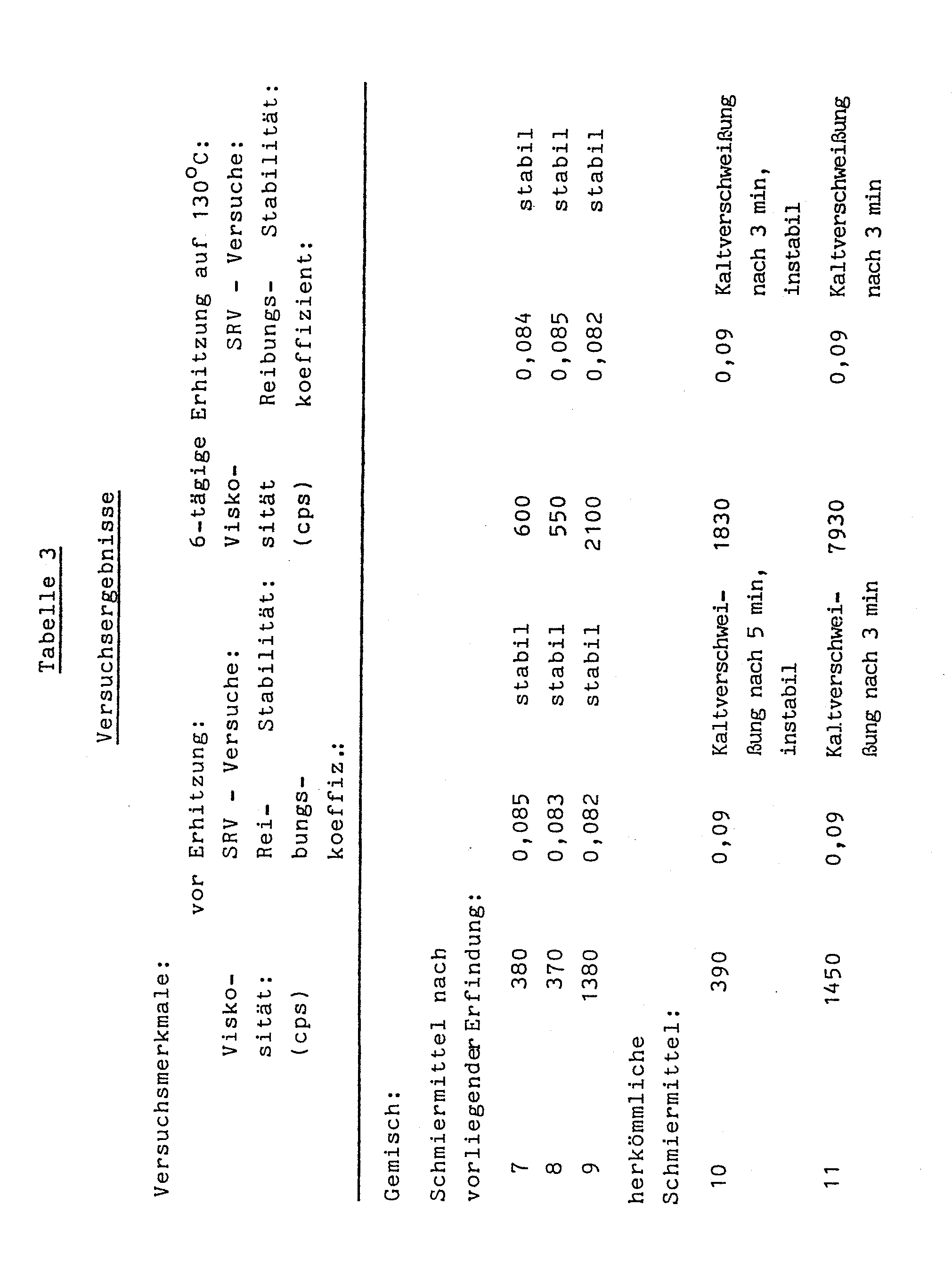
- Nach den Ergebnissen der Versuche vorübergehender Erhitzung besaßen die Schmiermittel nach vorliegender Erfindung auch bei geringer Viskosität einen vorteilhaften Reibungskoeffizienten im SRV-Versuch bei guter Stabilität; auch die Veränderungen der Viskosität war gering und damit günstig.
- Stahlrohre wurden unter Verwendung des Schmiermittels 7 des Beispiels 2 nach dem Verfahren der Tabelle 4 für das Ziehen vorbereitet und gezogen. Es wurden die Zugkraft und die Kraft des Stopfens gemessen, das Äußere des gezogenen Rohres betrachtet und auf Rauhheit der Oberfläche sowie Schmiermittelentfernbarkeit untersucht. Die Ziehbedingungen sind in Tabelle 5 und die Ergebnisse in Tabelle 6 niedergelegt.


- Zum Vergleich wurden in Vergleichsversuch 1 Stahlrohre gleicher Qualität und unter gleichen Bedingungen, jedoch unter Verwendung des Schmiermittels 11 der Tabelle 2, gezogen. Auch diese Ergebnisse sind in Tabelle 6 zusammengefaßt.
- In Vergleichsversuch 2 wurden gleichartige Stahlrohre einer Phosphatierbehandlung mit anschließender Beseifung unterworfen und dann unter den gleichen Ziehbedingungen verformt.
- Die Vorbehandlung erfolgte dabei nach dem Schema:

- Auch hier sind die Versuchsergebnisse in Tabelle 6 wiedergegeben.

- Nach den Ergebnissen der Rohrziehversuche zeigten die mit dem Schmiermittel nach vorliegender Erfindung verarbeiteten Rohre keine Schadstellen, sie waren außerdem von geringer Rauhheit der Oberfläche. Schließlich waren auch die Eigenschaften der Schmiermittelentfernung gut.
Claims (6)
Priority Applications (1)
| Application Number | Priority Date | Filing Date | Title |
|---|---|---|---|
| AT84110944T ATE34998T1 (de) | 1983-09-17 | 1984-09-13 | Schmiermittel fuer die metallbearbeitung. |
Applications Claiming Priority (2)
| Application Number | Priority Date | Filing Date | Title |
|---|---|---|---|
| JP58170580A JPS6063295A (ja) | 1983-09-17 | 1983-09-17 | 金属材料の冷間加工用潤滑剤 |
| JP170580/83 | 1983-09-17 |
Publications (3)
| Publication Number | Publication Date |
|---|---|
| EP0135193A2 true EP0135193A2 (de) | 1985-03-27 |
| EP0135193A3 EP0135193A3 (en) | 1986-02-19 |
| EP0135193B1 EP0135193B1 (de) | 1988-06-08 |
Family
ID=15907465
Family Applications (1)
| Application Number | Title | Priority Date | Filing Date |
|---|---|---|---|
| EP84110944A Expired EP0135193B1 (de) | 1983-09-17 | 1984-09-13 | Schmiermittel für die Metallbearbeitung |
Country Status (4)
| Country | Link |
|---|---|
| EP (1) | EP0135193B1 (de) |
| JP (1) | JPS6063295A (de) |
| AT (1) | ATE34998T1 (de) |
| DE (2) | DE3433597A1 (de) |
Families Citing this family (1)
| Publication number | Priority date | Publication date | Assignee | Title |
|---|---|---|---|---|
| RU2177981C1 (ru) * | 2000-04-21 | 2002-01-10 | Гомельский жировой комбинат | Смазка для обработки металлов давлением |
Family Cites Families (4)
| Publication number | Priority date | Publication date | Assignee | Title |
|---|---|---|---|---|
| US2697072A (en) * | 1951-06-08 | 1954-12-14 | Texas Co | Emulsion type drawing compounds containing carboxyalkyl cellulose salts |
| US2977300A (en) * | 1958-08-21 | 1961-03-28 | Continental Oil Co | Method of producing heat-stable greases |
| US3372117A (en) * | 1965-11-26 | 1968-03-05 | Hooker Chemical Corp | Cold forming lubricant |
| US3879305A (en) * | 1973-03-26 | 1975-04-22 | Mobil Oil Corp | Grease thickened with oxygen-linked or sulfur-linked polyureas |
-
1983
- 1983-09-17 JP JP58170580A patent/JPS6063295A/ja active Granted
-
1984
- 1984-09-13 DE DE19843433597 patent/DE3433597A1/de not_active Withdrawn
- 1984-09-13 AT AT84110944T patent/ATE34998T1/de not_active IP Right Cessation
- 1984-09-13 EP EP84110944A patent/EP0135193B1/de not_active Expired
- 1984-09-13 DE DE8484110944T patent/DE3471952D1/de not_active Expired
Also Published As
| Publication number | Publication date |
|---|---|
| JPS6126957B2 (de) | 1986-06-23 |
| EP0135193A3 (en) | 1986-02-19 |
| JPS6063295A (ja) | 1985-04-11 |
| DE3471952D1 (en) | 1988-07-14 |
| EP0135193B1 (de) | 1988-06-08 |
| DE3433597A1 (de) | 1985-04-18 |
| ATE34998T1 (de) | 1988-06-15 |
Similar Documents
| Publication | Publication Date | Title |
|---|---|---|
| EP2995674B1 (de) | Verwendung eines Sulfats sowie Verfahren zum Herstellen eines Stahlbauteils durch Umformen in einer Umformmaschine | |
| EP0324395B1 (de) | Verfahren zur Phosphatierung von Metalloberflächen | |
| DE1627741C3 (de) | Auf umzuformende Stahlbleche aufgebrachte Feststoffschmiermittelschicht und Verfahren zu ihrer Herstellung | |
| DE3881511T2 (de) | Mechanisch aufgebrachte beschichtungen, die schmiermittel enthalten. | |
| DE69205543T2 (de) | Feuerverzinktes Stahlblech mit ausgezeichneter Gleitformfähigkeit. | |
| WO2004050808A2 (de) | Schmierstoffbeschichtetes metallblech mit verbesserten umformeigenschaften | |
| AU580408B2 (en) | Coating metals for lubrication during cold forming | |
| DE2749227B2 (de) | ||
| EP0251192B1 (de) | Schmiermittel für die Metallumformung | |
| DE2536119C2 (de) | Wasserfreies Tiefziehmittel und dessen Verwendung | |
| EP0288853B1 (de) | Verfahren zur Vorbereitung von Werkstücken aus Titan oder Titanlegierungen | |
| DE2542828C3 (de) | Verfahren zum Herstellen von Stahlblech mit guten Schmiereigenschaften für die Verwendung beim Tiefziehen | |
| DE1954040A1 (de) | Schmiermittel zur Metallbearbeitung und Verfahren zur Vorbehandlung von Metallen | |
| EP0039093B1 (de) | Verfahren zur Phosphatierung von Metalloberflächen sowie dessen Anwendung | |
| EP0270836B1 (de) | Verfahren zum Ziehen von Draht | |
| DE69431200T2 (de) | Ölgehärtete Drähte und Verfahren zu ihrer Herstellung | |
| EP0135193B1 (de) | Schmiermittel für die Metallbearbeitung | |
| DE3438525A1 (de) | Verfahren zur erleichterung der kaltverformung | |
| DE69022388T2 (de) | Aufgewickeltes Bandmaterial aus Stahl mit einer Beschichtung aus festem Schmiermittel. | |
| EP0232929B1 (de) | Verfahren zur Erleichterung der Kaltumformung von Edelstahl | |
| DE3140240A1 (de) | Zirkonium enthaltende mantelelektrode zur metallichtbogenschweissung unter schutzgas | |
| DE60306569T2 (de) | Beschichtungslösung für Metalle und Metalllegierungen | |
| DE1621515C2 (de) | Verfahren zum herstellen einer sulfidhaltigen selbst schmierenden schicht auf metallischen oberflaechen | |
| DE3922464A1 (de) | Waessrige schmierbehandlungsfluessigkeit und verfahren zur kalten, plastischen bearbeitung metallischer materialien | |
| DE102005006885B4 (de) | Gelenkzapfen für ein Kugelgelenk und Verfahren zum Herstellen eines solchen |
Legal Events
| Date | Code | Title | Description |
|---|---|---|---|
| PUAI | Public reference made under article 153(3) epc to a published international application that has entered the european phase |
Free format text: ORIGINAL CODE: 0009012 |
|
| AK | Designated contracting states |
Designated state(s): AT BE CH DE FR IT LI SE |
|
| PUAL | Search report despatched |
Free format text: ORIGINAL CODE: 0009013 |
|
| AK | Designated contracting states |
Designated state(s): AT BE CH DE FR IT LI SE |
|
| 17P | Request for examination filed |
Effective date: 19860715 |
|
| 17Q | First examination report despatched |
Effective date: 19870910 |
|
| GRAA | (expected) grant |
Free format text: ORIGINAL CODE: 0009210 |
|
| AK | Designated contracting states |
Kind code of ref document: B1 Designated state(s): AT BE CH DE FR IT LI SE |
|
| REF | Corresponds to: |
Ref document number: 34998 Country of ref document: AT Date of ref document: 19880615 Kind code of ref document: T |
|
| REF | Corresponds to: |
Ref document number: 3471952 Country of ref document: DE Date of ref document: 19880714 |
|
| ITF | It: translation for a ep patent filed | ||
| ET | Fr: translation filed | ||
| PLBE | No opposition filed within time limit |
Free format text: ORIGINAL CODE: 0009261 |
|
| STAA | Information on the status of an ep patent application or granted ep patent |
Free format text: STATUS: NO OPPOSITION FILED WITHIN TIME LIMIT |
|
| 26N | No opposition filed | ||
| ITTA | It: last paid annual fee | ||
| PGFP | Annual fee paid to national office [announced via postgrant information from national office to epo] |
Ref country code: FR Payment date: 19920820 Year of fee payment: 9 |
|
| PGFP | Annual fee paid to national office [announced via postgrant information from national office to epo] |
Ref country code: CH Payment date: 19920821 Year of fee payment: 9 |
|
| PGFP | Annual fee paid to national office [announced via postgrant information from national office to epo] |
Ref country code: SE Payment date: 19920826 Year of fee payment: 9 |
|
| PGFP | Annual fee paid to national office [announced via postgrant information from national office to epo] |
Ref country code: AT Payment date: 19920827 Year of fee payment: 9 |
|
| PGFP | Annual fee paid to national office [announced via postgrant information from national office to epo] |
Ref country code: BE Payment date: 19920902 Year of fee payment: 9 |
|
| PGFP | Annual fee paid to national office [announced via postgrant information from national office to epo] |
Ref country code: DE Payment date: 19921029 Year of fee payment: 9 |
|
| PG25 | Lapsed in a contracting state [announced via postgrant information from national office to epo] |
Ref country code: AT Effective date: 19930913 |
|
| PG25 | Lapsed in a contracting state [announced via postgrant information from national office to epo] |
Ref country code: SE Effective date: 19930914 |
|
| PG25 | Lapsed in a contracting state [announced via postgrant information from national office to epo] |
Ref country code: LI Effective date: 19930930 Ref country code: CH Effective date: 19930930 Ref country code: BE Effective date: 19930930 |
|
| BERE | Be: lapsed |
Owner name: NIHON PARKERIZING CO. LTD Effective date: 19930930 |
|
| PG25 | Lapsed in a contracting state [announced via postgrant information from national office to epo] |
Ref country code: FR Free format text: LAPSE BECAUSE OF NON-PAYMENT OF DUE FEES Effective date: 19940531 |
|
| REG | Reference to a national code |
Ref country code: CH Ref legal event code: PL |
|
| PG25 | Lapsed in a contracting state [announced via postgrant information from national office to epo] |
Ref country code: DE Effective date: 19940601 |
|
| REG | Reference to a national code |
Ref country code: FR Ref legal event code: ST |
|
| EUG | Se: european patent has lapsed |
Ref document number: 84110944.0 Effective date: 19940410 |