EP0135566B1 - Complexes metallo-organiques d'aluminium zirconium utiles en tant qu'agents hydrophobes et de couplage - Google Patents
Complexes metallo-organiques d'aluminium zirconium utiles en tant qu'agents hydrophobes et de couplage Download PDFInfo
- Publication number
- EP0135566B1 EP0135566B1 EP84901043A EP84901043A EP0135566B1 EP 0135566 B1 EP0135566 B1 EP 0135566B1 EP 84901043 A EP84901043 A EP 84901043A EP 84901043 A EP84901043 A EP 84901043A EP 0135566 B1 EP0135566 B1 EP 0135566B1
- Authority
- EP
- European Patent Office
- Prior art keywords
- carbon atoms
- acid
- composition
- aluminum
- alkyl
- Prior art date
- Legal status (The legal status is an assumption and is not a legal conclusion. Google has not performed a legal analysis and makes no representation as to the accuracy of the status listed.)
- Expired - Lifetime
Links
- 230000002209 hydrophobic effect Effects 0.000 title abstract description 5
- ZGUQGPFMMTZGBQ-UHFFFAOYSA-N [Al].[Al].[Zr] Chemical compound [Al].[Al].[Zr] ZGUQGPFMMTZGBQ-UHFFFAOYSA-N 0.000 title description 32
- 230000008878 coupling Effects 0.000 title description 2
- 238000010168 coupling process Methods 0.000 title description 2
- 238000005859 coupling reaction Methods 0.000 title description 2
- 239000000203 mixture Substances 0.000 claims abstract description 88
- QCWXUUIWCKQGHC-UHFFFAOYSA-N Zirconium Chemical group [Zr] QCWXUUIWCKQGHC-UHFFFAOYSA-N 0.000 claims abstract description 43
- 239000000945 filler Substances 0.000 claims abstract description 27
- 239000002904 solvent Substances 0.000 claims abstract description 25
- 229910052751 metal Inorganic materials 0.000 claims abstract description 9
- 239000002184 metal Substances 0.000 claims abstract description 9
- 239000002131 composite material Substances 0.000 claims abstract description 7
- AZDRQVAHHNSJOQ-UHFFFAOYSA-N alumane Chemical group [AlH3] AZDRQVAHHNSJOQ-UHFFFAOYSA-N 0.000 claims abstract 11
- 125000004432 carbon atom Chemical group C* 0.000 claims description 65
- XAGFODPZIPBFFR-UHFFFAOYSA-N aluminium Chemical compound [Al] XAGFODPZIPBFFR-UHFFFAOYSA-N 0.000 claims description 44
- 239000000047 product Substances 0.000 claims description 43
- 229910052726 zirconium Inorganic materials 0.000 claims description 36
- 229910052782 aluminium Inorganic materials 0.000 claims description 33
- XLYOFNOQVPJJNP-UHFFFAOYSA-N water Substances O XLYOFNOQVPJJNP-UHFFFAOYSA-N 0.000 claims description 32
- 239000003446 ligand Substances 0.000 claims description 28
- WNLRTRBMVRJNCN-UHFFFAOYSA-N adipic acid Chemical compound OC(=O)CCCCC(O)=O WNLRTRBMVRJNCN-UHFFFAOYSA-N 0.000 claims description 26
- 125000000217 alkyl group Chemical group 0.000 claims description 23
- 238000006243 chemical reaction Methods 0.000 claims description 23
- LVYZJEPLMYTTGH-UHFFFAOYSA-H dialuminum chloride pentahydroxide dihydrate Chemical group [Cl-].[Al+3].[OH-].[OH-].[Al+3].[OH-].[OH-].[OH-].O.O LVYZJEPLMYTTGH-UHFFFAOYSA-H 0.000 claims description 22
- 239000007795 chemical reaction product Substances 0.000 claims description 21
- 150000001732 carboxylic acid derivatives Chemical class 0.000 claims description 20
- -1 aralkyl carboxylic acid Chemical class 0.000 claims description 19
- CERQOIWHTDAKMF-UHFFFAOYSA-N Methacrylic acid Chemical group CC(=C)C(O)=O CERQOIWHTDAKMF-UHFFFAOYSA-N 0.000 claims description 17
- 238000000034 method Methods 0.000 claims description 16
- VYPSYNLAJGMNEJ-UHFFFAOYSA-N Silicium dioxide Chemical compound O=[Si]=O VYPSYNLAJGMNEJ-UHFFFAOYSA-N 0.000 claims description 15
- 239000000758 substrate Substances 0.000 claims description 14
- 239000001361 adipic acid Substances 0.000 claims description 12
- 235000011037 adipic acid Nutrition 0.000 claims description 12
- 125000003342 alkenyl group Chemical group 0.000 claims description 12
- 125000000304 alkynyl group Chemical group 0.000 claims description 11
- 125000001309 chloro group Chemical group Cl* 0.000 claims description 10
- 239000011521 glass Substances 0.000 claims description 10
- 229920005989 resin Polymers 0.000 claims description 10
- 239000011347 resin Substances 0.000 claims description 10
- YXFVVABEGXRONW-UHFFFAOYSA-N Toluene Chemical compound CC1=CC=CC=C1 YXFVVABEGXRONW-UHFFFAOYSA-N 0.000 claims description 9
- 239000002253 acid Substances 0.000 claims description 9
- PNEYBMLMFCGWSK-UHFFFAOYSA-N aluminium oxide Inorganic materials [O-2].[O-2].[O-2].[Al+3].[Al+3] PNEYBMLMFCGWSK-UHFFFAOYSA-N 0.000 claims description 9
- 239000000460 chlorine Substances 0.000 claims description 9
- 229910052801 chlorine Inorganic materials 0.000 claims description 9
- 235000014113 dietary fatty acids Nutrition 0.000 claims description 9
- 239000000194 fatty acid Substances 0.000 claims description 9
- 229930195729 fatty acid Natural products 0.000 claims description 9
- 150000004665 fatty acids Chemical class 0.000 claims description 9
- VTYYLEPIZMXCLO-UHFFFAOYSA-L Calcium carbonate Chemical compound [Ca+2].[O-]C([O-])=O VTYYLEPIZMXCLO-UHFFFAOYSA-L 0.000 claims description 8
- UCMIRNVEIXFBKS-UHFFFAOYSA-N beta-alanine Chemical group NCCC(O)=O UCMIRNVEIXFBKS-UHFFFAOYSA-N 0.000 claims description 8
- 239000003960 organic solvent Substances 0.000 claims description 8
- 150000004684 trihydrates Chemical class 0.000 claims description 8
- 239000004593 Epoxy Substances 0.000 claims description 7
- GWEVSGVZZGPLCZ-UHFFFAOYSA-N Titan oxide Chemical compound O=[Ti]=O GWEVSGVZZGPLCZ-UHFFFAOYSA-N 0.000 claims description 7
- 239000007822 coupling agent Substances 0.000 claims description 7
- 239000000123 paper Substances 0.000 claims description 7
- 239000000377 silicon dioxide Substances 0.000 claims description 7
- 229910052736 halogen Chemical group 0.000 claims description 6
- 150000002367 halogens Chemical group 0.000 claims description 6
- WYURNTSHIVDZCO-UHFFFAOYSA-N Tetrahydrofuran Chemical compound C1CCOC1 WYURNTSHIVDZCO-UHFFFAOYSA-N 0.000 claims description 5
- 150000008065 acid anhydrides Chemical class 0.000 claims description 5
- 150000001735 carboxylic acids Chemical class 0.000 claims description 5
- 239000003365 glass fiber Substances 0.000 claims description 5
- 125000003827 glycol group Chemical group 0.000 claims description 5
- 150000002576 ketones Chemical class 0.000 claims description 5
- 150000001298 alcohols Chemical class 0.000 claims description 4
- 229940000635 beta-alanine Drugs 0.000 claims description 4
- 229910000019 calcium carbonate Inorganic materials 0.000 claims description 4
- IPCSVZSSVZVIGE-UHFFFAOYSA-N hexadecanoic acid Chemical compound CCCCCCCCCCCCCCCC(O)=O IPCSVZSSVZVIGE-UHFFFAOYSA-N 0.000 claims description 4
- 239000010445 mica Substances 0.000 claims description 4
- 229910052618 mica group Inorganic materials 0.000 claims description 4
- 239000004753 textile Substances 0.000 claims description 4
- 239000010456 wollastonite Substances 0.000 claims description 4
- 229910052882 wollastonite Inorganic materials 0.000 claims description 4
- RYHBNJHYFVUHQT-UHFFFAOYSA-N 1,4-Dioxane Chemical compound C1COCCO1 RYHBNJHYFVUHQT-UHFFFAOYSA-N 0.000 claims description 3
- 239000002738 chelating agent Substances 0.000 claims description 3
- 239000011094 fiberboard Substances 0.000 claims description 3
- 239000002480 mineral oil Substances 0.000 claims description 3
- 235000010446 mineral oil Nutrition 0.000 claims description 3
- 239000000454 talc Substances 0.000 claims description 3
- 229910052623 talc Inorganic materials 0.000 claims description 3
- 229920001169 thermoplastic Polymers 0.000 claims description 3
- 239000004416 thermosoftening plastic Substances 0.000 claims description 3
- 239000004408 titanium dioxide Substances 0.000 claims description 3
- FXHOOIRPVKKKFG-UHFFFAOYSA-N N,N-Dimethylacetamide Chemical compound CN(C)C(C)=O FXHOOIRPVKKKFG-UHFFFAOYSA-N 0.000 claims description 2
- CTQNGGLPUBDAKN-UHFFFAOYSA-N O-Xylene Chemical compound CC1=CC=CC=C1C CTQNGGLPUBDAKN-UHFFFAOYSA-N 0.000 claims description 2
- ZQPPMHVWECSIRJ-KTKRTIGZSA-N oleic acid Chemical compound CCCCCCCC\C=C/CCCCCCCC(O)=O ZQPPMHVWECSIRJ-KTKRTIGZSA-N 0.000 claims description 2
- 229920001187 thermosetting polymer Polymers 0.000 claims description 2
- 239000008096 xylene Substances 0.000 claims description 2
- 125000004356 hydroxy functional group Chemical group O* 0.000 claims 11
- MUBZPKHOEPUJKR-UHFFFAOYSA-N Oxalic acid Chemical group OC(=O)C(O)=O MUBZPKHOEPUJKR-UHFFFAOYSA-N 0.000 claims 6
- NIXOWILDQLNWCW-UHFFFAOYSA-N Acrylic acid Chemical group OC(=O)C=C NIXOWILDQLNWCW-UHFFFAOYSA-N 0.000 claims 4
- OFOBLEOULBTSOW-UHFFFAOYSA-N Malonic acid Chemical group OC(=O)CC(O)=O OFOBLEOULBTSOW-UHFFFAOYSA-N 0.000 claims 4
- 125000005233 alkylalcohol group Chemical group 0.000 claims 3
- 125000001449 isopropyl group Chemical group [H]C([H])([H])C([H])(*)C([H])([H])[H] 0.000 claims 3
- 125000004123 n-propyl group Chemical group [H]C([H])([H])C([H])([H])C([H])([H])* 0.000 claims 3
- 125000003396 thiol group Chemical class [H]S* 0.000 claims 3
- RTBFRGCFXZNCOE-UHFFFAOYSA-N 1-methylsulfonylpiperidin-4-one Chemical compound CS(=O)(=O)N1CCC(=O)CC1 RTBFRGCFXZNCOE-UHFFFAOYSA-N 0.000 claims 2
- AOHAPDDBNAPPIN-UHFFFAOYSA-N 3-Methoxy-4,5-methylenedioxybenzoic acid Chemical compound COC1=CC(C(O)=O)=CC2=C1OCO2 AOHAPDDBNAPPIN-UHFFFAOYSA-N 0.000 claims 2
- KDYFGRWQOYBRFD-UHFFFAOYSA-N Succinic acid Chemical group OC(=O)CCC(O)=O KDYFGRWQOYBRFD-UHFFFAOYSA-N 0.000 claims 2
- JFCQEDHGNNZCLN-UHFFFAOYSA-N anhydrous glutaric acid Natural products OC(=O)CCCC(O)=O JFCQEDHGNNZCLN-UHFFFAOYSA-N 0.000 claims 2
- KDYFGRWQOYBRFD-NUQCWPJISA-N butanedioic acid Chemical group O[14C](=O)CC[14C](O)=O KDYFGRWQOYBRFD-NUQCWPJISA-N 0.000 claims 2
- 125000002496 methyl group Chemical group [H]C([H])([H])* 0.000 claims 2
- 235000006408 oxalic acid Nutrition 0.000 claims 2
- WRIDQFICGBMAFQ-UHFFFAOYSA-N (E)-8-Octadecenoic acid Natural products CCCCCCCCCC=CCCCCCCC(O)=O WRIDQFICGBMAFQ-UHFFFAOYSA-N 0.000 claims 1
- TWJNQYPJQDRXPH-UHFFFAOYSA-N 2-cyanobenzohydrazide Chemical compound NNC(=O)C1=CC=CC=C1C#N TWJNQYPJQDRXPH-UHFFFAOYSA-N 0.000 claims 1
- LQJBNNIYVWPHFW-UHFFFAOYSA-N 20:1omega9c fatty acid Natural products CCCCCCCCCCC=CCCCCCCCC(O)=O LQJBNNIYVWPHFW-UHFFFAOYSA-N 0.000 claims 1
- QSBYPNXLFMSGKH-UHFFFAOYSA-N 9-Heptadecensaeure Natural products CCCCCCCC=CCCCCCCCC(O)=O QSBYPNXLFMSGKH-UHFFFAOYSA-N 0.000 claims 1
- 235000021360 Myristic acid Nutrition 0.000 claims 1
- TUNFSRHWOTWDNC-UHFFFAOYSA-N Myristic acid Natural products CCCCCCCCCCCCCC(O)=O TUNFSRHWOTWDNC-UHFFFAOYSA-N 0.000 claims 1
- 239000005642 Oleic acid Substances 0.000 claims 1
- ZQPPMHVWECSIRJ-UHFFFAOYSA-N Oleic acid Natural products CCCCCCCCC=CCCCCCCCC(O)=O ZQPPMHVWECSIRJ-UHFFFAOYSA-N 0.000 claims 1
- 235000021314 Palmitic acid Nutrition 0.000 claims 1
- 235000021355 Stearic acid Nutrition 0.000 claims 1
- YKTSYUJCYHOUJP-UHFFFAOYSA-N [O--].[Al+3].[Al+3].[O-][Si]([O-])([O-])[O-] Chemical compound [O--].[Al+3].[Al+3].[O-][Si]([O-])([O-])[O-] YKTSYUJCYHOUJP-UHFFFAOYSA-N 0.000 claims 1
- 125000004103 aminoalkyl group Chemical group 0.000 claims 1
- 150000001733 carboxylic acid esters Chemical class 0.000 claims 1
- 150000004697 chelate complex Chemical class 0.000 claims 1
- 150000008282 halocarbons Chemical class 0.000 claims 1
- QXJSBBXBKPUZAA-UHFFFAOYSA-N isooleic acid Natural products CCCCCCCC=CCCCCCCCCC(O)=O QXJSBBXBKPUZAA-UHFFFAOYSA-N 0.000 claims 1
- LMCMBAZKDXLNDB-UHFFFAOYSA-N n,n-dimethylformamide;methylsulfonylmethane Chemical compound CN(C)C=O.CS(C)(=O)=O LMCMBAZKDXLNDB-UHFFFAOYSA-N 0.000 claims 1
- WQEPLUUGTLDZJY-UHFFFAOYSA-N n-Pentadecanoic acid Natural products CCCCCCCCCCCCCCC(O)=O WQEPLUUGTLDZJY-UHFFFAOYSA-N 0.000 claims 1
- QIQXTHQIDYTFRH-UHFFFAOYSA-N octadecanoic acid Chemical compound CCCCCCCCCCCCCCCCCC(O)=O QIQXTHQIDYTFRH-UHFFFAOYSA-N 0.000 claims 1
- OQCDKBAXFALNLD-UHFFFAOYSA-N octadecanoic acid Natural products CCCCCCCC(C)CCCCCCCCC(O)=O OQCDKBAXFALNLD-UHFFFAOYSA-N 0.000 claims 1
- 235000021313 oleic acid Nutrition 0.000 claims 1
- 239000008117 stearic acid Substances 0.000 claims 1
- 239000003795 chemical substances by application Substances 0.000 abstract description 15
- 238000004519 manufacturing process Methods 0.000 abstract description 9
- 239000002245 particle Substances 0.000 abstract description 9
- 239000000126 substance Substances 0.000 abstract description 9
- 238000000576 coating method Methods 0.000 abstract description 5
- 239000000835 fiber Substances 0.000 abstract description 5
- 230000000704 physical effect Effects 0.000 abstract description 4
- 230000003301 hydrolyzing effect Effects 0.000 abstract description 2
- 239000000243 solution Substances 0.000 description 25
- DNIAPMSPPWPWGF-UHFFFAOYSA-N Propylene glycol Chemical compound CC(O)CO DNIAPMSPPWPWGF-UHFFFAOYSA-N 0.000 description 21
- OKKJLVBELUTLKV-UHFFFAOYSA-N Methanol Chemical compound OC OKKJLVBELUTLKV-UHFFFAOYSA-N 0.000 description 18
- VEXZGXHMUGYJMC-UHFFFAOYSA-N Hydrochloric acid Chemical compound Cl VEXZGXHMUGYJMC-UHFFFAOYSA-N 0.000 description 16
- KFZMGEQAYNKOFK-UHFFFAOYSA-N Isopropanol Chemical compound CC(C)O KFZMGEQAYNKOFK-UHFFFAOYSA-N 0.000 description 15
- 238000002360 preparation method Methods 0.000 description 15
- 239000002002 slurry Substances 0.000 description 14
- 229910052500 inorganic mineral Inorganic materials 0.000 description 13
- CMOAHYOGLLEOGO-UHFFFAOYSA-N oxozirconium;dihydrochloride Chemical compound Cl.Cl.[Zr]=O CMOAHYOGLLEOGO-UHFFFAOYSA-N 0.000 description 13
- 238000010992 reflux Methods 0.000 description 13
- CSCPPACGZOOCGX-UHFFFAOYSA-N Acetone Chemical compound CC(C)=O CSCPPACGZOOCGX-UHFFFAOYSA-N 0.000 description 12
- 238000004566 IR spectroscopy Methods 0.000 description 12
- 239000011152 fibreglass Substances 0.000 description 12
- 239000012764 mineral filler Substances 0.000 description 11
- 238000010668 complexation reaction Methods 0.000 description 9
- 125000002887 hydroxy group Chemical group [H]O* 0.000 description 9
- 235000010755 mineral Nutrition 0.000 description 9
- 230000009467 reduction Effects 0.000 description 9
- 125000003178 carboxy group Chemical group [H]OC(*)=O 0.000 description 8
- 239000000463 material Substances 0.000 description 7
- 239000011707 mineral Substances 0.000 description 7
- 239000003607 modifier Substances 0.000 description 7
- 230000002829 reductive effect Effects 0.000 description 7
- 230000001476 alcoholic effect Effects 0.000 description 6
- 239000006185 dispersion Substances 0.000 description 6
- 238000001035 drying Methods 0.000 description 6
- 239000000376 reactant Substances 0.000 description 6
- LYCAIKOWRPUZTN-UHFFFAOYSA-N Ethylene glycol Chemical compound OCCO LYCAIKOWRPUZTN-UHFFFAOYSA-N 0.000 description 5
- 238000013019 agitation Methods 0.000 description 5
- 235000007831 chromium(III) chloride Nutrition 0.000 description 5
- 238000000354 decomposition reaction Methods 0.000 description 5
- 238000004090 dissolution Methods 0.000 description 5
- 230000005484 gravity Effects 0.000 description 5
- 230000004048 modification Effects 0.000 description 5
- 238000012986 modification Methods 0.000 description 5
- 239000000843 powder Substances 0.000 description 5
- 150000004756 silanes Chemical class 0.000 description 5
- 239000007787 solid Substances 0.000 description 5
- 238000001228 spectrum Methods 0.000 description 5
- 150000001450 anions Chemical class 0.000 description 4
- 230000008901 benefit Effects 0.000 description 4
- 229960000359 chromic chloride Drugs 0.000 description 4
- LJAOOBNHPFKCDR-UHFFFAOYSA-K chromium(3+) trichloride hexahydrate Chemical compound O.O.O.O.O.O.[Cl-].[Cl-].[Cl-].[Cr+3] LJAOOBNHPFKCDR-UHFFFAOYSA-K 0.000 description 4
- 239000011636 chromium(III) chloride Substances 0.000 description 4
- 230000006872 improvement Effects 0.000 description 4
- 239000011256 inorganic filler Substances 0.000 description 4
- 239000012766 organic filler Substances 0.000 description 4
- 239000003973 paint Substances 0.000 description 4
- 239000000049 pigment Substances 0.000 description 4
- 230000009257 reactivity Effects 0.000 description 4
- VZGDMQKNWNREIO-UHFFFAOYSA-N tetrachloromethane Chemical compound ClC(Cl)(Cl)Cl VZGDMQKNWNREIO-UHFFFAOYSA-N 0.000 description 4
- 238000009736 wetting Methods 0.000 description 4
- 0 CCCCCC*1C(CCCCCCNCCCC2C(******)*C***CCCCC*CC2)C1 Chemical compound CCCCCC*1C(CCCCCCNCCCC2C(******)*C***CCCCC*CC2)C1 0.000 description 3
- YMWUJEATGCHHMB-UHFFFAOYSA-N Dichloromethane Chemical compound ClCCl YMWUJEATGCHHMB-UHFFFAOYSA-N 0.000 description 3
- PEDCQBHIVMGVHV-UHFFFAOYSA-N Glycerine Chemical compound OCC(O)CO PEDCQBHIVMGVHV-UHFFFAOYSA-N 0.000 description 3
- ZMXDDKWLCZADIW-UHFFFAOYSA-N N,N-Dimethylformamide Chemical compound CN(C)C=O ZMXDDKWLCZADIW-UHFFFAOYSA-N 0.000 description 3
- BLRPTPMANUNPDV-UHFFFAOYSA-N Silane Chemical compound [SiH4] BLRPTPMANUNPDV-UHFFFAOYSA-N 0.000 description 3
- 150000007513 acids Chemical class 0.000 description 3
- 125000002579 carboxylato group Chemical group [O-]C(*)=O 0.000 description 3
- NZSLBYVEIXCMBT-UHFFFAOYSA-N chloro hypochlorite;zirconium Chemical group [Zr].ClOCl NZSLBYVEIXCMBT-UHFFFAOYSA-N 0.000 description 3
- 239000008367 deionised water Substances 0.000 description 3
- 229910021641 deionized water Inorganic materials 0.000 description 3
- 229920001971 elastomer Polymers 0.000 description 3
- 239000002655 kraft paper Substances 0.000 description 3
- 239000011159 matrix material Substances 0.000 description 3
- 238000002156 mixing Methods 0.000 description 3
- 229910000077 silane Inorganic materials 0.000 description 3
- 125000001424 substituent group Chemical group 0.000 description 3
- 238000004381 surface treatment Methods 0.000 description 3
- IAZDPXIOMUYVGZ-UHFFFAOYSA-N Dimethylsulphoxide Chemical compound CS(C)=O IAZDPXIOMUYVGZ-UHFFFAOYSA-N 0.000 description 2
- LFQSCWFLJHTTHZ-UHFFFAOYSA-N Ethanol Chemical compound CCO LFQSCWFLJHTTHZ-UHFFFAOYSA-N 0.000 description 2
- DHMQDGOQFOQNFH-UHFFFAOYSA-N Glycine Chemical compound NCC(O)=O DHMQDGOQFOQNFH-UHFFFAOYSA-N 0.000 description 2
- 238000002835 absorbance Methods 0.000 description 2
- 239000000853 adhesive Substances 0.000 description 2
- 230000001070 adhesive effect Effects 0.000 description 2
- 229940009840 aluminum chlorhydrate Drugs 0.000 description 2
- 239000012736 aqueous medium Substances 0.000 description 2
- 239000003125 aqueous solvent Substances 0.000 description 2
- 239000011324 bead Substances 0.000 description 2
- 239000011230 binding agent Substances 0.000 description 2
- 230000015572 biosynthetic process Effects 0.000 description 2
- 239000000806 elastomer Substances 0.000 description 2
- 150000002148 esters Chemical class 0.000 description 2
- 125000005843 halogen group Chemical group 0.000 description 2
- 230000007062 hydrolysis Effects 0.000 description 2
- 238000006460 hydrolysis reaction Methods 0.000 description 2
- 238000011065 in-situ storage Methods 0.000 description 2
- 238000002329 infrared spectrum Methods 0.000 description 2
- 229910010272 inorganic material Inorganic materials 0.000 description 2
- 239000011147 inorganic material Substances 0.000 description 2
- 230000002427 irreversible effect Effects 0.000 description 2
- 239000002609 medium Substances 0.000 description 2
- 125000005395 methacrylic acid group Chemical group 0.000 description 2
- 239000002557 mineral fiber Substances 0.000 description 2
- 239000004033 plastic Substances 0.000 description 2
- 229920003023 plastic Polymers 0.000 description 2
- 229920000728 polyester Polymers 0.000 description 2
- 238000006116 polymerization reaction Methods 0.000 description 2
- 239000011541 reaction mixture Substances 0.000 description 2
- 150000003839 salts Chemical class 0.000 description 2
- 229920006395 saturated elastomer Polymers 0.000 description 2
- 239000000565 sealant Substances 0.000 description 2
- 239000007921 spray Substances 0.000 description 2
- PXQLVRUNWNTZOS-UHFFFAOYSA-N sulfanyl Chemical class [SH] PXQLVRUNWNTZOS-UHFFFAOYSA-N 0.000 description 2
- HHVIBTZHLRERCL-UHFFFAOYSA-N sulfonyldimethane Chemical compound CS(C)(=O)=O HHVIBTZHLRERCL-UHFFFAOYSA-N 0.000 description 2
- YLQBMQCUIZJEEH-UHFFFAOYSA-N tetrahydrofuran Natural products C=1C=COC=1 YLQBMQCUIZJEEH-UHFFFAOYSA-N 0.000 description 2
- MTCFGRXMJLQNBG-REOHCLBHSA-N (2S)-2-Amino-3-hydroxypropansäure Chemical compound OC[C@H](N)C(O)=O MTCFGRXMJLQNBG-REOHCLBHSA-N 0.000 description 1
- RNFJDJUURJAICM-UHFFFAOYSA-N 2,2,4,4,6,6-hexaphenoxy-1,3,5-triaza-2$l^{5},4$l^{5},6$l^{5}-triphosphacyclohexa-1,3,5-triene Chemical compound N=1P(OC=2C=CC=CC=2)(OC=2C=CC=CC=2)=NP(OC=2C=CC=CC=2)(OC=2C=CC=CC=2)=NP=1(OC=1C=CC=CC=1)OC1=CC=CC=C1 RNFJDJUURJAICM-UHFFFAOYSA-N 0.000 description 1
- TUPMGGHTDIFOMI-UHFFFAOYSA-J 2-methylprop-2-enoate;zirconium(4+) Chemical compound [Zr+4].CC(=C)C([O-])=O.CC(=C)C([O-])=O.CC(=C)C([O-])=O.CC(=C)C([O-])=O TUPMGGHTDIFOMI-UHFFFAOYSA-J 0.000 description 1
- VEORPZCZECFIRK-UHFFFAOYSA-N 3,3',5,5'-tetrabromobisphenol A Chemical compound C=1C(Br)=C(O)C(Br)=CC=1C(C)(C)C1=CC(Br)=C(O)C(Br)=C1 VEORPZCZECFIRK-UHFFFAOYSA-N 0.000 description 1
- WEHZNZTWKUYVIY-UHFFFAOYSA-N 3-oxabicyclo[3.2.2]nona-1(7),5,8-triene-2,4-dione Chemical class O=C1OC(=O)C2=CC=C1C=C2 WEHZNZTWKUYVIY-UHFFFAOYSA-N 0.000 description 1
- 239000005995 Aluminium silicate Substances 0.000 description 1
- 229920000049 Carbon (fiber) Polymers 0.000 description 1
- VEXZGXHMUGYJMC-UHFFFAOYSA-M Chloride anion Chemical compound [Cl-] VEXZGXHMUGYJMC-UHFFFAOYSA-M 0.000 description 1
- LEVWYRKDKASIDU-QWWZWVQMSA-N D-cystine Chemical compound OC(=O)[C@H](N)CSSC[C@@H](N)C(O)=O LEVWYRKDKASIDU-QWWZWVQMSA-N 0.000 description 1
- 229920002430 Fibre-reinforced plastic Polymers 0.000 description 1
- 239000004471 Glycine Substances 0.000 description 1
- PMMYEEVYMWASQN-DMTCNVIQSA-N Hydroxyproline Chemical compound O[C@H]1CN[C@H](C(O)=O)C1 PMMYEEVYMWASQN-DMTCNVIQSA-N 0.000 description 1
- XUJNEKJLAYXESH-REOHCLBHSA-N L-Cysteine Chemical compound SC[C@H](N)C(O)=O XUJNEKJLAYXESH-REOHCLBHSA-N 0.000 description 1
- ONIBWKKTOPOVIA-BYPYZUCNSA-N L-Proline Chemical compound OC(=O)[C@@H]1CCCN1 ONIBWKKTOPOVIA-BYPYZUCNSA-N 0.000 description 1
- QNAYBMKLOCPYGJ-REOHCLBHSA-N L-alanine Chemical compound C[C@H](N)C(O)=O QNAYBMKLOCPYGJ-REOHCLBHSA-N 0.000 description 1
- AGPKZVBTJJNPAG-WHFBIAKZSA-N L-isoleucine Chemical compound CC[C@H](C)[C@H](N)C(O)=O AGPKZVBTJJNPAG-WHFBIAKZSA-N 0.000 description 1
- ROHFNLRQFUQHCH-YFKPBYRVSA-N L-leucine Chemical compound CC(C)C[C@H](N)C(O)=O ROHFNLRQFUQHCH-YFKPBYRVSA-N 0.000 description 1
- FFEARJCKVFRZRR-BYPYZUCNSA-N L-methionine Chemical compound CSCC[C@H](N)C(O)=O FFEARJCKVFRZRR-BYPYZUCNSA-N 0.000 description 1
- COLNVLDHVKWLRT-QMMMGPOBSA-N L-phenylalanine Chemical compound OC(=O)[C@@H](N)CC1=CC=CC=C1 COLNVLDHVKWLRT-QMMMGPOBSA-N 0.000 description 1
- AYFVYJQAPQTCCC-GBXIJSLDSA-N L-threonine Chemical compound C[C@@H](O)[C@H](N)C(O)=O AYFVYJQAPQTCCC-GBXIJSLDSA-N 0.000 description 1
- OUYCCCASQSFEME-QMMMGPOBSA-N L-tyrosine Chemical compound OC(=O)[C@@H](N)CC1=CC=C(O)C=C1 OUYCCCASQSFEME-QMMMGPOBSA-N 0.000 description 1
- KZSNJWFQEVHDMF-BYPYZUCNSA-N L-valine Chemical compound CC(C)[C@H](N)C(O)=O KZSNJWFQEVHDMF-BYPYZUCNSA-N 0.000 description 1
- ROHFNLRQFUQHCH-UHFFFAOYSA-N Leucine Natural products CC(C)CC(N)C(O)=O ROHFNLRQFUQHCH-UHFFFAOYSA-N 0.000 description 1
- BPQQTUXANYXVAA-UHFFFAOYSA-N Orthosilicate Chemical compound [O-][Si]([O-])([O-])[O-] BPQQTUXANYXVAA-UHFFFAOYSA-N 0.000 description 1
- ONIBWKKTOPOVIA-UHFFFAOYSA-N Proline Natural products OC(=O)C1CCCN1 ONIBWKKTOPOVIA-UHFFFAOYSA-N 0.000 description 1
- MTCFGRXMJLQNBG-UHFFFAOYSA-N Serine Natural products OCC(N)C(O)=O MTCFGRXMJLQNBG-UHFFFAOYSA-N 0.000 description 1
- 229910000831 Steel Inorganic materials 0.000 description 1
- FEWJPZIEWOKRBE-UHFFFAOYSA-N Tartaric Acid Chemical class [H+].[H+].[O-]C(=O)C(O)C(O)C([O-])=O FEWJPZIEWOKRBE-UHFFFAOYSA-N 0.000 description 1
- AYFVYJQAPQTCCC-UHFFFAOYSA-N Threonine Natural products CC(O)C(N)C(O)=O AYFVYJQAPQTCCC-UHFFFAOYSA-N 0.000 description 1
- 239000004473 Threonine Substances 0.000 description 1
- KZSNJWFQEVHDMF-UHFFFAOYSA-N Valine Natural products CC(C)C(N)C(O)=O KZSNJWFQEVHDMF-UHFFFAOYSA-N 0.000 description 1
- PEQYWQJRQVAUAZ-UHFFFAOYSA-L [Cr](=O)(=O)(Cl)Cl.C(C(=C)C)(=O)O Chemical compound [Cr](=O)(=O)(Cl)Cl.C(C(=C)C)(=O)O PEQYWQJRQVAUAZ-UHFFFAOYSA-L 0.000 description 1
- 238000010521 absorption reaction Methods 0.000 description 1
- 230000002411 adverse Effects 0.000 description 1
- 238000005054 agglomeration Methods 0.000 description 1
- 230000002776 aggregation Effects 0.000 description 1
- 235000004279 alanine Nutrition 0.000 description 1
- 150000001336 alkenes Chemical class 0.000 description 1
- 125000003545 alkoxy group Chemical group 0.000 description 1
- 229940061720 alpha hydroxy acid Drugs 0.000 description 1
- 150000001280 alpha hydroxy acids Chemical class 0.000 description 1
- 230000004075 alteration Effects 0.000 description 1
- DNXNYEBMOSARMM-UHFFFAOYSA-N alumane;zirconium Chemical class [AlH3].[Zr] DNXNYEBMOSARMM-UHFFFAOYSA-N 0.000 description 1
- 239000004411 aluminium Substances 0.000 description 1
- 235000012211 aluminium silicate Nutrition 0.000 description 1
- CCALPSCGTRJNTD-UHFFFAOYSA-K aluminum propane-1,2-diol trichloride Chemical compound [Al+3].[Cl-].[Cl-].[Cl-].CC(O)CO CCALPSCGTRJNTD-UHFFFAOYSA-K 0.000 description 1
- 150000008064 anhydrides Chemical class 0.000 description 1
- 239000002216 antistatic agent Substances 0.000 description 1
- 150000001510 aspartic acids Chemical class 0.000 description 1
- 230000003190 augmentative effect Effects 0.000 description 1
- 238000005452 bending Methods 0.000 description 1
- 235000010233 benzoic acid Nutrition 0.000 description 1
- WPYMKLBDIGXBTP-UHFFFAOYSA-N benzoic acid group Chemical group C(C1=CC=CC=C1)(=O)O WPYMKLBDIGXBTP-UHFFFAOYSA-N 0.000 description 1
- 239000004917 carbon fiber Substances 0.000 description 1
- 150000007942 carboxylates Chemical class 0.000 description 1
- 230000015556 catabolic process Effects 0.000 description 1
- 230000008859 change Effects 0.000 description 1
- 238000012512 characterization method Methods 0.000 description 1
- 239000013522 chelant Substances 0.000 description 1
- AHXGRMIPHCAXFP-UHFFFAOYSA-L chromyl dichloride Chemical class Cl[Cr](Cl)(=O)=O AHXGRMIPHCAXFP-UHFFFAOYSA-L 0.000 description 1
- 235000013985 cinnamic acid Nutrition 0.000 description 1
- WBYWAXJHAXSJNI-UHFFFAOYSA-N cinnamic acid group Chemical class C(C=CC1=CC=CC=C1)(=O)O WBYWAXJHAXSJNI-UHFFFAOYSA-N 0.000 description 1
- 239000011248 coating agent Substances 0.000 description 1
- 150000001875 compounds Chemical class 0.000 description 1
- XUJNEKJLAYXESH-UHFFFAOYSA-N cysteine Natural products SCC(N)C(O)=O XUJNEKJLAYXESH-UHFFFAOYSA-N 0.000 description 1
- 235000018417 cysteine Nutrition 0.000 description 1
- 229960003067 cystine Drugs 0.000 description 1
- 230000003247 decreasing effect Effects 0.000 description 1
- 238000006731 degradation reaction Methods 0.000 description 1
- 230000008034 disappearance Effects 0.000 description 1
- 238000002845 discoloration Methods 0.000 description 1
- PMMYEEVYMWASQN-UHFFFAOYSA-N dl-hydroxyproline Natural products OC1C[NH2+]C(C([O-])=O)C1 PMMYEEVYMWASQN-UHFFFAOYSA-N 0.000 description 1
- 230000000694 effects Effects 0.000 description 1
- 125000003700 epoxy group Chemical group 0.000 description 1
- 150000002191 fatty alcohols Chemical class 0.000 description 1
- 239000011151 fibre-reinforced plastic Substances 0.000 description 1
- 239000002657 fibrous material Substances 0.000 description 1
- 238000001914 filtration Methods 0.000 description 1
- 239000003063 flame retardant Substances 0.000 description 1
- 150000002311 glutaric acids Chemical class 0.000 description 1
- 238000009787 hand lay-up Methods 0.000 description 1
- MNWFXJYAOYHMED-UHFFFAOYSA-N heptanoic acid group Chemical group C(CCCCCC)(=O)O MNWFXJYAOYHMED-UHFFFAOYSA-N 0.000 description 1
- FUZZWVXGSFPDMH-UHFFFAOYSA-N hexanoic acid group Chemical group C(CCCCC)(=O)O FUZZWVXGSFPDMH-UHFFFAOYSA-N 0.000 description 1
- 229930195733 hydrocarbon Natural products 0.000 description 1
- 150000002430 hydrocarbons Chemical class 0.000 description 1
- WGCNASOHLSPBMP-UHFFFAOYSA-N hydroxyacetaldehyde Natural products OCC=O WGCNASOHLSPBMP-UHFFFAOYSA-N 0.000 description 1
- 229960002591 hydroxyproline Drugs 0.000 description 1
- 238000010348 incorporation Methods 0.000 description 1
- 239000004434 industrial solvent Substances 0.000 description 1
- 239000012784 inorganic fiber Substances 0.000 description 1
- 229910003475 inorganic filler Inorganic materials 0.000 description 1
- 239000001023 inorganic pigment Substances 0.000 description 1
- AGPKZVBTJJNPAG-UHFFFAOYSA-N isoleucine Natural products CCC(C)C(N)C(O)=O AGPKZVBTJJNPAG-UHFFFAOYSA-N 0.000 description 1
- 229960000310 isoleucine Drugs 0.000 description 1
- NLYAJNPCOHFWQQ-UHFFFAOYSA-N kaolin Chemical compound O.O.O=[Al]O[Si](=O)O[Si](=O)O[Al]=O NLYAJNPCOHFWQQ-UHFFFAOYSA-N 0.000 description 1
- 230000000670 limiting effect Effects 0.000 description 1
- 235000020778 linoleic acid Nutrition 0.000 description 1
- OYHQOLUKZRVURQ-HZJYTTRNSA-N linoleic acid group Chemical group C(CCCCCCC\C=C/C\C=C/CCCCC)(=O)O OYHQOLUKZRVURQ-HZJYTTRNSA-N 0.000 description 1
- 230000007774 longterm Effects 0.000 description 1
- 238000012423 maintenance Methods 0.000 description 1
- 230000014759 maintenance of location Effects 0.000 description 1
- 229930182817 methionine Natural products 0.000 description 1
- 238000009828 non-uniform distribution Methods 0.000 description 1
- 239000012457 nonaqueous media Substances 0.000 description 1
- JRZJOMJEPLMPRA-UHFFFAOYSA-N olefin Natural products CCCCCCCC=C JRZJOMJEPLMPRA-UHFFFAOYSA-N 0.000 description 1
- 125000000962 organic group Chemical group 0.000 description 1
- 150000001282 organosilanes Chemical class 0.000 description 1
- 230000036961 partial effect Effects 0.000 description 1
- 239000011236 particulate material Substances 0.000 description 1
- NQPDZGIKBAWPEJ-UHFFFAOYSA-N pentanoic acid group Chemical group C(CCCC)(=O)O NQPDZGIKBAWPEJ-UHFFFAOYSA-N 0.000 description 1
- COLNVLDHVKWLRT-UHFFFAOYSA-N phenylalanine Natural products OC(=O)C(N)CC1=CC=CC=C1 COLNVLDHVKWLRT-UHFFFAOYSA-N 0.000 description 1
- 229920000647 polyepoxide Polymers 0.000 description 1
- 229920001225 polyester resin Polymers 0.000 description 1
- 239000004645 polyester resin Substances 0.000 description 1
- 229920000642 polymer Polymers 0.000 description 1
- 229920000098 polyolefin Polymers 0.000 description 1
- 125000002924 primary amino group Chemical group [H]N([H])* 0.000 description 1
- 238000009877 rendering Methods 0.000 description 1
- 239000005060 rubber Substances 0.000 description 1
- 239000013049 sediment Substances 0.000 description 1
- 238000004513 sizing Methods 0.000 description 1
- KYKFCSHPTAVNJD-UHFFFAOYSA-L sodium adipate Chemical compound [Na+].[Na+].[O-]C(=O)CCCCC([O-])=O KYKFCSHPTAVNJD-UHFFFAOYSA-L 0.000 description 1
- 239000001601 sodium adipate Substances 0.000 description 1
- 235000011049 sodium adipate Nutrition 0.000 description 1
- 159000000000 sodium salts Chemical class 0.000 description 1
- 241000894007 species Species 0.000 description 1
- 230000003595 spectral effect Effects 0.000 description 1
- 239000010959 steel Substances 0.000 description 1
- 238000006467 substitution reaction Methods 0.000 description 1
- 239000004094 surface-active agent Substances 0.000 description 1
- 238000003786 synthesis reaction Methods 0.000 description 1
- 235000002906 tartaric acid Nutrition 0.000 description 1
- FGMPLJWBKKVCDB-UHFFFAOYSA-N trans-L-hydroxy-proline Natural products ON1CCCC1C(O)=O FGMPLJWBKKVCDB-UHFFFAOYSA-N 0.000 description 1
- 238000012546 transfer Methods 0.000 description 1
- 229910052723 transition metal Inorganic materials 0.000 description 1
- 150000003624 transition metals Chemical class 0.000 description 1
- OUYCCCASQSFEME-UHFFFAOYSA-N tyrosine Natural products OC(=O)C(N)CC1=CC=C(O)C=C1 OUYCCCASQSFEME-UHFFFAOYSA-N 0.000 description 1
- 229920006305 unsaturated polyester Polymers 0.000 description 1
- 239000004474 valine Substances 0.000 description 1
- 239000011800 void material Substances 0.000 description 1
- 239000000080 wetting agent Substances 0.000 description 1
Images



Classifications
-
- C—CHEMISTRY; METALLURGY
- C07—ORGANIC CHEMISTRY
- C07F—ACYCLIC, CARBOCYCLIC OR HETEROCYCLIC COMPOUNDS CONTAINING ELEMENTS OTHER THAN CARBON, HYDROGEN, HALOGEN, OXYGEN, NITROGEN, SULFUR, SELENIUM OR TELLURIUM
- C07F7/00—Compounds containing elements of Groups 4 or 14 of the Periodic Table
- C07F7/003—Compounds containing elements of Groups 4 or 14 of the Periodic Table without C-Metal linkages
Definitions
- This invention relates to the manufacture of composite products, such products to be defined as containing chemically dissimilar materials most generally typified by an organic nonpolar substance and an inorganic polar substance.
- the invention describes the preparation and use of novel mixed metal metallo-organic substances which are useful in chemically modifying the particulate or fibrous materials, preferably inorganic materials, for incorporation into the resin matrices with which they will share an interfacial boundary.
- fibers most specifically fiberglass, have been treated with methacrylate chromic chloride as disclosed in: U.S. Pat. Nos. 2,273,040; 2,524,803; 2,552,910; 2,544,666; 2,554,667; 2,544,668; 2,611,718; and trialkoxy silanes as disclosed in: U.S. Pat. Nos.: 2742378; 2776910; 2832754; 2930809; 2 946 701; 3045036; 3169884; 3211684; 3 258 477; 3849471.
- Silanes have also enjoyed usage as a preferred surface treatment for mineral fillers such as silica, alumina trihydrate, mica, wollastonite, and glass beads when such are to be used in applications wherein physical strength of the composite is an important performance property.
- organo titanates such as described in U.S. Pat. Nos. 4096110, 4 098 758, 4141 751 and 4 152 311 have found some application in mineral filler thermoplastic composites. In other less demanding applications as are found in paper manufacture and some coating areas it is viable to use surfactants or fatty acid salts to chemically alter the inorganic substrate.
- silanes are offset by their high cost, requirement for heat input to react with fillers, and handling problems related to rapid hydrolysis and polymerization in the presence of moisture which greatly reduces their effectiveness. Titanates are also hindered by undesirable economics, albeit not as severe as silanes, and also by their limited application in aqueous environments and in products wherein strength properties are significant.
- compositions to be described herein are unique substances which are highly soluble in water and a variety of polar organics, hydrolytically stable, cost effective viz-a-viz aforementioned silanes and titanates, and highly reactive, reacting essentially instantaneously with mineral fillers and functional organic particulates at ambient temperature.
- the said compositions are predicated upon an important symbiotic relationship which recognizes the preferred reactivity of inorganic substrates with the aluminum portion of the molecule and the advantages of using a tetravalent transition metal for purposes of complexation with a reactive organic.
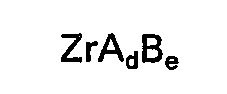
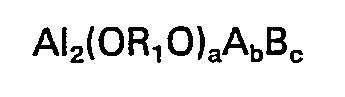
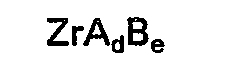
- a and B are chloro or hydroxy
- a is a numerical value ranging from about 0.05 to 2, preferably 0.1 to 1
- b is a number ranging from about 0.05 to 5.5, preferably about 1 to 5
- A is hydroxy and b ranges from 2 to 5
- B is chlorine and ranges from 1 to 3.8.
- -OC(R 2 )O- anionic ligands is useful in the preparation of the subject compositions.
- specific dibasic acids include the anions of oxalic, malonic, succinic, glutonic, adipic, tartaric, itaconic, maleic, fumaric, phthalic and terephthalic and examples of specific monobasic acids include the anions of fatty acids, such as myristic, palmitic, stearic, oleic, linoleic and linoleic acids.
- the hydrophobicity imparted by the fatty acids provides a preferred material.
- Examples of specific aminofunctional carboxylate anions, -OC(R 2 )0- 1 include the anions of glycine, alanine, beta-alanine, valine, leucine, isoleucine, phenylalanine, tyrosine, serine, threonine, methionine, cysteine, cystine, proline, hydroxyproline, aspartic, and glutaric acids.
- Examples of specific monobasic carboxylate anions, -OC(R 2 )O- include the anions of acetic, propionic, butyric, pentanoic, hexanoic, heptanoic, octanoic, dodecanoic, myristic, palmitic, stearic, isostearic, propenoic, 2-methylpropenoic, butenoic, hexenoic, benzoic and cinnamic acids.
- Examples of the anhydrides of dibasic acids include phthalic, isophthalic and terephthalic anhydrides.
- Examples of chelating ligands, -OR,O-, include ethylene glycol, propylene glycol, glycerol, etc.
- Examples of alpha-hydroxy acids, R 3 CH(OH)COO-, are glycolic, lactic, alpha-hydroxybutyric, and tartaric acids and those known in the art.
- characterization of these compositions using infrared spectroscopy has indicated that greater than 99% (>70% where C 12 ⁇ C 18 carboxylates are used) of the conventional ligand, -OC(R 2 )0- is present in complex form (i.e. has reacted) in the aluminum zirconium metallo-organic, and furthermore, that the organofunctional ligands are bound to an aluminum metal center on the one hand and to a zirconium metal center on the other.
- the IR information also indicated that the chelating agent -OR,O- forms a chelated complex with aluminum.
- the reaction product apparently involves the chelated aluminum moiety bridged to the zirconium oxychloride moiety through the organofunctional ligand.
- one of the A or B groups may be replaced by a lower alkoxy group having 1 to 6 carbon atoms.
- X, Y and Z are at least each 1, and may vary from 1 to 100 or more, depending on the reactivity of the particular materials and the desired form of the product.
- the molar ratio of aluminum moiety to zirconium moiety (X:Z) may vary from about 1.5 to 10, with the preferred ratio being from about 3 to 6.
- the ratio of organofunctional ligand to total metal (Y:(2X+Z)) may vary from about 0.05 to 2.0, with the preferred ratio being about 0.1 to 1.0.
- composition cited herein is not prepared in the absence of solvent to avoid encountering undesirable hydrolysis and polymerization reactions resulting in a highly polymeric solid reaction product.
- Preparation of the subject composition is attained in solvents which may be comprised of lower alcohols having 1 to 6 carbon atoms and lower ketones having 1 to 6 carbon atoms, wherein the water content may vary from 0% to 25%.
- solvents which may be comprised of lower alcohols having 1 to 6 carbon atoms and lower ketones having 1 to 6 carbon atoms, wherein the water content may vary from 0% to 25%.
- the active matter of compositions so prepared is from 10% to 60%, preferably from 15% to 50%.
- Pursuant to such preparation the product may be spray dried, freeze dried or otherwise solvent stripped to leave a solid having high activity.
- hydrophobic embodiments of the present invention can be used as coupling agents for inorganic pigments, fibers or fillers in polymer systems which cannot effectively tolerate water or moisture, including polyolefins, various elastomers, epoxies, etc., or in water free systems such as solvent based paints, adhesives, caulks, coatings, etc., as well as many plastic products and forms, such as films, extruded or molded forms, etc., which are found substantially in the absence of water.
- the metallo-organic complex thus prepared is substantially hydrophobic, and is soluble in a wide variety of non-aqueous solvents.
- suitable industrial solvents are well known, and include alcohols, ketones, carboxylic acids and their esters, tetrahydrofuran, dioxane, dimethylsulfone, dimethylformamide, dimethylacetamide, carbon tetrachloride, mineral oil, toluene, xylene and similar organic solvents.
- the stabilized aluminum complex can be prepared as either an isolated composition prior to introduction of the zirconium moiety in solvent solution or prepared in situ with zirconium oxychloride, the preferred route being preparation of the stabilized aluminum complex as a separate, isolated composition wherein the aluminum complex solution is dried to remove water and other solvents, and subsequently redispersed in nonaqueous media.
- the dimeric aluminum reactant is dissolved in methanol, whereupon propylene glycol is added and the mixture refluxed at 65-70°C for one hour to form the stabilized dimeric aluminum complex.
- Organofunctional ligand can be achieved either upon introduction of the ligand to a solution containing only zirconium oxychloride, or after the introduction and reaction of the zirconium oxychloride with the aforementioned stabilized aluminum chlorohydrate.
- the route elected for synthesis will result in a significant difference in end product composition as characterized by physical and compositional properties with each type of complex useful in particular types of applications.
- the basicity of the dimeric aluminum chlorohydrate moeity critically alters both the reactivity of such with the zirconium moeity and the resultant performance of the aluminum zirconium metallo-organic complex end product.
- the basicity can be varied from 0 to 5/6 (0.83) by reaction of the aluminum chlorohydrate with a chloride source exemplified by, but not restricted to, HCI.
- Preparation of a reduced (less than 5/6) basicity dimeric aluminum chlorhydrate specie with invariant compositions occurs by careful commingling of the hydrochloric acid and aluminum chlorohydrate so as to maintain a constant temperature of 30°C to 100°C resulting from the exothermic addition, the preferred temperature being 40°C to 60°C. It is to be noted that maintenance of the exotherm temperature at less than 30°C requires an impractically lengthy addition time, whereas an exotherm temperature in excess of 60°C may result in variant composition.
- compositions prepared in accordance with the teachings of the subject invention are characterized as having a slight yellow color which may range from ⁇ 50 Pt-Co to Gardner 5 in intensity. Such compositions generally are clear immediately after preparation, but may contain as much as 0.5% insolubles which may be allowed to sediment or removed by conventional filtration techniques.
- the active product can be isolated by low vacuum ambient temperature solvent removal, thereby resulting in a highly viscous (>106 cps) gelatinous mass that, upon complete drying, forms a rigid solid which adheres strongly to glass and resists aqueous dissolution.
- composition of matter of the invention is the reaction product of the aforementioned aluminum zirconium metallo-organic complexes having the structure as previously described and a substrate, the substrate being
- phf parts per hundred filler
- phf parts per hundred filler
- the active product may be chemically reacted with the surface of a particulate inorganic material, such materials to include silica, calcium carbonate, alumina trihydrate, aluminum silicates (Kaolin and the like), talc, wollastonite, glass beads, mica or titanium dioxide resulting in an essentially immediate, largely irreversible alteration in the physical and chemical properties of such particles.
- a particulate inorganic material such materials to include silica, calcium carbonate, alumina trihydrate, aluminum silicates (Kaolin and the like), talc, wollastonite, glass beads, mica or titanium dioxide resulting in an essentially immediate, largely irreversible alteration in the physical and chemical properties of such particles.
- the resultant fabricated article manufactured with such surface modified particulates will show an improvement in physical strength properties which is related to the capability of the finished article being able to transfer an applied stress across the resin particulate interface. It is an object of this invention that the interfacial void which characterizes an untreated filler in contact with a resinous matrix is largely eliminated when the mineral surface has been modified with the subject composition due to:
- the subject composition can be employed to alter the surface of a substance such as tetrabromobisphenol A rendering it more readily dispersible in a resinous system and thereby enhance its efficiency as a flame retardant.
- reaction of the aluminum zirconium metallo-organic agent is postulated to occur between the pendant hydroxy or other groups of both aluminum and zirconium metal centers and the filler substrate surface hydroxy groups or surface adsorbed molecules of water.
- the heretofore described modification of the filler surface can be readily effected by any of the following reaction modes:
- Reaction between the filler substrate and the aluminum zirconium metallo-organic agent typically occurs within seconds after contact of the substrate and modifier as effected by low shear mixing (which may include manual agitation) for slurries having an initial viscosity of less than 50,000 cps.
- An abrupt viscosity reduction to less than 10% of the original viscosity is indicative of the significant change in the surface character of the filler.
- the above disclosed inorganic and organic fillers to be used in accordance with the present invention include particles ranging in size from 0.05 to 500 microns, preferably 0.5 to 50 microns. Where the composition is used with inorganic or organic fibers of filaments, they may also range from about 0.05 to 500 microns (equivalent cylindrical diameter), preferably 0.05 to 50 microns. While some benefit will be obtained from the use of the present aluminum zirconium metallo-organic agents with inorganic or organic fillers of substantially any size, typically the improvement in properties is more substantial and more necessary with the smaller particles.
- the filler When the filler is glass, it may be in the form of glass fibers either as strands in the forming operation or subsequently as woven fiberglass and woven or nonwoven fiberglass mat.
- the manufacture of fiberglass typically consists of passing the hot glass fibers as they emerge from the forming bushing through an aqueous sizing bath which includes antistatic agents, wetting agents, binders and, of primary importance in this discussion, coupling (or keying) agents.
- Such agents in the past have been typified by organosilanes and methacrylato chromic chloride.
- the subject composition has a capacity to chemically react with both the glass fiber and a resin (most commonly epoxy or unsaturated polyester) and being highly soluble and stable in aqueous media, therefore can be introduced as a replacement for either the silane and/or the methacrylato chromic chloride.
- a resin most commonly epoxy or unsaturated polyester
- Such substitution will impart to the fiberglass the reactivity necessary for successful use in fiberglass reinforced composites and also the necessary antistatic properties to facilitate handling during the manufacture of the fiberglass and its subsequent use in a variety of fabrication techniques (to include spray gun, hand lay-up, and other commonly encountered methods of fiberglass use).
- treatment of mineral or organic fillers and pigments in accordance with the teachings of the subject invention, will permit the usage of elevated levels of such fillers in plastic and elastomeric articles without substantial diminution in physical properties of the finished article, with advantageous reductions in filled resin viscosity, and with attendant cost savings and property benefits.
- similar treatment of mineral fibers (especially glass fibers), and also carbon fibers will enhance performance of such in glass reinforced matrices.
- reaction product is combined with 150 g MeOH.
- the mixture is brought to reflux, and propylene glycol, 10.88 g (0.143 moles) is fed to the reduced basicity aluminum chlorohydrate, and the system refluxed for 1 hour.
- the product is indicated by infrared spectroscopy to have a complexed form of propylene glycol.
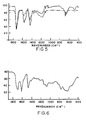
- the IR spectrum of propylene glycol shows three strong absorbance bands in the 1200-1360 cm-' region at 1230 cm- 1 , 1290 cm -1 and 1330 cm-'.
- the latter two bands can be assigned with reasonable certainty to 0-H bending vibration modes in the glycol.
- the 0-H bond is destroyed resulting in the disappearance of such bands as clearly revealed in the spectrum of the propanolato aluminum (solid line).
- the C-O stretching vibrations and related overtone bands found at 840-1230 cm -1 have either disappeared or shifted, as seen in the spectrum of the complexed material.
- Zirconium oxychloride solution 0.0339 moles Zr (20.30 g) is combined with 50.00 g of isopropyl alcohol and methacrylic acid, 0.115 moles (9.90 g). The mixture is refluxed for 1/2 hour to form a partial complex with the zirconium.
- Infrared spectroscopy indicates the product thus prepared to be a hybrid complex wherein the methacrylic acid forms a complex bridge between the aluminum and zirconium metal centers.
- the aforementioned shift of the olefinic absorbance at 1645 cm -1 is accompanied by a pronounced reduction in absorption intensity which is not observed when a complex is formed.
- Example 2 the product of Example 2 is observed to have complex bands at 1570 cm -1 and 1595 cm -1 , ( Figure 4) and also a strong band at 1645 cm -1 indicative of the formation of a true complex rather than a salt.
- the absence of a band at or around 1700 cm-' indicates that virtually all methacrylic acid is present in complex form.
- the product thus prepared has the following characteristics: Specific Gravity (g/ml) 1.00, Flash Point (°F) 74, Decomposition Point (°C)>300, Active matter (wt% solids) 17.5, pH (2% solution) 3.50, Aluminum (wt %) 2.95, Zirconium (wt %) 1.70.
- Zirconium oxychloride powder (44.8% Zr) 0.0329 moles Zr (6.85 g), is combined with 60.00 g of isopropyl alcohol, 30.00 g of acetone, and 4.00 g of concentrated hydrochloric acid.
- An alcoholic solution of the reaction product of Example 1 is prepared by dissolving a 27.92 g portion of sec-propanolato aluminum chlorohydrate, 0.197 moles AI in 35.00 g of methanol.
- the zirconium oxychloride solution as described is heated to 45°C-60°C whereupon the solution of sec-propanolato aluminum chlorohydrate is added. The mix formed thereby is heated to reflux and such temperature is maintained for one hour.
- Infrared spectroscopy indicates the product thus prepared to be a hybrid complex wherein one carboxy group of adipic acid forms a complex bridge between the aluminum and zirconium metal centers and the other carboxy group remains uncomplexed.
- the pi bond becomes delocalized over the 3 atom carboxy system O-C-O resulting in a weakened C-O bond which is observed as a downfield shift.
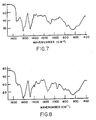
- Figure 7 the product is observed to have complex bands at 1585 cm -1 (sZ), 1610 cm -1 (s).
- one -COOH of the dibasic acid remains uncomplexed as indicated by the residual bands at 1700 cm -1 and 1735 cm- 1 .
- the product composition having complex peaks at 1585 cm -1 and 1610 cm-' is a hybrid structure in which the bidentate organofunctional ligand is bound to both a zirconium and aluminum atom.
- Examples 5, 6, 7 are observed to have a comparable structure whereby the organofunctional ligand R z COO is bound to both a zirconium and aluminum atom.
- Zirconium oxychloride powder (44.8% Zr) 0.0376 moles Zr (7.79 g), is combined with 68.27 g of isopropyl alcohol, 34.14 g of acetone, and 4.55 g of concentrated hydrochloric acid.
- An alcoholic solution of the reaction product of Example 3 is prepared by dissolving a 27.96 g portion of the sec-propanolato aluminum chlorohydrate (1/2 basic), 0.225 moles Al, in 28.63 g of methanol. Subsequent to complete dissolution, concentrated hydrochloric acid, 11.10 g, is slowly added to the reactor with agitation. The rate of addition is controlled so as to prevent the reaction exotherm from exceeding 50°C. The aluminum intermediate formed thereby is 1/3 basic.
- the zirconium oxychloride solution as described is heated to 45°C to 60°C whereupon the aforementioned reduced basicity (1/3 basic) sec-propanolato aluminum chlorohydrate solution is added.
- the reaction mixture is then heated to reflux and maintained at that temperature for one hour.
- Infrared spectroscopy indicates the product thus prepared to be a hybrid complex wherein one carboxy group of adipic acid forms a complex bridge between the aluminum and zirconium metal centers and the other carboxy group remains uncomplexed.
- the product thus prepared has the following characteristics: Specific Gravity (g/ml) 0.974, Flash Point (°F) 67, Decomposition Point (°C) >300, Active Matter (wt %) 24.1, pH (2% Solution) 4.20, Aluminum (wt %) 2.65, Zirconium (wt %) 1.55, Water (wt %) 5.00.
- Zirconium oxychloride powder (44.8% Zr) 0.0329 moles Zr (6.85 g), is combined with 60.00 g of isopropyl alcohol, 30.00 g of acetone, and 4.00 g of concentrated hydrochloric acid.
- An alcoholic solution of the reaction product of Example 3 is prepared by dissolving a 27.92 g portion of the sec-propanolato aluminum chlorohydrate, 0.197 moles Al, in 35.00 g of methanol.
- the zirconium oxychloride solution as described is heated to 45°C-60°C whereupon the solution of sec-propanolato aluminum chlorohydrate is added. The mix formed thereby is heated to reflux and such temperature is maintained for one hour.
- Infrared spectroscopy indicates the product thus prepared to be composed of 70% of a hybrid complex wherein the fatty acids form a complex bridge between the aluminum and zirconium metal centers and the remaining 30% is weakly complexed (1740 cm-').
- the product thus prepared has the following characteristics: Specific Gravity (g/ml) 0.923, Flash Point (°F) 67, Decomposition Point (°C) >300, Active Matter (wt %) 25.7, pH (2% Solution) 4.50, Aluminum (wt %) 2.65, Zirconium (wt %) 1.55, Water (wt %) 1.28.
- Zirconium oxychloride powder (44.8% Zr) 0.0329 moles Zr (6.85 g), is combined with 60.00 g of isopropyl alcohol, 30.00 g of acetone, and 4.00 g of concentrated hydrochloric acid.
- Methacrylic acid 0.0655 moles (5.64 g) is added to the mixture with agitation at ambient temperature. The mixture is heated to reflux temperature and held for 0.5 to 1.0 hours.
- An alcoholic solution of the reaction product of Example 3 is prepared by dissolving sec-propanolato aluminum chlorohydrate, 0.197 moles AI (27.92 g) in 50.00 g of methanol.
- the reaction mixture described above is cooled to 45°C whereupon the solution of sec-propanolato aluminum chlorohydrate is added.
- the resultant aluminum zirconium methacrylato mixture is reheated to reflux for 0.5 to 1.5 hours.
- the aluminum zirconium methacrylato product is cooled to 60°C whereupon a blend of fatty acids, consisting of 90% C 14 , 10% C 12 and C, 6 , 0.0822 moles (18.74 g), is added and reflux continued until complexation is at least 70% complete as determined by infrared spectroscopy (Figure 10).
- Infrared spectroscopy indicates the product thus prepared to be a compound of a hybrid complex wherein the 70% of the fatty acids and 100% of the methacrylic acid form a complex bridge between aluminum and zirconium metal centers.
- the product thus prepared has the following characteristics: Specific Gravity (g/ml) 0.910, Flash Point (°F) 67, Decomposition Point (°C) >300, Active Matter (wt %) 24.0, pH (2% Solution) 3.70, Aluminum (wt %) 2.63, Zirconium (wt %) 1.51, Water (wt %) 1.26.
- compositions of this invention for the surface modification of finely divided inorganic mineral fillers characterized by particle sizes between 0.5 and 5.0 microns.
- filler dispersions were prepared as shown in the accompanying table at the indicated concentrations and in the indicated solvents.
- 400 g of alumina trihydrate (1 micron particle size) is dispersed in 600 g of deionized water using a 4 blade high speed paint agitator.
- Example 7 the composition of Example 7, 0.9 g (1.5 phf, 0.34 phf of active matter) may be dissolved in 90 g of deionized water.
- Alumina trihydrate, 60 g, is added to the aqueous mix whereupon a slurry having a viscosity of 100 cps results (Brookfield, Spindle 5, 20 rpm).
- compositions provide aluminum zirconium metallo-organic treatment agents which were useful in improving the surface properties of inorganic fillers and like materials. It is also possible to obtain useful compositions using other organic reactants and other AI:Zr ratios and basicities, outside the range indicated in Table II, but such products should be checked for stability and effectiveness before use. Preferably, the compositions made in accordance with the present invention have shelf life of at least 30 days.
- a 70 wt % alcoholic dispersion of silica (1.8 micron particle size) is prepared as per the procedure described in Example 8.
- To the slurry is added 0.03 phf (active matter) of an aluminum zirconium metallo-organic surface modifying agent, made in accordance with the procedure of Example 4 having the composition of Example 21 (c).
- the viscosity of the untreated and treated slurry is noted (as shown in Table 111).
- the slurry is then placed in a drying oven at 110°C for 30 minutes to remove solvent whereupon to the dry treated silica is added an amount of alcohol equivalent to that which is removed during the drying process.
- the silica is redispersed and the viscosity is measured and observed to be equivalent to the analogous slurry prior to drying. The results are shown in Table III.
- a 40 wt% alcoholic dispersion of alumina trihydrate (1 micron particle size) is prepared, treated with 0.34 phf (active matter) of an aluminum zirconium metallo-organic surface modifier and then processed as described in the foregoing silica dispersion system.
- Table IV show a 90% viscosity reduction upon adding the surface modifier and >99.5% viscosity reduction upon drying and redispersion.
- Fiberglass was prepared and treated with an aqueous size bath containing aluminum zirconium metallo-organic coupling agent. Subsequently, fiberglass reinforced polyester laminates were prepared using a United States Steel general purpose unsaturated orthophthalic polyester resin (approx. 70%) and the treated fiberglass (approx. 30%). Two similar fabricated laminates were prepared using commercially available methacrylato chromic chloride and methacrylato silane under identical conditions. The laminates were then evaluated for wet and dry physical properties.
- a 5 wt % aqueous bath of the product of Example 6 is prepared.
- a 3"x6" section of unbleached kraft paper is saturated in the solution, padded, and dried at 100°C for 2 minutes.
- textile substrates may be treated with the composition of Example 6 achieving similar water repellancy without undesirable impact on aesthetics.
Landscapes
- Chemical & Material Sciences (AREA)
- Organic Chemistry (AREA)
- Paints Or Removers (AREA)
- Polymers With Sulfur, Phosphorus Or Metals In The Main Chain (AREA)
- Reinforced Plastic Materials (AREA)
- Compositions Of Macromolecular Compounds (AREA)
- Paper (AREA)
- Preventing Corrosion Or Incrustation Of Metals (AREA)
Abstract
Claims (29)








Priority Applications (1)
| Application Number | Priority Date | Filing Date | Title |
|---|---|---|---|
| AT84901043T ATE50998T1 (de) | 1983-02-09 | 1984-02-08 | Aluminium-zirkonium-metallorganische komplexe zur verwendung als kupplungs- und wasserabstossende verbindungen. |
Applications Claiming Priority (4)
| Application Number | Priority Date | Filing Date | Title |
|---|---|---|---|
| US06/465,207 US4539048A (en) | 1983-02-09 | 1983-02-09 | Aluminum zirconium metallo-organic complexes useful as coupling agents |
| US465207 | 1983-03-22 | ||
| US478043 | 1983-03-22 | ||
| US06/478,043 US4539049A (en) | 1983-02-09 | 1983-03-22 | Aluminum zirconium metallo-organic complex useful as coupling and hydrophobic agents |
Publications (3)
| Publication Number | Publication Date |
|---|---|
| EP0135566A1 EP0135566A1 (fr) | 1985-04-03 |
| EP0135566A4 EP0135566A4 (fr) | 1986-04-15 |
| EP0135566B1 true EP0135566B1 (fr) | 1990-03-14 |
Family
ID=27041253
Family Applications (1)
| Application Number | Title | Priority Date | Filing Date |
|---|---|---|---|
| EP84901043A Expired - Lifetime EP0135566B1 (fr) | 1983-02-09 | 1984-02-08 | Complexes metallo-organiques d'aluminium zirconium utiles en tant qu'agents hydrophobes et de couplage |
Country Status (9)
| Country | Link |
|---|---|
| US (1) | US4539049A (fr) |
| EP (1) | EP0135566B1 (fr) |
| JP (1) | JPH0759588B2 (fr) |
| AU (1) | AU581843B2 (fr) |
| CA (1) | CA1301182C (fr) |
| DE (1) | DE3481618D1 (fr) |
| IT (1) | IT1210129B (fr) |
| NZ (1) | NZ207068A (fr) |
| WO (1) | WO1984003093A1 (fr) |
Cited By (1)
| Publication number | Priority date | Publication date | Assignee | Title |
|---|---|---|---|---|
| US9169432B2 (en) | 2012-06-29 | 2015-10-27 | Schlumberger Technology Corporation | Spread crosslinker and method of water control downhole |
Families Citing this family (31)
| Publication number | Priority date | Publication date | Assignee | Title |
|---|---|---|---|---|
| US4764632A (en) * | 1986-01-07 | 1988-08-16 | Cavedon Chemical Company, Inc. | Multifunctional amino zirconium aluminum metallo organic complexes useful as adhesion promoter |
| US4690966A (en) * | 1987-02-26 | 1987-09-01 | Lord Corporation | Heat activated silicon-based adhesive |
| US4826564A (en) * | 1987-10-30 | 1989-05-02 | International Business Machines Corporation | Method of selective reactive ion etching of substrates |
| DE3829154A1 (de) * | 1988-08-27 | 1990-03-01 | Collardin Gmbh Gerhard | Chromfreies verfahren zur vorbehandlung von metallischen oberflaechen vor einer beschichtung mit organischen materialien |
| DE3932744A1 (de) * | 1989-09-30 | 1991-04-11 | Herberts Gmbh | Waessriges ueberzugsmittel fuer die elektrotauchlackierung, verfahren zur elektrotauchlackierung und verwendung von zirkonaluminaten in ueberzugsmitteln fuer die elektrotauchlackierung |
| US5017360A (en) * | 1990-04-20 | 1991-05-21 | Dow Corning Corporation | Surface modified aluminum and aluminum-zirconium salts |
| US5131926A (en) * | 1991-03-15 | 1992-07-21 | Norton Company | Vitrified bonded finely milled sol gel aluminous bodies |
| US5981011A (en) | 1992-01-22 | 1999-11-09 | A*Ware Technologies, L.C. | Coated sheet material |
| US5260353A (en) * | 1992-10-16 | 1993-11-09 | Kerr-Mcgee Chemical Corporation | Hydrophobicity through metal ion activation |
| US6949245B1 (en) | 1999-06-25 | 2005-09-27 | Genentech, Inc. | Humanized anti-ErbB2 antibodies and treatment with anti-ErbB2 antibodies |
| US6596837B2 (en) | 2001-03-27 | 2003-07-22 | Acushnet Company | Abrasion resistant coated golf equipment |
| US6596808B1 (en) * | 2001-06-15 | 2003-07-22 | Henkel Loctite Corporation | Structural anaerobic adhesive compositions with improved cure speed and strength |
| US6761932B2 (en) * | 2002-08-23 | 2004-07-13 | Basf Corporation | Method to improve adhesion of primers to substrates |
| US8518546B2 (en) | 2003-07-01 | 2013-08-27 | Transitions Optical, Inc. | Photochromic compounds and compositions |
| US8545984B2 (en) * | 2003-07-01 | 2013-10-01 | Transitions Optical, Inc. | Photochromic compounds and compositions |
| US8211338B2 (en) | 2003-07-01 | 2012-07-03 | Transitions Optical, Inc | Photochromic compounds |
| US7850093B2 (en) * | 2008-01-31 | 2010-12-14 | Lockheed Martin Corporation | System, method and apparatus for agitated and pressurized reservoir mounted directly to automated spray dispenser |
| US20100014010A1 (en) * | 2008-06-27 | 2010-01-21 | Transitions Optical, Inc. | Formulations comprising mesogen containing compounds |
| US20090326186A1 (en) * | 2008-06-27 | 2009-12-31 | Transitions Optical, Inc. | Mesogen containing compounds |
| US8623238B2 (en) | 2008-06-27 | 2014-01-07 | Transitions Optical, Inc. | Mesogenic stabilizers |
| US8628685B2 (en) | 2008-06-27 | 2014-01-14 | Transitions Optical, Inc | Mesogen-containing compounds |
| US7910020B2 (en) * | 2008-06-27 | 2011-03-22 | Transitions Optical, Inc. | Liquid crystal compositions comprising mesogen containing compounds |
| US8431039B2 (en) | 2008-06-27 | 2013-04-30 | Transitions Optical, Inc. | Mesogenic stabilizers |
| US8349210B2 (en) | 2008-06-27 | 2013-01-08 | Transitions Optical, Inc. | Mesogenic stabilizers |
| US8613868B2 (en) | 2008-06-27 | 2013-12-24 | Transitions Optical, Inc | Mesogenic stabilizers |
| US7910019B2 (en) | 2008-06-27 | 2011-03-22 | Transitions Optical, Inc. | Mesogen containing compounds |
| CN101407644B (zh) * | 2008-11-04 | 2011-08-17 | 华南理工大学 | 一种铝锆偶联剂的制备方法 |
| US20130112942A1 (en) | 2011-11-09 | 2013-05-09 | Juanita Kurtin | Composite having semiconductor structures embedded in a matrix |
| US10768176B2 (en) | 2014-06-17 | 2020-09-08 | Anteo Technologies Pty Ltd | Hetero functional binding systems |
| CA2962919C (fr) | 2014-09-30 | 2024-01-02 | Transitions Optical, Inc. | Absorbeurs de lumiere ultraviolette |
| US20200283908A1 (en) | 2019-03-04 | 2020-09-10 | Momentive Performance Materials Inc. | Protective coating composition and coated metallic substrate comprising same |
Family Cites Families (24)
| Publication number | Priority date | Publication date | Assignee | Title |
|---|---|---|---|---|
| US2832754A (en) * | 1955-01-21 | 1958-04-29 | Union Carbide Corp | Alkoxysilylpropylamines |
| US3030320A (en) * | 1955-07-05 | 1962-04-17 | Du Pont | Organic titanium compounds |
| US2930809A (en) * | 1956-10-12 | 1960-03-29 | Union Carbide Corp | Aminoalkylsilicon compounds and process for producing same |
| US2941918A (en) * | 1957-06-12 | 1960-06-21 | Curtiss Wright Corp | Novel polymeric products and process |
| US2946701A (en) * | 1957-11-12 | 1960-07-26 | Dow Corning | Method of treating glass with epoxysilanes and their epoxy-amine adducts, and the articles made thereby |
| US3044982A (en) * | 1957-11-12 | 1962-07-17 | Union Carbide Corp | Organopolysiloxanes and process for producing same |
| US3045036A (en) * | 1957-11-18 | 1962-07-17 | Union Carbide Corp | End-blocked aminoalkylpolysiloxanes and process for cyclic aminoalkyl-siloxanes |
| US3032570A (en) * | 1959-02-13 | 1962-05-01 | Du Pont | Organic titanium compounds |
| GB1054265A (fr) * | 1962-11-07 | 1900-01-01 | ||
| US3334119A (en) * | 1964-01-17 | 1967-08-01 | Glidden Co | Triorganometalloxy titanium, zirconium and hafnium trialkoxyamines |
| GB1058395A (en) * | 1964-05-20 | 1967-02-08 | Hardman & Holden Ltd | Improvements relating to zirconium compounds |
| US3405153A (en) * | 1965-09-15 | 1968-10-08 | Armour Pharma | Metal-aluminum inorganic-organic complexes and methods of preparing same |
| US3697475A (en) * | 1969-10-30 | 1972-10-10 | Freeport Sulphur Co | Inorganic-organo titanate polymeric film |
| US3660134A (en) * | 1969-10-30 | 1972-05-02 | Freeport Sulphur Co | Inorganic materials surface reacted with organo titanium compounds |
| US3697474A (en) * | 1969-10-30 | 1972-10-10 | Freeport Sulphur Co | Organo-clay-polymer compositions |
| US3792068A (en) * | 1971-04-02 | 1974-02-12 | Procter & Gamble | Dry powder aerosol antiperspirant composition incorporating dry powder antiperspirant active complex and process for its preparation |
| US3981986A (en) * | 1973-11-23 | 1976-09-21 | Armour Pharmaceutical Company | Zirconium-aluminum-polyol buffered anti-perspirant complexes |
| US4017599A (en) * | 1973-11-23 | 1977-04-12 | Armour Pharmaceutical Company | Aluminum-zirconium anti-perspirant systems with salts of amino acids |
| US4141751A (en) * | 1975-10-24 | 1979-02-27 | Malvern Minerals Company | Process for preparing modified particulate and/or fibrous, crystalline and amorphous inorganic substances |
| US4080353A (en) * | 1976-01-30 | 1978-03-21 | Kenrich Petrochemicals, Inc. | Titanate phosphite adducts and their use |
| US4102642A (en) * | 1976-04-30 | 1978-07-25 | Banks John B | Treatment of fabric comprising cotton or keratinous fibers for shrink resistance |
| US4223010A (en) * | 1979-01-08 | 1980-09-16 | Armour Pharmaceutical Company | Basic zirconium complexes and methods of making and using in antiperspirants |
| US4360544A (en) * | 1979-10-09 | 1982-11-23 | Ppg Industries, Inc. | Organotin surface treatment and interleaving material for glass sheets |
| US4414275A (en) * | 1981-07-13 | 1983-11-08 | Loctite (Ireland) Limited | UV Curable adhesive tape |
-
1983
- 1983-03-22 US US06/478,043 patent/US4539049A/en not_active Expired - Lifetime
-
1984
- 1984-02-08 CA CA000446989A patent/CA1301182C/fr not_active Expired - Lifetime
- 1984-02-08 DE DE8484901043T patent/DE3481618D1/de not_active Expired - Fee Related
- 1984-02-08 WO PCT/US1984/000180 patent/WO1984003093A1/fr not_active Ceased
- 1984-02-08 EP EP84901043A patent/EP0135566B1/fr not_active Expired - Lifetime
- 1984-02-08 NZ NZ207068A patent/NZ207068A/en unknown
- 1984-02-08 AU AU25776/84A patent/AU581843B2/en not_active Ceased
- 1984-02-08 JP JP59501016A patent/JPH0759588B2/ja not_active Expired - Fee Related
- 1984-02-08 IT IT8483318A patent/IT1210129B/it active
Cited By (1)
| Publication number | Priority date | Publication date | Assignee | Title |
|---|---|---|---|---|
| US9169432B2 (en) | 2012-06-29 | 2015-10-27 | Schlumberger Technology Corporation | Spread crosslinker and method of water control downhole |
Also Published As
| Publication number | Publication date |
|---|---|
| IT1210129B (it) | 1989-09-06 |
| CA1301182C (fr) | 1992-05-19 |
| EP0135566A1 (fr) | 1985-04-03 |
| JPH0759588B2 (ja) | 1995-06-28 |
| AU2577684A (en) | 1984-08-30 |
| DE3481618D1 (de) | 1990-04-19 |
| IT8483318A0 (it) | 1984-02-08 |
| AU581843B2 (en) | 1989-03-09 |
| NZ207068A (en) | 1988-04-29 |
| WO1984003093A1 (fr) | 1984-08-16 |
| EP0135566A4 (fr) | 1986-04-15 |
| JPS60500537A (ja) | 1985-04-18 |
| US4539049A (en) | 1985-09-03 |
Similar Documents
| Publication | Publication Date | Title |
|---|---|---|
| EP0135566B1 (fr) | Complexes metallo-organiques d'aluminium zirconium utiles en tant qu'agents hydrophobes et de couplage | |
| US4539048A (en) | Aluminum zirconium metallo-organic complexes useful as coupling agents | |
| US3905936A (en) | Coating particulates | |
| US4122062A (en) | Alkoxy titanate salts useful as coupling agents | |
| US4328041A (en) | Comminuted inorganic materials | |
| US5571851A (en) | Reinforcing fillers for plastics systems | |
| US5143965A (en) | Magnesium hydroxide having fine, plate-like crystalline structure and process therefor | |
| JPH10158521A (ja) | アルコールを基礎とするオルガノポリシロキサン含有組成物、該組成物の製造法並びに該組成物の使用法 | |
| JPH11323136A (ja) | 水溶性オルガノシロキサンの安定な組成物、その製造方法およびその使用 | |
| EP0391447B1 (fr) | Procédé de production de particules d'oxydes anorganiques | |
| JPH10158522A (ja) | 水を基礎とするオルガノポリシロキサン含有組成物、該組成物の製造法並びに該組成物の使用法 | |
| JP2903699B2 (ja) | インキ組成物 | |
| KR101287790B1 (ko) | 우수한 분산성을 갖는 저장 안정성 바륨 설페이트의 제조 방법 | |
| US4540777A (en) | Method for the modification of starch in an aqueous medium | |
| GB2134094A (en) | A method of producing surface- treated barium sulfate and a resin composition including the same | |
| JPS6025437B2 (ja) | 有機チタネート含有組成物 | |
| EP0119011B1 (fr) | Procédé d'adhérence | |
| US4764632A (en) | Multifunctional amino zirconium aluminum metallo organic complexes useful as adhesion promoter | |
| US4482655A (en) | Comminuted inorganic materials | |
| JPH045071B2 (fr) | ||
| US4195141A (en) | Aqueous solution of mixtures of silicon-organic compounds | |
| EP0153193B1 (fr) | Charges finement divisées traitées en surface | |
| US5796117A (en) | Preparation of waterborne silane/titanium chelates composition | |
| JP2002530195A (ja) | 粒子の疎水化方法およびポリマー分散物におけるその使用 | |
| JPH0476956B2 (fr) |
Legal Events
| Date | Code | Title | Description |
|---|---|---|---|
| PUAI | Public reference made under article 153(3) epc to a published international application that has entered the european phase |
Free format text: ORIGINAL CODE: 0009012 |
|
| AK | Designated contracting states |
Designated state(s): AT BE CH DE FR GB LI LU NL SE |
|
| 17P | Request for examination filed |
Effective date: 19850201 |
|
| A4 | Supplementary search report drawn up and despatched |
Effective date: 19860415 |
|
| 17Q | First examination report despatched |
Effective date: 19870715 |
|
| RAP1 | Party data changed (applicant data changed or rights of an application transferred) |
Owner name: ADVANTECH HOLDINGS INC. |
|
| GRAA | (expected) grant |
Free format text: ORIGINAL CODE: 0009210 |
|
| AK | Designated contracting states |
Kind code of ref document: B1 Designated state(s): AT BE CH DE FR GB LI LU NL SE |
|
| REF | Corresponds to: |
Ref document number: 50998 Country of ref document: AT Date of ref document: 19900315 Kind code of ref document: T |
|
| ET | Fr: translation filed | ||
| REF | Corresponds to: |
Ref document number: 3481618 Country of ref document: DE Date of ref document: 19900419 |
|
| PLBE | No opposition filed within time limit |
Free format text: ORIGINAL CODE: 0009261 |
|
| STAA | Information on the status of an ep patent application or granted ep patent |
Free format text: STATUS: NO OPPOSITION FILED WITHIN TIME LIMIT |
|
| 26N | No opposition filed | ||
| EPTA | Lu: last paid annual fee | ||
| EAL | Se: european patent in force in sweden |
Ref document number: 84901043.4 |
|
| REG | Reference to a national code |
Ref country code: GB Ref legal event code: IF02 |
|
| PGFP | Annual fee paid to national office [announced via postgrant information from national office to epo] |
Ref country code: SE Payment date: 20020206 Year of fee payment: 19 Ref country code: GB Payment date: 20020206 Year of fee payment: 19 |
|
| PGFP | Annual fee paid to national office [announced via postgrant information from national office to epo] |
Ref country code: FR Payment date: 20020212 Year of fee payment: 19 |
|
| PGFP | Annual fee paid to national office [announced via postgrant information from national office to epo] |
Ref country code: LU Payment date: 20020213 Year of fee payment: 19 Ref country code: AT Payment date: 20020213 Year of fee payment: 19 |
|
| PGFP | Annual fee paid to national office [announced via postgrant information from national office to epo] |
Ref country code: CH Payment date: 20020214 Year of fee payment: 19 |
|
| PGFP | Annual fee paid to national office [announced via postgrant information from national office to epo] |
Ref country code: DE Payment date: 20020227 Year of fee payment: 19 |
|
| PGFP | Annual fee paid to national office [announced via postgrant information from national office to epo] |
Ref country code: NL Payment date: 20020228 Year of fee payment: 19 |
|
| PGFP | Annual fee paid to national office [announced via postgrant information from national office to epo] |
Ref country code: BE Payment date: 20020418 Year of fee payment: 19 |
|
| PG25 | Lapsed in a contracting state [announced via postgrant information from national office to epo] |
Ref country code: LU Free format text: LAPSE BECAUSE OF NON-PAYMENT OF DUE FEES Effective date: 20030208 Ref country code: GB Free format text: LAPSE BECAUSE OF NON-PAYMENT OF DUE FEES Effective date: 20030208 Ref country code: AT Free format text: LAPSE BECAUSE OF NON-PAYMENT OF DUE FEES Effective date: 20030208 |
|
| PG25 | Lapsed in a contracting state [announced via postgrant information from national office to epo] |
Ref country code: SE Free format text: LAPSE BECAUSE OF NON-PAYMENT OF DUE FEES Effective date: 20030209 |
|
| PG25 | Lapsed in a contracting state [announced via postgrant information from national office to epo] |
Ref country code: LI Free format text: LAPSE BECAUSE OF NON-PAYMENT OF DUE FEES Effective date: 20030228 Ref country code: CH Free format text: LAPSE BECAUSE OF NON-PAYMENT OF DUE FEES Effective date: 20030228 Ref country code: BE Free format text: LAPSE BECAUSE OF NON-PAYMENT OF DUE FEES Effective date: 20030228 |
|
| PG25 | Lapsed in a contracting state [announced via postgrant information from national office to epo] |
Ref country code: NL Free format text: LAPSE BECAUSE OF NON-PAYMENT OF DUE FEES Effective date: 20030901 |
|
| PG25 | Lapsed in a contracting state [announced via postgrant information from national office to epo] |
Ref country code: DE Free format text: LAPSE BECAUSE OF NON-PAYMENT OF DUE FEES Effective date: 20030902 |
|
| EUG | Se: european patent has lapsed | ||
| GBPC | Gb: european patent ceased through non-payment of renewal fee | ||
| REG | Reference to a national code |
Ref country code: CH Ref legal event code: PL |
|
| PG25 | Lapsed in a contracting state [announced via postgrant information from national office to epo] |
Ref country code: FR Free format text: LAPSE BECAUSE OF NON-PAYMENT OF DUE FEES Effective date: 20031031 |
|
| NLV4 | Nl: lapsed or anulled due to non-payment of the annual fee |
Effective date: 20030901 |
|
| REG | Reference to a national code |
Ref country code: FR Ref legal event code: ST |