EP0135743B1 - Verfahren zur Trennung von organische Bestandteile enthaltende Stoffgemischen - Google Patents
Verfahren zur Trennung von organische Bestandteile enthaltende Stoffgemischen Download PDFInfo
- Publication number
- EP0135743B1 EP0135743B1 EP84109274A EP84109274A EP0135743B1 EP 0135743 B1 EP0135743 B1 EP 0135743B1 EP 84109274 A EP84109274 A EP 84109274A EP 84109274 A EP84109274 A EP 84109274A EP 0135743 B1 EP0135743 B1 EP 0135743B1
- Authority
- EP
- European Patent Office
- Prior art keywords
- solvent
- components
- mixture
- procedure according
- extraction
- Prior art date
- Legal status (The legal status is an assumption and is not a legal conclusion. Google has not performed a legal analysis and makes no representation as to the accuracy of the status listed.)
- Expired
Links
- 239000000203 mixture Substances 0.000 title claims abstract description 43
- 239000000126 substance Substances 0.000 title claims abstract description 13
- 238000000034 method Methods 0.000 title claims description 39
- 238000000926 separation method Methods 0.000 title description 26
- 230000008569 process Effects 0.000 title description 17
- 239000002904 solvent Substances 0.000 claims abstract description 53
- 238000000605 extraction Methods 0.000 claims abstract description 33
- 239000000284 extract Substances 0.000 claims abstract description 21
- 239000000654 additive Substances 0.000 claims abstract 10
- 230000000996 additive effect Effects 0.000 claims abstract 10
- 238000001556 precipitation Methods 0.000 claims abstract 2
- 238000002156 mixing Methods 0.000 claims description 20
- 238000001179 sorption measurement Methods 0.000 claims description 7
- OKKJLVBELUTLKV-UHFFFAOYSA-N Methanol Chemical compound OC OKKJLVBELUTLKV-UHFFFAOYSA-N 0.000 claims description 6
- YXFVVABEGXRONW-UHFFFAOYSA-N Toluene Chemical compound CC1=CC=CC=C1 YXFVVABEGXRONW-UHFFFAOYSA-N 0.000 claims description 6
- 239000012528 membrane Substances 0.000 claims description 6
- 238000002360 preparation method Methods 0.000 claims description 6
- ATUOYWHBWRKTHZ-UHFFFAOYSA-N Propane Chemical compound CCC ATUOYWHBWRKTHZ-UHFFFAOYSA-N 0.000 claims description 4
- VNWKTOKETHGBQD-UHFFFAOYSA-N methane Chemical compound C VNWKTOKETHGBQD-UHFFFAOYSA-N 0.000 claims description 4
- OTMSDBZUPAUEDD-UHFFFAOYSA-N Ethane Chemical compound CC OTMSDBZUPAUEDD-UHFFFAOYSA-N 0.000 claims description 2
- 230000000694 effects Effects 0.000 claims description 2
- 239000001294 propane Substances 0.000 claims description 2
- 238000005204 segregation Methods 0.000 claims 4
- 150000008280 chlorinated hydrocarbons Chemical class 0.000 claims 1
- RYYVLZVUVIJVGH-UHFFFAOYSA-N caffeine Chemical compound CN1C(=O)N(C)C(=O)C2=C1N=CN2C RYYVLZVUVIJVGH-UHFFFAOYSA-N 0.000 description 14
- 239000007789 gas Substances 0.000 description 9
- 239000004615 ingredient Substances 0.000 description 9
- LPHGQDQBBGAPDZ-UHFFFAOYSA-N Isocaffeine Natural products CN1C(=O)N(C)C(=O)C2=C1N(C)C=N2 LPHGQDQBBGAPDZ-UHFFFAOYSA-N 0.000 description 7
- VJEONQKOZGKCAK-UHFFFAOYSA-N caffeine Natural products CN1C(=O)N(C)C(=O)C2=C1C=CN2C VJEONQKOZGKCAK-UHFFFAOYSA-N 0.000 description 7
- 229960001948 caffeine Drugs 0.000 description 7
- 230000008901 benefit Effects 0.000 description 6
- 239000000470 constituent Substances 0.000 description 5
- 238000010586 diagram Methods 0.000 description 5
- 238000005406 washing Methods 0.000 description 5
- 230000001105 regulatory effect Effects 0.000 description 4
- 241000208125 Nicotiana Species 0.000 description 3
- 235000002637 Nicotiana tabacum Nutrition 0.000 description 3
- 239000000463 material Substances 0.000 description 3
- 239000002244 precipitate Substances 0.000 description 3
- OKTJSMMVPCPJKN-UHFFFAOYSA-N Carbon Chemical compound [C] OKTJSMMVPCPJKN-UHFFFAOYSA-N 0.000 description 2
- 230000008021 deposition Effects 0.000 description 2
- 238000012545 processing Methods 0.000 description 2
- 230000009467 reduction Effects 0.000 description 2
- 230000000717 retained effect Effects 0.000 description 2
- 239000011877 solvent mixture Substances 0.000 description 2
- 238000011144 upstream manufacturing Methods 0.000 description 2
- SNICXCGAKADSCV-JTQLQIEISA-N (-)-Nicotine Chemical compound CN1CCC[C@H]1C1=CC=CN=C1 SNICXCGAKADSCV-JTQLQIEISA-N 0.000 description 1
- 241000533293 Sesbania emerus Species 0.000 description 1
- 206010053615 Thermal burn Diseases 0.000 description 1
- 239000003463 adsorbent Substances 0.000 description 1
- 229910052799 carbon Inorganic materials 0.000 description 1
- 230000003197 catalytic effect Effects 0.000 description 1
- 238000009833 condensation Methods 0.000 description 1
- 230000005494 condensation Effects 0.000 description 1
- 238000013461 design Methods 0.000 description 1
- 238000011161 development Methods 0.000 description 1
- 230000018109 developmental process Effects 0.000 description 1
- 229930195733 hydrocarbon Natural products 0.000 description 1
- 150000002430 hydrocarbons Chemical class 0.000 description 1
- 229910001872 inorganic gas Inorganic materials 0.000 description 1
- 238000005342 ion exchange Methods 0.000 description 1
- 238000011068 loading method Methods 0.000 description 1
- 238000012986 modification Methods 0.000 description 1
- 230000004048 modification Effects 0.000 description 1
- 229930014626 natural product Natural products 0.000 description 1
- 229960002715 nicotine Drugs 0.000 description 1
- SNICXCGAKADSCV-UHFFFAOYSA-N nicotine Natural products CN1CCCC1C1=CC=CN=C1 SNICXCGAKADSCV-UHFFFAOYSA-N 0.000 description 1
- 239000003921 oil Substances 0.000 description 1
- 238000005457 optimization Methods 0.000 description 1
- 230000035699 permeability Effects 0.000 description 1
- 239000000256 polyoxyethylene sorbitan monolaurate Substances 0.000 description 1
- 230000008929 regeneration Effects 0.000 description 1
- 238000011069 regeneration method Methods 0.000 description 1
- 230000036575 thermal burns Effects 0.000 description 1
- 230000008646 thermal stress Effects 0.000 description 1
Images


Classifications
-
- B—PERFORMING OPERATIONS; TRANSPORTING
- B01—PHYSICAL OR CHEMICAL PROCESSES OR APPARATUS IN GENERAL
- B01D—SEPARATION
- B01D11/00—Solvent extraction
- B01D11/02—Solvent extraction of solids
- B01D11/0203—Solvent extraction of solids with a supercritical fluid
-
- A—HUMAN NECESSITIES
- A23—FOODS OR FOODSTUFFS; TREATMENT THEREOF, NOT COVERED BY OTHER CLASSES
- A23F—COFFEE; TEA; THEIR SUBSTITUTES; MANUFACTURE, PREPARATION, OR INFUSION THEREOF
- A23F5/00—Coffee; Coffee substitutes; Preparations thereof
- A23F5/20—Reducing or removing alkaloid content; Preparations produced thereby; Extracts or infusions thereof
- A23F5/206—Reducing or removing alkaloid content; Preparations produced thereby; Extracts or infusions thereof by extraction of the beans with selective solvents other than water or aqueous bean extracts, including supercritical gases
-
- A—HUMAN NECESSITIES
- A23—FOODS OR FOODSTUFFS; TREATMENT THEREOF, NOT COVERED BY OTHER CLASSES
- A23L—FOODS, FOODSTUFFS OR NON-ALCOHOLIC BEVERAGES, NOT OTHERWISE PROVIDED FOR; PREPARATION OR TREATMENT THEREOF
- A23L27/00—Spices; Flavouring agents or condiments; Artificial sweetening agents; Table salts; Dietetic salt substitutes; Preparation or treatment thereof
- A23L27/10—Natural spices, flavouring agents or condiments; Extracts thereof
- A23L27/11—Natural spices, flavouring agents or condiments; Extracts thereof obtained by solvent extraction
Definitions
- the invention relates to a method for separating mixtures of substances containing organic constituents by high pressure extraction.
- the systems for carrying out the high pressure extraction process basically consist of an extractor and a separator.
- the solvent flows through the mixture of substances and thereby dissolves certain ingredients. These are separated as much as possible from the solvent in the downstream separator. Since the amount of ingredients transported per unit of solvent in the separator is generally small, large amounts of solvent have to flow through the extractor in order to achieve satisfactory levels of extraction. For economic reasons, it is therefore necessary to return the solvent, which has largely been freed from the ingredients, from the separator for reuse in the extractor and to maintain this cycle until the desired degree of extraction is achieved.
- Fractional extraction or extract extraction may be mentioned here as an example.
- extractors and separators are used under different pressure and temperature conditions and / or the process is carried out in successive steps under these conditions.
- all of these process stages are based on the basic principle described.
- the separation of the dissolved ingredients from the solvent is of crucial importance for the economy of the high pressure extraction process. Insufficient separation worsens the economics of the process and limits the loading capacity of the solvent for further extraction.
- the separation in the separator is carried out either by changes in pressure and temperature, or different separator fillings are used, which work, for example, according to the principles of adsorption, gas washing or ion exchange.
- the invention has for its object to provide a method for high pressure extraction, in which the separation of the extracted ingredients can be carried out more economically than before with little technical effort and in particular without thermal stress on the extract.
- the invention is based on the knowledge that the solubility of a good solvent or solvent mixture at constant temperature and pressure conditions can surprisingly be drastically reduced by adding small amounts of an additional component, as a result of which the dissolved ingredients are almost completely eliminated. Even if temperature or pressure changes are still required for the extensive separation of the dissolved ingredients despite the addition of an additional component according to the invention, these are nevertheless considerably smaller than when separating without an additional component. The thermal load on the extract is thus at least decisively reduced, the technically complex use of adsorbents, ion exchangers or washing solutions is completely eliminated.
- the method according to the invention is aimed exclusively at improving the extract separation during high pressure extraction.
- the procedure in the extractor is not affected.
- the invention can therefore in all Known high-pressure extraction processes are used, ie in all solutions or solvent mixtures, when working in the subcritical or supercritical range and both with simple extraction and with fractional extraction with extractors and separators connected in parallel or in series.
- gases that can also be used as solvents can be considered as additional components.
- the gases used for this are Co z , N z O, NH 3 , H 2 0, N 2 , Ar or organic gases such as methane, ethane, propane or their derivatives such as methanol and toluene or chlorinated or fluorinated hydrocarbons.
- inorganic gases are preferred as an additional component, in particular N 2 or Ar.
- inorganic gases are of course also possible.
- the admixture of the additional component can take place in a mixing stage upstream of the separation stage, but it can also take place in a mixing stage integrated in the separator.
- the separator is thus designed as a mixing separation stage.
- the mixing stage can be kept simple and e.g. consist only of a nozzle for the additional component and a mixing section. However, more complex mixing techniques can also be used.
- the mixture of solvent and additional component must be separated again in one preparation step. If additional component mixtures are used, several treatment stages may be necessary. As a rule, it is advantageous if not only the solvent, but also the additional component is reused after the treatment in accordance with the method according to the invention. However, this is not absolutely necessary.
- all known and suitable methods can be used. The selection depends primarily on the type of mixture and the operating conditions. For example, the separation can be carried out using membranes, adsorber materials or washing solutions. In addition, catalytic or thermal burns and the reduction of certain proportions of the mixture are also possible.
- Parts of the mixture can also be separated off by condensation.
- the N z / CO z mixtures which are suitable for many applications can be separated more advantageously, for example, by adsorption or by membranes, depending on the composition, if appropriate by a combination of adsorption and membranes. This means that CO 2 is better bound to almost all adsorber materials than N 2 . In the case of small CO s contents in this mixture, the adsorption technology should therefore be preferred.
- the decisive advantage of the method according to the invention is that both the residue and the extract are obtained in a form which can be recycled. Especially with isobaric and isothermal driving, i.e. Without any noteworthy pressure and temperature differences between the extractor and separator, the extract is obtained in pure form and not accumulated, e.g. B. on adsorber material or diluted such as in washing solutions.
- Another advantage of the method according to the invention is that the addition of the additional component makes the extraction of the extracts more economical, since even if pressure and temperature changes between extraction and separation have to be carried out in order to optimally carry out the extraction process, these are considerably smaller than without Use of additional components according to the invention.
- the preparation and regeneration of the mixture of solvent and additional component can be carried out economically using various processes which are optimally adapted to the particular compositions. Both in membrane technology and in adsorption technology, in particular pressure swing adsorption, good separation successes for the compositions in question can be achieved with significantly smaller pressure differences than is possible with the previously customary separation of solvents and extracts.
- Caffeine can be extracted from raw, moistened coffee beans with moist C0 2 under high pressures of approx. 300 bar and temperatures of approx. 80 ° C. However, it is difficult to separate the dissolved caffeine. At 80 ° C and 300 bar the caffeine solubility in C0 2 is approx. 4 mg / g, at 80 ° C and 250 bar just under 1 mg / g and only at 80 ° C and 160 bar does a solubility of approx. 0, 1 mg / g reached. Isothermal separation of caffeine to a satisfactory extent solely by reducing the pressure therefore requires a pressure difference between the extractor and separator of more than 100 bar. Isobaric deposition is practically out of the question since at 300 bar even at 38 ° C there is still a caffeine solubility of approx. 2 mg / g.
- the loaded C0 2 is admixed, for example, with N 2 as the additional component
- the solubility of the mixture of solvent and additional component drops drastically.
- N 2 content of 5% in the mixture it drops to approx. 80%, with 10% N 2 content to approx. 40% and with 25% N 2 content to approx. 10% of the value for pure CO 2 .
- This information relates to 300 bar and 80 ° C.
- the inventive admixture of N 2 as an additional component to the loaded solvent CO 2 thus achieves extensive separation of the extract in an isobaric and isothermal mode of operation.
- the separation of the mixture of CO 2 and N2 after the separation of the caffeine can take place, for example, with special solubility membranes which have a permeability coefficient of approximately 4250 kgm / Ns for CO 2 and approximately 235 kgm / Ns for N 2 .
- the method according to the invention can also be used to advantage in the denicotization of tobacco.
- CO 2 has a good, practically optimal dissolving power for nicotine and can absorb around 80 mg / g. If, according to the invention, 25% N 2 is added to the loaded CO 2 as an additional component, this leads to a drastic reduction in the solubility to approximately 2.5% of the value for pure CO 2 . This effect can also be achieved by adding 10% Ar.
- the solubility values for the N 2 / C0 2 and Ar / C0 2 mixtures also relate to 150 bar and 50 ° C. When separating oils from natural products, organic gases are often better solvents than CO 2 . According to the invention, the solvency can also be drastically reduced here by admixing an additional component, in particular N 2 .
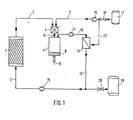
- the process diagram shown in FIG. 1 can be used, for example, in the previously described decaffeination of green coffee or nicotinization of tobacco.
- the extractor 1 contains the mixture of substances to be extracted.
- the solvent flows through line 2 under the desired pressure and temperature conditions. It loads in the extractor 1 with the ingredient to be extracted and leaves the extractor 1 through the line 3.
- an additional component is added to the loaded solvent in a mixing device 4, which passes through the line 5 into the mixing device 4.
- the mixture of loaded solvent and additional component enters the separator 7 through the line 6.
- the previously dissolved ingredients in the separator 7 precipitate out as an extract 8 and can be removed through line 9.
- the mixture of solvent and additional component which has largely been freed from the dissolved constituents, passes through line 10 to the treatment stage 11.
- the mixture is separated again into its constituents and the individual partial streams are re-introduced to the corresponding process stages.
- the solvent passes from the treatment stage 11 through the lines 12 and 2 again into the extractor 1, the additional component flows through the lines 13 and 5 again into the mixing device 4. Pressure losses in the system are compensated for by the pumps 14, 15 and 16.
- the system is filled from the reservoir 17 for the additional component and the reservoir 19 for the solvent when the shut-off valves 18 and 20 are open at the beginning of the process. If necessary, it can also be replenished from the storage containers during the process.
- FIG. 2 shows the process diagram of a pressure extraction with two-stage separation and an additional component of the same composition.
- the position numbers of FIG. 1 have been retained for the same system parts.
- Two separators 7a, 7b with upstream mixing devices 4a, 4b are used.
- the loaded solvent from the extractor 1 passes through line 3 into the first mixing device 4a, where, according to the invention, an additional component is mixed in via line 5a and regulating valve 21a.
- the mixture passes through line 6a into the separator 7a, where dissolved constituents precipitate out as extract 8a and can be drawn off through line 9a.
- the mixture of solvent, non-precipitated constituents and additional component leaving the separator 7a through line 10a is then fed into a downstream mixing device 4b, where it is mixed with further additional component through line 5b and regulating valve 21b. This further reduces the solubility.
- a second extract fraction 8b precipitates out of the mixture entering the separator 7b through line 6b and can be drawn off through line 9b.
- the further process sequence corresponds to that of FIG. 1.
- FIG. 3 shows a pressure extraction with two-stage separation, in which two additional components of different compositions are used.
- the mixing device 4c, line 6c, separator 7c, line 10e, mixing device 4d, line 6d and separator 7d are connected in series. However, they are different together mixed additional components used.
- the other additional component arrives from the storage container 17d through the shut-off valve 18d, the pump 16d, the line 5d and the regulating valve 21d into the mixing device 4d.
Landscapes
- Chemical & Material Sciences (AREA)
- Life Sciences & Earth Sciences (AREA)
- Engineering & Computer Science (AREA)
- Food Science & Technology (AREA)
- Polymers & Plastics (AREA)
- Health & Medical Sciences (AREA)
- Chemical Kinetics & Catalysis (AREA)
- Nutrition Science (AREA)
- Extraction Or Liquid Replacement (AREA)
- Separation Using Semi-Permeable Membranes (AREA)
- Jellies, Jams, And Syrups (AREA)
- Electrical Discharge Machining, Electrochemical Machining, And Combined Machining (AREA)
- Tea And Coffee (AREA)
Priority Applications (1)
| Application Number | Priority Date | Filing Date | Title |
|---|---|---|---|
| AT84109274T ATE22664T1 (de) | 1983-09-03 | 1984-08-04 | Verfahren zur trennung von organische bestandteile enthaltende stoffgemischen. |
Applications Claiming Priority (2)
| Application Number | Priority Date | Filing Date | Title |
|---|---|---|---|
| DE3331906 | 1983-09-03 | ||
| DE19833331906 DE3331906A1 (de) | 1983-09-03 | 1983-09-03 | Verfahren zur trennung von organische bestandteile enthaltenden stoffgemischen |
Publications (2)
| Publication Number | Publication Date |
|---|---|
| EP0135743A1 EP0135743A1 (de) | 1985-04-03 |
| EP0135743B1 true EP0135743B1 (de) | 1986-10-08 |
Family
ID=6208214
Family Applications (1)
| Application Number | Title | Priority Date | Filing Date |
|---|---|---|---|
| EP84109274A Expired EP0135743B1 (de) | 1983-09-03 | 1984-08-04 | Verfahren zur Trennung von organische Bestandteile enthaltende Stoffgemischen |
Country Status (10)
| Country | Link |
|---|---|
| US (1) | US4714617A (da) |
| EP (1) | EP0135743B1 (da) |
| JP (1) | JPS60156504A (da) |
| AT (1) | ATE22664T1 (da) |
| CA (1) | CA1243888A (da) |
| DE (1) | DE3331906A1 (da) |
| DK (1) | DK417084A (da) |
| ES (1) | ES535374A0 (da) |
| NO (1) | NO161037C (da) |
| ZA (1) | ZA846816B (da) |
Families Citing this family (21)
| Publication number | Priority date | Publication date | Assignee | Title |
|---|---|---|---|---|
| DE3570971D1 (en) * | 1984-03-08 | 1989-07-20 | Givaudan & Cie Sa | Preparation of flavouring extracts |
| DE3443390A1 (de) * | 1984-11-28 | 1986-05-28 | Hopfenextraktion HVG Barth, Raiser & Co, 8069 Wolnzach | Verfahren zur abtrennung von coffein aus verfluessigten oder ueberkritischen gasen |
| JPS62201828A (ja) * | 1986-02-28 | 1987-09-05 | Suntory Ltd | 超臨界抽出法及びそのための装置 |
| US4898188A (en) * | 1986-12-22 | 1990-02-06 | R. J. Reynolds Tobacco Company | Tobacco Processing |
| US5018540A (en) * | 1986-12-29 | 1991-05-28 | Philip Morris Incorporated | Process for removal of basic materials |
| DE3706594A1 (de) * | 1987-02-28 | 1988-09-08 | Messer Griesheim Gmbh | Verfahren zur extraktion organischer bestandteile aus feststoffen |
| US5178735A (en) * | 1987-09-07 | 1993-01-12 | Chlorine Engineers | Process for the supercritical extraction and separation of solid samples |
| US5435325A (en) * | 1988-04-21 | 1995-07-25 | R. J. Reynolds Tobacco Company | Process for providing tobacco extracts using a solvent in a supercritical state |
| US5240603A (en) * | 1990-03-02 | 1993-08-31 | Hewlett-Packard Company | Decoupled flow and pressure setpoints in an extraction instrument using compressible fluids |
| JP2562857Y2 (ja) * | 1990-12-12 | 1998-02-16 | 曙ブレーキ工業株式会社 | 車両用ホイール |
| GB9413875D0 (en) * | 1994-07-09 | 1994-08-31 | British Nuclear Fuels Plc | Separating solutes from solutions |
| DE4447116A1 (de) * | 1994-12-29 | 1996-07-04 | Sueddeutsche Kalkstickstoff | Verfahren zur Fraktionierung bzw. Raffination von lipiden Naturstoffen |
| PT730830E (pt) * | 1995-03-06 | 2002-07-31 | Flachsmann Ag Emil | Processo para a eliminacao de impurezas lipofilas e/ou residuos indesejaveis contidos em bebidas ou preparados de plantas |
| CA2255413A1 (en) | 1998-12-11 | 2000-06-11 | Fracmaster Ltd. | Foamed nitrogen in liquid co2 for fracturing |
| WO2000065018A1 (en) * | 1999-04-26 | 2000-11-02 | 3M Innovative Properties Company | Stabilized carbon dioxide fluid composition and use thereof |
| ES2161611B1 (es) * | 1999-06-18 | 2003-04-01 | Consejo Superior Investigacion | Procedimiento de obtencion de lanolina y lana exentas de plaguicidas. |
| CN100334979C (zh) | 2002-07-18 | 2007-09-05 | 法塞克斯公司 | 减少烟草中成分的方法及通过该方法得到的烟草 |
| US20070137663A1 (en) * | 2005-12-01 | 2007-06-21 | R. J. Reynolds Tobacco Company | Method of extracting sucrose esters from oriental tobacco |
| US20120125354A1 (en) | 2010-11-18 | 2012-05-24 | R.J. Reynolds Tobacco Company | Fire-Cured Tobacco Extract and Tobacco Products Made Therefrom |
| WO2013142483A1 (en) | 2012-03-19 | 2013-09-26 | R. J. Reynolds Tobacco Company | Method for treating an extracted tobacco pulp and tobacco products made therefrom |
| DE102013018981A1 (de) | 2013-11-13 | 2015-05-13 | Bernd Degen | Verfahren zur Herstellung eines Pflanzenextrakts |
Family Cites Families (18)
| Publication number | Priority date | Publication date | Assignee | Title |
|---|---|---|---|---|
| US3074851A (en) * | 1958-12-02 | 1963-01-22 | Knedel Maximilian | Fractionation of protein solutions |
| DE1493190C3 (de) * | 1963-04-16 | 1980-10-16 | Studiengesellschaft Kohle Mbh, 4330 Muelheim | Verfahren zur Trennung von Stoffgemischen |
| US4153063A (en) * | 1970-09-02 | 1979-05-08 | Studiengesellschaft Kohle Mbh | Process for the extraction of nicotine from tobacco |
| DE2207989A1 (de) * | 1971-03-08 | 1972-10-12 | VEB Petrolchemisches Kombinat Schwedt, χ 1330 Schwedt | Verfahren zur Extraktion mittels Lo sungsmittelgemischen, insbesondere zur Gewinnung von Aromaten |
| US4167589A (en) * | 1971-06-03 | 1979-09-11 | Otto Vitzthum | Method for the manufacture of caffeine free black tea |
| DE2637197C2 (de) * | 1976-08-18 | 1983-01-27 | Hag Ag, 2800 Bremen | Verfahren zum Entzug von Coffein aus coffeinhaltigen Naturstoffen mit einem überkritischen Extraktionsmittel |
| DE2727191B2 (de) * | 1977-06-16 | 1980-07-03 | Hag Ag, 2800 Bremen | Verfahren zur selektiven Extraktion von Coffein aus pflanzlichen Materialien |
| DE2737793A1 (de) * | 1977-08-22 | 1979-03-08 | Peter Siegfried | Verfahren zur entcoffeinierung von rohkaffee |
| NL7712503A (nl) * | 1977-11-14 | 1979-05-16 | D E J Int Research | Werkwijze voor het decaffeineren van groene koffiebonen. |
| US4348422A (en) * | 1978-02-13 | 1982-09-07 | Studiengesellschaft Kohle M.B.H. | Process for the direct decaffeination of aqueous coffee extract solutions |
| US4322445A (en) * | 1978-08-14 | 1982-03-30 | Siegfried Peter | Process for decaffeinating coffee |
| US4251559A (en) * | 1978-11-06 | 1981-02-17 | Societe D'assistance Technique Pour Produits Nestle S.A. | Decaffeination process |
| US4341804A (en) * | 1979-03-26 | 1982-07-27 | General Foods Corporation | Decaffeination of aqueous roasted coffee extract |
| US4472442A (en) * | 1980-09-26 | 1984-09-18 | General Foods Corporation | Decaffeination process |
| US4437939A (en) * | 1981-07-17 | 1984-03-20 | The Halcon Sd Group, Inc. | Process for separating ethylene oxide from aqueous solutions |
| US4437938A (en) * | 1981-07-17 | 1984-03-20 | The Halcon Sd Group, Inc. | Process for recovering ethylene oxide from aqueous solutions |
| BE896610A (fr) * | 1982-05-06 | 1983-08-16 | Hop Developments Ltd | Extraction d'une matiere vegetale en utilisant de l'anhydride carbonique |
| DE3334736A1 (de) * | 1983-09-26 | 1985-04-04 | Kohlensäure-Werke Rud. Buse GmbH & Co, 5462 Bad Hönningen | Verfahren zur herstellung von nikotinarmem tabak durch hochdruckextraktion |
-
1983
- 1983-09-03 DE DE19833331906 patent/DE3331906A1/de not_active Withdrawn
-
1984
- 1984-08-04 AT AT84109274T patent/ATE22664T1/de not_active IP Right Cessation
- 1984-08-04 EP EP84109274A patent/EP0135743B1/de not_active Expired
- 1984-08-23 ES ES535374A patent/ES535374A0/es active Granted
- 1984-08-31 DK DK417084A patent/DK417084A/da not_active Application Discontinuation
- 1984-08-31 NO NO843467A patent/NO161037C/no unknown
- 1984-08-31 CA CA000462289A patent/CA1243888A/en not_active Expired
- 1984-08-31 ZA ZA846816A patent/ZA846816B/xx unknown
- 1984-09-03 JP JP59182906A patent/JPS60156504A/ja active Pending
-
1986
- 1986-03-27 US US06/845,474 patent/US4714617A/en not_active Expired - Fee Related
Also Published As
| Publication number | Publication date |
|---|---|
| ATE22664T1 (de) | 1986-10-15 |
| NO161037B (no) | 1989-03-20 |
| EP0135743A1 (de) | 1985-04-03 |
| JPS60156504A (ja) | 1985-08-16 |
| ES8505258A1 (es) | 1985-05-16 |
| CA1243888A (en) | 1988-11-01 |
| DK417084A (da) | 1985-03-04 |
| US4714617A (en) | 1987-12-22 |
| DK417084D0 (da) | 1984-08-31 |
| ES535374A0 (es) | 1985-05-16 |
| ZA846816B (en) | 1985-07-31 |
| DE3331906A1 (de) | 1985-03-21 |
| NO843467L (no) | 1985-03-04 |
| NO161037C (no) | 1989-06-28 |
Similar Documents
| Publication | Publication Date | Title |
|---|---|---|
| EP0135743B1 (de) | Verfahren zur Trennung von organische Bestandteile enthaltende Stoffgemischen | |
| DE3334736C2 (da) | ||
| EP0012986B1 (de) | Verfahren zum Abtrennen und Gewinnen gasförmiger Komponenten aus einem Gasgemisch durch physikalische Wäsche | |
| DE19654945C2 (de) | Im wesentlichen nikotinfreies Tabakaromaöl sowie Verfahren zu dessen Herstellung | |
| DE2127642C3 (de) | Verfahren zur Herstellung von coffeinfreiem schwarzem Tee mit vollem Aromagehalt | |
| DE2153807C3 (de) | Adiabatisches Verfahren zur Trennung von Gasgemischen durch selektive Adsorption und nachfolgende Desorption mindestens einer Gaskomponente | |
| DE3541775C2 (de) | Verfahren zum Entfernen von Schwefelwasserstoff aus Gasgemischen | |
| DE2724763C2 (de) | Verfahren zum Reinigen und Zerlegen eines Gasgemisches | |
| DE3716898C2 (da) | ||
| DE3327091A1 (de) | Verfahren zum entfernen von stickstoffgas aus einer mischung aus n(pfeil abwaerts)2(pfeil abwaerts) und co oder aus n(pfeil abwaerts)2(pfeil abwaerts), co(pfeil abwaerts)2(pfeil abwaerts) und co | |
| DE2727191A1 (de) | Verfahren zur selektiven extraktion von coffein aus pflanzlichen materialien | |
| EP0066868B1 (de) | Verfahren zur Trennung von Gasgemischen mittels Druckwechsel-Adsorptionstechnik | |
| DE3445502C2 (da) | ||
| DE3640333C3 (de) | Verfahren und Vorrichtung zur Herstellung von aromatisiertem, entcoffeiniertem Tee | |
| DE2707745A1 (de) | Verfahren und einrichtung zur anreicherung des anteils eines als gemischkomponente in einem gasgemisch enthaltenen gases | |
| WO2015043707A1 (de) | Verfahren und vorrichtung zur sauergaswäsche | |
| DE2634535C3 (de) | Verfahren zur Entcoffeinierung von Rohkaffee | |
| EP0280935A2 (de) | Verfahren zur Extraktion organischer Bestandteile aus Feststoffen | |
| EP0247999B1 (de) | Verfahren zum Behandeln von Kaffee | |
| DE2846976C3 (de) | Verfahren zur Entcoffeinierung von Rohkaffee | |
| DE2702784C2 (de) | Verfahren zum Zerlegen eines Gasgemisches | |
| DD254888A5 (de) | Druckwechseladsorptionsverfahren | |
| EP0650328B1 (de) | Verfahren zur abreicherung von coffein und chlorogensäuren aus rohkaffee | |
| DD288533A5 (de) | Verfahren zum trennen von gasgemischen durch druckwechseladsorption | |
| DE19524481C2 (de) | Verfahren zur Entcoffeinierung von schwarzem Tee |
Legal Events
| Date | Code | Title | Description |
|---|---|---|---|
| PUAI | Public reference made under article 153(3) epc to a published international application that has entered the european phase |
Free format text: ORIGINAL CODE: 0009012 |
|
| AK | Designated contracting states |
Designated state(s): AT BE CH FR GB IT LI NL SE |
|
| RTI1 | Title (correction) | ||
| 17P | Request for examination filed |
Effective date: 19850425 |
|
| GRAA | (expected) grant |
Free format text: ORIGINAL CODE: 0009210 |
|
| AK | Designated contracting states |
Kind code of ref document: B1 Designated state(s): AT BE CH FR GB IT LI NL SE |
|
| REF | Corresponds to: |
Ref document number: 22664 Country of ref document: AT Date of ref document: 19861015 Kind code of ref document: T |
|
| ITF | It: translation for a ep patent filed | ||
| ET | Fr: translation filed | ||
| PLBE | No opposition filed within time limit |
Free format text: ORIGINAL CODE: 0009261 |
|
| STAA | Information on the status of an ep patent application or granted ep patent |
Free format text: STATUS: NO OPPOSITION FILED WITHIN TIME LIMIT |
|
| 26N | No opposition filed | ||
| PGFP | Annual fee paid to national office [announced via postgrant information from national office to epo] |
Ref country code: AT Payment date: 19890810 Year of fee payment: 6 |
|
| PGFP | Annual fee paid to national office [announced via postgrant information from national office to epo] |
Ref country code: CH Payment date: 19890814 Year of fee payment: 6 |
|
| ITTA | It: last paid annual fee | ||
| PGFP | Annual fee paid to national office [announced via postgrant information from national office to epo] |
Ref country code: GB Payment date: 19900724 Year of fee payment: 7 |
|
| PG25 | Lapsed in a contracting state [announced via postgrant information from national office to epo] |
Ref country code: AT Effective date: 19900804 |
|
| PGFP | Annual fee paid to national office [announced via postgrant information from national office to epo] |
Ref country code: FR Payment date: 19900807 Year of fee payment: 7 |
|
| PGFP | Annual fee paid to national office [announced via postgrant information from national office to epo] |
Ref country code: SE Payment date: 19900828 Year of fee payment: 7 |
|
| PG25 | Lapsed in a contracting state [announced via postgrant information from national office to epo] |
Ref country code: LI Effective date: 19900831 Ref country code: CH Effective date: 19900831 |
|
| PGFP | Annual fee paid to national office [announced via postgrant information from national office to epo] |
Ref country code: NL Payment date: 19900831 Year of fee payment: 7 |
|
| PGFP | Annual fee paid to national office [announced via postgrant information from national office to epo] |
Ref country code: BE Payment date: 19900904 Year of fee payment: 7 |
|
| REG | Reference to a national code |
Ref country code: CH Ref legal event code: PL |
|
| PG25 | Lapsed in a contracting state [announced via postgrant information from national office to epo] |
Ref country code: GB Effective date: 19910804 |
|
| PG25 | Lapsed in a contracting state [announced via postgrant information from national office to epo] |
Ref country code: SE Effective date: 19910805 |
|
| PG25 | Lapsed in a contracting state [announced via postgrant information from national office to epo] |
Ref country code: BE Effective date: 19910831 |
|
| BERE | Be: lapsed |
Owner name: KOHLENSAURE-WERKE RUD. BUSE G.M.B.H & CO. Effective date: 19910831 Owner name: MESSER GRIESHEIM G.M.B.H. Effective date: 19910831 |
|
| PG25 | Lapsed in a contracting state [announced via postgrant information from national office to epo] |
Ref country code: NL Effective date: 19920301 |
|
| GBPC | Gb: european patent ceased through non-payment of renewal fee | ||
| NLV4 | Nl: lapsed or anulled due to non-payment of the annual fee | ||
| PG25 | Lapsed in a contracting state [announced via postgrant information from national office to epo] |
Ref country code: FR Effective date: 19920430 |
|
| REG | Reference to a national code |
Ref country code: FR Ref legal event code: ST |
|
| EUG | Se: european patent has lapsed |
Ref document number: 84109274.5 Effective date: 19920306 |