EP0135747B1 - Ion-Beweglichkeitsspektrometersystem mit verbesserter Spezifik - Google Patents
Ion-Beweglichkeitsspektrometersystem mit verbesserter Spezifik Download PDFInfo
- Publication number
- EP0135747B1 EP0135747B1 EP84109332A EP84109332A EP0135747B1 EP 0135747 B1 EP0135747 B1 EP 0135747B1 EP 84109332 A EP84109332 A EP 84109332A EP 84109332 A EP84109332 A EP 84109332A EP 0135747 B1 EP0135747 B1 EP 0135747B1
- Authority
- EP
- European Patent Office
- Prior art keywords
- sample
- ion
- reagent
- ions
- acetone
- Prior art date
- Legal status (The legal status is an assumption and is not a legal conclusion. Google has not performed a legal analysis and makes no representation as to the accuracy of the status listed.)
- Expired - Lifetime
Links
Images


Classifications
-
- G—PHYSICS
- G01—MEASURING; TESTING
- G01N—INVESTIGATING OR ANALYSING MATERIALS BY DETERMINING THEIR CHEMICAL OR PHYSICAL PROPERTIES
- G01N30/00—Investigating or analysing materials by separation into components using adsorption, absorption or similar phenomena or using ion-exchange, e.g. chromatography or field flow fractionation
- G01N30/02—Column chromatography
- G01N30/62—Detectors specially adapted therefor
- G01N30/64—Electrical detectors
- G01N30/70—Electron capture detectors
-
- G—PHYSICS
- G01—MEASURING; TESTING
- G01N—INVESTIGATING OR ANALYSING MATERIALS BY DETERMINING THEIR CHEMICAL OR PHYSICAL PROPERTIES
- G01N27/00—Investigating or analysing materials by the use of electric, electrochemical, or magnetic means
- G01N27/62—Investigating or analysing materials by the use of electric, electrochemical, or magnetic means by investigating the ionisation of gases, e.g. aerosols; by investigating electric discharges, e.g. emission of cathode
- G01N27/622—Ion mobility spectrometry
- G01N27/623—Ion mobility spectrometry combined with mass spectrometry
Definitions
- the invention is related to the field of ion mobility spectrometers and in particular to an ion mobility spectrometer having means for continuously adding a chemical reagent vapor to the carrier gas in order to improve the selectivity of the spectrometer and eliminate the adverse affects of interfering vapors.
- the operation of the ion mobility spectrometer is similar to the operation of a time-of-flight mass spectrometer, the difference being that a time-of-flight spectrometer operates in a vacuum where the mean free path of the contained gases is many times the dimensions of the gas container whereas the ion mobility spectrometer operates at or near atmospheric pressure where the mean free path of the contained gas is smaller than the dimensions of the container.
- a typical ion mobility spectrometer such as disclosed by Cohen et al, U.S.
- patent 3,621,240 comprises an ion/molecule reaction chamber, an ionization source associated with the ion reaction chamber, an ion drift chamber, an ion/molecule injector shutter or grid interposed between the ion reaction chamber and the ion drift chamber, and an ion collector.
- a carrier gas normally purified air or nitrogen, is introduced into the ion mobility spectrometer to transport vapor from a sample material to be identified or detected. The carrier gas with the sample vapor are ionized by the ionization source in the ion/molecule reaction chamber.
- the relative concentrations of the carrier gas and the sample vapor are such that the molecules of the carrier gas are more easily directly ionized by the ionization source than the molecules of the sample vapor. Since the mean free path for the ionized carrier molecules is many times smaller than the dimensions of the reaction chamber, there are multiple collisions between the ionized carrier molecules and the sample molecules. The tendency of these collisions is to transfer the ion charge from the ionized carrier molecules to the sample molecules. Therefore, the ionization of the sample gas is primarily by this secondary ionization process.
- the charged molecules or ions are accelerated to a terminal velocity by an electrostatic field gradient within the ion/molecule reaction chamber causing them to travel towards the injection grid interfacing the ion drift chamber.
- the bias on the injection grid is reduced to zero for a short period of time to permit a quantity (pulse) of ions to pass from the ion/molecule reaction chamber to the ion drift chamber.
- the passed ions are drawn, under the influence of an electrostatic drift field, to the ion collector where they are collected.
- the time of arrival of each ion species, both carrier gas and sample, at the ion collector is determined by the particular ion's mobility through the non-ionized gas filling the drift chamber.
- the heavier ions characteristically move slower through the drift chamber and arrive at the ion collector later than the lighter ions. It is thus possible to characterize the different ion species by monitoring the time between the introduction of the ions into the drift chamber at the injection grid and the arrival of the ions at the ion collector. An electrometer measures the quantity of ions collected by the ion collector.
- the sample vapor is injected into a carrier gas which transports the vapor molecules to the ion/molecule reaction chamber and exposes the vapor molecules to ion/molecule reactions with the ions generated in the ionized carrier gas.
- the sample can simply be a sample of ambient air.
- certain constituents of atmospheric air such as water, ammonia and nitrogen oxides, interfere with the proper performance of the ion mobility spectrometer.
- the effects of these components can be significantly attenuated through the use of a membrane inlet filter described in U.S. patent 4,311,669 issued January 19, 1982.
- additional improvements in specificity are needed to allow ion mobility spectrometry to be used as a detector for specific sample materials in the presence of contaminants or other interferences.
- Munson discloses a method for generating sample ions in a mass spectrometer by mixing a reagent gas with the sample vapors.
- the reagent gas is ionized first to form stable ions.
- the stable ions of the reagent gas then undergo ion/molecule reactions with the sample vapor to form ions characteristic of the sample vapor.
- the concentration of the sample in the ionized reagent gas is less than 1 percent.
- patent 3,920,987 disclose a method for detecting explosives in which a reagent gas comprising a mixture of sulfur hexachloride (SF6) and nitrogen (N2) is first ionized in a separate chamber to form stable negative ions. The ionized reagent gas is then mixed with the sample vapor in an atmospheric pressure reaction chamber. In the atmospheric pressure reaction chamber electron exchange reactions occur to ionize the explosive constituent of the sample, before the ions are transmitted to a mass analyzer at reduced pressure for analysis.
- Sulfur hexafluoride (SF6) was selected because it had a lower electron affinity than the explosive molecules in the sample but a higher electron affinity than the other constituents in the air which serves as the carrier for the explosive samples.
- McClure in U.S. patent 4,374,090 discloses a method for detecting certain chemical agents in which a reagent gas of DMMP (dimethylmethylphosphonate), TBA (Tributylamine), DIMP (diisopropylmethylphosphonate), DMSO (dimethylsulfoxide), di-N-butylamine and mixtures thereof are first ionized in the reaction chamber of an ionization detector as described in U.S. patent 3,835,328. The stable ions formed from the reagent gas then undergo ion/molecule reactions with the sample vapor to produce ions characteristic of the sample vapor which can be analyzed by the ionization detector.
- DMMP dimethylmethylphosphonate
- TBA Tributylamine
- DIMP diisopropylmethylphosphonate
- DMSO dimethylsulfoxide
- Positive ion or proton transfer reactions are among the most important class of ion/molecule reactions used in ion mobility spectrometry. If M is the sample molecule and RH+ is the reactant ion, ionization occurs in accordance with: RH++M ⁇ R+MH+ where MH+ is the product ion.
- RH++M ⁇ R+MH+ where MH+ is the product ion.
- the tendency of the proton H+, to transfer from the reactant ion RH+ to the sample M is regulated by the relative proton affinities of R and M.
- the proton affinity of M must be greater than the proton affinity of R if the proton transfer reaction is to occur.
- organophosphorous compounds such as dimethylmethylphosphonate (DMMP)
- DMMP dimethylmethylphosphonate
- cluster reactions can take place to yield: where M2H+ is the dimer ion.
- ionization occurs in accordance with: R ⁇ +M ⁇ R+M ⁇ (charge transfer) R ⁇ +M ⁇ RH+(M-H) ⁇ (proton abstraction) when M ⁇ is the product ion for charge transfer H+ is the proton (M-H) ⁇ is the product ion for proton abstraction.
- the tendency of an electron to transfer from the reactant ion, R ⁇ , to the sample M is regulated by the relative electron affinities of R and M.
- the electron affinity of M must be greater than R if the charge transfer reaction is to take place.
- the tendency of a proton to transfer from the sample molecule M to the reactant ion R ⁇ is regulated by the acidity of M relative to R. The acidity of M must be greater than R if the proton abstraction is to take place.
- One embodiment of this invention provides an ion mobility spectrometer comprising sample injection means for injecting into a reaction chamber of said spectrometer, a sample gas or vapor having at least one constituent to be detected and which reduces the specificity of said spectrometer for at least one constituent to be detected, and carrier gas circulating means for circulating a carrier gas through said reaction chamber, having a reagent source for introducing a reagent selected from acetone, carbon tetrachloride and both acetone and carbon tetrachloride into said carrier gas before said gas is introduced into the reaction chamber.
- Another embodiment of this invention provides a method for using an ion mobility spectrometer as described above for detecting at least one constituent in a sample gas or vapor which may contain said constituent to be detected and which may contain at least one contaminant which reduces the specificity of said spectrometer for said constituent.
- This embodiment comprises circulating a carrier gas through the reaction chamber of said spectrometer with the carrier gas circulating means, introducing a reagent selected from acetone, carbon tetrachloride and both acetone and carbon tetrachloride into the carrier gas from reagent source, injecting said reagant, carrier gas and sample into said reaction chamber through sample injection means thereby forming a reagent/carrier/sample mixture; and ionizing said reagent/carrier/sample mixture to form stable ions of said reagent, said stable ions reacting with said sample to produce ions characteristic of the constituents of the sample, and allowing said ions characteristic of the constituents of said sample to pass through a drift chamber to a collector electrode of said spectrometer.
- the present invention involves the addition of at least one chemical reagent to the carrier gas of an ion mobility spectrometer to modify the reactant ions.
- the reagent modifies the ion-molecule reaction chemistry allowing the formation of stable ions specific to a sample under atmospheric conditions. More specifically, the invention relates to, but is not limited to, the detection of carbonyl and organophosphorus compounds using acetone as a reagent and organonitro compounds using carbon tetrachloride as a reagent.
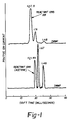
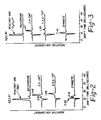
- the response of an ion mobility spectrometer to acetone produces a single ion mobility peak with a drift time ratio K o of 1.19 relative to (H2O) n H+ for a drift temperature of 50°C.
- the ions contributing to the single ion mobility peak of acetone have been shown to be protonated acetone dimers.
- This proton affinity exceeds that for ionized water vapor, (H2O) n H+, by as much as 54 Kcal/mole (226 KJ/mole) and exceeds that for clustered ammonia vapor ions, (H2O) n NH+4, by as much as 22 Kcal/mole (92 KJ/mole).
- the dimer of acetone provides greater specificity of response than water or ammonia vapor due to its higher proton affinity.
- any ketone, carbonyl, sulfoxide, or phosphoryl compound may be used as a reagent in the place of acetone.
- the ionization of organophosphorous compounds are dependent on the nature of the positive reactant ions in the ion mobility spectrometer.
- mass spectrometric data shows that the ions contributing to the various peaks of dimethylmethylphosphonate (DMMP) in FIGURE 1 are DMMP(H20) n H+ and DMMP2H+ with reduced mobilities of 1.91 and 1.48 cm2V ⁇ 1s ⁇ 1 respectively.
- Prober and Dam disclose the use of hexafluoroacetone in air to calibrate the concentration response of ion mobility spectrometry. Besides not specifying a concentration calibration technique but rather an ion modification technique, the present disclosure differs from that by Prober and Dam in that hexafluoroacetone would not be selected, as a reagent because of its low proton affinity (159.3 Kcal/mole) (666.5 KJ/mole). A reagent having a low proton affinity offers little advantage in increasing identification specificity of ion mobility spectrometry.
- Carbon Tetrachloride The response of an ion mobility spectrometer to carbon tetrachloride produces a single ion mobility peak with a drift time ratio of 0.89 relative to (H20) n C04 ⁇ for a drift temperature of 108°C.
- the ions contributing to the single ion mobility peak of carbon tetrachloride have been shown to be (H20) n Cl ⁇ ions.
- the electron affinity of chlorine is 2.32-2.45 electron volts. This electron affinity exceeds that for oxygen by as much as 2 electron volts.
- the (H20) n Cl ⁇ ion of carbon tetrachloride provides greater specificity of response than (H20) n CO4 ⁇ or (H20) n 02 ⁇ due to its higher electron affinity and greater acidity.
- organonitro compounds are dependent on the nature of the negative reactant ions in the ion mobility spectrometer.
- free electrons serve as reactant ions and the ions produced from dinitrotoluene (DNT) and trinitroluene (TNT) are the M ⁇ molecular negative ion.
- DNT dinitrotoluene
- TNT trinitroluene
- H20 purified air as the carrier gas
- (H20) n C04 ⁇ ions serve as reactant ions and the ions produced from DNT and TNT are the proton abstracted (M-H) ⁇ negative ions.
- (H20) n Cl ⁇ ions can also be used to attach to a sample molecule to produce (M+Cl) ⁇ ions.
- Sample compounds which are alkylating agents or contain "active" hydrogens, e.g. captan, dieldrin and dimethylsulfoxide, can be detected and identified in this manner.
- halogen ions such as (H20) n Br ⁇ and (H20) n I ⁇ will display chemistry similar to (H20) n Cl ⁇ ions.
- the (H20) n B r ⁇ and (H20) n I ⁇ ions can be produced in ion mobility spectrometry by using brominated and iodized reagent compounds such as dibromobenzene and iodobenzene respectively.
- the ion mobility spectrometer 10 is of the type disclosed in U.S. patent 4,311,699 having a reaction chamber 12, a drift chamber 14 and permeable membrane sample input 16.
- the ion mobility spectrometer includes suitable heating means, not shown, to provide an appropriate operating temperature, and biasing means for providing potentials to the electrodes 18 disposed along the length of the ion mobility spectrometer to established a proper electrical potential gradient from the entrance aperture 20 to a collector electrode 22.
- the reaction chamber 12 and drift chamber 14 are separated by an injection grid 24 electrically connected to the output of a Pulse Generator 26.
- the Pulse Generator 26 generates a first electrical signal biasing injection grid at a potential inhibiting the ion flow from the reaction chamber 12 to the drift chamber 14.
- Periodically the Pulse Generator 26 generates a second signal in the form of a short duration pulse biasing injection grid at a potential permitting the ions to flow through injection grid 24 from the reaction chamber 12 to the drift chamber 14.
- the ions transmitted through injection grid 24, during the occurrence of the second signal drift across the length of the drift chamber 14 under the influence of the electric field provided by electrodes 18, and are collected by ion collector electrode 22.
- the ions collected by ion collector electrode 22 create an electrical signal which is amplified by Amplifier 28 such as an electrometer circuit.
- Amplifier 28 such as an electrometer circuit.
- the output of Amplifier 28 is communicated to the Electronic Processing Unit (EPU) 30.
- the Electronic Processing Unit 30 also receives the signals generated by the Pulse Generator 26 and generates a signal characteristic of the sample as shall be explained hereinafter.
- Ionizer 32 for generating the requisite ions is disposed in the reaction chamber 12 adjacent to inlet 20.
- Ionizer 32 may be a radioactive source, a corona discharge device, an electron source or any other such ionizing device known in the art.
- the sample input 16 comprises a sample chamber 34 separated from an integral concentric mixing chamber 36 by a membrane 38.
- the membrane 38 is selected to selectively transmit the constituent of the sample desired to be detected and may be either a non-porous semipermeable type or a porous diffusion type as disclosed in U.S. patent 4,311,669.
- the sample chamber 34 has a sample inlet port 40 and an exhaust port 42 connected to a Sample Pump 44 by means of connecting line 46.
- the Sample Pump 44 provides for a continuous flow of the sample directed across the face of membrane 38.
- the mixing chamber 36 comprises an inner cylindrical member 48 and an outer cylindrical member 50.
- the outer cylindrical member 50 supports the membrane 38 at one end and is connected to inner cylindrical member 48 by means of an annular end cap 52 at the other end.
- the free end of the inner cylindrical member 48 is spaced a short distance from the membrane 36 providing an internal flow path connecting the space between the internal cylindrical member 48 and external cylindrical member 50 and the interior of internal cylindrical member 48.
- the end of the internal cylindrical member 48 opposite membrane 38 defines the entrance aperture 20 to reaction chamber 12 opposite injection grid 24.
- the mixing chamber 36 has an entrance aperture 54 passing through the external cylindrical member 50 adjacent to end cap 52, receiving a mixture of the carrier gas and the reagent.
- a Cell Pump 56 recirculates a carrier gas through the reaction and drift chambers 12 and 14 respectively through feed conduits 58, 60, and 62 and return conduit 64.
- a Filter 66 disposed at the junction of conduits 58 and 60 removes water vapor and other contaminants from the carrier gas as is known in the art.
- the Filter 66 may incorporate a desiccant, silica gel or be a molecular sieve.
- a first flow control valve 68 controls the velocity of the gas flow through the drift chamber.
- Reagent Source 70 is also connected to Reagent Source 70.
- Reagent Source 70 may be a single reagent source introducing either acetone or carbon tetrachloride into the carrier gas or may be a dual Reagent Source introducing both acetone and carbon tetrachloride into the carrier gas.
- the Reagent Source 70 is connected to the mixing chamber 36 by means of conduit 72.
- a second flow control value 74 controls the flow rate of the carrier gas through Reagent Source 70 and to the mixing chamber 36.
- the operation of the ion mobility spectrometer is as follows:
- the Sample Pump causes a continuous flow of sample gas across the outer surface of membrane 38 which selectively transmits the constituent of the sample desired to be detected to the mixing chamber 36.
- the mixture of the reagent and carrier gases input to mixing chamber 36 from the Reagent Source 70 scrub the internal surface membrane 38 producing a mixture of the sample, reagent, and carrier gases which is received into the reaction chamber 12 though entrance aperture 20.
- the mixture containing the sample is ionized in the reaction chamber and starts to drift towards the injection grid 24 under the influence of the generated electrostatic field.
- the proton affinity, electron affinity or acidity of the reactant ion of the reagent is greater than that of the normal contaminants of the sample, such as water and ammonia, but less than that of the constituent of the sample to be detected, the primary reaction will be between that of reactant ions of the reagent and the constituent of the sample desired to be detected.
- the reagent is acetone, or similar compound, or carbon tetrachloride, or similar compound
- the formed reactant ions because of their higher proton affinity, electron affinity, or acidity will react primarily with the molecules of the constituent of the sample to be detected and will not react with the normal contaminants of the sample and carrier gas.
- the reactant ions do not have a tendency to cluster as previously described, the ion peaks for the constituent desired to be detected will be fixed and sharply defined as long as the water content is maintained at a concentration level of less than 20 parts per million.
- the injection grid 24 is periodically biased to transmit a short pulse of ions into the drift chamber, where they drift towards the collector electrode 22 under the influence of the electrostatic field.
- the electrical signal produced by the ions being collected by the collector electrode 22 is amplified by amplifier 28 to generate a signal indicative of the number of ions being collected at any given time.
- the Electronic Control Unit 30, samples the output of Amplifier 28 at predetermined time intervals after each injection pulse.
- the Electronic Processing Unit 30 may perform any of the data analysis or manipulations as is known in the art.
- the Electronic Processing Unit may output a graph displaying the ion spectrum of the reagent and sample, it may produce a visual display or print out identifying each constituent of the sample and their concentration. It also may produce a visual display or print out indicative of only one or more sample constituents of particular interest, or it may produce a simple audible alarm indicating that a particular constituent is present in the sample.
- the Electronic Processing Unit 30 may only sample the output of Amplifier 28 during one or more relatively narrow time intervals after each injection impulse, such drift times being indicative of drift velocity of the particular constituent or constituents in the sample.
- drift time is of major importance in the signature of the detected ions.
- the drift time, t d is the time it takes for the ion to arrive at the ion collector electrode after it has been injected into the drift chamber 14 by injector grid 24.
- V d KE
- K is the ion mobility
- E is the gradient of the electrostatic field.
- the equation for the drift time of the detected ion, t d can be rewritten as follows: If a calibration ion, i.e.
- K oc the mobility of the calibration ion
- K os the mobility of the sample ion.
- the above relationship is independent of temperature and pressure provided the chemical composition of the constituents of the sample do not change.
- One of the major causes of chemical change in ion mobility spectrometry is the clustering of water.
- the use of acetone as the reagent not only provides the desired calibration peaks but also quenches the water cluster mechanism and makes drift time ratios constant over a wider temperature and pressure range.
- the Reagent Source 70 for a single reagent comprise a non-porous container or tube 80 filled with acetone or carbon tetrachloride having a closed end 82.
- tube 80 is made from, but not limited to stainless steel and is about 6 millimeters (1/4 inch) in diameter.
- the closed end 82 may be formed integral with tube 80 as shown or may be a separate cap (not shown) sealing the end of tube 80 as is known in the art.
- the open end of tube 80 is covered by a permeable membrane 84 comprising, for example, three sheets of poly propylene approximately 12 to 13 mm thick.
- the membrane 84 is held over the end of tube 80 by a polytetrafluoroethylene ferrule 86 which is captivated between an inwardly tapered shoulder of a "T" pipe fitting 88 and a cap nut 92.
- the "T" pipe fitting 88 may include a baffle 90 directing the carrier gas over the surface of membrane 84.
- the permeability of the membrane 84 is such that the Reagent Sources 70 containing acetone or carbon tetrachloride as the reagent, will produce a reagent concentration of 8 parts per million in a carrier gas. This concentration is kept constant by regulating the temperature of the Reagent Source by means of a heater or heater/cooler element 94 controlled by temperature controller 96.
- the Reagent Source 70 will comprise two Reagent Sources such as shown on Figure 5 with membranes 84 of both Reagent Sources exposed to the carrier gas.
- membrane 84 is not limited to polypropylene but may include other materials such as dimethylsilicone, polyethylene, polystyrene, ceran, etc.
- the tube containing the acetone and carbon tetrachloride may be a closed plastic or polymeric tube ("permeation tube") with permeable walls or a solid plastic or polymeric source impregnated with acetone and carbon tetrachloride. Permeation would be adjusted by the wall thickness of the plastic or polymeric tube or the degree of impregnation of the solid source.
Landscapes
- Physics & Mathematics (AREA)
- Health & Medical Sciences (AREA)
- Life Sciences & Earth Sciences (AREA)
- Chemical & Material Sciences (AREA)
- General Physics & Mathematics (AREA)
- Spectroscopy & Molecular Physics (AREA)
- Pathology (AREA)
- Immunology (AREA)
- Analytical Chemistry (AREA)
- Biochemistry (AREA)
- General Health & Medical Sciences (AREA)
- Molecular Biology (AREA)
- Electrochemistry (AREA)
- Chemical Kinetics & Catalysis (AREA)
- Other Investigation Or Analysis Of Materials By Electrical Means (AREA)
Claims (2)
- Ionen-Beweglichkeitsspektrometer (10) mit einer groben Injektionseinrichtung (40, 38, 36) zum Injektieren eines Probegases oder Dampfes in eine Reaktionskammer (12) dieses Spektrometers, wobei das Probegas wenigstens einen zu entdeckenden Bestandteil aufweist und wenigstens eine vorbestimmte Verunreinigung enthalten darf, welche die Spezifität des Spektrometers für wenigstens einen zu entdeckenden Bestandteil Verringert, gekennzeichnet durch eine Trägergas-Zirkuliereinrichtung (56, 58, 60, 62, 66, 72) zum Zirkulieren eines Trägergases durch die Reaktionskammer (12) und eine Reagenzquelle (70) zum Einführen eines Reagenz, ausgewählt unter Aceton, Kohlenstofftetrachlorid und gemeinsam Aceton und Kohlenstofftetrachlorid, in das Trägergas, bevor das Gas in die Reaktionskammer eingeleitet wird.
- Verfahren zur Benutzung eines Ionen-Beweglichkeitsspektrometers (10) nach Anspruch 1 zum Entdecken wenigstens eines Bestandteils in einem Probegas oder Dampf, welches oder welcher den zu entdeckenden Bestandteil enthalten darf und welcher wenigstens eine Verunreinigung enthalten darf, die die Spezifität dieses Spektrometers für diesen Bestandteil verringert, bei welchem ein Trägergas durch die Reaktionskammer (12) des Spektrometers (10) mittels der Trägergas-Zirkuliereinrichtung (56, 58, 60, 62, 66, 72) zirkuliert wird, ein Reagenz, ausgewählt unter Aceton, Kohlenstofftetrachlorid und gemeinsam Aceton und Kohlenstofftetrachlorid, in das Trägergas von der Reagenzquelle her eingeleitet wird, das Reagenz, das Trägergas und die Probe in die Reaktionskammer (12) über die Probeninjektionseinrichtung (40, 38, 36) eingeleitet und dadurch ein Reagenz/Trägergas/Probe-Gemisch gebildet wird, und dieses Reagenz/Trägergas/Probe-Gemisch ionisiert wird, um von dem Reagenz stabile Ionen zu bilden, wobei diese stabile Ionen mit der Probe reagieren, um Ionen zu erzeugen, die für die Bestandteile der Probe kennzeichnend sind, und daß diese für die Bestandteile der Probe kennzeichnenden Ionen durch eine Driftkammer (14) hindurch zu einer Kollektorelektrode (22) des Spektrometers geleitet werden.
Applications Claiming Priority (2)
| Application Number | Priority Date | Filing Date | Title |
|---|---|---|---|
| US535451 | 1983-09-23 | ||
| US06/535,451 US4551624A (en) | 1983-09-23 | 1983-09-23 | Ion mobility spectrometer system with improved specificity |
Publications (3)
| Publication Number | Publication Date |
|---|---|
| EP0135747A2 EP0135747A2 (de) | 1985-04-03 |
| EP0135747A3 EP0135747A3 (en) | 1986-10-29 |
| EP0135747B1 true EP0135747B1 (de) | 1992-06-03 |
Family
ID=24134286
Family Applications (1)
| Application Number | Title | Priority Date | Filing Date |
|---|---|---|---|
| EP84109332A Expired - Lifetime EP0135747B1 (de) | 1983-09-23 | 1984-08-07 | Ion-Beweglichkeitsspektrometersystem mit verbesserter Spezifik |
Country Status (3)
| Country | Link |
|---|---|
| US (1) | US4551624A (de) |
| EP (1) | EP0135747B1 (de) |
| DE (1) | DE3485754T2 (de) |
Cited By (1)
| Publication number | Priority date | Publication date | Assignee | Title |
|---|---|---|---|---|
| DE19938392B4 (de) * | 1999-08-05 | 2007-11-08 | Dräger Safety AG & Co. KGaA | Einlasssystem für Ionenmobilitätsspektrometer |
Families Citing this family (95)
| Publication number | Priority date | Publication date | Assignee | Title |
|---|---|---|---|---|
| CA1223461A (en) * | 1985-02-08 | 1987-06-30 | Andre H. Lawrence | Method and apparatus for the introduction of a vapourized sample into an analytical test apparatus |
| US4791291A (en) * | 1986-07-14 | 1988-12-13 | The Dow Chemical Company | Mass spectrometer sampling system for a liquid stream |
| US4777363A (en) * | 1986-08-29 | 1988-10-11 | Research Corporation Technologies, Inc. | Ion mobility spectrometer |
| GB8625593D0 (en) * | 1986-10-25 | 1986-11-26 | Analytical Instr Ltd | Ion drift detector |
| US4840911A (en) * | 1987-05-28 | 1989-06-20 | The United States Of America As Represented By The Secretary Of The Army | Use of sulfoxides for testing ionization detector system |
| US4797554A (en) * | 1987-12-24 | 1989-01-10 | Allied-Signal Inc. | Ion mobility spectrometer |
| GB2228139B (en) * | 1989-02-09 | 1993-11-17 | Graseby Ionics Ltd | Ion mobility detector |
| DE3904168A1 (de) * | 1989-02-11 | 1990-08-23 | Honeywell Elac Nautik Gmbh | Gasdetektor |
| US5071771A (en) * | 1989-12-04 | 1991-12-10 | Forintek Canada Corporation | Identification of wood species |
| US5234838A (en) * | 1990-04-17 | 1993-08-10 | Environmental Technologies Group, Inc. | Ammonia monitor based on ion mobility spectrometry with selective dopant chemistry |
| US5095206A (en) * | 1990-06-01 | 1992-03-10 | Environmental Technologies Group, Inc. | Method and apparatus for improving the specificity of an ion mobility spectrometer utillizing sulfur dioxide dopant chemistry |
| US5283199A (en) * | 1990-06-01 | 1994-02-01 | Environmental Technologies Group, Inc. | Chlorine dioxide monitor based on ion mobility spectrometry with selective dopant chemistry |
| US5083019A (en) * | 1990-08-21 | 1992-01-21 | Environmental Technologies Group, Inc. | Preconcentrator for ion mobility spectrometer |
| US5109157A (en) * | 1991-03-21 | 1992-04-28 | Loen Andrew E | Ion mobility detector |
| IL97742A0 (en) * | 1991-04-01 | 1992-06-21 | Israel Atomic Energy Comm | Spectrometer |
| GB9115053D0 (en) * | 1991-07-12 | 1991-08-28 | Graseby Ionics Ltd | Fluid sampling system |
| GB9116222D0 (en) * | 1991-07-26 | 1991-09-11 | Graseby Ionics Ltd | Introduction of samples into ion mobility spectrameter |
| US5189301A (en) * | 1991-08-20 | 1993-02-23 | Cpad Holdings, Ltd. | Simple compact ion mobility spectrometer having a focusing electrode which defines a non-uniform field for the drift region |
| US5338931A (en) * | 1992-04-23 | 1994-08-16 | Environmental Technologies Group, Inc. | Photoionization ion mobility spectrometer |
| US5294794A (en) * | 1993-02-18 | 1994-03-15 | Thermo King Corporation | Automatic compensation for ion mobility sensor |
| US5300773A (en) * | 1993-02-18 | 1994-04-05 | Thermo King Corporation | Pulsed ionization ion mobility sensor |
| US5371364A (en) * | 1993-02-18 | 1994-12-06 | Thermo King Corporation | Practical implementations for ion mobility sensor |
| US5405781A (en) * | 1993-09-21 | 1995-04-11 | Barringer Research Limited | Ion mobility spectrometer apparatus and method, incorporating air drying |
| DE4417366A1 (de) * | 1994-05-18 | 1995-12-07 | Schmidt Gebr Druckfarben | Verfahren zum qualitätskontrollierten Veredeln einer Oberfläche mit einer strahlungsgehärteten Oberflächenveredelung |
| KR0156602B1 (ko) * | 1994-07-08 | 1998-12-01 | 황해웅 | 이온이동도 분석기 |
| GB2291200A (en) * | 1994-07-15 | 1996-01-17 | Ion Track Instr | Ion mobility spectrometer and method of operation for enhanced detection of narotics |
| GB9510405D0 (en) * | 1995-05-23 | 1995-07-19 | Graseby Dynamics Ltd | Ion mobility spectrometers |
| US5767512A (en) * | 1996-01-05 | 1998-06-16 | Battelle Memorial Institute | Method for reduction of selected ion intensities in confined ion beams |
| DE19609582C1 (de) * | 1996-03-12 | 1997-05-28 | Bruker Saxonia Analytik Gmbh | Photoionisations-Ionenmobilitätsspektrometrie |
| JP2000509487A (ja) * | 1996-04-04 | 2000-07-25 | マイン・セイフティ・アプライアンセス・カンパニー | 運搬可能なイオン移動度分析計と共に使用する再循環濾過装置 |
| US5736739A (en) * | 1996-04-04 | 1998-04-07 | Mine Safety Appliances Company | Recirculating filtration system for use with a transportable ion mobility spectrometer in gas chromatography applications |
| US6100698A (en) * | 1997-06-17 | 2000-08-08 | Raytheon Co | Ion mobility sensors and spectrometers having a corona discharge ionization source |
| GB9914552D0 (en) * | 1999-06-23 | 1999-08-25 | Graseby Dynamics Ltd | Ion mobility spectrometers |
| US6495824B1 (en) * | 2000-03-13 | 2002-12-17 | Bechtel Bwxt Idaho, Llc | Ion mobility spectrometer, spectrometer analyte detection and identification verification system, and method |
| US6639214B1 (en) * | 2000-05-09 | 2003-10-28 | Air Products And Chemicals, Inc. | Method of improving the performance of an ion mobility spectrometer used to detect trace atmospheric impurities in gases |
| US6627878B1 (en) * | 2000-07-11 | 2003-09-30 | The United States Of America As Represented By The Secretary Of The Navy | (Chemical agent) point detection system (IPDS) employing dual ion mobility spectrometers |
| IT1319667B1 (it) | 2000-11-17 | 2003-10-23 | Getters Spa | Metodo per la misura della concentrazione di azoto in argon mediantespettroscopia di mobilita' ionica. |
| US6806468B2 (en) * | 2001-03-01 | 2004-10-19 | Science & Engineering Services, Inc. | Capillary ion delivery device and method for mass spectroscopy |
| DE10125907A1 (de) * | 2001-05-28 | 2002-12-12 | Michael Karas | Separation von chiralen Substanzen in einem Ionenmobilitätsspektrometer durch Zuführung selektiv wechselwirkender Kollisionsgase |
| ITMI20011193A1 (it) * | 2001-06-06 | 2002-12-06 | Getters Spa | Metodo per la misura mediante spettroscopia di mobilita' ionica dellaconcentrazione di acqua in argon, idrogeno, azoto e elio |
| US6992282B2 (en) * | 2001-10-26 | 2006-01-31 | American Air Liquide, Inc. | Use of a nebulizer to add gas to eliminate metal deposition on the sampling orifices of an inductively coupled plasma mass spectrometer |
| US6794645B2 (en) * | 2001-11-30 | 2004-09-21 | California Institute Of Technology | Proton-transfer-reaction/ion-mobility-spectrometer and method of using the same |
| US6870155B2 (en) * | 2002-02-15 | 2005-03-22 | Implant Sciences Corporation | Modified vortex for an ion mobility spectrometer |
| US6888128B2 (en) * | 2002-02-15 | 2005-05-03 | Implant Sciences Corporation | Virtual wall gas sampling for an ion mobility spectrometer |
| DE10310394A1 (de) | 2003-03-07 | 2004-09-23 | Wma Airsense Analysentechnik Gmbh | Verfahren und Meßsystem zur Erfassung von Gefahrstoffen |
| JP4303499B2 (ja) * | 2003-03-24 | 2009-07-29 | 株式会社日立ハイテクコントロールシステムズ | 化学剤の探知装置 |
| EP1697024B1 (de) * | 2003-12-18 | 2017-08-30 | DH Technologies Development Pte. Ltd. | Verfahren und vorrichtung zur verbesserten ionenbasierten probendetektion unter verwendung von selektiver vortrennung und verstärkung |
| US7405394B2 (en) * | 2004-08-24 | 2008-07-29 | Hitachi, Ltd. | Gas cluster-ion irradiation apparatus |
| US7361206B1 (en) * | 2004-09-07 | 2008-04-22 | United States Of America As Represented By The Secretary Of The Navy | Apparatus and method for water vapor removal in an ion mobility spectrometer |
| WO2006110700A1 (en) * | 2005-04-11 | 2006-10-19 | Anthony Jenkins | Improved system for the detection of trace vapors and particles in air |
| GB0508239D0 (en) | 2005-04-23 | 2005-06-01 | Smiths Group Plc | Detection apparatus |
| GB0509874D0 (en) | 2005-05-14 | 2005-06-22 | Smiths Group Plc | Detection systems and dopants |
| GB0511224D0 (en) * | 2005-06-02 | 2005-07-06 | Smiths Group Plc | IMS systems |
| US7946150B2 (en) * | 2005-07-20 | 2011-05-24 | Smiths Detection-Watford Limited | Detection systems |
| US7541575B2 (en) * | 2006-01-11 | 2009-06-02 | Mds Inc. | Fragmenting ions in mass spectrometry |
| GB0618669D0 (en) * | 2006-09-22 | 2006-11-01 | Smiths Group Plc | Detection |
| GB0620748D0 (en) | 2006-10-19 | 2006-11-29 | Smiths Group Plc | Spectrometer apparatus |
| GB0621990D0 (en) * | 2006-11-04 | 2006-12-13 | Smiths Group Plc | Detection |
| GB0625478D0 (en) | 2006-12-20 | 2007-01-31 | Smiths Group Plc | Detection apparatus |
| GB0625481D0 (en) * | 2006-12-20 | 2007-01-31 | Smiths Group Plc | Detector apparatus and pre-concentrators |
| GB0625480D0 (en) * | 2006-12-20 | 2007-01-31 | Smiths Group Plc | Detector apparatus, pre-concentrators and methods |
| GB0625479D0 (en) | 2006-12-20 | 2007-01-31 | Smiths Group Plc | Detection apparatus |
| GB0712363D0 (en) * | 2007-06-26 | 2007-08-01 | Smiths Group Plc | Detectors |
| DE102007033547B3 (de) * | 2007-07-19 | 2009-01-08 | Dräger Safety AG & Co. KGaA | Verfahren zur Bestimmung einer Analytsubstanz oder eines Analytsubstanz-Gemisches in Gegenwart eines Dopant-Gemisches mittels eines Ionenmobilitätsspektrometers und Ionenmobilitätsspektrometer |
| US7985949B2 (en) * | 2007-07-30 | 2011-07-26 | Particle Measuring Systems, Inc. | Detection of analytes using ion mobility spectrometry |
| DE102007052802B4 (de) * | 2007-11-06 | 2012-06-14 | Bruker Daltonik Gmbh | Ionenmobilitätsspektrometer und Verfahren zu seinem Betrieb |
| CN101587029B (zh) | 2008-05-21 | 2013-10-23 | 同方威视技术股份有限公司 | 用于痕量探测仪的样品处理系统及方法 |
| DE102008026433B4 (de) * | 2008-06-02 | 2011-12-01 | Eads Deutschland Gmbh | Vorrichtung und Verfahren zur Detektion und Identifikation von Gasen, Dämpfen und Partikeln |
| GB2461346B (en) * | 2008-07-04 | 2013-02-13 | Smiths Group Plc | Electrical connectors |
| CN101629933B (zh) * | 2008-07-16 | 2012-06-20 | 同方威视技术股份有限公司 | 离子迁移谱仪 |
| US20100224770A1 (en) * | 2009-03-06 | 2010-09-09 | Ensco, Inc. | Method for configuring an ion mobility spectrometer system |
| CN102495128B (zh) * | 2009-06-30 | 2015-08-19 | 同方威视技术股份有限公司 | 一种适于掺杂气发生装置的加热控温装置 |
| ITTO20090513A1 (it) * | 2009-07-08 | 2011-01-09 | Varian Spa | Dispositivo di campionamento per gas e apparato analizzatore di gas che impiega detto dispositivo. |
| IT1400850B1 (it) * | 2009-07-08 | 2013-07-02 | Varian Spa | Apparecchiatura di analisi gc-ms. |
| US8648293B2 (en) * | 2009-07-08 | 2014-02-11 | Agilent Technologies, Inc. | Calibration of mass spectrometry systems |
| CN102033100B (zh) * | 2009-09-25 | 2013-03-13 | 同方威视技术股份有限公司 | 使用掺杂剂的离子迁移谱仪(ims)的检测系统及检测方法 |
| CN102074448B (zh) | 2009-11-20 | 2014-09-24 | 同方威视技术股份有限公司 | 离子迁移谱仪以及提高其检测灵敏度的方法 |
| GB201005315D0 (en) | 2010-03-29 | 2010-05-12 | Micromass Ltd | Seperation and quantitation of the C3-epimer of 250HD3 in serum using UPLC/MS/MS |
| JP5764433B2 (ja) * | 2011-08-26 | 2015-08-19 | 株式会社日立ハイテクノロジーズ | 質量分析装置及び質量分析方法 |
| US20140370613A1 (en) * | 2011-12-14 | 2014-12-18 | Waters Technologies Corporation | Atmospheric Pressure Chemical Ionization Detection |
| DE102011121669B9 (de) * | 2011-12-20 | 2014-09-04 | Drägerwerk AG & Co. KGaA | Identifizierung von Analyten mit einem Ionen-Mobilitäts-Spektrometer unter Bildung von Dimer-Analyten |
| CN104380098B (zh) * | 2012-05-18 | 2018-03-27 | Dh科技发展私人贸易有限公司 | 用于选择性检测生物学相关酸的方法 |
| EP2856140B1 (de) | 2012-06-01 | 2019-10-16 | Smiths Detection-Watford Limited | Spektrometer aufweisend verstärker und integrierten kondensator |
| MX341070B (es) | 2012-06-01 | 2016-08-04 | Smiths Detection - Watford Ltd | Amplificador de transimpedancia capacitiva con desfase. |
| CN103884770B (zh) * | 2012-12-19 | 2016-12-28 | 中国科学院大连化学物理研究所 | 一种爆炸物的检测方法 |
| DE102013114421B4 (de) * | 2013-12-19 | 2016-02-18 | Gottfried Wilhelm Leibniz Universität Hannover | Gasanalyseeinrichtung und Verfahren zur Gasanalyse |
| CN105448639B (zh) * | 2014-09-01 | 2017-06-09 | 中国科学院大连化学物理研究所 | 一种差分式离子迁移谱进样气路及其控制方法 |
| US9766218B2 (en) * | 2014-10-31 | 2017-09-19 | Morpho Detection, Llc | Gas curtain at inlet for trace detectors |
| CN104759189A (zh) * | 2015-03-12 | 2015-07-08 | 同方威视技术股份有限公司 | 离子迁移谱仪中可持续工作的气体净化装置 |
| EP3106867B1 (de) * | 2015-06-19 | 2017-12-27 | Airsense Analytics GmbH | Verfahren und vorrichtung zur identifizierung von gasen |
| EP3596823B8 (de) * | 2017-03-16 | 2021-04-14 | Isotopx Ltd | Verstärker |
| CN108461377A (zh) * | 2018-04-16 | 2018-08-28 | 中国科学技术大学 | 一种膜进样质子转移反应质谱 |
| CN112924529A (zh) * | 2019-12-06 | 2021-06-08 | 中国科学院大连化学物理研究所 | 一种基于离子迁移谱仪的氧化三甲胺检测方法及其应用 |
| CN114624326A (zh) * | 2020-12-11 | 2022-06-14 | 中国科学院大连化学物理研究所 | 一种抑制光电离反应产物co3-离子的方法 |
| CN113588767A (zh) * | 2021-08-03 | 2021-11-02 | 大连工业大学 | 一种基于时间分辨动态热解析离子迁移谱的生物胺检测方法 |
Citations (1)
| Publication number | Priority date | Publication date | Assignee | Title |
|---|---|---|---|---|
| US4374090A (en) * | 1981-07-06 | 1983-02-15 | Honeywell Inc. | Chemical bias agent detection |
Family Cites Families (11)
| Publication number | Priority date | Publication date | Assignee | Title |
|---|---|---|---|---|
| US3555272A (en) * | 1968-03-14 | 1971-01-12 | Exxon Research Engineering Co | Process for chemical ionization for intended use in mass spectrometry and the like |
| US3621239A (en) * | 1969-01-28 | 1971-11-16 | Franklin Gro Corp | Detecting a trace substance in a sample gas comprising reacting the sample with different species of reactant ions |
| DE2028805C3 (de) * | 1970-06-11 | 1974-05-22 | Franklin Gno Corp., West Palm Beach, Fla. (V.St.A.) | Verfahren und Einrichtung zum Feststellen eines Gasbestandteils |
| JPS4994393A (de) * | 1972-09-14 | 1974-09-07 | ||
| US3920987A (en) * | 1972-09-14 | 1975-11-18 | Stanford Research Inst | Method and system for detecting explosives |
| US4023398A (en) * | 1975-03-03 | 1977-05-17 | John Barry French | Apparatus for analyzing trace components |
| GB1604926A (en) * | 1978-05-31 | 1981-12-16 | Pye Electronic Prod Ltd | Trace vapour detection |
| US4238678A (en) * | 1978-10-05 | 1980-12-09 | Honeywell Inc. | Apparatus and a method for detecting and measuring trace gases in air or other gaseous backgrounds |
| US4259573A (en) * | 1979-11-05 | 1981-03-31 | E. I. Du Pont De Nemours And Company | Method of determining small concentrations of chemical compounds by plasma chromatography |
| US4311669A (en) * | 1980-08-21 | 1982-01-19 | The Bendix Corporation | Membrane interface for ion mobility detector cells |
| US4378499A (en) * | 1981-03-31 | 1983-03-29 | The Bendix Corporation | Chemical conversion for ion mobility detectors using surface interactions |
-
1983
- 1983-09-23 US US06/535,451 patent/US4551624A/en not_active Expired - Lifetime
-
1984
- 1984-08-07 DE DE8484109332T patent/DE3485754T2/de not_active Expired - Lifetime
- 1984-08-07 EP EP84109332A patent/EP0135747B1/de not_active Expired - Lifetime
Patent Citations (1)
| Publication number | Priority date | Publication date | Assignee | Title |
|---|---|---|---|---|
| US4374090A (en) * | 1981-07-06 | 1983-02-15 | Honeywell Inc. | Chemical bias agent detection |
Cited By (1)
| Publication number | Priority date | Publication date | Assignee | Title |
|---|---|---|---|---|
| DE19938392B4 (de) * | 1999-08-05 | 2007-11-08 | Dräger Safety AG & Co. KGaA | Einlasssystem für Ionenmobilitätsspektrometer |
Also Published As
| Publication number | Publication date |
|---|---|
| EP0135747A2 (de) | 1985-04-03 |
| DE3485754D1 (de) | 1992-07-09 |
| EP0135747A3 (en) | 1986-10-29 |
| US4551624A (en) | 1985-11-05 |
| DE3485754T2 (de) | 1993-01-14 |
Similar Documents
| Publication | Publication Date | Title |
|---|---|---|
| US4551624A (en) | Ion mobility spectrometer system with improved specificity | |
| US4378499A (en) | Chemical conversion for ion mobility detectors using surface interactions | |
| US5491337A (en) | Ion trap mobility spectrometer and method of operation for enhanced detection of narcotics | |
| Puton et al. | Ion mobility spectrometry: Current status and application for chemical warfare agents detection | |
| CA1145816A (en) | Membrane interface for ion mobility detector cells | |
| US4777363A (en) | Ion mobility spectrometer | |
| US5234838A (en) | Ammonia monitor based on ion mobility spectrometry with selective dopant chemistry | |
| US7262407B2 (en) | Explosives detection using differential mobility spectrometry | |
| Eiceman et al. | Ion mobility spectrometry of hydrazine, monomethylhydrazine, and ammonia in air with 5-nonanone reagent gas | |
| DE10310394A1 (de) | Verfahren und Meßsystem zur Erfassung von Gefahrstoffen | |
| Ewing et al. | The kinetics of the decompositions of the proton bound dimers of 1, 4-dimethylpyridine and dimethyl methylphosphonate from atmospheric pressure ion mobility spectra | |
| US3920987A (en) | Method and system for detecting explosives | |
| CA2563437A1 (en) | Ion mobility spectrometer comprising a corona discharge ionization element | |
| JP6650940B2 (ja) | 検出器での化学的同定を容易にするプロセス及びシステム | |
| EP1672363B1 (de) | Verfahren zur Leistungssteigerung eines Ionenbeweglichkeitsspektrometers zur Detektion atmosphärischer Spurenverunreinigungen in Gasen | |
| US7375317B2 (en) | Ion drift-chemical ionization mass spectrometry | |
| EP0219602A2 (de) | Ionisationsdetektor | |
| Leasure et al. | Continuous detection of hydrazine and monomethylhydrazine using ion mobility spectrometry | |
| EP0292974A2 (de) | Entladungsionisierungsquelle zum Analysieren der Atmosphäre | |
| CA3028086C (en) | METHOD FOR DETECTING ORGANOPHOSPHORIC COMPOUNDS AND ILLICIT DRUGS | |
| US4740474A (en) | Method for determining the presence of diborane in air | |
| US20040108454A1 (en) | Negative ion atmospheric pressure ionization and selected ion mass spectrometry using a 63Ni electron source | |
| CN121729270A (zh) | 气体离子精馏 | |
| Jafari et al. | Quantitative and Qualitative Analysis of Endosulfan by Ion Mobility Spectrometry | |
| McLuckey et al. | Explosives detection with an ion trap mass spectrometer |
Legal Events
| Date | Code | Title | Description |
|---|---|---|---|
| PUAI | Public reference made under article 153(3) epc to a published international application that has entered the european phase |
Free format text: ORIGINAL CODE: 0009012 |
|
| AK | Designated contracting states |
Designated state(s): DE GB IT |
|
| PUAL | Search report despatched |
Free format text: ORIGINAL CODE: 0009013 |
|
| AK | Designated contracting states |
Kind code of ref document: A3 Designated state(s): DE GB IT |
|
| 17P | Request for examination filed |
Effective date: 19870313 |
|
| 17Q | First examination report despatched |
Effective date: 19881216 |
|
| RAP1 | Party data changed (applicant data changed or rights of an application transferred) |
Owner name: ENVIRONMENTAL TECHNOLOGIES GROUP, INC. |
|
| GRAA | (expected) grant |
Free format text: ORIGINAL CODE: 0009210 |
|
| AK | Designated contracting states |
Kind code of ref document: B1 Designated state(s): DE GB IT |
|
| REF | Corresponds to: |
Ref document number: 3485754 Country of ref document: DE Date of ref document: 19920709 |
|
| ITF | It: translation for a ep patent filed | ||
| PLBE | No opposition filed within time limit |
Free format text: ORIGINAL CODE: 0009261 |
|
| STAA | Information on the status of an ep patent application or granted ep patent |
Free format text: STATUS: NO OPPOSITION FILED WITHIN TIME LIMIT |
|
| 26N | No opposition filed | ||
| REG | Reference to a national code |
Ref country code: GB Ref legal event code: IF02 |
|
| PGFP | Annual fee paid to national office [announced via postgrant information from national office to epo] |
Ref country code: GB Payment date: 20030806 Year of fee payment: 20 |
|
| PGFP | Annual fee paid to national office [announced via postgrant information from national office to epo] |
Ref country code: DE Payment date: 20030814 Year of fee payment: 20 |
|
| PG25 | Lapsed in a contracting state [announced via postgrant information from national office to epo] |
Ref country code: GB Free format text: LAPSE BECAUSE OF EXPIRATION OF PROTECTION Effective date: 20040806 |
|
| REG | Reference to a national code |
Ref country code: GB Ref legal event code: PE20 |