EP0135764A2 - Taktsynchronisation in einem verteilten Rechnernetz - Google Patents
Taktsynchronisation in einem verteilten Rechnernetz Download PDFInfo
- Publication number
- EP0135764A2 EP0135764A2 EP84109532A EP84109532A EP0135764A2 EP 0135764 A2 EP0135764 A2 EP 0135764A2 EP 84109532 A EP84109532 A EP 84109532A EP 84109532 A EP84109532 A EP 84109532A EP 0135764 A2 EP0135764 A2 EP 0135764A2
- Authority
- EP
- European Patent Office
- Prior art keywords
- message
- clocks
- received
- network
- cpu
- Prior art date
- Legal status (The legal status is an assumption and is not a legal conclusion. Google has not performed a legal analysis and makes no representation as to the accuracy of the status listed.)
- Granted
Links
Images


Classifications
-
- G—PHYSICS
- G06—COMPUTING OR CALCULATING; COUNTING
- G06F—ELECTRIC DIGITAL DATA PROCESSING
- G06F1/00—Details not covered by groups G06F3/00 - G06F13/00 and G06F21/00
- G06F1/04—Generating or distributing clock signals or signals derived directly therefrom
- G06F1/14—Time supervision arrangements, e.g. real time clock
Definitions
- This invention relates to the synchronization of clocks in a distributed computing network in the presence of faults, the network processcr nodes exchanging information asynchronously.
- each processor node consults its own internal clock. Since clocks in distributed systems drift apart, they must be periodically resynchronized, that is, brought very close together in value. This resynchronization is necessary in order to carry out many protocols for distributed systems.
- One such protocol is described in Strong et al, application Serial No. 06/485,575, filcd on April 18, 1983, entitled "A Method for Achieving Multiple Processor Agreement Optimized for No Faults".
- Lamport In a seminal article, Lamport, "Time, Clocks, and the Ordering of Events in a Distributed System", Vol. 21, Communications of the Association of Computing Machinery, pages 558-565, July 1982, Lamport uses the concept of one event happening before another in order to define a partial ordering of events. Further, Lamport describes a protocol for extending this partial ordering to a total ordering for synchronizing events and then applying this to a system of physical clocks. This guarantees that a set of correct clocks will differ by no more than a specifiable amount.
- clock synchronization in this context is simply the condition that clocks differ by no more than a specified upper bound.
- the synchronizer could broadcast different messages to different processors, or it could broadcast the same message but at different times, or it could forget to broadcast to some processors.
- there could be a failure in the synchronizer in the middle of its broadcast of the message "the time is 9:00 a.m.”. It could then spontaneously recover five minutes later and continue broadcasting the message.
- one-half of the processors would receive the message "the time is 9:00 a.m.” at 9:00 a.m. while the other half would receive it at 9:05 a.m.
- every correct processor will try to act as a synchronizer at roughly the same time, and at least one will succeed. To insure that this occurs at approximately the same time, the method guarantees that the processors will essentially always agree on the expected time for the next synchronization.
- the method of this invention is directed to periodically synchronizing local clocks in a network of counterpart communicating processors (nodes).
- nodes communicating processors
- the method steps are executable at each CPU.
- the first step includes ascertaining whether a time value message has been received within a current synchronizing interval. Next, if said message has not been received within said interval, then the CPU originates and broadcasts to all network connected CPU's exactly one time value message. To this message, the CPU appends thereto its unforgeable signature, resetting the expected time of next resynchronization, and updating its local clock.
- the method steps further include ascertaining whether a received message is valid according as to whether said message was received within a period determined as a function of the number of signatures appending the message. Lastly, if said received message is valid, then the CPU appends thereto its unforgeable signature and passes exactly the one message on by broadcasting to all network connected CPU's, resets the expected time of next resynchronization, and updates its local clock; otherwise, the CPU returns to a wait state.
- This method guarantees that the clocks used by correct processors never deviate by more than some maximum amount dmax.
- a clock of a correct processor is never set back.
- Resynchronization is achieved by creating new clocks and, after a certain period of overlapping existence, discarding the old clocks. The difference between the reading of the new clock and that of the old is always non-negative and never exceeds a fixed amount ADJ.
- the method of this invention is executable upon a computing system of the type including one or more CPU's, each having a main store, input/output channel, control unit, direct access storage devices, local addressable clocks, and other I/O devices coupled thereto.
- a computing system of the type including one or more CPU's, each having a main store, input/output channel, control unit, direct access storage devices, local addressable clocks, and other I/O devices coupled thereto.
- Typical resources include a main store, I/O devices, the CPU, data sets, and control or processing programs.
- such systems are capable of "multiprogramming".
- the latter pertains to the concurrent execution of two or more processes by a computing system, and can be managed on a computer running under IBM System/370 operating system as described in IBM publication GC28-6646, July 1973, and listed in IBM System/360 bibliography, GA22-6822.
- Networks of asynchronously operating CPU's are described in Fitzgerald, USP 3,940,743, "Interconnecting Unit for Independently Operable Data Processing Systems", issued February 24, 1976, and Antonacco et al, USP 4,223,380, "Distributed Multiprocessor Communication System", issued September 16, 1980.
- the bounded rate of drift is represented by the following relation: (1+p) -1 (v-u) ⁇ c(v) - c(u) ⁇ (1+p) (v-u), where v and u are real times.
- processors are numbered 1,2,..,n. If processor i intends to send a message m, then there exists an encoding function e. such that:
- FIG. 1 there is exhibited a high level decision flow diagram of the method of centralized clock synchronization as set out in Halpern et al application.
- Residing at each processor/clock node in the network is an ordered list of nodes.
- the first node on the list broadcasts a time value with its unforgeable signature to all other nodes including itself.
- a message exchange proceeds wherein receiving processors in the network pass such a message on with their own unforgeable signatures to all active processors including themselves. If the message is received within an interval predetermined as a function of the number of signatures, then the time value is accepted as valid and the local clock is set forward.
- the first node on the list is replaced with the next node and the replacement node broadcasts an updated time value with its unforgeable signature to all nodes including itself and repeats the message exchange.
- the first node on the list t to the other processors what the current time is. Because such a "synchronizer" could be faulty, the ordered list constitutes a method for replacing such a faulty synchronizer.
- each processor in the network executes a collection of tasks at least one of which is in the wait state.
- decentralized synchronization method it is desirable to define terms involving time and clocks, characterize the relevant aspects of the network, and relate these to the task implemented method steps of the invention.
- BEG k is the time the last non-faulty processor decides to start its kth clock.
- END k is the time that the first non-faulty processor decides to start up its k+1 clock.
- FIG. 4 shows time divided into intervals.
- the length of an interval ( END k - BEG k ) is of the order of hours while the gap between the intervals (BEG k+1 - END k ) is on the order of seconds.
- a processor will use its kth clock for several seconds into the (k+l)st interval in order to do the timing for any protocols begun in the kth interval. This is what is shown in FIG. 4 where clock c 0 i overlaps the interval c 0 i , c 1 i , etc. Also, even if there is a brief overlap period in which two clocks are in use, there is no ambiguity as to which clock to use since all protocols are required to be time stamped.
- the variables local to a particular processor include:
- the primitives for task scheduling include timers and monitors. Timers measure duration of time. A monitor which "wakes up" a processor upon the occurrence of some event such as that of a timer going off will possibly be a wake up message from some other task.
- Dmax must be chosen as a function of the network topology and the number of faults to be tolerated. Given a network G and upper bounds f p ,f l on the number of processor and communication link faults respectively, let brt G (f p ,f 1 ) be the worst case time to broadcast a message in G with f p processor faults and f l communication link faults, provided these faults do not disconnect G:
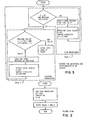
- FIG. 2 there is shown a global flow for a network of processors.
- Each processor will have its clocks and intervals initialized to predetermined values after which two tasks are invoked which run perpetually.
- the first task termed a “time manager/monitor” is triggered if its clock has attained the current value of et, in which case it signs and broadcasts a message "the time is et" to all other nodes in the network and updates its local clock, interval number, and value of et.
- the other task, task 2, denominated a "message manager/monitor” is triggered by the receipt of a message. It then tests the validity of the message. If it is valid, the processor signs the message and passes it on to all other processors. It also updates its local clock, interval number, and value of et. This flow is detailed in FIG. 3.
- Resynchronization is achieved by creating new clocks and, after a certain period of overlapping existence, discarding the old clocks. The difference between the reading of the new clock and that of the old is always non-negative and never exceeds the fixed amount adj.
- a valid message may arrive at any time within an interval that has size several multiples of dmax, the correct processors will be synchronized to be within dmin, which is less than dmax, at the beginning of each resynchronization period. If the message provides "the time is t" arrives "early”, it is said to be valid, even if it arrives sxdmax before t, where s is the number of signatures. To appreciate the necessity for this aspect, suppose dmax is .1 seconds. Further, suppose that processor i receives a message with three signatures stating "the time is 11:00". Lastly, suppose this message arrives .3 seconds before 11:00. It follows, that processor i according to the invention, will consider this message valid.
- processor j is correct and is running .1 seconds slower than processor i. Moreover, if processor j receives processor i's message almost instantaneously, processor j will receive the message roughly .4 seconds before 11:00 on its clock. Since the message now has four signatures, processor j will also consider it valid. This illustration can be extended to a circumstance in which a fixed bound on the interval in which a message is considered valid that is independent of the number of signatures on the message will simply not work.
- dmax .11 seconds
- dmin .1 seconds
- adj .llf seconds. Note here that dmax is roughly equal to dmin. Lastly, dmin and dmax can both be made smaller by giving the synchronization process high priority in the scheduling of the operating system of each local processor.
- the enumerated tasks 1 and 2 as shown in FIGS. 2 and 3, are expressible in a high level programming language such as PL/I.
- PL/I is fully described in IBM Systems Reference Library Manual S/360-29, catalog no. GC28-8201-4, 5th Edition, copyrighted December 1972.
- a representation of tasks 1 and 2 written in a PL/I subset is included in this specification respectively as counterpart tables 1 and 2.
- the instructions occupy the left side of the page with the right side containing comment fields as required.
- the inclusions of these executable monitors is set forth in order to illustrate, by way of example, the ease with which the method of this invention may be practiced by those possessing skill in this art.
- Other high level language representations such as PASCAL or ADA might otherwise with equal ease and facility have been drawn.
Landscapes
- Engineering & Computer Science (AREA)
- Theoretical Computer Science (AREA)
- Physics & Mathematics (AREA)
- General Engineering & Computer Science (AREA)
- General Physics & Mathematics (AREA)
- Multi Processors (AREA)
Applications Claiming Priority (4)
| Application Number | Priority Date | Filing Date | Title |
|---|---|---|---|
| US06/528,282 US4531185A (en) | 1983-08-31 | 1983-08-31 | Centralized synchronization of clocks |
| US528282 | 1983-08-31 | ||
| US560082 | 1983-12-09 | ||
| US06/560,082 US4584643A (en) | 1983-08-31 | 1983-12-09 | Decentralized synchronization of clocks |
Publications (3)
| Publication Number | Publication Date |
|---|---|
| EP0135764A2 true EP0135764A2 (de) | 1985-04-03 |
| EP0135764A3 EP0135764A3 (en) | 1990-07-18 |
| EP0135764B1 EP0135764B1 (de) | 1993-03-31 |
Family
ID=27062676
Family Applications (1)
| Application Number | Title | Priority Date | Filing Date |
|---|---|---|---|
| EP84109532A Expired - Lifetime EP0135764B1 (de) | 1983-08-31 | 1984-08-10 | Taktsynchronisation in einem verteilten Rechnernetz |
Country Status (3)
| Country | Link |
|---|---|
| US (1) | US4584643A (de) |
| EP (1) | EP0135764B1 (de) |
| DE (1) | DE3486116T2 (de) |
Cited By (7)
| Publication number | Priority date | Publication date | Assignee | Title |
|---|---|---|---|---|
| GB2162023A (en) * | 1984-06-22 | 1986-01-22 | Austria Mikrosysteme Int | Loosely coupled distributed computer system |
| EP0365819A3 (de) * | 1988-10-25 | 1991-09-18 | International Business Machines Corporation | Synchronisierte fehlertolerante Uhren für Multiprozessorsysteme |
| BE1004115A5 (fr) * | 1989-02-24 | 1992-09-29 | Rosemount Inc | Synchronisation de temps de reseaux de commande. |
| GB2271251A (en) * | 1992-10-01 | 1994-04-06 | Digital Equipment Int | Timer synchronisation in data communications networks |
| GB2274046A (en) * | 1992-12-21 | 1994-07-06 | Otis Elevator Co | Media access protocol |
| GB2304506A (en) * | 1992-12-21 | 1997-03-19 | Otis Elevator Co | Media access protocol |
| EP1690166A4 (de) * | 2003-11-03 | 2009-11-04 | Network Appliance Inc | System und verfahren für ein aufzeichnungs-retentionsdatum in einem einmalbeschreibbaren und mehrmals lesbaren speichersystem |
Families Citing this family (28)
| Publication number | Priority date | Publication date | Assignee | Title |
|---|---|---|---|---|
| JPH0610802B2 (ja) * | 1986-06-04 | 1994-02-09 | 株式会社日立製作所 | 分散処理システムの入力メッセージ整合化方法 |
| US4920485A (en) * | 1986-09-02 | 1990-04-24 | Amdahl Corporation | Method and apparatus for arbitration and serialization in a multiprocessor system |
| US4965719A (en) * | 1988-02-16 | 1990-10-23 | International Business Machines Corporation | Method for lock management, page coherency, and asynchronous writing of changed pages to shared external store in a distributed computing system |
| US5253252A (en) * | 1989-01-10 | 1993-10-12 | The Foxboro Company | Token device for distributed time scheduling in a data processing system |
| SE466123B (sv) * | 1989-04-25 | 1991-12-16 | Kvaser Consultant Ab | Anordning foer att synkonisera data i ett datoriserat system, som innefattar en gemensam seriell datakommunikationskanal |
| CA2075048C (en) * | 1990-01-30 | 1999-08-17 | Gregory A. Pascucci | Networked facilities management system |
| US5978831A (en) * | 1991-03-07 | 1999-11-02 | Lucent Technologies Inc. | Synchronous multiprocessor using tasks directly proportional in size to the individual processors rates |
| US5319680A (en) * | 1991-09-03 | 1994-06-07 | The Whitaker Corporation | Phase locked loop synchronization system for use in data communications |
| DE59108895D1 (de) * | 1991-12-18 | 1998-01-08 | Siemens Ag | Verfahren zur Uhrzeitführung in Computernetzen |
| US5689688A (en) * | 1993-11-16 | 1997-11-18 | International Business Machines Corporation | Probabilistic anonymous clock synchronization method and apparatus for synchronizing a local time scale with a reference time scale |
| US5530846A (en) * | 1993-12-29 | 1996-06-25 | International Business Machines Corporation | System for decoupling clock amortization from clock synchronization |
| US5535217A (en) * | 1994-12-20 | 1996-07-09 | International Business Machines Corporation | Method and apparatus for probabilistic clock synchronization with interval arithmetic |
| US5701446A (en) * | 1995-06-09 | 1997-12-23 | International Business Machines Corporation | Method for fine grain adjustments to system time in computer systems |
| US5790805A (en) * | 1996-04-23 | 1998-08-04 | Ncr Corporation | Distributed timer synchronization |
| DE19620622A1 (de) * | 1996-05-22 | 1997-11-27 | Siemens Ag | Verfahren zur Synchronisation von Programmen auf unterschiedlichen Computern eines Verbundes |
| US6125368A (en) * | 1997-02-28 | 2000-09-26 | Oracle Corporation | Fault-tolerant timestamp generation for multi-node parallel databases |
| US5964846A (en) * | 1997-07-07 | 1999-10-12 | International Business Machines Corporation | System and method for mapping processor clock values in a multiprocessor system |
| US6006206A (en) * | 1997-09-08 | 1999-12-21 | Reuters Limited | Data health monitor for financial information communications networks |
| EP1052793B8 (de) * | 1999-05-11 | 2009-04-01 | Canon Kabushiki Kaisha | Verfahren und Vorrichtung zur Synchronisierung zwischen zwei Netzwerken |
| US6742048B1 (en) * | 2000-07-10 | 2004-05-25 | Advanced Micro Devices, Inc. | Multilevel network for distributing trusted time and delegating levels of trust regarding timekeeping |
| AUPQ896300A0 (en) * | 2000-07-24 | 2000-08-17 | Nec Australia Pty Ltd | A clock synchronisation method for usb sink devices |
| GB2373400B (en) * | 2001-01-17 | 2003-04-09 | Marconi Comm Ltd | Real time clocks in communications networks |
| US7483403B2 (en) * | 2002-01-10 | 2009-01-27 | Robert Bosch Gmbh | Protocol for reliable, self-organizing, low-power wireless network for security and building automation systems |
| US20070077926A1 (en) * | 2005-09-30 | 2007-04-05 | Arati Manjeshwar | Method and system to reconfigure a network to improve network lifetime using most reliable communication links |
| AT501510B1 (de) * | 2004-07-19 | 2009-05-15 | Univ Wien Tech | Dezentrale fehlertolerante taktgenerierung in vlsi chips |
| EP1894116A1 (de) * | 2005-06-10 | 2008-03-05 | Freescale Semiconductor, Inc. | Verfahren und einrichtung zur rahmensynchronisation |
| WO2006131143A1 (en) * | 2005-06-10 | 2006-12-14 | Freescale Semiconductor, Inc. | Device and method for media access control |
| US20120185444A1 (en) * | 2011-01-14 | 2012-07-19 | Sparkes Andrew | Clock Monitoring in a Data-Retention Storage System |
Family Cites Families (7)
| Publication number | Priority date | Publication date | Assignee | Title |
|---|---|---|---|---|
| DE1250659B (de) * | 1964-04-06 | 1967-09-21 | International Business Machines Corporation, Armonk, NY (V St A) | Mikroprogrammgesteuerte Datenverarbeitungsanlage |
| FR1587572A (de) * | 1968-10-25 | 1970-03-20 | ||
| SE347826B (de) * | 1970-11-20 | 1972-08-14 | Ericsson Telefon Ab L M | |
| US3940743A (en) * | 1973-11-05 | 1976-02-24 | Digital Equipment Corporation | Interconnecting unit for independently operable data processing systems |
| US3932847A (en) * | 1973-11-06 | 1976-01-13 | International Business Machines Corporation | Time-of-day clock synchronization among multiple processing units |
| US4021784A (en) * | 1976-03-12 | 1977-05-03 | Sperry Rand Corporation | Clock synchronization system |
| US4223380A (en) * | 1978-04-06 | 1980-09-16 | Ncr Corporation | Distributed multiprocessor communication system |
-
1983
- 1983-12-09 US US06/560,082 patent/US4584643A/en not_active Expired - Lifetime
-
1984
- 1984-08-10 EP EP84109532A patent/EP0135764B1/de not_active Expired - Lifetime
- 1984-08-10 DE DE84109532T patent/DE3486116T2/de not_active Expired - Fee Related
Cited By (10)
| Publication number | Priority date | Publication date | Assignee | Title |
|---|---|---|---|---|
| GB2162023A (en) * | 1984-06-22 | 1986-01-22 | Austria Mikrosysteme Int | Loosely coupled distributed computer system |
| EP0365819A3 (de) * | 1988-10-25 | 1991-09-18 | International Business Machines Corporation | Synchronisierte fehlertolerante Uhren für Multiprozessorsysteme |
| BE1004115A5 (fr) * | 1989-02-24 | 1992-09-29 | Rosemount Inc | Synchronisation de temps de reseaux de commande. |
| GB2271251A (en) * | 1992-10-01 | 1994-04-06 | Digital Equipment Int | Timer synchronisation in data communications networks |
| GB2271251B (en) * | 1992-10-01 | 1996-08-14 | Digital Equipment Int | Timer synchronisation system |
| GB2274046A (en) * | 1992-12-21 | 1994-07-06 | Otis Elevator Co | Media access protocol |
| GB2304506A (en) * | 1992-12-21 | 1997-03-19 | Otis Elevator Co | Media access protocol |
| GB2274046B (en) * | 1992-12-21 | 1997-06-04 | Otis Elevator Co | Media access protocol |
| GB2304506B (en) * | 1992-12-21 | 1997-06-04 | Otis Elevator Co | Media access protocol |
| EP1690166A4 (de) * | 2003-11-03 | 2009-11-04 | Network Appliance Inc | System und verfahren für ein aufzeichnungs-retentionsdatum in einem einmalbeschreibbaren und mehrmals lesbaren speichersystem |
Also Published As
| Publication number | Publication date |
|---|---|
| DE3486116D1 (de) | 1993-05-06 |
| EP0135764B1 (de) | 1993-03-31 |
| EP0135764A3 (en) | 1990-07-18 |
| DE3486116T2 (de) | 1993-10-07 |
| US4584643A (en) | 1986-04-22 |
Similar Documents
| Publication | Publication Date | Title |
|---|---|---|
| EP0135764B1 (de) | Taktsynchronisation in einem verteilten Rechnernetz | |
| US4531185A (en) | Centralized synchronization of clocks | |
| Halpern et al. | Fault-tolerant clock synchronization | |
| Dolev et al. | Dynamic fault-tolerant clock synchronization | |
| EP0178473B1 (de) | Verfahren zum Rundsenden von Nachrichten in ein verteiltes Rechnernetz | |
| US4937741A (en) | Synchronization of fault-tolerant parallel processing systems | |
| Simons | An overview of clock synchronization | |
| Lamport et al. | Byzantine clock synchronization | |
| Pfeifer et al. | Formal verification for time-triggered clock synchronization | |
| WO1984003158A1 (en) | A method for achieving multiple processor agreement optimized for no faults | |
| Babaoglu et al. | Understanding non-blocking atomic commitment | |
| US6981063B1 (en) | Method for time synchronization of a computer network, and computer network with time synchronization | |
| JPH05307424A (ja) | 計算機網でのクロックタイム制御方法 | |
| Ferreira et al. | Combining operational flexibility and dependability in FTT-CAN | |
| US6363496B1 (en) | Apparatus and method for reducing duration of timeout periods in fault-tolerant distributed computer systems | |
| US6801951B1 (en) | System and method for fault-tolerant clock synchronization using interactive convergence | |
| Ferreira et al. | Achieving fault tolerance in FTT-CAN | |
| Thambidurai et al. | Clock synchronization in MAFT | |
| Kopetz | Fault containment and error detection in TTP/C and FlexRay | |
| de Azevedo et al. | Fault-tolerant clock synchronization of large multicomputers via multistep interactive convergence | |
| Veríssimo | On the role of time in distributed systems | |
| Alstein et al. | Hard real-time reliable multicast in the DEDOS system | |
| Lonn et al. | Synchronisation in safety-critical distributed control Systems | |
| Delporte-Gallet et al. | Real-time fault-tolerant atomic broadcast | |
| Chakravarthi et al. | A fine-grain clock synchronization mechanism for QoS based communication on myrinet |
Legal Events
| Date | Code | Title | Description |
|---|---|---|---|
| PUAI | Public reference made under article 153(3) epc to a published international application that has entered the european phase |
Free format text: ORIGINAL CODE: 0009012 |
|
| 17P | Request for examination filed |
Effective date: 19841123 |
|
| AK | Designated contracting states |
Designated state(s): DE FR GB |
|
| PUAL | Search report despatched |
Free format text: ORIGINAL CODE: 0009013 |
|
| AK | Designated contracting states |
Kind code of ref document: A3 Designated state(s): DE FR GB |
|
| 17Q | First examination report despatched |
Effective date: 19911202 |
|
| GRAA | (expected) grant |
Free format text: ORIGINAL CODE: 0009210 |
|
| AK | Designated contracting states |
Kind code of ref document: B1 Designated state(s): DE FR GB |
|
| REF | Corresponds to: |
Ref document number: 3486116 Country of ref document: DE Date of ref document: 19930506 |
|
| ET | Fr: translation filed | ||
| PLBE | No opposition filed within time limit |
Free format text: ORIGINAL CODE: 0009261 |
|
| STAA | Information on the status of an ep patent application or granted ep patent |
Free format text: STATUS: NO OPPOSITION FILED WITHIN TIME LIMIT |
|
| 26N | No opposition filed | ||
| PGFP | Annual fee paid to national office [announced via postgrant information from national office to epo] |
Ref country code: GB Payment date: 19950726 Year of fee payment: 12 |
|
| PGFP | Annual fee paid to national office [announced via postgrant information from national office to epo] |
Ref country code: FR Payment date: 19950807 Year of fee payment: 12 |
|
| PGFP | Annual fee paid to national office [announced via postgrant information from national office to epo] |
Ref country code: DE Payment date: 19950821 Year of fee payment: 12 |
|
| PG25 | Lapsed in a contracting state [announced via postgrant information from national office to epo] |
Ref country code: GB Effective date: 19960810 |
|
| GBPC | Gb: european patent ceased through non-payment of renewal fee |
Effective date: 19960810 |
|
| PG25 | Lapsed in a contracting state [announced via postgrant information from national office to epo] |
Ref country code: FR Effective date: 19970430 |
|
| PG25 | Lapsed in a contracting state [announced via postgrant information from national office to epo] |
Ref country code: DE Effective date: 19970501 |
|
| REG | Reference to a national code |
Ref country code: FR Ref legal event code: ST |