EP0135802B1 - Masse à mouler thermoplastique - Google Patents
Masse à mouler thermoplastique Download PDFInfo
- Publication number
- EP0135802B1 EP0135802B1 EP84110006A EP84110006A EP0135802B1 EP 0135802 B1 EP0135802 B1 EP 0135802B1 EP 84110006 A EP84110006 A EP 84110006A EP 84110006 A EP84110006 A EP 84110006A EP 0135802 B1 EP0135802 B1 EP 0135802B1
- Authority
- EP
- European Patent Office
- Prior art keywords
- weight
- copolymer
- proportion
- carbon atoms
- monomer
- Prior art date
- Legal status (The legal status is an assumption and is not a legal conclusion. Google has not performed a legal analysis and makes no representation as to the accuracy of the status listed.)
- Expired
Links
Classifications
-
- C—CHEMISTRY; METALLURGY
- C08—ORGANIC MACROMOLECULAR COMPOUNDS; THEIR PREPARATION OR CHEMICAL WORKING-UP; COMPOSITIONS BASED THEREON
- C08L—COMPOSITIONS OF MACROMOLECULAR COMPOUNDS
- C08L69/00—Compositions of polycarbonates; Compositions of derivatives of polycarbonates
Definitions
- the mixtures known from (1) have branched polycarbonates.
- the molding compositions produced therefrom have an improved processing range compared to molding compositions which contain unbranched polycarbonates.
- the known molding compositions still have disadvantages with regard to the weld line strength and demolding force.
- the task was to determine the weld line strength and the demolding force of moldings made from mixtures of polycarbonate and copolymers, for. B. ABS, ASA and AES to improve.
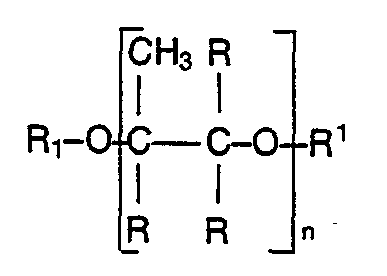
- the impact-modified acrylonitrile-styrene and polycarbonate mixtures have linear homopolymers of a certain structure and a certain molecular weight in an amount of 0.1 to 3, preferably 0.3 to 1.5,% by weight, based on the mixture of polycarbonate and the impact modified copolymer are added.
- the molding composition contains components A, B and D and optionally additives C;
- the molding composition according to the invention preferably consists of A, B and D.
- Component A Polycarbonates A in the sense of the molding composition according to the invention are to be understood as meaning aromatic polycarbonates based on homopolycarbonates and copolycarbonates.
- suitable bisphenols are: dihydroxydiphenyls, bis (hydroxyphenyl) alkanes, bis (hydroxyphenyl) ethers.
- Polycarbonates based on 2,2-bis (4-hydroxyphenyl) propane are particularly preferred.
- Component A uses 10 to 90% by weight, in particular 30 to 80% by weight, based in each case on the molding composition of A and B.
- thermoplastic molding composition according to the present invention contains component B in a proportion of 10 to 90% by weight, in particular in a proportion of 70 to 20% by weight, in each case based on A + B.
- the structure of component B of the molding composition is in three parts.
- Component B of the molding composition according to the invention has as component b i , an elastomer, in a proportion of 1 to 40% by weight, in particular 10 to 30% by weight, in each case based on B.
- a copolymer b 2 is grafted onto this elastomer, ie a rubber which has a glass transition temperature below 0 ° C., in particular below ⁇ 30 ° C., and has a proportion of 5 to 40% by weight, in particular 5 to 30% by weight .%, each related to B.
- the sum of b 1 and b 2 sometimes also referred to in the text below as a graft copolymer, that is to say as the result of the grafting, does not yet constitute the entire component B.
- Component B contains, in addition to components b 1 and b 2 , at least one copolymer b 3 (hard matrix) in a proportion of 20 to 94% by weight, in particular 40 to 85% by weight, in each case based on B.
- This copolymer constitutes together with component A is a common hard matrix of the molding compound in which the graft copolymer is evenly distributed.
- the elastomer b 1 can be composed of (co) polymers of conjugated dienes having 4 to 5 carbon atoms, in particular 1,3-butadiene and isoprene; preference is given to using butadiene alone.
- These esters of acrylic or methacrylic acid which have 1 to 8 carbon atoms in the alkyl radical are also suitable. Of these esters, butyl acrylate or ethylhexyl acrylate is preferred.
- Elastomers which are based on EPDM rubbers, ie a terpolymer of ethylene, propylene and a non-conjugated diene, are also suitable.
- Preferred non-conjugated dienes for the construction of these terpolymers are dicyclopentadiene-1,4-hexadiene and 5-ethylidene borbones, tricyclopentadiene, -heptadiene, -octadiene, etc.
- the ethylene / propylene weight ratio in these terpolymers is preferably in the range from 75 to 25 to 40:60.
- the diene is incorporated in the terpolymer in such quantities and in such a form that iodine numbers of 2 to 30 result. This corresponds to about 1 to 15 CC double bonds per 1000 carbon atoms.
- the monomer units can be arranged statistically or in blocks.
- EPDM rubbers are known to the person skilled in the art. Such rubbers, as well as the above-mentioned butadiene rubbers and acrylate rubbers, are also commercially available.
- the ML 4 elasticities at 100 ° C are in the range from 20 to 90 for the EPDM rubbers mentioned.
- copolymers in particular copolymers of conjugated dienes with alkyl esters, and also copolymers of dienes with vinylaromatic monomers, these vinylaromatic monomers having 6 to 12 carbon atoms, can also be used as elastomers b i .
- Styrene and its allyl derivatives, such as p-methylstyrene and a-methylstyrene, are used in particular as vinylaromatic monomers for the rubbers mentioned.
- copolymers of butadiene and styrene of conventional composition 70/30 are used in the amounts known to the person skilled in the art.
- the rubbers based on conjugated dienes are very preferably used.
- copolymers of conjugated dienes and of acrylic acid esters or only acrylate rubbers are used.
- terpolymers, such as EPDM rubbers, as a graft base also provides more weather-resistant products.
- the elastomeric component b i can optionally be crosslinked, ie conventional polyfunctional monomers such as divinyl, diacryl and diallyl compounds are used in the amounts known to the person skilled in the art in the production thereof.
- the acrylate rubbers are preferably produced using crosslinking agents, such as butanediol diacrylate and in particular tricyclodecenyl acrylate.
- the copolymer b 2 ie the graft shell, is composed of at least one monomer from two different groups.
- the first group is vinyl aromatic monomers, in particular styrene and the alkyl derivatives, of which the a-methylstyrene and p-methylstyrene are emphasized.
- Styrene is particularly preferably used.
- mixtures of styrene and the allyl derivatives or exclusively the a-methylstyrene and in particular the p-methylstyrene are used.
- the second component for the construction of the copolymer b 2 is a (non-aromatic, ethylenically unsaturated monomer.
- Such (non-aromatic) ethylenically unsaturated monomers are suitable, in particular the derivatives of acrylic acid and methacrylic acid.
- the esters of acrylic acid and methacrylic acid may also be mentioned 1 to 8 carbon atoms in the alkyl radical and the acrylonitrile and the methacrylonitrile.
- the (meth) acrylonitrile is preferably used.
- the above-mentioned vinyl aromatic monomers and the non-aromatic ethylenically unsaturated monomers are used in a weight ratio of 60:40 to 90:10
- the result of the preparation of the copolymer in the presence of the elastomer b i is a graft copolymer in which the copolymer is grafted onto the elastomer within limits known to the person skilled in the art.
- the graft shell can optionally be produced in two stages, with 5 in the first stage of the grafting up to 50% by weight, preferably 20 to 40% by weight of only the vinyl aromatic monomer and in the second stage the remaining amount of the vinyl aromatic monomer and the total amount of the (non-aromatic) ethylenically unsaturated monomer, ie 30 to 100% by weight, can be used.
- the copolymer b 2 regardless of whether it is prepared in one or two stages, should have 90 to 60% by weight of vinyl aromatic monomers and 40 to 10% by weight (non-aromatic) ethylenically unsaturated monomers, in each case based on b 2 .
- the graft shell is preferably composed of 85 to 60% by weight of styrene and 15 to 40% by weight of AN.
- Both the elastomer and the graft copolymer are preferably prepared in emulsion and can be subjected to particle enlargement by the usual methods.
- the graft copolymer should have particles in the range from 0.2 to 1.0 ⁇ m (d so -value of the integral mass distribution).
- Component b 3 is a non-elastomeric hard component which is composed of at least one vinylaromatic monomer and at least one (nonaromatic) ethylenically unsaturated monomer.
- Suitable vinyl aromatic monomers which are used in an amount of 50 to 90% by weight, in particular 65 to 80% by weight, based on b 3 , are: styrene and its derivatives, in particular the alkyl derivatives, such as a-methylstyrene or p-methylstyrene. Styrene and, if more thermally stable molding compositions are desired, the alkyl derivatives are preferably used.
- the non-aromatic ethylenically unsaturated monomer is used in an amount of 10 to 50% by weight, in particular 20 to 35% by weight, based on b 3 .
- Suitable monomers are the derivatives of acrylic and methacrylic acid, in particular the esters of alcohols having 1 to 8 carbon atoms in the alkyl radical, and the nitriles. Of the nitriles, acrylonitrile and methacrylonitrile are preferred.
- the graft copolymer (b i + b 2 ) to be used according to the invention can be obtained commercially or it can be prepared, for example, by the method described in DE-PS 1 260135.
- the graft base, the elastomer b 1 is first prepared by the rubber monomer (s) and the polyfunctional, crosslinking monomers (optionally together with other comonomers) in an aqueous emulsion in a manner known per se at temperatures between 20 and 100 ° C, preferably between 50 and 80 ° C are polymerized.
- the usual emulsifiers such as alkali salts of alkyl or alkylarylsulfonic acids, alkyl sulfates, fatty alcohol sulfonates, salts of higher fatty acids with 10 to 30 carbon atoms or resin soaps can be used.
- the sodium salts of alkyl sulfonates or fatty acids having 10 to 18 carbon atoms are preferably used. It is expedient to use the emulsifiers in amounts of 0.5 to 5% by weight, in particular 0.8 to 2% by weight, based on the monomers used in the preparation of the graft base b i . In general, a water to monomer ratio of 2: 1 to 0.7: 1 is used.
- the usual persulfates, such as, for example, potassium persulfate, are used in particular as polymerization initiators, but redox systems can also be used. The initiators are generally used in amounts of 0.1 to 1% by weight, based on the monomers used in the preparation of the elastomer b 1 .
- the usual buffer substances by means of which pH values are preferably set from 6 to 9, can be used as further polymerization auxiliaries.
- the precise polymerization conditions, in particular the type, dosage, and amount of the emulsifier are determined within the ranges given above in detail so that the resulting latex of the optionally crosslinked rubber polymer a d so value in the range of 0.2 to 1.0 microns , preferably in the range of 0.25 to 0.7 11 m.
- Distribution 2 is in the range from 2 to 0.5, in particular 1.5 to 1.0.
- the average particle sizes mentioned apply both to the elastomer (b 1 ) and to the graft copolymer (b 1 + b 2 ).
- graft copolymer b1 + b2 graft copolymer b1 + b2
- grafting is then carried out in the next step in the presence of the latex b i thus obtained.
- this will be Grafting in one stage (e.g. for diene rubbers, EPDM or diene / styrene rubbers) or in 2 stages, e.g. B. preferably carried out for acrylate rubbers.
- a vinyl aromatic monomer (b 2 a,) having up to 12 carbon atoms is first polymerized to produce the graft shell.
- Examples of such monomers are styrene, a-methylstyrene and alkylated styrenes, such as p-methylstyrene and tert-butylstyrene. Styrene, a-methylstyrene and p-methylstyrene are particularly preferably used. It is advantageous to use this graft copolymerization of styrene (b 2 a 1 ) on the graft base, for. B. cross-linked acrylic ester polymer (b 1 ) again in aqueous emulsion under the usual conditions listed above.
- the graft copolymerization can expediently take place in the same system as the emulsion polymerization for the preparation of the graft base (b i ), it being possible, if necessary, to add further emulsifier and initiator.
- the styrene to be grafted on can be added to the reaction mixture all at once, batchwise in several stages or, preferably, continuously during the polymerization.
- the graft copolymerization of the styrene in the presence of the z. B. crosslinked acrylic ester polymer is carried out in such a way that a degree of grafting of 2.5 to 25% by weight, preferably 10 to 20% by weight, results in the graft copolymer (b1 + b2).
- a second stage the graft copolymerization with a monomer mixture (b 2 a2) of a vinyl aromatic monomer and a non-aromatic ethylenically unsaturated monomer, the monomers already used in the first graft stage, in particular styrene, a-methylstyrene and p-methylstyrene.
- a monomer mixture (b 2 a2) of a vinyl aromatic monomer and a non-aromatic ethylenically unsaturated monomer the monomers already used in the first graft stage, in particular styrene, a-methylstyrene and p-methylstyrene.
- copolymerizable, ethylenically unsaturated monomers are acrylonitrile, (meth) -acrylate with 1-4 carbon atoms in the alkyl radical, acrylic acid, maleic anhydride, acrylamide and / or vinyl methyl ether.
- Acrylonitrile, ethyl acrylate, methyl methacrylate and mixtures thereof are particularly preferred.
- Particularly preferred monomer mixtures are styrene and acrylonitrile, a-methylstyrene or p-methylstyrene and acrylonitrile and styrene, acrylonitrile and methyl methacrylate.
- the second step of the graft copolymerization is also expediently carried out in the same system, it being possible, if necessary, to add further emulsifier and initiator.
- the preferably grafted-on monomer mixture of, for example, styrene and acrylonitrile can be added to the reaction mixture all at once, batchwise in several stages or preferably continuously during the polymerization.
- the graft copolymerization of the mixture of styrene and acrylonitrile in the presence of, for example, crosslinked acrylic ester polymer is carried out in such a way that a degree of grafting of 10 to 45% by weight, preferably 15-40% by weight, results in the graft copolymer (B).
- the copolymer B contains as a further component (b 3 ) a hard component composed of one or more copolymers of styrene and / or a-methylstyrene with acrylonitrile.
- the acrylonitrile content in these copolymers of the hard component (b 3 ) should be 20 to 40% by weight, based on the respective copolymer of the hard component.
- This hard component (b 3 ) also includes the free, non-grafted styrene / acrylonitrile copolymers formed in the graft copolymerization for the preparation of (b 1 + b 2 ).
- This additional, separately produced hard component (b 3 ) can be a styrene / acrylonitrile copolymer, an a-methylstyrene / acrylonitrile copolymer, a styrene / methyl methacrylate copolymer, a styrene / maleic anhydride copolymer or an a-methylstyrene / Act styrene / acrylonitrile, a styrene / acrylonitrile / methyl methacrylate, a styrene / acrylonitrile / maleic anhydride or a styrene / acrylonitrile / acrylic acid terpolymer, or an a-methylstyrene / styrene / acrylonitrile terpolymer.
- copolymers can be used individually or as a mixture with one another for the hard component, so that the additional, separately produced hard component (b 3 ) of the mixtures according to the invention is, for example, a mixture of a styrene / acrylonitrile copolymer and an a-methylstyrene / Acrylonitrile copolymer can act.
- the hard component (b 3 ) of the compositions according to the invention consists of a mixture of a styrene / acrylonitrile copolymer and an a-methylstyrene / acrylonitrile copolymer
- the acrylonitrile content of the two copolymers should at most not exceed 10% by weight %, preferably not more than 5% by weight, based on the copolymer, differ from one another.
- the hard component (b 3 ) of the compositions according to the invention can, however, also consist only of a single styrene / acrylonitrile copolymer, namely when the same monomer mixture of styrene and .prepared for the preparation of the graft copolymers and for the preparation of the additional, separately produced hard components Acrylonitrile is assumed.
- the additional, separately produced hard component (b 3 ) can be obtained by the conventional methods.
- the copolymerization of the styrene and / or a-methylstyrene with the acrylonitrile can be carried out in bulk, solution, suspension or aqueous emulsion.
- the hard component (b 3 ) preferably has a viscosity number from 40 to 100, in particular from 50 to 80.
- the molding compositions according to the invention optionally contain, as further component (C), additives or mixtures thereof, as are customary for ABS, ASA and AES polymers and polycarbonates.
- additives are: fillers, other polymers, dyes, pigments, antistatic agents, antioxidants, flame retardants and lubricants.
- the additives are used in customary and effective amounts, preferably in amounts of 0.1 to a total of about 30% by weight, based on the mixture of (A + B + C).
- component D of the molding compositions according to the invention homopolymers of ethylene oxide or propylene oxide, which may optionally be substituted in the main chain with fluorine or Cl atoms, are suitable.
- the polyethers mentioned carry OH groups at the end, but can also be etherified with the customary alcohols, for example with aliphatic or cycloaliphatic, straight-chain or branched alcohols with, for. B. 1 to 12 carbon atoms.
- Preferred, cheap alcohols which are used in technical. Syntheses occur, e.g. B. CH 3 OH, C 2 H s OH, the propanols, butenols and 2-ethylhexanol.
- the polyethers mentioned can also be used in a mixture with one another, as a result of which different degrees of hydrophilicity can be set.
- the homopolymers are prepared in a manner known per se (N. Schönfeldt, interfacially active ethylene oxide adducts, Stuttgart, 1976, p. 53) by polymerization.
- component D into components A or B of the molding composition
- the incorporation of component D into components A or B of the molding composition can be carried out in all ways known to the person skilled in the art.
- the molding composition according to the invention can be produced by mixing components A, B, D and the additives by known processes. Known mixing units can be used for this. Components (A), (B), (C) and (D) are preferably mixed by extruding, kneading or rolling the components together.
- Individual components of the molding composition can also be premixed into partial mixtures and these partial mixtures intimately, e.g. can be mixed in kneaders or while heating a partial mixture in extruders.
- component A and the hard matrix of component B can be mixed; in an extruder in a melt of this mixture, the graft copolymer (b 1 + b 2 ) and component C, optionally with the additives D, z. B. premixed dry, introduced.
- graft copolymerization products [component b 1 + b 2] obtained in aqueous dispersion or to mix them directly as a dispersion with the polycarbonate A, the copolymer b 3 and the components C and D, where then the graft copolymers are completely dried during the mixing.
- the molding compositions according to the invention can be processed by the known methods of thermoplastic processing, that is, for. B. by extrusion, injection molding, calendering, blow molding, pressing or sintering; from the according to the invention are particularly preferred Molding compounds produced in accordance with the process are produced by injection molding for automobile construction.
- a polycarbonate based on 2,2-bis (4-hydroxiphenyl) propane with an intrinsic viscosity of 0.52 [dl / g] (measured at 25 ° C. in methylene chloride) was used as component A).
- the following graft copolymer was used as component B-1): 45% by weight, based on B-1 graft copolymer (component b i b 2 according to claim), in which 60 parts by weight of a polybutadiene rubber (component b 1 according to claim) with an average particle size (d thus the integral mass distribution) of 0.3 ⁇ m 40 parts by weight of a mixture of styrene / acrylonitrile (component b 2 according to claim) in a weight ratio of 70:30 and with 55% by weight, based on B-1, of a styrene / Acrylonitrile copolymers (component b 3 according to claim) with an acrylonitrile content of 35% by weight and a viscosity number of 80 ml / g and an additional 0.2 parts of a sterically hindered phenol (Rütenol®) is mixed.
- component B-1 graft copolymer
- component b 1 polybut
- graft copolymer was used as component B-2); 50% by weight, based on B-2, of graft copolymer in which 60 parts by weight of a partially crosslinked polybutyl acrylate rubber (b 1 ) with an average particle size (d so value of the integral mass distribution) of 0.4 ⁇ m 13 parts by weight of styrene (b 2 a 1 ) and 27 parts by weight (b 2 a 2 ) of a mixture of styrene / acrylonitrile in a weight ratio of 70:30.
- b 1 partially crosslinked polybutyl acrylate rubber
- b 2 a 1 an average particle size (d so value of the integral mass distribution) of 0.4 ⁇ m 13 parts by weight of styrene (b 2 a 1 ) and 27 parts by weight (b 2 a 2 ) of a mixture of styrene / acrylonitrile in a weight ratio of 70:30.
- Pluriols were used as component D).
- the name is followed by a letter and a number for identification.
- the letter E means that it is a polyethylene oxide polymer, P means a polypropylene oxide polymer.
- the number denotes the average molecular weight.
Landscapes
- Chemical & Material Sciences (AREA)
- Health & Medical Sciences (AREA)
- Chemical Kinetics & Catalysis (AREA)
- Medicinal Chemistry (AREA)
- Polymers & Plastics (AREA)
- Organic Chemistry (AREA)
- Compositions Of Macromolecular Compounds (AREA)
Claims (9)




Applications Claiming Priority (2)
| Application Number | Priority Date | Filing Date | Title |
|---|---|---|---|
| DE3331155 | 1983-08-30 | ||
| DE19833331155 DE3331155A1 (de) | 1983-08-30 | 1983-08-30 | Thermoplastische formmasse |
Publications (3)
| Publication Number | Publication Date |
|---|---|
| EP0135802A2 EP0135802A2 (fr) | 1985-04-03 |
| EP0135802A3 EP0135802A3 (en) | 1986-10-22 |
| EP0135802B1 true EP0135802B1 (fr) | 1988-11-17 |
Family
ID=6207742
Family Applications (1)
| Application Number | Title | Priority Date | Filing Date |
|---|---|---|---|
| EP84110006A Expired EP0135802B1 (fr) | 1983-08-30 | 1984-08-22 | Masse à mouler thermoplastique |
Country Status (2)
| Country | Link |
|---|---|
| EP (1) | EP0135802B1 (fr) |
| DE (2) | DE3331155A1 (fr) |
Families Citing this family (10)
| Publication number | Priority date | Publication date | Assignee | Title |
|---|---|---|---|---|
| US4904710A (en) * | 1985-10-31 | 1990-02-27 | The Dow Chemical Company | Gamma radiation resistant carbonate polymer compositions |
| ES2031948T3 (es) * | 1987-04-17 | 1993-01-01 | Bayer Ag | Masas de moldeo de policarbonato antiestaticas ignifugas. |
| DE3735754A1 (de) * | 1987-10-22 | 1989-05-03 | Basf Ag | Thermoplastische formmasse, verfahren zu ihrer herstellung und deren verwendung |
| US4904729A (en) * | 1988-10-12 | 1990-02-27 | The Dow Chemical Company | Impact resistant polycarbonate blend |
| US4929676A (en) * | 1989-04-24 | 1990-05-29 | The Dow Chemical Company | Impact and chemical resistant polycarbonate blend |
| EP0439763A3 (en) * | 1990-01-30 | 1991-10-23 | Mobay Corporation | Gamma radiation resistant polyestercarbonate compositions |
| CA2218167A1 (fr) * | 1997-02-28 | 1998-08-28 | Gary Kogowski | Copolymeres acrylonitrile-styrene-acrylate offrant une resistance aux taches amelioree |
| DE19844496A1 (de) * | 1998-09-29 | 2000-03-30 | Bayer Ag | Antistatisch ausgerüstete thermoplastische Formmassen mit verbesserten Eigenschaften |
| US6599625B2 (en) | 2001-10-31 | 2003-07-29 | E. I. Du Pont De Nemours And Company | Polyether ester elastomer comprising polytrimethylene ether ester soft segment and trimethylene ester hard segment |
| US6562457B1 (en) | 2001-10-31 | 2003-05-13 | E. I. Du Pont De Nemours And Company | Polyether ester elastomer comprising polytrimethylene ether ester soft segment and tetramethylene ester hard segment |
Family Cites Families (3)
| Publication number | Priority date | Publication date | Assignee | Title |
|---|---|---|---|---|
| DE2901576C2 (de) * | 1979-01-17 | 1987-02-26 | Basf Ag, 6700 Ludwigshafen | Schlagzähe thermoplastische Kunststoffmassen |
| DE3112428A1 (de) * | 1981-03-28 | 1982-10-07 | Basf Ag, 6700 Ludwigshafen | Antistatische thermoplastische formmassen |
| DE3149812A1 (de) * | 1981-12-16 | 1983-07-21 | Basf Ag, 6700 Ludwigshafen | Thermoplastische formmassen |
-
1983
- 1983-08-30 DE DE19833331155 patent/DE3331155A1/de not_active Withdrawn
-
1984
- 1984-08-22 DE DE8484110006T patent/DE3475205D1/de not_active Expired
- 1984-08-22 EP EP84110006A patent/EP0135802B1/fr not_active Expired
Also Published As
| Publication number | Publication date |
|---|---|
| EP0135802A3 (en) | 1986-10-22 |
| EP0135802A2 (fr) | 1985-04-03 |
| DE3475205D1 (en) | 1988-12-22 |
| DE3331155A1 (de) | 1985-03-14 |
Similar Documents
| Publication | Publication Date | Title |
|---|---|---|
| EP0164513B1 (fr) | Compositions de moulage thermoplastiques | |
| EP0244856B1 (fr) | Composition à mouler thermoplastique à base de polycarbonate, ASA et copolymères contenant des unités aromatiques-vinyliques et AN | |
| EP0800555B1 (fr) | Masses thermoplastiques de moulage a base de copolymeres greffes et de polymeres sequences | |
| EP0111260B1 (fr) | Masses à mouler thermoplastiques | |
| EP0450511B1 (fr) | Polymères greffés sous forme de particule et masse à mouler thermoplastique à ténacité améliorée préparée à partir de ceux-ci | |
| EP1141122A1 (fr) | Matieres moulables thermoplastiques | |
| EP0534297A2 (fr) | Masse à mouler ignifugée | |
| DE3939046A1 (de) | Thermoplastische formmassen mit hoher kaeltezaehigkeit | |
| EP0135802B1 (fr) | Masse à mouler thermoplastique | |
| EP0312929A2 (fr) | Compositions à mouler thermoplastiques, procédé pur leur préparation et leur utilisation | |
| DE2901576A1 (de) | Schlagzaehe thermoplastische kunststoffmassen | |
| EP0135801B1 (fr) | Masse à mouler thermoplastique | |
| EP0258741B1 (fr) | Masse à mouler thermoplastique à base d'ABS | |
| EP0161452B1 (fr) | Compositions de moulage thermoplastiques | |
| DE19639592A1 (de) | Thermoplastische Formmassen | |
| EP0219090A2 (fr) | Masses à mouler à base de polycarbonate, de copolymères SAN et d'un copolymère greffé | |
| EP0101904B1 (fr) | Compositions moulables à base de polyvinylchloride, copolymères spécifiques et lubrifiants polymériques possédant une haute stabilité au vieillissement | |
| DE3149812A1 (de) | Thermoplastische formmassen | |
| EP0534238B1 (fr) | Compositions à mouler de polycarbonate et d'ABS, ignifuges et exemptes de chlore et de brome | |
| EP0056871B1 (fr) | Masses de moulage thermoplastiques | |
| DE2135348C3 (de) | Thermoplastisch-elastische Formmassen | |
| EP0261396B1 (fr) | Masse à mouler thermoplastique à base d'ABS | |
| EP0139971B1 (fr) | Masse de moulage thermoplastique | |
| EP0177875B1 (fr) | Masse à mouler thermoplastique auto-extinguible | |
| DE4000544A1 (de) | Styrolpolymere mit verbessertem brandverhalten |
Legal Events
| Date | Code | Title | Description |
|---|---|---|---|
| PUAI | Public reference made under article 153(3) epc to a published international application that has entered the european phase |
Free format text: ORIGINAL CODE: 0009012 |
|
| AK | Designated contracting states |
Designated state(s): BE DE FR GB NL |
|
| PUAL | Search report despatched |
Free format text: ORIGINAL CODE: 0009013 |
|
| AK | Designated contracting states |
Kind code of ref document: A3 Designated state(s): BE DE FR GB NL |
|
| 17P | Request for examination filed |
Effective date: 19860904 |
|
| 17Q | First examination report despatched |
Effective date: 19871005 |
|
| GRAA | (expected) grant |
Free format text: ORIGINAL CODE: 0009210 |
|
| AK | Designated contracting states |
Kind code of ref document: B1 Designated state(s): BE DE FR GB NL |
|
| REF | Corresponds to: |
Ref document number: 3475205 Country of ref document: DE Date of ref document: 19881222 |
|
| GBT | Gb: translation of ep patent filed (gb section 77(6)(a)/1977) | ||
| ET | Fr: translation filed | ||
| PLBE | No opposition filed within time limit |
Free format text: ORIGINAL CODE: 0009261 |
|
| STAA | Information on the status of an ep patent application or granted ep patent |
Free format text: STATUS: NO OPPOSITION FILED WITHIN TIME LIMIT |
|
| 26N | No opposition filed | ||
| PGFP | Annual fee paid to national office [announced via postgrant information from national office to epo] |
Ref country code: FR Payment date: 19910712 Year of fee payment: 8 |
|
| PGFP | Annual fee paid to national office [announced via postgrant information from national office to epo] |
Ref country code: GB Payment date: 19910801 Year of fee payment: 8 |
|
| PGFP | Annual fee paid to national office [announced via postgrant information from national office to epo] |
Ref country code: DE Payment date: 19910809 Year of fee payment: 8 |
|
| PGFP | Annual fee paid to national office [announced via postgrant information from national office to epo] |
Ref country code: BE Payment date: 19910812 Year of fee payment: 8 |
|
| PGFP | Annual fee paid to national office [announced via postgrant information from national office to epo] |
Ref country code: NL Payment date: 19910831 Year of fee payment: 8 |
|
| PG25 | Lapsed in a contracting state [announced via postgrant information from national office to epo] |
Ref country code: DE Effective date: 19920812 |
|
| PG25 | Lapsed in a contracting state [announced via postgrant information from national office to epo] |
Ref country code: GB Effective date: 19920822 |
|
| PG25 | Lapsed in a contracting state [announced via postgrant information from national office to epo] |
Ref country code: BE Effective date: 19920831 |
|
| BERE | Be: lapsed |
Owner name: BASF A.G. Effective date: 19920831 |
|
| PG25 | Lapsed in a contracting state [announced via postgrant information from national office to epo] |
Ref country code: NL Effective date: 19930301 |
|
| NLV4 | Nl: lapsed or anulled due to non-payment of the annual fee | ||
| GBPC | Gb: european patent ceased through non-payment of renewal fee |
Effective date: 19920822 |
|
| PG25 | Lapsed in a contracting state [announced via postgrant information from national office to epo] |
Ref country code: FR Effective date: 19930430 |
|
| REG | Reference to a national code |
Ref country code: FR Ref legal event code: ST |