EP0136169A2 - Poudre d'acier allié pour pièces frittées à résistance - Google Patents
Poudre d'acier allié pour pièces frittées à résistance Download PDFInfo
- Publication number
- EP0136169A2 EP0136169A2 EP84306525A EP84306525A EP0136169A2 EP 0136169 A2 EP0136169 A2 EP 0136169A2 EP 84306525 A EP84306525 A EP 84306525A EP 84306525 A EP84306525 A EP 84306525A EP 0136169 A2 EP0136169 A2 EP 0136169A2
- Authority
- EP
- European Patent Office
- Prior art keywords
- powder
- steel powder
- alloy steel
- weight
- amount
- Prior art date
- Legal status (The legal status is an assumption and is not a legal conclusion. Google has not performed a legal analysis and makes no representation as to the accuracy of the status listed.)
- Granted
Links
Images
Classifications
-
- C—CHEMISTRY; METALLURGY
- C22—METALLURGY; FERROUS OR NON-FERROUS ALLOYS; TREATMENT OF ALLOYS OR NON-FERROUS METALS
- C22C—ALLOYS
- C22C33/00—Making ferrous alloys
- C22C33/02—Making ferrous alloys by powder metallurgy
- C22C33/0257—Making ferrous alloys by powder metallurgy characterised by the range of the alloying elements
- C22C33/0264—Making ferrous alloys by powder metallurgy characterised by the range of the alloying elements the maximum content of each alloying element not exceeding 5%
Definitions
- the present invention relates to an alloy steel powder for high strength sintered parts and particularly to an alloy steel powder which is inexpensive and advantageously develops the high strength as raw material steel powder for sintered machine parts..
- alloy steel powder As well known, the applicable field of sintered parts has been broadened owing to the progress of the powder metallurgical technic and therefore an alloy steel powder has been together used as the raw material powder in addition to pure iron powder.
- This alloy steel powder is usually produced by water atomization followed by finish-recution and the development of such an alloy steel powder can firstly provide high strength sintered parts, the production of which has been difficult in the prior process wherein alloy elements are added and mixed to pure iron powder.
- alloy steel powders such as 2Ni-0.5Mo, 1.5Ni-0.5Cu-0.5Mo and the like have been proposed.
- alloy steel powders are relatively high in alloy element amount, so that the cost of the raw material is high and the steel powders become hard. Therefore, such alloy steel powders are not fully satisfied with respect to the points (1) and (2) among the above described requirements.
- the first aspect of the invention lies in an alloy steel powder for high strength sintered parts consisting essentially of 0.4-1.3% by weight (shown by merely "%" hereinafter) of Ni, 0.2-0.5% of Cu, the total amount of Ni and Cu being 0.6-1.5%, 0.1-0.3% of Mo and the remainder being not more than 0.02% of C, not more than 0.1% of Si, not more than 0.3% of Mn and not more than 0.01% of N respectively in the incidental mixed amount and substantially Fe.
- the second aspect of the invention lies in an alloy steel powder for high strength sintered parts, which is a mixture of the above described alloy steel powder with ferro-phosphorus powder, phosphorus content in the total mixed powder being 0.05-0.6%.
- the first aspect of the invention provides particularly excellent properties when the sintered body is used after said body is heat-treated, while the alloy steel powder of the second aspect of the invention is advantageously used when the sintered body is directly used.
- Ni 0.4-1.3%
- Cu 0.2-0.5%
- Ni+Cu 0.6-1.5%
- Both Ni and Cu effectively contribute to the strengthening of the sintered body by formation of a solid solution in Fe base.
- the total amount is less than 0.6%, the activity thereof is poor, so that said amount must be at least 0.6% and when the total amount is limited within 1.5%, the deterioration of compressibility due to hardening of steel powder owing to the addition of alloy elements can be restrained to the minimum limit, so that the total amount of Ni and Cu is limited within the range of 0.6-1.5%.
- the additive element Cu is cheaper than Ni, so that it is advantageous to positively add Cu as far as possible in the same total amount of Ni and Cu and the amount of Ni is reduced.
- Cu content is not less than 0.2%, Cu can be used in place of Ni without influencing upon the properties, so that it is advantageous to use Cu in place of Ni. But if the amount of Cu used in place of Ni exceeds 0.5%, the strength of the sintered body is noticeably lowered and such an amount is not preferable and Cu is limited within the range of 0.2-0.5%.
- Ni is more expensive than Cu but is a useful element for improving the toughness of the sintered body and the lower limit of Ni is 0.4 considering the activity of said element. From the above described requirements of the upper limit of Ni+Cu of 1.5% and the lower limit of Cu of 0.2%, the upper limit of Ni is 1.3%.
- Mo is an essential element, because this element strengthens the sintered body through the formation of the solid solution in Fe base and forms a hard carbide and improves the strength and hardness of the sintered body and further improves the quenching ability.
- the added amount needs at least 0.1% considering the activity, while if said amount exceeds 0.3%, such an amount is not preferable in view of the compressibility and the cost of the raw material, so that the range of Mo content is limited to 0.1-0.3%.
- Si adversely affects the compressibility of the steel powder and is readily preferentially oxidized when the sintering is carried out with a cheap dissociated hydrocarbon gas (RX gas) etc. and affects noticeably adversely the sintered body, so that Si amount is limited to not more than 0.1%.
- RX gas dissociated hydrocarbon gas
- Mn has been generally known as an element for improving the quenching ability but is readily preferentially oxidized when the sintering is carried out with a cheap dissociated hydrocarbon gas (RX gas) in powder metallurgy and adversely affects the strength of the sintered body, so that the amount of Mn is limited to not more than 0.3% in the present invention.
- RX gas dissociated hydrocarbon gas
- the excellent alloy steel powder satisfying all the above described four requirements can be obtained. That is, the alloy steel powders according to the present invention are fairly lower than the prior alloy steel powders in the ratio of the alloy amount occupied, so that the alloy steel powders are excellent in the cost of the steel powder and the compressibility and as seen from the example described hereinafter, any specific atmosphere is not necessary when sintering and the strength and toughness of the sintered body after heat treatment are far more improved than the cases where the prior alloy steel powders are used.
- the strength is very effectively improved by mixing a small amount of ferro-phosphorus powder to the alloy steel powder having the above described composition. That is, it has been found that the sintering strength higher than the alloy steel powder having a large amount of alloy elements as in the prior alloy steel powders, can be obtained in a lower cost by using a mixed powder in which ferro-phosphorus powder is mixed t.) the alloy steel powder having the above described composition in an amount of 0.05-0.6% based on the total powder.
- the addition of P in the form of ferro-phosphorus powder provides the solid solution in Fe base to strengthen the sintered body and has a function by which the pores in the sintered body are made spherical, and contributes to improve the toughness.
- the content of P is less than 0.05% based on the total amount of the mixed powder, the addition effect is poor, while even if said content exceeds 0.6%, the effect proportional to the increase of the added amount cannot be obtained and further phosphorus precipitates in the grain boundary and the toughness is rather deteriorated, so that the content of P is limited within the range of 0.05-0.6%.
- Molten steels were produced so as to obtain steel powders (No. 1 and No. 2) according to the present invention and a conventional steel powder (No. 3), which steel powders had a composition shown in the following Table 1. While each of the molten steels was flowed out through a nozzle of a tundish, the molten steel was atomized with a pressurized water of 150 kg/cm 2 . The atomized steel powder was dehydrated and dried, and then the dried steel powder was finally reduced at 1,000°C for 90 minutes in a dissociated ammonia gas.
- the resulting cake was pulverized by means of a hammer mill, and the pulverized steel powder was sieved to obtain a powder having a particle size of not larger than the 80 mesh sieve opening.
- the resulting powder had a property shown in the following Table 2.
- Table 3 shows the green density and the mechanical properties of the heat-treated sintered body in each steel powder.
- the alloy steel powder of the present invention is superior to conventional alloy steel powder in compressibility of the powder itself and in strength and toughness of the heat-treated sintered body. Moreover, the alloy steel powder of the present invention can be produced very inexpensively in view of its alloy composition. Therefore, the present invention is a very effective invention.
- alloy steel powders A-J having a chemical composition shown in the following Table 4 with respect to Ni, Cu and Mo were produced in the same manner as described above.
- the chemical composition, in % by weight, for components other than Ni, Cu and Mo was as follows: C: 0.003-0.009%, Si: 0.006-0.010%, Mn: 0.05-0.11% and N: ⁇ 0.0015%.
- steel powders were compacted, sintered and heat-treated in the same manner as described above.
- the tensile strength of the heat-treated sintered bodies are shown in Table 4.
- steel powders indicated by the mark (*) are those of the present invention.
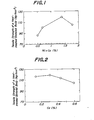
- Fig. 1 is a graph illustrating the relation between the total amount of Ni and Cu contained in a steel powder and the tensile strength of the heat-treated sintered body. It can be seen from Fig. 1 that, when the total amount of Ni and Cu is less than 0.6%, the strength decreases noticeably. While, even when the total amount is more than 1.5%, the strength does not improve but rather decreases due to the lowering of the compressibility of the steel powder.
- Steel powders G, C, F and E contain about 0.2% of Mo and a variant amount of Cu under a condition of the total amount of Ni and Cu of about 1.3.
- Fig. 2 illustrates the relation between the Cu content in a steel powder and the tensile strength of the heat-treated sintered body. It can be seen from Fig. 2 that, when the Cu content is up to about 0.3%, Cu can be replaced by Ni without an adverse affect on the strength, but when the Cu content exceeds 0.4%, the strength of the heat-treated sintered body decreases. It can be judged from this result that the Cu content within the range of 0.2-0.5% is effective for obtaining inexpensively a sintered body having excellent properties.
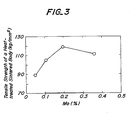
- Steel powders H, I, C and J contain about 1% of Ni and a variant amount of Mo under a condition of the amount of Cu of about 0.3%.
- Fig. 3 illustrates the relation between the Mo content in a steel powder and the tensile strength of the heat-treated sintered body. It can be clearly seen from Fig. 3 that, when the Mo content is less than 0.1%, the strength decreases noticeably, and when the Mo content exceeds 0.3%, the strength rather decreases.
- Ferro-phosphorus powder having a particle size of -325 meshes and having a P content of 27% was added to the alloy steel powder of No. 2 shown in the above Tables 1 and 2 to produce an alloy steel powder of No. 4 having a P content of 0.4%.
- the alloy steel powder of No. 4 was mixed with graphite powder and zinc stearate, and then compacted and sintered in the same manner as described in the above described experiment to obtain a sintered body.
- Table 5 shows the density of the green compact and the mechanical properties of the sintered body before heat-treatment.
- the conventional steel powder of No. 3 was treated in the same manner as described above, and the density of the green compact and the mechanical properties of the sintered body before heat-treatment, are also shown in Table 5.
- the resulting steel powder (No. 4, steel powder of the present invention) has a high compressibility in itself and further is superior in strength and toughness in the sintered body before heat-treatment, to a steel powder produced from the conventional steel powder of No. 3 by adding ferro-phosphorus powder thereto.
- an alloy steel powder which satisfies all the above described four requirements in the raw steel powder for the production of a sintered body having a high strength can be produced very advantageously.
Landscapes
- Chemical & Material Sciences (AREA)
- Engineering & Computer Science (AREA)
- Materials Engineering (AREA)
- Mechanical Engineering (AREA)
- Metallurgy (AREA)
- Organic Chemistry (AREA)
- Powder Metallurgy (AREA)
Applications Claiming Priority (2)
| Application Number | Priority Date | Filing Date | Title |
|---|---|---|---|
| JP179211/83 | 1983-09-29 | ||
| JP58179211A JPS6075501A (ja) | 1983-09-29 | 1983-09-29 | 高強度焼結部品用の合金鋼粉 |
Publications (3)
| Publication Number | Publication Date |
|---|---|
| EP0136169A2 true EP0136169A2 (fr) | 1985-04-03 |
| EP0136169A3 EP0136169A3 (en) | 1986-04-23 |
| EP0136169B1 EP0136169B1 (fr) | 1989-03-08 |
Family
ID=16061870
Family Applications (1)
| Application Number | Title | Priority Date | Filing Date |
|---|---|---|---|
| EP84306525A Expired EP0136169B1 (fr) | 1983-09-29 | 1984-09-25 | Poudre d'acier allié pour pièces frittées à résistance |
Country Status (5)
| Country | Link |
|---|---|
| US (1) | US4561893A (fr) |
| EP (1) | EP0136169B1 (fr) |
| JP (1) | JPS6075501A (fr) |
| CA (1) | CA1222151A (fr) |
| DE (1) | DE3477021D1 (fr) |
Cited By (1)
| Publication number | Priority date | Publication date | Assignee | Title |
|---|---|---|---|---|
| EP0263373A3 (en) * | 1986-10-04 | 1989-08-02 | Etablissement Supervis | Process for manufacturing a wear-resistant sintered alloy |
Families Citing this family (8)
| Publication number | Priority date | Publication date | Assignee | Title |
|---|---|---|---|---|
| JPS6318001A (ja) * | 1986-07-11 | 1988-01-25 | Kawasaki Steel Corp | 粉末冶金用合金鋼粉 |
| CA1337468C (fr) * | 1987-08-01 | 1995-10-31 | Kuniaki Ogura | Acier allie pour utilisation en metallurgie des poudres |
| JPH01123002A (ja) * | 1987-11-05 | 1989-05-16 | Kawasaki Steel Corp | 高強度焼結鋼の製造方法 |
| DE4001899C1 (fr) * | 1990-01-19 | 1991-07-25 | Mannesmann Ag, 4000 Duesseldorf, De | |
| DE4001900A1 (de) * | 1990-01-19 | 1991-07-25 | Mannesmann Ag | Metallpulvermischung |
| SE9101819D0 (sv) * | 1991-06-12 | 1991-06-12 | Hoeganaes Ab | Jaernbaserad pulverkomposition som efter sintring uppvisar god formstabilitet |
| US6551373B2 (en) | 2000-05-11 | 2003-04-22 | Ntn Corporation | Copper infiltrated ferro-phosphorous powder metal |
| US6676894B2 (en) | 2002-05-29 | 2004-01-13 | Ntn Corporation | Copper-infiltrated iron powder article and method of forming same |
Family Cites Families (14)
| Publication number | Priority date | Publication date | Assignee | Title |
|---|---|---|---|---|
| CA935307A (en) * | 1971-03-29 | 1973-10-16 | Ford Motor Company Of Canada | Prealloyed metal forging powder |
| US3901661A (en) * | 1972-04-06 | 1975-08-26 | Toyo Kohan Co Ltd | Prealloyed steel powder for formation of structural parts by powder forging and powder forged article for structural parts |
| US4049429A (en) * | 1973-03-29 | 1977-09-20 | The International Nickel Company, Inc. | Ferritic alloys of low flow stress for P/M forgings |
| US3864809A (en) * | 1973-03-29 | 1975-02-11 | Int Nickel Co | Process of producing by powder metallurgy techniques a ferritic hot forging of low flow stress |
| SE393635B (sv) * | 1976-06-24 | 1977-05-16 | Hoeganaes Ab | Fosforhaltigt stalpulver och sett for dess framstellning |
| US4069044A (en) * | 1976-08-06 | 1978-01-17 | Stanislaw Mocarski | Method of producing a forged article from prealloyed-premixed water atomized ferrous alloy powder |
| US4093449A (en) * | 1976-10-26 | 1978-06-06 | Hoganas Ab, Fack | Phosphorus steel powder and a method of manufacturing the same |
| SE408435B (sv) * | 1976-11-03 | 1979-06-11 | Hoeganaes Ab | Sett att framstella ett kopparhaltigt jernpulver |
| SE7612279L (sv) * | 1976-11-05 | 1978-05-05 | British Steel Corp | Finfordelat glodgat stalpulver, samt sett att framstella detta. |
| JPS5810962B2 (ja) * | 1978-10-30 | 1983-02-28 | 川崎製鉄株式会社 | 圧縮性、成形性および熱処理特性に優れる合金鋼粉 |
| US4236945A (en) * | 1978-11-27 | 1980-12-02 | Allegheny Ludlum Steel Corporation | Phosphorus-iron powder and method of producing soft magnetic material therefrom |
| JPS5638450A (en) * | 1979-09-06 | 1981-04-13 | Kawasaki Steel Corp | Alloy steel powder excellent in compressibility and moldability as well as hardenability and toughness as sealing material |
| JPS57164901A (en) * | 1981-02-24 | 1982-10-09 | Sumitomo Metal Ind Ltd | Low alloy steel powder of superior compressibility, moldability and hardenability |
| JPS5810962A (ja) * | 1981-07-14 | 1983-01-21 | Victor Co Of Japan Ltd | 2値化装置 |
-
1983
- 1983-09-29 JP JP58179211A patent/JPS6075501A/ja active Granted
-
1984
- 1984-09-25 US US06/654,369 patent/US4561893A/en not_active Expired - Lifetime
- 1984-09-25 EP EP84306525A patent/EP0136169B1/fr not_active Expired
- 1984-09-25 DE DE8484306525T patent/DE3477021D1/de not_active Expired
- 1984-09-28 CA CA000464269A patent/CA1222151A/fr not_active Expired
Cited By (1)
| Publication number | Priority date | Publication date | Assignee | Title |
|---|---|---|---|---|
| EP0263373A3 (en) * | 1986-10-04 | 1989-08-02 | Etablissement Supervis | Process for manufacturing a wear-resistant sintered alloy |
Also Published As
| Publication number | Publication date |
|---|---|
| JPS6075501A (ja) | 1985-04-27 |
| US4561893A (en) | 1985-12-31 |
| DE3477021D1 (en) | 1989-04-13 |
| EP0136169B1 (fr) | 1989-03-08 |
| EP0136169A3 (en) | 1986-04-23 |
| CA1222151A (fr) | 1987-05-26 |
| JPS6364483B2 (fr) | 1988-12-12 |
Similar Documents
| Publication | Publication Date | Title |
|---|---|---|
| CA1095678A (fr) | Methode de forgeage d'un alliage ferreux en poudre, pre-allie et proportions optimales | |
| CN102439189B (zh) | 高强度低合金化烧结钢 | |
| US4985309A (en) | Alloyed steel powder for powder metallurgy | |
| JP2002501122A (ja) | 焼結製品調製用鋼粉末 | |
| DE3232001A1 (de) | Verschleissfeste sinterlegierung, verfahren zu deren herstellung und daraus hergestellte nocke | |
| US4561893A (en) | Alloy steel powder for high strength sintered parts | |
| CA2143015C (fr) | Poudres d'acier allie; corps frittes, constitues de ces poudres; procede d'obtention | |
| JP3446322B2 (ja) | 粉末冶金用合金鋼粉 | |
| JPH06306403A (ja) | 高強度、高靱性Cr合金鋼粉焼結体およびその製造方法 | |
| WO1996005007A1 (fr) | Poudre a base de fer contenant du chrome, du molybdene et du manganese | |
| EP0274542B1 (fr) | Poudre d'alliage d'acier pour metallurgie des poudres | |
| Cundill et al. | Mechanical properties of sinter/forged low-alloy steels | |
| JPH09195006A (ja) | 焼結耐摩耗材用原料粉末 | |
| KR100189234B1 (ko) | 압축성형 및 소결에 의해 내충격성 물품을 제조하기 위한 철-기지 분말 | |
| JP2001158934A (ja) | 耐摩耗性鉄系焼結合金の製造方法 | |
| US5599377A (en) | Mixed iron powder for powder metallurgy | |
| JPS61295302A (ja) | 焼結用低合金鉄粉末 | |
| JPH07103442B2 (ja) | 高強度焼結合金鋼の製造方法 | |
| JPH0459362B2 (fr) | ||
| JP4198226B2 (ja) | 高強度焼結体 | |
| JPH01123002A (ja) | 高強度焼結鋼の製造方法 | |
| JPS6136041B2 (fr) | ||
| JPS59129753A (ja) | 高強度焼結材料用合金鋼粉 | |
| JPH0568522B2 (fr) | ||
| JPH07278725A (ja) | 切削性に優れた焼結鋼の製造方法 |
Legal Events
| Date | Code | Title | Description |
|---|---|---|---|
| PUAI | Public reference made under article 153(3) epc to a published international application that has entered the european phase |
Free format text: ORIGINAL CODE: 0009012 |
|
| AK | Designated contracting states |
Designated state(s): DE FR GB SE |
|
| PUAL | Search report despatched |
Free format text: ORIGINAL CODE: 0009013 |
|
| AK | Designated contracting states |
Kind code of ref document: A3 Designated state(s): DE FR GB SE |
|
| 17P | Request for examination filed |
Effective date: 19861014 |
|
| 17Q | First examination report despatched |
Effective date: 19871009 |
|
| GRAA | (expected) grant |
Free format text: ORIGINAL CODE: 0009210 |
|
| AK | Designated contracting states |
Kind code of ref document: B1 Designated state(s): DE FR GB SE |
|
| REF | Corresponds to: |
Ref document number: 3477021 Country of ref document: DE Date of ref document: 19890413 |
|
| ET | Fr: translation filed | ||
| PLBI | Opposition filed |
Free format text: ORIGINAL CODE: 0009260 |
|
| 26 | Opposition filed |
Opponent name: HOEGANAES AB Effective date: 19891208 |
|
| EAL | Se: european patent in force in sweden |
Ref document number: 84306525.1 |
|
| PGFP | Annual fee paid to national office [announced via postgrant information from national office to epo] |
Ref country code: FR Payment date: 19950911 Year of fee payment: 12 |
|
| PGFP | Annual fee paid to national office [announced via postgrant information from national office to epo] |
Ref country code: GB Payment date: 19950918 Year of fee payment: 12 |
|
| PGFP | Annual fee paid to national office [announced via postgrant information from national office to epo] |
Ref country code: DE Payment date: 19950928 Year of fee payment: 12 |
|
| APAC | Appeal dossier modified |
Free format text: ORIGINAL CODE: EPIDOS NOAPO |
|
| PG25 | Lapsed in a contracting state [announced via postgrant information from national office to epo] |
Ref country code: GB Effective date: 19960925 |
|
| PG25 | Lapsed in a contracting state [announced via postgrant information from national office to epo] |
Ref country code: FR Effective date: 19960930 |
|
| PLBN | Opposition rejected |
Free format text: ORIGINAL CODE: 0009273 |
|
| STAA | Information on the status of an ep patent application or granted ep patent |
Free format text: STATUS: OPPOSITION REJECTED |
|
| GBPC | Gb: european patent ceased through non-payment of renewal fee |
Effective date: 19960925 |
|
| PG25 | Lapsed in a contracting state [announced via postgrant information from national office to epo] |
Ref country code: DE Effective date: 19970603 |
|
| 27O | Opposition rejected |
Effective date: 19960227 |
|
| REG | Reference to a national code |
Ref country code: FR Ref legal event code: ST |
|
| REG | Reference to a national code |
Ref country code: FR Ref legal event code: ST |
|
| PGFP | Annual fee paid to national office [announced via postgrant information from national office to epo] |
Ref country code: SE Payment date: 19970918 Year of fee payment: 14 |
|
| PG25 | Lapsed in a contracting state [announced via postgrant information from national office to epo] |
Ref country code: SE Free format text: LAPSE BECAUSE OF NON-PAYMENT OF DUE FEES Effective date: 19980926 |
|
| EUG | Se: european patent has lapsed |
Ref document number: 84306525.1 |
|
| APAH | Appeal reference modified |
Free format text: ORIGINAL CODE: EPIDOSCREFNO |