EP0136610A2 - Support d'échantillons pour la spectroscopie de masse d'ions secondaires (SIMS) et autres méthodes sensibles d'analyse de rayons à particules et son procédé de fonctionnement - Google Patents
Support d'échantillons pour la spectroscopie de masse d'ions secondaires (SIMS) et autres méthodes sensibles d'analyse de rayons à particules et son procédé de fonctionnement Download PDFInfo
- Publication number
- EP0136610A2 EP0136610A2 EP84111011A EP84111011A EP0136610A2 EP 0136610 A2 EP0136610 A2 EP 0136610A2 EP 84111011 A EP84111011 A EP 84111011A EP 84111011 A EP84111011 A EP 84111011A EP 0136610 A2 EP0136610 A2 EP 0136610A2
- Authority
- EP
- European Patent Office
- Prior art keywords
- sample holder
- sample
- rotating part
- holder according
- carrier device
- Prior art date
- Legal status (The legal status is an assumption and is not a legal conclusion. Google has not performed a legal analysis and makes no representation as to the accuracy of the status listed.)
- Ceased
Links
Images

Classifications
-
- H—ELECTRICITY
- H01—ELECTRIC ELEMENTS
- H01J—ELECTRIC DISCHARGE TUBES OR DISCHARGE LAMPS
- H01J49/00—Particle spectrometers or separator tubes
- H01J49/02—Details
- H01J49/04—Arrangements for introducing or extracting samples to be analysed, e.g. vacuum locks; Arrangements for external adjustment of electron- or ion-optical components
- H01J49/0409—Sample holders or containers
-
- H—ELECTRICITY
- H01—ELECTRIC ELEMENTS
- H01J—ELECTRIC DISCHARGE TUBES OR DISCHARGE LAMPS
- H01J37/00—Discharge tubes with provision for introducing objects or material to be exposed to the discharge, e.g. for the purpose of examination or processing thereof
- H01J37/02—Details
- H01J37/20—Means for supporting or positioning the object or the material; Means for adjusting diaphragms or lenses associated with the support
-
- H—ELECTRICITY
- H01—ELECTRIC ELEMENTS
- H01J—ELECTRIC DISCHARGE TUBES OR DISCHARGE LAMPS
- H01J49/00—Particle spectrometers or separator tubes
- H01J49/02—Details
- H01J49/10—Ion sources; Ion guns
- H01J49/14—Ion sources; Ion guns using particle bombardment, e.g. ionisation chambers
- H01J49/142—Ion sources; Ion guns using particle bombardment, e.g. ionisation chambers using a solid target which is not previously vapourised
Definitions
- the invention relates to a sample holder for secondary ion mass spectrometry and other sensitive particle beam analysis methods according to the preamble of claim 1 and a method for their operation.
- the concentration range that can be registered in a depth profile (“dynamic range”) should be expanded from over 10 21 atoms / cm 3 to under 10 14 atoms / cm 3 , and the detection limits for the doping elements of interest, e.g. Boron, antimony, should be lowered as much as possible.
- the present invention has for its object to provide a sample holder of the type mentioned, which has a further simplified structure and is therefore easier to manufacture with which the aim of the environmental freedom of the samples to be analyzed can be realized to a better extent than in the prior art mentioned .
- the samples are first prepared so small that they lie completely within the area covered by the ion beam or particle beam. Secondly, these samples are completely supported and analyzed in the direction of the respective ion or particle beam. This largely eliminates disruptive crater rim and environmental influences.
- sample holder according to the invention requires only a small amount of preparation and leads to significantly improved results in routine measurements. Repeat measurements due to doubtful results can be omitted when using a sample holder according to the invention.
- a sample holder when an ion beam is used, the reversal points of the ion beam movement when the sample is scanned and thus the “crater rim” lie outside the limits of the sample. If a neutral particle beam is used, it can be achieved in an analogous manner that the edge of the area hit by this neutral particle beam lies outside the limits of the sample. Signal contributions from the surroundings of the sample are completely eliminated in that the sample appears to be completely carrier-free in the direction of the ion beam or particle beam, in that the needle-shaped sample carrier is completely covered by the sample. With a sample holder according to the invention, no more particles can strike the surroundings of the sample to be analyzed.
- an ion beam IB is scanned line by line over a sample PR in a known manner, and a sputter crater is thereby generated on this sample PR.
- the ion-shaped removal products (secondary ions) that are produced in this way are fed to a mass spectrometer and analyzed.
- secondary ion signal intensity of a certain ion type is registered as a function of the Z time, a so-called depth profile is obtained for the chemical element in question with respect to the sample PR being examined.
- the sample PR to be analyzed for its elemental composition is bombarded with an ion beam IB (eg oxygen 02+, 1 to 15 keV, 1 nA to 10 / mA) and thereby slowly removed in a sputtering process .
- IB ion beam
- the atoms and molecular fragments released (sputtered) from the sample surface can, if they are electrically charged ("secondary ions"), be directed into a mass spectrometer, separated here according to their mass-to-charge ratio m / e and detected with the aid of a multiplier or the like and be counted.
- the ion beam IB is usually focused on the sample surface and line by row over the area to be removed on the sample PR stares.
- an a-DIDA device from Atomika GmbH, Kunststoff, Federal Republic of Germany, can be used as the raster ion beam device.
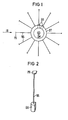
- the sample holder consists of a rotating part DT, into which needles NA are inserted in the radial direction and ground perpendicular to the longitudinal axis.
- a small-sawed sample PR is glued onto each needle NA for environmental analysis.
- the surface of such a sample PR should have a length and a width of less than 1 mm each.
- the entire sample holder consisting of a rotating part DT with inserted needles NA and glued samples PR is attached to the shaft DM of a commercially available ultra-high vacuum manipulator.
- the individual samples PR can be brought one after the other into the examination position in which the ion beam IB strikes the surface of the sample PR approximately perpendicularly.
- the needles NA have a diameter which is smaller than the corresponding dimension of the small-sawed samples PR, so that the samples PR themselves cover these needles NA with respect to the ion beam IB.
- the needles NA should be as long as possible so that in the direction of the ion beam IB the primary ions of the ion beam IB that do not strike the sample surface can only strike another surface at a great distance from this sample surface, so that the measurement signals triggered on this other surface really make no contribution more about the deliver measurement signals registered in the mass spectrometer.
- needles NA for example, sewing needles with a diameter d of less than 0.6 mm and a length 1 of at least 5 mm are particularly suitable. Experiments with a needle length of 40 mm and a needle diameter of 0.4 mm have given very good results. Shorter needle lengths down to 1 mm are useful when using ion optics to transfer the secondary ions into the mass spectrometer.
- the needles NA can be inserted into the rotating part DT with such an inclination that the ion beam IB strikes the sample surface exactly perpendicularly. This can compensate for the inclination of the ion beam IB of approximately 2 ° with respect to the sample normal in the Atomika device mentioned.
- each individual needle NA is either permanently inserted into the screw-in part of the rotating part DT or, as shown in FIG. 2, is held interchangeably for easier sample assembly.
- a configuration of a sample holder according to the invention is provided which allows the position of the needle NA to be defined with respect to its angle of rotation about its longitudinal axis.
- the needle NA can be firmly inserted in a short fastening sleeve BA, this fastening sleeve BA having a flat or a groove on its circumference.
- FIG 1 two needles NA are shown, which are fastened to the rotating part DT by means of such fastening sleeves BA in such a way that the abutment surface of the fastening sleeve BA lies fully on the screw-in piece of the rotating part DT.
- That part of the rotating part DT in which the needles NA are inserted is electrically insulated from the shaft DM of the manipulator by at least one insulation piece. In this way, certain potentials can be achieved in the sample PR to be examined by electrical contact.
- the number of needles NA and thus the sample positions in a sample holder according to the invention depends both on design considerations and on the minimum distance to the neighboring needles to be required.
- a diameter of the entire "spoke wheel” which consists of a rotating part DT plus needles NA attached to it, e.g. 120 mm, a division of this "spoke wheel” in steps of 30 ° is suitable.
- the rotating part DT can be dimensioned such that a second "spoke wheel” can be attached to it parallel to the first "spoke wheel", thereby doubling the number of sample positions.
- FIG. 3 shows a further exemplary embodiment of the invention.
- the information given in FIGS. 1 and 2 also apply analogously to FIG. 3.
- 3 shows a suitable sample holder for such secondary ion mass spectrometry devices in which the ion beam IB is incident on the samples PR parallel to the axis MA of the manipulator.
- the needles NA are fastened to a sample plate TE by means of fastening sleeves BA in such a way that the abutment surfaces of the fastening sleeves BA lie firmly against the outer edge of the sample plate TE. In this way, the ion beam IB can in turn strike the surfaces of the samples PR perpendicularly.
- electrodes can additionally be provided in a sample holder according to the invention in order to retain scattered particles (ions, electrons).
- any slight scatter that may still occur, which originate from the rotating part DT or the needles NA can be kept as small as possible by suitable choice of materials and / or by suitable coatings on these materials of the rotating part DT and the needles NA.
Landscapes
- Chemical & Material Sciences (AREA)
- Analytical Chemistry (AREA)
- Physics & Mathematics (AREA)
- Engineering & Computer Science (AREA)
- Plasma & Fusion (AREA)
- Analysing Materials By The Use Of Radiation (AREA)
- Electron Tubes For Measurement (AREA)
Applications Claiming Priority (2)
| Application Number | Priority Date | Filing Date | Title |
|---|---|---|---|
| DE3335581 | 1983-09-30 | ||
| DE19833335581 DE3335581A1 (de) | 1983-09-30 | 1983-09-30 | Probenhalterung fuer sekundaerionen-massenspektrometrie und andere empfindliche teilchenstrahl-analysenmethoden und verfahren zu ihrem betrieb |
Publications (2)
| Publication Number | Publication Date |
|---|---|
| EP0136610A2 true EP0136610A2 (fr) | 1985-04-10 |
| EP0136610A3 EP0136610A3 (fr) | 1986-08-13 |
Family
ID=6210615
Family Applications (1)
| Application Number | Title | Priority Date | Filing Date |
|---|---|---|---|
| EP84111011A Ceased EP0136610A3 (fr) | 1983-09-30 | 1984-09-14 | Support d'échantillons pour la spectroscopie de masse d'ions secondaires (SIMS) et autres méthodes sensibles d'analyse de rayons à particules et son procédé de fonctionnement |
Country Status (4)
| Country | Link |
|---|---|
| US (1) | US4851672A (fr) |
| EP (1) | EP0136610A3 (fr) |
| JP (1) | JPS6093948A (fr) |
| DE (2) | DE3335581A1 (fr) |
Cited By (2)
| Publication number | Priority date | Publication date | Assignee | Title |
|---|---|---|---|---|
| US4719349A (en) * | 1986-05-27 | 1988-01-12 | The United States Of America As Represented By The Department Of Health And Human Services | Electrochemical sample probe for use in fast-atom bombardment mass spectrometry |
| US4820044A (en) * | 1986-11-15 | 1989-04-11 | The British Petroleum Company P.L.C. | Transport detector system |
Families Citing this family (2)
| Publication number | Priority date | Publication date | Assignee | Title |
|---|---|---|---|---|
| DE10112387B4 (de) | 2001-03-15 | 2004-03-25 | Bruker Daltonik Gmbh | Massenspektrometrische Genotypisierung |
| US20080035389A1 (en) * | 2006-08-11 | 2008-02-14 | Hall David R | Roof Mining Drill Bit |
Family Cites Families (7)
| Publication number | Priority date | Publication date | Assignee | Title |
|---|---|---|---|---|
| DE1226228B (de) * | 1959-07-24 | 1966-10-06 | Max Planck Gesellschaft | Bewegbarer Praeparattisch fuer einen Korpus-kularstrahlapparat, insbesondere Elektronen-mikroskop oder Elektronenbeugungsgeraet |
| DE1789019B1 (de) * | 1968-09-23 | 1972-04-27 | Siemens Ag | Verfahren zur erzeugung eines stereobildes mittels der elektronenstrahlmikroskopie |
| US3911282A (en) * | 1973-11-01 | 1975-10-07 | Dresser Ind | Axial ion beam accelerator tube having a wobbled target |
| US4110625A (en) * | 1976-12-20 | 1978-08-29 | International Business Machines Corporation | Method and apparatus for monitoring the dose of ion implanted into a target by counting emitted X-rays |
| DE3128814A1 (de) * | 1981-07-21 | 1983-02-10 | Siemens AG, 1000 Berlin und 8000 München | Elektrisch leitende probenhalterung fuer die analysentechnik der sekundaerionen-massenspektrometrie |
| US4405864A (en) * | 1981-09-08 | 1983-09-20 | Rca Corporation | Ion implanter end processing station |
| FR2529383A1 (fr) * | 1982-06-24 | 1983-12-30 | Commissariat Energie Atomique | Porte-cible a balayage mecanique utilisable notamment pour l'implantation d'ioris |
-
1983
- 1983-09-30 DE DE19833335581 patent/DE3335581A1/de not_active Withdrawn
- 1983-09-30 DE DE8328167U patent/DE8328167U1/de not_active Expired
-
1984
- 1984-08-20 US US06/642,396 patent/US4851672A/en not_active Expired - Fee Related
- 1984-09-14 EP EP84111011A patent/EP0136610A3/fr not_active Ceased
- 1984-09-27 JP JP59202874A patent/JPS6093948A/ja active Granted
Cited By (2)
| Publication number | Priority date | Publication date | Assignee | Title |
|---|---|---|---|---|
| US4719349A (en) * | 1986-05-27 | 1988-01-12 | The United States Of America As Represented By The Department Of Health And Human Services | Electrochemical sample probe for use in fast-atom bombardment mass spectrometry |
| US4820044A (en) * | 1986-11-15 | 1989-04-11 | The British Petroleum Company P.L.C. | Transport detector system |
Also Published As
| Publication number | Publication date |
|---|---|
| DE8328167U1 (de) | 1986-04-10 |
| JPS6093948A (ja) | 1985-05-25 |
| EP0136610A3 (fr) | 1986-08-13 |
| US4851672A (en) | 1989-07-25 |
| JPH0246893B2 (fr) | 1990-10-17 |
| DE3335581A1 (de) | 1985-04-18 |
Similar Documents
| Publication | Publication Date | Title |
|---|---|---|
| EP0208894B1 (fr) | Spectromètre de masses à temps de vol avec Un réflecteur d'ions | |
| DE69026751T2 (de) | Ionenbündelfokussierungsvorrichtung | |
| EP0218920B1 (fr) | Filtre d'énergie électronique de type Oméga | |
| DE69230174T2 (de) | Flugzeitmassenspektrometer mit einer oeffnung zum ausgleich von uebertragungsvermoegen und aufloesung | |
| DE69127957T2 (de) | Ionenstreuungsspektrometer | |
| DE102016009643B4 (de) | Verbesserung des Dynamikbereichs für die Isotopenverhältnis-Massenspektrometrie | |
| DE2739829A1 (de) | Anordnung zur analyse einer probe durch beschuss mit elektromagnetischer strahlung | |
| DE112013000852T5 (de) | Ladungsteilchenstrahlvorrichtung | |
| DE69115589T2 (de) | Mehrkanal-Ladungsteilchen-Analysator | |
| DE69410133T2 (de) | Mehrdetektorsystem für die Detektion geladener Partikel | |
| EP1063676A2 (fr) | Dispositif et procédé de spectroscopie électronique à résolution en énergie et angulaire | |
| DE60126048T2 (de) | Massenspektrometer und massenspektrometrisches Verfahren | |
| DE2607788A1 (de) | Sekundaerelektronen-detektor | |
| DE4041297A1 (de) | Verfahren und vorrichtung zum waehlen der aufloesung eines ladungsteilchenstrahl-analysators | |
| DE2705430C3 (de) | Elektrostatischer Analysator für geladene Teilchen | |
| EP0829901A1 (fr) | Analyse de surfaces par spectrométrie de masse | |
| EP0123860A2 (fr) | Analyseur d'énergie d'électrons avec un détecteur à plusieurs canaux | |
| EP0070351B1 (fr) | Support d'échantillon à conductibilité électrique destiné à la technique d'analyse de spectrométrie de masse à ions secondaires | |
| DE2706629C3 (de) | Einrichtung zur Überwachung der Position und der räumlichen Verteilung eines Elektronenstrahlbündels hoher Energie | |
| DE69028647T2 (de) | Energieanalysator für geladene Teilchen | |
| DE3335581A1 (de) | Probenhalterung fuer sekundaerionen-massenspektrometrie und andere empfindliche teilchenstrahl-analysenmethoden und verfahren zu ihrem betrieb | |
| DE2105805A1 (de) | Gerat zur Elektronenspektroskopie | |
| DE3636506A1 (de) | Spiralabtastverfahren | |
| DE102018116305B4 (de) | Dynamischer Ionenfilter zur Reduzierung hochabundanter Ionen | |
| DE2022132A1 (de) | Spektrometer |
Legal Events
| Date | Code | Title | Description |
|---|---|---|---|
| PUAI | Public reference made under article 153(3) epc to a published international application that has entered the european phase |
Free format text: ORIGINAL CODE: 0009012 |
|
| AK | Designated contracting states |
Designated state(s): AT DE FR GB NL |
|
| 17P | Request for examination filed |
Effective date: 19850827 |
|
| PUAL | Search report despatched |
Free format text: ORIGINAL CODE: 0009013 |
|
| AK | Designated contracting states |
Kind code of ref document: A3 Designated state(s): AT DE FR GB NL |
|
| 17Q | First examination report despatched |
Effective date: 19880422 |
|
| STAA | Information on the status of an ep patent application or granted ep patent |
Free format text: STATUS: THE APPLICATION HAS BEEN REFUSED |
|
| 18R | Application refused |
Effective date: 19900320 |
|
| APAF | Appeal reference modified |
Free format text: ORIGINAL CODE: EPIDOSCREFNE |
|
| RIN1 | Information on inventor provided before grant (corrected) |
Inventor name: VON CRIEGERN, ROLF, DIPL.-PHYS. Inventor name: WEITZEL, INGO, DIPL.-PHYS. |