EP0136613A2 - Rail ayant une haute résistance à l'usure dans le champignon et une haute résistance à la rupture dans le patin - Google Patents
Rail ayant une haute résistance à l'usure dans le champignon et une haute résistance à la rupture dans le patin Download PDFInfo
- Publication number
- EP0136613A2 EP0136613A2 EP84111040A EP84111040A EP0136613A2 EP 0136613 A2 EP0136613 A2 EP 0136613A2 EP 84111040 A EP84111040 A EP 84111040A EP 84111040 A EP84111040 A EP 84111040A EP 0136613 A2 EP0136613 A2 EP 0136613A2
- Authority
- EP
- European Patent Office
- Prior art keywords
- rail
- head
- foot
- cooling
- rolling
- Prior art date
- Legal status (The legal status is an assumption and is not a legal conclusion. Google has not performed a legal analysis and makes no representation as to the accuracy of the status listed.)
- Withdrawn
Links
Images
Classifications
-
- C—CHEMISTRY; METALLURGY
- C21—METALLURGY OF IRON
- C21D—MODIFYING THE PHYSICAL STRUCTURE OF FERROUS METALS; GENERAL DEVICES FOR HEAT TREATMENT OF FERROUS OR NON-FERROUS METALS OR ALLOYS; MAKING METAL MALLEABLE, e.g. BY DECARBURISATION OR TEMPERING
- C21D9/00—Heat treatment, e.g. annealing, hardening, quenching or tempering, adapted for particular articles; Furnaces therefor
- C21D9/04—Heat treatment, e.g. annealing, hardening, quenching or tempering, adapted for particular articles; Furnaces therefor for rails
-
- Y—GENERAL TAGGING OF NEW TECHNOLOGICAL DEVELOPMENTS; GENERAL TAGGING OF CROSS-SECTIONAL TECHNOLOGIES SPANNING OVER SEVERAL SECTIONS OF THE IPC; TECHNICAL SUBJECTS COVERED BY FORMER USPC CROSS-REFERENCE ART COLLECTIONS [XRACs] AND DIGESTS
- Y10—TECHNICAL SUBJECTS COVERED BY FORMER USPC
- Y10S—TECHNICAL SUBJECTS COVERED BY FORMER USPC CROSS-REFERENCE ART COLLECTIONS [XRACs] AND DIGESTS
- Y10S148/00—Metal treatment
- Y10S148/902—Metal treatment having portions of differing metallurgical properties or characteristics
Definitions
- the invention relates to a rail with high wear resistance in the rail head and high break resistance in the rail foot.
- Rails for rail-bound traffic should on the one hand have a high wear resistance in the rail head and, on the other hand, should have a high level of safety against breakage due to the bending tensile stress in the track. Since the wear resistance increases and the resistance to breakage increases with increasing rail strength, it has not been possible to improve both properties at the same time with one material composition.
- a solution was seen in the so-called dual-substance rail. Thanks to the composite casting in the rail head, it has a high-strength material with high wear resistance and a soft material with good toughness properties in the rail web and foot. However, due to the low strength in the rail web and foot, such rails are not suitable for high loads because they deform plastically under high axle loads (> 22 t). Nor can metallurgical disturbances be avoided with sufficient certainty in the area of the material transition. They can cause permanent breaks. Compound cast rails have therefore not been used for a long time.
- the fracture toughness determined in fracture mechanical tests as a material characteristic has recently been used to assess the fracture behavior.
- the fracture toughness is determined in accordance with ASTM standard E 399-74.
- the rails after rolling and subsequent heat treatment, have a fine pearlitic structure in the head and a martensitic tempering structure in the foot.
- the martensitic remuneration structure set in the base of the rail is decisive for the high break resistance of the rail.
- Rails with a basic analysis according to claim 3 have tensile strength values of> 1100 N / mm 2 in the head and> 1000 N / mm 2 in the foot fracture toughness values of> 2000 N / mm 3/2 .
- a splint with the analysis according to claim 2 would only have fracture toughness values in the order of 1500 to 2000 N / mm 3/2
- a splint with the basic analysis according to claim 3 would only have fracture toughness values in the order of 1000 to 1400 N / mm mm 3/2 .
- Rail steels with the features of claims 1 to 3 thus have high strengths in the rail head, which is synonymous with high wear resistance.
- the simultaneously high strength and good fracture toughness values in the rail base make them suitable for use even with high axle loads over 22 t, without plastic deformation of the rails occurring and a high level of security against brittle fractures.
- the heat treatment of the rails according to the invention is advantageously carried out from the rolling heat.
- the finish rolling temperatures are above the range of the austenitizing temperatures, i.e. between 800 to 900 ° C. In this way it can be avoided that the rails have to be heated again in air to temperatures in the range from 810 to 890 ° C. after cooling to room temperature on the cooling bed. This measure is recommended if suitable cooling devices are directly available or can be created in rolling mills behind the rolling stands.
- the rail made of this material cooled in air after rolling and, when rolled, had the mechanical properties listed in Table 1, column 1.
- the head was cooled to 450 ° C on the surface in 15 s with compressed air.
- the rail foot was cooled to room temperature in 20 s using a compressed air / water mixture.
- the rail foot was then tempered at 650 ° C.
- the heat treatment resulted in a fine pearlitic structure in the rail head up to 20 mm depth and a martensitic tempering structure in the rail foot with the exception of a limited area below the web.
- the mechanical properties after the heat treatment are for the rail head in Table 1, Column 3 and for the rail foot given in Table 1, Column 4.
- the tensile strength in the rail head had increased by 180 N / mm 2 to 1150 N / mm 2 . Wear resistance had roughly doubled. Elongation at break and toughness had changed only slightly in the rail head. By tempering the rail foot, the yield point had been raised in approximately the same way as in the rail head. In this way, the load capacity of the rails was increased even for high axle loads, up to 35 t. The fracture toughness was more than doubled by the tempering.
- the rail can only withstand surface defects of up to 3 mm depth when it is rolled with a usual internal tensile stress on the underside of the rail base of approx. 240 N / mm 2 and an additional tensile bending stress due to traffic loads of 200 N / mm2, it increases due to the improved Crack toughness in the rail base the tolerable defect depth to over 25 mm. Errors or damage of this depth are extremely rare and can also be easily identified in good time by the usual non-destructive tests on the track.
- the fracture resistance of the new rails has thus been significantly improved compared to conventional, high-strength rails.
- the rail head was therefore no longer heat treated.
- the rail base was austenitized at 860 ° C and then quenched to 100 ° C in 12o s with a compressed air / water mixture.
- the tempering temperature was 680 ° C.
- By tempering a martensitic microstructure compensation was set in total R ußquer- cut.
- the mechanical properties measured on the rail are summarized in Table 2.
- the high strength of the rail head gives the rail a high wear resistance.
- the rail is particularly suitable for use in heavy load traffic with high axle loads (approx. 35 t).
- the tolerable crack depth increases from approx. 2 mm in the rolled state to approx. 20 mm after the heat treatment of the rail foot. The safety against breakage is also significantly improved with this rail.
- cooling media that reduce the susceptibility to stress cracking, such as oil.
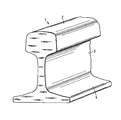
- the drawing shows the rail 1 with its head 2, web 3 and foot 4.
Landscapes
- Chemical & Material Sciences (AREA)
- Engineering & Computer Science (AREA)
- Physics & Mathematics (AREA)
- Thermal Sciences (AREA)
- Crystallography & Structural Chemistry (AREA)
- Mechanical Engineering (AREA)
- Materials Engineering (AREA)
- Metallurgy (AREA)
- Organic Chemistry (AREA)
- Heat Treatment Of Articles (AREA)
- Metal Rolling (AREA)
Applications Claiming Priority (2)
| Application Number | Priority Date | Filing Date | Title |
|---|---|---|---|
| DE19833336006 DE3336006A1 (de) | 1983-10-04 | 1983-10-04 | Schiene mit hoher verschleissfestigkeit im kopf und hoher bruchsicherheit im fuss |
| DE3336006 | 1983-10-04 |
Publications (2)
| Publication Number | Publication Date |
|---|---|
| EP0136613A2 true EP0136613A2 (fr) | 1985-04-10 |
| EP0136613A3 EP0136613A3 (fr) | 1986-08-20 |
Family
ID=6210916
Family Applications (1)
| Application Number | Title | Priority Date | Filing Date |
|---|---|---|---|
| EP84111040A Withdrawn EP0136613A3 (fr) | 1983-10-04 | 1984-09-15 | Rail ayant une haute résistance à l'usure dans le champignon et une haute résistance à la rupture dans le patin |
Country Status (4)
| Country | Link |
|---|---|
| US (1) | US4575397A (fr) |
| EP (1) | EP0136613A3 (fr) |
| JP (1) | JPS60103154A (fr) |
| DE (1) | DE3336006A1 (fr) |
Cited By (2)
| Publication number | Priority date | Publication date | Assignee | Title |
|---|---|---|---|---|
| EP0252895A3 (en) * | 1986-07-10 | 1990-07-18 | Centre De Recherches Metallurgiques Centrum Voor Research In De Metallurgie Association Sans But Lucratif | Method and apparatus for producing high resistant rails |
| EP0849368A1 (fr) * | 1996-12-19 | 1998-06-24 | Voest-Alpine Schienen GmbH | Laminé profilé et procédé pour sa fabrication |
Families Citing this family (21)
| Publication number | Priority date | Publication date | Assignee | Title |
|---|---|---|---|---|
| EP0190448A1 (fr) * | 1985-01-18 | 1986-08-13 | Krupp Stahl AG | Procédé pour diminuer les tensions résiduelles de rails d'acier dressés par rouleaux |
| JPS6299438A (ja) * | 1985-10-24 | 1987-05-08 | Nippon Kokan Kk <Nkk> | 不安定破壊伝播停止能力を有する耐摩耗性高性能レ−ル |
| JPS62227042A (ja) * | 1986-03-28 | 1987-10-06 | Nippon Steel Corp | 衝撃破壊抵抗性の優れた軌条の製造法 |
| JPH0730401B2 (ja) * | 1986-11-17 | 1995-04-05 | 日本鋼管株式会社 | 靭性の優れた高強度レ−ルの製造方法 |
| US4886558A (en) * | 1987-05-28 | 1989-12-12 | Nkk Corporation | Method for heat-treating steel rail head |
| US5000798A (en) * | 1989-11-07 | 1991-03-19 | The Algoma Steel Corporation, Limited | Method for shape control of rail during accelerated cooling |
| US5209792A (en) * | 1990-07-30 | 1993-05-11 | Nkk Corporation | High-strength, damage-resistant rail |
| US5135587A (en) * | 1991-04-01 | 1992-08-04 | Ford Motor Company | Machinable, strong, but crackable low ductility steel forging |
| DE4200545A1 (de) * | 1992-01-11 | 1993-07-15 | Butzbacher Weichenbau Gmbh | Gleisteile sowie verfahren zur herstellung dieser |
| US5704570A (en) * | 1992-12-16 | 1998-01-06 | Yamato Kogyo Co., Ltd. | Welded nose rail used for crossing |
| GB9313060D0 (en) * | 1993-06-24 | 1993-08-11 | British Steel Plc | Rails |
| RU2139946C1 (ru) * | 1996-04-15 | 1999-10-20 | Ниппон Стил Корпорейшн | Обладающие превосходной износостойкостью и свариваемостью рельсы из низколегированной термообработанной перлитной стали, а также способ их производства |
| US5815833A (en) * | 1998-01-28 | 1998-10-06 | Kuo; Li-Lin | Convertible article for simultaneously providing sleeping bag, jacket and carrying bag |
| DE10107746A1 (de) * | 2001-02-07 | 2003-04-03 | Schreck Mieves Gmbh | Schiene für gleisgebundene Tagebaugrossgeräte |
| RU2283353C1 (ru) * | 2005-02-14 | 2006-09-10 | Открытое акционерное общество "Новокузнецкий металлургический комбинат" | Способ термической обработки рельсов |
| CN100482812C (zh) * | 2006-09-12 | 2009-04-29 | 攀枝花钢铁(集团)公司 | 钢轨热处理方法及钢轨热处理机组 |
| JP4994928B2 (ja) * | 2007-04-17 | 2012-08-08 | 新日本製鐵株式会社 | 耐折損性に優れたレールの製造方法 |
| US20110189047A1 (en) * | 2010-02-02 | 2011-08-04 | Transportation Technology Center, Inc. | Railroad rail steels resistant to rolling contact fatigue |
| CN101880822B (zh) * | 2010-07-21 | 2012-05-30 | 武汉钢铁(集团)公司 | 用于客运钢轨的热轧高韧性碳素钢 |
| US9573432B2 (en) | 2013-10-01 | 2017-02-21 | Hendrickson Usa, L.L.C. | Leaf spring and method of manufacture thereof having sections with different levels of through hardness |
| CA2962031C (fr) * | 2014-09-22 | 2019-05-14 | Jfe Steel Corporation | Procede de fabrication de rail et appareil de fabrication de rail |
Family Cites Families (10)
| Publication number | Priority date | Publication date | Assignee | Title |
|---|---|---|---|---|
| US1285749A (en) * | 1915-05-15 | 1918-11-26 | Bethlehem Steel Corp | Steel rail. |
| US1418985A (en) * | 1920-12-08 | 1922-06-06 | William J Martin | Process of and apparatus for tempering steel rails |
| US1828325A (en) * | 1927-08-22 | 1931-10-20 | Kurz Heinrich | Process for the manufacture of rails with hardened heads |
| US2793947A (en) * | 1954-12-27 | 1957-05-28 | United States Steel Corp | Shelling-resistant rail |
| AT259610B (de) * | 1965-08-18 | 1968-01-25 | Krupp Ag Huettenwerke | Verfahren zur Herstellung von verschleißfesten Schienen hoher Festigkeit |
| DE1508415B1 (de) * | 1966-05-05 | 1970-11-26 | Krupp Ag Huettenwerke | Verfahren zur Waermebehandlung von Schienen,insbesondere Eisenbahnschienen aus Stahl |
| DE1583418B2 (de) * | 1967-08-08 | 1972-05-18 | Ukrainskij Nautschno-Issledowatelskij Institut Metallow, Charkow (Sowjetunion) | Vorrichtung zum fortlaufenden abschrecken von schienen |
| GB1342582A (en) * | 1970-03-20 | 1974-01-03 | British Steel Corp | Rail steel |
| DE2439338C2 (de) * | 1974-08-16 | 1980-08-28 | Fried. Krupp, Huettenwerke Ag, 4630 Bochum | Verfahren zur Wärmebehandlung von Schienen aus der Walzhitze |
| US4486248A (en) * | 1982-08-05 | 1984-12-04 | The Algoma Steel Corporation Limited | Method for the production of improved railway rails by accelerated cooling in line with the production rolling mill |
-
1983
- 1983-10-04 DE DE19833336006 patent/DE3336006A1/de not_active Ceased
-
1984
- 1984-09-15 EP EP84111040A patent/EP0136613A3/fr not_active Withdrawn
- 1984-10-01 US US06/656,400 patent/US4575397A/en not_active Expired - Fee Related
- 1984-10-03 JP JP59206430A patent/JPS60103154A/ja active Pending
Cited By (3)
| Publication number | Priority date | Publication date | Assignee | Title |
|---|---|---|---|---|
| EP0252895A3 (en) * | 1986-07-10 | 1990-07-18 | Centre De Recherches Metallurgiques Centrum Voor Research In De Metallurgie Association Sans But Lucratif | Method and apparatus for producing high resistant rails |
| EP0849368A1 (fr) * | 1996-12-19 | 1998-06-24 | Voest-Alpine Schienen GmbH | Laminé profilé et procédé pour sa fabrication |
| US6086685A (en) * | 1996-12-19 | 2000-07-11 | Voest-Alpine Schienen Gmbh | Profiled rolling stock and method for manufacturing the same |
Also Published As
| Publication number | Publication date |
|---|---|
| US4575397A (en) | 1986-03-11 |
| EP0136613A3 (fr) | 1986-08-20 |
| JPS60103154A (ja) | 1985-06-07 |
| DE3336006A1 (de) | 1985-04-25 |
Similar Documents
| Publication | Publication Date | Title |
|---|---|---|
| EP0136613A2 (fr) | Rail ayant une haute résistance à l'usure dans le champignon et une haute résistance à la rupture dans le patin | |
| DE69811200T2 (de) | Einsatzstahl mit hervorragender verhinderung der sekundärrekristallisation während der aufkohlung, verfahren zu dessen herstellung, halbzeug für aufzukohlende teile | |
| DE60130755T2 (de) | Warmgewalzter draht oder stahlblock, die wärmebandelbar und verwendbar im maschinenbau sind und herstellungsverfahren dafür | |
| DE2439338C2 (de) | Verfahren zur Wärmebehandlung von Schienen aus der Walzhitze | |
| EP1546426B1 (fr) | Composition d'acier et pieces matricees fabriquees a partir de cette composition | |
| DE60205744T2 (de) | Durch beanspruchungsarme bearbeitung und glühen von gewöhnlichem kohlenstoffarmem stahl hergestellte hochfeste und hochduktile stahlplatte mit hyperfeiner kristallkornstruktur und herstellungsverfahren dafür | |
| DE112016005223T5 (de) | Nicht vergüteter Walzdraht mit ausgezeichneter Kaltverformbarkeit und Herstellungsverfahren davon | |
| DE69418565T2 (de) | Wärmeunbehandelter stahl zum warmschmieden, verfahren zur herstellung eines daraus hergestellten schmiedestückes und schmiedestück | |
| DE112020004121T5 (de) | Warmgewalzter stahl für räder mit einer zugfestigkeit von über 500 mpa und herstellungsverfahren dafür | |
| DE1301586B (de) | Austenitische ausscheidungshaertbare Stahllegierung und Verfahren zu ihrer Waermebehandlung | |
| EP1561833B1 (fr) | Acier pour la fabrication d'éléments à haute résistance mécanique et excellente ténacité aux basses températures et son utilisation | |
| DE69409524T2 (de) | Schienen | |
| EP0620865B1 (fr) | Tron on de voie ferree et son procede de fabrication | |
| EP2103704B1 (fr) | Produit longitudinal laminé à chaud et son procédé de fabrication | |
| EP0160616A2 (fr) | Utilisation d'un acier dans des atmosphères contenant de l'acide sulfhydrique | |
| EP0422378A1 (fr) | Méthode pour amÀ©liorer le travail à froid d'aciers trempables | |
| EP1052296B1 (fr) | Utilisation d'un acier pour la fabrication de plaques de blindage | |
| WO2016020519A1 (fr) | Produits semi-finis à haute résistance et en même temps durs, et composants en acier fortement allié, leur procédé de fabrication et utilisation | |
| DE2356791A1 (de) | Verfahren zum herstellen von draht aus niedriglegiertem stahl | |
| DE3616518A1 (de) | Verfahren zum herstellen eines hochfesten stahls | |
| DE2416055C3 (de) | Verwendung eines Stahles als Werkstoff für Schienen | |
| DE3832014A1 (de) | Verfahren zur herstellung hochfester nahtloser stahlrohre | |
| DE2846930C2 (de) | Verwendung eines austenitischen Manganstahls | |
| DE69107439T2 (de) | Hochfester rostfreier Stahl mit guten Zähigkeitseigenschaften, und Verfahren zu seiner Herstellung. | |
| DE112006003553B4 (de) | Dicke Stahlplatte für eine Schweißkonstruktion mit ausgezeichneter Festigkeit und Zähigkeit in einem Zentralbereich der Dicke und geringen Eigenschaftsänderungen durch ihre Dicke und Produktionsverfahren dafür |
Legal Events
| Date | Code | Title | Description |
|---|---|---|---|
| PUAI | Public reference made under article 153(3) epc to a published international application that has entered the european phase |
Free format text: ORIGINAL CODE: 0009012 |
|
| AK | Designated contracting states |
Designated state(s): AT DE FR GB IT LU |
|
| RTI1 | Title (correction) | ||
| PUAL | Search report despatched |
Free format text: ORIGINAL CODE: 0009013 |
|
| STAA | Information on the status of an ep patent application or granted ep patent |
Free format text: STATUS: THE APPLICATION HAS BEEN WITHDRAWN |
|
| AK | Designated contracting states |
Kind code of ref document: A3 Designated state(s): AT DE FR GB IT LU |
|
| 18W | Application withdrawn |
Withdrawal date: 19860730 |
|
| RIN1 | Information on inventor provided before grant (corrected) |
Inventor name: HELLER, WILHELM, DR.-ING. |