EP0137251A2 - Bismorpholines, process for their preparation and their use as anti-hydrolysis agents - Google Patents
Bismorpholines, process for their preparation and their use as anti-hydrolysis agents Download PDFInfo
- Publication number
- EP0137251A2 EP0137251A2 EP84109977A EP84109977A EP0137251A2 EP 0137251 A2 EP0137251 A2 EP 0137251A2 EP 84109977 A EP84109977 A EP 84109977A EP 84109977 A EP84109977 A EP 84109977A EP 0137251 A2 EP0137251 A2 EP 0137251A2
- Authority
- EP
- European Patent Office
- Prior art keywords
- alkyl
- cycloalkyl
- alkenyl
- oder
- hydrogen
- Prior art date
- Legal status (The legal status is an assumption and is not a legal conclusion. Google has not performed a legal analysis and makes no representation as to the accuracy of the status listed.)
- Granted
Links
- RWVOGXIGXUGIFR-UHFFFAOYSA-N C(CC1)CCC1N1C2Oc(cccc3)c3N(C3CCCCC3)C2OC2C1CCCC2 Chemical compound C(CC1)CCC1N1C2Oc(cccc3)c3N(C3CCCCC3)C2OC2C1CCCC2 RWVOGXIGXUGIFR-UHFFFAOYSA-N 0.000 description 1
- QEHNAGPCAZIOMD-UHFFFAOYSA-N CCC1N(C)C2OCC(C=C)N(C)C2OC1 Chemical compound CCC1N(C)C2OCC(C=C)N(C)C2OC1 QEHNAGPCAZIOMD-UHFFFAOYSA-N 0.000 description 1
Classifications
-
- C—CHEMISTRY; METALLURGY
- C07—ORGANIC CHEMISTRY
- C07D—HETEROCYCLIC COMPOUNDS
- C07D498/00—Heterocyclic compounds containing in the condensed system at least one hetero ring having nitrogen and oxygen atoms as the only ring hetero atoms
- C07D498/02—Heterocyclic compounds containing in the condensed system at least one hetero ring having nitrogen and oxygen atoms as the only ring hetero atoms in which the condensed system contains two hetero rings
- C07D498/04—Ortho-condensed systems
-
- C—CHEMISTRY; METALLURGY
- C08—ORGANIC MACROMOLECULAR COMPOUNDS; THEIR PREPARATION OR CHEMICAL WORKING-UP; COMPOSITIONS BASED THEREON
- C08K—Use of inorganic or non-macromolecular organic substances as compounding ingredients
- C08K5/00—Use of organic ingredients
- C08K5/16—Nitrogen-containing compounds
- C08K5/34—Heterocyclic compounds having nitrogen in the ring
- C08K5/35—Heterocyclic compounds having nitrogen in the ring having also oxygen in the ring
Definitions
- the subject of the invention is also the use of these 2,3,2 ', 3'-bismorpholine derivatives in amounts of 0.1 to 10 parts by weight in plastics containing ester and / or carbonate groups, in particular in polyurethanes based on higher molecular weight polyester and / or Polycarbonate polyols as hydrolysis protection agents.
- Ester groups are known to be susceptible to hydrolytic cleavage with the regression of the starting components. In the case of higher molecular weight substances which contain ester groups as structural components, such a reaction causes the polymer chain to degrade, which as a rule results in a loss of the mechanical values. Another disadvantage is the autocatalytic destruction caused by the constantly emerging carboxylic acid groups, which is becoming increasingly drastic.
- hydroxyalkylurea derivatives described in DE-PS 2 106 726 also show good effects, but the high melting points and the low solubility of this substance class in polyesters or short-chain chain extenders are disadvantageous here.
- cycloalkyl or aryl radicals can also carry inert radicals such as alkyl, chlorine or bromine.
- the invention furthermore relates to the use of 2,3,2 ', 3'-bismorpholines as hydrolysis protection agents for plastics containing ester groups and / or carbonate groups, in particular polyurethanes comprising polyisocyanates, ester groups and / or carbonate groups containing polyols containing ester groups and / or carbonate groups, preferably High molecular weight polyols, and optionally other auxiliaries and additives, by the 2,3,2 ', 3'-bismorpholine derivatives of the structure identified above are used in the plastic in amounts of 0.1 to 10, preferably 0.3 to 5, particularly preferably 0.5 to 2.5 parts.
- the bismorpholines can be added to the starting materials or their mixtures, in the case of polyurethanes, for example, either to the higher molecular weight polyol part and / or the customarily used chain extenders or to their mixtures. You can also the finished plastics containing ester and / or carbonate groups, e.g. their melts, solutions or dispersions.
- Glyoxal serves as the starting compound for the preparation of the bismorpholines as the preferred bisaldehyde, which is generally used in the form of its technical, aqueous solution.
- N-monosubstituted ⁇ -amino alcohols N-methylethanolamine, N-ethylethanolamine, N-propylethanolamine, N-cyclohexylethanolamine, 2-hydroxyethylaniline, 2- (N-methylamino) -butene- (3) -ol- (1), N-methylamino-2-
- Glyoxal and the B-amino alcohols are preferably reacted in stoichiometric amounts (1: 2); if one of the components is in excess, the compounds according to the invention nevertheless form in accordance with the amount of the deficit component.
- the reaction itself is preferably carried out in aqueous solution, after a short heating, e.g. to 40 to 100 ° C, the reaction products, especially those of the higher substituted representatives, drop out, e.g. the methyl or ethyl derivatives can be obtained virtually quantitatively with good purity by partially concentrating their solution.
- the reaction can also be carried out in aqueous organic solvents, e.g. aqueous alcohols, ethers or ketones and similar compounds.
- polyurethanes containing ester groups and / or carbonate groups in particular can be effectively stabilized.
- ester and / or carbonate groups there are any polyurethanes, with Mit Use of polyols containing ester groups and / or carbonate groups to understand polyurethanes, ie polyurethane foams, polyurethane elastomers, polyurethane-based coating agents, adhesives, joint sealing compounds and others.
- Such polyurethanes containing ester groups can be constructed on the basis of higher molecular weight hydroxypolyesters, hydroxypolylactones, for example on the basis of oil caprolactones, hydroxypolycarbonates, for example hexanediol polycarbonates and polyethers containing ester or carbonate groups.
- the hydrolysis stabilizers to be used according to the invention are also suitable for protecting any other plastics containing ester groups and / or carbonate groups, such as polyesters from polycarboxylic acids, preferably dicarboxylic acids such as phthalic acid, isophthalic acid, terephthalic acid or adipic acid Carbonic acid, and polyhydric alcohols, such as ethylene glycol, butanediol, neopentyldiol, hexanediol, glycerin, 2,2-bis (4'-hydroxyphenyl) propane, trimethylolpropane, pentaerythritol, etc.
- polycarboxylic acids preferably dicarboxylic acids such as phthalic acid, isophthalic acid, terephthalic acid or adipic acid Carbonic acid
- polyhydric alcohols such as ethylene glycol, butanediol, neopentyldiol, hexanediol
- polycarbonates for example based on 2,2-bis (4'-hydroxyphenyl) propane, can be stabilized.
- plastics can be present, for example, as paints, films, coatings, fibers, foams, elastomers, casting resins or compacts.
- the slightly yellow product can be converted into a completely colorless substance with a melting point of 75 ° C. by sublimation.
- the molecular ion M + is observed at 172 in the mass spectrum.
- the high-field resonance served to elucidate the structure, the results of which are tabulated.
- the data obtained correspond to those of the morpholine ring 1,2 . This is especially true for the geminal and vicinal coupling constants.
- 100 parts by weight of a polyester consisting of adipic acid and ethylene glycol with an average molecular weight of 2,000 and an OH number of 56 are dewatered at 130 ° C. under a vacuum of approx. 40 mm and then kept at approx. 130 ° C.
- 1,4-butanediol are added to the prepolymer with vigorous stirring. It is stirred for about 30 seconds and poured into a mold preheated to 110 ° C. The mixture is pourable for approx. 60 seconds and solidifies after approx. 9 minutes.
- the elastomer is annealed at 110 ° C for 24 hours. It then has the properties given in Table 1).
- Example 7 the NCO prepolymer is made. After the exothermic reaction has ended, a mixture of 0.6 parts by weight, 4,4'-dimethyl-2,3, 2 ', 3'-bismorpholine according to Example 1 is added to the NCO prepolymer with vigorous stirring in 5 parts by weight. Parts of butanediol 1.4 as given and processed as in Example 7.
- the comparative values show that the substance class according to the invention is superior in its action to a conventional stabilizer which is commonly used in industry.
- the NCO prepolymer is prepared as in Example 7. After the exothermic reaction has ended, a mixture of 0.8 part by weight according to Example 6 and 5.0 parts by weight 1,4-butanediol is added to the prepolymer with vigorous stirring. It is stirred for about 30 seconds and in a to 110 ° C. preheated mold. The mixture is pourable for approx. 50 seconds and solidifies after approx. 9 minutes.
- the elastomer is annealed at 110 ° C for 24 hours. After that, it has the following properties (see Table 1).
Landscapes
- Chemical & Material Sciences (AREA)
- Organic Chemistry (AREA)
- Health & Medical Sciences (AREA)
- Chemical Kinetics & Catalysis (AREA)
- Medicinal Chemistry (AREA)
- Polymers & Plastics (AREA)
- Polyurethanes Or Polyureas (AREA)
Abstract
Gegenstand der Erfindung sind neuartige 2,3,2',3'-Bismorpholinderivate der Formel

- R, und R2 gleiche oder verschiedene Alkyl-, Alkenyl-, Cycloalkyl- oder Aryl-Substituenten,
- R3,R4,R5,R6 Wasserstoff und/oder Alkyl-, Alkenyl- sowie Aryl-Substituenten bevorzugt C1-C7-Substituenten oder über Verknüpfung von R3 und R6 einen Cycloalkylen- oder Aryten-Substituenten bildend, wobei für Arylen R4, Rs entfallen, bedeuten.
- R and R 2 are identical or different alkyl, alkenyl, cycloalkyl or aryl substituents,
- R 3 , R 4 , R 5 , R 6 are hydrogen and / or alkyl, alkenyl and aryl substituents, preferably C 1 -C 7 substituents or by linking R 3 and R 6 to form a cycloalkylene or aryten substituent, where R 4 , R s are omitted for aryls.
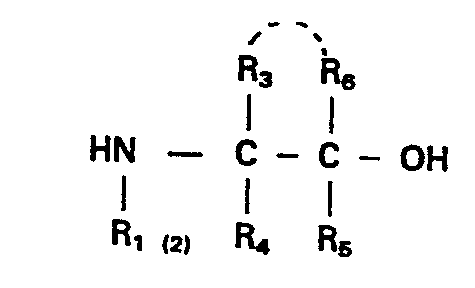
Beansprucht wird auch ihr Herstellungverfahren durch Umsetzung von Glyoxal mit N-monosubstituierten Aminoethanolen vom Typ
Erfindungsgegenstand ist ferner die Verwendung dieser 2,3,2',3'-Bismorpholinderivate in Mengen von 0,1 bis 10 Gew.-Teilen in ester- und/oder carbonatgruppenhaltigen Kunststoffen, insbesondere in Polyurethanen auf Basis von höhermolekularen Polyester- und/oder Polycarbonatpolyolen als Hydrolyseschutzmittel.The subject of the invention is also the use of these 2,3,2 ', 3'-bismorpholine derivatives in amounts of 0.1 to 10 parts by weight in plastics containing ester and / or carbonate groups, in particular in polyurethanes based on higher molecular weight polyester and / or Polycarbonate polyols as hydrolysis protection agents.
Description
Gegenstand der Erfindung sind neuartige 2,3,2',3'-Bismorpholinderivate der Formel

- R1 und R2 gleiche oder verschiedene Alkyl-, Alkenyl-, Cycloalkyl- oder Aryl-Substituenten,
- R3,R4,R5,R6 Wasserstoff und/oder Alkyl-, Alkenyl-, Cycloalkyl sowie Aryl-Substituenten, vorzugsweise C1-C7-Substituenten oder über Verknüpfung von R3 - und R6 einen Cycloalkylen- oder Arylen-Substituenten bildend, wobei für Arylen R4, R5 entfallen, bedeuten.
- R 1 and R 2 are identical or different alkyl, alkenyl, cycloalkyl or aryl substituents,
- R 3 , R 4 , R 5 , R 6 are hydrogen and / or alkyl, alkenyl, cycloalkyl and aryl substituents, preferably C 1 -C 7 substituents or, by linking R 3 - and R 6, a cycloalkylene or arylene -Substituting, where R 4 , R 5 are absent for arylene.
Beansprucht wird auch ihr Herstellungverfahren durch Umsetzung von Glyoxal mit N-monosubstituierten Aminoethanolen vom Typ .

Erfindungsgegenstand ist ferner die Verwendung dieser 2,3,2',3'-Bismorpholinderivate in Mengen von 0,1 bis 10 Gew.-Teilen in ester- und/oder carbonatgruppenhaltigen Kunststoffen, insbesondere in Polyurethanen auf Basis von höhermolekularen Polyester- und/oder Polycarbonatpolyolen als Hydrolyseschutzmittel.The subject of the invention is also the use of these 2,3,2 ', 3'-bismorpholine derivatives in amounts of 0.1 to 10 parts by weight in plastics containing ester and / or carbonate groups, in particular in polyurethanes based on higher molecular weight polyester and / or Polycarbonate polyols as hydrolysis protection agents.
Bekanntlich sind Estergruppen (einschließlich Carbonatgruppen) gegen hydrolytische Spaltung unter Rückbildung der Ausgangskomponenten anfällig. Bei höhermolekularen Stoffen, die Estergruppen als Aufbaukomponenten enthalten, bewirkt eine solche Reaktion den Abbau der Polymerkette, was in der Regel einen.Verlust der mechanischen Werte bewirkt. Ein weiterer Nachteil ist die autokatalytische Zerstörung durch fortwährend neu anfallende Carbonsäuregruppen, die immer drastischer wird.Ester groups (including carbonate groups) are known to be susceptible to hydrolytic cleavage with the regression of the starting components. In the case of higher molecular weight substances which contain ester groups as structural components, such a reaction causes the polymer chain to degrade, which as a rule results in a loss of the mechanical values. Another disadvantage is the autocatalytic destruction caused by the constantly emerging carboxylic acid groups, which is becoming increasingly drastic.
Die Umsetzungsprodukte von Polyestern mit mindestens bifunktionellen Isocyanaten führt z.B. zu Polyurethanen, die als Hochleistungselastomere technisch mannigfaltige Anwendung finden. Um das hohe Werteniveau dieser Kunststoffe gegen einen Abbau durch feuchte Wärme, Wasser und Wasserdampf zu sichern, werden seit langem Hydrolyseschutzmittel verwendet, wie sie z.B. die Stoffgruppe der Carbodiimide darstellt und in der DE-PS 1 005 726 sowie den BE-PSen 610 969, 612 040 und 733 573 beschrieben sind. Aus der FR-PS 1 450 919 sind weiterhin Iminooxazolidine der Formel

- R1 = Aryl
- R2 = Aryl, Alkyl als Alterungsschutzmittel bei estergruppenhaltigen Verbindungen bekannt geworden. In beiden Fällen sind jedoch sowohl Wanderungstendenz, Auswirkungen auf den Druckverformungsrest als auch katalytische Wirkung (Veränderung der Gieß- und Topfzeiten von Polyurethanen) von Nachteil.
- R1 = aryl
- R 2 = aryl, alkyl has become known as an anti-aging agent for compounds containing ester groups. In both cases, however, both the tendency to migrate, the effects on the compression set and the catalytic effect (change in the pouring and pot life of polyurethanes) are disadvantageous.
Die in der DE-PS 2 106 726 beschriebenen Hydroxyalkylharnstoff-Derivate zeigen zwar auch gute Wirkung, nachteilig sind jedoch hier die hohen Schmelzpunkte und die geringe Löslichkeit dieser Stoffklasse in Polyestern oder kurzkettigen Kettenverlängerern.The hydroxyalkylurea derivatives described in DE-PS 2 106 726 also show good effects, but the high melting points and the low solubility of this substance class in polyesters or short-chain chain extenders are disadvantageous here.
Völlig überraschend wurde nun eine Gruppe von Hydrolyseschutzmitteln mit ausgeprägt positiv zu beurteilenden Verarbeitungseigenschaften aufgefunden, die mit den bisher bekannten Stoffklassen in keinem Zusammenhang steht, was Reaktionsverlauf, Struktur und Stoffeigenschaften der Reaktionsprodukte betrifft.Completely surprisingly, a group of hydrolysis protection agents with processing properties that are to be assessed as positively positive has now been found Previously known substance classes have no connection with regard to the course of the reaction, structure and material properties of the reaction products.
Hierbei handelt es sich um als Hydrolyseschutzmittel (HSM) wirkende, bisher nicht beschriebene Reaktionsprodukte von Glyoxal und durch organische Gruppen substituierte Aminoethanolen, wobei Cycloacetale der Struktur von 2,3,2',3'-Bismorpholinen gemäß der Struktur
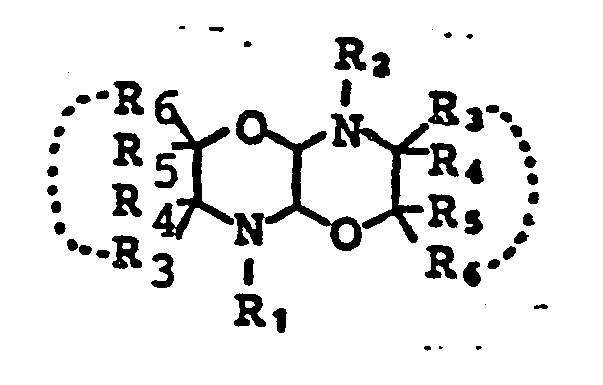
- R1 und R2 gleiche oder verschiedene Alkyl-, Alkenyl-, Cycloalkyl- oder Aryl-Substituenten, bevorzugt C1- bis C7-Alkyl oder C5- bzw. C6-Cycloalkyl, besonders bevorzugt Methyl oder Cyclohexyl,
- R3, R4, R5' R6 Wasserstoff und/oder Alkyl-,Alkenyl-, Cycloalkyl- oder Aryl-Substituenten, bevorzugt C1-C7-AlkylSubstituenten, oder durch Verknüpfung von R3 und R6 mit dem Aminoethanol einen Cycloalkylen- oder Arylen-Substituenten bildend, wobei für Arylen-Substituenten R4/R5 entfällt, besonders bevorzugt Wasserstoff
- R 1 and R 2 are identical or different alkyl, alkenyl, cycloalkyl or aryl substituents, preferably C 1 to C 7 alkyl or C 5 or C 6 cycloalkyl, particularly preferably methyl or cyclohexyl,
- R 3 , R 4 , R 5 ' R 6 are hydrogen and / or alkyl, alkenyl, cycloalkyl or aryl substituents, preferably C 1 -C 7 alkyl substituents, or by linking R 3 and R 6 to the aminoethanol Forming cycloalkylene or arylene substituents, R 4 / R 5 being omitted for arylene substituents, particularly preferably hydrogen
Die Cycloalkyl- oder Arylreste (vorzugsweise Benzolreste) können auch inerte Reste wie Alkyl, Chlor oder Brom tragen.The cycloalkyl or aryl radicals (preferably benzene radicals) can also carry inert radicals such as alkyl, chlorine or bromine.
Gegenstand der Erfindung ist auch ein Verfahren zur Herstellung der 2,3,2',3'-Bismorpholinderivate aus
- a) Glyoxal und
- b) N-monosubstituierten Aminoethanolen vom Typ

- a) glyoxal and
- b) N-monosubstituted aminoethanols of the type
Gegenstand der Erfindung ist ferner die Verwendung von 2,3,2',3'-Bismorpholinen als Hydrolyseschutzmittel für Estergruppen und/oder Carbonatgruppen enthaltende Kunststoffe, insbesondere Estergruppen und/oder Carbonatgruppen enthaltende Polyurethane aus Polyisocyanaten, Estergruppen und/oder Carbonatgruppen aufweisenden Polyolen, vorzugsweise höhermolekularen Polyolen, sowie gegebenenfalls weiteren Hilfs- und Zusatzstoffen, indem man die 2,3,2',3'-Bismorpholinderivate der oben gekennzeichneten Struktur in Mengen von 0,1 bis 10, bevorzugt 0,3 bis 5, besonders bevorzugt 0,5 bis 2,5 Teilen, im Kunststoff verwendet.The invention furthermore relates to the use of 2,3,2 ', 3'-bismorpholines as hydrolysis protection agents for plastics containing ester groups and / or carbonate groups, in particular polyurethanes comprising polyisocyanates, ester groups and / or carbonate groups containing polyols containing ester groups and / or carbonate groups, preferably High molecular weight polyols, and optionally other auxiliaries and additives, by the 2,3,2 ', 3'-bismorpholine derivatives of the structure identified above are used in the plastic in amounts of 0.1 to 10, preferably 0.3 to 5, particularly preferably 0.5 to 2.5 parts.
Die Bismorpholine können aufgrund ihrer guten Löslichkeit den Ausgangsstoffen oder ihren Gemischen, bei Polyurethanen beispielsweise entweder dem höhermolekularen Polyolteil und/oder den üblich verwendeten Kettenverlängerungsmitteln oder ihren Gemischen zugesetzt werden. Sie können ferner auch den fertigen, Ester- und/oder Carbonatgruppen enthaltenden Kunststoffen, z.B. ihren Schmelzen, Lösungen oder Dispersionen, einverleibt werden.Because of their good solubility, the bismorpholines can be added to the starting materials or their mixtures, in the case of polyurethanes, for example, either to the higher molecular weight polyol part and / or the customarily used chain extenders or to their mixtures. You can also the finished plastics containing ester and / or carbonate groups, e.g. their melts, solutions or dispersions.
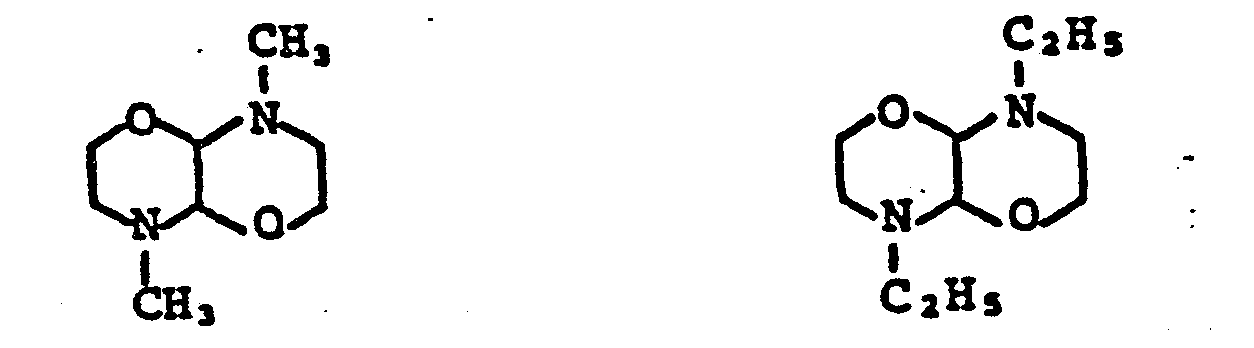
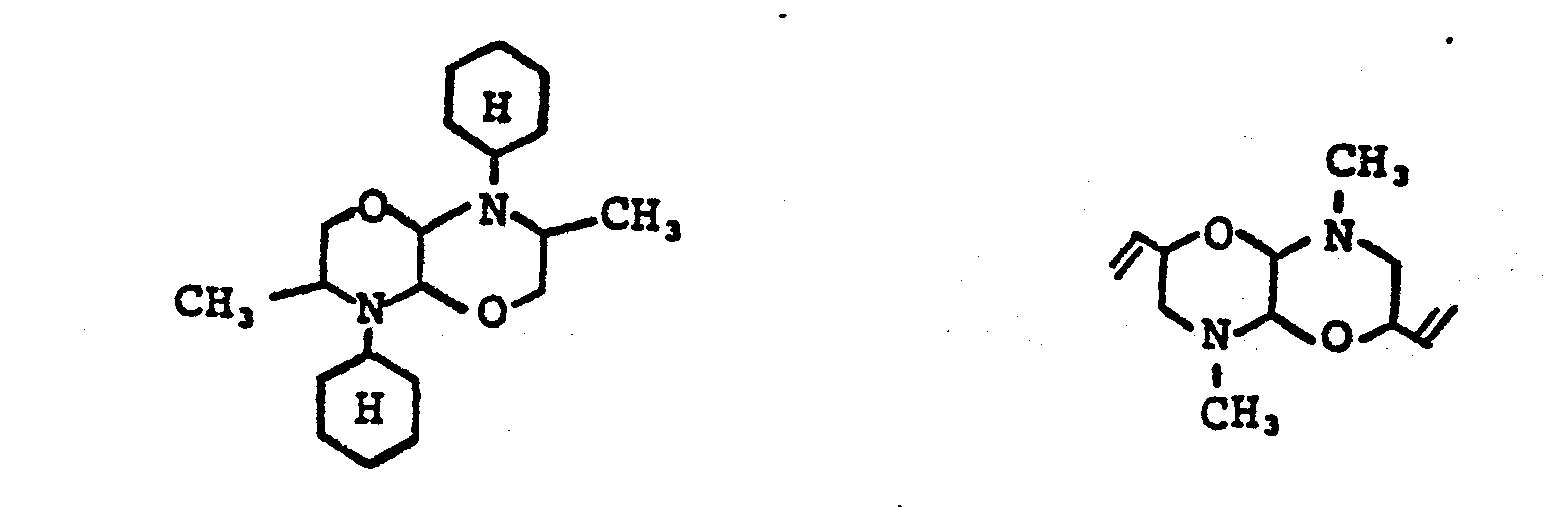
Als erfindungsgemäße Vertreter dieser Stoffklasse der Bismorpholine seien angeführt:




Als Ausgangsverbindungen für die Darstellung der Bismorpholine dient Glyoxal als bevorzugter Bisaldehyd, der im allgemeinen in Form seiner technischen, wäßrigen Lösung eingesetzt wird.Glyoxal serves as the starting compound for the preparation of the bismorpholines as the preferred bisaldehyde, which is generally used in the form of its technical, aqueous solution.
Als Beispiele für die N-monosubstituierten ß-Aminoalkohole seien folgende Verbindungen angeführt: N-Methylethanolamin, N-Ethyl-ethanolamin, N-Propyl-ethanolamin, N-Cyclohexyl-ethanolamin, 2-Hydroxyethyl-anilin, 2-(N-Methylamino)-buten-(3)-ol-(1), N-Methylamino-2-The following compounds may be mentioned as examples of the N-monosubstituted β-amino alcohols: N-methylethanolamine, N-ethylethanolamine, N-propylethanolamine, N-cyclohexylethanolamine, 2-hydroxyethylaniline, 2- (N-methylamino) -butene- (3) -ol- (1), N-methylamino-2-
hydroxy-buten-(3), 2-(N-Phenylamino)-buten-(3)-ol-(1), N-Phenylamino-2-hydroxy-buten-(3), 2-(N-Methylamino)-2-phenyl-ethanol, 2-(N-Methylamino)-1-phenyl-ethanol, 2-(N-Phenylamino)-2-phenyl-ethanol, 2-(N-Phenylamino)-1-phenyl-ethanol, 2-(N-Phenylamino)-cyclohexanol-1, 2-(N-Cyclohexylamino)-cyclohexanol-(1), 1-(N-Phenyl)-2-hydroxy-propylamin, 1-(N-Cyclohexyl)-2-hydroxypropylamin und 1-(N-Methyl)-2-hydroxypropyl-amin oder ihre Gemische.hydroxybutene (3), 2- (N-phenylamino) -butene- (3) -ol- (1), N-phenylamino-2-hydroxybutene (3), 2- (N-methylamino) - 2-phenylethanol, 2- (N-methylamino) -1-phenylethanol, 2- (N-phenylamino) -2-phenylethanol, 2- (N-phenylamino) -1-phenylethanol, 2- (N-phenylamino) cyclohexanol-1, 2- (N-cyclohexylamino) cyclohexanol- (1), 1- (N-phenyl) -2-hydroxypropylamine, 1- (N-cyclohexyl) -2-hydroxypropylamine and 1- (N-methyl) -2-hydroxypropylamine or their mixtures.
Glyoxal und die B-Aminoalkohole werden bevorzugt in stöchiometrischen Mengen (1 : 2) umgesetzt; bei Überschuß einer der Komponenten bilden sich trotzdem die erfindungsgemäßen Verbindungen entsprechend der Menge der Unterschußkomponente. Die Reaktion selbst wird bevorzugt in wäßriger Lösung durchgeführt, wobei nach kurzem Erwärmen, z.B. auf 40 bis 100°C, die Reaktionsprodukte, besonders die der höher substituierten Vertreter, ausfallen, während z.B. die Methyl- oder Ethylderivate durch teilweises Einengen ihrer Lösung praktisch quantitativ mit guter Reinheit erhalten werden können. Die Reaktion kann auch in wäßrig-organischen Lösungsmitteln erfolgen, z.B. wäßrigen Alkoholen, Ethern oder Ketonen und ähnlichen Verbindungen.Glyoxal and the B-amino alcohols are preferably reacted in stoichiometric amounts (1: 2); if one of the components is in excess, the compounds according to the invention nevertheless form in accordance with the amount of the deficit component. The reaction itself is preferably carried out in aqueous solution, after a short heating, e.g. to 40 to 100 ° C, the reaction products, especially those of the higher substituted representatives, drop out, e.g. the methyl or ethyl derivatives can be obtained virtually quantitatively with good purity by partially concentrating their solution. The reaction can also be carried out in aqueous organic solvents, e.g. aqueous alcohols, ethers or ketones and similar compounds.
Erfindungsgemäß können insbesondere Estergruppen und/oder Carbonatgruppen aufweisende Polyurethane wirksam stabilisiert werden. Unter Ester- und/oder Carbonatgruppen aufweisenden Polyurethanen sind beliebige, unter Mitverwendung von Estergruppen und/oder Carbonatgruppen aufweisenden Polyolen hergestellte Polyurethane, d.h. Polyurethanschaumstoffe, Polyurethanelastomere, Beschichtungsmittel auf Polyurethanbasis, Klebstoffe, Fugenvergußmassen und andere zu verstehen. Solche estergruppenhaltigen Polyurethane können auf der Basis von höhermolekularen Hydroxypolyestern, Hydroxypolylactonen, z.B. auf der Basis von Öi -Caprolactonen, Hydroxypolycarbonaten, z.B. Hexandiolpolycarbonaten und ester- bzw. carbonatgruppenhaltigen Polyethern aufgebaut werden.According to the invention, polyurethanes containing ester groups and / or carbonate groups in particular can be effectively stabilized. Under ester and / or carbonate groups, there are any polyurethanes, with Mit Use of polyols containing ester groups and / or carbonate groups to understand polyurethanes, ie polyurethane foams, polyurethane elastomers, polyurethane-based coating agents, adhesives, joint sealing compounds and others. Such polyurethanes containing ester groups can be constructed on the basis of higher molecular weight hydroxypolyesters, hydroxypolylactones, for example on the basis of oil caprolactones, hydroxypolycarbonates, for example hexanediol polycarbonates and polyethers containing ester or carbonate groups.
Außer zur bevorzugten Stabilisierung der Estergruppen und/oder Polycarbonatgruppen aufweisenden Polyurethane eignen sich die erfindungsgemäß zu verwendenden Hydrolyseschutzmittel auch zum Schutz beliebig anderer, Estergruppen und/oder Carbonatgruppen aufweisender Kunststoffe, wie z.B. Polyestern aus Polycarbonsäuren, vorzugsweise Dicarbonsäuren wie Phthalsäure, Isophthalsäure, Terephthalsäure, Adipinsäure oder Kohlensäure, und mehrwertigen Alkoholen, wie z.B. Ethylenglykol, Butandiol, Neopentyldiol, Hexandiol, Glycerin, 2,2-Bis-(4'-hydroxyphenyl)-propan, Trimethylolpropan, Pentaerythrit usw. Sie können auch zum Schutz von seitenständigen Estergruppen aufweisenden Polymeren bzw. Copolymeren auf Acrylsäure- bzw. Methacrylsäureesterbasis oder für Kunststoffe auf der Basis von Vinylestern, wie z.B. Polyvinylacetat usw. verwendet werden. Außerdem können Polycarbonate, z.B. auf der Basis von 2,2-Bis-(4'-hydroxyphenyl)-propan stabilisiert werden. Derartige Kunststoffe können beispielsweise als Lacke, Folien, Überzüge, Fasern, Schaumstoffe, Elastomere, Gießharze oder Preßkörper vorliegen.In addition to the preferred stabilization of the polyurethanes containing ester groups and / or polycarbonate groups, the hydrolysis stabilizers to be used according to the invention are also suitable for protecting any other plastics containing ester groups and / or carbonate groups, such as polyesters from polycarboxylic acids, preferably dicarboxylic acids such as phthalic acid, isophthalic acid, terephthalic acid or adipic acid Carbonic acid, and polyhydric alcohols, such as ethylene glycol, butanediol, neopentyldiol, hexanediol, glycerin, 2,2-bis (4'-hydroxyphenyl) propane, trimethylolpropane, pentaerythritol, etc. You can also protect polymers containing pendant ester groups or Copolymers based on acrylic acid or methacrylic acid ester or for plastics based on vinyl esters, such as polyvinyl acetate, etc., can be used. In addition, polycarbonates, for example based on 2,2-bis (4'-hydroxyphenyl) propane, can be stabilized. Such plastics can be present, for example, as paints, films, coatings, fibers, foams, elastomers, casting resins or compacts.

In 375 g (5 mol) Methylethanolamin werden 482 g (2,5 mol) 30 % wäßrige Glyoxallösung getropft, wobei die Temperatur auf 75 bis 80°C steigt. Man erhitzt 5 h auf 80°C und engt danach die Lösung ein, wobei das Bismorpholin langsam auskristallisiert. Die Restfeuchtigkeit wird durch Abnutschen entfernt und das Produkt getrocknet. Ausbeute 735 g, entspr. 85 % d. Th. Schmp. 73 - 74°C.482 g (2.5 mol) of 30% aqueous glyoxal solution are added dropwise to 375 g (5 mol) of methylethanolamine, the temperature rising to 75 to 80.degree. The mixture is heated at 80 ° C. for 5 h and then the solution is concentrated, the bismorpholine slowly crystallizing out. The residual moisture is removed by suction filtering and the product is dried. Yield 735 g, corresponding to 85% of theory. Th. Mp 73 - 74 ° C.
Das leicht gelbe Produkt kann durch Sublimation in eine völlig farblose Substanz vom Schmp. 75°C überführt werden.The slightly yellow product can be converted into a completely colorless substance with a melting point of 75 ° C. by sublimation.
Analyse ber.C 55,8, H 9,3, N 16,3; gef.C 55,2, H 9,0, N 16,2;Analysis calc. C 55.8, H 9.3, N 16.3; Found C 55.2, H 9.0, N 16.2;
Im Massenspektrum wird das Molekülion M + bei 172 beobachtet. Zur Strukturaufklärung diente die Hochfeldresonanz, deren Ergebnisse tabellarisch aufgeführt sind.The molecular ion M + is observed at 172 in the mass spectrum. The high-field resonance served to elucidate the structure, the results of which are tabulated.
1 H-Daten vom Beispiel 1, gem. bis 360 MHZ in CDC13 Chem. Versch. (ppm) Kopplungskonst. J (Hz)

Die erhaltenen Daten entsprechen denen des Morpholinrings 1,2. Das gilt vor allem für die geminalen und vicinalen Kopplungskonstanten.

In 48,5 g 30 %iger Glyoxallösung werden 75,5 g 3-Methyl-N-hydroxyethyl-anilin getropft, für 2 h auf 80°C erwärmt, abgekühlt, abgesaugt; der Rückstand wird mit 120 ml Methanol warm aufgerührt, abgesaugt und getrocknet; Ausbeute 58 g farbl. Kristalle, Schm. 151 - 152°C.
- 1) W.B. Smith u. B.A. Shoulders, J. Phys. Chem 69, 579 (1965)
- 2) J. Devilliers, H.D. Giao und J. Novech, Compt. Rend. 277C, 1067 (1973).
- 1) WB Smith u. BA Shoulders, J. Phys. Chem 69, 579 (1965)
- 2) J. Devilliers, HD Giao and J. Novech, Compt. Rend. 277C, 1067 (1973).
Analyse ber. C 75,0, H 6,2, N 8,7;Analysis calc. C 75.0, H 6.2, N 8.7;
gef. C 74,3, H 7,8, N 8,5;found C 74.3, H 7.8, N 8.5;
1H-Daten in CDC13 bei 360 MHz für den Morpholinteil

Die Struktur als Morpholinderivat wird demnach auch wie unter Beispiel 1 belegt.

In 96,8 g 30 %iger Glyoxallösung werden 137 g Hydroxyethylanilin getropft, für 2 h auf 80°C erwärmt, abgekühlt, abgesaugt, in 250 ml Methanol erwärmt, abgesaugt und getrocknet; Ausbeute 89 g farblose Kristalle, Schmp. 163°C;137 g of hydroxyethylaniline are added dropwise to 96.8 g of 30% glyoxal solution, heated to 80 ° C. for 2 h, cooled, suction filtered, heated in 250 ml of methanol, suction filtered and dried; Yield 89 g of colorless crystals, mp. 163 ° C;
Analyse ber. C 73,0, H 6,7, N 9,45; gef. C 71,4, H 6,5, N 8,9 ;

In 48,5 g 30 %.iger wäßriger Glyoxallösung werden 65 g 2-Aminomethylcyclohexanol getropft, 3 h auf 80°C erwärmt, anschließend eingeengt, auf Ton getrocknet und aus 70 ml Methanol umkristallisiert; Ausbeute 24 g farblose Kristalle, Schmp. 111 - 113°C Analyse ber. C 68,5, H 10,0, N 10,0; gef. C 68,8, H 9,0, N 9,9;

Analyse ber. C 77,2, H 7,9, N 6,95;Analysis calc. C 77.2, H 7.9, N 6.95;
gef. C 76,0, H 7,5, N 6,5 ;

Analyse ber.C 70,0, H 10,4, N 9,1;Analysis calc. C 70.0, H 10.4, N 9.1;
gef.C 69,9, H 10,0, N 9,1;Found C 69.9, H 10.0, N 9.1;
7.1 Standard-Polyurethan ohne Hydrolysenschutzmittel (Vergleich)7.1 Standard polyurethane without hydrolysis protection agent (comparison)
100 Gew.-Teile eines aus Adipinsäure und Ethylenglykol bestehenden Polyesters mit einem mittleren Molekulargewicht von 2.000 und einer OH-Zahl von 56 werden bei 130°C unter einem Vakuum von ca. 40 mm entwässert und anschließend bei ca. 130°C gehalten.100 parts by weight of a polyester consisting of adipic acid and ethylene glycol with an average molecular weight of 2,000 and an OH number of 56 are dewatered at 130 ° C. under a vacuum of approx. 40 mm and then kept at approx. 130 ° C.
Dann gibt man 25 Gew.-Teile 1,5-Diisocyanatonaphthalin zu. Nach ca. 2 Minuten wird ein Vakuum von ca.Then 25 parts by weight of 1,5-diisocyanatonaphthalene are added. After approx. 2 minutes, a vacuum of approx.
40 mm angelegt. Nach Beendigung der exothermen Reaktion wird zu dem Prepolymer unter starkem Rühren 5 Gew.-Teile Butandiol-1,4 zugegeben. Es wird ca. 30 Sekunden gerührt und in eine auf 110°C vorgeheizte Form gegossen. Die Mischung ist ca. 60 Sekunden gießfähig und erstarrt nach ca. 9 Minuten.40 mm. After the exothermic reaction has ended, 5 parts by weight of 1,4-butanediol are added to the prepolymer with vigorous stirring. It is stirred for about 30 seconds and poured into a mold preheated to 110 ° C. The mixture is pourable for approx. 60 seconds and solidifies after approx. 9 minutes.
Das Elastomer wird noch 24 Stunden bei 110°C getempert. Danach hat es die in Tabelle 1) angegebenen Eigenschaften.The elastomer is annealed at 110 ° C for 24 hours. It then has the properties given in Table 1).
Nach einer Lagerung in Wasser bei 80°C (Lagerkörper - Normstab S1 gemäß DIN 53504) wird die Zugfestigkeit, Spannung bei 100 % und die Reißdehnung nach 0, 7, 9 und 11 Tagen erneut.gemessen (siehe Tabelle 2).After storage in water at 80 ° C (bearing body - standard rod S1 according to DIN 53504) the tensile strength, tension at 100% and the elongation at break after 0, 7, 9 and 11 days are measured again (see Table 2).
Verwendung als Hydrolyseschutzmittel in Polyurethanelastomeren.Use as hydrolysis protection agent in polyurethane elastomers.
Wie in Beispiel 7 wird das NCO-Prepolymer hergestellt. Nach Beendigung der exothermen Reaktion wird zu dem NCO-Prepolymer unter starkem Rühren eine Abmischung von 0,6 Gew.-Teilen, 4,4'-Dimethyl-2,3, 2',3'-bismorpholin nach Beispiel 1 in 5 Gew.-Teile Butandiol 1,4 wie gegeben und wie in Beispiel 7 verarbeitet .As in Example 7, the NCO prepolymer is made. After the exothermic reaction has ended, a mixture of 0.6 parts by weight, 4,4'-dimethyl-2,3, 2 ', 3'-bismorpholine according to Example 1 is added to the NCO prepolymer with vigorous stirring in 5 parts by weight. Parts of butanediol 1.4 as given and processed as in Example 7.
Nach einer Lagerung in Wasser bei 80°C (Lagerkörper - Normstab S1 gemäß DIN 53 504) wird die Zugfestigkeit, Spannung bei 100 % und die Reißdehnung erneut gemessen (siehe Tabelle 2).After storage in water at 80 ° C (bearing body - standard rod S1 according to DIN 53 504), the tensile strength becomes speed, tension at 100% and the elongation at break measured again (see Table 2).
Die stabilisierende Wirkung der 2,3,2',3'-Bismorpholine zeigt sich besonders deutlich.nach der 11-tägigen Einwirkung von Wasser bei 80°C bei den Festigkeits- und Dehnungswerten.The stabilizing effect of 2,3,2 ', 3'-bismorpholines is particularly evident after the 11-day exposure to water at 80 ° C in the strength and elongation values.
(Vergleich mit einem bekannten Hydrolyseschutzmittel)(Comparison with a known hydrolysis protection agent)
Verwendet man statt der erfindungsgemäßen Verbindung nach Beispiel 8 0,85 Teile 2,2',6,6'-Tetraisopropyldiphenylcarbo diimid, werden folgende Werte im Hydrolysetest erhalten (siehe Tabelle 2).If, instead of the compound according to the invention according to Example 8, 0.85 part of 2,2 ', 6,6'-tetraisopropyldiphenylcarbodiimide is used, the following values are obtained in the hydrolysis test (see Table 2).
Die Vergleichswerte zeigen, daß die erfindungsgemäße Stoffklasse in ihrer Wirkung einem üblichen, technisch verbreitet eingesetzten Stabilisator überlegen ist.The comparative values show that the substance class according to the invention is superior in its action to a conventional stabilizer which is commonly used in industry.
Das NCO-Prepolymer wird wie in Beispiel 7 hergestellt. Nach Beendigung der exothermen Reaktion wird zu dem Prepolymer unter starkem Rühren eine Abmischung von 0,8 Gew.-Teilen nach Beispiel 6 und 5,0 Gew.-Teilen Butandiol-1,4 zugegeben. Es wird ca. 30 Sekunden gerührt und in eine auf 110°C vorgeheizte Form gegossen. Die Mischung ist ca. 50 Sekunden gießfähig und erstarrt nach ca. 9 Minuten.The NCO prepolymer is prepared as in Example 7. After the exothermic reaction has ended, a mixture of 0.8 part by weight according to Example 6 and 5.0 parts by weight 1,4-butanediol is added to the prepolymer with vigorous stirring. It is stirred for about 30 seconds and in a to 110 ° C. preheated mold. The mixture is pourable for approx. 50 seconds and solidifies after approx. 9 minutes.
Das Elastomer wird noch 24 Stunden bei 110°C getempert. Danach hat es folgende Eigenschaften (siehe Tabelle 1).The elastomer is annealed at 110 ° C for 24 hours. After that, it has the following properties (see Table 1).
Nach einer Lagerung in Wasser bei 80°C (Lagerkörper - Normstab S1 gemäß DIN 53504) wird die Zugfestigkeit, Spannung bei 100 % und die Reißdehnung erneut gemessen (siehe Tabelle 2).


100 Gew.-Teile eines Butandiol-1,4/Adipinsäurepolyesters (OH-Zahl 49,1) werden mit 1 Gew.-Teil Hydrolysenschutzmittel gemäß Beispiel 1, 0,8 Gew.-Teile Stearylamid und 10 Gew.-Teile Butandiol-1,4 bei 120°C verrührt. 39,6 Gew.-Teile 4,4'-Diisocyanatodiphenylmethan (Verhältnis von NCO/OH-Gruppen = 1,03) werden auf 60°C erhitzt und unter starkem Rühren zu der obigen 120°C warmen Lösung zugegeben. Das reagierende Gemisch wird anschließend auf ein mit Trennwachs.versehenes Blech gegossen. Es verfestigt sich sehr rasch und kann bereits nach etwa 6 Minuten entformt werden. Das Polymer wird nun in Schneidemühlen zerkleinert und nach 2 - 4 Tagen zu Formkörpern verspritzt, die 17 h bei 80°C getempert werden. Diese Formkörper weisen die in Tabelle 1 aufgeführten physikalischen Daten auf.100 parts by weight of a 1,4-butanediol / adipic acid polyester (OH number 49.1) are mixed with 1 part by weight of hydrolysis protection agent according to Example 1, 0.8 parts by weight of stearylamide and 10 parts by weight of butanediol-1 , 4 stirred at 120 ° C. 39.6 parts by weight of 4,4'-diisocyanatodiphenylmethane (ratio of NCO / OH groups = 1.03) are heated to 60 ° C. and added to the above 120 ° C. solution while stirring vigorously. The reacting mixture is then poured onto a sheet provided with Trennwachs.. It solidifies very quickly and can be removed from the mold after only about 6 minutes. The polymer is then comminuted in cutting mills and, after 2-4 days, molded to give moldings which are annealed at 80 ° C. for 17 h. These moldings have the physical data listed in Table 1.
Es fällt insbesondere die gute Hydrolysenstabilität dieses Produktes auf (Tabelle 2a). Nach 6 Tagen bei 100°C ist dieses Elastomer technisch noch weitgehend intakt, während das Vergleichsbeispiel ohne 4,4'-Dimethyl-2,3,2',3'-bis-morpholin fast vollständig zerstört ist.The good hydrolytic stability of this product is particularly noticeable (Table 2a). After 6 days at 100 ° C., this elastomer is still largely intact technically, while the comparative example without 4,4'-dimethyl-2,3,2 ', 3'-bis-morpholine is almost completely destroyed.
100 Gew.-Teile eines Butandiol-1,4/Adipinsäurepolyesters (OH-Zahl 49,1) werden mit 0,5 Gew.-Teilen des Hydrolysenschutzmittels gemäß Beispiel 6, 0,8 Gew.-Teilen Stearylamid und 10 Gew.-Teilen Butandiol-1,4 bei 120°C verrührt. 39,6 Gew.-Teile 4,4'-Diisocyanatodiphenylmethan (Verhältnis von NCO/OH-Gruppen = 1,03) werden auf 60°C erhitzt und unter starkem Rühren zu der obigen 120°C warmen Lösung zugegeben. Das reagierende Gemisch wird anschließend auf ein mit Trennwachs versehenes Blech gegossen. Es verfestigt sich sehr rasch und kann bereits nach etwa 6 Minuten entformt werden. Das Polymer wird nun in Schneidemühlen zerkleinert und nach 2 - 4 Tagen zu Formkörpern verspritzt, die 17 h bei 80°C getempert werden. Diese Formkörper weisen die in Tabelle 1 aufgeführten physikalischen Daten auf.100 parts by weight of a 1,4-butanediol / adipic acid polyester (OH number 49.1) are mixed with 0.5 part by weight of the hydrolysis protection agent according to Example 6, 0.8 part by weight of stearylamide and 10 parts by weight of 1,4-butanediol stirred at 120 ° C. 39.6 parts by weight of 4,4'-diisocyanatodiphenylmethane (ratio of NCO / OH groups = 1.03) are heated to 60 ° C. and added to the above 120 ° C. solution with vigorous stirring. The reacting mixture is then poured onto a sheet provided with release wax. It solidifies very quickly and can be removed from the mold after only about 6 minutes. The polymer is then comminuted in cutting mills and, after 2-4 days, molded to give moldings which are annealed at 80 ° C. for 17 h. These moldings have the physical data listed in Table 1.
Es fällt insbesondere die gute Hydrolysenstabilität dieses Produktes auf (Tabelle 2a). Nach 6 Tagen bei 100°C ist dieses Elastomer technisch noch weitgehend intakt, während das Vergleichsbeispiel ohne 4,4'-Bis- cyclohexyl-2,3,2',3'-bismorpholin fast vollständig zerstört ist.The good hydrolytic stability of this product is particularly noticeable (Table 2a). After 6 days at 100 ° C., this elastomer is still largely intact technically, while the comparative example without 4,4'-bis-cyclohexyl-2,3,2 ', 3'-bismorpholine is almost completely destroyed.
Es wird wie in Beispiel 11 und 12 verfahren. Es fehlt jedoch der erfindungsgemäße Stabilisatorzusatz.The procedure is as in Examples 11 and 12. However, the stabilizer additive according to the invention is missing.
Die physikalischen Prüfwerte dieses verspritzten Thermoplasten sind in Tabellen 1 und 2a aufgeführt.The physical test values of this sprayed thermoplastic are listed in Tables 1 and 2a.
Claims (7)

bedeuten.1. 2,3,2 ', 3'-bismorpholine derivatives of the formula
mean.
bedeutet.2. Compounds according to claim 1, characterized in that
means.
bedeutet.3. Compounds according to claims 1 and 2, characterized in that
means.

bedeuten, in wäßriger Lösung oder wasserhaltigen Lösungsmitteln, bevorzugt bei 40 bis 100°C und einem bevorzugten Molverhältnis von 1 : 2 umsetzt.4. A process for the preparation of the compounds according to claims 1 to 3, characterized in that glyoxal with N-monosubstituted amino alcohols of the formula
mean, in aqueous solution or water-containing solvents, preferably at 40 to 100 ° C and a preferred molar ratio of 1: 2.
Applications Claiming Priority (2)
| Application Number | Priority Date | Filing Date | Title |
|---|---|---|---|
| DE3331436 | 1983-08-31 | ||
| DE19833331436 DE3331436A1 (en) | 1983-08-31 | 1983-08-31 | BISMORPHOLINE, METHOD FOR THE PRODUCTION THEREOF AND THEIR USE AS A HYDROLYSIS PROTECT |
Publications (3)
| Publication Number | Publication Date |
|---|---|
| EP0137251A2 true EP0137251A2 (en) | 1985-04-17 |
| EP0137251A3 EP0137251A3 (en) | 1986-03-12 |
| EP0137251B1 EP0137251B1 (en) | 1988-09-28 |
Family
ID=6207921
Family Applications (1)
| Application Number | Title | Priority Date | Filing Date |
|---|---|---|---|
| EP84109977A Expired EP0137251B1 (en) | 1983-08-31 | 1984-08-22 | Bismorpholines, process for their preparation and their use as anti-hydrolysis agents |
Country Status (3)
| Country | Link |
|---|---|
| US (2) | US4617387A (en) |
| EP (1) | EP0137251B1 (en) |
| DE (2) | DE3331436A1 (en) |
Families Citing this family (3)
| Publication number | Priority date | Publication date | Assignee | Title |
|---|---|---|---|---|
| DE3504480A1 (en) * | 1985-02-09 | 1986-08-14 | Bayer Ag, 5090 Leverkusen | NEW CYCLOACETALS, METHOD FOR THE PRODUCTION THEREOF AND THEIR USE FOR THE PRODUCTION OF AZALACTONES |
| US5462721A (en) * | 1994-08-24 | 1995-10-31 | Crescent Holdings Limited | Hydrogen sulfide scavenging process |
| US7659326B2 (en) * | 2006-01-09 | 2010-02-09 | Beyond Technologies Australia Pty Ltd. | Antimicrobial paint |
Family Cites Families (9)
| Publication number | Priority date | Publication date | Assignee | Title |
|---|---|---|---|---|
| DE1005726B (en) * | 1955-10-26 | 1957-04-04 | Bayer Ag | Stabilizing agent against the effects of heat and moisture in polyester compounds modified by polysocyanates |
| NL272088A (en) * | 1960-12-02 | |||
| NL273087A (en) * | 1960-12-31 | |||
| US3594387A (en) * | 1964-10-09 | 1971-07-20 | Mobay Chemical Corp | Method of preparing 2-imino-oxazolidines and the stabilization of polyesters therewith |
| US3770693A (en) * | 1964-10-09 | 1973-11-06 | Baychem Corp | Stabilization of polyesterurethanes with 2-imino-oxazolidines |
| DE1292393B (en) * | 1965-10-12 | 1969-04-10 | Huels Chemische Werke Ag | Stabilization of unsaturated ethyleneª‡-olefin rubbers |
| DE1770495A1 (en) * | 1968-05-25 | 1971-11-11 | Bayer Ag | Stabilized polyethylene glycol terephthalates |
| US3689499A (en) * | 1968-10-28 | 1972-09-05 | Sidney H Metzger Jr | Method for preparing iminooxazolidines from guanidines |
| DE2106726C3 (en) * | 1971-02-12 | 1983-12-01 | Bayer Ag, 5090 Leverkusen | Hydrolysis inhibitor for plastics containing ester groups |
-
1983
- 1983-08-31 DE DE19833331436 patent/DE3331436A1/en not_active Withdrawn
-
1984
- 1984-08-15 US US06/640,907 patent/US4617387A/en not_active Expired - Fee Related
- 1984-08-22 EP EP84109977A patent/EP0137251B1/en not_active Expired
- 1984-08-22 DE DE8484109977T patent/DE3474304D1/en not_active Expired
-
1986
- 1986-04-29 US US06/857,014 patent/US4639478A/en not_active Expired - Fee Related
Also Published As
| Publication number | Publication date |
|---|---|
| US4639478A (en) | 1987-01-27 |
| DE3474304D1 (en) | 1988-11-03 |
| EP0137251A3 (en) | 1986-03-12 |
| US4617387A (en) | 1986-10-14 |
| DE3331436A1 (en) | 1985-03-21 |
| EP0137251B1 (en) | 1988-09-28 |
Similar Documents
| Publication | Publication Date | Title |
|---|---|---|
| EP0460481B1 (en) | Process for the stabilisation of resins containing ester groups | |
| DE2719131C2 (en) | ||
| DE69813395T2 (en) | Biodegradable plastic composition and method to control its biodegradation rate | |
| EP0571831B1 (en) | Multi-stage process for the preparation of thermoplastically processable polyurethane elastomers | |
| DE1108904B (en) | Process for the production of foams containing urethane groups | |
| DE2913958C3 (en) | Glass fiber reinforced thermoplastic polyurethane resin composition, method for its production and use thereof | |
| EP0609698A1 (en) | Process for the preparation of organic carboiimides and their utilization as stabilizers for plastics | |
| DE2545647C3 (en) | Stabilization of synthetic polymers | |
| EP0571828B1 (en) | Multi-stage process for the preparation of thermoplastically processable polyurethane elastomers | |
| DE1595699C3 (en) | Stabilized polyurethanes | |
| EP0137251B1 (en) | Bismorpholines, process for their preparation and their use as anti-hydrolysis agents | |
| DE1694093A1 (en) | Stabilization of polyurethanes | |
| DE2066059B1 (en) | Process for the preparation of cyanoformamidyl isocyanates | |
| DE1947953B2 (en) | ||
| DE2106726A1 (en) | Hydrolysis inhibitor for plastics containing ester groups | |
| EP0148462B1 (en) | Process for the in-situ preparation of urea groups containing diisocyanates in polyols, dispersions and solutions prepared according to this process and their use | |
| DE2545645C2 (en) | Thiazolinylamino-piperidine derivatives | |
| EP3099725A1 (en) | Stabilized plasticizers for thermoplastic polyurethane | |
| DE2545646A1 (en) | CYANAMID | |
| DE2364399A1 (en) | STABILIZED MOLDING AND COMPRESSED COMPOUNDS | |
| EP0563918A1 (en) | Polyurethane moulding material | |
| EP3686240A1 (en) | Hydrolytically stabilised polyethylene terephthalate (pet) - containing compositions | |
| DE2523106A1 (en) | MIXTURES OF ALPHA,ALPHA'-BIS-(2-HYDROXY-3,5-DIALKYLPHENYL)-P-DIISOPROPYLBENZENE AND -M-DIISOPROPYLBENZENE, PROCESS FOR THEIR PREPARATION AND THEIR USE AS STABILIZER | |
| DE2025896A1 (en) | New diamines. Eliminated from: 2001772 | |
| DE2523107A1 (en) | SYNTHETIC POLYMER MATERIALS STABILIZED AGAINST DISCOLORATION AND DEGRADATION |
Legal Events
| Date | Code | Title | Description |
|---|---|---|---|
| PUAI | Public reference made under article 153(3) epc to a published international application that has entered the european phase |
Free format text: ORIGINAL CODE: 0009012 |
|
| 17P | Request for examination filed |
Effective date: 19840822 |
|
| AK | Designated contracting states |
Designated state(s): BE DE FR GB IT |
|
| RTI1 | Title (correction) | ||
| PUAL | Search report despatched |
Free format text: ORIGINAL CODE: 0009013 |
|
| AK | Designated contracting states |
Kind code of ref document: A3 Designated state(s): BE DE FR GB IT |
|
| 17Q | First examination report despatched |
Effective date: 19870708 |
|
| GRAA | (expected) grant |
Free format text: ORIGINAL CODE: 0009210 |
|
| ITF | It: translation for a ep patent filed | ||
| AK | Designated contracting states |
Kind code of ref document: B1 Designated state(s): BE DE FR GB IT |
|
| REF | Corresponds to: |
Ref document number: 3474304 Country of ref document: DE Date of ref document: 19881103 |
|
| ET | Fr: translation filed | ||
| GBT | Gb: translation of ep patent filed (gb section 77(6)(a)/1977) | ||
| PLBE | No opposition filed within time limit |
Free format text: ORIGINAL CODE: 0009261 |
|
| STAA | Information on the status of an ep patent application or granted ep patent |
Free format text: STATUS: NO OPPOSITION FILED WITHIN TIME LIMIT |
|
| 26N | No opposition filed | ||
| PGFP | Annual fee paid to national office [announced via postgrant information from national office to epo] |
Ref country code: DE Payment date: 19930713 Year of fee payment: 10 |
|
| PGFP | Annual fee paid to national office [announced via postgrant information from national office to epo] |
Ref country code: FR Payment date: 19930811 Year of fee payment: 10 |
|
| PGFP | Annual fee paid to national office [announced via postgrant information from national office to epo] |
Ref country code: GB Payment date: 19930812 Year of fee payment: 10 |
|
| ITTA | It: last paid annual fee | ||
| PGFP | Annual fee paid to national office [announced via postgrant information from national office to epo] |
Ref country code: BE Payment date: 19930831 Year of fee payment: 10 |
|
| PG25 | Lapsed in a contracting state [announced via postgrant information from national office to epo] |
Ref country code: GB Effective date: 19940822 |
|
| PG25 | Lapsed in a contracting state [announced via postgrant information from national office to epo] |
Ref country code: BE Effective date: 19940831 |
|
| BERE | Be: lapsed |
Owner name: BAYER A.G. Effective date: 19940831 |
|
| GBPC | Gb: european patent ceased through non-payment of renewal fee |
Effective date: 19940822 |
|
| PG25 | Lapsed in a contracting state [announced via postgrant information from national office to epo] |
Ref country code: FR Effective date: 19950428 |
|
| PG25 | Lapsed in a contracting state [announced via postgrant information from national office to epo] |
Ref country code: DE Effective date: 19950503 |
|
| REG | Reference to a national code |
Ref country code: FR Ref legal event code: ST |