EP0137251B1 - Bismorpholine, Verfahren zu ihrer Herstellung und ihre Verwendung als Hydrolyseschutzmittel - Google Patents
Bismorpholine, Verfahren zu ihrer Herstellung und ihre Verwendung als Hydrolyseschutzmittel Download PDFInfo
- Publication number
- EP0137251B1 EP0137251B1 EP84109977A EP84109977A EP0137251B1 EP 0137251 B1 EP0137251 B1 EP 0137251B1 EP 84109977 A EP84109977 A EP 84109977A EP 84109977 A EP84109977 A EP 84109977A EP 0137251 B1 EP0137251 B1 EP 0137251B1
- Authority
- EP
- European Patent Office
- Prior art keywords
- groups
- group
- hydrogen
- phenyl
- denote
- Prior art date
- Legal status (The legal status is an assumption and is not a legal conclusion. Google has not performed a legal analysis and makes no representation as to the accuracy of the status listed.)
- Expired
Links
- 238000000034 method Methods 0.000 title claims description 5
- 238000002360 preparation method Methods 0.000 title claims description 4
- 230000000655 anti-hydrolysis Effects 0.000 title 1
- LEQAOMBKQFMDFZ-UHFFFAOYSA-N glyoxal Chemical compound O=CC=O LEQAOMBKQFMDFZ-UHFFFAOYSA-N 0.000 claims description 26
- 230000007062 hydrolysis Effects 0.000 claims description 19
- 238000006460 hydrolysis reaction Methods 0.000 claims description 19
- UFHFLCQGNIYNRP-UHFFFAOYSA-N Hydrogen Chemical compound [H][H] UFHFLCQGNIYNRP-UHFFFAOYSA-N 0.000 claims description 18
- 229910052739 hydrogen Inorganic materials 0.000 claims description 15
- 239000001257 hydrogen Substances 0.000 claims description 15
- 125000004185 ester group Chemical group 0.000 claims description 14
- 229920002635 polyurethane Polymers 0.000 claims description 14
- 239000004814 polyurethane Substances 0.000 claims description 14
- 125000005587 carbonate group Chemical group 0.000 claims description 13
- 229940015043 glyoxal Drugs 0.000 claims description 13
- 150000001875 compounds Chemical class 0.000 claims description 11
- 125000001997 phenyl group Chemical group [H]C1=C([H])C([H])=C(*)C([H])=C1[H] 0.000 claims description 11
- XLYOFNOQVPJJNP-UHFFFAOYSA-N water Substances O XLYOFNOQVPJJNP-UHFFFAOYSA-N 0.000 claims description 11
- -1 N-monosubstituted aminoalcohols Chemical class 0.000 claims description 8
- 150000003077 polyols Chemical class 0.000 claims description 6
- 239000000126 substance Substances 0.000 claims description 6
- 239000007864 aqueous solution Substances 0.000 claims description 5
- 125000000113 cyclohexyl group Chemical group [H]C1([H])C([H])([H])C([H])([H])C([H])(*)C([H])([H])C1([H])[H] 0.000 claims description 5
- 229920005862 polyol Polymers 0.000 claims description 5
- HZAXFHJVJLSVMW-UHFFFAOYSA-N 2-Aminoethan-1-ol Chemical compound NCCO HZAXFHJVJLSVMW-UHFFFAOYSA-N 0.000 claims description 3
- 239000000654 additive Substances 0.000 claims description 3
- 125000002993 cycloalkylene group Chemical group 0.000 claims description 3
- 125000003187 heptyl group Chemical group [H]C([*])([H])C([H])([H])C([H])([H])C([H])([H])C([H])([H])C([H])([H])C([H])([H])[H] 0.000 claims description 3
- 150000002431 hydrogen Chemical group 0.000 claims description 3
- 125000002496 methyl group Chemical group [H]C([H])([H])* 0.000 claims description 3
- 125000000732 arylene group Chemical group 0.000 claims description 2
- 125000004108 n-butyl group Chemical group [H]C([H])([H])C([H])([H])C([H])([H])C([H])([H])* 0.000 claims description 2
- 229920001228 polyisocyanate Polymers 0.000 claims description 2
- 239000005056 polyisocyanate Substances 0.000 claims description 2
- 239000003223 protective agent Substances 0.000 claims 3
- 229920003002 synthetic resin Polymers 0.000 claims 2
- 239000000057 synthetic resin Substances 0.000 claims 2
- 239000003125 aqueous solvent Substances 0.000 claims 1
- 239000012752 auxiliary agent Substances 0.000 claims 1
- OKKJLVBELUTLKV-UHFFFAOYSA-N Methanol Chemical compound OC OKKJLVBELUTLKV-UHFFFAOYSA-N 0.000 description 15
- 238000004458 analytical method Methods 0.000 description 12
- 239000011814 protection agent Substances 0.000 description 12
- 239000000243 solution Substances 0.000 description 12
- WERYXYBDKMZEQL-UHFFFAOYSA-N butane-1,4-diol Chemical compound OCCCCO WERYXYBDKMZEQL-UHFFFAOYSA-N 0.000 description 11
- 239000000203 mixture Substances 0.000 description 10
- 238000006243 chemical reaction Methods 0.000 description 9
- WNLRTRBMVRJNCN-UHFFFAOYSA-N adipic acid Chemical compound OC(=O)CCCCC(O)=O WNLRTRBMVRJNCN-UHFFFAOYSA-N 0.000 description 8
- 229920003023 plastic Polymers 0.000 description 8
- 239000004033 plastic Substances 0.000 description 8
- 229920000728 polyester Polymers 0.000 description 7
- LYCAIKOWRPUZTN-UHFFFAOYSA-N Ethylene glycol Chemical compound OCCO LYCAIKOWRPUZTN-UHFFFAOYSA-N 0.000 description 6
- 125000003118 aryl group Chemical group 0.000 description 5
- 229920001971 elastomer Polymers 0.000 description 5
- 239000000806 elastomer Substances 0.000 description 5
- 239000000047 product Substances 0.000 description 5
- 238000003756 stirring Methods 0.000 description 5
- 239000001361 adipic acid Substances 0.000 description 4
- 235000011037 adipic acid Nutrition 0.000 description 4
- 125000000217 alkyl group Chemical group 0.000 description 4
- 239000007795 chemical reaction product Substances 0.000 description 4
- 239000013078 crystal Substances 0.000 description 4
- 150000002148 esters Chemical class 0.000 description 4
- 229920000515 polycarbonate Polymers 0.000 description 4
- 239000004417 polycarbonate Substances 0.000 description 4
- 229920000642 polymer Polymers 0.000 description 4
- PEDCQBHIVMGVHV-UHFFFAOYSA-N Glycerine Chemical compound OCC(O)CO PEDCQBHIVMGVHV-UHFFFAOYSA-N 0.000 description 3
- 230000000052 comparative effect Effects 0.000 description 3
- 230000003301 hydrolyzing effect Effects 0.000 description 3
- 238000002844 melting Methods 0.000 description 3
- 230000008018 melting Effects 0.000 description 3
- 238000000465 moulding Methods 0.000 description 3
- 239000003381 stabilizer Substances 0.000 description 3
- 238000003860 storage Methods 0.000 description 3
- MGUMZJAQENFQKN-UHFFFAOYSA-N 2-(cyclohexylamino)ethanol Chemical compound OCCNC1CCCCC1 MGUMZJAQENFQKN-UHFFFAOYSA-N 0.000 description 2
- MWGATWIBSKHFMR-UHFFFAOYSA-N 2-anilinoethanol Chemical compound OCCNC1=CC=CC=C1 MWGATWIBSKHFMR-UHFFFAOYSA-N 0.000 description 2
- UPMLOUAZCHDJJD-UHFFFAOYSA-N 4,4'-Diphenylmethane Diisocyanate Chemical compound C1=CC(N=C=O)=CC=C1CC1=CC=C(N=C=O)C=C1 UPMLOUAZCHDJJD-UHFFFAOYSA-N 0.000 description 2
- 0 CC(C(*)N(C)C1OC2I)OC1N(*)C2I Chemical compound CC(C(*)N(C)C1OC2I)OC1N(*)C2I 0.000 description 2
- 239000004970 Chain extender Substances 0.000 description 2
- YNAVUWVOSKDBBP-UHFFFAOYSA-N Morpholine Chemical group C1COCCN1 YNAVUWVOSKDBBP-UHFFFAOYSA-N 0.000 description 2
- OPKOKAMJFNKNAS-UHFFFAOYSA-N N-methylethanolamine Chemical compound CNCCO OPKOKAMJFNKNAS-UHFFFAOYSA-N 0.000 description 2
- KKEYFWRCBNTPAC-UHFFFAOYSA-N Terephthalic acid Chemical compound OC(=O)C1=CC=C(C(O)=O)C=C1 KKEYFWRCBNTPAC-UHFFFAOYSA-N 0.000 description 2
- CIUQDSCDWFSTQR-UHFFFAOYSA-N [C]1=CC=CC=C1 Chemical compound [C]1=CC=CC=C1 CIUQDSCDWFSTQR-UHFFFAOYSA-N 0.000 description 2
- IISBACLAFKSPIT-UHFFFAOYSA-N bisphenol A Chemical compound C=1C=C(O)C=CC=1C(C)(C)C1=CC=C(O)C=C1 IISBACLAFKSPIT-UHFFFAOYSA-N 0.000 description 2
- 238000009835 boiling Methods 0.000 description 2
- CDQSJQSWAWPGKG-UHFFFAOYSA-N butane-1,1-diol Chemical compound CCCC(O)O CDQSJQSWAWPGKG-UHFFFAOYSA-N 0.000 description 2
- 238000005520 cutting process Methods 0.000 description 2
- 230000000694 effects Effects 0.000 description 2
- ACCCMOQWYVYDOT-UHFFFAOYSA-N hexane-1,1-diol Chemical compound CCCCCC(O)O ACCCMOQWYVYDOT-UHFFFAOYSA-N 0.000 description 2
- 125000002887 hydroxy group Chemical group [H]O* 0.000 description 2
- QQVIHTHCMHWDBS-UHFFFAOYSA-N isophthalic acid Chemical compound OC(=O)C1=CC=CC(C(O)=O)=C1 QQVIHTHCMHWDBS-UHFFFAOYSA-N 0.000 description 2
- LYRFLYHAGKPMFH-UHFFFAOYSA-N octadecanamide Chemical compound CCCCCCCCCCCCCCCCCC(N)=O LYRFLYHAGKPMFH-UHFFFAOYSA-N 0.000 description 2
- 239000003960 organic solvent Substances 0.000 description 2
- XNGIFLGASWRNHJ-UHFFFAOYSA-N phthalic acid Chemical compound OC(=O)C1=CC=CC=C1C(O)=O XNGIFLGASWRNHJ-UHFFFAOYSA-N 0.000 description 2
- 229920003225 polyurethane elastomer Polymers 0.000 description 2
- 239000007858 starting material Substances 0.000 description 2
- GCWPGEWXYDEQAY-UHFFFAOYSA-N (2-aminocyclohexyl)methanol Chemical compound NC1CCCCC1CO GCWPGEWXYDEQAY-UHFFFAOYSA-N 0.000 description 1
- SBJCUZQNHOLYMD-UHFFFAOYSA-N 1,5-Naphthalene diisocyanate Chemical compound C1=CC=C2C(N=C=O)=CC=CC2=C1N=C=O SBJCUZQNHOLYMD-UHFFFAOYSA-N 0.000 description 1
- UJPKMTDFFUTLGM-UHFFFAOYSA-N 1-aminoethanol Chemical group CC(N)O UJPKMTDFFUTLGM-UHFFFAOYSA-N 0.000 description 1
- PDWRZTUCFSPTEH-UHFFFAOYSA-N 1-anilinobut-1-en-2-ol Chemical compound C1(=CC=CC=C1)NC=C(CC)O PDWRZTUCFSPTEH-UHFFFAOYSA-N 0.000 description 1
- SMZOUWXMTYCWNB-UHFFFAOYSA-N 2-(2-methoxy-5-methylphenyl)ethanamine Chemical compound COC1=CC=C(C)C=C1CCN SMZOUWXMTYCWNB-UHFFFAOYSA-N 0.000 description 1
- GZCPEUOCUUNCLZ-UHFFFAOYSA-N 2-(3-methylanilino)ethanol Chemical compound CC1=CC=CC(NCCO)=C1 GZCPEUOCUUNCLZ-UHFFFAOYSA-N 0.000 description 1
- MIJDSYMOBYNHOT-UHFFFAOYSA-N 2-(ethylamino)ethanol Chemical compound CCNCCO MIJDSYMOBYNHOT-UHFFFAOYSA-N 0.000 description 1
- ULIMZYAYESNNIP-UHFFFAOYSA-N 2-(methylamino)-2-phenylethanol Chemical compound CNC(CO)C1=CC=CC=C1 ULIMZYAYESNNIP-UHFFFAOYSA-N 0.000 description 1
- BCLSJHWBDUYDTR-UHFFFAOYSA-N 2-(propylamino)ethanol Chemical compound CCCNCCO BCLSJHWBDUYDTR-UHFFFAOYSA-N 0.000 description 1
- NIXOWILDQLNWCW-UHFFFAOYSA-N 2-Propenoic acid Natural products OC(=O)C=C NIXOWILDQLNWCW-UHFFFAOYSA-N 0.000 description 1
- GEZCEEKQRBTNSR-UHFFFAOYSA-N 2-amino-1-phenylcyclohexan-1-ol Chemical compound NC1CCCCC1(O)C1=CC=CC=C1 GEZCEEKQRBTNSR-UHFFFAOYSA-N 0.000 description 1
- GGMOJBRNGQDSQN-UHFFFAOYSA-N 2-anilino-1-phenylethanol Chemical compound C=1C=CC=CC=1C(O)CNC1=CC=CC=C1 GGMOJBRNGQDSQN-UHFFFAOYSA-N 0.000 description 1
- SZYXTSZZPUQJNB-UHFFFAOYSA-N 2-anilino-2-phenylethanol Chemical compound C=1C=CC=CC=1C(CO)NC1=CC=CC=C1 SZYXTSZZPUQJNB-UHFFFAOYSA-N 0.000 description 1
- YAXGBZDYGZBRBQ-UHFFFAOYSA-N 4,5-dihydro-1,3-oxazol-2-amine Chemical class NC1=NCCO1 YAXGBZDYGZBRBQ-UHFFFAOYSA-N 0.000 description 1
- UUXUIKYFSFZXPX-UHFFFAOYSA-O CC(C1[OH+]c(cccc2)c2Nc2ccccc2)Oc2ccccc2N1c1ccccc1 Chemical compound CC(C1[OH+]c(cccc2)c2Nc2ccccc2)Oc2ccccc2N1c1ccccc1 UUXUIKYFSFZXPX-UHFFFAOYSA-O 0.000 description 1
- BVKZGUZCCUSVTD-UHFFFAOYSA-L Carbonate Chemical compound [O-]C([O-])=O BVKZGUZCCUSVTD-UHFFFAOYSA-L 0.000 description 1
- ZCTYHONEGJTYQV-UHFFFAOYSA-N N-methylphenylethanolamine Chemical compound CNCC(O)C1=CC=CC=C1 ZCTYHONEGJTYQV-UHFFFAOYSA-N 0.000 description 1
- ZJCCRDAZUWHFQH-UHFFFAOYSA-N Trimethylolpropane Chemical compound CCC(CO)(CO)CO ZJCCRDAZUWHFQH-UHFFFAOYSA-N 0.000 description 1
- 239000002253 acid Substances 0.000 description 1
- 150000007513 acids Chemical class 0.000 description 1
- 230000000996 additive effect Effects 0.000 description 1
- 239000000853 adhesive Substances 0.000 description 1
- 230000001070 adhesive effect Effects 0.000 description 1
- 150000001298 alcohols Chemical class 0.000 description 1
- 230000003712 anti-aging effect Effects 0.000 description 1
- 230000001588 bifunctional effect Effects 0.000 description 1
- 150000001718 carbodiimides Chemical class 0.000 description 1
- BVKZGUZCCUSVTD-UHFFFAOYSA-N carbonic acid Chemical compound OC(O)=O BVKZGUZCCUSVTD-UHFFFAOYSA-N 0.000 description 1
- 125000002843 carboxylic acid group Chemical group 0.000 description 1
- 238000005266 casting Methods 0.000 description 1
- 230000015556 catabolic process Effects 0.000 description 1
- 230000003197 catalytic effect Effects 0.000 description 1
- 150000001793 charged compounds Chemical class 0.000 description 1
- 239000003795 chemical substances by application Substances 0.000 description 1
- 239000004927 clay Substances 0.000 description 1
- 238000003776 cleavage reaction Methods 0.000 description 1
- 239000011248 coating agent Substances 0.000 description 1
- 238000000576 coating method Methods 0.000 description 1
- 230000006835 compression Effects 0.000 description 1
- 238000007906 compression Methods 0.000 description 1
- 229920001577 copolymer Polymers 0.000 description 1
- 230000008878 coupling Effects 0.000 description 1
- 238000010168 coupling process Methods 0.000 description 1
- 238000005859 coupling reaction Methods 0.000 description 1
- 230000006378 damage Effects 0.000 description 1
- 230000006735 deficit Effects 0.000 description 1
- 238000006731 degradation reaction Methods 0.000 description 1
- 150000001991 dicarboxylic acids Chemical class 0.000 description 1
- 239000006185 dispersion Substances 0.000 description 1
- 150000002170 ethers Chemical class 0.000 description 1
- 125000001495 ethyl group Chemical group [H]C([H])([H])C([H])([H])* 0.000 description 1
- 239000000835 fiber Substances 0.000 description 1
- 238000001914 filtration Methods 0.000 description 1
- 239000006260 foam Substances 0.000 description 1
- 239000011888 foil Substances 0.000 description 1
- 238000010438 heat treatment Methods 0.000 description 1
- 229920006247 high-performance elastomer Polymers 0.000 description 1
- 239000003112 inhibitor Substances 0.000 description 1
- 239000012948 isocyanate Substances 0.000 description 1
- 150000002513 isocyanates Chemical class 0.000 description 1
- 150000002576 ketones Chemical class 0.000 description 1
- 238000004519 manufacturing process Methods 0.000 description 1
- 238000001819 mass spectrum Methods 0.000 description 1
- 239000000463 material Substances 0.000 description 1
- 239000000155 melt Substances 0.000 description 1
- 125000005397 methacrylic acid ester group Chemical group 0.000 description 1
- 125000000250 methylamino group Chemical group [H]N(*)C([H])([H])[H] 0.000 description 1
- 150000002780 morpholines Chemical class 0.000 description 1
- XLDBGFGREOMWSL-UHFFFAOYSA-N n,n'-bis[2,6-di(propan-2-yl)phenyl]methanediimine Chemical compound CC(C)C1=CC=CC(C(C)C)=C1N=C=NC1=C(C(C)C)C=CC=C1C(C)C XLDBGFGREOMWSL-UHFFFAOYSA-N 0.000 description 1
- 125000000962 organic group Chemical group 0.000 description 1
- 239000003973 paint Substances 0.000 description 1
- WXZMFSXDPGVJKK-UHFFFAOYSA-N pentaerythritol Chemical compound OCC(CO)(CO)CO WXZMFSXDPGVJKK-UHFFFAOYSA-N 0.000 description 1
- 229920000570 polyether Polymers 0.000 description 1
- 229920002689 polyvinyl acetate Polymers 0.000 description 1
- 239000011118 polyvinyl acetate Substances 0.000 description 1
- 229920005989 resin Polymers 0.000 description 1
- 239000011347 resin Substances 0.000 description 1
- 230000000630 rising effect Effects 0.000 description 1
- 230000007017 scission Effects 0.000 description 1
- 239000002904 solvent Substances 0.000 description 1
- 230000006641 stabilisation Effects 0.000 description 1
- 238000011105 stabilization Methods 0.000 description 1
- 230000000087 stabilizing effect Effects 0.000 description 1
- 238000000859 sublimation Methods 0.000 description 1
- 230000008022 sublimation Effects 0.000 description 1
- 238000000967 suction filtration Methods 0.000 description 1
- 150000005846 sugar alcohols Polymers 0.000 description 1
- 229920001169 thermoplastic Polymers 0.000 description 1
- 239000004416 thermosoftening plastic Substances 0.000 description 1
- 229920001567 vinyl ester resin Polymers 0.000 description 1
- 125000000391 vinyl group Chemical group [H]C([*])=C([H])[H] 0.000 description 1
Classifications
-
- C—CHEMISTRY; METALLURGY
- C07—ORGANIC CHEMISTRY
- C07D—HETEROCYCLIC COMPOUNDS
- C07D498/00—Heterocyclic compounds containing in the condensed system at least one hetero ring having nitrogen and oxygen atoms as the only ring hetero atoms
- C07D498/02—Heterocyclic compounds containing in the condensed system at least one hetero ring having nitrogen and oxygen atoms as the only ring hetero atoms in which the condensed system contains two hetero rings
- C07D498/04—Ortho-condensed systems
-
- C—CHEMISTRY; METALLURGY
- C08—ORGANIC MACROMOLECULAR COMPOUNDS; THEIR PREPARATION OR CHEMICAL WORKING-UP; COMPOSITIONS BASED THEREON
- C08K—Use of inorganic or non-macromolecular organic substances as compounding ingredients
- C08K5/00—Use of organic ingredients
- C08K5/16—Nitrogen-containing compounds
- C08K5/34—Heterocyclic compounds having nitrogen in the ring
- C08K5/35—Heterocyclic compounds having nitrogen in the ring having also oxygen in the ring
Definitions
- Subject of the invention is also the use of these 2,3,2 ', 3'-bismorpholine derivatives in amounts of 0.1 to 10 parts by weight in plastics containing ester and / or carbonate groups, in particular in polyurethanes based on higher molecular weight polyester and / or Polycarbonate polyols as hydrolysis protection agents.
- Ester groups are known to be susceptible to hydrolytic cleavage with the regression of the starting components. In the case of higher molecular weight substances which contain ester groups as structural components, such a reaction causes the polymer chain to degrade, which as a rule results in a loss of the mechanical values. Another disadvantage is the auto-catalytic destruction caused by the constantly new carboxylic acid groups, which is becoming increasingly drastic.
- hydroxyalkylurea derivatives described in DE-PS 2 106 726 also show good effects, but the high melting points and the low solubility of this substance class in polyesters or short-chain chain extenders are disadvantageous here.
- CA, 87 (1977), No. 201553c are compounds of the general formula known. However, there is no indication in the publication of their use as hydrolysis protection agents.
- the invention furthermore relates to the use of 2,3,2 ', 3'-bismorpholines as hydrolysis protection agents for plastics containing ester groups and / or carbonate groups, in particular polyurethanes comprising polyisocyanates, ester groups and / or carbonate groups containing polyols containing ester groups and / or carbonate groups, preferably High molecular weight polyols, as well as, where appropriate, other auxiliaries and additives, although other hydrolysis protection agents which are customary per se can also be used by identifying the 2,3,2 ', 3'-bismorpholine derivatives of the above Neten structure in amounts of 0.1 to 10, preferably 0.3 to 5, particularly preferably 0.5 to 2.5 parts, used in the plastic.
- the bismorpholines can be added to the starting materials or their mixtures, in the case of polyurethanes, for example, either to the higher molecular weight polyol part and / or the customarily used chain extenders or to their mixtures. You can also the finished, ester and / or carbonate groups containing plastics such. B. their melts, solutions or dispersions, are incorporated.
- Glyoxal serves as the starting compound for the preparation of the bismorpholines as the preferred bisaldehyde, which is generally used in the form of its technical, aqueous solution.
- N-monosubstituted ⁇ -amino alcohols N-methylethanolamine, N-ethylethanolamine, N-propylethanolamine, N-cyclohexylethanolamine, 2-hydroxyethylaniline, 2- (N- Methylamino) -butene- (3) -ol- (1), N-methy) amino-2-hydroxybutene-(3), 2- (N-phenylamino) -butene- (3) -ol- ( 1), N-phenylamino-2-hydroxybutene (3), 2- (N-methylamino) -2-phenylethanol, 2- (N-methylamino) -1-phenylethanol, 2- ( N-phenylamino) -2-phenylethanol, 2- (N-phenylamino) -1-phenylethanol, 2- (N-phenylamino) cyclohexanol-1, 2- (N-cyclohexylamino)
- Glyoxal and the ⁇ -amino alcohols are preferably reacted in stoichiometric amounts (1: 2); if one of the components is in excess, the compounds according to the invention nevertheless form in accordance with the amount of the deficit component.
- the reaction itself is preferably carried out in aqueous solution, after a short heating, e.g. B. to 40 to 100 ° C, the reaction products, especially those of the higher substituted representatives, fail, while z. B. the methyl or ethyl derivatives can be obtained practically quantitatively with good purity by partially concentrating their solution.
- the reaction can also be carried out in aqueous organic solvents, e.g. B. aqueous alcohols, ethers or ketones and similar compounds.
- polyurethanes containing ester groups and / or carbonate groups in particular can be effectively stabilized.
- ester and / or carbonate groups-containing polyurethanes ie Polyuret h anschaumstoffe, polyurethane elastomers, coating agents, polyurethane-based adhesives, Fugenvergußmassen and understand any, polyurethanes prepared with concomitant use of Ester phenomenon and / or carbonate-containing polyols other.
- Such polyurethanes containing ester groups can be based on higher molecular weight hydroxypolyesters, hydroxypolylactones, e.g. B. on the basis of e-caprolactones, hydroxypolycarbonates, for. B. hexanediol polycarbonates and ester or carbonate group-containing polyethers.
- the hydrolysis stabilizers to be used according to the invention are also suitable for protecting any other plastics containing ester groups and / or carbonate groups, such as, for. B. polyesters of polycarboxylic acids, preferably dicarboxylic acids such as phthalic acid, isophthalic acid, terephthalic acid, adipic acid or carbonic acid, and polyhydric alcohols, such as. B.
- polycarbonates, e.g. B. can be stabilized on the basis of 2,2-bis (4'-hydroxyphenyl) propane.
- Such plastics can be used, for example, as paints, foils, coatings, fibers, foams. Elastomers, casting resins or compacts are present.
- the molecular ion M + is observed at 172 in the mass spectrum.
- the high-field resonance served to elucidate the structure, the results of which are tabulated.
- the data obtained correspond to those of the morpholine ring 1,2 . This is especially true for the geminal and vicinal coupling constants.
- 100 parts by weight of a polyester consisting of adipic acid and ethylene glycol with an average molecular weight of 2,000 and an OH number of 56 are dewatered at 130 ° C. under a vacuum of approx. 60 mbar (40 mm Hg) and then at approx. 130 ° C kept.
- the elastomer is annealed at 110 ° C for 24 hours. It then has the properties given in Table 1).
- Example 7 the NCO prepolymer is made. After the exothermic reaction has ended, a mixture of 0.6 parts by weight, 4,4'-dimethyl-2,3, 2 ', 3'-bismorpholine according to Example 1 is added to the NCO prepolymer with vigorous stirring in 5 parts by weight. Parts of butanediol 1.4 as given and processed as in Example 7.
- the comparative values show that the substance class according to the invention is superior in its action to a conventional stabilizer which is commonly used in industry.
- the NCO prepolymer is prepared as in Example 7. After the exothermic reaction has ended, a mixture of 0.8 part by weight according to Example 6 and 5.0 parts by weight 1,4-butanediol is added to the prepolymer with vigorous stirring. It is stirred for about 30 seconds and poured into a mold preheated to 110 ° C. The mixture is pourable for approx. 50 seconds and solidifies after approx. 9 minutes.
- the elastomer is annealed at 110 ° C for 24 hours. After that, it has the following properties (see Table 1).
Landscapes
- Chemical & Material Sciences (AREA)
- Organic Chemistry (AREA)
- Health & Medical Sciences (AREA)
- Chemical Kinetics & Catalysis (AREA)
- Medicinal Chemistry (AREA)
- Polymers & Plastics (AREA)
- Polyurethanes Or Polyureas (AREA)
Description
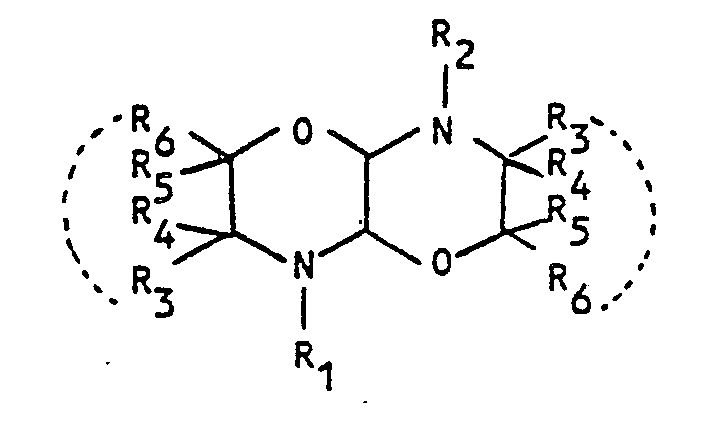
- Gegenstand der Erfindung sind neue 2,3,2',3'-Bismorpholinderivate der Formel

- R1 und R2 gleiche oder verschiedene C1 bis CrAlkyl-, C5-C6-Cycloalkyl-, oder Phenylreste sind, wobei für R3, R4, R5 und R6 = Wasserstoff n-Butyl und Phenyl ausgenommen sind,
- R3, R4, R5, R6 gleich oder verschieden Wasserstoff und/oder einen C1-C7-Alkyl-Substituenten, einen Phenylrest oder über Verknüpfung von R3 und R6 einen Cycloalkylen- oder Arylen-Substituenten (wobei für Arylen R4, R5 entfallen) bildend,
- Beansprucht wird auch ihr Herstellungsverfahren durch Umsetzung von Glyoxal mit N-monosubstituierten Aminoethanolen vom Typ

- Erfindungsgegenstand ist ferner die Verwendung dieser 2,3,2′,3′-Bismorpholinderivate in Mengen von 0,1 bis 10 Gew.-Teilen in ester- und/oder carbonatgruppenhaltigen Kunststoffen, insbesondere in Polyurethanen auf Basis von höhermolekularen Polyester- und/oder Polycarbonatpolyolen als Hydrolyseschutzmittel.
- Bekanntlich sind Estergruppen (einschließlich Carbonatgruppen) gegen hydrolytische Spaltung unter Rückbildung der Ausgangskomponenten anfällig. Bei höhermolekularen Stoffen, die Estergruppen als Aufbaukomponenten enthalten, bewirkt eine solche Reaktion den Abbau der Polymerkette, was in der Regel einen Verlust der mechanischen Werte bewirkt. Ein weiterer Nachteil ist die autokatalytische Zerstörung durch fortwährend neu anfallende Carbonsäuregruppen, die immer drastischer wird.
- Die Umsetzungsprodukte von Polyestern mit mindestens bifunktionellen Isocyanaten führt z. B. zu Polyurethanen, die als Hochleistungselastomere technisch mannigfaltige Anwendung finden. Um das hohe Werteniveau dieser Kunststoffe gegen einen Abbau durch feuchte Wärme, Wasser und Wasserdampf zu sichern, werden seit langem Hydrolyseschutzmittel verwendet, wie sie z. B. die Stoffgruppe der Carbodiimide darstellt und in der DE-PS 1005 726 sowie den BE-PSen 610 969, 612 040 und 733 573 beschrieben sind. Aus der FR-PS 1 450 919 sind weiterhin Iminooxazolidine der Formel

- R1 = Aryl
- R2 = Aryl, Alkyl
- Die in der DE-PS 2 106 726 beschriebenen Hydroxyalkylharnstoff-Derivate zeigen zwar auch gute Wirkung, nachteilig sind jedoch hier die hohen Schmelzpunkte und die geringe Löslichkeit dieser Stoff klasse in Polyestern oder kurzkettigen Kettenverlängerern.
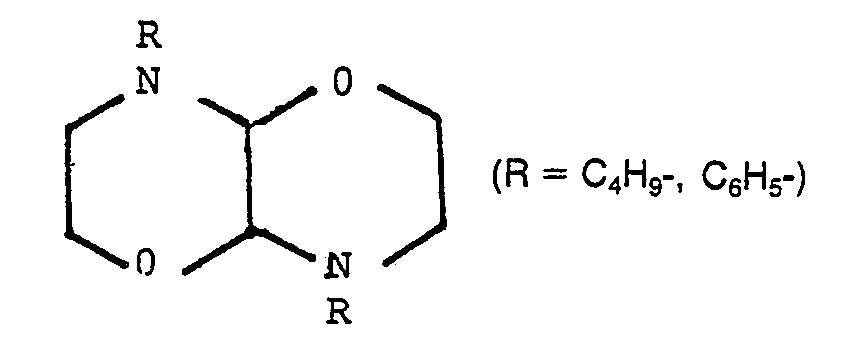
- Aus CA, 87 (1977), Nr. 201553c, sind Verbindungen der allgemeinen Formel
- Völlig überraschend wurde nun eine Gruppe von Hydrolyseschutzmittel mit ausgeprägt positiv zu beurteilenden Verarbeitungseigenschaften aufgefunden, die mit den bisher dafür bekannten Stoffklassen in keinem Zusammenhang stehen, was Reaktionsverlauf, Struktur und Stoffeigenschaften der Reaktionsprodukte betrifft.
- Hierbei handelt es sich um als Hydrolyseschutzmittel (HSM) wirkende, bisher nicht beschriebene Reaktionsprodukte von Glyoxal und durch organische Gruppen substituierte Aminoethanolen, wobei Cycloacetale der Struktur von 2,3,2',3'-Bismorpholinen gemäß der Struktur

- R1 und R2 gleiche oder verschiedene C1 bis C7-Alkyl-, C5-C6-Cycloalkyl-, oder Phenylreste sind, wobei für R3, R4, R6 und R6 = Wasserstoff n-Butyl und Phenyl ausgenommen sind,
- R3, R4, R5, R6 gleich oder verschieden Wasserstoff und/oder einen C1-C7-Alkyl-Substituenten, einen Phenylrest oder über Verknüpfung von R3 und R6 einen Cycloalkylen- oder Arylen-Substituenten (wobei für Arylen R4, R5 entfallen) bildend, besonders bevorzugt Wasserstoff
- Besonders bevorzugt sind Verbindungen bei denen
- R1, R2 eine CH3-Gruppe, eine C2H5-Gruppe, eine Cyclohexylgruppe, eine Phenylgruppe wobei für R3, R4, R5, R6 = Wasserstoff die Phenylgruppe ausgenommen ist,
- R3, R4, R5, R6 Wasserstoff oder die Reste
- R3 und R6 über Verknüfung mit dem Aminoethanol einen Cyclohexanrest bilden,
- R4, R5 Wasserstoff oder einen C1 bis CrAlkylrest, vorzugsweise Wasserstoff
- Gegenstand der Erfindung ist auch ein Verfahren zur Herstellung der 2,3,2',3'-Bismorpholinderivate aus
- a) Glyoxal und
- b) N-monosubstituierten Aminoethanolen vom Typ

- Gegenstand der Erfindung ist ferner die Verwendung von 2,3,2',3'-Bismorpholinen als Hydrolyseschutzmittel für Estergruppen und/oder Carbonatgruppen enthaltende Kunststoffe, insbesondere Estergruppen und/oder Carbonatgruppen enthaltende Polyurethane aus Polyisocyanaten, Estergruppen und/oder Carbonatgruppen aufweisenden Polyolen, vorzugsweise höhermolekularen Polyolen, sowie gegebenenfalls weiteren Hilfs- und Zusatzstoffen wobei auch weitere, an sich übliche Hydrolyseschutzmittel mitverwendet werden können, indem man die 2,3,2′,3′-Bismorpholinderivate der oben gekennzeichneten Struktur in Mengen von 0,1 bis 10, bevorzugt 0,3 bis 5, besonders bevorzugt 0,5 bis 2,5 Teilen, im Kunststoff verwendet.
- Die Bismorpholine können aufgrund ihrer guten Löslichkeit den Ausgangsstoffen oder ihren Gemischen, bei Polyurethanen beispielsweise entweder dem höhermolekularen Polyolteil und/oder den üblich verwendeten Kettenverlängerungsmitteln oder ihren Gemischen zugesetzt werden. Sie können ferner auch den fertigen, Ester- und/oder Carbonatgruppen enthaltenden Kunststoffen, z. B. ihren Schmelzen, Lösungen oder Dispersionen, einverleibt werden.
- Als erfindungsgemäße Vertreter dieser Stoffklasse der Bismorpholine seien angeführt :


- Als Ausgangsverbindungen für die Darstellung der Bismorpholine dient Glyoxal als bevorzugter Bisaldehyd, der im allgemeinen in Form seiner technischen, wäßrigen Lösung eingesetzt wird.
- Als Beispiele für die N-monosubstituierten β-Aminoalkohole seien folgende Verbindungen angeführt : N-Methyl-ethanolamin, N-Ethyl-ethanolamin, N-Propyl-ethanolamin, N-Cyclohexyl-ethanolamin, 2-Hydroxyethyl-anilin, 2-(N-Methylamino)-buten-(3)-ol-(1), N-Methy)amino-2-hydroxy-buten-(3), 2-(N-Phenylami- no)-buten-(3)-ol-(1), N-Phenylamino-2-hydroxy-buten-(3), 2-(N-Methylamino)-2-phenyl-ethanol, 2-(N-Me- thylamino)-1-phenyl-ethanol, 2-(N-Phenylamino)-2-phenyl-ethanol, 2-(N-Phenylamino)-1-phenyl-ethanol, 2-(N-Phenylamino)-cyclohexanol-1, 2-(N-Cyclohexylamino)-cyclohexanol-(1), 1-(N-Phenyl)-2-hydroxypropylamin, 1-(N-Cyclohexyl)-2-hydroxypropylamin und 1-(N-Methyl)-2-hydroxypropylamin oder ihre Gemische. 1
- Glyoxal und die β-Aminoalkohole werden bevorzugt in stöchiometrischen Mengen (1 : 2) umgesetzt ; bei Überschuß einer der Komponenten bilden sich trotzdem die erfindungsgemäßen Verbindungen entsprechend der Menge der Unterschußkomponente. Die Reaktion selbst wird bevorzugt in wäßriger Lösung durchgeführt, wobei nach kurzem Erwärmen, z. B. auf 40 bis 100 °C, die Reaktionsprodukte, besonders die der höher substituierten Vertreter, ausfallen, während z. B. die Methyl- oder Ethylderivate durch teilweises Einengen ihrer Lösung praktisch quantitativ mit guter Reinheit erhalten werden können. Die Reaktion kann auch in wäßrig-organischen Lösungsmitteln erfolgen, z. B. wäßrigen Alkoholen, Ethern oder Ketonen und ähnlichen Verbindungen.
- Erfindungsgemäß können insbesondere Estergruppen und/oder Carbonatgruppen aufweisende Polyurethane wirksam stabilisiert werden. Unter Ester- und/oder Carbonatgruppen aufweisenden Polyurethanen sind beliebige, unter Mitverwendung von Estergruppen und/oder Carbonatgruppen aufweisenden Polyolen hergestellte Polyurethane, d. h. Polyurethanschaumstoffe, Polyurethanelastomere, Beschichtungsmittel auf Polyurethanbasis, Klebstoffe, Fugenvergußmassen und andere zu verstehen. Solche estergruppenhaltigen Polyurethane können auf der Basis von höhermolekularen Hydroxypolyestern, Hydroxypolylactonen, z. B. auf der Basis von e-Caprolactonen, Hydroxypolycarbonaten, z. B. Hexandiolpolycarbonaten und ester- bzw. carbonatgruppenhaltigen Polyethern aufgebaut werden.
- Außer zur bevorzugten Stabilisierung der Estergruppen und/oder Polycarbonatgruppen aufweisenden Polyurethane eignen sich die erfindungsgemäß zu verwendenden Hydrolyseschutzmittel auch zum Schutz beliebig anderer, Estergruppen und/oder Carbonatgruppen aufweisender Kunststoffe, wie z. B. Polyestern aus Polycarbonsäuren, vorzugsweise Dicarbonsäuren wie Phthalsäure, Isophthalsäure, Terephthalsäure, Adipinsäure oder Kohlensäure, und mehrwertigen Alkoholen, wie z. B. Ethylenglykol, Butandiol, Neopentyldiol, Hexandiol, Glycerin, 2,2-Bis-(4'-hydroxyphenyl)-propan, Trimethylolpropan, Pentaerythrit usw. Sie können auch zum Schutz von seitenständigen Estergruppen aufweisenden Polymeren bzw. Copolymeren auf Acrylsäure- bzw. Methacrylsäureesterbasis oder für Kunststoffe auf der Basis von Vinylestern, wie z. B. Polyvinylacetat usw. verwendet werden. Außerdem können Polycarbonate, z. B. auf der Basis von 2,2-Bis-(4'-hydroxyphenyl)-propan stabilisiert werden.
- Derartige Kunststoffe können beispielsweise als Lacke, Folien, Überzüge, Fasern, Schaumstoffe. Elastomere, Gießharze oder Preßkörper vorliegen.
-
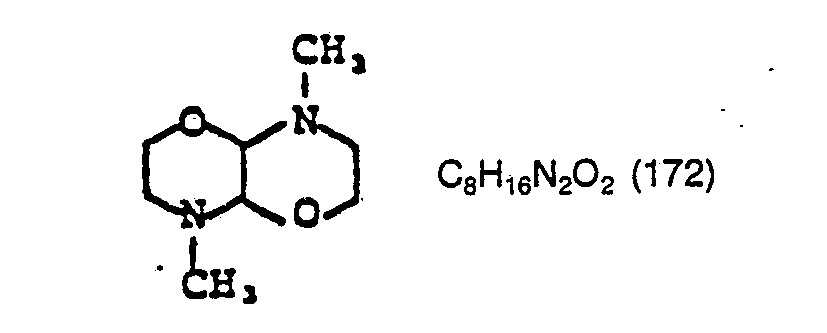
- In 375 g (5 mol) Methylethanolamin werden 482 g (2,5 mol) 30 % wäßrige Glyoxallösung getropft, wobei die Temperatur auf 75 bis 80 °C steigt. Man erhitzt 5 h auf 80 °C und engt danach die Lösung ein, wobei das Bismorpholin langsam auskristallisiert. Die Restfeuchtigkeit wird durch Abnutschen entfernt und das Produkt getrocknet. Ausbeute 735 g, entspr. 85 % d. Th. Schmp. 73-74 °C.
- Das leicht gelbe Produkt kann durch Sublimation in eine völlig farblose Substanz vom Schmp. 75 °C überführt werden.
- Analyse ber. : C 55,8 H 9,3 N 16,3 ;
- gef. : C 55,2 H 9,0 N 16,2 ;
- Im Massenspektrum wird das Molekülion M+ bei 172 beobachtet. Zur Strukturaufklärung diente die Hochfeldresonanz, deren Ergebnisse tabellarisch aufgeführt sind.
- 1H-Daten vom Beispiel 1, gem. bis 360 MHz in CDCl3
-
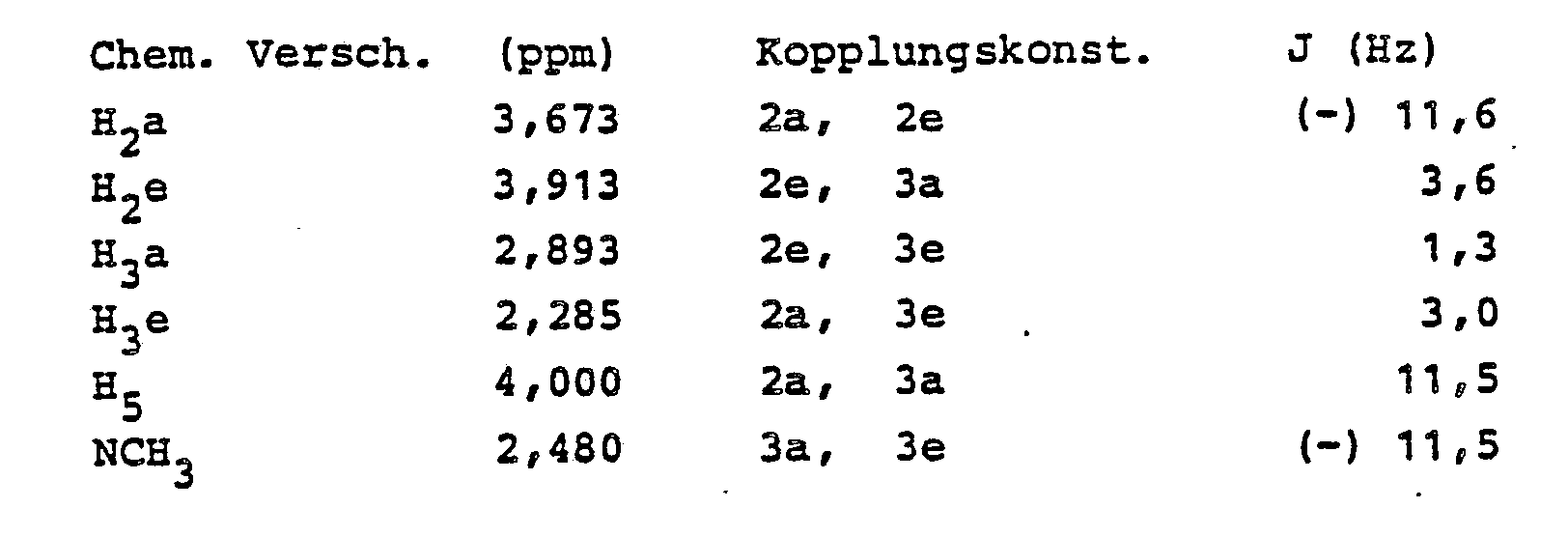
- Die erhaltenen Daten entsprechen denen des Morpholinrings 1,2. Das gilt vor allem für die geminalen und vicinalen Kopplungskonstanten.
-

- In 48,5 g 30%iger Glyoxallösung werden 75,5 g 3-Methyl-N-hydroxyethyl-anilin getropft, für 2 h auf 80 °C erwärmt, abgekühlt, abgesaugt ; der Rückstand wird mit 120 ml Methanol warm aufgerührt, abgesaugt und getrocknet ; Ausbeute 58 g farbl. Kristalle, Schm. 151-152 °C.
- Analyse ber. : C 75,0 H 6,2 N 8,7 ;
- gef. : C 74,3 H 7,8 N 8,5 ;
- 1H-Daten in CDCI3 bei 360 MHz für den Morpholinteil
1) W. B. Smith u. B. A. Shoulders, J. Phys. Chem 69, 579 (1965).
2) J. Devilliers, H. D. Giao und J. Novech, Compt. Rend. 277C, 1067 (1973).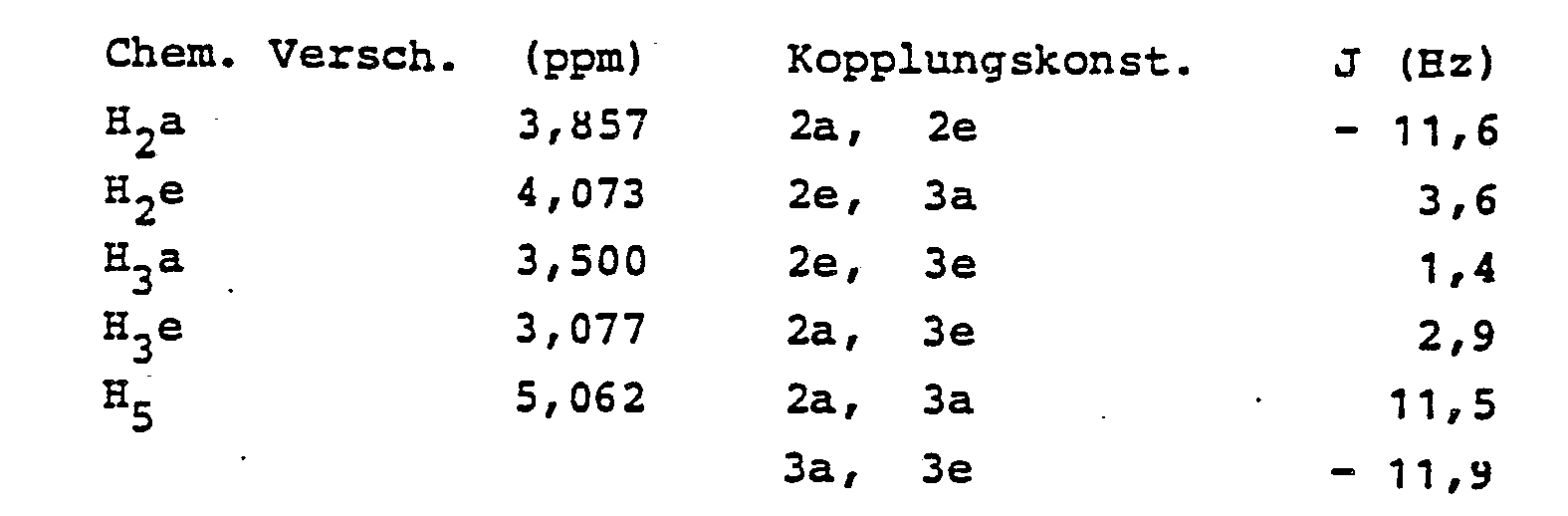
- Die Struktur als Morpholinderivat wird demnach auch wie unter Beispiel 1 belegt.
-

- Analyse ber. : C 73,0 H 6,7 N 9,45 ;
- gef. : C 71,4 H 6,5 N 8,9 ;
-

- Analyse ber. : C 68,5 H 10,0 N 10,0 ;
- gef. : C 68,8 H 9,0 N 9,9;
-

- Analyse ber. : C 77,2 H 7,9 N 6,95 ;
- gef. : C 76,0 H 7,5 N 6,5 ;
- In 38,8 g 30 %iger Glyoxallösung werden bei 25 °C 57,2 g Hydroxyethylcyclohexylamin getropft und für 4 h auf 70 °C erwärmt. Nach dem Absaugen wird aus Methanol umkristallisiert, Ausbeute 44 g, 72 % der Theorie, farblose Nadeln, Schmp. 95-97 °C.
- Analyse ber : C 70,0 H 10,4 N 9,1 ;
- gef : C 69,9 H 10,0 N 9,1 ;
- 100 Gew.-Teile eines aus Adipinsäure und Ethylenglykol bestehenden Polyesters mit einem mittleren Molekulargewicht von 2.000 und einer OH-Zahl von 56 werden bei 130 °C unter einem Vakuum von ca. 60 mbar (40 mm Hg) entwässert und anschließend bei ca. 130 °C gehalten.
- Dann gibt man 25 Gew.-Teile 1,5-Diisocyanatonaphthalin zu. Nach ca. 2 Minuten wird ein Vakuum von ca. 60 mbar (40 mm Hg) angelegt. Nach Beendigung der exothermen Reaktion wird zu dem Prepolymer unter starkem Rühren 5 Gew.-Teile Butandiol-1,4 zugegeben. Es wird ca. 30 Sekunden gerührt und in eine auf 110 °C vorgeheizte Form gegossen. Die Mischung ist ca. 60 Sekunden gießfähig und erstarrt nach ca. 9 Minuten.
- Das Elastomer wird noch 24 Stunden bei 110°C getempert. Danach hat es die in Tabelle 1) angegebenen Eigenschaften.
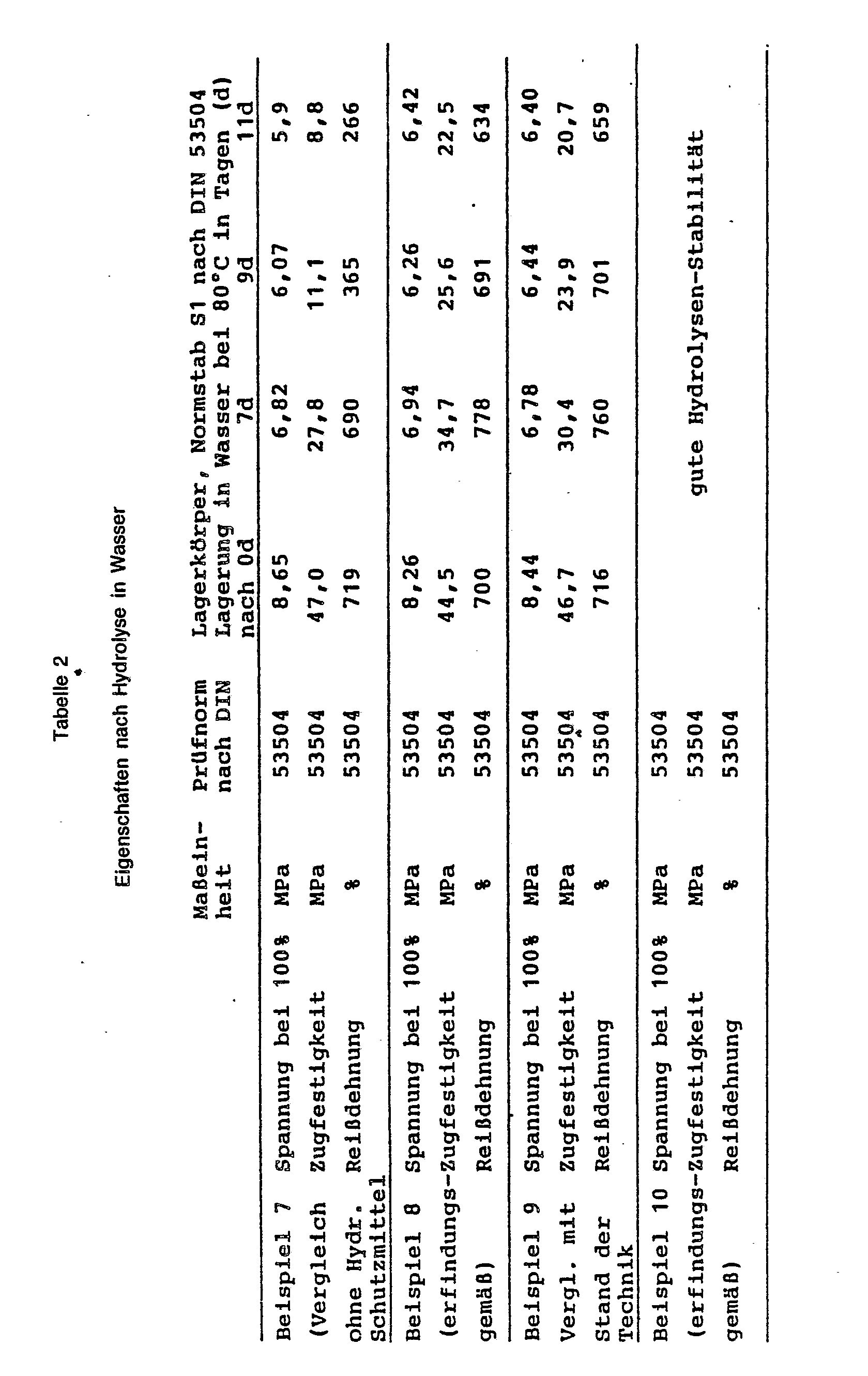
- Nach einer Lagerung in Wasser bei 80 °C (Lagerkörper - Normstab S1 gemäß DIN 53504) wird die Zugfestigkeit, Spannung bei 100 % und die Reißdehnung nach 0, 7, 9 und 11 Tagen erneut gemessen (siehe Tabelle 2).
- Wie in Beispiel 7 wird das NCO-Prepolymer hergestellt. Nach Beendigung der exothermen Reaktion wird zu dem NCO-Prepolymer unter starkem Rühren eine Abmischung von 0,6 Gew.-Teilen, 4,4'-Dimethyl-2,3, 2', 3'-bismorpholin nach Beispiel 1 in 5 Gew.-Teile Butandiol 1,4 wie gegeben und wie in Beispiel 7 verarbeitet.
- Nach einer Lagerung in Wasser bei 80 °C (Lagerkörper - Normstab S1 gemäß DIN 53 504) wird die Zugfestigkeit, Spannung bei 100 % und die Reißdehnung erneut gemessen (siehe Tabelle 2).
- Die stabilisierende Wirkung der 2,3,2',3'-Bismorpholine zeigt sich besonders deutlich nach der 11- tägigen Einwirkung von Wasser bei 80 °C bei den Festigkeits- und Dehnungswerten.
- Verwendet man statt der erfindungsgemäßen Verbindung nach Beispiel 8 0,85 Teile 2,2',6,6'-Tetraisopropyldiphenylcarbodiimid, werden folgende Werte im Hydrolysetest erhalten (siehe Tabelle 2).
- Die Vergleichswerte zeigen, daß die erfindungsgemäße Stoffklasse in ihrer Wirkung einem üblichen, technisch verbreitet eingesetzten Stabilisator überlegen ist.
- Das NCO-Prepolymer wird wie in Beispiel 7 hergestellt. Nach Beendigung der exothermen Reaktion wird zu dem Prepolymer unter starkem Rühren eine Abmischung von 0,8 Gew.-Teilen nach Beispiel 6 und 5,0 Gew.-Teilen Butandiol-1,4 zugegeben. Es wird ca. 30 Sekunden gerührt und in eine auf 110°C vorgeheizte Form gegossen. Die Mischung ist ca. 50 Sekunden gießfähig und erstarrt nach ca. 9 Minuten.
- Das Elastomer wird noch 24 Stunden bei 110°C getempert. Danach hat es folgende Eigenschaften (siehe Tabelle 1).
- Nach einer Lagerung in Wasser bei 80 °C (Lagerkörper - Normstab S1 gemäß DIN 53504) wird die Zugfestigkeit, Spannung bei 100 % und die Reißdehnung erneut gemessen (siehe Tabelle 2).


- 100 Gew.-Teile eines Butandiol-1,4/Adipinsäurepolyesters (OH-Zahl 49,1) werden mit 1 Gew.-Teil Hydrolysenschutzmittel gemäß Beispiel 1, 0,8 Gew.-Teile Stearylamid und 10 Gew.-Teile Butandiol-1,4 bei 120°C verrührt. 39,6 Gew.-Teile 4,4'-Diisocyanatodiphenylmethan (Verhältnis von NCO/OH-Gruppen = 1,03) werden auf 60 °C erhitzt und unter starkem Rühren zu der obigen 120 °C warmen Lösung zugegeben. Das reagierende Gemisch wird anschließend auf ein mit Treennwachs versehenes Blech gegossen. Es verfestigt sich sehr rasch und kann bereits nach etwa 6 Minuten entformt werden. Das Polymer wird nun in Schneidemühlen zerkleinert und nach 2-4 Tagen zu Förmkörpern verspritzt, die 17 h bei 80 °C getempert werden. Diese Formkörper weisen die in Tabelle 1 aufgeführten physikalischen Daten auf.
- Es fällt insbesondere die gute Hydrolysenstabilität dieses Produktes auf (Tabelle 2a). Nach 6 Tagen bei 100°C ist dieses Elastomer technisch noch weitgehend intakt, während das Vergleichsbeispiel ohne 4,4'-Dimethyl-2,3,2',3'-bis-morpholin fast vollständig zerstört ist.
- 100 Gew.-Teile eines Butandiol-1,4/Adipinsäurepolyesters (OH-Zahl 49,1) werden mit 0,5 Gew.-Teilen des Hydrolysenschutzmittels gemäß Beispiel 6, 0,8 Gew.-Teilen Stearylamid und 10 Gew.-Teilen Butandiol-1,4 bei 120°C verrührt. 39,6 Gew.-Teile 4,4'-Diisocyanatodiphenylmethan (Verhältnis von NCO/OH-Gruppen =·1,03) werden auf 60 °C erhitzt und unter starkem Rühren zu der obigen 120 °C warmen Lösung zugegeben. Das reagierende Gemisch wird anschließend auf ein mit Trennwachs versehenes Blech gegossen. Es verfestigt sich sehr rasch und kann bereits nach etwa 6 Minuten entformt werden. Das Polymer wird nun in Schneidemühlen zerkleinert und nach 2-4 Tagen zu Formkörpern verspritzt, die 17 h bei 80 °C getempert werden. Diese Formkörper weisen die in Tabelle 1 aufgeführten physikalischen Daten auf.
- Es fällt insbesondere die gute Hydrolysenstabilität dieses Produktes auf (Tabelle 2a). Nach 6 Tagen bei 100 °C ist dieses Elastomer technisch noch weitgehend intakt, während das Vergleichsbeispiel ohne 4,4′-Bis-cyclohexyl-2,3,2′,3′-bismorpholin fast vollständig zerstört ist.
- Es wird wie in Beispiel 11 und 12 verfahren. Es fehlt jedoch der erfindungsgemäße Stabilisatorzusatz.
- Die physikalischen Prüfwerte dieses verspritzten Thermoplasten sind in Tabellen 1 und 2a aufgeführt.
bedeuten.
als Alterungsschutzmittel bei estergruppenhaltigen Verbindungen bekannt geworden. In beiden Fällen sind jedoch sowohl Wanderungstendenz, Auswirkungen auf den Druckverformungsrest als auch katalytische Wirkung (Veränderung der Gieß- und Topfzeiten von Polyurethanen) von Nachteil.
bedeuten.
bedeutet.

Claims (7)
bedeuten.
bedeutet.

bedeutet.

Applications Claiming Priority (2)
| Application Number | Priority Date | Filing Date | Title |
|---|---|---|---|
| DE3331436 | 1983-08-31 | ||
| DE19833331436 DE3331436A1 (de) | 1983-08-31 | 1983-08-31 | Bismorpholine, verfahren zu ihrer herstellung und ihre verwendung als hydrolyseschutzmittel |
Publications (3)
| Publication Number | Publication Date |
|---|---|
| EP0137251A2 EP0137251A2 (de) | 1985-04-17 |
| EP0137251A3 EP0137251A3 (en) | 1986-03-12 |
| EP0137251B1 true EP0137251B1 (de) | 1988-09-28 |
Family
ID=6207921
Family Applications (1)
| Application Number | Title | Priority Date | Filing Date |
|---|---|---|---|
| EP84109977A Expired EP0137251B1 (de) | 1983-08-31 | 1984-08-22 | Bismorpholine, Verfahren zu ihrer Herstellung und ihre Verwendung als Hydrolyseschutzmittel |
Country Status (3)
| Country | Link |
|---|---|
| US (2) | US4617387A (de) |
| EP (1) | EP0137251B1 (de) |
| DE (2) | DE3331436A1 (de) |
Families Citing this family (3)
| Publication number | Priority date | Publication date | Assignee | Title |
|---|---|---|---|---|
| DE3504480A1 (de) * | 1985-02-09 | 1986-08-14 | Bayer Ag, 5090 Leverkusen | Neue cycloacetale, verfahren zu ihrer herstellung und ihre verwendung zur herstellung von azalactonen |
| US5462721A (en) * | 1994-08-24 | 1995-10-31 | Crescent Holdings Limited | Hydrogen sulfide scavenging process |
| US7659326B2 (en) * | 2006-01-09 | 2010-02-09 | Beyond Technologies Australia Pty Ltd. | Antimicrobial paint |
Family Cites Families (9)
| Publication number | Priority date | Publication date | Assignee | Title |
|---|---|---|---|---|
| DE1005726B (de) * | 1955-10-26 | 1957-04-04 | Bayer Ag | Stabilisierendes Mittel gegenueber den Einfluessen von Waerme und Feuchtigkeit in durch polysocyanate modifizierten Polyestermassen |
| NL272088A (de) * | 1960-12-02 | |||
| NL273087A (de) * | 1960-12-31 | |||
| US3594387A (en) * | 1964-10-09 | 1971-07-20 | Mobay Chemical Corp | Method of preparing 2-imino-oxazolidines and the stabilization of polyesters therewith |
| US3770693A (en) * | 1964-10-09 | 1973-11-06 | Baychem Corp | Stabilization of polyesterurethanes with 2-imino-oxazolidines |
| DE1292393B (de) * | 1965-10-12 | 1969-04-10 | Huels Chemische Werke Ag | Stabilisieren von ungesaettigten AEthylen-ª-Olefin-Kautschuken |
| DE1770495A1 (de) * | 1968-05-25 | 1971-11-11 | Bayer Ag | Stabilisierte Polyaethylenglykolterephthalate |
| US3689499A (en) * | 1968-10-28 | 1972-09-05 | Sidney H Metzger Jr | Method for preparing iminooxazolidines from guanidines |
| DE2106726C3 (de) * | 1971-02-12 | 1983-12-01 | Bayer Ag, 5090 Leverkusen | Hydrolyseschutzmittel für estergruppenhaltige Kunststoffe |
-
1983
- 1983-08-31 DE DE19833331436 patent/DE3331436A1/de not_active Withdrawn
-
1984
- 1984-08-15 US US06/640,907 patent/US4617387A/en not_active Expired - Fee Related
- 1984-08-22 EP EP84109977A patent/EP0137251B1/de not_active Expired
- 1984-08-22 DE DE8484109977T patent/DE3474304D1/de not_active Expired
-
1986
- 1986-04-29 US US06/857,014 patent/US4639478A/en not_active Expired - Fee Related
Also Published As
| Publication number | Publication date |
|---|---|
| US4639478A (en) | 1987-01-27 |
| DE3474304D1 (en) | 1988-11-03 |
| EP0137251A2 (de) | 1985-04-17 |
| EP0137251A3 (en) | 1986-03-12 |
| US4617387A (en) | 1986-10-14 |
| DE3331436A1 (de) | 1985-03-21 |
Similar Documents
| Publication | Publication Date | Title |
|---|---|---|
| DE69813395T2 (de) | Biologisch abbaubare Plastikzusammensetzung und Methode zur Kontrolle ihrer biologischen Abbaurate | |
| DE2019324C3 (de) | Verfahren zur Herstellung von lichtechten Polyurethanionomeren | |
| EP0460481B1 (de) | Verfahren zur Stabilisierung von Estergruppen enthaltenden Kunststoffen | |
| DE2913958C3 (de) | Glasfaserverstärkte thermoplastische Polyurethanharzzusammensetzung, Verfahren zu ihrer Herstellung und deren Verwendung | |
| DE2642386A1 (de) | Permanent stabilisierte polyurethane | |
| EP0609698A1 (de) | Verfahren zur Herstellung organischer Carbodiimide und ihre Verwendung als Kunststoff Stabilisatoren | |
| DE1013869B (de) | Verfahren zur Herstellung von Isocyanat-Polymerisationsprodukten | |
| DE2545647C3 (de) | Stabilisierung synthetischer Polymerer | |
| EP0137251B1 (de) | Bismorpholine, Verfahren zu ihrer Herstellung und ihre Verwendung als Hydrolyseschutzmittel | |
| DE3542919A1 (de) | Treibmittelzusammensetzung und diese enthaltende gasexpandierbare polymerzusammensetzung | |
| DE1694093A1 (de) | Stabilisierung von Polyurethanen | |
| EP3099725B1 (de) | Stabilisierte weichmacher für thermoplastisches polyurethan | |
| DE1947953B2 (de) | ||
| DE2106726A1 (de) | Hydrolyseschutzmittel für estergruppenhaltige Kunststoffe | |
| DE2012285A1 (de) | alpha, alpha Bis (2 hydroxy phenyl) dusopropylbenzole als Stabilise toren fur Polyurethane | |
| EP0148462B1 (de) | Verfahren zur in situ-Herstellung von Harnstoffgruppen-enthaltenden Diisocyanaten in Polyolen, dem Verfahren entsprechende Dispersionen oder Lösungen sowie ihre Verwendung | |
| DE2545645C2 (de) | Thiazolinylamino-piperidin-Derivate | |
| EP0563918A1 (de) | Polyurethan-Formmasse | |
| DE2545646A1 (de) | Cyanamide | |
| EP3686240A1 (de) | Hydrolysestabilisierte polyethylenterephthalat (pet) haltige zusammensetzungen | |
| DE2058544A1 (de) | Verfahren zur Verbesserung der Alterungsbestaendigkeit von Kautschuk | |
| DE1420278A1 (de) | Thermoplastische Polyesteramide und Verfahren zu ihrer Herstellung | |
| DE2523106A1 (de) | Gemische aus alpha,alpha'-bis-(2- hydroxy-3,5-dialkylphenyl)-p-diisopropylbenzolen und -m-diisopropylbenzole, verfahren zu ihrer herstellung und ihre verwendung als stabilisatoren | |
| DE2025896A1 (de) | Neue Diamine. Ausscheidung aus: 2001772 | |
| DE1145353B (de) | Verfahren zur Herstellung von homogenen Kunststoffen einschliesslich Flaechengebilden nach dem Isocyanat-Polyadditionsverfahren |
Legal Events
| Date | Code | Title | Description |
|---|---|---|---|
| PUAI | Public reference made under article 153(3) epc to a published international application that has entered the european phase |
Free format text: ORIGINAL CODE: 0009012 |
|
| 17P | Request for examination filed |
Effective date: 19840822 |
|
| AK | Designated contracting states |
Designated state(s): BE DE FR GB IT |
|
| RTI1 | Title (correction) | ||
| PUAL | Search report despatched |
Free format text: ORIGINAL CODE: 0009013 |
|
| AK | Designated contracting states |
Kind code of ref document: A3 Designated state(s): BE DE FR GB IT |
|
| 17Q | First examination report despatched |
Effective date: 19870708 |
|
| GRAA | (expected) grant |
Free format text: ORIGINAL CODE: 0009210 |
|
| ITF | It: translation for a ep patent filed | ||
| AK | Designated contracting states |
Kind code of ref document: B1 Designated state(s): BE DE FR GB IT |
|
| REF | Corresponds to: |
Ref document number: 3474304 Country of ref document: DE Date of ref document: 19881103 |
|
| ET | Fr: translation filed | ||
| GBT | Gb: translation of ep patent filed (gb section 77(6)(a)/1977) | ||
| PLBE | No opposition filed within time limit |
Free format text: ORIGINAL CODE: 0009261 |
|
| STAA | Information on the status of an ep patent application or granted ep patent |
Free format text: STATUS: NO OPPOSITION FILED WITHIN TIME LIMIT |
|
| 26N | No opposition filed | ||
| PGFP | Annual fee paid to national office [announced via postgrant information from national office to epo] |
Ref country code: DE Payment date: 19930713 Year of fee payment: 10 |
|
| PGFP | Annual fee paid to national office [announced via postgrant information from national office to epo] |
Ref country code: FR Payment date: 19930811 Year of fee payment: 10 |
|
| PGFP | Annual fee paid to national office [announced via postgrant information from national office to epo] |
Ref country code: GB Payment date: 19930812 Year of fee payment: 10 |
|
| ITTA | It: last paid annual fee | ||
| PGFP | Annual fee paid to national office [announced via postgrant information from national office to epo] |
Ref country code: BE Payment date: 19930831 Year of fee payment: 10 |
|
| PG25 | Lapsed in a contracting state [announced via postgrant information from national office to epo] |
Ref country code: GB Effective date: 19940822 |
|
| PG25 | Lapsed in a contracting state [announced via postgrant information from national office to epo] |
Ref country code: BE Effective date: 19940831 |
|
| BERE | Be: lapsed |
Owner name: BAYER A.G. Effective date: 19940831 |
|
| GBPC | Gb: european patent ceased through non-payment of renewal fee |
Effective date: 19940822 |
|
| PG25 | Lapsed in a contracting state [announced via postgrant information from national office to epo] |
Ref country code: FR Effective date: 19950428 |
|
| PG25 | Lapsed in a contracting state [announced via postgrant information from national office to epo] |
Ref country code: DE Effective date: 19950503 |
|
| REG | Reference to a national code |
Ref country code: FR Ref legal event code: ST |