EP0137499A2 - Verfahren zur Gewinnung von beta-Elemonsäure und diese enthaltende pharmazeutische Zubereitungen - Google Patents
Verfahren zur Gewinnung von beta-Elemonsäure und diese enthaltende pharmazeutische Zubereitungen Download PDFInfo
- Publication number
- EP0137499A2 EP0137499A2 EP84112192A EP84112192A EP0137499A2 EP 0137499 A2 EP0137499 A2 EP 0137499A2 EP 84112192 A EP84112192 A EP 84112192A EP 84112192 A EP84112192 A EP 84112192A EP 0137499 A2 EP0137499 A2 EP 0137499A2
- Authority
- EP
- European Patent Office
- Prior art keywords
- acid
- elemonic
- pharmaceutical preparations
- elemolic
- elemonic acid
- Prior art date
- Legal status (The legal status is an assumption and is not a legal conclusion. Google has not performed a legal analysis and makes no representation as to the accuracy of the status listed.)
- Withdrawn
Links
- XLPAINGDLCDYQV-SDTWUMECSA-N (2s)-6-methyl-2-[(5r,10s,13s,14s,17s)-4,4,10,13,14-pentamethyl-3-oxo-1,2,5,6,7,11,12,15,16,17-decahydrocyclopenta[a]phenanthren-17-yl]hept-5-enoic acid Chemical compound C([C@@]12C)CC(=O)C(C)(C)[C@@H]1CCC1=C2CC[C@@]2(C)[C@H]([C@H](CCC=C(C)C)C(O)=O)CC[C@@]21C XLPAINGDLCDYQV-SDTWUMECSA-N 0.000 title claims abstract description 50
- NBSBUIQBEPROBM-VGYIVZNUSA-N 3beta-hydroxytirucallic acid Natural products C([C@@]12C)C[C@H](O)C(C)(C)[C@@H]1CCC1=C2CC[C@@]2(C)[C@H]([C@H](CCC=C(C)C)C(O)=O)CC[C@@]21C NBSBUIQBEPROBM-VGYIVZNUSA-N 0.000 title claims abstract description 42
- 238000000034 method Methods 0.000 title claims abstract description 16
- 239000000825 pharmaceutical preparation Substances 0.000 title claims abstract description 12
- 238000004519 manufacturing process Methods 0.000 title claims abstract description 9
- 239000011347 resin Substances 0.000 claims abstract description 19
- 229920005989 resin Polymers 0.000 claims abstract description 19
- 239000004862 elemi Substances 0.000 claims abstract description 14
- 240000005209 Canarium indicum Species 0.000 claims abstract description 13
- 239000000203 mixture Substances 0.000 claims description 17
- 239000002253 acid Substances 0.000 claims description 15
- VYPSYNLAJGMNEJ-UHFFFAOYSA-N Silicium dioxide Chemical compound O=[Si]=O VYPSYNLAJGMNEJ-UHFFFAOYSA-N 0.000 claims description 6
- 230000003647 oxidation Effects 0.000 claims description 4
- 238000007254 oxidation reaction Methods 0.000 claims description 4
- 230000001476 alcoholic effect Effects 0.000 claims description 3
- 238000004587 chromatography analysis Methods 0.000 claims description 3
- 230000004054 inflammatory process Effects 0.000 claims description 3
- 239000000741 silica gel Substances 0.000 claims description 3
- 229910002027 silica gel Inorganic materials 0.000 claims description 3
- 150000008280 chlorinated hydrocarbons Chemical class 0.000 claims description 2
- 229910052500 inorganic mineral Inorganic materials 0.000 claims description 2
- 239000011707 mineral Substances 0.000 claims description 2
- NBSBUIQBEPROBM-UHFFFAOYSA-N (+)-trametenolic acid B Natural products CC12CCC(O)C(C)(C)C1CCC1=C2CCC2(C)C(C(CCC=C(C)C)C(O)=O)CCC21C NBSBUIQBEPROBM-UHFFFAOYSA-N 0.000 claims 1
- XLPAINGDLCDYQV-UHFFFAOYSA-N Pinicolsaeure Natural products CC12CCC(=O)C(C)(C)C1CCC1=C2CCC2(C)C(C(CCC=C(C)C)C(O)=O)CCC21C XLPAINGDLCDYQV-UHFFFAOYSA-N 0.000 claims 1
- NBSBUIQBEPROBM-IMJUUJEHSA-N alpha-Elemolic acid Chemical compound C([C@@]12C)C[C@@H](O)C(C)(C)[C@@H]1CCC1=C2CC[C@@]2(C)[C@H]([C@H](CCC=C(C)C)C(O)=O)CC[C@@]21C NBSBUIQBEPROBM-IMJUUJEHSA-N 0.000 claims 1
- 239000000969 carrier Substances 0.000 claims 1
- 241001465754 Metazoa Species 0.000 abstract description 7
- 239000004480 active ingredient Substances 0.000 abstract description 6
- 230000003110 anti-inflammatory effect Effects 0.000 abstract description 4
- 208000027866 inflammatory disease Diseases 0.000 abstract description 2
- OKKJLVBELUTLKV-UHFFFAOYSA-N Methanol Chemical compound OC OKKJLVBELUTLKV-UHFFFAOYSA-N 0.000 description 21
- YMWUJEATGCHHMB-UHFFFAOYSA-N Dichloromethane Chemical compound ClCCl YMWUJEATGCHHMB-UHFFFAOYSA-N 0.000 description 15
- 239000000243 solution Substances 0.000 description 15
- 150000007513 acids Chemical class 0.000 description 10
- 241000700159 Rattus Species 0.000 description 9
- 210000002683 foot Anatomy 0.000 description 9
- 101710172562 Cobra venom factor Proteins 0.000 description 8
- 206010030113 Oedema Diseases 0.000 description 8
- 239000012141 concentrate Substances 0.000 description 8
- 239000000126 substance Substances 0.000 description 8
- 206010003246 arthritis Diseases 0.000 description 7
- 238000012360 testing method Methods 0.000 description 7
- QTBSBXVTEAMEQO-UHFFFAOYSA-N Acetic acid Chemical compound CC(O)=O QTBSBXVTEAMEQO-UHFFFAOYSA-N 0.000 description 6
- VEXZGXHMUGYJMC-UHFFFAOYSA-N Hydrochloric acid Chemical compound Cl VEXZGXHMUGYJMC-UHFFFAOYSA-N 0.000 description 6
- YXFVVABEGXRONW-UHFFFAOYSA-N Toluene Chemical compound CC1=CC=CC=C1 YXFVVABEGXRONW-UHFFFAOYSA-N 0.000 description 6
- JHIVVAPYMSGYDF-UHFFFAOYSA-N cyclohexanone Chemical compound O=C1CCCCC1 JHIVVAPYMSGYDF-UHFFFAOYSA-N 0.000 description 6
- 230000000694 effects Effects 0.000 description 6
- 238000002474 experimental method Methods 0.000 description 6
- 230000037396 body weight Effects 0.000 description 5
- XLYOFNOQVPJJNP-UHFFFAOYSA-N water Substances O XLYOFNOQVPJJNP-UHFFFAOYSA-N 0.000 description 5
- HEDRZPFGACZZDS-UHFFFAOYSA-N Chloroform Chemical compound ClC(Cl)Cl HEDRZPFGACZZDS-UHFFFAOYSA-N 0.000 description 4
- FAPWRFPIFSIZLT-UHFFFAOYSA-M Sodium chloride Chemical compound [Na+].[Cl-] FAPWRFPIFSIZLT-UHFFFAOYSA-M 0.000 description 4
- 208000025865 Ulcer Diseases 0.000 description 4
- TZCXTZWJZNENPQ-UHFFFAOYSA-L barium sulfate Chemical compound [Ba+2].[O-]S([O-])(=O)=O TZCXTZWJZNENPQ-UHFFFAOYSA-L 0.000 description 4
- 238000011156 evaluation Methods 0.000 description 4
- 150000002500 ions Chemical class 0.000 description 4
- VLKZOEOYAKHREP-UHFFFAOYSA-N n-Hexane Chemical compound CCCCCC VLKZOEOYAKHREP-UHFFFAOYSA-N 0.000 description 4
- 239000002904 solvent Substances 0.000 description 4
- 231100000397 ulcer Toxicity 0.000 description 4
- CSCPPACGZOOCGX-UHFFFAOYSA-N Acetone Chemical compound CC(C)=O CSCPPACGZOOCGX-UHFFFAOYSA-N 0.000 description 3
- GUBGYTABKSRVRQ-QKKXKWKRSA-N Lactose Natural products OC[C@H]1O[C@@H](O[C@H]2[C@H](O)[C@@H](O)C(O)O[C@@H]2CO)[C@H](O)[C@@H](O)[C@H]1O GUBGYTABKSRVRQ-QKKXKWKRSA-N 0.000 description 3
- HEMHJVSKTPXQMS-UHFFFAOYSA-M Sodium hydroxide Chemical compound [OH-].[Na+] HEMHJVSKTPXQMS-UHFFFAOYSA-M 0.000 description 3
- 229920002472 Starch Polymers 0.000 description 3
- 239000002260 anti-inflammatory agent Substances 0.000 description 3
- 239000006227 byproduct Substances 0.000 description 3
- 239000007903 gelatin capsule Substances 0.000 description 3
- 238000004128 high performance liquid chromatography Methods 0.000 description 3
- 210000000548 hind-foot Anatomy 0.000 description 3
- 230000006698 induction Effects 0.000 description 3
- 230000005764 inhibitory process Effects 0.000 description 3
- HQKMJHAJHXVSDF-UHFFFAOYSA-L magnesium stearate Substances [Mg+2].CCCCCCCCCCCCCCCCCC([O-])=O.CCCCCCCCCCCCCCCCCC([O-])=O HQKMJHAJHXVSDF-UHFFFAOYSA-L 0.000 description 3
- 239000012074 organic phase Substances 0.000 description 3
- OIGNJSKKLXVSLS-VWUMJDOOSA-N prednisolone Chemical compound O=C1C=C[C@]2(C)[C@H]3[C@@H](O)C[C@](C)([C@@](CC4)(O)C(=O)CO)[C@@H]4[C@@H]3CCC2=C1 OIGNJSKKLXVSLS-VWUMJDOOSA-N 0.000 description 3
- 229960005205 prednisolone Drugs 0.000 description 3
- -1 sesquiterpene alcohols Chemical class 0.000 description 3
- 235000019698 starch Nutrition 0.000 description 3
- 230000001225 therapeutic effect Effects 0.000 description 3
- 238000005303 weighing Methods 0.000 description 3
- 208000009386 Experimental Arthritis Diseases 0.000 description 2
- PEDCQBHIVMGVHV-UHFFFAOYSA-N Glycerine Chemical compound OCC(O)CO PEDCQBHIVMGVHV-UHFFFAOYSA-N 0.000 description 2
- 206010022998 Irritability Diseases 0.000 description 2
- FYYHWMGAXLPEAU-UHFFFAOYSA-N Magnesium Chemical compound [Mg] FYYHWMGAXLPEAU-UHFFFAOYSA-N 0.000 description 2
- 241000699666 Mus <mouse, genus> Species 0.000 description 2
- 241000700157 Rattus norvegicus Species 0.000 description 2
- PMZURENOXWZQFD-UHFFFAOYSA-L Sodium Sulfate Chemical compound [Na+].[Na+].[O-]S([O-])(=O)=O PMZURENOXWZQFD-UHFFFAOYSA-L 0.000 description 2
- UIIMBOGNXHQVGW-UHFFFAOYSA-M Sodium bicarbonate Chemical class [Na+].OC([O-])=O UIIMBOGNXHQVGW-UHFFFAOYSA-M 0.000 description 2
- 239000013543 active substance Substances 0.000 description 2
- 239000002671 adjuvant Substances 0.000 description 2
- SMZOGRDCAXLAAR-UHFFFAOYSA-N aluminium isopropoxide Chemical compound [Al+3].CC(C)[O-].CC(C)[O-].CC(C)[O-] SMZOGRDCAXLAAR-UHFFFAOYSA-N 0.000 description 2
- 239000003435 antirheumatic agent Substances 0.000 description 2
- 239000007864 aqueous solution Substances 0.000 description 2
- 229920001429 chelating resin Polymers 0.000 description 2
- 238000006243 chemical reaction Methods 0.000 description 2
- 238000004140 cleaning Methods 0.000 description 2
- 230000004154 complement system Effects 0.000 description 2
- 238000001816 cooling Methods 0.000 description 2
- 238000001704 evaporation Methods 0.000 description 2
- 230000002496 gastric effect Effects 0.000 description 2
- CGIGDMFJXJATDK-UHFFFAOYSA-N indomethacin Chemical compound CC1=C(CC(O)=O)C2=CC(OC)=CC=C2N1C(=O)C1=CC=C(Cl)C=C1 CGIGDMFJXJATDK-UHFFFAOYSA-N 0.000 description 2
- 230000002401 inhibitory effect Effects 0.000 description 2
- 238000006317 isomerization reaction Methods 0.000 description 2
- 229910052749 magnesium Inorganic materials 0.000 description 2
- 235000019359 magnesium stearate Nutrition 0.000 description 2
- 238000002156 mixing Methods 0.000 description 2
- 230000007935 neutral effect Effects 0.000 description 2
- 239000000546 pharmaceutical excipient Substances 0.000 description 2
- 230000000144 pharmacologic effect Effects 0.000 description 2
- 239000012071 phase Substances 0.000 description 2
- 229960002895 phenylbutazone Drugs 0.000 description 2
- VYMDGNCVAMGZFE-UHFFFAOYSA-N phenylbutazonum Chemical compound O=C1C(CCCC)C(=O)N(C=2C=CC=CC=2)N1C1=CC=CC=C1 VYMDGNCVAMGZFE-UHFFFAOYSA-N 0.000 description 2
- 229920000036 polyvinylpyrrolidone Polymers 0.000 description 2
- 239000001267 polyvinylpyrrolidone Substances 0.000 description 2
- 235000013855 polyvinylpyrrolidone Nutrition 0.000 description 2
- 238000002360 preparation method Methods 0.000 description 2
- 230000000069 prophylactic effect Effects 0.000 description 2
- 150000003839 salts Chemical class 0.000 description 2
- 238000000926 separation method Methods 0.000 description 2
- 239000011780 sodium chloride Substances 0.000 description 2
- 239000007787 solid Substances 0.000 description 2
- 239000008107 starch Substances 0.000 description 2
- 238000003756 stirring Methods 0.000 description 2
- 238000002560 therapeutic procedure Methods 0.000 description 2
- IXPNQXFRVYWDDI-UHFFFAOYSA-N 1-methyl-2,4-dioxo-1,3-diazinane-5-carboximidamide Chemical compound CN1CC(C(N)=N)C(=O)NC1=O IXPNQXFRVYWDDI-UHFFFAOYSA-N 0.000 description 1
- YSULOORXQBDPCU-UHFFFAOYSA-N 2-(trimethylazaniumyl)ethanehydrazonate;hydrochloride Chemical compound [Cl-].C[N+](C)(C)CC(=O)NN YSULOORXQBDPCU-UHFFFAOYSA-N 0.000 description 1
- 229920001817 Agar Polymers 0.000 description 1
- GUBGYTABKSRVRQ-XLOQQCSPSA-N Alpha-Lactose Chemical compound O[C@@H]1[C@@H](O)[C@@H](O)[C@@H](CO)O[C@H]1O[C@@H]1[C@@H](CO)O[C@H](O)[C@H](O)[C@H]1O GUBGYTABKSRVRQ-XLOQQCSPSA-N 0.000 description 1
- 229920002261 Corn starch Polymers 0.000 description 1
- FBPFZTCFMRRESA-FSIIMWSLSA-N D-Glucitol Natural products OC[C@H](O)[C@H](O)[C@@H](O)[C@H](O)CO FBPFZTCFMRRESA-FSIIMWSLSA-N 0.000 description 1
- FBPFZTCFMRRESA-KVTDHHQDSA-N D-Mannitol Chemical compound OC[C@@H](O)[C@@H](O)[C@H](O)[C@H](O)CO FBPFZTCFMRRESA-KVTDHHQDSA-N 0.000 description 1
- FBPFZTCFMRRESA-JGWLITMVSA-N D-glucitol Chemical compound OC[C@H](O)[C@@H](O)[C@H](O)[C@H](O)CO FBPFZTCFMRRESA-JGWLITMVSA-N 0.000 description 1
- 241000196324 Embryophyta Species 0.000 description 1
- 108010010803 Gelatin Proteins 0.000 description 1
- WQZGKKKJIJFFOK-GASJEMHNSA-N Glucose Natural products OC[C@H]1OC(O)[C@H](O)[C@@H](O)[C@@H]1O WQZGKKKJIJFFOK-GASJEMHNSA-N 0.000 description 1
- 206010061218 Inflammation Diseases 0.000 description 1
- 229930195725 Mannitol Natural products 0.000 description 1
- 241000699670 Mus sp. Species 0.000 description 1
- 238000006036 Oppenauer oxidation reaction Methods 0.000 description 1
- 206010036030 Polyarthritis Diseases 0.000 description 1
- 239000002202 Polyethylene glycol Substances 0.000 description 1
- 208000025747 Rheumatic disease Diseases 0.000 description 1
- 206010070834 Sensitisation Diseases 0.000 description 1
- 235000021355 Stearic acid Nutrition 0.000 description 1
- 208000007107 Stomach Ulcer Diseases 0.000 description 1
- 229920006328 Styrofoam Polymers 0.000 description 1
- CZMRCDWAGMRECN-UGDNZRGBSA-N Sucrose Chemical compound O[C@H]1[C@H](O)[C@@H](CO)O[C@@]1(CO)O[C@@H]1[C@H](O)[C@@H](O)[C@H](O)[C@@H](CO)O1 CZMRCDWAGMRECN-UGDNZRGBSA-N 0.000 description 1
- 229930006000 Sucrose Natural products 0.000 description 1
- 241000209140 Triticum Species 0.000 description 1
- 235000021307 Triticum Nutrition 0.000 description 1
- 206010052428 Wound Diseases 0.000 description 1
- 208000027418 Wounds and injury Diseases 0.000 description 1
- 240000008042 Zea mays Species 0.000 description 1
- 235000005824 Zea mays ssp. parviglumis Nutrition 0.000 description 1
- 235000002017 Zea mays subsp mays Nutrition 0.000 description 1
- YKTSYUJCYHOUJP-UHFFFAOYSA-N [O--].[Al+3].[Al+3].[O-][Si]([O-])([O-])[O-] Chemical compound [O--].[Al+3].[Al+3].[O-][Si]([O-])([O-])[O-] YKTSYUJCYHOUJP-UHFFFAOYSA-N 0.000 description 1
- DPXJVFZANSGRMM-UHFFFAOYSA-N acetic acid;2,3,4,5,6-pentahydroxyhexanal;sodium Chemical compound [Na].CC(O)=O.OCC(O)C(O)C(O)C(O)C=O DPXJVFZANSGRMM-UHFFFAOYSA-N 0.000 description 1
- 230000003213 activating effect Effects 0.000 description 1
- 231100000460 acute oral toxicity Toxicity 0.000 description 1
- 230000001919 adrenal effect Effects 0.000 description 1
- 239000003463 adsorbent Substances 0.000 description 1
- 239000008272 agar Substances 0.000 description 1
- 235000010419 agar Nutrition 0.000 description 1
- 235000010443 alginic acid Nutrition 0.000 description 1
- 239000000783 alginic acid Substances 0.000 description 1
- 229920000615 alginic acid Polymers 0.000 description 1
- 229960001126 alginic acid Drugs 0.000 description 1
- 150000004781 alginic acids Chemical class 0.000 description 1
- 239000012670 alkaline solution Substances 0.000 description 1
- 238000010171 animal model Methods 0.000 description 1
- 150000001450 anions Chemical class 0.000 description 1
- 229940121363 anti-inflammatory agent Drugs 0.000 description 1
- 229940124599 anti-inflammatory drug Drugs 0.000 description 1
- 239000007900 aqueous suspension Substances 0.000 description 1
- WQZGKKKJIJFFOK-VFUOTHLCSA-N beta-D-glucose Chemical compound OC[C@H]1O[C@@H](O)[C@H](O)[C@@H](O)[C@@H]1O WQZGKKKJIJFFOK-VFUOTHLCSA-N 0.000 description 1
- 239000011230 binding agent Substances 0.000 description 1
- 230000015572 biosynthetic process Effects 0.000 description 1
- CJZGTCYPCWQAJB-UHFFFAOYSA-L calcium stearate Chemical compound [Ca+2].CCCCCCCCCCCCCCCCCC([O-])=O.CCCCCCCCCCCCCCCCCC([O-])=O CJZGTCYPCWQAJB-UHFFFAOYSA-L 0.000 description 1
- 239000008116 calcium stearate Substances 0.000 description 1
- 235000013539 calcium stearate Nutrition 0.000 description 1
- 235000021024 carbohydrate-rich diet Nutrition 0.000 description 1
- 239000001768 carboxy methyl cellulose Substances 0.000 description 1
- 239000012876 carrier material Substances 0.000 description 1
- 239000001913 cellulose Substances 0.000 description 1
- 229920002678 cellulose Polymers 0.000 description 1
- 235000013339 cereals Nutrition 0.000 description 1
- 239000003795 chemical substances by application Substances 0.000 description 1
- 239000011248 coating agent Substances 0.000 description 1
- 238000000576 coating method Methods 0.000 description 1
- 229940075614 colloidal silicon dioxide Drugs 0.000 description 1
- 238000004440 column chromatography Methods 0.000 description 1
- 235000005822 corn Nutrition 0.000 description 1
- 239000008120 corn starch Substances 0.000 description 1
- HPXRVTGHNJAIIH-UHFFFAOYSA-N cyclohexanol Chemical compound OC1CCCCC1 HPXRVTGHNJAIIH-UHFFFAOYSA-N 0.000 description 1
- 239000008121 dextrose Substances 0.000 description 1
- 150000001983 dialkylethers Chemical class 0.000 description 1
- 239000003085 diluting agent Substances 0.000 description 1
- 239000007884 disintegrant Substances 0.000 description 1
- 238000004821 distillation Methods 0.000 description 1
- 229940079593 drug Drugs 0.000 description 1
- 239000000975 dye Substances 0.000 description 1
- 230000008020 evaporation Effects 0.000 description 1
- 238000000605 extraction Methods 0.000 description 1
- 239000004744 fabric Substances 0.000 description 1
- 239000000706 filtrate Substances 0.000 description 1
- 229940124600 folk medicine Drugs 0.000 description 1
- 235000003599 food sweetener Nutrition 0.000 description 1
- 210000001156 gastric mucosa Anatomy 0.000 description 1
- 201000005917 gastric ulcer Diseases 0.000 description 1
- 239000008273 gelatin Substances 0.000 description 1
- 229920000159 gelatin Polymers 0.000 description 1
- 235000019322 gelatine Nutrition 0.000 description 1
- 235000011852 gelatine desserts Nutrition 0.000 description 1
- 235000011187 glycerol Nutrition 0.000 description 1
- 239000008187 granular material Substances 0.000 description 1
- 150000008282 halocarbons Chemical class 0.000 description 1
- 150000007857 hydrazones Chemical class 0.000 description 1
- 229930195733 hydrocarbon Natural products 0.000 description 1
- 150000002430 hydrocarbons Chemical class 0.000 description 1
- 229960000905 indomethacin Drugs 0.000 description 1
- 239000003978 infusion fluid Substances 0.000 description 1
- 239000007924 injection Substances 0.000 description 1
- 238000002347 injection Methods 0.000 description 1
- 238000002955 isolation Methods 0.000 description 1
- 239000004922 lacquer Substances 0.000 description 1
- 239000008101 lactose Substances 0.000 description 1
- 239000007788 liquid Substances 0.000 description 1
- 239000000314 lubricant Substances 0.000 description 1
- 239000011777 magnesium Substances 0.000 description 1
- 230000003211 malignant effect Effects 0.000 description 1
- 239000000594 mannitol Substances 0.000 description 1
- 235000010355 mannitol Nutrition 0.000 description 1
- 238000005259 measurement Methods 0.000 description 1
- 229920000609 methyl cellulose Polymers 0.000 description 1
- 239000001923 methylcellulose Substances 0.000 description 1
- 235000010981 methylcellulose Nutrition 0.000 description 1
- 235000010755 mineral Nutrition 0.000 description 1
- QIQXTHQIDYTFRH-UHFFFAOYSA-N octadecanoic acid Chemical compound CCCCCCCCCCCCCCCCCC(O)=O QIQXTHQIDYTFRH-UHFFFAOYSA-N 0.000 description 1
- OQCDKBAXFALNLD-UHFFFAOYSA-N octadecanoic acid Natural products CCCCCCCC(C)CCCCCCCCC(O)=O OQCDKBAXFALNLD-UHFFFAOYSA-N 0.000 description 1
- 239000003960 organic solvent Substances 0.000 description 1
- 201000008482 osteoarthritis Diseases 0.000 description 1
- 230000020477 pH reduction Effects 0.000 description 1
- 239000004854 plant resin Substances 0.000 description 1
- 239000011505 plaster Substances 0.000 description 1
- 229920001467 poly(styrenesulfonates) Polymers 0.000 description 1
- 229920001223 polyethylene glycol Polymers 0.000 description 1
- 230000003389 potentiating effect Effects 0.000 description 1
- 238000000746 purification Methods 0.000 description 1
- 238000011158 quantitative evaluation Methods 0.000 description 1
- 238000001953 recrystallisation Methods 0.000 description 1
- 230000008929 regeneration Effects 0.000 description 1
- 238000011069 regeneration method Methods 0.000 description 1
- 229940100486 rice starch Drugs 0.000 description 1
- 230000008313 sensitization Effects 0.000 description 1
- 229930004725 sesquiterpene Natural products 0.000 description 1
- 239000000377 silicon dioxide Substances 0.000 description 1
- 239000011734 sodium Substances 0.000 description 1
- 229910052708 sodium Inorganic materials 0.000 description 1
- 239000000661 sodium alginate Substances 0.000 description 1
- 235000019812 sodium carboxymethyl cellulose Nutrition 0.000 description 1
- 229920001027 sodium carboxymethylcellulose Polymers 0.000 description 1
- 239000000600 sorbitol Substances 0.000 description 1
- 239000008117 stearic acid Substances 0.000 description 1
- 210000002784 stomach Anatomy 0.000 description 1
- 239000008261 styrofoam Substances 0.000 description 1
- 239000005720 sucrose Substances 0.000 description 1
- 239000003765 sweetening agent Substances 0.000 description 1
- 239000000454 talc Substances 0.000 description 1
- 229910052623 talc Inorganic materials 0.000 description 1
- 238000011287 therapeutic dose Methods 0.000 description 1
- 231100001274 therapeutic index Toxicity 0.000 description 1
- 231100000419 toxicity Toxicity 0.000 description 1
- 230000001988 toxicity Effects 0.000 description 1
- 150000003648 triterpenes Chemical class 0.000 description 1
- 238000001291 vacuum drying Methods 0.000 description 1
- 239000002966 varnish Substances 0.000 description 1
Classifications
-
- C—CHEMISTRY; METALLURGY
- C07—ORGANIC CHEMISTRY
- C07J—STEROIDS
- C07J9/00—Normal steroids containing carbon, hydrogen, halogen or oxygen substituted in position 17 beta by a chain of more than two carbon atoms, e.g. cholane, cholestane, coprostane
- C07J9/005—Normal steroids containing carbon, hydrogen, halogen or oxygen substituted in position 17 beta by a chain of more than two carbon atoms, e.g. cholane, cholestane, coprostane containing a carboxylic function directly attached or attached by a chain containing only carbon atoms to the cyclopenta[a]hydrophenanthrene skeleton
-
- A—HUMAN NECESSITIES
- A61—MEDICAL OR VETERINARY SCIENCE; HYGIENE
- A61P—SPECIFIC THERAPEUTIC ACTIVITY OF CHEMICAL COMPOUNDS OR MEDICINAL PREPARATIONS
- A61P5/00—Drugs for disorders of the endocrine system
- A61P5/38—Drugs for disorders of the endocrine system of the suprarenal hormones
Definitions
- the invention relates to a process for the production of ß-elemonic acid and pharmaceutical preparations for human and veterinary therapy which contain ⁇ -elemonic acid as an effective component, in particular for the treatment of inflammatory processes.
- Elemi resin is obtained from various Burserazeen, especially from the genus Canaricum (Berger, Vol. 6, pp. 97-99; Hagers Handbuch der pharm.technik Bd. IV, pp. 765-766).
- the Elemi resin contains approx. 20 - 30% ethereal uls, approx. 20 - 25% amyrins, 5 - 6% elemic acids and various sesquiterpene alcohols and other triterpenic acids.
- Elemi resin was used in folk medicine to cover malignant wounds or as a plaster base for better adhesion. The resin is still needed in the industry for the production of lacquers and varnishes and for the finishing of felt fabrics.
- ⁇ -elemonic acid which is only present in approximately 2% of the elemi resin, has not yet been used therapeutically, and pharmacological studies are also not yet known.
- the object of the invention is a particularly advantageous process for the production of ⁇ -elemonic acid from plants or plant resins for use in pharmaceutical preparations.
- the invention also includes pharmaceutical preparations which contain ⁇ -elemonic acid as the active ingredient. It was surprisingly found that the pure ß-elemonic acid has a strong anti-inflammatory effect. ß-Elemonic acid is therefore particularly suitable for the therapy of rheumatic diseases, e.g. Arthrosis or chronic polyarthritis, whereby it is characterized by a very good tolerance.
- rheumatic diseases e.g. Arthrosis or chronic polyarthritis
- the resin is dissolved in an organic, water-immiscible solvent, such as e.g. Dialkyl ethers, alkyl carboxylic acid esters, hydrocarbons, halogenated hydrocarbons or aromatics, such as e.g. Toluene, dissolved and then. thoroughly mixed with an aqueous, alkaline solution, in particular 0.5N sodium hydroxide solution.
- an aqueous, alkaline phase is separated off and acidified to pH 3 with 20-30% hydrochloric acid with stirring and then with an organic solvent, such as e.g. Toluene, shaken out and the organic phase dried.
- a mixture of elemic acids is obtained (e.g. L. Ruzicka, J.R. Hosking and A.Wick, Helv. Chim. Acta 14 (1931), 811-820).
- the ⁇ -elemonic acid is converted from this mixture into a hydrazone by reaction with Girard-T reagent and separated from the other elemic acids by shaking out with water. After release by acidification, the ⁇ -elemonic acid can be extracted and isolated purely (e.g. L.Ruzicka and H.Häusermann, Helv. Chim. Acta 25 (1942), 439-57).
- a method has now been found in which, using all the elemic acids present in the elemic acid concentrate, ⁇ -elemonic acid is obtained in a simple, short way.
- the elemic resin is dissolved in an alcoholic solvent, e.g. Methanol, slurried and the residue filtered off.
- the clear solution is stirred with a basic ion exchanger.
- the exchange resin is then filtered off, washed out with an alcoholic solvent, then eluted with methanolic acetic acid solution and the eluate evaporated.
- the residue contains the elemic acids, ⁇ -elemonic acid, ⁇ 7 - ⁇ -elemolic acid and ⁇ 8 - ⁇ -elemolic acid.
- the advantage of this process lies in the approximately quantitative extraction yield with a concentration of 90-95% elemic acids in the concentrate.
- Another advantage is the reusability of the ion exchangers after regeneration with separation of approx. 20% insoluble by-products, especially amyrines.
- the isomerization of the ⁇ 7 - ⁇ -elemolic acid contained in the elemic acid concentrate to the ⁇ 8 - ⁇ -elemolic acid is carried out without prior separation of the elemic acids in a chlorinated hydrocarbon using a mineral acid.
- the oxidation of ⁇ 8 - ⁇ -elemolic acid to ß-elemonic acid is carried out in the crude mixture by Oppenauer reaction with aluminum isopropylate in cyclohexanone.
- the final purification is carried out by simple column chromatography on silica gel.
- the yields of ⁇ -elemonic acid from Manila-Elemi resin can be significantly improved.
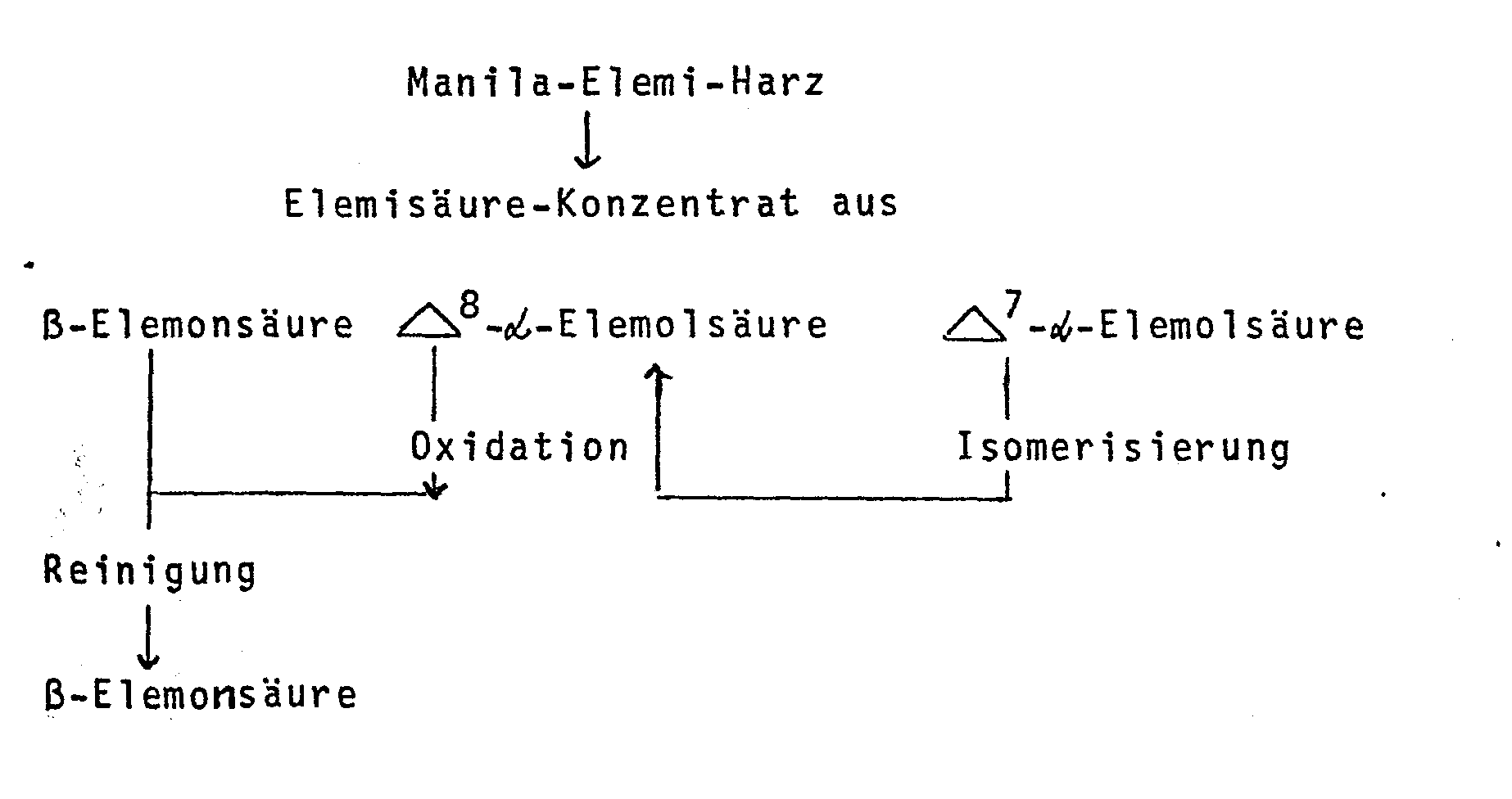
- the superiority of the new process is illustrated by the scheme for the production of ß-elemonic acid.
- the ⁇ -elemonic acid can be processed into pharmaceutical preparations by mixing a certain amount of active substance in a mixture with inorganic or organic, solid or liquid, pharmaceutically usable excipients which can be administered enterally or parenterally.
- tablets or gelatin capsules which contain the active ingredient together with diluents, such as. B. lactose, dextrose, sucrose, mannitol, sorbitol, cellulose and / or glycerin and lubricants, such as silica, talc, stearic acid or salts thereof, such as magnesium or calcium stearate and / or polyethylene glycol.
- Tablets also contain binders, e.g. magnesium, aluminum silicate, starch such as corn, wheat, rice starch, gelatin, methyl cellulose, sodium carboxymethyl cellulose and / or polyvinyl pyrrolidone and, if desired, disintegrants, e.g.
- the ⁇ -elemonic acid can be used in the form of injectable, for example intravenously administrable, preparations or infusion solutions. Such solutions are preferably isotonic aqueous solutions or suspensions, and these can be prepared, for example, from lyophilized preparations which contain the active substance alone or together with a carrier material before use.
- the pharmaceutical preparations can be prepared in a manner known per se, for example by means of conventional mixing, granulating, coating, dissolving or lyophilizing processes.
- the doses of the pharmaceutical preparations to be administered each contain 10 to 500 mg of ⁇ -elemonic acid, preferably 10 to 200 mg, in particular 50 to 100 mg, per dose and can be administered one or more times a day.
- the toxicity of ⁇ -elemonic acid was determined on the mouse and on the rat.
- mice > 4,640 mg / kg
- Comparison phenylbutazone oral mouse LD 50 465 mg / kg
- ß-elemonic acid was compared with prednisolone.
- ⁇ -elemonic acid was compared with prednisolone for this question (H.J. Lee, M.R.I. Soliman in Sciene 215, 989-991, 1982). The application was carried out on young rats, the application time was 8 days. ⁇ -elemonic acid was administered orally up to a dose of 316 mg / kg body weight, prednisolone intramuscularly up to a dose of 5 mg / kg body weight.
- the ED 30 and ED 50 values were determined using the regression line:
- the therapeutic index 1 and 2 as a measure of the therapeutic range for ß-elemonic acid is many times higher than for the comparison substances.
- ß-elemonic acid thus shows advantages in improved use in comparison with known anti-inflammatory drugs.
- Elemic acid concentrate 1 kg of Elemiharz are stirred in 10 1 of methanol and filtered off the undissolved.
- the clear solution is mixed with 1 kg of a strongly basic ion exchanger (OH - form, washed with methanol) and stirred for 3 hours.
- the exchange resin is filtered off and washed with methanol until no more by-products can be detected in the filtrate.
- the check is carried out by means of DC or HPLC. It is then eluted with a 10% methanolic acetic acid solution in order to detach the elemic acids from the ion exchanger. The mixture is eluted with further pure methanol until no elemic acid can be detected in the process.
- the dichloromethane is distilled off on a rotary evaporator at a bath temperature of 50 ° C and then the excess cyclohexanone is removed at 100 ° C and water pump vacuum. The residue is mixed with the same volume of n-hexane and stirred for 3-6 hours. The white solid is filtered off, washed with n-hexane and dried in a vacuum drying cabinet. Yield of crude ß-elemonic acid (based on the elemicon concentrate used: 53 - 60%
- a chromatography column (20 cm ⁇ , length 50 cm) is filled with 4 kg silica gel Si 60, 0.063-02 mm grain size, and moistened with dichloromethane.
- 400 g of crude ⁇ -elemonic acid (prepared by method c)) are dissolved in 2 l of dichloromethane while hot and, after cooling, added to the column.
- the mixture is eluted with a mixture of dichloromethane / methanol 100: 1.
- Approx. 30 1 eluate are collected as a preliminary.
- the ⁇ -elemonic acid is obtained from the main run (50-70 l eluate) by concentration and subsequent recrystallization from acetone.
- the course of the chromatography is monitored by means of DC or HPLC.
- the yield of pure ⁇ -elemonic acid is 240-300 g, corresponding to 60-75%.
- Elemonic acid, milk sugar and corn starch are granulated with an aqueous solution of polyvinylpyrrolidone.
- the dried granules are mixed with magnesium stearate, colloidal silicon dioxide and sodium carboxymethyl starch and pressed into tablets with a diameter of 8 mm.
- the active ingredient is mixed with the excipients and filled into size 3 hard gelatin capsules.
Landscapes
- Health & Medical Sciences (AREA)
- Chemical & Material Sciences (AREA)
- Organic Chemistry (AREA)
- General Health & Medical Sciences (AREA)
- Medicinal Chemistry (AREA)
- Life Sciences & Earth Sciences (AREA)
- Diabetes (AREA)
- Endocrinology (AREA)
- Chemical Kinetics & Catalysis (AREA)
- General Chemical & Material Sciences (AREA)
- Engineering & Computer Science (AREA)
- Nuclear Medicine, Radiotherapy & Molecular Imaging (AREA)
- Pharmacology & Pharmacy (AREA)
- Bioinformatics & Cheminformatics (AREA)
- Animal Behavior & Ethology (AREA)
- Public Health (AREA)
- Veterinary Medicine (AREA)
- Pharmaceuticals Containing Other Organic And Inorganic Compounds (AREA)
- Steroid Compounds (AREA)
- Acyclic And Carbocyclic Compounds In Medicinal Compositions (AREA)
- Organic Low-Molecular-Weight Compounds And Preparation Thereof (AREA)
Abstract
Description
- Die Erfindung betrifft ein Verfahren zur Gewinnung von ß-Elemonsäure und pharmazeutischen Zubereitungen für die Human- und Veterinärtherapie, welche als wirksame Komponente β-Elemonsäure enthalten, insbesondere zur Behandlung von entzündlichen Prozessen.
- β-Elemonsäure (13α, 14β, 17α, 20S, 3-0xo-lanosta-8,24-dien-21-carbonsäure)

- Elemiharz wurde in der Volksmedizin zur Abdeckung von bösartigen Wunden eingesetzt oder auch als Pflastergrundlage zur besseren Haftung verwendet. Das Harz wird weiterhin in der Industrie zur Herstellung von Lacken und Firnissen und zum Appretieren von Filzgewebe benötigt.
- Zur Aufklärung der Struktur der Triterpensäuren aus Elemi- harz wurden z. B. von L. Ruzicka und H. Häusermann, Helv. Chim. Acta, 1942, 25, 439-57, die einzelnen Substanzen isoliert.
- β-Elemonsäure, die nur zu ca. 2 % im Elemiharz vorkommt, wurde bisher noch nicht therapeutisch eingesetzt, auch pharmakologische Untersuchungen sind bisher nicht bekannt.
- Aufgabe der Erfindung ist ein besonders vorteilhaftes Verfahren zur Gewinnung von β-Elemonsäure aus Pflanzen bzw. pflanzlichen Harzen zur Verwendung in pharmazeutischen Zubereitungen.
- Diese Aufgabe wird durch das Verfahren gemäß Patentanspruch 1 gelöst.
- Die Erfindung schließt auch pharmazeutische Zubereitungen ein, die als aktiven Wirkstoff ß-Elemonsäure enthalten. Es wurde nämlich überraschend gefunden, daß die reine ß-Elemonsäure eine starke entzündungshemmende Wirkung besitzt. ß-Elemonsäure eignet sich daher besonders zur Therapie von rheumatischen Krankheiten, wie z.B. Arthrosen oder chronischer Polyarthritis, wobei sie sich durch eine sehr gute Verträglichkeit auszeichnet.
- Nach den bisher bekannten Verfahren zur Isolierung von ß-Elemonsäure aus Elemiharzen, insbesondere Manila Elemi, wird das Harz in einem organischen, mit Wasser nicht mischbaren Lösungsmittel, wie z.B. Dialkylether, Alkylcarbonsäureester, Kohlenwasserstoffen, halogenisierten Kohlenwasserstoffen oder Aromaten, wie z.B. Toluol, gelöst und anschließend . mit einer wäßrigen, alkalischen Lösungs, insbesondere 0,5N-Natronlauge, intensiv durchmischt. Die wäßrige, alkalische Phase wird abgetrennt und mit 20 - 30 %iger Salzsäure unter Rühren auf pH 3 angesäuert und anschließend mit einem organischen Lösungsmittel, wie z.B. Toluol, ausgeschüttelt und die organische Phase getrocknet. Nach dem Eindampfen des Lösungsmittels wird ein Gemisch von Elemisäuren erhalten (z.B. L. Ruzicka, J.R. Hosking und A.Wick, Helv. Chim. Acta 14 (1931), 811-820). Aus diesem Gemisch wird die ß-Elemonsäure durch Umsetzung mit Girard-T-Reagenz in ein Hydrazon überführt und durch Ausschütteln mit Wasser von den anderen Elemisäuren abgetrennt. Nach Freisetzung durch Ansäuern kann die β-Elemonsäure extrahiert und rein isoliert werden (z.B. L.Ruzicka und H.Häusermann, Helv. Chim. Acta 25 (1942), 439-57).
- Manila-Elemi-Harz enthält durchschnittlich
- 3 - 5 % ß-Elemonsäure
- 8 - 10 %Δ8-α- Elemolsäure
- 4 - 6 %Δ7-α- Elemolsäure
- Nach den bisher beschriebenen Methoden lassen sich nur die 3 - 5 % ß-Elemonsäuren zur Isolierung nutzen. Um die im Harz vorhandene Δ8-α-Elemolsäure durch Oxidation in die ß-Elemonsäure zu überführen, bedarf es weiterer aufwendiger Reinigungsschritte.
- Es wurde nun ein Verfahren gefunden, bei dem unter Ausnutzung aller im Elemisäure-Konzentrat vorhandenen Elemisäuren auf einem einfachen kurzen Weg ß-Elemonsäure gewonnen wird. Dabei wird zur Gewinnung eines Elemisäurekonzentrates das Elemiharz in einem alkoholischen Lösungsmittel, wie z.B. Methanol, aufgeschlämmt und der Rückstand abfiltriert.
- Die klare Lösung wird mit einem basischen Ionenaustauscher verrührt. Anschließend wird das Austauscherharz abfiltriert, mit einem alkoholischen Lösungsmittel ausgewaschen, danach mit methanolischer Essigsäurelösung eluiert und das Eluat eingedampft. Im Rückstand befinden sich die Elemisäuren, β-Elemonsäure, Δ7-α-Elemolsäure und Δ8-α-Elemolsäure. Der Vorteil dieses Verfahrens liegt in-der annähernd quantitavien Extraktionsausbeute bei einem Gehalt von 90 - 95 % Elemisäuren im Konzentrat. Ein weiterer Vorteil ist die Wiederverwendbarkeit der Ionenaustauscher nach Regeneration unter Abtrennung von ca. 20 % unlöslicher Nebenprodukte, besonders Amyrine. Die Isomerisierung der im Elemisäure- konzentrat enthaltenen Δ7-α-Elemolsäure zur Δ8-α-Elemolsäure wird ohne vorherige Auftrennung der Elemisäuren in einem chlorierten Kohlenwasserstoff unter Verwendung einer Mineralsäure durchgeführt.
- Die Oxydation von Δ8-α-Elemolsäure zur ß-Elemonsäure wird im rohen Gemisch durch Oppenauer-Reaktion mit Aluminium-isopropylat in Cyclohexanon durchgeführt. Die Endreinigung erfolgt durch einfache Säulenchromatographie an Kieselgel. Die Ausbeuten von ß-Elemonsäure aus Manila-Elemi-Harz können so wesentlich verbessert,werden. Die Überlegenheit des neuen Verfahrens wird durch das Schema der Gewinnung von ß-Elemonsäure verdeutlicht.Die ß-Elemonsäure kann zu pharmazeutischen Präparaten verarbeitet werden, indem eine bestimmte Menge an Wirksubstanz im Gemisch mit anorganischen oder organischen, festen oder flüssigen, pharmazeutisch verwendbaren Trägerstoffen, die sich enteral oder parenteral verabreichen lassen, gemischt wird.
- So verwendet man Tabletten oder Gelatinekapseln, welche den Wirkstoff zusammen mit Verdünnungsmitteln, wie z. B. Lactose, Dextrose, Sucrose, Mannit, Sorbit, Cellulose und/ oder Glycerin und Schmiermittel, z.B. Kieselerde, Talk, Stearinsäure oder Salze davon, wie Magnesium oder Calciumstearat und/oder Polyethylenglykol aufweisen. Tabletten enthalten ebenfalls Bindemittel, z.B. Magnesium-, Aluminiumsilikat, Stärke, wie Mais-, Weizen-, Reisstärke, Gelatine, Methylcellulose, Natriumcarboxymethylcellulose und/oder Polyvinylpyrrolidon und, wenn erwünscht, Sprengmittel, z.B. Stärken, Agar, Alginsäure oder ein Salz davon, wie Natrium- alginat, und/oder Brausemischungen oder Adsorptionsmittel, Farbstoffe, Geschmacksstoffe und Süßmittel. Ferner kann man die ß-Elemonsäure in Form von injizierbaren, z.B. intravenös verabreichbaren Präparaten oder Infusionslösungen einsetzen. Solche Lösungen sind vorzugsweise isotonische wäßrige Lösungen oder Suspensionen, wobei diese z.B. aus lyophilisierten Präparaten, welche die Wirksubstanz allein oder zusammen mit einem Trägermaterial enthalten, vor Gebrauch hergestellt werden können. Die pharmazeutischen Präparate können in an sich bekannter Weise, z.B, mittels konventioneller Misch-, Granulier-, Dragier-, Lösungs- oder Lyophilisierungsverfahren, hergestellt werden. Die jeweils zu verabreichenden Dosierungen der pharmazeutischen Zubereitungen enthalten 10 - 500 mg ß-Elemonsäure, bevorzugt 10 - 200 mg, insbesondere 50 - 100 mg, pro Dosis und kann ein- oder mehrmals pro Tag verabreicht werden.
- Die pharmakologische Wirksamkeit der ß-Elemonsäure wurde in den folgenden Modellen ermittelt.
- 1. Die Bestimmung der anti.phlogistischen Wirksamkeit erfolgte nach dem Rattenpfotenödem-Test nach Hillebrecht (J. Hillebrecht, Arzneim. Forsch. 1954, Bd. 4, S. 607). Hierbei wurde an je einer Hinterpfote von Ratten im Gewicht von 120 g bis 160 g durch subplantare Gabe von Carragenin (0,5 %ig in NaCl-Lösung-0,9 %ig) in einer Menge von 0,1 ml Lösung je Pfote ein ödem erzeugt. Nach Gabe der Testsubstanz, die in der Regel ein Volumen von 10 ml je kg Körpergewicht nicht überschreiten soll, wird das Volumen der Pfote in einem Oberlauf ermittelt. Nach 3 Stunden wird der Endwert festgestellt. Je Dosis wird der Versuch mit 5 Versuchs- und 5 Kontrolltieren eines Geschlechtes durchgeführt und mit der gleichen Tierzahl des anderen Geschlechts wiederholt. Zur Auswertung wird die prozentuale Hemmung des ödems gegenüber der Kontrollgruppe angegeben.

- 2. Als weiteres Modell zur Testung der antiphlogistischen Wirksamkeit wurde das mit Cobra Venom Factor (CVF) induzierte Rattenpfotenödem verwendet. Da CVF eine Entzündung über eine Aktivierung des Complementsystems hervorruft, können hier hemmende Substanzen ein neuartiges Wirkprinzip für eine Anwendung bei entzündlichen Erkrankungen eröffnen.
Zur ödemprovokation wurden an je einer Hinterpfote von Ratten im Gewicht von 120 - 160 g durch subplantare Injektion von CVF (10 Einheiten in 1 ml NaCl-Lösung 0,9%ig) in einer Menge von 0,1 ml Lösung je Pfote ein ödem erzeugt. Nach Gabe der Testsubstanz in einem Volumen von 10 ml je kg Körpergewicht wird das Volumen der Pfote in einem Oberlauf ermittelt. Nach 3 Stunden wird der Endwert festgestellt. Je Dosis wird der Versuch mit 5 Versuchs- und 5 Kontrolltieren eines Geschlechts durchgeführt und mit der gleichen Tierzahl des anderen Geschlechts wiederhölt. Zur Auswertung wird die prozentuale Hemmung des ödems gegenüber der Kontrollgruppe angegeben. Dabei wurden folgende Werte ermittelt:
- 3. Als weiteres relevantes Tiermodell zur Prüfung von Antirheumatika wurde die Adjuvans-Arthritis nach C. M. PEARSON, Proc. Soc. Exp. Biol. 91, 95-101 (1956) durchgeführt.
Pro Dosis werden 10 Wistar-Ratten im Gewicht von 120 - 150g eingesetzt. Die gleiche Tierzahl dient als Kontrolle. Mit 0,5 ml Freud'schem Adjuvans, subplantar injiziert, wird eine Arthritis erzeugt. Der Versuch dauert 17 Tage. Bei Versuchsbeginn wird das Pfotenvolumen der nicht-injizierten Hinterpfote ermittelt und dieses als Ausgangswert benutzt. Weitere Volumenmessungen werden am 14. und 17. Versuchstag durchgeführt. Bei der Auswertung wird die Differenz zwischen Ausgangs- und Endvolumen der Pfote, sowohl von der Versuchsgruppe als auch von der Kontrollgruppe gebildet und die Hemmung prozentual ausgedruckt. Bei täglicher Gabe vom Zeitpunkt der Arthritis-Induktion an (prophylaktische Applikation) wurden folgende Hemmwerte (%) ermittelt:
- Die häufigste Nebenwirkung bei bekannten Antirheumatica ist eine schlechte gastrointestinale Verträglichkeit mit Ulcusinduktion. Deshalb wurde die ß-Elemonsäure auf Ulcusinduktion hin untersucht.
- Die Bestimmung der Ulcusbildung erfolgte nach W.J.R.Whittle, Brit. J. Pharmacology 1975, Bd. 55, S. 242-43; L. Mariani, Europ. J. Toxicol. Eviron, 1975, Bd. 8, S. 335-39; R. Menguy und L. Desbaillets, Proc. Soc. Bio. Bd. 125, S. 1108. Bei den Versuchen wurden je Dosis und Kontrolle 10 männliche Wistarratten (120 - 150 g, die 16 Stunden nüchtern gehalten wurden) verwendet. Die Provokation des blutigen Magengeschwüres erfolgte durch orale Applikation des Wirkstoffes. Nach 3,5 Stunden wurden die Tiere getötet, der Magen entnommen, längs der großen Kurvatur geöffnet und auf eine Styroporplatte gespannt. Ermittelt wird der mittlere Ulcusfaktor des Versuchs und der Kontrollgruppe. Dabei wurden bei einmaliger Gabe nach vorheriger Sensibilisierung der Magenmukosa durch eine 3tägige kohlenhydratreiche Kost folgende Effekte festgestellt:

- Die Bestimmung der Toxizität der ß-Elemonsäure erfolgte an der Maus und an der Ratte.
- Akute perorale Toxizität an der Maus: > 4.640 mg/kg Vergleich Phenylbutazon oral Maus : LD50 465 mg/kg
- In einer dose-range-Studie an Ratten traten bei täglicher Applikation über 14 Tage mit Dosierungen von 681,0 und 1.000,0 mg/kg Körpergewicht keine gravierenden Nebenwirkungen auf.
- Zur Bestimmung der Nebenwirkungen wurde ß-Elemonsäure mit Prednisolon verglichen.
- Bekannte entzündungshemmende Substanzen können unerwünschte Nebenwirkungen verursachen, die teilweise bereits bei therapeutischen Dosen auftreten. Daher wurde für diese Fragestellung β-Elemonsäure mit Prednisolon vergleichend untersucht (H.J. Lee, M.R.I. Soliman in Sciene 215, 989-991, 1982). Die Applikation wurde an jungen Ratten vorgenommen, die Applikationsdauer betrug.8 Tage. β-Elemonsäure wurde oral bis zu einer Dosierung von 316 mg/kg KGW verabreicht, Prednisolon intramuskulär bis zu einer Dosierung von 5 mg/kg KGW.
- Im einzelnen wurden folgende Befunde erhoben:

- Bewertung/Wirkung von Elemonsäure zu bekannten Substanzen. Eine quantitative Bewertung von ß-Elemonsäure im Vergleich zu bekannten antiphlogistischen Substanzen wird durch die Bestimmung der therapeutischen Breite ermöglicht, d.h. durch die Sicherheit, mit der ein Wirkstoff angewendet werden kann. Zum Vergleich dient Indometacin als stark wirksames, sowie Phenylbutazon als schwächer wirksames Antiphlogistikum, eine Gewichtung, die aus den jeweiligen ED50-Werten des Arthritis-Versuches hervorgeht. Die therapeutische Breite wird 1. durch das Verhältnis zwischen der LD50 und der ED30 im CVF-Pfotenödem und 2. durch das Verhältnis zwischen dem Dosis-Schwellenwert der Magenunverträglichkeit und der ED50 im Arthritis-Modell angegeben. Die ED30- und ED50-Werte wurden mit Hilfe der Regressionsgeraden ermittelt:

- a) Elemisäurekonzentrat 1 kg Elemiharz werden in 10 1 Methanol verrührt und vom Ungelösten abfiltriert. Die klare Lösung wird mit 1 kg eines stark basischen Ionenaustauschers (OH--Form, mit Methanol gewaschen) versetzt und 3 Stunden gerührt. Das Austauscherharz wird abfiltriert und mit Methanol solange gewaschen, bis im Filtrat keine Nebenprodukte mehr nachgewiesen werden können. Die Überprüfung erfolgt mittels DC oder HPLC. Anschließend wird mit einer 10%igen methanolischen Essigsäurelösung eluiert, um die Elemisäuren vom Ionenaustauscher abzulösen. Mit weiterem reinen Methanol wird eluiert, bis,im Ablauf keine Elemisäure mehr nachgewiesen werden kann.
- Als Anionaustauscher werden verwendet: Dowex 1 x 8, Amberlite IRA 401, Amberlyst A 26. Nach Eindampfen des Eluats erhält man ein Elemisäurekonzentrat, bestehend aus:
- ß-Elemonsäure ca. 15 - 20 %
- Δ8-α-Elemolsäure ca. 50 - 60 %
- Δ7-α-Elemolsäure ca. 20 - 30 %
- Ausbeute bezogen auf Manila-Elemiharz: 200 - 250 g Gehalt an Elemisäuren: 90 - 95 %
- 1 kg Elemisäuregemisch (hergestellt nach Methode a) werden in 6 1 Chloroform gelöst, mit 1 1 36%iger Salzsäure versetzt und 5 Stunden bei Raumtemperatur gerührt. Die Chloroformphase wird abgetrennt, mit Wasser und einer gesättigten Natriumhydrogencarbonat-Lösung neutral gewaschen, über wasserfreiem Natriumsulfat getrocknet und eingeengt. Der erhaltene Rückstand wird aus 3 1 Methanol umkristallisiert.
- Ausbeute (bezogen auf eingesetztes Konzentrat): 60 - 70% Zusammensetzung: 10 - 15 % ß-Elemonsäure 80 - 85 % Δ8-α-Elemolsäure <1 % Δ7-α-Elemolsäure ca. 5 % Nebenprodukte
- In einem 4 1 Rundkolben mit Innenthermometer, Rührer und aufgesteckter Destillationsbrücke werden 200 g Elemisäuregemisch (hergestellt nach Methode b) 122 g Aluminium-isopropylat und 1500 ml Cyclohexanon bei 60°C Badtemperatur gerührt bis eine klare Lösung entsteht. Anschließend wird die Badtemperatur auf 100°C gesteigert und der Ansatz weitere 5 - 6 Stunden gerührt, wobei ein schwaches Vakuum von 200 mbar angelegt wird, um gebildetes Cyclohexanol auszuschleppen. Überprüfung der Reaktion mittels DC bzw. HPLC. Nach Abkühlen auf Raumtemperatur wird der Ansatz in ein 5 1 Becherglas überführt. Unter Rühren werden ca. 1 1 Scherbeneis und 200 ml 36%iger Salzsäure zugegeben. Danach gibt man 1 1 Wasser und 1 1 Dichlormethan zu und rührt weitere 5 - 10 Minuten. Die organische Phase wird im Scheidetrichter abgetrennt und mit 2 1 einer gesättigten Natriumhydrogencarbonat-Lösung zur Entfernung überschüssiger Säure verrührt. Die organische Phase wird mit Wasser neutralgewaschen und über wasserfreiem Natriumsulfat getrocknet.
- Das Dichlormethan wird am Rotationsverdampfer bei einer Badtemperatur von 50°C abdestilliert und anschließend bei 100°C und Wasserstrahlpumpen-Vakuum das überschüssige Cyclohexanon entfernt. Der Rückstand wird mit gleichem Volumenanteil n-Hexan versetzt und 3 - 6 Stunden gerührt. Der weiße Feststoff wird abgenutscht, mit n-Hexan gewaschen und im Vakuumtrockenschrank getrocknet. Ausbeute an roher ß-Elemonsäure (bezogen auf eingesetztes Elemikonzentrat: 53 - 60 %
- Eine Chromatographiesäule (20 cm Ø, Länge 50 cm), wird mit 4 kg Kieselgel Si 60, 0,063-02 mm Korngröße, gefüllt und mit Dichlormethan durchfeuchtet. 400 g rohe-β-Elemonsäure (hergestellt nach Methode c)) werden in 2 1 Dichlormethan heiß gelöst und nach Abkühlen auf die Säule gegeben. Mit einem Gemisch Dichlormethan/Methanol 100 : 1 wird eluiert. Als Vorlauf werden ca. 30 1 Eluat aufgefangen. Aus dem Hauptlauf (50 - 70 1 Eluat) wird die ß-Elemonsäure durch Einengen und anschließendem Umkristallisieren aus Aceton rein erhalten.
- Der Verlauf der Chromatographie wird mittels DC bzw. HPLC überwacht. Die Ausbeute an reiner ß-Elemonsäure beträgt 240 - 300 g entsprechend 60 - 75 %.
- Herstellung von Tabletten.

- Elemonsäure, Milchzucker und Maisstärke werden mit einer wäßrigen Lösung von Polyvinylpyrrolidon granuliert. Das getrocknete Granulat wird mit Magnesiumstearat, kolloidalem Siliciumdioxid und Natriumcarboximethylstärke gemischt und zu Tabletten mit einem Durchmesser von 8 mm verpreßt.
- Herstellung von Hartgelatinekapseln.

- Der Wirkstoff wird mit den Hilfsstoffen gemischt und in Hartgelatinekapseln der Größe 3 abgefüllt.
Claims (3)
Applications Claiming Priority (2)
| Application Number | Priority Date | Filing Date | Title |
|---|---|---|---|
| DE3337229 | 1983-10-13 | ||
| DE3337229A DE3337229C2 (de) | 1983-10-13 | 1983-10-13 | ß-Elemonsäure enthaltende pharmazeutische Zubereitungen |
Publications (2)
| Publication Number | Publication Date |
|---|---|
| EP0137499A2 true EP0137499A2 (de) | 1985-04-17 |
| EP0137499A3 EP0137499A3 (de) | 1986-03-26 |
Family
ID=6211719
Family Applications (1)
| Application Number | Title | Priority Date | Filing Date |
|---|---|---|---|
| EP84112192A Withdrawn EP0137499A3 (de) | 1983-10-13 | 1984-10-11 | Verfahren zur Gewinnung von beta-Elemonsäure und diese enthaltende pharmazeutische Zubereitungen |
Country Status (6)
| Country | Link |
|---|---|
| US (1) | US4618605A (de) |
| EP (1) | EP0137499A3 (de) |
| JP (1) | JPS60104098A (de) |
| DE (1) | DE3337229C2 (de) |
| DK (1) | DK489084A (de) |
| ZA (1) | ZA847975B (de) |
Cited By (1)
| Publication number | Priority date | Publication date | Assignee | Title |
|---|---|---|---|---|
| CN108653296A (zh) * | 2018-06-25 | 2018-10-16 | 天津中医药大学 | 榄香桐酸的应用及治疗胰腺炎的药物 |
Families Citing this family (3)
| Publication number | Priority date | Publication date | Assignee | Title |
|---|---|---|---|---|
| CN108721305A (zh) * | 2018-05-28 | 2018-11-02 | 南京工业大学 | β-榄香酮酸在制备抗人骨肉瘤药物中的应用 |
| CN113648315B (zh) * | 2021-08-13 | 2023-05-26 | 天津中医药大学 | 榄香酮酸及其固体分散体在制备溃疡性结肠炎药物中的应用 |
| CN120754109B (zh) * | 2024-11-08 | 2026-04-28 | 广州医科大学 | β-榄香酮酸或其衍生物在制备预防和/或治疗多囊卵巢综合征药物中的应用 |
-
1983
- 1983-10-13 DE DE3337229A patent/DE3337229C2/de not_active Expired
-
1984
- 1984-10-04 JP JP59207232A patent/JPS60104098A/ja active Pending
- 1984-10-11 EP EP84112192A patent/EP0137499A3/de not_active Withdrawn
- 1984-10-12 DK DK489084A patent/DK489084A/da not_active Application Discontinuation
- 1984-10-12 ZA ZA847975A patent/ZA847975B/xx unknown
- 1984-10-15 US US06/660,957 patent/US4618605A/en not_active Expired - Fee Related
Non-Patent Citations (3)
| Title |
|---|
| "Hagers Handbuch der Pharmazeutischen Praxis", vierte Neuausgabe, Band 4, 1973, Seiten 765-766, Springer Verlag, Heidelberg, DE. * |
| HELVETICA CHIMICA ACTA, Band 25, 1942, Seiten 439-457, Bazel, CH; L. RUZIEKA et al.: "Zur Kenttnis der Triterpene. Ueber die beta-elemonsaeure" * |
| W.H. LEWIS et al.: "Medical botany. Plants affecting man's healt", 1977, Seiten 347,348, Wiley-Interscience, New York, US. * |
Cited By (1)
| Publication number | Priority date | Publication date | Assignee | Title |
|---|---|---|---|---|
| CN108653296A (zh) * | 2018-06-25 | 2018-10-16 | 天津中医药大学 | 榄香桐酸的应用及治疗胰腺炎的药物 |
Also Published As
| Publication number | Publication date |
|---|---|
| DE3337229C2 (de) | 1986-09-25 |
| ZA847975B (en) | 1985-06-26 |
| DE3337229A1 (de) | 1985-05-02 |
| EP0137499A3 (de) | 1986-03-26 |
| US4618605A (en) | 1986-10-21 |
| DK489084A (da) | 1985-04-14 |
| JPS60104098A (ja) | 1985-06-08 |
| DK489084D0 (da) | 1984-10-12 |
Similar Documents
| Publication | Publication Date | Title |
|---|---|---|
| DE2549783C3 (de) | Triglyceride mit entzündungshemmender Wirkung | |
| DD235450B1 (de) | Verfahren zur herstellung neuer 1-(2-hydroxyaryl)-alkan-1-on-oxime | |
| EP0472501B1 (de) | Codeinsalz einer substituierten Carbonsäure, Verfahren zu seiner Herstellung, seine Verwendung und pharmazeutische Präparate | |
| DE2801186A1 (de) | Pflanzlicher extrakt aus chrysantellum-arten, verfahren zu seiner herstellung sowie den extrakt enthaltende arzneimittel | |
| EP0100516B1 (de) | 3-Beta-(3'-(Carboxypropionyloxy))-ursa-9(11),12-dien-28-carbonsäure sowie ihre Salze, Verfahren zu ihrer Herstellung und diese Verbindungen enthaltende Arzneimittel | |
| DE3336292C2 (de) | ||
| DE2252637A1 (de) | Choleretische arzneimittel | |
| DE2748291C3 (de) | Substituierte 13-Benzodioxan-4one und Verfahren zu ihrer Herstellung sowie Verwendung dieser Verbindungen bei der Bekämpfung von Entzündungen | |
| DE1932389B2 (de) | Neue 2-Naphthyl-2-methyläthanole und deren Acetate, sie enthaltende Arzneimittel und Verfahren zu ihrer Herstellung | |
| DE2350148A1 (de) | Thiophenderivate, verfahren zu deren herstellung und diese verbindungen enthaltende pharmazeutische zusammensetzungen | |
| DE2337067A1 (de) | Indensaeure-glucuronide | |
| DE3337229C2 (de) | ß-Elemonsäure enthaltende pharmazeutische Zubereitungen | |
| DE2028880A1 (en) | N-phenyl carbamoyl derivs of 3-beta-phenyl isopropyl-synononimines - - as psycho and cns | |
| EP0313935B1 (de) | Enolether von 6-Chlor-4-hydroxy-2-methyl-N-(2-pyridyl)-2H-thieno(2,3-e)-1,2-thiazin-3-carbonsäureamid-1,1-dioxid, ein Verfahren zu ihrer Herstellung sowie ihre Verwendung | |
| DE68911049T2 (de) | Therapeutische Verwendung des Isopropylesterderivates von Monosialogangliosiden bei Erkrankungen des Nervensystems, begleitet von Entzündungen. | |
| LU87406A1 (de) | Tromethamin-salz von 1-methyl-beta-oxo-alpha-(phenylcarbamoyl)-2-pyrrolproprionitril | |
| DE2428200A1 (de) | Essigsaeurederivate, verfahren zu deren herstellung und diese derivate enthaltende arzneimittel | |
| DE69206321T2 (de) | Ursane Derivate, ihre Herstellung und die enthaltende pharmazeutische Zusammensetzung. | |
| DE2203884A1 (de) | Verfahren zur gewinnung von leberwirksamen glykosiden aus picrorrhiza kurroa und diese verbindungen enthaltende arzneimittel | |
| DE69012213T2 (de) | Phenylessigsäurederivat. | |
| DE3028255A1 (de) | Neues halogen-derivat aus der 16 alpha -methylpregnan-reihe, seine herstellung, seine verwendung als arzneimittel und die es enthaltenden zusammensetzungen | |
| DE1468919C (de) | 3,11 Dioxo steroid 4,9 diene und ein Verfahren zu ihrer Herstellung | |
| DE1618224C3 (de) | D-Homosteroide, Verfahren zu deren Herstellung und diese enthaltende pharmazeutische Zubereitungen | |
| AT390254B (de) | Verfahren zur herstellung von neuen aminderivaten der 4-phenyl-4-oxo-2-butensaeure und von deren salzen | |
| DE1443474C (de) | PGE tief 2, PGE tief 3, deren Methyl ester, PGF tief 2 alpha, dessen Methylester und Methylesteriacetat |
Legal Events
| Date | Code | Title | Description |
|---|---|---|---|
| PUAI | Public reference made under article 153(3) epc to a published international application that has entered the european phase |
Free format text: ORIGINAL CODE: 0009012 |
|
| AK | Designated contracting states |
Designated state(s): AT BE CH DE FR GB IT LI LU NL SE |
|
| RTI1 | Title (correction) | ||
| PUAL | Search report despatched |
Free format text: ORIGINAL CODE: 0009013 |
|
| AK | Designated contracting states |
Kind code of ref document: A3 Designated state(s): AT BE CH DE FR GB IT LI LU NL SE |
|
| 17P | Request for examination filed |
Effective date: 19860627 |
|
| 17Q | First examination report despatched |
Effective date: 19870720 |
|
| STAA | Information on the status of an ep patent application or granted ep patent |
Free format text: STATUS: THE APPLICATION IS DEEMED TO BE WITHDRAWN |
|
| 18D | Application deemed to be withdrawn |
Effective date: 19871201 |
|
| RIN1 | Information on inventor provided before grant (corrected) |
Inventor name: LEYCK, SIGURD, DR. DIPL.-BIO. Inventor name: BIRKNER, CHRISTIAN, DR. DIPL.-CHEM. Inventor name: SCHROEDER, FRIEDHELM Inventor name: WETZIG, HELMUT, DR. Inventor name: STEINER, KLAUS, DR. DIPL.-CHEM. Inventor name: GOBER, KARL-HEINZ, DR. DIPL.-CHEM. Inventor name: STAPEL, GUENTHER, DR. Inventor name: CHRIST, BRUNO, DR. Inventor name: KESSELRING, KURT, DR. |