EP0137729A2 - Method for the control of fungal growth in paints or cutting fluids - Google Patents
Method for the control of fungal growth in paints or cutting fluids Download PDFInfo
- Publication number
- EP0137729A2 EP0137729A2 EP84306148A EP84306148A EP0137729A2 EP 0137729 A2 EP0137729 A2 EP 0137729A2 EP 84306148 A EP84306148 A EP 84306148A EP 84306148 A EP84306148 A EP 84306148A EP 0137729 A2 EP0137729 A2 EP 0137729A2
- Authority
- EP
- European Patent Office
- Prior art keywords
- chloroacetamide
- group
- methylphenyl
- compound
- bromo
- Prior art date
- Legal status (The legal status is an assumption and is not a legal conclusion. Google has not performed a legal analysis and makes no representation as to the accuracy of the status listed.)
- Granted
Links
Classifications
-
- A—HUMAN NECESSITIES
- A01—AGRICULTURE; FORESTRY; ANIMAL HUSBANDRY; HUNTING; TRAPPING; FISHING
- A01N—PRESERVATION OF BODIES OF HUMANS OR ANIMALS OR PLANTS OR PARTS THEREOF; BIOCIDES, e.g. AS DISINFECTANTS, AS PESTICIDES OR AS HERBICIDES; PEST REPELLANTS OR ATTRACTANTS; PLANT GROWTH REGULATORS
- A01N37/00—Biocides, pest repellants or attractants, or plant growth regulators containing organic compounds containing a carbon atom having three bonds to hetero atoms with at the most two bonds to halogen, e.g. carboxylic acids
- A01N37/18—Biocides, pest repellants or attractants, or plant growth regulators containing organic compounds containing a carbon atom having three bonds to hetero atoms with at the most two bonds to halogen, e.g. carboxylic acids containing the group —CO—N<, e.g. carboxylic acid amides or imides; Thio analogues thereof
- A01N37/22—Biocides, pest repellants or attractants, or plant growth regulators containing organic compounds containing a carbon atom having three bonds to hetero atoms with at the most two bonds to halogen, e.g. carboxylic acids containing the group —CO—N<, e.g. carboxylic acid amides or imides; Thio analogues thereof the nitrogen atom being directly attached to an aromatic ring system, e.g. anilides
- A01N37/24—Biocides, pest repellants or attractants, or plant growth regulators containing organic compounds containing a carbon atom having three bonds to hetero atoms with at the most two bonds to halogen, e.g. carboxylic acids containing the group —CO—N<, e.g. carboxylic acid amides or imides; Thio analogues thereof the nitrogen atom being directly attached to an aromatic ring system, e.g. anilides containing at least one oxygen or sulfur atom being directly attached to the same aromatic ring system
-
- A—HUMAN NECESSITIES
- A01—AGRICULTURE; FORESTRY; ANIMAL HUSBANDRY; HUNTING; TRAPPING; FISHING
- A01N—PRESERVATION OF BODIES OF HUMANS OR ANIMALS OR PLANTS OR PARTS THEREOF; BIOCIDES, e.g. AS DISINFECTANTS, AS PESTICIDES OR AS HERBICIDES; PEST REPELLANTS OR ATTRACTANTS; PLANT GROWTH REGULATORS
- A01N37/00—Biocides, pest repellants or attractants, or plant growth regulators containing organic compounds containing a carbon atom having three bonds to hetero atoms with at the most two bonds to halogen, e.g. carboxylic acids
- A01N37/18—Biocides, pest repellants or attractants, or plant growth regulators containing organic compounds containing a carbon atom having three bonds to hetero atoms with at the most two bonds to halogen, e.g. carboxylic acids containing the group —CO—N<, e.g. carboxylic acid amides or imides; Thio analogues thereof
- A01N37/22—Biocides, pest repellants or attractants, or plant growth regulators containing organic compounds containing a carbon atom having three bonds to hetero atoms with at the most two bonds to halogen, e.g. carboxylic acids containing the group —CO—N<, e.g. carboxylic acid amides or imides; Thio analogues thereof the nitrogen atom being directly attached to an aromatic ring system, e.g. anilides
-
- C—CHEMISTRY; METALLURGY
- C07—ORGANIC CHEMISTRY
- C07C—ACYCLIC OR CARBOCYCLIC COMPOUNDS
- C07C233/00—Carboxylic acid amides
- C07C233/01—Carboxylic acid amides having carbon atoms of carboxamide groups bound to hydrogen atoms or to acyclic carbon atoms
- C07C233/02—Carboxylic acid amides having carbon atoms of carboxamide groups bound to hydrogen atoms or to acyclic carbon atoms having nitrogen atoms of carboxamide groups bound to hydrogen atoms or to carbon atoms of unsubstituted hydrocarbon radicals
- C07C233/04—Carboxylic acid amides having carbon atoms of carboxamide groups bound to hydrogen atoms or to acyclic carbon atoms having nitrogen atoms of carboxamide groups bound to hydrogen atoms or to carbon atoms of unsubstituted hydrocarbon radicals with carbon atoms of carboxamide groups bound to acyclic carbon atoms of an acyclic saturated carbon skeleton
- C07C233/07—Carboxylic acid amides having carbon atoms of carboxamide groups bound to hydrogen atoms or to acyclic carbon atoms having nitrogen atoms of carboxamide groups bound to hydrogen atoms or to carbon atoms of unsubstituted hydrocarbon radicals with carbon atoms of carboxamide groups bound to acyclic carbon atoms of an acyclic saturated carbon skeleton having the nitrogen atom of at least one of the carboxamide groups bound to a carbon atom of a six-membered aromatic ring
Definitions
- the invention relates to N-substituted alpha-chloroacetamides which are useful as fungicides, and to processes for preparing them. This invention further relates to fungicidal compositions and to methods of controlling or modifying the growth of fungi in certain industrial fluids.
- fungicide as used herein and in the appended claims means materials having a modifying effect upon the growth of fungi. Such modifying effects include all deviations from natural development for example, killing, retardation, inhibition, and the like. The term is also used to identify the growth modifying activity of the compounds and compositions of this invention. A fungicide is commonly used to prevent either the destructive action or the unsightly appearance of fungi (or the enzymes produced during their growth) on materials by killing or inhibiting the growth of these organisms.
- fungi as used herein and in the appended claims means any nucleated, usually filamentous, sporebearing organism devoid of chlorophyll.
- the common term for fungi encountered in industrial biodeterioration in the non-scientific community is molds and mildews. Molds are defined as any of the small, multinucleate, possibly multicellular, filamentous fungi included in the Eumycetes. Mildew is the term usually applied to the growth of fungi on substrates such as fibers, fabrics, plastics, masonry and wood and results in discoloration and sometimes weakening or even disintegration of the material on which the growth occurs. Because more than a hundred species are involved in mildew, it has become a generic term indicating growth producing discoloration of the material with or without degradation of the substrate.
- -industrial material * refers to all products or substances other than foodstuffs and living things. Thus it includes paper, wood, paint, rubber, plastics, etc., but excludes food and drink, plants and animals and their vital parts or products. By extension, it excludes those fungi which are pathogenic, or phytopathogenic, which therefore excludes the fungi which are cited in the agricultural and/or insect literature and application patents.
- An object of this invention is to provide novel fungicidal compositions containing as an essential ingredient an N-substituted alpha-chloroacetamide having one, two or three ring substituents.
- Another object of this invention is to provide novel fungicidal compositions having a wide spectrum of fungicidal activity.
- Another object of this invention is to provide a fungicidal compound that is stable in an industrial environment.
- Another object of this invention is to provide a fungicidal compound that will not interfere with industrial processes.
- Another object of this invention is to provide methods for killing or inhibiting the growth of fungi including molds and mildew.
- Another object of this invention is to provide as new compounds certain N-substituted alpha-chloroacetamides having one, two or three ring substituents.
- novel alpha-chloroacetamides of this invention are represented by the formula wherein X l, X2 and X3 are hydrogen, hydroxy, halogen (Cl, Br, I and F), cyano, lower alkyl, or lower alkoxy groups.
- X l, X2 and X3 are hydrogen, hydroxy, halogen (Cl, Br, I and F), cyano, lower alkyl, or lower alkoxy groups.
- the preferred constituents are chloride, bromide, methyl, ethyl, and methoxy.
- the preferred compounds are N-(3,4-dichlorophenyl)-2-chloroacetamide, N-(4-bromo-2-methylphenyl)-2-chloroacetamide, N-phenyl-2-chloroacetamide, N-(2-bromophenyl)-2-chloroacetamide, N-(2,4-dibromophenyl)-2-chloroacetamide, N-(4-bromo-2,6-dimethyl phenyl)-2-chloroacetamide, N-(2,6-dibromo-4-methylphenyl)-2-chloroacetamide.
- novel alpha chloroacetamides of this invention are useful per se or formulated for sale as antifungal compositions with inert organic solvents such as dimethylformamide, N-methyl-2-pyrrolidone, 2-methoxy ethanol, 2-ethoxy ethanol, triethylphosphate, tributylphoshate and the like.
- the antifungal concentration of the novel compounds of this invention in such compositions ranges from about 10 to 60% by weight.
- the user employs the antifungal compositions in various environments in ranges from about 500 to about 30,000 ppm, preferably 5,000 to 15,000 ppm.
- those disclosed compounds are not at all suitable for use in an industrial environment.
- the compound For industrial use, the compound must be stable, i.e., it must retain its antimicrobial effects over a long period of time under relatively harsh conditions. Also, the compound must not affect the particular industrial process to which it is applied. Phytotoxicity is of no consequence and the mammalian toxicity is of minimal importance in the overall selection of a suitable compound.
- coatings such as paints are often exposed to environments with high moisture content and warm temperatures which favor mold formation. Under such conditions, fungal growth can occur to such an extent that the paint can discolor and turn dark. In some instances, the fungal growth can cause decomposition of the paint binder and a concommitant loosening of the film. Also the paint may be loosened and detached from the substrate.
- Emulsion latex paints are particularly prone to fungal attack. These emulsion type lattices contain polymers more likely to be attacked by fungi than alkyd resin-based paints which have a greater concentration of aromatic rings.
- 3,505,457 discloses 2,5 disubstituted alpha-iodoacetanilides, compounds to some extent structurally similar to the present invention.
- the compounds disclosed have an alpha-iodide in place of the alpha-chloride of the present invention.
- these alpha-iodoacetanilides do have fungicidal activity and are acceptable for use in the agricultural community, they are completely unsuitable for industrial fungicidal purposes.
- the alpha-iodoacetanilide is easily hydrolyzed under mild environmental conditions into its component parts alpha-iodo-acetic acid and the 2,5-disubstituted aniline. There is no fungcidal activity after hydrolysis.
- the alpha-chloroacetamides are not easily hydrolyzed under normal environmental conditions and therefore have much longer half-lives and retain their antifungal activity longer.
- the alpha-chloroacetamides will therefore retain their anti-fungal activity over a much longer time than will the compounds described in the prior art.
- alpha-bromoacetamides have similar chemical properties as the iodo analogs (i.e., will hydrolize under mild conditions) and are therefore not suitable for use in industrial environments.
- An industrial fungicide must also not affect the industrial material with which it is mixed.
- iodoacetamides e.g., N-(5-chloro-2-methoxyphenyl)-2-iodoacetamide and N-phenyl-2-iodoacetamide are mixed with paint, the paint forms a thick gel after 24 hours and is unusable. The corresponding alpha-bromoacetamides also cause gelling of paint after twenty-four hours.
- the compounds that are claimed in the present invention are not only different structurally from the compounds cited in the prior art but also have surprisingly different properties making these compounds uniquely suitable for inhibiting industrial biodeterioration.
- Industrial biodeterioration is an extremely broad problem and encompasses, but is not limited to, the following categories of industrial materials: paint, adhesives, floor polishes and finishes, pigments, colorants, and extender slurries, building materials such as joint cements, tape muds, acoustical plasters, tub caulks and grouts, cutting fluids, secondary oil recovery, specialty wood preservatives, cosmetics, textiles including fabrics and floor coverings, cooling towers, pulp and paper slimicides.
- the alpha-chloroacetamides of this invention are effective in the control of fungi in industrial materials.
- the present compounds exhibit microbiocidal action on a wide variety of fungi such as Penicillium sp, Aspergillus niger and other sp, Alternaria solani, and others, Aureobasidium pullulans, Cladosporium resinae, and Fusarium sps.
- the chloroacetamides of this invention can be prepared by chloroacetylation of suitable nuclear-substituted aromatic amines.
- the chloroacetylating agent is preferably either a chloroacetic anhydride or a chloroacetyl halide such as chloroacetyl chloride.
- the choices of chloroacylating agent is determined to some extent by the nature of the ortho substitution of the aromatic amine to be acetylated.
- the chloroacetic anhydride is ordinarily used with a difficultly acetylated amine such as 2,6-di-tert-butyl amine but it is usually preferred to use a chloroacetyl halide to acetylate the more reactive amines.
- the chloroacetylation reaction is preferably conducted in the presence of a suitable organic medium.
- the organic medium must be anyhdrous if the acetylating agent is a chloroacetic anhydride.
- anhydrous media or media containing water can be used with chloroacetyl halide acetylating agents.
- Suitable organic media for use with either acetylating agent include, for example, benzene, diethyl ether, 1,2-dichloroethane, hexane, chlorobenzene, toluene, chloroform, and the xylenes.
- the chloroacetylation reaction is generally carried out at a temperature which is between 90° and 115° C. It is generally preferable to carry out the reaction at atmospheric pressure although sub-atmospheric pressure and super-atmospheric pressure can be used.
- the acetamide products may be separated from the reaction mixture by methods well known to those skilled in the art, such as by distillation or fractional crystalization from the reaction medium or from solvents in case the desired product is a soluble substance.
- the fungicidal activity of the alpha chloroacetamides was determined by measuring the minimum inhibitory concentration (MIC).
- the MIC of the various compounds is the lowest amount of a biocide which will inhibit the growth of a microorganism or a mixture of microorganisms. It consists of a series of test tubes containing a growth medium for the organism(s) of interest: bacteria, fungi, etc. The compound is measured into the medium by serial dilution in an exact series of steps, often a decimal series, 1,2,3,4 etc., or 10,20,30 etc., and after inoculation and a suitable incubation, examined to determine the minimum amount of the compound which prevented growth.
- the inhibitory concentration is reported as the lowest amount, in parts per million, showing no growth when examined by the unaided eye.
- a small sample from each vessel is placed onto Nutrient Agar in Petri dishes and after 24 hours, examined for growth. Again, the lowest concentration in parts per million of compound showing no growth is reported.
- the test organism for determining the MIC for fungi is a week old culture of Aureobasidium pullulans (the most common mildew fungus).
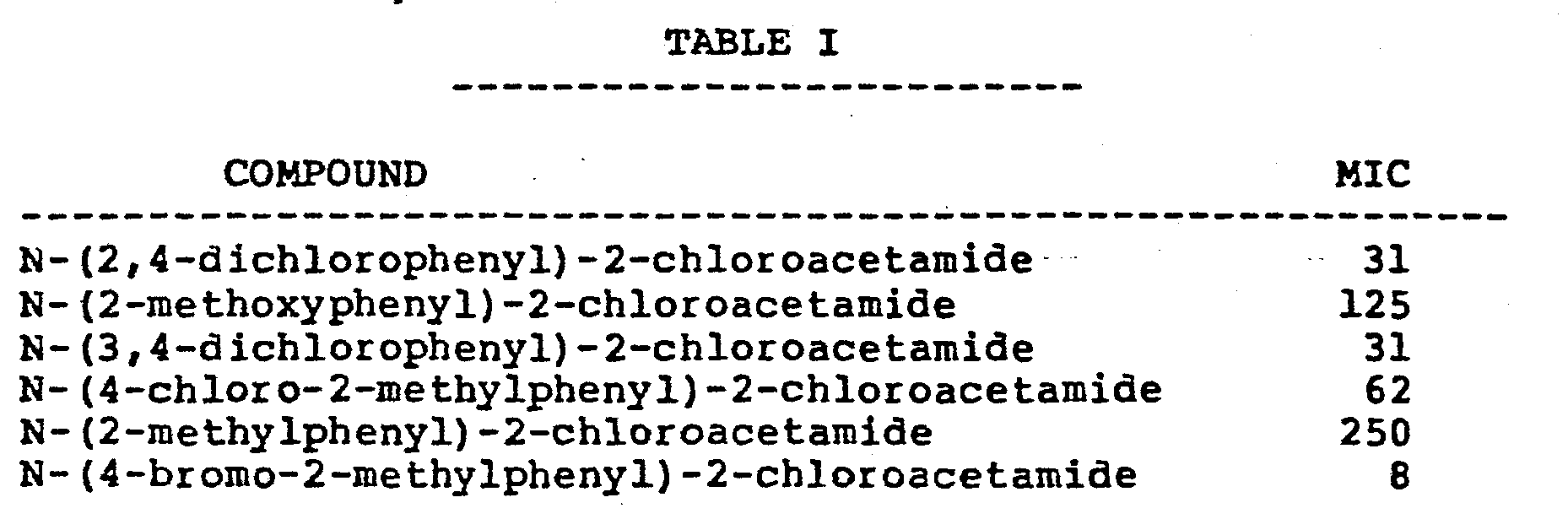
- Table I A summary of the MIC's of the preferred embodiments of the present invention is presented in Table I.
- N-(3,4-dichlorophenyl)-2-chloroacetamide was prepared by adding 113 grams of chloroacetylchloride in 80 cc of toluene to 165.3 grams 3,4-dichloroaniline and 950 cc toluene at 25°- 30°C over one hour. After the addition of the chloroacetylchloride was complete, the temperature of the reaction mixture was raised to reflux temperature (approximately 115°C) and refluxed for 16 hours. The reaction mixture was then cooled to 0°C and the precipitated product was separated by filtration. The precepitated product was then recrystallized resulting in a product that weighed 176.9 grams and having a melting point of 104°- 105°C.
- N-(4-bromo-2-methylphenyl)-2-chloroacetamide was prepared by adding 60 grams of chloroacetylchloride in 50 cc of 1,2-dichloroethane to 100 grams 4-bromo-2rmethylaniline and 600 cc 1,2-dichloroethane at 25°- 30°C over one hour. After the addition of the chloroacetylchloride was complete, the temperature of the reaction mixture was raised to reflux temperature (approximately 85°C) and refluxed for 25 hours. The reaction mixture was then cooled to 0°C and the precipitated product was separated by filtration. The precipitated product was then recrystallized resulting in a product that weighed 123 grams and having a melting point of 133°- 135°C.
- N-phenyl-2-chloroacetamide was prepared by adding 22.6 grams of chloroacetylchloride in 16 cc of Toluene to 18.6 grams aniline in 107 cc Toluene at 25°- 30°C over one hour. After the addition of the chloroacetylchloride was complete, the temperature of the reaction mixture was raised to reflux temperature (approximately 115°C) and refluxed for 16 hours. The reaction mixture was then cooled to 0°C and the precipitated product was separated by filtration. The precipitated product was then recrystallized resulting in a product that weighed 31.1 grams and having a melting point of 133°C - 135°C.
- N-(2-bromophenyl)-2-chloroacetamide was prepared by adding 16.1 grams of chloroacetylchloride in 15 cc of Toluene to 25 grams 2-bromoaniline and 150 cc Toluene at 25°- 30°C over one hour. After the addition of the chloroacetylchloride was complete, the temperature of the reaction mixture was raised to reflux temperature (approximately 115°C) and refluxed for 16 hours. The reaction mixture was then cooled to 0°C and the precipitated product was separated by filtration. The precipitated product was then recrystallized resulting in a product that weighed 22.7 grams and having a melting point of 76°C - 77°C.
- N-(2,4-dibromophenyl)-2-chloroacetamide was prepared by adding 11.3 grams of chloroacetylchloride in 20 cc of Toluene to 25 grams 2,4-dibromoaniline and 150 cc Toluene at 25°- 30°C over one hour. After the addition of the chloroacetylchloride was complete, the temperature of the reaction mixture was raised to reflux temperature (approximately 115°C) and refluxed for 16 hours. The reaction mixture was then cooled to 0°C and the precipitated product was separated by filtration. The precipitated product was then recrystallized resulting in a product that weighed 29.7 grams and having a melting point of 107°C - 108.5°C.
- the compounds of the present invention were tested as to their ability to inhibit the growth of fungi (mildew) of a paint film.
- the method uses a small environmental chamber constructed so as to maintain both the temperature and humidity at optimal conditions for the growth of fungi involved in mildew growth.
- a tray of soil is inoculated with mildew fungi and placed in the bottom of the cabinet over approximately l inch of water; the closed cabinet is maintained in a 25°C incubator.
- the organisms used are Aureobasidium pullulans (ATCC9348), Aspergillus niger (ATCC6275) and Penicillium sp. (ATCC9549).
- the fungal growth in the soil provides a constant air-borne inoculation for the surface of panels exposed in the top of the chamber.
- the panels are made of clear, white pine sapwood 37.5 mm x 75 mm x 9.4 mm. Each panel is coated twice with a standard paint containing the fungicide at the desired concentrations. Panels coated with the paint containing no fungicide are used as the negative control.
- the painted panels are hung vertically from the top of the chamber with the bottom of the panel approximately 3 inches above the soil tray. Replicate panels are placed randomly in the chamber. The panels are examined and rated each week for six weeks. Untreated painted panels fail in two to three weeks. The panels are rated from 10 (no growth) to 1 (maximum growth).
- the efficacy of the present invention in inhibiting fungal growth in metal cutting fluids was tested. Even in this industrial area of biodeterioration known to be primarily subject to bacterial spoilage, occasional fungicides are required. So, even though the products of the instant invention are not effective bactericides, their fungicidal activity is valuable and easily demonstrated.
- This procedure evaluates the effectiveness of a biocide to control bacteria and/or fungi responsible for the deterioration of metal working fluids.
- the antimicrobial agent is incorporated into a metal-working fluid at its use concentration (1000 parts per million). The mixture is then inoculated with microbial culture (fungi and bacteria) known to degrade such fluids.
- the fluid is aerated for five (5) days and then is unaerated for two days, thus simulating normal plant operations.
- the fluid is sampled before and after aeration and the samples evaluated for pH, total fungal and bacterial count. This regimen is continued until the antimicrobial fails by allowing a bacterial count of 1 x 10 7 organisms per ml or a duration of six weeks of limited growth occurs. This follows the ASTM Method E 686-80.
- the organisms used are either a culture of bacteria and fungus which normally would contaminate a cutting fluid: Staphylococcus aureus, Flavobacterium species, Pseudomonas aeruginosa, Escherichia coli, Desulfovibrio desulfuricans, and the fungi Cladosporium resenae and Fusarium sp. In all cases where bacteria were the inoculum, there was an overgrowth of lx 10 7 organisms in the negative control by the end of the first week. The results of the fungicidal tests are summarized in Table III.
- the fungicidal compounds were examined to determine whether they could prevent the growth of a cellulose degrading fungus on a chip of treated wood.
- Thin chips of transversely cut clear white pine about 40 mm x 40 mm x 1/2 mm are weighed, dipped into a solution of known concentration of the fungicide, dried and reweighed to determine the retention of the compound.
- the treated chips are placed on a glass "spacez" 5 mm above a fully developed growth of the fungus Coniophora souna Duby (ATCC36336) on a plastic petri dish of Malt Extract Agar. To prevent drying, the petri dishes are kept in polyethylene bags and are incubated at 25°C for four weeks. In this time, an untreated control is heavily deteriorated. Samples which are sufficiently protected do not show any significant traces of fungal attack.
Landscapes
- Life Sciences & Earth Sciences (AREA)
- Organic Chemistry (AREA)
- Chemical & Material Sciences (AREA)
- Dentistry (AREA)
- Health & Medical Sciences (AREA)
- Engineering & Computer Science (AREA)
- Plant Pathology (AREA)
- General Health & Medical Sciences (AREA)
- Wood Science & Technology (AREA)
- Zoology (AREA)
- Environmental Sciences (AREA)
- Pest Control & Pesticides (AREA)
- Agronomy & Crop Science (AREA)
- Organic Low-Molecular-Weight Compounds And Preparation Thereof (AREA)
- Agricultural Chemicals And Associated Chemicals (AREA)
Abstract
Description
- The invention relates to N-substituted alpha-chloroacetamides which are useful as fungicides, and to processes for preparing them. This invention further relates to fungicidal compositions and to methods of controlling or modifying the growth of fungi in certain industrial fluids.
- The term "fungicide" as used herein and in the appended claims means materials having a modifying effect upon the growth of fungi. Such modifying effects include all deviations from natural development for example, killing, retardation, inhibition, and the like. The term is also used to identify the growth modifying activity of the compounds and compositions of this invention. A fungicide is commonly used to prevent either the destructive action or the unsightly appearance of fungi (or the enzymes produced during their growth) on materials by killing or inhibiting the growth of these organisms.
- The term "fungi" as used herein and in the appended claims means any nucleated, usually filamentous, sporebearing organism devoid of chlorophyll. The common term for fungi encountered in industrial biodeterioration in the non-scientific community is molds and mildews. Molds are defined as any of the small, multinucleate, possibly multicellular, filamentous fungi included in the Eumycetes. Mildew is the term usually applied to the growth of fungi on substrates such as fibers, fabrics, plastics, masonry and wood and results in discoloration and sometimes weakening or even disintegration of the material on which the growth occurs. Because more than a hundred species are involved in mildew, it has become a generic term indicating growth producing discoloration of the material with or without degradation of the substrate.
- The term -industrial material* as used herein refers to all products or substances other than foodstuffs and living things. Thus it includes paper, wood, paint, rubber, plastics, etc., but excludes food and drink, plants and animals and their vital parts or products. By extension, it excludes those fungi which are pathogenic, or phytopathogenic, which therefore excludes the fungi which are cited in the agricultural and/or insect literature and application patents.
- An object of this invention is to provide novel fungicidal compositions containing as an essential ingredient an N-substituted alpha-chloroacetamide having one, two or three ring substituents.
- Another object of this invention is to provide novel fungicidal compositions having a wide spectrum of fungicidal activity.
- Another object of this invention is to provide a fungicidal compound that is stable in an industrial environment.
- Another object of this invention is to provide a fungicidal compound that will not interfere with industrial processes.
- Another object of this invention is to provide methods for killing or inhibiting the growth of fungi including molds and mildew.
- Another object of this invention is to provide as new compounds certain N-substituted alpha-chloroacetamides having one, two or three ring substituents.
- The novel alpha-chloroacetamides of this invention are represented by the formula

- The novel alpha chloroacetamides of this invention are useful per se or formulated for sale as antifungal compositions with inert organic solvents such as dimethylformamide, N-methyl-2-pyrrolidone, 2-methoxy ethanol, 2-ethoxy ethanol, triethylphosphate, tributylphoshate and the like. The antifungal concentration of the novel compounds of this invention in such compositions ranges from about 10 to 60% by weight. The user employs the antifungal compositions in various environments in ranges from about 500 to about 30,000 ppm, preferably 5,000 to 15,000 ppm.
- Although recent years have witnessed a large number of new microbicidal agents, there is still a need for fungicidal agents suitable for use in industrial environments to inhibit biodeterioration. Most industrial antifungal compounds were developed specifically for agricultural use. However, the requirements for an antifungal agent in agriculture are vastly different from those required in industrial biodeterioration. In order for the agricultural fungicides to be commercially successful, not only is their fungicidal activity of importance, but a minimal phytotoxicity and mammalian toxicity are required. An antifungal agent designed for agricultural use must have a relatively short half-life and must break down in the environment into non-toxic chemicals. In the field of industrial biodeterioration the phytotoxicity of a fungicide is of no importance; the mammalian toxicity is of secondary consideration; and, most importantly, long term stability and lack of chemical breakdown are highly desirable and sought after characteristics. Thus, the requirements for an industrial antifungal agent are quite different from an agricultural antifungal agent. Compounds having somewhat similar structures to the present invention are known to be effective for control of fungal organisms indigenous to the plant (agricultural) community.
- However, those disclosed compounds are not at all suitable for use in an industrial environment. For industrial use, the compound must be stable, i.e., it must retain its antimicrobial effects over a long period of time under relatively harsh conditions. Also, the compound must not affect the particular industrial process to which it is applied. Phytotoxicity is of no consequence and the mammalian toxicity is of minimal importance in the overall selection of a suitable compound.
- For example, coatings such as paints are often exposed to environments with high moisture content and warm temperatures which favor mold formation. Under such conditions, fungal growth can occur to such an extent that the paint can discolor and turn dark. In some instances, the fungal growth can cause decomposition of the paint binder and a concommitant loosening of the film. Also the paint may be loosened and detached from the substrate. Emulsion latex paints are particularly prone to fungal attack. These emulsion type lattices contain polymers more likely to be attacked by fungi than alkyd resin-based paints which have a greater concentration of aromatic rings. United States Patent No. 3,505,457 discloses 2,5 disubstituted alpha-iodoacetanilides, compounds to some extent structurally similar to the present invention. The compounds disclosed have an alpha-iodide in place of the alpha-chloride of the present invention. Although these alpha-iodoacetanilides do have fungicidal activity and are acceptable for use in the agricultural community, they are completely unsuitable for industrial fungicidal purposes. The alpha-iodoacetanilide is easily hydrolyzed under mild environmental conditions into its component parts alpha-iodo-acetic acid and the 2,5-disubstituted aniline. There is no fungcidal activity after hydrolysis. In contrast, the present invention, the alpha-chloroacetamides, are not easily hydrolyzed under normal environmental conditions and therefore have much longer half-lives and retain their antifungal activity longer. The alpha-chloroacetamides will therefore retain their anti-fungal activity over a much longer time than will the compounds described in the prior art.
- It should be noted that the alpha-bromoacetamides have similar chemical properties as the iodo analogs (i.e., will hydrolize under mild conditions) and are therefore not suitable for use in industrial environments.
- An industrial fungicide must also not affect the industrial material with which it is mixed. For example, when above mentioned iodoacetamides (e.g., N-(5-chloro-2-methoxyphenyl)-2-iodoacetamide and N-phenyl-2-iodoacetamide are mixed with paint, the paint forms a thick gel after 24 hours and is unusable. The corresponding alpha-bromoacetamides also cause gelling of paint after twenty-four hours.
- Thus, the compounds that are claimed in the present invention are not only different structurally from the compounds cited in the prior art but also have surprisingly different properties making these compounds uniquely suitable for inhibiting industrial biodeterioration.
- Industrial biodeterioration is an extremely broad problem and encompasses, but is not limited to, the following categories of industrial materials: paint, adhesives, floor polishes and finishes, pigments, colorants, and extender slurries, building materials such as joint cements, tape muds, acoustical plasters, tub caulks and grouts, cutting fluids, secondary oil recovery, specialty wood preservatives, cosmetics, textiles including fabrics and floor coverings, cooling towers, pulp and paper slimicides.
- The alpha-chloroacetamides of this invention are effective in the control of fungi in industrial materials. The present compounds exhibit microbiocidal action on a wide variety of fungi such as Penicillium sp, Aspergillus niger and other sp, Alternaria solani, and others, Aureobasidium pullulans, Cladosporium resinae, and Fusarium sps.
- The chloroacetamides of this invention can be prepared by chloroacetylation of suitable nuclear-substituted aromatic amines. The chloroacetylating agent is preferably either a chloroacetic anhydride or a chloroacetyl halide such as chloroacetyl chloride. The choices of chloroacylating agent is determined to some extent by the nature of the ortho substitution of the aromatic amine to be acetylated. Thus the chloroacetic anhydride is ordinarily used with a difficultly acetylated amine such as 2,6-di-tert-butyl amine but it is usually preferred to use a chloroacetyl halide to acetylate the more reactive amines.
- The chloroacetylation reaction is preferably conducted in the presence of a suitable organic medium. The organic medium must be anyhdrous if the acetylating agent is a chloroacetic anhydride. However, either anhydrous media or media containing water can be used with chloroacetyl halide acetylating agents. Suitable organic media for use with either acetylating agent include, for example, benzene, diethyl ether, 1,2-dichloroethane, hexane, chlorobenzene, toluene, chloroform, and the xylenes.
- The chloroacetylation reaction is generally carried out at a temperature which is between 90° and 115° C. It is generally preferable to carry out the reaction at atmospheric pressure although sub-atmospheric pressure and super-atmospheric pressure can be used. The acetamide products may be separated from the reaction mixture by methods well known to those skilled in the art, such as by distillation or fractional crystalization from the reaction medium or from solvents in case the desired product is a soluble substance.
- The fungicidal activity of the alpha chloroacetamides was determined by measuring the minimum inhibitory concentration (MIC). The MIC of the various compounds is the lowest amount of a biocide which will inhibit the growth of a microorganism or a mixture of microorganisms. It consists of a series of test tubes containing a growth medium for the organism(s) of interest: bacteria, fungi, etc. The compound is measured into the medium by serial dilution in an exact series of steps, often a decimal series, 1,2,3,4 etc., or 10,20,30 etc., and after inoculation and a suitable incubation, examined to determine the minimum amount of the compound which prevented growth. The inhibitory concentration is reported as the lowest amount, in parts per million, showing no growth when examined by the unaided eye. In tests where the medium is initially turbid, a small sample from each vessel is placed onto Nutrient Agar in Petri dishes and after 24 hours, examined for growth. Again, the lowest concentration in parts per million of compound showing no growth is reported. The test organism for determining the MIC for fungi is a week old culture of Aureobasidium pullulans (the most common mildew fungus). A summary of the MIC's of the preferred embodiments of the present invention is presented in Table I.
- The advantages, desirability and usefulness of the present invention are illustrated in the following examples.
- In this example, N-(3,4-dichlorophenyl)-2-chloroacetamide was prepared by adding 113 grams of chloroacetylchloride in 80 cc of toluene to 165.3 grams 3,4-dichloroaniline and 950 cc toluene at 25°- 30°C over one hour. After the addition of the chloroacetylchloride was complete, the temperature of the reaction mixture was raised to reflux temperature (approximately 115°C) and refluxed for 16 hours. The reaction mixture was then cooled to 0°C and the precipitated product was separated by filtration. The precepitated product was then recrystallized resulting in a product that weighed 176.9 grams and having a melting point of 104°- 105°C.
- In this example, N-(4-bromo-2-methylphenyl)-2-chloroacetamide was prepared by adding 60 grams of chloroacetylchloride in 50 cc of 1,2-dichloroethane to 100 grams 4-bromo-2rmethylaniline and 600 cc 1,2-dichloroethane at 25°- 30°C over one hour. After the addition of the chloroacetylchloride was complete, the temperature of the reaction mixture was raised to reflux temperature (approximately 85°C) and refluxed for 25 hours. The reaction mixture was then cooled to 0°C and the precipitated product was separated by filtration. The precipitated product was then recrystallized resulting in a product that weighed 123 grams and having a melting point of 133°- 135°C.
- In this example, N-phenyl-2-chloroacetamide was prepared by adding 22.6 grams of chloroacetylchloride in 16 cc of Toluene to 18.6 grams aniline in 107 cc Toluene at 25°- 30°C over one hour. After the addition of the chloroacetylchloride was complete, the temperature of the reaction mixture was raised to reflux temperature (approximately 115°C) and refluxed for 16 hours. The reaction mixture was then cooled to 0°C and the precipitated product was separated by filtration. The precipitated product was then recrystallized resulting in a product that weighed 31.1 grams and having a melting point of 133°C - 135°C.
- In this example, N-(2-bromophenyl)-2-chloroacetamide was prepared by adding 16.1 grams of chloroacetylchloride in 15 cc of Toluene to 25 grams 2-bromoaniline and 150 cc Toluene at 25°- 30°C over one hour. After the addition of the chloroacetylchloride was complete, the temperature of the reaction mixture was raised to reflux temperature (approximately 115°C) and refluxed for 16 hours. The reaction mixture was then cooled to 0°C and the precipitated product was separated by filtration. The precipitated product was then recrystallized resulting in a product that weighed 22.7 grams and having a melting point of 76°C - 77°C.
- In this example, N-(2,4-dibromophenyl)-2-chloroacetamide was prepared by adding 11.3 grams of chloroacetylchloride in 20 cc of Toluene to 25 grams 2,4-dibromoaniline and 150 cc Toluene at 25°- 30°C over one hour. After the addition of the chloroacetylchloride was complete, the temperature of the reaction mixture was raised to reflux temperature (approximately 115°C) and refluxed for 16 hours. The reaction mixture was then cooled to 0°C and the precipitated product was separated by filtration. The precipitated product was then recrystallized resulting in a product that weighed 29.7 grams and having a melting point of 107°C - 108.5°C.
- The compounds of the present invention were tested as to their ability to inhibit the growth of fungi (mildew) of a paint film. The method uses a small environmental chamber constructed so as to maintain both the temperature and humidity at optimal conditions for the growth of fungi involved in mildew growth. A tray of soil is inoculated with mildew fungi and placed in the bottom of the cabinet over approximately l inch of water; the closed cabinet is maintained in a 25°C incubator. The organisms used are Aureobasidium pullulans (ATCC9348), Aspergillus niger (ATCC6275) and Penicillium sp. (ATCC9549). The fungal growth in the soil provides a constant air-borne inoculation for the surface of panels exposed in the top of the chamber.
- The panels are made of clear, white pine sapwood 37.5 mm x 75 mm x 9.4 mm. Each panel is coated twice with a standard paint containing the fungicide at the desired concentrations. Panels coated with the paint containing no fungicide are used as the negative control. The painted panels are hung vertically from the top of the chamber with the bottom of the panel approximately 3 inches above the soil tray. Replicate panels are placed randomly in the chamber. The panels are examined and rated each week for six weeks. Untreated painted panels fail in two to three weeks. The panels are rated from 10 (no growth) to 1 (maximum growth).
- This method is described in Federal Specification TTP29B and is that of ASTM D3273-73T.

- The efficacy of the present invention in inhibiting fungal growth in metal cutting fluids (both soluble oil and synthetic cutting fluids) was tested. Even in this industrial area of biodeterioration known to be primarily subject to bacterial spoilage, occasional fungicides are required. So, even though the products of the instant invention are not effective bactericides, their fungicidal activity is valuable and easily demonstrated. This procedure evaluates the effectiveness of a biocide to control bacteria and/or fungi responsible for the deterioration of metal working fluids. The antimicrobial agent is incorporated into a metal-working fluid at its use concentration (1000 parts per million). The mixture is then inoculated with microbial culture (fungi and bacteria) known to degrade such fluids. The fluid is aerated for five (5) days and then is unaerated for two days, thus simulating normal plant operations. The fluid is sampled before and after aeration and the samples evaluated for pH, total fungal and bacterial count. This regimen is continued until the antimicrobial fails by allowing a bacterial count of 1 x 10⁷ organisms per ml or a duration of six weeks of limited growth occurs. This follows the ASTM Method E 686-80.
- The organisms used are either a culture of bacteria and fungus which normally would contaminate a cutting fluid: Staphylococcus aureus, Flavobacterium species, Pseudomonas aeruginosa, Escherichia coli, Desulfovibrio desulfuricans, and the fungi Cladosporium resenae and Fusarium sp. In all cases where bacteria were the inoculum, there was an overgrowth of lx 107 organisms in the negative control by the end of the first week. The results of the fungicidal tests are summarized in Table III.


- The fungicidal compounds were examined to determine whether they could prevent the growth of a cellulose degrading fungus on a chip of treated wood.
- Thin chips of transversely cut clear white pine about 40 mm x 40 mm x 1/2 mm are weighed, dipped into a solution of known concentration of the fungicide, dried and reweighed to determine the retention of the compound. The treated chips are placed on a glass "spacez" 5 mm above a fully developed growth of the fungus Coniophora puteana Duby (ATCC36336) on a plastic petri dish of Malt Extract Agar. To prevent drying, the petri dishes are kept in polyethylene bags and are incubated at 25°C for four weeks. In this time, an untreated control is heavily deteriorated. Samples which are sufficiently protected do not show any significant traces of fungal attack.

- While in the foregoing specification there have been set forth specific embodiments of this invention for purposes of illustration, it will be apparent to those skilled in the art that the specific embodiments and details thereof can be varied widely without departing from the spirit and scope of this invention.
Claims (16)


Applications Claiming Priority (2)
| Application Number | Priority Date | Filing Date | Title |
|---|---|---|---|
| US53652783A | 1983-09-28 | 1983-09-28 | |
| US536527 | 1983-09-28 |
Publications (3)
| Publication Number | Publication Date |
|---|---|
| EP0137729A2 true EP0137729A2 (en) | 1985-04-17 |
| EP0137729A3 EP0137729A3 (en) | 1986-04-23 |
| EP0137729B1 EP0137729B1 (en) | 1989-08-30 |
Family
ID=24138866
Family Applications (1)
| Application Number | Title | Priority Date | Filing Date |
|---|---|---|---|
| EP19840306148 Expired EP0137729B1 (en) | 1983-09-28 | 1984-09-07 | Method for the control of fungal growth in paints or cutting fluids |
Country Status (5)
| Country | Link |
|---|---|
| EP (1) | EP0137729B1 (en) |
| JP (1) | JPS6092252A (en) |
| CA (1) | CA1252041A (en) |
| DE (1) | DE3479556D1 (en) |
| IL (1) | IL73005A (en) |
Cited By (1)
| Publication number | Priority date | Publication date | Assignee | Title |
|---|---|---|---|---|
| EP0237731A1 (en) * | 1986-02-15 | 1987-09-23 | Riedel-De Haen Aktiengesellschaft | Microbicidal agents |
Family Cites Families (7)
| Publication number | Priority date | Publication date | Assignee | Title |
|---|---|---|---|---|
| DE834152C (en) * | 1950-06-06 | 1952-03-17 | Schulz Globus Werke F | Insecticides and fungicides |
| FR1546820A (en) * | 1966-11-01 | 1968-11-22 | Ciba Geigy | Herbicidal and fungicidal agents |
| US3781442A (en) * | 1971-03-24 | 1973-12-25 | Stauffer Chemical Co | Bromoacetanilides useful as biocides |
| BE788983A (en) * | 1971-09-22 | 1973-01-15 | Rolland Sa A | 3-TRIFLUOROMETHYLANILIDES |
| CS195321B2 (en) * | 1975-12-23 | 1980-01-31 | Ciba Geigy Ag | Plant growth suppressing agents |
| DE2842315A1 (en) * | 1978-09-28 | 1980-04-17 | Bayer Ag | N- (1,2-AZOLYL) ALKYL HALOGEN ACETANILIDES, METHOD FOR THE PRODUCTION THEREOF AND THEIR USE AS HERBICIDES |
| DE3373810D1 (en) * | 1982-07-27 | 1987-10-29 | Sumitomo Chemical Co | FUNGICIDAL ANILIDES |
-
1984
- 1984-08-21 CA CA000461473A patent/CA1252041A/en not_active Expired
- 1984-09-07 DE DE8484306148T patent/DE3479556D1/en not_active Expired
- 1984-09-07 EP EP19840306148 patent/EP0137729B1/en not_active Expired
- 1984-09-20 IL IL7300584A patent/IL73005A/en unknown
- 1984-09-28 JP JP20214184A patent/JPS6092252A/en active Pending
Cited By (1)
| Publication number | Priority date | Publication date | Assignee | Title |
|---|---|---|---|---|
| EP0237731A1 (en) * | 1986-02-15 | 1987-09-23 | Riedel-De Haen Aktiengesellschaft | Microbicidal agents |
Also Published As
| Publication number | Publication date |
|---|---|
| IL73005A (en) | 1989-02-28 |
| EP0137729A3 (en) | 1986-04-23 |
| JPS6092252A (en) | 1985-05-23 |
| CA1252041A (en) | 1989-04-04 |
| EP0137729B1 (en) | 1989-08-30 |
| DE3479556D1 (en) | 1989-10-05 |
Similar Documents
| Publication | Publication Date | Title |
|---|---|---|
| US3833731A (en) | Dihalomethylglutaronitriles used as antibacterial and antifungal agents | |
| FI90062C (en) | SAOSOM MICROBICIDES AND PRESERVATED MEDAL ANVAENDBAR NY CARBAMINE SYRESTER | |
| US5990174A (en) | Aqueous composition | |
| US5284844A (en) | Biocides for protecting industrial materials and water systems | |
| RU2039036C1 (en) | Biocidal composition and method of inhibiting growth of microorganisms in media | |
| US4166122A (en) | Bis-(5,5-dimethyl-1,3-oxazolidin-3-yl) methane as an antimicrobial agent | |
| NO171591B (en) | CONNECTION, BIOCID MIXING AND USE | |
| JPS63183570A (en) | N-alkyl-2,6-dimethylmorpholinocarboxyamide salt and fungicide containing same | |
| EP0493556A1 (en) | Biocide composition | |
| EP0137729B1 (en) | Method for the control of fungal growth in paints or cutting fluids | |
| DK167876B1 (en) | PROCEDURE FOR COMBATING CROP-BREATHING FUNGI, FUNGICID AGENT FOR USE IN THE EXERCISE OF THE PROCEDURE AND AMINOPHOSPHONIC ACID COMPOUNDS | |
| RU2091025C1 (en) | Fungicide synergistic composition | |
| KR960001204B1 (en) | N-alkylbenzenesulfonylcarbamoyl-5-chloroisothiazole derivatives | |
| US4198428A (en) | Aryl-thiocarboxylic acid thiocyanomethyl esters | |
| US4237019A (en) | 1-Thiocyanato-8-substituted naphthalene compounds and their use as biocides | |
| AU597968B2 (en) | Micro biocidal propargyl thiocyanate derivatives | |
| EP0160322A2 (en) | Iodonium ylide compositions and method for antimicrobial use | |
| AU595356B2 (en) | Substituted benzimidazole fungicide | |
| JPH0390055A (en) | Iodopropargyl esters of alphaamino acid derivative and microbial insecticide containing same | |
| JPH037205A (en) | Industrial antifungal and mildewproofing agent and composition of same agent | |
| EP0111413B1 (en) | Novel sulfone, process for its preparation, composition containing it and use thereof | |
| JPH09501401A (en) | N-dodecyl heterocyclic compounds useful as industrial microbicides and preservatives | |
| US3298910A (en) | Method for protecting against fungi with pyoluteorin | |
| USRE28356E (en) | Antibacterial and anttfungal treatment with sulfones | |
| JPH02240002A (en) | Fungus-and mold-preventing agent |
Legal Events
| Date | Code | Title | Description |
|---|---|---|---|
| PUAI | Public reference made under article 153(3) epc to a published international application that has entered the european phase |
Free format text: ORIGINAL CODE: 0009012 |
|
| AK | Designated contracting states |
Designated state(s): DE FR GB IT NL |
|
| PUAL | Search report despatched |
Free format text: ORIGINAL CODE: 0009013 |
|
| AK | Designated contracting states |
Kind code of ref document: A3 Designated state(s): DE FR GB IT NL |
|
| 17P | Request for examination filed |
Effective date: 19860729 |
|
| 17Q | First examination report despatched |
Effective date: 19880513 |
|
| GRAA | (expected) grant |
Free format text: ORIGINAL CODE: 0009210 |
|
| AK | Designated contracting states |
Kind code of ref document: B1 Designated state(s): DE FR GB IT NL |
|
| REF | Corresponds to: |
Ref document number: 3479556 Country of ref document: DE Date of ref document: 19891005 |
|
| ITF | It: translation for a ep patent filed | ||
| ET | Fr: translation filed | ||
| PLBE | No opposition filed within time limit |
Free format text: ORIGINAL CODE: 0009261 |
|
| STAA | Information on the status of an ep patent application or granted ep patent |
Free format text: STATUS: NO OPPOSITION FILED WITHIN TIME LIMIT |
|
| PGFP | Annual fee paid to national office [announced via postgrant information from national office to epo] |
Ref country code: FR Payment date: 19900713 Year of fee payment: 7 |
|
| PGFP | Annual fee paid to national office [announced via postgrant information from national office to epo] |
Ref country code: GB Payment date: 19900723 Year of fee payment: 7 |
|
| 26N | No opposition filed | ||
| PGFP | Annual fee paid to national office [announced via postgrant information from national office to epo] |
Ref country code: DE Payment date: 19900929 Year of fee payment: 7 |
|
| ITTA | It: last paid annual fee | ||
| PGFP | Annual fee paid to national office [announced via postgrant information from national office to epo] |
Ref country code: NL Payment date: 19900930 Year of fee payment: 7 |
|
| PG25 | Lapsed in a contracting state [announced via postgrant information from national office to epo] |
Ref country code: GB Effective date: 19910907 |
|
| PG25 | Lapsed in a contracting state [announced via postgrant information from national office to epo] |
Ref country code: NL Effective date: 19920401 |
|
| GBPC | Gb: european patent ceased through non-payment of renewal fee | ||
| NLV4 | Nl: lapsed or anulled due to non-payment of the annual fee | ||
| PG25 | Lapsed in a contracting state [announced via postgrant information from national office to epo] |
Ref country code: FR Effective date: 19920529 |
|
| PG25 | Lapsed in a contracting state [announced via postgrant information from national office to epo] |
Ref country code: DE Effective date: 19920602 |
|
| REG | Reference to a national code |
Ref country code: FR Ref legal event code: ST |