EP0138190A2 - Anordnung zur Messung der ex-vivo-Blutungszeit - Google Patents
Anordnung zur Messung der ex-vivo-Blutungszeit Download PDFInfo
- Publication number
- EP0138190A2 EP0138190A2 EP84112146A EP84112146A EP0138190A2 EP 0138190 A2 EP0138190 A2 EP 0138190A2 EP 84112146 A EP84112146 A EP 84112146A EP 84112146 A EP84112146 A EP 84112146A EP 0138190 A2 EP0138190 A2 EP 0138190A2
- Authority
- EP
- European Patent Office
- Prior art keywords
- arrangement according
- measuring
- measuring opening
- opening
- membrane
- Prior art date
- Legal status (The legal status is an assumption and is not a legal conclusion. Google has not performed a legal analysis and makes no representation as to the accuracy of the status listed.)
- Granted
Links
Images

Classifications
-
- G—PHYSICS
- G01—MEASURING; TESTING
- G01N—INVESTIGATING OR ANALYSING MATERIALS BY DETERMINING THEIR CHEMICAL OR PHYSICAL PROPERTIES
- G01N33/00—Investigating or analysing materials by specific methods not covered by groups G01N1/00 - G01N31/00
- G01N33/48—Biological material, e.g. blood, urine; Haemocytometers
- G01N33/50—Chemical analysis of biological material, e.g. blood, urine; Testing involving biospecific ligand binding methods; Immunological testing
- G01N33/86—Chemical analysis of biological material, e.g. blood, urine; Testing involving biospecific ligand binding methods; Immunological testing involving blood coagulating time or factors, or their receptors
-
- G—PHYSICS
- G01—MEASURING; TESTING
- G01N—INVESTIGATING OR ANALYSING MATERIALS BY DETERMINING THEIR CHEMICAL OR PHYSICAL PROPERTIES
- G01N21/00—Investigating or analysing materials by the use of optical means, i.e. using sub-millimetre waves, infrared, visible or ultraviolet light
- G01N21/75—Systems in which material is subjected to a chemical reaction, the progress or the result of the reaction being investigated
- G01N21/77—Systems in which material is subjected to a chemical reaction, the progress or the result of the reaction being investigated by observing the effect on a chemical indicator
- G01N21/82—Systems in which material is subjected to a chemical reaction, the progress or the result of the reaction being investigated by observing the effect on a chemical indicator producing a precipitate or turbidity
Definitions
- the invention relates to an arrangement for measuring the ex vivo bleeding time.
- the closure of injuries in the vascular system of organisms that have a blood circulation is largely autonomous.
- the blood platelets present in the blood fluid aggregate and together with fibrin form a plug that closes the opening and forms the framework for the connective tissue that later grows and forms the final occlusion.
- This finding allows the aggregation ability of blood platelets in an individual organism to be measured if, according to the invention, a blood sample is pressurized over a specific measurement opening and the time in which a specific one is measured Reduction of the measurement opening has occurred.
- the arrangement is characterized by the fact that the platelet aggregation takes place without being influenced by external, physiologically or pharmacologically active substances. This enables comparison values to be obtained for different individuals or different states of the same individual. Hematocrit and blood viscosity are taken into account in the measurement, so that these parameters, which essentially determine the microcirculation, are taken into account individually. On the other hand, the measured result is essentially determined by the function of the platelets, so that a platelet test is now available which allows simple quantification.
- the bleeding time may be changed by certain diseases, for example diabetes, or by therapeutically administered coagulants or anticoagulants.
- certain diseases for example diabetes
- therapeutically administered coagulants or anticoagulants for example, a simple check of the respective status is made possible.
- a mechanically tensionable diaphragm pump 10 has at its upper end an opening 20 provided with a seal, into which a ring 31 carrying a diaphragm 30 can be inserted.
- the membrane for example 200 ⁇ m thick, has a measuring opening 34 of approximately 0.05 mm in diameter.
- a drop of blood 50 is applied to the membrane 30 above the measuring opening 34, the ring 31 is placed on the seal 20 and the pump 10 is evacuated by pressure on the lever 11 and subsequent locking. The pressure difference across the measuring opening is then about 100mm Hg.
- the blood drop 50 which is arranged in an atmosphere 36 saturated with water vapor, for example by moistened cotton wool 39, begins to exit through the measuring opening 34 into the low-pressure space 14 of the pump 10.
- the now effective shear forces cause platelets to aggregate.
- the measurement opening 34 is thereby reduced. This reduction in the measurement opening is determined.
- the diaphragm pump can be omitted.
- thermostate the measuring chamber especially to a temperature of around 310 degrees K.
- the size of the diameter of the measuring opening and the membrane thickness should be approximately in a ratio of 0.01 to 10.
- the variation can be expediently optimized for the smallest amount of blood passing through. For example, if the diameter is about 25 ⁇ m and the membrane thickness is about 100 ⁇ m is.
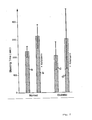
- FIG. 2 A result obtained with this measurement method is shown in FIG. 2.
- the bleeding time of normal test persons (a) after administration of 6.25 ⁇ g ketanserin per ml BLUT (b) and of diabetics (c) after administration of 6.25 ⁇ g ketanserin (d) was determined .
- the pierced membrane 30 with the measurement opening 34 is shown enlarged in FIG.
- the light-emitting diode 33 sends its light 37 through the measuring opening 34 of the membrane 30 covered with the blood drop 50, which is measured by a photo-receiver 38 and displayed by a display 36.
- the end point of the measurement is reached when no more blood flows through the measurement opening 34.
- the time required for this is the measured variable.
- a specific time can also be specified and the change in the lumen of the measurement opening that occurs thereafter can be determined.
- Such a method has the advantage that the determination of the end point is more accurate because the process does not lead to the blood flow coming to a standstill.
- Fig. 4 the change in lumen is determined by a conductivity measurement.
- the membrane 30 is metallized on both sides (301, 302) and a DC voltage U is applied between the electrodes.
- the electrical current I flows exclusively through the measuring opening 34.
- the lumen reduction by aggregation 355 can be determined well by the measuring instrument 361 indicating the change in resistance.
- the change in the measurement opening can also be determined by using the electrodes 301, 302 as capacitive resonant circuit elements.
- the resonance curve of the OsziLLators OS changes due to the aggregation 355 of the blood platelets. This change is measured after being superimposed with the signal of a fixed oscillator G and GL direction GL with the measuring instrument 362.
Landscapes
- Health & Medical Sciences (AREA)
- Life Sciences & Earth Sciences (AREA)
- Engineering & Computer Science (AREA)
- Chemical & Material Sciences (AREA)
- Immunology (AREA)
- Hematology (AREA)
- Physics & Mathematics (AREA)
- Analytical Chemistry (AREA)
- Biomedical Technology (AREA)
- Molecular Biology (AREA)
- Urology & Nephrology (AREA)
- Pathology (AREA)
- General Physics & Mathematics (AREA)
- General Health & Medical Sciences (AREA)
- Biochemistry (AREA)
- Cell Biology (AREA)
- Biotechnology (AREA)
- Medicinal Chemistry (AREA)
- Food Science & Technology (AREA)
- Microbiology (AREA)
- Chemical Kinetics & Catalysis (AREA)
- Plasma & Fusion (AREA)
- Investigating Or Analysing Biological Materials (AREA)
Abstract
Description
- Die Erfindung betrifft eine Anordnung zur Messung der ex-vivo-BLutungszeit.
- Der VerschLuss von VerLetzungen im Gefässystem von Organismen, die einen BLutkreisLauf haben, erfolgt weitgehend autonom. Dabei aggregieren die in der BLutfLüssigkeit vorhandenen BLutpLättchen und bilden mit Fibrin zusammen einen Pfropf, der die öffnung verschliesst und der das Gerüst für das später nachwachsende, den endgültigen VerschLuss bildende Bindegewebe bildet.
- Bisher war angenommen worden, dass die Aggregation von BLutpLättchen ausschliesslich durch das Freiwerden von Zwischensubstanzen, vor allem von Mediatoren und Enzymen entsteht, deren BiLdung oder Aktivierung durch verletzte Zellen oder durch die veränderte Hämodynamik provoziert wird.
- Es ist jedoch nun gefunden worden, dass Scherkräfte, wie sie beispielsweise in strömenden FLüssigkeiten in Wandnähe entstehen, bei hohen Werten bereits für sich eine Aggregation von BLutpLättchen auslösen.
- Diese Erkenntnis gestattet die Messung der Aggregationsfähigkeit von BLutpLättchen bei einem individuellen Organismus, wenn nach der Erfindung eine BLutprobe über einer bestimmten Messöffnung unter Druck gesetzt und die Zeit gemessen wird, in der eine bestimmte Verringerung der Messöffnung eingetreten ist.
- Die Anordnung zeichnet sich dadurch aus, dass die PLättchenaggregation ohne BeeinfLussung durch externe, physiologisch oder pharamkologisch wirksame Substanzen abläuft. Dadurch Lassen sich VergLeichswerte für verschiedene Individuen oder verschiedene Zustände des gleichen Individuums gewinnen. Dabei gehen Hämatokrit und BLutviskosität in die Messung ein, so dass diese, die MikrozirkuLation wesentlich bestimmenden Parameter individuell berücksichtigt sind. Andererseits wird das gemessene Ergebnis im wesentlichen durch die Funktion der Thrombozyten bestimmt, so dass nunmehr ein Thrombozytentest zur Verfügung steht, der eine einfache Quantifizierung zulässt.
- Reproduzierbare Ergebnisse Lassen sich besonders dann erreichen, wenn der Versuchsraum zu beiden Seiten der Messöffnung feucht gehalten ist, da dann keine Artefakte durch den Trocknungsprozess entstehen.
- Die BLutungszeit kann durch bestimmte Krankheiten, beispieLswe.ise Diabetes, oder durch therapeutisch verabreichte Gerinnungsmittel oder Antigerinnungsmittel verändert sein. Mit der Anordnung nach der Erfindung ist eine einfache überprüfung des jeweiligen Status ermöglicht.
- In der Zeichnung sind verschiedene Ausführungen der Erfindung dargestellt. Es zeigen
- Fig.1: eine vollständige Anordnung mit optischer Bestimmung des Normpunktes,
- Fig.2: ein Messergebnis
- Fig.3: eine vergrösserte DarsteLLung der Messöffnung,
- Fig.4: eine erste Anordnung mit elektrischer Bestimmung des Normpunktes
- Fig.5: eine zweite Anordnung mit elektrischer Bestimmung des Normpunktes
- Eine mechanisch spannbare Membranpumpe 10 weist in Fig.1 an ihrem oberen Ende eine mit einer Dichtung versehene öffnung 20 auf, in die ein eine Membran 30 tragender Ring 31 einsetzbar ist. Die Membran von beispielsweise 200 um Dicke weist eine Messöffnung 34 von etwa 0,05mm Durchmesser auf. Ein BLutstropfen 50 wird auf die Membran 30 über der Messöffnung 34 aufgebracht, der Ring 31 auf die Dichtung 20 gelegt und die Pumpe 10 durch Druck auf den Hebel 11 und anschliessende Arretierung evakuiert. Die Druckdifferenz über der Messöffnung beträgt danach etwa 100mm Hg.
- Der BLutstropfen 50, der in einer beispielsweise durch befeuchtete Watte 39 wasserdampfgesättigten Atmosphäre 36 angeordnet ist, beginnt, durch die Messöffnung 34 in den unter Niederdruck stehenden Raum 14 der Pumpe 10 auszutreten. Die nunmehr wirksamen Scherkräfte veranlassen dabei eine Aggregation der Blutplättchen. Dadurch wird die Messöffnung 34 verkleinert. Diese Verringerung der Messöffnung wird bestimmt.
- Stehen Pressluftinstallationen oder PressLuftfLaschen zur Verfügung, kann die Membranpumpe entfallen.
- VorteiLhaft ist auch die Thermostatisierung der Messkammer, insbesondere auf eine Temperatur von etwa 310 Grad K.
- Die Grösse des Durchmessers der Messöffnung und die Membrandicke sollen etwa im Verhältnis 0.01 bis 10 stehen. Die Variation kann dabei zweckmässig auf geringste durchtretende BLutmengen optimiert sein. So etwa, wenn der Durchmesser etwa 25 µm und die Membrandicke etwa 100 µm beträgt.
- Ein mit dieser Messmethode gewonnenes Ergebnis zeigt Fig.2 Hierin wurde die BLutungszeit von normalen Versuchspersonen (a), nach Verabreichung von 6.25µg Ketanserin pro ml BLut (b) und von Diabetikern (c), nach Verabreichung von 6.25 µg Ketanserin (d) bestimmt.
- In Fig.3 ist die durchbohrte Membran 30 mit der Messöffnung 34 vergrössert dargestellt.
- Die Leuchtdiode 33 sendet ihr Licht 37 durch die mit dem BLutstropfen 50 überdeckte Messöffnung 34 der Membran 30, das durch einen Photoempfänger 38 gemessen und durch eine Anzeige 36 angezeigt wird.
- Die Druckdifferenz über der Länge der die Messöffnung darstellenden Bohrung führt zu der gewünschten Scherkraft, die sich wie folgt berechnet:
- Es ist mit
- r = Radius der Messöffnung
- i = Fliessmenge
- L = Länge der Messöffnung
- dp = Druckdifferenz
- Q = Querschnitt der Messöffnung
-
v = MittLere Fliessgeschwindigkeit - = Viskosität
- = Scherrate
- τ = Scherkraft
- V = VoLumen
- (1)


- (2) Mit der Scherrate
- (3)

- (4)

- (5)

- (6)

- (1)
- Bei den gewählten Messgrössen:
- r ( µm) = 25 dp ( N/m2)=9600 L ( cm)=0.02 Q ( cm2)=1.96*10exp-5 v ( cm/s )=7.4-4.9*10exp-3 ergibt sich eine Scherkraft von etwa

- Der Endpunkt der Messung ist dann erreicht, wenn kein BLut mehr durch die Messöffnung 34 tritt. Die dazu erforderliche Zeit ist die gesuchte Messgrösse.
- Es kann aber auch eine bestimmte Zeit vorgegeben und die danach eingetretene Lumenänderung der Messöffnung festgestellt werden.
- Ein solche Methode hat den Vorteil dass die Bestimmung des Endpunktes genauer ist, weil der Vorgang nicht bis zum Stillstand des Blutdurchflusses geführt ist.
- In Fig. 4 ist die Lumenänderung durch eine Leitfähigkeitsmessung bestimmt. Dazu ist die Membran 30 beidseitig metallisiert (301,302) und eine GLeichspannung U zwischen die ELektroden gelegt. Der elektrische Strom I fliesst ausschliesslich durch die Messöffnung 34. Die Lumenverringerung durch Aggregation 355 kann durch das die Widerstandsänderung anzeigende Messinstrument 361 gut bestimmt werden.
- Gemäss Fig.5 kann die Veränderung der Messöffnung auch dadurch bestimmt werden, dass die ELektroden 301,302 als kapazitive SchwingkreiseLemente verwendet werden. Durch die Aggregation 355 der BLutpLättchen ändert sich die Resonanzkurve des OsziLLators OS. Diese Änderung wird nach überlagerung mit dem SignaL eines Festoszillators G und GLeichrichtung GL mit dem Messinstrument 362 gemessen.
Claims (11)
dass eine BLutprobe (50) über einer bestimmten Messöffnung (34) unter Druck gesetzt und die Zeit gemessen wird, in der eine bestimmte Verringerung der Messöffnung (34) durch Aggregation (355) von BLutpLättchen eingetreten ist.
Priority Applications (1)
| Application Number | Priority Date | Filing Date | Title |
|---|---|---|---|
| AT84112146T ATE44823T1 (de) | 1983-10-15 | 1984-10-10 | Anordnung zur messung der ex-vivo-blutungszeit. |
Applications Claiming Priority (2)
| Application Number | Priority Date | Filing Date | Title |
|---|---|---|---|
| DE19833337618 DE3337618A1 (de) | 1983-10-15 | 1983-10-15 | Anordnung zur messung der ex-vivo-blutungszeit |
| DE3337618 | 1983-10-15 |
Publications (3)
| Publication Number | Publication Date |
|---|---|
| EP0138190A2 true EP0138190A2 (de) | 1985-04-24 |
| EP0138190A3 EP0138190A3 (en) | 1987-04-22 |
| EP0138190B1 EP0138190B1 (de) | 1989-07-19 |
Family
ID=6211986
Family Applications (1)
| Application Number | Title | Priority Date | Filing Date |
|---|---|---|---|
| EP84112146A Expired EP0138190B1 (de) | 1983-10-15 | 1984-10-10 | Anordnung zur Messung der ex-vivo-Blutungszeit |
Country Status (4)
| Country | Link |
|---|---|
| US (1) | US4581920A (de) |
| EP (1) | EP0138190B1 (de) |
| AT (1) | ATE44823T1 (de) |
| DE (1) | DE3337618A1 (de) |
Cited By (2)
| Publication number | Priority date | Publication date | Assignee | Title |
|---|---|---|---|---|
| EP0316599A3 (en) * | 1987-11-19 | 1990-10-10 | Volker Freiherr Von Der Goltz | Flow-through apparatus for use in measuring bleeding time, and method for measuring bleeding time |
| EP1471353A3 (de) * | 2000-01-25 | 2005-08-17 | Freiherr von der Goltz, Volker | Vorrichtung und Verfahren zur Erfassung von Gerinnungsfunktionen der globalen, insbesondere der primären Hämostase |
Families Citing this family (2)
| Publication number | Priority date | Publication date | Assignee | Title |
|---|---|---|---|---|
| US4629706A (en) * | 1982-02-01 | 1986-12-16 | Miles Laboratories, Inc. | Method for determining allergic sensitivity |
| US5296379A (en) * | 1990-03-23 | 1994-03-22 | Peter Gorog | Apparatus and method for modeling arterial thrombus formations |
Family Cites Families (9)
| Publication number | Priority date | Publication date | Assignee | Title |
|---|---|---|---|---|
| US2312488A (en) * | 1940-03-15 | 1943-03-02 | Robert L Rowland | Coagulometer |
| CH478410A (de) * | 1966-10-11 | 1969-09-15 | Greiner Electronic Ag | Verfahren zur Bestimmung der Blutgerinnung |
| US3467862A (en) * | 1967-02-20 | 1969-09-16 | Usher Abramovich Vatmakher | Apparatus for recording resistance changes during the entire coagulation process in a biological fluid |
| DE1598732A1 (de) * | 1967-03-06 | 1970-12-03 | Le Vnii Medicinskich Instr Obo | Geraet zur Aufzeichnung des Kennwertes des Koagulationsverlaufes von biologischen Fluessigkeiten |
| GB1299363A (en) * | 1968-09-27 | 1972-12-13 | Amiram Ur | Monitoring of chemical, bio-chemical and biological reactions, particularly blood-clotting |
| FR2218803A5 (de) * | 1973-02-19 | 1974-09-13 | Daillet Ets | |
| DE2702557C3 (de) * | 1977-01-22 | 1979-10-11 | Labora Mannheim Gmbh Fuer Labortechnik, 6800 Mannheim | Vorrichtung zum Bestimmen der Blutsenkungsgeschwindigkeit |
| DE3005923A1 (de) * | 1980-02-16 | 1981-09-03 | Compur-Electronic GmbH, 8000 München | Photometrisches verfahren und photometrische vorrichtung zur bestimmung von reaktionsablaeufen |
| JPS5829450A (ja) * | 1981-08-18 | 1983-02-21 | 株式会社豊田中央研究所 | ヘマトクリツト測定装置 |
-
1983
- 1983-10-15 DE DE19833337618 patent/DE3337618A1/de not_active Withdrawn
-
1984
- 1984-10-10 EP EP84112146A patent/EP0138190B1/de not_active Expired
- 1984-10-10 AT AT84112146T patent/ATE44823T1/de not_active IP Right Cessation
- 1984-10-12 US US06/660,415 patent/US4581920A/en not_active Expired - Fee Related
Cited By (2)
| Publication number | Priority date | Publication date | Assignee | Title |
|---|---|---|---|---|
| EP0316599A3 (en) * | 1987-11-19 | 1990-10-10 | Volker Freiherr Von Der Goltz | Flow-through apparatus for use in measuring bleeding time, and method for measuring bleeding time |
| EP1471353A3 (de) * | 2000-01-25 | 2005-08-17 | Freiherr von der Goltz, Volker | Vorrichtung und Verfahren zur Erfassung von Gerinnungsfunktionen der globalen, insbesondere der primären Hämostase |
Also Published As
| Publication number | Publication date |
|---|---|
| DE3337618A1 (de) | 1985-04-25 |
| EP0138190A3 (en) | 1987-04-22 |
| ATE44823T1 (de) | 1989-08-15 |
| US4581920A (en) | 1986-04-15 |
| EP0138190B1 (de) | 1989-07-19 |
Similar Documents
| Publication | Publication Date | Title |
|---|---|---|
| DE60116351T2 (de) | Vorrichtung zur entnahme interstitieller flüssigkeit eines patienten für diagnostische tests | |
| US3999538A (en) | Method of blood viscosity determination | |
| DE69120231T2 (de) | Verfahren und Gerät zur Viskositätsmessung von Flüssigkeiten | |
| DE68929093T2 (de) | Vorrichtung zur Bestimmung von Gasen in Blutgefässen | |
| DE2734247C2 (de) | Vorrichtung zur fortlaufenden chemischen Analyse im lebenden Körper | |
| EP0790499B1 (de) | Verfahren zur Eichung von Gasmesssensoren für gelöste Gase und Verfahren zur Konzentrationsmessung von CO2 in Blut mit Hilfe eines solchen Eichverfahrens | |
| EP0246451B1 (de) | Vorrichtung zur Bestimmung von Gaspartialdrücken im Blut | |
| DE3781677T2 (de) | Verfahren und vorrichtung zur bestimmung von haematokrit in einem system zur bearbeitung von blutbestandteilen. | |
| DE1598079B2 (de) | Verfahren zum messen der glukose-konzentration im blut | |
| DE2436692B2 (de) | Verfahren und vorrichtung zur messung des drucks und anderer eigenschaften des blutes in einem menschlichen koerperteil | |
| DE69728525T2 (de) | Mittels vakuum verbesserter transdermaler flüssigkeitstransport | |
| DE19714087A1 (de) | Viskosimetrischer Affinitätssensor | |
| DE10392210T5 (de) | Verfahren und Vorrichtung zum Überwachen einer analytischen Konzentration mittels einer Osmose-Differenz-Druckmessung | |
| CH661128A5 (de) | Messsonde zu potentiometrischer messung von ionenkonzentrationen, verfahren zu deren herstellung und ihre verwendung. | |
| DE102004049064B3 (de) | Verfahren zur Unterscheidung von Nass- und Trockengas mit einem Atemalkoholmessgerät | |
| DE2840942B2 (de) | Nadeiförmiger osmotischer Kolloiddruckmesser | |
| DE60031128T2 (de) | Sonde für die mikrodialyse | |
| DE69221857T2 (de) | Messung der thromblytischen Aktivität von Blut | |
| EP0138190B1 (de) | Anordnung zur Messung der ex-vivo-Blutungszeit | |
| DE68925417T2 (de) | Tonometrische kathetervorrichtung und verfahren mit fernsensor | |
| AT376117B (de) | Fluessigkeits- und/oder gasuntersuchungsvorrichtung | |
| DE68925476T2 (de) | Tonometrische katheter-kombination | |
| DE1948259B2 (de) | Verfahren zum pruefen der osmotischen zerreissbarkeit organischer zellen, insbesondere roter blutzellen | |
| EP1753343A1 (de) | Verfahren zur messung des transkutanen co2-partialdrucks an einem ohrläppchen | |
| DE102007008509B4 (de) | Verfahren zur Messung der Viskosität und viskosimetrischer Affinitätssensor |
Legal Events
| Date | Code | Title | Description |
|---|---|---|---|
| PUAI | Public reference made under article 153(3) epc to a published international application that has entered the european phase |
Free format text: ORIGINAL CODE: 0009012 |
|
| AK | Designated contracting states |
Designated state(s): AT CH FR GB LI |
|
| RTI1 | Title (correction) | ||
| PUAL | Search report despatched |
Free format text: ORIGINAL CODE: 0009013 |
|
| AK | Designated contracting states |
Kind code of ref document: A3 Designated state(s): AT CH FR GB LI |
|
| 17P | Request for examination filed |
Effective date: 19870725 |
|
| 17Q | First examination report despatched |
Effective date: 19871022 |
|
| GRAA | (expected) grant |
Free format text: ORIGINAL CODE: 0009210 |
|
| AK | Designated contracting states |
Kind code of ref document: B1 Designated state(s): AT CH FR GB LI |
|
| PG25 | Lapsed in a contracting state [announced via postgrant information from national office to epo] |
Ref country code: GB Effective date: 19890719 Ref country code: FR Free format text: THE PATENT HAS BEEN ANNULLED BY A DECISION OF A NATIONAL AUTHORITY Effective date: 19890719 |
|
| REF | Corresponds to: |
Ref document number: 44823 Country of ref document: AT Date of ref document: 19890815 Kind code of ref document: T |
|
| PG25 | Lapsed in a contracting state [announced via postgrant information from national office to epo] |
Ref country code: AT Effective date: 19891010 |
|
| PG25 | Lapsed in a contracting state [announced via postgrant information from national office to epo] |
Ref country code: LI Effective date: 19891031 Ref country code: CH Effective date: 19891031 |
|
| EN | Fr: translation not filed | ||
| GBV | Gb: ep patent (uk) treated as always having been void in accordance with gb section 77(7)/1977 [no translation filed] | ||
| PLBE | No opposition filed within time limit |
Free format text: ORIGINAL CODE: 0009261 |
|
| STAA | Information on the status of an ep patent application or granted ep patent |
Free format text: STATUS: NO OPPOSITION FILED WITHIN TIME LIMIT |
|
| REG | Reference to a national code |
Ref country code: CH Ref legal event code: PL |
|
| 26N | No opposition filed |