EP0138325A2 - Chip carrier connector - Google Patents
Chip carrier connector Download PDFInfo
- Publication number
- EP0138325A2 EP0138325A2 EP84305565A EP84305565A EP0138325A2 EP 0138325 A2 EP0138325 A2 EP 0138325A2 EP 84305565 A EP84305565 A EP 84305565A EP 84305565 A EP84305565 A EP 84305565A EP 0138325 A2 EP0138325 A2 EP 0138325A2
- Authority
- EP
- European Patent Office
- Prior art keywords
- arm member
- connector
- lever
- circuit element
- engagement
- Prior art date
- Legal status (The legal status is an assumption and is not a legal conclusion. Google has not performed a legal analysis and makes no representation as to the accuracy of the status listed.)
- Granted
Links
Images



Classifications
-
- H—ELECTRICITY
- H05—ELECTRIC TECHNIQUES NOT OTHERWISE PROVIDED FOR
- H05K—PRINTED CIRCUITS; CASINGS OR CONSTRUCTIONAL DETAILS OF ELECTRIC APPARATUS; MANUFACTURE OF ASSEMBLAGES OF ELECTRICAL COMPONENTS
- H05K7/00—Constructional details common to different types of electric apparatus
- H05K7/02—Arrangements of circuit components or wiring on supporting structure
- H05K7/10—Plug-in assemblages of components, e.g. IC sockets
- H05K7/1053—Plug-in assemblages of components, e.g. IC sockets having interior leads
- H05K7/1061—Plug-in assemblages of components, e.g. IC sockets having interior leads co-operating by abutting
- H05K7/1069—Plug-in assemblages of components, e.g. IC sockets having interior leads co-operating by abutting with spring contact pieces
Definitions
- the present invention relates generally to an electrical connector for accommodating a circuit element carrier such as an integrated circuit chip carrier, and more specifically relates to a hold down member for securing the chip carrier in electrical contact in the connector.
- Integrated circuits are commonly packaged by mounting the semiconductor chip on a rectangular substrate or carrier having conductive elements on one side which extend from the chip to the marginal edge of the substrate.
- an electrical connector is employed which provides electrical connection between the conductive elements of the chip carrier and conductive traces of the printed circuit board.
- chip carrier connectors are shown for example in U.S. Patents 4,378,139; 4,220,383; and 4,381,131.
- these connectors typically include a rectangular (usually square) body or housing which supports, around the permetrical edge thereof, a .plurality of spring contacts.
- the chip carrier is receivable into the body, and the conductive elements thereon engage the spring contacts.
- the contacts include extending portions which connect to the conductive traces in the printed circuit board. In order to provide adequate electrical connection between the chip carrier and the spring contacts, it is necessary to provide some means to assure that the spring contacts will be continuously urged against the conductive elements of the chip carrier with a force sufficient to maintain such electrical contact.
- lids which are moved to bear against the chip carrier and urge it into resilient electrical contact with the spring contacts.
- These lids typically hinged at one end of the body, may also include a separate spring element to further bear against the chip carrier.
- Such hinged lids are shown, for example, in the above-mentioned U.S. patents 4,378,139 and 4,220,383.
- the carrier When employing a chip carrier of conventional dimensions, the carrier may include a great number of conductive elements or traces thereon. Each element would individually contact a corresponding one of an identical number of spring contacts in the connector. Each spring contact exerts a force against the connector upon insertion. The force may vary from contact to contact depending on construction, thickness and material composition. With contacts numbering in the range of 48 to 68 or lower, only a relatively light force is needed to urge the chip carrier into electrical connection with the contacts. However, when the number of conductive elements of the chip carrier, and correspondingly the number of contacts in the connector is increased to as many as 132 or more, as is now desired for increased capacity, the force needed to urge the chip carrier into engagement with the contacts is greatly increased. In fact, the applied force needed may be so great as to render insertion by the user difficult.
- Hinged lids or levers would of course reduce the difficulty of insertion as the lever aids in rendering a greater applied force to the carrier upon closing, based on simple lever principles. However, to provide an effective applied force sufficient to close the lid and urge the carrier into engagement with the contacts, the length of the lid would have to be greater then that which is acceptable for the space provided.
- the connector includes a device for urging the carrier into electrical connection with the contacts.
- the invention looks toward providing a circuit element connector comprising a body having a central cavity and supporting a plurality of electrical spring contacts therearound.
- a first arm member engages the circuit element and urges it into electrical connection with the contacts.
- a second arm member engages the first arm member and urges it into contact with the circuit element.
- the arm members are hinged covers wich overlie the central cavity, with the second arm member overlying the first arm member.
- Figure 1 shows, in bottom perspective view, a chip carrier including an integrated circuit semiconductive chip thereon.
- circuit element 10 which includes a chip carrier 12 comprising a thin flat insulative substrate having a plurality of electrically conductive portions or traces 14 thereon.
- Chip carrier 12 is substantially square in shape, and the conductive traces 14 extend on one surface 12a from the central region thereof to the marginal edge.
- An integrated circuit semiconductive chip 16 is mounted in approximately a central location on the bottom surface 12a of carrier 12.
- the traces 14 extend from the chip 16 and are electrically connected thereto. As the particular patterns of traces 14 on the carrier 12 may vary according to the content of the chip 16, traces 14 as shown are considered as representative.
- electrical connector 20 comprising a substantially square body 22 which is constructed typically of an insulative plastic, having four side walls 24. Body 22 defines between side walls 24, a central cavity 26, which accommodates and houses therein circuit element 10.
- circuit element 10 includes thereon, shown by way of example in schematic fashion, a heat sink 15 which is positioned over chip 16 to dissipate the heat that is generated during use.
- the size and shape of heat sink 15 may vary depending on the heat generated by the particular circuit element 10 employed. With certain connector and heat sink construction, power dissipation may be in the range of three to four watts.
- Body side walls 24 each include a plurality of slotted channels 28 each opening into the central cavity 26. Each slotted channel 28 receives and supportably separates an electrically conductive contact 30 (Figure 4).
- each side wall is segmented by thirty-three channels, thus providing a 132 contact connector. While the present invention is particularly useful with a connector having contacts numbering in this range, the invention may also be employed with connector having a lower or higher number of contacts.
- each contact 30 is supported by a portion of side wall 24 in an individual channel 28.
- Each contact 30 includes a main body portion 32 which secures the contact 30 to the body 22.
- An inclined spring element 34 extends in cantilevered fashion from the main body portion 32 into the central cavity 26.
- a rounded upper portion of the cantilever element 34 forms a contact portion 36 which serves to make electrical contact with an individual trace 14 of carrier 12 upon insertion of carrier 12 into connector 20.
- cantilever element 34 is resiliently deflectable upon insertion of carrier 12 into cavity 26.
- Contact 30 further includes an projecting portion 38 which extends downwardly through the bottom surface of body 22. Projecting portion 38 serves to make exterior electrical connection with a conductive element on a printed circuit board 29 shown in phantom in Figure 3 to which electrical connection of connector 20 is ultimately made. Such connection may for example be made by flow soldering or other conventional means.
- connector 20 further includes a pair of oppositely oriented plate-like levers 40 and 42 which serves as closing lids for connector 20.
- Lever 40 is a centrally-opened, square member having a base member 44 hingedly secured to one side wall 24a of body 22 at coaxial hinge pins 46 at opposites extents of base member 44.
- a pair of arm members 48 extend from hinged base member 44 toward opposite side wall 24b.
- a distal transverse bridging member 50 connects the distal extents of arm members 48.
- base member 44, arm members 48 and bridging member 50 form a four-sided, open frame which substantially spans the upper portion of connector 20.
- each side member of lever 40 Extending downwardly from each side member of lever 40 is a cantilever spring 52.
- the four springs 52 are arranged in a head-to-tail configuration, around the central opening of the lever 40, the secured extents of one spring being adjacent to an unsecured extent of another. With the chip carrier 12 inserted into cavity 26, the lever 40 may be closed down over and onto the carrier 12. The upwardly extending heat sink 15 is accommodated by the open frame configuration of lever 40.
- Lever 42 is of similar construction to that of lever 40, and includes a base member 43 hingedly secured to body 22 adjacent a side wall 24b opposite side wall 24a.
- a pair of arm members 47 extend from hinged base member 43 toward side wall 24a.
- a distal bridging member 49 connects the distal extents of arm members 47 to form a four-sided open frame.
- Coaxial hinge pins 53 secure base member 43 of lever 42 to connector 20.
- connector 10 With reference to Figures 3-6, the operation of connector 10 can be described.
- the connector 20 is in the open position with both levers 40 and 42 fully upright.
- the carrier 12 is positioned in the central cavity 26 of connector 20 so that the carrier 12 is seated on the contact portions 36 against the bias of the cantilever spring contacts 30.
- the chip 16 is placed face down from view shown in Figure 1 in the connector 20 so that the traces 14 engage the contacts 30.
- the first lever 40 is brought down over ,carrier 12 until one or more of the springs 52 bears against the upper surface of carrier 12. Further downward movement of the lever 40 and thus the carrier 12 will be resisted by the force exerted by the spring contacts 30 against the carrier 12. This force is sufficient to prevent further reasonable manual depressoin of the lever 40.
- connector 10 is in closed position with first lever 40 overlying by engaging first lever 40.
- chip carrier 12 is sufficiently urged against the bias of the spring contacts 30 to provide suitable electrical connection.
- Such urging is enhanced by the springs 52 of lever 40 which in closed position further bias carrier 12 against contacts 30.
- FIG. 6 A further feature of the present invention is shown in Figure 6. With the lever 40 and 42 closed in overlapping position over chip carrier 12, there will be sufficient urging of the carrier 12 against contacts 30 to provide adequate electrical connection. It is important to maintain this continuous urging by assuring that the lever 40 and 42 remain in a closed position over the chip carrier 12.
- Lever 40 is constructed to have an extent d, which, when in the closed position, will extend beyond the hinge pin 53 of lever 42.
- the distal bridging member 50 By extending beyond the hinge pin, and thus beyond the center of the hinging mechanism of lever 42, the distal bridging member 50 will exert upward force (due to the spring biases of both springs 52 and contacts 30) against the rear portion of lever 40. Since such force is extended upwards on one side of hinge pin 53 it will force by means of a moment the other side down into closed position against lever 40. Construction in this manner will serve as a latch preventing inadvertent opening of the levers 40 and 42.
- the connector 20 can be opened normally by lifting the distal bridging member 40 of lever 42.
- connector 20 is designed to place lever 40 and 42 in the ground path and thus provide continuous ground between the printed circuit board 29 and chip 16.
- Connector 20 has on the undersurface 59 thereof four slots 60, one at each corner. Slots 60 accommodate ground contacts 62. Each ground contact extends through the undersurface 59 of connector 20 for ultimate connection to ground traces on the printed circuit board. The upper portion of the ground contacts engage with and are connected to the distal bridging member 50 of lever 40, when in the closed position. As levers i 40 and 42 are constructed of conductive metal a grounding path will be established between the ground traces of the printed ciruit board and levers 40 and 42. Springs 52 which are integrally formed with lever 40 extend down and contact chip carrier 12 when the lever 40 and 42 are in a closed position. The ground path will continue to the selected traces of carrier 12 which are in contact with the spring 52.
- Connector 20 includes on the undersurface 59 thereof a pair of mounting posts 65 spaced at diagonally opposite corners of body 22. Posts 65 extend through aligned openings in printed circuit board 29 to properly position connector 20 on printed circuit board 29.
- a back up plate 70 is positioned adjacent the one side of printed circuit board 29, opposite the side to which connector 20 is mounted.
- Back up plate 70 which is preferably made of steel, is a square plate approximately the size of the undersurface 59 of connector 20 and includes four holes 72 one at each corner thereof. Holes 72 accommodate binding screws 74 which are inserted through holes 72 and up through similarly aligned openings (not shown) in printed circuit board 29.
- the undersurface 59 of connector 20 includes four screw threaded insert openings 66, one at each corner thereof which are aligned with holes 72 of plate 70. Openings 66 receive binding screws 74 thus securing connector 20 to plate 70 with printed circuit board 29 fixedly supported therebetween. In preferred form an insulative gasket 75 is interposed between plate 70 and printed circuit board 29.
- the present invention further contemplates placing the steel back plate 70 in the grounding path of connector 20.
- Such a shield may be provided by the steel back plate 70.
- grounding contacts 62 in electrical contact with lever 40 thus placing the levers 40 and 42 at ground potential.
- the back plate 70 will also be at ground potential.
- the back plate 70 can be connected to one of levers 40 or 42 in a variety of ways. One method for example would be to extend the length of the binding screws 74 so that they contact lever 40 in closed position thus establishing electrical connection therebetween.
Landscapes
- Engineering & Computer Science (AREA)
- Microelectronics & Electronic Packaging (AREA)
- Coupling Device And Connection With Printed Circuit (AREA)
- Wire Bonding (AREA)
- Details Of Connecting Devices For Male And Female Coupling (AREA)
Abstract
Description
- The present invention relates generally to an electrical connector for accommodating a circuit element carrier such as an integrated circuit chip carrier, and more specifically relates to a hold down member for securing the chip carrier in electrical contact in the connector. BACKGROUND OF THE INVENTION:
- The importance of integrated circuit semiconductors in the electronic industry is well known. These circuits have revolutionized the industry. Employed in miniaturized form and made into chips, these circuits can be utilized in great numbers in very little space, such as on printed circuit boards.
- Integrated circuits (IC) are commonly packaged by mounting the semiconductor chip on a rectangular substrate or carrier having conductive elements on one side which extend from the chip to the marginal edge of the substrate. In order to connect the chip carrier to the printed circuit board an electrical connector is employed which provides electrical connection between the conductive elements of the chip carrier and conductive traces of the printed circuit board. Such chip carrier connectors are shown for example in U.S. Patents 4,378,139; 4,220,383; and 4,381,131.
- Typically, these connectors include a rectangular (usually square) body or housing which supports, around the permetrical edge thereof, a .plurality of spring contacts. The chip carrier is receivable into the body, and the conductive elements thereon engage the spring contacts. The contacts include extending portions which connect to the conductive traces in the printed circuit board. In order to provide adequate electrical connection between the chip carrier and the spring contacts, it is necessary to provide some means to assure that the spring contacts will be continuously urged against the conductive elements of the chip carrier with a force sufficient to maintain such electrical contact.
- Devices commonly used to maintain such electrical contact are lids which are moved to bear against the chip carrier and urge it into resilient electrical contact with the spring contacts. These lids, typically hinged at one end of the body, may also include a separate spring element to further bear against the chip carrier. Such hinged lids are shown, for example, in the above-mentioned U.S. patents 4,378,139 and 4,220,383.
- When employing a chip carrier of conventional dimensions, the carrier may include a great number of conductive elements or traces thereon. Each element would individually contact a corresponding one of an identical number of spring contacts in the connector. Each spring contact exerts a force against the connector upon insertion. The force may vary from contact to contact depending on construction, thickness and material composition. With contacts numbering in the range of 48 to 68 or lower, only a relatively light force is needed to urge the chip carrier into electrical connection with the contacts. However, when the number of conductive elements of the chip carrier, and correspondingly the number of contacts in the connector is increased to as many as 132 or more, as is now desired for increased capacity, the force needed to urge the chip carrier into engagement with the contacts is greatly increased. In fact, the applied force needed may be so great as to render insertion by the user difficult.
- Hinged lids or levers would of course reduce the difficulty of insertion as the lever aids in rendering a greater applied force to the carrier upon closing, based on simple lever principles. However, to provide an effective applied force sufficient to close the lid and urge the carrier into engagement with the contacts, the length of the lid would have to be greater then that which is acceptable for the space provided.
- It is accordingly desirable to provide an urging mechanism which would provide sufficient effective force to the chip carrier and yet be of an acceptable size.
- It is an object of the present invention to provide a suitable electrical connector which will support a relatively high number of electrical contacts for connection with a chip carrier. The connector includes a device for urging the carrier into electrical connection with the contacts.
- In the efficient attainment of the foregoing and other objects, the invention looks toward providing a circuit element connector comprising a body having a central cavity and supporting a plurality of electrical spring contacts therearound. A first arm member engages the circuit element and urges it into electrical connection with the contacts. A second arm member engages the first arm member and urges it into contact with the circuit element.
- In a particularly employed embodiment the arm members are hinged covers wich overlie the central cavity, with the second arm member overlying the first arm member. Other objects and features of the invention will be evident from the following detailed description of the preferred embodiment of the present invention.
- Figure 1 shows, in bottom perspective view, a chip carrier including an integrated circuit semiconductive chip thereon.
- Figures 2 and 3 show in top and bottom perspective views respectively, the chip carrier connector of the present invention with the lids in non-engaged position.
- Figure 4 is a sectional fragmented showing of a portion of the connector body of Figures 2 and 3 supporting thereon one of a plurality of electrical spring contacts.
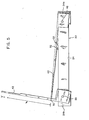
- Figures 5 and 6 show in side plan views the connector of Figures 2 and 3 with the lids in open and engaged position, respectively.
- Referring to Figure 1,
circuit element 10 is shown which includes achip carrier 12 comprising a thin flat insulative substrate having a plurality of electrically conductive portions ortraces 14 thereon.Chip carrier 12 is substantially square in shape, and theconductive traces 14 extend on onesurface 12a from the central region thereof to the marginal edge. An integrated circuitsemiconductive chip 16 is mounted in approximately a central location on thebottom surface 12a ofcarrier 12. Thetraces 14 extend from thechip 16 and are electrically connected thereto. As the particular patterns oftraces 14 on thecarrier 12 may vary according to the content of thechip 16,traces 14 as shown are considered as representative. - Referring now to Figures 2-4
electrical connector 20 is shown comprising a substantiallysquare body 22 which is constructed typically of an insulative plastic, having fourside walls 24.Body 22 defines betweenside walls 24, acentral cavity 26, which accommodates and houses thereincircuit element 10. As illustrated in Figures 2 and 3,circuit element 10 includes thereon, shown by way of example in schematic fashion, aheat sink 15 which is positioned overchip 16 to dissipate the heat that is generated during use. The size and shape ofheat sink 15 may vary depending on the heat generated by theparticular circuit element 10 employed. With certain connector and heat sink construction, power dissipation may be in the range of three to four watts. -
Body side walls 24 each include a plurality ofslotted channels 28 each opening into thecentral cavity 26. Each slottedchannel 28 receives and supportably separates an electrically conductive contact 30 (Figure 4). In the present illustrative embodiment each side wall is segmented by thirty-three channels, thus providing a 132 contact connector. While the present invention is particularly useful with a connector having contacts numbering in this range, the invention may also be employed with connector having a lower or higher number of contacts. - As particularly shown in Figure 4, each
contact 30 is supported by a portion ofside wall 24 in anindividual channel 28. Eachcontact 30 includes amain body portion 32 which secures thecontact 30 to thebody 22. Aninclined spring element 34 extends in cantilevered fashion from themain body portion 32 into thecentral cavity 26. A rounded upper portion of thecantilever element 34 forms acontact portion 36 which serves to make electrical contact with anindividual trace 14 ofcarrier 12 upon insertion ofcarrier 12 intoconnector 20. As will be described hereinafter,cantilever element 34 is resiliently deflectable upon insertion ofcarrier 12 intocavity 26. Contact 30 further includes an projectingportion 38 which extends downwardly through the bottom surface ofbody 22.Projecting portion 38 serves to make exterior electrical connection with a conductive element on a printedcircuit board 29 shown in phantom in Figure 3 to which electrical connection ofconnector 20 is ultimately made. Such connection may for example be made by flow soldering or other conventional means. - Referring again to Figures 2 and 3,
connector 20 further includes a pair of oppositely oriented plate-like levers connector 20. Lever 40 is a centrally-opened, square member having abase member 44 hingedly secured to oneside wall 24a ofbody 22 atcoaxial hinge pins 46 at opposites extents ofbase member 44. A pair ofarm members 48 extend from hingedbase member 44 towardopposite side wall 24b. A distaltransverse bridging member 50 connects the distal extents ofarm members 48. Thusbase member 44,arm members 48 and bridgingmember 50 form a four-sided, open frame which substantially spans the upper portion ofconnector 20. - Extending downwardly from each side member of
lever 40 is acantilever spring 52. The four springs 52 are arranged in a head-to-tail configuration, around the central opening of thelever 40, the secured extents of one spring being adjacent to an unsecured extent of another. With thechip carrier 12 inserted intocavity 26, thelever 40 may be closed down over and onto thecarrier 12. The upwardly extendingheat sink 15 is accommodated by the open frame configuration oflever 40. -
Lever 42 is of similar construction to that oflever 40, and includes abase member 43 hingedly secured tobody 22 adjacent aside wall 24b oppositeside wall 24a. A pair ofarm members 47 extend from hingedbase member 43 towardside wall 24a. Adistal bridging member 49 connects the distal extents ofarm members 47 to form a four-sided open frame. Coaxial hinge pins 53secure base member 43 oflever 42 toconnector 20. - With reference to Figures 3-6, the operation of
connector 10 can be described. - Initially the
connector 20 is in the open position with bothlevers carrier 12 is positioned in thecentral cavity 26 ofconnector 20 so that thecarrier 12 is seated on thecontact portions 36 against the bias of thecantilever spring contacts 30. Thechip 16 is placed face down from view shown in Figure 1 in theconnector 20 so that thetraces 14 engage thecontacts 30. Thefirst lever 40 is brought down over ,carrier 12 until one or more of thesprings 52 bears against the upper surface ofcarrier 12. Further downward movement of thelever 40 and thus thecarrier 12 will be resisted by the force exerted by thespring contacts 30 against thecarrier 12. This force is sufficient to prevent further reasonable manual depressoin of thelever 40. In this position (shown in Figure 5) thearm members 47 of thesecond lever 42 will rest against or be propped up by thedistal bridging member 50 oflever 50 which is contacting thelever 42 below the perpendicular intersection of the two levers. Downward pivotal movement of thesecond lever 42 will force thefirst lever 40 slidingly down onto thechip carrier 12. As thefirst lever 40 moves downward upon depression of thesecond lever 42, the length between the distal end oflever 42 and the intersection oflevers lever 40, the force applied by thefirst lever 40 to thechip carrier 12 will effectively increase, thus allowing the installer to overcome the spring force of thecontacts 30 and provide for easy manual insertion of thecarrier 12 into thecavity 26. - As shown in Figure 6,
connector 10 is in closed position withfirst lever 40 overlying by engagingfirst lever 40. In this position,chip carrier 12 is sufficiently urged against the bias of thespring contacts 30 to provide suitable electrical connection. Such urging is enhanced by thesprings 52 oflever 40 which in closed positionfurther bias carrier 12 againstcontacts 30. - A further feature of the present invention is shown in Figure 6. With the
lever chip carrier 12, there will be sufficient urging of thecarrier 12 againstcontacts 30 to provide adequate electrical connection. It is important to maintain this continuous urging by assuring that thelever chip carrier 12. -
Lever 40 is constructed to have an extent d, which, when in the closed position, will extend beyond thehinge pin 53 oflever 42. By extending beyond the hinge pin, and thus beyond the center of the hinging mechanism oflever 42, thedistal bridging member 50 will exert upward force (due to the spring biases of bothsprings 52 and contacts 30) against the rear portion oflever 40. Since such force is extended upwards on one side ofhinge pin 53 it will force by means of a moment the other side down into closed position againstlever 40. Construction in this manner will serve as a latch preventing inadvertent opening of thelevers connector 20 can be opened normally by lifting thedistal bridging member 40 oflever 42. - Referring again to Figure 3, a still further feature of the present invention is shown. It is often desirable to make a ground connection between the printed
circuit board 29 which supportsconnector 20, and certain ground traces or pads (not shown) onchip 16 orcarrier 12. In order to provide such a grounding path,connector 20 is designed to placelever circuit board 29 andchip 16. -
Connector 20 has on theundersurface 59 thereof fourslots 60, one at each corner.Slots 60 accommodateground contacts 62. Each ground contact extends through theundersurface 59 ofconnector 20 for ultimate connection to ground traces on the printed circuit board. The upper portion of the ground contacts engage with and are connected to thedistal bridging member 50 oflever 40, when in the closed position. Aslevers Springs 52 which are integrally formed withlever 40 extend down andcontact chip carrier 12 when thelever carrier 12 which are in contact with thespring 52. - A yet further feature of the present invention is shown in Figure 3.
Connector 20 includes on theundersurface 59 thereof a pair of mountingposts 65 spaced at diagonally opposite corners ofbody 22.Posts 65 extend through aligned openings in printedcircuit board 29 to properly positionconnector 20 on printedcircuit board 29. In order to securely anchorconnector 20 to printedcircuit board 29 prior to the flow soldering operation, a back upplate 70 is positioned adjacent the one side of printedcircuit board 29, opposite the side to whichconnector 20 is mounted. Back upplate 70, which is preferably made of steel, is a square plate approximately the size of theundersurface 59 ofconnector 20 and includes fourholes 72 one at each corner thereof.Holes 72 accommodate bindingscrews 74 which are inserted throughholes 72 and up through similarly aligned openings (not shown) in printedcircuit board 29. Theundersurface 59 ofconnector 20 includes four screw threadedinsert openings 66, one at each corner thereof which are aligned withholes 72 ofplate 70.Openings 66 receive bindingscrews 74 thus securingconnector 20 to plate 70 with printedcircuit board 29 fixedly supported therebetween. In preferred form aninsulative gasket 75 is interposed betweenplate 70 and printedcircuit board 29. - The present invention further contemplates placing the steel back
plate 70 in the grounding path ofconnector 20. In certain application it may be necessary to provide an electrical shield for thechip 16. Such a shield may be provided by the steel backplate 70. As previously set forth, groundingcontacts 62 in electrical contact withlever 40 thus placing thelevers back plate 70 in electrical connection with thelevers back plate 70 will also be at ground potential. Theback plate 70 can be connected to one oflevers binding screws 74 so that they contactlever 40 in closed position thus establishing electrical connection therebetween. - Having described the preferred embodiment of the invention together with its attendant advantages herein, it should be appreciated that other various modifications may be made without departing from the contemplated scope of the invention. Accordingly, the particularly described preferred embodiment is intended to be illustrative and not limited thereto. The true scope of the invention is set forth in the following claims.
Claims (10)
Applications Claiming Priority (2)
| Application Number | Priority Date | Filing Date | Title |
|---|---|---|---|
| US06/524,044 US4560217A (en) | 1983-08-17 | 1983-08-17 | Chip carrier connector |
| US524044 | 1983-08-17 |
Publications (3)
| Publication Number | Publication Date |
|---|---|
| EP0138325A2 true EP0138325A2 (en) | 1985-04-24 |
| EP0138325A3 EP0138325A3 (en) | 1986-01-29 |
| EP0138325B1 EP0138325B1 (en) | 1988-01-07 |
Family
ID=24087519
Family Applications (1)
| Application Number | Title | Priority Date | Filing Date |
|---|---|---|---|
| EP84305565A Expired EP0138325B1 (en) | 1983-08-17 | 1984-08-16 | Chip carrier connector |
Country Status (5)
| Country | Link |
|---|---|
| US (1) | US4560217A (en) |
| EP (1) | EP0138325B1 (en) |
| JP (1) | JPS6089952A (en) |
| CA (1) | CA1205538A (en) |
| DE (1) | DE3468608D1 (en) |
Families Citing this family (16)
| Publication number | Priority date | Publication date | Assignee | Title |
|---|---|---|---|---|
| JPH0134307Y2 (en) * | 1985-02-26 | 1989-10-18 | ||
| JPH0380987U (en) * | 1989-12-08 | 1991-08-19 | ||
| TW549655U (en) * | 2002-12-20 | 2003-08-21 | Hon Hai Prec Ind Co Ltd | An electrical connector |
| TW200509480A (en) * | 2003-08-27 | 2005-03-01 | Mitsumi Electric Co Ltd | Connector for camera module |
| TWM275587U (en) * | 2005-01-21 | 2005-09-11 | Hon Hai Prec Ind Co Ltd | Electrical connector assembly |
| US7258552B2 (en) * | 2005-07-05 | 2007-08-21 | Hewlett-Packard Development Company, L.P. | Socket for holding a circuit board module |
| CN2819519Y (en) * | 2005-08-24 | 2006-09-20 | 番禺得意精密电子工业有限公司 | Electric connector |
| CN100566028C (en) * | 2005-09-22 | 2009-12-02 | 富士康(昆山)电脑接插件有限公司 | Electrical Connector Assembly |
| CN100448117C (en) * | 2005-12-29 | 2008-12-31 | 富士康(昆山)电脑接插件有限公司 | Electrical connector assembly and electrical connector used for the electrical connector assembly |
| CN201130739Y (en) * | 2007-11-16 | 2008-10-08 | 富士康(昆山)电脑接插件有限公司 | Electrical Connector Assembly |
| US8081489B2 (en) * | 2008-12-24 | 2011-12-20 | Intel Corporation | Two piece wire bale independent load mechanism |
| US8816496B2 (en) | 2010-12-23 | 2014-08-26 | Intel Corporation | Thermal loading mechanism |
| TWM411712U (en) * | 2011-01-27 | 2011-09-11 | Hon Hai Prec Ind Co Ltd | Electrical connector |
| WO2014146134A1 (en) * | 2013-03-15 | 2014-09-18 | Neoconix, Inc. | Electrical connector with improved clamping mechanism |
| US20160072209A1 (en) * | 2014-09-05 | 2016-03-10 | Hzo, Inc. | Waterproof sockets and ports |
| US11587597B2 (en) * | 2020-06-24 | 2023-02-21 | Intel Corporation | Connector retention mechanism for improved structural reliability |
Family Cites Families (17)
| Publication number | Priority date | Publication date | Assignee | Title |
|---|---|---|---|---|
| US109330A (en) * | 1870-11-15 | Improvement in vessel s hatches | ||
| US1050265A (en) * | 1911-11-13 | 1913-01-14 | John V Crone | Radiator-cap. |
| US1645476A (en) * | 1922-06-28 | 1927-10-11 | Fell Harold Victor Morrison | Electrical cut-out |
| US2016606A (en) * | 1932-12-14 | 1935-10-08 | Badger Meter Mfg Co | Water meter cover |
| NL44208C (en) * | 1935-04-04 | |||
| US2927295A (en) * | 1954-02-23 | 1960-03-01 | Aircraft Marine Prod Inc | Plugboard assembly |
| US4130327A (en) * | 1977-05-27 | 1978-12-19 | Bunker Ramo Corporation | Electrical connector having a resilient cover |
| GB2008333B (en) * | 1977-11-14 | 1982-05-26 | Amp Inc | Electrical connector |
| US4278311A (en) * | 1979-04-06 | 1981-07-14 | Amp Incorporated | Surface to surface connector |
| US4220383A (en) * | 1979-04-06 | 1980-09-02 | Amp Incorporated | Surface to surface connector |
| US4354720A (en) * | 1980-10-20 | 1982-10-19 | Amp Incorporated | Connector assembly having improved latching means |
| US4381131A (en) * | 1981-05-04 | 1983-04-26 | Burroughs Corporation | Levered system connector for an integrated circuit package |
| US4378139A (en) * | 1981-07-14 | 1983-03-29 | Wells Electronics, Inc. | Integrated circuit carrier connector |
| JPS5827400A (en) * | 1981-08-11 | 1983-02-18 | 山一電機工業株式会社 | Locking mechanism for ic retaining plate in ic socket |
| US4433886A (en) * | 1981-12-17 | 1984-02-28 | Elco Corporation | Connector mounting for integrated circuit chip packages |
| US4460223A (en) * | 1981-12-30 | 1984-07-17 | Methode Electronics, Inc. | Cover for chip carrier socket |
| US4502747A (en) * | 1982-06-24 | 1985-03-05 | Amp Incorporated | Pad array socket |
-
1983
- 1983-08-17 US US06/524,044 patent/US4560217A/en not_active Expired - Fee Related
-
1984
- 1984-08-14 CA CA000460959A patent/CA1205538A/en not_active Expired
- 1984-08-16 EP EP84305565A patent/EP0138325B1/en not_active Expired
- 1984-08-16 DE DE8484305565T patent/DE3468608D1/en not_active Expired
- 1984-08-17 JP JP59171406A patent/JPS6089952A/en active Pending
Also Published As
| Publication number | Publication date |
|---|---|
| JPS6089952A (en) | 1985-05-20 |
| EP0138325B1 (en) | 1988-01-07 |
| US4560217A (en) | 1985-12-24 |
| CA1205538A (en) | 1986-06-03 |
| EP0138325A3 (en) | 1986-01-29 |
| DE3468608D1 (en) | 1988-02-11 |
Similar Documents
| Publication | Publication Date | Title |
|---|---|---|
| US4560217A (en) | Chip carrier connector | |
| US5221209A (en) | Modular pad array interface | |
| US5215472A (en) | High density grid array socket | |
| EP0632950B1 (en) | Integrated circuit test socket | |
| US4354720A (en) | Connector assembly having improved latching means | |
| US4130327A (en) | Electrical connector having a resilient cover | |
| JP4133141B2 (en) | Socket for electrical parts | |
| US4873761A (en) | Insertion/extraction tool | |
| US5387120A (en) | Latching IC connector | |
| US4460223A (en) | Cover for chip carrier socket | |
| US6821138B2 (en) | ZIF socket connector having means for preventing CPU mounted on the connector from deformation due to a clamping force acting thereon | |
| KR19990022014A (en) | Chip pile assembly and chip socket assembly for semiconductor chip | |
| WO1999056515A1 (en) | Integrated circuit intercoupling component with heat sink | |
| US20100177477A1 (en) | Adjustable retention load plate of electrical connector assembly | |
| KR100365027B1 (en) | socket | |
| JP2550437B2 (en) | Chip carrier socket | |
| US5245277A (en) | Clamp for testing used integrated circuit devices | |
| US20020182915A1 (en) | Socket for electrical parts | |
| US5788526A (en) | Integrated circuit test socket having compliant lid and mechanical advantage latch | |
| US5074798A (en) | Modular socket for an integrated circuit | |
| JP3302045B2 (en) | IC socket | |
| JPH0231463B2 (en) | ||
| JPH0922760A (en) | Fpc-board connection structure in personal handyphone | |
| JP3939801B2 (en) | Socket for electrical parts | |
| JP4169841B2 (en) | Socket for electrical parts |
Legal Events
| Date | Code | Title | Description |
|---|---|---|---|
| PUAI | Public reference made under article 153(3) epc to a published international application that has entered the european phase |
Free format text: ORIGINAL CODE: 0009012 |
|
| AK | Designated contracting states |
Designated state(s): BE CH DE FR GB IT LI NL SE |
|
| PUAL | Search report despatched |
Free format text: ORIGINAL CODE: 0009013 |
|
| AK | Designated contracting states |
Designated state(s): BE CH DE FR GB IT LI NL SE |
|
| 17P | Request for examination filed |
Effective date: 19860221 |
|
| 17Q | First examination report despatched |
Effective date: 19870324 |
|
| GRAA | (expected) grant |
Free format text: ORIGINAL CODE: 0009210 |
|
| AK | Designated contracting states |
Kind code of ref document: B1 Designated state(s): BE CH DE FR GB IT LI NL SE |
|
| REF | Corresponds to: |
Ref document number: 3468608 Country of ref document: DE Date of ref document: 19880211 |
|
| ITF | It: translation for a ep patent filed | ||
| ET | Fr: translation filed | ||
| PLBE | No opposition filed within time limit |
Free format text: ORIGINAL CODE: 0009261 |
|
| STAA | Information on the status of an ep patent application or granted ep patent |
Free format text: STATUS: NO OPPOSITION FILED WITHIN TIME LIMIT |
|
| 26N | No opposition filed | ||
| PG25 | Lapsed in a contracting state [announced via postgrant information from national office to epo] |
Ref country code: GB Effective date: 19890816 |
|
| PG25 | Lapsed in a contracting state [announced via postgrant information from national office to epo] |
Ref country code: SE Effective date: 19890817 |
|
| PG25 | Lapsed in a contracting state [announced via postgrant information from national office to epo] |
Ref country code: LI Effective date: 19890831 Ref country code: CH Effective date: 19890831 Ref country code: BE Effective date: 19890831 |
|
| BERE | Be: lapsed |
Owner name: THOMAS & BETTS CORP. Effective date: 19890831 |
|
| PG25 | Lapsed in a contracting state [announced via postgrant information from national office to epo] |
Ref country code: NL Effective date: 19900301 |
|
| NLV4 | Nl: lapsed or anulled due to non-payment of the annual fee | ||
| GBPC | Gb: european patent ceased through non-payment of renewal fee | ||
| PG25 | Lapsed in a contracting state [announced via postgrant information from national office to epo] |
Ref country code: FR Effective date: 19900427 |
|
| REG | Reference to a national code |
Ref country code: CH Ref legal event code: PL |
|
| PG25 | Lapsed in a contracting state [announced via postgrant information from national office to epo] |
Ref country code: DE Effective date: 19900501 |
|
| REG | Reference to a national code |
Ref country code: FR Ref legal event code: ST |
|
| EUG | Se: european patent has lapsed |
Ref document number: 84305565.8 Effective date: 19900418 |