EP0138445A2 - Procédé et dispositif pour la segmentation d'images de caractères - Google Patents
Procédé et dispositif pour la segmentation d'images de caractères Download PDFInfo
- Publication number
- EP0138445A2 EP0138445A2 EP84306526A EP84306526A EP0138445A2 EP 0138445 A2 EP0138445 A2 EP 0138445A2 EP 84306526 A EP84306526 A EP 84306526A EP 84306526 A EP84306526 A EP 84306526A EP 0138445 A2 EP0138445 A2 EP 0138445A2
- Authority
- EP
- European Patent Office
- Prior art keywords
- character
- line
- characters
- axis
- profile
- Prior art date
- Legal status (The legal status is an assumption and is not a legal conclusion. Google has not performed a legal analysis and makes no representation as to the accuracy of the status listed.)
- Granted
Links
Images

Classifications
-
- G—PHYSICS
- G06—COMPUTING OR CALCULATING; COUNTING
- G06V—IMAGE OR VIDEO RECOGNITION OR UNDERSTANDING
- G06V30/00—Character recognition; Recognising digital ink; Document-oriented image-based pattern recognition
- G06V30/10—Character recognition
- G06V30/14—Image acquisition
- G06V30/148—Segmentation of character regions
- G06V30/158—Segmentation of character regions using character size, text spacings or pitch estimation
-
- G—PHYSICS
- G06—COMPUTING OR CALCULATING; COUNTING
- G06V—IMAGE OR VIDEO RECOGNITION OR UNDERSTANDING
- G06V30/00—Character recognition; Recognising digital ink; Document-oriented image-based pattern recognition
- G06V30/10—Character recognition
Definitions
- the present invention relates to the field of character recognition, and in particular to the segmentation into individual character images of a coded representation of a line of characters printed on a document so that individual characters may be recognised or identified.
- segmentation is the process of dividing a horizontal string of characters written along a line on a document into separate or discrete characters, e.g. dividing a word into its individual letters.
- the OCR apparatus reads all the characters in a line generating coded signals representing the line ot characters.
- the segmentation process allows these coded signals to be broken up into individual coded images for each of the characters in the line.
- each coded character image is binarised and stored as a binary video data pattern which ideally contains only the data associated with the character to be recognised.
- the data representing each character is typically coded as picture elements (PELS) that are either black or white, which respectively represent the presence of a character portion or the presence of background (i.e. the absence of a character portion) at a particular location in the area or the document in which the character is written.
- PELS picture elements
- a coded representation (usually a hexadecimal byte) of that character can be transmitted to data processing equipment.
- United States Patent A-4,045,773 discloses another early segmentation technique that adjusts the segmentation point depending upon whether or not the scanned character is within a character trame.
- the rows of horizontally extending characters are scanned vertically after the interval of the lines separating the character frames has been provided.
- the scanned pattern portion is projected and tested for the presence ot a logical 1, which represents a dark spot, to determine whether or not the scanned pattern portion is a blank.
- the start and end points ot a character are determined, and the centre of the character is calculated using the start and end points. If the character is too small, scanning continues beyond the first start and end points to determine if the character comprises two or more sub-patterns, or if it should be rejected as noise. Having calculated the centre of the sub-pattern or character, the location of the centre is compared to the location of the character frame. All characters or patterns or sub-patterns having a centre within the character frame are segmented as a single character pattern.
- the object of the present invention is to provide an improved apparatus and method for segmenting into individual character images a coded representation of a line of characters printed on a document.
- the present invention is well suited to implementation using a general purpose microprocessor because the calculations can be accomplished with logical and arithmetic functions.
- the present invention enables overlapped characters, connected characters, underscored characters, broken characters and blank character spaces all to be segmented successfully.
- the present invention uses validation steps, such as a segmentation recognition retry feature which utilises feedback from the recognition of the specific characters, in order to enhance segmentation accuracy.
- each line of characters on a document is scanned in a series of parallel scan lines extending along the line of characters to generate successive sets of data signals representing the characters, including blank spaces, overlapped characters, etc.
- a set of data signals is generated for each scan line.
- the set ot data signals for each scan line represents binary picture elements (PELS) forming the cnaracters.
- the corresponding portions of the sets of data signals are logically ORed resulting in the generation of a horizontal binary character line profile segment in which a continuous series of bits of one binary state (binary bit "1") represents a continuous series ot black picture elements (PELS), and a continuous series ot the other binary state (binary bit "0") represents a series of white PELS.
- the series of black bits corresponds to character width in the direction of scanning, while the series or white bits corresponds to gaps between characters, or to the separation between portions of a broken or multi-part character.
- a profile segment is a continuous series of black PELS that corresponds to one or more characters or a discrete part of a multipart character within the character line protile.
- the linear tunction algorithm which may be implemented in software for use by a general purpose microprocessor, can be in either of two torms. If the pitch of the characters, which is defined as the distance between corresponding portions of adjacent characters, is known and the characters are believed to be printed reasonably accurately in preferred character locations then the linear tunction can be obtained by using the pitch of the characters and the position of the centre ot one of the profile segments. On the other hand, if the characters are not believed to be printed accurately in preferred character locations, the linear function is obtained by implementing a least squares regression technique using the positions of the centres ot all the profile segments. This well known statistical algorithm fits a straight line to a set of observed points (i.e.
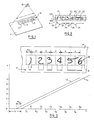
- an optical scanner 10 of known construction and operation scans a document 11 having one or more horizontal lines of characters 12.
- the characters are scanned in a direction generally parallel to the direction in which they extend across the document (i.e., horizontally).
- the scanner typically examines the entire length of the document by moving either the document or the scanner mechanism, and examines the entire width of the document by selecting a tield of view of appropriate width.
- the document is provided with a series ot contiguous horizontal boxes 13 each of which defines a preferred character location.
- the boxes have a predetermined pitch and delineate areas into which characters will preferably be located, in a one-to-one correspondence, to assist in the proper spacing ot handwritten characters.
- the optical scanner 10 scans each line of characters in a series of vertically spaced scan lines and generates information representative of the characters.
- Each character is considered to be made up trom a plurality of picture elements (PELs) arranged in horizontal rows and vertical columns. Each row contains a large number of PELs, several hundred or more.
- Each scan line scans along a row of PELs and generates a binary data bit for each PEL.
- Each PEL is either dark or light depending on whether it corresponds to a dark or a light portion of a character and the binary data bit representing each PEL will have a value indicating whether the PEL is dark or light. For each scan line there is therefore generated a set ot binary data bits representing the PELs scanned by the scan line.
- the scanner when scanning along the scan line bearing the reterence 120 in Figure 2, the scanner generates a set ot binary data signals, in which a logical 0 (zero) represents a blank or background space 2U and a logical 1 represents the presence of a portion of a character on the scan line, shown as a thick dot 21 on the scan line.
- the lines defining the boxes 13 are invisible to the scanner and thus are represented by a logical U unless a portion of a character coincides with one of these box defining lines, as where the tail of the numeral 5 crosses into a box at reference numeral 22.
- the scanner makes successive horizontal scans along the length of the document, and for each scan line is generated a corresponding set ot binary data signals which is likely to be different for each scan line. This is illustrated by a comparison of the scan line 120, with the scan line 180. It will be seen that each of these scan lines scans across portions of characters in different horizontal positions and therefore the sets of binary data signals generated for these scan lines are ditterent.
- the bits of each set of binary data signals are logically combined to generate a horizontal character line protile for the line of scanned characters.
- the bits in each set corresponding to each vertical column of PELs are logically combined using an OR function as described in more detail below.
- the horizontal character line profile is representative ot the widths ot the characters in the line and the spacing between the characters.
- the optical scanner 10 In operation, the optical scanner 10 generates information representative of the characters on the document 11, and this information is a series of sets of binary data signals representing the dark and light PELs torming the characters.
- the scanner makes successive horizontal scans and for each scan it generates logical zeros (0's) to represent a light PEL or background space, and logical ones (1's) to represent a dark PEL or the presence of a portion of a character on the scan line.
- the horizontal character line profile is generated by sequentially supplying the sets of data signals corresponding to the horizontal scan lines for a line of characters to a register having a set of storage positions each corresponding to a respective one of the PELs forming the scanned character. Beginning with a clear register (i.e.
- sets of binary data signals are eftectively logically combined using an OR function by successively providing them to the register.
- the corresponding register storage position For each logical 1 in a set of data signals representing a dark PEL, the corresponding register storage position is set to a logical 1, and remains a logical 1 until the register position is cleared after the entire line ot characters has been scanned.
- the corresponding register storage position For those PELs which are blank representing only a background space, the corresponding register storage position will remain set to a logical zero. Having been supplied with all of the sets of data signals, the register will retlect which vertical columns of PELs represent portions of characters and this information is reflected in the horizontal character line protile.
- the resulting horizontal character line protile such as the one illustrated at reference letter P for FIG. 2, appears as a series of black segments (logical 1's) separated by gaps of white (logical U's).
- the black segments 23 correspond to the horizontal locations of the scanned characters, and the white gaps 24 correspond to the separations between adjacent scanned characters.
- the profile has been described as horizontal, it is to be understood that the profile is parallel to the direction of reading, and thus may be oriented vertically for an alphabet that is read vertically.
- the corresponding horizontal character line profile is tested for one profile segment 23 that meets predetermined maximum and minimum width criteria.
- Profile segments that are too narrow such as a protile of a character representing the number 1
- Profile segments that are too wide such as the protile segment of a carelessly drawn character representing the number 5 where the top line extends too far to the right, are rejected because the character may extend outside the confines of the preferred character location.
- Profile segments falling within the predetermined range such as the profile segment of a character representing the number 3, are more likely to represent a character centrally located within the preferred character location.
- the preferred width range for a horizontal profile segment is 12 to 20 PELS. This preferred width range changes with changes in character spacing. For example, if the character spacing or density is 12 characters per inch, the preferred width range is 10 to 17 PELS. Experimental testing has shown that a valid profile segment usually is tound within the first tew character locations in a line, and often in the first character location of the line.
- Figure 3 illustrates how the position of the centre of one character, as determined from the horizontal character profile, can be used to determine the centres of preterred character locations in the same line and the segmentation points separating adjacent preferred characters locations given that the pitch of the characters in the line is known.
- the pitch is defined as the distance between the corresponding portions (tor example the centres) ot adjacent characters.
- Figure 3 shows part of a document 11 on which is printed a row of characters 12 located in preferred character locations.
- a profile segment P is formed by the method described above. The position ot the centre of each protile segment is determined.
- Two axes tor a graph as shown are drawn, the vertical or Y-axis represents the preferred locations of the characters in the line and the horizontal or X-axis represents the position in the line of the centre of eacn preferred location for each character.
- the preterred character locations are assumed to be spaced equally and therefore the preterred locations of the characters are represented by equally spaced points on the Y-axis.
- a line L1 can be drawn on the graph representing the positions of the centres C of the preferred locations for the characters. The equation for this line is:
- the intercept of the Y-axis and the X-axis corresponds to a datum point on the document 11 from which measurements are made in order to define the position of the centre of each preferred character location.
- the position ot the centre of each of the other preferred character locations can be found by reading off the position on the line relative to the X-axis tor each preferred character location on the Y-axis.
- the position of the centre C 4 can be found by determining the point on the line L1 corresponding to the fourth preferred character location on the Y-axis and then determining the position of the corresponding point C 4 on the X-axis.
- the distance a represents the distance between the centres of adjacent preferred character locations and all preterred character locations are the same width. Therefore the distance between each preferred character location centre and the line defining the boundary between adjacent preferred locations (the segmentation point) is a/Z.
- This line L2 extends parallel to line Ll and intercepts the X-axis at a point a distance a/z towards the intercept ot the X-axis and the Y-axis from the point of interception of line Ll as shown.
- the line L2 represents the positions of the boundaries between adjacent preferred character locations and these correspond to the segmentation points S 1 , S 2 ... between adjacent characters.
- the position of the segmentation point S 2 between characters 1 and 2 is obtained by determining the point on the line L2 corresponding to the character location 2 as represented on the Y-axis and determining the corresponding point S 2 on the X-axis.
- this information can be used by the OCR system to assist in recognising the characters.
- the character pitch will not be known and the centres ot the profile segments of the characters are considered to be only estimated positions of the centres of the preferred character locations. In these circumstances it is not possible to draw the line Ll. In this situation the positions of the centres of the profile segments of the characters are used with a least squares regression method to determine the true positions ot the centres of the preferred character locations.
- the method of least squares regression is a well known statistical procedure and is described in "Probability and Statistics tor Engineers", by Irwin Miller and John Freund, published 1965 by Prentice-Hall, in Chapter 1 L "Curve Fitting" at Section 12.1 "The Method ot Least Squares" in pages 226-231.
- Figure 4 also shows a graph in which the X-axis represents distance along the line ot characters from a datum point represented by the intersection of the X-axis with the Y-axis.
- the Y-axis represents the relative positions of the preferred character locations.
- the preterred character locations are assumed to be spaced apart equally and are represented by equally spaced points on the Y-axis but the actual positions of these locations are not known.
- the position of the centre PC of each profile segment is determined and a corresponding point entered on the graph.
- the positions of the centres PC 1 , PC 2 , PC 3 , PC 4 of the profile segments of the tour characters are illustrated.
- the distances along the X-axis of the positions of these centres are detined as x l , x 22 x 39 x 4 respectively.
- the positions ot these centres are considered to be estimated positions of the true centres C of the preferred character locations.
- the expression is made a minimum by varying the values of d and e and performing suitable mathematical calculations for all values of i and the values of d and e which result in this minimum value are noted.
- the line L3 can be drawn on the graph. From this line the true position ot the centre C of each preferred character location can be determined and the segmentation points S between adjacent preterred character locations can also be determined by the method described above with reterence to Figure 3.
- a character blank will have a profile segment of all logical U's, and can be recognised directly from the horizontal line profile, bypassing further processing.
- Overlapped characters may be segmented by generating a profile segment based only on a certain portion of each set ot character data signals, e.g. the portion representing the lower, central, or upper part ot the character. Ideally, the omitted portion of the character data signals will be that portion representing the overlap.
- Underscored characters can be segmented by generating a profile segment based only on the upper portion of the character which does not include the underscore. Noise can be deleted by establishing minimum requirements for the profile segment and adjusting the segmentation points accordingly.
- a suitably programmed microprocessor can be used to process the data signals representing the scanned characters in order to generate the profile segments, to determine the position of the centre ot each profile segment, to establish the linear function and to analyse the linear function in order to establish the positions of the centres ot the preferred character locations and the segmentation points.
Landscapes
- Engineering & Computer Science (AREA)
- Computer Vision & Pattern Recognition (AREA)
- Physics & Mathematics (AREA)
- General Physics & Mathematics (AREA)
- Multimedia (AREA)
- Theoretical Computer Science (AREA)
- Character Input (AREA)
- Character Discrimination (AREA)
Applications Claiming Priority (2)
| Application Number | Priority Date | Filing Date | Title |
|---|---|---|---|
| US06/537,280 US4562594A (en) | 1983-09-29 | 1983-09-29 | Method and apparatus for segmenting character images |
| US537280 | 1983-09-29 |
Publications (3)
| Publication Number | Publication Date |
|---|---|
| EP0138445A2 true EP0138445A2 (fr) | 1985-04-24 |
| EP0138445A3 EP0138445A3 (en) | 1988-07-27 |
| EP0138445B1 EP0138445B1 (fr) | 1992-07-22 |
Family
ID=24141990
Family Applications (1)
| Application Number | Title | Priority Date | Filing Date |
|---|---|---|---|
| EP84306526A Expired - Lifetime EP0138445B1 (fr) | 1983-09-29 | 1984-09-25 | Procédé et dispositif pour la segmentation d'images de caractères |
Country Status (5)
| Country | Link |
|---|---|
| US (1) | US4562594A (fr) |
| EP (1) | EP0138445B1 (fr) |
| JP (1) | JPS6077279A (fr) |
| CA (1) | CA1208785A (fr) |
| DE (1) | DE3485825D1 (fr) |
Cited By (3)
| Publication number | Priority date | Publication date | Assignee | Title |
|---|---|---|---|---|
| GB2188465A (en) * | 1986-02-28 | 1987-09-30 | Sumitomo Electric Industries | Optical character reader |
| GB2301470A (en) * | 1995-05-15 | 1996-12-04 | Sanyo Electric Co | Hand-written character recognition in facsimile apparatus |
| EP0780782A3 (fr) * | 1995-12-22 | 1998-07-08 | Canon Kabushiki Kaisha | Séparation de caractères joints en reconnaissance optique de caractères |
Families Citing this family (25)
| Publication number | Priority date | Publication date | Assignee | Title |
|---|---|---|---|---|
| US4887301A (en) * | 1985-06-05 | 1989-12-12 | Dest Corporation | Proportional spaced text recognition apparatus and method |
| US5050218A (en) * | 1986-08-26 | 1991-09-17 | Nec Corporation | Apparatus for recognizing address appearing on mail article |
| ATE112079T1 (de) * | 1987-07-30 | 1994-10-15 | Computer Ges Konstanz | Schaltungsanordnung zur aufbereitung von schrägstehenden, insbesondere handgeschriebenen zeichen. |
| US4998285A (en) * | 1988-03-11 | 1991-03-05 | Kabushiki Kaisha Toshiba | Character recognition apparatus |
| JP2822189B2 (ja) * | 1988-05-19 | 1998-11-11 | ソニー株式会社 | 文字認識装置及び方法 |
| US4932065A (en) * | 1988-11-16 | 1990-06-05 | Ncr Corporation | Universal character segmentation scheme for multifont OCR images |
| JP2644041B2 (ja) * | 1989-05-08 | 1997-08-25 | キヤノン株式会社 | 文字認識装置 |
| US5040229A (en) * | 1990-02-02 | 1991-08-13 | Eastman Kodak Company | Contour feature-based method for identification and segmentation of touching characters |
| US5172422A (en) * | 1991-05-13 | 1992-12-15 | Eastman Kodak Company | Fast character segmentation of skewed text lines for optical character recognition |
| US5253304A (en) * | 1991-11-27 | 1993-10-12 | At&T Bell Laboratories | Method and apparatus for image segmentation |
| US5506942A (en) * | 1992-09-01 | 1996-04-09 | Casio Computer Co., Ltd. | Apparatus of outputting a train of characters |
| US5321768A (en) * | 1992-09-22 | 1994-06-14 | The Research Foundation, State University Of New York At Buffalo | System for recognizing handwritten character strings containing overlapping and/or broken characters |
| US5745596A (en) * | 1995-05-01 | 1998-04-28 | Xerox Corporation | Method and apparatus for performing text/image segmentation |
| CA2176188C (fr) * | 1995-05-10 | 2001-07-31 | Shigetoshi Matsubara | Telecopieur pouvant reconnaitre les adresses manuscrites |
| US7721948B1 (en) * | 1999-05-25 | 2010-05-25 | Silverbrook Research Pty Ltd | Method and system for online payments |
| US7095894B2 (en) * | 2002-09-04 | 2006-08-22 | Lockheed Martin Corporation | Method and computer program product for recognizing italicized text |
| US7593574B2 (en) * | 2005-07-01 | 2009-09-22 | Microsoft Corporation | Ink warping for normalization and beautification / ink beautification |
| JP4945739B2 (ja) * | 2007-03-30 | 2012-06-06 | 日本電産サンキョー株式会社 | 文字列認識方法及び文字列認識装置 |
| CN102681745A (zh) * | 2010-12-28 | 2012-09-19 | 广东开心信息技术有限公司 | 手写输入系统及用户终端 |
| US8712188B2 (en) * | 2011-04-28 | 2014-04-29 | Hewlett-Packard Development Company, L.P. | System and method for document orientation detection |
| US20120281919A1 (en) * | 2011-05-06 | 2012-11-08 | King Abdul Aziz City For Science And Technology | Method and system for text segmentation |
| US9734132B1 (en) * | 2011-12-20 | 2017-08-15 | Amazon Technologies, Inc. | Alignment and reflow of displayed character images |
| CN103488281A (zh) * | 2013-01-05 | 2014-01-01 | 罗朝劲 | 增强型手写输入方案 |
| US9183636B1 (en) | 2014-04-16 | 2015-11-10 | I.R.I.S. | Line segmentation method |
| CN109002821B (zh) * | 2018-07-19 | 2021-11-02 | 武汉科技大学 | 一种基于连通域和切线斜率的网银盾数字识别方法 |
Family Cites Families (8)
| Publication number | Priority date | Publication date | Assignee | Title |
|---|---|---|---|---|
| US3164806A (en) * | 1961-11-30 | 1965-01-05 | Control Data Corp | Continuous register reading machine |
| US3526876A (en) * | 1965-10-24 | 1970-09-01 | Ibm | Character separation apparatus for character recognition machines |
| US4013999A (en) * | 1974-08-15 | 1977-03-22 | Recognition Equipment Incorporated | Single read station acquisition for character recognition |
| JPS5156139A (en) * | 1974-11-13 | 1976-05-17 | Hitachi Ltd | Mojomitorisochi niokeru kiridashihoshiki |
| US3992697A (en) * | 1974-12-27 | 1976-11-16 | Scan-Data Corporation | Character recognition system utilizing feature extraction |
| JPS5462731A (en) * | 1977-10-28 | 1979-05-21 | Nec Corp | Character segmentation system |
| US4377803A (en) * | 1980-07-02 | 1983-03-22 | International Business Machines Corporation | Algorithm for the segmentation of printed fixed pitch documents |
| NL183790C (nl) * | 1980-11-21 | 1989-01-16 | Nederlanden Staat | Werkwijze voor karaktersegmentatie. |
-
1983
- 1983-09-29 US US06/537,280 patent/US4562594A/en not_active Expired - Lifetime
-
1984
- 1984-08-14 CA CA000461010A patent/CA1208785A/fr not_active Expired
- 1984-08-18 JP JP59171018A patent/JPS6077279A/ja active Granted
- 1984-09-25 EP EP84306526A patent/EP0138445B1/fr not_active Expired - Lifetime
- 1984-09-25 DE DE8484306526T patent/DE3485825D1/de not_active Expired - Lifetime
Cited By (7)
| Publication number | Priority date | Publication date | Assignee | Title |
|---|---|---|---|---|
| GB2188465A (en) * | 1986-02-28 | 1987-09-30 | Sumitomo Electric Industries | Optical character reader |
| US4797940A (en) * | 1986-02-28 | 1989-01-10 | Sumitomo Electric Industries, Ltd. | Optical character reader |
| GB2188465B (en) * | 1986-02-28 | 1989-11-08 | Sumitomo Electric Industries | Optical character reader |
| GB2301470A (en) * | 1995-05-15 | 1996-12-04 | Sanyo Electric Co | Hand-written character recognition in facsimile apparatus |
| GB2301470B (en) * | 1995-05-15 | 1998-11-11 | Sanyo Electric Co | Document processing apparatus |
| US5991439A (en) * | 1995-05-15 | 1999-11-23 | Sanyo Electric Co., Ltd | Hand-written character recognition apparatus and facsimile apparatus |
| EP0780782A3 (fr) * | 1995-12-22 | 1998-07-08 | Canon Kabushiki Kaisha | Séparation de caractères joints en reconnaissance optique de caractères |
Also Published As
| Publication number | Publication date |
|---|---|
| DE3485825D1 (de) | 1992-08-27 |
| JPS6077279A (ja) | 1985-05-01 |
| JPH0519753B2 (fr) | 1993-03-17 |
| EP0138445B1 (fr) | 1992-07-22 |
| CA1208785A (fr) | 1986-07-29 |
| US4562594A (en) | 1985-12-31 |
| EP0138445A3 (en) | 1988-07-27 |
Similar Documents
| Publication | Publication Date | Title |
|---|---|---|
| EP0138445B1 (fr) | Procédé et dispositif pour la segmentation d'images de caractères | |
| US5280544A (en) | Optical character reading apparatus and method | |
| EP0138079B1 (fr) | Dispositif et procédé de reconnaissance de caractères pour la reconnaissance de caractères associés avec des signes diacritiques | |
| EP0854434B1 (fr) | Appareil et méthode pour extraire les lignes droites des tableaux dans des images normales de documents | |
| KR100582039B1 (ko) | 문자 인식 장치 | |
| US5033098A (en) | Method of processing character blocks with optical character reader | |
| CA2192023C (fr) | Separation de caracteres qui se touchent en reconnaissance optique des caracteres | |
| JPH04270485A (ja) | 印刷文字認識装置 | |
| US5119441A (en) | Optical character recognition apparatus and method using masks operation | |
| EP0476873B1 (fr) | Méthode et appareil de segmentation de régions d'image | |
| JPH07230525A (ja) | 罫線認識方法及び表処理方法 | |
| JP2581809B2 (ja) | 文字切出し装置 | |
| CA1148656A (fr) | Lecteur optique de caracteres | |
| JP2918363B2 (ja) | 文字分類方法及び文字認識装置 | |
| JPS6362025B2 (fr) | ||
| JPH06203207A (ja) | 文字切出し装置 | |
| JPH06131498A (ja) | 光学式活字文字認識装置における認識結果の総合判定方式 | |
| JPH04322390A (ja) | 文字認識装置 | |
| JP2001155113A (ja) | 文字認識装置及び文字枠線の検出方法 | |
| JPH06301814A (ja) | 文字読取装置 | |
| JPH0398185A (ja) | 文字読取装置における文字切り出し方法 | |
| JPS61267184A (ja) | 文字列の行位置検出方式 | |
| JPH08297719A (ja) | 文字認識方法及び文字認識装置 | |
| JPH08115384A (ja) | 文字切り出し装置 | |
| JPH06251196A (ja) | 文字切り出し装置 |
Legal Events
| Date | Code | Title | Description |
|---|---|---|---|
| PUAI | Public reference made under article 153(3) epc to a published international application that has entered the european phase |
Free format text: ORIGINAL CODE: 0009012 |
|
| 17P | Request for examination filed |
Effective date: 19841123 |
|
| AK | Designated contracting states |
Designated state(s): CH DE FR GB IT LI NL |
|
| PUAL | Search report despatched |
Free format text: ORIGINAL CODE: 0009013 |
|
| AK | Designated contracting states |
Kind code of ref document: A3 Designated state(s): CH DE FR GB IT LI NL |
|
| 17Q | First examination report despatched |
Effective date: 19900119 |
|
| GRAA | (expected) grant |
Free format text: ORIGINAL CODE: 0009210 |
|
| AK | Designated contracting states |
Kind code of ref document: B1 Designated state(s): CH DE FR GB IT LI NL |
|
| PG25 | Lapsed in a contracting state [announced via postgrant information from national office to epo] |
Ref country code: NL Effective date: 19920722 Ref country code: IT Free format text: LAPSE BECAUSE OF FAILURE TO SUBMIT A TRANSLATION OF THE DESCRIPTION OR TO PAY THE FEE WITHIN THE PRESCRIBED TIME-LIMIT;WARNING: LAPSES OF ITALIAN PATENTS WITH EFFECTIVE DATE BEFORE 2007 MAY HAVE OCCURRED AT ANY TIME BEFORE 2007. THE CORRECT EFFECTIVE DATE MAY BE DIFFERENT FROM THE ONE RECORDED. Effective date: 19920722 Ref country code: FR Effective date: 19920722 Ref country code: DE Effective date: 19920722 |
|
| REF | Corresponds to: |
Ref document number: 3485825 Country of ref document: DE Date of ref document: 19920827 |
|
| PG25 | Lapsed in a contracting state [announced via postgrant information from national office to epo] |
Ref country code: LI Effective date: 19920930 Ref country code: CH Effective date: 19920930 |
|
| PG25 | Lapsed in a contracting state [announced via postgrant information from national office to epo] |
Ref country code: GB Effective date: 19921022 |
|
| EN | Fr: translation not filed | ||
| NLV1 | Nl: lapsed or annulled due to failure to fulfill the requirements of art. 29p and 29m of the patents act | ||
| PLBE | No opposition filed within time limit |
Free format text: ORIGINAL CODE: 0009261 |
|
| STAA | Information on the status of an ep patent application or granted ep patent |
Free format text: STATUS: NO OPPOSITION FILED WITHIN TIME LIMIT |
|
| REG | Reference to a national code |
Ref country code: CH Ref legal event code: PL |
|
| GBPC | Gb: european patent ceased through non-payment of renewal fee |
Effective date: 19921022 |
|
| 26N | No opposition filed |