EP0138663B1 - Eliminateur de pollen comprenant un pyridazoylamine - Google Patents
Eliminateur de pollen comprenant un pyridazoylamine Download PDFInfo
- Publication number
- EP0138663B1 EP0138663B1 EP84401809A EP84401809A EP0138663B1 EP 0138663 B1 EP0138663 B1 EP 0138663B1 EP 84401809 A EP84401809 A EP 84401809A EP 84401809 A EP84401809 A EP 84401809A EP 0138663 B1 EP0138663 B1 EP 0138663B1
- Authority
- EP
- European Patent Office
- Prior art keywords
- group
- sub
- sup
- pollen
- alkyl
- Prior art date
- Legal status (The legal status is an assumption and is not a legal conclusion. Google has not performed a legal analysis and makes no representation as to the accuracy of the status listed.)
- Expired - Lifetime
Links
- 0 CC(N(*I)N=C1*)=C(*)C1=O Chemical compound CC(N(*I)N=C1*)=C(*)C1=O 0.000 description 3
Classifications
-
- C—CHEMISTRY; METALLURGY
- C07—ORGANIC CHEMISTRY
- C07D—HETEROCYCLIC COMPOUNDS
- C07D403/00—Heterocyclic compounds containing two or more hetero rings, having nitrogen atoms as the only ring hetero atoms, not provided for by group C07D401/00
- C07D403/02—Heterocyclic compounds containing two or more hetero rings, having nitrogen atoms as the only ring hetero atoms, not provided for by group C07D401/00 containing two hetero rings
- C07D403/04—Heterocyclic compounds containing two or more hetero rings, having nitrogen atoms as the only ring hetero atoms, not provided for by group C07D401/00 containing two hetero rings directly linked by a ring-member-to-ring-member bond
-
- A—HUMAN NECESSITIES
- A01—AGRICULTURE; FORESTRY; ANIMAL HUSBANDRY; HUNTING; TRAPPING; FISHING
- A01H—NEW PLANTS OR NON-TRANSGENIC PROCESSES FOR OBTAINING THEM; PLANT REPRODUCTION BY TISSUE CULTURE TECHNIQUES
- A01H1/00—Processes for modifying genotypes ; Plants characterised by associated natural traits
- A01H1/02—Methods or apparatus for hybridisation; Artificial pollination ; Fertility
- A01H1/026—Methods or apparatus for hybridisation; Artificial pollination ; Fertility by treatment with chemicals
-
- A—HUMAN NECESSITIES
- A01—AGRICULTURE; FORESTRY; ANIMAL HUSBANDRY; HUNTING; TRAPPING; FISHING
- A01N—PRESERVATION OF BODIES OF HUMANS OR ANIMALS OR PLANTS OR PARTS THEREOF; BIOCIDES, e.g. AS DISINFECTANTS, AS PESTICIDES OR AS HERBICIDES; PEST REPELLANTS OR ATTRACTANTS; PLANT GROWTH REGULATORS
- A01N43/00—Biocides, pest repellants or attractants, or plant growth regulators containing heterocyclic compounds
- A01N43/48—Biocides, pest repellants or attractants, or plant growth regulators containing heterocyclic compounds having rings with two nitrogen atoms as the only ring hetero atoms
- A01N43/58—1,2-Diazines; Hydrogenated 1,2-diazines
-
- A—HUMAN NECESSITIES
- A01—AGRICULTURE; FORESTRY; ANIMAL HUSBANDRY; HUNTING; TRAPPING; FISHING
- A01N—PRESERVATION OF BODIES OF HUMANS OR ANIMALS OR PLANTS OR PARTS THEREOF; BIOCIDES, e.g. AS DISINFECTANTS, AS PESTICIDES OR AS HERBICIDES; PEST REPELLANTS OR ATTRACTANTS; PLANT GROWTH REGULATORS
- A01N43/00—Biocides, pest repellants or attractants, or plant growth regulators containing heterocyclic compounds
- A01N43/713—Biocides, pest repellants or attractants, or plant growth regulators containing heterocyclic compounds having rings with four or more nitrogen atoms as the only ring hetero atoms
-
- C—CHEMISTRY; METALLURGY
- C07—ORGANIC CHEMISTRY
- C07D—HETEROCYCLIC COMPOUNDS
- C07D237/00—Heterocyclic compounds containing 1,2-diazine or hydrogenated 1,2-diazine rings
- C07D237/02—Heterocyclic compounds containing 1,2-diazine or hydrogenated 1,2-diazine rings not condensed with other rings
- C07D237/06—Heterocyclic compounds containing 1,2-diazine or hydrogenated 1,2-diazine rings not condensed with other rings having three double bonds between ring members or between ring members and non-ring members
- C07D237/10—Heterocyclic compounds containing 1,2-diazine or hydrogenated 1,2-diazine rings not condensed with other rings having three double bonds between ring members or between ring members and non-ring members with hetero atoms or with carbon atoms having three bonds to hetero atoms with at the most one bond to halogen, e.g. ester or nitrile radicals, directly attached to ring carbon atoms
- C07D237/24—Carbon atoms having three bonds to hetero atoms with at the most one bond to halogen
Definitions
- the present invention relates to a series of pyridazinone compounds, a process for their preparation, compositions containing these compounds, and a method of regulating the growth of plants using such compounds.
- DOS 28 08 795 discloses compounds of the formula: in which R' is carboxy, a carboxy salt, or an alkoxy carbonyl group, R 2 is a substituted phenyl group, R 3 is alkyl, and R 4 is hydrogen, alkyl or halogen. These compounds are disclosed to be pollen suppressants.
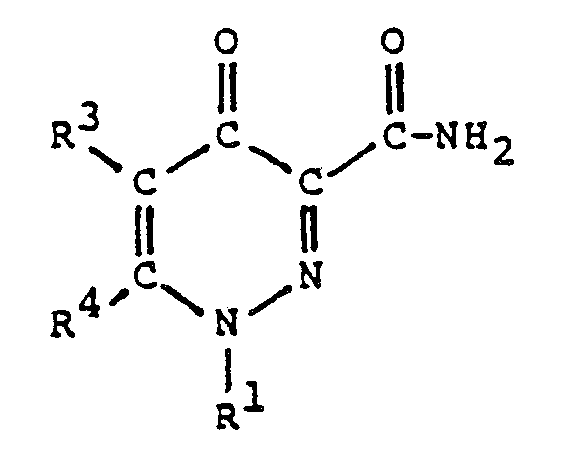
- R' and R 4 independently represent C 1 -C 4 alkyl, phenyl, naphthyl, or phenyl or naphthyl substituted with one to three substituents selected from the group consisting of halogen, trihalomethyl, C 1 -C 4 alkoxy, C 1 -C 4 alkyl, and cyano;
- R 5 is a C 1 -C 12 alkyl group, optionally substituted with one or more halogen atoms, or an aryl group selected from the group consisting of 6-membered rings containing 0-3 nitrogens and fused bicyclic 10- membered rings containing 6 atoms in each ring and 0-3 nitrogens per ring with the remaining atoms in the ring or rings of said aryl group being carbon atoms, said aryl group being optionally substituted with a C,-C 4 alkyl
- R 3 is hydrogen, a halogen, a C l -C 4 alkyl group, a carboxy group or an agronomically acceptable alkali metal saltthereof, or a group of the formula-COOR 6 or-CONR 6 R 7 where R 6 is a C 1 -C 4 alkyl group and R7 is R 6 or hydrogen.
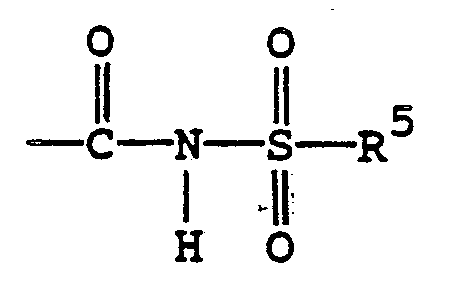
- the present invention provides novel pyridazoylamines in which R 2 , the substituent at the 3-position of the pyridazinone ring, is not a substituent normally used in pollen supressants. Instead, R 2 is a tetrazole of a sulfonamidocarboxy group.
- the chemical pollen suppressants of the invention include those compounds having the formula: wherein R 1 and R 4 independently represent C 1 ⁇ C 4 alkyl, phenyl, naphthyl, or phenyl or naphthyl substituted with one to three substituents selected from the group consisting of halogen, trihalomethyl, C 1 ⁇ C 4 alkoxy, C 1 ⁇ C 4 alkyl, and cyano; where R 5 is a C 1 -C 12 alkyl group, optionally substituted with one or more halogen atoms, or an aryl group selected from the group consisting of 6-membered rings containing 0-3 nitrogens and fused bicyclic 10- membered rings containing 6 atoms in each ring and 0-3 nitrogens per ring with the remaining atoms in the ring or rings of said aryl group being carbon atoms, said aryl group being optionally substituted with a C 1 -C 4 alkyl group or an electron-withdrawing group; and
- R 3 is hydrogen, a halogen, a C 1 -C 4 alkyl group, a carboxy group or an agronomically acceptable alkali metal salt thereof, or a group of the formula ⁇ COOR 6 or ⁇ CONR 6 R 7 where R 6 is a C 1 ⁇ C 4 alkyl group and R 7 is R 6 or hydrogen.
- R' represents phenyl or phenyl substituted with one to three substituents selected from the group consisting of halogen, trihalomethyl, C 1 -C 4 alkoxy, C l -C 4 alkyl and cyano; more preferably by phenyl substituted with one of said substituents; even more preferably by phenyl substituted with one halogen atom; and most preferably by phenyl substituted with chlorine in the para position;
- R 2 is wherein R 5 is a C 1 -C 12 alkyl group or an aryl group either of which is unsubstituted or is substituted with a C 1 -C 4 alkyl, NR , N0 2 , CN, COR 6 , CHO, COOH, COOR 6 , halogen, or CONR 6 R 7 group and further if an aryl group is preferred to be a phenyl, naphthyl, pyridyl, or naturally occurring pur
- R 3 is hydrogen; and R 4 is a C l -C 4 alkyl group, most preferably a methyl group.
- Preferred compounds are defined by selecting one or more of these listings of preferred substituents in combination with the general formula previously given. Certain combinations of substituents are especially preferred.
- One preferred grouping occurs when R' is phenyl mono-substituted with a halogen, R 2 is in which R 5 is a C 1 -C 12 alkyl group optionally substituted with one or more halogen atoms or a phenyl, naphthyl, or pyridyl group, optionally substituted with one or more C 1 -C 4 alkyl or specifically named electron-withdrawing groups, R 3 is hydrogen and R 4 is methyl.
- agronomically acceptable acid addition salts of compounds having the general formula given are those formed with strong acids such as hydrochloric, hydrobromic, sulfuric, and nitric acids. Also included are compounds in which the hydrogen on the nitrogen of R 2 is replaced with a sodium or potassium ion. Since this hydrogen is more active than the hydrogen of a typical amide, such salts may be prepared by the action of a strong base, such as sodium hydroxide or potassium hydroxide, on a compound of the general formula given. Salts of acidic or basic functional groups in other substituents are also included in this invention.
- Typical compounds of the invention include the following:
- the compounds in the invention can be synthesized according to known methods for the production of analogous compounds or can be produced by synthetic modification of known pyridazinones.
- one suitable method involves the reaction of a 4-hydroxy-2-pyrone of the formula: in which R 3 and R 4 represents one of the groups previously named, with a diazonium salt, for example, a diazonium chloride, prepared from an amine of the formula R 1 NH 2 where R' has the meaning previously defined.
- the reaction is carried out by reacting the pyrone with one equivalent of an aqueous base, such as potassium or sodium hydroxide, acetate, or carbonate, generally at a temperature of from -10-50°C in a polar solvent, such as water, methanol, ethanol, or dimethyl formamide.
- a polar solvent such as water, methanol, ethanol, or dimethyl formamide.
- a pyridazinone of the formula: is obtained, where R 1 , R 3 , and R 4 have the meanings previously defined.
- the above-indicated 3-carboxypyridazinone can then be converted into compounds of the invention by known methods.
- the carboxylic acid group can be converted into a mixed acid anhydride, for example by reacting with ethylchloroformate.
- the acid anhydride is then converted into an amide by reacting the acid anhydride with concentrated ammonia.
- the amide is then converted into a sulfonamide by reacting with a alkyl- or arylsulfonyl chloride.
- the product sulfonamide can also be prepared by reacting the mixed anhydride directly with an excess of an anion of the alkyl- or arylsulfonamide, and preparation by this method is preferred. This series of reactions is summarized and exemplified in the following scheme:
- Tetrazoles of the invention can easily be synthesized from a cyano compound formed by dehydrating the carboxamide described in the previous reaction scheme.
- the cyano group of this compound can easily be converted into a tetrazole by reacting with an azide using known methods, for example by refluxing in acetic acid for from several hours to several days.
- This reaction is summarized and exemplified in the following reaction scheme:
- Compounds of the invention are useful as chemical hybridization agents in gramineous crops, such as wheat, barley, maze, rice, sorgrum, millet, oats, rye, triticale, forage crops and the like.
- wheat is a preferred plant for treatment.
- Different plant growth regulating effects will be obtained depending upon the growth stage of the plant when treated.
- Compounds of the invention induce selected male sterility without also inducing unacceptable female sterility. About 30% female fertility is generally acceptable, although this level may differ when the method is used commercially, based on the economics of F, seed production.
- male sterility includes sterility caused by lack of male flower parts, by formation of sterile pollen, and by male flower parts which produce normal pollen but are functionally unable to cause pollination.
- male sterility of compounds of the invention is accompanied by female infertility of an unacceptable level or by phytotoxicity, the compounds are still minimally useful in production of ergot, for example as described in French Published Patent Application No. 2400832, which is herein incorporated by reference.
- compounds of the invention When compounds of the invention are used in hybridization, they are used in an amount sufficient to produce the effect of male sterility without producing a phytotoxic reaction or other undesired side- reaction.
- Compounds of the invention are generally applied at a rate of from 0.025 to 20.0 pounds per acre, and preferably from 0.125 to 10.0 pounds per acre. The amount used depends upon the plant type and the method of application as is well-known to those skilled in the art and can be determined by simple experimentation if not known.
- the two parent strains to be crossed are planted in alternate sections, rows, or groups of rows.
- the female parent is treated with a compound of the invention in order to render this parent male sterile. Pollen from the male (untreated) parent then fertilizes the female parent, either by mens of human intervention or preferably by means of a natural process, such as wind-borne pollination.
- the seed produced by the female parent is an F-1 hybrid, which is then collected according to convention techniques.
- One method of applying the compounds of the invention in the previously-mentioned hybridization technique or for otherwise inducing male sterility is application directly to the plant leaves.
- this method is used, very selective male sterility can be obtained when the compound is applied between the beginning of bloom and the beginning of meiosis.
- Compounds of the invention can also be applied directly to seed in order to cause male sterility, whereby the seeds are dipped into a fluid formulation containing the active ingredient. Seed can also be sprayed with a solution or suspension containing a compound of the invention. In general, seed are treated with a compound of the invention in an amount of from about to 10 pounds per 100 pounds of seed. Compounds of the invention are also effective when they are applied to the medium in which plants are grown such as soil or the water surface in a rice field.
- Plant regulating materials which can be used include auxins, gibberellins, ethylene liberating materials such as Ethephon, pyridones, cytokinins, maleic hydrazide, carbonic acid, 2,2-dimethyl hydrazide, cholines (as well as their salts), (2-chloroethyl)-trimethylammonium chloride, triiodobenzoic acid, tributyl-2,4-dichlorobenzenephosphonium chloride, polymeric N-vinyl-2-oxazolidinones, tri(dimethylaminoethyl)phosphate, and salts of these compounds as well as N-dimethylamino-1,2,3,6-tetrahydrophthalamides and their salts.
- compositions containing one or more compounds of the invention in a 1:99-99:1 ratio to one or more different compounds having plant regulatory activities may be prepared.
- compounds of the invention may be prepared into compositions useful for other agricultural purposes, such as herbicides, fungicides, insecticides, and plant bactericides.
- a compound of the invention can be applied to a plant either as itself or in combination with other plant growth regulators.
- a composition containing a compound of the invention and any other active ingredient may be diluted with an agronomically suitable carrier, which is any substance which itself is without any significant effect on plants but which is added in order to allow simpler application of the active ingredients to plants.
- Carriers include both liquids and solids.
- compositions of the invention can be either solid or liquid formulations or solutions.
- the compounds can be used in powders, emulsifiable concentrates, dusts, pellets, aerosols and solutions.
- a surface active agent may be added in order to increase uptake of the active compounds. It is especially preferred, and particular for methods which involve application to leaves, to utilize agents which aid in the application of the material, for example, dispersion agents and detergents.
- Compounds of the invention can be dissolved in any suitable solvent.
- solvents which can be used include water, alcohols, ketones, aromatic hydrocarbons, halogenated hydrocarbons, dimethylformamide, dioxane, and dimethylsulfoxide. Mixtures of these solvents can likewise be used.
- concentration of these solutions can be from about 2 to about 98% by weight of active ingredient and is preferred to be in the range from about 20 to about 75% by weight.
- the compounds of the invention are dissolved in an organic solvent, such as benzene, toluene, xylene, methylated naphthalene, corn oil, terpentine, o-dichlorobenzene, isophorone, cyclohexane, or methyl oleate or in mixtures of these solvents, together with an emulsifying material which allows the dispersion in water.
- organic solvent such as benzene, toluene, xylene, methylated naphthalene, corn oil, terpentine, o-dichlorobenzene, isophorone, cyclohexane, or methyl oleate or in mixtures of these solvents.
- Suitable emulsifying agents include ethylene oxide derivatives of alkylphenols or long-chained alcohols, mercaptans, carboxylic acids, and reactive amines, and especially high molecular weight alcohols.
- Solvent-soluble sulfates or sulfonates such as the alkaline earth salts or amine salts of alkylbenzenesulfonates as well as sodium fatty alcohol sulfates with surface active properties can be utilized as emulsifying agents either alone or in combination with an ethylene oxide reaction product.
- Free-flowing emulsion concentrates are formulated similarly to emulsifiable concentrates and contain, in addition to the previously described components, water as well as a stabilizing agent, such as a water-soluble cellulose derivative or a water-soluble salt of a polyacrylic acid.
- the concentration of the active ingredient in the emulsifiable concentrate is generally about 10 to 60 wt. % and in free-flowing emulsion concentrates is generally about 10 to 60% or soemtimes up to 75% by weight.
- the active ingredient is usually mixed with a finely divided solid, such as a clay, an organic silicate or carbonate, or a silica gel along with an agent capable of holding together the resulting materials.
- concentration of the active ingredient in such powders generally lies between about 20 and 98% by weight and preferably lies between 40 and 75% by weight.
- a dispersion material can generally be present in an amount of about 0.5 to 3% by weight of the entire powder.
- An agent may be added in order to control water adsorption and if added is generally present in an amount of about 0.1 to about 5% by weight of the total powder.
- Dusts can be prepared by mixing the active ingredient with a finely divided inert solid, which can be of an organic or inorganic nature. Suitable material for this purpose include flour, farina, diatomite, silicates, carbonates, and clays.
- a satisfactory method for the production of dusts involves crushing a wettable powder together with a finely divided carrier.
- a dust concentrate which contains from about 20 to about 80% of the active ingredient, is produced according to known methods and then diluted to form a final concentration of the compound of the invention of about 1 to about 10% by weight of the dust.
- Particulate formulations can be prepared by any known method, for example by impregnating the active ingredient into a solid material, such as particulate Fullers earth, vermiculite, cornmeal, seed hulls such as grain hulls, or other materials.
- a solution of one or more of the compounds of the invention in a freely flowing organic solvent can be applied to the particulate solid or mixed therewith, after which the solvent is evaporated away.
- the particulate material is not limited to a particular size. However, a useful size is from 16 to 60 mesh (U.S. standard mesh size).
- the active ingredient generally occupies about 2 to about 15 wt. % of the particulate formulation.
- Salts of the compounds of the invention can be prepared as aqueous solutions and applied in this form.
- the salts occupy typically about 0.05 to about 50 wt. % and preferably from about 0.1 to 10 wt. % of the solution. In any event, these solutions may be diluted with additional water prior to use.
- the activity of the active material can be increased by including another agent in the solution, such as glycerin, methylethylcellulose, hydroxyethyl cellulose, polyoxyethylene sorbital mono-oleate, polypropylene glycol, polyacrylic acid, polyethylene sodium malanate, or polyethyleneoxide.
- the auxiliary occupies generally from about 0.1 to about 5 wt. % and particularly from about 0.5 to 2 wt. % of the solution.
- the various solutions can in any case also contain an agriculturally suitable surface active agent.
- the compounds of the invention can be applied according to any known methods, for example in the form of hydraulic sprays, air sprays or dusts.
- a solution of the compound is generally utilized.
- the volume used and the rate of application depend upon various factors which vary with the method used, such as the specific type of application method, the stage of development of the plant to which the active ingredient is being applied, and other factors well known to those skilled in the art or easily determined by simple experimentation.
- a biological assay for pollen suppression was conducted on the wheat variety W-41 (Anza). This is a heavy tillering wheat which is grown commercially in California. Seeds were planted to provide four plants per 8-inch pot. Plants were raised in a greenhouse until the stage indicated in the following table of results. Three different stages of growth were defined for the purposes of this experiment as follows: Stage 1, spike length of 0.1-0.5 cm; Stage 2, spike length of 0.5-1.5 cm; Stage 3, spike length of 1.5-2.5 cm. External appearance was correlated with the development of the spikelet in order to avoid mistaking the onset of meiosis. Spikelets were removed at various developmental stages and anthers were removed from the most mature florets (which generally occured in about the middle of the spikelet).
Landscapes
- Life Sciences & Earth Sciences (AREA)
- Chemical & Material Sciences (AREA)
- Organic Chemistry (AREA)
- Environmental Sciences (AREA)
- Health & Medical Sciences (AREA)
- General Health & Medical Sciences (AREA)
- Pest Control & Pesticides (AREA)
- Plant Pathology (AREA)
- Engineering & Computer Science (AREA)
- Dentistry (AREA)
- Wood Science & Technology (AREA)
- Zoology (AREA)
- Agronomy & Crop Science (AREA)
- General Chemical & Material Sciences (AREA)
- Chemical Kinetics & Catalysis (AREA)
- Genetics & Genomics (AREA)
- Botany (AREA)
- Developmental Biology & Embryology (AREA)
- Agricultural Chemicals And Associated Chemicals (AREA)
- Plural Heterocyclic Compounds (AREA)
- Acyclic And Carbocyclic Compounds In Medicinal Compositions (AREA)
- Medicines Containing Material From Animals Or Micro-Organisms (AREA)
- Bidet-Like Cleaning Device And Other Flush Toilet Accessories (AREA)
- Medicines Containing Plant Substances (AREA)
- Detergent Compositions (AREA)
- Disinfection, Sterilisation Or Deodorisation Of Air (AREA)
Claims (31)






Priority Applications (1)
| Application Number | Priority Date | Filing Date | Title |
|---|---|---|---|
| AT84401809T ATE50990T1 (de) | 1983-09-14 | 1984-09-12 | Blumenstaubeliminierungsmittel ein pyridazolylamin enthaltend. |
Applications Claiming Priority (2)
| Application Number | Priority Date | Filing Date | Title |
|---|---|---|---|
| US532094 | 1983-09-14 | ||
| US06/532,094 US4561881A (en) | 1983-09-14 | 1983-09-14 | Pollen suppressant comprising a pyridazolylamine |
Publications (3)
| Publication Number | Publication Date |
|---|---|
| EP0138663A2 EP0138663A2 (fr) | 1985-04-24 |
| EP0138663A3 EP0138663A3 (en) | 1985-08-14 |
| EP0138663B1 true EP0138663B1 (fr) | 1990-03-14 |
Family
ID=24120356
Family Applications (1)
| Application Number | Title | Priority Date | Filing Date |
|---|---|---|---|
| EP84401809A Expired - Lifetime EP0138663B1 (fr) | 1983-09-14 | 1984-09-12 | Eliminateur de pollen comprenant un pyridazoylamine |
Country Status (5)
| Country | Link |
|---|---|
| US (1) | US4561881A (fr) |
| EP (1) | EP0138663B1 (fr) |
| AT (1) | ATE50990T1 (fr) |
| CA (1) | CA1246570A (fr) |
| DE (1) | DE3481613D1 (fr) |
Families Citing this family (4)
| Publication number | Priority date | Publication date | Assignee | Title |
|---|---|---|---|---|
| EP0302183A3 (fr) * | 1987-05-08 | 1990-08-08 | Chembred, Inc. | Semences de mais hybrides et procédé |
| GB8821447D0 (en) * | 1988-09-13 | 1988-10-12 | Ici Plc | Pyridazinone manufacture |
| FR2648135B1 (fr) * | 1989-06-07 | 1991-09-27 | Pf Medicament | Derives de phenyl-1-dihydro-1,4 amino-3 oxo-4 pyridazines, leur preparation et leur application en therapeutique |
| FR2676733B1 (fr) * | 1991-05-22 | 1993-10-01 | Fabre Medicament Pierre | Derives de phenyl-1 dihydro-1,4 hydroxy-3 oxo-4 pyridazines, leur preparation et leur application en therapeutique. |
Family Cites Families (2)
| Publication number | Priority date | Publication date | Assignee | Title |
|---|---|---|---|---|
| US3967952A (en) * | 1975-07-03 | 1976-07-06 | Eli Lilly And Company | 3,5-Diphenyl-4(1H)-pyridazinones(thiones) |
| EP0037133A1 (fr) * | 1980-03-26 | 1981-10-07 | Shell Internationale Researchmaatschappij B.V. | Dérivés de pyridazinone, procédé pour leur préparation, compositions les contenant, leur utilisation dans une méthode de régulation de croissance des plantes, d'augmentation du rendement des plants de fèves de soja, de stérilisation des anthères mâles des plants incluant les plants de céréales à petits grains, de même que dans une méthode de production de semence F1 hybride |
-
1983
- 1983-09-14 US US06/532,094 patent/US4561881A/en not_active Expired - Lifetime
-
1984
- 1984-09-12 DE DE8484401809T patent/DE3481613D1/de not_active Expired - Lifetime
- 1984-09-12 AT AT84401809T patent/ATE50990T1/de not_active IP Right Cessation
- 1984-09-12 EP EP84401809A patent/EP0138663B1/fr not_active Expired - Lifetime
- 1984-09-13 CA CA000463044A patent/CA1246570A/fr not_active Expired
Also Published As
| Publication number | Publication date |
|---|---|
| DE3481613D1 (de) | 1990-04-19 |
| ATE50990T1 (de) | 1990-03-15 |
| US4561881A (en) | 1985-12-31 |
| CA1246570A (fr) | 1988-12-13 |
| EP0138663A2 (fr) | 1985-04-24 |
| EP0138663A3 (en) | 1985-08-14 |
Similar Documents
| Publication | Publication Date | Title |
|---|---|---|
| US4604134A (en) | Pollen suppressant comprising a fused pyridazine | |
| PL115813B1 (en) | Plant growth regulator | |
| US4729782A (en) | Pollen suppressant comprising a fused pyridazinone | |
| EP0363236B1 (fr) | Suppresseur de pollen contenant une cinnoline substituée par un groupe oxy ou amino en position 5 | |
| EP0138663B1 (fr) | Eliminateur de pollen comprenant un pyridazoylamine | |
| US4732603A (en) | 1-aryl-1,4-dihydro-4-oxo-5-carboxypyridazine derivatives and their use as plant growth regulators and hybridizing agents | |
| EP0049971B1 (fr) | Pyridazines substituées, leur procédé de préparation, leur usage comme régulateurs de croissance des plantes et compositions régulatrices de croissance des plantes les contenant | |
| EP0197226A1 (fr) | Agents d'hybridation comprenant des dérivés d'acides cinnoline-3-carboxyliques et leur application | |
| US4707181A (en) | 1-aryl-1,4-dihydro-4-oxo-3,5-dicarboxypyridazine derivatives and their use as plant growth regulators and hybridizing agents | |
| US4756740A (en) | Pollen suppressant comprising a fused pyridazine | |
| CA1246569A (fr) | Suppresseur de pollen contenant une 3- carboxyalcoxyaminocarbonylpyridazine | |
| US5129940A (en) | Pollen suppressant for liliopsida plants comprising a 5-oxy-substituted cinnoline | |
| KR860001250B1 (ko) | 1-아릴-1,4-디하이드로-4-옥소-3,5-디카르복시피리다진유도체의 제조방법 | |
| CA1276149C (fr) | Les 5-acyl-1-aryl-1,4-dihydro-4-oxo-3-carboxypyridazines et leur utilisation comme agents d'hybridation en usine | |
| US5129939A (en) | Pollen suppressant comprising a 5-oxy- or amino-substituted cinnoline | |
| US5062880A (en) | 1-aryl-1,4-dihydro-4-oxo-5-carboxypyridazine derivatives and their use as plant growth regulators and hybridizing agents | |
| KR860001251B1 (ko) | 1-아릴-1,4-디하이드로-4-옥소-5-카르복시피리다진 유도체의 제조방법 | |
| EP0530063A1 (fr) | Suppresseur de pollen pour des plantes dicotyledones contenant une 5-oxy-cinnoline | |
| EP1149108A1 (fr) | Production de phosphonopyrazoles | |
| EP0364135A2 (fr) | Hybridation chimique des dicotylédones |
Legal Events
| Date | Code | Title | Description |
|---|---|---|---|
| PUAI | Public reference made under article 153(3) epc to a published international application that has entered the european phase |
Free format text: ORIGINAL CODE: 0009012 |
|
| AK | Designated contracting states |
Designated state(s): AT BE CH DE FR GB IT LI LU NL SE |
|
| PUAL | Search report despatched |
Free format text: ORIGINAL CODE: 0009013 |
|
| AK | Designated contracting states |
Designated state(s): AT BE CH DE FR GB IT LI LU NL SE |
|
| 17P | Request for examination filed |
Effective date: 19851128 |
|
| 17Q | First examination report despatched |
Effective date: 19861223 |
|
| GRAA | (expected) grant |
Free format text: ORIGINAL CODE: 0009210 |
|
| AK | Designated contracting states |
Kind code of ref document: B1 Designated state(s): AT BE CH DE FR GB IT LI LU NL SE |
|
| REF | Corresponds to: |
Ref document number: 50990 Country of ref document: AT Date of ref document: 19900315 Kind code of ref document: T |
|
| REF | Corresponds to: |
Ref document number: 3481613 Country of ref document: DE Date of ref document: 19900419 |
|
| ET | Fr: translation filed | ||
| ITF | It: translation for a ep patent filed | ||
| PLBE | No opposition filed within time limit |
Free format text: ORIGINAL CODE: 0009261 |
|
| STAA | Information on the status of an ep patent application or granted ep patent |
Free format text: STATUS: NO OPPOSITION FILED WITHIN TIME LIMIT |
|
| REG | Reference to a national code |
Ref country code: CH Ref legal event code: PUE Owner name: ORSAN |
|
| 26N | No opposition filed | ||
| REG | Reference to a national code |
Ref country code: GB Ref legal event code: 732 |
|
| ITPR | It: changes in ownership of a european patent |
Owner name: CESSIONE;ORSAN |
|
| NLS | Nl: assignments of ep-patents |
Owner name: ORSAN TE PARIJS, FRANKRIJK. |
|
| REG | Reference to a national code |
Ref country code: FR Ref legal event code: TP |
|
| REG | Reference to a national code |
Ref country code: CH Ref legal event code: PUE Owner name: ORSAN |
|
| ITPR | It: changes in ownership of a european patent |
Owner name: CESSIONE;ORSEM |
|
| NLS | Nl: assignments of ep-patents |
Owner name: ORSAN TE PARIJS EN ORSEM TE FRETIN, FRANKRIJK. |
|
| REG | Reference to a national code |
Ref country code: GB Ref legal event code: 732 |
|
| REG | Reference to a national code |
Ref country code: FR Ref legal event code: TP |
|
| ITTA | It: last paid annual fee | ||
| EPTA | Lu: last paid annual fee | ||
| REG | Reference to a national code |
Ref country code: FR Ref legal event code: TP |
|
| ITPR | It: changes in ownership of a european patent |
Owner name: CESSIONE;HYBRINOVA |
|
| REG | Reference to a national code |
Ref country code: CH Ref legal event code: PUE Owner name: HYBRINOVA Ref country code: GB Ref legal event code: 732E |
|
| NLS | Nl: assignments of ep-patents |
Owner name: HYBRINOVA TE LES ULIS, FRANKRIJK. |
|
| EAL | Se: european patent in force in sweden |
Ref document number: 84401809.3 |
|
| BECA | Be: change of holder's address |
Free format text: 981103 *E.I. DUPONT DE NEMOURS AND CY:1007 MARKET STREET, WILMINGTON DELAWARE 19898 |
|
| BECH | Be: change of holder |
Free format text: 981103 *E.I. DUPONT DE NEMOURS AND CY:1007 MARKET STREET, WILMINGTON DELAWARE 19898 |
|
| NLS | Nl: assignments of ep-patents |
Owner name: E.I. DU PONT DE NEMOURS AND CO. |
|
| NLT1 | Nl: modifications of names registered in virtue of documents presented to the patent office pursuant to art. 16 a, paragraph 1 |
Owner name: FINARGE 25 |
|
| REG | Reference to a national code |
Ref country code: GB Ref legal event code: 732E |
|
| REG | Reference to a national code |
Ref country code: GB Ref legal event code: IF02 |
|
| PGFP | Annual fee paid to national office [announced via postgrant information from national office to epo] |
Ref country code: SE Payment date: 20030904 Year of fee payment: 20 |
|
| PGFP | Annual fee paid to national office [announced via postgrant information from national office to epo] |
Ref country code: FR Payment date: 20030909 Year of fee payment: 20 |
|
| PGFP | Annual fee paid to national office [announced via postgrant information from national office to epo] |
Ref country code: GB Payment date: 20030910 Year of fee payment: 20 |
|
| PGFP | Annual fee paid to national office [announced via postgrant information from national office to epo] |
Ref country code: AT Payment date: 20030911 Year of fee payment: 20 |
|
| PGFP | Annual fee paid to national office [announced via postgrant information from national office to epo] |
Ref country code: LU Payment date: 20030917 Year of fee payment: 20 |
|
| PGFP | Annual fee paid to national office [announced via postgrant information from national office to epo] |
Ref country code: CH Payment date: 20030918 Year of fee payment: 20 |
|
| PGFP | Annual fee paid to national office [announced via postgrant information from national office to epo] |
Ref country code: NL Payment date: 20030922 Year of fee payment: 20 |
|
| PGFP | Annual fee paid to national office [announced via postgrant information from national office to epo] |
Ref country code: DE Payment date: 20030925 Year of fee payment: 20 |
|
| PGFP | Annual fee paid to national office [announced via postgrant information from national office to epo] |
Ref country code: BE Payment date: 20031203 Year of fee payment: 20 |
|
| PG25 | Lapsed in a contracting state [announced via postgrant information from national office to epo] |
Ref country code: LI Free format text: LAPSE BECAUSE OF EXPIRATION OF PROTECTION Effective date: 20040911 Ref country code: GB Free format text: LAPSE BECAUSE OF EXPIRATION OF PROTECTION Effective date: 20040911 Ref country code: CH Free format text: LAPSE BECAUSE OF EXPIRATION OF PROTECTION Effective date: 20040911 |
|
| PG25 | Lapsed in a contracting state [announced via postgrant information from national office to epo] |
Ref country code: NL Free format text: LAPSE BECAUSE OF EXPIRATION OF PROTECTION Effective date: 20040912 Ref country code: LU Free format text: LAPSE BECAUSE OF EXPIRATION OF PROTECTION Effective date: 20040912 Ref country code: AT Free format text: LAPSE BECAUSE OF EXPIRATION OF PROTECTION Effective date: 20040912 |
|
| BE20 | Be: patent expired |
Owner name: *E.I. DUPONT DE NEMOURS AND CY Effective date: 20040912 |
|
| REG | Reference to a national code |
Ref country code: CH Ref legal event code: PL |
|
| REG | Reference to a national code |
Ref country code: GB Ref legal event code: PE20 |
|
| NLV7 | Nl: ceased due to reaching the maximum lifetime of a patent |
Effective date: 20040912 |
|
| EUG | Se: european patent has lapsed |