EP0139643B1 - Filtre birefringent accorde a cristaux liquides - Google Patents
Filtre birefringent accorde a cristaux liquides Download PDFInfo
- Publication number
- EP0139643B1 EP0139643B1 EP19830901565 EP83901565A EP0139643B1 EP 0139643 B1 EP0139643 B1 EP 0139643B1 EP 19830901565 EP19830901565 EP 19830901565 EP 83901565 A EP83901565 A EP 83901565A EP 0139643 B1 EP0139643 B1 EP 0139643B1
- Authority
- EP
- European Patent Office
- Prior art keywords
- cells
- filter
- cell
- liquid crystal
- filter according
- Prior art date
- Legal status (The legal status is an assumption and is not a legal conclusion. Google has not performed a legal analysis and makes no representation as to the accuracy of the status listed.)
- Expired
Links
- 239000004973 liquid crystal related substance Substances 0.000 title claims abstract description 56
- 210000004027 cell Anatomy 0.000 claims abstract description 163
- 210000002858 crystal cell Anatomy 0.000 claims abstract description 23
- 230000003287 optical effect Effects 0.000 claims abstract description 9
- 230000000903 blocking effect Effects 0.000 claims description 33
- 239000000463 material Substances 0.000 claims description 22
- 239000010453 quartz Substances 0.000 claims description 7
- VYPSYNLAJGMNEJ-UHFFFAOYSA-N silicon dioxide Inorganic materials O=[Si]=O VYPSYNLAJGMNEJ-UHFFFAOYSA-N 0.000 claims description 7
- 230000010287 polarization Effects 0.000 claims description 6
- 230000004044 response Effects 0.000 claims description 6
- 239000000382 optic material Substances 0.000 claims description 4
- 238000000411 transmission spectrum Methods 0.000 claims description 4
- 229920006254 polymer film Polymers 0.000 claims description 3
- 230000005540 biological transmission Effects 0.000 claims description 2
- 238000001914 filtration Methods 0.000 claims 4
- 230000010363 phase shift Effects 0.000 claims 1
- 238000009877 rendering Methods 0.000 claims 1
- 230000002860 competitive effect Effects 0.000 abstract description 3
- 238000002834 transmittance Methods 0.000 description 19
- 230000005855 radiation Effects 0.000 description 17
- 238000010521 absorption reaction Methods 0.000 description 11
- 238000013461 design Methods 0.000 description 8
- 230000035945 sensitivity Effects 0.000 description 8
- 238000001228 spectrum Methods 0.000 description 7
- 238000005259 measurement Methods 0.000 description 6
- 239000006185 dispersion Substances 0.000 description 5
- 230000008859 change Effects 0.000 description 4
- 230000007423 decrease Effects 0.000 description 4
- 238000005286 illumination Methods 0.000 description 4
- 230000003595 spectral effect Effects 0.000 description 4
- 230000008901 benefit Effects 0.000 description 3
- 238000005094 computer simulation Methods 0.000 description 3
- 230000003247 decreasing effect Effects 0.000 description 3
- 239000000835 fiber Substances 0.000 description 3
- 239000011521 glass Substances 0.000 description 3
- 239000000203 mixture Substances 0.000 description 3
- 230000002829 reductive effect Effects 0.000 description 3
- 238000004611 spectroscopical analysis Methods 0.000 description 3
- 238000004847 absorption spectroscopy Methods 0.000 description 2
- 125000004122 cyclic group Chemical group 0.000 description 2
- 238000000151 deposition Methods 0.000 description 2
- 230000000694 effects Effects 0.000 description 2
- 230000005684 electric field Effects 0.000 description 2
- 230000005284 excitation Effects 0.000 description 2
- 239000003365 glass fiber Substances 0.000 description 2
- 238000000034 method Methods 0.000 description 2
- 230000010355 oscillation Effects 0.000 description 2
- 230000000979 retarding effect Effects 0.000 description 2
- 230000002441 reversible effect Effects 0.000 description 2
- 238000012360 testing method Methods 0.000 description 2
- 239000013598 vector Substances 0.000 description 2
- AOKPAJGZCAHDMA-UHFFFAOYSA-N 2-dodecan-5-yl-2-phenylpropanedinitrile Chemical compound CCCCCCCC(CCCC)C(C#N)(C#N)C1=CC=CC=C1 AOKPAJGZCAHDMA-UHFFFAOYSA-N 0.000 description 1
- WFPHTSSOOUESRE-UHFFFAOYSA-N 2-phenyl-2-propylcyclohexane-1-carbonitrile Chemical compound C(#N)C1C(CCCC1)(C1=CC=CC=C1)CCC WFPHTSSOOUESRE-UHFFFAOYSA-N 0.000 description 1
- 229910021532 Calcite Inorganic materials 0.000 description 1
- 238000002835 absorbance Methods 0.000 description 1
- -1 alkyl biphenyl Chemical compound 0.000 description 1
- 238000004458 analytical method Methods 0.000 description 1
- 238000013459 approach Methods 0.000 description 1
- 235000010290 biphenyl Nutrition 0.000 description 1
- 239000004305 biphenyl Substances 0.000 description 1
- 210000002421 cell wall Anatomy 0.000 description 1
- 238000007796 conventional method Methods 0.000 description 1
- 239000013078 crystal Substances 0.000 description 1
- 125000004093 cyano group Chemical group *C#N 0.000 description 1
- 230000008021 deposition Effects 0.000 description 1
- 238000011161 development Methods 0.000 description 1
- 238000009826 distribution Methods 0.000 description 1
- 230000034964 establishment of cell polarity Effects 0.000 description 1
- 239000000374 eutectic mixture Substances 0.000 description 1
- 230000008020 evaporation Effects 0.000 description 1
- 238000001704 evaporation Methods 0.000 description 1
- 230000001747 exhibiting effect Effects 0.000 description 1
- 238000002474 experimental method Methods 0.000 description 1
- 238000001506 fluorescence spectroscopy Methods 0.000 description 1
- 238000002189 fluorescence spectrum Methods 0.000 description 1
- 230000004907 flux Effects 0.000 description 1
- 230000010354 integration Effects 0.000 description 1
- 239000007788 liquid Substances 0.000 description 1
- 238000004519 manufacturing process Methods 0.000 description 1
- 230000007246 mechanism Effects 0.000 description 1
- QSHDDOUJBYECFT-UHFFFAOYSA-N mercury Chemical compound [Hg] QSHDDOUJBYECFT-UHFFFAOYSA-N 0.000 description 1
- 229910052753 mercury Inorganic materials 0.000 description 1
- 239000010445 mica Substances 0.000 description 1
- 229910052618 mica group Inorganic materials 0.000 description 1
- 238000012986 modification Methods 0.000 description 1
- 230000004048 modification Effects 0.000 description 1
- 230000003534 oscillatory effect Effects 0.000 description 1
- 125000001147 pentyl group Chemical group C(CCCC)* 0.000 description 1
- 230000000737 periodic effect Effects 0.000 description 1
- ZUOUZKKEUPVFJK-UHFFFAOYSA-N phenylbenzene Natural products C1=CC=CC=C1C1=CC=CC=C1 ZUOUZKKEUPVFJK-UHFFFAOYSA-N 0.000 description 1
- 230000000750 progressive effect Effects 0.000 description 1
- 230000001902 propagating effect Effects 0.000 description 1
- 125000001436 propyl group Chemical group [H]C([*])([H])C([H])([H])C([H])([H])[H] 0.000 description 1
- 230000009467 reduction Effects 0.000 description 1
- 238000001055 reflectance spectroscopy Methods 0.000 description 1
- 239000007787 solid Substances 0.000 description 1
- 239000002904 solvent Substances 0.000 description 1
- 125000006850 spacer group Chemical group 0.000 description 1
- WFKWXMTUELFFGS-UHFFFAOYSA-N tungsten Chemical compound [W] WFKWXMTUELFFGS-UHFFFAOYSA-N 0.000 description 1
- 229910052721 tungsten Inorganic materials 0.000 description 1
- 239000010937 tungsten Substances 0.000 description 1
Images


Classifications
-
- G—PHYSICS
- G02—OPTICS
- G02F—OPTICAL DEVICES OR ARRANGEMENTS FOR THE CONTROL OF LIGHT BY MODIFICATION OF THE OPTICAL PROPERTIES OF THE MEDIA OF THE ELEMENTS INVOLVED THEREIN; NON-LINEAR OPTICS; FREQUENCY-CHANGING OF LIGHT; OPTICAL LOGIC ELEMENTS; OPTICAL ANALOGUE/DIGITAL CONVERTERS
- G02F1/00—Devices or arrangements for the control of the intensity, colour, phase, polarisation or direction of light arriving from an independent light source, e.g. switching, gating or modulating; Non-linear optics
- G02F1/01—Devices or arrangements for the control of the intensity, colour, phase, polarisation or direction of light arriving from an independent light source, e.g. switching, gating or modulating; Non-linear optics for the control of the intensity, phase, polarisation or colour
- G02F1/13—Devices or arrangements for the control of the intensity, colour, phase, polarisation or direction of light arriving from an independent light source, e.g. switching, gating or modulating; Non-linear optics for the control of the intensity, phase, polarisation or colour based on liquid crystals, e.g. single liquid crystal display cells
- G02F1/133—Constructional arrangements; Operation of liquid crystal cells; Circuit arrangements
- G02F1/1333—Constructional arrangements; Manufacturing methods
- G02F1/1347—Arrangement of liquid crystal layers or cells in which the final condition of one light beam is achieved by the addition of the effects of two or more layers or cells
- G02F1/13471—Arrangement of liquid crystal layers or cells in which the final condition of one light beam is achieved by the addition of the effects of two or more layers or cells in which all the liquid crystal cells or layers remain transparent, e.g. FLC, ECB, DAP, HAN, TN, STN, SBE-LC cells
- G02F1/13473—Arrangement of liquid crystal layers or cells in which the final condition of one light beam is achieved by the addition of the effects of two or more layers or cells in which all the liquid crystal cells or layers remain transparent, e.g. FLC, ECB, DAP, HAN, TN, STN, SBE-LC cells for wavelength filtering or for colour display without the use of colour mosaic filters
-
- G—PHYSICS
- G01—MEASURING; TESTING
- G01J—MEASUREMENT OF INTENSITY, VELOCITY, SPECTRAL CONTENT, POLARISATION, PHASE OR PULSE CHARACTERISTICS OF INFRARED, VISIBLE OR ULTRAVIOLET LIGHT; COLORIMETRY; RADIATION PYROMETRY
- G01J3/00—Spectrometry; Spectrophotometry; Monochromators; Measuring colours
- G01J3/12—Generating the spectrum; Monochromators
-
- G—PHYSICS
- G02—OPTICS
- G02B—OPTICAL ELEMENTS, SYSTEMS OR APPARATUS
- G02B27/00—Optical systems or apparatus not provided for by any of the groups G02B1/00 - G02B26/00, G02B30/00
- G02B27/28—Optical systems or apparatus not provided for by any of the groups G02B1/00 - G02B26/00, G02B30/00 for polarising
- G02B27/288—Filters employing polarising elements, e.g. Lyot or Solc filters
-
- G—PHYSICS
- G02—OPTICS
- G02F—OPTICAL DEVICES OR ARRANGEMENTS FOR THE CONTROL OF LIGHT BY MODIFICATION OF THE OPTICAL PROPERTIES OF THE MEDIA OF THE ELEMENTS INVOLVED THEREIN; NON-LINEAR OPTICS; FREQUENCY-CHANGING OF LIGHT; OPTICAL LOGIC ELEMENTS; OPTICAL ANALOGUE/DIGITAL CONVERTERS
- G02F1/00—Devices or arrangements for the control of the intensity, colour, phase, polarisation or direction of light arriving from an independent light source, e.g. switching, gating or modulating; Non-linear optics
- G02F1/01—Devices or arrangements for the control of the intensity, colour, phase, polarisation or direction of light arriving from an independent light source, e.g. switching, gating or modulating; Non-linear optics for the control of the intensity, phase, polarisation or colour
- G02F1/13—Devices or arrangements for the control of the intensity, colour, phase, polarisation or direction of light arriving from an independent light source, e.g. switching, gating or modulating; Non-linear optics for the control of the intensity, phase, polarisation or colour based on liquid crystals, e.g. single liquid crystal display cells
- G02F1/137—Devices or arrangements for the control of the intensity, colour, phase, polarisation or direction of light arriving from an independent light source, e.g. switching, gating or modulating; Non-linear optics for the control of the intensity, phase, polarisation or colour based on liquid crystals, e.g. single liquid crystal display cells characterised by the electro-optical or magneto-optical effect, e.g. field-induced phase transition, orientation effect, guest-host interaction or dynamic scattering
- G02F1/139—Devices or arrangements for the control of the intensity, colour, phase, polarisation or direction of light arriving from an independent light source, e.g. switching, gating or modulating; Non-linear optics for the control of the intensity, phase, polarisation or colour based on liquid crystals, e.g. single liquid crystal display cells characterised by the electro-optical or magneto-optical effect, e.g. field-induced phase transition, orientation effect, guest-host interaction or dynamic scattering based on orientation effects in which the liquid crystal remains transparent
- G02F1/1393—Devices or arrangements for the control of the intensity, colour, phase, polarisation or direction of light arriving from an independent light source, e.g. switching, gating or modulating; Non-linear optics for the control of the intensity, phase, polarisation or colour based on liquid crystals, e.g. single liquid crystal display cells characterised by the electro-optical or magneto-optical effect, e.g. field-induced phase transition, orientation effect, guest-host interaction or dynamic scattering based on orientation effects in which the liquid crystal remains transparent the birefringence of the liquid crystal being electrically controlled, e.g. ECB-, DAP-, HAN-, PI-LC cells
-
- G—PHYSICS
- G02—OPTICS
- G02F—OPTICAL DEVICES OR ARRANGEMENTS FOR THE CONTROL OF LIGHT BY MODIFICATION OF THE OPTICAL PROPERTIES OF THE MEDIA OF THE ELEMENTS INVOLVED THEREIN; NON-LINEAR OPTICS; FREQUENCY-CHANGING OF LIGHT; OPTICAL LOGIC ELEMENTS; OPTICAL ANALOGUE/DIGITAL CONVERTERS
- G02F2203/00—Function characteristic
- G02F2203/05—Function characteristic wavelength dependent
- G02F2203/055—Function characteristic wavelength dependent wavelength filtering
Definitions
- the present invention relates to a liquid crystal tuned birefringent filter and, more particularly, to an electrically tunable filter including stacked birefringent liquid crystal cells.
- the principle of the birefringent filter was first suggested by the French astronomer Berhard Lyot in 1933. Lyot constructed filters having a half-bandwidth of about five angstroms and used them for photographing the solar corona in monochromatic light.
- the Lyot-type filter consists of a stack of elements, each of which consists of a birefringent cell, i.e. a retarder, and a polarizer.
- a Lyot-type filter reference should be made to U.S. Patent No. 2,718,170, issued September 20, 1955 to Bernard Lyot and entitled Slitless Spectrophotometer.
- Birefringent cells have the property that their refractive index, hence the velocity of propagation of light therethrough, varies with direction through the element. Such materials are said to be anisotropic.
- a polarized light beam passes through a birefringent cell, the beam breaks into two orthogonally polarized components called the ordinary and extraordinary rays, which propagate with velocities which are inversely proportional to the two refractive indices existing in the directions of beam propagation. These two beams emerge from the birefringent cell with a difference in phase angles.
- the resultant beam in general, is said to be elliptically polarized.
- the two beams totally interfere and the intensity of the beam falls to zero. If the slow ray emerges with its phase angle 180° or some multiple of 180° behind the fast ray, the two rays interfere constructively and there is no dimunition of beam intensity.
- the phase angle difference between the component beams is a function of the difference in refractive indices in the orthogonally propagating beam directions, the birefringence, An, the thickness, d, of the birefringent material, and the wavelength, X, of light.
- the relative phase angle is:
- the product And is called the retardation.
- M ⁇ where M is an integer
- N ⁇ /2 where N is an odd integer
- the ordinary and extraordinary rays destructively interfere and the intensity falls to zero. If And is kept constant while wavelength changes, intensity will vary in a cyclic manner.
- the value of M at the design wavelength ⁇ is called the order of the element.
- a filter is constructed by using a plurality of birefringent elements, the thicknesses of which increase in a geometrical progression whose ratio is two.
- the filter elements of Lyot were made of quartz and had their faces parallel to each other and normal to the light rays and their optical axes parallel to one another and forming 45° angles with the planes of polarization of polarizers sandwiched between each cell.
- Lyot The disadvantage of the filter described by Lyot is that it is very expensive and was designed for use at a single frequency, having very limited turnability. On the other hand, many applications require the use of tunable narrow bandwidth filters and attempts have been made to make widely tunable Lyot filters. Lyot, himself, suggested that it was possible to cause the center of the transmitted band to be movable by changing the temperature of the filter and this did indeed provide limited tunability.
- the wavelength at which the fringe maxima occur will change.
- birefringent materials such as quartz, calcite or mica
- the Babinet-Soleil compensator is a commonly used birefringent element consisting of two quartz wedges. In sliding past each other, the effective thickness changes and with it the retardation. It is also possible to change the birefringence in some materials. This has been accomplished by utilizing stressed polymer films as variable retarders.
- a variable birefringence can also be induced in almost any liquid by applying a strong electric field (usually requiring thousands of volts).
- the Kerr cell is such a device.
- a variable birefringence can also be induced in certain ferroelectric crystals by applying a strong field.
- a moderately narrow band, tunable, birefringent filter is disclosed using zero-twist, nematic-phase, liquid crystal cells as variable retarders in Lyot-type arrangements.
- These filters can achieve analytically useful levels of resolution and stray-light ratios for costs that are competitive with prism and grating monochromators.
- these birefringent filters can be tuned and/or rendered opaque by applying appropriate voltages to the cells thereof.
- a double-beam instrument can be constructed with no moving parts. Power requirements for the filter are negligible and a useful filter can be designed to occupy a volume less than one cubic inch (16 cm 3 ). These properties render such a filter ideally suited to microprocessor control.
- such a filter comprises a plurality of birefringent liquid crystal cells arranged in a stack, each of the cells including a zero-twist, nematic-phase liquid crystal material with a positive dielectric anisotropy and a polarizer between each cell and before and after the first and last cells, respectively, in the stack.
- a collimated beam of light is directed through the stack of cells and the emergent beam is utilized and detected.
- the filter can be made highly transmissive at a single wavelength and can have a relatively high level of resolution and a low stray-light ratio.
- All of the cells can be electrically connected in parallel and the transmittance wavelength varied over a relatively wide range by the application of a voltage to each of the cells.
- One of the cells can be used as a modulator to alternately render the cell transmissive and opaque.
- a tunable light filter adapted to be positioned in the path of the beam of light, comprising:
- the electro-optic material in such a filter is a zero-twist nematic-phase liquid crystal material with a positive dielectric anisotropy, and the orders of those of said cells having a relatively low order vary in an approximately arithmetic progression, and the orders of those of said cells having a relatively high order vary in an approximately geometric progression.
- Lyot by stacking a series of birefringent elements, each of which produces a different order of retardation, but subject to the restriction that the retardation of each element be integral multiples of a design wavelength, the stack will have a high transmittance at this wavelength and a low transmittance at nearby wavelengths.
- the thicknesses of the elements increase in a geometrical progression whose ratio equals two. Such a filter and the results thereof are described in U.S. Patent No. 2,718,170.
- Cell 10 consists of a thin layer of liquid crystal material 11 sandwiched between first and second transparent plates 12 and 13 which are preferably made from glass.
- the spacing between plates 12 and 13, and therefore, the thickness of the liquid crystal layer is determined by suitable spacers, preferably plural glass fibers 14.
- the inside surfaces of plates 12 and 13 are coated with'transparent conducting layers 16 and 17, respectively, and transparent alignment layers 18 and 19, respectively. Conducting layers 16 and 17 are connected to electrical leads 22 and 23, respectively.
- the liquid crystal material 11 is of the nematic-phase type with a positive dielectric anisotropy.
- the most important properties of the liquid crystal material 11 are absorption, birefringence, viscosity, dielectric anisotropy, and temperature range of the nematic phase.
- suitable materials are known to those skilled in the art.
- a mixture of trans cyano, alkyl biphenyl homologues is one of the most widely used materials for liquid crystal displays.
- Another available material is a pure trans cyano, propyl phenyl cyclohexane.
- Another available material is a eutectic mixture of propyl, pentyl, and heptyl cyano phenyl cyanohexane in the mole ratio 2.1 to 1.6 to 1.
- a liquid crystal mixture can be used in a birefringent filter only within a wavelength interval where it is acceptably transparent.
- dichroism is defined as the difference in absorbance for the ordinary and extraordinary beams and operates as a limit on the short wavelength behavior of a birefringent element. Dichroism results in an unequal intensity of ordinary and extraordinary rays emerging from the liquid crystal cell and incident on a polarizer. Therefore, these rays can never totally interfere. Consequently, the amplitudes of oscillations in the retardation spectra are reduced.
- Dichroism is implicit in liquid crystal molecules. The molecular structure responsible for the refraction anisotropy and dielectric anisotropy should be expected to produce dichroism. Furthermore, the higher the birefringence, the higher the dichroism to be expected.
- this property is defined as the difference between the refractive indices measured with rays whose E vectors are parallel and perpendicular to the optic axis of the liquid crystal cell. It is appropriate to differentiate between two types of birefringence, the principal birefringence, ⁇ n, which has the above definition, and the apparent birefringence, An', which is a function of ⁇ n, applied voltage, and the tilt of the liquid crystal director relative to the cell plates, caused either by the electric field or the wall forces, as will be described more fully hereinafter.
- the apparent birefringence can be calculated from a spectrum obtained when placing cell 10 between parallel polarizers with the molecular director, defined by layers 18 and 19, in a plane 45° to the beam plane of polarization. Spectra so obtained are herein called retardation spectra.
- the order of the retardation is defined and described by M. This order is easily identified by applying voltage to the cell. Sixteen volts usually suffices to reduce An' to nearly zero and the retardation, An'd, then approaches zero. Upon slowly reducing the voltage, the number of transmittance oscillations identifies M.
- viscosity influences the response time of the cell as the voltage applied thereto is changed.
- plates 12 and 13 For use in a Lyot filter, plates 12 and 13 should have high transmittance, low strain, and maximum flatness.
- the sides of plates 12 and 13 are typically polished to 1/4 fringe.
- Conducting layers 16 and 17 are typically a tin- doped In 2 0 3 layer.
- the technique for the deposition of such a layer onto plates 12 and 13 is well known to those skilled in the art.
- liquid crystal molecules In a liquid crystal cell, it is necessary to align the liquid crystal molecules such that the long axes of the molecules are parallel to each other and approximately parallel to the surfaces of plates 12 and 13. This can be achieved by rubbing the inside surfaces of plates 12 and 13, as is known in the art. Alternatively, alignment layers 18 and 19 on the inside surfaces of plates 12 and 13 may be used. In this later case, the liquid crystal molecules are typically aligned with lyers of SiO deposited by evaporation at low or high angles relative to the surfaces of plates 12 and 13 (so called L and H coats). The alignment properties of SiO layers 18 and 19 will be described more fully hereinafter.
- the thickness and parallelity of plates 12 and 13 is of utmost importance. Accordingly, conventional methods of separating plates 12 and 13 are unsuitable for use in a birefringent filter.
- glass fibers such as plural fibers 14, have proven to be suitable for use as separators. Fibers can be produced having a diameter from 3 to 50 pm and cut into segments. These segments can be examined under a microscope to select segments having a uniform thickness and the desired diameter. After plates 12 and 13 are formed and positioned on opposite sides of these selected fibers 14, the entire structure can be clamped together and sealed with plastic in a manner similar to that used in the manufacture of liquid crystal displays.
- each cell 10 is sandwiched between a pair of polarizers 20 and 21.
- the optical axes of polarizers 20 and 21 are parallel and oriented at a 45° angle to the optical axis of cell 10. The significance of this will be described more fully hereinafter with regard to the discussion of a plurality of cells for use in a filter.
- each cell of a plurality of stacked cells it is essential that the retardation in each cell of a plurality of stacked cells be uniform across the area common to a beam of light passing therethrough. Furthermore, since the retardation will be a function of the voltage applied to layers 16 and 17, retardation must vary equally over the area of the beam when the field is applied. This uniformity can only be obtained when liquid crystal layer 11 is in a uniform nematic phase.
- the liquid crystal molecules In the absence of a field applied between layers 16 and 17, the liquid crystal molecules assume an orientation dictated by alignment layers 18 and 19. That is, the angle between the director, or optic axis, and the plane of electrodes 16 and 17 in the absence of a field is called the surface director tilt and is a function of alignment layers 18 and 19.
- the two alignment layers most commonly encountered in liquid crystal displays are the so-called H and L coats formed by depositing SiO on plates 12 and 13 at incidence angles of about 60° and 83°, respectively. It has been ascertained that the surface director tilt with an H coat is 0° and with and L coat is 25°.
- Other alignment layers known to those skilled in the art produce intermediate surface director tilts.
- HH both layers 18 and 19 being H layers
- HL one of layers 18 and 19 being an H layer and the other being an L layer
- uniform LL both layers 18 and 19 being L layers with the directors tilted in the same direction
- splayed LL both layers 18 and 19 being L layers eith the directors tilted in opposite directions
- the splayed LL cells exhibit an even more troublesome behavior.
- the tilted molecules away from the walls experience the highest initial torque and rotate in directions to increase tilt; however, molecules of opposite tilt exist in these cells at zero field.
- the liquid crystal molecules assume a 180° twist which persists when the field is removed. Forthis reason, the splayed configuration is to be avoided in a birefringent filter.
- Figure 2(a) is a plot of the intensity of light passing through a cell, such as cell 10, with polarizers on opposite sides thereof, as a function of wavelength, and And held constant. It is seen that as the wavelength changes, intensity will vary in a cyclic manner.
- Figure 2(b) shows the intensity of light passing through a cell of twice the thickness of the first cell as a function of wavelength.
- Figure 2(c) shows the intensity of light passing through a cell whose retardation is four times that of the cell exhibiting the transmittance shown in Figure 2(a).
- HBW half bandwidth
- SLR stray-light ratio
- the width of the two high-intensity bands at half maximum intensity is called the half bandwidth.
- the SLR is the ratio of detected radiant power outside of a given bandwidth to the total detected radiant power.
- the usual given bandwidth is defined as that spectral region five half bandwidths on either side of the design wavelength.
- Resolution improves inversely in proportion to HBW.
- Accuracy in the ultimate use of a filter increases inversely in proportion to SLR. Thus, we desire to achieve both a small HBW and a small SLR.
- Increasing the number of elements in a filter reduces the HBW but does not necessarily reduce the SLR. The reason is that when the number of elements is increased, the denominator of the SLR may decrease faster than the numerator. Increasing the number of elements in a filter, where all elements have the same order, M, decreases HBW slowly while rapidly decreasing SLR. Adding elements to a filter in a geometric progression of M, as described by Lyot, rapidly decreases HBW but actually increases SLR. The challenge in designing a good filter is in selecting orders of elements between these extremes. According to the present invention, the best compromise is found in an arithmetic progression of low order elements and a near geometric progression of high order elements, as will be discussed more fully hereinafter.
- a filter at 700 nm would have to have an HBW of less than 20 nm and a SLR of well under 1 %. As will be discussed more fully hereinafter, this can be achieved with a filter consisting of seven or more elements.
- filter 25 includes four cells 26-29, each identical to cell 10 of Figure 1. In actuality, more cells may and will be included.
- a polarizer 31 is positioned on the outside of cell 26, a polarizer 32 is positioned bewteen cells 26 and 27, a polarizer 33 is positioned between cells 27 and 28, a polarizer 34 is positioned between cells 28 and 29, and a polarizer 35 is positioned on the outside of cell 29.
- a cell and a polarizer make up an element. It is seen that there is one more polarizer than there are elements.
- Cells 26-29 and polarizers 31-35 are mounted within a thermostated enclosure 37.
- a pair of contacts are required for each cell and these would extend out through enclosure 37.
- One contact of each cell may be interconnected to form a common ground.
- a temperature in the range of 37-45°C is contemplated with a tolerance of plus or minus 0.5°C.
- a filter, including thermostat can be as small as 1 x 1 x 1/2 inches (2.54x2.54x1.27 cm).
- light from a source 40 may be collimated by a lens 41 and conducted through the arrangement of cells and polarizers in enclosure 37.
- a second lens 42 refocuses the filtered beam on a cell 43 holding a sample under test.
- a detector 44 may be positioned close to cell 43 to detect rays scattered by the sample.
- a blocking filter 45 may be positioned between cell 43 and detector 44 to restrict the tuning range of filter 25. Blocking filter 45 also serves to reduce the sensitivity of detector 44 to ambient light when cell 43 is not totally enclosed.
- Equation (2) permits the generation of a retardation spectrum for a retarder of a given order.
- the following equation closely defines the dependence of birefringence on wavelength for a typical liquid crystal mixture and can be used in place of ⁇ n:
- Generating such a retardation spectrum typically using a computer, for a filter with a design wavelength of 700 nm, will show that all curves reach maximum transmittance at 700 nm and also at 432 nm, rather than at 350 nm.
- the ratio of the retardation to the wavelength is twice that at 700 nm for all orders.
- the interval between these two wavelengths will be called one octave of retardation. If stray light is to be held within tolerable limits, some mechanism must limit system response to less than one octave of retardation. This may be source irradiance, detector sensitivity, or the use of a blocking filter.
- a computer simulation is the preferred method of selecting the number of elements and the order of such elements to achieve a given result.
- This computer simulation must consider the spectral emittance of the source and the spectral sensitivity of the detector as well as fundamental equations (3) and (4).
- the best criterion for selection of order combinations is the integration of signal transmitted in the interval of stray light divided by the total integrated signal.
- a convenient way of appraising this data is to plot the accumulated sum as a function of wavelength away from the design wavelength. In this way, one can determine the span of tunability for some specified SLR.
- each cell would be identical except that progressive cells will have different thicknesses in accordance with the orders.
- a 13th order cell will be thirteen times as thick as the first order cell.
- the thicker a cell the slower its response time and, as a result, the higher orders of cells often become excessively thick and slow.
- This undesirable situation can be overcome in a variety of different ways; such as, using, instead of one thick cell, two or more stacked cells having lesser thicknesses. In such a case, more than one cell would be positioned between consecutive polarizers.
- a liquid crystal cell of reduced thickness can be combined with a fixed retarder made of quartz or a polymer film.
- blocking filters can be of two types, glass absorption and interference.
- the use of such blocking filters in filter instruments is well known to those skilled in the art.
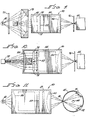
- FIG 4 shows a birefringent filter, generally designated 50, for use in a dual-beam photometer.
- Filter 50 includes four stacked sets of cells 51 sandwiched between polarizers 52.
- the general configuration of filter 50 is the same as filter 25, except that each cell of filter 25 is replaced by a pair of parallel cells 51. This provides dual-beam operation.
- An aperture plate 53 masks all but the two desired areas of the liquid crystal cells 51 defined by the cell conducting layers.
- These components are mounted within a thermostated enclosure 54 having lenses 55 and 56 at opposite ends thereof, as described previously with regard to filter 25. Ideally, the two lenses are achromatic over the range 340-700 nm.
- Figures 5 and 6 show how filter 50 may be used for absorption, fluorescence and reflectance spectroscopy. No moving parts are required except for the wavelength range selector which may be ganged to the blocking filters shown. More specifically, Figure 5 shows filter 50 used for dual-wavelength spectroscopy, the arrangement being similar to that shown in Figure 3 for a single- wavelength instrument. That is, reference numeral 40 designates a continuum source, which may be a low-voltage, filament, tungsten lamp. The beam emerging from filter 50 is focused through cell 43 holding a sample under test onto detector 44 which is positioned close to sample cell 43 in order to detect light scattered by the sample. Blocking filter 45 is positioned between sample cell 43 and detector 44 to restrict the tuning range of filter 50.
- reference numeral 40 designates a continuum source, which may be a low-voltage, filament, tungsten lamp.
- the beam emerging from filter 50 is focused through cell 43 holding a sample under test onto detector 44 which is positioned close to sample cell 43 in order to detect light scattered by the sample
- the first signal is proportional to the intensity 1 1 when filter 50 (either or both halves) is set to wavelength ⁇ 1 with a beam passing through the sample.
- the next signal is proportional to the intensity 1 2 when the signal is set to wavelength ⁇ 2 and the third signal is proportional to the intensity 1 3 when the filter is opaque.
- the desired quantity is usually:
- filter 50 is used for double-beam absorption spectroscopy.
- sample and reference cells 58 and 59 are positioned in the paths of the two beams, as shown. Otherwise, the configuration remains unchanged. If it is desired to maintain the sample at the same temperature as filter 50, cells 58 and 59 could be located within enclosure 54, immediately in front of lens 55, as shown in Figure 7.
- Blocking filter 45, detector 44, and source 40 serve the same functions as described in Figure 5.
- both halves of filter 50 transmit the same wavelength, but at different times. This is accomplished by alternately setting the two halves of the filter to be opaque. Three temporally separated signals are obtained from detector 44, the third occurring when both halves are opaque. Identifying these signals as 1 58 , 1 59 , and 1 3 , the transmittance of a solution placed in cell 58 with a solvent in cell 59 is given by:
- the instrument configuration shown in Figure 6 is well suited for the measurement of diffused transmittance of turbid samples because detector 44 may be located close to cells 58 and 59.
- FIG. 7 accomplishes this objective.
- the instrument configuration shown in Figure 7 is similar to that shown in Figure 6, with the primary distinction being that detector 44 and blocking filter 45 are spaced from lens 55 so that an aperture plate 60, having a small pin hole 61, may be positioned at the focal point of lens 55. Also, cells 58 and 59 are shown located within enclosure 54, between aperture plate 53 and lens 55.
- Fluorescence measurements with a 0° illumination geometry can be made with the configuration shown in Figure 8.
- the configuration of Figure 8 includes source 40, which may be the same type used in Figures 5-7, or may be an emission source such as a mercury arc.
- source 40 On one side of source 40 is a blocking filter 71 of the short-path variety designed to pass the exciting radiation and reject the fluorescent radiation.
- Adjacent filter 71 is a lens 72 which focuses this exciting radiation on a sample in a sample cell 73.
- the radiation from cell 73 impinges on lens 55 of filter 50, which has a pair of blocking filters 74 and 75 positioned within housing 54, between lens 55 and aperture plate 53.
- Blocking filter 74 is designed to pass the fluorescing radiation and reject the exciting radiation.
- the upper half of filter 50 can then be tuned to the desired portion of the fluorescence spectrum.
- Blocking filter 75 is designed to pass the exciting radiation while rejecting the fluorescent radiation.
- the lower half of filter 50 is tuned to the wavelengths of exciting radiation.
- the focused beam from filter 50 passes through an aperture plate 76 onto detector 44.
- the signals from detector 44 are again sorted by alternately tuning the halves of filter 50 to be opaque.
- the desired output is the ratio of the zero corrected fluorescence to zero corrected excitation signals.
- the configuration shown in Figure 8 can be used in a single-beam mode by tuning both halves of filter 50 to the same fluorescence wavelength (alternated with opaque zero measurements). Blocking filter 75 would then be identical to filter 74. This mode does not compensate for source fluctuations, but permits use of exciting light of wavelength shorter than 340 nm (filter 50 being opaque to these wavelengths). Furthermore, by switching source 40 and detector 44 positions in Figure 8, the configuration can be used for excitation spectroscopy provided the excited light need not have a wavelength shorter than 340 nm.
- the 0° illumination geometry of Figure 8 is suitable only for samples which exhibit low absorption of both exciting and fluorescing radiation. When absorption is high, a front illumination is better and is superior to the 90° geometry conventionally used.
- Figure 9 shows how this illumination geometry can be adapted for a birefringent filter.
- Blocking filter 71 again passes the exciting radiation while rejecting the fluorescing radiation. In this case, if the front surface of sample cell 73 is lightly etched, a sufficient amount of the exciting radiation will scatter back through blocking filter 75 to give a signal proportional to the exciting intensity. The fluorescence radiation passes through blocking filter 74 and the upper half of filter 50.
- Figure 10 Still another configuration ideal for fluorescence measurements with a laser source is shown in Figure 10.
- the configuration of Figure 10 is similar to Figures 8 and 9, except that source 40, blocking filter 71, lens 72 and mirror 78 are omitted. Instead, a small plain mirror 80, within enclosure 54, between block filters 74 and 75, reflects light from a laser located normal to the plane of the illustration. The reflected rays are focused by lens 55 onto the fluorescing sample in cell 73. The scattered radiation is sensed by filter 50 in the same manner as described previously for the configuration of Figure 9.
- the configuration of Figure 11 includes an integrating sphere 85 containing four ports.
- the configuration also includes source 40 and filter 50 having a single blocking filter 87 positioned therein, between aperture plate 53 and lens 55.
- the two halves of filter 50 alternately pass radiation of the same wavelength through one small port 88 in sphere 85, located at the focal point of lens 55.
- the rays alternately fall on a reference reflector plate 91 and a sample reflector 92 positioned at two of the remaining ports.
- the integrated reflected radiation is detected by a detector (not shown) located at a port 93 out of the plane of the illustration.
- the two beams are again isolated by alternately tuning the two halves of filter 50 to being opaque.
- the positions of source 40 and the detector in Figure 11 can be interchanged. This permits a discrimination between reflection and fluorescence at the sample.
- the reason for this is two-fold.
- the first-order element is the most effective in absorbing light in those vicinities furthest from the wavelength of maximum transmittance, where there is the most stray light. Therefore, by using two first-order elements, there tends to be a flattening of the area of minimum transmittance, that area between the two peaks in Figure 2(a).
- one of the two first-order elements can be used as a modulator to render the filter alternately transmissive and opaque.
- the average tilt of the liquid crystal molecules in the cell increases as the field on the cell is increased.
- the average tilt is specified because there is a distribution of tilt within the cell. That is, those molecules closest to the cell walls hardly move and the central molecules experience the greatest tilt.
- the retardation produced in a property oriented cell is a function of this average tilt.
- the voltage function is defined as a plot of retardation versus voltage.
- the voltage function is determined by measurung transmittance at a fixed wavelength as a function of the applied field.
- the retardation is then computed from the transmittance using equation (3).
- At least one of the cells of a filter may operate as a modulator to render the filter alternately transparent and opaque at the tuned wavelength.
- the modulator cell will usually be the thinnest cell in the filter since it will have the fastest response time to the modulating signal. Appreciable light intensity modulation can occur at frequencies as high as 1 kHz. Desirable modulation frequencies usually fall in the range of 10 to 100 Hz.
- the frequency used for tuning be significantly higher than the frequency used for modulation to avoid cell polarization effects.
- the tuning frequency should be at least 1 kHz.
- birefringent filter that passes a series of discrete wavelengths by using a fixed retarder, such as a quartz plate, only in the highest order element. Unlike the filter systems described heretobefore, this filter does not incorporate a variable retarding component within the highest-order element.
- a series of discrete wavelengths suffice. For example, there are many clinical analyses that could be accomplished with a filter system selecting only the wavelengths 340, 380, 405, 465 and 700 nm. Such a filter could be constructed using the same eight- order combinations described hereinbefore, except for the highest-order element.
- the transmittance of each element is oscillatory as a function of wavelength with many maxima. These maxima are closest together for the highest order element. Therefore, the seven variable retardation cells can be used to tune the filter to one of the wavelengths at which the fixed retarder element has maximum transmission.
- the advantages of this system are: (1) a decreased sensitivity to temperature because of a low temperature coefficient of retardation in quartz and other solid state retarders, and (2) a narrow bandwidth with good response time. The latter advantage accrues because it is no longer necessary to vary the retardation of the highest order and slowest responding element.
- collimation sensitivity is minimized by rotating the optic axis by 90° in alternate retarding elements.
- collimation sensitivity may be minimized by maintaining a common plane of the tilting optic axes in all cells. In this manner, collimation in this single plane only need be assured.
- Collimation in one plane only is widely utilized in optical instruments by employing a slit as the defining aperture.
- a slit as the defining aperture.
- the combination of a slit and a lens or mirror functioning as a collimator allows more light flux through a system than that obtained with a fully collimated beam obtained with a pin-hole aperture and a collimator.
- a moderately narrow band, tunable, birefringent filter is dis- losed using zero-twist, nematic-phase, liquid crystal cells 10 as variable retarders in Lyot-type arrangements.
- Filters 25 and 50 can achieve analytically useful levels of resolution and stray-light ratios for costs that are competitive with prism and grating monochromators.
- filters 25 and 50 can be tuned and/or rendered opaque by applying appropriate voltages to the cells 10 thereof.
- a double-beam instrument such as those shown in Figures 5-11, can be constructed with no moving parts other than those required to exchange blocking filters. Power requirements for such filters are negligible, and a useful filter can be designed to occupy a volume of less than one cubic inch.
Landscapes
- Physics & Mathematics (AREA)
- General Physics & Mathematics (AREA)
- Spectroscopy & Molecular Physics (AREA)
- Optics & Photonics (AREA)
- Nonlinear Science (AREA)
- Mathematical Physics (AREA)
- Chemical & Material Sciences (AREA)
- Crystallography & Structural Chemistry (AREA)
- Liquid Crystal (AREA)
Abstract
Claims (20)
Applications Claiming Priority (1)
| Application Number | Priority Date | Filing Date | Title |
|---|---|---|---|
| PCT/US1983/000604 WO1984004402A1 (fr) | 1983-04-21 | 1983-04-21 | Filtre birefringent accorde a cristaux liquides |
Publications (2)
| Publication Number | Publication Date |
|---|---|
| EP0139643A1 EP0139643A1 (fr) | 1985-05-08 |
| EP0139643B1 true EP0139643B1 (fr) | 1989-11-29 |
Family
ID=22175048
Family Applications (1)
| Application Number | Title | Priority Date | Filing Date |
|---|---|---|---|
| EP19830901565 Expired EP0139643B1 (fr) | 1983-04-21 | 1983-04-21 | Filtre birefringent accorde a cristaux liquides |
Country Status (3)
| Country | Link |
|---|---|
| EP (1) | EP0139643B1 (fr) |
| DE (1) | DE3380906D1 (fr) |
| WO (1) | WO1984004402A1 (fr) |
Families Citing this family (3)
| Publication number | Priority date | Publication date | Assignee | Title |
|---|---|---|---|---|
| DE69226998T2 (de) * | 1991-07-19 | 1999-04-15 | Sharp K.K., Osaka | Optisches Modulationselement und Vorrichtungen mit einem solchen Element |
| GB2286056A (en) * | 1994-01-21 | 1995-08-02 | Sharp Kk | Electrically controllable wavelength filter |
| GB9609737D0 (en) * | 1996-05-10 | 1996-07-17 | Barr & Stroud Ltd | Colour selective filters |
Family Cites Families (8)
| Publication number | Priority date | Publication date | Assignee | Title |
|---|---|---|---|---|
| US2600962A (en) * | 1948-10-09 | 1952-06-17 | Polaroid Corp | Tunable narrow band optical filter |
| DE2155241C2 (de) * | 1971-11-06 | 1983-09-08 | Licentia Patent-Verwaltungs-Gmbh, 6000 Frankfurt | Verfahren zum Betrieb einer Flüssigkristallzelle |
| GB1469638A (en) * | 1973-07-18 | 1977-04-06 | Secr Defence | Liquid crystal display device |
| DD107368A1 (fr) * | 1973-10-12 | 1974-07-20 | ||
| US4097128A (en) * | 1975-04-24 | 1978-06-27 | Tokyo Shibaura Electric Co., Ltd. | Liquid crystal color display devices |
| US4394069A (en) * | 1979-06-05 | 1983-07-19 | Beckman Instruments, Inc. | Liquid crystal tuned birefringent filter |
| US4272195A (en) * | 1979-06-05 | 1981-06-09 | Beckman Instruments, Inc. | Method and apparatus for determining the wavelength of light |
| US4416514A (en) * | 1980-11-10 | 1983-11-22 | Polaroid Corporation | Color filter |
-
1983
- 1983-04-21 EP EP19830901565 patent/EP0139643B1/fr not_active Expired
- 1983-04-21 DE DE8383901565T patent/DE3380906D1/de not_active Expired - Fee Related
- 1983-04-21 WO PCT/US1983/000604 patent/WO1984004402A1/fr not_active Ceased
Also Published As
| Publication number | Publication date |
|---|---|
| DE3380906D1 (de) | 1990-01-04 |
| EP0139643A1 (fr) | 1985-05-08 |
| WO1984004402A1 (fr) | 1984-11-08 |
Similar Documents
| Publication | Publication Date | Title |
|---|---|---|
| US4394069A (en) | Liquid crystal tuned birefringent filter | |
| US6992809B1 (en) | Multi-conjugate liquid crystal tunable filter | |
| US8400574B2 (en) | Short wave infrared multi-conjugate liquid crystal tunable filter | |
| US8736777B2 (en) | VIS-SNIR multi-conjugate liquid crystal tunable filter | |
| US4198123A (en) | Optical scrambler for depolarizing light | |
| US9256013B2 (en) | Short-wavelength infrared (SWIR) multi-conjugate liquid crystal tunable filter | |
| US7362489B2 (en) | Multi-conjugate liquid crystal tunable filter | |
| EP0258996B1 (fr) | Eléments optiques à couches minces | |
| US4729640A (en) | Liquid crystal light modulation device | |
| US20140362331A1 (en) | Short-Wavelength Infrared (SWIR) Multi-Conjugate Liquid Crystal Tunable Filter | |
| CA1257796A (fr) | Filtre a radiations a bande etroite a structure colloidale cristallline | |
| US5469279A (en) | Chiral smectic liquid crystal multipass optical filters including a variable retarder (and a variable isotropic spacer) | |
| US4444469A (en) | Narrow band rejection filter utilizing a liquid crystal cell | |
| US4247166A (en) | Single plate birefringent optical filter | |
| US4272195A (en) | Method and apparatus for determining the wavelength of light | |
| EP1780582A1 (fr) | Filtre de diffraction polarisé et filtre de diffraction polarisé en couches | |
| CA2389225A1 (fr) | Reseaux a cristaux liquides induits par un champ electrique lateral | |
| WO2006023528A2 (fr) | Filtre d'imagerie spectrale accordable conçu pour des plages spectrales d'uv | |
| US4497542A (en) | Apparatus for minimizing beam collimation sensitivity in optical instruments including liquid crystal cells | |
| US4407566A (en) | Optical filter | |
| WO1984004402A1 (fr) | Filtre birefringent accorde a cristaux liquides | |
| EP1234164A1 (fr) | Filtre | |
| JPH0587808B2 (fr) | ||
| JP2003066450A (ja) | 液晶素子および光減衰器 | |
| CN119895297A (zh) | 衍射光栅系统 |
Legal Events
| Date | Code | Title | Description |
|---|---|---|---|
| PUAI | Public reference made under article 153(3) epc to a published international application that has entered the european phase |
Free format text: ORIGINAL CODE: 0009012 |
|
| AK | Designated contracting states |
Kind code of ref document: A1 Designated state(s): DE FR GB NL SE Designated state(s): DE FR GB NL SE |
|
| 17P | Request for examination filed |
Effective date: 19850426 |
|
| 17Q | First examination report despatched |
Effective date: 19861027 |
|
| D17Q | First examination report despatched (deleted) | ||
| GRAA | (expected) grant |
Free format text: ORIGINAL CODE: 0009210 |
|
| AK | Designated contracting states |
Kind code of ref document: B1 Designated state(s): DE FR GB NL SE |
|
| REF | Corresponds to: |
Ref document number: 3380906 Country of ref document: DE Date of ref document: 19900104 |
|
| ET | Fr: translation filed | ||
| PLBE | No opposition filed within time limit |
Free format text: ORIGINAL CODE: 0009261 |
|
| PLBE | No opposition filed within time limit |
Free format text: ORIGINAL CODE: 0009261 |
|
| STAA | Information on the status of an ep patent application or granted ep patent |
Free format text: STATUS: NO OPPOSITION FILED WITHIN TIME LIMIT |
|
| 26N | No opposition filed | ||
| 26N | No opposition filed | ||
| PGFP | Annual fee paid to national office [announced via postgrant information from national office to epo] |
Ref country code: SE Payment date: 19910328 Year of fee payment: 9 |
|
| PGFP | Annual fee paid to national office [announced via postgrant information from national office to epo] |
Ref country code: NL Payment date: 19910430 Year of fee payment: 9 |
|
| PG25 | Lapsed in a contracting state [announced via postgrant information from national office to epo] |
Ref country code: SE Effective date: 19920422 |
|
| PG25 | Lapsed in a contracting state [announced via postgrant information from national office to epo] |
Ref country code: NL Effective date: 19921101 |
|
| NLV4 | Nl: lapsed or anulled due to non-payment of the annual fee | ||
| EUG | Se: european patent has lapsed |
Ref document number: 83901565.8 Effective date: 19921108 |
|
| PGFP | Annual fee paid to national office [announced via postgrant information from national office to epo] |
Ref country code: GB Payment date: 19970319 Year of fee payment: 15 |
|
| PGFP | Annual fee paid to national office [announced via postgrant information from national office to epo] |
Ref country code: FR Payment date: 19970411 Year of fee payment: 15 |
|
| PGFP | Annual fee paid to national office [announced via postgrant information from national office to epo] |
Ref country code: DE Payment date: 19970428 Year of fee payment: 15 |
|
| PG25 | Lapsed in a contracting state [announced via postgrant information from national office to epo] |
Ref country code: GB Free format text: LAPSE BECAUSE OF NON-PAYMENT OF DUE FEES Effective date: 19980421 |
|
| PG25 | Lapsed in a contracting state [announced via postgrant information from national office to epo] |
Ref country code: FR Free format text: THE PATENT HAS BEEN ANNULLED BY A DECISION OF A NATIONAL AUTHORITY Effective date: 19980430 |
|
| GBPC | Gb: european patent ceased through non-payment of renewal fee |
Effective date: 19980421 |
|
| PG25 | Lapsed in a contracting state [announced via postgrant information from national office to epo] |
Ref country code: DE Free format text: LAPSE BECAUSE OF NON-PAYMENT OF DUE FEES Effective date: 19990202 |
|
| REG | Reference to a national code |
Ref country code: FR Ref legal event code: ST |