EP0139948B1 - Eisbahn - Google Patents
Eisbahn Download PDFInfo
- Publication number
- EP0139948B1 EP0139948B1 EP84109668A EP84109668A EP0139948B1 EP 0139948 B1 EP0139948 B1 EP 0139948B1 EP 84109668 A EP84109668 A EP 84109668A EP 84109668 A EP84109668 A EP 84109668A EP 0139948 B1 EP0139948 B1 EP 0139948B1
- Authority
- EP
- European Patent Office
- Prior art keywords
- skating rink
- ice skating
- ice
- nonwoven
- rink according
- Prior art date
- Legal status (The legal status is an assumption and is not a legal conclusion. Google has not performed a legal analysis and makes no representation as to the accuracy of the status listed.)
- Expired
Links
Images
Classifications
-
- E—FIXED CONSTRUCTIONS
- E01—CONSTRUCTION OF ROADS, RAILWAYS, OR BRIDGES
- E01C—CONSTRUCTION OF, OR SURFACES FOR, ROADS, SPORTS GROUNDS, OR THE LIKE; MACHINES OR AUXILIARY TOOLS FOR CONSTRUCTION OR REPAIR
- E01C13/00—Pavings or foundations specially adapted for playgrounds or sports grounds; Drainage, irrigation or heating of sports grounds
- E01C13/10—Pavings or foundations specially adapted for playgrounds or sports grounds; Drainage, irrigation or heating of sports grounds for artificial surfaces for outdoor or indoor practice of snow or ice sports
- E01C13/102—Civil engineering aspects of the construction of ice rinks or sledge runs made from frozen-liquid, semi-liquid or frozen-pasty substances, e.g. portable basins
- E01C13/105—Civil engineering aspects of the construction of ice rinks or sledge runs made from frozen-liquid, semi-liquid or frozen-pasty substances, e.g. portable basins of artificially refrigerated rinks or runs, e.g. cooled rink floors or swimming pools or tennis courts convertible into rinks
Definitions
- the invention relates to an ice rink consisting of a cooling plate and an ice coating thereon with embedded characters.
- Ice rinks of the aforementioned type are used in a variety of ways for sporting and dancing activities. They can be both mobile and stationary, and the characters embedded in the coating of ice usually consist of a paint application of a lower layer of ice, which is flooded with water and covered with ice in the course of its subsequent solidification. The attachment of appropriate signs is accordingly complex. In addition to great manual dexterity on the part of the personnel involved in the installation, it requires a great deal of time.
- the invention has for its object to further develop an ice rink of the aforementioned type such that characters of any shape can be attached or exchanged in a short time by unskilled personnel.
- the ice coating of the ice rink proposed according to the invention thus contains prefabricated characters which are arranged on the cooling plate or a lower layer of ice in a short time and without great manual dexterity, flooded with water and incorporated into the ice rink formed during the solidification of the water.
- the characters can then be seen from the top of the ice coating and convey any information to the user of the ice rink. They do not affect the usability of the ice rink in any way. After thawing the ice rink, they can be dried and reused later. In contrast, a faster changeover time is achieved if the layer of ice containing the characters is removed in its entirety, which can be done, for example, thermally or mechanically with the aid of known devices. New characters, possibly in a different distribution, can then be applied to the neutral sub-layer thus obtained, flooded with water and frozen again.
- the characters are not tied to the installation allows them to be created separately in terms of time and space from the installation site, for example in the context of industrial production. Accordingly, great care can be taken with regard to the special design of the characters, and in addition to any geometrical shape, almost any color can be used, for example also fluorescent colors. In addition to characters that are used only for marking and identifying the ice rink, such characters can also be used are used to loosen up the taste of the appearance of the ice rink, the aesthetic edification and / or advertising. The training opportunities are accordingly extremely diverse.
- the symbols consist of a mineral and / or polymeric material body, which is completely penetrated by open and merging pores at least in the vertical direction and has a porosity of 90 - 99.5%.
- nonwovens can be used, with flexible versions being preferred.
- lattice structures made from these materials or foils can also be used.
- the pore cross-sections are to be roughly designed to avoid larger reflection surfaces in order to avoid inclusions of air bubbles after the flooding which impair the color effect.
- characters made from a nonwoven fabric made from bonded individual fibers the nonwoven fabric having a porosity of 90 to 99.5%, preferably one of 96 to 99%, and the individual fibers having a titer of 20 to 100 dtex, preferably one of 30 to 60 dtex.
- the thickness is 2 to 15 mm, preferably 6 to 10 mm.
- thermal permeability which essentially corresponds to that of normal ice.
- the heat impinging on the surface of the ice rink is therefore dissipated in the area of the signs in the direction of the cooling plate as well as in the surrounding zones in which no signs are attached. Changed properties of the ice rink in the area of the signs are therefore not to be feared.
- the mutual interference can be mechanical, thermal and / or chemical.
- there is a particularly irregular mutual assignment of the individual fibers contained in the nonwoven which significantly favors the desired indifferent reflection behavior.
- the subsequent coloring can take place at the same time as the chemical binding agent is introduced, which simplifies production.
- the nonwoven fabric used in accordance with the invention can consist wholly or partly of inorganic and / or synthetically produced fibers, for example those based on PVC, polyester, polypropylene, polyamide or glass.
- polyester fibers are preferred because they have a density above that of water. The exact positioning of the characters during the subsequent flooding is therefore particularly simple. The coloring does not pose any difficulties, and the high level of elasticity allows extremely high levels of porosity to be achieved with good inherent strength. The light resistance is excellent.
- the mixture is fed to a carding machine and processed into a fleece with a basis weight of 200 g / m 2 , which has a thickness of about 10 cm.
- the fleece is immediately compacted in a rolling mill. This contains two steel rollers with a diameter of 30 cm and a temperature of 180 ° C, which are set against each other with a line pressure of 200 N / cm. The working speed is 16 m / min. The fleece then has a thickness of 18 mm. It is then further compressed by needling from both sides. The stitch density is 10 / cm 2. The needling leads to a large increase in strength and a further reduction in the thickness. The latter is then 11.5 mm.
- the fleece is inherently strong. No support by secondary support elements is required for further processing.
- the fleece is then impregnated with a dye liquor consisting of the following composition:
- the dye absorption is 50 g / m 2 .
- the fleece is of an aggressive red color. It can be used immediately.
- the final weight is 250 g / M 2.
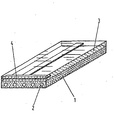
- the attached drawing shows a section of an exemplary embodiment of the ice rink proposed according to the invention.
- This consists of the cooling plate 1 with the tubes 2 evenly distributed therein, through which the cooling medium is passed.
- the cooling plate is made of concrete in most cases.
Landscapes
- Engineering & Computer Science (AREA)
- Structural Engineering (AREA)
- Thermal Sciences (AREA)
- General Engineering & Computer Science (AREA)
- Architecture (AREA)
- Civil Engineering (AREA)
- Physics & Mathematics (AREA)
- Nonwoven Fabrics (AREA)
- Table Devices Or Equipment (AREA)
- Ladders (AREA)
- Paints Or Removers (AREA)
- Road Paving Structures (AREA)
- Soil Working Implements (AREA)
- Professional, Industrial, Or Sporting Protective Garments (AREA)
Description
- Die Erfindung betrifft eine Eisbahn, bestehend aus einer Kühlplatte und einer darauf aufgebrachten Beschichtung aus Eis mit eingebetteten Zeichen.
- Eisbahnen der vorgenannten Art finden vielfältig Anwendung für sportliche und tänzerische Betätigungen. Sie können sowohl mobil als auch stationär ausgeführt sein, und die in die Beschichtung aus Eis eingebetteten Zeichen bestehen gewöhnlich aus einem Farbauftrag einer unteren Eisschicht, der mit Wasser überflutet und im Zuge von dessen anschließender Erstarrung mit Eis überdeckt wird. Die Anbringung entsprechender Zeichen ist dementsprechend aufwendig. Sie erfordert neben einer großen handwerklichen Geschicklichkeit des mit der Anbringung befaßten Personals einen großen Zeitaufwand.
- Der Erfindung liegt die Aufgabe zugrunde, eine Eisbahn der vorgenannten Art derart weiter zu entwickeln, daß Zeichen einer beliebigen Gestalt von handwerklich wenig geübtem Personal in kurzer Zeit angebracht oder ausgetauscht werden können.
- Diese Aufgabe wird erfindungsgemäß bei einer Eisbahn der vorgenannten Art mit den kennzeichnenden Merkmalen des Patentanspruchs 1 gelöst. Auf vorteilhafte Ausgestaltungen nehmen die Unteransprüche Bezug.
- Die Eisbeschichtung der erfindungsgemäß vorgeschlagenen Eisbahn enthält somit vorfabrizierte Zeichen, die in kurzer Zeit und ohne große handwerkliche Geschicklichkeit auf der Kühlplatte oder einer unteren Eisschicht angeordnet, mit Wasser überflutet und in die während der Erstarrung des Wassers gebildete Eisbahn eingebunden werden. Die Zeichen können anschließend von der Oberseite der Eisbeschichtung gesehen werden und dem Benutzer der Eisbahn beliebige Informationen übermitteln. Sie beeinträchtigen die Benutzbarkeit der Eisbahn in keiner Weise. Sie können nach einem Auftauen der Eisbahn getrocknet und zu einem späteren Zeitpunkt wiederverwendet werden. Eine schnellere Umrüstzeit wird demgegenüber erreicht, wenn die die Zeichen enthaltende Schicht aus Eis in ihrer Gesamtheit entfernt wird, was beispielsweise thermisch oder mechanisch mit Hilfe bekannter Einrichtungen erfolgen kann. Auf die so erhaltene, neutrale Unterschicht können anschließend neue Zeichen in gegebenenfalls anderer Verteilung aufgebracht, mit Wasser überflutet und erneut eingefroren werden.
- Die nicht an die Verlegung gebundene Herstellung der Zeichen erlaubt es, diese zeitlich und räumlich getrennt vom Montageort zu erzeugen, beispielsweise im Rahmen einer industriellen Fertigung. Auf die spezielle Ausbildung der Zeichen kann dementsprechend eine große Sorgfalt verwendet werden, und neben einer beliebigen geometrischen Gestalt können nahezu beliebige Farben zur Anwendung gelangen, beispielsweise auch fluoreszierende Farben, neben Zeichen, die ausschließlich der Markierung und Kennzeichnung der Eisbahn dienen, können daher auch solche zur Anwendung gelangen, die der geschmacklichen Auflockerung des Erscheinungsbildes der Eisbahn dienen, der ästhetischen Erbauung und/oder der Werbung. Die Ausbildungsmöglichkeiten sind dementsprechend außerordentlich vielfältig.
- Die Zeichen bestehen aus einem mineralischen und/oder polymeren Werkstoffkörper, der von offenen und ineinander übergehenden Poren zumindest in senkrechter Richtung ganz durchdrungen ist und eine Porosität von 90 - 99,5 % aufweist. Neben Schaumstoffen können Vliesstoffe zur Anwendung gelangen, wobei flexiblen Ausführungen der Vorzug gegeben wird. Gitterstrukturen aus diesen Werkstoffen oder Folien sind jedoch ebenfalls verwendbar. Die Porenquerschnitte sind unter Vermeidung größerer Reflexionsflächen grob auszulegen, um die Farbwirkung beeinträchtigende Einschlüsse von Luftblasen nach der Überflutung zu vermeiden.
- Bevorzugt gelangen Zeichen aus einem Vliesstoff aus untereinender verbundenen Einzelfasern zur Anwendung, wobei der Vliesstoff eine Porosität von 90 bis 99,5 % aufweist, vorzugsweise eine solche von 96 bis 99 %, und wobei die Einzelfasern einen Titer von 20 bis 100 dtex haben, vorzugsweise einen solchen von 30 bis 60 dtex. Die Dicke beträgt 2 bis 15 mm, bevorzugt 6 bis 10 mm. Sie gewährleistet in Verbindung mit der außerordentlich offenen, lockeren Struktur des Vliesstoffes eine Wärmedurchlässigkeit; die im wesentlichen derjenigen des normalen Eises entspricht. Die auf die Oberfläche der Eisbahn auftreffende Wärme wird daher im Bereich der Zeichen ebenso in Richtung der Kühlplatte abgeleitet wie in den umgebenden Zonen, in denen keine Zeichen angebracht sind. Veränderte Eigenschaften der Eisbahn im Bereich der Zeichen sind daher nicht zu befürchten.
- Dieser überraschende Effekt ist sehr wahrscheinlich darauf zurückzuführen, daß die Fasern der vorschlagsgemäß zur Anwendung gelangenden Vliesstoffe Wärmestrahlen weder in nennenswertem Maße zu speichern, noch in differenzierter Weise zu reflektieren vermögen. Die Wärme kann dadurch im Bereich der Zeichen gleichgut abgeleitet werden wie in den umgebenden Zonen. Die Art der Einfärbung der Zeichen het hierauf keinen nennenswerten Einfluß. Es hat sich jedoch als vorteilhaft bewährt, für die Herstellung der Zeichen Fasern aus hydrophilen Werkstoffen zu verwenden, beispielsweise aus Zellulose. Diese Fasern werden homogen in den gebildeten Eisblock eingebuinden, was das Erscheinungsbild der fertigen Eisbahn besonders attraktiv erscheinen läßt. Die Verwendung anderer natürlicher Fasern ist möglich, obgleich diese im allgemeinen nicht die gute Einfärbbarkeit der zellulosischen Fasern haben.
- Die gegenseitige Verhindung kann mechanischer, thermischer und/oder chemischer Art sein. Im erstgenannten Falle ergibt sich eine besonders unregelmäßige gegenseitige Zuordnung der in dem Vliesstoff enthaltenen Einzelfasern, was das erwünschte indifferente Reflektionsverhalten wesentlich begünstigt. Im letztgenannten Falle kann die nachträgliche Einfärbung zugleich mit der Einbringung des chemiach wirkenden Bindemittels erfolgen, was die Fabrikation erleichtert.
- Neben den vorgenannten Fasern kann der erfindungsgemäß zur Anwendung gelangende Vliesstoff ganz oder teilweise aus anorganischen und/oder synthetisch hergestellten Fasern bestehen, beispielsweise aus solchen auf PVC-, Polyester-, Polypropylen-, Polyamid- oder Glasbasis. Polyesterfasern wird in diesem Falle der Vorzug gegeben, weil diese eine Wichte oberhalb von derjenigen des Wassers haben. Die exakte Positionierung der Zeichen während der nachfolgenden Überflutung ist daher besonders einfach. Die Einfärbung bereitet keinerlei Schwierigkeiten, und die hohe Sprungelastizität erlaubt es, bei guter Eigenfestigkeit extrem hohe Porositätsgrade zu erzielen. Die Lichtbeständigkeit ist ausgezeichnet.
- In dem nachfolgenden Beispiel wird eine beispielhafte Ausführung eines gut geeigneten Vliesstoffes beschrieben:
- Zur Herstellung des Vliesstoffes wird ein gleichmäßiges Gemisch aus den folgenden Fasern verwendet:

- Das Gemisch wird einer Krempelanlage zugeführt und zu einem Vlies mit einem Flächengewicht von 200 g/m2 verarbeitet, das eine Dicke von etwa 10 cm aufweist.
- Das Vlies wird unmittelbar anschließend in einem Walzwerk verdichtet. Dieses enthält zwei Stahlwalzen mit einem Durchmesser von 30 cm und einer Temperatur von 180°C, die mit einem Liniendruck von 200 N/cm gegeneinander angestellt sind. Die Arbeitsgeschwindigkeit beträgt 16 m/min. Das Vlies hat anschließend eine Dicke von 18 mm. Es wird durch eine Nadelung von beiden Seiten anschließend weiter verdichtet. Die Stichdichte beträgt 10/cm2. Die Nadelung führt zu einer großen Festigkeitssteigerung sowie zu einer weiteren Verminderung der Dicke. Letztere beträgt anschließend 11,5 mm.
- Das Vlies ist eigenfest. Es bedarf bei der weiteren Verarbeitung keiner Abstützung durch sekundäre Unterstützungselemente.
- Das Vlies wird anschließend mit einer Färbeflotte imprägniert, bestehend aus der folgenden Zusammensetzung:
-

- Nach der abschließenden Trocknung beträgt die Farbstoffaufnahme 50 g/m2. Das Vlies ist von aggressiver roter Farbe. Es kann unmittelbar seiner Verwendung zugeführt werden. Das Endgewicht beträgt 250 g/M2.
- Die in der Anlage beigefügte Zeichnung zeigt einen Ausschnitt aus einer beispielhaften Ausführung der erfindungsgemäß vorgeschlagenen Eisbahn. Diese besteht aus der Kühlplatte 1 mit den gleichmäßig darin verteilten Rohren 2, durch die das Kühlmedium hindurchgeführt wird. Die Kühlplatte besteht in den meisten Fällen aus Beton. Sie trägt auf der Oberseite die eigentliche Beschichtung 3 aus Eis, in die die aus Streifen symbolisch angedeuteten Zeichen 4 aus Vliesstoff eingebettet sind.
Claims (10)
Priority Applications (1)
| Application Number | Priority Date | Filing Date | Title |
|---|---|---|---|
| AT84109668T ATE30256T1 (de) | 1983-09-21 | 1984-08-14 | Eisbahn. |
Applications Claiming Priority (2)
| Application Number | Priority Date | Filing Date | Title |
|---|---|---|---|
| DE19833334081 DE3334081A1 (de) | 1983-09-21 | 1983-09-21 | Eisbahn |
| DE3334081 | 1983-09-21 |
Publications (3)
| Publication Number | Publication Date |
|---|---|
| EP0139948A2 EP0139948A2 (de) | 1985-05-08 |
| EP0139948A3 EP0139948A3 (en) | 1986-04-30 |
| EP0139948B1 true EP0139948B1 (de) | 1987-10-14 |
Family
ID=6209664
Family Applications (1)
| Application Number | Title | Priority Date | Filing Date |
|---|---|---|---|
| EP84109668A Expired EP0139948B1 (de) | 1983-09-21 | 1984-08-14 | Eisbahn |
Country Status (4)
| Country | Link |
|---|---|
| EP (1) | EP0139948B1 (de) |
| AT (1) | ATE30256T1 (de) |
| CA (1) | CA1238063A (de) |
| DE (2) | DE3334081A1 (de) |
Families Citing this family (1)
| Publication number | Priority date | Publication date | Assignee | Title |
|---|---|---|---|---|
| CA2208192C (en) * | 1997-06-18 | 2002-08-27 | Big Color Creations Ltd. | Process for placing color graphics in ice |
Family Cites Families (2)
| Publication number | Priority date | Publication date | Assignee | Title |
|---|---|---|---|---|
| US2665561A (en) * | 1949-07-11 | 1954-01-12 | Reuben J Yocum | Ice-skating rink |
| US3471216A (en) * | 1966-07-19 | 1969-10-07 | James Lovgren | Arrangement on ice-skating ice |
-
1983
- 1983-09-21 DE DE19833334081 patent/DE3334081A1/de not_active Withdrawn
-
1984
- 1984-08-14 DE DE8484109668T patent/DE3466788D1/de not_active Expired
- 1984-08-14 AT AT84109668T patent/ATE30256T1/de not_active IP Right Cessation
- 1984-08-14 EP EP84109668A patent/EP0139948B1/de not_active Expired
- 1984-09-20 CA CA000463689A patent/CA1238063A/en not_active Expired
Also Published As
| Publication number | Publication date |
|---|---|
| ATE30256T1 (de) | 1987-10-15 |
| EP0139948A3 (en) | 1986-04-30 |
| DE3466788D1 (en) | 1987-11-19 |
| CA1238063A (en) | 1988-06-14 |
| DE3334081A1 (de) | 1985-04-18 |
| EP0139948A2 (de) | 1985-05-08 |
Similar Documents
| Publication | Publication Date | Title |
|---|---|---|
| DE3546114C2 (de) | ||
| EP0435001A2 (de) | Schichtstoff | |
| DE2034195A1 (de) | Kunstleder und Verfahren zur Her stellung desselben | |
| EP0238476B1 (de) | Nubuk-bzw. velourlederartiges Substrat sowie Verfahren zur Herstellung desselben | |
| DE2165423A1 (de) | Faserhaltige bzw. fibröse, nichtgewebte Struktur und Verfahren zu ihrer Herstellung | |
| EP0340691B1 (de) | Verfahren und Vorrichtung zur Herstellung einer Fasermatte | |
| EP0900869B1 (de) | Verfahren zur Herstellung eines hydrodynamisch verfestigten Nonwovens, Nonwoven nach dieser Herstellung und Trägervlies nach dieser Herstellung | |
| DE2900771A1 (de) | Glasfaserhaltiges, nicht-gewebtes zweischichten-bahnsubstrat und verfahren zu seiner herstellung | |
| DE4424328A1 (de) | Dämmaterial | |
| DE102009007748B4 (de) | Insektenschutzgewebe | |
| EP3004453A1 (de) | Reinigungstuch | |
| DE9411193U1 (de) | Dämmaterial | |
| EP0139948A2 (de) | Eisbahn | |
| EP0805752B1 (de) | Flächenartiges verbundisoliermaterialsystem und verfahren zu dessen herstellung | |
| DE3922028C2 (de) | ||
| DE3331312A1 (de) | Eisbahn | |
| DE2344835A1 (de) | Verfahren zur herstellung eines geschichteten, flaechenfoermigen stoffes | |
| DE8324948U1 (de) | Eisbahn | |
| DE3134396A1 (de) | Laminatstruktur fuer akustische anwendungen und verfahren zu ihrer herstellung | |
| DE19623584A1 (de) | Textiles Flächengebilde zur Verwendung als Betonformzwischenlage | |
| DE2639840A1 (de) | Laminatartiges textilprodukt, umfassend ein gewebtes textilmaterial und ein mit diesem verbundenes nicht-gewebtes textilmaterial, sowie ein ganz oder teilweise aus einem solchen textilprodukt bestehender gegenstand | |
| DE922410C (de) | Verfahren zur Herstellung von poroesem Kunstleder | |
| DE60035284T2 (de) | Filterband | |
| DE1957941A1 (de) | Verfahren zur Herstellung eines ungewebten Florstoffes | |
| DE20106096U1 (de) | Laminat als Wandbelag bzw. Schattierungselement |
Legal Events
| Date | Code | Title | Description |
|---|---|---|---|
| PUAI | Public reference made under article 153(3) epc to a published international application that has entered the european phase |
Free format text: ORIGINAL CODE: 0009012 |
|
| AK | Designated contracting states |
Designated state(s): AT BE CH DE FR GB IT LI LU NL SE |
|
| PUAL | Search report despatched |
Free format text: ORIGINAL CODE: 0009013 |
|
| AK | Designated contracting states |
Kind code of ref document: A3 Designated state(s): AT BE CH DE FR GB IT LI LU NL SE |
|
| 17P | Request for examination filed |
Effective date: 19860320 |
|
| 17Q | First examination report despatched |
Effective date: 19870206 |
|
| ITF | It: translation for a ep patent filed | ||
| GRAA | (expected) grant |
Free format text: ORIGINAL CODE: 0009210 |
|
| AK | Designated contracting states |
Kind code of ref document: B1 Designated state(s): AT BE CH DE FR GB IT LI LU NL SE |
|
| PG25 | Lapsed in a contracting state [announced via postgrant information from national office to epo] |
Ref country code: BE Effective date: 19871014 |
|
| REF | Corresponds to: |
Ref document number: 30256 Country of ref document: AT Date of ref document: 19871015 Kind code of ref document: T |
|
| ET | Fr: translation filed | ||
| REF | Corresponds to: |
Ref document number: 3466788 Country of ref document: DE Date of ref document: 19871119 |
|
| PLBE | No opposition filed within time limit |
Free format text: ORIGINAL CODE: 0009261 |
|
| STAA | Information on the status of an ep patent application or granted ep patent |
Free format text: STATUS: NO OPPOSITION FILED WITHIN TIME LIMIT |
|
| PG25 | Lapsed in a contracting state [announced via postgrant information from national office to epo] |
Ref country code: GB Free format text: LAPSE BECAUSE OF NON-PAYMENT OF DUE FEES Effective date: 19880814 Ref country code: AT Effective date: 19880814 |
|
| PG25 | Lapsed in a contracting state [announced via postgrant information from national office to epo] |
Ref country code: SE Effective date: 19880815 |
|
| PG25 | Lapsed in a contracting state [announced via postgrant information from national office to epo] |
Ref country code: LU Free format text: LAPSE BECAUSE OF NON-PAYMENT OF DUE FEES Effective date: 19880831 Ref country code: LI Effective date: 19880831 Ref country code: CH Effective date: 19880831 |
|
| 26N | No opposition filed | ||
| PG25 | Lapsed in a contracting state [announced via postgrant information from national office to epo] |
Ref country code: NL Effective date: 19890301 |
|
| NLV4 | Nl: lapsed or anulled due to non-payment of the annual fee | ||
| PG25 | Lapsed in a contracting state [announced via postgrant information from national office to epo] |
Ref country code: FR Free format text: LAPSE BECAUSE OF NON-PAYMENT OF DUE FEES Effective date: 19890428 |
|
| REG | Reference to a national code |
Ref country code: CH Ref legal event code: PL |
|
| PG25 | Lapsed in a contracting state [announced via postgrant information from national office to epo] |
Ref country code: DE Effective date: 19890503 |
|
| GBPC | Gb: european patent ceased through non-payment of renewal fee | ||
| REG | Reference to a national code |
Ref country code: FR Ref legal event code: ST |
|
| EUG | Se: european patent has lapsed |
Ref document number: 84109668.8 Effective date: 19890510 |