EP0140102A1 - Water-soluble titanium-acetyl acetonates - Google Patents
Water-soluble titanium-acetyl acetonates Download PDFInfo
- Publication number
- EP0140102A1 EP0140102A1 EP84110932A EP84110932A EP0140102A1 EP 0140102 A1 EP0140102 A1 EP 0140102A1 EP 84110932 A EP84110932 A EP 84110932A EP 84110932 A EP84110932 A EP 84110932A EP 0140102 A1 EP0140102 A1 EP 0140102A1
- Authority
- EP
- European Patent Office
- Prior art keywords
- titanium
- solutions
- water
- bis
- acetylacetonate
- Prior art date
- Legal status (The legal status is an assumption and is not a legal conclusion. Google has not performed a legal analysis and makes no representation as to the accuracy of the status listed.)
- Granted
Links
- XLYOFNOQVPJJNP-UHFFFAOYSA-N water Substances O XLYOFNOQVPJJNP-UHFFFAOYSA-N 0.000 claims abstract description 25
- -1 glycol ethers Chemical class 0.000 claims abstract description 18
- 239000010936 titanium Substances 0.000 claims abstract description 16
- 229910052719 titanium Inorganic materials 0.000 claims abstract description 16
- LYCAIKOWRPUZTN-UHFFFAOYSA-N ethylene glycol Natural products OCCO LYCAIKOWRPUZTN-UHFFFAOYSA-N 0.000 claims abstract description 10
- WGCNASOHLSPBMP-UHFFFAOYSA-N hydroxyacetaldehyde Natural products OCC=O WGCNASOHLSPBMP-UHFFFAOYSA-N 0.000 claims abstract description 10
- 239000013522 chelant Substances 0.000 claims abstract description 8
- RTAQQCXQSZGOHL-UHFFFAOYSA-N Titanium Chemical compound [Ti] RTAQQCXQSZGOHL-UHFFFAOYSA-N 0.000 claims description 13
- LCKIEQZJEYYRIY-UHFFFAOYSA-N Titanium ion Chemical compound [Ti+4] LCKIEQZJEYYRIY-UHFFFAOYSA-N 0.000 claims description 10
- 239000002904 solvent Substances 0.000 claims description 9
- 125000003545 alkoxy group Chemical group 0.000 claims description 7
- 238000000576 coating method Methods 0.000 claims description 4
- 239000003054 catalyst Substances 0.000 claims description 3
- 239000011248 coating agent Substances 0.000 claims description 3
- 239000010695 polyglycol Substances 0.000 claims description 3
- 229920000151 polyglycol Polymers 0.000 claims description 3
- 238000004132 cross linking Methods 0.000 claims description 2
- 150000002170 ethers Chemical class 0.000 claims description 2
- 239000000758 substrate Substances 0.000 claims description 2
- 239000000243 solution Substances 0.000 abstract description 49
- MTHSVFCYNBDYFN-UHFFFAOYSA-N diethylene glycol Chemical group OCCOCCO MTHSVFCYNBDYFN-UHFFFAOYSA-N 0.000 abstract description 7
- 150000001875 compounds Chemical class 0.000 abstract description 6
- 238000001556 precipitation Methods 0.000 abstract description 2
- 239000012895 dilution Substances 0.000 abstract 1
- 238000010790 dilution Methods 0.000 abstract 1
- KFZMGEQAYNKOFK-UHFFFAOYSA-N Isopropanol Chemical compound CC(C)O KFZMGEQAYNKOFK-UHFFFAOYSA-N 0.000 description 40
- LFQSCWFLJHTTHZ-UHFFFAOYSA-N Ethanol Chemical compound CCO LFQSCWFLJHTTHZ-UHFFFAOYSA-N 0.000 description 16
- RYSXWUYLAWPLES-MTOQALJVSA-N (Z)-4-hydroxypent-3-en-2-one titanium Chemical compound [Ti].C\C(O)=C\C(C)=O.C\C(O)=C\C(C)=O.C\C(O)=C\C(C)=O.C\C(O)=C\C(C)=O RYSXWUYLAWPLES-MTOQALJVSA-N 0.000 description 15
- YXFVVABEGXRONW-UHFFFAOYSA-N Toluene Chemical compound CC1=CC=CC=C1 YXFVVABEGXRONW-UHFFFAOYSA-N 0.000 description 15
- SBASXUCJHJRPEV-UHFFFAOYSA-N 2-(2-methoxyethoxy)ethanol Chemical compound COCCOCCO SBASXUCJHJRPEV-UHFFFAOYSA-N 0.000 description 12
- ZWEHNKRNPOVVGH-UHFFFAOYSA-N 2-Butanone Chemical compound CCC(C)=O ZWEHNKRNPOVVGH-UHFFFAOYSA-N 0.000 description 12
- YMWUJEATGCHHMB-UHFFFAOYSA-N Dichloromethane Chemical compound ClCCl YMWUJEATGCHHMB-UHFFFAOYSA-N 0.000 description 10
- 239000000047 product Substances 0.000 description 7
- QTBSBXVTEAMEQO-UHFFFAOYSA-N Acetic acid Chemical compound CC(O)=O QTBSBXVTEAMEQO-UHFFFAOYSA-N 0.000 description 5
- 230000001476 alcoholic effect Effects 0.000 description 5
- 238000004519 manufacturing process Methods 0.000 description 5
- 238000002360 preparation method Methods 0.000 description 5
- GWEVSGVZZGPLCZ-UHFFFAOYSA-N Titan oxide Chemical compound O=[Ti]=O GWEVSGVZZGPLCZ-UHFFFAOYSA-N 0.000 description 4
- 229910052782 aluminium Inorganic materials 0.000 description 4
- XAGFODPZIPBFFR-UHFFFAOYSA-N aluminium Chemical compound [Al] XAGFODPZIPBFFR-UHFFFAOYSA-N 0.000 description 4
- 239000007864 aqueous solution Substances 0.000 description 4
- 239000000203 mixture Substances 0.000 description 4
- 238000006243 chemical reaction Methods 0.000 description 3
- 239000007788 liquid Substances 0.000 description 3
- 238000000034 method Methods 0.000 description 3
- 239000003960 organic solvent Substances 0.000 description 3
- 238000004381 surface treatment Methods 0.000 description 3
- OVSGBKZKXUMMHS-VGKOASNMSA-L (z)-4-oxopent-2-en-2-olate;propan-2-olate;titanium(4+) Chemical compound [Ti+4].CC(C)[O-].CC(C)[O-].C\C([O-])=C\C(C)=O.C\C([O-])=C\C(C)=O OVSGBKZKXUMMHS-VGKOASNMSA-L 0.000 description 2
- XLLIQLLCWZCATF-UHFFFAOYSA-N 2-methoxyethyl acetate Chemical compound COCCOC(C)=O XLLIQLLCWZCATF-UHFFFAOYSA-N 0.000 description 2
- RTZKZFJDLAIYFH-UHFFFAOYSA-N Diethyl ether Chemical compound CCOCC RTZKZFJDLAIYFH-UHFFFAOYSA-N 0.000 description 2
- YRKCREAYFQTBPV-UHFFFAOYSA-N acetylacetone Chemical compound CC(=O)CC(C)=O YRKCREAYFQTBPV-UHFFFAOYSA-N 0.000 description 2
- 239000003153 chemical reaction reagent Substances 0.000 description 2
- 239000003431 cross linking reagent Substances 0.000 description 2
- 150000002148 esters Chemical class 0.000 description 2
- 239000000945 filler Substances 0.000 description 2
- 239000003365 glass fiber Substances 0.000 description 2
- 239000000463 material Substances 0.000 description 2
- 239000004033 plastic Substances 0.000 description 2
- 229920003023 plastic Polymers 0.000 description 2
- 239000004408 titanium dioxide Substances 0.000 description 2
- POILWHVDKZOXJZ-ARJAWSKDSA-M (z)-4-oxopent-2-en-2-olate Chemical compound C\C([O-])=C\C(C)=O POILWHVDKZOXJZ-ARJAWSKDSA-M 0.000 description 1
- TYKCBTYOMAUNLH-MTOQALJVSA-J (z)-4-oxopent-2-en-2-olate;titanium(4+) Chemical compound [Ti+4].C\C([O-])=C\C(C)=O.C\C([O-])=C\C(C)=O.C\C([O-])=C\C(C)=O.C\C([O-])=C\C(C)=O TYKCBTYOMAUNLH-MTOQALJVSA-J 0.000 description 1
- OAYXUHPQHDHDDZ-UHFFFAOYSA-N 2-(2-butoxyethoxy)ethanol Chemical compound CCCCOCCOCCO OAYXUHPQHDHDDZ-UHFFFAOYSA-N 0.000 description 1
- VXQBJTKSVGFQOL-UHFFFAOYSA-N 2-(2-butoxyethoxy)ethyl acetate Chemical compound CCCCOCCOCCOC(C)=O VXQBJTKSVGFQOL-UHFFFAOYSA-N 0.000 description 1
- XNWFRZJHXBZDAG-UHFFFAOYSA-N 2-METHOXYETHANOL Chemical compound COCCO XNWFRZJHXBZDAG-UHFFFAOYSA-N 0.000 description 1
- POAOYUHQDCAZBD-UHFFFAOYSA-N 2-butoxyethanol Chemical compound CCCCOCCO POAOYUHQDCAZBD-UHFFFAOYSA-N 0.000 description 1
- ZNQVEEAIQZEUHB-UHFFFAOYSA-N 2-ethoxyethanol Chemical compound CCOCCO ZNQVEEAIQZEUHB-UHFFFAOYSA-N 0.000 description 1
- 241001136792 Alle Species 0.000 description 1
- 206010013786 Dry skin Diseases 0.000 description 1
- 229920000881 Modified starch Polymers 0.000 description 1
- 239000004698 Polyethylene Substances 0.000 description 1
- 125000005595 acetylacetonate group Chemical group 0.000 description 1
- 125000000217 alkyl group Chemical group 0.000 description 1
- 239000004411 aluminium Substances 0.000 description 1
- 238000009835 boiling Methods 0.000 description 1
- 229910052799 carbon Inorganic materials 0.000 description 1
- 125000004432 carbon atom Chemical group C* 0.000 description 1
- 239000001913 cellulose Substances 0.000 description 1
- 229920002678 cellulose Polymers 0.000 description 1
- 230000000052 comparative effect Effects 0.000 description 1
- 238000000354 decomposition reaction Methods 0.000 description 1
- XXJWXESWEXIICW-UHFFFAOYSA-N diethylene glycol monoethyl ether Chemical compound CCOCCOCCO XXJWXESWEXIICW-UHFFFAOYSA-N 0.000 description 1
- 238000004821 distillation Methods 0.000 description 1
- 238000001035 drying Methods 0.000 description 1
- 125000001301 ethoxy group Chemical group [H]C([H])([H])C([H])([H])O* 0.000 description 1
- 150000002334 glycols Chemical class 0.000 description 1
- 125000003253 isopropoxy group Chemical group [H]C([H])([H])C([H])(O*)C([H])([H])[H] 0.000 description 1
- 229910052751 metal Inorganic materials 0.000 description 1
- 239000002184 metal Substances 0.000 description 1
- 150000002739 metals Chemical class 0.000 description 1
- 230000004048 modification Effects 0.000 description 1
- 238000012986 modification Methods 0.000 description 1
- 235000019426 modified starch Nutrition 0.000 description 1
- 239000003973 paint Substances 0.000 description 1
- 229920000728 polyester Polymers 0.000 description 1
- 229920006267 polyester film Polymers 0.000 description 1
- 229920000573 polyethylene Polymers 0.000 description 1
- 239000002244 precipitate Substances 0.000 description 1
- RLJWTAURUFQFJP-UHFFFAOYSA-N propan-2-ol;titanium Chemical compound [Ti].CC(C)O.CC(C)O.CC(C)O.CC(C)O RLJWTAURUFQFJP-UHFFFAOYSA-N 0.000 description 1
- JTQPTNQXCUMDRK-UHFFFAOYSA-N propan-2-olate;titanium(2+) Chemical compound CC(C)O[Ti]OC(C)C JTQPTNQXCUMDRK-UHFFFAOYSA-N 0.000 description 1
- 239000002994 raw material Substances 0.000 description 1
- 239000000376 reactant Substances 0.000 description 1
- 238000000926 separation method Methods 0.000 description 1
- 239000007858 starting material Substances 0.000 description 1
- 238000003756 stirring Methods 0.000 description 1
- VXUYXOFXAQZZMF-UHFFFAOYSA-N tetraisopropyl titanate Substances CC(C)O[Ti](OC(C)C)(OC(C)C)OC(C)C VXUYXOFXAQZZMF-UHFFFAOYSA-N 0.000 description 1
- 238000005303 weighing Methods 0.000 description 1
- 230000004580 weight loss Effects 0.000 description 1
Classifications
-
- C—CHEMISTRY; METALLURGY
- C08—ORGANIC MACROMOLECULAR COMPOUNDS; THEIR PREPARATION OR CHEMICAL WORKING-UP; COMPOSITIONS BASED THEREON
- C08K—Use of inorganic or non-macromolecular organic substances as compounding ingredients
- C08K5/00—Use of organic ingredients
- C08K5/0091—Complexes with metal-heteroatom-bonds
-
- C—CHEMISTRY; METALLURGY
- C07—ORGANIC CHEMISTRY
- C07F—ACYCLIC, CARBOCYCLIC OR HETEROCYCLIC COMPOUNDS CONTAINING ELEMENTS OTHER THAN CARBON, HYDROGEN, HALOGEN, OXYGEN, NITROGEN, SULFUR, SELENIUM OR TELLURIUM
- C07F7/00—Compounds containing elements of Groups 4 or 14 of the Periodic Table
- C07F7/003—Compounds containing elements of Groups 4 or 14 of the Periodic Table without C-Metal linkages
-
- C—CHEMISTRY; METALLURGY
- C08—ORGANIC MACROMOLECULAR COMPOUNDS; THEIR PREPARATION OR CHEMICAL WORKING-UP; COMPOSITIONS BASED THEREON
- C08J—WORKING-UP; GENERAL PROCESSES OF COMPOUNDING; AFTER-TREATMENT NOT COVERED BY SUBCLASSES C08B, C08C, C08F, C08G or C08H
- C08J7/00—Chemical treatment or coating of shaped articles made of macromolecular substances
- C08J7/12—Chemical modification
Definitions
- the present invention relates to titanium (IV) dialkoxybis-acetylacetonates which are either themselves soluble in water or whose solutions are miscible with water without decomposition occurring.
- titanium chelates in particular titanium (IV) bis-acetylacetonate
- titanium (IV) bis-acetylacetonate As a catalyst, crosslinking agent or as a coating material.
- alkyl titanates it is also possible to work in the presence of moisture, since the alcoholic solutions of titanium (IV) dialkoxy bis acetylacetonates used in practice are water-compatible.
- These solutions are generally prepared by reacting one mole of a titanium tetraalkyl ester, in particular tetraisopropyl titanate, with two moles of acetylacetone, the alcohol liberated in the reaction not being distilled off but serving as a solvent for the reagent, which is also known as titanium acetylacetonate.
- the commercial solutions of titanium acetylacetonate are generally about 75% solutions of this chelate in that of Alkoxy corresponding alcohol.
- the object was therefore to provide titanium acetylacetonate solutions which can be diluted to contents below 5% by simply adding water without the solutions becoming cloudy.
- titanium (IV) dialkoxy-bis-acetylacetonates have now been found, which are characterized in that at least one of the alkoxy groups is an alkyloxyalkyleneoxy or an alkyloxy polyalkyleneoxy group.
- the new compounds are water soluble. Their solutions in glycol ethers or polyglycol ethers can also be diluted with water and are particularly suitable for the preparation of low-percentage acetylacetonate solutions with a content of the new titanium acetylacetonates of less than 5% by weight.
- the use of such (poly) glycol ether solutions as starting solutions for the preparation of dilute aqueous titanium (IV) acetylacetonate solutions is particularly recommended because these solutions are obtained directly in the preparation of the new compounds.
- titanium (IV) dialkoxy-bis-acetylacetonates or their alcoholic solutions are generally prepared from the known titanium (IV) dialkoxy-bis-acetylacetonates or their alcoholic solutions. These are mixed with as much glycol ether or polyglycol ether as is necessary to adjust the desired concentration of titanium chelate and to exchange one or two alkoxy groups per mole of titanium chelate. The mixture is then heated to at least 40 ° C. and the alcohol split off and the solution alcohol are distilled off. The distillation is advantageously carried out under vacuum. Because of the usually large boiling point differences between the alcohol and the glycol ethers, this method of working and the separation of the alcohol pose no problems.
- the amount of solvent for the glycol ether solutions of the new titanium chelates can be varied within wide limits; the amount is expediently chosen so that the titanium chelate content of the solutions is above 50% by weight and the viscosity of the solutions obtained does not become too high.
- the preferred range of solutions is generally between 50 and 75% by weight.
- glycol ethers which are both in the form of their alkoxy radical in the new titanium chelates and can be used as solvents for the new chelates, according to the general formula HO- [CH 2 -CH 2 -O] n -R, in which R is for one Alkyl radical with 1-4 carbon atoms and n can assume values between 1 and 8, preferably between 1 and 4.
- examples of such glycol ethers are the glycol monomethyl ether, glycol monoethyl ether, glycol monobutyl ether, diglycol monomethyl ether, diglycol monoethyl ether, diglycol monobutyl ether.
- Glycol ether mixtures can also be used so that various glycol ethene residues are also contained in the new chelates.
- the reaction of the titanium (IV) dialkoxy-bis-acetylacetonates with the glycol ethers can also be carried out with the corresponding alkyl glycol carboxylates, which are also referred to as glycol esters.
- examples include glycol monomethyl ether acetate and diglycol monobutyl ether acetate. These compounds react with the titanium acetylacetonate with ester exchange. Like the glycol ethers mentioned above, they can also be used as solvents.
- the titanium acetylacetonate which is preferably used to prepare the new compounds and their solutions, is the diisopropoxy-bis (acetylacetonato) titanium, which is also referred to as diisopropoxy-bis- (2,4-pentanedionato) titanium (IV).
- diisopropoxy-bis (acetylacetonato) titanium which is also referred to as diisopropoxy-bis- (2,4-pentanedionato) titanium (IV).
- other Titanacetyl let - acetonates where the Diisoproxyoli example is replaced with the n-butoxy, n-propoxy, iso-butoxy or ethoxy group, and in meeting the alkoxy alcohols are present in solution, use as raw materials.
- the titanium chelates according to the invention can be used wherever hydrolysis-stable organic titanates are required as reactants. In particular, they will be used with advantage where low concentrations of titanate are to be available as coating material, crosslinking agent or catalyst in aqueous solution, i.e. for example for the surface treatment of substrates, for improving the properties of aqueous paints based on polyesters or for crosslinking cellulose and starch derivatives in aqueous solution.
Landscapes
- Chemical & Material Sciences (AREA)
- Organic Chemistry (AREA)
- Health & Medical Sciences (AREA)
- Chemical Kinetics & Catalysis (AREA)
- Medicinal Chemistry (AREA)
- Polymers & Plastics (AREA)
- General Chemical & Material Sciences (AREA)
- Catalysts (AREA)
- Paints Or Removers (AREA)
- Processes Of Treating Macromolecular Substances (AREA)
- Organic Low-Molecular-Weight Compounds And Preparation Thereof (AREA)
Abstract
Vorliegende Erfindung behandelt neue Titanacetylacetonate. Die neuen Verbindungen enthalten eine oder zwei Glycolethergruppen an das zentrale Ti-Atom gebunden. Ihre Lösungen in Glycolethern ergeben nach Verdünnen mit Wasser auf Chelatgehalte bis herab zu 1 Gew.-% stabile Lösungen, die selbst nach einer Standzeit von mehreren Monaten weder Ausfällungen noch Trübungen zeigen.The present invention treats new titanium acetylacetonates. The new compounds contain one or two glycol ether groups attached to the central Ti atom. Their solutions in glycol ethers, after dilution with water to chelate contents down to 1% by weight, result in stable solutions which, even after a standing time of several months, show neither precipitation nor cloudiness.
Description
Gegenstand der vorliegenden Erfindung sind Titan (IV) dialkoxybis-acetylacetonate, die entweder selbst in Wasser löslich sind oder deren Lösungen mit Wasser mischbar sind, ohne daß Zersetzungen auftreten.The present invention relates to titanium (IV) dialkoxybis-acetylacetonates which are either themselves soluble in water or whose solutions are miscible with water without decomposition occurring.
Es ist bekannt, Titanchelate, insbesondere Titan(IV)bis- acetylacetonat, als Katalysator, Vernetzer oder als Beschichtungsmaterial einzusetzen. Dabei kann, im Gegensatz zum Einsatz von Alkyltitanaten, auch in Gegenwart von Feuchtigkeit gearbeitet werden, da die in Praxis eingesetzten alkoholischen Lösungen von Titan (IV)-dialkoxy- bis-acetylacetonaten wasserverträglich sind. Diese Lösungen werden im allgemeinen hergestellt durch Umsetzung von einem Mol eines Titansäuretetraalkylesters, insbesondere von Tetraisopropyltitanat, mit zwei Mol Acetylaceton , wobei der bei der Reaktion freiwerdende Alkohol nicht abdestillie t wird, sondern als Lösungsmittel für das auch als Titanacetylacetonat bezeichnete Reagenz dient. Demzufolge sind die handelsüblichen Lösungen von Titanacetylacetonat im allgemeinen etwa 75 %ige Lösungen dieses Chelats in dem der Alkoxigruppe entsprechenden Alkohol.It is known to use titanium chelates, in particular titanium (IV) bis-acetylacetonate, as a catalyst, crosslinking agent or as a coating material. In contrast to the use of alkyl titanates, it is also possible to work in the presence of moisture, since the alcoholic solutions of titanium (IV) dialkoxy bis acetylacetonates used in practice are water-compatible. These solutions are generally prepared by reacting one mole of a titanium tetraalkyl ester, in particular tetraisopropyl titanate, with two moles of acetylacetone, the alcohol liberated in the reaction not being distilled off but serving as a solvent for the reagent, which is also known as titanium acetylacetonate. Accordingly, the commercial solutions of titanium acetylacetonate are generally about 75% solutions of this chelate in that of Alkoxy corresponding alcohol.
In den Einsatzgebieten für Titanacetylacetonate besteht zunehmend die Forderung, dieses Reagenz in geringen Konzentrationen, vornehmlich in Konzentrationen unter 5 %, einzusetzen und das organische Lösungsmittel weitgehend durch Wasser zu ersetzen.In the fields of use for titanium acetylacetonates, there is an increasing demand to use this reagent in low concentrations, primarily in concentrations below 5%, and to largely replace the organic solvent with water.
Die an sich naheliegende Lösung dieser Forderung, die oben genannten alkoholischen Lösungen des Titanacetyl acetonats mit Wasser zu verdünnen, stößt auf folgende Schwierigkeiten:
- Beim einfachen Verdünnen dieser alkoholischen Lösungen mit Wasser fallen Niederschläge aus. Zur Verhinderung des Auftretens dieser Niederschläge ist es bereits vorgeschlagen worden, vor dem Wasserzusatz die Lösung mit der gleichen Gewichtsmenge 10 %iger Essigsäure zu versetzen, anschließend die 13fache Menge einer 1:1-Isopropanol-Wasser-Mischung hinzuzufügen und daraufhin erst mit Wasse zu verdünnen. Weitere Vorschläge geben an, entweder zunächst die doppelte Menge Methylethylketon hinzuzufügen und dann das Wasser langsam einzurühren oder das Wasser in Form einer Mischung aus 7 Teilen Wasser und 3 Teilen Isopropanol einzubringen. Alle diese Vorschläge sind teil weise zu aufwendig, erhöhen den Anteil an organischen Lösungsmitteln und bringen keine befriedigende Lösung des Problems.
- When these alcoholic solutions are simply diluted with water, precipitation occurs. To prevent the occurrence of these precipitates, it has already been proposed to add the same amount by weight of 10% acetic acid to the solution before adding water, then to add 13 times the amount of a 1: 1 isopropanol / water mixture and then to dilute it with water . Other suggestions state either adding twice the amount of methyl ethyl ketone and then slowly stirring in the water, or introducing the water in the form of a mixture of 7 parts of water and 3 parts of isopropanol. All of these suggestions are sometimes too complex, increase the proportion of organic solvents and do not bring a satisfactory solution to the problem.
Es bestand deshalb die Aufgabe, Titanacetylacetonatlösungen bereitzustellen, die sich durch einfache Zugabe von Wasser auf Gehalte unter 5 % verdünnen lassen, ohne daß Trübungen der Lösungen eintreten.The object was therefore to provide titanium acetylacetonate solutions which can be diluted to contents below 5% by simply adding water without the solutions becoming cloudy.
In Erfüllung dieser Aufgabe wurden nun Titan (IV)-dial- koxy-bis-acetylacetonate gefunden, die dadurch gekennzeichnet sind, daß mindestens eine der Alkoxygruppen eine Alkyloxialkylenoxi- oder eine Alkyl-oxipolyalkylenoxigruppe ist.In fulfilling this task, titanium (IV) dialkoxy-bis-acetylacetonates have now been found, which are characterized in that at least one of the alkoxy groups is an alkyloxyalkyleneoxy or an alkyloxy polyalkyleneoxy group.
Die neuen Verbindungen sind wasserlöslich. Ihre Lösungen in Glycolethern oder Polyglycolethern sind ebenfalls mit Wasser verdünnbar und eignen sich besonders gut zur Herstellung von niedrigprozetigen Acetylacetonatlösungen mit Gehalten an den neuen Titanaaetylacetonaten unter 5 Gew.-%. Der Einsatz solcher (Poly)-glycolether-Lösungen als Ausgangslösungen zur Herstellung von verdünnten wäßrigen Titan(IV)-acetylacetonat-Lösungen empfiehlt sich besonders deshalb,'weil diese Lösungen bei der Herstellung der neuen Verbindungen direkt anfallen.The new compounds are water soluble. Their solutions in glycol ethers or polyglycol ethers can also be diluted with water and are particularly suitable for the preparation of low-percentage acetylacetonate solutions with a content of the new titanium acetylacetonates of less than 5% by weight. The use of such (poly) glycol ether solutions as starting solutions for the preparation of dilute aqueous titanium (IV) acetylacetonate solutions is particularly recommended because these solutions are obtained directly in the preparation of the new compounds.
Die Herstellung erfolgt im allgemeinen aus den bekannten Titan(IV)-dialkoxy-bis-acetylacetonaten bzw. deren alkoholischen Lösungen. Diese werden mit soviel Glycolether oder Polyglycolether versetzt, wie zur Einstellung der gewiinschten Konzentration an Titanchelat und zum Austausch von ein oder zwei Alkoxygruppen pro Mol Titanchelat notwendig ist. Anschließend wird auf mindestens 40°C erwärmt und der abgespaltene Alkohol sowie der Lösungs-Alkohol abdestilliert. Die Abdestillation erfolgt zweckmäßigerweise unter Vakuum. Aufgrund der in der Regel großen Siedepunktsunterschiede zwischen dem Alkohol und den Glycolethern bereitet diese Arbeitsweise und das Abtrennen des Alkohols keine Probleme.They are generally prepared from the known titanium (IV) dialkoxy-bis-acetylacetonates or their alcoholic solutions. These are mixed with as much glycol ether or polyglycol ether as is necessary to adjust the desired concentration of titanium chelate and to exchange one or two alkoxy groups per mole of titanium chelate. The mixture is then heated to at least 40 ° C. and the alcohol split off and the solution alcohol are distilled off. The distillation is advantageously carried out under vacuum. Because of the usually large boiling point differences between the alcohol and the glycol ethers, this method of working and the separation of the alcohol pose no problems.
Beim Austausch nur einer Alkoxygruppe in den alkoholischen Titan(IV)-dialkoxy-bis-acetylacetonat-Lösungen müssen demzufolge drei Mol Alkohol pro Mol Titanchelatlösung, beim Austausch beider Alkoxygruppen vier Mol Alkohol aus dem Ansatz entfernt werden. Wenn die Herstellung der neuen Verbindungen in lösemittelfreier Form gewünscht wird, dann wird bei der genannten Herstellungsart nur soviel (Poly)-Glycolether eingesetzt, wie dem auszutauschenden, gebundenen Alkohol entspricht. Die Abdestillation des Alkohols wird dann solange fortgesetzt, bis sowohl der ursprünglich gebundene als auch den als Dösungsmittel eingesetzte einfache Alkohol abdestilliert ist.When only one alkoxy group is replaced in the alcoholic titanium (IV) dialkoxy-bis-acetylacetonate solutions, three moles of alcohol per mole of titanium chelate solution must be removed from the batch when exchanging both alkoxy groups. If the production of the new compounds in solvent-free form is desired, then only as much (poly) glycol ether as the one to be exchanged is used in the production method mentioned corresponds to alcohol. The alcohol is then distilled off until both the originally bound alcohol and the simple alcohol used as the solvent have been distilled off.
Für technische, praktische Zwecke genügt jedoch die Herstellung von wasserverträglichen Lösungen der neuen Titanchelate. Dazu wird praktischerweise zusätzlich zu der Meng des (Poly)-Glycolethers, der für den Austausch des gebundenen Alkohols notwendig ist, noch zusätzlich soviel an dem gleichen Glycolether dem Ansatz hinzugefügt, wie der gewünschtén Konzentration der Dösung entspricht. Auch dann wird sowohl der in dem Ausgangsprodukt vorhandene gebundene als auch der als Lösungsmittel enthaltene einfache Alkohol möglichst quantitativ abdestilliert.However, the production of water-compatible solutions of the new titanium chelates is sufficient for technical, practical purposes. For this purpose, in addition to the amount of the (poly) -glycol ether, which is necessary for the exchange of the bound alcohol, so much of the same glycol ether is added to the batch as corresponds to the desired concentration of the solution. Even then, both the bound alcohol and the simple alcohol contained in the starting product are distilled off as quantitatively as possible.
Die Lösungsmittelmenge für die Glycoletherlösungen der neuen Titanchelate kann in weiten Grenzen variiert werden; zweckmäßigerweise wählt man die Menge so, daß der Titanchelatgehalt der Lösungen über 50 Gew.-% liegt und die Viskosität der erhaltenen Lösungen nicht zu hoch wird. Der bevorzugte Bereich der Lösungen liegt im allgemeinen zwischen 50 und 75 Gew.-%.The amount of solvent for the glycol ether solutions of the new titanium chelates can be varied within wide limits; the amount is expediently chosen so that the titanium chelate content of the solutions is above 50% by weight and the viscosity of the solutions obtained does not become too high. The preferred range of solutions is generally between 50 and 75% by weight.
Die Glycolether, die sowohl in Form ihres Alkoxyrestes in den neuen Titanchelaten vorliegen als auch als Lösungsmittel für die neuen Chelate eingesetzt werden können, entsprechend der allgemeinen Formel HO-[CH2-CH2-O] n-R, in der R für einen Alkylrest mit 1 - 4 C-Atomen steht und n Werte zwischen 1 und 8, vorzugsweise zwischen 1 und 4 annehmen kann. Beispiele für solche Glycolether sind die Glycolmonomethylether, Glycolmonoethylether, Glycolmonobutylether, Diglycolmonomethylether, Diglycolmonoethyl ether, Diglycolmonobutylether. Auch Glycolethergemische können eingesetzt werden, SO daß auch verschiedene Glycolethenneste in den neuen Chelaten enthalten sein kennen.The glycol ethers, which are both in the form of their alkoxy radical in the new titanium chelates and can be used as solvents for the new chelates, according to the general formula HO- [CH 2 -CH 2 -O] n -R, in which R is for one Alkyl radical with 1-4 carbon atoms and n can assume values between 1 and 8, preferably between 1 and 4. Examples of such glycol ethers are the glycol monomethyl ether, glycol monoethyl ether, glycol monobutyl ether, diglycol monomethyl ether, diglycol monoethyl ether, diglycol monobutyl ether. Glycol ether mixtures can also be used so that various glycol ethene residues are also contained in the new chelates.
Die Umsetzung der Titan(IV)-dialkoxy-bis-acetylacetonate mit den Glycolethern kann auch mit den entsprechenden Alkylglycolcarboxylaten durchgeführt werden, die auch als Glycolester bezeichnet werden. Als Beispiele seien Glycolmonomethylether-acetat und Diglycolmonobutylether-acetat genannt. Diese Verbindungen reagieren unter Esteraustausch mit dem Titanacetylacetonat. Sie können ebenso wie die oben genannten Glycolether auch als Lösungsmittel eingesetzt werden.The reaction of the titanium (IV) dialkoxy-bis-acetylacetonates with the glycol ethers can also be carried out with the corresponding alkyl glycol carboxylates, which are also referred to as glycol esters. Examples include glycol monomethyl ether acetate and diglycol monobutyl ether acetate. These compounds react with the titanium acetylacetonate with ester exchange. Like the glycol ethers mentioned above, they can also be used as solvents.
Das Titanacetylacetonat, das bevorzugt zur Herstellung der neuen Verbindungen und deren Lösungen eingesetzt wird, ist das Diisopropoxy-bis(acetylacetonato)-titan, das auch als Diisopropoxy-bis-(2,4-pentandionato)-titan (IV) bezeichnet wird. Jedoch lassen sich auch andere Titanacetyl- acetonate, bei denen die Diisoproxygruppe z.B. durch die n-Butoxy-, n-Propoxy-, iso-Butoxy- oder die Ethoxi-Gruppe ersetzt ist, und die in den den Alkoxygruppen entsprechen den Alkoholen gelöst vorliegen, als Ausgangsprodukte einsetzten.The titanium acetylacetonate, which is preferably used to prepare the new compounds and their solutions, is the diisopropoxy-bis (acetylacetonato) titanium, which is also referred to as diisopropoxy-bis- (2,4-pentanedionato) titanium (IV). However, other Titanacetyl let - acetonates where the Diisoproxygruppe example is replaced with the n-butoxy, n-propoxy, iso-butoxy or ethoxy group, and in meeting the alkoxy alcohols are present in solution, use as raw materials.
Die Anwendung der erfindungsgemäßen Titanchelate kann überall dort liegen, wo hydrolysestabile organische Titanate als Reaktionspartner benötigt werden. Insbesondere werden sie mit Vorteil dort eingesetzt werden, wo in wäßriger Lösung geringe Konzentrationen an Titanat als Beschichtungsmaterial, Vernetzer oder.Katalysator zur Verfügung stehen sollen, d.h. beispielsweise zur Oberflächenbehandlung von Substraten, zur Verbesserung der Eigenschaften von wäßrigen Lacken auf Basis von Polyestern oder zur Vernetzung von Cellulose- und Stärkederivaten in wäßri ger Lösung.The titanium chelates according to the invention can be used wherever hydrolysis-stable organic titanates are required as reactants. In particular, they will be used with advantage where low concentrations of titanate are to be available as coating material, crosslinking agent or catalyst in aqueous solution, i.e. for example for the surface treatment of substrates, for improving the properties of aqueous paints based on polyesters or for crosslinking cellulose and starch derivatives in aqueous solution.
Herstellung von Bis-2-(2-methoxi-ethoxi)-ethoxi-titan-bis- acetylacetonat.Production of bis-2- (2-methoxy-ethoxy) -ethoxy-titanium-bis-acetylacetonate.
In den 1 1-Kolben eines Labor-Vakuumrötationsverdampfers werden 242 g handelsübliches Titanacetylacetonat (0,5 Mol als 75 %ige Lösung in Isopropanol) eingewogen und mit 120 g Methyldiglycol (1 Mol, 2-(2-Methoxi-ethoxi)ethanol) versetzt. Anschließend wird, beginnend bei einer Wasserbadtemperatur von 35°C, die im Laufe von 6 Stunden bis auf 80°C gesteigert wird, und bei einem verminderten Druck von 25 mbar, sowohl das im Ausgangsmaterial vorhandene wie auch das durch die Austauschreaktion des Titanacetylacetonats mit dem Methyldiglycol entstandene Isopropanol abdestilliert. Ausbeute 119,7 g Isopropanol (99,8 % der Theorie = 120 g, 2 Mol). Das so erhaltene Produkt ist ein dunkelrote, leicht bewegliche Flüssigkeit mit folgenden Kennzahlen:
- Berechnungszahl n20 D = 1, 5440
- Viskosität (20°C) = 57,5 mPa•s
- Titandioxid-Gehalt = 16,4 %
- Löslichkeit: Löslich in Isopropanol, Methylethylketon, Toluol oder Methylenchlorid. Beispielsweise sind 10 %ige Lösungen in diesen Lösungsmitteln mindestens über drei Monate stabil.
- Calculation number n 20 D = 1, 5440
- Viscosity (20 ° C) = 57.5 mPa • s
- Titanium dioxide content = 16.4%
- Solubility: Soluble in isopropanol, methyl ethyl ketone, toluene or methylene chloride. For example, 10% solutions in these solvents are stable for at least three months.
Herstellung von Isopropoxi-2-(2-methoxi-ethoxi)ethoxi- titan-bis-acetylacetonatProduction of isopropoxy-2- (2-methoxy-ethoxy) ethoxy-titanium-bis-acetylacetonate
In den 1 1-Kolben eines Labor-Vakuumrotationsverdampfers werden 242 g handelsübliches Titanacetylacetonat (0,5 Mol als 75 %ige Lösung in Isopropanol) eingewogen und mit 60 g Methyldiglycol (0,5 Mol, 2-(2-Methoxi-ethoxi)ethanol versetzt. Anschließend wird, wie im Beispiel 1 beschrieber,242 g of commercially available titanium acetylacetonate (0.5 mol as a 75% solution in isopropanol) are weighed into the 1 1 flask of a laboratory vacuum rotary evaporator and 60 g of methyl diglycol (0.5 mol, 2- (2-methoxyethoxy)) ethanol Then, as described in Example 1,
Isopropanol unter vermindertem Druck (ca. 25 mbar) abdestilliert. Erhalten werden 89,6 g Isopropanol. (99,6 % der Theorie = 90 g, 1,5 Mol). Das so erhaltene Produkt ist eine dunktelrote, leicht bewegliche Flüssigkeit mit folgenden Kennzahlen:
- Berechnungszahl n20 D - 1,5440
- Viskosität (20°C) = 57, 5 mPa•s
- Titandioxid-Gehalt = 18,3 %
- Löslichkeit: Löslich in Isopropanol, Methylethylketon, Toluol oder Methylenchlorid. Beispielsweise sind 10 %ige Lösungen in diesen Lösungsmitteln mindestens über drei Monate stabil.
- Calculation number n 20 D - 1.5440
- Viscosity (20 ° C) = 57.5 mPa • s
- Titanium dioxide content = 18.3%
- Solubility: Soluble in isopropanol, methyl ethyl ketone, toluene or methylene chloride. For example, 10% solutions in these solvents are stable for at least three months.
Herstellung einer 65 %igen Lösung des Titanchelats nach Beispiel 1 in MethyldiglycolPreparation of a 65% solution of the titanium chelate according to Example 1 in methyl diglycol
In den 1 1-Kolben eines Labor-Vakuumrotationsverdampfers werden 242 g handelsübliches Titanacetylacetonat (0,5 Mol als 75 %ige Lösung in Isopropanol) eingewogen und mit 250 g Methyldiglycol (120 g = 1 Mol zum Austausch der Iso propoxy-Gruppen, 130 g als Lösungsmittel) versetzt. Anschließend wird, wie in Beispiel 1 beschrieben, Isopropanol unter vermindertem Druck (ca. 25 mbar) abdestilliert. Erhalten werden 119,5 g Isopropanol (99,5 % der Theorie = 120 g, 2 Mol). Das Produkt ist eine dunkelbraunrote Flüssigkeit, die sich mit Wasser in allen Verhältnissen mischen läßt.In the 1 1 flask of a laboratory vacuum rotary evaporator, 242 g of commercially available titanium acetylacetonate (0.5 mol as a 75% solution in isopropanol) are weighed and with 250 g of methyl diglycol (120 g = 1 mol to exchange the isopropoxy groups, 130 g added as a solvent). Then, as described in Example 1, isopropanol is distilled off under reduced pressure (approx. 25 mbar). 119.5 g of isopropanol (99.5% of theory = 120 g, 2 mol) are obtained. The product is a dark brown-red liquid that can be mixed with water in all proportions.
Herstellung einer 75 %igen Lösung von Diisopropoxy-titanbis-acetylacetonat in Methyldiglycol.Preparation of a 75% solution of diisopropoxy-titanium bis-acetylacetonate in methyl diglycol.
In den 1- 1-Kolben eines Labor-Vakuumrotationsverdampfer werden 242 g handelsübliches Titanacetylacetonat (0,5 Mol als 75 %ige Lösung in Isopropanol) eingewogen und mit 60 g Methyldiglycol versetzt. Diese Menge Methyldiglycol entspricht der in 242 g Titanacetylacetonat enthaltenen Isopropanolmenge. Bei einem verminderten Druck von 25 mbar and einer Wasserbadtemperatur von 25°C wird während 6 Stunden Isopropanol über die Wasserstrahlpumpe abgezogen. Die Rückwägung des Kolbeninhalts ergibt einen Gewichtsverlust von 59,5 g, d.h. 99,2 % des im Titanacetylacetonat enthaltenen freien Isopropanols sind entfernt und durch Methyldiglycol ersetzt.242 g of commercially available titanium acetylacetonate (0.5 mol as a 75% solution in isopropanol) are weighed into the 1- 1 flask of a laboratory vacuum rotary evaporator and 60 g of methyl diglycol are added. This amount of methyl diglycol corresponds to the amount of isopropanol contained in 242 g of titanium acetylacetonate. At a reduced pressure of 25 mbar and a water bath temperature of 25 ° C, isopropanol is drawn off via the water jet pump for 6 hours. Weighing the contents of the flask results in a weight loss of 59.5 g, i.e. 99.2% of the free isopropanol contained in the titanium acetylacetonate has been removed and replaced by methyl diglycol.
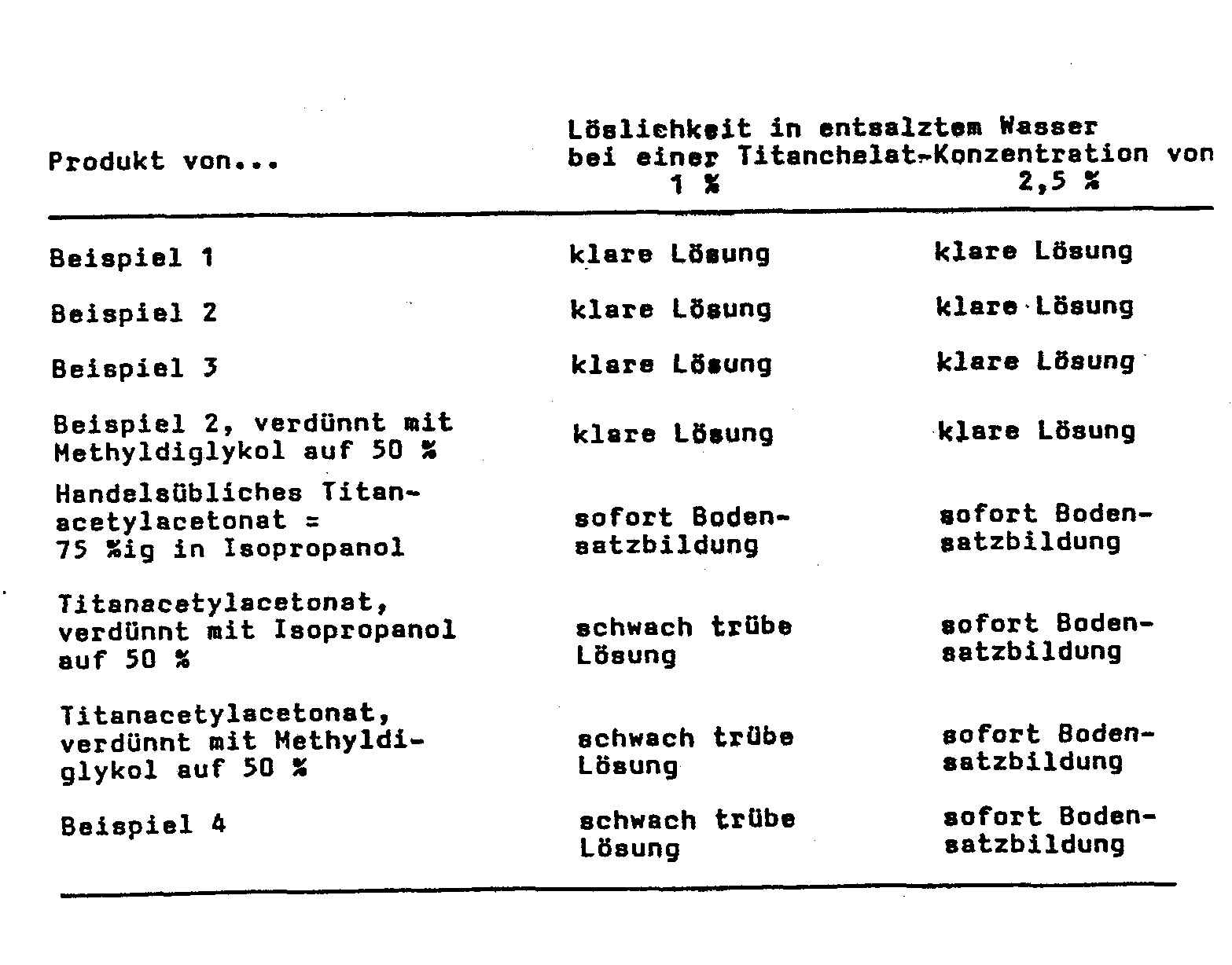
Prüfung der Löslichkeit der Produkte von Beispiel 1 bis 4 in Wasser im Konzentrationsbereich 1 - 2,5 %.
Anwendung 1 bzw. 2,5 %iger wäßriger Lösungen der Produkte nach Beispiel 1 und 2 zur Oberflächen-Modifikation von Metallen, Kunststoffen, Füllstoffen und Glasfasern.
- a) Zur Oberflächenbehandlung von Aluminiumblech wird eine 2 %ige Lösung des Produktes nach Beispiel 1 hergestellt und ein Aluminiumblech (Abmessung:15 x 8 x 0,1 cm) darin 30 Sekunden getaucht. Nach Ablauf der überschüssigen Lösung und Abtrocknen des Bleches mittels Warmluft verbleibt auf dem Aluminium eine die Haftung zu nachfolgenden Lackierungen verbessernde Schicht, die derjenigen gleichwertig ist, die durch Tauchen eines gleichen Bleches in einer 2 %igen Lösung von han delsüblichem Titanacetylacetonat in Toluol mit nachfolgendem Trocknen erhalten wird.
- b) Die Arbeitsweise nach a) läßt sich auch auf die haftungsverbessernde Oberflächenbehandlung von Kunststoffen, wie z.B. Polyethylen- oder Polyesterfolien, von Füllstoffen und von Glasfasern übertragen. Bei diesen Anwendungen mußte bisher entweder mit brennbaren oder physiologisch bedenklichen organischen Lösungsmitteln gearbeitet werden, oder das Titanacetyl acetonat mußte durch umständliche Verfahrensschritte in eine nur teilweise wäßrige Lösung überführt werden.
- a) For the surface treatment of aluminum sheet, a 2% solution of the product according to Example 1 is prepared and an aluminum sheet (dimensions: 15 x 8 x 0.1 cm) is immersed in it for 30 seconds. After the excess solution has run out and the sheet has been dried by means of warm air, a layer which improves the adhesion to subsequent coatings remains on the aluminum, which is equivalent to that obtained by immersing the same sheet in a 2% solution of commercially available titanium acetylacetonate in toluene with subsequent drying is obtained.
- b) The procedure according to a) can also be applied to the adhesion-improving surface treatment of plastics, such as, for example, polyethylene or polyester films, of fillers and of glass fibers. In these applications previously either combustible or physiologically questionable organic solvents had to be used, or the titanium acetyl acetonate had to be converted into an only partially aqueous solution by laborious process steps.
Claims (6)
Applications Claiming Priority (2)
| Application Number | Priority Date | Filing Date | Title |
|---|---|---|---|
| DE3337100 | 1983-10-12 | ||
| DE3337100A DE3337100C2 (en) | 1983-10-12 | 1983-10-12 | Water-soluble titanium (IV) -bis-acetylacetonate |
Publications (2)
| Publication Number | Publication Date |
|---|---|
| EP0140102A1 true EP0140102A1 (en) | 1985-05-08 |
| EP0140102B1 EP0140102B1 (en) | 1986-09-03 |
Family
ID=6211639
Family Applications (1)
| Application Number | Title | Priority Date | Filing Date |
|---|---|---|---|
| EP84110932A Expired EP0140102B1 (en) | 1983-10-12 | 1984-09-13 | Water-soluble titanium-acetyl acetonates |
Country Status (5)
| Country | Link |
|---|---|
| US (1) | US4647680A (en) |
| EP (1) | EP0140102B1 (en) |
| JP (1) | JPS6081140A (en) |
| CA (1) | CA1234133A (en) |
| DE (2) | DE3337100C2 (en) |
Cited By (2)
| Publication number | Priority date | Publication date | Assignee | Title |
|---|---|---|---|---|
| EP0316893A3 (en) * | 1987-11-19 | 1990-10-17 | Huls Aktiengesellschaft | Condensed acetoacetic ester-titanium chelates and process for their preparation |
| AU668775B2 (en) * | 1992-12-17 | 1996-05-16 | Ge Bayer Silicones Gmbh & Co. Kg | Novel titanium(IV) chelates and their use in polysiloxane materials |
Families Citing this family (11)
| Publication number | Priority date | Publication date | Assignee | Title |
|---|---|---|---|---|
| US4802740A (en) * | 1985-02-13 | 1989-02-07 | Canon Kabushiki Kaisha | Liquid crystal alignment layer containing polyvinyl-alcohol and titanium-alkoxide |
| US4847233A (en) * | 1987-07-27 | 1989-07-11 | Hi-Tek Polymers, Inc. | Metal acetylacetonate/alkylphenol curing catalyst for polycyanate esters of polyhydric phenols |
| GB9116267D0 (en) * | 1991-07-27 | 1991-09-11 | Tioxide Chemicals Limited | Aqueous compositions |
| US6562990B1 (en) | 2002-07-03 | 2003-05-13 | E. I. Du Pont De Nemours And Company | Titanium chelates and processes therefor |
| WO2005089480A2 (en) | 2004-03-19 | 2005-09-29 | Stuart Arthur Bateman | Activation method |
| KR101264450B1 (en) | 2005-01-21 | 2013-05-15 | 더 보잉 컴파니 | Activation method using modifying agent |
| AU2007297378B2 (en) | 2006-09-19 | 2013-05-30 | Swimc Llc | Food and beverage coated containers, method of coating and coating composition |
| TWI359698B (en) * | 2008-04-22 | 2012-03-11 | Iner Aec Executive Yuan | Method for producing catalyst for wastewater treat |
| JP2010063979A (en) * | 2008-09-09 | 2010-03-25 | Totoku Electric Co Ltd | Method for manufacturing photocatalyst fiber |
| JP5838643B2 (en) * | 2010-08-09 | 2016-01-06 | Toto株式会社 | Titanium complex and aqueous coating solution containing the same |
| EP2543685A1 (en) * | 2011-07-08 | 2013-01-09 | cynora GmbH | Method for covalent binding of a metal compound to a polymer |
Citations (3)
| Publication number | Priority date | Publication date | Assignee | Title |
|---|---|---|---|---|
| DE2200347A1 (en) * | 1971-01-06 | 1973-10-25 | Gen Electric | ALKANDIOXY TITANCHELATE |
| DE3008193A1 (en) * | 1980-03-04 | 1981-09-10 | Dynamit Nobel Ag, 5210 Troisdorf | LIQUID, REFRIGERABLE TITANIUM CATALYST PREPARATION |
| US4294724A (en) * | 1980-02-06 | 1981-10-13 | Phillips Petroleum Company | Titanium impregnated silica-chromium catalysts |
Family Cites Families (13)
| Publication number | Priority date | Publication date | Assignee | Title |
|---|---|---|---|---|
| GB734113A (en) * | 1950-08-26 | 1955-07-27 | Bayer Ag | Stable complex titanic acid esters and their production |
| US3017282A (en) * | 1957-04-12 | 1962-01-16 | Du Pont | Stable, aqueous solutions of organic titanium compounds |
| US3002854A (en) * | 1957-04-12 | 1961-10-03 | Du Pont | Treatment with titanium organic compositions |
| US3006941A (en) * | 1960-08-22 | 1961-10-31 | Harshaw Chem Corp | Stabilized metal alcoholates |
| US3004863A (en) * | 1960-10-04 | 1961-10-17 | Du Pont | Process for increasing the scratch resistance of glass |
| US3157661A (en) * | 1960-11-25 | 1964-11-17 | Du Pont | Solvent-soluble water-repellency compositions containing wax, liquid titanium ester and stabilizer |
| US3387994A (en) * | 1965-04-09 | 1968-06-11 | Du Pont | Process for rendering glass scratch resistant by decomposition of a titanium ester chelate |
| US3856839A (en) * | 1971-01-06 | 1974-12-24 | Gen Electric | Alkanedioxy titanium chelates |
| US3946057A (en) * | 1972-05-03 | 1976-03-23 | Union Carbide Corporation | Preparation of metal complexes of 1,3-diketones |
| US4438039A (en) * | 1980-07-02 | 1984-03-20 | General Electric Company | Titanium chelate catalyst for silicone compositions |
| DK487783A (en) * | 1982-11-05 | 1984-05-06 | Du Pont | TITANESTER COMPOSITION AND PROCEDURE FOR PREPARING THEREOF |
| US4478755A (en) * | 1982-11-05 | 1984-10-23 | E. I. Du Pont De Nemours And Company | Titanate compositions having depressed freezing points |
| US4551544A (en) * | 1982-11-05 | 1985-11-05 | E. I. Du Pont De Nemours And Company | Titanium ester compositions having depressed freezing points |
-
1983
- 1983-10-12 DE DE3337100A patent/DE3337100C2/en not_active Expired
-
1984
- 1984-07-30 JP JP59157740A patent/JPS6081140A/en active Granted
- 1984-09-13 EP EP84110932A patent/EP0140102B1/en not_active Expired
- 1984-09-13 DE DE8484110932T patent/DE3460623D1/en not_active Expired
- 1984-10-09 US US06/658,477 patent/US4647680A/en not_active Expired - Fee Related
- 1984-10-11 CA CA000465172A patent/CA1234133A/en not_active Expired
Patent Citations (3)
| Publication number | Priority date | Publication date | Assignee | Title |
|---|---|---|---|---|
| DE2200347A1 (en) * | 1971-01-06 | 1973-10-25 | Gen Electric | ALKANDIOXY TITANCHELATE |
| US4294724A (en) * | 1980-02-06 | 1981-10-13 | Phillips Petroleum Company | Titanium impregnated silica-chromium catalysts |
| DE3008193A1 (en) * | 1980-03-04 | 1981-09-10 | Dynamit Nobel Ag, 5210 Troisdorf | LIQUID, REFRIGERABLE TITANIUM CATALYST PREPARATION |
Non-Patent Citations (1)
| Title |
|---|
| HANS KITTEL, "Lehrbuch der Lacke und Beschichtungen: Band III:"Lonemittel, Weichmacher, additive, Zwischenprodukte", 1976 Verlag W.A. Colomb in der H. Heenemann GMBH Berlin-Oberschwandorf *seiten 396-398, Abschnitt 3.10.3.3 "Metallorganische verbindungen"* * |
Cited By (2)
| Publication number | Priority date | Publication date | Assignee | Title |
|---|---|---|---|---|
| EP0316893A3 (en) * | 1987-11-19 | 1990-10-17 | Huls Aktiengesellschaft | Condensed acetoacetic ester-titanium chelates and process for their preparation |
| AU668775B2 (en) * | 1992-12-17 | 1996-05-16 | Ge Bayer Silicones Gmbh & Co. Kg | Novel titanium(IV) chelates and their use in polysiloxane materials |
Also Published As
| Publication number | Publication date |
|---|---|
| CA1234133A (en) | 1988-03-15 |
| DE3337100C2 (en) | 1986-01-09 |
| DE3460623D1 (en) | 1986-10-09 |
| JPH0432814B2 (en) | 1992-06-01 |
| US4647680A (en) | 1987-03-03 |
| JPS6081140A (en) | 1985-05-09 |
| DE3337100A1 (en) | 1985-05-09 |
| EP0140102B1 (en) | 1986-09-03 |
Similar Documents
| Publication | Publication Date | Title |
|---|---|---|
| EP0140102B1 (en) | Water-soluble titanium-acetyl acetonates | |
| DE3737047A1 (en) | PREPARATION BASED ON TITANIUM CHELATES OF DIOLES AND TITANIACYLATES | |
| DE3337098C2 (en) | ||
| DE2150787B2 (en) | New N.N'-diaryloxamides, their manufacture and use as stabilizers for organic materials | |
| EP0330136B1 (en) | Zirkonium(IV)-chelates, their preparation and their use in printing inks | |
| EP0035649A2 (en) | Liquid cold-stable titanium catalyst composition and process for its preparation | |
| EP0139214B1 (en) | Water-soluble triethanolamine titanates | |
| DE2110546A1 (en) | Process for the preparation of cellulose ether derivatives | |
| DE3404949C1 (en) | Water soluble zirconic esters | |
| EP0079310B1 (en) | Process for preparing mixtures of esters of polyalkyl-piperidinol derivatives | |
| EP0128295B1 (en) | Process for modifying starch in the presence of solvents | |
| DE2557456C2 (en) | Process for the preparation of amine oxides | |
| DE2165302A1 (en) | Means to reduce perspiration | |
| DE3733608A1 (en) | NEW TITANIUM (IV) CHELESES AND THEIR USE IN PRINTING COLORS | |
| DE69010452T2 (en) | KLATHRATE COMPOUND OF RING-SUBSTITUTED SALICYL ACID SALT. | |
| DE941430C (en) | Process for the production of water-soluble titanium and zirconic acid esters | |
| AT395438B (en) | METHOD FOR PRODUCING ORGANOZINN PREPARATIONS AND THE USE THEREOF | |
| DE875804C (en) | Process for the preparation of conversion products of pentaerythritol dichlorohydrin monosulfuric acid ester | |
| DE1801868C3 (en) | Process for the preparation of asubstituted unsaturated carboxylic acids | |
| DD212965A5 (en) | PROCESS FOR THE PREPARATION OF 1-HYDROXYALKAN-1-PHOSPHONESAEURES | |
| DE867994C (en) | Process for the production of organic thiophosphoric acid esters | |
| AT244352B (en) | Process for the preparation of new organotin compounds containing mercaptobenzothiazole groups | |
| DE1618906C3 (en) | Process for the production of fatty acid esters of high molecular weight polyalcohol polyethers | |
| DE2918592A1 (en) | METHOD FOR PRODUCING THE ARYLESTERS OF CARBONIC ACIDS | |
| DE3139301A1 (en) | Process for the preparation of dialkyl (3-chloro-n-propyl)malonates or alkyl (3-chloro-n-propyl)cyanoacetates |
Legal Events
| Date | Code | Title | Description |
|---|---|---|---|
| PUAI | Public reference made under article 153(3) epc to a published international application that has entered the european phase |
Free format text: ORIGINAL CODE: 0009012 |
|
| AK | Designated contracting states |
Designated state(s): BE DE FR GB NL |
|
| 17P | Request for examination filed |
Effective date: 19850904 |
|
| GRAA | (expected) grant |
Free format text: ORIGINAL CODE: 0009210 |
|
| AK | Designated contracting states |
Kind code of ref document: B1 Designated state(s): BE DE FR GB NL |
|
| REF | Corresponds to: |
Ref document number: 3460623 Country of ref document: DE Date of ref document: 19861009 |
|
| ET | Fr: translation filed | ||
| PLBE | No opposition filed within time limit |
Free format text: ORIGINAL CODE: 0009261 |
|
| STAA | Information on the status of an ep patent application or granted ep patent |
Free format text: STATUS: NO OPPOSITION FILED WITHIN TIME LIMIT |
|
| 26N | No opposition filed | ||
| PGFP | Annual fee paid to national office [announced via postgrant information from national office to epo] |
Ref country code: GB Payment date: 19940901 Year of fee payment: 11 |
|
| PGFP | Annual fee paid to national office [announced via postgrant information from national office to epo] |
Ref country code: BE Payment date: 19940928 Year of fee payment: 11 |
|
| PGFP | Annual fee paid to national office [announced via postgrant information from national office to epo] |
Ref country code: NL Payment date: 19940930 Year of fee payment: 11 |
|
| PGFP | Annual fee paid to national office [announced via postgrant information from national office to epo] |
Ref country code: FR Payment date: 19941114 Year of fee payment: 11 |
|
| PG25 | Lapsed in a contracting state [announced via postgrant information from national office to epo] |
Ref country code: GB Effective date: 19950913 |
|
| PG25 | Lapsed in a contracting state [announced via postgrant information from national office to epo] |
Ref country code: BE Effective date: 19950930 |
|
| BERE | Be: lapsed |
Owner name: DYNAMIT NOBEL A.G. Effective date: 19950930 |
|
| PG25 | Lapsed in a contracting state [announced via postgrant information from national office to epo] |
Ref country code: NL Effective date: 19960401 |
|
| GBPC | Gb: european patent ceased through non-payment of renewal fee |
Effective date: 19950913 |
|
| PG25 | Lapsed in a contracting state [announced via postgrant information from national office to epo] |
Ref country code: FR Effective date: 19960531 |
|
| NLV4 | Nl: lapsed or anulled due to non-payment of the annual fee |
Effective date: 19960401 |
|
| REG | Reference to a national code |
Ref country code: FR Ref legal event code: ST |
|
| PGFP | Annual fee paid to national office [announced via postgrant information from national office to epo] |
Ref country code: DE Payment date: 19961007 Year of fee payment: 13 |
|
| PG25 | Lapsed in a contracting state [announced via postgrant information from national office to epo] |
Ref country code: DE Free format text: LAPSE BECAUSE OF NON-PAYMENT OF DUE FEES Effective date: 19980603 |