EP0140748B1 - Verfahren zur Herstellung von 4-Quinolinonen - Google Patents
Verfahren zur Herstellung von 4-Quinolinonen Download PDFInfo
- Publication number
- EP0140748B1 EP0140748B1 EP84401861A EP84401861A EP0140748B1 EP 0140748 B1 EP0140748 B1 EP 0140748B1 EP 84401861 A EP84401861 A EP 84401861A EP 84401861 A EP84401861 A EP 84401861A EP 0140748 B1 EP0140748 B1 EP 0140748B1
- Authority
- EP
- European Patent Office
- Prior art keywords
- acid
- general formula
- carbon atoms
- linear
- denotes
- Prior art date
- Legal status (The legal status is an assumption and is not a legal conclusion. Google has not performed a legal analysis and makes no representation as to the accuracy of the status listed.)
- Expired
Links
- 238000000034 method Methods 0.000 title claims description 17
- 238000002360 preparation method Methods 0.000 title claims description 3
- HETSDWRDICBRSQ-UHFFFAOYSA-N 3h-quinolin-4-one Chemical class C1=CC=C2C(=O)CC=NC2=C1 HETSDWRDICBRSQ-UHFFFAOYSA-N 0.000 title 1
- ZMXDDKWLCZADIW-UHFFFAOYSA-N N,N-Dimethylformamide Chemical compound CN(C)C=O ZMXDDKWLCZADIW-UHFFFAOYSA-N 0.000 claims abstract description 30
- YGYAWVDWMABLBF-UHFFFAOYSA-N Phosgene Chemical compound ClC(Cl)=O YGYAWVDWMABLBF-UHFFFAOYSA-N 0.000 claims abstract description 25
- 125000004432 carbon atom Chemical group C* 0.000 claims abstract description 15
- 239000002253 acid Substances 0.000 claims abstract description 14
- 125000004435 hydrogen atom Chemical group [H]* 0.000 claims abstract description 12
- 239000002841 Lewis acid Substances 0.000 claims abstract description 8
- 150000007517 lewis acids Chemical class 0.000 claims abstract description 8
- AQKKRXMVSOXABZ-UHFFFAOYSA-N 3-anilinopropanoic acid Chemical compound OC(=O)CCNC1=CC=CC=C1 AQKKRXMVSOXABZ-UHFFFAOYSA-N 0.000 claims abstract description 5
- 125000005843 halogen group Chemical group 0.000 claims abstract description 5
- BUWPZNOVIHAWHW-UHFFFAOYSA-N 2,3-dihydro-1h-quinolin-4-one Chemical compound C1=CC=C2C(=O)CCNC2=C1 BUWPZNOVIHAWHW-UHFFFAOYSA-N 0.000 claims abstract 6
- YMWUJEATGCHHMB-UHFFFAOYSA-N Dichloromethane Chemical compound ClCCl YMWUJEATGCHHMB-UHFFFAOYSA-N 0.000 claims description 69
- 239000000047 product Substances 0.000 claims description 41
- HEMHJVSKTPXQMS-UHFFFAOYSA-M Sodium hydroxide Chemical compound [OH-].[Na+] HEMHJVSKTPXQMS-UHFFFAOYSA-M 0.000 claims description 27
- VSCWAEJMTAWNJL-UHFFFAOYSA-K aluminium trichloride Chemical compound Cl[Al](Cl)Cl VSCWAEJMTAWNJL-UHFFFAOYSA-K 0.000 claims description 12
- UBOXGVDOUJQMTN-UHFFFAOYSA-N 1,1,2-trichloroethane Chemical compound ClCC(Cl)Cl UBOXGVDOUJQMTN-UHFFFAOYSA-N 0.000 claims description 8
- KRHYYFGTRYWZRS-UHFFFAOYSA-N Fluorane Chemical compound F KRHYYFGTRYWZRS-UHFFFAOYSA-N 0.000 claims description 8
- QAOWNCQODCNURD-UHFFFAOYSA-N Sulfuric acid Chemical compound OS(O)(=O)=O QAOWNCQODCNURD-UHFFFAOYSA-N 0.000 claims description 7
- 239000003960 organic solvent Substances 0.000 claims description 7
- 239000002904 solvent Substances 0.000 claims description 5
- NGNBDVOYPDDBFK-UHFFFAOYSA-N 2-[2,4-di(pentan-2-yl)phenoxy]acetyl chloride Chemical compound CCCC(C)C1=CC=C(OCC(Cl)=O)C(C(C)CCC)=C1 NGNBDVOYPDDBFK-UHFFFAOYSA-N 0.000 claims description 4
- GDTBXPJZTBHREO-UHFFFAOYSA-N bromine Chemical compound BrBr GDTBXPJZTBHREO-UHFFFAOYSA-N 0.000 claims description 4
- 125000001424 substituent group Chemical group 0.000 claims description 4
- RYHBNJHYFVUHQT-UHFFFAOYSA-N 1,4-Dioxane Chemical compound C1COCCO1 RYHBNJHYFVUHQT-UHFFFAOYSA-N 0.000 claims description 3
- XJDNKRIXUMDJCW-UHFFFAOYSA-J titanium tetrachloride Chemical compound Cl[Ti](Cl)(Cl)Cl XJDNKRIXUMDJCW-UHFFFAOYSA-J 0.000 claims description 3
- 229910021578 Iron(III) chloride Inorganic materials 0.000 claims description 2
- CYTYCFOTNPOANT-UHFFFAOYSA-N Perchloroethylene Chemical group ClC(Cl)=C(Cl)Cl CYTYCFOTNPOANT-UHFFFAOYSA-N 0.000 claims description 2
- 229910021627 Tin(IV) chloride Inorganic materials 0.000 claims description 2
- 229910052794 bromium Inorganic materials 0.000 claims description 2
- 239000000460 chlorine Substances 0.000 claims description 2
- 229910052801 chlorine Inorganic materials 0.000 claims description 2
- 229910052731 fluorine Inorganic materials 0.000 claims description 2
- 125000001153 fluoro group Chemical group F* 0.000 claims description 2
- 150000008282 halocarbons Chemical class 0.000 claims description 2
- 239000013067 intermediate product Substances 0.000 claims description 2
- RBTARNINKXHZNM-UHFFFAOYSA-K iron trichloride Chemical compound Cl[Fe](Cl)Cl RBTARNINKXHZNM-UHFFFAOYSA-K 0.000 claims description 2
- 125000004971 nitroalkyl group Chemical group 0.000 claims description 2
- 229950011008 tetrachloroethylene Drugs 0.000 claims description 2
- HPGGPRDJHPYFRM-UHFFFAOYSA-J tin(iv) chloride Chemical compound Cl[Sn](Cl)(Cl)Cl HPGGPRDJHPYFRM-UHFFFAOYSA-J 0.000 claims description 2
- QGJOPFRUJISHPQ-UHFFFAOYSA-N Carbon disulfide Chemical compound S=C=S QGJOPFRUJISHPQ-UHFFFAOYSA-N 0.000 claims 2
- VABWFCZSSRYQBL-UHFFFAOYSA-N 3-(n-carbonochloridoylanilino)propanoic acid Chemical compound OC(=O)CCN(C(Cl)=O)C1=CC=CC=C1 VABWFCZSSRYQBL-UHFFFAOYSA-N 0.000 claims 1
- WBCSFBMGQFDNJX-UHFFFAOYSA-N 4-oxo-2,3-dihydroquinoline-1-carbonyl chloride Chemical compound C1=CC=C2N(C(=O)Cl)CCC(=O)C2=C1 WBCSFBMGQFDNJX-UHFFFAOYSA-N 0.000 claims 1
- VEXZGXHMUGYJMC-UHFFFAOYSA-M Chloride anion Chemical compound [Cl-] VEXZGXHMUGYJMC-UHFFFAOYSA-M 0.000 claims 1
- KZBUYRJDOAKODT-UHFFFAOYSA-N Chlorine Chemical compound ClCl KZBUYRJDOAKODT-UHFFFAOYSA-N 0.000 claims 1
- 150000007529 inorganic bases Chemical class 0.000 claims 1
- 238000002955 isolation Methods 0.000 claims 1
- BDHFUVZGWQCTTF-UHFFFAOYSA-N sulfonic acid Chemical compound OS(=O)=O BDHFUVZGWQCTTF-UHFFFAOYSA-N 0.000 claims 1
- 239000001117 sulphuric acid Substances 0.000 claims 1
- 235000011149 sulphuric acid Nutrition 0.000 claims 1
- 239000000543 intermediate Substances 0.000 abstract description 3
- 125000003545 alkoxy group Chemical group 0.000 abstract description 2
- 125000000217 alkyl group Chemical group 0.000 abstract description 2
- 150000001875 compounds Chemical class 0.000 abstract 1
- 239000003814 drug Substances 0.000 abstract 1
- 229940079593 drug Drugs 0.000 abstract 1
- XLYOFNOQVPJJNP-UHFFFAOYSA-N water Substances O XLYOFNOQVPJJNP-UHFFFAOYSA-N 0.000 description 26
- 239000011541 reaction mixture Substances 0.000 description 23
- 241001558496 Talpa caeca Species 0.000 description 20
- XBDQKXXYIPTUBI-UHFFFAOYSA-N Propionic acid Substances CCC(O)=O XBDQKXXYIPTUBI-UHFFFAOYSA-N 0.000 description 17
- XKRFYHLGVUSROY-UHFFFAOYSA-N Argon Chemical compound [Ar] XKRFYHLGVUSROY-UHFFFAOYSA-N 0.000 description 14
- 239000000203 mixture Substances 0.000 description 13
- QSHDDOUJBYECFT-UHFFFAOYSA-N mercury Chemical compound [Hg] QSHDDOUJBYECFT-UHFFFAOYSA-N 0.000 description 12
- 229910052753 mercury Inorganic materials 0.000 description 12
- 239000008346 aqueous phase Substances 0.000 description 9
- 230000008018 melting Effects 0.000 description 9
- 238000002844 melting Methods 0.000 description 9
- 238000001914 filtration Methods 0.000 description 8
- 239000012074 organic phase Substances 0.000 description 8
- 239000012071 phase Substances 0.000 description 8
- 239000002244 precipitate Substances 0.000 description 8
- PMZURENOXWZQFD-UHFFFAOYSA-L Sodium Sulfate Chemical compound [Na+].[Na+].[O-]S([O-])(=O)=O PMZURENOXWZQFD-UHFFFAOYSA-L 0.000 description 7
- -1 alkyl radicals Chemical class 0.000 description 7
- 229910052786 argon Inorganic materials 0.000 description 7
- 238000010908 decantation Methods 0.000 description 7
- 238000001953 recrystallisation Methods 0.000 description 7
- XEKOWRVHYACXOJ-UHFFFAOYSA-N Ethyl acetate Chemical compound CCOC(C)=O XEKOWRVHYACXOJ-UHFFFAOYSA-N 0.000 description 6
- OKKJLVBELUTLKV-UHFFFAOYSA-N Methanol Chemical compound OC OKKJLVBELUTLKV-UHFFFAOYSA-N 0.000 description 6
- 238000004458 analytical method Methods 0.000 description 6
- 238000006243 chemical reaction Methods 0.000 description 6
- 239000000706 filtrate Substances 0.000 description 6
- 238000002329 infrared spectrum Methods 0.000 description 6
- 238000001819 mass spectrum Methods 0.000 description 6
- 239000000155 melt Substances 0.000 description 6
- VLKZOEOYAKHREP-UHFFFAOYSA-N n-Hexane Chemical compound CCCCCC VLKZOEOYAKHREP-UHFFFAOYSA-N 0.000 description 6
- 238000000655 nuclear magnetic resonance spectrum Methods 0.000 description 6
- 229910052938 sodium sulfate Inorganic materials 0.000 description 6
- 235000011152 sodium sulphate Nutrition 0.000 description 6
- FERIUCNNQQJTOY-UHFFFAOYSA-N Butyric acid Chemical compound CCCC(O)=O FERIUCNNQQJTOY-UHFFFAOYSA-N 0.000 description 4
- 0 C*CC(*)N(*C)C1=CC=C*(C)C=C1 Chemical compound C*CC(*)N(*C)C1=CC=C*(C)C=C1 0.000 description 4
- RTZKZFJDLAIYFH-UHFFFAOYSA-N Diethyl ether Chemical compound CCOCC RTZKZFJDLAIYFH-UHFFFAOYSA-N 0.000 description 4
- 239000012300 argon atmosphere Substances 0.000 description 4
- 238000001816 cooling Methods 0.000 description 4
- 239000012153 distilled water Substances 0.000 description 4
- 239000000284 extract Substances 0.000 description 4
- 239000007789 gas Substances 0.000 description 4
- KUDPGZONDFORKU-UHFFFAOYSA-N n-chloroaniline Chemical compound ClNC1=CC=CC=C1 KUDPGZONDFORKU-UHFFFAOYSA-N 0.000 description 4
- NIXOWILDQLNWCW-UHFFFAOYSA-N Acrylic acid Chemical compound OC(=O)C=C NIXOWILDQLNWCW-UHFFFAOYSA-N 0.000 description 3
- PAYRUJLWNCNPSJ-UHFFFAOYSA-N N-phenyl amine Natural products NC1=CC=CC=C1 PAYRUJLWNCNPSJ-UHFFFAOYSA-N 0.000 description 3
- 150000007513 acids Chemical class 0.000 description 3
- 239000002585 base Substances 0.000 description 3
- RBBOWEDMXHTEPA-UHFFFAOYSA-N hexane;toluene Chemical compound CCCCCC.CC1=CC=CC=C1 RBBOWEDMXHTEPA-UHFFFAOYSA-N 0.000 description 3
- 229920000137 polyphosphoric acid Polymers 0.000 description 3
- 238000003822 preparative gas chromatography Methods 0.000 description 3
- 235000019260 propionic acid Nutrition 0.000 description 3
- IUVKMZGDUIUOCP-BTNSXGMBSA-N quinbolone Chemical compound O([C@H]1CC[C@H]2[C@H]3[C@@H]([C@]4(C=CC(=O)C=C4CC3)C)CC[C@@]21C)C1=CCCC1 IUVKMZGDUIUOCP-BTNSXGMBSA-N 0.000 description 3
- 238000007363 ring formation reaction Methods 0.000 description 3
- 238000003756 stirring Methods 0.000 description 3
- WHTVZRBIWZFKQO-AWEZNQCLSA-N (S)-chloroquine Chemical compound ClC1=CC=C2C(N[C@@H](C)CCCN(CC)CC)=CC=NC2=C1 WHTVZRBIWZFKQO-AWEZNQCLSA-N 0.000 description 2
- SMZOUWXMTYCWNB-UHFFFAOYSA-N 2-(2-methoxy-5-methylphenyl)ethanamine Chemical compound COC1=CC=C(C)C=C1CCN SMZOUWXMTYCWNB-UHFFFAOYSA-N 0.000 description 2
- WIXUZVQMOUIMNP-UHFFFAOYSA-N 2-(3-chloroanilino)propanoic acid Chemical compound OC(=O)C(C)NC1=CC=CC(Cl)=C1 WIXUZVQMOUIMNP-UHFFFAOYSA-N 0.000 description 2
- LFQSCWFLJHTTHZ-UHFFFAOYSA-N Ethanol Chemical compound CCO LFQSCWFLJHTTHZ-UHFFFAOYSA-N 0.000 description 2
- CTQNGGLPUBDAKN-UHFFFAOYSA-N O-Xylene Chemical compound CC1=CC=CC=C1C CTQNGGLPUBDAKN-UHFFFAOYSA-N 0.000 description 2
- 239000013543 active substance Substances 0.000 description 2
- NWGGKKGAFZIVBJ-UHFFFAOYSA-N antrafenine Chemical compound FC(F)(F)C1=CC=CC(N2CCN(CCOC(=O)C=3C(=CC=CC=3)NC=3C4=CC=C(C=C4N=CC=3)C(F)(F)F)CC2)=C1 NWGGKKGAFZIVBJ-UHFFFAOYSA-N 0.000 description 2
- 239000012298 atmosphere Substances 0.000 description 2
- 230000015572 biosynthetic process Effects 0.000 description 2
- WTEOIRVLGSZEPR-UHFFFAOYSA-N boron trifluoride Chemical compound FB(F)F WTEOIRVLGSZEPR-UHFFFAOYSA-N 0.000 description 2
- 125000003178 carboxy group Chemical group [H]OC(*)=O 0.000 description 2
- 125000001309 chloro group Chemical group Cl* 0.000 description 2
- 229960003677 chloroquine Drugs 0.000 description 2
- WHTVZRBIWZFKQO-UHFFFAOYSA-N chloroquine Natural products ClC1=CC=C2C(NC(C)CCCN(CC)CC)=CC=NC2=C1 WHTVZRBIWZFKQO-UHFFFAOYSA-N 0.000 description 2
- 238000009833 condensation Methods 0.000 description 2
- 230000005494 condensation Effects 0.000 description 2
- 230000008034 disappearance Effects 0.000 description 2
- 238000000921 elemental analysis Methods 0.000 description 2
- 239000007791 liquid phase Substances 0.000 description 2
- RNVCVTLRINQCPJ-UHFFFAOYSA-N o-toluidine Chemical compound CC1=CC=CC=C1N RNVCVTLRINQCPJ-UHFFFAOYSA-N 0.000 description 2
- 239000003921 oil Substances 0.000 description 2
- 235000019198 oils Nutrition 0.000 description 2
- 239000010502 orange oil Substances 0.000 description 2
- 239000000843 powder Substances 0.000 description 2
- 239000007787 solid Substances 0.000 description 2
- 239000000725 suspension Substances 0.000 description 2
- 238000003786 synthesis reaction Methods 0.000 description 2
- 239000008096 xylene Substances 0.000 description 2
- CAPCBAYULRXQAN-UHFFFAOYSA-N 1-n,1-n-diethylpentane-1,4-diamine Chemical compound CCN(CC)CCCC(C)N CAPCBAYULRXQAN-UHFFFAOYSA-N 0.000 description 1
- XWKAVQKJQBISOL-UHFFFAOYSA-N 2-(phenylazaniumyl)propanoate Chemical compound OC(=O)C(C)NC1=CC=CC=C1 XWKAVQKJQBISOL-UHFFFAOYSA-N 0.000 description 1
- PNPCRKVUWYDDST-UHFFFAOYSA-N 3-chloroaniline Chemical compound NC1=CC=CC(Cl)=C1 PNPCRKVUWYDDST-UHFFFAOYSA-N 0.000 description 1
- OVCDSSHSILBFBN-UHFFFAOYSA-N Amodiaquine Chemical compound C1=C(O)C(CN(CC)CC)=CC(NC=2C3=CC=C(Cl)C=C3N=CC=2)=C1 OVCDSSHSILBFBN-UHFFFAOYSA-N 0.000 description 1
- 229910015900 BF3 Inorganic materials 0.000 description 1
- ZOXJGFHDIHLPTG-UHFFFAOYSA-N Boron Chemical compound [B] ZOXJGFHDIHLPTG-UHFFFAOYSA-N 0.000 description 1
- ZAFNJMIOTHYJRJ-UHFFFAOYSA-N Diisopropyl ether Chemical compound CC(C)OC(C)C ZAFNJMIOTHYJRJ-UHFFFAOYSA-N 0.000 description 1
- DGAQECJNVWCQMB-PUAWFVPOSA-M Ilexoside XXIX Chemical compound C[C@@H]1CC[C@@]2(CC[C@@]3(C(=CC[C@H]4[C@]3(CC[C@@H]5[C@@]4(CC[C@@H](C5(C)C)OS(=O)(=O)[O-])C)C)[C@@H]2[C@]1(C)O)C)C(=O)O[C@H]6[C@@H]([C@H]([C@@H]([C@H](O6)CO)O)O)O.[Na+] DGAQECJNVWCQMB-PUAWFVPOSA-M 0.000 description 1
- 235000019502 Orange oil Nutrition 0.000 description 1
- QAOWNCQODCNURD-UHFFFAOYSA-L Sulfate Chemical compound [O-]S([O-])(=O)=O QAOWNCQODCNURD-UHFFFAOYSA-L 0.000 description 1
- 238000013019 agitation Methods 0.000 description 1
- 125000001931 aliphatic group Chemical group 0.000 description 1
- 229960001444 amodiaquine Drugs 0.000 description 1
- 150000001448 anilines Chemical class 0.000 description 1
- 229950004064 antrafenine Drugs 0.000 description 1
- 230000001174 ascending effect Effects 0.000 description 1
- 229910052796 boron Inorganic materials 0.000 description 1
- 230000005587 bubbling Effects 0.000 description 1
- RBHJBMIOOPYDBQ-UHFFFAOYSA-N carbon dioxide;propan-2-one Chemical compound O=C=O.CC(C)=O RBHJBMIOOPYDBQ-UHFFFAOYSA-N 0.000 description 1
- DXHPZXWIPWDXHJ-UHFFFAOYSA-N carbon monosulfide Chemical compound [S+]#[C-] DXHPZXWIPWDXHJ-UHFFFAOYSA-N 0.000 description 1
- 239000003795 chemical substances by application Substances 0.000 description 1
- 150000001805 chlorine compounds Chemical group 0.000 description 1
- WBLIXGSTEMXDSM-UHFFFAOYSA-N chloromethane Chemical compound Cl[CH2] WBLIXGSTEMXDSM-UHFFFAOYSA-N 0.000 description 1
- 238000004587 chromatography analysis Methods 0.000 description 1
- LDHQCZJRKDOVOX-NSCUHMNNSA-N crotonic acid Chemical compound C\C=C\C(O)=O LDHQCZJRKDOVOX-NSCUHMNNSA-N 0.000 description 1
- 238000001704 evaporation Methods 0.000 description 1
- 230000008020 evaporation Effects 0.000 description 1
- 238000000605 extraction Methods 0.000 description 1
- GWOFUCIGLDBNKM-UHFFFAOYSA-N glafenine Chemical compound OCC(O)COC(=O)C1=CC=CC=C1NC1=CC=NC2=CC(Cl)=CC=C12 GWOFUCIGLDBNKM-UHFFFAOYSA-N 0.000 description 1
- 229960001650 glafenine Drugs 0.000 description 1
- 238000004128 high performance liquid chromatography Methods 0.000 description 1
- 239000012535 impurity Substances 0.000 description 1
- 229910052500 inorganic mineral Inorganic materials 0.000 description 1
- 238000003402 intramolecular cyclocondensation reaction Methods 0.000 description 1
- 239000007788 liquid Substances 0.000 description 1
- 239000011707 mineral Substances 0.000 description 1
- TYJJADVDDVDEDZ-UHFFFAOYSA-M potassium hydrogencarbonate Chemical compound [K+].OC([O-])=O TYJJADVDDVDEDZ-UHFFFAOYSA-M 0.000 description 1
- 238000000746 purification Methods 0.000 description 1
- LISFMEBWQUVKPJ-UHFFFAOYSA-N quinolin-2-ol Chemical compound C1=CC=C2NC(=O)C=CC2=C1 LISFMEBWQUVKPJ-UHFFFAOYSA-N 0.000 description 1
- 229930185107 quinolinone Natural products 0.000 description 1
- 230000035484 reaction time Effects 0.000 description 1
- 229920006395 saturated elastomer Polymers 0.000 description 1
- 239000011734 sodium Substances 0.000 description 1
- 229910052708 sodium Inorganic materials 0.000 description 1
- 238000001228 spectrum Methods 0.000 description 1
- 238000010183 spectrum analysis Methods 0.000 description 1
- 229910001220 stainless steel Inorganic materials 0.000 description 1
- 239000010935 stainless steel Substances 0.000 description 1
- 239000007858 starting material Substances 0.000 description 1
- 239000000126 substance Substances 0.000 description 1
- 238000004809 thin layer chromatography Methods 0.000 description 1
- LDHQCZJRKDOVOX-UHFFFAOYSA-N trans-crotonic acid Natural products CC=CC(O)=O LDHQCZJRKDOVOX-UHFFFAOYSA-N 0.000 description 1
- 230000009466 transformation Effects 0.000 description 1
- ITMCEJHCFYSIIV-UHFFFAOYSA-N triflic acid Chemical class OS(=O)(=O)C(F)(F)F ITMCEJHCFYSIIV-UHFFFAOYSA-N 0.000 description 1
- LEMQFBIYMVUIIG-UHFFFAOYSA-N trifluoroborane;hydrofluoride Chemical compound F.FB(F)F LEMQFBIYMVUIIG-UHFFFAOYSA-N 0.000 description 1
- 239000012808 vapor phase Substances 0.000 description 1
Classifications
-
- C—CHEMISTRY; METALLURGY
- C07—ORGANIC CHEMISTRY
- C07D—HETEROCYCLIC COMPOUNDS
- C07D215/00—Heterocyclic compounds containing quinoline or hydrogenated quinoline ring systems
- C07D215/02—Heterocyclic compounds containing quinoline or hydrogenated quinoline ring systems having no bond between the ring nitrogen atom and a non-ring member or having only hydrogen atoms or carbon atoms directly attached to the ring nitrogen atom
- C07D215/16—Heterocyclic compounds containing quinoline or hydrogenated quinoline ring systems having no bond between the ring nitrogen atom and a non-ring member or having only hydrogen atoms or carbon atoms directly attached to the ring nitrogen atom with hetero atoms or with carbon atoms having three bonds to hetero atoms with at the most one bond to halogen, e.g. ester or nitrile radicals, directly attached to ring carbon atoms
- C07D215/20—Oxygen atoms
- C07D215/22—Oxygen atoms attached in position 2 or 4
-
- C—CHEMISTRY; METALLURGY
- C07—ORGANIC CHEMISTRY
- C07D—HETEROCYCLIC COMPOUNDS
- C07D215/00—Heterocyclic compounds containing quinoline or hydrogenated quinoline ring systems
- C07D215/02—Heterocyclic compounds containing quinoline or hydrogenated quinoline ring systems having no bond between the ring nitrogen atom and a non-ring member or having only hydrogen atoms or carbon atoms directly attached to the ring nitrogen atom
- C07D215/16—Heterocyclic compounds containing quinoline or hydrogenated quinoline ring systems having no bond between the ring nitrogen atom and a non-ring member or having only hydrogen atoms or carbon atoms directly attached to the ring nitrogen atom with hetero atoms or with carbon atoms having three bonds to hetero atoms with at the most one bond to halogen, e.g. ester or nitrile radicals, directly attached to ring carbon atoms
- C07D215/20—Oxygen atoms
- C07D215/22—Oxygen atoms attached in position 2 or 4
- C07D215/233—Oxygen atoms attached in position 2 or 4 only one oxygen atom which is attached in position 4
Definitions
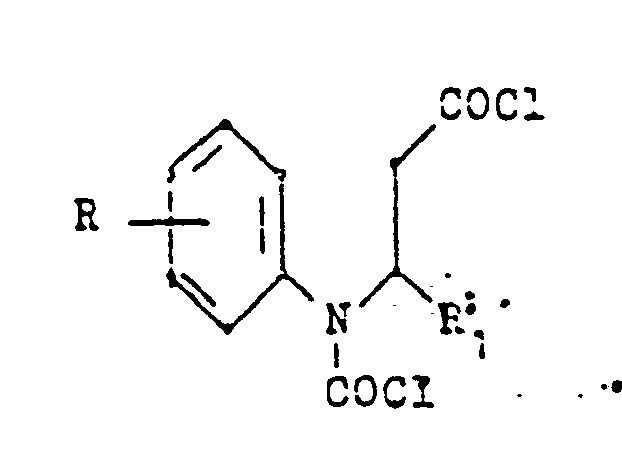
- R represents a hydrogen atom or a substituent chosen from the group of halogen atoms and straight or branched alkyl radicals containing 1 to 4 carbon atoms and straight or branched alkyloxy containing 1 to 4 carbon atoms
- R 1 represents a hydrogen atom or a straight or branched alkyl radical containing 1 to 4 carbon atoms.
- the products of general formula (III) are obtained by the action of phosgene on a product of general formula (II) by operating in an organic solvent such as methylene chloride, 1,1,2-trichloroethane. , aliphatic esters or dioxane at a temperature between -10 and 150 ° C and, preferably between -30 and 80 ° C.
- an organic solvent such as methylene chloride, 1,1,2-trichloroethane. , aliphatic esters or dioxane.
- a slight excess of phosgene is used (less than 10%) relative to the 3-anilino-propionic acid of general formula (II) used. It is advantageous to operate in an inert atmosphere.
- the products of general formula (IV) are obtained by the action of phosgene on the products of general formula (III) in the presence of a trace of dimethylformamide by operating in an organic solvent such as methylene chloride, trihaloethanes such as 1,1,2-trichloroethane or dioxane at a temperature between -10 and 100 ° C and preferably between -0 and 50 ° C.
- an organic solvent such as methylene chloride
- trihaloethanes such as 1,1,2-trichloroethane or dioxane
- a slight excess of phosgene is used compared to the product of general formula (III). It is advantageous to operate in an inert atmosphere.
- the products of general formula (V) are obtained by intramolecular cyclization of a product of general formula (IV) using a Lewis acid or a strong acid.
- Lewis acids aluminum chloride, ferric chloride, titanium chloride or stannic chloride are particularly suitable.
- sulfuric acid As strong acids, sulfuric acid, hydrofluoric acid, acids are particularly suitable.
- sulfonic alkyl sulfonic, arylsulfonic, trifluoromethanesulfonic acids
- polyphosphoric acid As strong acids, sulfuric acid, hydrofluoric acid, acids are particularly suitable.
- the reaction is carried out in a suitably chosen solvent at a temperature between -10 and 70 ° C and preferably between 0 and 50 ° C.
- organic solvents can be used halogenated hydrocarbons such as methylene chloride, trihaloethanes such as 1,1,2-trichioroethane, carbon sulfide, nitroalkanes or tetrachlorethylene.
- the cyclization takes place at a temperature between 20 and 100 ° C.
- the products of general formula (V) can also be obtained directly from a 3-anilino-propionic acid without it being necessary to intermediately isolate the products of general formula (III) and (IV) .
- the product of general formula (II) is treated with phosgene, at the rate of at least 2 moles of phosgene per mole of 3-anilino-propionic acid of general formula (II) used, in a solvent.
- organic such as methylene chloride or 1,1,2,2-trichloroethane at a temperature between -10 and 150 ° C and preferably between 30 and 80 ° C, then dimethylformamide is added and the reaction is continued until with complete transformation.
- Lewis acid or strong acid is added to the reaction mixture and the reaction is continued until complete disappearance of the starting product and the intermediate products.
- the product of general formula (V) is separated from the reaction mixture according to the usual methods.
- the products of general formula (I) can be obtained by the action of a mineral base on a product of general formula (V). It is particularly advantageous to use sodium hydroxide in methanolic solution by operating at a temperature between 50 and 100 ° C.
- the reaction is generally carried out in water at a temperature between 70 and 100 ° C using an excess of aniline relative to the acid of general formula (VI) used.
- the reaction time is generally between 1 and 4 hours.
- tetrahydro-1,2,3,4 quinolinones-4 of general formula (I) are particularly useful as intermediates in the synthesis of therapeutically active substances such as chloroquine, glafenine, antrafenine or amodiaquine.
- 7-chloro-1,2,3,4-tetrahydro-quinolinone-4 can be converted into chloroquine by condensation of 4-diethylamino-1-methyl butylamine in the presence of air according to the process described by WS Johnson and BG Buell , J. Amer. Chem. Soc., 74.4513 (1952).
- the precipitate is separated by filtration under a stream of argon and then dried under reduced pressure (1 mm of mercury; 0.13 kPa) to constant weight. 3.2 g of m.chloroanilino-3-propionic acid hydrochloride are thus obtained.
- the product after recrystallization from isopropyl ether, melts at 111 ° C.
- the organic phase is heated for 1 hour at 80 ° C under reduced pressure (20 mm of mercury; 2.7 kPa). 195.4 g of a product are obtained containing 94% m.chloro-anilino-3-propionic acid and 2.3% water.
- the reaction mixture is concentrated under reduced pressure (20 mm of mercury; 2.7 kPa) at 40 ° C. 8 g of a yellow-orange oil are thus obtained. This oil is taken up in 20 cm 3 of ethyl acetate at 4 ° C. A slight precipitate is formed which is separated by filtration under an argon atmosphere. The filtrate is concentrated to dryness under reduced pressure ( 2 mm of mercury; 2.7 kpa) then dried to constant weight under reduced pressure (1 mm of mercury; 0.13 kpa) at 40 ° C. This gives 7, 4 g of acid chloride of N-chloroformyl m. chloroanilino-3-propionic acid, practically pure, in the form of an orange oil, the structure of which is confirmed by quantitative elemental analysis, the infrared spectrum, the mass spectrum and the nuclear magnetic resonance spectrum of the proton.
- Example 2 In an apparatus identical to that used in Example 1, 25 cm 3 of methylene chloride are introduced. A stream of phosgene is then passed for 10 minutes at a temperature in the region of 20 ° C. so as to remove the water and the ethanol present in the solvent used. The dissolved phosgene is eliminated by passing a stream of argon for 20 minutes at a temperature in the region of 40 ° C. 2 g of N-chloroformylm.chloroanilino-3-propionic acid acid chloride (7.13 m.moles) are then added, operating under an argon atmosphere at a temperature of 26 ° C. in 10 minutes, 2.09 g of anhydrous aluminum chloride, the temperature going from 26 to 32 ° C.
- the reaction mixture then consists of a yellow liquid phase and a suspension. It is left to react for 15 hours at a temperature in the region of 20 ° C. and then the reaction mixture is poured onto 25 g of ice. The organic phase is separated by decantation. The aqueous phase is extracted with 4 times 25 cm 3 of methylene chloride. The combined organic extracts are washed with 4 times 25 cm 3 of water and then dried over sodium sulfate. After filtration, the filtrate is concentrated to dryness under reduced pressure (20 mm of mercury; 2.7 kPa) at 40 ° C.
- chloroformyl-1 chloro-7 tetra-hydro-1,2,3,4 quinolinone-4 is confirmed by its quantitative elemental analysis, its infrared spectrum, its mass spectrum and its nuclear magnetic resonance spectrum of proton.
- chloroformyl-1-chloro-7,3-tetrahydro-1,2,3,4 quinolinone-4 is introduced into 20 cm 3 of a normal sodium hydroxide solution in methanol. The mixture is heated at 65 ° C. for 3 hours 10 minutes. The reaction mixture is concentrated under reduced pressure (20 mm of mercury; 2.7 kpa) at 40 ° C, then it is taken up in 100 cm3 of water and 100 cm3 of methylene chloride. After decantation, the aqueous phase is extracted by 3 times 50 cm 3 of methylene chloride. The combined organic phases are washed with 4 times 50 cm 3 of distilled water and then dried over sodium sulfate. After filtration and concentration to dryness, 0.36 g of chloro-7 tetra-hydro-1,2,3,4 quinolinone-4 is obtained, melting at 132 ° C.
- the reaction mixture is poured onto 150 g of ice.
- the aqueous phase is extracted with 4 times 50 cm 3 of methylene chloride and the combined organic phases are washed with 5 times 30 cm 3 of water and then dried over anhydrous sodium sulfate. After filtration and dry concentration of the filtrate under reduced pressure (20 mm of mercury; 2.7 kPa) at 40 ° C, 7.294 g of chloroformyl-1-chloro-7, tetrahydro-1,2,3,4 quinolinone-4 are obtained , practically pure, in the form of a yellow solid.
- the aqueous phase is extracted with 4 times 15 cm 3 of methylene chloride.
- the combined organic extracts are washed with twice 20 cm 3 of water and then dried over sodium sulfate. After filtration, the filtrate is concentrated to dryness under reduced pressure (20 mm of mercury; 2.7 kPa) at 40 ° C. 1.195 g of a brown residue are then obtained, essentially containing 1-chloroformyl-7-chloro-1,2,3,4-tetrahydro-quinolinone-4.
- the yield is 40.5% relative to the m.chloroanili-no-3 propionic acid used.
- the yield is 38.2% relative to the chloride of m-chloroanilino-3-propionic acid used.
- (2-methyl-anilino) -3-propionic acid is prepared in a manner analogous to that described in Example 1 but from 64.3 g (0.60 mole) of o-toluidine, of 11, 6 g (0.16 mole) of acrylic acid and 36.6 cm3 of water. 23.85 g of a white powder are thus obtained which, after recrystallization from a toluenehexane mixture 70-30 (by volume), gives 21.7 g (012 mole) of pure product melting at 87 ° C.
- the combined organic extracts are washed with 2 times 20 cm 3 of water and then dried over sodium sulfate. After filtration, the filtrate is concentrated to dryness under reduced pressure (20 mm of mercury; 2.7 kPa) at 40 ° C. 0.90 g of a yellow product are obtained, melting between 86 ° C and 88 ° C.
- the nuclear magnetic resonance spectrum shows that it is 8-methyl-1,2,3,4-tetrahydro-quinolinone-4 containing 10% of impurities. After recrystallization from hexane, the product melts at 98 ° C.
- Chloro-7 chloroformyl-1 methyl-2 tetrahydro-1,2,3,4 quino-linone-4 is prepared in a manner analogous to that described in Example 9 but starting from 5.42 g (25, 4 m.moles) (3-chloroanilino) -3 butanoic acid, 6.7 g (67.7 m.moles) phosgene, 25 cm3 methylene chloride, 0.23 cm 3 dimethylformamide and 8.15 (61.1 m.moles) of aluminum chloride.
- 3-chloro anilino) -3 butanoic acid is prepared in a manner analogous to that described in Example 1 but from 65 cm 3 (0.5 mole) of 3-chloro aniline, from 11.20 g (0.129 mol) of crotonic acid and 31 cm 3 of distilled water. 14.66 g (68.6 mole s) of product are thus obtained after purification in the form of a white powder, melting at around 50 ° C.
- 7-chloro-2-methyl-1,2,3,4-tetrahydro-quinolinone-4 is prepared in a manner analogous to that described in Example 4 but starting from 1.30 g (5.0 m.moles) chloro-7 chloroformyl-1 methyl-2 tetra-hydro-1,2,3,4 quinolinone-4 of 5 cm3 of xylene and 4 cm 3 of 5N sodium hydroxide.
Landscapes
- Chemical & Material Sciences (AREA)
- Organic Chemistry (AREA)
- Organic Low-Molecular-Weight Compounds And Preparation Thereof (AREA)
- Pharmaceuticals Containing Other Organic And Inorganic Compounds (AREA)
- Nitrogen Condensed Heterocyclic Rings (AREA)
- Plural Heterocyclic Compounds (AREA)
- Measuring Or Testing Involving Enzymes Or Micro-Organisms (AREA)
- Quinoline Compounds (AREA)
Claims (10)



Priority Applications (1)
| Application Number | Priority Date | Filing Date | Title |
|---|---|---|---|
| AT84401861T ATE24899T1 (de) | 1983-09-22 | 1984-09-20 | Verfahren zur herstellung von 4-quinolinonen. |
Applications Claiming Priority (2)
| Application Number | Priority Date | Filing Date | Title |
|---|---|---|---|
| FR8315073A FR2552430B1 (fr) | 1983-09-22 | 1983-09-22 | Procede de preparation de quinolinones-4 |
| FR8315073 | 1983-09-22 |
Publications (2)
| Publication Number | Publication Date |
|---|---|
| EP0140748A1 EP0140748A1 (de) | 1985-05-08 |
| EP0140748B1 true EP0140748B1 (de) | 1987-01-14 |
Family
ID=9292446
Family Applications (1)
| Application Number | Title | Priority Date | Filing Date |
|---|---|---|---|
| EP84401861A Expired EP0140748B1 (de) | 1983-09-22 | 1984-09-20 | Verfahren zur Herstellung von 4-Quinolinonen |
Country Status (11)
| Country | Link |
|---|---|
| US (1) | US4593101A (de) |
| EP (1) | EP0140748B1 (de) |
| JP (1) | JPS6087267A (de) |
| KR (1) | KR910003365B1 (de) |
| AT (1) | ATE24899T1 (de) |
| DE (1) | DE3462035D1 (de) |
| DK (1) | DK452684A (de) |
| ES (1) | ES8505657A1 (de) |
| FR (1) | FR2552430B1 (de) |
| HU (1) | HU192584B (de) |
| IN (1) | IN162623B (de) |
Families Citing this family (1)
| Publication number | Priority date | Publication date | Assignee | Title |
|---|---|---|---|---|
| WO2007098047A2 (en) * | 2006-02-16 | 2007-08-30 | The Mclean Hospital Corporation | Methods and compositions for the treatment of parkinson's disease |
Family Cites Families (4)
| Publication number | Priority date | Publication date | Assignee | Title |
|---|---|---|---|---|
| US4013662A (en) * | 1974-12-19 | 1977-03-22 | Pfizer Inc. | Alkyl and benzyl 6,7-dialkoxy-2-methyl-4-oxo-1,2,3,4-tetrahydroquinoline-1-carboxylates |
| JPS51139626A (en) * | 1975-05-29 | 1976-12-02 | Sumitomo Chem Co Ltd | A herbicide and a process for its preparation |
| GB2092130B (en) * | 1980-07-28 | 1984-05-10 | Hodogaya Chemical Co Ltd | 4-oximino-1,2,3,4-tetrahydroquinoline derivatives |
| FR2498184A1 (fr) * | 1981-01-16 | 1982-07-23 | Rhone Poulenc Sante | Procede de preparation de quinolinones-4 |
-
1983
- 1983-09-22 FR FR8315073A patent/FR2552430B1/fr not_active Expired
-
1984
- 1984-09-20 IN IN739/DEL/84A patent/IN162623B/en unknown
- 1984-09-20 US US06/652,527 patent/US4593101A/en not_active Expired - Fee Related
- 1984-09-20 EP EP84401861A patent/EP0140748B1/de not_active Expired
- 1984-09-20 JP JP59195864A patent/JPS6087267A/ja active Pending
- 1984-09-20 DE DE8484401861T patent/DE3462035D1/de not_active Expired
- 1984-09-20 AT AT84401861T patent/ATE24899T1/de active
- 1984-09-20 KR KR1019840005764A patent/KR910003365B1/ko not_active Expired
- 1984-09-21 DK DK452684A patent/DK452684A/da not_active Application Discontinuation
- 1984-09-21 HU HU843578A patent/HU192584B/hu unknown
- 1984-09-21 ES ES536140A patent/ES8505657A1/es not_active Expired
Also Published As
| Publication number | Publication date |
|---|---|
| JPS6087267A (ja) | 1985-05-16 |
| ATE24899T1 (de) | 1987-01-15 |
| FR2552430B1 (fr) | 1985-10-25 |
| KR850002254A (ko) | 1985-05-10 |
| ES536140A0 (es) | 1985-06-01 |
| HUT36094A (en) | 1985-08-28 |
| KR910003365B1 (ko) | 1991-05-28 |
| DK452684A (da) | 1985-03-23 |
| DE3462035D1 (en) | 1987-02-19 |
| EP0140748A1 (de) | 1985-05-08 |
| FR2552430A1 (fr) | 1985-03-29 |
| US4593101A (en) | 1986-06-03 |
| ES8505657A1 (es) | 1985-06-01 |
| HU192584B (en) | 1987-06-29 |
| DK452684D0 (da) | 1984-09-21 |
| IN162623B (de) | 1988-06-18 |
Similar Documents
| Publication | Publication Date | Title |
|---|---|---|
| EP0056766B1 (de) | Verfahren zur Herstellung von 4-Amino-chlorchinolinen | |
| FR2561647A1 (fr) | Derives de 1-(hydroxymethyl)-1,6,7,11b-tetrahydro-2h,4h-(1,3)-oxazino- ou -thiazino(4,3,a)isoquinoleine, procede pour leur preparation et compositions pharmaceutiques les contenant | |
| CA2006464C (fr) | Procede de preparation du phenyl-1 diethylaminocarbonyl-1 phtalimidomethyl-2 cyclopropane z | |
| CA1181073A (fr) | Procede de preparation de quinolinones-4 | |
| EP0143018B1 (de) | Verfahren zur Herstellung von 4-chinolinonen | |
| EP0200840B1 (de) | Verfahren zur Herstellung von gegebenenfalls in 5-Stellung halogenisierten 6-(Nieder)-alkoxy-1-naphthoesäuren und den entsprechenden Estern | |
| EP0086678A1 (de) | Verfahren zur Herstellung von 2-Acyl-1,3,4,6,7,11b-2H-hexahydro-4-pyrazino(2,1-a)isochinolinonen und Zwischenprodukte | |
| EP0140748A1 (de) | Verfahren zur Herstellung von 4-Quinolinonen | |
| EP0196943B1 (de) | 8-Thiotetrahydrochinoleinderivate und deren Salze | |
| CH671575A5 (de) | ||
| EP0408437B1 (de) | 2-Alkyliminobenzothiazoline, ihre Herstellung und sie enthaltende Arzneimittel | |
| EP0379413B1 (de) | 1,8-Benzonaphthyridinderivate, ihre Herstellung und diese enthaltende Zusammensetzungen | |
| EP0056764B1 (de) | Verfahren zur Herstellung von 7-Chlor-1,2,3,4-tetrahydro-4-Chinolon | |
| EP0177398B1 (de) | Chlorierte Abkömmlinge von Hexadecen, deren Herstellung und deren Anwendung in der Synthese von Vitamin E | |
| EP0242289A1 (de) | Verfahren zur Herstellung von Oxazinobenzothiazin-6,6-dioxidderivaten | |
| EP0363263B1 (de) | Verfahren zur Herstellung von Propionsäurederivaten | |
| EP0145554B1 (de) | Verfahren zur Herstellung von chlorierten ethylenisch ungesättigten Verbidungen | |
| CA2007718A1 (fr) | Procede de separation d'isomeres optiques des derives de la dihydro-1,4 pyridine | |
| EP0016665B1 (de) | Verfahren zur Herstellung von Xanthonderivaten | |
| FR2472569A1 (fr) | 1,2,3,4,4a,9b-hexahydro 4-hydroxy dibenzofurannes et leur procede de preparation | |
| FR2482966A1 (fr) | 1, 2, 3, 4, 4a, 9b, -hexahydro 4-amino dibenzofurannes, leur procede de preparation et leur application en therapeutique | |
| FR2642070A1 (fr) | Nouveaux derives de benzonaphtyridine-1,8 et leur preparation | |
| FR2565974A1 (fr) | Nouveau procede de p | |
| FR2698364A1 (fr) | Dérivés de pyrrole, leur préparation et leur application en thérapeutique. | |
| FR2533925A1 (fr) | Hexahydro-1,2,3,6,7,10b thieno (3',2' : 3,4) pyrido (1,2-a) pyrazinones-4, et leur procede de preparation ainsi que leur activite anthelmintique |
Legal Events
| Date | Code | Title | Description |
|---|---|---|---|
| PUAI | Public reference made under article 153(3) epc to a published international application that has entered the european phase |
Free format text: ORIGINAL CODE: 0009012 |
|
| AK | Designated contracting states |
Designated state(s): AT BE CH DE FR GB IT LI LU NL SE |
|
| 17P | Request for examination filed |
Effective date: 19850612 |
|
| 17Q | First examination report despatched |
Effective date: 19860612 |
|
| ITF | It: translation for a ep patent filed | ||
| GRAA | (expected) grant |
Free format text: ORIGINAL CODE: 0009210 |
|
| AK | Designated contracting states |
Kind code of ref document: B1 Designated state(s): AT BE CH DE FR GB IT LI LU NL SE |
|
| REF | Corresponds to: |
Ref document number: 24899 Country of ref document: AT Date of ref document: 19870115 Kind code of ref document: T |
|
| REF | Corresponds to: |
Ref document number: 3462035 Country of ref document: DE Date of ref document: 19870219 |
|
| PG25 | Lapsed in a contracting state [announced via postgrant information from national office to epo] |
Ref country code: LU Free format text: LAPSE BECAUSE OF NON-PAYMENT OF DUE FEES Effective date: 19870930 |
|
| PLBE | No opposition filed within time limit |
Free format text: ORIGINAL CODE: 0009261 |
|
| STAA | Information on the status of an ep patent application or granted ep patent |
Free format text: STATUS: NO OPPOSITION FILED WITHIN TIME LIMIT |
|
| 26N | No opposition filed | ||
| PGFP | Annual fee paid to national office [announced via postgrant information from national office to epo] |
Ref country code: FR Payment date: 19900730 Year of fee payment: 7 |
|
| PGFP | Annual fee paid to national office [announced via postgrant information from national office to epo] |
Ref country code: GB Payment date: 19900831 Year of fee payment: 7 |
|
| PGFP | Annual fee paid to national office [announced via postgrant information from national office to epo] |
Ref country code: AT Payment date: 19900924 Year of fee payment: 7 |
|
| ITTA | It: last paid annual fee | ||
| PGFP | Annual fee paid to national office [announced via postgrant information from national office to epo] |
Ref country code: NL Payment date: 19900930 Year of fee payment: 7 |
|
| PGFP | Annual fee paid to national office [announced via postgrant information from national office to epo] |
Ref country code: LU Payment date: 19901002 Year of fee payment: 7 |
|
| PGFP | Annual fee paid to national office [announced via postgrant information from national office to epo] |
Ref country code: CH Payment date: 19901009 Year of fee payment: 7 |
|
| PGFP | Annual fee paid to national office [announced via postgrant information from national office to epo] |
Ref country code: DE Payment date: 19901031 Year of fee payment: 7 |
|
| PGFP | Annual fee paid to national office [announced via postgrant information from national office to epo] |
Ref country code: BE Payment date: 19901114 Year of fee payment: 7 |
|
| PGFP | Annual fee paid to national office [announced via postgrant information from national office to epo] |
Ref country code: SE Payment date: 19901219 Year of fee payment: 7 |
|
| PG25 | Lapsed in a contracting state [announced via postgrant information from national office to epo] |
Ref country code: GB Effective date: 19910920 Ref country code: AT Effective date: 19910920 |
|
| PG25 | Lapsed in a contracting state [announced via postgrant information from national office to epo] |
Ref country code: SE Effective date: 19910921 |
|
| PG25 | Lapsed in a contracting state [announced via postgrant information from national office to epo] |
Ref country code: LI Effective date: 19910930 Ref country code: CH Effective date: 19910930 Ref country code: BE Effective date: 19910930 |
|
| BERE | Be: lapsed |
Owner name: RHONE-POULENC SANTE Effective date: 19910930 |
|
| PG25 | Lapsed in a contracting state [announced via postgrant information from national office to epo] |
Ref country code: NL Effective date: 19920401 |
|
| NLV4 | Nl: lapsed or anulled due to non-payment of the annual fee | ||
| GBPC | Gb: european patent ceased through non-payment of renewal fee | ||
| PG25 | Lapsed in a contracting state [announced via postgrant information from national office to epo] |
Ref country code: FR Effective date: 19920529 |
|
| REG | Reference to a national code |
Ref country code: CH Ref legal event code: PL |
|
| PG25 | Lapsed in a contracting state [announced via postgrant information from national office to epo] |
Ref country code: DE Effective date: 19920602 |
|
| REG | Reference to a national code |
Ref country code: FR Ref legal event code: ST |
|
| EUG | Se: european patent has lapsed |
Ref document number: 84401861.4 Effective date: 19920408 |