EP0140973A1 - Luftdepolarisierte elektrode und verfahren zur herstellung ihrer katalysators - Google Patents
Luftdepolarisierte elektrode und verfahren zur herstellung ihrer katalysators Download PDFInfo
- Publication number
- EP0140973A1 EP0140973A1 EP83902289A EP83902289A EP0140973A1 EP 0140973 A1 EP0140973 A1 EP 0140973A1 EP 83902289 A EP83902289 A EP 83902289A EP 83902289 A EP83902289 A EP 83902289A EP 0140973 A1 EP0140973 A1 EP 0140973A1
- Authority
- EP
- European Patent Office
- Prior art keywords
- catalyst
- manganese oxide
- air cell
- ray diffraction
- producing
- Prior art date
- Legal status (The legal status is an assumption and is not a legal conclusion. Google has not performed a legal analysis and makes no representation as to the accuracy of the status listed.)
- Granted
Links
Images





Classifications
-
- C—CHEMISTRY; METALLURGY
- C01—INORGANIC CHEMISTRY
- C01G—COMPOUNDS CONTAINING METALS NOT COVERED BY SUBCLASSES C01D OR C01F
- C01G45/00—Compounds of manganese
- C01G45/02—Oxides
-
- H—ELECTRICITY
- H01—ELECTRIC ELEMENTS
- H01M—PROCESSES OR MEANS, e.g. BATTERIES, FOR THE DIRECT CONVERSION OF CHEMICAL ENERGY INTO ELECTRICAL ENERGY
- H01M12/00—Hybrid cells; Manufacture thereof
- H01M12/04—Hybrid cells; Manufacture thereof composed of a half-cell of the fuel-cell type and of a half-cell of the primary-cell type
- H01M12/06—Hybrid cells; Manufacture thereof composed of a half-cell of the fuel-cell type and of a half-cell of the primary-cell type with one metallic and one gaseous electrode
-
- H—ELECTRICITY
- H01—ELECTRIC ELEMENTS
- H01M—PROCESSES OR MEANS, e.g. BATTERIES, FOR THE DIRECT CONVERSION OF CHEMICAL ENERGY INTO ELECTRICAL ENERGY
- H01M4/00—Electrodes
- H01M4/86—Inert electrodes with catalytic activity, e.g. for fuel cells
- H01M4/90—Selection of catalytic material
- H01M4/9016—Oxides, hydroxides or oxygenated metallic salts
-
- C—CHEMISTRY; METALLURGY
- C01—INORGANIC CHEMISTRY
- C01P—INDEXING SCHEME RELATING TO STRUCTURAL AND PHYSICAL ASPECTS OF SOLID INORGANIC COMPOUNDS
- C01P2002/00—Crystal-structural characteristics
- C01P2002/70—Crystal-structural characteristics defined by measured X-ray, neutron or electron diffraction data
- C01P2002/72—Crystal-structural characteristics defined by measured X-ray, neutron or electron diffraction data by d-values or two theta-values, e.g. as X-ray diagram
-
- C—CHEMISTRY; METALLURGY
- C01—INORGANIC CHEMISTRY
- C01P—INDEXING SCHEME RELATING TO STRUCTURAL AND PHYSICAL ASPECTS OF SOLID INORGANIC COMPOUNDS
- C01P2002/00—Crystal-structural characteristics
- C01P2002/70—Crystal-structural characteristics defined by measured X-ray, neutron or electron diffraction data
- C01P2002/74—Crystal-structural characteristics defined by measured X-ray, neutron or electron diffraction data by peak-intensities or a ratio thereof only
-
- C—CHEMISTRY; METALLURGY
- C01—INORGANIC CHEMISTRY
- C01P—INDEXING SCHEME RELATING TO STRUCTURAL AND PHYSICAL ASPECTS OF SOLID INORGANIC COMPOUNDS
- C01P2002/00—Crystal-structural characteristics
- C01P2002/70—Crystal-structural characteristics defined by measured X-ray, neutron or electron diffraction data
- C01P2002/77—Crystal-structural characteristics defined by measured X-ray, neutron or electron diffraction data by unit-cell parameters, atom positions or structure diagrams
-
- C—CHEMISTRY; METALLURGY
- C01—INORGANIC CHEMISTRY
- C01P—INDEXING SCHEME RELATING TO STRUCTURAL AND PHYSICAL ASPECTS OF SOLID INORGANIC COMPOUNDS
- C01P2004/00—Particle morphology
- C01P2004/01—Particle morphology depicted by an image
- C01P2004/03—Particle morphology depicted by an image obtained by SEM
-
- C—CHEMISTRY; METALLURGY
- C01—INORGANIC CHEMISTRY
- C01P—INDEXING SCHEME RELATING TO STRUCTURAL AND PHYSICAL ASPECTS OF SOLID INORGANIC COMPOUNDS
- C01P2004/00—Particle morphology
- C01P2004/10—Particle morphology extending in one dimension, e.g. needle-like
Definitions
- This invention relates to improvements in the catalyst for use in the air zinc cell, and is intended to provide an air zinc cell having excellent high-rate discharge characteristics and storage characteristics.
- the cells to which the catalyst electrode of this invention is applicable include fuel cells using alkaline electrolytes, air zinc cells for stationary or installation use, etc. but is particularly useful for the air-zinc button cell.
- the catalyst materials heretofore explored from very early times to the present day are various metals and metal oxides, activated carbon, carbon, etc.
- noble metals such as metals'of the platinum group and silver as deposited on activated carbon or carbon black, mixtures of metal oxides with carbon, and mixtures of metal phthalocyanine complexes with carbon, whether heat-treated or not, may be mentioned by way of example.
- noble metal elements represented by platinum and palladium have relatively high catalyst activity but when the difficulty of regeneration for reuse is taken into consideration, as it is important in the case of primary cells such as air-zinc button cells, noble metal catalysts have the disadvantage that they cannot be provided at low costs.
- manganese oxides have catalyst activity and some of them have satisfactory discharge characteristics at a current not exceeding several mA/cm 2 but these oxides are not necessarily fully satisfactory in high-rate discharge at a current of more than 10 mA/cm 2 and in discharge characteristics after storage. Under the circumstances there has been demanded a manganese oxide having improved catalyst activity and storage stability.
- This invention relates to a catalyst for an alkaline air cell, said catalyst comprising a manganese oxide obtainable by heat-treating y-manganese oxyhydroxide (y-MnOOH), particularly a manganese oxide obtainable by heat-treating y-MnOOH at a temperature between 250°C and 450°C and whose X-ray diffraction pattern is mainly characteristic of Mn 5 O 8 .
- y-MnOOH y-manganese oxyhydroxide
- the manganese oxyhydroxide y-MnOOH used for the practice of this invention occurs as acicular crystals as shown in Fig. 1, which crystals having a major-axis length a of not more than 10 p and a minor-axis length b of not more than 1 p, with an aspect ratio a/b of ⁇ 10.
- Fig. 2 shows the thermogravimetric weight-loss curves of y-MnOOH in various atmospheres.
- the inert atmospheres I of nitrogen, argon and helium gases and the air atmosphere II tend to show substantially the same course of weight change but in the temperature region indicated at b in Fig. 2, the weight changes in inert atmospheres I, i.e. nitrogen, argon and helium, are greater than in the air (II).
- Mn 5 O 8 is produced in a substantial proportion although some amount of y-MnOOH remains unreacted and a diffraction pattern characteristic of Mn 5 O 8 and, to a lesser extent, of Mn 3 0 4 is observed up to 450°C but an X-ray diffraction pattern characteristic of a-Mn 2 0 3 is obtained at 500°C.
- the heat treatment in air shows substantially the same tendency as that in nitrogen or argon but Mn 5 O 8 is predominant in the region of 250 to 300°C, where ⁇ -MnO 2 in addition to y-MnOOH can also be confirmed by reference to ASTM Data File.
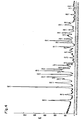
- Fig. 3 shows a typical X-ray diffraction pattern (copper (Cu) target, carbon filter, voltage 40 KV, current 40 mA) of Mn 5 O 8 obtained by heat-treating y-MnOOH in nitrogen gas at 400°C for 2 hours.
- the horizontal axis represents 20 and the vertical axis represents the peak intensity.
- Fig. 4 shows the X-ray diffraction pattern of the manganese oxide obtained by. heat-treatment at 300°C and Fig. 5 shows the pattern of the manganese oxide obtained at 450°C.
- diffraction peak positions may also be displaced by about 0.02.
- MnOx was dissolved in known quantities of oxalic acid and sulfuric acid and the unreacted oxalic acid was titrated with potassium permanganate to find the proportion of MnO 2 . Then, MnOx was dissolved in hydrochloric acid and titrated with EDTA to find the proportion of metallic Mn. From these data, X in MnOx was computed by means of the following equation.
- the manganese oxide obtained by the method of this invention occur as acute acicular crystals and has characteristics of Mn 5 O 8 in X-ray diffraction pattern.
- a catalyst electrode is manufactured in the following manner.
- the manganese oxide according to this invention is admixed with activated carbon, carbon black and an aqueous fluorine-containing resin dispersion to prepare a paste, which is then coated over a screen of stainless steel, silver or the like.
- the sheet thus formed is then dried and heat-treated at a temperature of about 300°C so as to slightly sinter the fluorine-containing resin.
- the fluorine-containing resin acts as a binder and a repellent against alkaline electrolyte, etc.
- the activated carbon serves as a catalyst support but since it is low in electrical conductivity, carbon black is added. In some cases, carbon black alone can be used as a catalyst support in lieu of activated carbon.
- the above catalyst electrode can be provided in wafer thickness, for example in a thickness less than 0.2 mm.
- the manganese oxide obtained by heat-treating, y-MnOOH (30 weight parts) was mixed with 20 weight parts of activated carbon, 20 weight parts of carbon black, 30 weight parts (as nonvolatile matter) of an aqueous dispersion of polyethylene tetrafluoride, and 100 weight parts of distilled matter.
- the mixture was kneaded well and rolled to give a 0.5 mm-thick sheet.
- the sheet was filled into a nickel screen with a wire diameter of 0.1 mm and a mesh size of 40 meshes, dried and pressed to give a catalyst sheet with a thickness of 0.4 mm.
- This catalyst sheet was heat-treated at 300°C for 15 minutes to sinter the polyethylene tetrafluoride component for increased water repellency.
- the sintered catalyst sheet was punched to give an air-zinc button cell catalyst electrode with a diameter . of 11.0 mm.
- the diameter of the effective area of this catalyst electrode was 9.0 mm.
- This sheet electrode was laminated with a 0.2 mm-thick porous polyethylene tetrafluoride film of the same size to render the sheet gas-permeable but liquid-impermeable.
- This catalyst electrode was then assembled as follows to provide an air button cell.
- an air diffusion pad 3 was set in position on the inside bottom of a positive electrode case 1 having air access holes 2 through the bottom, and the catalyst electrode 5 laminated with polyethylene tetrafluoride film 4 was set in position, followed by insertion of a separator 6.
- a metal-clad seal plate configured in the form of a dish 7 was assembled with a seal ring 8 of synthetic resin to provide a sealing assembly.
- This sealing assembly was filled with zinc powder as a negative electrode active material 9 and an alkaline electrolyte.
- the sealing assembly containing the negative electrode was fitted with the above positive electrode case containing the positive electrode and other members and the whole assembly was sealed tightly with a metal mold to give a leak-tight air-zinc button cell as illustrated in Fig. 6.
- Indicated at 10 is a seal paper for closing the air access holes 2 which is peeled off to expose the holes 2 when the button cell is used.
- y-MnOOH was heat-treated in the air at temperatures varying at intervals of 50°C from 200 to 700°C for about 3 hours to give manganese oxides.
- Each of these manganese oxides (30 weight parts) was kneaded with 20 weight parts of activated carbon, 20 weight parts of carbon black and 30 weight parts (as nonvolatile matter) of an aqueous dispersion of polyethylene tetrafluoride.
- the mixture was filled into a metal screen with a wire diameter of 0.1 mm and a mesh size of 40 meshes to give a 0.5 mm-thick catalyst sheet.
- This sheet was heat-treated at 300°C for 20 minutes to sinter the polyethylene tetrafluoride component for added water repellency and, then, punched to give a catalyst electrode with a diameter of 11.0 mm.
- the effective diameter of this electrode was 9.0 mm.
- This electrode was laminated with a 0.2 mm-thick porous polyethylene tetrafluoride film to provide an air cell electrode.
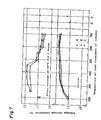
- Example 1 y-MnOOH was heat-treated in nitrogen gas at temperatures varying at 50°C intervals from 200 to 700°C for about 3 hours to give manganese oxides and using these manganese oxides, air cells were fabricated in the same manner as Example 1. These cells were designated B 1 through B 11 and evaluated as Example
- y-MnOOH was heat-treated in argon gas by the same procedure as Examples 1 and 2 and air cells C 1 through C 11 were fabricated using the product catalysts and evaluated. The results are indicated by the legend ⁇ in Fig. 7.
- Example 1 As a control run, untreated y-MnOOH was admixed with activated carbon, carbon black and an aqueous dispersion of polyethylene tetrafluoride in the same . proportions as in Example 1 and using the resultant catalyst, an air cell was fabricated in the same manner as Example 1. The cell was designated D.
- control cell E was fabricated using ⁇ -MnO 2 obtainable by pyrolysis of manganese nitrate in the same manner as above.
- the temperature region conducive to such superior characteristics is the region where many of the peak positions in the aforementioned X-ray diffraction pattern agreed with those of Mn 5 0 8 .
- the manganese oxide obtained using y-MnOOH as a starting material in accordance with this invention occur as acute needles, it is effectively brought into contact and interlaced with the activated carbon, carbon black, fluorine-containing resin, and metal screen which together form the catalyst electrode. Since the parameters of water repellency, hydrophilicity and electrical conductivity are all realized in a single crystal domain, there appears to be at work a favorable influence on catalytic activity and storage stability.
- the manganese oxide obtainable by heat-treating y-MnOOH shows stable catalytic characteristics even after prolonged storage
- its X-ray diffraction pattern after storage is not necessarily identical with the initial pattern but may change as shown in Fig. 8. This is because the manganese oxide is further stabilized in alkaline medium.
- the catalyst employing the manganese oxide of this invention features a high retention voltage at high-rate discharge and has excellent storage characteristics as compared with the conventional manganese oxide or manganese oxyhydroxide.
Landscapes
- Chemical & Material Sciences (AREA)
- Electrochemistry (AREA)
- Organic Chemistry (AREA)
- Engineering & Computer Science (AREA)
- Chemical Kinetics & Catalysis (AREA)
- General Chemical & Material Sciences (AREA)
- Manufacturing & Machinery (AREA)
- Inorganic Chemistry (AREA)
- Materials Engineering (AREA)
- Inert Electrodes (AREA)
- Hybrid Cells (AREA)
- Catalysts (AREA)
- Battery Electrode And Active Subsutance (AREA)
Applications Claiming Priority (2)
| Application Number | Priority Date | Filing Date | Title |
|---|---|---|---|
| JP46247/83 | 1983-03-18 | ||
| JP58046247A JPS59171468A (ja) | 1983-03-18 | 1983-03-18 | 空気極及びその触媒の製造法 |
Publications (3)
| Publication Number | Publication Date |
|---|---|
| EP0140973A1 true EP0140973A1 (de) | 1985-05-15 |
| EP0140973A4 EP0140973A4 (de) | 1985-09-02 |
| EP0140973B1 EP0140973B1 (de) | 1988-04-20 |
Family
ID=12741817
Family Applications (1)
| Application Number | Title | Priority Date | Filing Date |
|---|---|---|---|
| EP83902289A Expired EP0140973B1 (de) | 1983-03-18 | 1983-07-21 | Luftdepolarisierte elektrode und verfahren zur herstellung ihrer katalysators |
Country Status (5)
| Country | Link |
|---|---|
| US (1) | US4595643A (de) |
| EP (1) | EP0140973B1 (de) |
| JP (1) | JPS59171468A (de) |
| DE (1) | DE3376372D1 (de) |
| WO (1) | WO1984003799A1 (de) |
Cited By (3)
| Publication number | Priority date | Publication date | Assignee | Title |
|---|---|---|---|---|
| EP0297377A3 (en) * | 1987-07-03 | 1989-12-06 | Varta Batterie Aktiengesellschaft | Process for producing a plastic-bound gas diffusion electrode containing a manganese oxide catalyst with a predominant composition of dimanganese trioxide and pentamanganese octoxide |
| EP0441592A3 (en) * | 1990-02-09 | 1991-12-04 | Eveready Battery Company, Inc. | Air-assisted alkaline cells |
| US5489493A (en) * | 1995-06-07 | 1996-02-06 | Eveready Battery Company, Inc. | Alkaline manganese dioxide cell |
Families Citing this family (30)
| Publication number | Priority date | Publication date | Assignee | Title |
|---|---|---|---|---|
| JPS61243659A (ja) * | 1985-04-19 | 1986-10-29 | Matsushita Electric Ind Co Ltd | 空気極用触媒 |
| DE3720962A1 (de) * | 1987-06-25 | 1989-01-05 | Bruno Dipl Ing Siller | Luftsauerstoffelement mit manganchloridloesung als elektrolyt |
| HU201438B (en) * | 1988-08-31 | 1990-10-28 | Karl Kordesh | Rechargeable zinc-restricted alkali manganese dioxide-zinc cell |
| WO1993012554A1 (en) * | 1991-12-16 | 1993-06-24 | Matsi, Inc. | Collapsing foam anode backing for zinc-air battery |
| US5312457A (en) * | 1992-07-01 | 1994-05-17 | Kerr-Mcgee Chemical Corporation | Use of hydroquinone to precondition manganese dioxide for use in rechargeable electrochemical cells |
| US5458988A (en) * | 1993-08-10 | 1995-10-17 | Matsi, Inc. | Metal-air-cells having improved anode assemblies |
| US6517899B1 (en) | 1995-01-20 | 2003-02-11 | Engelhard Corporation | Catalyst and adsorption compositions having adhesion characteristics |
| AU4701196A (en) | 1995-01-20 | 1996-08-07 | Engelhard Corporation | Pollutant treating device located in vehicle compartment for cleaning ambient air |
| US6214303B1 (en) | 1995-01-20 | 2001-04-10 | Engelhard Corporation | Method and apparatus for treating the atmosphere |
| US6200542B1 (en) | 1995-01-20 | 2001-03-13 | Engelhard Corporation | Method and apparatus for treating the atmosphere |
| US20020018742A1 (en) * | 1995-01-20 | 2002-02-14 | Engelhard Corporation | Method and apparatus for treating the atmosphere |
| US6818254B1 (en) * | 1995-01-20 | 2004-11-16 | Engelhard Corporation | Stable slurries of catalytically active materials |
| US6863984B2 (en) | 1995-01-20 | 2005-03-08 | Engelhard Corporation | Catalyst and adsorption compositions having improved adhesion characteristics |
| US5997831A (en) * | 1996-07-12 | 1999-12-07 | Engelhard Corporation | Method of catalytically treating the atmosphere and heat exchange devices produced thereby |
| US6833217B2 (en) * | 1997-12-31 | 2004-12-21 | Duracell Inc. | Battery cathode |
| US6156283A (en) | 1998-03-23 | 2000-12-05 | Engelhard Corporation | Hydrophobic catalytic materials and method of forming the same |
| EP1159769A1 (de) | 1999-02-26 | 2001-12-05 | The Gillette Company | Hochleistung alkalische batterie |
| US6368751B1 (en) * | 1999-10-08 | 2002-04-09 | Reves, Inc. | Electrochemical electrode for fuel cell |
| US6428931B1 (en) * | 2000-08-15 | 2002-08-06 | Aer Energy Resources, Inc. | Methods for making oxygen reduction catalyst using micelle encapsulation and metal-air electrode including said catalyst |
| US6444609B1 (en) | 2000-08-15 | 2002-09-03 | Aer Energy Resources, Inc. | Manganese-based oxygen reduction catalyst, metal-air electrode including said catalyst and methods for making the same |
| SG104277A1 (en) * | 2001-09-24 | 2004-06-21 | Inst Of Microelectronics | Circuit for measuring changes in capacitor gap using a switched capacitor technique |
| US8974964B2 (en) * | 2005-11-14 | 2015-03-10 | Spectrum Brands, Inc. | Metal air cathode: manganese oxide contained in octahedral molecular sieve |
| US9136540B2 (en) * | 2005-11-14 | 2015-09-15 | Spectrum Brands, Inc. | Metal air cathode manganese oxide contained in octahedral molecular sieve |
| US7718319B2 (en) | 2006-09-25 | 2010-05-18 | Board Of Regents, The University Of Texas System | Cation-substituted spinel oxide and oxyfluoride cathodes for lithium ion batteries |
| JP5738898B2 (ja) * | 2010-01-29 | 2015-06-24 | エバレデイ バツテリ カンパニー インコーポレーテツド | 二酸化マンガンを含む触媒電極を有する電気化学電池を製造する方法 |
| CN102476054B (zh) * | 2010-11-29 | 2013-12-04 | 中国科学院大连化学物理研究所 | 一种Ag/MnyOx/C催化剂及其制备和应用 |
| JP6717681B2 (ja) * | 2016-06-20 | 2020-07-01 | 古河電池株式会社 | 触媒シートの製造方法、及び空気極の製造方法 |
| US10615412B2 (en) * | 2018-01-30 | 2020-04-07 | Octopus Technologies Inc. | Manganese oxide composition and method for preparing manganese oxide composition |
| US12132211B2 (en) | 2021-11-05 | 2024-10-29 | E-Zinc Inc. | Systems and methods for air cathodes |
| CN116726911B (zh) * | 2023-06-19 | 2024-06-11 | 金华职业技术学院 | 一种Mn5O8臭氧常温分解催化剂及其制备方法 |
Family Cites Families (6)
| Publication number | Priority date | Publication date | Assignee | Title |
|---|---|---|---|---|
| JPS4855333A (de) * | 1971-11-16 | 1973-08-03 | ||
| US4121018A (en) * | 1976-08-09 | 1978-10-17 | Meer Danilovich Kocherginsky | Positive electrode for air-depolarized alkaline primary cell with thickened electrolyte |
| JPS5399431A (en) * | 1977-02-09 | 1978-08-30 | Hitachi Maxell | Dry battery |
| US4269691A (en) * | 1978-09-05 | 1981-05-26 | The Dow Chemical Company | Oxygen electrode preparation |
| DE3123100A1 (de) * | 1981-06-11 | 1983-01-05 | Varta Batterie Ag, 3000 Hannover | Mangandioxidelektrode fuer lithium-batterien |
| JPS58157068A (ja) * | 1982-03-15 | 1983-09-19 | Matsushita Electric Ind Co Ltd | ボタン型空気電池 |
-
1983
- 1983-03-18 JP JP58046247A patent/JPS59171468A/ja active Granted
- 1983-07-21 US US06/681,418 patent/US4595643A/en not_active Expired - Lifetime
- 1983-07-21 DE DE8383902289T patent/DE3376372D1/de not_active Expired
- 1983-07-21 EP EP83902289A patent/EP0140973B1/de not_active Expired
- 1983-07-21 WO PCT/JP1983/000234 patent/WO1984003799A1/ja not_active Ceased
Cited By (3)
| Publication number | Priority date | Publication date | Assignee | Title |
|---|---|---|---|---|
| EP0297377A3 (en) * | 1987-07-03 | 1989-12-06 | Varta Batterie Aktiengesellschaft | Process for producing a plastic-bound gas diffusion electrode containing a manganese oxide catalyst with a predominant composition of dimanganese trioxide and pentamanganese octoxide |
| EP0441592A3 (en) * | 1990-02-09 | 1991-12-04 | Eveready Battery Company, Inc. | Air-assisted alkaline cells |
| US5489493A (en) * | 1995-06-07 | 1996-02-06 | Eveready Battery Company, Inc. | Alkaline manganese dioxide cell |
Also Published As
| Publication number | Publication date |
|---|---|
| WO1984003799A1 (en) | 1984-09-27 |
| JPS59171468A (ja) | 1984-09-27 |
| EP0140973A4 (de) | 1985-09-02 |
| US4595643A (en) | 1986-06-17 |
| JPH0369145B2 (de) | 1991-10-31 |
| EP0140973B1 (de) | 1988-04-20 |
| DE3376372D1 (en) | 1988-05-26 |
Similar Documents
| Publication | Publication Date | Title |
|---|---|---|
| US4595643A (en) | Air cell electrode and process for preparing its catalyst | |
| US4132619A (en) | Electrocatalyst | |
| EP1252097B1 (de) | Lithium enthaltendes mangandioxid | |
| EP1405358B1 (de) | Kathodenmaterial für wiederaufladbare lithiumbatterien | |
| US7259126B2 (en) | Gas diffusion electrode and catalyst for electrochemical oxygen reduction and method of dispersing the catalyst | |
| US5079107A (en) | Cathode alloy electrocatalysts | |
| US7201857B2 (en) | Performance enhancing additive material for the nickel hydroxide positive electrode in rechargeable alkaline cells | |
| Matsuki et al. | Oxygen reduction electrocatalysis on some manganese oxides | |
| US6818347B1 (en) | Performance enhancing additives for electrochemical cells | |
| EP0184830B1 (de) | Nickelelektrode für alkalische Batterien | |
| GB2160854A (en) | Manganese dioxide, production and use thereof | |
| US6878489B2 (en) | Lithium cell with improved cathode | |
| JP2007516568A (ja) | 改良された陰極を有するリチウム電池 | |
| US8231988B2 (en) | Batteries and battery components with magnetically modified manganese dioxide | |
| US6270925B1 (en) | Lithium battery | |
| US20070065721A1 (en) | Alkaline storage cell and hydrogen storage alloy for negative electrode or alkaline storage cell | |
| EP2602857A1 (de) | Alkalibatterie und verfahren zur herstellung eines positivelektrodenmaterials für die alkalibatterie | |
| US3861961A (en) | Gas electrode | |
| Restovic et al. | Oxygen evolution reaction on copper manganites—effect of preparation method and electrode manufacturing on superficial sites density | |
| Celorrio et al. | Tellurium-doped lanthanum manganite as catalysts for the oxygen reduction reaction | |
| CA2295204A1 (en) | Hydrogen storage alloy | |
| JPH09190827A (ja) | 空気電池用空気極 | |
| JPH0261096B2 (de) | ||
| JPS61243659A (ja) | 空気極用触媒 | |
| JPH01200561A (ja) | 空気極用触媒 |
Legal Events
| Date | Code | Title | Description |
|---|---|---|---|
| PUAI | Public reference made under article 153(3) epc to a published international application that has entered the european phase |
Free format text: ORIGINAL CODE: 0009012 |
|
| 17P | Request for examination filed |
Effective date: 19841121 |
|
| AK | Designated contracting states |
Designated state(s): DE FR GB |
|
| 17Q | First examination report despatched |
Effective date: 19860528 |
|
| GRAA | (expected) grant |
Free format text: ORIGINAL CODE: 0009210 |
|
| AK | Designated contracting states |
Kind code of ref document: B1 Designated state(s): DE FR GB |
|
| REF | Corresponds to: |
Ref document number: 3376372 Country of ref document: DE Date of ref document: 19880526 |
|
| ET | Fr: translation filed | ||
| PLBE | No opposition filed within time limit |
Free format text: ORIGINAL CODE: 0009261 |
|
| STAA | Information on the status of an ep patent application or granted ep patent |
Free format text: STATUS: NO OPPOSITION FILED WITHIN TIME LIMIT |
|
| 26N | No opposition filed | ||
| PGFP | Annual fee paid to national office [announced via postgrant information from national office to epo] |
Ref country code: FR Payment date: 19950711 Year of fee payment: 13 |
|
| REG | Reference to a national code |
Ref country code: GB Ref legal event code: 746 Effective date: 19960628 |
|
| PG25 | Lapsed in a contracting state [announced via postgrant information from national office to epo] |
Ref country code: FR Effective date: 19970328 |
|
| REG | Reference to a national code |
Ref country code: FR Ref legal event code: ST |
|
| PGFP | Annual fee paid to national office [announced via postgrant information from national office to epo] |
Ref country code: DE Payment date: 20000717 Year of fee payment: 18 |
|
| PGFP | Annual fee paid to national office [announced via postgrant information from national office to epo] |
Ref country code: GB Payment date: 20010718 Year of fee payment: 19 |
|
| REG | Reference to a national code |
Ref country code: GB Ref legal event code: IF02 |
|
| PG25 | Lapsed in a contracting state [announced via postgrant information from national office to epo] |
Ref country code: DE Free format text: LAPSE BECAUSE OF NON-PAYMENT OF DUE FEES Effective date: 20020501 |
|
| PG25 | Lapsed in a contracting state [announced via postgrant information from national office to epo] |
Ref country code: GB Free format text: LAPSE BECAUSE OF NON-PAYMENT OF DUE FEES Effective date: 20020721 |
|
| GBPC | Gb: european patent ceased through non-payment of renewal fee |
Effective date: 20020721 |